

- Market Size (2026)
- USD 1.3 Bn
- Forecast (2036)
- USD 2.8 Bn
- CAGR (2026 to 2036)
- 7.9%
ELV Aluminium Casting and Sheet Scrap Recovery in Europe Industry Size, Industry Forecast and Outlook By FMI
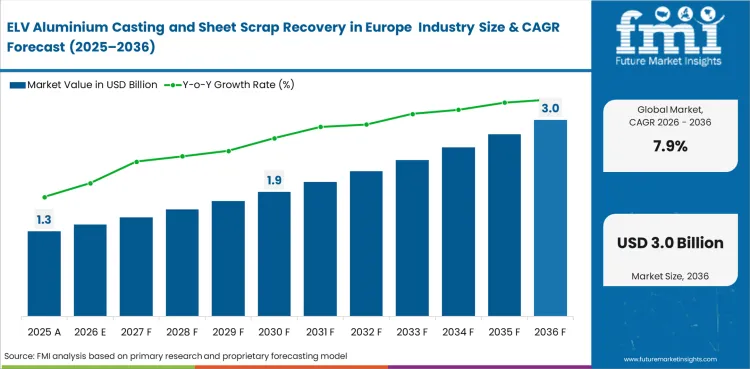
Revenue from the ELV aluminium casting and sheet scrap recovery in Europe industry reached USD 1.2 billion in 2025. FMI places the market at USD 1.3 billion in 2026. Industry value is expected to reach USD 2.8 billion by 2036 at a CAGR of 7.9%. Cleaner alloy separation and stronger in-region scrap retention are improving outlet value for recovered feed. Foundry demand and rolled-product demand are reinforcing the same shift.
Summary of ELV Aluminium Casting and Sheet Scrap Recovery in Europe Industry
- The ELV aluminium casting and sheet scrap recovery in Europe industry is expected to reach USD 2.8 billion by 2036.
- The market is expected to expand at a CAGR of 7.9% from 2026 to 2036.
- Industry valuation stood at USD 1.2 billion in 2025.
- Market value is estimated at USD 1.3 billion in 2026.
- Cast scrap is expected to account for 58.0% share in 2026 under material stream.
- Shredder recovery is forecast to account for 41.0% share in 2026 under recovery route.
- Secondary foundries are expected to account for 43.0% share in 2026 under the end outlet.
- Spain is projected to post the fastest country CAGR through 2036 in this industry.
Key Takeaways, Market Size, and Forecast
- ELV Aluminium Casting and Sheet Scrap Recovery in Europe Industry is projected to grow from USD 1.3 billion in 2026 to USD 2.8 billion by 2036, at a CAGR of 7.9%.
- The industry was valued at USD 1.2 billion in 2025.
- By 2036, the industry is expected to be worth USD 2.8 billion.
- The industry is expected to expand at a CAGR of 7.9% from 2026 to 2036.
- The industry is projected to create an incremental opportunity of USD 1.5 billion.
- In 2026, Cast scrap is expected to account for 58.0% of the material stream segment.
- Spain (8.9%) and Poland (8.7%) are two of the fastest growing markets.
ELV Aluminium Casting and Sheet Scrap Recovery in Europe Industry Key Takeaways
| Parameter | Details |
|---|---|
| Market value (2026) | USD 1.3 billion |
| Forecast value (2036) | USD 2.8 billion |
| CAGR (2026 to 2036) | 7.9% |
| Estimated market value (2025) | USD 1.2 billion |
| Incremental opportunity | USD 1.5 billion |
| Leading material stream | Cast scrap |
| Leading recovery route | Shredder recovery |
| Leading end outlet | Secondary foundries |
| Leading vehicle class | Passenger cars |
| Brands referenced in market landscape | Stena Recycling, TSR Recycling, Scholz Recycling, EMR, Hydro, Speira, Novelis |
Source: Future Market Insights (FMI) analysis, based on proprietary forecasting model and primary research
Scrap handlers across Europe are deciding how ELV aluminium should leave the yard. The key choice is between mixed shredder output and cleaner alloy streams that follow a defined melt route. Market value depends less on total recovery volumes and more on whether cast‑heavy material and mixed grades reach the right outlet without losing alloy control. In many cases, better sorting of collected ELVs creates more value than higher collection volumes.
Sorting discipline is therefore critical for the next stage of growth. Economics improve when dismantlers and remelters keep cast and sheet fractions consistently separate. With this approach, ELV aluminium shifts away from discounted mixed scrap and becomes usable secondary material. As consistency improves, downstream buyers gain stronger confidence in input quality and alloy fit.
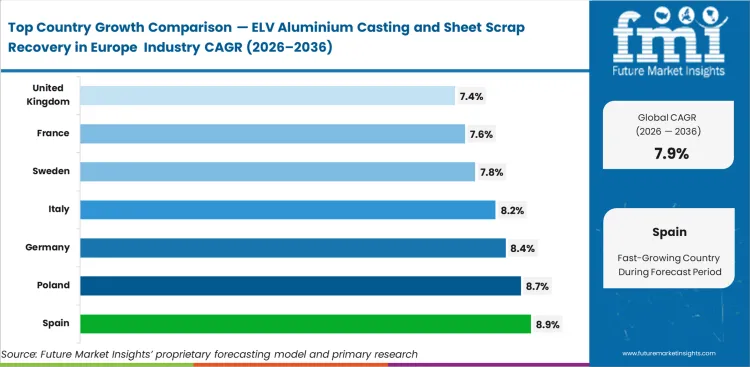
Spain is projected to record 8.9% CAGR through 2036 as dismantling depth improves and downstream scrap demand strengthens. Poland is likely to post 8.7% CAGR because processing capacity is newer and links with regional vehicle production are tighter. Germany follows at 8.4% CAGR where ELV aluminium stays close to automotive metals recovery. Italy is expected to register 8.2%, while Sweden is expected to reach a CAGR of 7.8%. France is likely to post 7.6% CAGR and the United Kingdom 7.4% CAGR as collection quality, export pressure, and outlet mix continue to shape value capture.
Segmental Analysis
Key Facts About Segments
- Cast scrap is expected to account for 58.0% share in 2026. Engine blocks, transmission housings, and wheels move into remelt channels with less correction than thinner sheet fractions.
- A 41.0% share is expected for shredder recovery in 2026. Mixed ELV intake and yard-space pressure keep rapid liberation commercially relevant.
- Powertrain castings are anticipated to represent 24.0% of component-source demand in 2026. Familiar alloy profiles keep engine and transmission scrap close to foundry-led demand.
- Market estimates place eddy current systems at 34.0% share in 2026 under sorting technology. Non-ferrous recovery at scale still depends on a stable first split before higher-spec tools can preserve more outlet value.
- Mixed auto grades are likely to secure 46.0% share in 2026. Much of the ELV aluminium stream exits the line before full alloy refinement is achieved.
- Secondary foundries are forecast to account for 43.0% share in 2026 under end outlet. Casting-rich feed fits foundry meltshop requirements more easily than wrought-rich scrap.
- In 2026, passenger cars are expected to contribute 72.0% of vehicle-class demand. Collection spread and dismantling routines across Europe continue to lean on car parc turnover.
ELV Aluminium Casting and Sheet Scrap Recovery in Europe Industry Analysis by Material Stream
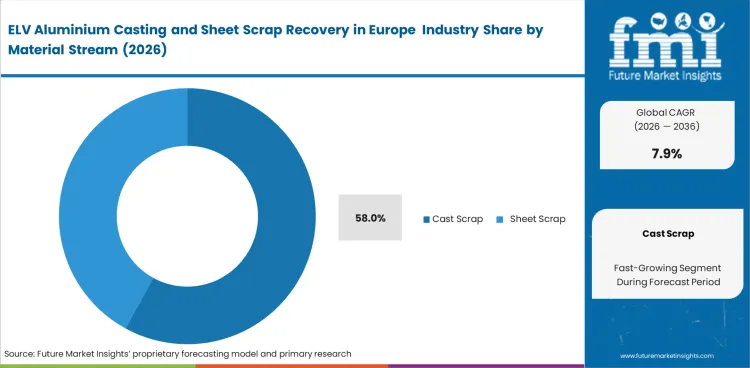
Vehicle tear-down economics favor cast scrap because recovered material can move into remelt channels with less correction. Engine blocks and wheels arrive in forms recyclers already understand. Sheet scrap is gaining relevance as lightweight closures and body structures enter the ELV pool, though cleaner separation and tighter alloy control are still needed to preserve value. In 2026, cast scrap is projected to contribute 58.0% of total market share. Until sheet-rich flows improve in quality, processors will continue to rely on cast fractions as the easier link between yard recovery and dependable melt demand.
- Alloy discipline: Cast-heavy fractions usually move with fewer sorting conflicts, which helps recyclers protect melt value.
- Residue exposure: Sheet-rich scrap loses price more quickly when steel, coatings, or mixed alloys remain attached to the bundle.
- Routing fit: Foundry buyers remain easier outlets for recovered cast material, which keeps cash conversion steadier for processors.
ELV Aluminium Casting and Sheet Scrap Recovery in Europe Industry Analysis by Recovery Route
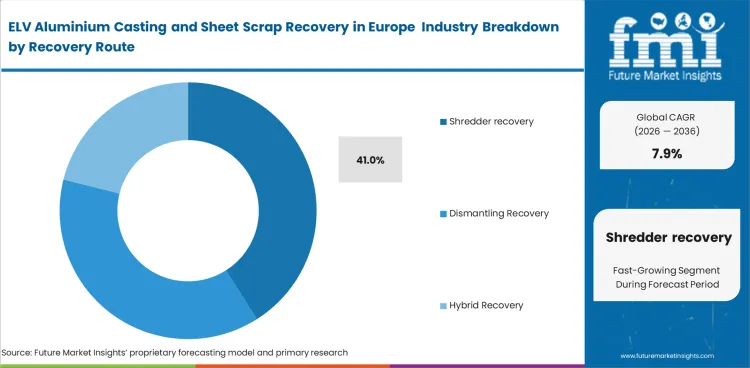
High-volume ELV processing begins with rapid liberation because yards need material moving before space and labor pressure tighten margins. Shredder recovery stays central where operators handle mixed intake and cannot rely on deep dismantling for every unit. Shredder recovery is estimated to represent 41.0% share in 2026. Dismantling recovery creates cleaner fractions, however, it demands more time and clearer commercial intent at the yard. Sites that focus on speed alone often leave remelters to absorb quality loss that could have been removed upstream.
- Throughput pressure: Fast liberation remains attractive where ELV intake is uneven, and yard space turns tight.
- Yield balance: Cleaner dismantling improves value only when operators recover enough metal to offset added handling time.
- Timing gap: Recovery routes with weak pre-sorting often force remelters to absorb variation that could have been removed earlier.
ELV Aluminium Casting and Sheet Scrap Recovery in Europe Industry Analysis by Component Source
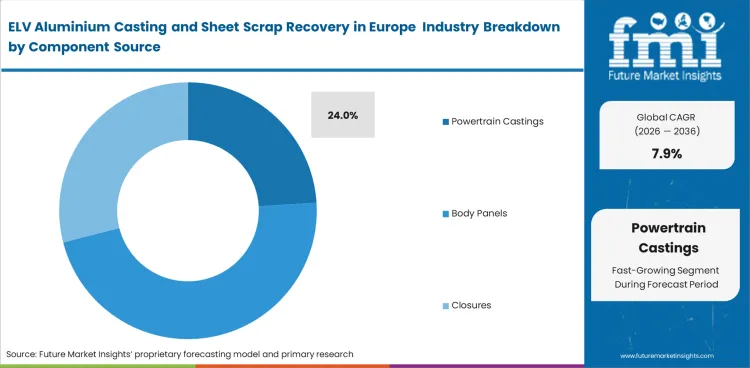
Powertrain-derived aluminium is dominant in recovery use as it reaches the yard in dense parts with familiar alloy profiles and dependable recoverability. Engines and transmission-related castings still define a large share of the value pool even as more aluminium moves into outer structures. Body panels and closures can improve in importance when dismantling depth improves, though separation conditions remain less uniform and alloy outcomes harder to predict. Share contribution from powertrain castings is expected to record around 24.0% in 2026. Recyclers that confuse visible material growth with outlet readiness often hold more abundant fractions that clear at weaker net realization.
- Engine concentration: Powertrain scrap offers a familiar mix that is easier to grade and sell into foundry routes.
- Dismantling depth: Complex closures and newer assemblies need cleaner removal if their metal is to retain higher-value outlets.
- Replacement cycle: Older vehicles continue to feed cast-heavy recovery pools, slowing any abrupt shift in source mix.
ELV Aluminium Casting and Sheet Scrap Recovery in Europe Industry Analysis by Sorting Technology
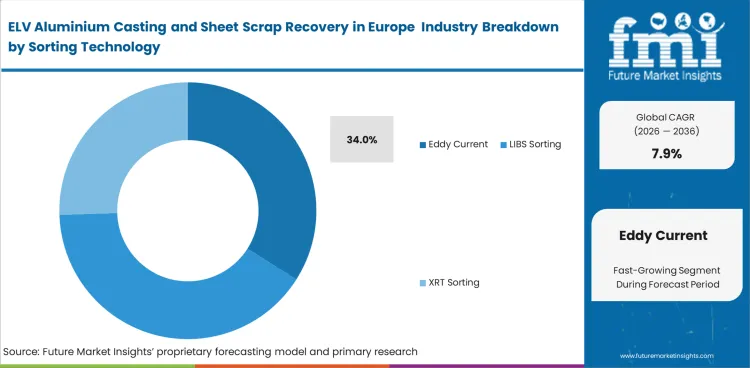
Sorting quality decides whether ELV aluminium behaves like broad commodity scrap or like a more usable secondary metal stream. Eddy current separation remains the base layer because non-ferrous recovery at scale needs a reliable first split before advanced tools can do useful work. More advanced sensors can lift purity, though they only earn that role after the line has produced a stable non-ferrous fraction. FMI estimates suggested eddy current systems will represent 34.0% of the market in 2026. Processors that rush material beyond this stage may gain volume on paper but lose pricing power downstream.
- Sensor layering: First-stage non-ferrous separation remains necessary before higher-spec sorting can do meaningful work.
- Purity payoff: Better technology earns its return when it improves outlet quality instead of only increasing line complexity.
- Calibration control: Weak settings or unstable feed can erode the value advantage that better sorting is meant to create.
ELV Aluminium Casting and Sheet Scrap Recovery in Europe Industry Analysis by Purity Grade
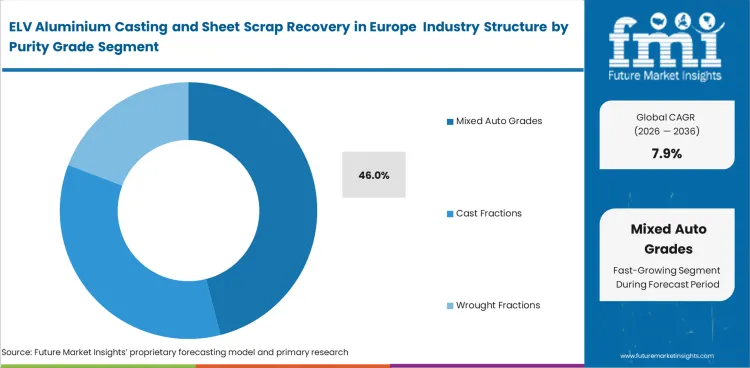
Mixed auto grades stay prominent because much of the ELV stream leaves the line before full alloy refinement is achieved. Practical limits in current recovery setups explain that lead more than ideal quality does. Cleaner fractions can earn stronger treatment from remelters and rolling buyers, especially when lower-carbon sourcing strategies require tighter chemistry. In 2026, mixed auto grades are likely to contribute 46.0% of total demand. Processors that stop at recovery and do not improve lot discipline leave a meaningful share of the value pool with downstream buyers.
- Blend reality: Mixed grades move easily because they fit existing commercial habits even when they limit pricing upside.
- Chemistry risk: Cross-alloy contamination narrows the number of premium outlets available to recovered aluminum.
- Remelt relevance: Buyers pay closer attention to consistency once ELV scrap moves beyond simple foundry substitution.
ELV Aluminium Casting and Sheet Scrap Recovery in Europe Industry Analysis by End Outlet
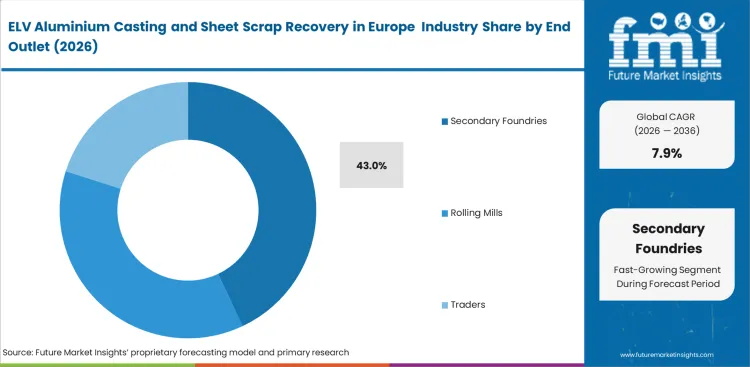
Recovered ELV aluminium needs an outlet that can absorb real-world variability without stripping away too much of the value created during sorting and preparation. Secondary foundries are best placed for that role because they can use casting-rich feed with fewer adjustments than rolling operations require. Rolling mills and billet casters offer better upside for cleaner wrought-rich fractions, as they demand tighter chemistry and more stable lot control. Secondary foundries are poised to represent 43.0% share in 2026. Recyclers that read this fit early make better calls on sorting depth and timing of sale.
- Meltshop tolerance: Foundries can accept a broader range of recovered casting-grade material than sheet-linked routes.
- Sheetmaker demand: Rolling pathways open only when scrap quality is high enough to avoid heavy downgrade.
- Pricing spread: Outlet choice determines how much of the recovered metal’s embedded value a processor can keep.
ELV Aluminium Casting and Sheet Scrap Recovery in Europe Industry Analysis by Vehicle Class
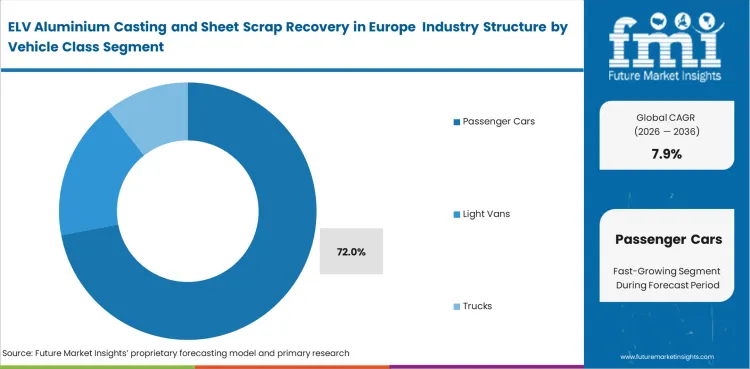
Passenger car retirements shape the commercial rhythm of this market because collection density and downstream scrap availability lean heavily on car parc turnover. Light vans and buses are more in demand in narrower channels, but they fail to match the volume regularity or processing familiarity of passenger cars. Passenger vehicles are also closely tied to future recovery value as aluminium use grows in closures and other lightweight parts. Market share for passenger cars is expected to reach 72.0% by 2026. Recovery businesses that build capacity around exceptions instead of the dominant flow usually weaken yard economics.
- Parc turnover: Passenger cars generate the broadest and most regular ELV inflow across Europe.
- Collection spread: Recovery networks are built around car volumes, which gives this class a lasting advantage.
- Residual diversity: Smaller classes can lift value in selected channels, though they do not redefine the market’s main demand base.
Polymer Wrap and Specialty Packs Are Staying Firm
Polymer-heavy packaging remains the main cost pressure point for this industry. Producer-price benchmarks show plastics packaging film and sheet manufacturing moved from 180.314 in Dec 2025 to 182.753 in Feb 2026. Single-web film for flexible packaging rose from 184.412 to 187.409 over the same period. Specialty bags, pouches, and liners moved only from 281.180 to 281.624. Scrap processors handling clean sheet offcuts and segregated cast fractions should use higher-spec films and liners only where contamination control protects recovery value.
Paper Is Softer, but Rigid Packs Are Repricing Up
Rigid packaging costs are moving unevenly across this industry. Folding paperboard boxes fell from 241.084 in Dec 2025 to 236.353 in Feb 2026, which points to some easing in paper-based secondary packaging. Glass containers increased from 215.425 to 223.488, and barrels, drums, pails, and other metal containers rose from 467.349 to 473.189 over the same period. World Bank data reported in April 2026 show metal prices edged up 1.4% in March and aluminum led that move at 10%. European recyclers can push paper-based protection where it fits, but rigid container contracts and metal-linked packaging contracts need tighter renegotiation cycles.
Regional Analysis
Key Facts About Country
- Spain is expected to register 8.9% CAGR through 2036, which places it at the top of the country group.
- Poland is forecast to post 8.7% CAGR through 2036 as processing capacity improves and links with regional vehicle production tighten.
- Market growth for ELV aluminium casting and sheet scrap recovery in Germany is expected to run at a CAGR of 8.4% during the forecast period.
- Italy is likely to see ELV aluminium casting and sheet scrap recovery advance at a CAGR of 8.2% through 2036.
- A CAGR of 7.8% is expected for ELV aluminium casting and sheet scrap recovery in Sweden through 2036.
- Through 2036, ELV aluminium casting and sheet scrap recovery demand in France is expected to grow at a CAGR of 7.6%.
- The United Kingdom is set to post 7.4% CAGR in the market for ELV aluminium casting and sheet scrap recovery during the assessment period.
Based on the regional analysis, the ELV Aluminium Casting and Sheet Scrap Recovery in Europe Market is segmented into Western Europe, Southern Europe, and Northern and Central Europe across 40 plus countries.
.webp "Top Country Growth Comparison Elv Aluminium Casting And Sheet Scrap Recovery In Europe Industry Cagr (2026 2036)")
| Country | CAGR (2026 to 2036) |
|---|---|
| Germany | 8.4% |
| Spain | 8.9% |
| France | 7.6% |
| Italy | 8.2% |
| Poland | 8.7% |
| United Kingdom | 7.4% |
| Sweden | 7.8% |
Source: Future Market Insights (FMI) analysis, based on proprietary forecasting model and primary research
Western Europe ELV Aluminium Casting and Sheet Scrap Recovery in Europe Industry Analysis
Western Europe industry has reached the saturation as downstream remelting capacity is deep enough to reward cleaner scrap. Price realization in this region depends on how reliably material arrives by alloy family and contamination level. Connections with cast-alloy demand and rolled-product demand keep quality pressure high. Western Europe remains the commercial reference point because recovery-stage discipline translates into price difference more clearly here than in most other parts of Europe.
- Vehicle dismantling, shredder infrastructure, and remelt demand give Germany a strong operating base. Material does not need to travel far to reach a serious downstream user, which strengthens the case for cleaner fraction management. Germany is expected to register a CAGR of 8.4% through 2036 in ELV aluminium casting and sheet scrap recovery. Value growth depends less on finding more scrap and more on protecting what is already recoverable. Processors that keep mixed material in circulation without upgrading it leave money on the table.
- Scrap quality in France depends on coordination between collection, dismantling, and processing from the first intake point. Cleaner streams move well, though uneven preparation still limits part of the upside. Through 2036, ELV aluminium casting and sheet scrap recovery demand in France is expected to grow at a CAGR of 7.6%. Growth becomes more durable when processors tie recovery decisions closely to downstream melt requirements. Weak coordination keeps too much value trapped in blended lots.
- Export pressure and domestic outlet choice define the United Kingdom more than simple scrap availability. Recovery businesses can collect meaningful ELV aluminium, but value capture depends on how much material is refined before it leaves the chain. The market for ELV aluminium casting and sheet scrap recovery in the United Kingdom is set to expand at a CAGR of 7.4% over the assessment period. Better grade separation can lift realizations, though mixed material still moves too easily into lower-value routes.
Additional Western European countries in FMI’s full report show the same divide between strong collection and uneven value capture at the sort-and-route stage. Markets with better remelting access convert quality gains into price gains more quickly. Markets with weaker outlet alignment recover the metal successfully but do not keep the same value.
Southern Europe ELV Aluminium Casting and Sheet Scrap Recovery in Europe Industry Analysis
Southern Europe brings a different growth pattern to this industry. Yard practice, dismantling depth, and foundry demand matter more here than broad industrial scale alone. Better sorting and grading can change value capture without resetting the full chain. Southern Europe has adequate aluminium flow, but more of that flow must reach the right outlet in the right condition.
- Dismantling activity and processing upgrades give Spain one of the strongest growth paths in this industry. Recyclers are benefiting from a setting where better sorting can improve final outlet quality without resetting the value chain. Spain is projected to record a CAGR of 8.9% in ELV aluminium casting and sheet scrap recovery during the forecast period. Growth depends on how effectively operators connect recovered fractions with domestic and nearby industrial demand. Cleaner routing will determine who captures the extra value.
- Foundry demand gives Italy a practical advantage because a large share of ELV aluminium can move into end uses that already accept recycled casting feed. Quality control is still necessary, but value capture becomes easier when separation is done well. Italy is projected to record a CAGR of 8.2% in ELV aluminium casting and sheet scrap recovery during the forecast period. Sheet-rich material needs more careful treatment if it is to avoid downgrades. Operators that improve pre-sort quality should see the most stable uplift.
Other Southern European countries in FMI’s full study show a similar opportunity pattern. Recovery businesses gain when they lift quality without building an overly complex process. Regions with strong foundry pull monetize casting-rich scrap earlier. Areas with weaker outlet discipline depend more on traders and mixed-grade movement.
Northern and Central Europe ELV Aluminium Casting and Sheet Scrap Recovery in Europe Industry Analysis
Northern and Central Europe combine disciplined scrap practice with a smaller ELV base than Western Europe. Material quality often looks better here, which supports cleaner routing into downstream remelting and industrial recycling channels. This region shows how process discipline can lift value even without the largest retirement volumes. Growth depends less on scale and more on how reliably operators protect alloy quality from intake to sale.
- Processing capacity, industrial growth, and stronger links with regional manufacturing are improving Poland’s position in this segment. Recyclers are moving closer to the point where better fraction management can translate into better outlet quality instead of simple volume handling. Poland is projected to record a CAGR of 8.7% in ELV aluminium casting and sheet scrap recovery during the forecast period. Progress depends on keeping more recoverable aluminium inside structured processing routes rather than losing value through mixed handling.
- Clean scrap habits and disciplined material handling give Sweden a different kind of strength. Recovery flows are not the largest in Europe, but quality management can be more consistent and that supports better downstream acceptance. Demand for ELV aluminium casting and sheet scrap recovery in Sweden is expected to rise at a CAGR of 7.8% through 2036. That pace sits below the leaders, though it reflects a measured market rather than a weak one. Stable quality can preserve strong value across a smaller scrap base.
FMI’s broader regional coverage includes additional countries where the same themes appear in different proportions. Smaller ELV pools do not automatically produce weak commercial outcomes when sorting quality stays high. Central and northern processors often show that disciplined handling can offset some scale limits.
Competitive Aligners for Market Players
Collection reach is the primary point of competition across the aluminium recycling market. Stena Recycling, EMR, TSR Recycling, and Scholz Recycling are relevant at this stage because access to yards and shredding capacity shapes initial material quality. Non‑ferrous separation also affects how material enters the recovery system. Recyclers secure repeat demand when lot consistency is predictable. Outlet routes must also remain practical for sustained demand. High collection volume supports throughput but it rarely strengthens positioning without alloy preservation.
Downstream integration creates the second competitive layer. Companies such as Hydro, Speira, and Novelis operate downstream through remelting or rolled‑product routes. These capabilities affect how much value recovered aluminium can retain. Commercial advantage comes from process alignment rather than asset ownership alone. Operators that route each aluminium fraction correctly maintain better acceptance rates. Margin performance weakens when operators focus mainly on broad volume.
Buyer requirements continue to shape balance across the value chain. Recyclers and secondary aluminium consumers depend on shared consistency. Large buyers seek adaptable supply, but they require tighter chemistry control. Cleaner deliveries are increasingly expected to be standard. Local access and outlet alignment support multiple operating models through 2036.
Key Players in ELV Aluminium Casting and Sheet Scrap Recovery in Europe Industry
- Stena Recycling
- TSR Recycling
- Scholz Recycling
- EMR
- Hydro
- Speira
- Novelis
Scope of the Report
| Metric | Value |
|---|---|
| Quantitative Units | USD 1.3 billion to USD 2.8 billion, at a CAGR of 7.9% |
| Market Definition | This report covers the recovery, sorting, and downstream routing of aluminum casting and sheet scrap generated from end-of-life vehicles in Europe. Scope includes value capture across cast-rich and wrought-rich ELV fractions that move through dismantling, shredding, sorting, and remelting channels. Adjacent primary aluminum and non-vehicle scrap streams are excluded. |
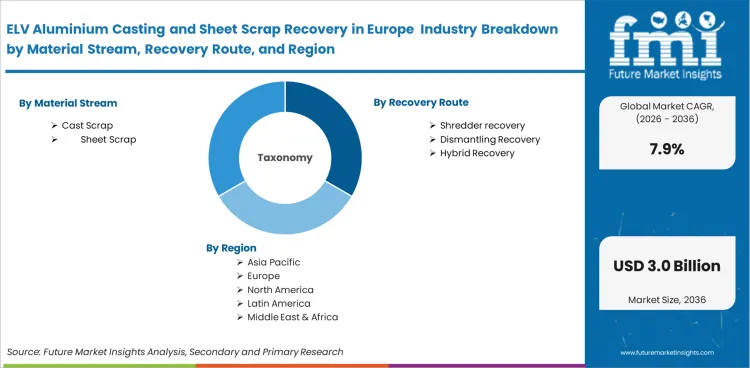
| Material Stream Segmentation | Cast Scrap, Sheet Scrap |
| Recovery Route Segmentation | Shredder Recovery, Dismantling Recovery, Hybrid Recovery |
| Component Source Segmentation | Powertrain Castings, Body Panels, Closures, Subframes, Battery Housings, Wheels |
| Sorting Technology Segmentation | Eddy Current, LIBS Sorting, XRT Sorting, Sink-Float, Manual Sorting |
| Purity Grade Segmentation | Mixed Auto Grades, Cast Fractions, Wrought Fractions, Mill-Grade Scrap |
| End Outlet Segmentation | Secondary Foundries, Rolling Mills, Billet Casters, Traders |
| Vehicle Class Segmentation | Passenger Cars, Light Vans, Trucks, Buses |
| Regions Covered | Western Europe, Southern Europe, Northern and Central Europe |
| Countries Covered | Germany, Spain, France, Italy, Poland, United Kingdom, Sweden, and 40 plus countries |
| Key Companies Profiled | Stena Recycling, TSR Recycling, Scholz Recycling, EMR, Hydro, Speira, Novelis |
| Forecast Period | 2026 to 2036 |
| Approach | FMI combined primary interviews across the European recycling and secondary aluminum chain with desk analysis of ELV flows, scrap routing, and remelt demand patterns. Market sizing was built from recoverable aluminum value logic rather than from gross vehicle disposal counts alone. Forecast validation considered outlet fit, quality retention, and the direction of downstream demand for cleaner recycled feed. |
Source: Future Market Insights (FMI) analysis, based on proprietary forecasting model and primary research
ELV Aluminium Casting and Sheet Scrap Recovery in Europe Industry Analysis by Segments
Material Stream
- Cast Scrap
- Sheet Scrap
Recovery Route
- Shredder Recovery
- Dismantling Recovery
- Hybrid Recovery
Component Source
- Powertrain Castings
- Body Panels
- Closures
- Subframes
- Battery Housings
- Wheels
Sorting Technology
- Eddy Current
- LIBS Sorting
- XRT Sorting
- Sink-Float
- Manual Sorting
Purity Grade
- Mixed Auto Grades
- Cast Fractions
- Wrought Fractions
- Mill-Grade Scrap
End Outlet
- Secondary Foundries
- Rolling Mills
- Billet Casters
- Traders
Vehicle Class
- Passenger Cars
- Light Vans
- Trucks
- Buses
Region
- Western Europe
- Germany
- France
- Netherlands
- Belgium
- Austria
- Switzerland
- Luxembourg
- Northern Europe
- Denmark
- Sweden
- Norway
- Finland
- Ireland
- Iceland
- Southern Europe
- Italy
- Spain
- Portugal
- Greece
- Malta
- Cyprus
- Eastern Europe
- Poland
- Czech Republic
- Hungary
- Romania
- Slovakia
- Bulgaria
- Croatia
- Slovenia
- Estonia
- Latvia
- Lithuania
Bibliography
- USA Bureau of Labor Statistics. (2026, March 18). Producer Price Index by Industry: Plastics Packaging Film and Sheet Manufacturing [PCU326112326112]. FRED, Federal Reserve Bank of St. Louis.
- USA Bureau of Labor Statistics. (2026, March 18). Producer Price Index by Industry: Plastics Packaging Film and Sheet Manufacturing: Single-Web Film, Rolls, and Sheets for Flexible Packaging Uses [PCU32611232611211]. FRED, Federal Reserve Bank of St. Louis.
- USA Bureau of Labor Statistics. (2026, March 18). Producer Price Index by Commodity: Pulp, Paper, and Allied Products: Specialty Bags, Pouches and Liners [WPU09150216]. FRED, Federal Reserve Bank of St. Louis.
- USA Bureau of Labor Statistics. (2026, March 18). Producer Price Index by Industry: Folding Paperboard Box Manufacturing: Folding Paperboard Boxes, Packaging, and Packaging Components [PCU3222123222120]. FRED, Federal Reserve Bank of St. Louis.
- USA Bureau of Labor Statistics. (2026, March 18). Producer Price Index by Industry: Glass Container Manufacturing: Glass Containers (Including Value of Packaging) [PCU3272133272130]. FRED, Federal Reserve Bank of St. Louis.
- USA Bureau of Labor Statistics. (2026, March 18). Producer Price Index by Commodity: Metals and Metal Products: Barrels, Drums, Pails and Other Metal Containers [WPU1032]. FRED, Federal Reserve Bank of St. Louis.
- Baffes, J., & Macadangdang, M. H. (2026, April 3). Energy prices surged in March; non-energy edged up-Pink Sheet. World Bank Data Blog.
- European Aluminium. (2025, March). A strategy for the long-term availability and quality of aluminium scrap in Europe.
- ACEA. (2025, August). Pocket Guide 2025/2026.
- Transport & Environment. (2024, October). T&E position paper on the End-of-life Vehicles Regulation.
- Hydro. (2024). Integrated annual report 2024.
- Novelis. (2025, March 13). Novelis Unveils Industry’s First Aluminium Coil Made from 100% Recycled End-of-Life Automotive Scrap.
- Speira. (2024). Sustainability Report 2024.
- CLEPA. (2024). End-of-Life Vehicles Regulation.
- ACEM. (2024, October 30). Supporting a Sustainable Inclusion for Motorcycles in the End-of-Life Vehicles Regulation.
This bibliography is provided for reader reference. The full FMI report contains the complete reference list with primary source documentation.
This Report Addresses
- Market intelligence to support strategic decisions across cast scrap, sheet scrap, shredder recovery, dismantling recovery, and alloy-sensitive sorting routes in Europe
- Market size estimation and 10-year revenue forecasts from 2026 to 2036 supported by ELV recovery-value modeling, outlet-fit assessment, and downstream demand mapping
- Growth opportunity mapping across material stream, recovery route, component source, sorting technology, purity grade, end outlet, and vehicle class with emphasis on cleaner cast-wrought separation
- Segment and regional revenue forecasts covering cast scrap, shredder recovery, powertrain castings, eddy current systems, mixed auto grades, secondary foundries, and passenger cars across Europe
- Competition strategy assessment including collection reach, sorting discipline, remelt access, outlet alignment, and lot-quality consistency
- Process and route analysis covering dismantling depth, shredding efficiency, sensor-led separation, chemistry preservation, and remelt suitability within the ELV aluminium chain
- Market access analysis covering formal ELV collection, scrap-retention conditions, downstream alloy demand, and the commercial limits of mixed-grade output
- Market report delivery in PDF, Excel, PPT, and interactive dashboard formats for executive strategy, circular-material planning, and operational benchmarking use
Frequently Asked Questions
What is covered in the ELV aluminium casting and sheet scrap recovery in Europe industry report?
It covers recovery trends, value outlook, segment structure, country demand patterns, and downstream outlet development across ELV aluminium casting and sheet scrap recovery in Europe.
What is driving growth in ELV aluminium scrap recovery across Europe?
Growth is supported by a stronger recovery focus at dismantling and shredding stages and by firmer demand for cleaner recycled aluminium feed.
Why does cast scrap remain more important than sheet scrap in this space?
Cast scrap holds stronger commercial value because engines, housings, and wheels fit remelt routes more easily than sheet-rich fractions.
Why is sheet scrap recovery drawing more attention now?
Sheet scrap is gaining attention because cleaner wrought fractions are becoming more useful for rolling mills and higher-value outlet pathways.
What makes scrap sorting so important in this report?
Sorting matters because mixed aluminium lowers recovery value, while cleaner separation improves acceptance across foundry and rolling outlets.
Which route remains more common in vehicle aluminium recovery?
Shredder recovery remains more common because it handles a large share of ELV volume before deeper dismantling is completed.
Why do secondary foundries hold a strong position in downstream demand?
Secondary foundries stay central because recovered casting alloys fit remelting demand more directly than sheet-led rolling routes.
Which vehicle group contributes the largest share of aluminium scrap volumes?
Passenger cars contribute the largest share because they dominate ELV generation across Europe and provide the broadest scrap flow.
Why do country growth rates differ across the European recycling base?
Country growth varies because dismantling depth, shredder capacity, remelting access, and local outlet discipline differ across Europe.
What is the main commercial challenge in this market?
The main challenge is not aluminium availability alone. The harder task is recovering cleaner fractions that retain enough value after sorting.
How does this report help manufacturers and recyclers?
It shows where scrap value is improving, which segments carry stronger recovery logic, and which countries offer better commercial conditions.
What kind of buyer or stakeholder would use this analysis most?
This analysis is most useful for recyclers, remelters, metal processors, and auto circularity planners.
Preview the report firsthand - request a free sample
Get SampleGet the brochure for pricing and purchase details.
Get PDFTable of Content
- Executive Summary
- Global Market Outlook
- Demand-side Trends
- Supply-side Trends
- Technology Roadmap Analysis
- Analysis and Recommendations
- Market Overview
- Market Coverage / Taxonomy
- Market Definition / Scope / Limitations
- Research Methodology
- Chapter Orientation
- Analytical Lens and Working Hypotheses
- Market Structure, Signals, and Trend Drivers
- Benchmarking and Cross-market Comparability
- Market Sizing, Forecasting, and Opportunity Mapping
- Research Design and Evidence Framework
- Desk Research Programme (Secondary Evidence)
- Company Annual and Sustainability Reports
- Peer-reviewed Journals and Academic Literature
- Corporate Websites, Product Literature, and Technical Notes
- Earnings Decks and Investor Briefings
- Statutory Filings and Regulatory Disclosures
- Technical White Papers and Standards Notes
- Trade Journals, Industry Magazines, and Analyst Briefs
- Conference Proceedings, Webinars, and Seminar Materials
- Government Statistics Portals and Public Data Releases
- Press Releases and Reputable Media Coverage
- Specialist Newsletters and Curated Briefings
- Sector Databases and Reference Repositories
- FMI Internal Proprietary Databases and Historical Market Datasets
- Subscription Datasets and Paid Sources
- Social Channels, Communities, and Digital Listening Inputs
- Additional Desk Sources
- Expert Input and Fieldwork (Primary Evidence)
- Primary Modes
- Qualitative Interviews and Expert Elicitation
- Quantitative Surveys and Structured Data Capture
- Blended Approach
- Why Primary Evidence is Used
- Field Techniques
- Interviews
- Surveys
- Focus Groups
- Observational and In-context Research
- Social and Community Interactions
- Stakeholder Universe Engaged
- C-suite Leaders
- Board Members
- Presidents and Vice Presidents
- R&D and Innovation Heads
- Technical Specialists
- Domain Subject-matter Experts
- Scientists
- Physicians and Other Healthcare Professionals
- Governance, Ethics, and Data Stewardship
- Research Ethics
- Data Integrity and Handling
- Primary Modes
- Tooling, Models, and Reference Databases
- Desk Research Programme (Secondary Evidence)
- Data Engineering and Model Build
- Data Acquisition and Ingestion
- Cleaning, Normalisation, and Verification
- Synthesis, Triangulation, and Analysis
- Quality Assurance and Audit Trail
- Market Background
- Market Dynamics
- Drivers
- Restraints
- Opportunity
- Trends
- Scenario Forecast
- Demand in Optimistic Scenario
- Demand in Likely Scenario
- Demand in Conservative Scenario
- Opportunity Map Analysis
- Product Life Cycle Analysis
- Supply Chain Analysis
- Investment Feasibility Matrix
- Value Chain Analysis
- PESTLE and Porter’s Analysis
- Regulatory Landscape
- Regional Parent Market Outlook
- Production and Consumption Statistics
- Import and Export Statistics
- Market Dynamics
- Global Market Analysis 2021 to 2025 and Forecast, 2026 to 2036
- Historical Market Size Value (USD Million) Analysis, 2021 to 2025
- Current and Future Market Size Value (USD Million) Projections, 2026 to 2036
- Y-o-Y Growth Trend Analysis
- Absolute $ Opportunity Analysis
- Global Market Pricing Analysis 2021 to 2025 and Forecast 2026 to 2036
- Global Market Analysis 2021 to 2025 and Forecast 2026 to 2036, By Material Stream
- Introduction / Key Findings
- Historical Market Size Value (USD Million) Analysis By Material Stream , 2021 to 2025
- Current and Future Market Size Value (USD Million) Analysis and Forecast By Material Stream , 2026 to 2036
- Cast Scrap
- Sheet Scrap
- Cast Scrap
- Y-o-Y Growth Trend Analysis By Material Stream , 2021 to 2025
- Absolute $ Opportunity Analysis By Material Stream , 2026 to 2036
- Global Market Analysis 2021 to 2025 and Forecast 2026 to 2036, By Recovery Route
- Introduction / Key Findings
- Historical Market Size Value (USD Million) Analysis By Recovery Route, 2021 to 2025
- Current and Future Market Size Value (USD Million) Analysis and Forecast By Recovery Route, 2026 to 2036
- Shredder recovery
- Dismantling Recovery
- Hybrid Recovery
- Shredder recovery
- Y-o-Y Growth Trend Analysis By Recovery Route, 2021 to 2025
- Absolute $ Opportunity Analysis By Recovery Route, 2026 to 2036
- Global Market Analysis 2021 to 2025 and Forecast 2026 to 2036, By Component Source
- Introduction / Key Findings
- Historical Market Size Value (USD Million) Analysis By Component Source, 2021 to 2025
- Current and Future Market Size Value (USD Million) Analysis and Forecast By Component Source, 2026 to 2036
- Powertrain Castings
- Body Panels
- Closures
- Powertrain Castings
- Y-o-Y Growth Trend Analysis By Component Source, 2021 to 2025
- Absolute $ Opportunity Analysis By Component Source, 2026 to 2036
- Global Market Analysis 2021 to 2025 and Forecast 2026 to 2036, By Sorting Technology
- Introduction / Key Findings
- Historical Market Size Value (USD Million) Analysis By Sorting Technology, 2021 to 2025
- Current and Future Market Size Value (USD Million) Analysis and Forecast By Sorting Technology, 2026 to 2036
- Eddy Current
- LIBS Sorting
- XRT Sorting
- Eddy Current
- Y-o-Y Growth Trend Analysis By Sorting Technology, 2021 to 2025
- Absolute $ Opportunity Analysis By Sorting Technology, 2026 to 2036
- Global Market Analysis 2021 to 2025 and Forecast 2026 to 2036, By Purity Grade
- Introduction / Key Findings
- Historical Market Size Value (USD Million) Analysis By Purity Grade, 2021 to 2025
- Current and Future Market Size Value (USD Million) Analysis and Forecast By Purity Grade, 2026 to 2036
- Mixed Auto Grades
- Cast Fractions
- Wrought Fractions
- Mixed Auto Grades
- Y-o-Y Growth Trend Analysis By Purity Grade, 2021 to 2025
- Absolute $ Opportunity Analysis By Purity Grade, 2026 to 2036
- Global Market Analysis 2021 to 2025 and Forecast 2026 to 2036, By End Outlet
- Introduction / Key Findings
- Historical Market Size Value (USD Million) Analysis By End Outlet, 2021 to 2025
- Current and Future Market Size Value (USD Million) Analysis and Forecast By End Outlet, 2026 to 2036
- Secondary Foundries
- Rolling Mills
- Traders
- Secondary Foundries
- Y-o-Y Growth Trend Analysis By End Outlet, 2021 to 2025
- Absolute $ Opportunity Analysis By End Outlet, 2026 to 2036
- Global Market Analysis 2021 to 2025 and Forecast 2026 to 2036, By Vehicle Class
- Introduction / Key Findings
- Historical Market Size Value (USD Million) Analysis By Vehicle Class, 2021 to 2025
- Current and Future Market Size Value (USD Million) Analysis and Forecast By Vehicle Class, 2026 to 2036
- Passenger Cars
- Light Vans
- Trucks
- Passenger Cars
- Y-o-Y Growth Trend Analysis By Vehicle Class, 2021 to 2025
- Absolute $ Opportunity Analysis By Vehicle Class, 2026 to 2036
- Global Market Analysis 2021 to 2025 and Forecast 2026 to 2036, By Region
- Introduction
- Historical Market Size Value (USD Million) Analysis By Region, 2021 to 2025
- Current Market Size Value (USD Million) Analysis and Forecast By Region, 2026 to 2036
- North America
- Latin America
- Western Europe
- Eastern Europe
- East Asia
- South Asia and Pacific
- Middle East & Africa
- Market Attractiveness Analysis By Region
- North America Market Analysis 2021 to 2025 and Forecast 2026 to 2036, By Country
- Historical Market Size Value (USD Million) Trend Analysis By Market Taxonomy, 2021 to 2025
- Market Size Value (USD Million) Forecast By Market Taxonomy, 2026 to 2036
- By Country
- USA
- Canada
- Mexico
- By Material Stream
- By Recovery Route
- By Component Source
- By Sorting Technology
- By Purity Grade
- By End Outlet
- By Vehicle Class
- By Country
- Market Attractiveness Analysis
- By Country
- By Material Stream
- By Recovery Route
- By Component Source
- By Sorting Technology
- By Purity Grade
- By End Outlet
- By Vehicle Class
- Key Takeaways
- Latin America Market Analysis 2021 to 2025 and Forecast 2026 to 2036, By Country
- Historical Market Size Value (USD Million) Trend Analysis By Market Taxonomy, 2021 to 2025
- Market Size Value (USD Million) Forecast By Market Taxonomy, 2026 to 2036
- By Country
- Brazil
- Chile
- Rest of Latin America
- By Material Stream
- By Recovery Route
- By Component Source
- By Sorting Technology
- By Purity Grade
- By End Outlet
- By Vehicle Class
- By Country
- Market Attractiveness Analysis
- By Country
- By Material Stream
- By Recovery Route
- By Component Source
- By Sorting Technology
- By Purity Grade
- By End Outlet
- By Vehicle Class
- Key Takeaways
- Western Europe Market Analysis 2021 to 2025 and Forecast 2026 to 2036, By Country
- Historical Market Size Value (USD Million) Trend Analysis By Market Taxonomy, 2021 to 2025
- Market Size Value (USD Million) Forecast By Market Taxonomy, 2026 to 2036
- By Country
- Germany
- UK
- Italy
- Spain
- France
- Nordic
- BENELUX
- Rest of Western Europe
- By Material Stream
- By Recovery Route
- By Component Source
- By Sorting Technology
- By Purity Grade
- By End Outlet
- By Vehicle Class
- By Country
- Market Attractiveness Analysis
- By Country
- By Material Stream
- By Recovery Route
- By Component Source
- By Sorting Technology
- By Purity Grade
- By End Outlet
- By Vehicle Class
- Key Takeaways
- Eastern Europe Market Analysis 2021 to 2025 and Forecast 2026 to 2036, By Country
- Historical Market Size Value (USD Million) Trend Analysis By Market Taxonomy, 2021 to 2025
- Market Size Value (USD Million) Forecast By Market Taxonomy, 2026 to 2036
- By Country
- Russia
- Poland
- Hungary
- Balkan & Baltic
- Rest of Eastern Europe
- By Material Stream
- By Recovery Route
- By Component Source
- By Sorting Technology
- By Purity Grade
- By End Outlet
- By Vehicle Class
- By Country
- Market Attractiveness Analysis
- By Country
- By Material Stream
- By Recovery Route
- By Component Source
- By Sorting Technology
- By Purity Grade
- By End Outlet
- By Vehicle Class
- Key Takeaways
- East Asia Market Analysis 2021 to 2025 and Forecast 2026 to 2036, By Country
- Historical Market Size Value (USD Million) Trend Analysis By Market Taxonomy, 2021 to 2025
- Market Size Value (USD Million) Forecast By Market Taxonomy, 2026 to 2036
- By Country
- China
- Japan
- South Korea
- By Material Stream
- By Recovery Route
- By Component Source
- By Sorting Technology
- By Purity Grade
- By End Outlet
- By Vehicle Class
- By Country
- Market Attractiveness Analysis
- By Country
- By Material Stream
- By Recovery Route
- By Component Source
- By Sorting Technology
- By Purity Grade
- By End Outlet
- By Vehicle Class
- Key Takeaways
- South Asia and Pacific Market Analysis 2021 to 2025 and Forecast 2026 to 2036, By Country
- Historical Market Size Value (USD Million) Trend Analysis By Market Taxonomy, 2021 to 2025
- Market Size Value (USD Million) Forecast By Market Taxonomy, 2026 to 2036
- By Country
- India
- ASEAN
- Australia & New Zealand
- Rest of South Asia and Pacific
- By Material Stream
- By Recovery Route
- By Component Source
- By Sorting Technology
- By Purity Grade
- By End Outlet
- By Vehicle Class
- By Country
- Market Attractiveness Analysis
- By Country
- By Material Stream
- By Recovery Route
- By Component Source
- By Sorting Technology
- By Purity Grade
- By End Outlet
- By Vehicle Class
- Key Takeaways
- Middle East & Africa Market Analysis 2021 to 2025 and Forecast 2026 to 2036, By Country
- Historical Market Size Value (USD Million) Trend Analysis By Market Taxonomy, 2021 to 2025
- Market Size Value (USD Million) Forecast By Market Taxonomy, 2026 to 2036
- By Country
- Kingdom of Saudi Arabia
- Other GCC Countries
- Turkiye
- South Africa
- Other African Union
- Rest of Middle East & Africa
- By Material Stream
- By Recovery Route
- By Component Source
- By Sorting Technology
- By Purity Grade
- By End Outlet
- By Vehicle Class
- By Country
- Market Attractiveness Analysis
- By Country
- By Material Stream
- By Recovery Route
- By Component Source
- By Sorting Technology
- By Purity Grade
- By End Outlet
- By Vehicle Class
- Key Takeaways
- Key Countries Market Analysis
- USA
- Pricing Analysis
- Market Share Analysis, 2025
- By Material Stream
- By Recovery Route
- By Component Source
- By Sorting Technology
- By Purity Grade
- By End Outlet
- By Vehicle Class
- Canada
- Pricing Analysis
- Market Share Analysis, 2025
- By Material Stream
- By Recovery Route
- By Component Source
- By Sorting Technology
- By Purity Grade
- By End Outlet
- By Vehicle Class
- Mexico
- Pricing Analysis
- Market Share Analysis, 2025
- By Material Stream
- By Recovery Route
- By Component Source
- By Sorting Technology
- By Purity Grade
- By End Outlet
- By Vehicle Class
- Brazil
- Pricing Analysis
- Market Share Analysis, 2025
- By Material Stream
- By Recovery Route
- By Component Source
- By Sorting Technology
- By Purity Grade
- By End Outlet
- By Vehicle Class
- Chile
- Pricing Analysis
- Market Share Analysis, 2025
- By Material Stream
- By Recovery Route
- By Component Source
- By Sorting Technology
- By Purity Grade
- By End Outlet
- By Vehicle Class
- Germany
- Pricing Analysis
- Market Share Analysis, 2025
- By Material Stream
- By Recovery Route
- By Component Source
- By Sorting Technology
- By Purity Grade
- By End Outlet
- By Vehicle Class
- UK
- Pricing Analysis
- Market Share Analysis, 2025
- By Material Stream
- By Recovery Route
- By Component Source
- By Sorting Technology
- By Purity Grade
- By End Outlet
- By Vehicle Class
- Italy
- Pricing Analysis
- Market Share Analysis, 2025
- By Material Stream
- By Recovery Route
- By Component Source
- By Sorting Technology
- By Purity Grade
- By End Outlet
- By Vehicle Class
- Spain
- Pricing Analysis
- Market Share Analysis, 2025
- By Material Stream
- By Recovery Route
- By Component Source
- By Sorting Technology
- By Purity Grade
- By End Outlet
- By Vehicle Class
- France
- Pricing Analysis
- Market Share Analysis, 2025
- By Material Stream
- By Recovery Route
- By Component Source
- By Sorting Technology
- By Purity Grade
- By End Outlet
- By Vehicle Class
- India
- Pricing Analysis
- Market Share Analysis, 2025
- By Material Stream
- By Recovery Route
- By Component Source
- By Sorting Technology
- By Purity Grade
- By End Outlet
- By Vehicle Class
- ASEAN
- Pricing Analysis
- Market Share Analysis, 2025
- By Material Stream
- By Recovery Route
- By Component Source
- By Sorting Technology
- By Purity Grade
- By End Outlet
- By Vehicle Class
- Australia & New Zealand
- Pricing Analysis
- Market Share Analysis, 2025
- By Material Stream
- By Recovery Route
- By Component Source
- By Sorting Technology
- By Purity Grade
- By End Outlet
- By Vehicle Class
- China
- Pricing Analysis
- Market Share Analysis, 2025
- By Material Stream
- By Recovery Route
- By Component Source
- By Sorting Technology
- By Purity Grade
- By End Outlet
- By Vehicle Class
- Japan
- Pricing Analysis
- Market Share Analysis, 2025
- By Material Stream
- By Recovery Route
- By Component Source
- By Sorting Technology
- By Purity Grade
- By End Outlet
- By Vehicle Class
- South Korea
- Pricing Analysis
- Market Share Analysis, 2025
- By Material Stream
- By Recovery Route
- By Component Source
- By Sorting Technology
- By Purity Grade
- By End Outlet
- By Vehicle Class
- Russia
- Pricing Analysis
- Market Share Analysis, 2025
- By Material Stream
- By Recovery Route
- By Component Source
- By Sorting Technology
- By Purity Grade
- By End Outlet
- By Vehicle Class
- Poland
- Pricing Analysis
- Market Share Analysis, 2025
- By Material Stream
- By Recovery Route
- By Component Source
- By Sorting Technology
- By Purity Grade
- By End Outlet
- By Vehicle Class
- Hungary
- Pricing Analysis
- Market Share Analysis, 2025
- By Material Stream
- By Recovery Route
- By Component Source
- By Sorting Technology
- By Purity Grade
- By End Outlet
- By Vehicle Class
- Kingdom of Saudi Arabia
- Pricing Analysis
- Market Share Analysis, 2025
- By Material Stream
- By Recovery Route
- By Component Source
- By Sorting Technology
- By Purity Grade
- By End Outlet
- By Vehicle Class
- Turkiye
- Pricing Analysis
- Market Share Analysis, 2025
- By Material Stream
- By Recovery Route
- By Component Source
- By Sorting Technology
- By Purity Grade
- By End Outlet
- By Vehicle Class
- South Africa
- Pricing Analysis
- Market Share Analysis, 2025
- By Material Stream
- By Recovery Route
- By Component Source
- By Sorting Technology
- By Purity Grade
- By End Outlet
- By Vehicle Class
- USA
- Market Structure Analysis
- Competition Dashboard
- Competition Benchmarking
- Market Share Analysis of Top Players
- By Regional
- By Material Stream
- By Recovery Route
- By Component Source
- By Sorting Technology
- By Purity Grade
- By End Outlet
- By Vehicle Class
- Competition Analysis
- Competition Deep Dive
- Competition Deep Dive
- Assumptions & Acronyms Used


