

- Market Size (2026)
- USD 0.6 Bn
- Forecast (2036)
- USD 1.8 Bn
- CAGR (2026 to 2036)
- 11.6%
Server Coolant Headers Market Forecast and Outlook 2026 to 2036
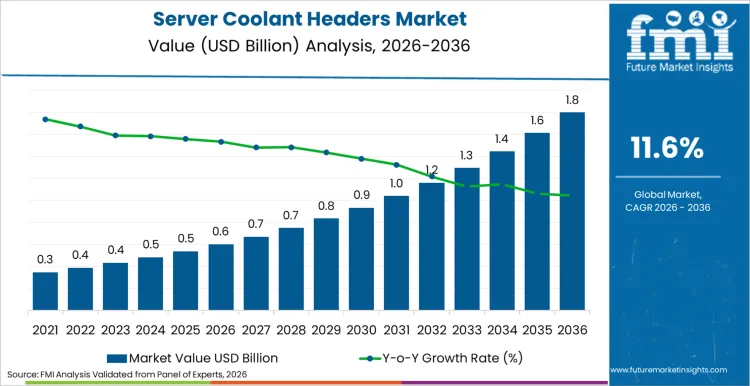
Server coolant headers market revenue is projected to total USD 0.6 billion in 2026, increasing to USD 1.8 billion by 2036, at a CAGR of 11.6%. FMI analysis indicates the market is undergoing a rapid evolution driven by the shift from monolithic CDUs to decentralized, rack-based cooling. The 2026-2027 period will be defined by the standardization of header interfaces for server blind-mate connections and the integration of smart valves for dynamic flow control per server slot.
Growth is anchored in the precise thermal management requirements of heterogeneous computing within single racks. The 2026 revision of the Open Compute Project (OCP) Advanced Cooling Solutions specification includes a detailed mechanical and hydraulic standard for rack-level coolant headers. This specification aims to ensure interoperability between servers from any OCP-recognized vendor and coolant distribution units, creating a substantial, unified addressable market for compliant header designs.
Vertiv Holdings Co. launched its Liebert® DCD Dynamic Flow Header series in Q1 2026. The design features individual needle valves for each server outlet paired with integrated flow sensors, allowing for real-time software-based balancing of coolant flow across a rack populated with servers of varying thermal loads, a critical capability for AI inference workloads.
Technical innovation focuses on reducing header footprint and eliminating potential leak points. Asetek A/S announced in late 2025 the development of a patented, monolithic aluminum header block manufactured using additive techniques. The design incorporates internal microchannels and sensor ports directly into the structure, removing the need for brazed joints or threaded fittings, thereby enhancing reliability in high-vibration environments.
Schneider Electric SE integrated its EcoStruxure IT analytics platform with sensor data from its new SmartRack Coolant Header in February 2026. The header provides per-outlet pressure and temperature data, enabling predictive detection of blockages in server cold plates before thermal events occur.
Rittal GmbH & Co. KG expanded its production of corrosion-resistant stainless-steel headers in early 2026, targeting the chemical and pharmaceutical industries where closed-loop cooling systems use purified water with stringent contamination controls, representing a high-margin niche application.
Summary of Server Coolant Headers Market
What is the Long-Term Growth Outlook for the Server Coolant Header Market?
FMI projects the global server coolant header market to expand from USD 0.6 billion in 2026 to USD 1.8 billion by 2036, registering an 11.6% CAGR. Expansion reflects the granularization of cooling distribution, where precise control moves from the room or rack level to the individual server or even component level. Headers are no longer passive manifolds but are active hydraulic components essential for optimizing performance, minimizing pump energy, and ensuring uniform cooling across expensive, heterogeneous hardware.
The density of AI server racks, the need for zero-downtime maintenance through hot-swappable server trays, and the economic drive to reduce pumping power in large-scale liquid cooling deployments, propels this growth. Demand is accelerating for headers that support multi-zone cooling, provide diagnostic visibility, and enable rapid serviceability.
FMI Research Approach: This projection is derived from FMI’s proprietary forecasting framework integrating server shipment forecasts by form factor, adoption rates of blind-mate liquid connections, analysis of pump energy as a percentage of data center IT load, and primary interviews with data center mechanical engineers.
How do FMI Analysts Expect the Server Coolant Header Market to Evolve Structurally?
FMI analysts anticipate a clear stratification between high-flow, low-complexity headers for bulk cooling (e.g., rear-door heat exchangers) and highly instrumented, multi-outlet headers for direct-to-chip and immersion cooling support. This evolution is driven by the divergence of cooling methodologies. The market will see consolidation around a few standardized header form factors for volume applications, while custom, application-specific designs will dominate high-performance computing.
Innovations such as headers with embedded micro-pumps for localized pressure boosting, headers designed for two-phase coolant distribution with integrated vapor separators, and the use of composite materials for weight reduction are redefining product capabilities. Headers are increasingly becoming firmware-managed devices within the cooling control loop.
FMI Research Approach: Insights are informed by analysis of cooling system architecture patents, materials science advancements in composites and additive manufacturing, and technical roadmaps from server OEMs detailing next-generation tray designs.
Which Geographies Command the Largest Share of the Server Coolant Header Market?
China leads the global server coolant header market, advancing at an estimated 12.4% CAGR, driven by its accelerated deployment of liquid-cooled AI clusters and government-led standardization efforts. The United States follows with an 11.9% CAGR, underpinned by hyperscaler co-design of custom header solutions and strong defense sector investment in ruggedized cooling.
The UK, Germany, and South Korea represent high-growth, innovation-driven markets with CAGRs of 10.9%, 10.8%, and 10.4%, respectively. Growth in the UK and Germany is fueled by stringent efficiency regulations and industrial edge computing, while South Korea’s growth is linked to its leadership in semiconductor and display manufacturing, which utilize precise process cooling.
FMI Research Approach: Country-level forecasts are built using analysis of national AI infrastructure investments, defense modernization budgets, industrial automation trends, and the local manufacturing footprint of server OEMs.
What Will Be the Market Size of Server Coolant Headers by 2036?
By 2036, the server coolant header market is expected to reach USD 1.8 billion. This growth will be supported by the near-ubiquitous adoption of liquid cooling for servers beyond the AI tier, including high-end enterprise and edge computing. The proliferation of micro-modular data centers and the retrofit of existing air-cooled racks with liquid cooling kits will further drive demand, making headers a high-volume component within the data center supply chain.
FMI Research Approach: Long-term market sizing incorporates liquid cooling penetration rates across server segments, the average header count per rack and per CDU, and the projected growth of prefabricated modular data centers with integrated liquid cooling.
What are some Globally Distinct Trends Shaping the Server Coolant Header Market?
Globally, the dual forces of standardization for operational simplicity and customization for peak performance are shaping the market. The push from large-scale data center operators for vendor-agnostic, hot-swappable servers is driving header interface standardization. Conversely, the need to cool specialized hardware like optical switches or compute accelerators (XPUs) is driving custom header designs with unique flow patterns and connection types.
Sustainability trends are promoting headers designed for low-pressure drop to reduce pump energy and constructed from easily recyclable mono-materials. Simultaneously, the trend toward maintenance-free systems is fueling interest in headers with self-sealing, dry-disconnect ports that prevent coolant loss during server replacement.
FMI Research Approach: Trend analysis is informed by tracking contributions to open hardware standards, reviewing sustainability reports from cloud providers for cooling energy breakdowns, and analyzing failure mode data related to coolant leaks in data centers.
Server Coolant Headers Market Key Takeaways
| Metrics | Values |
|---|---|
| Expected Value (2026E) | USD 0.6 billion |
| Projected Value (2036F) | USD 1.8 billion |
| CAGR (2026-2036) | 11.6% |
Source: Future Market Insights (FMI) analysis, based on proprietary forecasting model and primary research
Why is the Server Coolant Headers Market Growing?
The move to RSD and composable infrastructure is redefining cooling distribution. Hewlett Packard Enterprise’s 2026 Synergy composable racks utilize a dedicated, intelligent coolant header that dynamically allocates flow between compute, storage, and fabric modules based on real-time workload demands. This header is a fundamental enabling component, allowing power and cooling to be treated as pooled resources alongside compute, creating a direct correlation between advanced infrastructure design and sophisticated header demand.
Preventing thermal imbalance in mixed-utilization racks is a critical operational challenge. A 2026 study by the Uptime Institute highlighted that uneven cooling distribution in liquid-cooled racks can lead to a 15-20% performance throttling on the hottest servers. This is driving the adoption of “smart headers” with integrated flow control valves. CoolIT Systems, Inc.’s 2026 launch of its Adaptive Flow Header, which uses thermal feedback from the servers to adjust individual outlet flows, directly addresses this issue, turning the header into a performance optimization tool.
The rise of DLC for enterprise servers creates a new volume segment. Intel’s and AMD’s 2026 rollout of DLC-ready versions of their mainstream server CPUs is prompting OEMs like Dell and HPE to offer factory-integrated cold plate options. Each of these server trays requires a connection to a rack header. This mainstreaming of DLC beyond HPC creates a sustained, high-volume demand for standardized, cost-optimized coolant headers, distinct from the custom headers used in frontier AI systems.
How is Server Coolant Headers Market Segmented?
The server coolant headers market segment landscape is defined by the header’s position in the cooling hierarchy, the material best suited for the coolant and environment, and the specific cooling application it serves. Primary distribution headers dominate as the main rack-level artery, aluminum is favored for its balance of performance and cost in most data center fluids, and rack cooling is the primary application driving volume.
Why are Primary Distribution Headers the Dominant Type?
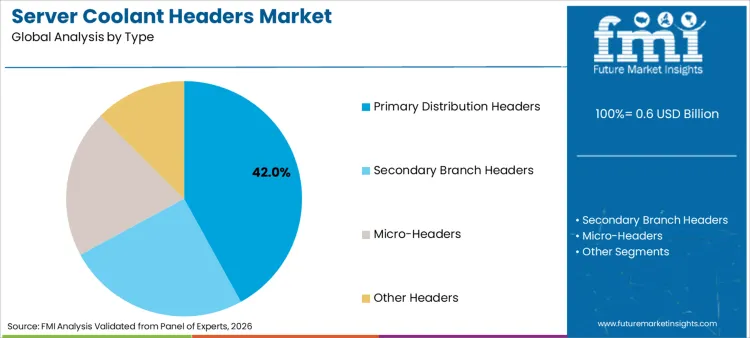
Primary distribution headers account for a 42% market share. This dominance is due to their role as the fundamental hydraulic interface between the facility’s secondary cooling loop and the rack’s internal cooling distribution.
The 2026 update to ASHRAE Standard 90.4 includes guidance on flow isolation and measurement at this primary header point for effective thermal load management. New data center designs are specifying primary headers with built-in flow meters and isolation valves as a best practice, embedding them into the base design of liquid-cooled racks.
What Factors Sustain Aluminum's Material Leadership?
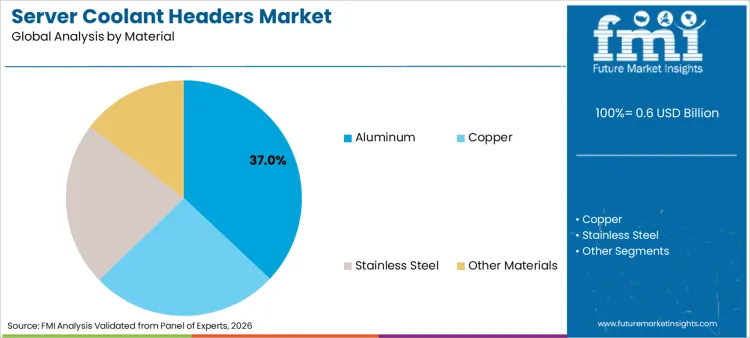
Aluminum commands a 37% share of the material segment. Its leadership is rooted in its excellent thermal conductivity for heat exchange headers, its corrosion resistance when used with properly treated water, and its suitability for high-volume extrusion and casting manufacturing processes.
Submer Technologies, S.L.’s 2026 development of an aluminum header with a nanoceramic anodized coating demonstrated a 10x improvement in corrosion resistance against aggressive dielectric fluids. This advancement extends header lifespan in immersion applications, solidifying aluminum’s position in both single- and two-phase cooling environments.
How Does the Rack Cooling Application Drive Market Volume?
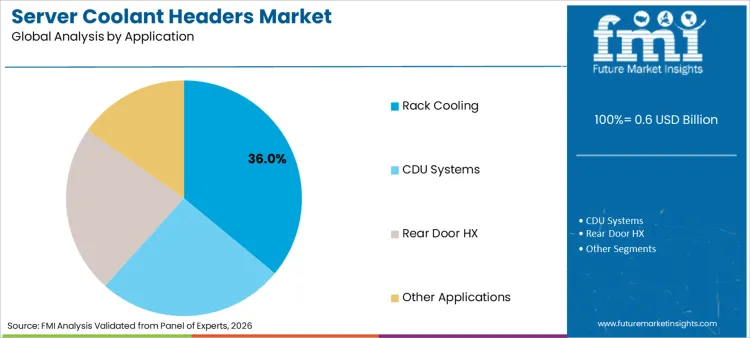
The Rack Cooling application segment holds a 36% share and is the primary volume driver. This segment encompasses headers for direct-to-chip (D2C) and rear-door heat exchanger (RDHx) systems deployed at scale in AI training and cloud data centers.
LiquidStack Limited’s 2026 contract to supply over 10,000 standardized rack headers for a hyperscale data center campus in Nevada exemplifies this volume. The headers were required to have a leak-rate specification of less than 1 droplet per year per connection when mated with the hyperscaler’s custom quick-disconnect fitting, highlighting the extreme reliability requirements of volume deployments.
What Drivers, Restraints, Opportunities, and Trends Prevail in the Server Coolant Headers Market?
Expansion of server coolanr headers demand is driven by the operational imperative for predictive maintenance. The adoption of CBM strategies in critical facilities is creating demand for headers with embedded health sensors. A 2026 technical specification from the U.S. Department of Defense for its data centers requires coolant headers to have vibration sensors to detect impeller cavitation from failing pumps and pressure transient sensors to identify clogging, moving headers from passive parts to predictive diagnostic nodes.
A significant restraint is the engineering complexity and cost of validating header compatibility with new dielectric fluids. Each new synthetic or hydrocarbon-based fluid requires extensive material compatibility testing with seals, gaskets, and the header body itself. A 2025 industry study found that full validation of a header design for a new fluid can take 12-18 months and cost over USD 500,000, slowing the pace of innovation and creating a moat for incumbents with pre-validated designs.
A key trend is the functional integration of the header with other rack components. Chilldyne, Inc.’s 2026 Negative Pressure Rack design integrates the coolant header directly into the structural frame of the rack, serving as both a fluid conduit and a structural cross-member. This integration saves space, improves rigidity, and reduces the total parts count, aligning with the trend towards prefabricated, optimized rack-scale solutions.
The trend toward two-phase cooling creates opportunities for specialized header designs. Iceotope Technologies Limited’s 2026 partnership with a refrigerant manufacturer focused on developing a header with an integrated liquid-vapor separator for its two-phase immersion system. This header must manage the distribution of saturated liquid and the return of vapor, a fundamentally different hydraulic challenge than single-phase systems, creating a specialized and high-value product niche.
Analysis of Server Coolant Headers Market by Key Countries
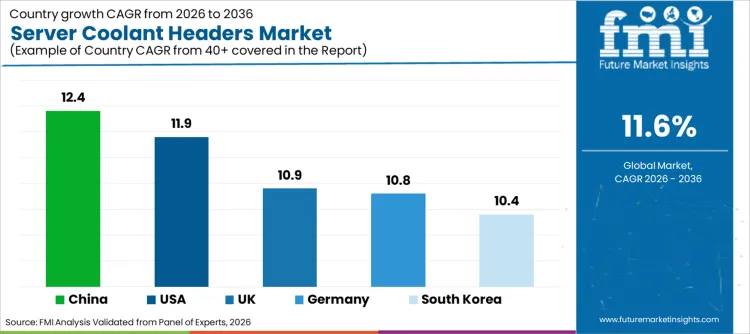
| Country | CAGR (2026-2036) |
|---|---|
| USA | 11.9% |
| UK | 10.9% |
| China | 12.4% |
| Germany | 10.8% |
| South Korea | 10.4% |
Source: Future Market Insights (FMI) analysis, based on proprietary forecasting model and primary research
How do Hyperscaler Co-Design Practices Shape the Server Coolant Headers Market in USA?
USA’s 11.9% CAGR is characterized by deep co-design between hyperscalers and select cooling vendors. Amazon Web Services’ 2026 Nitro system architecture for its next-generation AI servers includes a custom coolant header design that is integral to the rack’s power distribution board.
This header is not a standalone component but a multi-layer laminated part of the board itself, distributing low-voltage power and coolant within the same assembly. This level of integration, driven by the scale and technical resources of U.S. hyperscalers, creates a market for highly specialized, proprietary header solutions that are not commercially available, favoring vendors with deep engineering partnerships.
How is UK's Focus on Lifecycle Sustainability Influencing Header Design?
The UK’s 10.9% CAGR is heavily influenced by LCA requirements in public and financial sector procurement. The UK Cabinet Office’s 2026 Technology Code of Practice for public cloud and data center services requires vendors to disclose the embodied carbon of critical components.
This has led cooling system suppliers like those serving London’s financial data centers to source headers manufactured using low-carbon, recycled aluminum and to design them for easy disassembly and material recovery at end-of-life. The header’s environmental footprint, alongside its performance, has become a key differentiator in this market.
What Role does China's Indigenous Innovation Policy Play in Header Supply?
China’s leading 12.4% CAGR is propelled by policies enforcing technological self-sufficiency in critical infrastructure. The 2026 “China Standard 2035” plan for data center infrastructure includes specific performance and dimensional standards for server coolant headers. This has prompted domestic server giants like Inspur and Lenovo to establish joint ventures with local fluid handling manufacturers to produce guobiao headers.
These headers must meet the hydraulic performance of international designs but use domestically sourced materials and manufacturing processes, creating a parallel, insulated supply chain that dominates the domestic market and is increasingly competitive in Belt and Road Initiative projects.
How does Germany's Mittelstand Model Drive Specialized Header Demand?
Germany’s 10.8% CAGR is driven by the needs of its Mittelstand in advanced manufacturing. Companies producing industrial laser cutters, semiconductor inspection tools, and high-precision machine tools require small-batch, custom coolant headers for equipment cooling.
These headers often have unique port configurations, special coatings for ultra-pure water, or exotic materials like titanium for corrosive chemicals. German engineering firms like those within the VDMA (Mechanical Engineering Industry Association) provide a steady demand for these high-margin, custom-engineered headers, supporting a sector of specialized manufacturers rather than volume producers.
Why is South Korea's Display and Memory Fab Market a Key Niche?
South Korea’s 10.4% CAGR is closely tied to its world-leading display panel and memory fabrication facilities. The photolithography and etching tools in these fabs require ultra-precise temperature control, achieved through specialized chillers and point-of-use cooling headers.
Samsung’s 2026 specification for its next-generation DRAM fab required headers with a 316L stainless steel body and electropolished internal surfaces to prevent particle generation in the cooling loop. This application demands extreme cleanliness and reliability, creating a premium niche market for headers that meet semiconductor-grade purity standards, often supplied by the same firms that provide high-purity gas and chemical delivery systems.
What is the Competition Outlook for Server Coolant Headers?
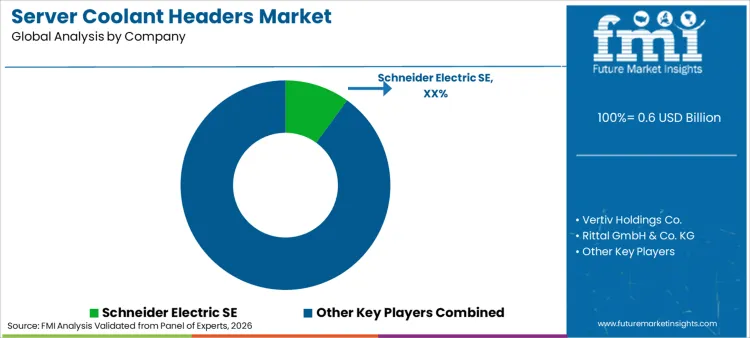
Competitive intensity reflects the header’s role as a nexus between mechanical design, fluid dynamics, and data connectivity. The landscape is dividing between large infrastructure providers offering headers as part of integrated rack solutions and specialized component engineers focusing on performance-critical or custom designs. Competition is increasingly based on hydraulic performance data (pressure drop curves, flow uniformity), smart features, and the availability of global technical support for installation and maintenance.
Strategic evolution prior to 2025 was defined by cooling system manufacturers designing proprietary headers to optimize their own system performance, leading to vendor lock-in. The observable strategic direction for 2026 and beyond is participation in open ecosystem consortia. For instance, the collaboration between Vertiv, Schneider Electric, and several server OEMs in the OCP’s Advanced Cooling project is aimed at defining an open header standard. Companies that align their product roadmaps with such standards are positioning themselves for volume adoption in multi-vendor environments.
Strategic leadership is shifting toward providing headers as part of a performance-guaranteed cooling solution. Green Revolution Cooling, Inc.’s 2026 service model for its immersion systems includes a warranty on the entire fluid path, including headers. The company uses data from sensors in its headers to proactively manage fluid health and pre-empt failures, transforming the header from a sold component into a monitored asset within a service-level agreement.
Recent Developments
- Schneider Electric SE and NVIDIA announced a co-engineered reference design in February 2026 for AI racks featuring a split-loop header that separates cooling for GPUs and CPUs into two independent hydraulic circuits within the same header body, allowing for different coolant temperatures and flow rates.
- Asetek A/S received a significant order in late 2025 from a European supercomputing center for its direct-to-chip cooling headers, which were required to use a specific, locally sourced recycled aluminum alloy to meet the project’s sustainability criteria.
- Rittal GmbH & Co. KG launched a new line of pre-piped and pre-tested “header modules” in Q1 2026, which combine the primary header, isolation valves, and flow meters into a single skidded unit for faster data center deployment, reducing onsite labor by an estimated 80%.
Key Players Profiled
- Schneider Electric SE
- Vertiv Holdings Co.
- Rittal GmbH & Co. KG
- Asetek A/S
- CoolIT Systems, Inc.
- Submer Technologies, S.L.
- LiquidStack Limited
- Chilldyne, Inc.
- Iceotope Technologies Limited
- Green Revolution Cooling, Inc.
Market Definition
The server coolant headers market comprises revenue generated from the design, manufacture, and supply of precision fluid distribution manifolds used within server racks and cooling distribution units (CDUs) to partition and direct liquid coolant to multiple server inlets or cooling components. These headers ensure balanced flow, manage pressure, and often incorporate valving, sensing, or connection interfaces. The market includes primary, secondary, micro-headers, and other specialized types constructed from aluminum, copper, stainless steel, and engineered polymers.
The market scope covers headers used in data center rack cooling (direct-to-chip, immersion), CDU systems, rear-door heat exchangers, and other liquid-cooled IT infrastructure. Revenue includes value from integrated sensors, valves, mounting hardware, and associated control electronics sold as part of the header assembly. The market excludes general plumbing fittings, facility-level piping, and the CDU or server cold plates themselves unless the header is sold as an integrated sub-assembly of those products.
Scope of Report
| Items | Values |
|---|---|
| Quantitative Units | USD 0.6 billion |
| Type | Primary Distribution Headers; Secondary Branch Headers; Micro-Headers; Other Headers |
| Material | Aluminum; Copper; Stainless Steel; Other Materials |
| Application | Rack Cooling; CDU Systems; Rear Door HX; Other Applications |
| Regions Covered | North America, Western Europe, Eastern Europe, East Asia, South Asia & Pacific, Latin America, Middle East & Africa |
| Countries | USA, UK, China, Germany, South Korea and 40+ countries |
| Key Companies | Schneider Electric SE; Vertiv Holdings Co.; Rittal GmbH & Co. KG; Asetek A/S; CoolIT Systems, Inc.; Submer Technologies, S.L.; LiquidStack Limited; Chilldyne, Inc.; Iceotope Technologies Limited; Green Revolution Cooling, Inc. |
Source: Future Market Insights (FMI) analysis, based on proprietary forecasting model and primary research
Server Coolant Headers Market Key Segments
By Type
- Primary Distribution Headers
- Secondary Branch Headers
- Micro-Headers
- Other Headers
By Material
- Aluminum
- Copper
- Stainless Steel
- Other Materials
By Application
- Rack Cooling
- CDU Systems
- Rear Door HX
- Other Applications
By Region
- North America
- Western Europe
- Eastern Europe
- East Asia
- South Asia & Pacific
- Latin America
- Middle East & Africa
Bibliography
- ASHRAE. (2026). ANSI/ASHRAE Standard 90.4-2026: Energy Standard for Data Centers. American Society of Heating, Refrigerating and Air-Conditioning Engineers.
- Open Compute Project (OCP). (2026). Advanced Cooling Module: Mechanical and Hydraulic Interface Specification v3.0.
- Uptime Institute. (2026). Intelligent Infrastructure: Managing Thermal Imbalance in Liquid-Cooled Racks.
- U.S. Department of Defense. (2026). Technical Specification: Condition-Based Maintenance for Data Center Cooling Systems.
- VDMA. (2026). Guideline: Cooling System Components for Precision Manufacturing Equipment.
Frequently Asked Questions
How big is the server coolant headers market in 2026?
The global server coolant headers market is estimated to be valued at USD 0.6 billion in 2026.
What will be the size of server coolant headers market in 2036?
The market size for the server coolant headers market is projected to reach USD 1.8 billion by 2036.
How much will be the server coolant headers market growth between 2026 and 2036?
The server coolant headers market is expected to grow at a 11.6% CAGR between 2026 and 2036.
What are the key product types in the server coolant headers market?
The key product types in server coolant headers market are primary distribution headers, secondary branch headers, micro-headers and other headers.
Which material segment to contribute significant share in the server coolant headers market in 2026?
In terms of material, aluminum segment to command 37.0% share in the server coolant headers market in 2026.
Preview the report firsthand - request a free sample
Get SampleGet the brochure for pricing and purchase details.
Get PDFTable of Content
- Executive Summary
- Global Market Outlook
- Demand-side Trends
- Supply-side Trends
- Technology Roadmap Analysis
- Analysis and Recommendations
- Market Overview
- Market Coverage / Taxonomy
- Market Definition / Scope / Limitations
- Market Background
- Market Dynamics
- Drivers
- Restraints
- Opportunity
- Trends
- Scenario Forecast
- Demand in Optimistic Scenario
- Demand in Likely Scenario
- Demand in Conservative Scenario
- Opportunity Map Analysis
- Product Life Cycle Analysis
- Supply Chain Analysis
- Investment Feasibility Matrix
- Value Chain Analysis
- PESTLE and Porter’s Analysis
- Regulatory Landscape
- Regional Parent Market Outlook
- Production and Consumption Statistics
- Import and Export Statistics
- Market Dynamics
- Global Market Analysis 2021 to 2025 and Forecast, 2026 to 2036
- Historical Market Size Value (USD Million) Analysis, 2021 to 2025
- Current and Future Market Size Value (USD Million) Projections, 2026 to 2036
- Y-o-Y Growth Trend Analysis
- Absolute $ Opportunity Analysis
- Global Market Pricing Analysis 2021 to 2025 and Forecast 2026 to 2036
- Global Market Analysis 2021 to 2025 and Forecast 2026 to 2036, By Type
- Introduction / Key Findings
- Historical Market Size Value (USD Million) Analysis By Type , 2021 to 2025
- Current and Future Market Size Value (USD Million) Analysis and Forecast By Type , 2026 to 2036
- Primary Distribution Headers
- Secondary Branch Headers
- Micro-Headers
- Other Headers
- Primary Distribution Headers
- Y-o-Y Growth Trend Analysis By Type , 2021 to 2025
- Absolute $ Opportunity Analysis By Type , 2026 to 2036
- Global Market Analysis 2021 to 2025 and Forecast 2026 to 2036, By Material
- Introduction / Key Findings
- Historical Market Size Value (USD Million) Analysis By Material, 2021 to 2025
- Current and Future Market Size Value (USD Million) Analysis and Forecast By Material, 2026 to 2036
- Aluminum
- Copper
- Stainless Steel
- Other Materials
- Aluminum
- Y-o-Y Growth Trend Analysis By Material, 2021 to 2025
- Absolute $ Opportunity Analysis By Material, 2026 to 2036
- Global Market Analysis 2021 to 2025 and Forecast 2026 to 2036, By Application
- Introduction / Key Findings
- Historical Market Size Value (USD Million) Analysis By Application, 2021 to 2025
- Current and Future Market Size Value (USD Million) Analysis and Forecast By Application, 2026 to 2036
- Rack Cooling
- CDU Systems
- Rear Door HX
- Other Applications
- Rack Cooling
- Y-o-Y Growth Trend Analysis By Application, 2021 to 2025
- Absolute $ Opportunity Analysis By Application, 2026 to 2036
- Global Market Analysis 2021 to 2025 and Forecast 2026 to 2036, By Region
- Introduction
- Historical Market Size Value (USD Million) Analysis By Region, 2021 to 2025
- Current Market Size Value (USD Million) Analysis and Forecast By Region, 2026 to 2036
- North America
- Latin America
- Western Europe
- Eastern Europe
- East Asia
- South Asia and Pacific
- Middle East & Africa
- Market Attractiveness Analysis By Region
- North America Market Analysis 2021 to 2025 and Forecast 2026 to 2036, By Country
- Historical Market Size Value (USD Million) Trend Analysis By Market Taxonomy, 2021 to 2025
- Market Size Value (USD Million) Forecast By Market Taxonomy, 2026 to 2036
- By Country
- USA
- Canada
- Mexico
- By Type
- By Material
- By Application
- By Country
- Market Attractiveness Analysis
- By Country
- By Type
- By Material
- By Application
- Key Takeaways
- Latin America Market Analysis 2021 to 2025 and Forecast 2026 to 2036, By Country
- Historical Market Size Value (USD Million) Trend Analysis By Market Taxonomy, 2021 to 2025
- Market Size Value (USD Million) Forecast By Market Taxonomy, 2026 to 2036
- By Country
- Brazil
- Chile
- Rest of Latin America
- By Type
- By Material
- By Application
- By Country
- Market Attractiveness Analysis
- By Country
- By Type
- By Material
- By Application
- Key Takeaways
- Western Europe Market Analysis 2021 to 2025 and Forecast 2026 to 2036, By Country
- Historical Market Size Value (USD Million) Trend Analysis By Market Taxonomy, 2021 to 2025
- Market Size Value (USD Million) Forecast By Market Taxonomy, 2026 to 2036
- By Country
- Germany
- UK
- Italy
- Spain
- France
- Nordic
- BENELUX
- Rest of Western Europe
- By Type
- By Material
- By Application
- By Country
- Market Attractiveness Analysis
- By Country
- By Type
- By Material
- By Application
- Key Takeaways
- Eastern Europe Market Analysis 2021 to 2025 and Forecast 2026 to 2036, By Country
- Historical Market Size Value (USD Million) Trend Analysis By Market Taxonomy, 2021 to 2025
- Market Size Value (USD Million) Forecast By Market Taxonomy, 2026 to 2036
- By Country
- Russia
- Poland
- Hungary
- Balkan & Baltic
- Rest of Eastern Europe
- By Type
- By Material
- By Application
- By Country
- Market Attractiveness Analysis
- By Country
- By Type
- By Material
- By Application
- Key Takeaways
- East Asia Market Analysis 2021 to 2025 and Forecast 2026 to 2036, By Country
- Historical Market Size Value (USD Million) Trend Analysis By Market Taxonomy, 2021 to 2025
- Market Size Value (USD Million) Forecast By Market Taxonomy, 2026 to 2036
- By Country
- China
- Japan
- South Korea
- By Type
- By Material
- By Application
- By Country
- Market Attractiveness Analysis
- By Country
- By Type
- By Material
- By Application
- Key Takeaways
- South Asia and Pacific Market Analysis 2021 to 2025 and Forecast 2026 to 2036, By Country
- Historical Market Size Value (USD Million) Trend Analysis By Market Taxonomy, 2021 to 2025
- Market Size Value (USD Million) Forecast By Market Taxonomy, 2026 to 2036
- By Country
- India
- ASEAN
- Australia & New Zealand
- Rest of South Asia and Pacific
- By Type
- By Material
- By Application
- By Country
- Market Attractiveness Analysis
- By Country
- By Type
- By Material
- By Application
- Key Takeaways
- Middle East & Africa Market Analysis 2021 to 2025 and Forecast 2026 to 2036, By Country
- Historical Market Size Value (USD Million) Trend Analysis By Market Taxonomy, 2021 to 2025
- Market Size Value (USD Million) Forecast By Market Taxonomy, 2026 to 2036
- By Country
- Kingdom of Saudi Arabia
- Other GCC Countries
- Turkiye
- South Africa
- Other African Union
- Rest of Middle East & Africa
- By Type
- By Material
- By Application
- By Country
- Market Attractiveness Analysis
- By Country
- By Type
- By Material
- By Application
- Key Takeaways
- Key Countries Market Analysis
- USA
- Pricing Analysis
- Market Share Analysis, 2025
- By Type
- By Material
- By Application
- Canada
- Pricing Analysis
- Market Share Analysis, 2025
- By Type
- By Material
- By Application
- Mexico
- Pricing Analysis
- Market Share Analysis, 2025
- By Type
- By Material
- By Application
- Brazil
- Pricing Analysis
- Market Share Analysis, 2025
- By Type
- By Material
- By Application
- Chile
- Pricing Analysis
- Market Share Analysis, 2025
- By Type
- By Material
- By Application
- Germany
- Pricing Analysis
- Market Share Analysis, 2025
- By Type
- By Material
- By Application
- UK
- Pricing Analysis
- Market Share Analysis, 2025
- By Type
- By Material
- By Application
- Italy
- Pricing Analysis
- Market Share Analysis, 2025
- By Type
- By Material
- By Application
- Spain
- Pricing Analysis
- Market Share Analysis, 2025
- By Type
- By Material
- By Application
- France
- Pricing Analysis
- Market Share Analysis, 2025
- By Type
- By Material
- By Application
- India
- Pricing Analysis
- Market Share Analysis, 2025
- By Type
- By Material
- By Application
- ASEAN
- Pricing Analysis
- Market Share Analysis, 2025
- By Type
- By Material
- By Application
- Australia & New Zealand
- Pricing Analysis
- Market Share Analysis, 2025
- By Type
- By Material
- By Application
- China
- Pricing Analysis
- Market Share Analysis, 2025
- By Type
- By Material
- By Application
- Japan
- Pricing Analysis
- Market Share Analysis, 2025
- By Type
- By Material
- By Application
- South Korea
- Pricing Analysis
- Market Share Analysis, 2025
- By Type
- By Material
- By Application
- Russia
- Pricing Analysis
- Market Share Analysis, 2025
- By Type
- By Material
- By Application
- Poland
- Pricing Analysis
- Market Share Analysis, 2025
- By Type
- By Material
- By Application
- Hungary
- Pricing Analysis
- Market Share Analysis, 2025
- By Type
- By Material
- By Application
- Kingdom of Saudi Arabia
- Pricing Analysis
- Market Share Analysis, 2025
- By Type
- By Material
- By Application
- Turkiye
- Pricing Analysis
- Market Share Analysis, 2025
- By Type
- By Material
- By Application
- South Africa
- Pricing Analysis
- Market Share Analysis, 2025
- By Type
- By Material
- By Application
- USA
- Market Structure Analysis
- Competition Dashboard
- Competition Benchmarking
- Market Share Analysis of Top Players
- By Regional
- By Type
- By Material
- By Application
- Competition Analysis
- Competition Deep Dive
- Schneider Electric SE
- Overview
- Product Portfolio
- Profitability by Market Segments (Product/Age /Sales Channel/Region)
- Sales Footprint
- Strategy Overview
- Marketing Strategy
- Product Strategy
- Channel Strategy
- Vertiv Holdings Co.
- Rittal GmbH & Co. KG
- Asetek A/S
- CoolIT Systems, Inc.
- Submer Technologies, S.L.
- LiquidStack Limited
- Chilldyne, Inc.
- Iceotope Technologies Limited
- Green Revolution Cooling, Inc.
- Schneider Electric SE
- Competition Deep Dive
- Assumptions & Acronyms Used
- Research Methodology


