

- Industry Size (2026)
- USD 10.14 Bn
- Forecast (2036)
- USD 19.39 Bn
- CAGR (2026 to 2036)
- 6.7%
Corrosion Resistant Resin Market Size, Market Forecast and Outlook By FMI
The corrosion resistant resin market was valued at USD 9.50 billion in 2025. Based on Future Market Insights' analysis, demand is estimated to reach USD 10.14 billion in 2026 and USD 19.39 billion by 2036. FMI projects a CAGR of 6.7% during the forecast period. The incremental opportunity from 2026 to 2036 stands at USD 9.25 billion. Epoxy resins hold 26.4% of demand by type in 2026, coatings command 44.7% of application-level consumption, and the chemical end-use industry accounts for 25.3% of sector demand, as per FMI. Corrosion resistant resins are polymer-based materials formulated to protect substrates from chemical, thermal, and environmental degradation across industrial applications.
Summary of Corrosion Resistant Resin Market
- Market valuation is expected to climb to USD 19.39 billion by 2036.
- The industry is expected to expand at 6.7% annually from 2026 through 2036.
- The 2025 baseline valuation came in at USD 9.50 billion.
- The ten-year outlook presents a cumulative growth opportunity of USD 9.25 billion.
- Epoxy leads by Type with 26.4% share in 2026.
- Coating leads by Application with 44.7% share in 2026.
- The market is a speciality polymer category where demand is driven by the installed base of chemical processing, marine, and energy infrastructure requiring periodic recoating and the expansion of new corrosion-critical construction projects across Asia Pacific.
- Among key countries, India at 8.5%, China at 8%, USA at 6.2%, Canada at 5.8%, UK at 5.5%, Germany at 5.2%, Japan at 4.8% CAGR respectively.
FMI is of the opinion that the market is being reshaped by two converging forces: tightening environmental regulations on volatile organic compound emissions from solvent-based coatings, and the structural expansion of chemical processing and marine infrastructure in Asia Pacific. Epoxy systems lead by resin type because of their superior adhesion, chemical resistance, and mechanical strength across a wide range of operating temperatures. Coating applications dominate because protective coatings represent the highest-volume consumption pathway for corrosion resistant resins, applied across storage tanks, process vessels, pipelines, marine hulls, and structural steel. The composites segment is growing faster in percentage terms as fibre-reinforced polymer applications expand in chemical plant ducting, scrubber systems, and offshore platform structures.
India leads at 8.5% CAGR, driven by petrochemical refinery expansion and coastal infrastructure projects requiring marine-grade corrosion protection systems. China follows at 8%, supported by the national chemical industry modernisation programme mandating corrosion-resistant lining systems in new plant construction. The United States registers 6.2% growth, anchored by refinery maintenance cycles and infrastructure rehabilitation spending under the Infrastructure Investment and Jobs Act. Canada tracks at 5.8%, the United Kingdom at 5.5%, Germany at 5.2%, and Japan at 4.8%, where mature chemical and marine industries sustain steady recoating and replacement demand.

Corrosion Resistant Resin Market Key Takeaways
| Metric | Details |
|---|---|
| Industry Size (2026) | USD 10.14 billion |
| Industry Value (2036) | USD 19.39 billion |
| CAGR (2026-2036) | 6.7% |
Source: Future Market Insights, 2026
Corrosion Resistant Resin Market Definition
Corrosion resistant resins are polymer-based materials engineered to withstand chemical attack, moisture penetration, and environmental degradation when applied as coatings, linings, or composite matrices on metal and concrete substrates. Primary resin chemistries include epoxy, polyurethane, polyester, and vinyl ester systems, each formulated for specific temperature ranges, chemical exposure profiles, and mechanical load requirements. End-use industries span chemical processing, marine, oil and gas, automotive, pulp and paper, food and beverages, infrastructure, and power generation.
Corrosion Resistant Resin Market Inclusions
Market scope covers global and regional market sizes for corrosion resistant resins from 2026 to 2036. Segmentation spans type (epoxy, polyurethanes, polyester, vinyl ester, others), application (coating, composites, others), and end-user industry (chemical, marine, oil and gas, automobile, pulp and paper, food and beverages, infrastructure, power generation). The analysis includes formulation technology trends, raw material pricing dynamics, and regulatory compliance assessments.
Corrosion Resistant Resin Market Exclusions
The scope excludes general-purpose decorative paints and architectural coatings without specialised corrosion resistance properties. Metallic coatings such as galvanising and thermal spray systems are omitted. Rubber linings and ceramic tile linings applied without resin-based bonding systems fall outside analytical parameters.
Corrosion Resistant Resin Market Research Methodology
- Primary Research: Analysts engaged with procurement specialists, plant operators, and technology integration leads to map decision gates triggering purchases and upgrades.
- Desk Research: Data collection aggregated regulatory filings, government procurement records, industry association publications, and company financial disclosures.
- Market-Sizing and Forecasting: Baseline values derive from bottom-up aggregation of product shipments and consumption records, applying region-specific adoption curves to project future demand.
- Data Validation and Update Cycle: Projections are tested against publicly reported capital expenditure guidance from leading companies and cross-referenced with government statistical agency data.
Why is the Corrosion Resistant Resin Market Growing?
The Corrosion Resistant Resin market is witnessing significant growth, driven by increasing demand for durable and protective coatings across chemical, industrial, and infrastructure sectors. Rising awareness of corrosion prevention and the need to extend the lifespan of equipment and structures are fueling adoption. Technological advancements in resin formulations have enhanced chemical resistance, mechanical strength, and environmental performance, enabling their application in challenging industrial conditions.
The growing emphasis on sustainability and compliance with environmental regulations is encouraging the use of advanced resins that minimize volatile organic compound emissions while providing long-term protection. Investments in chemical processing facilities, offshore installations, and industrial infrastructure projects are further supporting market expansion. Manufacturers are increasingly focusing on improving resin performance, optimizing production processes, and developing customized solutions for specific industrial needs.
The market is also benefiting from the integration of resins with advanced coating technologies and surface treatment solutions, providing enhanced corrosion resistance As industries prioritize equipment reliability, safety, and cost-effective maintenance, the Corrosion Resistant Resin market is expected to maintain steady growth in the coming years.
Segmental Analysis
The corrosion resistant resin market is segmented by type, application, end user industry, and geographic regions. By type, corrosion resistant resin market is divided into Epoxy, Polyurethanes, Polyester, Vinyl Ester, and Others. In terms of application, corrosion resistant resin market is classified into Coating, Composites, and Others. Based on end user industry, corrosion resistant resin market is segmented into Chemical, Marine, Oil And Gas, Automobile, Pulp And Paper, Food And Beverages, Infrastructure, and Power Generation. Regionally, the corrosion resistant resin industry is classified into North America, Latin America, Western Europe, Eastern Europe, Balkan & Baltic Countries, Russia & Belarus, Central Asia, East Asia, South Asia & Pacific, and the Middle East & Africa.
Insights into the Epoxy Type Segment

The epoxy type segment is projected to hold 26.4% of the market revenue in 2026, making it the leading resin type. Its dominance is driven by superior adhesion, mechanical strength, and chemical resistance, which make it suitable for a wide range of industrial applications. Epoxy resins are extensively used in protective coatings, structural composites, and industrial adhesives, providing long-term durability in corrosive environments.
The ability to customize epoxy formulations to specific operational requirements enhances their appeal across chemical processing, marine, and construction sectors. Improved thermal stability and compatibility with reinforcing materials further contribute to performance reliability. Manufacturers benefit from cost-effective maintenance and reduced downtime when epoxy resins are used for protective applications.
Technological innovations in curing mechanisms and resin blends continue to improve process efficiency and application versatility As industries increasingly seek high-performance materials that can withstand harsh chemical and environmental conditions, the epoxy segment is expected to retain its leading position, supported by strong demand in industrial coatings and structural applications.
Insights into the Coating Application Segment

The coating application segment is anticipated to account for 44.7% of the market revenue in 2026, establishing it as the largest application category. Growth in this segment is being driven by the widespread need for protective surfaces that prevent corrosion, chemical degradation, and wear in industrial equipment and infrastructure. Corrosion resistant resins are incorporated into coatings to provide long-term durability, resistance to harsh chemicals, and improved surface performance.
The ability to deliver tailored coating solutions for different substrates and environmental conditions enhances adoption. Industries such as chemical processing, oil and gas, marine, and manufacturing are increasingly implementing these coatings to reduce maintenance costs and extend asset lifespan.
Advancements in application technologies, including spray, roll-on, and automated coating systems, have further simplified deployment while improving uniformity and protection quality As regulatory standards for equipment safety and environmental compliance become more stringent, the demand for high-performance resin-based coatings is expected to maintain strong momentum, ensuring the coating segment remains the primary driver of market growth.
Insights into the Chemical End-Use Industry Segment

The chemical end-use industry segment is projected to hold 25.3% of the market revenue in 2026, establishing it as the leading industry for corrosion resistant resin applications. This growth is being driven by the need to protect chemical processing equipment, storage tanks, pipelines, and reactors from aggressive chemicals, high temperatures, and corrosive environments. Corrosion resistant resins provide durable and reliable protection, ensuring operational efficiency, safety, and compliance with industrial standards.
The ability to customize resin formulations to meet specific chemical resistance and mechanical performance requirements supports widespread adoption. Investments in expanding chemical production capacity and upgrading aging infrastructure are further fueling demand.
The integration of resins with coating technologies and surface treatments enhances asset longevity and reduces maintenance costs As the chemical industry focuses on operational efficiency, safety, and sustainability, the demand for high-performance corrosion resistant resins is expected to remain robust, reinforcing this segment as a key revenue contributor in the market.
Market Overview
Corrosion Resistant Resin Market Overview
Resin is termed as a ‘solid or highly viscous substance’ which is typically converted into polymers. The resins are plant derived or synthetic in origin. Resins also exist in the mixture of organic compounds. Corrosion resistant resin is primarily formulated as isophthalic, terephthalic and vinyl ester resin.
The corrosion resistant resins are high performance specialty polyester and ideal for the manufacture of tanks, pipes, vessels that contain acids, alkalis, fuels, foodstuff, water and other demanding material that can corrode metals.
As the corrosion resistant resins are highly resistant to chemicals, solvents, moisture and elevated temperature, the demand of the corrosion resistant resin is high and which leads to the significant growth of the market. In the marketplace, the corrosion resistant resins successfully compete with the steel and aluminum due to its inherent longevity, ease of installation and the ability to easily maintain and repair as compared to metals.
Analysis of Corrosion Resistant Resin Market By Key Countries
.webp "Top Country Growth Comparison Corrosion Resistant Resin Market Cagr (2026 2036)")
| Country | CAGR |
|---|---|
| China | 9.0% |
| India | 8.4% |
| Germany | 7.7% |
| France | 7.0% |
| UK | 6.4% |
| USA | 5.7% |
| Brazil | 5.0% |
Source: FMI analysis based on primary research and proprietary forecasting model

Country-wise Analysis
The Corrosion Resistant Resin Market is expected to register a CAGR of 6.7% during the forecast period, exhibiting varied country level momentum. China leads with the highest CAGR of 9.0%, followed by India at 8.4%. Developed markets such as Germany, France, and the UK continue to expand steadily, while the USA is likely to grow at consistent rates. Brazil posts the lowest CAGR at 5.0%, yet still underscores a broadly positive trajectory for the global Corrosion Resistant Resin Market. In 2024, Germany held a dominant revenue in the Western Europe market and is expected to grow with a CAGR of 7.7%. The USA Corrosion Resistant Resin Market is estimated to be valued at USD 3.3 billion in 2026 and is anticipated to reach a valuation of USD 5.7 billion by 2036. Sales are projected to rise at a CAGR of 5.7% over the forecast period between 2026 and 2036. While Japan and South Korea markets are estimated to be valued at USD 429.3 million and USD 322.9 million respectively in 2026.
Key Players in the Corrosion Resistant Resin Market

- Ashland
- Huntsman International LLC.
- Hexion Inc.
- Reichhold LLC
- Scott Bader Company Ltd.
- AOC
- Olin Corporation
- Sino Polymer Co., Ltd.
- SWANCOR
- Grasim Industries Limited (India) and Aditya Birla Chemicals (Thailand) Pvt. Ltd
- TotalEnergies
- Allnex GMBH
- BASF SE
Scope of the Report
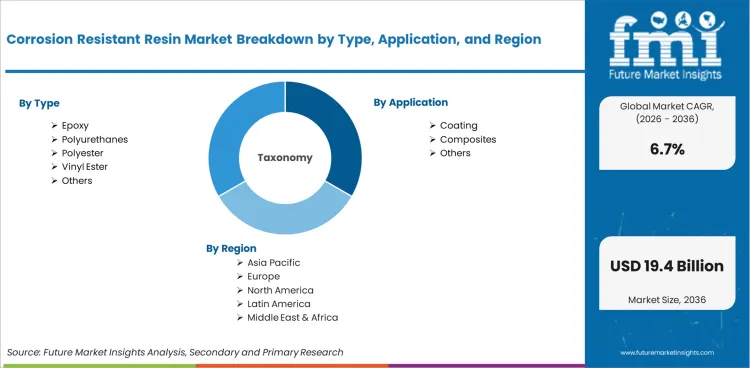
| Metric | Value |
|---|---|
| Quantitative Units | USD 10.14 billion to USD 19.39 billion, at a CAGR of 6.7% |
| Market Definition | Corrosion resistant resins are polymer-based materials engineered to withstand chemical attack, moisture penetration, and environmental degradation when applied as coatings, linings, or composite matrices on metal and concrete substrates. Primary resin chemistries include epoxy, polyurethane, polyester, and vinyl ester systems, each formulated for specific temperature ranges, chemical exposure profiles, and mechanical load requirements. |
| Type Segmentation | Epoxy, Polyurethanes, Polyester, Vinyl Ester, Others |
| Application Segmentation | Coating, Composites, Others |
| End User Industry Segmentation | Chemical, Marine, Oil and Gas, Automobile, Pulp and Paper, Food and Beverages, Infrastructure, Power Generation |
| Regions Covered | North America, Latin America, Europe, East Asia, South Asia, Oceania, Middle East & Africa |
| Countries Covered | India, China, USA, Canada, UK, Germany, Japan, and 40 plus countries |
| Key Companies Profiled | Ashland, Huntsman International LLC., Hexion Inc., Reichhold LLC, Scott Bader Company Ltd., AOC, Olin Corporation, Sino Polymer Co., Ltd., SWANCOR, TotalEnergies, Allnex GMBH, BASF SE |
| Forecast Period | 2026 to 2036 |
| Approach | Forecasting models apply a bottom-up methodology starting with installed base metrics and projecting adoption rates using region-specific demand curves. |
Corrosion Resistant Resin Market by Segments
Type:
- Epoxy
- Polyurethanes
- Polyester
- Vinyl Ester
- Others
Application:
- Coating
- Composites
- Others
End User Industry:
- Chemical
- Marine
- Oil And Gas
- Automobile
- Pulp And Paper
- Food And Beverages
- Infrastructure
- Power Generation
Region:
- North America
- USA
- Canada
- Mexico
- Latin America
- Brazil
- Chile
- Rest of Latin America
- Western Europe
- Germany
- UK
- Italy
- Spain
- France
- Nordic
- BENELUX
- Rest of Western Europe
- Eastern Europe
- Russia
- Poland
- Hungary
- Balkan & Baltic
- Rest of Eastern Europe
- East Asia
- China
- Japan
- South Korea
- South Asia and Pacific
- India
- ASEAN
- Australia & New Zealand
- Rest of South Asia and Pacific
- Middle East & Africa
- Kingdom of Saudi Arabia
- Other GCC Countries
- Turkiye
- South Africa
- Other African Union
- Rest of Middle East & Africa
Bibliography
- 1. American Society for Testing and Materials. (2024). ASTM D4541: Standard Test Method for Pull-Off Strength of Coatings Using Portable Adhesion Testers. ASTM.
- 2. International Maritime Organization. (2024). Performance Standard for Protective Coatings: PSPC Update. IMO.
- 3. European Coatings Association. (2025). Market Report: Industrial Protective Coatings in Europe 2025. CEPE.
- 4. Ministry of Chemicals and Fertilizers, Government of India. (2025). Chemical Industry Annual Review 2024-25. Government of India.
- 5. International Organization for Standardization. (2024). ISO 12944: Paints and Varnishes, Corrosion Protection of Steel Structures. ISO.
This bibliography is provided for reader reference. The full Future Market Insights report contains the complete reference list with primary research documentation.
Frequently Asked Questions
How large is the demand for Corrosion Resistant Resin in the global market in 2026?
Demand for Corrosion Resistant Resin in the global market is estimated to be valued at USD 10.14 billion in 2026.
What will be the market size of Corrosion Resistant Resin in the global market by 2036?
Market size for Corrosion Resistant Resin is projected to reach USD 19.39 billion by 2036.
What is the expected demand growth for Corrosion Resistant Resin in the global market between 2026 and 2036?
Demand for Corrosion Resistant Resin is expected to grow at a CAGR of 6.7% between 2026 and 2036.
Which Type is poised to lead global sales by 2026?
Epoxy accounts for 26.4% share in 2026.
How is the Application segment structured in 2026?
Coating holds 44.7% of segment share in 2026.
What is driving demand in India?
India is projected to grow at a CAGR of 8.5% during 2026 to 2036, supported by national policy frameworks and expanding infrastructure investment.
What is Corrosion Resistant Resin and what is it mainly used for?
Corrosion resistant resins are polymer-based materials engineered to withstand chemical attack, moisture penetration, and environmental degradation when applied as coatings, linings, or composite matrices on metal and concrete substrates. Primary resin chemistries include epoxy, polyurethane, polyester, and vinyl ester systems, each formulated for specific temperature ranges, chemical exposure profiles, and mechanical load requirements.
What is included in the scope of this report?
Market scope covers global and regional market sizes for corrosion resistant resins from 2026 to 2036. Segmentation spans type (epoxy, polyurethanes, polyester, vinyl ester, others), application (coating, composites, others), and end-user industry (chemical, marine, oil and gas, automobile, pulp and paper, food and beverages, infrastructure, power generation).
Preview the report firsthand - request a free sample
Get SampleGet the brochure for pricing and purchase details.
Get PDFTable of Content
- Executive Summary
- Global Market Outlook
- Demand-side Trends
- Supply-side Trends
- Technology Roadmap Analysis
- Analysis and Recommendations
- Market Overview
- Market Coverage / Taxonomy
- Market Definition / Scope / Limitations
- Research Methodology
- Chapter Orientation
- Analytical Lens and Working Hypotheses
- Market Structure, Signals, and Trend Drivers
- Benchmarking and Cross-market Comparability
- Market Sizing, Forecasting, and Opportunity Mapping
- Research Design and Evidence Framework
- Desk Research Programme (Secondary Evidence)
- Company Annual and Sustainability Reports
- Peer-reviewed Journals and Academic Literature
- Corporate Websites, Product Literature, and Technical Notes
- Earnings Decks and Investor Briefings
- Statutory Filings and Regulatory Disclosures
- Technical White Papers and Standards Notes
- Trade Journals, Industry Magazines, and Analyst Briefs
- Conference Proceedings, Webinars, and Seminar Materials
- Government Statistics Portals and Public Data Releases
- Press Releases and Reputable Media Coverage
- Specialist Newsletters and Curated Briefings
- Sector Databases and Reference Repositories
- FMI Internal Proprietary Databases and Historical Market Datasets
- Subscription Datasets and Paid Sources
- Social Channels, Communities, and Digital Listening Inputs
- Additional Desk Sources
- Expert Input and Fieldwork (Primary Evidence)
- Primary Modes
- Qualitative Interviews and Expert Elicitation
- Quantitative Surveys and Structured Data Capture
- Blended Approach
- Why Primary Evidence is Used
- Field Techniques
- Interviews
- Surveys
- Focus Groups
- Observational and In-context Research
- Social and Community Interactions
- Stakeholder Universe Engaged
- C-suite Leaders
- Board Members
- Presidents and Vice Presidents
- R&D and Innovation Heads
- Technical Specialists
- Domain Subject-matter Experts
- Scientists
- Physicians and Other Healthcare Professionals
- Governance, Ethics, and Data Stewardship
- Research Ethics
- Data Integrity and Handling
- Primary Modes
- Tooling, Models, and Reference Databases
- Desk Research Programme (Secondary Evidence)
- Data Engineering and Model Build
- Data Acquisition and Ingestion
- Cleaning, Normalisation, and Verification
- Synthesis, Triangulation, and Analysis
- Quality Assurance and Audit Trail
- Market Background
- Market Dynamics
- Drivers
- Restraints
- Opportunity
- Trends
- Scenario Forecast
- Demand in Optimistic Scenario
- Demand in Likely Scenario
- Demand in Conservative Scenario
- Opportunity Map Analysis
- Product Life Cycle Analysis
- Supply Chain Analysis
- Investment Feasibility Matrix
- Value Chain Analysis
- PESTLE and Porter’s Analysis
- Regulatory Landscape
- Regional Parent Market Outlook
- Production and Consumption Statistics
- Import and Export Statistics
- Market Dynamics
- Global Market Analysis 2021 to 2025 and Forecast, 2026 to 2036
- Historical Market Size Value (USD Million) Analysis, 2021 to 2025
- Current and Future Market Size Value (USD Million) Projections, 2026 to 2036
- Y-o-Y Growth Trend Analysis
- Absolute $ Opportunity Analysis
- Global Market Pricing Analysis 2021 to 2025 and Forecast 2026 to 2036
- Global Market Analysis 2021 to 2025 and Forecast 2026 to 2036, By Type
- Introduction / Key Findings
- Historical Market Size Value (USD Million) Analysis By Type , 2021 to 2025
- Current and Future Market Size Value (USD Million) Analysis and Forecast By Type , 2026 to 2036
- Epoxy
- Polyurethanes
- Polyester
- Vinyl Ester
- Others
- Epoxy
- Y-o-Y Growth Trend Analysis By Type , 2021 to 2025
- Absolute $ Opportunity Analysis By Type , 2026 to 2036
- Global Market Analysis 2021 to 2025 and Forecast 2026 to 2036, By Application
- Introduction / Key Findings
- Historical Market Size Value (USD Million) Analysis By Application, 2021 to 2025
- Current and Future Market Size Value (USD Million) Analysis and Forecast By Application, 2026 to 2036
- Coating
- Composites
- Others
- Coating
- Y-o-Y Growth Trend Analysis By Application, 2021 to 2025
- Absolute $ Opportunity Analysis By Application, 2026 to 2036
- Global Market Analysis 2021 to 2025 and Forecast 2026 to 2036, By End User Industry
- Introduction / Key Findings
- Historical Market Size Value (USD Million) Analysis By End User Industry, 2021 to 2025
- Current and Future Market Size Value (USD Million) Analysis and Forecast By End User Industry, 2026 to 2036
- Chemical
- Marine
- Oil And Gas
- Automobile
- Pulp And Paper
- Food And Beverages
- Infrastructure
- Power Generation
- Chemical
- Y-o-Y Growth Trend Analysis By End User Industry, 2021 to 2025
- Absolute $ Opportunity Analysis By End User Industry, 2026 to 2036
- Global Market Analysis 2021 to 2025 and Forecast 2026 to 2036, By Region
- Introduction
- Historical Market Size Value (USD Million) Analysis By Region, 2021 to 2025
- Current Market Size Value (USD Million) Analysis and Forecast By Region, 2026 to 2036
- North America
- Latin America
- Western Europe
- Eastern Europe
- East Asia
- South Asia and Pacific
- Middle East & Africa
- Market Attractiveness Analysis By Region
- North America Market Analysis 2021 to 2025 and Forecast 2026 to 2036, By Country
- Historical Market Size Value (USD Million) Trend Analysis By Market Taxonomy, 2021 to 2025
- Market Size Value (USD Million) Forecast By Market Taxonomy, 2026 to 2036
- By Country
- USA
- Canada
- Mexico
- By Type
- By Application
- By End User Industry
- By Country
- Market Attractiveness Analysis
- By Country
- By Type
- By Application
- By End User Industry
- Key Takeaways
- Latin America Market Analysis 2021 to 2025 and Forecast 2026 to 2036, By Country
- Historical Market Size Value (USD Million) Trend Analysis By Market Taxonomy, 2021 to 2025
- Market Size Value (USD Million) Forecast By Market Taxonomy, 2026 to 2036
- By Country
- Brazil
- Chile
- Rest of Latin America
- By Type
- By Application
- By End User Industry
- By Country
- Market Attractiveness Analysis
- By Country
- By Type
- By Application
- By End User Industry
- Key Takeaways
- Western Europe Market Analysis 2021 to 2025 and Forecast 2026 to 2036, By Country
- Historical Market Size Value (USD Million) Trend Analysis By Market Taxonomy, 2021 to 2025
- Market Size Value (USD Million) Forecast By Market Taxonomy, 2026 to 2036
- By Country
- Germany
- UK
- Italy
- Spain
- France
- Nordic
- BENELUX
- Rest of Western Europe
- By Type
- By Application
- By End User Industry
- By Country
- Market Attractiveness Analysis
- By Country
- By Type
- By Application
- By End User Industry
- Key Takeaways
- Eastern Europe Market Analysis 2021 to 2025 and Forecast 2026 to 2036, By Country
- Historical Market Size Value (USD Million) Trend Analysis By Market Taxonomy, 2021 to 2025
- Market Size Value (USD Million) Forecast By Market Taxonomy, 2026 to 2036
- By Country
- Russia
- Poland
- Hungary
- Balkan & Baltic
- Rest of Eastern Europe
- By Type
- By Application
- By End User Industry
- By Country
- Market Attractiveness Analysis
- By Country
- By Type
- By Application
- By End User Industry
- Key Takeaways
- East Asia Market Analysis 2021 to 2025 and Forecast 2026 to 2036, By Country
- Historical Market Size Value (USD Million) Trend Analysis By Market Taxonomy, 2021 to 2025
- Market Size Value (USD Million) Forecast By Market Taxonomy, 2026 to 2036
- By Country
- China
- Japan
- South Korea
- By Type
- By Application
- By End User Industry
- By Country
- Market Attractiveness Analysis
- By Country
- By Type
- By Application
- By End User Industry
- Key Takeaways
- South Asia and Pacific Market Analysis 2021 to 2025 and Forecast 2026 to 2036, By Country
- Historical Market Size Value (USD Million) Trend Analysis By Market Taxonomy, 2021 to 2025
- Market Size Value (USD Million) Forecast By Market Taxonomy, 2026 to 2036
- By Country
- India
- ASEAN
- Australia & New Zealand
- Rest of South Asia and Pacific
- By Type
- By Application
- By End User Industry
- By Country
- Market Attractiveness Analysis
- By Country
- By Type
- By Application
- By End User Industry
- Key Takeaways
- Middle East & Africa Market Analysis 2021 to 2025 and Forecast 2026 to 2036, By Country
- Historical Market Size Value (USD Million) Trend Analysis By Market Taxonomy, 2021 to 2025
- Market Size Value (USD Million) Forecast By Market Taxonomy, 2026 to 2036
- By Country
- Kingdom of Saudi Arabia
- Other GCC Countries
- Turkiye
- South Africa
- Other African Union
- Rest of Middle East & Africa
- By Type
- By Application
- By End User Industry
- By Country
- Market Attractiveness Analysis
- By Country
- By Type
- By Application
- By End User Industry
- Key Takeaways
- Key Countries Market Analysis
- USA
- Pricing Analysis
- Market Share Analysis, 2025
- By Type
- By Application
- By End User Industry
- Canada
- Pricing Analysis
- Market Share Analysis, 2025
- By Type
- By Application
- By End User Industry
- Mexico
- Pricing Analysis
- Market Share Analysis, 2025
- By Type
- By Application
- By End User Industry
- Brazil
- Pricing Analysis
- Market Share Analysis, 2025
- By Type
- By Application
- By End User Industry
- Chile
- Pricing Analysis
- Market Share Analysis, 2025
- By Type
- By Application
- By End User Industry
- Germany
- Pricing Analysis
- Market Share Analysis, 2025
- By Type
- By Application
- By End User Industry
- UK
- Pricing Analysis
- Market Share Analysis, 2025
- By Type
- By Application
- By End User Industry
- Italy
- Pricing Analysis
- Market Share Analysis, 2025
- By Type
- By Application
- By End User Industry
- Spain
- Pricing Analysis
- Market Share Analysis, 2025
- By Type
- By Application
- By End User Industry
- France
- Pricing Analysis
- Market Share Analysis, 2025
- By Type
- By Application
- By End User Industry
- India
- Pricing Analysis
- Market Share Analysis, 2025
- By Type
- By Application
- By End User Industry
- ASEAN
- Pricing Analysis
- Market Share Analysis, 2025
- By Type
- By Application
- By End User Industry
- Australia & New Zealand
- Pricing Analysis
- Market Share Analysis, 2025
- By Type
- By Application
- By End User Industry
- China
- Pricing Analysis
- Market Share Analysis, 2025
- By Type
- By Application
- By End User Industry
- Japan
- Pricing Analysis
- Market Share Analysis, 2025
- By Type
- By Application
- By End User Industry
- South Korea
- Pricing Analysis
- Market Share Analysis, 2025
- By Type
- By Application
- By End User Industry
- Russia
- Pricing Analysis
- Market Share Analysis, 2025
- By Type
- By Application
- By End User Industry
- Poland
- Pricing Analysis
- Market Share Analysis, 2025
- By Type
- By Application
- By End User Industry
- Hungary
- Pricing Analysis
- Market Share Analysis, 2025
- By Type
- By Application
- By End User Industry
- Kingdom of Saudi Arabia
- Pricing Analysis
- Market Share Analysis, 2025
- By Type
- By Application
- By End User Industry
- Turkiye
- Pricing Analysis
- Market Share Analysis, 2025
- By Type
- By Application
- By End User Industry
- South Africa
- Pricing Analysis
- Market Share Analysis, 2025
- By Type
- By Application
- By End User Industry
- USA
- Market Structure Analysis
- Competition Dashboard
- Competition Benchmarking
- Market Share Analysis of Top Players
- By Regional
- By Type
- By Application
- By End User Industry
- Competition Analysis
- Competition Deep Dive
- Ashland
- Overview
- Product Portfolio
- Profitability by Market Segments (Product/Age /Sales Channel/Region)
- Sales Footprint
- Strategy Overview
- Marketing Strategy
- Product Strategy
- Channel Strategy
- Huntsman International LLC.
- Hexion Inc.
- Reichhold LLC
- Scott Bader Company Ltd.
- AOC
- Olin Corporation
- Sino Polymer Co., Ltd.
- SWANCOR
- Grasim Industries Limited (India) and Aditya Birla Chemicals (Thailand) Pvt. Ltd
- TotalEnergies
- Allnex GMBH
- BASF SE
- Ashland
- Competition Deep Dive
- Assumptions & Acronyms Used


