

- Industry Size (2026)
- USD 2.0 Bn
- Forecast (2036)
- USD 9.0 Bn
- CAGR (2026 to 2036)
- 16.2%
AI Server Chassis Market Forecast and Outlook 2026 to 2036
AI server chassis market revenue is projected to total USD 2.0 billion in 2026, surging to USD 9.0 billion by 2036, at a CAGR of 16.2%. FMI analysis indicates the market is experiencing explosive growth driven by the transition from general-purpose servers to purpose-built AI acceleration platforms. The 2026-2027 period will be defined by the standardization of chassis form factors for liquid-cooled GPU trays and the integration of chassis management controllers (CMC) with data center infrastructure management (DCIM) software.
Growth is anchored in the insatiable compute requirements for frontier AI model training and inference. NVIDIA’s 2026 disclosure of its Blackwell Ultra GPU platform specifications included a reference chassis design demanding 15kW of cooling capacity and a proprietary high-voltage direct current (HVDC) power bus. This sets a new benchmark, compelling chassis manufacturers to radically innovate thermal and power design to support such platforms.
Super Micro Computer, Inc. launched its "Universal GPU Liquid Cooling Chassis" in Q1 2026. The design supports a mix of 4, 8, or 16 GPU configurations from different vendors through a modular tray system and includes an integrated, rack-level distribution manifold, reducing deployment complexity for hyperscalers by an estimated 40%.
Technical innovation focuses on structural integrity for high-mass components and signal integrity for ultra-high-speed interconnects. Foxconn Technology Group, in collaboration with a major GPU vendor, announced in late 2025 the development of a carbon-fiber reinforced chassis. This design reduces weight by 30% while improving stiffness to prevent board flex under the weight of large heatsinks, a critical factor in maintaining reliable PCIe Gen 6 connections.
Quanta Computer Inc. revealed its partnership with a leading provider of optical interconnect co-packages in February 2026. The resulting chassis design replaces traditional copper traces with embedded fiber optic channels for GPU-to-GPU communication within the box, dramatically reducing latency and power consumption for tightly coupled workloads.
Wiwynn Corporation expanded its manufacturing lines for direct-to-chip (D2C) cold plate ready chassis in early 2026, citing a 500% year-over-year increase in orders from cloud service providers building dedicated AI regions.
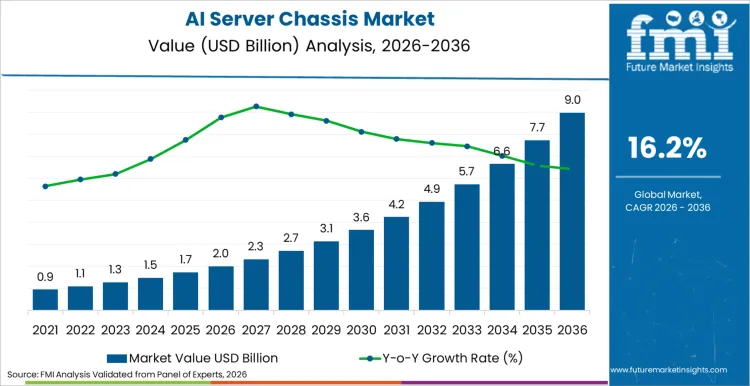
Summary of AI Server Chassis Market
What is the Long-Term Growth Outlook for the AI Server Chassis Market?
FMI projects the global AI server chassis market to expand from USD 2.0 billion in 2026 to USD 9.0 billion by 2036, registering a 16.2% CAGR. Market expansion reflects the physical embodiment of the AI hardware arms race. The chassis is no longer a commodity box but a high-engineering substrate that dictates how much silicon can be packed, cooled, and powered within a single rack unit. Its design directly limits or enables computational density.
This growth is propelled by the exponential parameter count of large language models, the shift from training-centric to inference-dense deployments requiring optimized form factors, and the economic imperative to maximize capital expenditure on compute. Demand is accelerating for chassis that are pre-validated for specific GPU/accelerator combinations, offer tool-less serviceability, and provide granular thermal and power telemetry.
FMI Research Approach: This projection is derived from FMI’s proprietary forecasting framework integrating GPU and accelerator shipment forecasts, hyperscaler capital expenditure announcements on AI infrastructure, technology adoption curves for liquid cooling, and primary interviews with ODM and data center operators.
How do FMI Analysts Expect the AI Server Chassis Market to Evolve Structurally?
FMI analysts anticipate a rapid stratification into three distinct chassis paradigms: high-density, liquid-cooled training chassis; optimized air-cooled inference chassis; and modular, disaggregated chassis for composable infrastructure. This evolution is driven by the diverging requirements of AI workload stages. The market will see consolidation around open standards like OCP DC-MHS (Open Compute Project Data Center Modular Hardware System) for volume segments, while proprietary designs will dominate the bleeding-edge performance tier.
Innovations such as chassis with integrated immersion tanks, chassis designed as structural elements of the rack itself (rack-as-a-chassis), and the use of advanced composites for electromagnetic interference (EMI) shielding and thermal conduction are redefining the product category. The chassis is becoming a firmware-managed asset with its own security and lifecycle management protocols.
FMI Research Approach: Insights are informed by analysis of OCP and Open19 specification contributions, patent filings related to thermal interface materials and structural design, and product roadmaps from leading CSPs and semiconductor companies.
Which Geographies Command the Largest Share of the AI Server Chassis Market?
China leads the global AI server chassis market, advancing at an estimated 15.4% CAGR, driven by national self-sufficiency policies in computing power and massive domestic AI model development. The United States follows with a 13.9% CAGR, underpinned by private hyperscaler investment and venture capital funding for AI hardware startups.
The United Kingdom and Japan represent high-value, innovation-centric markets with CAGRs of 13.7% and 12.7%, respectively. The UK's growth is fueled by its strong AI research sector and financial services demand for inference, while Japan’s is linked to its robotics, semiconductor, and automotive industries integrating on-premise AI.
FMI Research Approach: Country-level forecasts are built using analysis of national AI strategies, semiconductor sovereignty initiatives, corporate R&D expenditure, and the localization mandates for data processing in key sectors like finance and healthcare.
What Will Be the Market Size of AI Server Chassis by 2036?
By 2036, the AI server chassis market is expected to reach USD 9.0 billion. AI becoming a pervasive workload across all sectors, necessitating specialized hardware from the core cloud to the extreme edge, will support this growth. The retrofit of existing data center racks with AI-optimized chassis and the emergence of AI-specific prefabricated modular data centers will be significant demand drivers. Value will increasingly reside in chassis intelligence and cooling integration, not just raw metal fabrication.
FMI Research Approach: Long-term market sizing incorporates total addressable market analysis for AI servers, penetration rates of accelerated computing in enterprise, replacement cycles for existing GPU servers, and the integration value-add of smart chassis features.
What are some Globally Distinct Trends Shaping the AI Server Chassis Market?
Globally, the triumvirate of thermal density, power delivery, and rapid iteration is shaping the market. The inability of air to cool next-generation accelerators is forcing liquid cooling from an option to a chassis design prerequisite. Concurrently, delivering 1000+ watts to multiple GPUs requires novel power supply architectures, such as chassis-integrated 48V DC distribution, moving power conversion upstream.
The speed of AI silicon innovation, with major vendors releasing new architectures annually, is driving demand for chassis that support rapid GPU tray swaps and forward/backward compatibility across generations. This makes modularity and tool-less design critical for protecting infrastructure investments. Furthermore, global supply chain resilience efforts are prompting regionalization of chassis assembly near key data center hubs.
FMI Research Approach: Trend analysis is informed by tracking thermal design power (TDP) roadmaps, monitoring advancements in power electronics, analyzing product lifecycle announcements from AI silicon vendors, and reviewing trade data on chassis sub-components.
AI Server Chassis Market Key Takeaways
| Metrics | Values |
|---|---|
| Expected Value (2026E) | USD 2.0 billion |
| Projected Value (2036F) | USD 9.0 billion |
| CAGR (2026-2036) | 16.2% |
Source: Future Market Insights (FMI) analysis, based on proprietary forecasting model and primary research
Why is the AI Server Chassis Market Growing?
The disaggregation of the server into composable elements makes the chassis a strategic integration point. Hewlett Packard Enterprise’s 2026 expansion of its GreenLake for AI offering features a proprietary chassis that allows CPU, GPU, memory, and storage resources to be pooled and composed via software. This chassis is not a server but a shared enclosure for disaggregated hardware, and its unique interconnect fabric and management capabilities are central to the business model, creating a new category of chassis-driven infrastructure.
The economics of AI inference at scale demand extreme optimization. A 2026 total cost of ownership study by a tier-one investment bank concluded that for large-scale inference deployments (e.g., social media content moderation, real-time translation), the energy and real-estate cost of the chassis and its cooling system contributed over 30% of the operational expenditure. This is driving hyperscalers like AWS and Google to co-design inference-optimized chassis with ODMs like Wistron Corporation and Inventec Corporation that prioritize power efficiency and high rack density over peak thermal performance, creating a massive volume segment distinct from training hardware.
Regulatory and environmental pressures are dictating physical design. The European Union’s 2026 iteration of the Energy Efficiency Directive for data centers includes a provisional specification for maximum power draw per square meter of floor space. This "power density cap" makes the physical footprint of the chassis a critical compliance factor. Chassis designs that can pack more compute into a smaller 2D footprint, often by moving to taller 8U or custom form factors, are gaining preference in regulated markets, directly influencing design priorities.
How is AI Server Chassis Market Segmented?
The target computational density, the method for managing resultant heat, and the physical form factor that balances density with serviceability, defines the AI server chassis market segment landscape.
The 4-GPU segment dominates as the current workhorse for scalable deployment, air cooling retains a significant share for inference and legacy facilities, and the 4U rackmount form factor represents the optimal balance of density, cooling capacity, and compatibility.
Why Does the 4-GPU Density Configuration Lead the Market?
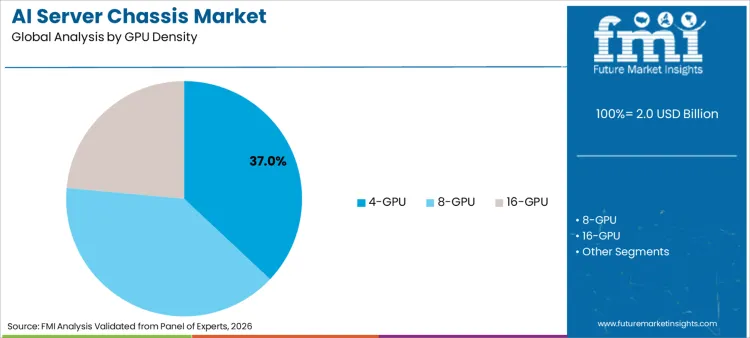
The 4-GPU chassis accounts for a 37% market share. This dominance is due to its role as the foundational building block for scalable AI cluster construction. It offers the best balance between thermal manageability, power supply availability, typically two 3kW PSUs, and compatibility with standard data center rack designs.
GIGA-BYTE Technology Co., Ltd.’s 2026 contract to supply 50,000 units of its 4-GPU air-cooled chassis to a global telco for edge AI inference deployment underscores this volume. The chassis was selected specifically for its ability to operate in telecom enclosures without liquid cooling infrastructure.
What Factors Sustain a Significant Share for Air-Cooled Designs?
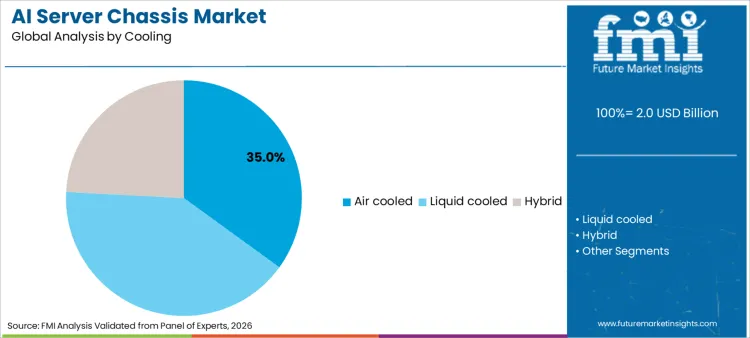
Air-cooled chassis maintain a 35% share of the cooling segment. This persistence is anchored in their lower total cost of ownership for inference workloads, operational simplicity, and suitability for deployment in edge locations or existing data centers lacking liquid cooling loops.
Dell Technologies Inc.’s 2026 launch of its XE9640 4U air-cooled chassis, designed for NVIDIA’s L40S inference GPUs, featured a partitioned wind tunnel design and high-static-pressure fans. It was benchmarked to deliver 95% of the performance of a liquid-cooled counterpart for inference models while eliminating coolant maintenance, making it economically compelling for widespread enterprise and edge deployment.
How Does the 4U Rackmount Form Factor Set the Standard?
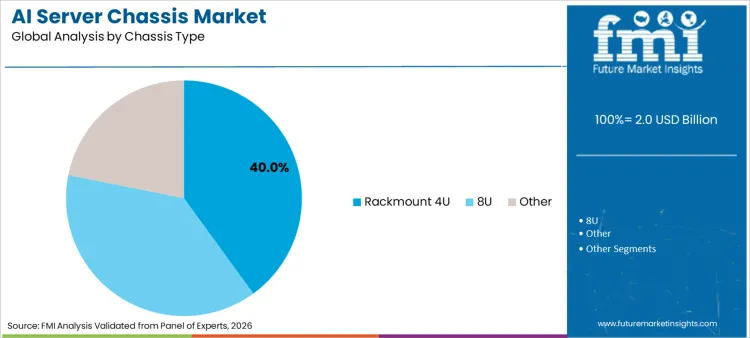
The 4U rackmount chassis commands a 40% share of the chassis type segment. Its leadership is rooted in its optimal internal volume for housing multiple large GPUs, associated power supplies, and network adapters while remaining serviceable by a single technician. The Open Compute Project’s 2026 finalization of its 4U Advanced Cooling Shelf specification has solidified this form factor as an industry standard for liquid-cooled systems.
Lenovo Group Ltd.’s ThinkSystem SD665-N V3, a 4U chassis housing 8x NVIDIA H100 GPUs with rear-door heat exchanger compatibility, is engineered to this specification, ensuring interoperability with standardized rack-level cooling and power, and driving volume adoption across cloud and enterprise buyers.
What Drivers, Restraints, Opportunities, and Trends Prevail in the AI Server Chassis Market?
Market expansion is driven by the vertical integration of cloud service providers into hardware design. Amazon Web Services’ 2026 announcement of its "Trainium2" accelerator was accompanied by the release of its corresponding chassis design specifications to its ODM partners. This chassis, optimized for AWS’s Nitro system and custom network fabric, is not sold publicly but is manufactured at scale solely for AWS. This model of CSP-specific chassis design creates colossal, captive demand streams for select ODMs while raising barriers to entry for others.
A key restraint is the soaring cost and complexity of validation and certification. Each new chassis design must undergo rigorous electromagnetic compatibility (EMC), safety (UL/CE), thermal, and signal integrity testing, often for specific geographic markets and with specific GPU combinations. A 2026 industry estimate placed the full validation cost for a new, high-density AI chassis at over USD 1.5 million and 9-12 months of time, creating a significant moat for established players with dedicated test labs and slowing the pace of new entrants.
A pivotal trend is the convergence of the chassis with the rack’s power and cooling infrastructure. Super Micro Computer’s 2026 "Rack Scale Architecture" features a chassis where the rear door is structurally part of the enclosure and contains the entire liquid cooling and 48V DC power distribution system. This "chassis-as-a-rack" approach minimizes interconnect losses, simplifies deployment to a single cable for facility power and network, and represents a move towards fully integrated, appliance-like AI compute blocks.
The trend toward specialized silicon for AI creates opportunities for custom, small-form-factor chassis. The deployment of Google’s TPU v6 pods and custom AI chips from startups requires chassis designs that deviate from standard PCIe-based GPU layouts. ODMs like Quanta and Inventec are establishing dedicated business units to provide low-volume, high-mix chassis design services for these bespoke silicon projects, representing a high-margin segment.
Analysis of AI Server Chassis Market by Key Countries
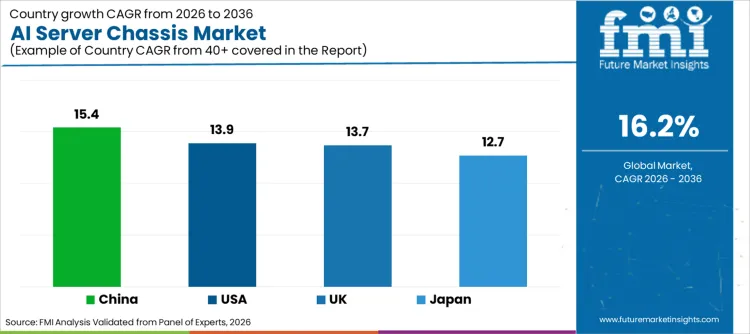
| Country | CAGR (2026-2036) |
|---|---|
| China | 15.4% |
| USA | 13.9% |
| UK | 13.7% |
| Japan | 12.7% |
Source: Future Market Insights (FMI) analysis, based on proprietary forecasting model and primary research
How is China's Computing Power Infrastructure Policy Structuring a Domestic Supply Chain?
China’s leading 15.4% CAGR is orchestrated by its National Computing Power Network initiative. The 2026–2030 implementation plan includes a Chassis Localization Directive requiring that 70% of the components (by value) in AI servers deployed in state-mandated computing hubs be domestically sourced.
This has triggered joint ventures between domestic OEMs like Inspur and local suppliers of sheet metal, connectors, and fans. These partnerships are producing "national standard" chassis that may not lead in absolute performance but meet localization thresholds, creating a parallel, policy-driven market that insulates domestic ODMs from international competition for the largest domestic projects.
What Role Does USA’s Venture Capital Ecosystem Play in Driving Niche Chassis Innovation?
USA”s 13.9% CAGR is characterized not only by hyperscaler demand but also by a vibrant venture capital ecosystem funding AI hardware startups. Companies developing novel optical interconnects, liquid immersion solutions, or exotic cooling (e.g., direct-to-chip two-phase) require chassis that are fundamentally different from OCP standards.
In 2026, a consortium of VCs established a shared Advanced Prototyping Lab in Silicon Valley, featuring chassis fabrication tools and testing equipment. This lab allows portfolio companies to iterate on mechanical designs rapidly without contracting with traditional ODMs early on, fostering a culture of radical chassis innovation that later gets productionized by established manufacturers.
How Does the UK's Financial Services Sector Dictate Specialized Chassis Requirements?
The UK’s 13.7% CAGR is heavily influenced by the unique needs of its dominant financial services and scientific research sectors. High-frequency trading firms require AI chassis with extreme low-latency characteristics, which often involves custom PCB layouts and shielding that influence the chassis design.
In 2026, a leading London-based hedge fund issued a specification for an AI inference chassis that included mu-metal shielding to prevent electromagnetic interference between servers, a requirement not found in typical data center deployments.
Research institutions like the UK’s Science and Technology Facilities Council require chassis that can be easily modified to accept prototype accelerator cards, driving demand for chassis with tool-less, flexible PCIe backplanes from suppliers who can cater to low-volume, high-variety orders.
Why is Japan's Focus on Robotics and Automotive a Key Driver for Ruggedized Chassis Design?
Japan’s 12.7% CAGR is closely tied to its world-leading robotics and automotive industries, which are integrating high-performance AI at the edge. Factory-floor robots and autonomous vehicle testing systems require AI chassis that meet industrial durability standards and wide temperature ranges.
Fanuc and Toyota’s 2026 joint specification for an Industrial AI Appliance required a chassis meeting IP52 dust/water resistance and IEC 60068-2-6 vibration standards, with corrosion-resistant coatings for factory environments. This drives Japanese ODMs and local subsidiaries of global players to develop ruggedized chassis lines distinct from their data-center-focused products, representing a specialized, high-reliability segment.
What is the Competition Outlook for AI Server Chassis?
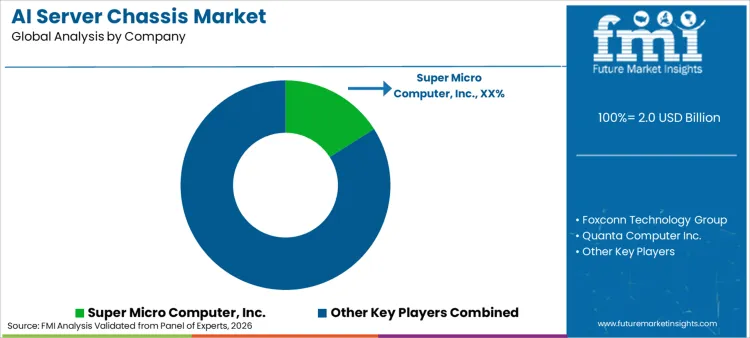
Competitive intensity reflects the market's split between volume ODM manufacturing for hyperscalers and branded, feature-differentiated systems for enterprises. The landscape is consolidating among top ODMs with the scale to meet CSP demands, while branded OEMs compete on integrated solutions, global service, and enterprise software stacks. Competition is increasingly based on time-to-market with support for new GPUs, depth of thermal engineering expertise, and the ability to offer global logistics and integrated liquid cooling solutions.
Server OEMs adapting existing general-purpose chassis designs to accommodate the first generations of AI accelerators, often leading to thermal and power compromises defined strategic evolution prior to 2025. Observable strategic direction for 2026 and beyond is the formation of deep, exclusive partnerships between ODMs and specific AI silicon vendors. For example, Wistron Corporation’s 2025 strategic alliance with a leading AI accelerator startup involved dedicating a manufacturing line and engineering team to produce chassis optimized solely for that startup’s products, creating a lock-in advantage.
Strategic leadership is shifting toward providing the chassis as part of a full-stack AI system solution. Hewlett Packard Enterprise’s 2026 "AI Factory" portfolio bundles its Apollo chassis with specific GPUs, networking, and the HPE Machine Learning Development Environment software, pre-validated and supported as a single SKU. This simplifies procurement and deployment for enterprises, moving competition from component-level specifications to solution-level outcomes and time-to-value.
Recent Developments
- Foxconn Technology Group announced a USD 200 million investment in February 2026 to build a dedicated AI server chassis plant in Wisconsin, USA, aiming to supply local assembly for North American hyperscalers and meet "Made in USA" procurement preferences for federal AI projects.
- Inventec Corporation and 3M Company announced a joint development agreement in late 2025 to create a chassis specifically designed for 3M’s Novec 7100 immersion fluid, including fluid-tight seals, integrated tanking, and a fluid management system, targeting the growing immersion cooling segment.
- Wiwynn Corporation introduced its "SV7220G3" 2U hybrid cooling chassis in Q1 2026, which supports air cooling for CPUs and NVMe drives while incorporating a direct-to-chip liquid cooling loop for GPUs, offering a migration path for data centers not ready for full liquid cooling.
Key Players Profiled
- Super Micro Computer, Inc.
- Foxconn Technology Group
- Quanta Computer Inc.
- Wistron Corporation
- Inventec Corporation
- Wiwynn Corporation
- GIGA-BYTE Technology Co., Ltd.
- Dell Technologies Inc.
- Hewlett Packard Enterprise
- Lenovo Group Ltd.
Market Definition
The AI server chassis market comprises revenue generated from the design, manufacture, and supply of structural enclosures specifically engineered to house and support the operation of servers dedicated to artificial intelligence and high-performance computing workloads.
These chassis are characterized by reinforced structures to support heavy accelerators, advanced thermal management features (high-flow fan walls, liquid cooling manifolds), and specialized power distribution. The market includes rackmount units of various heights such as 4U and 8U and specialized form factors.
The market scope covers chassis sold to ODMs, OEMs, CSPs, and enterprises for building AI training and inference servers. Revenue includes value from the core metal structure, integrated cooling components power supply bays, and chassis management controllers. The market excludes general-purpose server chassis not designed for high-density accelerators, the accelerators themselves, and complete AI server systems unless the chassis is sold as a separate component.
Scope of Report
| Items | Values |
|---|---|
| Quantitative Units | USD 2.0 billion |
| GPU Density | 4-GPU; 8-GPU; 16-GPU |
| Cooling | Air cooled; Liquid cooled; Hybrid |
| Chassis Type | Rackmount 4U; 8U; Other |
| Regions Covered | North America, Western Europe, Eastern Europe, East Asia, South Asia & Pacific, Latin America, Middle East & Africa |
| Countries | China, USA, UK, Japan and 40+ countries |
| Key Companies | Super Micro Computer, Inc.; Foxconn Technology Group; Quanta Computer Inc.; Wistron Corporation; Inventec Corporation; Wiwynn Corporation; GIGA-BYTE Technology Co., Ltd.; Dell Technologies Inc.; Hewlett Packard Enterprise; Lenovo Group Ltd. |
Source: Future Market Insights (FMI) analysis, based on proprietary forecasting model and primary research
AI Server Chassis Market Key Segments
By GPU Density
- 4-GPU
- 8-GPU
- 16-GPU
By Cooling
- Air cooled
- Liquid cooled
- Hybrid
By Chassis Type
- Rackmount 4U
- 8U
- Other
By Region
- North America
- Western Europe
- Eastern Europe
- East Asia
- South Asia & Pacific
- Latin America
- Middle East & Africa
Bibliography
- Open Compute Project (OCP). (2026). Data Center Modular Hardware System (DC-MHS) and Advanced Cooling Shelf Specifications, Revision 3.0.
- NVIDIA Corporation. (2026). DGX Platform System Architecture: Blackwell Series Design Guide.
- European Commission. (2026). Delegated Regulation on Energy Efficiency Standards for Data Center IT Equipment.
- USA Department of Energy. (2026). Report on AI Compute Infrastructure: Energy and Sustainability Implications.
- IDC. (2026). Worldwide AI Server Forecast and Taxonomy, 2026-2036.
Frequently Asked Questions
What is the expected value of the AI server chassis market in 2026?
The AI server chassis market is expected to reach USD 2.0 billion in 2026, driven by the rapid build-out of dedicated AI infrastructure by cloud providers and enterprises.
What is the projected value by 2036 and CAGR from 2026 to 2036?
By 2036, the market is projected to reach USD 9.0 billion, expanding at a CAGR of 16.2% between 2026 and 2036.
Why is chassis design so critical for AI servers compared to general-purpose servers?
AI servers pack multiple high-power-density accelerators (GPUs) generating immense heat in a confined space. The chassis must provide structural support, efficient thermal dissipation (often via liquid cooling), and clean power delivery to prevent performance throttling. Its design is inextricably linked to the achievable computational density and reliability of the system.
What is driving the growth of liquid-cooled and hybrid chassis designs?
The thermal design power of leading AI accelerators has surpassed the cooling capacity of practical air-cooling solutions within standard rack units. Liquid cooling (direct-to-chip or immersion) is becoming necessary to unlock full performance and achieve higher rack densities. Hybrid designs offer a transitional path, cooling only the hottest components (GPUs) with liquid while using air for the rest.
Which segment currently dominates and why?
The 4-GPU, air-cooled, 4U rackmount chassis currently holds significant shares across segments. It represents the most common, scalable, and infrastructure-compatible building block for deploying AI workloads, balancing performance, cost, and ease of integration into existing data centers. It serves as the workhorse for a wide range of inference and smaller-scale training tasks.
Preview the report firsthand - request a free sample
Get SampleGet the brochure for pricing and purchase details.
Get PDFTable of Content
- Executive Summary
- Global Market Outlook
- Demand-side Trends
- Supply-side Trends
- Technology Roadmap Analysis
- Analysis and Recommendations
- Market Overview
- Market Coverage / Taxonomy
- Market Definition / Scope / Limitations
- Market Background
- Market Dynamics
- Drivers
- Restraints
- Opportunity
- Trends
- Scenario Forecast
- Demand in Optimistic Scenario
- Demand in Likely Scenario
- Demand in Conservative Scenario
- Opportunity Map Analysis
- Product Life Cycle Analysis
- Supply Chain Analysis
- Investment Feasibility Matrix
- Value Chain Analysis
- PESTLE and Porter’s Analysis
- Regulatory Landscape
- Regional Parent Market Outlook
- Production and Consumption Statistics
- Import and Export Statistics
- Market Dynamics
- Global Market Analysis 2021 to 2025 and Forecast, 2026 to 2036
- Historical Market Size Value (USD Million) Analysis, 2021 to 2025
- Current and Future Market Size Value (USD Million) Projections, 2026 to 2036
- Y-o-Y Growth Trend Analysis
- Absolute $ Opportunity Analysis
- Global Market Pricing Analysis 2021 to 2025 and Forecast 2026 to 2036
- Global Market Analysis 2021 to 2025 and Forecast 2026 to 2036, By GPU Density
- Introduction / Key Findings
- Historical Market Size Value (USD Million) Analysis By GPU Density , 2021 to 2025
- Current and Future Market Size Value (USD Million) Analysis and Forecast By GPU Density , 2026 to 2036
- 4-GPU
- 8-GPU
- 16-GPU
- 4-GPU
- Y-o-Y Growth Trend Analysis By GPU Density , 2021 to 2025
- Absolute $ Opportunity Analysis By GPU Density , 2026 to 2036
- Global Market Analysis 2021 to 2025 and Forecast 2026 to 2036, By Cooling
- Introduction / Key Findings
- Historical Market Size Value (USD Million) Analysis By Cooling, 2021 to 2025
- Current and Future Market Size Value (USD Million) Analysis and Forecast By Cooling, 2026 to 2036
- Air cooled
- Liquid cooled
- Hybrid
- Air cooled
- Y-o-Y Growth Trend Analysis By Cooling, 2021 to 2025
- Absolute $ Opportunity Analysis By Cooling, 2026 to 2036
- Global Market Analysis 2021 to 2025 and Forecast 2026 to 2036, By Chassis Type
- Introduction / Key Findings
- Historical Market Size Value (USD Million) Analysis By Chassis Type, 2021 to 2025
- Current and Future Market Size Value (USD Million) Analysis and Forecast By Chassis Type, 2026 to 2036
- Rackmount 4U
- 8U
- Other
- Rackmount 4U
- Y-o-Y Growth Trend Analysis By Chassis Type, 2021 to 2025
- Absolute $ Opportunity Analysis By Chassis Type, 2026 to 2036
- Global Market Analysis 2021 to 2025 and Forecast 2026 to 2036, By Region
- Introduction
- Historical Market Size Value (USD Million) Analysis By Region, 2021 to 2025
- Current Market Size Value (USD Million) Analysis and Forecast By Region, 2026 to 2036
- North America
- Latin America
- Western Europe
- Eastern Europe
- East Asia
- South Asia and Pacific
- Middle East & Africa
- Market Attractiveness Analysis By Region
- North America Market Analysis 2021 to 2025 and Forecast 2026 to 2036, By Country
- Historical Market Size Value (USD Million) Trend Analysis By Market Taxonomy, 2021 to 2025
- Market Size Value (USD Million) Forecast By Market Taxonomy, 2026 to 2036
- By Country
- USA
- Canada
- Mexico
- By GPU Density
- By Cooling
- By Chassis Type
- By Country
- Market Attractiveness Analysis
- By Country
- By GPU Density
- By Cooling
- By Chassis Type
- Key Takeaways
- Latin America Market Analysis 2021 to 2025 and Forecast 2026 to 2036, By Country
- Historical Market Size Value (USD Million) Trend Analysis By Market Taxonomy, 2021 to 2025
- Market Size Value (USD Million) Forecast By Market Taxonomy, 2026 to 2036
- By Country
- Brazil
- Chile
- Rest of Latin America
- By GPU Density
- By Cooling
- By Chassis Type
- By Country
- Market Attractiveness Analysis
- By Country
- By GPU Density
- By Cooling
- By Chassis Type
- Key Takeaways
- Western Europe Market Analysis 2021 to 2025 and Forecast 2026 to 2036, By Country
- Historical Market Size Value (USD Million) Trend Analysis By Market Taxonomy, 2021 to 2025
- Market Size Value (USD Million) Forecast By Market Taxonomy, 2026 to 2036
- By Country
- Germany
- UK
- Italy
- Spain
- France
- Nordic
- BENELUX
- Rest of Western Europe
- By GPU Density
- By Cooling
- By Chassis Type
- By Country
- Market Attractiveness Analysis
- By Country
- By GPU Density
- By Cooling
- By Chassis Type
- Key Takeaways
- Eastern Europe Market Analysis 2021 to 2025 and Forecast 2026 to 2036, By Country
- Historical Market Size Value (USD Million) Trend Analysis By Market Taxonomy, 2021 to 2025
- Market Size Value (USD Million) Forecast By Market Taxonomy, 2026 to 2036
- By Country
- Russia
- Poland
- Hungary
- Balkan & Baltic
- Rest of Eastern Europe
- By GPU Density
- By Cooling
- By Chassis Type
- By Country
- Market Attractiveness Analysis
- By Country
- By GPU Density
- By Cooling
- By Chassis Type
- Key Takeaways
- East Asia Market Analysis 2021 to 2025 and Forecast 2026 to 2036, By Country
- Historical Market Size Value (USD Million) Trend Analysis By Market Taxonomy, 2021 to 2025
- Market Size Value (USD Million) Forecast By Market Taxonomy, 2026 to 2036
- By Country
- China
- Japan
- South Korea
- By GPU Density
- By Cooling
- By Chassis Type
- By Country
- Market Attractiveness Analysis
- By Country
- By GPU Density
- By Cooling
- By Chassis Type
- Key Takeaways
- South Asia and Pacific Market Analysis 2021 to 2025 and Forecast 2026 to 2036, By Country
- Historical Market Size Value (USD Million) Trend Analysis By Market Taxonomy, 2021 to 2025
- Market Size Value (USD Million) Forecast By Market Taxonomy, 2026 to 2036
- By Country
- India
- ASEAN
- Australia & New Zealand
- Rest of South Asia and Pacific
- By GPU Density
- By Cooling
- By Chassis Type
- By Country
- Market Attractiveness Analysis
- By Country
- By GPU Density
- By Cooling
- By Chassis Type
- Key Takeaways
- Middle East & Africa Market Analysis 2021 to 2025 and Forecast 2026 to 2036, By Country
- Historical Market Size Value (USD Million) Trend Analysis By Market Taxonomy, 2021 to 2025
- Market Size Value (USD Million) Forecast By Market Taxonomy, 2026 to 2036
- By Country
- Kingdom of Saudi Arabia
- Other GCC Countries
- Turkiye
- South Africa
- Other African Union
- Rest of Middle East & Africa
- By GPU Density
- By Cooling
- By Chassis Type
- By Country
- Market Attractiveness Analysis
- By Country
- By GPU Density
- By Cooling
- By Chassis Type
- Key Takeaways
- Key Countries Market Analysis
- USA
- Pricing Analysis
- Market Share Analysis, 2025
- By GPU Density
- By Cooling
- By Chassis Type
- Canada
- Pricing Analysis
- Market Share Analysis, 2025
- By GPU Density
- By Cooling
- By Chassis Type
- Mexico
- Pricing Analysis
- Market Share Analysis, 2025
- By GPU Density
- By Cooling
- By Chassis Type
- Brazil
- Pricing Analysis
- Market Share Analysis, 2025
- By GPU Density
- By Cooling
- By Chassis Type
- Chile
- Pricing Analysis
- Market Share Analysis, 2025
- By GPU Density
- By Cooling
- By Chassis Type
- Germany
- Pricing Analysis
- Market Share Analysis, 2025
- By GPU Density
- By Cooling
- By Chassis Type
- UK
- Pricing Analysis
- Market Share Analysis, 2025
- By GPU Density
- By Cooling
- By Chassis Type
- Italy
- Pricing Analysis
- Market Share Analysis, 2025
- By GPU Density
- By Cooling
- By Chassis Type
- Spain
- Pricing Analysis
- Market Share Analysis, 2025
- By GPU Density
- By Cooling
- By Chassis Type
- France
- Pricing Analysis
- Market Share Analysis, 2025
- By GPU Density
- By Cooling
- By Chassis Type
- India
- Pricing Analysis
- Market Share Analysis, 2025
- By GPU Density
- By Cooling
- By Chassis Type
- ASEAN
- Pricing Analysis
- Market Share Analysis, 2025
- By GPU Density
- By Cooling
- By Chassis Type
- Australia & New Zealand
- Pricing Analysis
- Market Share Analysis, 2025
- By GPU Density
- By Cooling
- By Chassis Type
- China
- Pricing Analysis
- Market Share Analysis, 2025
- By GPU Density
- By Cooling
- By Chassis Type
- Japan
- Pricing Analysis
- Market Share Analysis, 2025
- By GPU Density
- By Cooling
- By Chassis Type
- South Korea
- Pricing Analysis
- Market Share Analysis, 2025
- By GPU Density
- By Cooling
- By Chassis Type
- Russia
- Pricing Analysis
- Market Share Analysis, 2025
- By GPU Density
- By Cooling
- By Chassis Type
- Poland
- Pricing Analysis
- Market Share Analysis, 2025
- By GPU Density
- By Cooling
- By Chassis Type
- Hungary
- Pricing Analysis
- Market Share Analysis, 2025
- By GPU Density
- By Cooling
- By Chassis Type
- Kingdom of Saudi Arabia
- Pricing Analysis
- Market Share Analysis, 2025
- By GPU Density
- By Cooling
- By Chassis Type
- Turkiye
- Pricing Analysis
- Market Share Analysis, 2025
- By GPU Density
- By Cooling
- By Chassis Type
- South Africa
- Pricing Analysis
- Market Share Analysis, 2025
- By GPU Density
- By Cooling
- By Chassis Type
- USA
- Market Structure Analysis
- Competition Dashboard
- Competition Benchmarking
- Market Share Analysis of Top Players
- By Regional
- By GPU Density
- By Cooling
- By Chassis Type
- Competition Analysis
- Competition Deep Dive
- Super Micro Computer, Inc.
- Overview
- Product Portfolio
- Profitability by Market Segments (Product/Age /Sales Channel/Region)
- Sales Footprint
- Strategy Overview
- Marketing Strategy
- Product Strategy
- Channel Strategy
- Foxconn Technology Group
- Quanta Computer Inc.
- Wistron Corporation
- Inventec Corporation
- Wiwynn Corporation
- GIGA-BYTE Technology Co., Ltd.
- Dell Technologies Inc.
- Hewlett Packard Enterprise
- Super Micro Computer, Inc.
- Competition Deep Dive
- Assumptions & Acronyms Used
- Research Methodology


