

- Market Size (2026)
- USD 728.8 Mn
- Forecast (2036)
- USD 1355.3 Mn
- CAGR (2026 to 2036)
- 6.4%
Air Suspension Height Control Valve Components Market Size, Market Forecast and Outlook By FMI
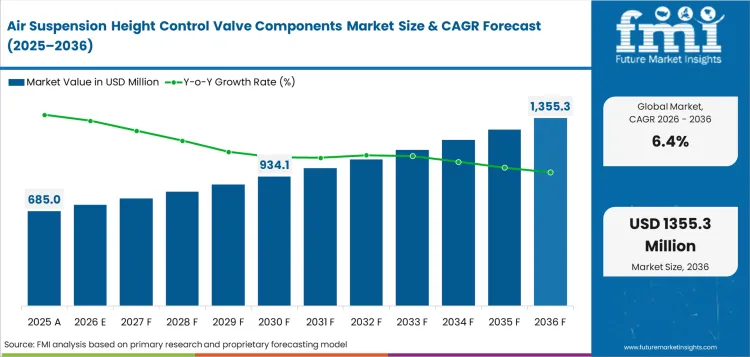
The air suspension height control valve components market size stood at USD 685.0 million in 2025 and is projected to reach USD 728.8 million in 2026. Industry is forecast to reach USD 1,355.3 million by 2036 at 6.4% CAGR. By sales channel, OEM fitment is estimated to account for 68.9% share in 2026. Pneumatic control is anticipated to represent 62.5% share of control type in 2026.
Summary of the Air Suspension Height Control Valve Components Market
- Demand and Growth Drivers
- Heavy truck and trailer platforms are using leveling valves to protect ride height under changing freight loads.
- Premium buses and coaches are shifting toward electronic air suspension as operators need repeatable kneeling and ride comfort.
- Fleet service work is driving replacement demand as linkages and fittings face road dust and air line moisture.
- Product and Segment View
- OEM fitment is projected to account for 68.9% share in 2026 through early validation with chassis and suspension layouts.
- Pneumatic control is anticipated to capture 62.5% share in 2026 due to mechanical air logic suiting cost and service needs.
- Mechanical valves are forecast to represent 41.8% share in 2026 since fleets need proven parts with fast service access.
- Geography and Competitive Outlook
- India is projected to record 8.1% CAGR by 2036, driven by commercial vehicle output and trailer fleets expanding.
- China is expected to expand at 7.4% CAGR by 2036, led by bus and heavy truck programs adopting air leveling parts.
- Companies such as ZF, SAF-HOLLAND, Hendrickson and Link Manufacturing define competition across electronic control and mechanical valve replacement.
- Analyst Opinion
- Nikhil Kaitwade, Principal Consultant for Industrial Automation at FMI, observes, "Air suspension height control valves now define how consistently heavy vehicles hold ride height under load. Suppliers will win by proving seal durability, low air loss and repeat calibration accuracy. Future value will move toward integrated valves able to reduce service time while keeping mechanical fallbacks easy for fleets."
- Air Suspension Height Control Valve Components Market Value Analysis
- Valve value is shifting from basic leveling bodies toward integrated units combining pressure sensing with air control.
- Manufacturer spending is tied to chassis stability as freight loads change across haulage and bus service cycles.
- Component makers are linking automotive valve quality with seal material and calibration range as air suspension becomes more electronic.
- Demand comes from truck OEMs and replacement channels seeking stable ride height with limited air leakage.
Key Takeaways, Market Size, and Forecast
- The air suspension height control valve components market was valued at USD 685.0 million in 2025.
- The air suspension height control valve components industry value is forecast to reach USD 1,355.3 million by 2036.
- From 2026 to 2036, the sector is projected to expand at 6.4% CAGR.
- Industry revenue is forecast to create an incremental opportunity of USD 626.5 million from 2026 to 2036.
- OEM fitment is set to account for 68.9% share of sales channel in 2026.
- Pneumatic control is anticipated to represent 62.5% share of control type in 2026.
- India is predicted to record 8.1% CAGR by 2036, with China at 7.4% CAGR during the forecast.
Height control valves are moving from simple leveling parts into ride height control modules for trucks and trailers. Demand is also rising in buses and premium passenger cars, which require different fitment approaches. In June 2025, ZF reported that its fifth-generation OptiRide ECAS entered serial production for Hyundai buses, featuring a smart pneumatic actuator that integrates solenoid valves and pressure sensors.
In September 2025, Link Manufacturing announced that its SmartValve became a factory-installed option on International Motors LT Series trucks. Earlier, in January 2024, SAF‑HOLLAND confirmed that its trailer air ride suspensions would transition to Haldex PR+ height control valves starting in March 2024. Suppliers with valve sealing depth and ride height calibration support are likely to gain preference in air suspension system components programs.
Air Suspension Height Control Valve Components Market Definition
Air suspension height control valve components cover devices and subparts regulating air flow into air springs so a vehicle holds a selected ride height. Scope includes mechanical valves, electronic valves, solenoid blocks, height sensors and linkage kits used in air suspension systems. Revenue includes OEM fitment, replacement valves and fleet service kits. Pure air springs and shock absorbers are excluded unless sold as a valve assembly.
Air Suspension Height Control Valve Components Market Inclusions
Scope includes mechanical ride height valves, electronic control valves, dump valves, solenoid valve blocks and sensor linkages for trucks, trailers, buses and passenger cars. Aluminum, polymer and brass valve bodies are included. OEM and aftermarket channels are included if revenue relates to ride height control components. Fleet service kits are included only if valve parts are identifiable.
Air Suspension Height Control Valve Components Market Exclusions
Scope excludes air springs, compressors, shock absorbers and full suspension modules sold without identifiable valve revenue. General automotive engine valves are outside scope because engine airflow control differs from ride height control. Brake valves and air dryers are excluded unless packaged with a height control function. Software-only suspension calibration tools are excluded from component revenue.
Air Suspension Height Control Valve Components Market Research Methodology
- Primary Research: FMI analysts reviewed chassis sourcing, fleet service patterns, valve replacement cycles and truck platform validation practices.
- Desk Research: Official vehicle production, commercial vehicle output, supplier announcements and air suspension product evidence guided country and company mapping.
- Market Sizing and Forecasting: Forecast values used vehicle output, air suspension fitment rates, valve replacement timing and average component price checks.
- Data Validation: Checks compared 2026 value with 2036 value, segment share balance and country growth patterns against commercial vehicle production signals.
Why is the Air Suspension Height Control Valve Components Market Growing?
- Heavy trucks and buses need stable ride height as cargo weight changes during freight and passenger service.
- Electronic height control is expanding as air suspension system components shift toward sensor-based leveling.
- Service replacement is rising as commercial vehicle suspension overhaul services replace worn valves during suspension repair.
Commercial vehicle platforms give height control valves a clearer role in load stability and driver comfort. OICA placed global commercial vehicle production at 24.8 million units in 2024. A large commercial chassis pool creates steady fitment and replacement openings for valves keeping air springs at the correct height. ZF reported in June 2025, OptiRide ECAS had crossed 6.5 million sold units before its fifth-generation bus system entered serial production. Link Manufacturing said in September 2025 that SmartValve became a factory-installed option on International Motors LT Series trucks. SAF-HOLLAND’s January 2024 notice said SAF trailer air ride suspensions specified with height control valves would use Haldex PR Plus HCVs from March 2024. These examples reflect a shift from simple mechanical leveling toward validated electronic and branded replacement options.
Market Segmentation Analysis
- Mechanical valves are projected to capture 41.8% share in 2026 due to service teams preferring simple parts adjustable without software tools.
- Heavy trucks are anticipated to hold 34.7% share in 2026 since tractor and vocational platforms depend on air ride for loaded stability.
- Pneumatic control is forecast to account for 62.5% share in 2026 as air logic meeting most ride height needs with limited electronic content.
- OEM fitment is projected to represent 68.9% share in 2026, driven by valve layout required to match chassis geometry before vehicle launch.
- Aluminum bodies are expected to hold 37.6% share in 2026 through durability and pressure stability in heavy vehicle duty.
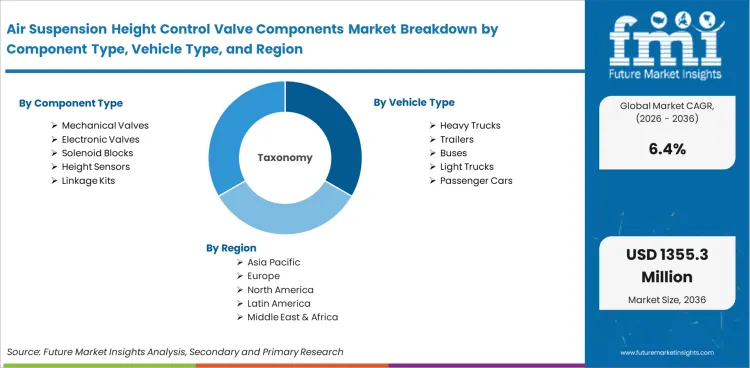
Market segmentation is divided into five parent groups based on how ride height parts are specified and serviced. Component type separates mechanical valves from solenoid blocks and sensors. Vehicle type shows why truck, trailer and bus platforms create different airflow needs. Control type separates pneumatic formats from electronic units tied to automotive sensors. Sales channel explains value built into vehicle launch programs and replacement kits. Material captures pressure strength and service cost across automotive suspension control arms and nearby chassis parts.
Insights into Air Suspension Height Control Valve Components Market by Component Type
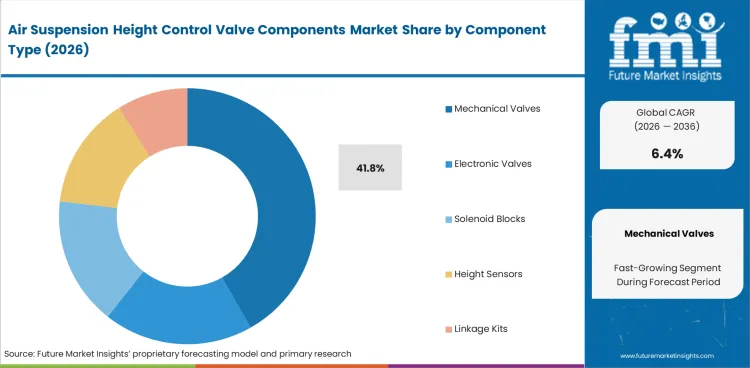
- Mechanical valves are projected to account for 41.8% share in 2026, led by proven lever-based designs allowing quick ride height adjustment during fleet service work.
- Solenoid blocks gain selective value as electronic control units need compact air routing, pressure feedback and cleaner packaging near air supply modules.
Insights into Air Suspension Height Control Valve Components Market by Vehicle Type
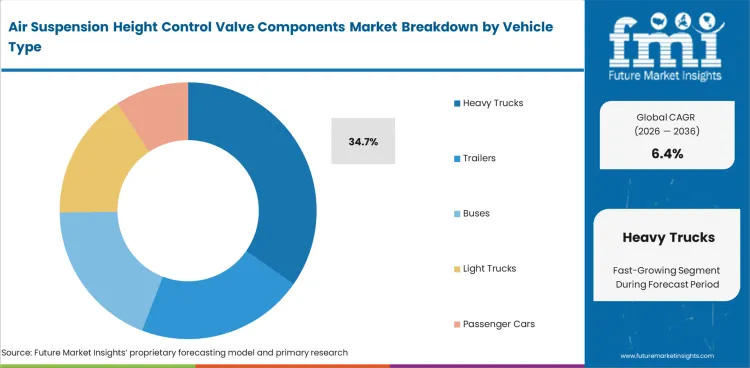
- Heavy trucks are anticipated to account for 34.7% share in 2026, reflected by loaded axle control making ride height valves critical for tractors and vocational chassis.
- Trailers form a steady replacement pool since air ride units operate across freight cycles and often need valve kits during suspension service.
Insights into Air Suspension Height Control Valve Components Market by Control Type
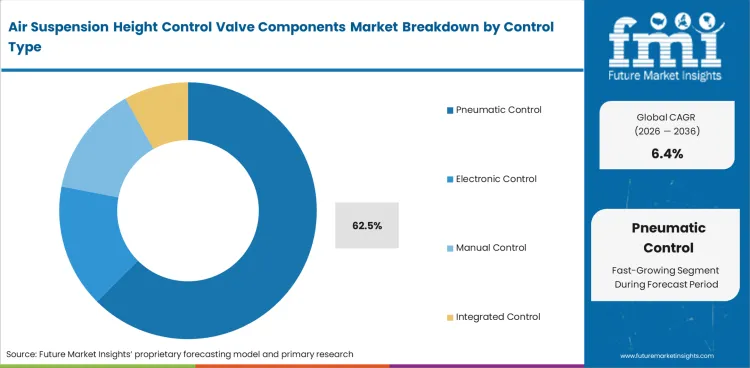
- Pneumatic control is projected to account for 62.5% share in 2026 due to mechanical air circuits giving fleets easy diagnosis and lower replacement cost.
- Electronic control is gaining traction as smart valves combine sensor input with air routing, especially near automotive air compressor units.
Insights into Air Suspension Height Control Valve Components Market by Sales Channel
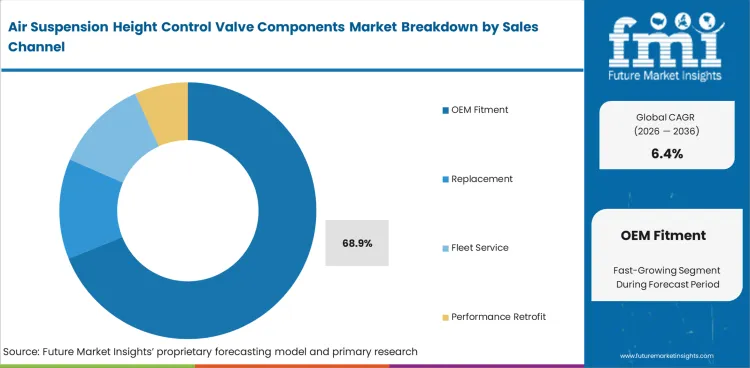
- OEM fitment is projected to account for 68.9% share in 2026 since ride height valve placement must be validated with chassis brackets and air line routing.
- Fleet service remains important as carriers replace valve bodies and linkages during routine checks tied to telematics and connectivity control unit systems.
Insights into Air Suspension Height Control Valve Components Market by Material
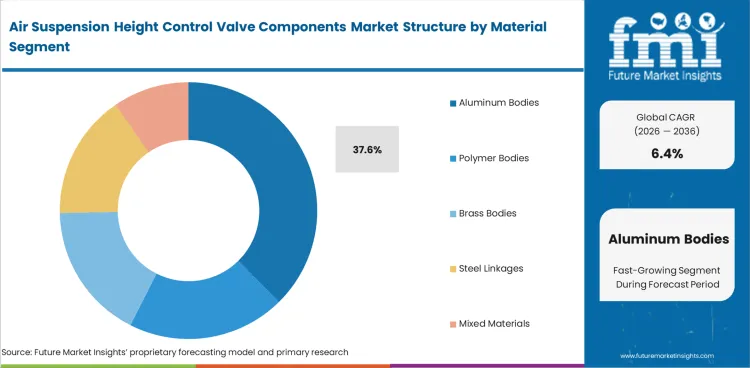
- Aluminum bodies are projected to account for 37.6% share in 2026 as metal housings handle pressure cycling and harsh underbody exposure.
- Polymer bodies have selective use as suppliers reduce weight and simplify molded features around control arm and suspension joint bearings.
Air Suspension Height Control Valve Components Market Drivers, Restraints and Opportunities
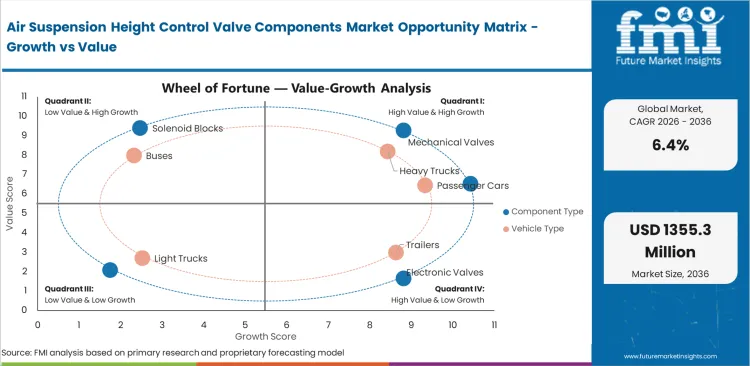
- Ride height stability is raising valve calibration needs as truck platforms handle wider payload variation.
- Air quality remains a service limit as moisture and dirt damage seals inside lower cost valve units.
- Integrated control creates opportunity as OEMs combine height sensors and valves inside compact suspension modules.
Ride height valves are taking on more importance as truck and trailer makers connect load control with tire wear. OEMs specify valve behavior early because bracket position and air-line routing affect ride height accuracy. Suppliers with repeat leak testing can protect service intervals and reduce air loss for fleet operators. Service risk remains visible because low-priced valves can lose calibration after linkage damage or seal contamination. Future value will move toward electronic valves that cut air loss and simplify fifth wheel alignment. Adjacent demand relates to air suspension system components and commercial vehicle suspension overhaul services.
Technology Adoption and Automation Penetration Analysis
Technology use is shifting toward electronic height control and factory-calibrated valve modules. Link Manufacturing said in September 2025, SmartValve became a factory-installed option on International Motors LT Series trucks. International became the fourth major OEM route for the system after Freightliner, Kenworth and Peterbilt. Factory option codes show electronic height control moving beyond retrofit demand into production line specification. SmartValve adoption changes service needs because fleet workshops must handle both air systems and software setup. Adjacent chassis control trends relate to active suspension damper actuator systems and adaptive suspension damper programs.
Application-wise Equipment Deployment Analysis
Equipment use is strongest in heavy trucks and trailers because ride height affects load balance and tire wear. Buses create a separate adoption route as kneeling and curb alignment need repeat height movement. SAF-HOLLAND said in January 2024 that SAF trailer air ride suspensions specified with height control valves would use Haldex PR+ HCVs from March 2024. The notice confirms direct production fitment for trailer suspension programs. Trailer and bus demand will favor valve parts that hold calibration under road spray and repeated air pressure cycles. Wider chassis control investment is anticipated to drive bus and coach suspension bearing components and active stabilizer bar actuator demand over the forecast period.
Analysis of Air Suspension Height Control Valve Components Market by Key Countries
.webp "Top Country Growth Comparison Air Suspension Height Control Valve Components Market Cagr (2026 2036)")
| Country | CAGR |
|---|---|
| India | 8.1% |
| China | 7.4% |
| Mexico | 6.9% |
| United States | 6.3% |
| Germany | 5.8% |
| South Korea | 5.5% |
| Japan | 5.1% |
Source: Future Market Insights, 2026.
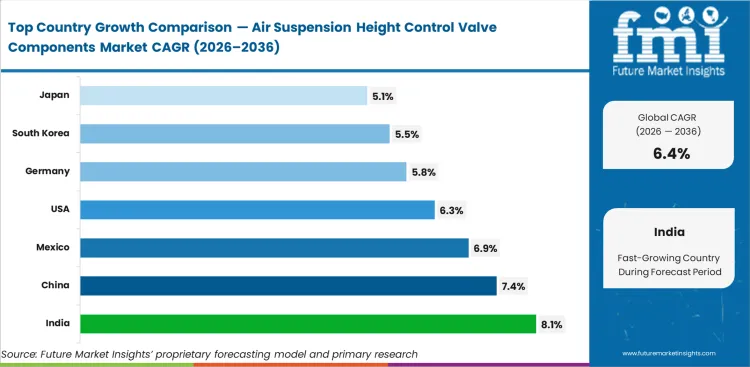
Air Suspension Height Control Valve Components Market CAGR Analysis by Country
- India is projected to record 8.1% CAGR by 2036 due to truck output and trailer fleets creating wider valve replacement needs.
- China is expected to expand at 7.4% CAGR by 2036, led by bus and heavy vehicle production keeping OEM fitment active.
- Mexico is forecast to grow at 6.9% CAGR by 2036 as export assembly supports local suspension component supply.
- United States is expected to advance at 6.3% CAGR by 2036 as Class 8 tractor options increase electronic height control use.
- Germany is projected to rise at 5.8% CAGR by 2036 since suppliers focus on premium truck and bus control systems.
- South Korea are forecast at 5.5% CAGR by 2036 as bus exports and chassis programs support steady valve integration.
- Japan is expected to post 5.1% CAGR by 2036 through mature vehicle platforms favor measured replacement and selective electronic control.
Country performance differs by commercial vehicle output, bus fleet needs and local supplier depth. India and China track above global pace because vehicle production growth leaves more room for new air suspension fitment. Mexico records stronger readiness as North American export assembly pulls component localization. Germany, Japan and South Korea grow below the global line as mature engineering systems already carry refined ride height control content.
Demand Outlook for Air Suspension Height Control Valve Components in India
Demand in India is projected to record 8.1% CAGR by 2036, driven by commercial vehicle output and trailer expansion creating more valve fitment points. SIAM separately reports 951,991 commercial vehicle sales in 2024, which is more relevant to trucks and buses. High-production volume widens the platform pool for ride height valves. Local service networks will matter because fleets need quick replacements for mechanical parts. SAF-HOLLAND acquisition of Haldex ANAND India adds stronger local pneumatic component depth.
- Freight growth favors mechanical valves service teams can adjust with standard tools across long haul routes.
- Bus and coach production creates demand for kneeling valves keeping passenger access repeatable during city service.
- Local supply can reduce lead time for valve bodies and linkages as fleets standardize replacement kits.
Demand Analysis of Air Suspension Height Control Valve Components in China
Industry in China is expected to expand at 7.4% CAGR by 2036 as vehicle production scale supports active chassis component sourcing. Official auto industry data released in January 2025 placed 2024 total vehicle output at 31.282 million units. Such scale gives suppliers a broad route into truck, bus and passenger air suspension programs. Domestic OEMs can localize solenoid blocks and sensor-based valve units faster than import-dependent markets. Electronic control demand is likely to improve as bus comfort and premium vehicle ride targets rise.
- Bus programs need valves supporting repeat height changes during boarding and stop-start city service.
- Heavy truck platforms favor durable pneumatic control as freight operators look for low leakage and easy diagnosis.
- Local production depth supports quick engineering changes for valve brackets and linkage geometry.
Growth Outlook for Air Suspension Height Control Valve Components in Mexico
Sales in Mexico are forecast to grow at 6.9% CAGR by 2036 as export assembly supports local air suspension component supply. OICA recorded 4,202,642 vehicles produced in Mexico during 2024. Commercial vehicle assembly forms a meaningful share of total output. North American programs need valves meeting common fitment and service rules across borders. Component suppliers with Mexico capacity can reduce freight risk for underbody and chassis parts.
- Export programs favor valves able to match United States platform specifications with minimal redesign.
- Supplier qualification will focus on pressure stability and corrosion resistance under mixed road conditions.
- Aftermarket channels gain value as fleets move tractors and trailers across border operating cycles.
Opportunity Analysis of Air Suspension Height Control Valve Components in the United States
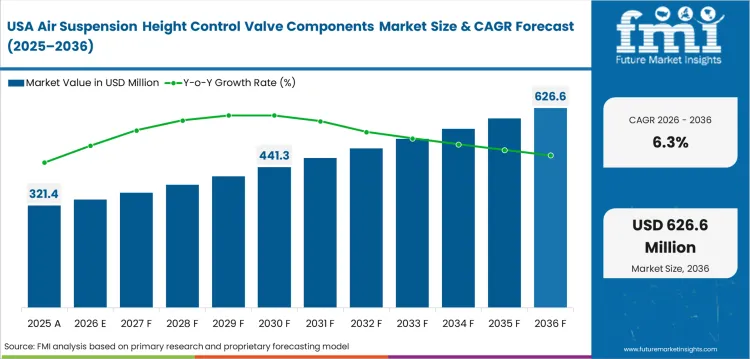
The market in the United States is expected to advance at 6.3% CAGR by 2036, led by heavy truck fleets adopting factory and retrofit height control options. In September 2025 Link Manufacturing said International LT customers can specify SmartValve with option code 14WCS. Fleet needs are practical because coupling height and landing gear effort affect daily work. OICA placed United States vehicle production at 10,562,188 units in 2024. Tractor and trailer service activity keeps replacement demand active.
- Class 8 tractor programs favor electronic height control as fleets need safer trailer coupling and reduced air use.
- Replacement demand stays tied to valve seal wear and linkage damage during high mileage service.
- Chassis data from fleet telematics control units and tracking devices can flag ride height faults earlier during service planning.
Demand Analysis of Air Suspension Height Control Valve Components in Germany
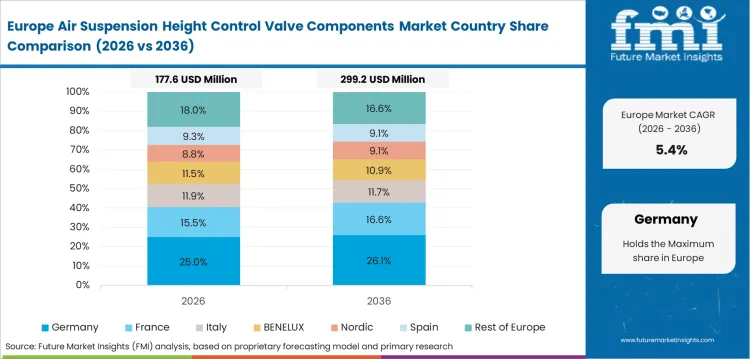
Demand in Germany is projected to rise at 5.8% CAGR by 2036 through premium trucks and buses maintaining the importance of electronic leveling content. OICA recorded 4,069,222 vehicles produced in Germany during 2024. Supplier depth supports high-specification valve blocks and air control modules. ZF and Knorr-Bremse give local engineering teams strong pneumatic and chassis control knowledge. German demand will favor low air loss and precise height return after load changes.
- Premium truck programs need valve modules protecting ride height without raising compressor run time.
- Bus applications favor electronic kneeling control as city operators require stable boarding height and ride comfort.
- Supplier selection will depend on calibration proof, endurance testing and easy service access across fleet workshops.
Sales Outlook for Air Suspension Height Control Valve Components in South Korea
Sales in South Korea is forecast at 5.5% CAGR by 2036 as bus platforms and export vehicles use air suspension control for comfort. OICA placed 2024 vehicle production at 4,127,252 units. Local OEMs often design vehicles for several export regions. Such programs need valves meeting varied service climates and air line layouts. Demand will favor integrated units combining height sensing with durable pneumatic switching.
- Bus and coach programs create a steady route for electronic control valves supporting curb kneeling.
- Export platforms need compact valve assemblies tolerating heat, road spray and different maintenance practices.
- Local suppliers can gain share by proving consistent leakage performance across repeated height adjustment cycles.
Future Outlook for Air Suspension Height Control Valve Components in Japan
Japan is expected to post 5.1% CAGR by 2036 as mature vehicle engineering supports selective use of refined valve components. Japan produced 8,234,681 vehicles in 2024 according to OICA production data. Conservative platform changes keep adoption measured. Valve suppliers must prove durability before broader use in truck and bus programs. Replacement demand will favor compact mechanical valves and precise linkage kits for established fleets.
- Hybrid and premium vehicle programs can use electronic valve blocks for smoother height correction.
- Commercial fleets will continue to value mechanical valves with simple adjustment and low replacement cost.
- Engineering standards place strong weight on leak control, corrosion life and stable ride height over long service cycles.
Competitive Landscape and Strategic Positioning
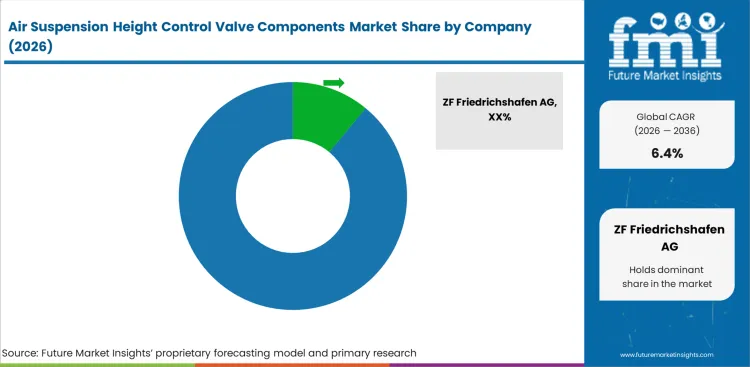
- Pneumatic control suppliers have an advantage because valve durability and air sealing directly affect fleet service cost.
- Electronic valve specialists compete by combining sensor input with air routing inside compact suspension modules.
- Suspension system suppliers gain value as OEMs prefer validated packages covering brackets and valves with linkage kits.
Competition in the air suspension height control valve components market is driven by platform access and service support. Truck and trailer OEMs assess suppliers by how well valves hold calibration and seal air. ZF competes based on OptiRide ECAS and legacy WABCO pneumatic control experience. SAF-HOLLAND and Haldex retain strong trailer air suspension valve importance after the PR+ height control valve change. Hendrickson and Link Manufacturing compete from suspension system positions turning valve design into fleet service value.
RAPA Automotive and Knorr-Bremse add depth in solenoid valve blocks and conventional air suspension valves. Ridewell plays a focused role in mechanical height control valves for trucks and buses. Smaller suppliers can compete in replacement channels when kits fit multiple applications and include durable linkages. Competitive strength will favor suppliers combining reliable validated OEM fitment and practical service support across fleet repair cycles.
Key Companies in the Air Suspension Height Control Valve Components Market
Competitive structure is best assessed by grouping companies around electronic control, trailer pneumatic parts and mechanical replacement valves.
- Electronic Control and Chassis Systems: ZF Friedrichshafen AG, RAPA Automotive and Knorr-Bremse AG compete depending on electronic leveling and air control expertise.
- Trailer and Heavy Vehicle Suspension Suppliers: SAF-HOLLAND SE, Haldex and Hendrickson remain relevant through trailer air suspension and heavy-duty platform relationships.
- Replacement and Fleet Valve Specialists: Link Manufacturing and Ridewell Suspensions compete through universal height control valves and service kits for fleets.
Competitive Benchmarking: Air Suspension Height Control Valve Components Market
| Company | Valve Fit | Electronic Control Depth | Fleet Service Reach | Geographic Footprint |
|---|---|---|---|---|
| ZF Friedrichshafen AG | High | Strong | Strong | Global ECAS systems |
| SAF-HOLLAND SE | High | Medium | Strong | Trailer and CV reach |
| Hendrickson | High | Medium | Strong | North America and global |
| Link Manufacturing | High | Strong | Medium | North America fleets |
| Knorr-Bremse AG | High | Medium | Strong | Global brake and air systems |
| RAPA Automotive | Medium | Strong | Medium | Germany, USA and China |
| Ridewell Suspensions | Medium | Medium | Strong | North America replacement |
Source: Future Market Insights competitive analysis, 2026. Ratings reflect relative positioning based on valve fit, electronic control depth and fleet service reach.
Key Developments in Air Suspension Height Control Valve Components Market
- In January 2024, SAF-HOLLAND said SAF trailer air ride suspensions specified with height control valves would use Haldex PR+ HCVs from March 2024.
- In June 2025, ZF said fifth generation OptiRide ECAS entered serial production for Hyundai buses with a compact smart pneumatic actuator.
- In September 2025, Link Manufacturing said SmartValve became a factory-installed electronic height control valve option on International Motors LT Series trucks.
Key Players in the Air Suspension Height Control Valve Components Market
Major Global Players:
- ZF Friedrichshafen AG
- SAF-HOLLAND SE / Haldex
- Knorr-Bremse AG
- Hendrickson
- RAPA Automotive GmbH & Co. KG
Specialist and Regional Players:
- Link Manufacturing Ltd.
- Ridewell Suspensions
- Dunlop Suspension Systems
- Barksdale Inc.
- Hadley Products Corporation
Market Report Scope
| Parameter | Details |
|---|---|
| Quantitative Units | USD 728.8 million to USD 1,355.3 million, at 6.4% CAGR |
| Market Definition | Ride height valve components regulating air flow into air springs for vehicle leveling |
| Component Type | Mechanical Valves, Electronic Valves, Solenoid Blocks, Height Sensors, Linkage Kits |
| Vehicle Type | Heavy Trucks, Trailers, Buses, Light Trucks, Passenger Cars |
| Control Type | Pneumatic Control, Electronic Control, Manual Control, Integrated Control |
| Sales Channel | OEM Fitment, Replacement, Fleet Service, Performance Retrofit |
| Material | Aluminum Bodies, Polymer Bodies, Brass Bodies, Steel Linkages, Mixed Materials |
| Regions Covered | North America, Latin America, Western Europe, Eastern Europe, East Asia, South Asia and Pacific, Middle East and Africa |
| Countries Covered | United States, China, Germany, Japan, India, South Korea, Mexico and 30+ countries |
| Key Companies Profiled | ZF Friedrichshafen AG, SAF-HOLLAND SE, Hendrickson, Knorr-Bremse AG, RAPA Automotive, Link Manufacturing, Ridewell Suspensions |
| Forecast Period | 2026 to 2036 |
| Approach | Analyst built values, vehicle production checks, supplier evidence, OEM fitment review and segment share estimates |
Source: Future Market Insights, 2026.
Air Suspension Height Control Valve Components Market Breakdown by Component Type, Vehicle Type, Control Type, Sales Channel, Material and Region
By Component Type:
- Mechanical Valves
- Electronic Valves
- Solenoid Blocks
- Height Sensors
- Linkage Kits
By Vehicle Type:
- Heavy Trucks
- Trailers
- Buses
- Light Trucks
- Passenger Cars
By Control Type:
- Pneumatic Control
- Electronic Control
- Manual Control
- Integrated Control
By Sales Channel:
- OEM Fitment
- Replacement
- Fleet Service
- Performance Retrofit
By Material:
- Aluminum Bodies
- Polymer Bodies
- Brass Bodies
- Steel Linkages
- Mixed Materials
By Region:
- North America
- Latin America
- Western Europe
- Eastern Europe
- East Asia
- South Asia and Pacific
- Middle East and Africa
Research Sources and Bibliography
- China State Council. (2025, January 13). China’s auto output, sales both reach new heights in 2024.
- International Organization of Motor Vehicle Manufacturers. (2025). 2024 statistics.
- Link Manufacturing Ltd. (2025, September 23). SmartValve now available as factory-installed option at International.
- SAF-HOLLAND. (2024, January 22). Production change notification: SAF trailer air ride suspensions will be equipped with Haldex brand height control valves.
- SAF-HOLLAND. (2025, April 17). SAF-HOLLAND acquires outstanding shares in the Indian joint venture Haldex ANAND India Private Limited.
- Society of Indian Automobile Manufacturers. (2025, January 14). Auto industry sales performance of December 2024, October-December 2024, April-December 2024 and January-December 2024.
- ZF Friedrichshafen AG. (2025, June 5). ZF delivers electronically controlled air suspension OptiRide to bus manufacturer Hyundai.
Bibliography uses government sources, trade association data and official company evidence relevant to vehicle production, air suspension fitment and component developments.
This Report Answers
- How large is the air suspension height control valve components industry in 2026 and 2036?
- Which parent segments carry leading dominant share percentages in 2026?
- How do OEM fitment and replacement service shape valve component value?
- Which countries show stronger readiness for air suspension height control valve components?
- How do mechanical valves and electronic control units compete across vehicle platforms?
- Which suppliers are positioned across pneumatic control, solenoid blocks and fleet replacement kits?
- How do chassis electronics and heavy-duty truck load and axle weight sensor systems change service planning?
Frequently Asked Questions
What is the air suspension height control valve components market size in 2026?
The air suspension height control valve components market size is projected to cross USD 728.8 million in 2026 as OEM fitment drives early value.
What is the forecast value of the air suspension height control valve components market by 2036?
Industry value is forecast to reach USD 1,355.3 million by 2036 due to commercial vehicle and bus platforms using more leveling valves.
What CAGR is expected for the air suspension height control valve components market?
The sector revenue is projected to expand at 6.4% CAGR from 2026 to 2036 across tracked global vehicle programs.
Which sales channel leads the air suspension height control valve components market?
OEM fitment is projected to account for 68.9% share in 2026 since valve placement is validated before vehicle launch.
Which control type has the leading share in air suspension height control valve components demand?
Pneumatic control is anticipated to represent 62.5% share in 2026 due to fleets valuing simple service and proven air logic.
Which component type has strong adoption in the air suspension height control valve components market?
Mechanical valves are forecast to capture 41.8% share in 2026 as replacement work favors adjustable and familiar valve designs.
Which country records faster growth in air suspension height control valve components demand?
India is projected to record 8.1% CAGR by 2036 as vehicle output and fleet service needs support valve adoption.
Why are air suspension height control valve components gaining attention?
Vehicle makers need ride height control parts protecting chassis balance while reducing air loss across truck and bus duty cycles.
Which companies compete in the air suspension height control valve components market?
ZF, SAF-HOLLAND, Hendrickson, Link Manufacturing, Knorr-Bremse, RAPA Automotive and Ridewell are relevant suppliers in valve components.
What restrains the air suspension height control valve components market?
Moisture and low-cost seal wear can shorten valve life and slow premium component adoption in price sensitive fleets.
Preview the report firsthand - request a free sample
Get SampleGet the brochure for pricing and purchase details.
Get PDFTable of Content
- Executive Summary
- Global Market Outlook
- Demand-side Trends
- Supply-side Trends
- Technology Roadmap Analysis
- Analysis and Recommendations
- Market Overview
- Market Coverage / Taxonomy
- Market Definition / Scope / Limitations
- Research Methodology
- Chapter Orientation
- Analytical Lens and Working Hypotheses
- Market Structure, Signals, and Trend Drivers
- Benchmarking and Cross-market Comparability
- Market Sizing, Forecasting, and Opportunity Mapping
- Research Design and Evidence Framework
- Desk Research Programme (Secondary Evidence)
- Company Annual and Sustainability Reports
- Peer-reviewed Journals and Academic Literature
- Corporate Websites, Product Literature, and Technical Notes
- Earnings Decks and Investor Briefings
- Statutory Filings and Regulatory Disclosures
- Technical White Papers and Standards Notes
- Trade Journals, Industry Magazines, and Analyst Briefs
- Conference Proceedings, Webinars, and Seminar Materials
- Government Statistics Portals and Public Data Releases
- Press Releases and Reputable Media Coverage
- Specialist Newsletters and Curated Briefings
- Sector Databases and Reference Repositories
- FMI Internal Proprietary Databases and Historical Market Datasets
- Subscription Datasets and Paid Sources
- Social Channels, Communities, and Digital Listening Inputs
- Additional Desk Sources
- Expert Input and Fieldwork (Primary Evidence)
- Primary Modes
- Qualitative Interviews and Expert Elicitation
- Quantitative Surveys and Structured Data Capture
- Blended Approach
- Why Primary Evidence is Used
- Field Techniques
- Interviews
- Surveys
- Focus Groups
- Observational and In-context Research
- Social and Community Interactions
- Stakeholder Universe Engaged
- C-suite Leaders
- Board Members
- Presidents and Vice Presidents
- R&D and Innovation Heads
- Technical Specialists
- Domain Subject-matter Experts
- Scientists
- Physicians and Other Healthcare Professionals
- Governance, Ethics, and Data Stewardship
- Research Ethics
- Data Integrity and Handling
- Primary Modes
- Tooling, Models, and Reference Databases
- Desk Research Programme (Secondary Evidence)
- Data Engineering and Model Build
- Data Acquisition and Ingestion
- Cleaning, Normalisation, and Verification
- Synthesis, Triangulation, and Analysis
- Quality Assurance and Audit Trail
- Market Background
- Market Dynamics
- Drivers
- Restraints
- Opportunity
- Trends
- Scenario Forecast
- Demand in Optimistic Scenario
- Demand in Likely Scenario
- Demand in Conservative Scenario
- Opportunity Map Analysis
- Product Life Cycle Analysis
- Supply Chain Analysis
- Investment Feasibility Matrix
- Value Chain Analysis
- PESTLE and Porter’s Analysis
- Regulatory Landscape
- Regional Parent Market Outlook
- Production and Consumption Statistics
- Import and Export Statistics
- Market Dynamics
- Global Market Analysis 2021 to 2025 and Forecast, 2026 to 2036
- Historical Market Size Value (USD Million) Analysis, 2021 to 2025
- Current and Future Market Size Value (USD Million) Projections, 2026 to 2036
- Y-o-Y Growth Trend Analysis
- Absolute $ Opportunity Analysis
- Global Market Pricing Analysis 2021 to 2025 and Forecast 2026 to 2036
- Global Market Analysis 2021 to 2025 and Forecast 2026 to 2036, By Component Type
- Introduction / Key Findings
- Historical Market Size Value (USD Million) Analysis By Component Type , 2021 to 2025
- Current and Future Market Size Value (USD Million) Analysis and Forecast By Component Type , 2026 to 2036
- Mechanical Valves
- Electronic Valves
- Solenoid Blocks
- Height Sensors
- Linkage Kits
- Mechanical Valves
- Y-o-Y Growth Trend Analysis By Component Type , 2021 to 2025
- Absolute $ Opportunity Analysis By Component Type , 2026 to 2036
- Global Market Analysis 2021 to 2025 and Forecast 2026 to 2036, By Vehicle Type
- Introduction / Key Findings
- Historical Market Size Value (USD Million) Analysis By Vehicle Type, 2021 to 2025
- Current and Future Market Size Value (USD Million) Analysis and Forecast By Vehicle Type, 2026 to 2036
- Heavy Trucks
- Trailers
- Buses
- Light Trucks
- Passenger Cars
- Heavy Trucks
- Y-o-Y Growth Trend Analysis By Vehicle Type, 2021 to 2025
- Absolute $ Opportunity Analysis By Vehicle Type, 2026 to 2036
- Global Market Analysis 2021 to 2025 and Forecast 2026 to 2036, By Control Type
- Introduction / Key Findings
- Historical Market Size Value (USD Million) Analysis By Control Type, 2021 to 2025
- Current and Future Market Size Value (USD Million) Analysis and Forecast By Control Type, 2026 to 2036
- Pneumatic Control
- Electronic Control
- Manual Control
- Integrated Control
- Pneumatic Control
- Y-o-Y Growth Trend Analysis By Control Type, 2021 to 2025
- Absolute $ Opportunity Analysis By Control Type, 2026 to 2036
- Global Market Analysis 2021 to 2025 and Forecast 2026 to 2036, By Sales Channel
- Introduction / Key Findings
- Historical Market Size Value (USD Million) Analysis By Sales Channel, 2021 to 2025
- Current and Future Market Size Value (USD Million) Analysis and Forecast By Sales Channel, 2026 to 2036
- OEM Fitment
- Replacement
- Fleet Service
- Performance Retrofit
- OEM Fitment
- Y-o-Y Growth Trend Analysis By Sales Channel, 2021 to 2025
- Absolute $ Opportunity Analysis By Sales Channel, 2026 to 2036
- Global Market Analysis 2021 to 2025 and Forecast 2026 to 2036, By Material
- Introduction / Key Findings
- Historical Market Size Value (USD Million) Analysis By Material, 2021 to 2025
- Current and Future Market Size Value (USD Million) Analysis and Forecast By Material, 2026 to 2036
- Aluminum Bodies
- Polymer Bodies
- Brass Bodies
- Steel Linkages
- Mixed Materials
- Aluminum Bodies
- Y-o-Y Growth Trend Analysis By Material, 2021 to 2025
- Absolute $ Opportunity Analysis By Material, 2026 to 2036
- Global Market Analysis 2021 to 2025 and Forecast 2026 to 2036, By Region
- Introduction
- Historical Market Size Value (USD Million) Analysis By Region, 2021 to 2025
- Current Market Size Value (USD Million) Analysis and Forecast By Region, 2026 to 2036
- North America
- Latin America
- Western Europe
- Eastern Europe
- East Asia
- South Asia and Pacific
- Middle East & Africa
- Market Attractiveness Analysis By Region
- North America Market Analysis 2021 to 2025 and Forecast 2026 to 2036, By Country
- Historical Market Size Value (USD Million) Trend Analysis By Market Taxonomy, 2021 to 2025
- Market Size Value (USD Million) Forecast By Market Taxonomy, 2026 to 2036
- By Country
- USA
- Canada
- Mexico
- By Component Type
- By Vehicle Type
- By Control Type
- By Sales Channel
- By Material
- By Country
- Market Attractiveness Analysis
- By Country
- By Component Type
- By Vehicle Type
- By Control Type
- By Sales Channel
- By Material
- Key Takeaways
- Latin America Market Analysis 2021 to 2025 and Forecast 2026 to 2036, By Country
- Historical Market Size Value (USD Million) Trend Analysis By Market Taxonomy, 2021 to 2025
- Market Size Value (USD Million) Forecast By Market Taxonomy, 2026 to 2036
- By Country
- Brazil
- Chile
- Rest of Latin America
- By Component Type
- By Vehicle Type
- By Control Type
- By Sales Channel
- By Material
- By Country
- Market Attractiveness Analysis
- By Country
- By Component Type
- By Vehicle Type
- By Control Type
- By Sales Channel
- By Material
- Key Takeaways
- Western Europe Market Analysis 2021 to 2025 and Forecast 2026 to 2036, By Country
- Historical Market Size Value (USD Million) Trend Analysis By Market Taxonomy, 2021 to 2025
- Market Size Value (USD Million) Forecast By Market Taxonomy, 2026 to 2036
- By Country
- Germany
- UK
- Italy
- Spain
- France
- Nordic
- BENELUX
- Rest of Western Europe
- By Component Type
- By Vehicle Type
- By Control Type
- By Sales Channel
- By Material
- By Country
- Market Attractiveness Analysis
- By Country
- By Component Type
- By Vehicle Type
- By Control Type
- By Sales Channel
- By Material
- Key Takeaways
- Eastern Europe Market Analysis 2021 to 2025 and Forecast 2026 to 2036, By Country
- Historical Market Size Value (USD Million) Trend Analysis By Market Taxonomy, 2021 to 2025
- Market Size Value (USD Million) Forecast By Market Taxonomy, 2026 to 2036
- By Country
- Russia
- Poland
- Hungary
- Balkan & Baltic
- Rest of Eastern Europe
- By Component Type
- By Vehicle Type
- By Control Type
- By Sales Channel
- By Material
- By Country
- Market Attractiveness Analysis
- By Country
- By Component Type
- By Vehicle Type
- By Control Type
- By Sales Channel
- By Material
- Key Takeaways
- East Asia Market Analysis 2021 to 2025 and Forecast 2026 to 2036, By Country
- Historical Market Size Value (USD Million) Trend Analysis By Market Taxonomy, 2021 to 2025
- Market Size Value (USD Million) Forecast By Market Taxonomy, 2026 to 2036
- By Country
- China
- Japan
- South Korea
- By Component Type
- By Vehicle Type
- By Control Type
- By Sales Channel
- By Material
- By Country
- Market Attractiveness Analysis
- By Country
- By Component Type
- By Vehicle Type
- By Control Type
- By Sales Channel
- By Material
- Key Takeaways
- South Asia and Pacific Market Analysis 2021 to 2025 and Forecast 2026 to 2036, By Country
- Historical Market Size Value (USD Million) Trend Analysis By Market Taxonomy, 2021 to 2025
- Market Size Value (USD Million) Forecast By Market Taxonomy, 2026 to 2036
- By Country
- India
- ASEAN
- Australia & New Zealand
- Rest of South Asia and Pacific
- By Component Type
- By Vehicle Type
- By Control Type
- By Sales Channel
- By Material
- By Country
- Market Attractiveness Analysis
- By Country
- By Component Type
- By Vehicle Type
- By Control Type
- By Sales Channel
- By Material
- Key Takeaways
- Middle East & Africa Market Analysis 2021 to 2025 and Forecast 2026 to 2036, By Country
- Historical Market Size Value (USD Million) Trend Analysis By Market Taxonomy, 2021 to 2025
- Market Size Value (USD Million) Forecast By Market Taxonomy, 2026 to 2036
- By Country
- Kingdom of Saudi Arabia
- Other GCC Countries
- Turkiye
- South Africa
- Other African Union
- Rest of Middle East & Africa
- By Component Type
- By Vehicle Type
- By Control Type
- By Sales Channel
- By Material
- By Country
- Market Attractiveness Analysis
- By Country
- By Component Type
- By Vehicle Type
- By Control Type
- By Sales Channel
- By Material
- Key Takeaways
- Key Countries Market Analysis
- USA
- Pricing Analysis
- Market Share Analysis, 2025
- By Component Type
- By Vehicle Type
- By Control Type
- By Sales Channel
- By Material
- Canada
- Pricing Analysis
- Market Share Analysis, 2025
- By Component Type
- By Vehicle Type
- By Control Type
- By Sales Channel
- By Material
- Mexico
- Pricing Analysis
- Market Share Analysis, 2025
- By Component Type
- By Vehicle Type
- By Control Type
- By Sales Channel
- By Material
- Brazil
- Pricing Analysis
- Market Share Analysis, 2025
- By Component Type
- By Vehicle Type
- By Control Type
- By Sales Channel
- By Material
- Chile
- Pricing Analysis
- Market Share Analysis, 2025
- By Component Type
- By Vehicle Type
- By Control Type
- By Sales Channel
- By Material
- Germany
- Pricing Analysis
- Market Share Analysis, 2025
- By Component Type
- By Vehicle Type
- By Control Type
- By Sales Channel
- By Material
- UK
- Pricing Analysis
- Market Share Analysis, 2025
- By Component Type
- By Vehicle Type
- By Control Type
- By Sales Channel
- By Material
- Italy
- Pricing Analysis
- Market Share Analysis, 2025
- By Component Type
- By Vehicle Type
- By Control Type
- By Sales Channel
- By Material
- Spain
- Pricing Analysis
- Market Share Analysis, 2025
- By Component Type
- By Vehicle Type
- By Control Type
- By Sales Channel
- By Material
- France
- Pricing Analysis
- Market Share Analysis, 2025
- By Component Type
- By Vehicle Type
- By Control Type
- By Sales Channel
- By Material
- India
- Pricing Analysis
- Market Share Analysis, 2025
- By Component Type
- By Vehicle Type
- By Control Type
- By Sales Channel
- By Material
- ASEAN
- Pricing Analysis
- Market Share Analysis, 2025
- By Component Type
- By Vehicle Type
- By Control Type
- By Sales Channel
- By Material
- Australia & New Zealand
- Pricing Analysis
- Market Share Analysis, 2025
- By Component Type
- By Vehicle Type
- By Control Type
- By Sales Channel
- By Material
- China
- Pricing Analysis
- Market Share Analysis, 2025
- By Component Type
- By Vehicle Type
- By Control Type
- By Sales Channel
- By Material
- Japan
- Pricing Analysis
- Market Share Analysis, 2025
- By Component Type
- By Vehicle Type
- By Control Type
- By Sales Channel
- By Material
- South Korea
- Pricing Analysis
- Market Share Analysis, 2025
- By Component Type
- By Vehicle Type
- By Control Type
- By Sales Channel
- By Material
- Russia
- Pricing Analysis
- Market Share Analysis, 2025
- By Component Type
- By Vehicle Type
- By Control Type
- By Sales Channel
- By Material
- Poland
- Pricing Analysis
- Market Share Analysis, 2025
- By Component Type
- By Vehicle Type
- By Control Type
- By Sales Channel
- By Material
- Hungary
- Pricing Analysis
- Market Share Analysis, 2025
- By Component Type
- By Vehicle Type
- By Control Type
- By Sales Channel
- By Material
- Kingdom of Saudi Arabia
- Pricing Analysis
- Market Share Analysis, 2025
- By Component Type
- By Vehicle Type
- By Control Type
- By Sales Channel
- By Material
- Turkiye
- Pricing Analysis
- Market Share Analysis, 2025
- By Component Type
- By Vehicle Type
- By Control Type
- By Sales Channel
- By Material
- South Africa
- Pricing Analysis
- Market Share Analysis, 2025
- By Component Type
- By Vehicle Type
- By Control Type
- By Sales Channel
- By Material
- USA
- Market Structure Analysis
- Competition Dashboard
- Competition Benchmarking
- Market Share Analysis of Top Players
- By Regional
- By Component Type
- By Vehicle Type
- By Control Type
- By Sales Channel
- By Material
- Competition Analysis
- Competition Deep Dive
- ZF Friedrichshafen AG
- Overview
- Product Portfolio
- Profitability by Market Segments (Product/Age /Sales Channel/Region)
- Sales Footprint
- Strategy Overview
- Marketing Strategy
- Product Strategy
- Channel Strategy
- SAF-HOLLAND SE
- Hendrickson
- Link Manufacturing
- Knorr-Bremse AG
- RAPA Automotive
- Ridewell Suspensions
- ZF Friedrichshafen AG
- Competition Deep Dive
- Assumptions & Acronyms Used


