

- Industry Size (2026)
- USD 1240.0 Mn
- Forecast (2036)
- USD 2138.0 Mn
- CAGR (2026 to 2036)
- 5.60%
Air Compressor Control System Market Forecast and Outlook 2026 to 2036
The air compressor control system market is likely to be valued at USD 1,240.0 million in 2026, is set to reach USD 2,138.0 million by 2036, and is projected to expand at a 5.6% CAGR over the forecast period. Pricing control is defended by compressor OEMs that bundle proprietary controllers, firmware, and service tools into the equipment lifecycle, keeping upgrades and replacements tied to certified parts and approved technicians. Contracted maintenance programs and remote monitoring subscriptions are often used to preserve recurring revenue and limit price-based switching.
Entry barriers are maintained through proven energy-saving performance, integration complexity across multi-compressor fleets, and plant acceptance requirements that favor controls with validated uptime and cybersecurity readiness. Fragmentation persists because many facilities run mixed-brand compressor rooms, leaving space for automation vendors and regional integrators that offer open-architecture PLC/SCADA solutions. At the same time, consolidation pressure is created when end users standardize on a single platform to reduce operator training, spare parts variety, and troubleshooting time. Value capture remains concentrated with suppliers that control algorithms, connectivity layers, and installed-base service access.
Quick Stats for Air Compressor Control System Market
- Air Compressor Control System Market Value (2026): USD 1,240.0 Million
- Air Compressor Control System Market Forecast Value (2036): USD 2,138.0 Million
- Air Compressor Control System Market Forecast CAGR 2026 to 2036: 5.60%
- Leading Control Type in Air Compressor Control System Market: Integrated VSD Controllers
- Leading End Use in Air Compressor Control System Market: Manufacturing
- Key Growth Regions in Air Compressor Control System Market: Asia Pacific, North America, Europe
- Top Key Players in Air Compressor Control System Market: Atlas Copco, Ingersoll Rand, Kaeser Kompressoren, Siemens, Schneider Electric, Rockwell Automation, Mitsubishi Electric, ABB, Sullair (Hitachi)
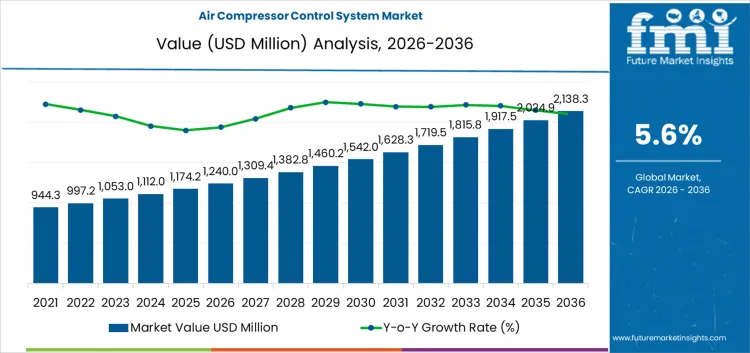
Air Compressor Control System Market Key Takeaways
| Metric | Value |
|---|---|
| Industry Value (2026) | USD 1,240.0 Million |
| Forecast Value (2036) | USD 2,138.0 Million |
| Forecast CAGR 2026 to 2036 | 5.60% |
How is the Global Air Compressor Control System Market Advancing?
The global air compressor control system market is advancing steadily, driven by the growing need to optimize compressed air efficiency and reduce energy consumption in industrial operations. Control systems are critical for regulating compressor operation, load management, pressure stability, and system sequencing, directly influencing energy use and equipment reliability.
A key driver supporting market growth is the increasing focus on energy management within industrial facilities. Compressed air systems are among the most energy-intensive utilities in manufacturing plants, and inefficient control can lead to excessive power consumption and pressure fluctuations. Advanced control systems enable real-time monitoring and coordinated operation of multiple compressors, allowing facilities to match air supply with demand more accurately and reduce energy losses.
Expansion of automation and digitalization across industries is further contributing to market adoption. Modern compressor control systems integrate programmable logic controllers, sensors, and human-machine interfaces to provide centralized system visibility and remote control capabilities. These systems support predictive maintenance by tracking operating parameters such as pressure, temperature, and run hours, helping reduce unplanned downtime.
Technological advancements are strengthening market penetration. Developments in variable speed control, cloud-based monitoring platforms, and data analytics are improving system responsiveness and operational efficiency. Integration with plant-wide energy management systems is also becoming more common. As industries continue to prioritize operational optimization and cost control, the air compressor control system market is expected to maintain consistent growth over the forecast period.
What is the Segment-Wise Overview of the Air Compressor Control System Market?
The air compressor control system market is driven by the need for energy efficiency, optimized compressor operation, and real-time performance management. Integrated VSD (variable speed drive) controllers lead with a 44% share, as they enable compressors to automatically adjust speed based on air demand, reducing energy consumption and operating costs. These controllers are increasingly adopted in modern compressor installations. By end use, manufacturing accounts for 36% of demand, reflecting widespread reliance on compressed air across production lines, automation systems, and industrial equipment. These segments highlight a market focused on intelligent control technologies and industrial environments where energy optimization and operational reliability are critical.
Why Do Integrated VSD Controllers Lead the Air Compressor Control System Market?
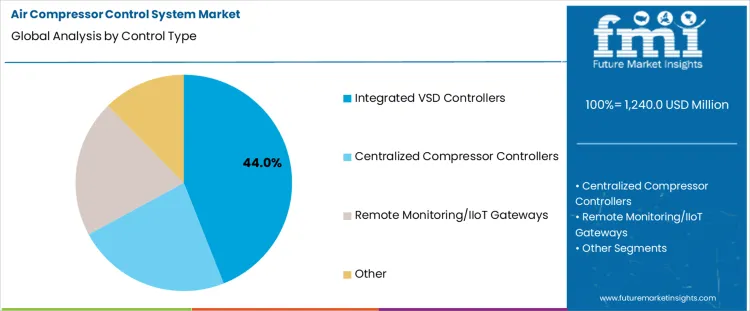
Integrated VSD controllers account for 44% of the air compressor control system market due to their ability to significantly improve energy efficiency and system performance. These controllers regulate motor speed in real time, matching air output precisely with demand and avoiding energy losses associated with load-unload operation. Integrated VSD systems also reduce mechanical stress, lower heat generation, and extend compressor service life. Their built-in design simplifies installation, minimizes control complexity, and improves system reliability compared to external control solutions. Industries operating compressors under variable load conditions particularly benefit from VSD technology. As energy costs rise and efficiency targets become stricter, integrated VSD controllers continue to be the preferred control solution for modern compressed air systems.
How Does Manufacturing Drive Demand in the Air Compressor Control System Market?
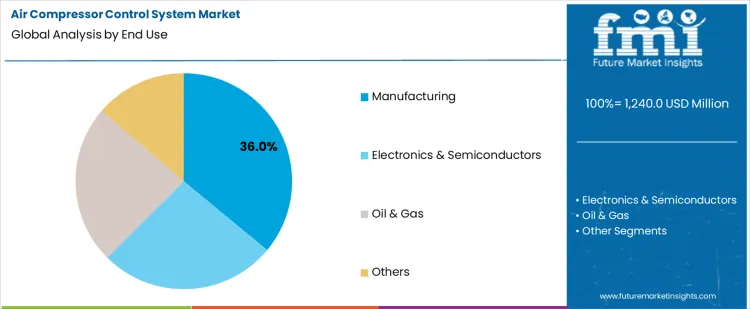
Manufacturing represents 36% of end-use demand, making it the largest application segment in the air compressor control system market. Manufacturing facilities depend heavily on compressed air for pneumatic tools, robotics, material handling, and process automation. Control systems are essential for maintaining stable pressure, minimizing energy waste, and coordinating multiple compressors operating simultaneously. Advanced control systems help manufacturers reduce power consumption, improve uptime, and prevent pressure fluctuations that can affect product quality. As factories move toward smart manufacturing and digital monitoring, demand for intelligent compressor control solutions continues to rise. This strong reliance on efficient and reliable compressed air infrastructure positions manufacturing as the primary driver of market growth.
What Are the Key Dynamics for the Air Compressor Control System Market?
Air compressor control systems regulate compressor sequencing, load-unload cycles, pressure levels, and runtime to ensure stable air supply while minimizing energy losses. Key market dynamics include rising electricity costs, growing industrial automation, and heightened focus on operational efficiency in manufacturing, automotive, food processing, and process industries. As compressed air systems account for a significant share of industrial energy use, control systems play a critical role in reducing wastage and maintaining pressure stability. Integration of centralized and networked control platforms further supports demand by enabling coordinated operation of multiple compressors within complex air systems.
How Are the Key Drivers Shaping the Air Compressor Control System Market?
Key drivers shaping the Air Compressor Control System Market include rising energy efficiency mandates, adoption of Industry 4.0 practices, and growing use of variable speed drive (VSD) compressors. Advanced control systems enable real-time monitoring, predictive maintenance, and adaptive compressor sequencing based on demand fluctuations. Integration with plant energy management systems allows operators to track performance metrics and optimize system efficiency. OEMs are increasingly offering proprietary control platforms that enhance compatibility and system reliability. The shift toward centralized control architectures in facilities operating multiple compressors further accelerates demand. As industries seek to reduce operating costs and improve equipment lifespan, investment in intelligent air compressor control systems continues to strengthen.
What Are the Challenges Impacting the Air Compressor Control System Market?
Challenges in the Air Compressor Control System Market include high initial investment costs for advanced control platforms, which can discourage adoption among small and mid-sized industrial users. Integration complexity with older compressors and heterogeneous equipment brands can limit system effectiveness if not properly configured. Lack of technical expertise in setting control parameters and interpreting performance data may reduce realized energy savings. Some end users underestimate the financial benefits of optimized control, delaying purchasing decisions. Cybersecurity concerns related to connected and networked control systems also present risks. Variability in compressed air demand patterns across industries complicates standardization of control solutions, requiring application-specific customization that can increase deployment time and cost.
What is the Growth Outlook for the Air Compressor Control System Market by Country?
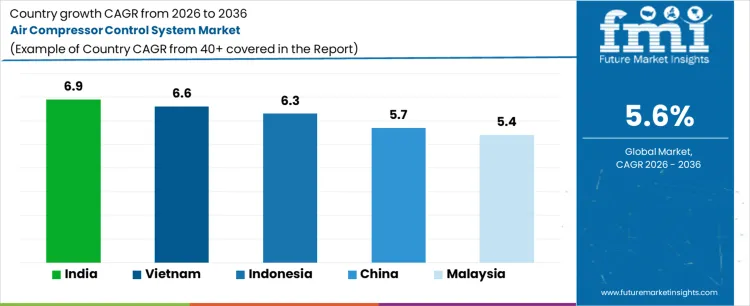
| Country | CAGR (%) |
|---|---|
| India | 6.9% |
| Vietnam | 6.6% |
| Indonesia | 6.3% |
| China | 5.7% |
| Malaysia | 5.4% |
The air compressor control system market is expanding steadily as industries prioritize energy efficiency, automation, and system reliability. India leads with a 6.9% CAGR, supported by industrial automation and rising energy optimization efforts. Vietnam follows at 6.6%, driven by export-oriented manufacturing and automation adoption. Indonesia grows at 6.3%, supported by industrial expansion and efficiency-focused operations. China records 5.7% growth, reflecting optimization-driven upgrades in a mature market. Malaysia expands at 5.4%, supported by gradual industrial modernization. As compressed air systems remain central to industrial operations, demand for intelligent and centralized control solutions is expected to remain consistent across these regions.
Why is the Air Compressor Control System Market Advancing in India?
The air compressor control system market in India is growing at a CAGR of 6.9%, driven by rising adoption of automation and energy optimization across industrial facilities. Manufacturing plants in automotive, pharmaceuticals, food processing, and metals rely on compressed air systems that operate continuously, creating demand for advanced control systems that optimize load management and reduce energy losses. Industrial operators are increasingly shifting from manual or standalone compressor operation toward centralized control platforms that balance multiple compressors efficiently. High electricity costs are encouraging factories to deploy intelligent controllers that adjust pressure setpoints and eliminate idle running. Expansion of smart factories and digital monitoring initiatives is strengthening demand for networked compressor control solutions. Retrofit demand is also rising as older compressor installations are upgraded with modern controllers. As India continues to scale industrial automation and efficiency-focused operations, adoption of air compressor control systems is expected to increase steadily.
What is Driving Air Compressor Control System Market Growth in Vietnam?
The air compressor control system market in Vietnam is expanding at a CAGR of 6.6%, supported by rapid industrialization and growing use of automated production lines. Electronics assembly, food processing, and export-oriented manufacturing facilities depend heavily on stable compressed air supply. Operators are investing in control systems to improve system reliability, reduce pressure fluctuations, and manage peak energy consumption. Rising energy costs are pushing manufacturers to adopt controllers that enable load sharing and real-time performance monitoring. Growth of industrial parks and foreign-invested manufacturing facilities is increasing deployment of multi-compressor systems that require coordinated control. Maintenance teams are also adopting control systems to improve fault detection and reduce unplanned downtime. As Vietnam continues to attract advanced manufacturing operations, demand for intelligent air compressor control systems is expected to grow consistently.
What Factors Are Supporting Air Compressor Control System Market Expansion in Indonesia?
The air compressor control system market in Indonesia is growing at a CAGR of 6.3%, driven by expansion of manufacturing, processing, and resource-based industries. Cement plants, food manufacturing units, and metal processing facilities operate compressed air systems under variable load conditions, creating demand for control systems that improve efficiency and reliability. Industrial operators are focusing on reducing energy waste caused by pressure instability and inefficient compressor sequencing. Adoption of centralized control platforms is increasing as facilities expand and operate multiple compressors simultaneously. Growth of industrial estates and infrastructure projects is further increasing the installed base of compressors requiring coordinated management. Focus on preventive maintenance and operational transparency is also supporting demand for monitoring-enabled control systems. As Indonesia continues to strengthen industrial productivity, adoption of air compressor control systems is expected to rise steadily.
Why is the Air Compressor Control System Market Developing at a Moderate Pace in China?
The air compressor control system market in China is expanding at a CAGR of 5.7%, reflecting a mature but steadily evolving industrial landscape. Large manufacturing facilities across electronics, automotive, and heavy industry already operate extensive compressed air networks, creating demand for system optimization rather than new installations. Industrial operators are adopting advanced control systems to reduce energy consumption and improve production stability. Government emphasis on energy efficiency and digital manufacturing is supporting upgrades to intelligent compressor controls. Replacement of legacy controllers with networked and data-enabled systems is driving retrofit demand. Local suppliers are developing cost-effective control solutions tailored to domestic industrial requirements. As China continues to optimize existing industrial infrastructure, demand for air compressor control systems is expected to remain stable.
What is Influencing Air Compressor Control System Market Growth in Malaysia?
The air compressor control system market in Malaysia is growing at a CAGR of 5.4%, driven by gradual industrial expansion and focus on operational efficiency. Electronics manufacturing, precision engineering, and food processing facilities rely on compressed air systems that benefit from coordinated control and monitoring. Manufacturers are adopting control systems to improve uptime, stabilize air pressure, and manage energy consumption. Growth of export-oriented production is increasing emphasis on process consistency and equipment reliability. Adoption is particularly strong in facilities operating multiple compressors where centralized control improves performance visibility. While capital expenditure cycles influence adoption speed, maintenance-driven upgrades support steady demand. As Malaysia continues to advance its industrial base and efficiency initiatives, demand for air compressor control systems is expected to grow at a measured pace.
How Are Companies Competing in the Air Compressor Control System Market?
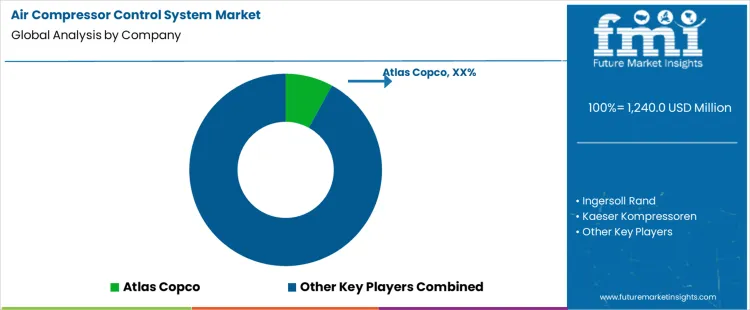
Competition in the air compressor control system market is driven by energy optimization capability, system reliability, integration flexibility, and the ability to manage multiple compressors under dynamic load conditions. Control systems are critical for sequencing, load balancing, pressure stability, and reducing energy waste across industrial compressed air networks, where electricity represents a major share of operating costs. Companies compete on real-time monitoring accuracy, advanced algorithms, connectivity with plant automation systems, and user-friendly interfaces. Differentiation increasingly centers on predictive control, analytics-driven optimization, and seamless integration with broader digital factory and energy management platforms.
Atlas Copco, Ingersoll Rand, Kaeser Kompressoren, and Sullair (Hitachi) lead competition through compressor-native control platforms tightly integrated with their equipment portfolios. These OEMs differentiate by offering control systems optimized for their compressors, enabling precise load sharing, pressure band control, and fault diagnostics. Atlas Copco and Kaeser emphasize energy-efficient master controllers capable of managing mixed compressor fleets, while Ingersoll Rand and Sullair leverage global service networks to support lifecycle optimization and remote monitoring.
Siemens, Schneider Electric, Rockwell Automation, Mitsubishi Electric, ABB, and regional controls providers compete through industrial automation expertise, open architectures, and advanced digital capabilities. These players differentiate with PLC-based and SCADA-integrated control systems that can manage compressors from multiple brands within a single plant. Siemens, ABB, and Schneider emphasize connectivity, cybersecurity, and integration with energy management and IIoT platforms. Rockwell and Mitsubishi focus on reliability and plant-wide automation compatibility. Across the market, competitive advantage is defined by energy savings delivered, system scalability, interoperability, and the ability to provide actionable insights that reduce compressed air operating costs.
Key Players in Air Compressor Control System Market
- Atlas Copco
- Ingersoll Rand
- Kaeser Kompressoren
- Siemens
- Schneider Electric
- Rockwell Automation
- Mitsubishi Electric
- ABB
- Sullair (Hitachi)
- Regional Controls Providers
Scope of Report
| Attributes | Description |
|---|---|
| Quantitative Unit (2026) | USD Million |
| Control Type | Integrated VSD Controllers, Centralized Compressor Controllers, Remote Monitoring / IIoT Gateways, Other |
| End Use | Manufacturing, Electronics & Semiconductors, Oil & Gas, Others |
| Regions Covered | Asia Pacific, Europe, North America, Latin America, Middle East & Africa |
| Countries Covered | China, Japan, South Korea, India, Australia & New Zealand, ASEAN, Rest of Asia Pacific, Germany, United Kingdom, France, Italy, Spain, Nordic, BENELUX, Rest of Europe, United States, Canada, Mexico, Brazil, Chile, Rest of Latin America, Kingdom of Saudi Arabia, Other GCC Countries, Turkey, South Africa, Other African Union, Rest of Middle East & Africa |
| Key Companies Profiled | Atlas Copco, Ingersoll Rand, Kaeser Kompressoren, Siemens, Schneider Electric, Rockwell Automation, Mitsubishi Electric, ABB, Sullair (Hitachi), Regional Controls Providers |
| Additional Attributes | Dollar sales by control type and end use; regional market size and forecast analysis; growth outlook across major regions; adoption trends for intelligent compressor control and optimization systems; assessment of energy efficiency gains, system integration complexity, and demand patterns across industrial manufacturing, electronics production, and oil and gas operations. |
Air Compressor Control System Market by Key Segments
Control Type
- Integrated VSD Controllers
- Centralized Compressor Controllers
- Remote Monitoring/IIoT Gateways
- Other
End Use
- Manufacturing
- Electronics & Semiconductors
- Oil & Gas
- Others
Region
- Asia Pacific
- China
- Japan
- South Korea
- India
- Australia & New Zealand
- ASEAN
- Rest of Asia Pacific
- Europe
- Germany
- United Kingdom
- France
- Italy
- Spain
- Nordic
- BENELUX
- Rest of Europe
- North America
- United States
- Canada
- Mexico
- Latin America
- Brazil
- Chile
- Rest of Latin America
- Middle East & Africa
- Kingdom of Saudi Arabia
- Other GCC Countries
- Turkey
- South Africa
- Other African Union
- Rest of Middle East & Africa
Bibliography
- Schneider Electric. Eco Struxure & trade; Machine SCADA Expert, Help Manual (User Guide & Technical Reference). 01 July 2024. Schneider Electric (Document download page).
- Siemens AG. SIMATIC HMI WinCC Unified V19 - System Manual (Online documentation, 02/2024). February 2024. Siemens Industry Support (PDF).
- Siemens AG. Engineering Guideline for WinCC Unified (© Siemens 2024). 2024. Siemens Industry Support (PDF).
- Rockwell Automation, Inc. Factory Talk® Energy Manager - Solution Profile (leverages Factory Talk® Data Mosaix & trade;). 2024 (published ~1.9 years before 07 Jan 2026 per listing). Rockwell Automation Literature Library (PDF).
- Rockwell Automation, Inc. NIS2 Compliance for Manufacturing and Industrial Control Systems (Industrial OT cybersecurity). 2024 (references Oct 2024 transposition timing). Rockwell Automation (web page).
Frequently Asked Questions
How big is the air compressor control system market in 2026?
The global air compressor control system market is estimated to be valued at USD 1,240.0 million in 2026.
What will be the size of air compressor control system market in 2036?
The market size for the air compressor control system market is projected to reach USD 2,138.3 million by 2036.
How much will be the air compressor control system market growth between 2026 and 2036?
The air compressor control system market is expected to grow at a 5.6% CAGR between 2026 and 2036.
What are the key product types in the air compressor control system market?
The key product types in air compressor control system market are integrated vsd controllers, centralized compressor controllers, remote monitoring/iiot gateways and other.
Which end use segment to contribute significant share in the air compressor control system market in 2026?
In terms of end use, manufacturing segment to command 36.0% share in the air compressor control system market in 2026.
Preview the report firsthand - request a free sample
Get SampleGet the brochure for pricing and purchase details.
Get PDFTable of Content
- Executive Summary
- Global Market Outlook
- Demand-side Trends
- Supply-side Trends
- Technology Roadmap Analysis
- Analysis and Recommendations
- Market Overview
- Market Coverage / Taxonomy
- Market Definition / Scope / Limitations
- Market Background
- Market Dynamics
- Drivers
- Restraints
- Opportunity
- Trends
- Scenario Forecast
- Demand in Optimistic Scenario
- Demand in Likely Scenario
- Demand in Conservative Scenario
- Opportunity Map Analysis
- Product Life Cycle Analysis
- Supply Chain Analysis
- Investment Feasibility Matrix
- Value Chain Analysis
- PESTLE and Porter’s Analysis
- Regulatory Landscape
- Regional Parent Market Outlook
- Production and Consumption Statistics
- Import and Export Statistics
- Market Dynamics
- Global Market Analysis 2021 to 2025 and Forecast, 2026 to 2036
- Historical Market Size Value (USD Million) Analysis, 2021 to 2025
- Current and Future Market Size Value (USD Million) Projections, 2026 to 2036
- Y-o-Y Growth Trend Analysis
- Absolute $ Opportunity Analysis
- Global Market Pricing Analysis 2021 to 2025 and Forecast 2026 to 2036
- Global Market Analysis 2021 to 2025 and Forecast 2026 to 2036, By Control Type
- Introduction / Key Findings
- Historical Market Size Value (USD Million) Analysis By Control Type, 2021 to 2025
- Current and Future Market Size Value (USD Million) Analysis and Forecast By Control Type, 2026 to 2036
- Integrated VSD Controllers
- Centralized Compressor Controllers
- Remote Monitoring/IIoT Gateways
- Other
- Integrated VSD Controllers
- Y-o-Y Growth Trend Analysis By Control Type, 2021 to 2025
- Absolute $ Opportunity Analysis By Control Type, 2026 to 2036
- Global Market Analysis 2021 to 2025 and Forecast 2026 to 2036, By End Use
- Introduction / Key Findings
- Historical Market Size Value (USD Million) Analysis By End Use, 2021 to 2025
- Current and Future Market Size Value (USD Million) Analysis and Forecast By End Use, 2026 to 2036
- Manufacturing
- Electronics & Semiconductors
- Oil & Gas
- Others
- Manufacturing
- Y-o-Y Growth Trend Analysis By End Use, 2021 to 2025
- Absolute $ Opportunity Analysis By End Use, 2026 to 2036
- Global Market Analysis 2021 to 2025 and Forecast 2026 to 2036, By Region
- Introduction
- Historical Market Size Value (USD Million) Analysis By Region, 2021 to 2025
- Current Market Size Value (USD Million) Analysis and Forecast By Region, 2026 to 2036
- North America
- Latin America
- Western Europe
- Eastern Europe
- East Asia
- South Asia and Pacific
- Middle East & Africa
- Market Attractiveness Analysis By Region
- North America Market Analysis 2021 to 2025 and Forecast 2026 to 2036, By Country
- Historical Market Size Value (USD Million) Trend Analysis By Market Taxonomy, 2021 to 2025
- Market Size Value (USD Million) Forecast By Market Taxonomy, 2026 to 2036
- By Country
- USA
- Canada
- Mexico
- By Control Type
- By End Use
- By Country
- Market Attractiveness Analysis
- By Country
- By Control Type
- By End Use
- Key Takeaways
- Latin America Market Analysis 2021 to 2025 and Forecast 2026 to 2036, By Country
- Historical Market Size Value (USD Million) Trend Analysis By Market Taxonomy, 2021 to 2025
- Market Size Value (USD Million) Forecast By Market Taxonomy, 2026 to 2036
- By Country
- Brazil
- Chile
- Rest of Latin America
- By Control Type
- By End Use
- By Country
- Market Attractiveness Analysis
- By Country
- By Control Type
- By End Use
- Key Takeaways
- Western Europe Market Analysis 2021 to 2025 and Forecast 2026 to 2036, By Country
- Historical Market Size Value (USD Million) Trend Analysis By Market Taxonomy, 2021 to 2025
- Market Size Value (USD Million) Forecast By Market Taxonomy, 2026 to 2036
- By Country
- Germany
- UK
- Italy
- Spain
- France
- Nordic
- BENELUX
- Rest of Western Europe
- By Control Type
- By End Use
- By Country
- Market Attractiveness Analysis
- By Country
- By Control Type
- By End Use
- Key Takeaways
- Eastern Europe Market Analysis 2021 to 2025 and Forecast 2026 to 2036, By Country
- Historical Market Size Value (USD Million) Trend Analysis By Market Taxonomy, 2021 to 2025
- Market Size Value (USD Million) Forecast By Market Taxonomy, 2026 to 2036
- By Country
- Russia
- Poland
- Hungary
- Balkan & Baltic
- Rest of Eastern Europe
- By Control Type
- By End Use
- By Country
- Market Attractiveness Analysis
- By Country
- By Control Type
- By End Use
- Key Takeaways
- East Asia Market Analysis 2021 to 2025 and Forecast 2026 to 2036, By Country
- Historical Market Size Value (USD Million) Trend Analysis By Market Taxonomy, 2021 to 2025
- Market Size Value (USD Million) Forecast By Market Taxonomy, 2026 to 2036
- By Country
- China
- Japan
- South Korea
- By Control Type
- By End Use
- By Country
- Market Attractiveness Analysis
- By Country
- By Control Type
- By End Use
- Key Takeaways
- South Asia and Pacific Market Analysis 2021 to 2025 and Forecast 2026 to 2036, By Country
- Historical Market Size Value (USD Million) Trend Analysis By Market Taxonomy, 2021 to 2025
- Market Size Value (USD Million) Forecast By Market Taxonomy, 2026 to 2036
- By Country
- India
- ASEAN
- Australia & New Zealand
- Rest of South Asia and Pacific
- By Control Type
- By End Use
- By Country
- Market Attractiveness Analysis
- By Country
- By Control Type
- By End Use
- Key Takeaways
- Middle East & Africa Market Analysis 2021 to 2025 and Forecast 2026 to 2036, By Country
- Historical Market Size Value (USD Million) Trend Analysis By Market Taxonomy, 2021 to 2025
- Market Size Value (USD Million) Forecast By Market Taxonomy, 2026 to 2036
- By Country
- Kingdom of Saudi Arabia
- Other GCC Countries
- Turkiye
- South Africa
- Other African Union
- Rest of Middle East & Africa
- By Control Type
- By End Use
- By Country
- Market Attractiveness Analysis
- By Country
- By Control Type
- By End Use
- Key Takeaways
- Key Countries Market Analysis
- USA
- Pricing Analysis
- Market Share Analysis, 2025
- By Control Type
- By End Use
- Canada
- Pricing Analysis
- Market Share Analysis, 2025
- By Control Type
- By End Use
- Mexico
- Pricing Analysis
- Market Share Analysis, 2025
- By Control Type
- By End Use
- Brazil
- Pricing Analysis
- Market Share Analysis, 2025
- By Control Type
- By End Use
- Chile
- Pricing Analysis
- Market Share Analysis, 2025
- By Control Type
- By End Use
- Germany
- Pricing Analysis
- Market Share Analysis, 2025
- By Control Type
- By End Use
- UK
- Pricing Analysis
- Market Share Analysis, 2025
- By Control Type
- By End Use
- Italy
- Pricing Analysis
- Market Share Analysis, 2025
- By Control Type
- By End Use
- Spain
- Pricing Analysis
- Market Share Analysis, 2025
- By Control Type
- By End Use
- France
- Pricing Analysis
- Market Share Analysis, 2025
- By Control Type
- By End Use
- India
- Pricing Analysis
- Market Share Analysis, 2025
- By Control Type
- By End Use
- ASEAN
- Pricing Analysis
- Market Share Analysis, 2025
- By Control Type
- By End Use
- Australia & New Zealand
- Pricing Analysis
- Market Share Analysis, 2025
- By Control Type
- By End Use
- China
- Pricing Analysis
- Market Share Analysis, 2025
- By Control Type
- By End Use
- Japan
- Pricing Analysis
- Market Share Analysis, 2025
- By Control Type
- By End Use
- South Korea
- Pricing Analysis
- Market Share Analysis, 2025
- By Control Type
- By End Use
- Russia
- Pricing Analysis
- Market Share Analysis, 2025
- By Control Type
- By End Use
- Poland
- Pricing Analysis
- Market Share Analysis, 2025
- By Control Type
- By End Use
- Hungary
- Pricing Analysis
- Market Share Analysis, 2025
- By Control Type
- By End Use
- Kingdom of Saudi Arabia
- Pricing Analysis
- Market Share Analysis, 2025
- By Control Type
- By End Use
- Turkiye
- Pricing Analysis
- Market Share Analysis, 2025
- By Control Type
- By End Use
- South Africa
- Pricing Analysis
- Market Share Analysis, 2025
- By Control Type
- By End Use
- USA
- Market Structure Analysis
- Competition Dashboard
- Competition Benchmarking
- Market Share Analysis of Top Players
- By Regional
- By Control Type
- By End Use
- Competition Analysis
- Competition Deep Dive
- Atlas Copco
- Overview
- Product Portfolio
- Profitability by Market Segments (Product/Age /Sales Channel/Region)
- Sales Footprint
- Strategy Overview
- Marketing Strategy
- Product Strategy
- Channel Strategy
- Ingersoll Rand
- Kaeser Kompressoren
- Siemens
- Schneider Electric
- Rockwell Automation
- Mitsubishi Electric
- ABB
- Sullair (Hitachi)
- Regional Controls Providers
- Atlas Copco
- Competition Deep Dive
- Assumptions & Acronyms Used
- Research Methodology


