

- Market Size (2026)
- USD 728.8 Mn
- Forecast (2036)
- USD 1355.3 Mn
- CAGR (2026 to 2036)
- 6.4%
Aircraft Avionics Cybersecurity Protection Systems Market Size, Market Forecast and Outlook By FMI
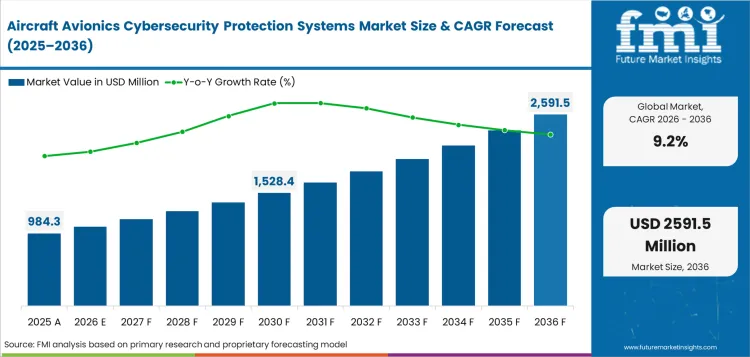
The aircraft avionics cybersecurity protection systems market size stood at USD 984.3 million in 2025 and is projected to cross USD 1,074.8 million in 2026. Industry revenue is forecast to reach USD 2,591.5 million by 2036 at 9.2% CAGR. By integration mode, line-fit integration is estimated to account for 64.1% share in 2026. Commercial aircraft are anticipated to represent 46.3% share of platform in 2026.
Summary of the Aircraft Avionics Cybersecurity Protection Systems Market
- Demand and Growth Drivers
- Connected aircraft programs are propelling the demand for cyber controls across cockpit networks and aircraft data transfer paths.
- EASA Part-IS deadlines are making information security evidence a formal part of aviation safety management.
- Software-defined radios and secure data loaders are raising operator focus on controlled software changes across airframes.
- Product and Segment View
- Line-fit integration is projected to account for 64.1% share in 2026 due to aircraft-level approval before entry into service.
- Commercial aircraft are anticipated to capture 46.3% share in 2026 with airline fleets carrying the broader connected avionics need.
- Network security is projected to represent 34.8% share in 2026 through secure gateways and data-link segmentation needs.
- Geography and Competitive Outlook
- India is projected to record 10.8% CAGR by 2036 driven by fleet growth and digital airline operations promoting retrofit need.
- China is expected to expand at 10.3% CAGR by 2036 reflecting aircraft output and low-altitude aviation digitization.
- Thales and Honeywell define one side of competition across avionics cyber protection. Collins Aerospace and BAE Systems add secure systems depth.
- Analyst Opinion
- Nikhil Kaitwade, Principal Consultant for Industrial Automation at FMI, observes, “Aircraft avionics cyber protection is becoming a safety evidence problem beyond an IT spending line. Airlines and aircraft makers now need systems able to protect software loads and flight data paths during normal operations. Suppliers with certified hardware and aircraft network experience will hold stronger positions across new-build and retrofit programs.”
- Aircraft Avionics Cybersecurity Protection Systems Market Value Analysis
- Aircraft avionics cybersecurity protection value is shifting from perimeter software toward certified controls embedded in aircraft data paths.
- Operator spending focuses on secure software loading as connected aircraft receive more digital updates during maintenance.
- Suppliers connect avionics protection with airworthiness proof as regulators ask for safety-relevant cyber risk control.
- Demand is supported by airlines and defense operators seeking reliable protection for flight deck and communication systems.
Key Takeaways, Market Size, and Forecast
- The aircraft avionics cybersecurity protection systems market was valued at USD 984.3 million in 2025.
- The aircraft avionics cybersecurity protection systems industry value is expected to reach USD 2,591.5 million by 2036.
- From 2026 to 2036, the sector is anticipated to expand at 9.2% CAGR.
- Industry revenue is forecast to create an incremental opportunity of USD 1,516.7 million from 2026 to 2036.
- Line-fit integration is poised to represent 64.1% share of integration mode in 2026.
- Commercial aircraft are anticipated to account for 46.3% share of platform in 2026.
- India is projected to record the stronger country pace at 10.8% CAGR by 2036, with China close behind at 10.3% CAGR.
Connected avionics are putting pressure on aircraft makers and airlines to protect software updates and data paths after aircraft enter service. In March 2025, FAA special conditions tied external network access to electronic system security evidence for connected aircraft systems. EASA’s December 2025 information security rules also moved cyber risk into aviation safety management. As a result, operators need suppliers providing certified data loading and avionics network knowledge without adding approval risk.
Aircraft Avionics Cybersecurity Protection Systems Market Definition
Aircraft avionics cybersecurity protection systems include hardware, software and services used to protect aircraft avionics from unauthorized access or unsafe data changes. Scope covers secure gateways and avionics intrusion detection. Secure data loaders and encrypted communication controls are included around flight systems. Revenue includes line-fit installation and retrofit upgrades. Software updates and managed support are included if tied to aircraft systems. General enterprise cyber tools are excluded unless sold for aircraft avionics or aviation safety systems.
Aircraft Avionics Cybersecurity Protection Systems Market Inclusions
Scope includes network security appliances and avionics intrusion detection tools. Secure communication radios and software integrity controls are included for aircraft. Commercial aircraft and military aircraft are included. Business jets, helicopters and unmanned aircraft are included. Line-fit and retrofit channels are included if protection is linked to avionics security. Support services are included only if tied to an aircraft protection system or regulatory compliance package.
Aircraft Avionics Cybersecurity Protection Systems Market Exclusions
Scope excludes general airport cyber software, passenger booking security and corporate IT firewalls. Standalone ground data center protection is outside scope unless connected to aircraft software loading or flight data transfer. Pure navigation hardware is excluded unless cyber protection is part of the product function. General consulting is excluded unless sold with aircraft cybersecurity assessment or avionics compliance support.
Aircraft Avionics Cybersecurity Protection Systems Market Research Methodology
- Primary Research: FMI analysts reviewed avionics security requirements across aircraft OEMs and airlines. Defense users and MRO service groups were checked separately.
- Desk Research: Official aviation safety rules and aircraft fleet data supported market sizing. Supplier product releases supported company mapping.
- Market Sizing and Forecasting: Forecast values used aircraft fleet scale and connected avionics penetration. Protection fitment rates and system pricing checks refined estimates.
- Data Validation: Checks compared 2026 value with 2036 value. Segment share balance was reviewed against fleet growth and regulation timing.
Why is the Aircraft Avionics Cybersecurity Protection Systems Market Growing?
- Connected aircraft architecture is increasing exposure at points used for aircraft data transfer and software loading.
- EASA Part-IS is pushing approved aviation organizations to treat cyber risk as a safety-linked compliance issue.
- Flight deck processing upgrades increase demand for protection controls able to work inside certified avionics environments.
Aircraft operators are paying closer attention to avionics cyber protection as aircraft exchange more data with maintenance and airline systems. A 2024 ARINC 429 hardware-in-the-loop study showed lack of encryption and authentication can expose avionics data buses to attack. Such findings support intrusion detection demand for older aircraft networks built before hostile cyber conditions became common. FAA special conditions for the Boeing 777-9 in May 2025 show how critical electrical and electronic systems now carry direct safety consequences. Protection suppliers can gain competitive edge by proving controlled updates and safe network separation.
Market Segmentation Analysis
- Network security is projected to capture 34.8% share in 2026 as secure gateways and segmented aircraft networks become common protection layers.
- Commercial aircraft are anticipated to hold 46.3% share in 2026 since airline fleets carry broad connectivity and maintenance data transfer needs.
- Communication systems are forecast to account for 31.7% share in 2026 reflecting secure radio, satcom and data-link protection needs.
- Line-fit integration is projected to represent 64.1% share in 2026 with aircraft-level approval favoring factory-installed cyber controls.
- Aircraft OEMs are expected to hold 39.5% share in 2026 through early specification of secure avionics architectures.
Market segmentation is divided into five parent groups based on protection function and aircraft platform. Protection type separates network security from intrusion detection. Platform shows how fleet mix changes the spending profile. System location explains whether cyber controls protect cockpit or communication paths. Integration mode separates factory fitment from retrofit demand. End user shows who specifies and validates avionics cyber protection.
Insights into Aircraft Avionics Cybersecurity Protection Systems Market by Protection Type
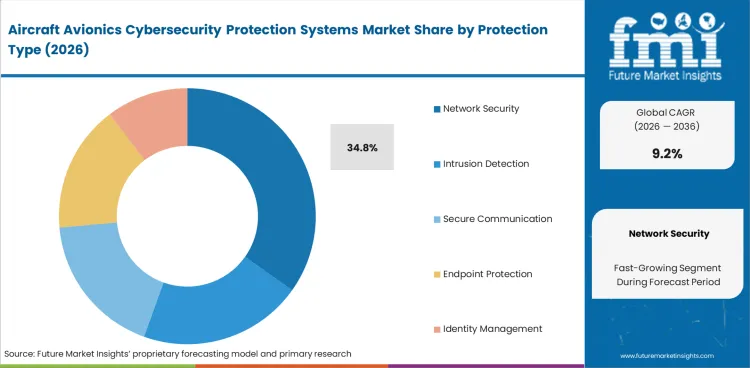
- Network security is projected to account for 34.8% share in 2026, driven by aircraft makers depending on secure gateways separating flight critical networks from data exchange paths used by maintenance systems.
- Intrusion detection retains a rising role as older data buses need monitoring tools able to spot abnormal messages without disturbing certified avionics behavior.
Insights into Aircraft Avionics Cybersecurity Protection Systems Market by Platform
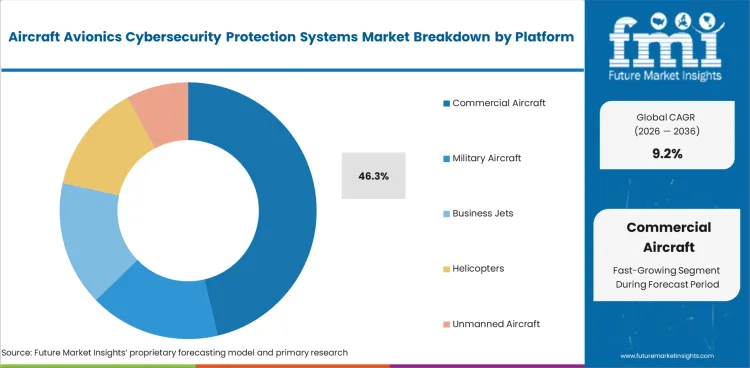
- Commercial aircraft are anticipated to account for 46.3% share in 2026 due to airline fleets relying on connected maintenance tools and secure software updates across many aircraft cycles.
- Military aircraft show stronger readiness for encrypted communication controls led by secure mission radios and cyber physical checks forming part of operational resilience.
Insights into Aircraft Avionics Cybersecurity Protection Systems Market by System Location
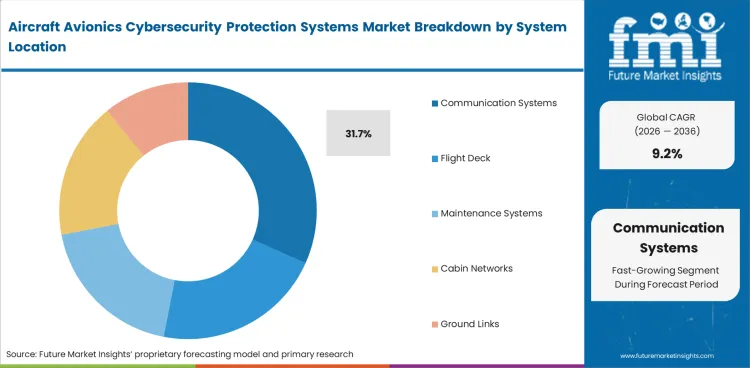
- Communication systems are forecast to account for 31.7% share in 2026 reflecting satcom and aircraft data links requiring encryption along with traffic filtering across routine operations.
- Flight deck systems keep a premium role as cockpit display and processor upgrades must meet strict software assurance expectations.
Insights into Aircraft Avionics Cybersecurity Protection Systems Market by Integration Mode
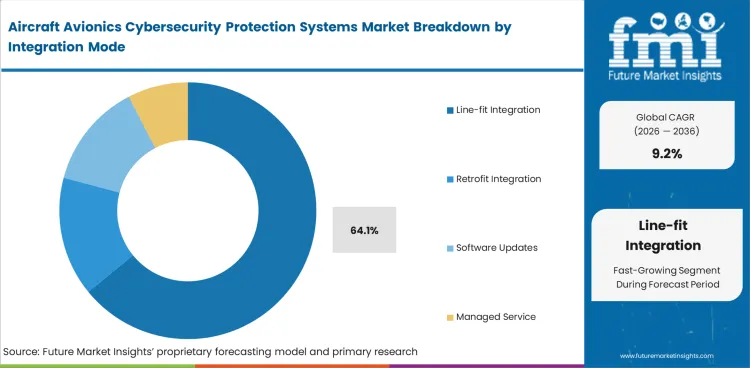
- Line-fit integration is projected to account for 64.1% share in 2026 since cyber protection is certified with avionics architecture before aircraft delivery.
- Retrofit integration is rising as airlines upgrade secure data loaders and intrusion monitoring across aircraft already in service.
Insights into Aircraft Avionics Cybersecurity Protection Systems Market by End User
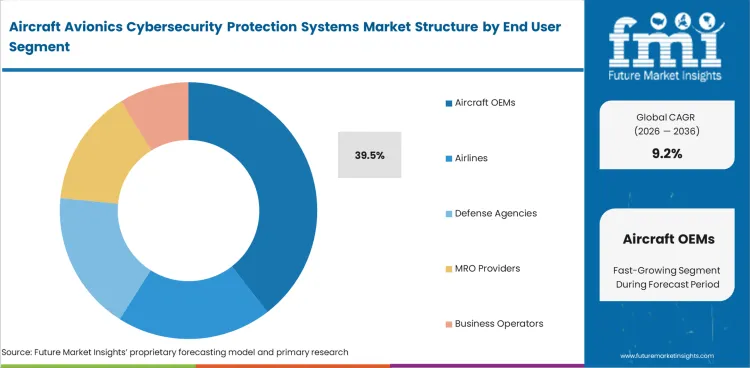
- Aircraft OEMs are expected to account for 39.5% share in 2026, led by cyber protection specifications integrating into aircraft design and airworthiness planning.
- Airlines hold a considerable retrofit opportunity as maintenance groups need secure software loading and controlled connectivity across daily operations.
Aircraft Avionics Cybersecurity Protection Systems Market Drivers, Restraints and Opportunities
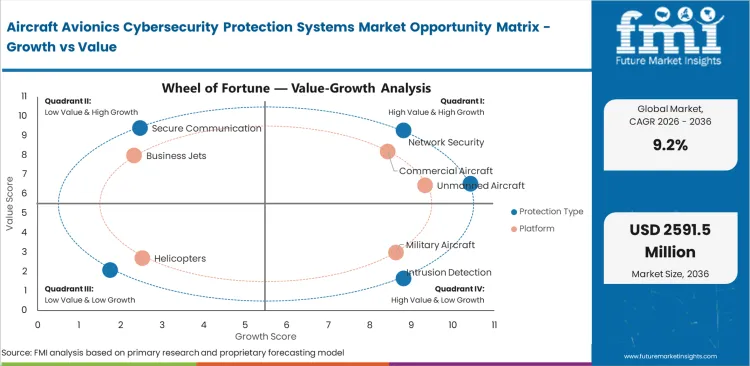
- Avionics software assurance is making secure data loading a higher priority as aircraft receive approved configuration files during maintenance.
- Certification cost can slow adoption because aircraft cyber tools must avoid interference with flight critical systems.
- Part-IS compliance offers opportunity for suppliers offering risk assessment and evidence support together.
Regulatory pressure is giving avionics cyber protection a lucrative investment prospect. European aviation organisations within Delegated Regulation 2022/1645 must comply with Part-IS by 16 October 2025. Compliance work makes aircraft network mapping and event reporting more visible to airline safety groups. Cost remains a restraint because every added tool must prove compatibility with certified aircraft systems. Opportunity is strongest for suppliers who can combine secure hardware and monitoring software in one package.
Technology Adoption and Automation Penetration Analysis
Technology use is strongest as cyber protection connects directly with aircraft communication systems and flight deck software. Collins Aerospace received FAA approval in September 2024 for a Mosarc-based cockpit display that increases cockpit processing power by 75.0%. Higher processing capacity gives aircraft more capacity for security functions and certified applications. Aircraft sensors and connected sensors add further data points that need trusted handling. Avionics cybersecurity suppliers will benefit as aircraft electronics become more software defined.
Application-wise Equipment Deployment Analysis
Equipment use is strongest around secure software loading, aircraft network monitoring and encrypted airborne communication. Teledyne Controls said its eADL XS meets ARINC 645-1 secure data loading needs and protects software parts with digital signature checks. CCX Technologies offers avionics intrusion detection that can collect ARINC-429 and AFDX data through secure router platforms. Demand also extends to flight tracking system security and flight information display system data integrity during flight operations. Suppliers with airframe integration proof can gain access to airline maintenance spending.
Analysis of Aircraft Avionics Cybersecurity Protection Systems Market by Key Countries
.webp "Top Country Growth Comparison Aircraft Avionics Cybersecurity Protection Systems Market Cagr (2026 2036)")
| Country | CAGR |
|---|---|
| India | 10.8% |
| China | 10.3% |
| United States | 9.4% |
| Germany | 8.7% |
| France | 8.4% |
| United Kingdom | 8.1% |
| Japan | 7.6% |
Source: Future Market Insights, 2026.
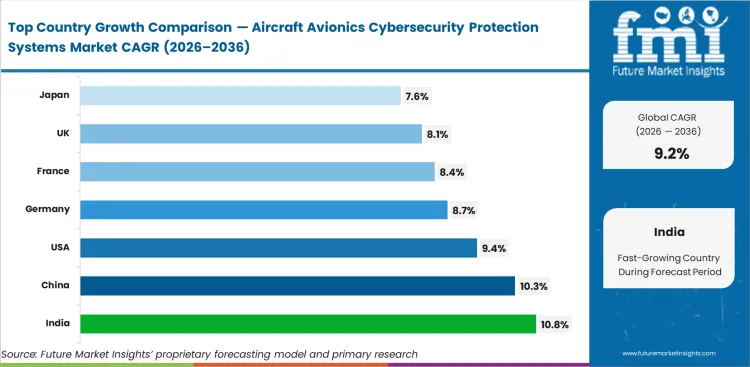
Aircraft Avionics Cybersecurity Protection Systems Market CAGR Analysis by Country
- India is projected to record 10.8% CAGR by 2036, influenced by fleet growth and wider digital airline operations.
- China is expected to expand at 10.3% CAGR by 2036 reflecting scale in demand for aircraft activity and low-altitude aviation systems.
- United States is forecast to grow at 9.4% CAGR by 2036 through certification depth and avionics supplier concentration.
- Germany is expected to advance at 8.7% CAGR by 2036, driven by Part-IS compliance and aircraft engineering depth guiding investment.
- France is projected to rise at 8.4% CAGR by 2036 due to civil aviation cyber rules and aerospace supply depth influencing adoption.
- United Kingdom is forecast at 8.1% CAGR by 2036 led by airline digital operations and aviation security oversight.
- Japan is expected to post 7.6% CAGR by 2036 as measured fleet expansion keeps cyber upgrades selective.
Country performance differs by fleet growth, regulatory timing and avionics supplier access. India and China are witnessing steady expansion as airline expansion and aircraft data systems create broader upgrade pools. United States growth reflects certification depth and concentration of suppliers. Germany and France benefit from European safety rules. Japan grows below the global pace as fleet renewal is steadier and retrofit cycles are more measured.
Demand Outlook for Aircraft Avionics Cybersecurity Protection Systems in India
Sector in India is projected to record 10.8% CAGR by 2036 due to airline fleet growth widening the need for secure avionics updates and connected maintenance controls. IATA reported domestic India RPKs rose 5.2% in full-year 2025. Traffic growth raises pressure on maintenance groups that manage software versions across more active aircraft. Secure data loaders and managed cyber checks can reduce configuration risk during tight turnaround windows.
- Indian operators are positioned to adopt line-fit cyber functions as new aircraft deliveries enter service over the assessment period.
- Airline maintenance groups need update controls that protect avionics software and reduce manual file handling.
- Fast fleet growth favors suppliers able to support local airlines with training and compliance documentation.
Growth Outlook for Aircraft Avionics Cybersecurity Protection Systems in China
Demand in China is expected to expand at 10.3% CAGR by 2036, driven by deepening domestic aviation activity and connected aircraft programs. CAAC reported 770.1 million passenger trips in 2025. Same release recorded 5.5 million takeoffs during the year. High flight activity increases the value of secure communication and data transfer controls. Low-altitude aviation adds another digital layer as registered drones reached 3.287 million by the end of 2025.
- Domestic aircraft and drone growth promotes wider demand for cyber checks around airborne digital systems.
- Airlines need secure data exchange with maintenance systems as aircraft utilization stays high across trunk routes.
- Local programs are expected to favor suppliers able to align with Chinese aviation safety review and domestic production needs.
Opportunity Analysis of Aircraft Avionics Cybersecurity Protection Systems in the United States
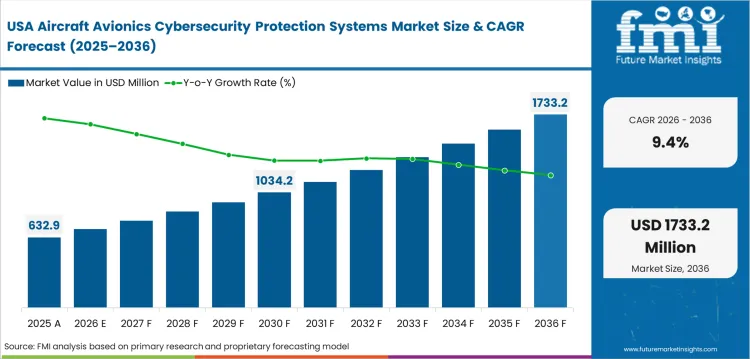
The market in United States is forecast to grow at 9.4% CAGR by 2036 since certification depth and connected aircraft retrofits keep system assurance high. FAA forecasts the USA commercial aircraft fleet will rise from 7.4 thousand aircraft in 2024 to 10.6 thousand aircraft in 2045. Fleet growth supports secure retrofit work across long-life aircraft. FAA software guidance covers airborne electronic hardware used in autopilots and flight controls.
- Certification experience gives domestic suppliers an advantage in cyber tools built for certified flight environments.
- Airline retrofit programs are positioned to prioritize secure loading and network filtering before broader cabin connectivity upgrades.
- Defense aircraft programs propel demand for secure communications as software-defined radios enter more rotary-wing fleets.
Demand Analysis of Aircraft Avionics Cybersecurity Protection Systems in Germany
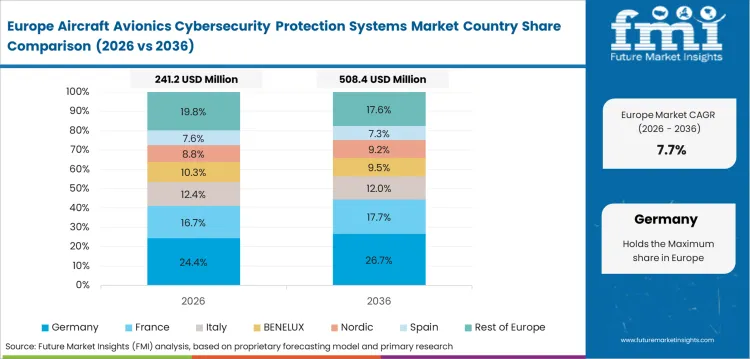
Sector in Germany is expected to advance at 8.7% CAGR by 2036, led by safety oversight and aircraft engineering depth raising cyber assurance spending. Destatis reported 207.2 million passengers at major German airports in 2025. Passenger recovery brings more aircraft cycles and maintenance events that need controlled software handling. Part-IS compliance reinforces documentation needs across aviation organisations.
- German operators are likely to favor certified tools with clear evidence packs for safety and audit reviews.
- Engineering groups need avionics cyber protection working with existing flight deck and communication systems.
- Local supplier discussions will be shaped by European compliance timing and aircraft network mapping needs.
Sales Outlook for Aircraft Avionics Cybersecurity Protection Systems in France
Industry in France is projected to rise at 8.4% CAGR by 2036, influenced by aerospace suppliers and aviation regulators focusing on cyber resilience. For instance, Aéroports de Paris SA reported 72,029,407 passengers at Paris-CDG in 2025. Dense airport activity keeps secure flight information flows and aircraft connectivity under closer review. Supplier strength in avionics and aircraft services supports adoption across OEM and airline channels.
- French aerospace programs can use cyber protection during design and production stages for new aircraft systems.
- Airline service groups need secure loading tools as digital maintenance files move between ground and aircraft systems.
- Part-IS compliance can lift demand for risk assessment tied to operational safety and aircraft system mapping.
Future Outlook for Aircraft Avionics Cybersecurity Protection Systems in the United Kingdom
Demand in the United Kingdom is forecast at 8.1% CAGR by 2036 since airline digital operations and cyber oversight raise avionics protection needs. UK Civil Aviation Authority data showed 302.0 million passengers moved through UK airports in 2025. High traffic makes aircraft availability and secure maintenance workflows commercially important. Aviation security providers can gain by helping operators document and control aircraft cyber risks.
- UK airlines use managed avionics cyber services to reduce pressure on internal technical groups.
- Passenger traffic scale supports spending on secure data paths that protect flight operations and maintenance planning.
- Defense aviation demand creates opportunity for encrypted airborne communication and cyber physical assessment tools.
Sales Analysis of Aircraft Avionics Cybersecurity Protection Systems in Japan
Japan is expected to post 7.6% CAGR by 2036 as measured fleet renewal keeps avionics cyber spending selective. IATA reported domestic Japan RPKs rose 4.8% in full-year 2025. Stable traffic recovery supports targeted upgrades instead of broad replacement cycles. Operators will likely prioritize protection for flight deck software and secure aircraft data transfer.
- Japanese airlines generally value long service life and low disruption during avionics retrofit work.
- Suppliers need proof that security tools can monitor aircraft data without affecting certified functions.
- Business jet and regional aircraft upgrades support smaller orders for secure dataloading and communication protection.
Competitive Landscape and Strategic Positioning
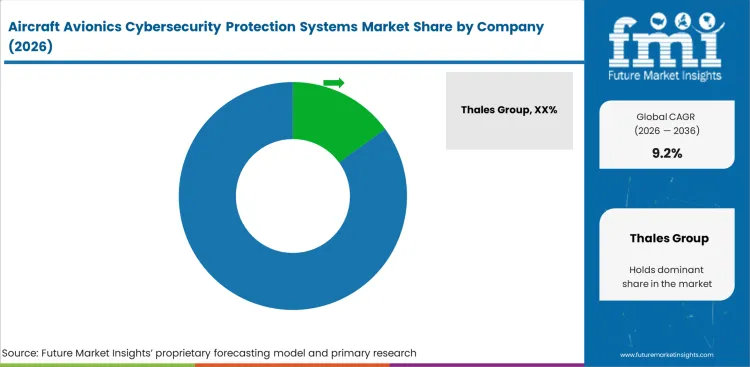
- Established avionics suppliers hold an advantage as cyber tools must work within certified aircraft electronics and safety approval limits.
- Specialist firms compete through intrusion detection and secure data loading for retrofit aircraft with limited upgrade windows.
- Compliance providers gain relevance as Part-IS turns aviation cyber risk into documented safety and operator evidence.
Competition in aircraft avionics cybersecurity protection systems centers on certified aircraft knowledge and safe protection of active avionics data routes. Thales and Collins Aerospace compete through deep avionics experience. Honeywell brings strength in navigation and cockpit systems. Operators favor suppliers able to reduce cyber risk without adding certification uncertainty.
Supplier advantage is strongest near aircraft communication systems and flight deck software update paths. Honeywell launched HANA in October 2025 for GPS jamming and spoofing threats. BAE Systems fielded AN/ARC-231A MARS secure airborne communications for USA Army rotary wing aircraft in September 2025. Specialist firms such as CCX Technologies and Airbus Protect are focusing on retrofit and compliance work with clear installation proof. Vendors combining aircraft protocol depth and safety case support are estimated to stay competitive through forecast period.
Key Companies in the Aircraft Avionics Cybersecurity Protection Systems Market
Competitive structure is best assessed by grouping companies around avionics platforms, secure communications and cyber compliance support.
- Avionics Platform Leaders: Thales Group and Honeywell Aerospace Technologies provide certified avionics systems. Collins Aerospace adds cockpit electronics depth. Their strength comes from aircraft program access and long relationships with aircraft OEMs.
- Secure Communication and Data Specialists: BAE Systems and Teledyne Controls compete through secure radios and data loaders. CCX Technologies and General Dynamics Mission Systems add avionics security depth across data bus monitoring and encrypted systems.
- Compliance and Embedded Security Providers: Airbus Protect supports airlines and aviation organisations with Part-IS gap analysis. L3Harris Technologies and Curtiss-Wright Corporation add secure communication and trusted embedded computing exposure.
Competitive Benchmarking: Aircraft Avionics Cybersecurity Protection Systems Market
| Company | Avionics Protocol Fit | Secure Communication Depth | Compliance Evidence Support | Geographic Footprint |
|---|---|---|---|---|
| Thales Group | High | Strong | Strong | Global avionics and defense |
| Honeywell Aerospace Technologies | High | Strong | Strong | Global aircraft systems |
| Collins Aerospace | High | Strong | Strong | Global avionics |
| BAE Systems plc | Medium | Strong | Strong | Defense aviation |
| Teledyne Controls | High | Medium | Medium | Commercial retrofit |
| CCX Technologies | High | Medium | Medium | Aerospace specialists |
| General Dynamics Mission Systems | Medium | Strong | Medium | Defense avionics |
| Airbus Protect | Medium | Medium | Strong | Europe and global airlines |
Source: Future Market Insights competitive analysis 2026. Ratings reflect relative positioning based on avionics protocol fit and secure communication depth.
Key Developments in Aircraft Avionics Cybersecurity Protection Systems Market
- In November 2024, Teledyne Controls announced Boeing 737NG certification for eADL XS secure data loading. The product supports software integrity and access control for avionics updates.
- In May 2025, BAE Systems published CyberA2 as software for assessing critical cyber physical systems including avionics. The product supports checks for tampering and operational errors.
- In September 2025, Teledyne Controls received FAA STC approval for eADL XS on the Airbus A320 family. The approval expands secure data loading options across A318, A319, A320 and A321 aircraft.
Key Players in the Aircraft Avionics Cybersecurity Protection Systems Market
Major Global Players:
- Thales Group
- Honeywell Aerospace Technologies
- Collins Aerospace
- BAE Systems plc
- Teledyne Controls
Specialist and Regional Players:
- CCX Technologies
- Airbus Protect
- General Dynamics Mission Systems
- L3Harris Technologies
- Curtiss-Wright Corporation
Market Report Scope
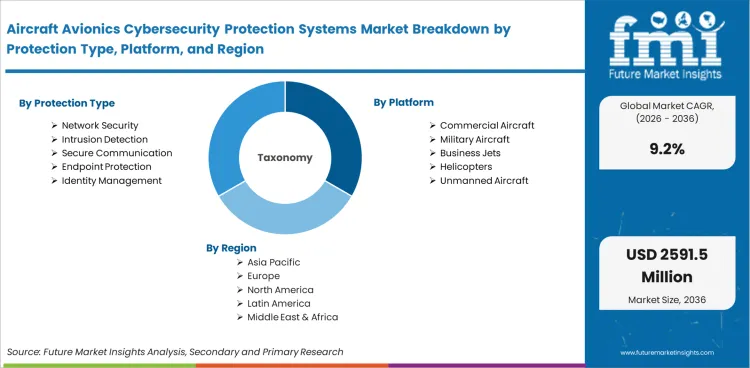
| Parameter | Details |
|---|---|
| Quantitative Units | USD 1,074.8 million to USD 2,591.5 million, at 9.2% CAGR |
| Market Definition | Hardware, software and services protecting aircraft avionics from unauthorized access or unsafe data changes |
| Protection Type | Network Security, Intrusion Detection, Secure Communication, Endpoint Protection, Identity Management |
| Platform | Commercial Aircraft, Military Aircraft, Business Jets, Helicopters, Unmanned Aircraft |
| System Location | Communication Systems, Flight Deck, Maintenance Systems, Cabin Networks, Ground Links |
| Integration Mode | Line-fit Integration, Retrofit Integration, Software Updates, Managed Service |
| End User | Aircraft OEMs, Airlines, Defense Agencies, MRO Providers, Business Operators |
| Regions Covered | North America, Latin America, Western Europe, Eastern Europe, East Asia, South Asia and Pacific, Middle East and Africa |
| Countries Covered | United States, Germany, China, India, Japan, France, United Kingdom and 30+ countries |
| Key Companies Profiled | Thales Group, Honeywell Aerospace Technologies, Collins Aerospace, BAE Systems plc, Teledyne Controls, CCX Technologies, Airbus Protect, General Dynamics Mission Systems, L3Harris Technologies, Curtiss-Wright Corporation |
| Forecast Period | 2026 to 2036 |
| Approach | Aircraft fleet checks, aviation cyber regulation review, supplier evidence and segment share estimates |
Source: Future Market Insights, 2026.
Aircraft Avionics Cybersecurity Protection Systems Market Breakdown by Protection Type, Platform, System Location, Integration Mode, End User and Region
By Protection Type:
- Network Security
- Intrusion Detection
- Secure Communication
- Endpoint Protection
- Identity Management
By Platform:
- Commercial Aircraft
- Military Aircraft
- Business Jets
- Helicopters
- Unmanned Aircraft
By System Location:
- Communication Systems
- Flight Deck
- Maintenance Systems
- Cabin Networks
- Ground Links
By Integration Mode:
- Line-fit Integration
- Retrofit Integration
- Software Updates
- Managed Service
By End User:
- Aircraft OEMs
- Airlines
- Defense Agencies
- MRO Providers
- Business Operators
By Region:
- North America
- Latin America
- Western Europe
- Eastern Europe
- East Asia
- South Asia and Pacific
- Middle East and Africa
Research Sources and Bibliography
- Federal Aviation Administration. (2025, March 5). Special conditions: Universal Avionics Systems Corporation, supplemental type certificate, transport category airplanes; electronic system security protection from unauthorized external access. Federal Register.
- European Union Aviation Safety Agency. (2025, December 5). Easy Access Rules for Information Security (Regulations (EU) 2023/203 and 2022/1645).
- BAE Systems. (2025, May 7). CyberA2™.
- Aéroports de Paris SA. (2026, January 15). December & full-year 2025 traffic figures. Groupe ADP.
- BAE Systems. (2025, September 4). USA Army begins fielding BAE Systems’ mission-critical software-defined radios across rotary-wing aviation fleet.
- Civil Aviation Administration of China. (2026, April 22). CAAC releases statistical bulletin of civil aviation industry development in 2025.
- Curtiss-Wright Defense Solutions. (2025, September 30). Curtiss-Wright selected by Bell Textron to provide encrypted flight recorders for MV-75 Long Range Assault Aircraft program.
- Destatis. (2026, January 29). 3,9% mehr Fluggäste im Jahr 2025 als im Vorjahr [3.9% more air passengers in 2025 than in the previous year]. Federal Statistical Office of Germany.
- Federal Aviation Administration. (2024, September 27). Aircraft certification software and airborne electronic hardware.
- Federal Aviation Administration. (2025). FAA aerospace forecast fiscal years 2025-2045.
- Federal Aviation Administration. (2025, May 23). Special conditions: The Boeing Company Model 777-9 airplane; operation without normal electrical power. Federal Register.
- General Dynamics Mission Systems. (2025, October 9). General Dynamics business units to participate in AUSA 2025.
- Honeywell Aerospace Technologies. (2025, October 13). Honeywell launches new alternative navigation software to counter jamming and spoofing threats.
- International Air Transport Association. (2026, January 29). Strong 2025 passenger demand masks ongoing capacity constraints.
- L3Harris Technologies. (2025, January 27). USA Army awards L3Harris nearly $300 million for resilient communications program.
- RTX. (2024, September 18). RTX’s Collins Aerospace receives first-ever FAA approval to increase cockpit processing power.
- Teledyne Controls. (2024, November 15). Teledyne’s new generation onboard secure data loader eADL XS™ certified on Boeing 737NG aircraft.
- Teledyne Controls. (2025, September 17). Teledyne’s new generation onboard secure data loader eADL XS™ certified on Airbus A320 aircraft family.
- Thales Group. (2024, November 19). Protecting aircraft with artificial intelligence: Thales and partners selected for first European project to develop sovereign AI for embedded cyberdefence.
- Trask, C., Movit, S., Clutter, J., Clark, R., Herrera, M., & Tran, K. (2024, August 29). ARINC 429 cyber-vulnerabilities and voltage data in a hardware-in-the-loop simulator. arXiv.
- UK Civil Aviation Authority. (2026, February 24). UK aviation officially breaks records with over 300m passenger journeys in 2025.
Bibliography is provided for reader reference with official and traceable sources.
This Report Answers
- What is the current and future value of the aircraft avionics cybersecurity protection systems market?
- What CAGR is forecast for the aircraft avionics cybersecurity protection systems market from 2026 to 2036?
- Which protection type is projected to hold a leading share in the aircraft avionics cybersecurity protection systems market?
- Which platform creates the main revenue pool for aircraft avionics cybersecurity protection systems?
- How do EASA Part-IS rules affect aircraft avionics cybersecurity protection system demand?
- Which countries are forecast to show higher CAGR for aircraft avionics cybersecurity protection systems?
- Which companies are active in aircraft avionics cybersecurity protection systems and related secure avionics tools?
- What is included and excluded in the aircraft avionics cybersecurity protection systems market definition?
- How are the aircraft avionics cybersecurity protection system revenue and segment shares estimated?
Frequently Asked Questions
What is the global market demand for aircraft avionics cybersecurity protection systems market in 2026?
The aircraft avionics cybersecurity protection systems market is estimated at USD 1,074.8 million as connected avionics expand.
What will be the value of aircraft avionics cybersecurity protection systems market by 2036?
The aircraft avionics cybersecurity protection systems market is forecast at USD 2,591.5 million by 2036 as certified cyber controls broaden.
What CAGR is expected for aircraft avionics cybersecurity protection systems market from 2026 to 2036?
The aircraft avionics cybersecurity protection systems sector is projected to expand at 9.2% CAGR from 2026 to 2036 as rules tighten.
Which segment holds a leading share in aircraft avionics cybersecurity protection systems market?
Line-fit integration is projected to account for 64.1% share in 2026 as aircraft makers certify cyber protection during production.
Which platform leads aircraft avionics cybersecurity protection systems market in 2026?
Commercial aircraft are anticipated to hold 46.3% share in 2026 as airline connectivity and secure maintenance data transfer support adoption.
Why is India important in aircraft avionics cybersecurity protection systems market?
India is projected to record 10.8% CAGR by 2036 as fleet growth increases the need for secure updates and connected maintenance.
What does aircraft avionics cybersecurity protection systems market include?
Market scope includes secure gateways and intrusion detection. Secure data loaders and compliance support are tied directly to aircraft avionics protection.
How does FMI forecast aircraft avionics cybersecurity protection systems market?
FMI uses fleet scale and avionics connectivity. Protection fitment rates and supplier validation checks estimate revenue and segment shares.
How do airlines buy aircraft avionics cybersecurity protection systems?
Airlines usually start with risk assessment, aircraft network mapping and retrofit feasibility before choosing secure data loading or monitoring tools.
How do aircraft avionics cybersecurity protection systems work?
Systems separate trusted aircraft networks, check software authenticity and monitor avionics messages for unsafe or unusual behavior during operations.
Who uses aircraft avionics cybersecurity protection systems?
Aircraft OEMs and airlines use protection systems to reduce cyber risk around avionics. Defense agencies and MRO providers use them for secure operations.
Why are secure data loaders important for avionics cyber protection?
Secure data loaders protect software parts by checking signatures and controlling access before approved files are loaded into aircraft systems.
Preview the report firsthand - request a free sample
Get SampleGet the brochure for pricing and purchase details.
Get PDFTable of Content
- Executive Summary
- Global Market Outlook
- Demand-side Trends
- Supply-side Trends
- Technology Roadmap Analysis
- Analysis and Recommendations
- Market Overview
- Market Coverage / Taxonomy
- Market Definition / Scope / Limitations
- Research Methodology
- Chapter Orientation
- Analytical Lens and Working Hypotheses
- Market Structure, Signals, and Trend Drivers
- Benchmarking and Cross-market Comparability
- Market Sizing, Forecasting, and Opportunity Mapping
- Research Design and Evidence Framework
- Desk Research Programme (Secondary Evidence)
- Company Annual and Sustainability Reports
- Peer-reviewed Journals and Academic Literature
- Corporate Websites, Product Literature, and Technical Notes
- Earnings Decks and Investor Briefings
- Statutory Filings and Regulatory Disclosures
- Technical White Papers and Standards Notes
- Trade Journals, Industry Magazines, and Analyst Briefs
- Conference Proceedings, Webinars, and Seminar Materials
- Government Statistics Portals and Public Data Releases
- Press Releases and Reputable Media Coverage
- Specialist Newsletters and Curated Briefings
- Sector Databases and Reference Repositories
- FMI Internal Proprietary Databases and Historical Market Datasets
- Subscription Datasets and Paid Sources
- Social Channels, Communities, and Digital Listening Inputs
- Additional Desk Sources
- Expert Input and Fieldwork (Primary Evidence)
- Primary Modes
- Qualitative Interviews and Expert Elicitation
- Quantitative Surveys and Structured Data Capture
- Blended Approach
- Why Primary Evidence is Used
- Field Techniques
- Interviews
- Surveys
- Focus Groups
- Observational and In-context Research
- Social and Community Interactions
- Stakeholder Universe Engaged
- C-suite Leaders
- Board Members
- Presidents and Vice Presidents
- R&D and Innovation Heads
- Technical Specialists
- Domain Subject-matter Experts
- Scientists
- Physicians and Other Healthcare Professionals
- Governance, Ethics, and Data Stewardship
- Research Ethics
- Data Integrity and Handling
- Primary Modes
- Tooling, Models, and Reference Databases
- Desk Research Programme (Secondary Evidence)
- Data Engineering and Model Build
- Data Acquisition and Ingestion
- Cleaning, Normalisation, and Verification
- Synthesis, Triangulation, and Analysis
- Quality Assurance and Audit Trail
- Market Background
- Market Dynamics
- Drivers
- Restraints
- Opportunity
- Trends
- Scenario Forecast
- Demand in Optimistic Scenario
- Demand in Likely Scenario
- Demand in Conservative Scenario
- Opportunity Map Analysis
- Product Life Cycle Analysis
- Supply Chain Analysis
- Investment Feasibility Matrix
- Value Chain Analysis
- PESTLE and Porter’s Analysis
- Regulatory Landscape
- Regional Parent Market Outlook
- Production and Consumption Statistics
- Import and Export Statistics
- Market Dynamics
- Global Market Analysis 2021 to 2025 and Forecast, 2026 to 2036
- Historical Market Size Value (USD Million) Analysis, 2021 to 2025
- Current and Future Market Size Value (USD Million) Projections, 2026 to 2036
- Y-o-Y Growth Trend Analysis
- Absolute $ Opportunity Analysis
- Global Market Pricing Analysis 2021 to 2025 and Forecast 2026 to 2036
- Global Market Analysis 2021 to 2025 and Forecast 2026 to 2036, By Protection Type
- Introduction / Key Findings
- Historical Market Size Value (USD Million) Analysis By Protection Type , 2021 to 2025
- Current and Future Market Size Value (USD Million) Analysis and Forecast By Protection Type , 2026 to 2036
- Network Security
- Intrusion Detection
- Secure Communication
- Endpoint Protection
- Identity Management
- Network Security
- Y-o-Y Growth Trend Analysis By Protection Type , 2021 to 2025
- Absolute $ Opportunity Analysis By Protection Type , 2026 to 2036
- Global Market Analysis 2021 to 2025 and Forecast 2026 to 2036, By Platform
- Introduction / Key Findings
- Historical Market Size Value (USD Million) Analysis By Platform, 2021 to 2025
- Current and Future Market Size Value (USD Million) Analysis and Forecast By Platform, 2026 to 2036
- Commercial Aircraft
- Military Aircraft
- Business Jets
- Helicopters
- Unmanned Aircraft
- Commercial Aircraft
- Y-o-Y Growth Trend Analysis By Platform, 2021 to 2025
- Absolute $ Opportunity Analysis By Platform, 2026 to 2036
- Global Market Analysis 2021 to 2025 and Forecast 2026 to 2036, By System Location
- Introduction / Key Findings
- Historical Market Size Value (USD Million) Analysis By System Location, 2021 to 2025
- Current and Future Market Size Value (USD Million) Analysis and Forecast By System Location, 2026 to 2036
- Communication Systems
- Flight Deck
- Maintenance Systems
- Cabin Networks
- Ground Links
- Communication Systems
- Y-o-Y Growth Trend Analysis By System Location, 2021 to 2025
- Absolute $ Opportunity Analysis By System Location, 2026 to 2036
- Global Market Analysis 2021 to 2025 and Forecast 2026 to 2036, By Integration Mode
- Introduction / Key Findings
- Historical Market Size Value (USD Million) Analysis By Integration Mode, 2021 to 2025
- Current and Future Market Size Value (USD Million) Analysis and Forecast By Integration Mode, 2026 to 2036
- Line-fit Integration
- Retrofit Integration
- Software Updates
- Managed Service
- Line-fit Integration
- Y-o-Y Growth Trend Analysis By Integration Mode, 2021 to 2025
- Absolute $ Opportunity Analysis By Integration Mode, 2026 to 2036
- Global Market Analysis 2021 to 2025 and Forecast 2026 to 2036, By End User
- Introduction / Key Findings
- Historical Market Size Value (USD Million) Analysis By End User, 2021 to 2025
- Current and Future Market Size Value (USD Million) Analysis and Forecast By End User, 2026 to 2036
- Aircraft OEMs
- Airlines
- Defense Agencies
- MRO Providers
- Business Operators
- Aircraft OEMs
- Y-o-Y Growth Trend Analysis By End User, 2021 to 2025
- Absolute $ Opportunity Analysis By End User, 2026 to 2036
- Global Market Analysis 2021 to 2025 and Forecast 2026 to 2036, By Region
- Introduction
- Historical Market Size Value (USD Million) Analysis By Region, 2021 to 2025
- Current Market Size Value (USD Million) Analysis and Forecast By Region, 2026 to 2036
- North America
- Latin America
- Western Europe
- Eastern Europe
- East Asia
- South Asia and Pacific
- Middle East & Africa
- Market Attractiveness Analysis By Region
- North America Market Analysis 2021 to 2025 and Forecast 2026 to 2036, By Country
- Historical Market Size Value (USD Million) Trend Analysis By Market Taxonomy, 2021 to 2025
- Market Size Value (USD Million) Forecast By Market Taxonomy, 2026 to 2036
- By Country
- USA
- Canada
- Mexico
- By Protection Type
- By Platform
- By System Location
- By Integration Mode
- By End User
- By Country
- Market Attractiveness Analysis
- By Country
- By Protection Type
- By Platform
- By System Location
- By Integration Mode
- By End User
- Key Takeaways
- Latin America Market Analysis 2021 to 2025 and Forecast 2026 to 2036, By Country
- Historical Market Size Value (USD Million) Trend Analysis By Market Taxonomy, 2021 to 2025
- Market Size Value (USD Million) Forecast By Market Taxonomy, 2026 to 2036
- By Country
- Brazil
- Chile
- Rest of Latin America
- By Protection Type
- By Platform
- By System Location
- By Integration Mode
- By End User
- By Country
- Market Attractiveness Analysis
- By Country
- By Protection Type
- By Platform
- By System Location
- By Integration Mode
- By End User
- Key Takeaways
- Western Europe Market Analysis 2021 to 2025 and Forecast 2026 to 2036, By Country
- Historical Market Size Value (USD Million) Trend Analysis By Market Taxonomy, 2021 to 2025
- Market Size Value (USD Million) Forecast By Market Taxonomy, 2026 to 2036
- By Country
- Germany
- UK
- Italy
- Spain
- France
- Nordic
- BENELUX
- Rest of Western Europe
- By Protection Type
- By Platform
- By System Location
- By Integration Mode
- By End User
- By Country
- Market Attractiveness Analysis
- By Country
- By Protection Type
- By Platform
- By System Location
- By Integration Mode
- By End User
- Key Takeaways
- Eastern Europe Market Analysis 2021 to 2025 and Forecast 2026 to 2036, By Country
- Historical Market Size Value (USD Million) Trend Analysis By Market Taxonomy, 2021 to 2025
- Market Size Value (USD Million) Forecast By Market Taxonomy, 2026 to 2036
- By Country
- Russia
- Poland
- Hungary
- Balkan & Baltic
- Rest of Eastern Europe
- By Protection Type
- By Platform
- By System Location
- By Integration Mode
- By End User
- By Country
- Market Attractiveness Analysis
- By Country
- By Protection Type
- By Platform
- By System Location
- By Integration Mode
- By End User
- Key Takeaways
- East Asia Market Analysis 2021 to 2025 and Forecast 2026 to 2036, By Country
- Historical Market Size Value (USD Million) Trend Analysis By Market Taxonomy, 2021 to 2025
- Market Size Value (USD Million) Forecast By Market Taxonomy, 2026 to 2036
- By Country
- China
- Japan
- South Korea
- By Protection Type
- By Platform
- By System Location
- By Integration Mode
- By End User
- By Country
- Market Attractiveness Analysis
- By Country
- By Protection Type
- By Platform
- By System Location
- By Integration Mode
- By End User
- Key Takeaways
- South Asia and Pacific Market Analysis 2021 to 2025 and Forecast 2026 to 2036, By Country
- Historical Market Size Value (USD Million) Trend Analysis By Market Taxonomy, 2021 to 2025
- Market Size Value (USD Million) Forecast By Market Taxonomy, 2026 to 2036
- By Country
- India
- ASEAN
- Australia & New Zealand
- Rest of South Asia and Pacific
- By Protection Type
- By Platform
- By System Location
- By Integration Mode
- By End User
- By Country
- Market Attractiveness Analysis
- By Country
- By Protection Type
- By Platform
- By System Location
- By Integration Mode
- By End User
- Key Takeaways
- Middle East & Africa Market Analysis 2021 to 2025 and Forecast 2026 to 2036, By Country
- Historical Market Size Value (USD Million) Trend Analysis By Market Taxonomy, 2021 to 2025
- Market Size Value (USD Million) Forecast By Market Taxonomy, 2026 to 2036
- By Country
- Kingdom of Saudi Arabia
- Other GCC Countries
- Turkiye
- South Africa
- Other African Union
- Rest of Middle East & Africa
- By Protection Type
- By Platform
- By System Location
- By Integration Mode
- By End User
- By Country
- Market Attractiveness Analysis
- By Country
- By Protection Type
- By Platform
- By System Location
- By Integration Mode
- By End User
- Key Takeaways
- Key Countries Market Analysis
- USA
- Pricing Analysis
- Market Share Analysis, 2025
- By Protection Type
- By Platform
- By System Location
- By Integration Mode
- By End User
- Canada
- Pricing Analysis
- Market Share Analysis, 2025
- By Protection Type
- By Platform
- By System Location
- By Integration Mode
- By End User
- Mexico
- Pricing Analysis
- Market Share Analysis, 2025
- By Protection Type
- By Platform
- By System Location
- By Integration Mode
- By End User
- Brazil
- Pricing Analysis
- Market Share Analysis, 2025
- By Protection Type
- By Platform
- By System Location
- By Integration Mode
- By End User
- Chile
- Pricing Analysis
- Market Share Analysis, 2025
- By Protection Type
- By Platform
- By System Location
- By Integration Mode
- By End User
- Germany
- Pricing Analysis
- Market Share Analysis, 2025
- By Protection Type
- By Platform
- By System Location
- By Integration Mode
- By End User
- UK
- Pricing Analysis
- Market Share Analysis, 2025
- By Protection Type
- By Platform
- By System Location
- By Integration Mode
- By End User
- Italy
- Pricing Analysis
- Market Share Analysis, 2025
- By Protection Type
- By Platform
- By System Location
- By Integration Mode
- By End User
- Spain
- Pricing Analysis
- Market Share Analysis, 2025
- By Protection Type
- By Platform
- By System Location
- By Integration Mode
- By End User
- France
- Pricing Analysis
- Market Share Analysis, 2025
- By Protection Type
- By Platform
- By System Location
- By Integration Mode
- By End User
- India
- Pricing Analysis
- Market Share Analysis, 2025
- By Protection Type
- By Platform
- By System Location
- By Integration Mode
- By End User
- ASEAN
- Pricing Analysis
- Market Share Analysis, 2025
- By Protection Type
- By Platform
- By System Location
- By Integration Mode
- By End User
- Australia & New Zealand
- Pricing Analysis
- Market Share Analysis, 2025
- By Protection Type
- By Platform
- By System Location
- By Integration Mode
- By End User
- China
- Pricing Analysis
- Market Share Analysis, 2025
- By Protection Type
- By Platform
- By System Location
- By Integration Mode
- By End User
- Japan
- Pricing Analysis
- Market Share Analysis, 2025
- By Protection Type
- By Platform
- By System Location
- By Integration Mode
- By End User
- South Korea
- Pricing Analysis
- Market Share Analysis, 2025
- By Protection Type
- By Platform
- By System Location
- By Integration Mode
- By End User
- Russia
- Pricing Analysis
- Market Share Analysis, 2025
- By Protection Type
- By Platform
- By System Location
- By Integration Mode
- By End User
- Poland
- Pricing Analysis
- Market Share Analysis, 2025
- By Protection Type
- By Platform
- By System Location
- By Integration Mode
- By End User
- Hungary
- Pricing Analysis
- Market Share Analysis, 2025
- By Protection Type
- By Platform
- By System Location
- By Integration Mode
- By End User
- Kingdom of Saudi Arabia
- Pricing Analysis
- Market Share Analysis, 2025
- By Protection Type
- By Platform
- By System Location
- By Integration Mode
- By End User
- Turkiye
- Pricing Analysis
- Market Share Analysis, 2025
- By Protection Type
- By Platform
- By System Location
- By Integration Mode
- By End User
- South Africa
- Pricing Analysis
- Market Share Analysis, 2025
- By Protection Type
- By Platform
- By System Location
- By Integration Mode
- By End User
- USA
- Market Structure Analysis
- Competition Dashboard
- Competition Benchmarking
- Market Share Analysis of Top Players
- By Regional
- By Protection Type
- By Platform
- By System Location
- By Integration Mode
- By End User
- Competition Analysis
- Competition Deep Dive
- Thales Group
- Overview
- Product Portfolio
- Profitability by Market Segments (Product/Age /Sales Channel/Region)
- Sales Footprint
- Strategy Overview
- Marketing Strategy
- Product Strategy
- Channel Strategy
- Honeywell Aerospace Technologies
- Collins Aerospace
- BAE Systems plc
- Teledyne Controls
- CCX Technologies
- General Dynamics Mission Systems
- Airbus Protect
- Thales Group
- Competition Deep Dive
- Assumptions & Acronyms Used


