

- Industry Size (2026)
- USD 4.2 Bn
- Forecast (2036)
- USD 8.9 Bn
- CAGR (2026 to 2036)
- 7.8%
Needle Protection Systems Market Forecast and Outlook 2026 to 2036
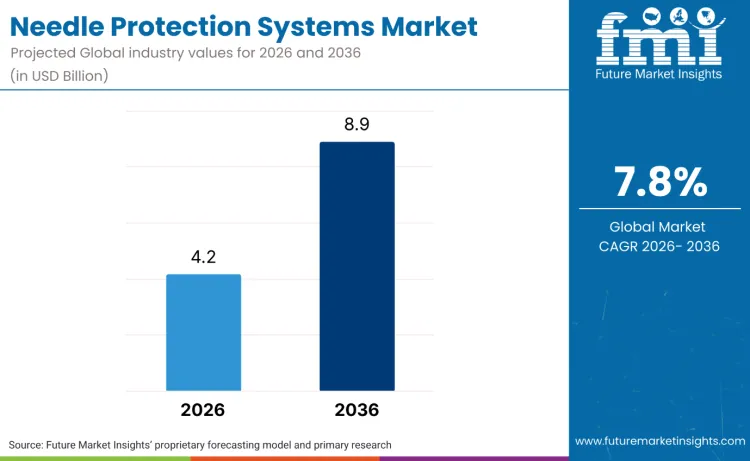
The global needle protection systems market is forecasted to reach USD 4.2 billion in 2026 and expand to USD 8.9 billion by 2036, advancing at a CAGR of 7.8%. As per FMI, this outlook shows a transformation in healthcare safety protocols toward prevention-first approaches, where traditional injury response systems are transitioning toward proactive safety platforms. Expansion is driven by the rising complexity of medical procedures, with hospitals and healthcare facilities embracing specialized safety technologies across clinical environments globally.
By leveraging artificial intelligence and sensor integration, healthcare providers can now perform comprehensive safety monitoring that evaluates thousands of potential risk scenarios during medical procedures before any injury occurs. This predictive capability allows for the rapid identification of high-risk procedures and the deployment of targeted safety interventions that were previously considered impossible to implement, effectively reducing injury rates and minimizing the financial burden of needlestick incidents. Companies such as Becton, Dickinson and Company are also significantly investing in connected safety platforms to enhance injury prevention.
"As one of the largest manufacturers of medical devices in the world whose products touch billions of patients around the globe, building on our long history of innovation is a responsibility we take very seriously. Through the ingenuity of our world-class team who strives to address unmet needs in healthcare every day, coupled with BD Excellence - our culture of continuous improvement - we can live our purpose and manufacture innovative medical products at scale as we deliver for our customers and the patients we serve." said Tom Polen, chairman, CEO and president of BD.
The industry's value proposition is shifting from reactive injury management toward predictive safety optimization. Advanced safety providers are integrating comprehensive monitoring systems, automated compliance tracking, and flexible platform designs to reduce safety protocol standardization challenges while improving protection effectiveness. Technology-positioned brands and specialized safety organizations are gaining preference, enabling direct healthcare partnerships and customized safety services across hospital and clinic networks.
Summary of Needle Protection Systems Market
What is the growth outlook on the needle protection systems market?
Future Market Insights projects the market to grow at a 7.8% CAGR from 2026 to 2036, expanding from USD 4.2 billion to USD 8.9 billion.
FMI research approach: Bottom-up device revenue modeling, safety-weighted healthcare analysis, compliance intensity assessment, and AI-led monitoring scenario modeling.
How do FMI analysts perceive the needle protection systems market to evolve?
The market is expected to move from basic safety devices toward AI-enabled smart protection platforms integrating monitoring, tracking, and autonomous safety optimization.
FMI research approach: Smart device transition analysis, AI workflow integration mapping, connected safety demand assessment, and predictive compliance benchmarking.
Which country holds the largest share in the needle protection systems market?
The United States accounts for the largest global value share.
FMI research approach: Country-level healthcare safety revenue modeling, injury prevention concentration analysis, adoption scoring for smart safety methods, and compliance density evaluation.
How large will the needle protection systems market be by 2036?
The global market is forecast to reach USD 8.9 billion by 2036.
FMI research approach: Long-term forecasting by device category and safety focus, compliance demand scaling, post-market revenue inclusion, and historical adoption validation.
What is the market definition of needle protection systems?
It covers safety devices and platforms supporting injury prevention, compliance monitoring, training, and safety validation for healthcare use.
FMI research approach: Market taxonomy validation, inclusion-exclusion structuring, application mapping by healthcare setting, and platform scope filtering.
What globally unique trends are shaping the needle protection systems market?
Key trends include smart safety adoption, automated compliance monitoring, and regulatory momentum toward mandatory safety device implementation.
FMI research approach: Smart platform uptake tracking, automation expansion analysis, regulatory pathway monitoring, and algorithm-focused competitive assessment.
Needle Protection Systems Market Key Takeaways
| Metric | Value |
|---|---|
| Market Value (2026) | USD 4.2 billion |
| Market Forecast Value (2036) | USD 8.9 billion |
| Forecast CAGR (2026-2036) | 7.8% |
Source: Future Market Insights (FMI) analysis, based on proprietary forecasting model and primary research
What is Driving the Demand for Needle Protection Systems?
Demand for needle protection systems is being propelled by the broad healthcare shift toward prevention-first safety paradigms and the escalating complexity of medical procedures requiring advanced safety technologies such as smart syringes and connected monitoring platforms, which require sophisticated safety, monitoring, and compliance systems. The rapid integration of artificial intelligence and machine learning into safety workflow protocols has amplified demand for predictive risk assessment and automated compliance tracking, enabling healthcare providers to reduce injury incidents and compress safety response timelines.
The regulatory momentum toward mandatory safety device implementation, exemplified by revised OSHA bloodborne pathogen standards, is driving widespread uptake of smart safety technologies and high-fidelity compliance systems in healthcare workflows, increasing procurement of specialized safety services. At the same time, healthcare investment patterns, including expanded infrastructure in emerging market healthcare hubs, are shifting innovation toward integrated, high-performance safety facilities, underscoring a demand trajectory rooted in predictive safety engineering and automated compliance.
How is the Needle Protection Systems Market Segmented?
The needle protection systems market has been segmented based on device type, clinical application, end user, and region. In terms of device type, the market is divided into safety syringes (passive/active), safety IV catheters and blood collection sets, needleless connectors and closed IV systems, sharps containers and disposal systems, and training and compliance monitoring services. By clinical application, the market is divided into medication administration, phlebotomy and blood collection, IV therapy and vascular access, surgical procedures, and home care self-injection. By end user, the market is segmented into hospitals, ambulatory and outpatient clinics, home healthcare providers, blood banks and laboratories, and diagnostic centers. Regionally, the market is divided into North America, Europe, East Asia, South Asia, Latin America, and Middle East and Africa.
Why Do Safety Syringes Dominate the Needle Protection Systems Market?
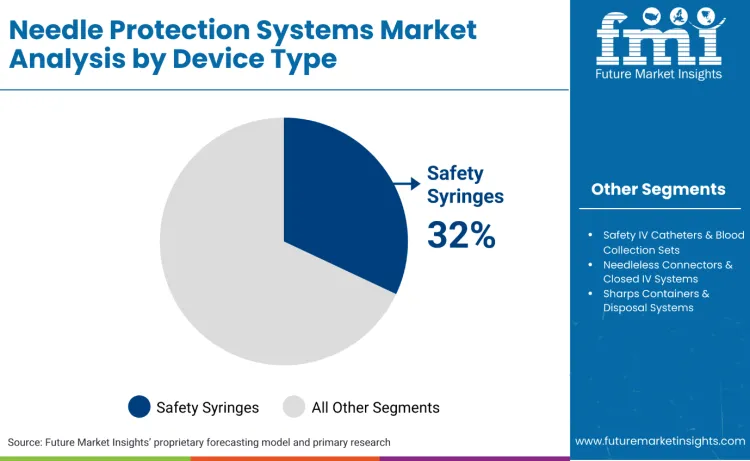
Safety syringes continue to lead the market, accounting for 32.0% of the share, driven by their widespread use in medication administration, vaccination programs, and routine clinical procedures. This device category offers the foundation needed for all injection-based medical activities, making it essential for hospital, clinic, and home healthcare organizations. Companies such as Becton, Dickinson and Company offer a portfolio of safety syringes and safety hypodermic devices (including passive and auto-disable syringes). Safety IV catheters and blood collection sets capture 28.0% of the market, supporting critical vascular access and diagnostic procedures while maintaining safety protocols. Their precision is critical for reducing injury risks while maintaining procedural effectiveness. Needleless connectors and closed IV systems, holding 18.0% of the market, remain a popular choice for IV therapy and vein device applications, offering scalable solutions for complex medical procedures where contamination prevention is required.
These devices are popular because they serve as a critical risk-mitigation strategy in an increasingly regulated and litigation-sensitive market. Healthcare facilities are also significantly investing in safety syringe technologies with integrated monitoring approaches. Specialized device providers integrate passive safety mechanisms, active protection systems, and AI-driven usage monitoring to identify high-quality safety outcomes while filtering out ineffective or non-compliant devices early. This prevention-first approach reduces costly injury incidents and shortens safety response timelines, allowing healthcare organizations to remain compliant and focus internal resources on patient care rather than injury management.
How Do Clinical Application Requirements Influence Needle Protection Systems Selection?
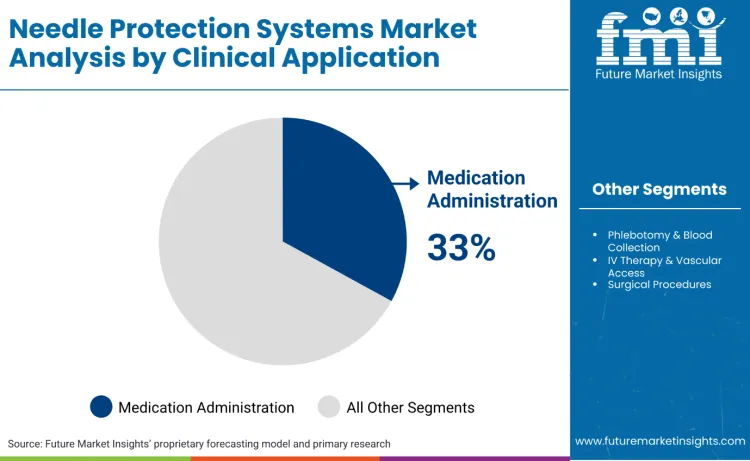
Medication administration stands as the dominant segment, commanding 33.0% of the market share. Needle protection systems remain centered on medication administration due to the exceptional frequency these procedures occur in distinguishing between routine and high-risk injection scenarios. Companies including ICU Medical, Inc. actively develop and market infusion pumps, syringe infusion systems, infusion management software (e.g., MedNet™ and PharmGuard™), and connected IV medication safety platforms that support precise drug delivery and administration workflows. Healthcare providers often perform hundreds of daily injections that serve as specific risk points for needlestick injuries, allowing for targeted safety interventions that avoid the systemic exposure caused by traditional unsafe injection practices. Clinical studies are essential in this field to validate how these safety mechanisms function within the complex healthcare environment, ensuring they can integrate with existing workflows and effectively protect healthcare workers from injury.
The market is also heavily shaped by the development of next-generation safety technologies like smart syringes and connected monitoring systems which require rigorous testing to establish safe operational parameters. For instance, BD offers a comprehensive range of safety injection devices and monitoring platforms, including passive safety syringes and real-time compliance tracking systems to support clinical safety programs and injury prevention studies. Clinical validation helps researchers optimize the effectiveness of safety mechanisms and the reliability of monitoring systems to prevent procedural failures that could lead to injury incidents. By using advanced testing protocols such as simulated clinical environments and real-world usage studies, developers can predict healthcare worker behavior and identify potential compliance gaps long before device deployment begins, making these systems a critical investment for modern healthcare safety.
How Is Technological Evolution Reshaping Needle Protection Systems?
The needle protection systems sector is shifting from traditional passive safety mechanisms to integrated smart platforms that combine real-time monitoring, automated compliance tracking, and predictive risk assessment. Strategic collaborations between device manufacturers and healthcare technology providers are accelerating this transition. This evolution brings needle safety workflows closer to predictive prevention by enabling more accurate risk assessment and earlier intervention using computational and sensor tools. Improved early-stage monitoring reduces injury incidents during high-risk procedures and complex medical protocols. The ability to advance safety devices with defined performance and compliance profiles is reshaping procurement decision making, allowing healthcare providers to prioritize solutions with stronger operational readiness and clinical effectiveness.
What Role Does Regulatory and Standards Maturation Play in Safety Innovation?
Greater regulatory clarity around medical device safety standards is stabilizing investment conditions for safety device manufacturers and enabling more confident platform expansion. Clearer regulatory expectations are lowering entry barriers for specialized manufacturers to deploy advanced safety technologies such as sensor integration, smart monitoring, and next-generation compliance tracking for usage analysis. Manufacturers are increasingly adopting platform-based safety workflows that can be validated once and reused across device categories, supporting faster regulatory pathways and sustained innovation in connected safety formats. In September 2025, ICU Medical, Inc. secured the 510 (k) clearance for Clave portfolio of needlefree connectors.
How Is the Needle Protection Systems Market Evolving Globally?
Global demand for needle protection systems is increasing as healthcare providers expand safety capabilities while addressing injury prevention, compliance monitoring, and risk assessment application requirements. Growth demonstrates rising use of smart safety platforms, procedure-specific safety positioning, and efficiency-optimized monitoring specifications across hospital networks, specialized healthcare facilities, and ambulatory care centers. Device selection focuses on safety effectiveness, monitoring comprehensiveness, and platform performance under various clinical scenarios. China records 11.2% CAGR, India records 10.8% CAGR, Brazil records 9.4% CAGR, USA records 8.1% CAGR, and Germany records 5.9% CAGR. Adoption remains driven by safety enhancement requirements and monitoring capabilities rather than volume expansion alone.
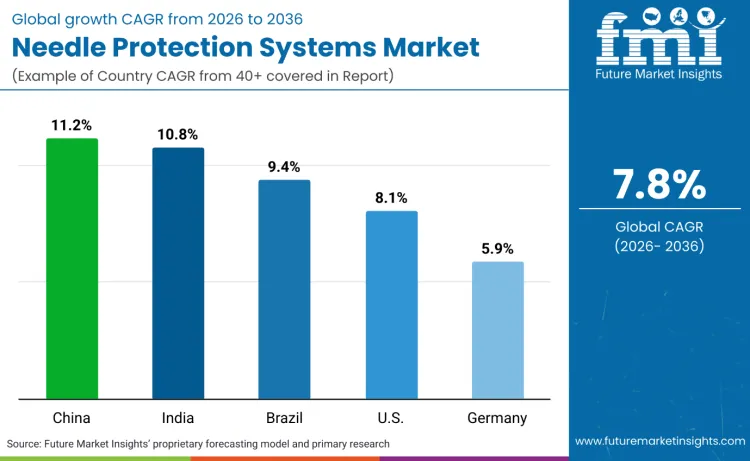
| Country | CAGR (2026-2036) |
|---|---|
| China | 11.2% |
| India | 10.8% |
| Brazil | 9.4% |
| USA | 8.1% |
| Germany | 5.9% |
Source: FMI historical analysis and forecast data
China: How is the Expanding Healthcare Infrastructure Driving Smart Safety Adoption?
The primary driver in China is the significant growth of healthcare facility modernization and smart medical device integration across metropolitan hospital networks. With the expansion of digital health platforms, Chinese healthcare systems are now experiencing millions of new safety protocol implementations, making traditional passive safety devices insufficient. This has promoted smart safety platform adoption for domestic healthcare delivery to ensure injury prevention capabilities and compliance innovation. Driven by this national scale of healthcare capability expansion, the Chinese needle protection systems market is set to grow at an 11.2% CAGR during the study period, led by massive demand in hospital modernization and ambulatory care sectors.
Over the next five years, the most significant opportunity lies in the integration of artificial intelligence-powered safety platforms with comprehensive monitoring hardware. As China targets healthcare leadership in digital medicine, there is a burgeoning demand for specialized safety systems that support complex procedures like minimally invasive surgery and advanced diagnostic protocols. Companies are expanding their manufacturing base in the country to boost their safety device capabilities.
India: Is Medical Tourism Elevating Protection Standards?
In India, the market is dominated by the evolution toward healthcare safety excellence and compliance-positioned safety categories. This safety-first approach is essential for Indian healthcare providers currently competing with international safety standards in domestic medical applications. Driven by this maturity, the Indian needle protection systems market is projected to grow at a 10.8% CAGR during the study period.
Over the next five years, the rise of medical tourism and healthcare facility accreditation, supported by expanded infrastructure, will necessitate high-precision safety systems for real-time monitoring and quality assurance. Second, India's growing role as a global hub for healthcare services creates a massive opening for cost-effective safety platforms tailored to procedure optimization. There is a burgeoning demand for affordable safety systems that use standardized protocols, addressing the safety needs of tier-2 and tier-3 healthcare facilities while maintaining international safety standards.
Brazil: Will Expanding Healthcare Access Accelerate Safety Integration?
Brazil's needle protection systems market is uniquely shaped by healthcare access expansion and medical infrastructure development. Brazilian healthcare providers are increasingly adopting smart safety platforms, maintaining safety positioning for capability assurance while using accessible pricing for broader healthcare appeal. Consequently, the Brazilian needle protection systems market is expected to grow at a 9.4% CAGR during the study period, as healthcare-focused organizations invest in validated safety and compliance monitoring categories.
Over the next five years, the market will pivot toward high-growth niches like telehealth-integrated safety platforms and cost-effective monitoring services. As domestic healthcare leaders transition from basic safety compliance to comprehensive injury prevention programs, there is an immediate opportunity to provide high-precision validation services for safety system characterization. The integration of artificial intelligence-driven monitoring into Brazil's expanding healthcare network will likely redefine safety protocols, allowing organizations to capitalize on predictive safety technologies for comprehensive injury prevention applications.
Germany: Is the Stringent Regulatory Scenario Revitalizing Safety Capabilities?
In Germany, the market is being driven by stringent regulatory scenario. A major development is healthcare institutions and medical facilities upgrading to technology-positioned safety platforms that feature innovation-heritage excellence to compete against standard safety methods in domestic healthcare applications. As German institutions prioritize digital innovation and safety excellence, the German needle protection systems market is set to grow at a 5.9% CAGR during the study period, focusing heavily on precision and safety capability enhancement.
Over the next five years, the most lucrative opportunities reside in the convergence of digital health and predictive safety analytics. As the German government streamlines regulatory barriers for medical device innovation, there is a significant opening for firms to develop artificial intelligence-integrated safety services that support personalized medicine and complex surgical procedures. The mandate for efficient healthcare delivery is creating a surge in demand for automated, resource-optimized safety processes, offering a high-margin niche for providers of streamlined, technology-enhanced safety platforms.
USA: How is the "Predictive Safety Revolution" Driving Healthcare Innovation?
The USA market is increasingly focused on the innovation and diversity of predictive safety applications. This transition aims at reducing dependence on reactive safety methods while improving domestic healthcare platform competitiveness. Supported by these healthcare safety mandates, the USA needle protection systems market is set to grow at an 8.1% CAGR during the study period.
Over the next five years, the most significant opportunity lies in the mass adoption of predictive safety technologies and artificial intelligence-driven risk assessment. As healthcare regulations increasingly validate smart monitoring systems, there is a burgeoning market for high-fidelity, sensor-based safety platforms that can simulate real-world clinical scenarios. The integration of machine learning into healthcare safety workflows will allow USA providers to leverage vast, secure data networks to design optimized safety protocols, effectively reducing injury incidents and establishing a new global benchmark for healthcare safety and compliance productivity.
Who are the Major Players Active in the Needle Protection Systems Market?
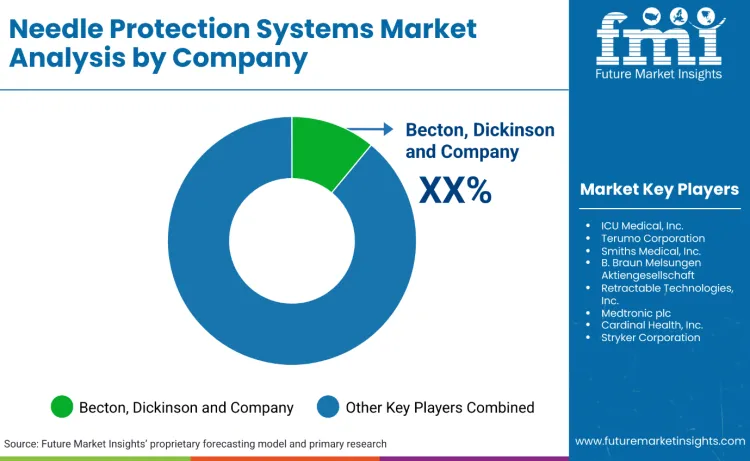
As healthcare protocols become dominated by complex procedures and connected monitoring systems, major players like BD, ICU Medical, and Terumo are competing on their ability to offer comprehensive safety platforms. These leaders are aggressively integrating artificial intelligence and real-time monitoring to offer connected safety solutions, allowing smaller healthcare facilities to operate with enterprise-level safety capabilities without extensive infrastructure investments. Success in this landscape is no longer measured just by a provider's device portfolio, but by their ability to deliver integrated safety ecosystems using smart technologies, thereby bypassing traditional, compliance-heavy safety protocols.
The market is also witnessing a distinct regional divergence in competitive strategy. While North American firms like BD and Smiths Medical maintain dominance through advanced technology integration and proximity to major healthcare networks, Asia-Pacific players, led by Terumo and local manufacturers, are rapidly scaling their smart device production and monitoring capabilities. This has created a "safety innovation arms race" where device providers are diversifying into niche areas such as procedure-specific safety devices and advanced compliance monitoring to address the growing complexity of modern medical procedures.
Key Industry Developments:
- In January 2026, Terumo Medical Corporation, a wholly-owned subsidiary of Terumo Corporation, launched SurTract™ Safety Syringe in the USA
- In February 2025, Philips inked a deal with Mass General Brigham (MGB), home to one of the largest hospital system-based research enterprises in the US to enhance patient care with AI.
Key Players in the Needle Protection Systems Market
- Becton, Dickinson and Company
- ICU Medical, Inc.
- Terumo Corporation
- Smiths Medical, Inc.
- B. Braun Melsungen Aktiengesellschaft
- Retractable Technologies, Inc.
- Medtronic plc
- Cardinal Health, Inc.
- Stryker Corporation
- Nipro Corporation
Market Definition
The needle protection systems market refers to the global healthcare safety applications of specialized device platforms designed to support injury prevention, compliance monitoring, risk assessment, and safety validation activities. It includes both smart and standard safety offerings, with segments that cater to various clinical applications such as medication administration, phlebotomy, and surgical procedures. The market size is measured in USD billion and analyzed over the 2026 to 2036 period.
The needle protection systems market includes device types such as safety syringes, IV catheters, needleless connectors, and compliance monitoring systems, utilized through both healthcare facilities and home care applications. The market is expanding due to growing interest in preventive safety technologies, device platform innovations, and evolving healthcare requirements toward higher-efficiency and more specialized safety monitoring capabilities.
Market Inclusion
Included in the needle protection systems market scope are safety devices categorized by type (syringes, catheters, connectors, and monitoring systems), with segmentation based on clinical applications (medication administration, phlebotomy, IV therapy), healthcare settings (hospitals, clinics, home care), and safety requirements (passive protection, active monitoring, compliance tracking). The scope includes safety platforms with a focus on injury prevention, healthcare compliance, and safety innovation, particularly those marketed through specialized device providers, healthcare institutions, and medical supply facilities.
Geographically, the market encompasses key regions such as North America, Europe, East Asia, South Asia, Latin America, and the Middle East and Africa, with country-level analysis for significant markets like China, India, Brazil, USA, and Germany.
Market Exclusion
Excluded from the needle protection systems market scope are non-safety medical devices and safety methods not designed for needlestick injury prevention, such as general medical equipment, non-needle safety devices, and non-healthcare safety platforms. Additionally, devices not intended for clinical or healthcare applications are not included.
The market excludes non-medical safety products, as well as safety-related products that are not marketed as needle protection platforms, such as general workplace safety equipment or industrial safety devices. Products with non-compliant safety specifications or those that do not meet regional regulatory standards for healthcare safety applications are outside the market's defined scope.
Scope of the Report
| Items | Values |
|---|---|
| Quantitative Units | USD billion |
| Device Type | Safety Syringes (Passive/Active); Safety IV Catheters & Blood Collection Sets; Needleless Connectors & Closed IV Systems; Sharps Containers & Disposal Systems; Training, Compliance & Monitoring Services |
| Clinical Application | Medication Administration; Phlebotomy & Blood Collection; IV Therapy & Vascular Access; Surgical Procedures; Home Care Self-Injection |
| End User | Hospitals; Ambulatory & Outpatient Clinics; Home Healthcare Providers; Blood Banks & Laboratories; Diagnostic Centers |
| Regions Covered | North America, Europe, East Asia, South Asia, Latin America, Middle East & Africa |
| Countries Covered | China, India, Brazil, USA, Germany, and 40+ countries |
| Key Companies Profiled | BD; ICU Medical; Terumo Corporation; Smiths Medical; B. Braun Melsungen AG; Others |
| Additional Attributes | Revenue analysis by device type, clinical application, and end user; performance in healthcare safety applications and monitoring capabilities across hospital networks, healthcare facilities, and home care applications; safety enhancement, compliance optimization, and platform benefits under clinical applications; impact on safety outcomes, injury prevention, and platform differentiation during procurement processes; compatibility with healthcare protocols and safety preferences; procurement dynamics driven by safety positioning, compliance innovation programs, and long-term healthcare partnerships. |
Needle Protection Systems Market by Segment
Device Type:
- Safety Syringes (Passive/Active)
- Safety IV Catheters & Blood Collection Sets
- Needleless Connectors & Closed IV Systems
- Sharps Containers & Disposal Systems
- Training, Compliance & Monitoring Services
Clinical Application:
- Medication Administration
- Phlebotomy & Blood Collection
- IV Therapy & Vascular Access
- Surgical Procedures
- Home Care Self-Injection
End User:
- Hospitals
- Ambulatory & Outpatient Clinics
- Home Healthcare Providers
- Blood Banks & Laboratories
- Diagnostic Centers
Region:
- East Asia
- China
- Japan
- South Korea
- Taiwan
- Rest of East Asia
- Europe
- Germany
- United Kingdom
- France
- Italy
- Spain
- BENELUX
- Nordic
- Rest of Europe
- North America
- USA
- Canada
- Mexico
- South Asia
- India
- Australia & New Zealand
- Southeast Asia
- Rest of South Asia
- Latin America
- Brazil
- Chile
- Colombia
- Argentina
- Rest of Latin America
- Middle East & Africa
- Kingdom of Saudi Arabia
- Other GCC Countries
- Turkey
- South Africa
- Other African Union
- Rest of Middle East & Africa
Bibliography
- World Bank. (2023). Health sector modernization and digital health systems. World Bank Group.
- Centers for Disease Control and Prevention. (2023). Sharps injury prevention in healthcare settings. National Institute for Occupational Safety and Health.
- Occupational Safety and Health Administration. (2023). Bloodborne pathogens standard (29 CFR 1910.1030). USA Department of Labor.
Frequently Asked Questions
How big is the needle protection systems market in 2026?
The global needle protection systems market is estimated to be valued at USD 4.2 billion in 2026.
What will be the size of the needle protection systems market in 2036?
The market size for the needle protection systems market is projected to reach USD 8.9 billion by 2036.
How much will the needle protection systems market grow between 2026 and 2036?
The needle protection systems market is expected to grow at a 7.8% CAGR between 2026 and 2036.
What are the key device types in the needle protection systems market?
The key device types in the needle protection systems market include safety syringes (passive/active), safety IV catheters and blood collection sets, needleless connectors and closed IV systems, and sharps containers and disposal systems.
Which end user will contribute a significant share in the needle protection systems market in 2026?
In terms of end user, the hospitals segment is set to command a 42.0% share in the needle protection systems market in 2026.
Preview the report firsthand - request a free sample
Get SampleGet the brochure for pricing and purchase details.
Get PDFTable of Content
- Needle Protection Systems Market Size and Share Forecast Outlook (2026 to 2036)
- Needle Protection Systems Market Forecast and Outlook (2026-2036)
- Needle Protection Systems Market Key Takeaways
- Key Shifts in the Needle Protection Systems Market from 2026 to 2036
- Needle Protection Systems Market Segmentation Analysis
- By Device Type
- Safety Syringes (Passive and Active)
- Safety IV Catheters and Blood Collection Sets
- Needleless Connectors and Closed IV Systems
- Sharps Containers and Disposal Systems
- Training, Compliance and Monitoring Services
- By Clinical Application
- Medication Administration
- Phlebotomy and Blood Collection
- IV Therapy and Vascular Access
- Surgical Procedures
- Home Care Self-Injection
- By End User
- Hospitals
- Ambulatory and Outpatient Clinics
- Home Healthcare Providers
- Blood Banks and Laboratories
- Diagnostic Centers
- By Region
- By Device Type
- Market Dynamics and Growth Analysis
- Growth Drivers
- Market Restraints
- Strategic Trends
- Needle Protection Systems Market Global Analysis
- East Asia
- South Asia
- North America
- Europe
- Latin America
- Middle East & Africa
- Competitive Landscape Analysis
- Key Players in the Needle Protection Systems Market
- Market Definition, Inclusion, and Exclusion Criteria
- Scope of the Needle Protection Systems Market Report
- Needle Protection Systems Market by Segment
- Bibliography
- Frequently Asked Questions (FAQs)


