

- Industry Size (2026)
- USD 180.0 Mn
- Forecast (2036)
- USD 344.0 Mn
- CAGR (2026 to 2036)
- 6.7%
Rim Protection Accessories Market Forecast and Outlook 2026 to 2036
The rim protection accessories market is likely to be valued at USD 180.0 million in 2026, and reach USD 344.0 million by 2036, at 6.7% CAGR. Value formation reflects damage avoidance economics rather than aesthetic customization. Demand concentrates in dense urban driving environments where curb contact frequency elevates wheel refurbishment costs. Adoption aligns with increased alloy wheel penetration and reduced sidewall tolerance from low profile tires. Purchasing decisions emphasize impact absorption, adhesion reliability, and profile compatibility, since premature detachment undermines protection credibility. Aftermarket channels dominate volume as accessories are typically added post vehicle delivery during tire changes, alignment, or cosmetic maintenance intervals.
Scale expansion remains constrained by fitment variability across rim widths, offsets, and bead geometries, limiting universal designs. Material wear from abrasion, moisture, and cleaning chemicals shortens service life, reinforcing replacement led demand rather than long retention cycles. Cost sensitivity persists outside premium segments, moderating uptake where wheel repair expense is perceived as manageable. Visual acceptance influences purchase decisions, particularly where accessories alter wheel appearance. Competitive intensity remains fragmented due to low entry barriers and limited performance standardization. Volume growth tracks urban vehicle density, alloy wheel adoption, and service channel recommendations rather than regulatory influence or discretionary styling trends.
Quick Stats for Rim Protection Accessories Market
- Rim Protection Accessories Market Value (2026): USD 180.0 million
- Rim Protection Accessories Market Forecast Value (2036): USD 344.0 million
- Rim Protection Accessories Market Forecast CAGR 2026 to 2036: 6.7%
- Leading Product Type by Demand Share: Rim Guard Strips & Edge Protectors
- Fastest-Growing Countries: India, Vietnam, Indonesia, Mexico, Brazil
- Top Players in Global Demand: AlloyGator, RimBlades USA, RimSavers, XPEL, 3M
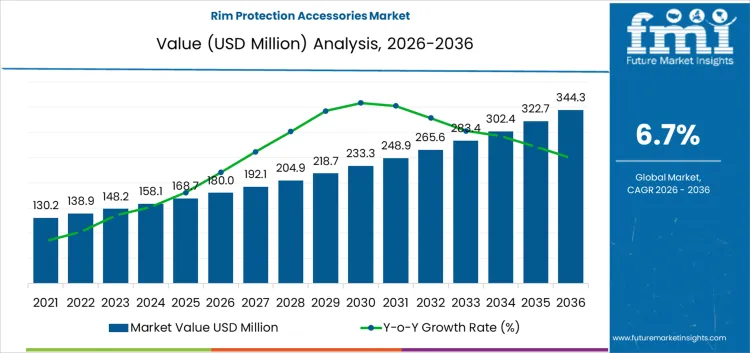
Rim Protection Accessories Market Key Takeaways
| Metric | Value |
|---|---|
| Market Value (2026) | USD 180.0 million |
| Market Forecast Value (2036) | USD 344.0 million |
| Forecast CAGR (2026-2036) | 6.7% |
Why is the Demand for Rim Protection Accessories Growing?
Demand for rim protection accessories is increasing as vehicle owners and fleet operators seek solutions that prevent damage to wheel rims from curb strikes, road debris, and pothole impacts. Alloy and custom wheels represent a significant investment in appearance and performance, and protection accessories such as rim guards, protective strips, and reinforced edge designs reduce the incidence of gouges, bends, and surface abrasions during every day driving and parking maneuvers. Engineers and product designers assess impact absorption properties, abrasion resistance, and ease of installation to ensure accessories provide consistent coverage without interfering with tire fitment or vehicle handling characteristics. Procurement teams evaluate material durability under repeated exposure to road salt, brake dust, and cleaning agents because long lasting protection reduces frequency of wheel refurbishment and associated costs.
Growth in urban driving, tight parking environments, and the prevalence of low profile tires reinforces uptake of rim protection accessories that align with aesthetic and functional criteria valued by passenger car, SUV, and light truck owners. Aftermarket demand is supported by availability of model-specific kits that match wheel diameters and offset specifications, enabling precise fit and visual integration with wheel design. Retailers and service providers maintain inventories that correspond with popular wheel sizes to support timely installation during routine maintenance visits. Technical improvements in polymer formulations and reinforced edge guards enhance resistance to impact and wear, contributing to longer service life and reduced total cost of ownership for vehicle operators. These application-focused and performance-driven needs are contributing to sustained demand growth in the rim protection accessories market.
How Are the Segments Classified in the Rim Protection Accessories Market?
Demand for rim protection accessories is shaped by wheel damage prevention needs, rising alloy wheel adoption, and urban driving exposure. Vehicle owners seek solutions that reduce curb rash, impact scuffs, and cosmetic deterioration during daily use. Adoption aligns with increased use of larger diameter wheels and low-profile tires. Product selection prioritizes fit accuracy, durability, and ease of installation. Segment classification reflects differentiation by accessory configuration, vehicle application profile, and material composition influencing protection effectiveness, longevity, and visual integration.
Which Product Type Represents the Largest Share of Demand?
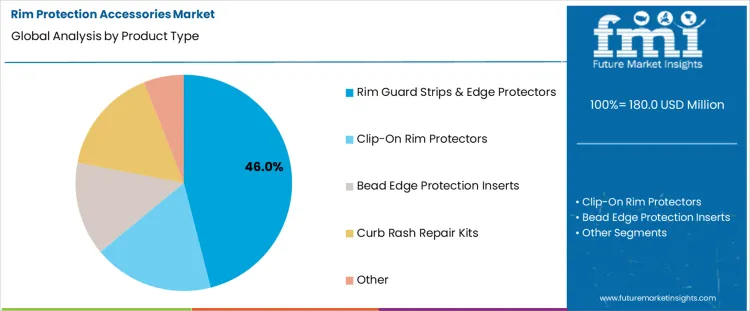
Rim guard strips and edge protectors hold 46.0%, representing the largest share among product types due to continuous perimeter coverage. These products attach along the wheel edge, creating a sacrificial barrier against curb contact. Flexible designs conform to varied rim geometries without permanent modification. Installation simplicity supports widespread adoption across vehicle categories. Clip-on rim protectors provide localized protection with reduced coverage area. Bead edge protection inserts focus on tire mounting zones with limited visibility. Curb rash repair kits address post-damage correction rather than prevention. Product type segmentation reflects preference for preventive solutions delivering constant edge protection during every day driving.
Key Points
- Edge protectors provide continuous rim perimeter coverage.
- Flexible designs support compatibility with varied wheel profiles.
- Other products focus on localized protection or damage repair.
Which Vehicle Segment Accounts for the Highest Share of Demand?
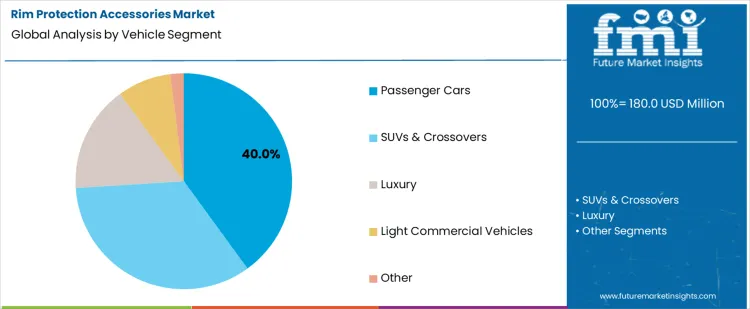
Passenger cars hold 40.0%, representing the largest share among vehicle segments due to high population density. Urban parking environments increase exposure to curbs and tight maneuvering spaces. Owners prioritize cosmetic preservation of alloy wheels used in daily commuting. Standard wheel sizes simplify accessory fitment and purchasing decisions. SUVs and crossovers follow with larger wheels and similar curb exposure. Luxury vehicles adopt protection to preserve premium wheel finishes. Light commercial vehicles emphasize functional durability over appearance. Vehicle segmentation reflects concentration where daily urban use and cosmetic sensitivity drive consistent adoption.
Key Points
- Passenger cars face frequent curb exposure in urban settings.
- Cosmetic wheel preservation influences accessory adoption.
- Other segments balance protection with usage priorities.
Which Material Accounts for the Highest Share of Demand?
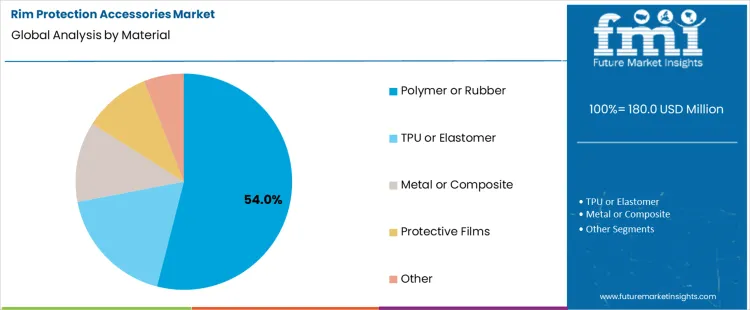
Polymer or rubber materials hold 54.0%, representing the largest share among materials due to flexibility and impact absorption. These materials deform under contact, reducing force transfer to wheel surfaces. Weather resistance supports durability under varied driving conditions. Color options allow visual integration with wheel designs. TPU or elastomer materials offer enhanced elasticity with higher cost. Metal or composite options provide rigidity with limited deformation. Protective films deliver minimal thickness with reduced impact protection. Material segmentation reflects preference for resilient, flexible compounds balancing protection performance, durability, and ease of installation.
Key Points
- Polymers absorb impact and reduce curb damage.
- Flexibility supports durability across driving conditions.
- Other materials trade elasticity for rigidity or thinness.
What are the Key Dynamics in the Rim Protection Accessories Market?
Demand for rim protection accessories reflects need to prevent cosmetic and structural damage to wheel rims during daily vehicle operation. Adoption concentrates in passenger vehicles, premium SUVs, urban delivery fleets, and vehicles fitted with low-profile tires. Global scope aligns with increased alloy wheel usage and curbside driving exposure. Usage centers on clip-on rim guards, adhesive strips, tire-integrated protectors, and replaceable edge rings designed to absorb impact and abrasion.
How do urban driving conditions and wheel design trends shape adoption?
Urban driving exposes wheels to curbs, tight parking spaces, speed bumps, and narrow access points that increase rim contact risk. Demand increases as low-profile tires and larger diameter alloy wheels reduce sidewall cushioning and expose rim edges. Premium wheels with painted or machined finishes raise repair cost sensitivity, supporting preventive accessory use. Delivery fleets adopt rim protectors to reduce cosmetic damage across frequent stop cycles and driver turnover. Tire-mounted and clip-on designs enable protection without wheel replacement. Compatibility with different rim profiles influences selection. Adoption reflects practical damage prevention tied directly to wheel geometry, driving environment, and replacement cost avoidance.
How do durability limits, fitment variability, and cost sensitivity influence market scalability?
Rim protection accessories face abrasion, impact, heat, and moisture exposure that shortens service life. Demand sensitivity rises where frequent replacement undermines cost justification. Fitment varies across rim widths, offsets, and bead profiles, limiting universal solutions. Adhesive-based products depend on surface preparation and bonding quality, affecting reliability. Visual acceptance varies, constraining adoption among appearance-focused users. Installation complexity affects uptake in non-professional settings. Aftermarket price competition pressures material quality. Absence of standardized performance ratings limits consumer confidence, constraining scalable adoption across mass-market vehicle segments.
How Is Demand for Rim Protection Accessories Evolving Globally?
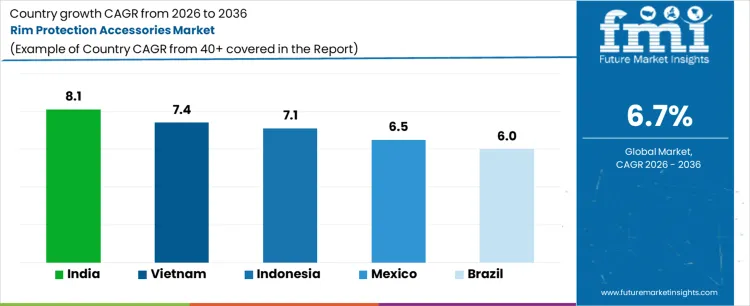
Demand for rim protection accessories is expanding globally due to rising alloy wheel penetration, urban driving exposure, and maintenance cost avoidance. Adoption aligns with passenger vehicles and utility models operating in congested cities where curb contact risk remains high. Growth in aftermarket customization and dealership bundling supports steady uptake. Replacement demand follows tire changes and wheel refurbishments. Growth rates in India at 8.1%, Vietnam at 7.4%, Indonesia at 7.1%, Mexico at 6.5%, and Brazil at 6.0% indicate strong expansion driven by urban usage intensity, wheel value protection, and service-led accessory adoption rather than styling-focused purchases.
| Country | CAGR (%) |
|---|---|
| India | 8.1% |
| Vietnam | 7.4% |
| Indonesia | 7.1% |
| Mexico | 6.5% |
| Brazil | 6.0% |
What Is Driving Expansion of Rim Protection Accessory Demand in India?
Demand for rim protection accessories in India is growing at a CAGR of 8.1%, supported by rapid alloy wheel adoption and dense urban driving conditions. Narrow roads, curbside parking, and frequent maneuvering elevate rim damage risk. Owners seek cost-effective solutions to avoid refurbishment expenses. Dealerships and service centers bundle rim guards during tire replacement and vehicle delivery. Growth of organized aftermarket retail improves fitment accuracy across high-volume models. Demand growth reflects practical damage prevention and maintenance cost control rather than premium vehicle customization.
- High alloy wheel penetration in urban vehicles
- Congested roads increasing curb contact risk
- Service-led bundling during tire changes
- Expansion of organized accessory retail
Why Is Vietnam Seeing Strong Uptake of Rim Protection Accessories?
Rim protection accessory demand in Vietnam is expanding at a CAGR of 7.4%, driven by urbanization and growing passenger car ownership. Street parking and tight turning radii increase exposure to wheel scuffing. Consumers prioritize low-cost preventive accessories over cosmetic repairs. Independent workshops promote rim guards alongside tire services. Rising use of compact cars with alloy wheels supports steady adoption. Growth reflects urban driving realities and service-channel promotion rather than discretionary aesthetic upgrades.
- Street parking increasing wheel scuff exposure
- Cost-sensitive preference for preventive accessories
- Independent workshop upselling during tire service
- Growing compact car alloy wheel usage
How Is Indonesia Supporting Growth in Rim Protection Accessory Sales?
Sales of rim protection accessories in Indonesia are growing at a CAGR of 7.1%, shaped by metropolitan traffic density and mixed road conditions. Frequent stop-and-go driving raises curb impact probability. Alloy wheel upgrades elevate replacement costs, encouraging protective measures. Aftermarket suppliers offer vehicle-specific profiles improving installation ease. Motorists favor durable materials resistant to heat and humidity. Growth reflects daily usage patterns and cost avoidance behavior rather than luxury vehicle penetration.
- Dense metropolitan traffic conditions
- Rising alloy wheel upgrade adoption
- Availability of vehicle-specific accessory profiles
- Preference for durable, climate-resistant materials
What Factors Are Sustaining Rim Protection Accessory Demand in Mexico?
Rim protection accessory demand in Mexico is expanding at a CAGR of 6.5%, supported by urban vehicle usage and service-driven aftermarket channels. Curbside parking in cities increases risk of wheel damage. Owners seek add-on protection compatible with North American vehicle platforms. Tire shops promote rim guards during alignment and balancing services. Fleet operators adopt accessories to reduce cosmetic repair costs. Growth reflects maintenance efficiency and service-channel influence rather than rapid growth in premium wheel segments.
- Urban curbside parking exposure
- Platform compatibility with regional vehicle models
- Tire shop promotion during routine services
- Fleet focus on cosmetic cost reduction
Why Is Brazil Experiencing Steady Growth in Rim Protection Accessories?
Demand for rim protection accessories in Brazil is growing at a CAGR of 6.0%, driven by urban congestion and consumer focus on vehicle upkeep. Road surface variability increases likelihood of rim contact damage. Owners prefer protective accessories to extend wheel appearance life. Aftermarket distribution networks expand availability across regions. Commercial fleets adopt rim guards to maintain vehicle presentation. Growth remains steady, reflecting practical maintenance priorities and urban usage patterns rather than performance-oriented modifications.
- Variable road surfaces increasing rim damage risk
- Consumer emphasis on vehicle appearance maintenance
- Expanding regional aftermarket distribution
- Fleet adoption for presentation consistency
What is the competitive landscape of demand for the rim protection accessories market globally?
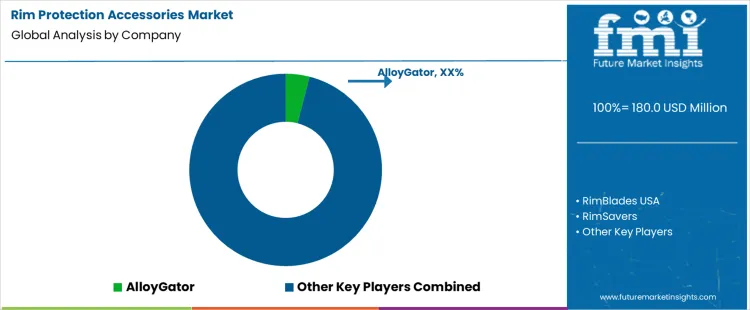
Demand for rim protection accessories is driven by the increasing focus on vehicle aesthetics, protection from curb damage, and the desire for cost-effective vehicle maintenance. Buyers evaluate the durability, ease of installation, aesthetic appeal, and compatibility with various rim types and sizes. Procurement behavior emphasizes the need for accessories that offer long-lasting protection without compromising the visual design of the vehicle. Purchasing decisions prioritize solutions that are easy to apply, offer superior impact resistance, and are available in a variety of colors and styles. Trend in the market reflects a growing interest in both functional and stylish rim protection, especially among car enthusiasts and those seeking to preserve the value of their vehicles.
AlloyGator leads competitive positioning with its extensive product range designed to fit various wheel sizes, offering high-impact protection and a customizable aesthetic appeal. RimBlades USA competes by providing easy-to-install rim protection products designed to prevent curb damage while enhancing the vehicle’s look. RimSavers supports demand with robust, high-quality protection accessories tailored to different rim types, focusing on durability and ease of use. XPEL participates with high-performance protection solutions, offering durable and visually appealing products designed for premium vehicles. 3M delivers rim protection accessories backed by its reputation for innovation and product reliability, ensuring long-lasting performance across various vehicles.
Key Players in the Rim Protection Accessories Market
- AlloyGator
- RimBlades USA
- RimSavers
- XPEL
- 3M
- Avery Dennison
- Würth
- Liqui Moly
- Rim Ringz
Scope of the Report
| Items | Values |
|---|---|
| Quantitative Units | USD million |
| Product Type | Rim Guard Strips & Edge Protectors; Clip-On Rim Protectors; Bead Edge Protection Inserts; Curb Rash Repair Kits; Other |
| Vehicle Segment | Passenger Cars; SUVs & Crossovers; Luxury; Light Commercial Vehicles; Other |
| Material | Polymer or Rubber; TPU or Elastomer; Metal or Composite; Protective Films; Other |
| Sales Channel | Online Retail; Auto Parts Retail; Detailing Shops; Tire or Wheel Shops; Other |
| Regions Covered | Asia Pacific, Europe, North America, Latin America, Middle East & Africa |
| Countries Covered | India, Vietnam, Indonesia, Mexico, Brazil, and 40+ countries |
| Key Companies Profiled | AlloyGator; RimBlades USA; RimSavers; XPEL; 3M; Avery Dennison; Würth; Liqui Moly; Rim Ringz |
| Additional Attributes | Dollar sales by product type, vehicle segment, material, and sales channel; performance in rim protection, curb rash repair, and wear resistance across polymer, TPU, elastomer, and metal composites; consumer adoption trends in passenger cars, SUVs, and light commercial vehicles; channel growth driven by online retail, auto parts retail, and detailing or tire shop partnerships. |
Rim Protection Accessories Market by Segment
Product Type:
- Rim Guard Strips & Edge Protectors
- Clip-On Rim Protectors
- Bead Edge Protection Inserts
- Curb Rash Repair Kits
- Other
Vehicle Segment:
- Passenger Cars
- SUVs & Crossovers
- Luxury
- Light Commercial Vehicles
- Other
Material:
- Polymer or Rubber
- TPU or Elastomer
- Metal or Composite
- Protective Films
- Other
Sales Channel:
- Online Retail
- Auto Parts Retail
- Detailing Shops
- Tire or Wheel Shops
- Other
Region:
- Asia Pacific
- China
- Japan
- South Korea
- India
- Australia & New Zealand
- ASEAN
- Rest of Asia Pacific
- Europe
- Germany
- United Kingdom
- France
- Italy
- Spain
- Nordic
- BENELUX
- Rest of Europe
- North America
- United States
- Canada
- Mexico
- Latin America
- Brazil
- Chile
- Rest of Latin America
- Middle East & Africa
- Kingdom of Saudi Arabia
- Other GCC Countries
- Turkey
- South Africa
- Other African Union
- Rest of Middle East & Africa
Bibliography
- International Organization for Standardization. (2024). Road vehicles—Wheels and rims—Performance requirements and test procedures (ISO 7141:2024). ISO.
- European Commission Joint Research Centre. (2023). Vehicle wheel and rim durability under urban driving conditions: Damage mechanisms and mitigation approaches. Publications Office of the European Union.
- United Nations Economic Commission for Europe. (2024). UNECE Regulation No. 124—Uniform provisions concerning the approval of wheels for passenger cars (consolidated amendments 2024). United Nations.
- Organisation for Economic Co-operation and Development. (2023). Urban road infrastructure, parking constraints, and vehicle component damage risk. OECD Publishing.
- National Highway Traffic Safety Administration. (2024). Vehicle wheel integrity, curb impact behavior, and aftermarket accessory considerations. USA Department of Transportation.
Frequently Asked Questions
How big is the rim protection accessories market in 2026?
The global rim protection accessories market is estimated to be valued at USD 180.0 million in 2026.
What will be the size of rim protection accessories market in 2036?
The market size for the rim protection accessories market is projected to reach USD 344.3 million by 2036.
How much will be the rim protection accessories market growth between 2026 and 2036?
The rim protection accessories market is expected to grow at a 6.7% CAGR between 2026 and 2036.
What are the key product types in the rim protection accessories market?
The key product types in rim protection accessories market are rim guard strips & edge protectors, clip-on rim protectors, bead edge protection inserts, curb rash repair kits and other.
Which vehicle segment segment to contribute significant share in the rim protection accessories market in 2026?
In terms of vehicle segment, passenger cars segment to command 40.0% share in the rim protection accessories market in 2026.
Preview the report firsthand - request a free sample
Get SampleGet the brochure for pricing and purchase details.
Get PDFTable of Content
- Executive Summary
- Global Market Outlook
- Demand-side Trends
- Supply-side Trends
- Technology Roadmap Analysis
- Analysis and Recommendations
- Market Overview
- Market Coverage / Taxonomy
- Market Definition / Scope / Limitations
- Market Background
- Market Dynamics
- Drivers
- Restraints
- Opportunity
- Trends
- Scenario Forecast
- Demand in Optimistic Scenario
- Demand in Likely Scenario
- Demand in Conservative Scenario
- Opportunity Map Analysis
- Product Life Cycle Analysis
- Supply Chain Analysis
- Investment Feasibility Matrix
- Value Chain Analysis
- PESTLE and Porter’s Analysis
- Regulatory Landscape
- Regional Parent Market Outlook
- Production and Consumption Statistics
- Import and Export Statistics
- Market Dynamics
- Global Market Analysis 2021 to 2025 and Forecast, 2026 to 2036
- Historical Market Size Value (USD Million) Analysis, 2021 to 2025
- Current and Future Market Size Value (USD Million) Projections, 2026 to 2036
- Y-o-Y Growth Trend Analysis
- Absolute $ Opportunity Analysis
- Global Market Pricing Analysis 2021 to 2025 and Forecast 2026 to 2036
- Global Market Analysis 2021 to 2025 and Forecast 2026 to 2036, By Product Type
- Introduction / Key Findings
- Historical Market Size Value (USD Million) Analysis By Product Type , 2021 to 2025
- Current and Future Market Size Value (USD Million) Analysis and Forecast By Product Type , 2026 to 2036
- Rim Guard Strips & Edge Protectors
- Clip-On Rim Protectors
- Bead Edge Protection Inserts
- Curb Rash Repair Kits
- Other
- Rim Guard Strips & Edge Protectors
- Y-o-Y Growth Trend Analysis By Product Type , 2021 to 2025
- Absolute $ Opportunity Analysis By Product Type , 2026 to 2036
- Global Market Analysis 2021 to 2025 and Forecast 2026 to 2036, By Vehicle Segment
- Introduction / Key Findings
- Historical Market Size Value (USD Million) Analysis By Vehicle Segment, 2021 to 2025
- Current and Future Market Size Value (USD Million) Analysis and Forecast By Vehicle Segment, 2026 to 2036
- Passenger Cars
- SUVs & Crossovers
- Luxury
- Light Commercial Vehicles
- Other
- Passenger Cars
- Y-o-Y Growth Trend Analysis By Vehicle Segment, 2021 to 2025
- Absolute $ Opportunity Analysis By Vehicle Segment, 2026 to 2036
- Global Market Analysis 2021 to 2025 and Forecast 2026 to 2036, By Material
- Introduction / Key Findings
- Historical Market Size Value (USD Million) Analysis By Material, 2021 to 2025
- Current and Future Market Size Value (USD Million) Analysis and Forecast By Material, 2026 to 2036
- Polymer or Rubber
- TPU or Elastomer
- Metal or Composite
- Protective Films
- Other
- Polymer or Rubber
- Y-o-Y Growth Trend Analysis By Material, 2021 to 2025
- Absolute $ Opportunity Analysis By Material, 2026 to 2036
- Global Market Analysis 2021 to 2025 and Forecast 2026 to 2036, By Sales Channel
- Introduction / Key Findings
- Historical Market Size Value (USD Million) Analysis By Sales Channel, 2021 to 2025
- Current and Future Market Size Value (USD Million) Analysis and Forecast By Sales Channel, 2026 to 2036
- Online Retail
- Auto Parts Retail
- Detailing Shops
- Tire or Wheel Shops
- Other
- Online Retail
- Y-o-Y Growth Trend Analysis By Sales Channel, 2021 to 2025
- Absolute $ Opportunity Analysis By Sales Channel, 2026 to 2036
- Global Market Analysis 2021 to 2025 and Forecast 2026 to 2036, By Region
- Introduction
- Historical Market Size Value (USD Million) Analysis By Region, 2021 to 2025
- Current Market Size Value (USD Million) Analysis and Forecast By Region, 2026 to 2036
- North America
- Latin America
- Western Europe
- Eastern Europe
- East Asia
- South Asia and Pacific
- Middle East & Africa
- Market Attractiveness Analysis By Region
- North America Market Analysis 2021 to 2025 and Forecast 2026 to 2036, By Country
- Historical Market Size Value (USD Million) Trend Analysis By Market Taxonomy, 2021 to 2025
- Market Size Value (USD Million) Forecast By Market Taxonomy, 2026 to 2036
- By Country
- USA
- Canada
- Mexico
- By Product Type
- By Vehicle Segment
- By Material
- By Sales Channel
- By Country
- Market Attractiveness Analysis
- By Country
- By Product Type
- By Vehicle Segment
- By Material
- By Sales Channel
- Key Takeaways
- Latin America Market Analysis 2021 to 2025 and Forecast 2026 to 2036, By Country
- Historical Market Size Value (USD Million) Trend Analysis By Market Taxonomy, 2021 to 2025
- Market Size Value (USD Million) Forecast By Market Taxonomy, 2026 to 2036
- By Country
- Brazil
- Chile
- Rest of Latin America
- By Product Type
- By Vehicle Segment
- By Material
- By Sales Channel
- By Country
- Market Attractiveness Analysis
- By Country
- By Product Type
- By Vehicle Segment
- By Material
- By Sales Channel
- Key Takeaways
- Western Europe Market Analysis 2021 to 2025 and Forecast 2026 to 2036, By Country
- Historical Market Size Value (USD Million) Trend Analysis By Market Taxonomy, 2021 to 2025
- Market Size Value (USD Million) Forecast By Market Taxonomy, 2026 to 2036
- By Country
- Germany
- UK
- Italy
- Spain
- France
- Nordic
- BENELUX
- Rest of Western Europe
- By Product Type
- By Vehicle Segment
- By Material
- By Sales Channel
- By Country
- Market Attractiveness Analysis
- By Country
- By Product Type
- By Vehicle Segment
- By Material
- By Sales Channel
- Key Takeaways
- Eastern Europe Market Analysis 2021 to 2025 and Forecast 2026 to 2036, By Country
- Historical Market Size Value (USD Million) Trend Analysis By Market Taxonomy, 2021 to 2025
- Market Size Value (USD Million) Forecast By Market Taxonomy, 2026 to 2036
- By Country
- Russia
- Poland
- Hungary
- Balkan & Baltic
- Rest of Eastern Europe
- By Product Type
- By Vehicle Segment
- By Material
- By Sales Channel
- By Country
- Market Attractiveness Analysis
- By Country
- By Product Type
- By Vehicle Segment
- By Material
- By Sales Channel
- Key Takeaways
- East Asia Market Analysis 2021 to 2025 and Forecast 2026 to 2036, By Country
- Historical Market Size Value (USD Million) Trend Analysis By Market Taxonomy, 2021 to 2025
- Market Size Value (USD Million) Forecast By Market Taxonomy, 2026 to 2036
- By Country
- China
- Japan
- South Korea
- By Product Type
- By Vehicle Segment
- By Material
- By Sales Channel
- By Country
- Market Attractiveness Analysis
- By Country
- By Product Type
- By Vehicle Segment
- By Material
- By Sales Channel
- Key Takeaways
- South Asia and Pacific Market Analysis 2021 to 2025 and Forecast 2026 to 2036, By Country
- Historical Market Size Value (USD Million) Trend Analysis By Market Taxonomy, 2021 to 2025
- Market Size Value (USD Million) Forecast By Market Taxonomy, 2026 to 2036
- By Country
- India
- ASEAN
- Australia & New Zealand
- Rest of South Asia and Pacific
- By Product Type
- By Vehicle Segment
- By Material
- By Sales Channel
- By Country
- Market Attractiveness Analysis
- By Country
- By Product Type
- By Vehicle Segment
- By Material
- By Sales Channel
- Key Takeaways
- Middle East & Africa Market Analysis 2021 to 2025 and Forecast 2026 to 2036, By Country
- Historical Market Size Value (USD Million) Trend Analysis By Market Taxonomy, 2021 to 2025
- Market Size Value (USD Million) Forecast By Market Taxonomy, 2026 to 2036
- By Country
- Kingdom of Saudi Arabia
- Other GCC Countries
- Turkiye
- South Africa
- Other African Union
- Rest of Middle East & Africa
- By Product Type
- By Vehicle Segment
- By Material
- By Sales Channel
- By Country
- Market Attractiveness Analysis
- By Country
- By Product Type
- By Vehicle Segment
- By Material
- By Sales Channel
- Key Takeaways
- Key Countries Market Analysis
- USA
- Pricing Analysis
- Market Share Analysis, 2025
- By Product Type
- By Vehicle Segment
- By Material
- By Sales Channel
- Canada
- Pricing Analysis
- Market Share Analysis, 2025
- By Product Type
- By Vehicle Segment
- By Material
- By Sales Channel
- Mexico
- Pricing Analysis
- Market Share Analysis, 2025
- By Product Type
- By Vehicle Segment
- By Material
- By Sales Channel
- Brazil
- Pricing Analysis
- Market Share Analysis, 2025
- By Product Type
- By Vehicle Segment
- By Material
- By Sales Channel
- Chile
- Pricing Analysis
- Market Share Analysis, 2025
- By Product Type
- By Vehicle Segment
- By Material
- By Sales Channel
- Germany
- Pricing Analysis
- Market Share Analysis, 2025
- By Product Type
- By Vehicle Segment
- By Material
- By Sales Channel
- UK
- Pricing Analysis
- Market Share Analysis, 2025
- By Product Type
- By Vehicle Segment
- By Material
- By Sales Channel
- Italy
- Pricing Analysis
- Market Share Analysis, 2025
- By Product Type
- By Vehicle Segment
- By Material
- By Sales Channel
- Spain
- Pricing Analysis
- Market Share Analysis, 2025
- By Product Type
- By Vehicle Segment
- By Material
- By Sales Channel
- France
- Pricing Analysis
- Market Share Analysis, 2025
- By Product Type
- By Vehicle Segment
- By Material
- By Sales Channel
- India
- Pricing Analysis
- Market Share Analysis, 2025
- By Product Type
- By Vehicle Segment
- By Material
- By Sales Channel
- ASEAN
- Pricing Analysis
- Market Share Analysis, 2025
- By Product Type
- By Vehicle Segment
- By Material
- By Sales Channel
- Australia & New Zealand
- Pricing Analysis
- Market Share Analysis, 2025
- By Product Type
- By Vehicle Segment
- By Material
- By Sales Channel
- China
- Pricing Analysis
- Market Share Analysis, 2025
- By Product Type
- By Vehicle Segment
- By Material
- By Sales Channel
- Japan
- Pricing Analysis
- Market Share Analysis, 2025
- By Product Type
- By Vehicle Segment
- By Material
- By Sales Channel
- South Korea
- Pricing Analysis
- Market Share Analysis, 2025
- By Product Type
- By Vehicle Segment
- By Material
- By Sales Channel
- Russia
- Pricing Analysis
- Market Share Analysis, 2025
- By Product Type
- By Vehicle Segment
- By Material
- By Sales Channel
- Poland
- Pricing Analysis
- Market Share Analysis, 2025
- By Product Type
- By Vehicle Segment
- By Material
- By Sales Channel
- Hungary
- Pricing Analysis
- Market Share Analysis, 2025
- By Product Type
- By Vehicle Segment
- By Material
- By Sales Channel
- Kingdom of Saudi Arabia
- Pricing Analysis
- Market Share Analysis, 2025
- By Product Type
- By Vehicle Segment
- By Material
- By Sales Channel
- Turkiye
- Pricing Analysis
- Market Share Analysis, 2025
- By Product Type
- By Vehicle Segment
- By Material
- By Sales Channel
- South Africa
- Pricing Analysis
- Market Share Analysis, 2025
- By Product Type
- By Vehicle Segment
- By Material
- By Sales Channel
- USA
- Market Structure Analysis
- Competition Dashboard
- Competition Benchmarking
- Market Share Analysis of Top Players
- By Regional
- By Product Type
- By Vehicle Segment
- By Material
- By Sales Channel
- Competition Analysis
- Competition Deep Dive
- AlloyGator
- Overview
- Product Portfolio
- Profitability by Market Segments (Product/Age /Sales Channel/Region)
- Sales Footprint
- Strategy Overview
- Marketing Strategy
- Product Strategy
- Channel Strategy
- RimBlades USA
- RimSavers
- XPEL
- 3M
- Avery Dennison
- Würth
- Liqui Moly
- Rim Ringz
- AlloyGator
- Competition Deep Dive
- Assumptions & Acronyms Used
- Research Methodology


