

- Industry Size (2026)
- USD 22.1 Bn
- Forecast (2036)
- USD 37.0 Bn
- CAGR (2026 to 2036)
- 5.3%
Perimeter Packaging Market Forecast and Outlook 2026 to 2036
The global perimeter packaging market is estimated at USD 22.1 billion in 2026 and is projected to reach USD 37.0 billion by 2036, expanding at a CAGR of 5.3% during the forecast period. According to Future Market Insights, market evolution between 2026 and 2036 will be driven less by packaged goods volume growth alone and more by the re-engineering of unit-load containment and transport protection systems across FMCG, industrial, and e-commerce supply chains. FMI believes that perimeter packaging solutions stretch films, shrink films, strapping, and wrap-around systems are increasingly being specified as integral components of logistics design rather than interchangeable consumables.
A key growth driver, as per FMI’s opinion, is the rising complexity and velocity of global logistics networks, including high-throughput warehouses, automated distribution centers, and intermodal transport systems. Stretch films, shrink bundling, and strapping solutions are being optimized to deliver higher load stability, puncture resistance, and containment force while reducing material usage and downtime in palletization operations.
A second driver highlighted by FMI is the rapid expansion of e-commerce and retail-ready packaging, which is increasing demand for perimeter packaging solutions capable of withstanding mixed-load palletization, long-distance shipping, and repeated handling. This trend is accelerating adoption of high-performance stretch films, pre-stretched films, and automated wrapping systems that ensure load integrity from warehouse to last-mile delivery.
A third structural driver is the sustainability-led redesign of transport packaging, as brand owners and logistics operators seek to reduce plastic usage, improve recyclability, and meet extended producer responsibility requirements. Bio-based films downgauged stretch wraps, recycled-content plastics, and paper-based strapping are gaining traction, particularly as perimeter packaging represents a significant share of logistics-related material consumption. “At Flex Films we are guided by innovation to create value-added differentiation to the best advantage of our clients spread in over 150 countries across the globe. Films are at the heart of flexible packaging and with over three decades of rich experience we precisely understand what our customers want. Anantshree Chaturvedi, Vice Chairman & CEO, Flex Films International
FMI expects these logistics-driven, automation-aligned, and sustainability-focused trends to structurally elevate the functional and economic importance of perimeter packaging over the coming decade. As supply chains continue to prioritize speed, safety, and material efficiency, perimeter packaging is expected to transition permanently from a cost-optimized consumable to a strategic infrastructure component within global transport and warehousing ecosystems.
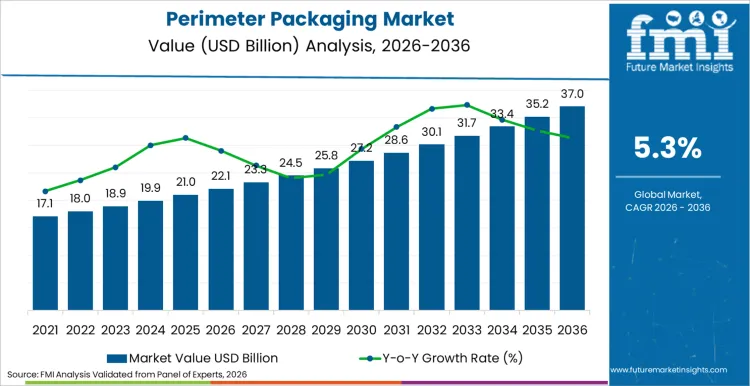
Summary of Perimeter Packaging Market
What Is Growth Outlook for the Perimeter Packaging Market as per Future Market Insights Projection?
Future Market Insights projects the perimeter packaging market to expand at a CAGR of 5.3% from 2026 to 2036, increasing from USD 22.1 billion in 2026 to USD 37.0 billion by 2036. Market growth is driven by rising demand for load stabilization, product protection, and efficient bundling solutions across manufacturing, logistics, retail, and industrial supply chains.
The expansion of e-commerce, increasing palletized transport, and higher throughput requirements in warehousing and distribution centers are significantly strengthening demand for stretch films, shrink wraps, strapping, and wrap-around perimeter packaging systems.
FMI Research Approach: FMI models perimeter packaging demand using historical pallet movement volumes, multipack bundling rates, and secondary and tertiary packaging penetration across industries. Forecasts integrate growth in automated packaging lines, logistics infrastructure expansion, and material substitution trends, with sensitivity to sustainability regulations and automation adoption through 2036.
How Do FMI Analysts Perceive the Perimeter Packaging Market to Evolve?
FMI analysts observe that the perimeter packaging market is evolving from labour-intensive, material-heavy solutions toward optimized, automation-ready, and sustainability-aligned packaging systems. Demand is increasingly shifting toward machine-applied and pre-stretched stretch films, high-performance shrink bundling, and automated strapping solutions that reduce material usage while enhancing load stability.
Material innovation, particularly in downgauged polyethylene films, PET strapping, recycled-content plastics, and bio-based alternatives is reshaping product portfolios. At the same time, integration of robotic stretch wrapping and high-speed bundling systems is becoming critical for large-scale FMCG, e-commerce, and industrial operations.
FMI Research Approach: FMI evaluates market evolution by analysing packaging type adoption, automation level transitions, material performance characteristics, and cost-per-pallet optimization trends. The analysis incorporates converter capabilities, equipment compatibility, and operational efficiency benchmarks across secondary and tertiary perimeter packaging applications.
Which Country Holds Largest Share in Global Perimeter Packaging Market?
Future Market Insights notes that the United States holds the largest share of the global perimeter packaging market by value. Market leadership is supported by high palletized freight volumes, advanced warehousing and logistics infrastructure, strong presence of automated distribution centres, and widespread adoption of stretch wrapping and strapping technologies.
The USA market also benefits from early adoption of sustainability-driven material optimization and automation solutions across FMCG, industrial manufacturing, and e-commerce logistics.
FMI Research Approach: Country-level analysis incorporates pallet throughput data, logistics infrastructure density, automation penetration, packaging equipment deployment, and regulatory frameworks influencing material selection and packaging efficiency.
How Large Will the Perimeter Packaging Market Be by 2036?
The global perimeter packaging market is projected to reach USD 37.0 billion by 2036, driven by continued growth in pallet load containment, multipack bundling, and transit protection across food & beverages, consumer goods, pharmaceuticals, industrial manufacturing, and construction materials.
FMI Research Approach: FMI calculates long-term market size by modelling perimeter packaging consumption per pallet, per multipack, and per shipment, weighted by packaging type, material, automation level, and end-use industry. Forecasts exclude primary product packaging to maintain strict scope alignment.
How Are Automation, Logistics Expansion, and Sustainability Fuelling Perimeter Packaging Adoption?
According to FMI analysts, rising labour costs, throughput pressures, and sustainability mandates are accelerating adoption of automated and material-efficient perimeter packaging solutions. Robotic stretch wrapping, semi-automatic strapping, and optimized shrink bundling systems are enabling manufacturers and logistics operators to improve load stability while reducing film usage and waste.
In parallel, regulatory and corporate sustainability goals are driving adoption of recyclable, recycled-content, and bio-based materials, positioning perimeter packaging as a key focus area for supply chain decarbonization and waste reduction initiatives.
FMI Research Approach: FMI incorporates automation investment trends, logistics network expansion, sustainability commitments, and material innovation pipelines into econometric demand models to refine long-term forecasts for perimeter packaging solutions.
Perimeter Packaging Market Key Takeaways
| Metric | Details |
|---|---|
| Market Size (2026) | USD 22.1 Bn |
| Market Value (2036) | USD 37.0 Bn |
| CAGR (2026-2036) | 5.3% |
Source: Future Market Insights (FMI) analysis, based on proprietary forecasting model and primary research.
Which Factors Drive Adoption of Perimeter Packaging Market?
Adoption of perimeter packaging is being driven by a structural shift in consumer goods and industrial supply chains toward enhanced protective packaging solutions that prioritize product safety, damage reduction, and transit resilience over conventional secondary packaging formats. Electronics, appliances, and fragile consumer products manufacturers are increasingly favouring perimeter packaging, such as edge protectors, corner guards, and frame supports to mitigate risks associated with shock, vibration, and compression during handling and long-distance shipping. According to the USA Consumer Product Safety Commission (CPSC), packaging that provides adequate protection against impact and stress is critical in minimizing injury risks and product defects, and adherence to standards like ASTM D4169 for performance testing of shipping containers has become a benchmark for damage prevention across distribution networks.
This transition is reinforced by the rapid expansion of e-commerce, rising consumer expectations for undamaged deliveries, and increasing costs associated with product returns and warranty claims. For example, Smurfit Kappa incorporates engineered perimeter protection systems into its sustainable fiber-based packaging solutions to deliver structural reinforcement, reduce material usage, and improve stacking performance across long-haul logistics.
FMI analysis indicates that perimeter packaging solutions supported by standardized testing protocols, validated performance data, and integration with automated packing lines achieve higher brand-owner confidence and faster repeat adoption. The expanding role of recyclable and renewable materials, modular protective designs, and digital simulation tools for drop and compression testing is further accelerating uptake by enabling reliable protection across diverse product categories, positioning perimeter packaging as an essential component of resilient supply chain systems rather than an optional protective add-on.
How is the Perimeter Packaging Market Segmented?
The perimeter packaging market has been segmented based on packaging type, material type, packaging level, application, end-use industry, automation level, and distribution channel. In terms of packaging type, the market is divided into stretch film packaging, shrink film packaging with open or partial enclosure, wrap-around rigid packaging, and strapping and banding solutions. Stretch film packaging includes hand-applied, machine-applied, and pre-stretched films, while shrink film formats are used for partial enclosure and bundling applications. Wrap-around rigid packaging and strapping systems support load stabilization and unit containment across logistics and industrial use cases.
By material type, the market is segmented into plastic-based materials, paper and paperboard, metal, and bio-based or recyclable materials. Plastic materials include polyethylene, polypropylene, and PET, while paper-based formats comprise corrugated board and kraft paper solutions. Additional segmentation includes packaging level, covering secondary perimeter packaging used for multipack bundling and unit stabilization, and tertiary perimeter packaging designed for pallet load containment and bulk transport protection. The market further spans multiple applications such as multipack bundling, pallet load stabilization, unit load containment, and transit protection across diverse end-use industries.
Why Does Stretch Film Packaging Hold a Dominant Share?
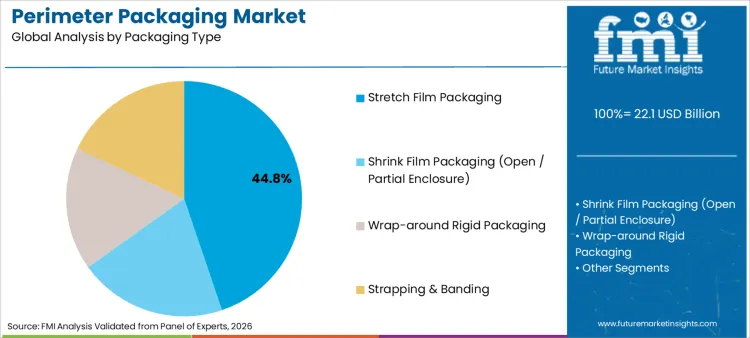
Stretch film packaging holds a dominant 44.8% share of the perimeter packaging market because it delivers the most efficient balance between load stability, cost control, and operational flexibility. Stretch films can be applied manually, semi-automatically, or through fully automated systems, allowing adoption across facilities of varying scale and automation maturity. Their ability to tightly secure irregular and uniform loads reduces product damage, load shifting, and transit losses while maintaining full visibility of packaged goods. This visibility supports scanning, inventory checks, and compliance without unpacking. The availability of machine-grade and pre-stretched films further enhances performance by reducing material usage and labor input in high-throughput environments. These attributes make stretch film the default perimeter packaging choice across FMCG, food and beverage, e-commerce, and industrial logistics operations.
Why Do Plastic Materials Dominate the Perimeter Packaging Market?
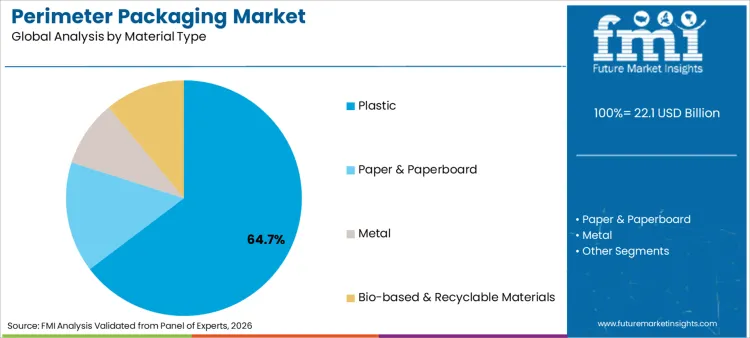
Plastic materials dominate the perimeter packaging market with a 64.7% share because they provide unmatched tensile strength, flexibility, and consistency under dynamic transport conditions. Materials such as polyethylene and polypropylene perform reliably across varying load weights, pallet configurations, and environmental exposures, making them compatible with automated wrapping, strapping, and banding systems. Plastics also enable downgauging strategies, allowing manufacturers to reduce material weight without sacrificing load security, which supports cost efficiency at scale. Additionally, plastic-based solutions increasingly incorporate recycled content and recyclable formulations, aligning performance needs with evolving sustainability requirements. As logistics volumes grow and supply chains prioritize speed, durability, and automation compatibility, plastic remains the most practical and scalable material platform for perimeter packaging applications.
What Trends Are Shaping Industry Evolution?
Beyond basic containment, perimeter packaging is increasingly being designed as an integral contributor to product protection, visibility, and brand communication. According to the USA Census Bureau’s Annual Retail Trade Report, retail sales of packaging-dependent categories including food, beverages, and household goods continue to grow year-over-year, underscoring rising demand for effective secondary and tertiary packaging to support transportation, display, and consumer convenience. This expansion of packaged goods trade is driving adoption of perimeter packaging solutions that combine structural integrity with impactful visual presentation, moving the category beyond commodity wraps into strategic packaging layers that enhance shelf appeal and handling safety.
Material innovation is reshaping the perimeter packaging landscape as manufacturers pivot toward sustainable substrates that reduce weight while maintaining strength. Corrugated fiberboard continues to dominate due to its recyclability and high load-bearing properties, but mono-material plastics, molded pulp, and advanced paperboards are gaining traction as brand owners push for circularity and lower environmental impact. These materials support reduced carbon footprint initiatives and align with tightening regulations on single-use plastics, pushing perimeter packaging toward more eco-efficient design paradigms.
Functional performance requirements are also evolving as e-commerce growth intensifies the need for perimeter packaging that can withstand complex logistics environments. Tamper-evident seals, reinforced corners, and impact-resistant constructions are becoming standard features to protect shipments through multiple touchpoints. This trend is particularly pronounced in direct-to-consumer channels, where package integrity directly influences customer satisfaction and return rates, elevating perimeter packaging from bulk containment to reliability-critical components of the product experience.
Customization and automation are increasingly influencing perimeter packaging adoption as retailers and manufacturers seek scalable solutions that support SKU proliferation. Barcode integration, RFID-ready materials, and printed marketing elements are being integrated into perimeter packaging formats to streamline inventory tracking and enhance brand storytelling. As a result, on-demand digital printing and variable data capabilities are gaining importance, enabling brands to tailor packaging at scale without incurring prohibitive costs.
Regional shifts in manufacturing and trade are impacting perimeter packaging demand patterns, with Asia-Pacific and Latin America emerging as fast-growth markets driven by expanding consumer goods production and logistics infrastructure. China and India are scaling export-oriented manufacturing that requires robust perimeter packaging to meet international handling standards. Meanwhile, established markets in North America and Europe are increasingly focused on sustainable packaging conversions and regulatory compliance, reinforcing the need for globally adaptable packaging strategies. According to the World Bank’s Logistics Performance Index (LPI), as global trade volumes increase and supply chain complexity rises, countries with higher LPI scores demonstrate greater efficiency in cargo handling and reduced packaging damage , highlighting the critical role of perimeter packaging solutions in modern logistics and international trade.
As regulatory scrutiny around recyclability, waste reduction, and material disclosure intensifies, perimeter packaging is transitioning from cost-driven bulk packaging to compliance-sensitive components of product delivery systems. Brand owners that effectively balance performance, sustainability, and cost are likely to capture long-term value, as perimeter packaging continues to evolve into a multifunctional element that supports protection, sustainability goals, and consumer engagement across the product lifecycle.
How Is the Perimeter Packaging Market Evolving Globally?
Global demand for perimeter packaging is rising as manufacturers across food, consumer goods, pharmaceuticals, and industrial products prioritize product protection, stability, and efficient load containment during storage and transportation. Growth is driven by increasing palletized shipments, expansion of e-commerce and omnichannel distribution, and rising requirements for damage prevention across complex supply chains. Perimeter packaging solutions such as strapping, wrapping, banding, and edge protection are becoming integral to logistics optimization and cargo integrity management.
Market evolution is shaped by automation adoption, material efficiency, and sustainability-focused redesign of packaging systems. China records a 7.2% CAGR, India records 6.8% CAGR, Indonesia records 6.4% CAGR, Brazil records 6.1% CAGR, and the United States records 5.6% CAGR during the forecast period. Adoption remains driven by operational reliability, cost control, and compliance with transport and safety standards rather than secondary packaging aesthetics.
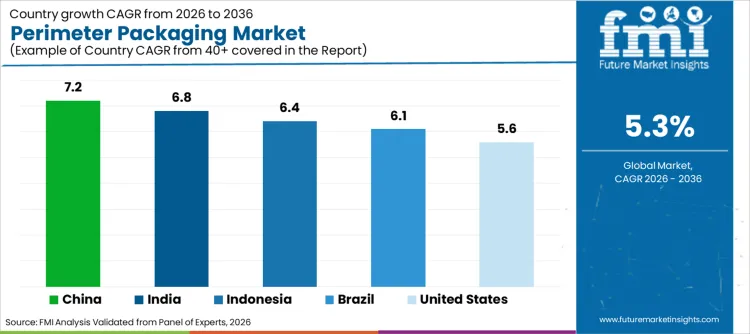
| Country | CAGR (2026-36) |
|---|---|
| China | 7.2% |
| India | 6.8% |
| Indonesia | 6.4% |
| Brazil | 6.1% |
| United States | 5.6% |
China: How Is Logistics Scale Driving Perimeter Packaging Demand?
China represents the largest and fastest-growing perimeter packaging market, supported by its massive manufacturing output and highly developed logistics ecosystem. High volumes of palletized goods across electronics, appliances, food, and industrial products are driving sustained demand for strapping and wrapping solutions that ensure load stability and transport safety.
The Chinese perimeter packaging market is projected to grow at a 7.2% CAGR during the study period. Growth is reinforced by increasing automation in warehousing and distribution centers, along with rising adoption of high-performance plastic strapping and stretch wrapping systems optimized for speed and material efficiency.
India: Is Infrastructure Expansion Accelerating Market Adoption?
India’s perimeter packaging market is expanding as investments in logistics infrastructure, warehousing, and cold-chain facilities continue to rise. Growth in manufacturing, retail distribution, and agricultural exports is increasing the need for reliable load containment and protective packaging solutions.
The Indian market is expected to grow at a 6.8% CAGR during the forecast period. Adoption is driven by increased use of stretch films, straps, and edge protectors that reduce transit damage while supporting cost-effective transportation across long domestic supply routes.
Indonesia: Is Manufacturing Growth Supporting Packaging Demand?
Indonesia’s perimeter packaging market is shaped by steady growth in manufacturing and consumer goods distribution. Expanding production of food, beverages, and household products is driving demand for packaging solutions that ensure safe handling and storage across domestic and export supply chains.
The Indonesian market is projected to grow at a 6.4% CAGR during the study period. Growth is supported by rising awareness of logistics efficiency and increasing use of perimeter packaging solutions in organized warehousing and distribution operations.
Brazil: Is Export-Oriented Logistics Driving Market Growth?
Brazil’s perimeter packaging market is expanding as agricultural exports, industrial goods shipments, and regional distribution networks grow in scale. Reliable perimeter packaging is critical for protecting goods during long-distance transportation and multimodal logistics operations.
The Brazilian market is expected to grow at a 6.1% CAGR during the study period. Growth is supported by increasing adoption of durable strapping and wrapping solutions that enhance load stability and reduce product loss across export and domestic logistics channels.
United States: Is Automation Shaping Perimeter Packaging Innovation?
The USA perimeter packaging market is set to grow at a 5.6% CAGR during the forecast period, driven by high levels of automation in warehousing, fulfillment centers, and manufacturing facilities. Companies increasingly invest in advanced perimeter packaging systems to improve throughput, consistency, and material utilization.
Sustainability considerations also influence market development, with growing adoption of recyclable strapping materials, downgauged stretch films, and automated systems that minimize waste while maintaining performance standards.
What Strategic Moves Are Defining the Competitive Landscape?
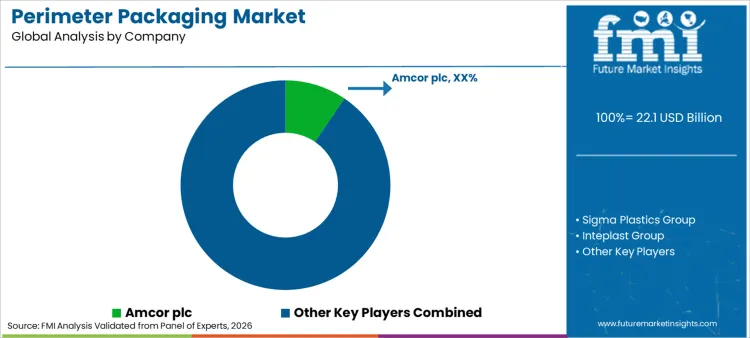
The competitive landscape of the global perimeter packaging market is increasingly defined by integration across flexible film production, packaging systems, and downstream application performance rather than capacity expansion alone. Leading players are repositioning perimeter packaging films, such as stretch, shrink, and protective wrap solutions as critical enablers of load stability, automation compatibility, and supply-chain efficiency across industrial, food, and consumer goods distribution.
A key strategic move shaping competition is the optimization of film performance for automated and high-speed packaging environments. Manufacturers are focusing on enhanced puncture resistance, controlled stretch behavior, downgauging, and consistent film quality to support automated pallet wrapping and bundling systems. This engineering-driven approach strengthens long-term supplier relationships with logistics operators, manufacturers, and retailers seeking improved packaging efficiency and reduced material usage.
Another defining trend is the integration of sustainability into perimeter packaging film design, particularly through downgauging, recycled content incorporation, and recyclable mono-material structures. Market leaders are aligning perimeter film portfolios with circular economy goals, enabling customers to reduce plastic consumption while maintaining load security and transportation safety. Sustainability alignment is increasingly influencing supplier selection, especially among multinational FMCG and industrial customers.
The market is also witnessing portfolio and capability realignment through selective acquisitions, divestments, and system-level investments. Rather than pursuing broad consolidation, companies are targeting capabilities that enhance packaging system performance, application expertise, and customer proximity. Collectively, these strategies are shifting competition away from commodity film supply toward performance reliability, automation compatibility, and sustainability leadership, redefining how competitive advantage is built in the perimeter packaging market.
Recent Developments:
- In January 2024, Amcor plc completed the acquisition of Moda Systems, a provider of automated protein packaging solutions. This move strengthens Amcor’s end-to-end packaging capabilities, enhancing its ability to optimize flexible and perimeter packaging films for high-speed, automated packaging environments and reinforcing its systems-level value proposition.
- In April 2024, Berry Global announced a strategic transaction to combine its Health, Hygiene and Specialties Global Nonwovens and Films business with Glatfelter, creating a new publicly traded company focused on specialty materials and packaging films. The move sharpens Berry Global’s strategic focus on high-value flexible and protective packaging solutions, including perimeter packaging applications.
Key Companies
- Amcor plc
- Sigma Plastics Group
- Inteplast Group
- Intertape Polymer Group (IPG)
- Novolex Holdings
- Signode (ITW)
- Manuli Stretch
- RKW Group
- Cosmo Films
- Innovia Films (CCL Industries)
- Polyplex Corporation Ltd.
- Presto Products, Inc.
- Darnel, Inc.
- Ergis S.A.
- Coveris
- AEP Industries (Berry Global)
- Bolloré Group (Packaging Films)
- Oben Group
- Paragon Films
Market Definition
The global perimeter packaging market refers to the ecosystem of packaging materials and solutions designed to protect, secure, and stabilize goods at the outermost layer during handling, transit, storage, and display. Perimeter packaging includes protective wraps, edge guards, corner protectors, stretch films, strapping systems, and other ancillary materials employed to reinforce primary and secondary packaging, prevent damage from impact or vibration, and ensure load integrity throughout supply chains.
The market includes perimeter packaging products manufactured from materials such as plastic films (e.g., PE and PVC), corrugated paperboard, molded pulp, foam, composite materials, and metal or plastic strapping. It covers solutions used across industries including food & beverage, pharmaceuticals, consumer goods, electronics, automotive parts, industrial machinery, and e-commerce logistics, irrespective of packaging format or application context.
On the other hand, the market excludes primary and retail packaging layers that directly contain products (e.g., bottles, cans, boxes) and internal cushioning materials used solely within primary packaging (e.g., fillers, void fillers). Packaging machinery and equipment, pallets, crates, and transport equipment not specifically designed as perimeter protection solutions are also outside the defined scope of the perimeter packaging market.
Scope of the Report
| Items | Values |
|---|---|
| Quantitative Units | USD billion |
| By Packaging Type | Stretch Film Packaging (Hand Stretch Film; Machine Stretch Film; Pre-Stretched Film); Shrink Film Packaging (Bullseye Shrink Wrap; Open-Side Shrink Wrap; Partial Shrink Bundling); Wrap-Around Rigid Packaging (Paperboard Wrap-Around Cartons; Corrugated Wrap-Around Sleeves); Strapping & Banding (Plastic Strapping; Steel Strapping; Paper Strapping) |
| By Material Type | Plastic (Polyethylene; Polypropylene; Polyethylene Terephthalate); Paper & Paperboard; Metal; Bio-Based & Recyclable Materials |
| End Use | Food & Beverages; Consumer Goods & FMCG; E-commerce & Retail Logistics; Pharmaceuticals & Healthcare; Industrial Manufacturing; Chemicals; Automotive & Components; Building & Construction Materials |
| Regions Covered | North America, Europe, East Asia, South Asia, Latin America, Middle East & Africa |
| Countries Covered | United States, Germany, China, India, Japan, Italy, and 40+ countries |
| Key Companies Profiled | Amcor plc; Sigma Plastics Group; Inteplast Group; Intertape Polymer Group (IPG); Novolex Holdings; Others |
| Additional Attributes | Revenue analysis by packaging type, material type, packaging level, application, automation level, and distribution channel; assessment of load stability, containment force, transport durability, and material efficiency; evaluation of automation adoption across manual, semi-automatic, and fully automated perimeter packaging systems; analysis of sustainability trends including downgauging, recyclable films, bio-based materials, and recycled-content plastics; procurement dynamics driven by logistics efficiency, cost optimization, regulatory compliance, and long-term supplier partnerships across global supply chains. |
Key Segments of Perimeter Packaging Market
By Packaging Type
- Stretch Film Packaging
- Hand stretch film
- Machine stretch film
- Pre-stretched film
- Shrink Film Packaging (Open / Partial Enclosure)
- Bullseye shrink wrap
- Open-side shrink wrap
- Partial shrink bundling
- Wrap-around Rigid Packaging
- Paperboard wrap-around cartons
- Corrugated wrap-around sleeves
- Strapping & Banding
- Plastic strapping (PP, PET)
- Steel strapping
- Paper strapping
By Material Type
- Plastic
- Polyethylene (LDPE, LLDPE, HDPE)
- Polypropylene (PP)
- Polyethylene terephthalate (PET)
- Paper & Paperboard
- Corrugated board
- Solid bleached sulfate (SBS)
- Kraft paper
- Metal
- Steel strapping
- Aluminum strapping
- Bio-based & Recyclable Materials
- Bio-PE
- Compostable films
- Recycled-content plastics
By Packaging Level
- Secondary Perimeter Packaging
- Multipack bundling
- Unit packaging stabilization
- Tertiary Perimeter Packaging
- Pallet load containment
- Bulk transport stabilization
By Application
- Multipack Bundling
- Beverage cans & bottles
- Consumer goods multipacks
- Pallet Load Stabilization
- FMCG palletization
- Industrial goods pallet loads
- Unit Load Containment
- Boxes, cartons, and cases
- Mixed-load pallet packaging
- Transit Protection
- Intermodal transport
- Warehouse handling & storage
By End-use Industry
- Food & Beverages
- Consumer Goods & FMCG
- E-commerce & Retail Logistics
- Pharmaceuticals & Healthcare
- Industrial Manufacturing
- Chemicals
- Automotive & Components
- Building & Construction Materials
By Automation Level
- Manual Packaging
- Hand-applied films and strapping
- Semi-automatic Packaging
- Turntable wrappers
- Semi-auto strapping machines
- Fully Automated Packaging
- Robotic stretch wrapping
- High-speed bundling systems
By Distribution Channel
- Direct Sales (OEMs & Converters)
- Distributors & Wholesalers
- Packaging Equipment Suppliers
- E-commerce / Online Procurement
By Region:
- North America
- Europe
- East Asia
- South Asia
- Latin America
- Middle East & Africa
Bibliography
- AMERIPEN-American Institute for Packaging and the Environment. (2024). Perimeter of the Store Packaging: Material Selection, Performance Requirements, and Sustainability Considerations. AMERIPEN.
- Flexible Packaging Association (FPA). (2024). Flexible Films and Lidding Solutions for Fresh Food and Perimeter Packaging Applications. Flexible Packaging Association.
- International Fresh Produce Association (IFPA). (2024). Packaging Technologies for Fresh Produce: Shelf-Life Extension, Protection, and Consumer Transparency. IFPA.
- PlasticsEurope. (2024). Polymer Materials for Food Trays, Lidding Films, and Fresh Food Packaging: Performance and Recycling Considerations. PlasticsEurope Association.
- PMMI-The Association for Packaging and Processing Technologies. (2024). Packaging Systems for Fresh Food Perimeters: Tray Sealing, MAP Compatibility, and Line Performance. PMMI Technical Publications.
- European Committee for Standardization (CEN). (2024). Packaging-Requirements for Packaging Recoverable through Recycling and Organic Recovery (EN 13430 and EN 13432 series). CEN/TC 261 Packaging.
- International Organization for Standardization (ISO). (2024). Food Packaging-Hygiene, Safety, and Performance Requirements for Primary Packaging (ISO 22000 and related guidance). ISO.
- USA Food and Drug Administration (FDA). (2024). Food Contact Materials for Fresh and Perishable Foods: Packaging Safety and Compliance Requirements (21 CFR Parts 174-178). USA Government Publishing Office.
Frequently Asked Questions
How big is the perimeter packaging market in 2026?
The global perimeter packaging market is estimated to be valued at USD 22.1 billion in 2026.
What will be the size of the perimeter packaging market in 2036?
The perimeter packaging market is projected to reach USD 37.0 billion by 2036.
How much will the perimeter packaging market grow between 2026 and 2036?
The perimeter packaging market is expected to grow at a 5.3% CAGR between 2026 and 2036.
What are the key packaging types in the perimeter packaging market?
Key packaging types include stretch film packaging, shrink film packaging (open or partial enclosure), wrap-around rigid packaging, and strapping & banding solutions used for load containment and bundling.
Which materials are commonly used in perimeter packaging solutions?
Perimeter packaging solutions primarily use polyethylene, polypropylene, PET, paper & paperboard, steel, aluminum, along with bio-based and recycled-content materials to improve sustainability performance.
Which applications drive demand for perimeter packaging?
Major demand drivers include multipack bundling, pallet load stabilization, unit load containment, and transit protection, particularly across FMCG, beverage, e-commerce, and industrial logistics operations.
Preview the report firsthand - request a free sample
Get SampleGet the brochure for pricing and purchase details.
Get PDFTable of Content
- Executive Summary
- Global Market Outlook
- Demand-side Trends
- Supply-side Trends
- Technology Roadmap Analysis
- Analysis and Recommendations
- Market Overview
- Market Coverage / Taxonomy
- Market Definition / Scope / Limitations
- Market Background
- Market Dynamics
- Drivers
- Restraints
- Opportunity
- Trends
- Scenario Forecast
- Demand in Optimistic Scenario
- Demand in Likely Scenario
- Demand in Conservative Scenario
- Opportunity Map Analysis
- Product Life Cycle Analysis
- Supply Chain Analysis
- Investment Feasibility Matrix
- Value Chain Analysis
- PESTLE and Porter’s Analysis
- Regulatory Landscape
- Regional Parent Market Outlook
- Production and Consumption Statistics
- Import and Export Statistics
- Market Dynamics
- Global Market Analysis 2021 to 2025 and Forecast, 2026 to 2036
- Historical Market Size Value (USD Million) Analysis, 2021 to 2025
- Current and Future Market Size Value (USD Million) Projections, 2026 to 2036
- Y-o-Y Growth Trend Analysis
- Absolute $ Opportunity Analysis
- Global Market Pricing Analysis 2021 to 2025 and Forecast 2026 to 2036
- Global Market Analysis 2021 to 2025 and Forecast 2026 to 2036, By Packaging Type
- Introduction / Key Findings
- Historical Market Size Value (USD Million) Analysis By Packaging Type , 2021 to 2025
- Current and Future Market Size Value (USD Million) Analysis and Forecast By Packaging Type , 2026 to 2036
- Stretch Film Packaging
- Shrink Film Packaging (Open / Partial Enclosure)
- Wrap-around Rigid Packaging
- Strapping & Banding
- Stretch Film Packaging
- Y-o-Y Growth Trend Analysis By Packaging Type , 2021 to 2025
- Absolute $ Opportunity Analysis By Packaging Type , 2026 to 2036
- Global Market Analysis 2021 to 2025 and Forecast 2026 to 2036, By Material Type
- Introduction / Key Findings
- Historical Market Size Value (USD Million) Analysis By Material Type, 2021 to 2025
- Current and Future Market Size Value (USD Million) Analysis and Forecast By Material Type, 2026 to 2036
- Plastic
- Paper & Paperboard
- Metal
- Bio-based & Recyclable Materials
- Plastic
- Y-o-Y Growth Trend Analysis By Material Type, 2021 to 2025
- Absolute $ Opportunity Analysis By Material Type, 2026 to 2036
- Global Market Analysis 2021 to 2025 and Forecast 2026 to 2036, By Packaging Level
- Introduction / Key Findings
- Historical Market Size Value (USD Million) Analysis By Packaging Level, 2021 to 2025
- Current and Future Market Size Value (USD Million) Analysis and Forecast By Packaging Level, 2026 to 2036
- Secondary Perimeter Packaging
- Tertiary Perimeter Packaging
- Secondary Perimeter Packaging
- Y-o-Y Growth Trend Analysis By Packaging Level, 2021 to 2025
- Absolute $ Opportunity Analysis By Packaging Level, 2026 to 2036
- Global Market Analysis 2021 to 2025 and Forecast 2026 to 2036, By Region
- Introduction
- Historical Market Size Value (USD Million) Analysis By Region, 2021 to 2025
- Current Market Size Value (USD Million) Analysis and Forecast By Region, 2026 to 2036
- North America
- Latin America
- Western Europe
- Eastern Europe
- East Asia
- South Asia and Pacific
- Middle East & Africa
- Market Attractiveness Analysis By Region
- North America Market Analysis 2021 to 2025 and Forecast 2026 to 2036, By Country
- Historical Market Size Value (USD Million) Trend Analysis By Market Taxonomy, 2021 to 2025
- Market Size Value (USD Million) Forecast By Market Taxonomy, 2026 to 2036
- By Country
- USA
- Canada
- Mexico
- By Packaging Type
- By Material Type
- By Packaging Level
- By Country
- Market Attractiveness Analysis
- By Country
- By Packaging Type
- By Material Type
- By Packaging Level
- Key Takeaways
- Latin America Market Analysis 2021 to 2025 and Forecast 2026 to 2036, By Country
- Historical Market Size Value (USD Million) Trend Analysis By Market Taxonomy, 2021 to 2025
- Market Size Value (USD Million) Forecast By Market Taxonomy, 2026 to 2036
- By Country
- Brazil
- Chile
- Rest of Latin America
- By Packaging Type
- By Material Type
- By Packaging Level
- By Country
- Market Attractiveness Analysis
- By Country
- By Packaging Type
- By Material Type
- By Packaging Level
- Key Takeaways
- Western Europe Market Analysis 2021 to 2025 and Forecast 2026 to 2036, By Country
- Historical Market Size Value (USD Million) Trend Analysis By Market Taxonomy, 2021 to 2025
- Market Size Value (USD Million) Forecast By Market Taxonomy, 2026 to 2036
- By Country
- Germany
- UK
- Italy
- Spain
- France
- Nordic
- BENELUX
- Rest of Western Europe
- By Packaging Type
- By Material Type
- By Packaging Level
- By Country
- Market Attractiveness Analysis
- By Country
- By Packaging Type
- By Material Type
- By Packaging Level
- Key Takeaways
- Eastern Europe Market Analysis 2021 to 2025 and Forecast 2026 to 2036, By Country
- Historical Market Size Value (USD Million) Trend Analysis By Market Taxonomy, 2021 to 2025
- Market Size Value (USD Million) Forecast By Market Taxonomy, 2026 to 2036
- By Country
- Russia
- Poland
- Hungary
- Balkan & Baltic
- Rest of Eastern Europe
- By Packaging Type
- By Material Type
- By Packaging Level
- By Country
- Market Attractiveness Analysis
- By Country
- By Packaging Type
- By Material Type
- By Packaging Level
- Key Takeaways
- East Asia Market Analysis 2021 to 2025 and Forecast 2026 to 2036, By Country
- Historical Market Size Value (USD Million) Trend Analysis By Market Taxonomy, 2021 to 2025
- Market Size Value (USD Million) Forecast By Market Taxonomy, 2026 to 2036
- By Country
- China
- Japan
- South Korea
- By Packaging Type
- By Material Type
- By Packaging Level
- By Country
- Market Attractiveness Analysis
- By Country
- By Packaging Type
- By Material Type
- By Packaging Level
- Key Takeaways
- South Asia and Pacific Market Analysis 2021 to 2025 and Forecast 2026 to 2036, By Country
- Historical Market Size Value (USD Million) Trend Analysis By Market Taxonomy, 2021 to 2025
- Market Size Value (USD Million) Forecast By Market Taxonomy, 2026 to 2036
- By Country
- India
- ASEAN
- Australia & New Zealand
- Rest of South Asia and Pacific
- By Packaging Type
- By Material Type
- By Packaging Level
- By Country
- Market Attractiveness Analysis
- By Country
- By Packaging Type
- By Material Type
- By Packaging Level
- Key Takeaways
- Middle East & Africa Market Analysis 2021 to 2025 and Forecast 2026 to 2036, By Country
- Historical Market Size Value (USD Million) Trend Analysis By Market Taxonomy, 2021 to 2025
- Market Size Value (USD Million) Forecast By Market Taxonomy, 2026 to 2036
- By Country
- Kingdom of Saudi Arabia
- Other GCC Countries
- Turkiye
- South Africa
- Other African Union
- Rest of Middle East & Africa
- By Packaging Type
- By Material Type
- By Packaging Level
- By Country
- Market Attractiveness Analysis
- By Country
- By Packaging Type
- By Material Type
- By Packaging Level
- Key Takeaways
- Key Countries Market Analysis
- USA
- Pricing Analysis
- Market Share Analysis, 2025
- By Packaging Type
- By Material Type
- By Packaging Level
- Canada
- Pricing Analysis
- Market Share Analysis, 2025
- By Packaging Type
- By Material Type
- By Packaging Level
- Mexico
- Pricing Analysis
- Market Share Analysis, 2025
- By Packaging Type
- By Material Type
- By Packaging Level
- Brazil
- Pricing Analysis
- Market Share Analysis, 2025
- By Packaging Type
- By Material Type
- By Packaging Level
- Chile
- Pricing Analysis
- Market Share Analysis, 2025
- By Packaging Type
- By Material Type
- By Packaging Level
- Germany
- Pricing Analysis
- Market Share Analysis, 2025
- By Packaging Type
- By Material Type
- By Packaging Level
- UK
- Pricing Analysis
- Market Share Analysis, 2025
- By Packaging Type
- By Material Type
- By Packaging Level
- Italy
- Pricing Analysis
- Market Share Analysis, 2025
- By Packaging Type
- By Material Type
- By Packaging Level
- Spain
- Pricing Analysis
- Market Share Analysis, 2025
- By Packaging Type
- By Material Type
- By Packaging Level
- France
- Pricing Analysis
- Market Share Analysis, 2025
- By Packaging Type
- By Material Type
- By Packaging Level
- India
- Pricing Analysis
- Market Share Analysis, 2025
- By Packaging Type
- By Material Type
- By Packaging Level
- ASEAN
- Pricing Analysis
- Market Share Analysis, 2025
- By Packaging Type
- By Material Type
- By Packaging Level
- Australia & New Zealand
- Pricing Analysis
- Market Share Analysis, 2025
- By Packaging Type
- By Material Type
- By Packaging Level
- China
- Pricing Analysis
- Market Share Analysis, 2025
- By Packaging Type
- By Material Type
- By Packaging Level
- Japan
- Pricing Analysis
- Market Share Analysis, 2025
- By Packaging Type
- By Material Type
- By Packaging Level
- South Korea
- Pricing Analysis
- Market Share Analysis, 2025
- By Packaging Type
- By Material Type
- By Packaging Level
- Russia
- Pricing Analysis
- Market Share Analysis, 2025
- By Packaging Type
- By Material Type
- By Packaging Level
- Poland
- Pricing Analysis
- Market Share Analysis, 2025
- By Packaging Type
- By Material Type
- By Packaging Level
- Hungary
- Pricing Analysis
- Market Share Analysis, 2025
- By Packaging Type
- By Material Type
- By Packaging Level
- Kingdom of Saudi Arabia
- Pricing Analysis
- Market Share Analysis, 2025
- By Packaging Type
- By Material Type
- By Packaging Level
- Turkiye
- Pricing Analysis
- Market Share Analysis, 2025
- By Packaging Type
- By Material Type
- By Packaging Level
- South Africa
- Pricing Analysis
- Market Share Analysis, 2025
- By Packaging Type
- By Material Type
- By Packaging Level
- USA
- Market Structure Analysis
- Competition Dashboard
- Competition Benchmarking
- Market Share Analysis of Top Players
- By Regional
- By Packaging Type
- By Material Type
- By Packaging Level
- Competition Analysis
- Competition Deep Dive
- Amcor plc
- Overview
- Product Portfolio
- Profitability by Market Segments (Product/Age /Sales Channel/Region)
- Sales Footprint
- Strategy Overview
- Marketing Strategy
- Product Strategy
- Channel Strategy
- Sigma Plastics Group
- Inteplast Group
- Signode (ITW)
- Novolex Holdings
- Amcor plc
- Competition Deep Dive
- Assumptions & Acronyms Used
- Research Methodology


