

- Industry Size (2026)
- USD 0.9 Bn
- Forecast (2036)
- USD 2.2 Bn
- CAGR (2026 to 2036)
- 9.3%
Bio-based Flame Retardant Cellulosic Apparel Market Forecast and Outlook 2026 to 2036
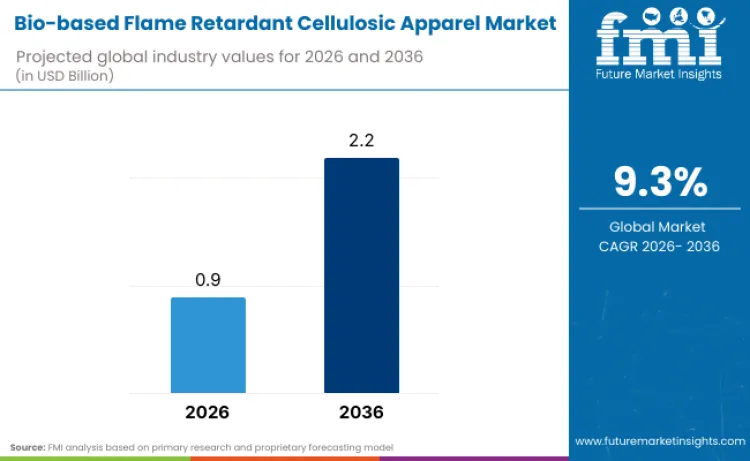
The bio-based flame retardant cellulosic apparel market is likely to total USD 0.9 billion in 2026. Future Market Insights expects this valuation to rise further, advancing to USD 2.2 billion by 2036, progressing at a 9.3% CAGR. Bio-based flame-retardant cellulosic fibers are undergoing a qualification-led reset shaped by cost exposure, feedstock control, and regulatory durability.
Competitive position is defined by scale efficiency and the ability to embed flame-retardant performance directly into fiber chemistry. Applied finishes and small-batch specialty positioning are losing relevance as buyers prioritise repeatable compliance and long-cycle supply stability.
The scheduled closure of Kelheim Fibres by March 2026 highlights the vulnerability of non-integrated producers. Technical capability in viscose modification has not offset sustained European energy costs, pulp price volatility, and constrained access to long-horizon capital. The exit has reduced available capacity for protective and technical textile programs in Europe, increasing buyer reliance on integrated suppliers with diversified production and sourcing footprints.
Integrated leaders are consolidating advantage through inherently flame-retardant fiber architectures supported by upstream biomass control. Birla Cellulose and Lenzing AG prioritise molecular-level flame retardancy that remains stable across laundering, mechanical stress, and garment service life. These platforms are structured to clear industrial safety standards such as NFPA 2112 and EN 469 while aligning with renewable material requirements embedded in public-sector and corporate procurement frameworks.
The shift from experimental bio-based fibers toward manufacturing-grade integration is also evident among emerging microbial cellulose developers focused on compatibility with incumbent lyocell infrastructure. As Andrew Moullin, CEO and Managing Director of Nanollose Limited, noted in the company’s January 2026 disclosure:
“The December quarter [2025] marked an important transition point for Nanollose, as we moved beyond incremental pilot batch validation and into a phase focused on scalability and cost reduction, confirming our ability to deliver microbial cellulose that can be directly integrated into existing lyocell production lines will reflect the strength of our collaboration with development partners and the maturity of our process.” - Source: Nanollose Limited Quarterly Activities Report, January 30, 2026
Manufacturing economics are reinforced through full-stream biomass utilisation. Lenzing’s biorefinery model converts cellulose co-products into margin-stabilising inputs, reducing exposure to commodity pulp cycles and positioning flame-retardant fibers within broader industrial biomaterials portfolios rather than isolated specialty lines.
Operational control is tightening through AI-enabled process optimisation and quality monitoring deployed at fiber and spinning stages. Yield stability and defect containment are treated as qualification variables. Circular feedstock strategies are also shaping supplier selection. Programs involving Sateri and Infinited Fiber Company indicate growing emphasis on closed-loop cellulose systems that reduce reliance on virgin pulp and support long-cycle sourcing resilience.
Summary of the Bio-based Flame Retardant Cellulosic Apparel Market
At what pace will Bio-based Flame Retardant Cellulosic Apparel Demand rise?
Future Market Insights expects the bio-based flame retardant cellulosic apparel market to expand at 9.3% CAGR from USD 0.9 billion in 2026 to USD 2.2 billion by 2036.
FMI Research Approach: Proprietary forecasting model triangulated with producer capacity signals, qualification cycles, and compliance-led demand pull.
What is FMI’s central viewpoint on how the market will develop?
FMI sees the market shifting toward a qualification-led growth model, where wash-durable, non-leaching, inherently FR fiber performance and scale reliability outweigh sustainability narratives. Demand concentrates around integrated suppliers that can defend compliance over long service life.
FMI Research Approach: Contract and tender logic mapping plus supplier capability benchmarking against safety and laundering durability requirements.
What is the single biggest demand catalyst showing up in 2025-2026?
Demand is being pulled forward by the regulatory tightening of conventional chemical flame retardants, accelerating substitution toward fiber-level FR architectures.
FMI Research Approach: Regulatory-to-procurement translation model that links restrictions, thresholds, and disclosure rules to buyer re-qualification timelines.
Which fiber category is holding the center of the mix in 2026?
Lyocell & Modal (~35% share in 2026) anchor demand because buyers trust these platforms under audit pressure and repeated laundering, especially when FR is integrated at polymer level.
FMI Research Approach: Segment share build-up using procurement specifications, brand program adoption, and fiber substitution feasibility under compliance constraints.
Which chemistry route is leading uptake right now?
Phosphorus-based FR systems lead with a 39.4% share because they can be integrated into the cellulose backbone for durable performance, reducing reliance on surface-applied finishes.
FMI Research Approach: Technology adoption scoring based on durability evidence, qualification ease, and wastewater/compliance burden at mill level.
Where is the revenue concentration coming from on the application side?
Workwear & protective apparel (~40% of revenue in 2026) remains the volume anchor, as public-sector and industrial buyers tighten specifications and reduce tolerance for re-qualification risk.
FMI Research Approach: End-use sizing based on safety-standard-linked demand pools and procurement intensity by buyer type.
What kinds of supplier moves best signal next-step scaling?
Signals include integration moves that expand circular or alternative cellulose inputs such as Lenzing AG advancing waste-derived cellulose capability and scale-readiness disclosures from emerging platforms like Nanollose Limited highlighting the shift from pilot validation to cost-down and scalability.
FMI Research Approach: Strategic move tracking across upstream control, process integration, and qualification readiness indicators.
Which country is projected to stay structurally important through the forecast?
USA (9.4% CAGR) remains a key growth engine as procurement and safer-chemistry screening tighten, encouraging adoption of inherently FR cellulosics that can clear durability and disclosure hurdles.
FMI Research Approach: Country-level modeling using policy-to-procurement conversion, sector exposure weighting, and supplier qualification density.
Bio-based Flame Retardant Cellulosic Apparel Market Key Takeaways
| Metric | Value |
|---|---|
| Expected Value (2026E) | USD 0.9 billion |
| Forecasted Value (2036F) | USD 2.2 billion |
| CAGR (2026-2036) | 9.3% |
Source: FMI analysis based on primary research and proprietary forecasting model
Why is Bio-based Flame Retardant Cellulosic Apparel Demand Rising?
Expansion is a function of regulatory contraction around conventional chemical flame retardants. In January 2026, European Chemicals Agency initiated a formal call for evidence targeting aromatic brominated flame retardants, accelerating substitution pressure across protective apparel and interior textile applications. Parallel regulatory tightening is visible in USA, where Massachusetts 310 CMR 78.00 lowered acceptable halogenated flame-retardant thresholds to 1,000 ppm in May 2025, effectively excluding legacy chemistries from compliant supply chains. Similar compliance pressure is emerging across the Middle East, where the UAE’s Phase II Plastic Ban implemented in January 2026 has reinforced procurement preference for bio-based polymer systems. These measures have shifted sourcing decisions toward cellulosic fibers capable of meeting flame performance requirements without restricted additives.
Commercial adoption is enabled by polymer-level integration of flame-retardant functionality. Market activity in 2026 reflects a move toward covalent bonding approaches that incorporate phosphorus-based retardants directly into the polymer backbone, eliminating durability losses associated with surface treatments. Research released by the German Institutes of Textile and Fiber Research in January 2026 demonstrated successful synthesis of flame-retardant polyethylene furanoate through copolymerized phosphorus compounds. This approach prevents additive migration and supports long-cycle performance under industrial laundering and wear conditions.
Fiber platforms built on this architecture are capable of clearing NFPA 2112 and EN 469 qualification thresholds required for protective apparel programs. Feedstock strategy is evolving toward multi-stream cellulose sourcing that reduces reliance on virgin wood pulp. In February 2026, Lenzing AG secured majority ownership of TreeToTextile AB, advancing waste-derived cellulose technology toward first industrial-scale deployment. Sateri is also expanding its Vision 2030 roadmap to scale FINEX™ recycled-content fibers into flame-retardant variants. These investments are building a more resilient raw material base that incorporates post-consumer textile waste alongside traditional pulp inputs, supporting both compliance durability and long-term supply security.
Analysis of Bio-based Flame Retardant Cellulosic Apparel Market by Key Segments
Why are Lyocell and Modal Holding the Center of the Fiber Mix?
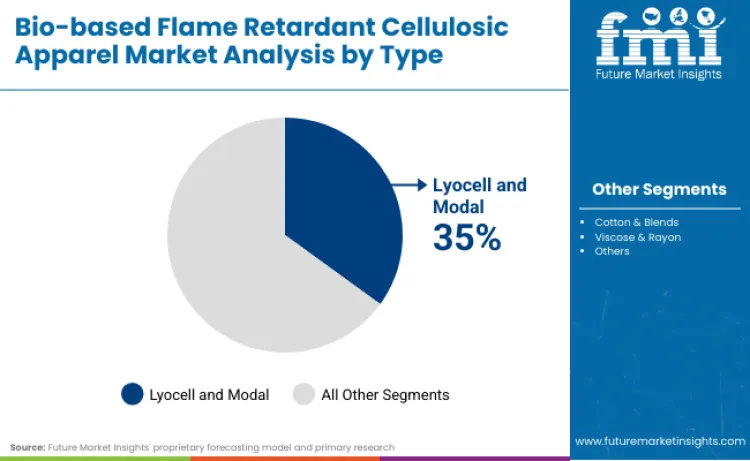
Accounting for about 35% of demand in 2026, Lyocell and modal remain the backbone of the fiber mix. Their position is no longer defended on comfort alone. Buyers are selecting these fibers because they behave predictably under regulation, laundering, and audit pressure. As post-2025 material rules tighten across Europe and Asia, closed-loop regenerated cellulosics are increasingly specified ahead of synthetics and conventional cotton in flame-retardant apparel programs. Regulatory alignment is reinforcing this shift. The EU’s Ecodesign for Sustainable Products Regulation working plan for 2025-2030 is pushing procurement toward fibers with high resource efficiency and controlled chemical profiles. Lyocell’s solvent-spinning route, with NMMO recovery rates above 99%, gives brands and suppliers a clearer compliance position when chemical release, worker exposure, and end-of-life traceability are reviewed during audits.
Are Phosphorus-Based Flame-Retardant Systems Maintaining their Lead?
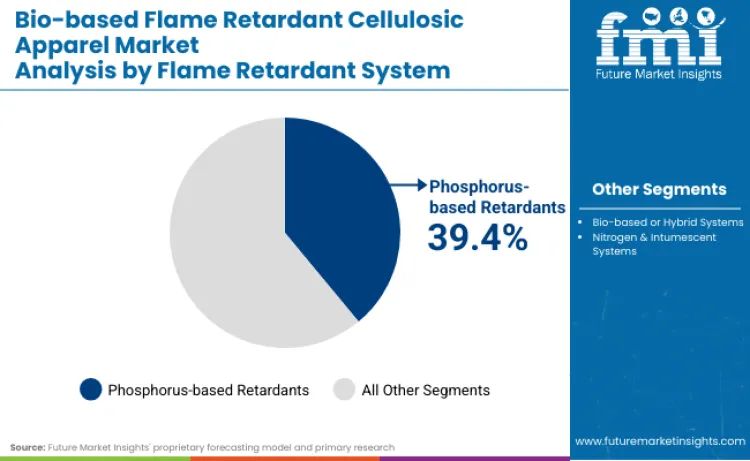
Phosphorus-based flame-retardant systems continue to dominate, representing 39.4% of demand. Their advantage lies in how the chemistry is integrated. By forming covalent bonds with the cellulose backbone, phosphorus systems deliver flame resistance that survives repeated laundering and long service cycles, avoiding the degradation issues associated with surface-applied treatments. A clear validation point emerged in 2025, when a European firefighting-apparel program qualified phosphorus-integrated regenerated cellulosic fabrics under EN ISO 6330 industrial laundering tests. The materials retained flame-retardant performance after more than 50 wash cycles, confirming that covalently bonded phosphorus systems sustained char formation and heat-release control without post-wash retreatment. Procurement teams now view this durability as a clear advantage over surface-applied FR finishes, which remain vulnerable to wash-down losses and requalification risk.
Is Workwear and Protective Apparel Carrying Volume Growth?
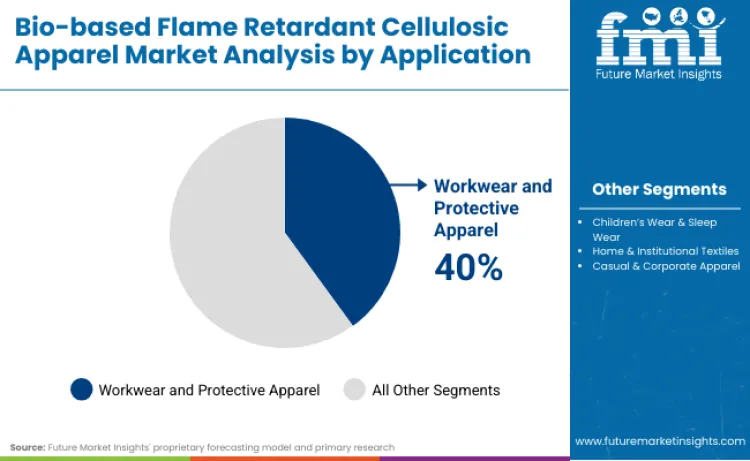
In 2026, workwear and protective apparel will likely contribute 40% of total revenue. Demand growth here is procurement-driven rather than discretionary. Public sector and industrial buyers are upgrading safety specifications, pulling volume through certified supply chains instead of relying on legacy materials. In India, revised technical specifications issued in 2025 by the Ministry of Home Affairs for fire-resistant overalls supplied to Central Armed Police Forces tightened alignment with NFPA 2112 and EN 469. This revision redirected orders away from conventional cotton-based flame-retardant fabrics toward bio-based cellulosic fibers that can meet durability, laundering, and documentation thresholds without requalification risk.
What Influences Demand for Bio-based Flame Retardant Cellulosic Apparel?
Exclusion events rather than sustainability positioning are increasingly shaping demand patterns in bio-based flame-retardant cellulosics. Over the past two years, procurement frameworks across transport, infrastructure, and institutional safety textiles have tightened chemical disclosure and durability review processes. Rail interior and public-facility tenders in Asia and the Middle East have introduced extended audit windows and post-installation performance verification, narrowing supplier eligibility and reducing tolerance for platforms reliant on topical flame-retardant treatments.
Supplier responses point to a shift toward qualification-led positioning. Sateri Group has increased its emphasis on regulated and institutional textile programs by strengthening traceability systems and buyer-facing compliance support, reflecting a move away from volume-driven apparel exposure. Tangshan Sanyou Chemical Fiber has similarly expanded investment in process consistency, audit documentation, and long-cycle qualification readiness as public-sector sourcing standards tighten across Asia-Pacific. Cost pressure continues to cap broader adoption. Producers supplying inherent bio-based flame retardant cellulosic apparel platforms face sustained capital intensity linked to energy exposure, controlled production environments, and expanded compliance documentation.
These economics keep demand concentrated in programs where compliance failure translates directly into contractual penalties or liability exposure. Price-sensitive apparel categories remain largely excluded, reinforcing a structural divide between regulated and discretionary demand pools. Supplier attrition is reshaping competitive access. Cordenka has narrowed its strategic focus toward reinforcement and industrial applications, reducing discretionary exposure in specialty cellulosic segments as qualification and energy costs rise. In parallel, several mid-tier producers in East Asia have deferred upgrades or consolidated technical fiber lines to manage return on invested capital under tighter compliance regimes. Buyers in protective wear and institutional furnishing categories report fewer qualified bids per sourcing cycle and longer lead times for certified supply.
How is the Bio-based Flame Retardant Cellulosic Apparel Market Profiled in Key Countries?
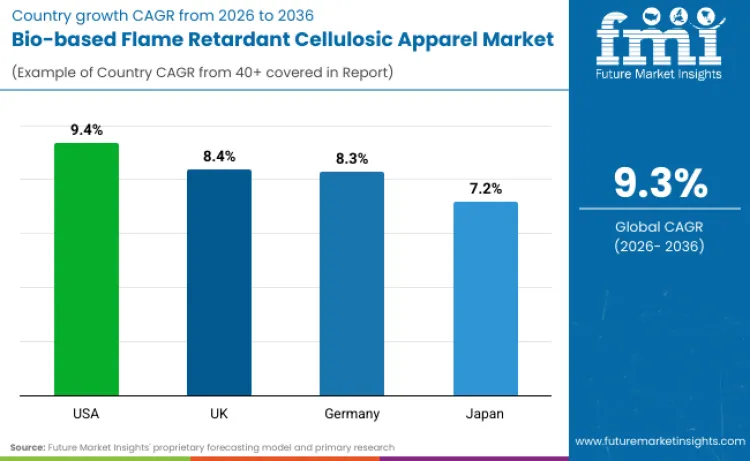
| Country | CAGR (2026-2036) |
|---|---|
| USA | 9.4% |
| UK | 8.4% |
| Japan | 7.2% |
| Germany | 8.3% |
Source: FMI’s proprietary forecasting model and primary research
How is Federal Procurement Turning Safer Choice into a Volume Anchor for Bio-Based FR Cellulosics in USA?
In USA, demand for bio-based flame-retardant cellulosics is consolidating around federally defined procurement rules rather than a patchwork of state bans, supporting a forecast CAGR of 9.4%. The January 2026 update to the USA Environmental Protection Agency Safer Choice Performance Measures has shifted compliance from a branding advantage to a gatekeeping criterion for federal and quasi-federal purchasing. With a target of 2,300 Safer Choice-certified products by September 2026, procurement teams are treating inclusion on the Safer Chemical Ingredients List as a hard screening tool, not a preference signal.
This has accelerated adoption of phosphorus-based and inorganic FR systems positioned as Design for the Environment alternatives. What matters operationally is the demand floor this creates. FR-integrated cellulosics that can clear toxicity, leaching, and lifecycle thresholds simultaneously are being written into multi-year supply programs. Supplier behaviour reflects this reset. ICL Group’s late-2024 launch of VeriQuel R100 illustrates the move toward reactive phosphorus chemistries that bond directly with cellulose. For USA textile manufacturers, this reduces exposure to additive-driven compliance risk, wastewater treatment burdens, and downstream disposal liabilities, factors that now sit squarely within federal procurement audits.
Why are Post-2025 Furniture Safety Reforms Rewiring FR Fiber Selection in UK?
Supporting an 8.4% CAGR, UK’s market includes inherently flame-retardant cellulosic apparel driven by a regulatory reset that removes workarounds. The Furniture and Furnishings (Fire) (Safety) (Amendment) Regulations 2025, effective October 30, 2025, eliminated the swing label route and placed liability on the permanent fiber structure itself. This has shortened sourcing cycles for home textile and upholstery programs, favouring fibers that deliver durable flame resistance without reliance on post-production chemical treatments. Capital signals are reinforcing this shift. Innovate UK’s £5.25 million Bio-based Manufacturing Launchpad, active through December 2026, is directing funding toward biomass-derived textile platforms that integrate safety at the material level. Together, regulation and public funding are filtering out retrofit-dependent solutions and elevating suppliers that can deliver audit-ready, industrial-scale FR fibers.
Will Germany’s Circular Economy Mandate reshape FR Technology Choices at Mill Level?
Germany’s bio-based FR cellulosic apparel landscape is tracking a CAGR of 8.3%, shaped less by outright bans and more by circularity constraints embedded in the National Circular Economy Strategy implemented in 2025. Mandatory separate textile waste collection is disadvantaging FR systems that block fiber-to-fiber recycling. In response, mills are converging on wash-resistant phosphorus-cellulose grafts and bio-coatings that preserve in-use performance while remaining compatible with closed-loop recovery. Applied research is de-risking these transitions. Fraunhofer WKI’s InnFla project, presented at LIGNA 2025, demonstrated formaldehyde-free FR coatings with more than 50% renewable content. The implication for suppliers is clear: fire safety and recyclability are now being evaluated together at the mill qualification stage, not traded off downstream.
Is Japan’s Sustainability Transformation Agenda Redirecting FR Cellulosic Innovation Pathways?
Japan’s market, advancing at an estimated CAGR of 7.2%, is being shaped by the integration of flame-retardant fiber development into national Sustainability Transformation priorities. The Ministry of Economy, Trade and Industry’s SX Brands 2026 program, launched in October 2025, explicitly favours scalable growth models tied to chemical recycling pathways for technical textiles. This is reinforced by the Environment Ministry’s January 2026 target to cut clothing waste by 25% by 2030. Producers are responding by extending recycling logic beyond synthetics. Teijin and Toray Industries are broadening their BRING initiatives toward cellulose recovery, where FR components are designed for reclamation rather than disposal. In Japan, this is creating a clear innovation filter: FR cellulosic platforms must now demonstrate both in-use performance and compatibility with emerging solvent-based recycling infrastructure to remain commercially relevant.
How is Competition in Bio-based Flame Retardant Cellulosic Apparel assuming Shape?
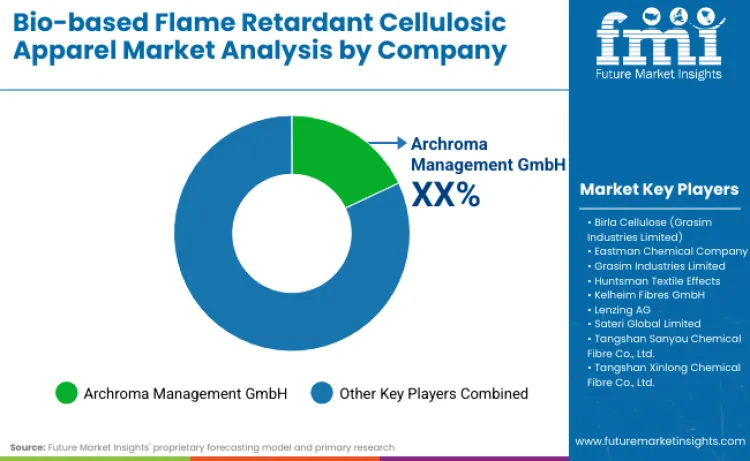
The competitive structure of the bio-based flame-retardant cellulosic fiber landscape is consolidating around scale and systems control rather than formulation novelty. Industry power is concentrating among vertically integrated producers, largely based in Asia, which can internalize forestry inputs, pulping, biorefining, and spinning within a single operating stack. This model is becoming decisive as energy costs, feedstock volatility, and regulatory scrutiny rise. Smaller or non-integrated mills are structurally disadvantaged, not because of technical shortcomings, but because they cannot absorb the cost and audit burden tied to permanent, regulation-proof flame-retardant performance.
From a technology standpoint, differentiation has shifted away from post-production chemical application toward fiber-level engineering. Buyers in safety-critical apparel and interior programs are prioritizing fibers where flame retardancy is inherent to the polymer matrix rather than delivered through finishes. Lyocell and Modal-based platforms that integrate phosphorus systems during extrusion are now treated as baseline-qualified substrates.
This change is narrowing the role of downstream chemical finishers and pulling fiber producers into earlier, specification-driven collaboration with military, aerospace, and firefighting procurement teams that require wash-durable, non-leaching compliance across the full garment lifecycle. Circularity is emerging as a secondary but increasingly decisive filter. As PFAS elimination and microplastic restrictions convert from policy intent into enforceable thresholds, competitive advantage is accruing to suppliers with secured feedstock optionality. Closed-loop systems that route agricultural residues or post-consumer textiles back into regenerated flame-retardant fibers are reshaping sourcing decisions. In this context, circular integration is less about ESG signaling and more about margin insulation, supply security, and long-term contract stability under pulp price volatility.
Key Developments
- Eastman expanded its performance cellulosics portfolio with the February 2026 launch of Naia™ Lyte at Première Vision Paris, positioning the filament platform between aesthetic and technical textile requirements. The initiative was supported through collaboration with Huafon Chemical, highlighting the role of cross-border integration in scaling advanced cellulose platforms.
- Archroma strengthened its relevance to flame-retardant-ready substrates through a late-2025 distribution agreement for the Fibre52 system, enabling lower-temperature, caustic-free pretreatment of cotton and regenerated cellulosics. The move aligns with growing demand for pretreatment technologies that preserve fiber integrity while meeting tightening water and emissions thresholds.
- Tangshan Sanyou completed spinning-level process upgrades in January 2026 to improve phosphorus dispersion consistency within regenerated fibers. The optimization responds directly to automotive interior specifications calling for tighter thermal stability tolerances ahead of 2026 program renewals.
Key Players Profiled
- Archroma Management GmbH
- Birla Cellulose (Grasim Industries Limited)
- Eastman Chemical Company
- Grasim Industries Limited
- Huntsman Textile Effects
- Kelheim Fibres GmbH
- Lenzing AG
- Sateri Global Limited
- Tangshan Sanyou Chemical Fibre Co., Ltd.
- Tangshan Xinlong Chemical Fibre Co., Ltd.
Market Definition
The bio-based flame retardant cellulosic apparel market covers the supply of renewable, cellulose-derived fibers and yarns engineered to deliver durable flame-retardant performance for regulated apparel and apparel-adjacent textile applications. This market is defined at the fiber and material supply level, capturing revenues generated by producers supplying inherently or integrally flame-retardant cellulosic fibers to textile mills, fabric manufacturers, and garment makers. Included fiber platforms span regenerated and modified cellulosics such as lyocell, modal, viscose, rayon, and selected cotton-based blends, where flame resistance is designed into the fiber or polymer structure to meet fire-safety and laundering durability requirements.
Report Inclusions
The scope of the market is anchored in qualification-led demand, where procurement decisions are shaped by regulatory acceptability, wash durability, non-leaching behavior, and long-cycle compliance with safety standards. Applications covered include workwear and protective apparel, children’s wear and sleepwear, home and institutional textiles, and selected uniform or corporate programs in which flame retardancy is mandated or tightly specified. Flame-retardant systems assessed within the market include phosphorus-based, bio-based, hybrid, nitrogen-based, and intumescent chemistries that are compatible with cellulosic substrates and industrial-scale production.
Report Exclusions
Excluded from this market are fully synthetic flame-retardant fibers such as aramids, modacrylics, and FR polyesters, as well as apparel manufacturing, branding, and retail activities downstream of fiber supply. Products dependent on temporary or surface-applied chemical flame-retardant finishes with limited durability or elevated regulatory exposure are also outside scope, as are non-apparel technical textiles and early-stage pilot innovations lacking commercial qualification. These boundaries ensure the market definition remains focused on commercially relevant, regulation-resilient bio-based flame-retardant cellulosic fibers shaping apparel supply chains over the forecast period.
Scope of Report
| Items | Values |
|---|---|
| Quantitative Units (2026) | USD 0.9 billion |
| Technology | Lyocell & Modal, Cotton & Blends, Viscose & Rayon, Others |
| End Use | Phosphorus-based Retardants, Bio-based or Hybrid Systems, Nitrogen & Intumescent Systems |
| Application | Workwear & Protection Apparel, Children’s Wear & Sleep Wear, Home & Institutional Textiles, Casual & Corporate Apparel |
| Regions Covered | North America, Western Europe, Eastern Europe, East Asia, South Asia & Pacific, Latin America, Middle East & Africa |
| Countries Covered | USA, UK, Germany, Japan, and 40+ countries |
| Key Companies Profiled | Lenzing Birla Cellulose Kelheim Fibres Sateri Tangshan Sanyou Eastman Grasim Industries Tangshan Xinlong Huntsman Textile Effects Archroma |
Source: FMI’s proprietary forecasting model and primary research
Bio-based Flame Retardant Cellulosic Apparel Market Key Segments
By Type:
- Lyocell & Modal
- Cotton & Blends
- Viscose & Rayon
- Others
By Flame Retardant System:
- Phosphorus-based Retardants
- Bio-based or Hybrid Systems
- Nitrogen & Intumescent Systems
By Application:
- Workwear & Protection Apparel
- Children’s Wear & Sleep Wear
- Home & Institutional Textiles
- Casual & Corporate Apparel
By Region:
- North America
- Western Europe
- Eastern Europe
- East Asia
- South Asia & Pacific
- Latin America
- Middle East & Africa
Bibliography
- European Chemicals Agency. (2026). Call for evidence on the restriction of aromatic brominated flame retardants under REACH. ECHA.
- German Institutes of Textile and Fiber Research Denkendorf. (2026). Phosphorus-copolymerized flame-retardant cellulose and bio-based polymer systems for durable textile applications. DITF Research Publications.
- International Organization for Standardization. (2023). ISO 6330:2023-Textiles: Domestic washing and drying procedures for textile testing. ISO.
- Lenzing AG. (2026). Annual and sustainability report 2025/26: Biorefinery integration and regenerated cellulosic fiber innovation. Lenzing Group.
- Nanollose Limited. (2026). Quarterly activities report: Scale-up readiness of microbial cellulose for lyocell integration (January 2026). Nanollose Ltd.
- USA Environmental Protection Agency. (2026). Safer Choice performance measures and Safer Chemical Ingredients List update. EPA.
Frequently Asked Questions
How big is the global bio-based flame retardant cellulosic apparel market?
The global bio-based flame retardant cellulosic apparel market is valued at USD 0.9 billion in 2026.
What is the growth outlook for the bio-based flame retardant cellulosic apparel market over the next 10 years?
The market is projected to reach USD 2.2 billion by 2036, expanding at a CAGR of 9.3% from 2026 to 2036.
Which applications or end uses drive demand for bio-based flame retardant cellulosic apparel?
Workwear and protective apparel drive demand, accounting for about 40% of revenue in 2026, supported by public-sector, industrial, and institutional safety requirements.
What are the key regional differences in the bio-based flame retardant cellulosic apparel market?
North America and Western Europe lead adoption due to tighter chemical regulations and procurement standards, while East Asia and Japan are shaped by circular economy and recycling compatibility mandates.
What are the main risks and constraints affecting this market?
High production costs, qualification intensity, and dependence on integrated supply chains limit adoption, keeping demand concentrated in compliance-driven applications
Preview the report firsthand - request a free sample
Get SampleGet the brochure for pricing and purchase details.
Get PDFTable of Content
- Executive Summary
- Market Outlook and Value Trajectory
- Qualification-led Demand Shift
- Supply-side Consolidation and Integration Trends
- Technology and Compliance Context
- Strategic Implications
- Market Overview
- Market Definition
- Market Scope and Coverage
- Inclusions and Exclusions
- Market Size Snapshot (2026) and Forecast (2036)
- Key Drivers, Restraints, and Trends
- Market Analysis and Forecast 2021 to 2036
- Historical Market Size Value (USD Billion), 2021 to 2025
- Market Forecast Value (USD Billion), 2026 to 2036
- Y-o-Y Growth Trend Analysis, 2021 to 2036
- Absolute Dollar Opportunity Analysis, 2026 to 2036
- Market Background and System Context
- Shift from Finish-dependent to Inherent FR Architectures
- Regulatory and Safety-standard Alignment
- Durability, Laundering, and Non-leaching Performance Benchmarks
- Feedstock Control and Biorefinery Integration
- Why is Bio-based Flame Retardant Cellulosic Apparel Demand Rising?
- Regulatory Contraction of Conventional Flame Retardants
- Qualification-led Procurement in Safety Apparel
- Polymer-level Integration of Flame Retardant Chemistry
- Feedstock Resilience and Circular Cellulose Pathways
- Global Market Pricing Analysis 2021 to 2036
- Pricing Assumptions and Cost Structure
- Historical Pricing Trend Analysis
- Forward Pricing Sensitivity and Outlook
- Global Market Analysis 2021 to 2025 and Forecast 2026 to 2036, By Fiber Type
- Introduction and Key Findings
- Historical Market Size Value Analysis
- Market Forecast and Opportunity Analysis
- Lyocell and Modal
- Cotton and Blends
- Viscose and Rayon
- Others
- Y-o-Y Growth Trend Analysis
- Absolute Dollar Opportunity Analysis
- Global Market Analysis 2021 to 2025 and Forecast 2026 to 2036, By Flame Retardant System
- Introduction and Key Findings
- Historical Market Size Value Analysis
- Market Forecast and Opportunity Analysis
- Phosphorus-based Retardants
- Bio-based or Hybrid Systems
- Nitrogen and Intumescent Systems
- Y-o-Y Growth Trend Analysis
- Absolute Dollar Opportunity Analysis
- Global Market Analysis 2021 to 2025 and Forecast 2026 to 2036, By Application
- Introduction and Key Findings
- Historical Market Size Value Analysis
- Market Forecast and Opportunity Analysis
- Workwear and Protective Apparel
- Children’s Wear and Sleepwear
- Home and Institutional Textiles
- Casual and Corporate Apparel
- Y-o-Y Growth Trend Analysis
- Absolute Dollar Opportunity Analysis
- Global Market Analysis 2021 to 2025 and Forecast 2026 to 2036, By Region
- Introduction
- Historical Market Size Value Analysis
- Market Forecast by Region
- North America
- Western Europe
- Eastern Europe
- East Asia
- South Asia and Pacific
- Latin America
- Middle East and Africa
- Market Attractiveness Analysis
- North America Market Analysis 2021 to 2025 and Forecast 2026 to 2036
- Historical Trend Analysis
- Market Forecast
- Key Takeaways
- Western Europe Market Analysis 2021 to 2025 and Forecast 2026 to 2036
- Historical Trend Analysis
- Market Forecast
- Key Takeaways
- Eastern Europe Market Analysis 2021 to 2025 and Forecast 2026 to 2036
- Historical Trend Analysis
- Market Forecast
- Key Takeaways
- East Asia Market Analysis 2021 to 2025 and Forecast 2026 to 2036
- Historical Trend Analysis
- Market Forecast
- Key Takeaways
- South Asia and Pacific Market Analysis 2021 to 2025 and Forecast 2026 to 2036
- Historical Trend Analysis
- Market Forecast
- Key Takeaways
- Latin America Market Analysis 2021 to 2025 and Forecast 2026 to 2036
- Historical Trend Analysis
- Market Forecast
- Key Takeaways
- Middle East and Africa Market Analysis 2021 to 2025 and Forecast 2026 to 2036
- Historical Trend Analysis
- Market Forecast
- Key Takeaways
- Country-wise Analysis
- USA
- UK
- Germany
- Japan
- Competition Outlook
- Competitive Landscape and Positioning
- Integrated Versus Non-integrated Producer Economics
- Qualification and Audit-readiness as Competitive Filters
- Recent Developments
- Company Profiles
- Lenzing AG
- Birla Cellulose
- Sateri Global
- Tangshan Sanyou Chemical Fibre
- Eastman Chemical Company
- Grasim Industries
- Huntsman Textile Effects
- Archroma Management GmbH
- Tangshan Xinlong Chemical Fibre
- Assumptions and Acronyms
- Assumptions
- Acronyms
- Research Methodology
- Chapter Orientation
- Analytical Framework
- Market Sizing and Forecasting Approach
- Validation and Data Sources
- Appendix
- Scope of Report
- Bibliography
- Frequently Asked Questions


