

- Industry Size (2026)
- USD 4.1 Bn
- Forecast (2036)
- USD 7.2 Bn
- CAGR (2026 to 2036)
- 6.1%
Low-Smoke Flame-Retardants Market Forecast and Outlook 2026 to 2036
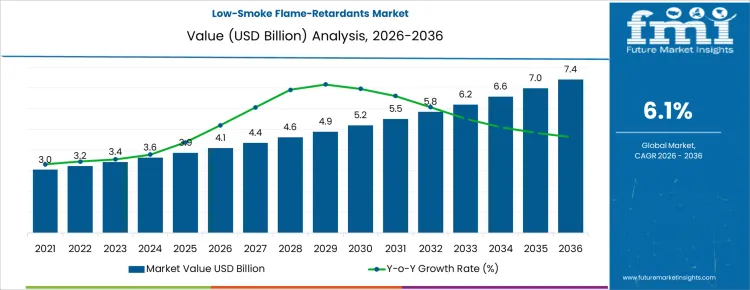
The low-smoke flame-retardants market is estimated at USD 4.1 billion in 2026 and is projected to reach USD 7.2 billion by 2036, exhibiting a CAGR of 6.1%. Initial growth from 2026 to 2031, rising from approximately USD 3.1 billion to USD 5.4 billion, is propelled by increased adoption in wire and cable LSZH compounds, construction materials, and automotive interiors. Aluminum trihydrate (ATH) and phosphorus-based flame retardants dominate chemistry preferences due to their effectiveness in smoke suppression and compliance with stringent fire-safety regulations across residential, commercial, and industrial infrastructure.
From 2031 to 2036, market expansion from roughly USD 5.6 billion to USD 7.2 billion is influenced by rising global safety standards, electrification of transportation, and demand for low-smoke materials in electronics and building applications. Growth is further supported by innovations in nitrogen/intumescent systems and synergistic formulations that enhance thermal stability and reduce toxic emissions. Manufacturers focusing on masterbatch and powder solutions compatible with varied polymer matrices are expected to maintain steady adoption, ensuring long-term market value accumulation.
Quick Stats of the Low-Smoke Flame-Retardants Market:
- Low-Smoke Flame-Retardants Market Value (2026): USD 4.1 billion
- Low-Smoke Flame-Retardants Market Forecast Value (2036): USD 7.2 billion
- Low-Smoke Flame-Retardants Market Forecast CAGR (2026 to 2036): 6.1%
- Leading Chemistry in the Market: ATH (aluminum trihydrate) (34%)
- Key Growth Regions in the Market: China, Brazil, USA, Germany, UK
- Top Players in the Market: Clariant, Albemarle, ICL Group, LANXESS, Nabaltec, Huber Engineered Materials, Italmatch Chemicals, BASF, RTP Company, J.M. Huber Corporation
What is the Growth Forecast for the Low-Smoke Flame-Retardants Market through 2036?
From 2026 to 2031, the low-smoke flame-retardants market grows from USD 4.1 billion to approximately USD 5.4 billion, reflecting early adoption driven by rising fire-safety regulations and health-conscious construction standards. Annual value additions increase progressively from USD 0.2 billion in 2026 to USD 0.4 billion in 2031. Growth is concentrated in electronics (around 35% of total consumption), transportation interiors (25%), and building materials (20%), with the remaining 20% split across industrial machinery, textiles, and packaging. Year-on-year adoption rates accelerate as product formulation improves, toxic smoke reduction is validated, and compliance trials expand across multi-site industrial applications.
Between 2031 and 2036, the market expands from roughly USD 5.4 billion to USD 7.2 billion, reflecting an accelerated late-stage growth trajectory. Annual increments rise from USD 0.4 billion to USD 0.5 billion, with adoption extending into mass-market building projects, automotive components, and high-volume consumer electronics. By 2036, electronics and transportation together account for over 60% of market value, while industrial machinery, textiles, and packaging contribute 15 to 20% collectively. Growth is reinforced by repeat procurement, broader regulatory enforcement across North America, Europe, and Asia Pacific, and portfolio-wide adoption of low-smoke flame-retardants, indicating structural embedding rather than selective project-based usage.
Low Smoke Flame Retardants Market Key Takeaways
| Metric | Value |
|---|---|
| Market Value (2026) | USD 4.1 billion |
| Forecast Value (2036) | USD 7.2 billion |
| Forecast CAGR (2026 to 2036) | 6.1% |
Why Is Smoke Suppression Reshaping Flame Retardant Selection Across Industries?
Early use of low smoke flame retardants was driven by operational lessons rather than broad material shifts. Fire incidents in enclosed spaces showed that smoke inhalation, not flame spread, caused most injuries and fatalities. Traditional flame retardants slowed ignition but produced dense smoke that impaired evacuation and emergency response. Rail operators, tunnel designers, and aircraft interior suppliers began specifying materials that limited smoke generation under fire conditions. Historical demand developed unevenly, tied to incident investigations, revised safety codes, and procurement rules in confined environments. Adoption remained narrow because low smoke formulations often required material redesign and higher cost, limiting use outside regulated applications.
Future demand reflects a change in how fire risk is evaluated. Safety standards increasingly measure smoke density, toxicity, and visibility alongside ignition resistance. Material performance is assessed under defined fire scenarios rather than generic flammability tests. Low smoke flame retardants are now selected early in product design to meet certification thresholds. Demand growth will follow enforcement of performance based fire codes and expansion of mass transit, data centres, and high occupancy buildings. Unlike earlier adoption driven by response to specific hazards, future use is embedded in design rules, material qualification processes, and liability management across sectors.
What Factors Are Affecting the Demand for Low Smoke Flame Retardants Market in Terms of Chemistry and Application?
Demand for low smoke flame retardants is segmented by chemistry and application across safety critical polymer and material systems. ATH aluminum trihydrate accounts for about 34% of total demand, making it the leading chemistry. MDH magnesium hydroxide, phosphorus based flame retardants, nitrogen intumescent systems, and smoke suppressants represent additional chemistries without disclosed share splits. These materials differ in decomposition temperature, smoke suppression efficiency, and loading requirements. Application segmentation reflects fire safety standards and smoke toxicity limits. Wire and cable LSZH compounds account for about 42% of demand, followed by construction materials, transportation interiors, electrical housings, and furniture textiles. Together, these segments explain demand formation shaped by regulatory fire performance requirements rather than material substitution cycles.
What Drives Demand by Chemistry in the Low Smoke Flame Retardants Market?
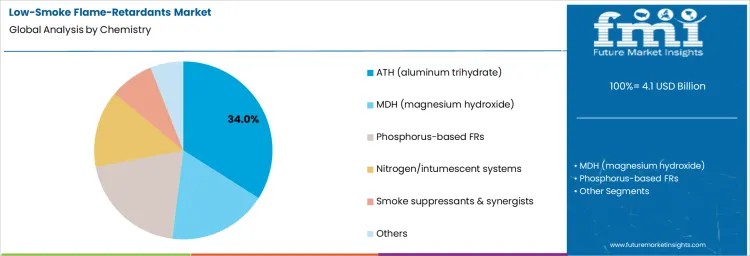
ATH aluminum trihydrate leads demand with a 34% share due to effective smoke suppression and halogen free performance. ATH decomposes endothermically, releasing water that cools substrates and dilutes combustion gases. MDH magnesium hydroxide is adopted where higher processing temperatures are required. Phosphorus based flame retardants are used where lower loadings and char formation are prioritized. Nitrogen based intumescent systems provide expansion and insulation during fire exposure. Smoke suppressants and synergists enhance performance in blended formulations. Chemistry selection reflects balance between processing constraints and fire performance targets. Demand therefore aligns with proven behavior under standardized fire testing rather than material novelty.
Chemistry driven demand remains stable because flame retardant systems are specified through certification testing. ATH based systems are embedded in LSZH compound formulations. MDH and phosphorus systems are applied where temperature or mechanical limits apply. Intumescent systems scale selectively in construction and transport. Synergists are used to fine tune performance. These patterns limit rapid substitution. Chemistry segmentation highlights reliance on predictable fire response. Demand therefore follows regulatory compliance frameworks rather than short term material cost shifts.
How Does Application Shape Demand for Low Smoke Flame Retardants Market?
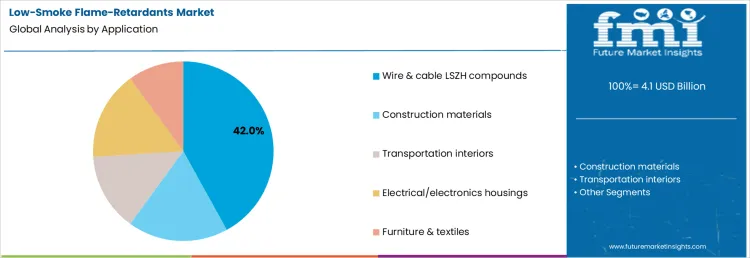
Wire and cable LSZH compounds account for about 42% of total demand, making this the leading application. These systems require low smoke density and low toxicity during fire events. Construction materials adopt low smoke flame retardants to meet building codes and evacuation safety criteria. Transportation interiors apply these materials to limit smoke spread in enclosed environments. Electrical and electronics housings rely on flame retardants to reduce ignition risk and smoke generation. Furniture and textile applications adopt selectively based on regional regulations. Application driven demand reflects exposure risk and occupant safety requirements rather than production volume alone.
Wire and cable applications maintain leadership due to stringent LSZH standards. Construction materials apply additives based on building classification. Transportation interiors require consistent fire performance across materials. Electronics housings adopt where enclosure density increases risk. Furniture and textiles scale based on local codes. Manufacturers avoid altering formulations once certified. This stabilizes demand distribution. Application segmentation therefore reinforces concentration in safety regulated uses with defined fire testing requirements.
How Are Low Smoke Flame Retardants Being Applied Across Construction, Electrical, and Consumer Products?
Use appears in materials where fire safety and reduced toxic smoke generation are critical. Cable and wire manufacturers incorporate low smoke flame retardants into polymer sheathing to limit smoke density during combustion. Building materials, including insulation panels and composite laminates, use them to meet fire safety codes while improving occupant safety. Consumer electronics and appliance housings integrate low smoke additives to protect users and reduce hazardous emissions in case of fire. These applications reflect operational and safety priorities rather than aesthetic or branding considerations, with adoption driven by regulatory compliance and life safety requirements.
What Operational and Material Conditions Support Adoption of Low Smoke Flame Retardants?
Selection aligns with polymer systems where thermal stability, mechanical performance, and processing conditions must be maintained. Engineers optimize additive concentration to achieve flame retardancy and low smoke emission without compromising tensile strength, flexibility, or melt flow. Production lines rely on uniform dispersion to prevent defects or localized degradation. Compliance with regional fire safety standards and testing protocols drives material choice and formulation. These conditions emerge from operational reliability, regulatory adherence, and safety performance priorities in structured manufacturing workflows.
Which Practical Considerations Limit Wider Use of Low Smoke Flame Retardants?
Cost per unit can be higher than conventional flame retardants, affecting adoption in commodity applications. Compatibility with different polymer matrices and fillers must be verified to prevent processing issues. Some additives may alter color, transparency, or surface finish. Long-term thermal stability and leaching behavior require validation. Regulatory certification processes vary by region, adding approval complexity. These factors result in selective deployment where fire safety, low smoke emission, and regulatory compliance justify incremental cost and formulation control.
What is the Demand for Low Smoke Flame Retardants by Country?
| Country | CAGR (%) |
|---|---|
| USA | 5.9% |
| Germany | 5.6% |
| China | 7.1% |
| UK | 5.5% |
| Brazil | 6.8% |
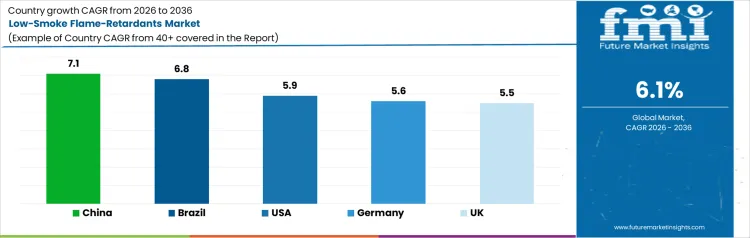
The demand for low smoke flame retardants varies across countries, driven by fire safety regulations, construction standards, and adoption in electrical and building materials. China leads with a 7.1% CAGR, supported by rapid infrastructure development, urbanization, and regulatory focus on fire safety. Brazil follows at 6.8%, driven by growth in construction, transportation, and industrial applications requiring low smoke solutions. The USA grows at 5.9%, reflecting steady adoption in commercial and residential construction, as well as electronics. Germany records 5.6%, shaped by strict fire safety regulations and mature industrial standards. The UK posts 5.5%, supported by compliance with building codes and stable use across industrial sectors.
How Is Fire Safety Driving Growth in the United States?
In the United States, revenue from the Low-Smoke Flame-Retardants Market is expanding at a CAGR of 5.9% through 2035, driven by adoption of chemical additives to reduce flammability and smoke generation in plastics, textiles, and construction materials. Manufacturers are integrating low-smoke flame-retardants into building materials, electrical components, and consumer products to meet safety regulations and improve fire performance. Demand is concentrated in construction, electronics, and industrial applications. Domestic suppliers provide high-performance retardants compatible with polymer processing and textile finishing. Regulatory compliance, safety standards, and recurring material production are sustaining predictable procurement nationwide.
- Construction, electronics, and industrial applications drive adoption of low-smoke flame-retardants
- Additives reduce flammability and smoke generation
- Domestic suppliers provide high-performance, polymer- and textile-compatible retardants
- Recurring material production sustains predictable procurement
How Are Safety Standards Supporting Growth in Germany?
Germany continues to record steady growth in the Low-Smoke Flame-Retardants Market at a CAGR of 5.6% through 2035, supported by stringent fire safety regulations in construction and electrical industries. Manufacturers are integrating low-smoke flame-retardants into plastics, insulation materials, and textiles to comply with national and EU standards. Demand is concentrated in industrial production, building construction, and consumer electronics. Domestic suppliers provide high-quality retardants compatible with polymers, coatings, and textile finishing processes. Compliance-driven procurement and stable production volumes are sustaining measured adoption nationwide.
- Fire safety regulations drive adoption of low-smoke flame-retardants
- Plastics, insulation materials, and textiles anchor demand
- Domestic suppliers provide polymer- and textile-compatible retardants
- Compliance and stable production sustain steady adoption
How Is Industrial Material Expansion Accelerating Adoption in China?
In China, revenue from the Low-Smoke Flame-Retardants Market is growing at a CAGR of 7.1% through 2035, driven by expansion of construction, electrical, and industrial material manufacturing. Manufacturers are integrating low-smoke flame-retardants into building materials, cables, plastics, and textiles to meet fire safety standards. Demand is strong across infrastructure, industrial production, and consumer goods applications. Domestic suppliers are scaling production of high-performance retardants compatible with polymer and textile processing. High production volumes and structured procurement practices are sustaining rapid adoption nationwide.
- Construction, electrical, and industrial materials drive low-smoke flame-retardant adoption
- Additives improve fire safety and reduce smoke generation
- Domestic suppliers scale production of polymer- and textile-compatible retardants
- High production volumes sustain consistent adoption
How Is Fire Safety Compliance Supporting Growth in the United Kingdom?
In the United Kingdom, revenue from the Low-Smoke Flame-Retardants Market is expanding at a CAGR of 5.5% through 2035, supported by fire safety regulations and building code requirements. Manufacturers are adopting low-smoke flame-retardants in plastics, textiles, and insulation materials to enhance safety in residential and commercial applications. Demand is concentrated in construction, industrial manufacturing, and consumer goods sectors. Domestic suppliers provide retardants engineered for compatibility with polymer processing and textile finishing. Regulatory compliance, safety standards, and recurring material production are sustaining predictable procurement nationwide.
- Plastics, textiles, and insulation materials anchor demand for low-smoke flame-retardants
- Additives enhance fire safety and reduce smoke generation
- Domestic suppliers provide polymer- and textile-compatible retardants
- Recurring material production sustains predictable procurement
How Is Construction and Industrial Material Growth Supporting Adoption in Brazil?
Brazil is seeing strong growth in the Low-Smoke Flame-Retardants Market at a CAGR of 6.8% through 2035, supported by increasing construction activity, industrial material manufacturing, and fire safety awareness. Manufacturers are integrating low-smoke flame-retardants into plastics, textiles, and insulation materials to meet safety requirements and reduce fire hazards. Demand is concentrated in infrastructure, industrial, and consumer goods applications. Domestic suppliers are expanding production of high-performance retardants compatible with polymer processing and textile finishing. Growth in construction and industrial material production, along with recurring safety-driven applications, is sustaining robust procurement nationwide.
- Construction, industrial, and consumer goods applications drive low-smoke flame-retardant adoption
- Additives enhance fire safety and reduce smoke output
- Domestic suppliers expand production of polymer- and textile-compatible retardants
- Recurring safety-driven applications sustain robust procurement
Which Companies Are Shaping Competition in The Low Smoke Flame Retardants Market Across Polymer and Cable Applications?
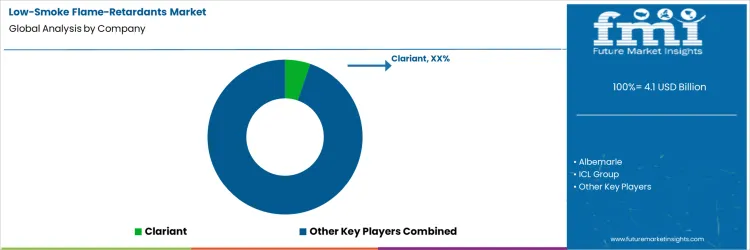
Competition in the Low Smoke Flame Retardants Market is driven by specialty material suppliers focused on halogen free and reduced emission formulations. Clariant, Albemarle, and ICL Group play a central role through aluminum and magnesium based flame retardant systems used in wire and cable, construction materials, and transportation interiors. LANXESS and BASF contribute through polymer additives and synergist chemistries integrated into engineering plastics and compounds. Nabaltec and J.M. Huber Corporation hold strong positions in mineral flame retardants supplied to compounders seeking smoke suppression and thermal stability. Competitive positioning reflects formulation consistency, processing compatibility, and performance under fire testing standards rather than breadth of application claims.
Mid-sized specialists and compound focused suppliers add depth to market dynamics. Huber Engineered Materials supports demand through refined mineral technologies tailored for low smoke performance. Italmatch Chemicals contributes phosphorus based additives used in selected polymer systems requiring controlled combustion behavior. RTP Company participates through compounded materials incorporating low smoke flame retardant packages rather than standalone additives. Local compounders and regional distributors influence adoption by aligning formulations with customer processing conditions and regulatory frameworks. Competition centers on dispersion quality, impact on mechanical properties, and reliability across production runs. Market entry is shaped by testing requirements, customer qualification cycles, and alignment with end use fire safety standards rather than rapid formulation turnover.
Key Players in the Low Smoke Flame Retardants Market
- Clariant
- Albemarle
- ICL Group
- LANXESS
- Nabaltec
- Huber Engineered Materials
- Italmatch Chemicals
- BASF
- RTP Company
- J.M. Huber Corporation
Scope of the Report
| Items | Values |
|---|---|
| Quantitative Units (2026) | USD billion |
| Chemistry | ATH (aluminum trihydrate); MDH (magnesium hydroxide); Phosphorus-based FRs; Nitrogen/intumescent systems; Smoke suppressants & synergists; Others |
| Application | Wire & cable LSZH compounds; Construction materials; Transportation interiors; Electrical/electronic housings; Furniture & textiles |
| Form | Powder; Granules; Masterbatch; Liquid dispersions |
| End-Use Industry | Building & construction; Power & telecom cables; Automotive & rail; Electronics; Others |
| Region | Asia Pacific; Europe; North America; Latin America; Middle East & Africa |
| Countries Covered | China; Japan; South Korea; India; Australia & New Zealand; ASEAN; Germany; United Kingdom; France; Italy; Spain; Nordic; BENELUX; United States; Canada; Mexico; Brazil; Chile; Kingdom of Saudi Arabia; Other GCC Countries; Turkey; South Africa; Other African Union; Rest of Asia Pacific; Rest of Europe; Rest of Latin America; Rest of Middle East & Africa |
| Key Companies Profiled | Clariant; Albemarle; ICL Group; LANXESS; Nabaltec; Huber Engineered Materials; Italmatch Chemicals; BASF; RTP Company; J.M. Huber Corporation |
| Additional Attributes | Dollar by sales across chemistry, application, and end-use industries; ATH and phosphorus-based systems lead demand due to smoke suppression efficiency; Wire & cable LSZH compounds account for the largest application share; Masterbatch and powder forms dominate supply due to ease of integration; Adoption is influenced by fire safety regulations, LSZH standards, and occupant safety requirements; Industrial, construction, and transportation applications anchor demand; Regulatory compliance, testing certification, and repeat procurement sustain steady adoption; Growth is supported by electrification, infrastructure expansion, and stricter fire safety standards; Domestic and regional suppliers provide polymer- and textile-compatible retardants; Adoption reflects structural embedding into industrial formulations rather than project-specific use. |
Low Smoke Flame Retardants Market Segmentation
Chemistry:
- ATH (aluminum trihydrate)
- MDH (magnesium hydroxide)
- Phosphorus-based FRs
- Nitrogen/intumescent systems
- Smoke suppressants & synergists
- Others
Application:
- Wire & cable LSZH compounds
- Construction materials
- Transportation interiors
- Electrical/electronic housings
- Furniture & textiles
Form:
- Powder
- Granules
- Masterbatch
- Liquid dispersions
End-Use Industry:
- Building & construction
- Power & telecom cables
- Automotive & rail
- Electronics
- Others
Region
- Asia Pacific
- China
- Japan
- South Korea
- India
- Australia & New Zealand
- ASEAN
- Rest of Asia Pacific
- Europe
- Germany
- United Kingdom
- France
- Italy
- Spain
- Nordic
- BENELUX
- Rest of Europe
- North America
- United States
- Canada
- Mexico
- Latin America
- Brazil
- Chile
- Rest of Latin America
- Middle East & Africa
- Kingdom of Saudi Arabia
- Other GCC Countries
- Turkey
- South Africa
- Other African Union
- Rest of Middle East & Africa
Frequently Asked Questions
How big is the low-smoke flame-retardants market in 2026?
The global low-smoke flame-retardants market is estimated to be valued at USD 4.1 billion in 2026.
What will be the size of low-smoke flame-retardants market in 2036?
The market size for the low-smoke flame-retardants market is projected to reach USD 7.4 billion by 2036.
How much will be the low-smoke flame-retardants market growth between 2026 and 2036?
The low-smoke flame-retardants market is expected to grow at a 6.1% CAGR between 2026 and 2036.
What are the key product types in the low-smoke flame-retardants market?
The key product types in low-smoke flame-retardants market are ath (aluminum trihydrate), mdh (magnesium hydroxide), phosphorus-based frs, nitrogen/intumescent systems, smoke suppressants & synergists and others.
Which application segment to contribute significant share in the low-smoke flame-retardants market in 2026?
In terms of application, wire & cable lszh compounds segment to command 42.0% share in the low-smoke flame-retardants market in 2026.
Preview the report firsthand - request a free sample
Get SampleGet the brochure for pricing and purchase details.
Get PDFTable of Content
- Executive Summary
- Global Market Outlook
- Demand-side Trends
- Supply-side Trends
- Technology Roadmap Analysis
- Analysis and Recommendations
- Market Overview
- Market Coverage / Taxonomy
- Market Definition / Scope / Limitations
- Market Background
- Market Dynamics
- Drivers
- Restraints
- Opportunity
- Trends
- Scenario Forecast
- Demand in Optimistic Scenario
- Demand in Likely Scenario
- Demand in Conservative Scenario
- Opportunity Map Analysis
- Product Life Cycle Analysis
- Supply Chain Analysis
- Investment Feasibility Matrix
- Value Chain Analysis
- PESTLE and Porter’s Analysis
- Regulatory Landscape
- Regional Parent Market Outlook
- Production and Consumption Statistics
- Import and Export Statistics
- Market Dynamics
- Global Market Analysis 2021 to 2025 and Forecast, 2026 to 2036
- Historical Market Size Value (USD Million) Analysis, 2021 to 2025
- Current and Future Market Size Value (USD Million) Projections, 2026 to 2036
- Y-o-Y Growth Trend Analysis
- Absolute $ Opportunity Analysis
- Global Market Pricing Analysis 2021 to 2025 and Forecast 2026 to 2036
- Global Market Analysis 2021 to 2025 and Forecast 2026 to 2036, By Chemistry
- Introduction / Key Findings
- Historical Market Size Value (USD Million) Analysis By Chemistry , 2021 to 2025
- Current and Future Market Size Value (USD Million) Analysis and Forecast By Chemistry , 2026 to 2036
- ATH (aluminum trihydrate)
- MDH (magnesium hydroxide)
- Phosphorus-based FRs
- Nitrogen/intumescent systems
- Smoke suppressants & synergists
- Others
- Y-o-Y Growth Trend Analysis By Chemistry , 2021 to 2025
- Absolute $ Opportunity Analysis By Chemistry , 2026 to 2036
- Global Market Analysis 2021 to 2025 and Forecast 2026 to 2036, By Application
- Introduction / Key Findings
- Historical Market Size Value (USD Million) Analysis By Application, 2021 to 2025
- Current and Future Market Size Value (USD Million) Analysis and Forecast By Application, 2026 to 2036
- Wire & cable LSZH compounds
- Construction materials
- Transportation interiors
- Electrical/electronics housings
- Furniture & textiles
- Y-o-Y Growth Trend Analysis By Application, 2021 to 2025
- Absolute $ Opportunity Analysis By Application, 2026 to 2036
- Global Market Analysis 2021 to 2025 and Forecast 2026 to 2036, By Form
- Introduction / Key Findings
- Historical Market Size Value (USD Million) Analysis By Form, 2021 to 2025
- Current and Future Market Size Value (USD Million) Analysis and Forecast By Form, 2026 to 2036
- Powder
- Granules
- Masterbatch
- Liquid dispersions
- Y-o-Y Growth Trend Analysis By Form, 2021 to 2025
- Absolute $ Opportunity Analysis By Form, 2026 to 2036
- Global Market Analysis 2021 to 2025 and Forecast 2026 to 2036, By End-Use Industry
- Introduction / Key Findings
- Historical Market Size Value (USD Million) Analysis By End-Use Industry, 2021 to 2025
- Current and Future Market Size Value (USD Million) Analysis and Forecast By End-Use Industry, 2026 to 2036
- Building & construction
- Power & telecom cables
- Automotive & rail
- Electronics
- Others
- Y-o-Y Growth Trend Analysis By End-Use Industry, 2021 to 2025
- Absolute $ Opportunity Analysis By End-Use Industry, 2026 to 2036
- Global Market Analysis 2021 to 2025 and Forecast 2026 to 2036, By Region
- Introduction
- Historical Market Size Value (USD Million) Analysis By Region, 2021 to 2025
- Current Market Size Value (USD Million) Analysis and Forecast By Region, 2026 to 2036
- North America
- Latin America
- Western Europe
- Eastern Europe
- East Asia
- South Asia and Pacific
- Middle East & Africa
- Market Attractiveness Analysis By Region
- North America Market Analysis 2021 to 2025 and Forecast 2026 to 2036, By Country
- Historical Market Size Value (USD Million) Trend Analysis By Market Taxonomy, 2021 to 2025
- Market Size Value (USD Million) Forecast By Market Taxonomy, 2026 to 2036
- By Country
- USA
- Canada
- Mexico
- By Chemistry
- By Application
- By Form
- By End-Use Industry
- By Country
- Market Attractiveness Analysis
- By Country
- By Chemistry
- By Application
- By Form
- By End-Use Industry
- Key Takeaways
- Latin America Market Analysis 2021 to 2025 and Forecast 2026 to 2036, By Country
- Historical Market Size Value (USD Million) Trend Analysis By Market Taxonomy, 2021 to 2025
- Market Size Value (USD Million) Forecast By Market Taxonomy, 2026 to 2036
- By Country
- Brazil
- Chile
- Rest of Latin America
- By Chemistry
- By Application
- By Form
- By End-Use Industry
- By Country
- Market Attractiveness Analysis
- By Country
- By Chemistry
- By Application
- By Form
- By End-Use Industry
- Key Takeaways
- Western Europe Market Analysis 2021 to 2025 and Forecast 2026 to 2036, By Country
- Historical Market Size Value (USD Million) Trend Analysis By Market Taxonomy, 2021 to 2025
- Market Size Value (USD Million) Forecast By Market Taxonomy, 2026 to 2036
- By Country
- Germany
- UK
- Italy
- Spain
- France
- Nordic
- BENELUX
- Rest of Western Europe
- By Chemistry
- By Application
- By Form
- By End-Use Industry
- By Country
- Market Attractiveness Analysis
- By Country
- By Chemistry
- By Application
- By Form
- By End-Use Industry
- Key Takeaways
- Eastern Europe Market Analysis 2021 to 2025 and Forecast 2026 to 2036, By Country
- Historical Market Size Value (USD Million) Trend Analysis By Market Taxonomy, 2021 to 2025
- Market Size Value (USD Million) Forecast By Market Taxonomy, 2026 to 2036
- By Country
- Russia
- Poland
- Hungary
- Balkan & Baltic
- Rest of Eastern Europe
- By Chemistry
- By Application
- By Form
- By End-Use Industry
- By Country
- Market Attractiveness Analysis
- By Country
- By Chemistry
- By Application
- By Form
- By End-Use Industry
- Key Takeaways
- East Asia Market Analysis 2021 to 2025 and Forecast 2026 to 2036, By Country
- Historical Market Size Value (USD Million) Trend Analysis By Market Taxonomy, 2021 to 2025
- Market Size Value (USD Million) Forecast By Market Taxonomy, 2026 to 2036
- By Country
- China
- Japan
- South Korea
- By Chemistry
- By Application
- By Form
- By End-Use Industry
- By Country
- Market Attractiveness Analysis
- By Country
- By Chemistry
- By Application
- By Form
- By End-Use Industry
- Key Takeaways
- South Asia and Pacific Market Analysis 2021 to 2025 and Forecast 2026 to 2036, By Country
- Historical Market Size Value (USD Million) Trend Analysis By Market Taxonomy, 2021 to 2025
- Market Size Value (USD Million) Forecast By Market Taxonomy, 2026 to 2036
- By Country
- India
- ASEAN
- Australia & New Zealand
- Rest of South Asia and Pacific
- By Chemistry
- By Application
- By Form
- By End-Use Industry
- By Country
- Market Attractiveness Analysis
- By Country
- By Chemistry
- By Application
- By Form
- By End-Use Industry
- Key Takeaways
- Middle East & Africa Market Analysis 2021 to 2025 and Forecast 2026 to 2036, By Country
- Historical Market Size Value (USD Million) Trend Analysis By Market Taxonomy, 2021 to 2025
- Market Size Value (USD Million) Forecast By Market Taxonomy, 2026 to 2036
- By Country
- Kingdom of Saudi Arabia
- Other GCC Countries
- Turkiye
- South Africa
- Other African Union
- Rest of Middle East & Africa
- By Chemistry
- By Application
- By Form
- By End-Use Industry
- By Country
- Market Attractiveness Analysis
- By Country
- By Chemistry
- By Application
- By Form
- By End-Use Industry
- Key Takeaways
- Key Countries Market Analysis
- USA
- Pricing Analysis
- Market Share Analysis, 2025
- By Chemistry
- By Application
- By Form
- By End-Use Industry
- Canada
- Pricing Analysis
- Market Share Analysis, 2025
- By Chemistry
- By Application
- By Form
- By End-Use Industry
- Mexico
- Pricing Analysis
- Market Share Analysis, 2025
- By Chemistry
- By Application
- By Form
- By End-Use Industry
- Brazil
- Pricing Analysis
- Market Share Analysis, 2025
- By Chemistry
- By Application
- By Form
- By End-Use Industry
- Chile
- Pricing Analysis
- Market Share Analysis, 2025
- By Chemistry
- By Application
- By Form
- By End-Use Industry
- Germany
- Pricing Analysis
- Market Share Analysis, 2025
- By Chemistry
- By Application
- By Form
- By End-Use Industry
- UK
- Pricing Analysis
- Market Share Analysis, 2025
- By Chemistry
- By Application
- By Form
- By End-Use Industry
- Italy
- Pricing Analysis
- Market Share Analysis, 2025
- By Chemistry
- By Application
- By Form
- By End-Use Industry
- Spain
- Pricing Analysis
- Market Share Analysis, 2025
- By Chemistry
- By Application
- By Form
- By End-Use Industry
- France
- Pricing Analysis
- Market Share Analysis, 2025
- By Chemistry
- By Application
- By Form
- By End-Use Industry
- India
- Pricing Analysis
- Market Share Analysis, 2025
- By Chemistry
- By Application
- By Form
- By End-Use Industry
- ASEAN
- Pricing Analysis
- Market Share Analysis, 2025
- By Chemistry
- By Application
- By Form
- By End-Use Industry
- Australia & New Zealand
- Pricing Analysis
- Market Share Analysis, 2025
- By Chemistry
- By Application
- By Form
- By End-Use Industry
- China
- Pricing Analysis
- Market Share Analysis, 2025
- By Chemistry
- By Application
- By Form
- By End-Use Industry
- Japan
- Pricing Analysis
- Market Share Analysis, 2025
- By Chemistry
- By Application
- By Form
- By End-Use Industry
- South Korea
- Pricing Analysis
- Market Share Analysis, 2025
- By Chemistry
- By Application
- By Form
- By End-Use Industry
- Russia
- Pricing Analysis
- Market Share Analysis, 2025
- By Chemistry
- By Application
- By Form
- By End-Use Industry
- Poland
- Pricing Analysis
- Market Share Analysis, 2025
- By Chemistry
- By Application
- By Form
- By End-Use Industry
- Hungary
- Pricing Analysis
- Market Share Analysis, 2025
- By Chemistry
- By Application
- By Form
- By End-Use Industry
- Kingdom of Saudi Arabia
- Pricing Analysis
- Market Share Analysis, 2025
- By Chemistry
- By Application
- By Form
- By End-Use Industry
- Turkiye
- Pricing Analysis
- Market Share Analysis, 2025
- By Chemistry
- By Application
- By Form
- By End-Use Industry
- South Africa
- Pricing Analysis
- Market Share Analysis, 2025
- By Chemistry
- By Application
- By Form
- By End-Use Industry
- USA
- Market Structure Analysis
- Competition Dashboard
- Competition Benchmarking
- Market Share Analysis of Top Players
- By Regional
- By Chemistry
- By Application
- By Form
- By End-Use Industry
- Competition Analysis
- Competition Deep Dive
- Clariant
- Overview
- Product Portfolio
- Profitability by Market Segments (Product/Age /Sales Channel/Region)
- Sales Footprint
- Strategy Overview
- Marketing Strategy
- Product Strategy
- Channel Strategy
- Albemarle
- ICL Group
- LANXESS
- Nabaltec
- Huber Engineered Materials
- Italmatch Chemicals
- BASF
- RTP Company
- J.M. Huber Corporation
- Clariant
- Competition Deep Dive
- Assumptions & Acronyms Used
- Research Methodology


