

- Market Size (2026)
- USD 5.1 Bn
- Forecast (2036)
- USD 10.1 Bn
- CAGR (2026 to 2036)
- 7.1%
Biobased Adhesive and Fixing Accessory Solutions Market Size, Market Forecast and Outlook By FMI
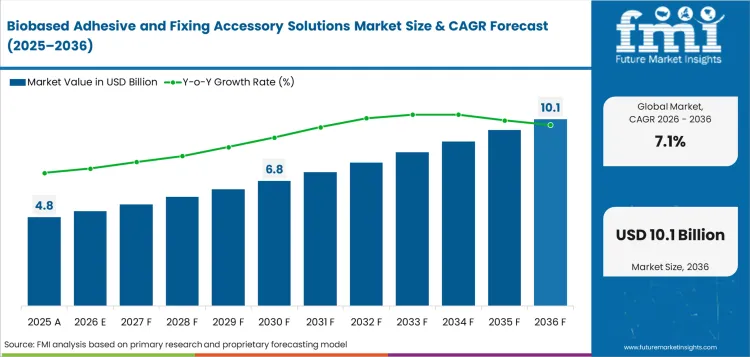
The biobased adhesive and fixing accessory solutions market size stood at USD 4.8 billion in 2025. Industry revenue is anticipated to scale to USD 5.1 billion in 2026 and forecast to rise to USD 10.1 billion by 2036 at 7.1% CAGR. Direct supply is expected to represent 44.3% share of sales channel in 2026. Liquid adhesives are projected to garner 39.4% share of fixing format in 2026.
Summary of Biobased Adhesive and Fixing Accessory Solutions Market
- Demand and Growth Drivers
- Packaging converters are shifting toward bio based tackifier resins led by paper and board lines demand renewable bond performance.
- Construction users are asking for low-emission fixing systems since product disclosure rules become part of tender checks.
- Woodworking and furniture plants favor water-based systems reducing odor and simplify indoor air quality claims.
- Product and Segment View
- Direct supply is expected to secure 44.3% share in 2026, reflecting large converters needing plant trials and formulation records.
- Liquid adhesives are projected to garner 39.4% share in 2026 due to easier dosing in packaging and wood lines.
- Packaging is forecast to account for 36.2% share in 2026, led by converters qualifying renewable packaging tapes and labels.
- Geography and Competitive Outlook
- China is projected to record 8.6% CAGR by 2036 as packaging output and industrial construction keep reformulation activity active.
- India is expected to expand at 8.2% CAGR by 2036 with construction activity and local packaging production raising adhesive use.
- Henkel AG & Co. KGaA and H.B. Fuller Company anchor supply through renewable hot melt adhesives and certified production routes.
- Analyst Opinion
- Nikhil Kaitwade, Principal Consultant for Chemicals and Materials at FMI, opines, "Biobased adhesive and fixing accessory solutions are moving from small green product lines into audited supply programs. Buyers value more than just plant-based content. Proof of reliable renewable bonding is as important as basic sustainability claims."
- Biobased Adhesive and Fixing Accessory Solutions Market Value Analysis
- Market value is influenced by adhesives and sealants volume used in packaging conversion and construction fixing work.
- Supplier pricing reflects renewable feedstock cost and certification systems proving biobased input claims.
- Replacement value expands as solvent-based products lose fit with indoor air and recycling requirements.
- Premium demand comes from pressure sensitive adhesives used in labels and specialty tapes.
Key Takeaways, Market Size, and Forecast
- The biobased adhesive and fixing accessory solutions market was valued at USD 4.8 billion in 2025.
- Industry value is expected to reach USD 10.1 billion by 2036 as packaging converters shift adhesive specifications toward verified renewable content.
- From 2026 to 2036, the sector is projected to expand at 7.1% CAGR.
- Industry revenue is forecast to create incremental opportunity of USD 5.0 billion from 2026 to 2036.
- Direct supply is poised to secure 44.3% share of sales channel in 2026.
- Liquid adhesives are likely to garner 39.4% share of fixing format in 2026.
- Country-level outlook points to China at 8.6% CAGR followed by India at 8.2% CAGR by 2036.
Adhesive buyers are focusing on verified renewable carbon content and recycling performance when choosing suppliers. In February 2024, ASTM International revised ASTM D6866 for measuring biobased or biogenic carbon content across solid and liquid samples. Formulators gain a stronger basis for renewable content claims during catalog approval and tenders. In August 2024, tesa launched tesa 64295 with over 75% bio-based material and 71.7% recyclability under PTS-RH 021:2012.
Tape suppliers can use such proof to support carton sealing programs where paper recovery performance affects brand approval. In September 2025, RecyClass approved Avery Dennison CleanFlake S7400ER as fully compatible with PET bottle recycling at 10 gsm coating weight. Label adhesive suppliers will need residue-control evidence as brand owners move away from generic wash-off claims.
Biobased Adhesive and Fixing Accessory Solutions Market Definition
Biobased adhesive and fixing accessory solutions are bonding materials and related fixing formats using renewable carbon from starch derivatives and soy. Rosin, lignin and plant oils form other input routes. Scope includes adhesives used in packaging and wood assembly. Construction fixing forms another counted use. Scope covers adhesive modifier inputs when renewable content shapes final bond behavior. Revenue includes finished adhesives and fixing accessories supplied for commercial use.
Biobased Adhesive and Fixing Accessory Solutions Market Inclusions
Scope includes starch adhesives and soy adhesives supplied as liquid or hot melt systems. Scope includes rosin and lignin grades used in packaging bonding and wood assembly. Fixing accessories include adhesive tapes, sealant strips and clips sold with renewable bonding systems. Construction fixing products are included when renewable adhesive chemistry forms the core value. Certified low-emission products and biopolymers are counted when they form the renewable bond layer inside finished adhesive systems.
Biobased Adhesive and Fixing Accessory Solutions Market Exclusions
Scope excludes conventional petrochemical adhesives with no declared renewable carbon input. Mechanical fasteners sold without adhesive systems are excluded. Decorative tapes and general craft glues are excluded unless supplied for commercial fixing work. Pure raw material sales are excluded unless sold inside finished adhesives. Disposal services and unrelated surface treatments are outside the scope.
Biobased Adhesive and Fixing Accessory Solutions Market Research Methodology
- Primary Research: FMI analysts reviewed buying needs across packaging converters, furniture plants and construction material distributors.
- Desk Research: Official construction data, bioplastics capacity updates and regulatory records supported market checks.
- Market Sizing and Forecasting: Forecast values used application-level adhesive consumption and renewable feedstock adoption assumptions.
- Data Validation: Checks compared 2026 value with 2036 value and tested country rates against construction and packaging signals.
Why is the Biobased Adhesive and Fixing Accessory Solutions Market Growing?
- Packaging converters are shifting toward bonding systems that support recyclable paper and board formats.
- Construction product suppliers need cleaner formulation records as disclosure rules become stricter.
- Furniture and wood assembly plants are using renewable binders to reduce odor and improve indoor material acceptance.
Packaging and construction are giving biobased adhesive and fixing accessory suppliers a clearer growth route. European Union packaging rules entered into force in February 2025 and require packaging on the EU market to become recyclable in an economically viable way by 2030. Packaging already accounts for 40% of plastic use in the EU and generated 186.5 kg of waste per person in 2022. Adhesive suppliers will gain when their products bond paperboard and tapes without disturbing recycling performance. Construction fixing demand is moving in the same direction as Regulation (EU) 2024/3110 requires environmental and safety performance disclosure for construction products, supporting renewable adhesives with traceable ingredients and lower indoor odor risk.
Market Segmentation Analysis
- Starch adhesives are forecast to capture 28.6% share in 2026, led by paperboard packaging using high-volume water-based bonding.
- Packaging bonding is projected to account for 34.7% share in 2026 due to cartons and labels carrying frequent adhesive use.
- Packaging end use is expected to represent 36.2% share in 2026 through fast-moving goods and e-commerce shipping needs.
- Liquid adhesives are projected to hold 39.4% share in 2026 with dosing systems already common across paper and wood lines.
- Direct supply is anticipated to account for 44.3% share in 2026 since large plants need technical checks before approval.
Segmentation is divided into five parent groups based on how buyers specify renewable bonding systems. Product Type separates the renewable chemistry families used to make the bond. Application shows the job performed by the adhesive or fixing accessory. End Use Sector captures packaging and construction buying. Wood-based buying is counted in the same parent group. Fixing Format separates liquids and hot melts. Tapes form a separate format for converters. Sales Channel shows whether suppliers sell through technical accounts or distributors.
Insights into Biobased Adhesive and Fixing Accessory Solutions Market by Product Type
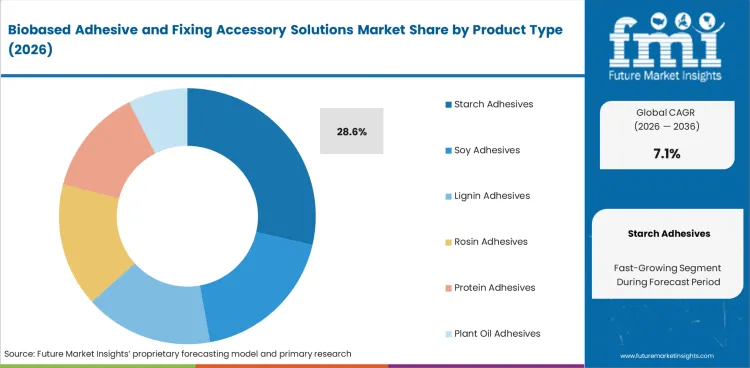
- Starch adhesives are projected to account for 28.6% share in 2026 due to corrugated board and paper bonding need low-cost renewable solids running cleanly on wet application systems.
- Rosin adhesives gain value in reactive hot melt adhesive blends since tack and heat response are central to package sealing work.
Insights into Biobased Adhesive and Fixing Accessory Solutions Market by Application
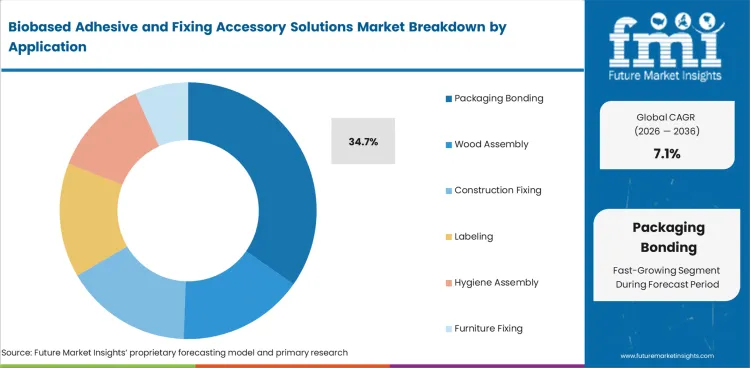
- Packaging bonding is expected to represent 34.7% share in 2026, led by carton closing and label attachment creating repeat adhesive volume across automated lines.
- Construction fixing expands through construction sealants and flooring adhesives requiring low-emission files for project approval.
Insights into Biobased Adhesive and Fixing Accessory Solutions Market by End Use Sector
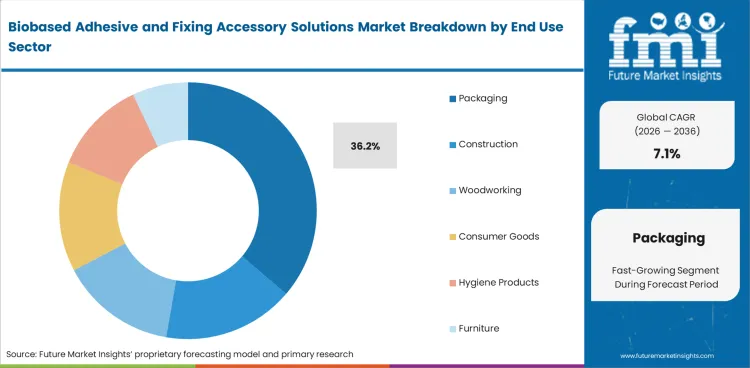
- Packaging is forecast to account for 36.2% share in 2026 since brand owners use adhesive changes to support recyclability and renewable material claims.
- Woodworking demand stays important as wood adhesives are tested for panels and furniture facing indoor air scrutiny.
Insights into Biobased Adhesive and Fixing Accessory Solutions Market by Fixing Format
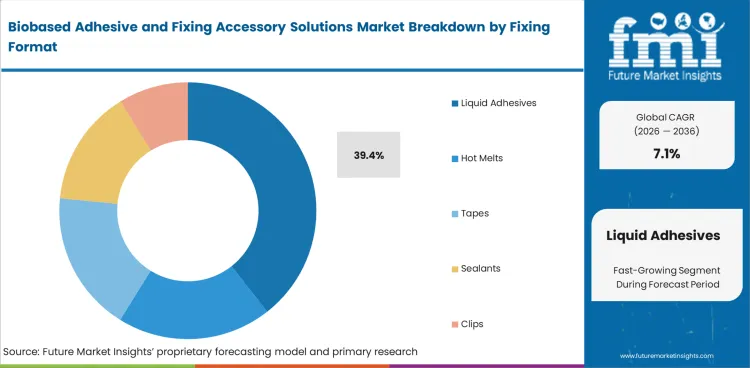
- Liquid adhesives are projected to account for 39.4% share in 2026 as water-based dosing supports packaging and furniture line conversion without major equipment changes.
- Tapes gain attention in hot melt adhesive tapes as converters look for cleaner sealing routes in paper packaging.
Insights into Biobased Adhesive and Fixing Accessory Solutions Market by Sales Channel
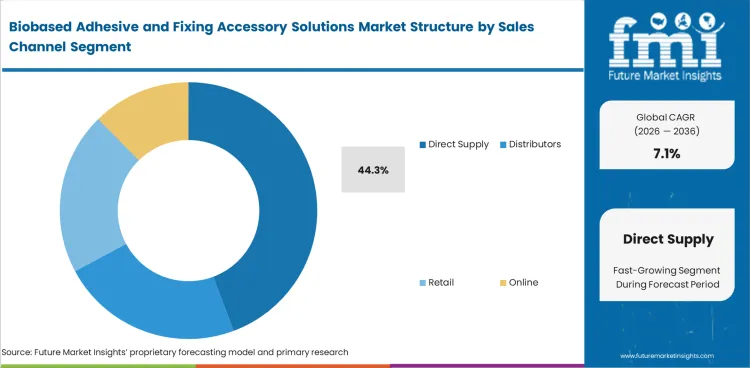
- Direct supply is anticipated to represent 44.3% share in 2026 through large accounts needing plant trials and batch support before approving new adhesive grades.
- Distributors remain important for small construction users buying sealants and fixing tapes with local stock availability.
Biobased Adhesive and Fixing Accessory Solutions Market Drivers, Restraints and Opportunities
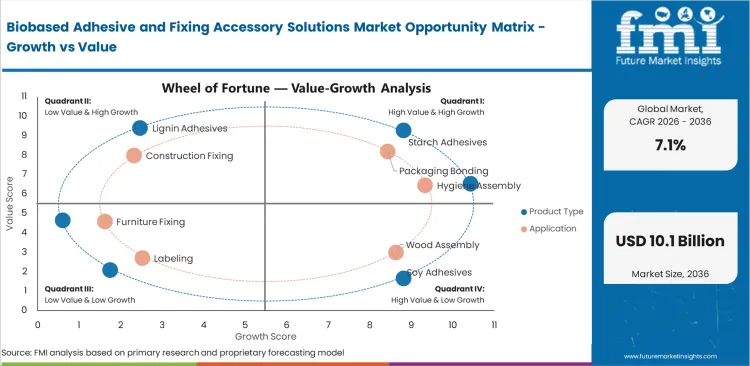
- Bio based packaging adhesive trials are expanding as carton sealing needs renewable bonding without line speed loss.
- Feedstock price swings restrict smaller suppliers lacking stable starch or plant oil sourcing.
- Construction disclosure rules create opportunity for renewable binders used in low emission building products.
Packaging conversion and building product disclosure will define the next growth cycle. Confederation of European Paper Industries reported in July 2025, packaging paper and board production in member countries rose 6.7% in 2024, supporting trials for carton sealing and paper tape adhesives. Feedstock risk needs tighter pricing control since the Food and Agriculture Organization of the United Nations Vegetable Oil Price Index averaged 161.6 points in 2025 and stood 17.1% above 2024. Construction creates another opening as LEED v5 guidance published in April 2025 combines product selection criteria across environmental product declarations and material ingredients. Suppliers proving renewable content and disclosure ready product files should gain stronger approval access during the forecast period.
Installed Base and Replacement Cycle Analysis
Packaging line replacement will stay selective during the forecast period as converters weigh new equipment spending against retrofits supporting renewable adhesive trials. The Association for Packaging and Processing Technologies reported in August 2025, United States packaging machinery sales reached USD 11.3 billion in 2024, with 2025 growth forecast at 2.2% after high interest rates and tariff uncertainty delayed orders. This supports a measured outlook for biobased adhesive suppliers as many plants test low temperature hot melts and paperboard bonding systems on existing lines before committing to full line upgrades.
Technology Adoption and Automation Penetration Analysis
Automation adoption will favor biobased adhesive systems proving stable dosing and predictable startup performance on packaging lines. The Association for Packaging and Processing Technologies reported in April 2025 that packaging line readiness depends on startup checklists and operator training. This points to a practical adoption path in which converters approve renewable adhesives only after equipment teams confirm maintenance needs and operator handling under automated line conditions.
Analysis of Biobased Adhesive and Fixing Accessory Solutions Market by Key Countries
.webp "Top Country Growth Comparison Biobased Adhesive And Fixing Accessory Solutions Market Cagr (2026 2036)")
| Country | CAGR |
|---|---|
| China | 8.6% |
| India | 8.2% |
| United States | 7.5% |
| Germany | 7.4% |
| France | 6.9% |
| Japan | 6.6% |
| United Kingdom | 6.3% |
Source: Future Market Insights, 2026.
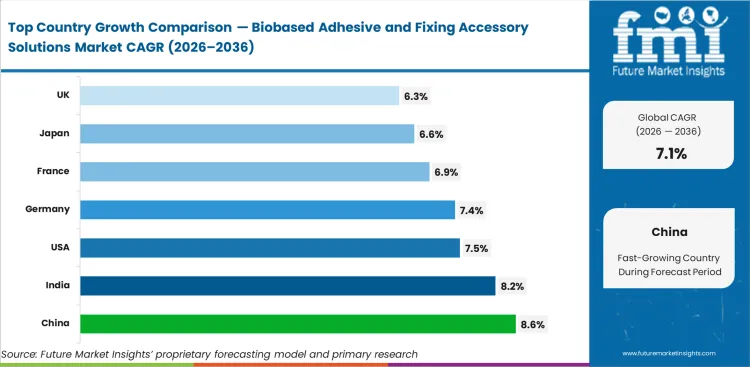
Biobased Adhesive and Fixing Accessory Solutions Market CAGR Analysis by Country
- China is projected to record 8.6% CAGR by 2036 due to packaging conversion and industrial building work creating faster reformulation cycles.
- India is expected to expand at 8.2% CAGR by 2036, led by construction activity and local packaging production lifting adhesive consumption.
- United States is forecast to grow at 7.5% CAGR by 2036 with public purchasing rules and safer product programs shaping specifications.
- Germany is expected to advance at 7.4% CAGR by 2036 as housing permits recover and low-emission building products gain interest.
- France is projected to rise at 6.9% CAGR by 2036 since building permits improve from the weak 2024 level.
- Japan is forecast at 6.6% CAGR by 2036, reflecting specialty adhesive exports and packaging quality requirements promoting premium grades.
- United Kingdom is expected to post 6.3% CAGR by 2036, influenced by repair activity and packaging demand carrying steady conversion work.
Country performance varies around the global rate as packaging intensity and construction recovery differ by region. China and India track above the global pace through manufacturing scale. Germany and the United States track near the upper range since rules and buyer screening favor certified products. Japan and the United Kingdom grow at measured rates as mature packaging and building channels limit faster switching.
Demand Outlook for Biobased Adhesive and Fixing Accessory Solutions in China
Demand in China is poised to record 8.6% CAGR by 2036, driven by packaging and construction users testing renewable bonding systems. National Bureau of Statistics data released in January 2026 showed real estate development investment reached 8,278.8 billion yuan in 2025. Lower building investment keeps construction fixing selective. Packaging conversion and appliance shipping create a steadier route for biobased adhesives than new property work.
- Industrial packaging lines create a large trial pool for carton bonding and label attachment.
- Construction fixing demand favors products with low odor and clear material disclosure files.
- Local blending capacity lowers delivery risk for starch and rosin adhesive grades.
Demand Analysis of Biobased Adhesive and Fixing Accessory Solutions in India
Industry in India is likely to expand at 8.2% CAGR by 2036 with construction and packaging output raising adhesive needs. Press Information Bureau data released in May 2025 estimated construction sector annual growth at 9.4% for fiscal 2024 to 2025. Faster building activity keeps flooring and panel fixing in view. Local packaging producers will seek renewable adhesives that do not raise rejection rates.
- Paperboard packaging favors starch adhesive grades with local feedstock access and lower applied cost.
- Construction users need simple product claims fitting tender and green building review.
- Distributor stock will prove important outside large plants as smaller users buy in shorter cycles.
Sales Outlook for Biobased Adhesive and Fixing Accessory Solutions in the United States
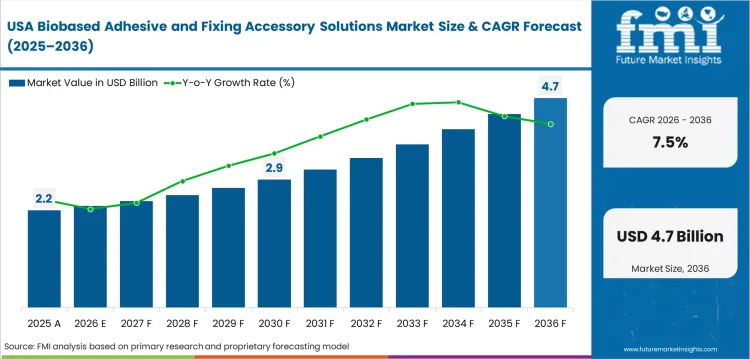
Sales in the United States are forecast to grow at 7.5% CAGR by 2036, led by public buying rules and packaging reformulation shape adhesive specifications. In May 2026, the United States Census Bureau reported March 2026 construction spending at a seasonally adjusted annual rate of USD 2.19 trillion. Construction activity supports flooring adhesives, sealants and fixing products used in repair and installation work. Federal biobased purchasing rules list adhesives with 24.0% minimum biobased content, giving institutional buyers a clearer route to specify renewable bonding materials.
- Public buying rules support adhesives with declared renewable content and clear category fit.
- Packaging converters test wash-off labels and recyclable tape systems for brand programs.
- Construction distributors carry low-emission products for flooring and wall fixing jobs.
Growth Outlook for Biobased Adhesive and Fixing Accessory Solutions in Germany
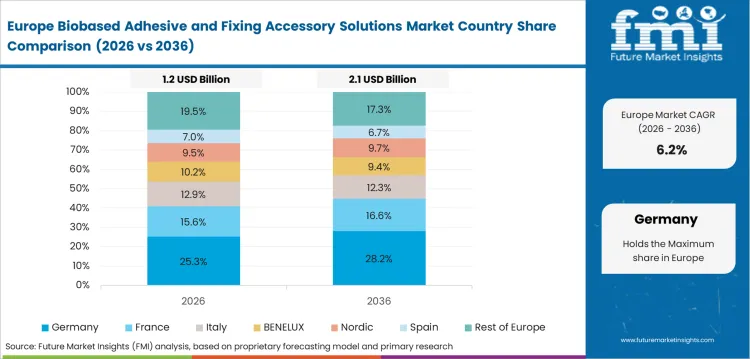
The market in Germany is expected to advance at 7.4% CAGR by 2036 due to construction permits recovery and adhesive buyers preferring documented chemistry. Destatis reported in February 2026, 238,500 dwellings were approved in 2025. Destatis recorded a 10.8% increase from 2024. Permit recovery supports flooring adhesives and wood fixing products after a weak building cycle.
- Low-emission building material screening favors suppliers with verified formulation and safety records.
- Packaging plants in Germany can adopt bio-based hot melts through existing technical service channels.
- Furniture makers keep water-based adhesive demand active for indoor products and panels.
Industry Outlook for Biobased Adhesive and Fixing Accessory Solutions in France
Industry in France is projected to rise at 6.9% CAGR by 2036 as construction permit activity and packaging sustainability targets support selective adhesive reformulation. Eurostat’s June 2025 France metadata states that permits are administrative authorizations for new buildings and major work, making them an early indicator of building activity. Construction fixing suppliers can use this context to position low-emission adhesives for flooring and building material fixing. Carton and label adhesives should also gain selective use as packaging users screen renewable bonding systems for recyclability claims.
- Building products with environmental files fit public and commercial project review.
- Food and consumer goods packaging supports carton adhesives with renewable resin content.
- Label recycling needs create demand for adhesive systems releasing during paper recovery.
Demand Outlook for Biobased Adhesive and Fixing Accessory Solutions in Japan
Sector in Japan is forecast at 6.6% CAGR by 2036 since specialty adhesive exports support higher-value renewable grades. World Bank WITS data placed Japan’s 2024 exports under HS 350691 at USD 292.8 million. Export depth shows formulation strength in specialty bonding. Domestic adoption will be selective since buyers expect stable quality and clear chemical safety records.
- High-quality packaging formats create space for renewable adhesive grades with tight process control.
- Industrial users compare biobased products against proven synthetic systems before switching.
- Supplier gains will depend on clean documentation and stable bond performance during humidity changes.
Sales Analysis of Biobased Adhesive and Fixing Accessory Solutions in the United Kingdom
Sales in the United Kingdom are expected to post 6.3% CAGR by 2036, reflecting repair work and packaging conversion carrying steady adhesive use. Office for National Statistics reported in August 2025, construction output grew 1.2% in the second quarter of 2025. Repair and maintenance rose 1.4% over the same period. Biobased adhesives should find entry through refurbishment and label systems before broader construction switching.
- Repair activity supports sealants and fixing tapes for interiors and light construction work.
- Retail packaging keeps pressure on tape and label adhesives with recycling claims.
- Supplier approval depends on clear safety records and reliable supply through distributors.
Competitive Landscape and Strategic Positioning
- Deep renewable formulation portfolios give large adhesive suppliers an advantage in packaging and construction accounts.
- Certified production sites are important as converters seek traceable renewable feedstock and lower-carbon sourcing.
- On-site support drives repeat orders since plant trials must prove line speed and clean bonding.
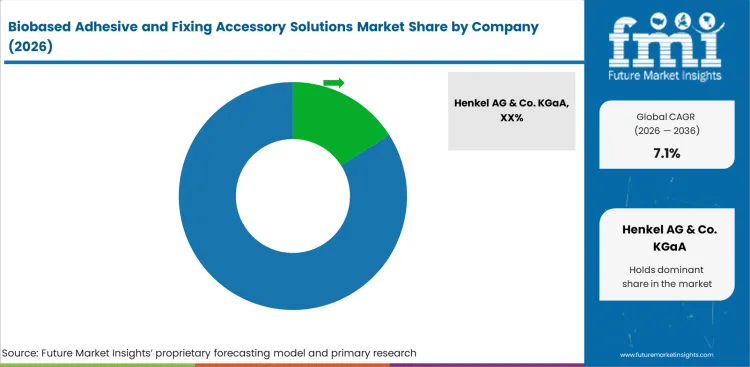
Large adhesive makers lead competition in biobased adhesive and fixing accessory solutions. Construction fixing suppliers and label specialists compete on formulation depth, certified sourcing and end use fit. Henkel AG & Co. KGaA and H.B. Fuller Company compete based on certified packaging adhesives and technical service. Arkema S.A. through Bostik expands competitive reach across packaging and construction adhesive systems. Sika AG and MAPEI S.p.A. hold strength in building applications needing low-emission fixing systems. Jowat SE serves industrial bonding applications with bio-based hot melts. Avery Dennison Corporation adds label and tape expertise led by label adhesive and ink systems.
Supplier selection depends on proof of renewable content without weaker bond strength or added line downtime. Smaller suppliers can win focused areas such as wash-off label adhesives. Larger suppliers are better placed for repeat work when material certificates are combined with plant troubleshooting. Firms with renewable formulation depth and practical line support are best positioned to win across packaging and construction accounts.
Key Companies in the Biobased Adhesive and Fixing Accessory Solutions Market
Competitive structure is separated into groups based on renewable formulation leaders, construction fixing suppliers and label specialists.
- Renewable Formulation Leaders: Henkel AG & Co. KGaA, H.B. Fuller Company and Jowat SE supply adhesive systems with bio-based or mass-balanced raw materials.
- Construction Fixing Suppliers: Arkema S.A. (Bostik) and Sika AG serve flooring and tile applications. MAPEI S.p.A. holds building fixing exposure.
- Label and Tape Specialists: Avery Dennison Corporation supports tapes and label applications needing recycling fit.
Competitive Benchmarking: Biobased Adhesive and Fixing Accessory Solutions Market
| Company | Renewable Feedstock Range | Certified Low-Emission Fit | Packaging Line Support | Geographic Footprint |
|---|---|---|---|---|
| Henkel AG & Co. KGaA | High | Strong | Strong | Europe and global |
| H.B. Fuller Company | High | Strong | Strong | North America and global |
| Arkema S.A. (Bostik) | High | Strong | Strong | Europe and global |
| Sika AG | Medium | Strong | Medium | Europe and global |
| Jowat SE | Medium | Medium | Strong | Europe and Asia |
| Avery Dennison Corporation | Medium | Strong | Strong | Global labels |
| MAPEI S.p.A. | Medium | Strong | Medium | Europe and Americas |
Source: Future Market Insights competitive analysis 2026. Ratings reflect relative positioning based on renewable feedstock range and end-use channel fit.
Key Developments in Biobased Adhesive and Fixing Accessory Solutions Market
- In January 2024, H.B. Fuller earned ISCC PLUS certification for Lüneburg and Nienburg production sites in Germany covering selected packaging adhesives.
- In September 2024, Henkel launched Technomelt Supra 079 Eco Cool with 49.0% directly biobased raw material for packaging users.
- In September 2024, Bostik introduced Kizen LIME with at least 80.0% renewable ingredients for paper and cardboard packaging.
Key Players in the Biobased Adhesive and Fixing Accessory Solutions Market
Major Global Players:
- Henkel AG & Co. KGaA
- H.B. Fuller Company
- Arkema S.A. (Bostik)
- Sika AG
- Avery Dennison Corporation
Specialist and Regional Players:
- Jowat SE
- MAPEI S.p.A.
Market Report Scope
| Parameter | Details |
|---|---|
| Quantitative units | USD 5.1 billion to USD 10.1 billion, at 7.1% CAGR |
| Market definition | Renewable adhesive systems and fixing accessories used in packaging, construction and wood bonding |
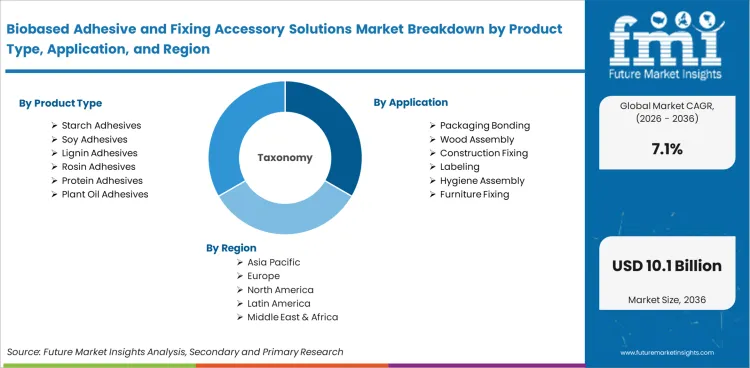
| Product type | Starch adhesives, soy adhesives, lignin adhesives, rosin adhesives, protein adhesives, plant oil adhesives |
| Application | Packaging bonding, wood assembly, construction fixing, labeling, hygiene assembly, furniture fixing |
| End use sector | Packaging, construction, woodworking, consumer goods, hygiene products, furniture |
| Fixing format | Liquid adhesives, hot melts, tapes, sealants, clips |
| Sales channel | Direct supply, distributors, retail, online |
| Regions covered | North America, Europe, East Asia, South Asia and Pacific, Rest of World |
| Countries covered | China, India, United States, Germany, France, Japan, United Kingdom |
| Key companies profiled | Henkel, H.B. Fuller, Arkema, Bostik, Sika, Jowat, Avery Dennison, MAPEI |
| Forecast period | 2026 to 2036 |
| Approach | Hybrid top-down and bottom-up model using adhesive use by application and renewable feedstock conversion checks |
Source: Future Market Insights, 2026.
Biobased Adhesive and Fixing Accessory Solutions Market Breakdown by Product Type, Application, End Use Sector, Fixing Format, Sales Channel and Region
By Product Type:
- Starch Adhesives
- Soy Adhesives
- Lignin Adhesives
- Rosin Adhesives
- Protein Adhesives
- Plant Oil Adhesives
By Application:
- Packaging Bonding
- Wood Assembly
- Construction Fixing
- Labeling
- Hygiene Assembly
- Furniture Fixing
By End Use Sector:
- Packaging
- Construction
- Woodworking
- Consumer Goods
- Hygiene Products
- Furniture
By Fixing Format:
- Liquid Adhesives
- Hot Melts
- Tapes
- Sealants
- Clips
By Sales Channel:
- Direct Supply
- Distributors
- Retail
- Online
By Region:
- North America
- United States
- Europe
- Germany
- France
- United Kingdom
- East Asia
- China
- Japan
- South Asia and Pacific
- India
- Rest of World
Research Sources and Bibliography
- European Commission. (2025, February). Packaging waste.
- European Parliament and Council of the European Union. (2024, December 18). Regulation (EU) 2024/3110 laying down harmonised rules for the marketing of construction products. EUR-Lex.
- Confederation of European Paper Industries. (2025, July 11). Resilient in uncertain times, pulp and paper sector continues to lead on sustainability and decarbonisation, new data shows.
- Food and Agriculture Organization of the United Nations. (2026, January 9). FAO Food Price Index dips in December despite higher world cereal quotations.
- USA Green Building Council. (2025, April). Criteria areas & achievement levels in LEED v5: Additional guidance for the Materials & Resources Credit: Building Product Selection & Procurement.
- PMMI. (2025, August). State of the industry 2025.
- PMMI. (2025, April). 2025 performance optimization: Insights for packaging line readiness.
- ASTM International. (2024, February 16). ASTM International revises key biobased testing standard.
- tesa SE. (2024, August 13). Recyclable paper-based transport securing tape: tesa launches new tesa® 64295.
- RecyClass. (2025, September 15). Avery Dennison RecyClass technology approval: CleanFlake S7400ER.
- European Bioplastics. (2024, December 10). Bioplastics market development update 2024.
- National Archives and Records Administration. (2025, January 2). 7 CFR § 3201.120: Adhesives. Electronic Code of Federal Regulations. https://www.ecfr.gov/current/title-7/subtitle-B/chapter-XXXII/part-3201/subpart-B/section-3201.120
- United States Census Bureau. (2026, May 7). Monthly construction spending, March 2026.
- National Bureau of Statistics of China. (2026, January 20). Investment in real estate development for 2025.
- Press Information Bureau, Government of India. (2025, May 30). Provisional estimates of annual gross domestic product for 2024-25 and quarterly estimates of gross domestic product for the fourth quarter of 2024-25.
- Office for National Statistics. (2025, August 14). Construction output in Great Britain: June 2025, new orders and Construction Output Price Indices, April to June 2025.
- H.B. Fuller Company. (2024, January 10). H.B. Fuller plants in Germany receive ISCC PLUS certification.
- Henkel AG & Co. KGaA. (2024, September 24). Bio just got cooler: Bio-based hot melt adhesive from Henkel helps save energy in the packaging process.
- Arkema S.A. (2024, September 9). Bostik takes a key step towards decarbonization with the launch of Kizen™ LIME, a new range of packaging adhesives.
- Eurostat. (2025, June 17). Building permits: France. European Commission.
- World Bank. (2026, May 21). Japan adhesives based on rubber or plastic exports by country, 2024. World Integrated Trade Solution.
Bibliography is provided for reader reference. Sources are official company and government publications dated 2024 onward. Regulatory, trade body and multilateral sources are used where relevant.
This Report Answers
- What is the current and future value of biobased adhesive and fixing accessory solutions market?
- What growth rate is expected for biobased adhesive and fixing accessory solutions market from 2026 to 2036?
- Which product type segment is expected to hold a strong share in biobased adhesive and fixing accessory solutions market?
- Which application and end use sector create the main use route for renewable adhesive systems?
- What factors support adoption of biobased adhesive and fixing accessory solutions in packaging and construction?
- How do sustainability rules and product disclosure trends affect supplier selection in this market?
- Which countries are expected to grow faster in biobased adhesive and fixing accessory solutions market?
- Which companies compete in renewable adhesive and fixing accessory supply?
- What is included and excluded in the biobased adhesive and fixing accessory solutions market definition?
Frequently Asked Questions
What is the global biobased adhesive and fixing accessory solutions market size in 2026?
In 2026, the biobased adhesive and fixing accessory solutions market is expected to reach USD 5.1 billion across packaging and construction uses.
What is the expected value of biobased adhesive and fixing accessory solutions market by 2036?
The biobased adhesive and fixing accessory solutions industry revenue is forecast to reach USD 10.1 billion by 2036 as renewable bonding gains wider use.
What CAGR is expected for biobased adhesive and fixing accessory solutions market?
Biobased adhesive and fixing accessory solutions sector is projected to expand at 7.1% CAGR from 2026 to 2036 as packaging conversion demand expands.
Which product type segment holds a strong share in biobased adhesive and fixing accessory solutions market?
Starch adhesives are expected to account for 28.6% share in 2026 as paperboard bonding uses renewable water-based adhesive systems.
Which application is prominent in biobased adhesive and fixing accessory solutions market?
Packaging bonding is projected to account for 34.7% share in 2026 as cartons and labels creating frequent adhesive consumption.
Which country grows faster in biobased adhesive and fixing accessory solutions market?
China is projected to record 8.6% CAGR by 2036 as packaging conversion and industrial building work support faster reformulation activity.
What are biobased adhesive and fixing accessory solutions?
Biobased adhesive and fixing accessory solutions use renewable carbon sources to bond packaging and wood. Labels and construction materials form other commercial applications.
How is biobased adhesive and fixing accessory solutions market forecast prepared?
Forecasting uses application adhesive consumption and renewable feedstock conversion checks. Country rates and segment shares refine packaging and construction exposure.
How do buyers choose biobased adhesive and fixing accessory solutions?
Buyers check bond strength and line speed. Construction users review emissions data before approving flooring or wall fixing products.
Where are biobased adhesive and fixing accessory solutions used most?
Packaging and woodworking use these products most often. Construction forms another common route. Labels and cartons provide common commercial applications. Panels and furniture add further demand.
Are biobased adhesive and fixing accessory solutions recyclable?
Recyclability depends on adhesive chemistry and the final package material. Wash-off labels and paper tape systems are designed to support recovery processes.
Which companies supply biobased adhesive and fixing accessory solutions?
Henkel and H.B. Fuller supply renewable bonding systems for commercial buyers. Bostik, Sika and Jowat hold related positions in adhesive supply. Avery Dennison and MAPEI add label and construction exposure.
Which fixing formats are included in biobased adhesive and fixing accessory solutions market?
Liquid adhesives, hot melts, tapes and sealants are counted when renewable bonding chemistry shapes the commercial product.
Why do construction users adopt biobased adhesive and fixing accessory solutions?
Construction users adopt these products when low-emission records and renewable input proof support flooring, panel and wall fixing approvals.
Preview the report firsthand - request a free sample
Get SampleGet the brochure for pricing and purchase details.
Get PDFTable of Content
- Key Takeaways
- Market Size and CAGR
- Top Growth Driver
- Fastest Growing Segment
- Leading Region
- Key Companies
- Emerging Opportunities
- Executive Summary
- Global Market Outlook
- Demand-side Trends
- Supply-side Trends
- Technology Roadmap Analysis
- Analysis and Recommendations
- Analyst Perspective (What is happening? Why now? What should investors know?)
- Key Questions Answered
- How large is the market?
- What is the CAGR?
- What are key trends?
- Which region dominates?
- Who are the leaders?
- Market Overview
- Market Coverage / Taxonomy
- Market Definition / Scope / Limitations
- Research Methodology
- Chapter Orientation
- Analytical Lens and Working Hypotheses
- Market Structure, Signals, and Trend Drivers
- Benchmarking and Cross-market Comparability
- Market Sizing, Forecasting, and Opportunity Mapping
- Research Design and Evidence Framework
- Desk Research Programme (Secondary Evidence)
- Expert Input and Fieldwork (Primary Evidence)
- Tooling, Models, and Reference Databases
- Data Engineering and Model Build
- Quality Assurance and Audit Trail
- Market Background
- Market Dynamics (Drivers, Restraints, Opportunity, Trends)
- Scenario Forecast (Optimistic, Likely, Conservative)
- Impact Analysis
- AI Impact
- Sustainability Impact
- Regulatory Impact
- Technology Impact
- Consumer / Buyer Analysis
- Purchase Drivers
- Adoption Barriers
- Buyer Journey
- Opportunity Map Analysis
- Product Life Cycle Analysis
- Supply Chain Analysis
- Investment Feasibility Matrix
- Value Chain Analysis
- PESTLE and Porter's Analysis
- Regulatory Landscape
- Regional Parent Market Outlook
- Production and Consumption Statistics
- Import and Export Statistics
- Global Market Analysis and Forecast, 2021 to 2036
- Historical Market Size Value (USD Billion) & Volume (Unit) Analysis, 2021 to 2025
- Current and Future Market Size Value (USD Billion) & Volume (Unit) Projections, 2026 to 2036
- Y-o-Y Growth Trend Analysis
- Absolute $ Opportunity Analysis
- Global Market Pricing Analysis, 2021 to 2036
- Global Market Analysis and Forecast, By Product Type, 2021 to 2036
- Introduction / Key Findings
- Historical Market Size Value (USD Billion) & Volume (Unit) Analysis By Product Type, 2021 to 2025
- Current and Future Market Size Value (USD Billion) & Volume (Unit) Analysis and Forecast By Product Type, 2026 to 2036
- Starch Adhesives
- Soy Adhesives
- Lignin Adhesives
- Rosin Adhesives
- Protein Adhesives
- Plant Oil Adhesives
- Starch Adhesives
- Y-o-Y Growth Trend Analysis By Product Type, 2021 to 2025
- Absolute $ Opportunity Analysis By Product Type, 2026 to 2036
- Global Market Analysis and Forecast, By Application, 2021 to 2036
- Introduction / Key Findings
- Historical Market Size Value (USD Billion) & Volume (Unit) Analysis By Application, 2021 to 2025
- Current and Future Market Size Value (USD Billion) & Volume (Unit) Analysis and Forecast By Application, 2026 to 2036
- Packaging Bonding
- Wood Assembly
- Construction Fixing
- Labeling
- Hygiene Assembly
- Furniture Fixing
- Packaging Bonding
- Y-o-Y Growth Trend Analysis By Application, 2021 to 2025
- Absolute $ Opportunity Analysis By Application, 2026 to 2036
- Global Market Analysis and Forecast, By End Use Sector, 2021 to 2036
- Introduction / Key Findings
- Historical Market Size Value (USD Billion) & Volume (Unit) Analysis By End Use Sector, 2021 to 2025
- Current and Future Market Size Value (USD Billion) & Volume (Unit) Analysis and Forecast By End Use Sector, 2026 to 2036
- Packaging
- Construction
- Woodworking
- Consumer Goods
- Hygiene Products
- Furniture
- Packaging
- Y-o-Y Growth Trend Analysis By End Use Sector, 2021 to 2025
- Absolute $ Opportunity Analysis By End Use Sector, 2026 to 2036
- Global Market Analysis and Forecast, By Fixing Format, 2021 to 2036
- Introduction / Key Findings
- Historical Market Size Value (USD Billion) & Volume (Unit) Analysis By Fixing Format, 2021 to 2025
- Current and Future Market Size Value (USD Billion) & Volume (Unit) Analysis and Forecast By Fixing Format, 2026 to 2036
- Liquid Adhesives
- Hot Melts
- Tapes
- Sealants
- Clips
- Liquid Adhesives
- Y-o-Y Growth Trend Analysis By Fixing Format, 2021 to 2025
- Absolute $ Opportunity Analysis By Fixing Format, 2026 to 2036
- Global Market Analysis and Forecast, By Sales Channel, 2021 to 2036
- Introduction / Key Findings
- Historical Market Size Value (USD Billion) & Volume (Unit) Analysis By Sales Channel, 2021 to 2025
- Current and Future Market Size Value (USD Billion) & Volume (Unit) Analysis and Forecast By Sales Channel, 2026 to 2036
- Direct Supply
- Distributors
- Retail
- Online
- Direct Supply
- Y-o-Y Growth Trend Analysis By Sales Channel, 2021 to 2025
- Absolute $ Opportunity Analysis By Sales Channel, 2026 to 2036
- Global Market Analysis and Forecast, By Region, 2021 to 2036
- Introduction
- Historical Market Size Value (USD Billion) & Volume (Unit) Analysis By Region, 2021 to 2025
- Current Market Size Value (USD Billion) & Volume (Unit) Analysis and Forecast By Region, 2026 to 2036
- North America
- Latin America
- Western Europe
- Eastern Europe
- East Asia
- South Asia and Pacific
- Middle East & Africa
- Market Attractiveness Analysis By Region
- North America Market Analysis and Forecast, By Country, 2021 to 2036
- Historical Market Size Value (USD Billion) & Volume (Unit) Trend Analysis By Market Taxonomy, 2021 to 2025
- Market Size Value (USD Billion) & Volume (Unit) Forecast By Market Taxonomy, 2026 to 2036
- By Country
- USA
- Canada
- Mexico
- By Product Type
- By Application
- By End Use Sector
- By Fixing Format
- By Sales Channel
- By Country
- Market Attractiveness Analysis
- By Country
- By Product Type
- By Application
- By End Use Sector
- By Fixing Format
- By Sales Channel
- Key Takeaways
- Latin America Market Analysis and Forecast, By Country
- Historical Market Size Value (USD Billion) & Volume (Unit) Trend Analysis By Market Taxonomy, 2021 to 2025
- Market Size Value (USD Billion) & Volume (Unit) Forecast By Market Taxonomy, 2026 to 2036
- By Country
- Brazil
- Chile
- Rest of Latin America
- By Product Type
- By Application
- By End Use Sector
- By Fixing Format
- By Sales Channel
- By Country
- Market Attractiveness Analysis
- By Country
- By Product Type
- By Application
- By End Use Sector
- By Fixing Format
- By Sales Channel
- Key Takeaways
- Western Europe Market Analysis and Forecast, By Country
- Historical Market Size Value (USD Billion) & Volume (Unit) Trend Analysis By Market Taxonomy, 2021 to 2025
- Market Size Value (USD Billion) & Volume (Unit) Forecast By Market Taxonomy, 2026 to 2036
- By Country
- Germany
- UK
- Italy
- Spain
- France
- Nordic
- BENELUX
- Rest of Western Europe
- By Product Type
- By Application
- By End Use Sector
- By Fixing Format
- By Sales Channel
- By Country
- Market Attractiveness Analysis
- By Country
- By Product Type
- By Application
- By End Use Sector
- By Fixing Format
- By Sales Channel
- Key Takeaways
- Eastern Europe Market Analysis and Forecast, By Country
- Historical Market Size Value (USD Billion) & Volume (Unit) Trend Analysis By Market Taxonomy, 2021 to 2025
- Market Size Value (USD Billion) & Volume (Unit) Forecast By Market Taxonomy, 2026 to 2036
- By Country
- Russia
- Poland
- Hungary
- Balkan & Baltic
- Rest of Eastern Europe
- By Product Type
- By Application
- By End Use Sector
- By Fixing Format
- By Sales Channel
- By Country
- Market Attractiveness Analysis
- By Country
- By Product Type
- By Application
- By End Use Sector
- By Fixing Format
- By Sales Channel
- Key Takeaways
- East Asia Market Analysis and Forecast, By Country
- Historical Market Size Value (USD Billion) & Volume (Unit) Trend Analysis By Market Taxonomy, 2021 to 2025
- Market Size Value (USD Billion) & Volume (Unit) Forecast By Market Taxonomy, 2026 to 2036
- By Country
- China
- Japan
- South Korea
- By Product Type
- By Application
- By End Use Sector
- By Fixing Format
- By Sales Channel
- By Country
- Market Attractiveness Analysis
- By Country
- By Product Type
- By Application
- By End Use Sector
- By Fixing Format
- By Sales Channel
- Key Takeaways
- South Asia and Pacific Market Analysis and Forecast, By Country
- Historical Market Size Value (USD Billion) & Volume (Unit) Trend Analysis By Market Taxonomy, 2021 to 2025
- Market Size Value (USD Billion) & Volume (Unit) Forecast By Market Taxonomy, 2026 to 2036
- By Country
- India
- ASEAN
- Australia & New Zealand
- Rest of South Asia and Pacific
- By Product Type
- By Application
- By End Use Sector
- By Fixing Format
- By Sales Channel
- By Country
- Market Attractiveness Analysis
- By Country
- By Product Type
- By Application
- By End Use Sector
- By Fixing Format
- By Sales Channel
- Key Takeaways
- Middle East & Africa Market Analysis and Forecast, By Country
- Historical Market Size Value (USD Billion) & Volume (Unit) Trend Analysis By Market Taxonomy, 2021 to 2025
- Market Size Value (USD Billion) & Volume (Unit) Forecast By Market Taxonomy, 2026 to 2036
- By Country
- Kingdom of Saudi Arabia
- Other GCC Countries
- Türkiye
- South Africa
- Other African Union
- Rest of Middle East & Africa
- By Product Type
- By Application
- By End Use Sector
- By Fixing Format
- By Sales Channel
- By Country
- Market Attractiveness Analysis
- By Country
- By Product Type
- By Application
- By End Use Sector
- By Fixing Format
- By Sales Channel
- Key Takeaways
- Key Countries Market Analysis
- USA
- Pricing Analysis
- Market Share Analysis, 2025
- By Product Type
- By Application
- By End Use Sector
- By Fixing Format
- By Sales Channel
- Canada
- Pricing Analysis
- Market Share Analysis, 2025
- By Product Type
- By Application
- By End Use Sector
- By Fixing Format
- By Sales Channel
- Mexico
- Pricing Analysis
- Market Share Analysis, 2025
- By Product Type
- By Application
- By End Use Sector
- By Fixing Format
- By Sales Channel
- Brazil
- Pricing Analysis
- Market Share Analysis, 2025
- By Product Type
- By Application
- By End Use Sector
- By Fixing Format
- By Sales Channel
- Chile
- Pricing Analysis
- Market Share Analysis, 2025
- By Product Type
- By Application
- By End Use Sector
- By Fixing Format
- By Sales Channel
- Germany
- Pricing Analysis
- Market Share Analysis, 2025
- By Product Type
- By Application
- By End Use Sector
- By Fixing Format
- By Sales Channel
- UK
- Pricing Analysis
- Market Share Analysis, 2025
- By Product Type
- By Application
- By End Use Sector
- By Fixing Format
- By Sales Channel
- Italy
- Pricing Analysis
- Market Share Analysis, 2025
- By Product Type
- By Application
- By End Use Sector
- By Fixing Format
- By Sales Channel
- Spain
- Pricing Analysis
- Market Share Analysis, 2025
- By Product Type
- By Application
- By End Use Sector
- By Fixing Format
- By Sales Channel
- France
- Pricing Analysis
- Market Share Analysis, 2025
- By Product Type
- By Application
- By End Use Sector
- By Fixing Format
- By Sales Channel
- India
- Pricing Analysis
- Market Share Analysis, 2025
- By Product Type
- By Application
- By End Use Sector
- By Fixing Format
- By Sales Channel
- ASEAN
- Pricing Analysis
- Market Share Analysis, 2025
- By Product Type
- By Application
- By End Use Sector
- By Fixing Format
- By Sales Channel
- Australia & New Zealand
- Pricing Analysis
- Market Share Analysis, 2025
- By Product Type
- By Application
- By End Use Sector
- By Fixing Format
- By Sales Channel
- China
- Pricing Analysis
- Market Share Analysis, 2025
- By Product Type
- By Application
- By End Use Sector
- By Fixing Format
- By Sales Channel
- Japan
- Pricing Analysis
- Market Share Analysis, 2025
- By Product Type
- By Application
- By End Use Sector
- By Fixing Format
- By Sales Channel
- South Korea
- Pricing Analysis
- Market Share Analysis, 2025
- By Product Type
- By Application
- By End Use Sector
- By Fixing Format
- By Sales Channel
- Russia
- Pricing Analysis
- Market Share Analysis, 2025
- By Product Type
- By Application
- By End Use Sector
- By Fixing Format
- By Sales Channel
- Poland
- Pricing Analysis
- Market Share Analysis, 2025
- By Product Type
- By Application
- By End Use Sector
- By Fixing Format
- By Sales Channel
- Hungary
- Pricing Analysis
- Market Share Analysis, 2025
- By Product Type
- By Application
- By End Use Sector
- By Fixing Format
- By Sales Channel
- Kingdom of Saudi Arabia
- Pricing Analysis
- Market Share Analysis, 2025
- By Product Type
- By Application
- By End Use Sector
- By Fixing Format
- By Sales Channel
- Türkiye
- Pricing Analysis
- Market Share Analysis, 2025
- By Product Type
- By Application
- By End Use Sector
- By Fixing Format
- By Sales Channel
- South Africa
- Pricing Analysis
- Market Share Analysis, 2025
- By Product Type
- By Application
- By End Use Sector
- By Fixing Format
- By Sales Channel
- USA
- Market Structure Analysis
- Competition Dashboard
- Competition Benchmarking
- Market Share Analysis of Top Players
- By Regional
- By Product Type
- By Application
- By End Use Sector
- By Fixing Format
- By Sales Channel
- Emerging Startups
- Innovation Benchmarking
- Competition Analysis
- Competition Deep Dive
- Henkel AG & Co. KGaA
- Overview
- Product Portfolio
- Profitability by Market Segments (Product/Region/Sales Channel)
- Sales Footprint
- Strategy Overview
- Marketing Strategy
- Product Strategy
- Channel Strategy
- H.B. Fuller Company
- Arkema S.A. (Bostik)
- Sika AG
- Avery Dennison Corporation
- Jowat SE
- MAPEI S.p.A.
- Henkel AG & Co. KGaA
- Case Studies
- Success Stories
- Recent Developments
- Competition Deep Dive
- Assumptions & Acronyms Used


