

- Industry Size (2026)
- USD 325 Mn
- Forecast (2036)
- USD 1009.4 Mn
- CAGR (2026 to 2036)
- 12.0%
Adhesives for Hydrogen Tank Composite Wraps Market Forecast and Outlook 2026 to 2036
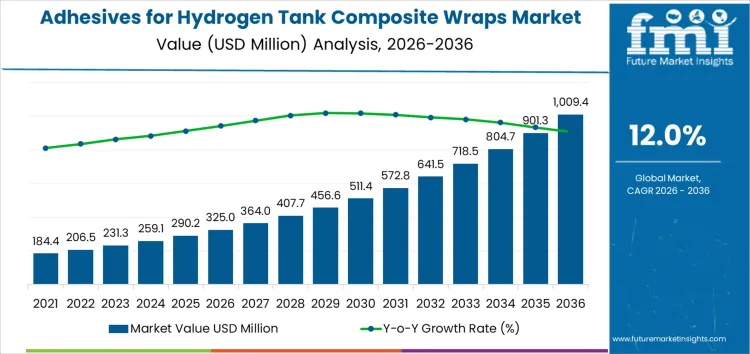
The adhesives for hydrogen tank composite wraps market is valued at USD 325 million in 2026 and is projected to reach USD 1,009.4 million by 2036, reflecting a CAGR of 12.0%. Growth dynamics during this period are shaped by tank pressure ratings, filament winding precision, and cure cycle reliability rather than overall hydrogen infrastructure volume. Cost structures reflect resin system compatibility, controlled viscosity ranges, and rejection risk during composite layup. Suppliers with stable curing behavior reduce scrap rates and improve throughput economics. Pricing leverage improves where adhesive selection influences certified burst performance, creating specification driven demand anchored in safety qualification requirements.
Between 2026 and 2036, value capture centers on qualification permanence and production yield control. Composite tank manufacturers prioritize consistency across winding speeds and environmental conditions, limiting tolerance for formulation variability. Once approved, adhesives remain embedded due to costly requalification and safety testing. Dependency on certified material systems constrains sourcing options. Strategic tradeoffs arise between optimizing cure speed and maintaining structural integrity across tank geometries. Firms integrating process support with formulation supply secure stronger margins. Profit pools concentrate among suppliers aligned with long production runs for heavy duty transport and stationary storage platforms.
Quick Stats for Adhesives for Hydrogen Tank Composite Wraps Market
- Adhesives for Hydrogen Tank Composite Wraps Market Value (2026): USD 325 million
- Adhesives for Hydrogen Tank Composite Wraps Market Forecast Value (2036): USD 1,009.4 million
- Adhesives for Hydrogen Tank Composite Wraps Market Forecast CAGR (2026-2036): 12.0%
- Leading Type in Adhesives for Hydrogen Tank Composite Wraps Market: Epoxy-based structural adhesives
- Key Growth Regions in Adhesives for Hydrogen Tank Composite Wraps Market: Asia Pacific, Europe, North America
- Top Players in Adhesives for Hydrogen Tank Composite Wraps Market: Solvay, Hexcel Corporation, Huntsman, Toray Industries, Gurit
What Is the Growth Forecast for Adhesives for Hydrogen Tank Composite Wraps Market through 2036?
Pressure containment requirements and composite integrity standards shape the early growth phase of the adhesives for hydrogen tank composite wraps market between 2026 and 2031. During this period, the market expands from USD 325 million to USD 502 million, adding USD 177 million in value. Annual progression from USD 325 million onward reflects rising deployment of high-pressure hydrogen storage systems in mobility and industrial applications. Historical growth was limited by low hydrogen infrastructure penetration and conservative material qualification cycles. Future expansion in this phase is supported by increased adoption of composite pressure vessels, improved adhesive compatibility with carbon fiber reinforcements, and growing focus on weight reduction and structural reliability.
Tank scale up and system level standardization drive growth from 2031 to 2036. Over this period, the market increases from USD 502 million to USD 1,009.4 million, adding USD 506 million and representing the stronger expansion window. Annual values rise from USD 556 million to USD 1,009.4 million, indicating accelerating year over year momentum. Earlier demand centered on pilot scale hydrogen storage projects, while future growth reflects wider rollout across fuel cell vehicles, transport trailers, and stationary storage systems. Higher operating pressures, larger tank formats, and tighter safety certification requirements support sustained expansion as advanced adhesives become essential to composite wrap performance and long term durability.
Adhesives for Hydrogen Tank Composite Wraps Market Key Takeaways
| Metric | Value |
|---|---|
| Market Value (2026) | USD 325 million |
| Forecast Value (2036) | USD 1,009.4 million |
| Forecast CAGR (2026-2036) | 12.0% |
What Is Driving Growth in the Adhesives for Hydrogen Tank Composite Wraps Market?
Growth in the adhesives for hydrogen tank composite wraps market reflects performance requirements unique to high-pressure hydrogen storage rather than general adhesive use. Hydrogen tanks in transportation and stationary energy applications are increasingly made from carbon fiber and other advanced composites that require reliable bonding between liner, overwrap, and protective layers. Traditional adhesive systems often lacked the combination of hydrogen impermeability, resistance to stress cycles, and durability under wide temperature fluctuations needed to maintain composite integrity over long service intervals. Early uptake occurred where developers faced delamination, microcracking, or fatigue in prototype tanks, prompting shift to specialised adhesives with tailored chemistries.
Future growth in this market will be shaped by shifts in hydrogen economy deployment, regulatory safety frameworks, and performance qualification standards rather than by incremental adhesive improvements alone. Governments and industry consortia are establishing codes for hydrogen storage that define structural integrity, leak prevention, and long-term endurance under high pressure. Manufacturers of composite tanks for fuel cell vehicles, industrial storage, and renewable energy systems will specify adhesives that meet documented criteria for hydrogen compatibility, mechanical resilience, and bonding durability. Advances in polymer adhesive systems designed to reduce gas permeation and maintain cohesive strength over repeated pressure cycles support these requirements. Demand will align with formalised certification pathways, safety testing protocols, and integration into production processes rather than isolated performance anecdotes.
What Factors Are Affecting the Demand for Adhesives for Hydrogen Tank Composite Wraps Market in Terms of Adhesive Chemistry and Tank Type?
The adhesives market for hydrogen tank composite wraps is driven by the expansion of hydrogen mobility, higher operating pressures, and strict safety certification requirements. Demand centers on adhesive systems that ensure structural integrity, fatigue resistance, and long-term durability under cyclic pressure and temperature variation. Adoption is shaped by tank architecture, liner material, and composite winding processes. Market leadership reflects proven performance in safety-critical environments rather than experimentation with unvalidated bonding chemistries.
What Is Driving Leadership by Adhesive Chemistry in the Adhesives for Hydrogen Tank Composite Wraps Market?
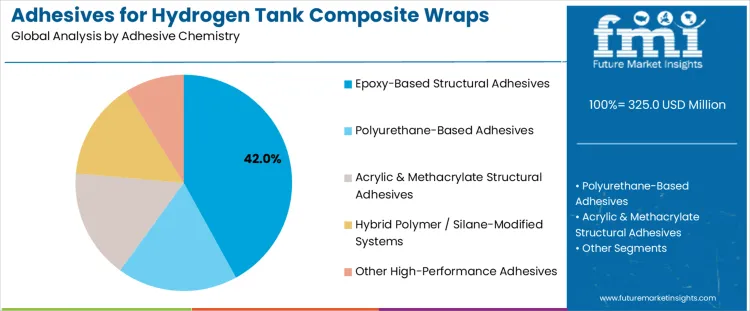
Epoxy-based structural adhesives account for about 42% of demand because they provide high bond strength, chemical resistance, and dimensional stability required for composite overwrap applications. These adhesives integrate effectively with carbon fiber and glass fiber reinforcement systems used in filament winding. Tank manufacturers rely on epoxies to transfer load between fibers and liners while maintaining integrity under high internal pressure. Their predictable curing behavior supports controlled manufacturing and certification. Long-standing use in aerospace and pressure vessels further reinforces confidence. These attributes make epoxy systems the preferred choice for structural bonding in hydrogen tanks operating at elevated pressures.
Polyurethane, acrylic, and hybrid polymer adhesives play secondary roles. Polyurethanes offer flexibility but lower structural stiffness. Acrylics provide fast curing but face thermal limits. Hybrid silane-modified systems address vibration and sealing needs but are not primary load carriers. Other high-performance adhesives remain niche. Chemistry leadership therefore reflects structural reliability and certification acceptance rather than curing speed or processing convenience.
What Is Driving Leadership by Tank Type in the Adhesives for Hydrogen Tank Composite Wraps Market?
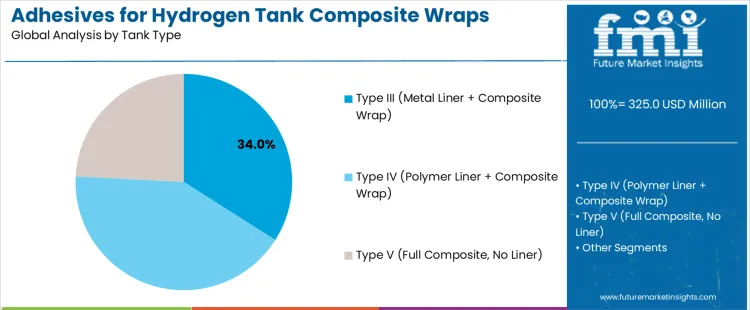
Type III tanks account for about 34% of demand because they balance weight reduction with structural robustness using metal liners wrapped in composites. These tanks are widely adopted in transportation and industrial hydrogen storage due to established standards and manufacturability. Adhesives play a critical role in bonding the composite wrap to the liner, ensuring load transfer and fatigue resistance. Manufacturers prioritize adhesive systems validated for metal-to-composite interfaces, reinforcing demand concentration in this tank category.
Type IV tanks are gaining momentum due to weight advantages, but polymer liners introduce bonding challenges requiring specialized surface treatment. Type V tanks eliminate liners but remain limited to advanced applications due to cost and certification hurdles. These designs expand future demand but currently operate at smaller scale. Tank type leadership therefore reflects maturity, certification readiness, and production volume rather than maximum weight savings potential.
How Are Adhesives for Hydrogen Tank Composite Wraps Being Applied Across Energy and Automotive Sectors?
Use appears in hydrogen storage systems where composite-wrapped tanks require high-strength bonding and gas-tight integrity. Manufacturers adopt advanced adhesives to bond carbon fiber or fiberglass layers to liners and overwraps, ensuring mechanical strength, impact resistance, and leak prevention. Fuel cell vehicle OEMs, industrial gas suppliers, and energy storage companies integrate these adhesives to meet pressure, safety, and durability standards. These applications reflect operational and safety priorities rather than aesthetic objectives, with adoption driven by structural integrity, hydrogen containment, and regulatory compliance.
What Operational and Material Conditions Support Adoption of Adhesives for Hydrogen Tank Composite Wraps?
Selection aligns with substrates that must withstand high pressures, thermal cycling, and environmental exposure without delamination. Adhesive formulations are optimized for shear and peel strength, chemical compatibility, and cure time under controlled temperature and humidity. Assembly lines monitor layer alignment, adhesive thickness, and curing conditions to ensure uniform performance. Quality control evaluates bond integrity, leak tightness, and mechanical resilience to comply with ISO and SAE hydrogen storage standards. These conditions emerge from operational reliability, tank safety, and material performance priorities in structured composite manufacturing workflows.
Which Practical Considerations Limit Wider Use of Adhesives for Hydrogen Tank Composite Wraps?
High material cost and process complexity limit adoption to specialized facilities and high-pressure applications. Adhesive compatibility with liner materials, fiber reinforcements, and surface treatments must be validated. Cure monitoring and post-cure inspection add operational overhead. Regulatory approvals and certification for pressure vessels vary by region. These factors lead to selective deployment where mechanical reliability, hydrogen containment, and compliance justify incremental cost and process management.
What is the Demand for Adhesives for Hydrogen Tank Composite Wraps by Country?
| Country | CAGR (%) |
|---|---|
| China | 14.0% |
| USA | 11.5% |
| Germany | 10.2% |
| Japan | 9.6% |
| South Korea | 9.3% |
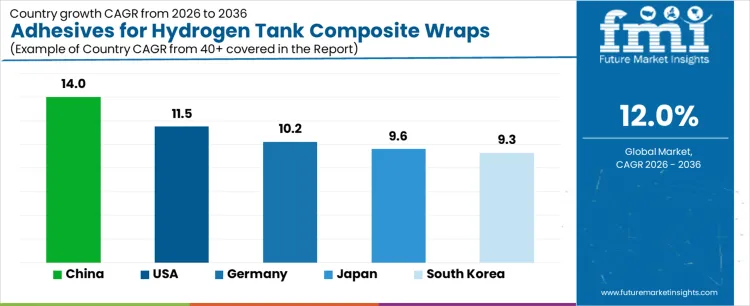
The demand for adhesives for hydrogen tank composite wraps varies across countries, driven by hydrogen fuel adoption, energy transition initiatives, and automotive and industrial hydrogen storage growth. China leads with a 14.0% CAGR, supported by government incentives for hydrogen vehicles, expansion of hydrogen infrastructure, and adoption of composite tanks requiring advanced adhesives. The USA follows at 11.5%, driven by EV and hydrogen vehicle adoption, industrial energy applications, and safety standards for composite tanks. Germany records 10.2%, shaped by renewable energy initiatives and hydrogen mobility projects. Japan posts 9.6%, supported by industrial hydrogen use and automotive adoption. South Korea grows at 9.3%, reflecting emerging hydrogen infrastructure and energy sector investments.
How Are Adhesives for Hydrogen Tank Composite Wraps Expanding in China?
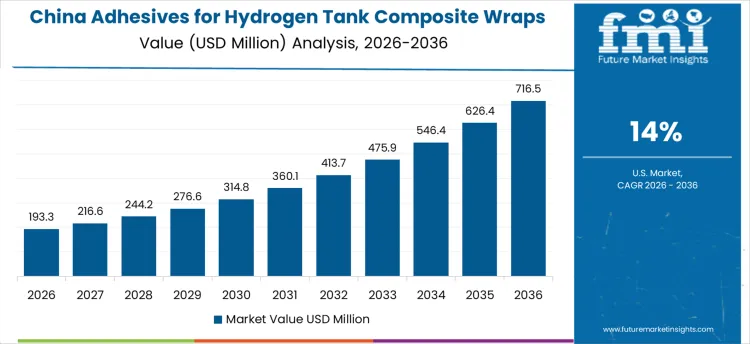
In China, the Adhesives for Hydrogen Tank Composite Wraps Market is growing at a CAGR of 14% through 2036, fueled by rapid adoption of hydrogen-powered vehicles, industrial hydrogen storage facilities, and renewable energy projects. Manufacturers are using high-performance adhesives to bond composite layers, improve mechanical strength, and ensure safety in high-pressure hydrogen tanks. Demand is concentrated in automotive manufacturing hubs, hydrogen production zones, and industrial composite wrap facilities. Compared to the USA, China emphasizes large-scale industrial integration and urban adoption. Domestic suppliers provide high-strength, chemically compatible adhesives suitable for recurring composite tank production and rigorous safety testing cycles.
- Automotive manufacturing hubs, hydrogen production zones, and composite wrap facilities drive adoption
- Adhesives improve mechanical strength, bonding, and safety in hydrogen tanks
- Domestic suppliers provide high-strength, chemically compatible adhesives
- Recurring production and testing cycles sustain rapid adoption
How Are Hydrogen Vehicle Expansion and Industrial Standards Driving Growth in the United States?
In the United States, revenue is growing at a CAGR of 11.5% through 2036, supported by increasing production of hydrogen fuel cell vehicles, stationary hydrogen storage, and industrial fuel cell applications. Manufacturers are integrating adhesives for composite tank wraps to enhance structural integrity, pressure resistance, and long-term safety. Demand is concentrated in automotive hubs, hydrogen production facilities, and industrial storage plants. Compared to Germany, adoption emphasizes operational efficiency alongside regulatory compliance. Domestic suppliers provide high-performance adhesives compatible with automated composite wrap assembly and recurring tank production cycles.
- Automotive hubs, hydrogen production facilities, and industrial storage plants drive adoption
- Adhesives enhance structural integrity, pressure resistance, and safety
- Domestic suppliers provide high-performance, assembly-compatible adhesives
- Recurring tank production cycles sustain adoption
How Are Regulatory Standards and Industrial Safety Driving Adoption in Germany?
In Germany, the market is expanding at a CAGR of 10.2% through 2036, driven by stringent EU safety regulations and hydrogen storage standards. Automotive OEMs, industrial hydrogen producers, and composite manufacturers are adopting specialized adhesives to bond tank wraps, ensure pressure safety, and maintain compliance. Demand is concentrated in automotive hubs, hydrogen storage clusters, and industrial composite facilities. Compared to China, Germany emphasizes compliance, testing, and quality assurance over volume. Domestic suppliers provide certified, high-performance adhesives compatible with high-pressure composite tank assembly and recurring quality inspections.
- Automotive hubs, hydrogen storage clusters, and industrial composite facilities drive adoption
- Adhesives ensure pressure safety and regulatory compliance
- Domestic suppliers provide certified, high-performance adhesive solutions
- Recurring quality inspections sustain adoption
How Are Automotive Standards Supporting Growth in Japan?
In Japan, the market is growing at a CAGR of 9.6% through 2036, supported by hydrogen fuel cell vehicle adoption, industrial hydrogen storage, and high-pressure tank safety requirements. Manufacturers are integrating adhesives for composite wraps to improve bonding strength, maintain pressure resistance, and comply with domestic standards. Demand is concentrated in automotive manufacturing hubs, hydrogen production facilities, and composite wrap plants. Compared to China, adoption focuses more on quality, precision, and regulatory compliance rather than large-scale volume. Domestic suppliers provide high-performance, chemically compatible adhesives suitable for recurring composite wrap production and safety testing.
- Automotive manufacturing hubs, hydrogen production facilities, and composite wrap plants drive adoption
- Adhesives improve bonding strength, pressure resistance, and compliance
- Domestic suppliers provide high-performance, chemically compatible adhesives
- Recurring production and testing cycles sustain adoption
How Are Industrial and Hydrogen Infrastructure Driving Market Expansion in South Korea?
In South Korea, the market is expanding at a CAGR of 9.3% through 2036, driven by hydrogen fuel cell vehicle manufacturing, industrial hydrogen storage, and renewable energy projects. Manufacturers are adopting adhesives for composite tank wraps to ensure structural durability, chemical compatibility, and safety in high-pressure applications. Demand is concentrated in automotive hubs, industrial hydrogen facilities, and composite manufacturing centers. Compared to Japan, adoption emphasizes industrial-scale integration and volume adoption. Domestic suppliers provide high-strength, production-compatible adhesives suitable for recurring composite tank assembly and rigorous safety inspections.
- Automotive hubs, industrial hydrogen facilities, and composite manufacturing centers drive adoption
- Adhesives ensure structural durability, chemical compatibility, and safety
- Domestic suppliers provide high-strength, production-compatible adhesives
- Recurring tank assembly and safety inspections sustain adoption
Which Strategic Approaches Define Competition in the Adhesives for Hydrogen Tank Composite Wraps Market under Pressure Vessel Safety Constraints?
Competition in adhesives for hydrogen tank composite wraps is governed by failure consequence rather than by processing convenience. Adhesives used in filament wound pressure vessels must maintain load transfer, crack resistance, and interlaminar stability under extreme pressure cycling and temperature variation. Solvay and Huntsman approach this market through epoxy and hybrid resin systems engineered for controlled cure kinetics and long term fatigue resistance, supporting carbon fiber overwrap integrity. Their strategies emphasize qualification against burst, creep, and permeation testing rather than broad material versatility. Hexcel and Toray influence adhesive selection indirectly through tight coupling between fiber sizing, resin compatibility, and composite system behavior, making adhesive choice inseparable from the overall materials stack.
A different competitive logic applies among composite system specialists. Gurit positions itself around integrated materials solutions, aligning adhesives with prepregs, reinforcements, and process guidance tailored for hydrogen storage applications. This strategy prioritizes manufacturability and repeatability in filament winding and curing rather than standalone adhesive performance metrics. Across the market, suppliers focus on long validation cycles, traceable test data, and conservative formulation evolution to meet pressure vessel certification standards. Competitive advantage is built through credibility with regulators, consistency under cyclic loading, and close collaboration with tank manufacturers. Success depends on risk mitigation, system compatibility, and predictable performance over decades of service rather than rapid material innovation or cost driven substitution.
Key Players in the Adhesives for Hydrogen Tank Composite Wraps Market
- Solvay
- Hexcel Corporation
- Huntsman (Araldite, etc.)
- Toray Industries
- Gurit
Scope of the Report
| Items | Values |
|---|---|
| Quantitative Units (2026) | USD million |
| Type | Epoxy-Based Structural Adhesives, Polyurethane-Based Adhesives, Acrylic and Methacrylate Structural Adhesives, Hybrid Polymer and Silane-Modified Systems, Other High-Performance Adhesives |
| Application | Composite Overwrap Bonding, Liner-to-Composite Interface Bonding, Interlaminar Reinforcement, Fatigue and Crack Resistance Layers |
| End Users | Hydrogen Tank Manufacturers, Fuel Cell Vehicle OEMs, Industrial Hydrogen Storage System Producers, Aerospace and Defense Composite Fabricators |
| Regions Covered | Asia Pacific, Europe, North America, Latin America, Middle East and Africa |
| Countries Covered | China, United States, Germany, Japan, South Korea, India, United Kingdom, France, Italy, Canada, Mexico, Brazil, ASEAN countries, GCC countries, and other global regions |
| Key Companies Profiled | Solvay, Hexcel Corporation, Huntsman, Toray Industries, Gurit |
| Additional Attributes | Dollar by sales across adhesive chemistry and tank type, qualification and certification requirements for pressure vessels, composite manufacturing yield and rejection risk analysis, compatibility with filament winding and cure cycle control, regional demand trends across mobility and stationary hydrogen storage platforms |
Adhesives for Hydrogen Tank Composite Wraps Market Segmentation
Adhesive Chemistry:
- Epoxy-Based Structural Adhesives
- Polyurethane-Based Adhesives
- Acrylic & Methacrylate Structural Adhesives
- Hybrid Polymer / Silane-Modified Systems
- Other High-Performance Adhesives
Tank Type:
- Type III (Metal Liner + Composite Wrap)
- Type IV (Polymer Liner + Composite Wrap)
- Type V (Full Composite, No Liner)
End-Use Sector:
- Fuel Cell Electric Vehicles (FCEVs)
- Hydrogen Storage Infrastructure
- Aerospace & Defense Hydrogen Systems
- Industrial & Stationary Power
Region:
- Asia Pacific
- China
- Japan
- South Korea
- India
- Australia & New Zealand
- ASEAN
- Rest of Asia Pacific
- Europe
- Germany
- United Kingdom
- France
- Italy
- Spain
- Nordic
- BENELUX
- Rest of Europe
- North America
- United States
- Canada
- Mexico
- Latin America
- Brazil
- Chile
- Rest of Latin America
- Middle East & Africa
- Kingdom of Saudi Arabia
- Other GCC Countries
- Turkey
- South Africa
- Other African Union
- Rest of Middle East & Africa
Bibliography
- ISO. (2020). ISO 11114-4: Cylinders and tubes - Compatibility of cylinder and valve materials with gas contents - Part 4: Composite materials. International Organization for Standardization.
- Becker, S., Braun, M., & Schnack, E. (2019). Design and material challenges for high-pressure hydrogen storage vessels. International Journal of Hydrogen Energy, 44(19), 9640-9653.
Frequently Asked Questions
How big is the adhesives for hydrogen tank composite wraps market in 2026?
The global adhesives for hydrogen tank composite wraps market is estimated to be valued at USD 325.0 million in 2026.
What will be the size of adhesives for hydrogen tank composite wraps market in 2036?
The market size for the adhesives for hydrogen tank composite wraps market is projected to reach USD 1,009.4 million by 2036.
How much will be the adhesives for hydrogen tank composite wraps market growth between 2026 and 2036?
The adhesives for hydrogen tank composite wraps market is expected to grow at a 12.0% CAGR between 2026 and 2036.
What are the key adhesive chemistry types in the adhesives for hydrogen tank composite wraps market?
The key adhesive chemistry types in adhesives for hydrogen tank composite wraps market are epoxy-based structural adhesives, polyurethane-based adhesives, acrylic & methacrylate structural adhesives, hybrid polymer / silane-modified systems and other high-performance adhesives.
Which tank type segment to contribute significant share in the adhesives for hydrogen tank composite wraps market in 2026?
In terms of tank type, type III (metal liner + composite wrap) segment to command 34.0% share in the adhesives for hydrogen tank composite wraps market in 2026.
Preview the report firsthand - request a free sample
Get SampleGet the brochure for pricing and purchase details.
Get PDFTable of Content
- Executive Summary
- Global Market Outlook
- Demand-side Trends
- Supply-side Trends
- Technology Roadmap Analysis
- Analysis and Recommendations
- Market Overview
- Market Coverage / Taxonomy
- Market Definition / Scope / Limitations
- Market Background
- Market Dynamics
- Drivers
- Restraints
- Opportunity
- Trends
- Scenario Forecast
- Demand in Optimistic Scenario
- Demand in Likely Scenario
- Demand in Conservative Scenario
- Opportunity Map Analysis
- Product Life Cycle Analysis
- Supply Chain Analysis
- Investment Feasibility Matrix
- Value Chain Analysis
- PESTLE and Porter’s Analysis
- Regulatory Landscape
- Regional Parent Market Outlook
- Production and Consumption Statistics
- Import and Export Statistics
- Market Dynamics
- Global Market Analysis 2021 to 2025 and Forecast, 2026 to 2036
- Historical Market Size Value (USD Million) Analysis, 2021 to 2025
- Current and Future Market Size Value (USD Million) Projections, 2026 to 2036
- Y-o-Y Growth Trend Analysis
- Absolute $ Opportunity Analysis
- Global Market Pricing Analysis 2021 to 2025 and Forecast 2026 to 2036
- Global Market Analysis 2021 to 2025 and Forecast 2026 to 2036, By Adhesive Chemistry
- Introduction / Key Findings
- Historical Market Size Value (USD Million) Analysis By Adhesive Chemistry , 2021 to 2025
- Current and Future Market Size Value (USD Million) Analysis and Forecast By Adhesive Chemistry , 2026 to 2036
- Epoxy-Based Structural Adhesives
- Polyurethane-Based Adhesives
- Acrylic & Methacrylate Structural Adhesives
- Hybrid Polymer / Silane-Modified Systems
- Other High-Performance Adhesives
- Epoxy-Based Structural Adhesives
- Y-o-Y Growth Trend Analysis By Adhesive Chemistry , 2021 to 2025
- Absolute $ Opportunity Analysis By Adhesive Chemistry , 2026 to 2036
- Global Market Analysis 2021 to 2025 and Forecast 2026 to 2036, By Tank Type
- Introduction / Key Findings
- Historical Market Size Value (USD Million) Analysis By Tank Type, 2021 to 2025
- Current and Future Market Size Value (USD Million) Analysis and Forecast By Tank Type, 2026 to 2036
- Type III (Metal Liner + Composite Wrap)
- Type IV (Polymer Liner + Composite Wrap)
- Type V (Full Composite, No Liner)
- Type III (Metal Liner + Composite Wrap)
- Y-o-Y Growth Trend Analysis By Tank Type, 2021 to 2025
- Absolute $ Opportunity Analysis By Tank Type, 2026 to 2036
- Global Market Analysis 2021 to 2025 and Forecast 2026 to 2036, By End-Use Sector
- Introduction / Key Findings
- Historical Market Size Value (USD Million) Analysis By End-Use Sector, 2021 to 2025
- Current and Future Market Size Value (USD Million) Analysis and Forecast By End-Use Sector, 2026 to 2036
- Fuel Cell Electric Vehicles (FCEVs)
- Hydrogen Storage Infrastructure
- Aerospace & Defense Hydrogen Systems
- Industrial & Stationary Power
- Fuel Cell Electric Vehicles (FCEVs)
- Y-o-Y Growth Trend Analysis By End-Use Sector, 2021 to 2025
- Absolute $ Opportunity Analysis By End-Use Sector, 2026 to 2036
- Global Market Analysis 2021 to 2025 and Forecast 2026 to 2036, By Region
- Introduction
- Historical Market Size Value (USD Million) Analysis By Region, 2021 to 2025
- Current Market Size Value (USD Million) Analysis and Forecast By Region, 2026 to 2036
- North America
- Latin America
- Western Europe
- Eastern Europe
- East Asia
- South Asia and Pacific
- Middle East & Africa
- Market Attractiveness Analysis By Region
- North America Market Analysis 2021 to 2025 and Forecast 2026 to 2036, By Country
- Historical Market Size Value (USD Million) Trend Analysis By Market Taxonomy, 2021 to 2025
- Market Size Value (USD Million) Forecast By Market Taxonomy, 2026 to 2036
- By Country
- USA
- Canada
- Mexico
- By Adhesive Chemistry
- By Tank Type
- By End-Use Sector
- By Country
- Market Attractiveness Analysis
- By Country
- By Adhesive Chemistry
- By Tank Type
- By End-Use Sector
- Key Takeaways
- Latin America Market Analysis 2021 to 2025 and Forecast 2026 to 2036, By Country
- Historical Market Size Value (USD Million) Trend Analysis By Market Taxonomy, 2021 to 2025
- Market Size Value (USD Million) Forecast By Market Taxonomy, 2026 to 2036
- By Country
- Brazil
- Chile
- Rest of Latin America
- By Adhesive Chemistry
- By Tank Type
- By End-Use Sector
- By Country
- Market Attractiveness Analysis
- By Country
- By Adhesive Chemistry
- By Tank Type
- By End-Use Sector
- Key Takeaways
- Western Europe Market Analysis 2021 to 2025 and Forecast 2026 to 2036, By Country
- Historical Market Size Value (USD Million) Trend Analysis By Market Taxonomy, 2021 to 2025
- Market Size Value (USD Million) Forecast By Market Taxonomy, 2026 to 2036
- By Country
- Germany
- UK
- Italy
- Spain
- France
- Nordic
- BENELUX
- Rest of Western Europe
- By Adhesive Chemistry
- By Tank Type
- By End-Use Sector
- By Country
- Market Attractiveness Analysis
- By Country
- By Adhesive Chemistry
- By Tank Type
- By End-Use Sector
- Key Takeaways
- Eastern Europe Market Analysis 2021 to 2025 and Forecast 2026 to 2036, By Country
- Historical Market Size Value (USD Million) Trend Analysis By Market Taxonomy, 2021 to 2025
- Market Size Value (USD Million) Forecast By Market Taxonomy, 2026 to 2036
- By Country
- Russia
- Poland
- Hungary
- Balkan & Baltic
- Rest of Eastern Europe
- By Adhesive Chemistry
- By Tank Type
- By End-Use Sector
- By Country
- Market Attractiveness Analysis
- By Country
- By Adhesive Chemistry
- By Tank Type
- By End-Use Sector
- Key Takeaways
- East Asia Market Analysis 2021 to 2025 and Forecast 2026 to 2036, By Country
- Historical Market Size Value (USD Million) Trend Analysis By Market Taxonomy, 2021 to 2025
- Market Size Value (USD Million) Forecast By Market Taxonomy, 2026 to 2036
- By Country
- China
- Japan
- South Korea
- By Adhesive Chemistry
- By Tank Type
- By End-Use Sector
- By Country
- Market Attractiveness Analysis
- By Country
- By Adhesive Chemistry
- By Tank Type
- By End-Use Sector
- Key Takeaways
- South Asia and Pacific Market Analysis 2021 to 2025 and Forecast 2026 to 2036, By Country
- Historical Market Size Value (USD Million) Trend Analysis By Market Taxonomy, 2021 to 2025
- Market Size Value (USD Million) Forecast By Market Taxonomy, 2026 to 2036
- By Country
- India
- ASEAN
- Australia & New Zealand
- Rest of South Asia and Pacific
- By Adhesive Chemistry
- By Tank Type
- By End-Use Sector
- By Country
- Market Attractiveness Analysis
- By Country
- By Adhesive Chemistry
- By Tank Type
- By End-Use Sector
- Key Takeaways
- Middle East & Africa Market Analysis 2021 to 2025 and Forecast 2026 to 2036, By Country
- Historical Market Size Value (USD Million) Trend Analysis By Market Taxonomy, 2021 to 2025
- Market Size Value (USD Million) Forecast By Market Taxonomy, 2026 to 2036
- By Country
- Kingdom of Saudi Arabia
- Other GCC Countries
- Turkiye
- South Africa
- Other African Union
- Rest of Middle East & Africa
- By Adhesive Chemistry
- By Tank Type
- By End-Use Sector
- By Country
- Market Attractiveness Analysis
- By Country
- By Adhesive Chemistry
- By Tank Type
- By End-Use Sector
- Key Takeaways
- Key Countries Market Analysis
- USA
- Pricing Analysis
- Market Share Analysis, 2025
- By Adhesive Chemistry
- By Tank Type
- By End-Use Sector
- Canada
- Pricing Analysis
- Market Share Analysis, 2025
- By Adhesive Chemistry
- By Tank Type
- By End-Use Sector
- Mexico
- Pricing Analysis
- Market Share Analysis, 2025
- By Adhesive Chemistry
- By Tank Type
- By End-Use Sector
- Brazil
- Pricing Analysis
- Market Share Analysis, 2025
- By Adhesive Chemistry
- By Tank Type
- By End-Use Sector
- Chile
- Pricing Analysis
- Market Share Analysis, 2025
- By Adhesive Chemistry
- By Tank Type
- By End-Use Sector
- Germany
- Pricing Analysis
- Market Share Analysis, 2025
- By Adhesive Chemistry
- By Tank Type
- By End-Use Sector
- UK
- Pricing Analysis
- Market Share Analysis, 2025
- By Adhesive Chemistry
- By Tank Type
- By End-Use Sector
- Italy
- Pricing Analysis
- Market Share Analysis, 2025
- By Adhesive Chemistry
- By Tank Type
- By End-Use Sector
- Spain
- Pricing Analysis
- Market Share Analysis, 2025
- By Adhesive Chemistry
- By Tank Type
- By End-Use Sector
- France
- Pricing Analysis
- Market Share Analysis, 2025
- By Adhesive Chemistry
- By Tank Type
- By End-Use Sector
- India
- Pricing Analysis
- Market Share Analysis, 2025
- By Adhesive Chemistry
- By Tank Type
- By End-Use Sector
- ASEAN
- Pricing Analysis
- Market Share Analysis, 2025
- By Adhesive Chemistry
- By Tank Type
- By End-Use Sector
- Australia & New Zealand
- Pricing Analysis
- Market Share Analysis, 2025
- By Adhesive Chemistry
- By Tank Type
- By End-Use Sector
- China
- Pricing Analysis
- Market Share Analysis, 2025
- By Adhesive Chemistry
- By Tank Type
- By End-Use Sector
- Japan
- Pricing Analysis
- Market Share Analysis, 2025
- By Adhesive Chemistry
- By Tank Type
- By End-Use Sector
- South Korea
- Pricing Analysis
- Market Share Analysis, 2025
- By Adhesive Chemistry
- By Tank Type
- By End-Use Sector
- Russia
- Pricing Analysis
- Market Share Analysis, 2025
- By Adhesive Chemistry
- By Tank Type
- By End-Use Sector
- Poland
- Pricing Analysis
- Market Share Analysis, 2025
- By Adhesive Chemistry
- By Tank Type
- By End-Use Sector
- Hungary
- Pricing Analysis
- Market Share Analysis, 2025
- By Adhesive Chemistry
- By Tank Type
- By End-Use Sector
- Kingdom of Saudi Arabia
- Pricing Analysis
- Market Share Analysis, 2025
- By Adhesive Chemistry
- By Tank Type
- By End-Use Sector
- Turkiye
- Pricing Analysis
- Market Share Analysis, 2025
- By Adhesive Chemistry
- By Tank Type
- By End-Use Sector
- South Africa
- Pricing Analysis
- Market Share Analysis, 2025
- By Adhesive Chemistry
- By Tank Type
- By End-Use Sector
- USA
- Market Structure Analysis
- Competition Dashboard
- Competition Benchmarking
- Market Share Analysis of Top Players
- By Regional
- By Adhesive Chemistry
- By Tank Type
- By End-Use Sector
- Competition Analysis
- Competition Deep Dive
- Hexcel Corporation
- Overview
- Product Portfolio
- Profitability by Market Segments (Product/Age /Sales Channel/Region)
- Sales Footprint
- Strategy Overview
- Marketing Strategy
- Product Strategy
- Channel Strategy
- Huntsman (Araldite, etc.)
- Toray Industries
- Gurit
- Hexcel Corporation
- Competition Deep Dive
- Assumptions & Acronyms Used
- Research Methodology


