

- Market Size (2026)
- USD 190.0 Mn
- Forecast (2036)
- USD 380.0 Mn
- CAGR (2026 to 2036)
- 7.2%
Biobased Anti-Blocking Agents for Flexible Packaging Films Market Size, Market Forecast and Outlook By FMI
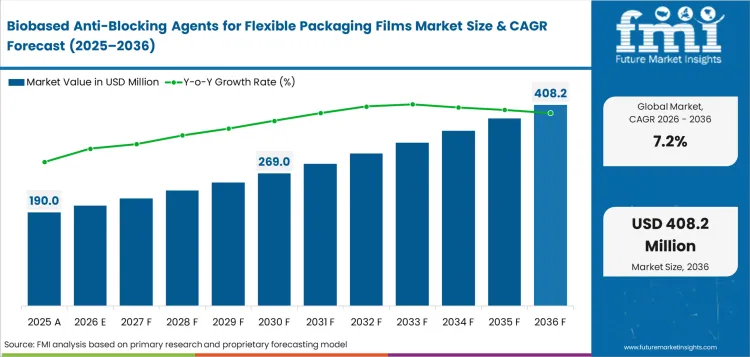
FMI analysis shows that the biobased anti-blocking agents for flexible packaging films market was valued at USD 177.3 million in 2025. Industry value is projected to cross USD 190.0 million in 2026 and rise to USD 380.0 million by 2036 at a 7.2% CAGR. Masterbatch is expected to account for 58.0% share of product form demand in 2026. Direct sales are projected to hold 55.0% share of sales channel demand in 2026.
Summary of the Biobased Anti-Blocking Agents for Flexible Packaging Films Market
- Demand and Growth Drivers
- Flexible packaging film producers require biobased anti-blocking agents as brand owners shift toward lower fossil-based additive content.
- Food packaging applications form the largest use base, led by sealed pouches and wraps requiring clean film release during packing.
- Plant-based silica and starch blends sustain steady adoption since converters require low-friction films with fewer petroleum-derived additives.
- Product and Segment View
- Masterbatch is expected to lead the Product Form segment with 58.0% share influencing cleaner dosing during film extrusion.
- Blown film is anticipated to lead film process with 52.0% share as PE pouch and wrap lines use this route widely.
- Food packaging is estimated to lead application with 46.0% share as safe film release and low odor stay central to brand checks.
- Geography and Competitive Outlook
- China and India are forecast above the global 7.2% CAGR as film output and packaging exports support faster additive use.
- Germany and the United Kingdom remain steady buyers as packaging tax and recycling rules influence material choices.
- Palsgaard, Fine Organics and Sukano are offering plant-based additives and biopolymer masterbatch support.
- Avient and Emery Oleochemicals extend the supplier base through functional packaging additives and renewable polymer additive lines.
- Analyst Opinion
- Ismail Sutaria, Principal Analyst for Packaging at FMI, states, "Biobased anti-blocking agent use is a rising due to the technical limitations of traditional inorganic additives in high-clarity and mono-material recyclable films. I view this sector as a film handling business first and a sustainability story second. Converters will not accept plant-based additives if rolls block during storage or if printed packs lose clarity. The real buying test is simple dosing and stable unwind performance.“
- Biobased Anti-Blocking Agents for Flexible Packaging Films Market Value Analysis
- The biobased anti-blocking agents for flexible packaging films market is moving from early adoption into a clearer additive-use segment.
- Film converters are adopting these additives because they seek lower fossil-based additive content in food and consumer packaging films.
- Wider use of plant-derived waxes and mineral alternatives in polyethylene film processing.
- Packaging owners need smooth film handling and sustainability claims without disrupting sealing performance.
Key Takeaways
- The biobased anti-blocking agents for flexible packaging films market value stood at USD 177.3 million in 2025.
- Industry value is projected to reach USD 380.0 million by 2036 as food film converters move toward safer additive packs.
- The sector is expected to expand at a 7.2% CAGR from 2026 to 2036 across flexible packaging film uses.
- The market is projected to create an incremental opportunity of USD 190.0 million between 2026 and 2036.
- Masterbatch is expected to account for 58.0% share in 2026 as pellet dosing suits high-speed film conversion lines.
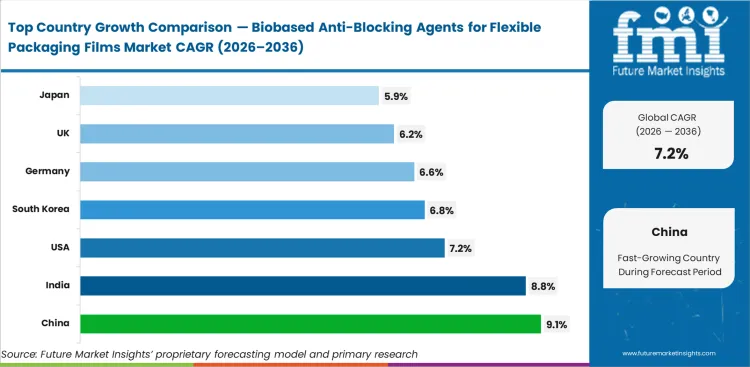
- China at 9.1% CAGR and India at 8.8% CAGR are forecast above the global pace through 2036.
Biobased anti-blocking agents for flexible packaging films are expected to gain use as converters reduce blocking in thin films without heavy mineral loading. Cargill’s 2025 Optislip data shows film use levels of 500 to 2000 ppm. This supports low-dose additive use in compact flexible packaging structures.
PLA and PHA film producers are likely to shift toward biopolymer-ready grades because Cargill lists 100% bio-based anti-block options for PLA blends and other compostable resins. Sukano’s 2025 BOPLA work adds a scale signal because its anti-block masterbatch enables up to 7x transverse stretch on existing BOPP equipment. EU PPWR timelines are expected to increase demand for additive systems with clearer compostability and recyclability documentation.
Biobased Anti-Blocking Agents for Flexible Packaging Films Market Definition
The sector covers plant-based or renewable-content additives used to keep flexible packaging films from sticking during production, storage and use. Products include masterbatch systems and liquid concentrates for PE and PP films. The scope covers PLA and other biofilm resins. Finished flexible packs and base polymers stay outside the value counted in this study.
Biobased Anti-Blocking Agents for Flexible Packaging Films Market Inclusions
The study includes product form, chemistry type, film resin, application, film process and sales channel across global flexible film demand.
Biobased Anti-Blocking Agents for Flexible Packaging Films Market Exclusions
Conventional talc-only additives, fossil-based slip agents, finished pouches and rigid packaging stay outside this study.
Biobased Anti-Blocking Agents for Flexible Packaging Films Market Research Methodology
- Primary Research: FMI analysts reviewed additive suppliers, film converters and packaging compounders active in flexible film supply. Interviews focused on film unwind, haze control and food-contact documentation.
- Desk Research: The desk review used public product literature and official packaging waste statistics covering bio-based additive activity.
- Market Sizing and Forecasting: The forecast aligned anti-blocking additive use with film output, additive dosage and country-level packaging conversion depth. Each of the six parent segment leaders was checked against buyer use patterns.
- Data Validation: Segment balance and country growth were compared with supplier product lines and public policy signals.
Why is the Biobased Anti-Blocking Agents for Flexible Packaging Films Market Growing?
- Food film producers are reassessing additive packs due to recyclable structures and compostable formats depending on clearer food-contact files.
- BOPLA film development is creating fresh additive demands led by PLA films requiring lower sticking during winding and secondary processing.
- Vegetable amide grades help PE and PP film handling because converters seek bio-based slip and antiblock options for polyolefin films.
- EU packaging rules are pushing brands toward recyclable packaging by 2030, raising demand for certified additives in compostable and recyclable films.
Food packaging converters are changing additive choices as brand owners press for lower fossil content in film structures. European Commission rules now require all packaging placed on the EU market to be recyclable by 2030, influencing flexible film producers to select additives supporting recyclable and compostable packaging designs. EU recycling pressure makes anti-blocking additives part of film design choices rather than a small processing aid purchase. Suppliers with food-contact files and low-haze performance gain better access to snack and dry goods film trials.
Biopolymer films need surface control as PLA and starch blends can block during winding or storage. Sukano introduced BOPLA antiblock masterbatch technology in October 2025 for compostable film processing under PPWR pressure. Sukano's launch supports polylactic acid film use as converters test compostable structures with better handling. Additive makers able to support BOPLA and polyolefin lines will have a wider customer base through 2036.
Market Segmentation Analysis
- Masterbatch is expected to lead product form demand with 58.0% share in 2026 as pellet concentrate suits clean metering on film lines.
- Direct sales are projected to hold 55.0% share in 2026, influencing large converters seeking lab support before grade approval.
- Blown film is anticipated to represent 52.0% share in 2026 due to PE bags and pouch films maintaining process widelye the process widely.
- Food packaging is estimated to account for 46.0% share in 2026 since film release and low odor are checked closely by food brands.
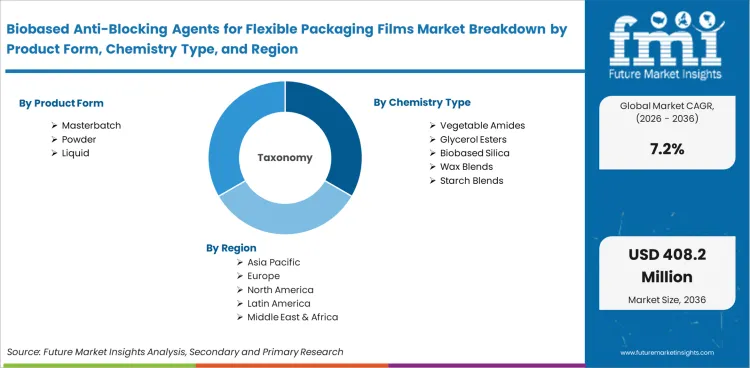
The biobased anti-blocking agents for flexible packaging films market is segmented by product form, comprising masterbatch, powder, and liquid, with masterbatch leading due to cleaner dosing and easier handling on film lines. By chemistry type, the market spans vegetable amides, glycerol esters, biobased silica, wax blends and starch blends, with vegetable amides dominating as PE and PP film converters already understand their slip and release behavior.
The market is further segmented by film resin into polyethylene, polypropylene, PLA, starch blends, PBAT blends and PHA, with polyethylene accounting for the largest share as pouch and wrap production relies heavily on PE films. By application, food packaging holds the leading position driven by film release needs across snack, bakery and dry food packs. Film process segmentation includes blown film, cast film, BOPLA and BOPP, with blown film most widely used across PE bags and pouches. Sales channels such as direct sales, distributors and compounders further define demand, with direct sales gaining preference due to converter trials and compliance-file review.
Biobased Anti-Blocking Agents for Flexible Packaging Films Market Analysis by Product Form
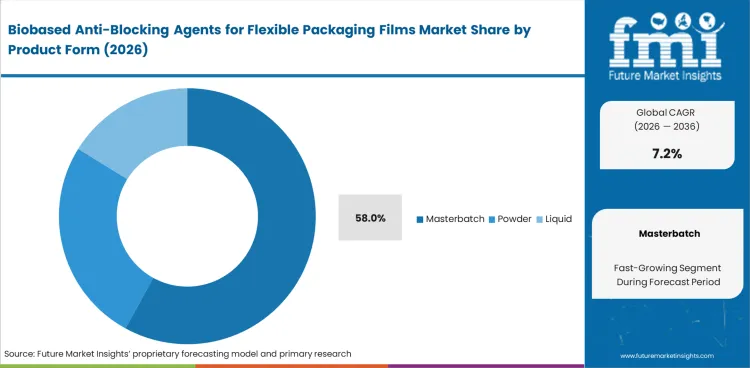
- Masterbatch is expected to account for 58.0% share in 2026 as pellet concentrates support cleaner feeding and steadier additive spread on high-speed film lines.
- Masterbatch supply helps converters reduce handling dust and dosing errors improving repeat film release during winding and pouch conversion.
Insights into the Powder Segment
- Powder grades serve compounders preferring custom blends for smaller production batches and specialty film structures.
- Powder use stays practical for additive premix work, although large converters often prefer pellet systems for cleaner plant handling.
Biobased Anti-Blocking Agents for Flexible Packaging Films Market Analysis by Chemistry Type
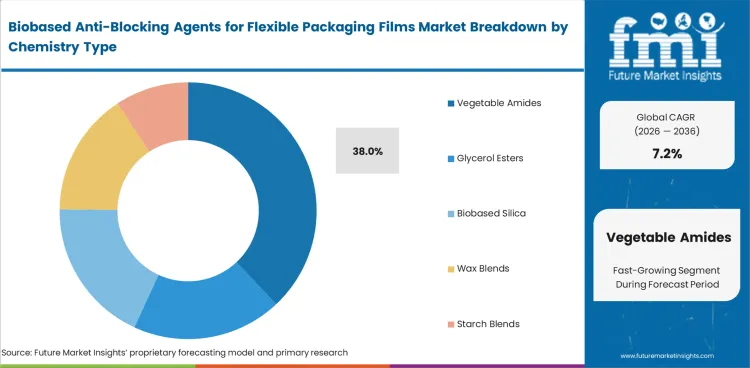
- Existing compatibility of erucamide and behenamide with PE and PP film processing positions vegetable amides at a projected 38.0% share in 2026.
- Film converters use vegetable amides to balance slip and blocking control helping food packs unwind cleanly during packing.
Insights into the Glycerol Esters Segment
- Glycerol esters gain use in films needing softer surface behavior and renewable additive positioning.
- Demand is highest in applications that require moderate release while avoiding heavy mineral loading in the film.
Biobased Anti-Blocking Agents for Flexible Packaging Films Market Analysis by Film Resin
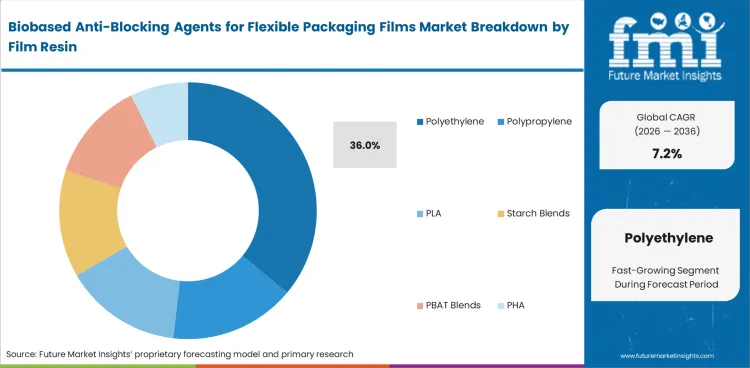
- Polyethylene is projected to capture a 36.0% share in 2026, reflecting its dominance in flexible pouches and retail wrap applications.
- PE film producers need balanced antiblock performance since excess surface activity can affect heat sealing and print quality.
Insights into the PLA Segment
- PLA films create additive needs as transparent bio-based films can block during winding and storage.
- BOPLA development raises the need for low-haze antiblock masterbatches, especially in snack wraps and small compostable packs.
Biobased Anti-Blocking Agents for Flexible Packaging Films Market Analysis by Application
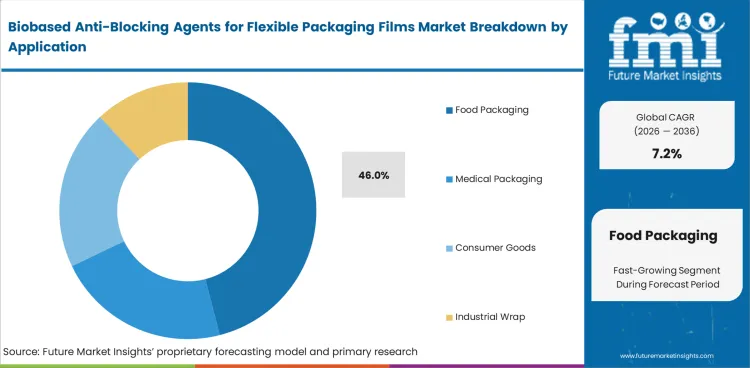
- Food packaging is expected to secure 46.0% share in 2026, led by food-facing films requiring clean unwind and low odor.
- Snack and bakery film converters check antiblock grades closely since haze and seal quality affect pack acceptance.
Insights into the Medical Packaging Segment
- Medical packaging uses biobased antiblock additives more cautiously as qualification and contamination checks are tighter than food packs.
- Suppliers serving this segment need clearer documentation and repeat film behavior before converters approve new additive packs.
Biobased Anti-Blocking Agents for Flexible Packaging Films Market Analysis by Film Process
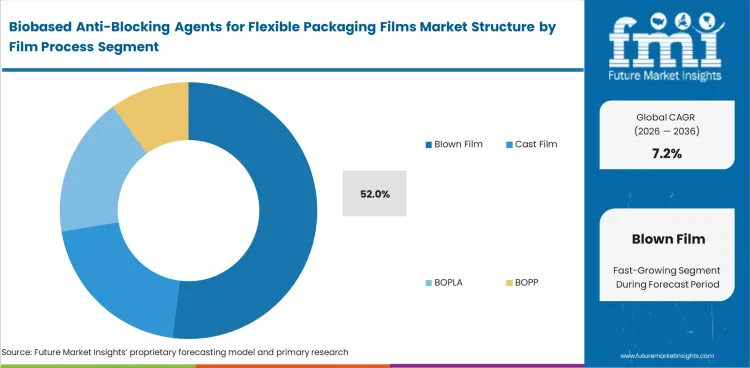
- Blown film is projected to account for 52.0% share in 2026, driven by PE pouch and bag lines adopting this route widely.
- Blown film producers require antiblock control during roll storage avoiding film layers from sticking before printing or sealing.
Insights into the BOPLA Segment
- BOPLA gains attention as compostable transparent films need surface control without losing clarity.
- Additive suppliers with PLA carrier systems influence converters testing compostable packs for snacks and dry foods.
Biobased Anti-Blocking Agents for Flexible Packaging Films Market Analysis by Sales Channel
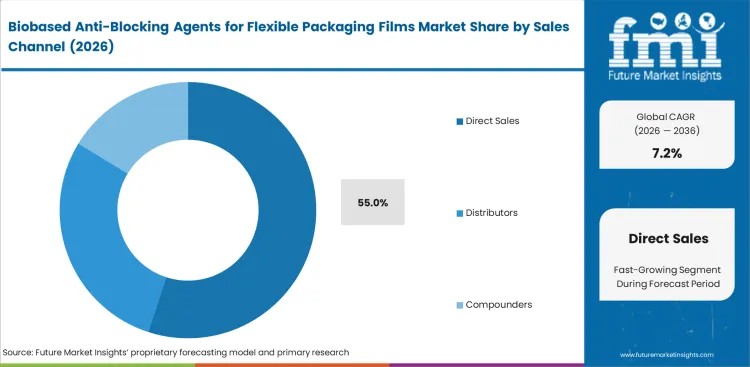
- Direct sales are expected to hold 55.0% share of sales channel demand in 2026 because large converters depend on samples and compliance support before approval.
- Direct supplier contact helps film makers resolve haze and sealing issues during line trials. Dosing settings are handled during the same trial.
Insights into the Distributors Segment
- Distributors serve smaller converters needing faster access to standard antiblock grades and smaller order volumes.
- Distributor demand is expanding among regional film producers with limited lab support and shorter buying cycles.
Biobased Anti-Blocking Agents for Flexible Packaging Films Market Drivers Restraints and Opportunities
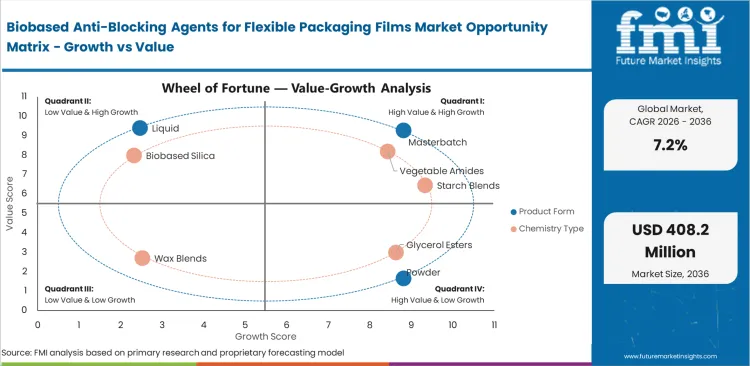
- Food-contact review will favor plant-based additives with clear documentation and repeat film roll performance through 2036.
- Oleochemical price movement will limit use in low-cost films if suppliers cannot prove lower dosage or fewer line issues.
- BOPLA film development creates room for specialty compostable packaging films with tailored anti-block masterbatches.
- Mono-material PE films will add opportunities for additive packs supporting roll release without hurting seal performance.
BOPLA films are creating demand for surface-control additives as converters test clear compostable structures for food packs. Sukano and NatureWorks developed anti-block masterbatches for oriented PLA films with surface roughness options for processing. This supports cleaner winding and secondary processing without reducing the film clarity needed for food packaging. Food-contact documentation adds another approval layer as additives can affect odor and regulatory review in snack and dry food films. Palsgaard’s Einar 987 reflects on how plant-based food-grade additives with worldwide food-contact approval can reduce review friction for PE and PP producers. Cost pressure remains a restraint as many renewable additive routes use vegetable oil-based fatty-acid chemistry. Suppliers with PLA carrier experience and regional sourcing control can defend margins better as film trials move into larger packaging lines.
Import Dependence and Trade Flow Analysis
Import dependence in the biobased anti-blocking agents for flexible packaging films market remains moderate to high as converters depend on cross-border supply of bio-based waxes along with PLA/PHA carriers and mineral blends. European Bioplastics reported global biobased plastics capacity at 2.31 million tonnes in 2025, with capacity projected to reach 4.69 million tonnes by 2030. Packaging accounted for 41.3% of bioplastics applications in 2025, equal to nearly 0.95 million tonnes. The trade-linked packaging base keeps additive sourcing exposed to regional feedstock availability, certification requirements and logistics stability. Supplier qualification is expected to stay concentrated around reliable import channels as film producers prioritize consistent particle size, food-contact compliance and stable roll-separation performance.
Material Switching and Replacement Analysis
Material switching in the biobased anti-blocking agents for flexible packaging films market is shifting toward compostable PLA-based masterbatch systems as converters seek film separation, asset compatibility and regulatory alignment in one material route. Sukano launched its SUKANO Antiblock masterbatch for BOPLA with NatureWorks in October 2025, enabling compostable films to run on existing BOPP equipment with up to 7x transverse direction stretch. This development supports replacement of fossil-based surface modifiers for converters requiring stable winding with larger barrier performance and lower sticking during secondary processing. Adoption is expected to remain selective as film producers balance bio-based material premiums with commercial-scale handling performance and packaging compliance needs.
Regional Analysis
.webp "Top Country Growth Comparison Biobased Anti Blocking Agents For Flexible Packaging Films Market Cagr (2026 2036)")
| Country | CAGR 2026 to 2036 |
|---|---|
| China | 9.1% |
| India | 8.8% |
| United States | 7.2% |
| South Korea | 6.8% |
| Germany | 6.6% |
| United Kingdom | 6.2% |
| Japan | 5.9% |
Source: Future Market Insights analysis based on country demand narratives and public source checks in 2026.
Analysis of Biobased Anti-Blocking Agents for Flexible Packaging Films Market by Key Countries
- China is expected to record the fastest pace at 9.1% CAGR by 2036 as large PE film output and food pouch production raise additive use.
- India is projected to follow at 8.8% CAGR by 2036 as snack packaging growth and local film conversion influence larger masterbatch intake.
- United States demand is projected at 7.2% CAGR by 2036 since recyclable film programs and food-contact checks keep additive trials steady.
- South Korea is expected to advance at 6.8% CAGR by 2036, driven by high-quality pouch films and electronics wraps requiring cleaner surface release.
- Germany at 6.6% CAGR, the United Kingdom at 6.2% CAGR and Japan at 5.9% CAGR expand by 2036 through mature packaging systems and tighter film quality checks.
Country growth differs with film conversion scale and packaging regulation. China leads as large flexible film production supports faster additive intake. India follows as packaged food output and local converter activity rise from a smaller base. United States demand advances through recyclable film trials and food-contact documentation. Germany and the United Kingdom grow through packaging waste rules and retailer checks. South Korea and Japan maintain steadier adoption as converters refine film release and clarity.
Future Outlook for Biobased Anti-Blocking Agents for Flexible Packaging Films in China
Demand for biobased anti-blocking agents for flexible packaging films in China is projected to rise at 9.1% CAGR by 2036 as PE film production and packaged food growth increase additive use. Local converters need masterbatch grades reducing blocking during roll storage and pouch making. China leads the country outlook due to its large film conversion base and steady domestic food packaging supply.
- Large PE film output supports repeat additive use as pouch and wrap producers need stable film release across higher-volume lines.
- Food packaging converters require low-haze antiblock systems protecting clarity during snack and dry food packing.
- Local compounders gain more opportunity to serve film producers needing faster samples and steady additive quality.
Demand Outlook for Biobased Anti-Blocking Agents for Flexible Packaging Films in India
The sector in India is expected to expand at 8.8% CAGR by 2036, led by packaged snacks and flexible pouch production increasing additive demand from a smaller base. Domestic film producers require lower-blocking performance without raising haze or harming sealing behavior. India follows China as converter additions and food packaging growth propel larger masterbatch consumption.
- Packaged snack production supports additive intake as converters supply more pouch films for regional food brands.
- Local film makers use vegetable amide and mineral-based systems to improve roll release during storage and printing.
- Supplier opportunity improves for producers able to offer smaller trial lots and quick support for local film lines.
Industry Outlook for Biobased Anti-Blocking Agents for Flexible Packaging Films in the United States
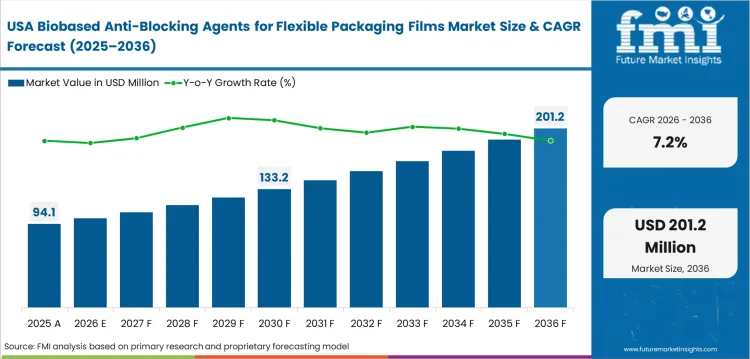
Sales of biobased anti-blocking agents for flexible packaging films in the United States are projected to increase at 7.2% CAGR by 2036, influenced by recyclable film programs sustaining converter trials. Established food packaging producers need additive systems depending on film release and food-contact documentation. United States maintains steady growth through brand-led packaging redesign and stricter compliance review.
- Recyclable PE film projects influence demand for additive packs reducing blocking without hurting sealing performance.
- Food-contact review raises the value of suppliers with clear documentation and repeat batch quality.
- Flexible packaging converters need additives protecting film clarity during high-speed printing and pouch conversion.
Sales Outlook for Biobased Anti-Blocking Agents for Flexible Packaging Films in South Korea
Demand for the sector in South Korea is expected to advance at 6.8% CAGR by 2036 due to premium pouch films and electronics wraps depending on better surface control. Local converters focus on clear film appearance and clean unwinding during packing.
- Premium pouch film production sustains additive introduction as brands require smooth unwinding and low surface haze.
- Electronics wrapping films need controlled slip and blocking resistance to protect surface finish during handling.
- Local converters favor masterbatch suppliers adjusting additive loading without disrupting print or seal quality.
Demand Outlook for Biobased Anti-Blocking Agents for Flexible Packaging Films in Germany
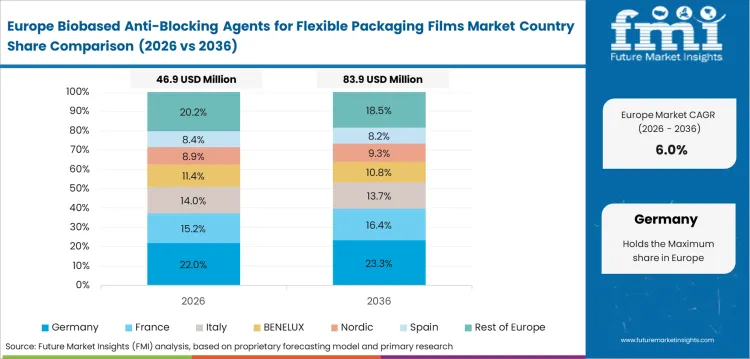
Biobased anti-blocking additive demand in Germany is projected to record 6.6% CAGR by 2036 as packaging waste rules and food film standards influence additive selection. German converters focus on recyclable film structures and clean documentation for food-facing packs.
- Recyclable film work supports additives helping PE structures unwind cleanly during conversion and packing.
- Food packaging producers require low-odor additive systems with dependable film release across repeated production batches.
- Local compounders require stricter test compelling converters to check haze and sealing before additive approval.
Demand Outlook for Biobased Anti-Blocking Agents for Flexible Packaging Films in the United Kingdom
Industry demand in the United Kingdom is forecast to grow at 6.2% CAGR by 2036, reflected by retailer packaging checks and flexible food packs sustaining consistent additive adoption. Local converters depend on antiblock systems supporting recyclable film claims and clean pack appearance. United Kingdom adoption remains steady as retailer-led quality review shapes film material choices.
- Retailer packaging checks influence additive systems with clear documentation and consistent release behavior.
- Food pouch producers use antiblock masterbatches to reduce roll sticking during printing and sealing steps.
- Regional distributors serve smaller converters needing quick access to standard grades and shorter delivery cycles.
Demand Outlook for Biobased Anti-Blocking Agents for Flexible Packaging Films in Japan
The sector in Japan is expected to post 5.9% CAGR by 2036 led by mature packaging production maintaining steady additive adoption. Film makers focus on low haze and controlled surface feel across food wraps and specialty packs. Japan records the slowest pace as replacement activity outweighs large new conversion capacity.
- Mature food packaging demand sustaining steady additive integration in films requiring clean unwinding and clear appearance.
- Japanese converters prefer additives with low odor and stable performance during high-speed pack production.
- Specialty film producers use biobased antiblock systems to refine surface handling without changing established film structures.
Competitive Positioning and Strategic Supplier Strength
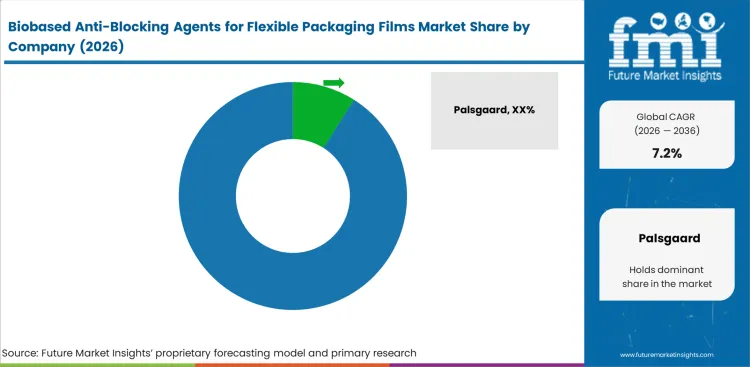
- Competition is focused on food-contact documentation and plant-based additive depth across PE and PP film lines.
- Palsgaard has strength in plant-based food-grade polymer additives for PE and PP film uses.
- Fine Organics competes through vegetable amide chemistry, with Finawax B positioned for polyolefin film anti-blocking performance.
Supplier strength in this sector is shaped by proof on a film line. Food packaging converters approve additives only after roll blocking with haze and odor checks. Palsgaard and Fine Organics use plant-based chemistry routes for polyolefin films. Sukano adds strength in compostable packaging films through BOPLA masterbatch work with NatureWorks. Avient extends coverage through anti-block and slip additive platforms for flexible polyolefin packaging. Emery Oleochemicals supports the adjacent base through renewable polymer additive chemistry. Price alone rarely wins after a converter validates a grade in commercial film output.
Key Companies in the Biobased Anti-Blocking Agents for Flexible Packaging Films Market
Competition spans plant-based additive makers, biopolymer masterbatch specialists and functional polymer additive suppliers.
- Plant-based additive makers: Palsgaard and Fine Organics compete through vegetable-derived chemistry for PP and PE film uses. Their strength comes from food-contact support, odor control and familiarity with film converter qualification steps.
- Biopolymer masterbatch specialists: Sukano and Avient compete through carrier compatibility and film process support. Sukano is largest in PLA and BOPLA additive packs. Avient has a wider color and additive platform for packaging converters.
- Green polymer additive suppliers: Emery Oleochemicals, Cargill Bioindustrial and Ampacet are focusing on renewable additive know-how and regional application support. These suppliers are useful for converters seeking anti-block performance and lower fossil content in film structures.
Competitive Benchmarking: Biobased Anti-Blocking Agents for Flexible Packaging Films Market
| Company | Biobased Chemistry Depth | Film Trial Support | Food-Contact File Strength | Footprint |
|---|---|---|---|---|
| Palsgaard | High | Large | Large | Global |
| Fine Organics | High | Moderate | Large | Asia and Global |
| Sukano | High | Large | Moderate | Europe and North America |
| Avient | Moderate | Large | Large | Global |
| Emery Oleochemicals | High | Large | Moderate | Asia and Global |
| Cargill Bioindustrial | Moderate | Moderate | Large | Global |
| Ampacet | Moderate | Large | Moderate | Global |
Source: Future Market Insights competitive analysis, 2026. Ratings reflect relative positioning based on biobased chemistry depth, film trial support and food-contact file strength.
Key Developments in Biobased Anti-Blocking Agents for Flexible Packaging Films Market
- In April 2024, Emery Oleochemicals opened a Green Polymer Additives application lab in Rayong, Thailand to support regional testing for polymer additives used in packaging.
- In April 2025, Avient presented sustainable colorants and additives at Chinaplas 2025, with non-PFAS process aids and circular material options for packaging and polyolefin films.
- In October 2025, Sukano launched BOPLA masterbatch technology with NatureWorks to support compostable films needing anti-block and barrier performance.
Key Players in the Biobased Anti-Blocking Agents for Flexible Packaging Films Market
Plant-based additive makers
- Palsgaard
- Fine Organics
Biopolymer masterbatch specialists
- Sukano
- Avient
Green polymer additive suppliers
- Emery Oleochemicals
- Cargill Bioindustrial
- Ampacet
Report Scope and Coverage
| Item | Value |
|---|---|
| Market value in 2025 | USD 177.3 million |
| Market value in 2026 | USD 190.0 million |
| Market value in 2036 | USD 380.0 million |
| CAGR from 2026 to 2036 | 7.2% |
| Quantitative units | USD million |
| Market definition | Plant-based or renewable-content anti-blocking additives used in flexible packaging films |
| By product form | Masterbatch, powder, liquid |
| By chemistry type | Vegetable amides, glycerol esters, biobased silica, wax blends, starch blends |
| By film resin | Polyethylene, polypropylene, PLA, starch blends, PBAT blends, PHA |
| By application | Food packaging, medical packaging, consumer goods, industrial wrap |
| By film process | Blown film, Cast film, BOPLA, BOPP |
| By sales channel | Direct sales, distributors, compounders |
| Regions covered | North America, Latin America, Europe, East Asia, South Asia and Pacific, Middle East and Africa |
| Countries covered | China, India, United States, Germany, South Korea, United Kingdom, Japan |
| Companies profiled | Palsgaard, Fine Organics, Sukano, Avient, Emery Oleochemicals, Cargill Bioindustrial, Ampacet |
| Forecast period | 2026 to 2036 |
| Approach | FMI public demand model aligned with product use narratives and company updates |
Source: Future Market Insights analysis, 2026.
Biobased Anti-Blocking Agents for Flexible Packaging Films Market Breakdown by Product Form, Chemistry Type, Film Resin, Application, Film Process, Sales Channel, and Region
Biobased Anti-Blocking Agents for Flexible Packaging Films Market Segmented by Product Form
- Masterbatch
- Powder
- Liquid
Biobased Anti-Blocking Agents for Flexible Packaging Films Market Segmented by Chemistry Type
- Vegetable Amides
- Glycerol Esters
- Biobased Silica
- Wax Blends
- Starch Blends
Biobased Anti-Blocking Agents for Flexible Packaging Films Market Segmented by Film Resin
- Polyethylene
- Polypropylene
- PLA
- Starch Blends
- PBAT Blends
- PHA
Biobased Anti-Blocking Agents for Flexible Packaging Films Market Segmented by Application
- Food Packaging
- Medical Packaging
- Consumer Goods
- Industrial Wrap
Biobased Anti-Blocking Agents for Flexible Packaging Films Market Segmented by Film Process
- Blown Film
- Cast Film
- BOPLA
- BOPP
Biobased Anti-Blocking Agents for Flexible Packaging Films Market Segmented by Sales Channel
- Direct Sales
- Distributors
- Compounders
Biobased Anti-Blocking Agents for Flexible Packaging Films Market by Region
- North America
- United States
- Latin America
- Europe
- Germany
- United Kingdom
- East Asia
- China
- Japan
- South Korea
- South Asia and Pacific
- India
- Middle East and Africa
Research Sources and Bibliography
- Avient Corporation. (2025, April 15). Avient to present a broad array of innovative and sustainable materials solutions at CHINAPLAS 2025.
- Cargill. (n.d.). Anti-block polymer additives. https://www.cargill.com/bioindustrial/polymer-additives/anti-block
- Emery Oleochemicals. (2024, April 22). Emery
- Eurostat. (2025, October 10). Packaging waste statistics.
- European Bioplastics. (2025, December 2). EUBP presents the results of the 2025 market data report.
- European Commission. (2025). Packaging waste.
- German Environment Agency. (2026, January 27). Packaging waste recycling in Germany is working.
- GOV.UK. (2026, February 12). Plastic Packaging Tax: steps to take.
- International Trade Administration. (2025, August 20). Japan recycled plastic materials.
- National Bureau of Statistics of China. (2026, January 20). Industrial production operation in December 2025.
- Palsgaard. (2025, June 10). Palsgaard introduces Einar® 987 anti-fouling additive for the PE and PP polymerisation process.
- Press Information Bureau. (2025, November 16). PLEXCONCIL celebrates 70 years of advancing India’s plastics export industry.
- Sukano. (2025, October 2). Sukano launches breakthrough BOPLA masterbatch technology to enable barrier properties for compostable plastic packaging.
- United Nations Environment Programme. (2025, June 3). How one Korean province is aiming to make plastic pollution history.
The bibliography is provided for reader reference and direct source checking.
This Report Answers
- How large the biobased anti-blocking agents for flexible packaging films sector is in 2026 and how far it can rise by 2036?
- Which product form and chemistry type hold the largest projected share positions in 2026?
- Why masterbatch and vegetable amides hold the clearest lead in current additive structure?
- Why China and India lead the country growth set through 2036?
- How direct sales shape supply access for large flexible film converters?
- Which supplier capabilities help companies defend position in PE and PP film additive supply?
- What packaging regulation and compostable film signals support the forecast method used in this study?
Frequently Asked Questions
How large is the biobased anti-blocking agents for flexible packaging films market in 2026?
The biobased anti-blocking agents for flexible packaging films market is expected to reach USD 190.0 million in 2026.
What will the biobased anti-blocking agents for flexible packaging films market be worth by 2036?
The biobased anti-blocking agents for flexible packaging films market is forecast to reach USD 380.0 million by 2036 as sustainable film additives gain use.
What CAGR is projected for the biobased anti-blocking agents for flexible packaging films market from 2026 to 2036?
The biobased anti-blocking agents for flexible packaging films market is projected to expand at 7.2% CAGR from 2026 to 2036.
Which product form leads the biobased anti-blocking agents for flexible packaging films market?
Masterbatch is expected to lead the biobased anti-blocking agents for flexible packaging films market with 58.0% share in 2026 as pellet dosing supports cleaner film production.
Which application leads the biobased anti-blocking agents for flexible packaging films market?
Food packaging is anticipated to lead the biobased anti-blocking agents for flexible packaging films market with 46.0% share in 2026 as films need smooth unwinding and clear appearance.
Why does China post the fastest biobased anti-blocking agents for flexible packaging films market rise?
China is expected to record 9.1% CAGR by 2036 as large PE film output and food pouch production raise additive use.
Preview the report firsthand - request a free sample
Get SampleGet the brochure for pricing and purchase details.
Get PDFTable of Content
- Executive Summary
- Global Market Outlook
- Demand-side Trends
- Supply-side Trends
- Technology Roadmap Analysis
- Analysis and Recommendations
- Market Overview
- Market Coverage / Taxonomy
- Market Definition / Scope / Limitations
- Research Methodology
- Chapter Orientation
- Analytical Lens and Working Hypotheses
- Market Structure, Signals, and Trend Drivers
- Benchmarking and Cross-market Comparability
- Market Sizing, Forecasting, and Opportunity Mapping
- Research Design and Evidence Framework
- Desk Research Programme (Secondary Evidence)
- Company Annual and Sustainability Reports
- Peer-reviewed Journals and Academic Literature
- Corporate Websites, Product Literature, and Technical Notes
- Earnings Decks and Investor Briefings
- Statutory Filings and Regulatory Disclosures
- Technical White Papers and Standards Notes
- Trade Journals, Industry Magazines, and Analyst Briefs
- Conference Proceedings, Webinars, and Seminar Materials
- Government Statistics Portals and Public Data Releases
- Press Releases and Reputable Media Coverage
- Specialist Newsletters and Curated Briefings
- Sector Databases and Reference Repositories
- FMI Internal Proprietary Databases and Historical Market Datasets
- Subscription Datasets and Paid Sources
- Social Channels, Communities, and Digital Listening Inputs
- Additional Desk Sources
- Expert Input and Fieldwork (Primary Evidence)
- Primary Modes
- Qualitative Interviews and Expert Elicitation
- Quantitative Surveys and Structured Data Capture
- Blended Approach
- Why Primary Evidence is Used
- Field Techniques
- Interviews
- Surveys
- Focus Groups
- Observational and In-context Research
- Social and Community Interactions
- Stakeholder Universe Engaged
- C-suite Leaders
- Board Members
- Presidents and Vice Presidents
- R&D and Innovation Heads
- Technical Specialists
- Domain Subject-matter Experts
- Scientists
- Physicians and Other Healthcare Professionals
- Governance, Ethics, and Data Stewardship
- Research Ethics
- Data Integrity and Handling
- Primary Modes
- Tooling, Models, and Reference Databases
- Desk Research Programme (Secondary Evidence)
- Data Engineering and Model Build
- Data Acquisition and Ingestion
- Cleaning, Normalisation, and Verification
- Synthesis, Triangulation, and Analysis
- Quality Assurance and Audit Trail
- Market Background
- Market Dynamics
- Drivers
- Restraints
- Opportunity
- Trends
- Scenario Forecast
- Demand in Optimistic Scenario
- Demand in Likely Scenario
- Demand in Conservative Scenario
- Opportunity Map Analysis
- Product Life Cycle Analysis
- Supply Chain Analysis
- Investment Feasibility Matrix
- Value Chain Analysis
- PESTLE and Porter’s Analysis
- Regulatory Landscape
- Regional Parent Market Outlook
- Production and Consumption Statistics
- Import and Export Statistics
- Market Dynamics
- Global Market Analysis 2021 to 2025 and Forecast, 2026 to 2036
- Historical Market Size Value (USD Million) Analysis, 2021 to 2025
- Current and Future Market Size Value (USD Million) Projections, 2026 to 2036
- Y-o-Y Growth Trend Analysis
- Absolute $ Opportunity Analysis
- Global Market Pricing Analysis 2021 to 2025 and Forecast 2026 to 2036
- Global Market Analysis 2021 to 2025 and Forecast 2026 to 2036, By Product Form
- Introduction / Key Findings
- Historical Market Size Value (USD Million) Analysis By Product Form , 2021 to 2025
- Current and Future Market Size Value (USD Million) Analysis and Forecast By Product Form , 2026 to 2036
- Masterbatch
- Powder
- Liquid
- Masterbatch
- Y-o-Y Growth Trend Analysis By Product Form , 2021 to 2025
- Absolute $ Opportunity Analysis By Product Form , 2026 to 2036
- Global Market Analysis 2021 to 2025 and Forecast 2026 to 2036, By Chemistry Type
- Introduction / Key Findings
- Historical Market Size Value (USD Million) Analysis By Chemistry Type, 2021 to 2025
- Current and Future Market Size Value (USD Million) Analysis and Forecast By Chemistry Type, 2026 to 2036
- Vegetable Amides
- Glycerol Esters
- Biobased Silica
- Wax Blends
- Starch Blends
- Vegetable Amides
- Y-o-Y Growth Trend Analysis By Chemistry Type, 2021 to 2025
- Absolute $ Opportunity Analysis By Chemistry Type, 2026 to 2036
- Global Market Analysis 2021 to 2025 and Forecast 2026 to 2036, By Film Resin
- Introduction / Key Findings
- Historical Market Size Value (USD Million) Analysis By Film Resin, 2021 to 2025
- Current and Future Market Size Value (USD Million) Analysis and Forecast By Film Resin, 2026 to 2036
- Polyethylene
- Polypropylene
- PLA
- Starch Blends
- PBAT Blends
- PHA
- Polyethylene
- Y-o-Y Growth Trend Analysis By Film Resin, 2021 to 2025
- Absolute $ Opportunity Analysis By Film Resin, 2026 to 2036
- Global Market Analysis 2021 to 2025 and Forecast 2026 to 2036, By Application
- Introduction / Key Findings
- Historical Market Size Value (USD Million) Analysis By Application, 2021 to 2025
- Current and Future Market Size Value (USD Million) Analysis and Forecast By Application, 2026 to 2036
- Food Packaging
- Medical Packaging
- Consumer Goods
- Industrial Wrap
- Food Packaging
- Y-o-Y Growth Trend Analysis By Application, 2021 to 2025
- Absolute $ Opportunity Analysis By Application, 2026 to 2036
- Global Market Analysis 2021 to 2025 and Forecast 2026 to 2036, By Film Process
- Introduction / Key Findings
- Historical Market Size Value (USD Million) Analysis By Film Process, 2021 to 2025
- Current and Future Market Size Value (USD Million) Analysis and Forecast By Film Process, 2026 to 2036
- Blown Film
- Cast Film
- BOPLA
- BOPP
- Blown Film
- Y-o-Y Growth Trend Analysis By Film Process, 2021 to 2025
- Absolute $ Opportunity Analysis By Film Process, 2026 to 2036
- Global Market Analysis 2021 to 2025 and Forecast 2026 to 2036, By Sales Channel
- Introduction / Key Findings
- Historical Market Size Value (USD Million) Analysis By Sales Channel, 2021 to 2025
- Current and Future Market Size Value (USD Million) Analysis and Forecast By Sales Channel, 2026 to 2036
- Direct Sales
- Distributors
- Compounders
- Direct Sales
- Y-o-Y Growth Trend Analysis By Sales Channel, 2021 to 2025
- Absolute $ Opportunity Analysis By Sales Channel, 2026 to 2036
- Global Market Analysis 2021 to 2025 and Forecast 2026 to 2036, By Region
- Introduction
- Historical Market Size Value (USD Million) Analysis By Region, 2021 to 2025
- Current Market Size Value (USD Million) Analysis and Forecast By Region, 2026 to 2036
- North America
- Latin America
- Western Europe
- Eastern Europe
- East Asia
- South Asia and Pacific
- Middle East & Africa
- Market Attractiveness Analysis By Region
- North America Market Analysis 2021 to 2025 and Forecast 2026 to 2036, By Country
- Historical Market Size Value (USD Million) Trend Analysis By Market Taxonomy, 2021 to 2025
- Market Size Value (USD Million) Forecast By Market Taxonomy, 2026 to 2036
- By Country
- USA
- Canada
- Mexico
- By Product Form
- By Chemistry Type
- By Film Resin
- By Application
- By Film Process
- By Sales Channel
- By Country
- Market Attractiveness Analysis
- By Country
- By Product Form
- By Chemistry Type
- By Film Resin
- By Application
- By Film Process
- By Sales Channel
- Key Takeaways
- Latin America Market Analysis 2021 to 2025 and Forecast 2026 to 2036, By Country
- Historical Market Size Value (USD Million) Trend Analysis By Market Taxonomy, 2021 to 2025
- Market Size Value (USD Million) Forecast By Market Taxonomy, 2026 to 2036
- By Country
- Brazil
- Chile
- Rest of Latin America
- By Product Form
- By Chemistry Type
- By Film Resin
- By Application
- By Film Process
- By Sales Channel
- By Country
- Market Attractiveness Analysis
- By Country
- By Product Form
- By Chemistry Type
- By Film Resin
- By Application
- By Film Process
- By Sales Channel
- Key Takeaways
- Western Europe Market Analysis 2021 to 2025 and Forecast 2026 to 2036, By Country
- Historical Market Size Value (USD Million) Trend Analysis By Market Taxonomy, 2021 to 2025
- Market Size Value (USD Million) Forecast By Market Taxonomy, 2026 to 2036
- By Country
- Germany
- UK
- Italy
- Spain
- France
- Nordic
- BENELUX
- Rest of Western Europe
- By Product Form
- By Chemistry Type
- By Film Resin
- By Application
- By Film Process
- By Sales Channel
- By Country
- Market Attractiveness Analysis
- By Country
- By Product Form
- By Chemistry Type
- By Film Resin
- By Application
- By Film Process
- By Sales Channel
- Key Takeaways
- Eastern Europe Market Analysis 2021 to 2025 and Forecast 2026 to 2036, By Country
- Historical Market Size Value (USD Million) Trend Analysis By Market Taxonomy, 2021 to 2025
- Market Size Value (USD Million) Forecast By Market Taxonomy, 2026 to 2036
- By Country
- Russia
- Poland
- Hungary
- Balkan & Baltic
- Rest of Eastern Europe
- By Product Form
- By Chemistry Type
- By Film Resin
- By Application
- By Film Process
- By Sales Channel
- By Country
- Market Attractiveness Analysis
- By Country
- By Product Form
- By Chemistry Type
- By Film Resin
- By Application
- By Film Process
- By Sales Channel
- Key Takeaways
- East Asia Market Analysis 2021 to 2025 and Forecast 2026 to 2036, By Country
- Historical Market Size Value (USD Million) Trend Analysis By Market Taxonomy, 2021 to 2025
- Market Size Value (USD Million) Forecast By Market Taxonomy, 2026 to 2036
- By Country
- China
- Japan
- South Korea
- By Product Form
- By Chemistry Type
- By Film Resin
- By Application
- By Film Process
- By Sales Channel
- By Country
- Market Attractiveness Analysis
- By Country
- By Product Form
- By Chemistry Type
- By Film Resin
- By Application
- By Film Process
- By Sales Channel
- Key Takeaways
- South Asia and Pacific Market Analysis 2021 to 2025 and Forecast 2026 to 2036, By Country
- Historical Market Size Value (USD Million) Trend Analysis By Market Taxonomy, 2021 to 2025
- Market Size Value (USD Million) Forecast By Market Taxonomy, 2026 to 2036
- By Country
- India
- ASEAN
- Australia & New Zealand
- Rest of South Asia and Pacific
- By Product Form
- By Chemistry Type
- By Film Resin
- By Application
- By Film Process
- By Sales Channel
- By Country
- Market Attractiveness Analysis
- By Country
- By Product Form
- By Chemistry Type
- By Film Resin
- By Application
- By Film Process
- By Sales Channel
- Key Takeaways
- Middle East & Africa Market Analysis 2021 to 2025 and Forecast 2026 to 2036, By Country
- Historical Market Size Value (USD Million) Trend Analysis By Market Taxonomy, 2021 to 2025
- Market Size Value (USD Million) Forecast By Market Taxonomy, 2026 to 2036
- By Country
- Kingdom of Saudi Arabia
- Other GCC Countries
- Turkiye
- South Africa
- Other African Union
- Rest of Middle East & Africa
- By Product Form
- By Chemistry Type
- By Film Resin
- By Application
- By Film Process
- By Sales Channel
- By Country
- Market Attractiveness Analysis
- By Country
- By Product Form
- By Chemistry Type
- By Film Resin
- By Application
- By Film Process
- By Sales Channel
- Key Takeaways
- Key Countries Market Analysis
- USA
- Pricing Analysis
- Market Share Analysis, 2025
- By Product Form
- By Chemistry Type
- By Film Resin
- By Application
- By Film Process
- By Sales Channel
- Canada
- Pricing Analysis
- Market Share Analysis, 2025
- By Product Form
- By Chemistry Type
- By Film Resin
- By Application
- By Film Process
- By Sales Channel
- Mexico
- Pricing Analysis
- Market Share Analysis, 2025
- By Product Form
- By Chemistry Type
- By Film Resin
- By Application
- By Film Process
- By Sales Channel
- Brazil
- Pricing Analysis
- Market Share Analysis, 2025
- By Product Form
- By Chemistry Type
- By Film Resin
- By Application
- By Film Process
- By Sales Channel
- Chile
- Pricing Analysis
- Market Share Analysis, 2025
- By Product Form
- By Chemistry Type
- By Film Resin
- By Application
- By Film Process
- By Sales Channel
- Germany
- Pricing Analysis
- Market Share Analysis, 2025
- By Product Form
- By Chemistry Type
- By Film Resin
- By Application
- By Film Process
- By Sales Channel
- UK
- Pricing Analysis
- Market Share Analysis, 2025
- By Product Form
- By Chemistry Type
- By Film Resin
- By Application
- By Film Process
- By Sales Channel
- Italy
- Pricing Analysis
- Market Share Analysis, 2025
- By Product Form
- By Chemistry Type
- By Film Resin
- By Application
- By Film Process
- By Sales Channel
- Spain
- Pricing Analysis
- Market Share Analysis, 2025
- By Product Form
- By Chemistry Type
- By Film Resin
- By Application
- By Film Process
- By Sales Channel
- France
- Pricing Analysis
- Market Share Analysis, 2025
- By Product Form
- By Chemistry Type
- By Film Resin
- By Application
- By Film Process
- By Sales Channel
- India
- Pricing Analysis
- Market Share Analysis, 2025
- By Product Form
- By Chemistry Type
- By Film Resin
- By Application
- By Film Process
- By Sales Channel
- ASEAN
- Pricing Analysis
- Market Share Analysis, 2025
- By Product Form
- By Chemistry Type
- By Film Resin
- By Application
- By Film Process
- By Sales Channel
- Australia & New Zealand
- Pricing Analysis
- Market Share Analysis, 2025
- By Product Form
- By Chemistry Type
- By Film Resin
- By Application
- By Film Process
- By Sales Channel
- China
- Pricing Analysis
- Market Share Analysis, 2025
- By Product Form
- By Chemistry Type
- By Film Resin
- By Application
- By Film Process
- By Sales Channel
- Japan
- Pricing Analysis
- Market Share Analysis, 2025
- By Product Form
- By Chemistry Type
- By Film Resin
- By Application
- By Film Process
- By Sales Channel
- South Korea
- Pricing Analysis
- Market Share Analysis, 2025
- By Product Form
- By Chemistry Type
- By Film Resin
- By Application
- By Film Process
- By Sales Channel
- Russia
- Pricing Analysis
- Market Share Analysis, 2025
- By Product Form
- By Chemistry Type
- By Film Resin
- By Application
- By Film Process
- By Sales Channel
- Poland
- Pricing Analysis
- Market Share Analysis, 2025
- By Product Form
- By Chemistry Type
- By Film Resin
- By Application
- By Film Process
- By Sales Channel
- Hungary
- Pricing Analysis
- Market Share Analysis, 2025
- By Product Form
- By Chemistry Type
- By Film Resin
- By Application
- By Film Process
- By Sales Channel
- Kingdom of Saudi Arabia
- Pricing Analysis
- Market Share Analysis, 2025
- By Product Form
- By Chemistry Type
- By Film Resin
- By Application
- By Film Process
- By Sales Channel
- Turkiye
- Pricing Analysis
- Market Share Analysis, 2025
- By Product Form
- By Chemistry Type
- By Film Resin
- By Application
- By Film Process
- By Sales Channel
- South Africa
- Pricing Analysis
- Market Share Analysis, 2025
- By Product Form
- By Chemistry Type
- By Film Resin
- By Application
- By Film Process
- By Sales Channel
- USA
- Market Structure Analysis
- Competition Dashboard
- Competition Benchmarking
- Market Share Analysis of Top Players
- By Regional
- By Product Form
- By Chemistry Type
- By Film Resin
- By Application
- By Film Process
- By Sales Channel
- Competition Analysis
- Competition Deep Dive
- Palsgaard
- Overview
- Product Portfolio
- Profitability by Market Segments (Product/Age /Sales Channel/Region)
- Sales Footprint
- Strategy Overview
- Marketing Strategy
- Product Strategy
- Channel Strategy
- Fine Organics
- Sukano
- Avient
- Emery Oleochemicals
- Cargill Bioindustrial
- Ampacet
- Palsgaard
- Competition Deep Dive
- Assumptions & Acronyms Used


