

- Industry Size (2026)
- USD 1 Bn
- Forecast (2036)
- USD 2 Bn
- CAGR (2026 to 2036)
- 6.7%
Anti-Blocking Agents for Packaging Films Market Forecast and Outlook 2026 to 2036
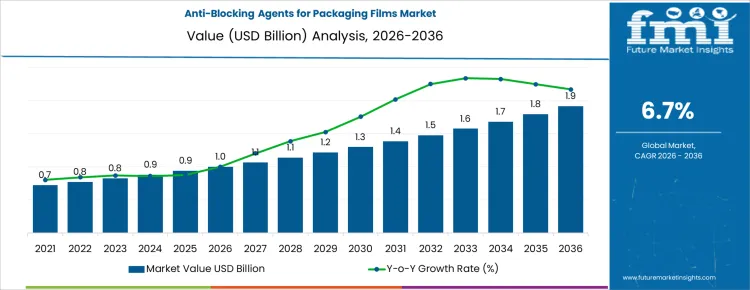
The anti-blocking agents for packaging films market is expected to grow from USD 1 billion in 2026 to USD 2 billion by 2036, reflecting a compound annual growth rate (CAGR) of 6.7%. These agents are used in packaging films to prevent the layers of film from sticking together during production, handling, or storage. With the rising demand for packaging solutions that offer durability, transparency, and ease of handling, anti-blocking agents play a crucial role in enhancing the functionality and performance of films, particularly in food and consumer goods packaging. As consumer goods, e-commerce, and food packaging continue to expand, the adoption of anti-blocking agents is expected to rise, ensuring better product handling and shelf life.
The market growth is further supported by the increasing focus on sustainability and eco-friendly packaging solutions. As industries move toward more recyclable and biodegradable packaging, the demand for anti-blocking agents that maintain the integrity of these new materials without compromising performance is expected to grow. Additionally, the ongoing shift toward high-performance packaging films that combine durability and aesthetic appeal will continue to drive the demand for effective anti-blocking solutions.
Quick Stats of the Anti-Blocking Agents for Packaging Films Market
- Anti-Blocking Agents for Packaging Films Market Value (2026): USD 1 billion
- Anti-Blocking Agents for Packaging Films Market Forecast Value (2036): USD 2 billion
- Anti-Blocking Agents for Packaging Films Market Global Forecast CAGR (2026 to 2036): 6.7%
- Anti-Blocking Agents for Packaging Films Market Leading Segment: Supply Form (Masterbatch) 52%
- Key Growth Regions in Anti-Blocking Agents for Packaging Films Market: China
- Top Players in Anti-Blocking Agents for Packaging Films Market: Imerys, Evonik Industries, OMYA, Minerals Technologies, Sibelco, Ampacet, Clariant, Avient, LyondellBasell, Fuji Silysia Chemical
What is the Growth Forecast for the Anti-Blocking Agents for Packaging Films Market through 2036?
The early vs late growth curve comparison for the anti-blocking agents for packaging films market highlights two distinct phases of growth. Starting at USD 1 billion in 2026, the market grows to USD 1.1 billion in 2027 and USD 1.2 billion in 2028, reflecting gradual expansion as industries increasingly incorporate anti-blocking agents into packaging films. These early years indicate moderate growth driven by steady demand for improved packaging performance and ease of handling in manufacturing processes.
From 2028 to 2030, the market continues to grow, reaching USD 1.2 billion in 2029 and USD 1.3 billion in 2030. This period shows a more consistent growth trajectory, with the adoption of anti-blocking agents becoming more established across various packaging segments. Between 2030 and 2035, the market sees more pronounced acceleration, reaching USD 1.4 billion in 2031, USD 1.5 billion in 2032, and USD 1.6 billion in 2033. By 2035, the market is projected to reach USD 1.7 billion, with the final value of USD 2 billion expected by 2036. This comparison shows that while the market begins with steady, moderate growth, demand accelerates in the later years as innovation in packaging technology and sustainability efforts further increase the need for anti-blocking agents.
Anti-Blocking Agents for Packaging Films Market Key Takeaways
| Metric | Value |
|---|---|
| Industry Sales Value (2026) | USD 1 billion |
| Industry Forecast Value (2036) | USD 2 billion |
| Industry Forecast CAGR (2026 to 2036) | 6.7% |
What Is Driving the Demand for the Anti-Blocking Agents for Packaging Films Market Globally?
The global demand for anti-blocking agents for packaging films is driven by growth in flexible packaging applications across food and beverage, pharmaceuticals, consumer goods and industrial segments, where processing performance and package quality are critical. Anti-blocking agents are additives incorporated into polymer films-such as polyethylene, polypropylene, PET and co extruded structures-to prevent the tacky surfaces of adjacent film layers from sticking together during production, storage and end use. As packaging converters and brand owners push for higher line speeds, thinner films, and improved clarity and printability, formulation challenges such as blocking become more pronounced.
Anti-blocking agents help maintain film handling performance, improve machinability on high speed filling lines, and preserve aesthetic quality by reducing haze and surface imperfections. Growth in convenience products, portioned foods, and retail packaging formats that rely on multilayer films or high barrier structures further reinforces the need for reliable anti-blocking solutions that support both manufacturing efficiency and product protection. Consumer expectations for clean, defect free packaging that conveys freshness and quality also contribute to widespread adoption of performance enhancing additives in film formulations.
Future demand for anti-blocking agents is expected to increase as packaging innovation and sustainability priorities evolve worldwide. Advances in additive technology-such as development of particles with tailored size, shape, and surface chemistry-will improve performance in thinner, multi layer, and high clarity films while supporting recyclability and compatibility with recycling streams. Regulatory emphasis on food contact safety and environmental impact will influence additive selection, encouraging use of materials with verified safety and lower ecological footprint.
Growth in e commerce and automated packaging operations will sustain pressure on film performance, heightening the need for robust anti-blocking systems that reduce downtime and waste. Expansion of packaging applications in emerging markets, combined with rising middle class consumption of convenience and packaged goods, will broaden the addressable base for performance additives. Sustainability trends may also drive innovation in bio based or engineered mineral anti-blocking agents that align with circular material goals. As global packaging value chains balance performance, cost, and environmental priorities, demand for advanced anti-blocking agents that deliver consistent quality and process reliability is expected to grow steadily.
What are the Leading Segments in the Global Anti-Blocking Agents for Packaging Films Market?
The global anti-blocking agents for packaging films market is segmented by supply form and application. Among supply forms, masterbatch leads the market, accounting for 52% of the share, followed by powder, compounded concentrates, and slurry/dispersion. Masterbatch is preferred for its ease of incorporation into packaging films and its ability to improve processing efficiency.
On the application side, food packaging is the largest segment, representing 42% of the market share, followed by consumer non-food packaging, industrial stretch/shrink films, agricultural films, and medical/pharma packaging. The growth of the market is driven by the increasing demand for packaging solutions that enhance film performance, reduce blocking, and maintain product integrity during storage and transport.
What Drives the Growth of Masterbatch in the Anti-Blocking Agents for Packaging Films Market?
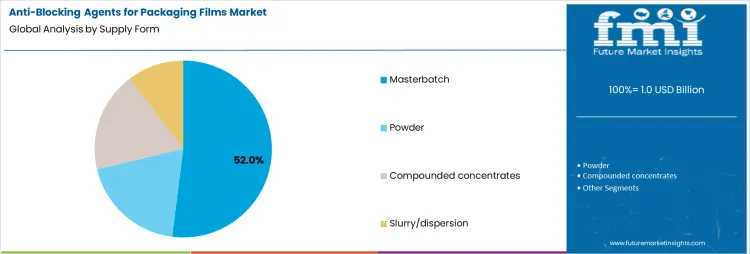
Masterbatch is the dominant supply form in the anti-blocking agents for packaging films market, capturing 52% of the share. This is largely due to the advantages offered by masterbatch in improving the processing and performance of packaging films. Masterbatch allows for easy, uniform distribution of anti-blocking agents in the polymer matrix, ensuring that the films remain free from blocking during storage and handling. This feature is particularly important for packaging applications that require smooth and efficient processing, such as food packaging and consumer non-food packaging.
The growing demand for transparent, easy-to-handle films that prevent sticking and ensure smooth film handling during production and packaging has boosted the popularity of masterbatch. Additionally, masterbatch formulations are adaptable and can be tailored for specific types of films, including polyolefins, PET, and other polymers, which further supports their widespread use in packaging applications. The preference for masterbatch is also driven by its cost-effectiveness, ease of use, and the ability to achieve consistent performance. As the packaging industry continues to prioritize efficiency and performance, the demand for masterbatch anti-blocking agents is expected to remain strong, maintaining its leading position in the market.
What is Driving the Demand for Food Packaging in the Anti-Blocking Agents for Packaging Films Market?
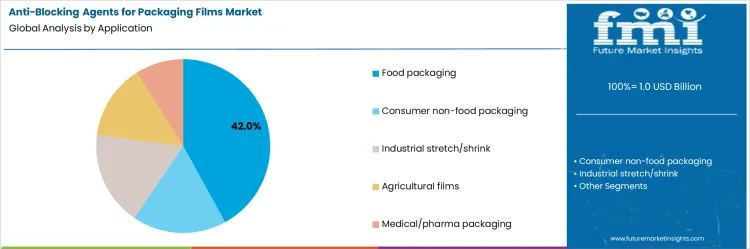
Food packaging is the leading application in the anti-blocking agents for packaging films market, accounting for 42% of the share. The demand for anti-blocking agents in food packaging is driven by the need for packaging materials that maintain product quality, integrity, and ease of use. Anti-blocking agents prevent the sticking or blocking of films during storage, transportation, and handling, ensuring that food packaging remains functional and attractive. These agents are crucial in packaging films that require smooth surfaces, such as those used in the packaging of fresh produce, meats, and ready-to-eat meals. As food packaging increasingly shifts toward materials that provide longer shelf life, enhanced durability, and ease of handling, the use of anti-blocking agents has become essential.
The growing focus on food safety, convenience, and the demand for more sustainable packaging solutions further supports the increased adoption of anti-blocking agents in food packaging. Additionally, with the rise of e-commerce and home delivery services, the need for efficient packaging that protects food products during transport and ensures a high-quality presentation at the point of sale is driving market growth. The increasing focus on reducing waste, along with the demand for high-performance packaging films, ensures that food packaging will remain a dominant application segment in the anti-blocking agents market.
What are the Key Dynamics of the Global Anti-Blocking Agents for Packaging Films Market?
The global anti-blocking agents for packaging films market is growing as manufacturers focus on improving film handling, processing efficiency and end use performance. Anti-blocking agents are incorporated into polymer film surfaces to prevent layers from sticking together, which helps during printing, converting and consumer use. Demand spans food packaging, medical films, industrial wrapping and flexible retail packaging where clarity, slip and processing reliability matter. Growth reflects expansion of flexible packaging, rising quality standards, and interest in additives that support smoother production workflows and better consumer experience across regions.
What are the Key Drivers for the Global Anti-Blocking Agents for Packaging Films Market?
Increasing production of flexible packaging materials motivates use of anti-blocking agents to maintain film separation and prevent defects during high speed processing. Film converters and brand owners prioritizing efficient converting, printing and lamination adopt performance enhancers that minimize machine stoppages and waste. Demand for packaging with high optical clarity, good surface slip and better tactile feel supports adoption of tailored additive systems. Growth in sectors like food and beverage, personal care, pharmaceuticals and e commerce drives need for high quality films with consistent performance from production to end use.
What are the Restraints for the Global Anti-Blocking Agents for Packaging Films Market?
One restraint is formulation complexity, as additive load and particle size must be optimized to deliver anti-blocking performance without negatively affecting film clarity or seal integrity. Some high performance anti-blocking agents may add cost, which can affect pricing in value oriented market segments and influence material selection. Variability in polymer types and processing conditions requires careful testing to ensure compatibility, which increases development cycles for converters. Regulatory scrutiny and varying compliance requirements for additives in food contact applications also require documentation and validation that can slow product rollout in certain regions.
What are the Key Trends in the Global Anti-Blocking Agents for Packaging Films Market?
A key trend is development of engineered additive systems that balance anti-blocking performance with transparency and surface slip, supporting premium film applications. Suppliers are focusing on nano and micro scale materials that deliver controlled surface modification while preserving optical properties. Bio based and environmentally sourced agents that align with sustainability goals are gaining interest as brands emphasize greener packaging solutions. Collaboration between additive producers and film manufacturers accelerates tailored solutions that address specific processing challenges. Adoption of low migration agents for sensitive applications and advances in dispersion technologies help expand use in food, medical and high barrier film structures globally.
What is the Country-Wise Analysis of the Anti-Blocking Agents for Packaging Films Market?
The anti-blocking agents for packaging films market is projected to grow steadily, driven by increasing demand for high-performance packaging solutions across various industries, including food and beverage, pharmaceuticals, and consumer goods. These agents are essential in preventing packaging films from sticking together during production and storage, enhancing their performance and ease of handling.
As consumer demand for durable, efficient, and sustainable packaging rises, the adoption of anti-blocking agents is increasing. High-growth markets like China are seeing significant demand, driven by industrial growth and an expanding packaging sector. Developed markets such as the USA, UK, and Germany are experiencing steady growth, supported by advancements in packaging technologies and the growing need for high-quality, versatile packaging solutions.
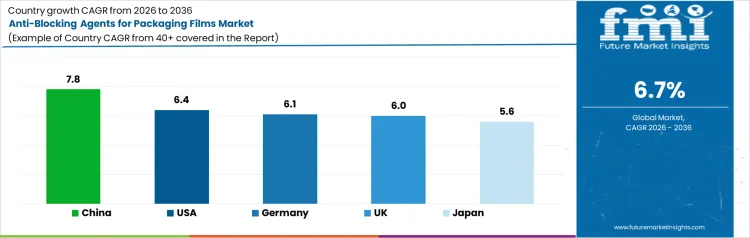
| Country | CAGR (2026-2036) |
|---|---|
| China | 7.8% |
| United States | 6.4% |
| United Kingdom | 6% |
| Germany | 6.1% |
| Japan | 5.6% |
What is the Growth Outlook for the Anti-Blocking Agents for Packaging Films Market in China?
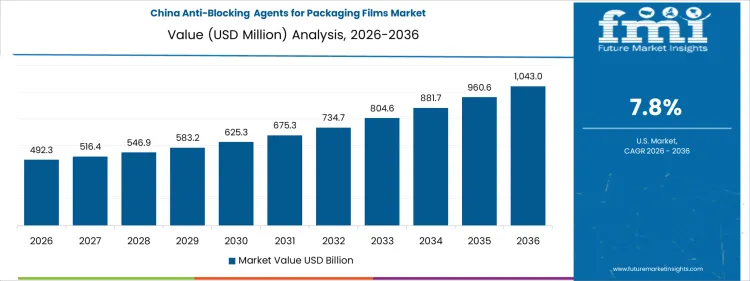
The anti-blocking agents for packaging films market in China is expected to grow at the highest rate, with a projected CAGR of 7.8%. China’s rapid industrialization, expanding packaging sector, and increasing consumer demand for high-performance packaging solutions are driving the growth of this market. The demand for anti-blocking agents is particularly strong in the food and beverage, pharmaceutical, and consumer goods industries, where efficient and durable packaging is essential. As China continues to prioritize technological advancements and sustainability in manufacturing, the adoption of anti-blocking agents is expected to rise. With the country’s large consumer base and growing middle class, China is set to lead the global market for anti-blocking agents in packaging films.
What is the Market Outlook for the Anti-Blocking Agents for Packaging Films Market in the United States?
The anti-blocking agents for packaging films market in the United States is projected to grow steadily, with a projected CAGR of 6.4%. The USA is one of the largest markets for packaging films, with strong demand from sectors such as food packaging, pharmaceuticals, and consumer goods. As the need for high-performance, efficient, and sustainable packaging solutions increases, anti-blocking agents are becoming essential in the production of packaging films. The USA market is also influenced by consumer demand for eco-friendly packaging, with a growing preference for products that reduce environmental impact. The steady growth of e-commerce and retail packaging further supports the increasing adoption of anti-blocking agents. As the market continues to evolve, the demand for these agents is expected to grow in line with broader packaging industry trends.
What is the Growth Forecast for the Anti-Blocking Agents for Packaging Films Market in the United Kingdom?
The anti-blocking agents for packaging films market in the United Kingdom is expected to grow at a moderate pace, with a projected CAGR of 6%. The UK’s packaging sector is increasingly focused on sustainability and high-performance solutions. As the demand for eco-friendly and efficient packaging solutions rises, anti-blocking agents are becoming an essential component in the production of packaging films, particularly in industries such as food, pharmaceuticals, and cosmetics. With growing consumer demand for packaging that is both functional and environmentally responsible, the UK market for anti-blocking agents is expected to see steady growth. Additionally, increasing regulatory pressure on packaging sustainability is likely to further boost the demand for anti-blocking agents in the coming years.
What is the Market Outlook for the Anti-Blocking Agents for Packaging Films Market in Germany?
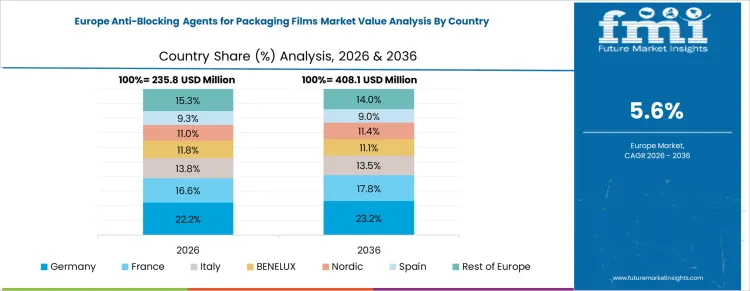
The anti-blocking agents for packaging films market in Germany is projected to grow at a steady pace, with a projected CAGR of 6.1%. Germany’s strong focus on sustainability and high-quality manufacturing is driving the demand for efficient and eco-friendly packaging solutions. The need for anti-blocking agents in packaging films is increasing across various sectors, including food packaging, pharmaceuticals, and consumer goods, as companies seek to improve packaging performance and reduce environmental impact. Germany’s robust regulatory environment, which encourages the use of sustainable and safe materials, is further fueling the demand for anti-blocking agents. As the packaging industry continues to innovate and prioritize sustainability, the German market for anti-blocking agents is expected to experience steady growth.
What are the Growth Prospects for the Anti-Blocking Agents for Packaging Films Market in Japan?
The anti-blocking agents for packaging films market in Japan is expected to grow at a moderate pace, with a projected CAGR of 5.6%. Japan’s well-established packaging sector, particularly in food, pharmaceuticals, and consumer goods, is increasingly adopting advanced additives like anti-blocking agents to improve packaging efficiency and performance. The growing demand for high-quality, sustainable packaging solutions is pushing the adoption of these agents. Japan’s focus on environmental sustainability, along with rising consumer expectations for both performance and eco-friendliness in packaging, is contributing to steady market growth. Despite a relatively slower growth rate compared to other regions, Japan’s market for anti-blocking agents will continue to expand as demand for functional, high-performance packaging solutions increases.
What is the Competitive Landscape for the Anti-Blocking Agents for Packaging Films Market?
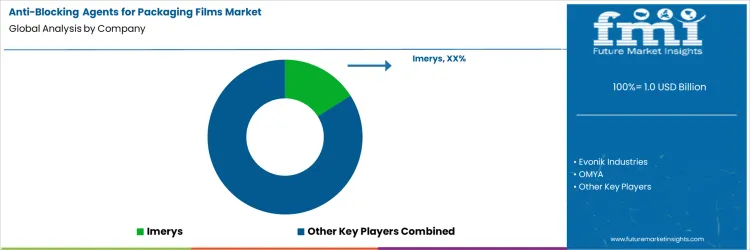
The anti-blocking agents for packaging films market is growing as manufacturers seek solutions to prevent the sticking or blocking of films, improving packaging performance. Imerys leads the market with its advanced anti-blocking agents, offering high-quality mineral-based solutions that improve the flow and handling of packaging films. Their focus on innovation and product quality positions them as a dominant player in the market. Evonik Industries, OMYA, and Minerals Technologies are major competitors, providing specialized anti-blocking agents that enhance film processing and reduce friction. Evonik Industries offers a range of anti-blocking agents designed for improved film performance, while OMYA and Minerals Technologies supply high-performance mineral-based solutions that meet the growing demand for efficient packaging.
Sibelco, Ampacet, Clariant, Avient, LyondellBasell, and Fuji Silysia Chemical contribute further to the competitive landscape by offering a variety of anti-blocking agents tailored for different packaging applications. Sibelco focuses on sustainable and effective mineral-based agents, while Ampacet offers innovative additives to enhance packaging films' functionality. Clariant and Avient specialize in providing advanced anti-blocking agents that improve the handling and efficiency of films, while LyondellBasell and Fuji Silysia Chemical bring their expertise in producing high-performance additives for packaging. These companies compete based on product innovation, sustainability, and the ability to provide reliable anti-blocking solutions that enhance the overall performance of packaging films.
Key Players of the Anti-Blocking Agents for Packaging Films Market
- Imerys
- Evonik Industries
- OMYA
- Minerals Technologies
- Sibelco
- Ampacet
- Clariant
- Avient
- LyondellBasell
- Fuji Silysia Chemical
Scope of the Report
| Items | Values |
|---|---|
| Quantitative Units (2026) | USD Billion |
| Additive Type | Silica Anti-Block, Talc-Based Anti-Block, Calcium Carbonate, Amide/Wax Anti-Block, Others |
| Film Polymer | PE/LLDPE Films, PP/BOPP Films, PET/BOPET Films, PLA & Bio-Based Films, Multilayer/Others |
| Supply Form | Masterbatch, Powder, Compounded Concentrates, Slurry/Dispersion |
| Application | Food Packaging, Consumer Non-Food Packaging, Industrial Stretch/Shrink, Agricultural Films, Medical/Pharma Packaging |
| Companies | Imerys, Evonik Industries, OMYA, Minerals Technologies, Sibelco, Ampacet, Clariant, Avient, LyondellBasell, Fuji Silysia Chemical |
| Regions Covered | North America, Latin America, Western Europe, Eastern Europe, South Asia and Pacific, East Asia, Middle East & Africa |
| Countries Covered | United States, Canada, Mexico, Brazil, Argentina, Germany, France, United Kingdom, Italy, Spain, Netherlands, China, India, Japan, South Korea, ANZ, GCC Countries, South Africa |
| Additional Attributes | Dollar by sales by additive type, film polymer, supply form, application, and region. Includes market trends in anti-blocking agents for packaging films, focusing on silica, talc-based, calcium carbonate, and amide/wax additives. Highlights the role of masterbatch, powder, and compounded concentrates in food, consumer packaging, and industrial applications. Focus on cost-effectiveness, sustainability, regulatory compliance, market share, and competitive positioning of key companies in the packaging additives market. |
Anti-Blocking Agents for Packaging Films Market Segmentation
By Additive Type:
- Silica anti-block
- Talc-based anti-block
- Calcium carbonate
- Amide/wax anti-block
- Others
By Film Polymer:
- PE/LLDPE films
- PP/BOPP films
- PET/BOPET films
- PLA & bio-based films
- Multilayer/others
By Supply Form:
- Masterbatch
- Powder
- Compounded concentrates
- Slurry/dispersion
By Application:
- Food packaging
- Consumer non-food packaging
- Industrial stretch/shrink
- Agricultural films
- Medical/pharma packaging
By Region:
- Asia Pacific
- China
- Japan
- South Korea
- India
- Australia & New Zealand
- ASEAN
- Rest of Asia Pacific
- Europe
- Germany
- United Kingdom
- France
- Italy
- Spain
- Nordic
- BENELUX
- Rest of Europe
- North America
- United States
- Canada
- Mexico
- Latin America
- Brazil
- Chile
- Rest of Latin America
- Middle East & Africa
- Kingdom of Saudi Arabia
- Other GCC Countries
- Turkey
- South Africa
- Other African Union
- Rest of Middle East & Africa
Frequently Asked Questions
How big is the anti-blocking agents for packaging films market in 2026?
The global anti-blocking agents for packaging films market is estimated to be valued at USD 1.0 billion in 2026.
What will be the size of anti-blocking agents for packaging films market in 2036?
The market size for the anti-blocking agents for packaging films market is projected to reach USD 1.9 billion by 2036.
How much will be the anti-blocking agents for packaging films market growth between 2026 and 2036?
The anti-blocking agents for packaging films market is expected to grow at a 6.7% CAGR between 2026 and 2036.
What are the key product types in the anti-blocking agents for packaging films market?
The key product types in anti-blocking agents for packaging films market are silica anti-block, talc-based anti-block, calcium carbonate, amide/wax anti-block and others.
Which film polymer segment to contribute significant share in the anti-blocking agents for packaging films market in 2026?
In terms of film polymer, pe/lldpe films segment to command 40.0% share in the anti-blocking agents for packaging films market in 2026.
Preview the report firsthand - request a free sample
Get SampleGet the brochure for pricing and purchase details.
Get PDFTable of Content
- Executive Summary
- Global Market Outlook
- Demand-side Trends
- Supply-side Trends
- Technology Roadmap Analysis
- Analysis and Recommendations
- Market Overview
- Market Coverage / Taxonomy
- Market Definition / Scope / Limitations
- Market Background
- Market Dynamics
- Drivers
- Restraints
- Opportunity
- Trends
- Scenario Forecast
- Demand in Optimistic Scenario
- Demand in Likely Scenario
- Demand in Conservative Scenario
- Opportunity Map Analysis
- Product Life Cycle Analysis
- Supply Chain Analysis
- Investment Feasibility Matrix
- Value Chain Analysis
- PESTLE and Porter’s Analysis
- Regulatory Landscape
- Regional Parent Market Outlook
- Production and Consumption Statistics
- Import and Export Statistics
- Market Dynamics
- Global Market Analysis 2021 to 2025 and Forecast, 2026 to 2036
- Historical Market Size Value (USD Million) Analysis, 2021 to 2025
- Current and Future Market Size Value (USD Million) Projections, 2026 to 2036
- Y-o-Y Growth Trend Analysis
- Absolute $ Opportunity Analysis
- Global Market Pricing Analysis 2021 to 2025 and Forecast 2026 to 2036
- Global Market Analysis 2021 to 2025 and Forecast 2026 to 2036, By Additive Type
- Introduction / Key Findings
- Historical Market Size Value (USD Million) Analysis By Additive Type , 2021 to 2025
- Current and Future Market Size Value (USD Million) Analysis and Forecast By Additive Type , 2026 to 2036
- Silica anti-block
- Talc-based anti-block
- Calcium carbonate
- Amide/wax anti-block
- Others
- Y-o-Y Growth Trend Analysis By Additive Type , 2021 to 2025
- Absolute $ Opportunity Analysis By Additive Type , 2026 to 2036
- Global Market Analysis 2021 to 2025 and Forecast 2026 to 2036, By Film Polymer
- Introduction / Key Findings
- Historical Market Size Value (USD Million) Analysis By Film Polymer, 2021 to 2025
- Current and Future Market Size Value (USD Million) Analysis and Forecast By Film Polymer, 2026 to 2036
- PE/LLDPE films
- PP/BOPP films
- PET/BOPET films
- PLA & bio-based films
- Multilayer/others
- Y-o-Y Growth Trend Analysis By Film Polymer, 2021 to 2025
- Absolute $ Opportunity Analysis By Film Polymer, 2026 to 2036
- Global Market Analysis 2021 to 2025 and Forecast 2026 to 2036, By Supply Form
- Introduction / Key Findings
- Historical Market Size Value (USD Million) Analysis By Supply Form, 2021 to 2025
- Current and Future Market Size Value (USD Million) Analysis and Forecast By Supply Form, 2026 to 2036
- Masterbatch
- Powder
- Compounded concentrates
- Slurry/dispersion
- Y-o-Y Growth Trend Analysis By Supply Form, 2021 to 2025
- Absolute $ Opportunity Analysis By Supply Form, 2026 to 2036
- Global Market Analysis 2021 to 2025 and Forecast 2026 to 2036, By Application
- Introduction / Key Findings
- Historical Market Size Value (USD Million) Analysis By Application, 2021 to 2025
- Current and Future Market Size Value (USD Million) Analysis and Forecast By Application, 2026 to 2036
- Food packaging
- Consumer non-food packaging
- Industrial stretch/shrink
- Agricultural films
- Medical/pharma packaging
- Y-o-Y Growth Trend Analysis By Application, 2021 to 2025
- Absolute $ Opportunity Analysis By Application, 2026 to 2036
- Global Market Analysis 2021 to 2025 and Forecast 2026 to 2036, By Region
- Introduction
- Historical Market Size Value (USD Million) Analysis By Region, 2021 to 2025
- Current Market Size Value (USD Million) Analysis and Forecast By Region, 2026 to 2036
- North America
- Latin America
- Western Europe
- Eastern Europe
- East Asia
- South Asia and Pacific
- Middle East & Africa
- Market Attractiveness Analysis By Region
- North America Market Analysis 2021 to 2025 and Forecast 2026 to 2036, By Country
- Historical Market Size Value (USD Million) Trend Analysis By Market Taxonomy, 2021 to 2025
- Market Size Value (USD Million) Forecast By Market Taxonomy, 2026 to 2036
- By Country
- USA
- Canada
- Mexico
- By Additive Type
- By Film Polymer
- By Supply Form
- By Application
- By Country
- Market Attractiveness Analysis
- By Country
- By Additive Type
- By Film Polymer
- By Supply Form
- By Application
- Key Takeaways
- Latin America Market Analysis 2021 to 2025 and Forecast 2026 to 2036, By Country
- Historical Market Size Value (USD Million) Trend Analysis By Market Taxonomy, 2021 to 2025
- Market Size Value (USD Million) Forecast By Market Taxonomy, 2026 to 2036
- By Country
- Brazil
- Chile
- Rest of Latin America
- By Additive Type
- By Film Polymer
- By Supply Form
- By Application
- By Country
- Market Attractiveness Analysis
- By Country
- By Additive Type
- By Film Polymer
- By Supply Form
- By Application
- Key Takeaways
- Western Europe Market Analysis 2021 to 2025 and Forecast 2026 to 2036, By Country
- Historical Market Size Value (USD Million) Trend Analysis By Market Taxonomy, 2021 to 2025
- Market Size Value (USD Million) Forecast By Market Taxonomy, 2026 to 2036
- By Country
- Germany
- UK
- Italy
- Spain
- France
- Nordic
- BENELUX
- Rest of Western Europe
- By Additive Type
- By Film Polymer
- By Supply Form
- By Application
- By Country
- Market Attractiveness Analysis
- By Country
- By Additive Type
- By Film Polymer
- By Supply Form
- By Application
- Key Takeaways
- Eastern Europe Market Analysis 2021 to 2025 and Forecast 2026 to 2036, By Country
- Historical Market Size Value (USD Million) Trend Analysis By Market Taxonomy, 2021 to 2025
- Market Size Value (USD Million) Forecast By Market Taxonomy, 2026 to 2036
- By Country
- Russia
- Poland
- Hungary
- Balkan & Baltic
- Rest of Eastern Europe
- By Additive Type
- By Film Polymer
- By Supply Form
- By Application
- By Country
- Market Attractiveness Analysis
- By Country
- By Additive Type
- By Film Polymer
- By Supply Form
- By Application
- Key Takeaways
- East Asia Market Analysis 2021 to 2025 and Forecast 2026 to 2036, By Country
- Historical Market Size Value (USD Million) Trend Analysis By Market Taxonomy, 2021 to 2025
- Market Size Value (USD Million) Forecast By Market Taxonomy, 2026 to 2036
- By Country
- China
- Japan
- South Korea
- By Additive Type
- By Film Polymer
- By Supply Form
- By Application
- By Country
- Market Attractiveness Analysis
- By Country
- By Additive Type
- By Film Polymer
- By Supply Form
- By Application
- Key Takeaways
- South Asia and Pacific Market Analysis 2021 to 2025 and Forecast 2026 to 2036, By Country
- Historical Market Size Value (USD Million) Trend Analysis By Market Taxonomy, 2021 to 2025
- Market Size Value (USD Million) Forecast By Market Taxonomy, 2026 to 2036
- By Country
- India
- ASEAN
- Australia & New Zealand
- Rest of South Asia and Pacific
- By Additive Type
- By Film Polymer
- By Supply Form
- By Application
- By Country
- Market Attractiveness Analysis
- By Country
- By Additive Type
- By Film Polymer
- By Supply Form
- By Application
- Key Takeaways
- Middle East & Africa Market Analysis 2021 to 2025 and Forecast 2026 to 2036, By Country
- Historical Market Size Value (USD Million) Trend Analysis By Market Taxonomy, 2021 to 2025
- Market Size Value (USD Million) Forecast By Market Taxonomy, 2026 to 2036
- By Country
- Kingdom of Saudi Arabia
- Other GCC Countries
- Turkiye
- South Africa
- Other African Union
- Rest of Middle East & Africa
- By Additive Type
- By Film Polymer
- By Supply Form
- By Application
- By Country
- Market Attractiveness Analysis
- By Country
- By Additive Type
- By Film Polymer
- By Supply Form
- By Application
- Key Takeaways
- Key Countries Market Analysis
- USA
- Pricing Analysis
- Market Share Analysis, 2025
- By Additive Type
- By Film Polymer
- By Supply Form
- By Application
- Canada
- Pricing Analysis
- Market Share Analysis, 2025
- By Additive Type
- By Film Polymer
- By Supply Form
- By Application
- Mexico
- Pricing Analysis
- Market Share Analysis, 2025
- By Additive Type
- By Film Polymer
- By Supply Form
- By Application
- Brazil
- Pricing Analysis
- Market Share Analysis, 2025
- By Additive Type
- By Film Polymer
- By Supply Form
- By Application
- Chile
- Pricing Analysis
- Market Share Analysis, 2025
- By Additive Type
- By Film Polymer
- By Supply Form
- By Application
- Germany
- Pricing Analysis
- Market Share Analysis, 2025
- By Additive Type
- By Film Polymer
- By Supply Form
- By Application
- UK
- Pricing Analysis
- Market Share Analysis, 2025
- By Additive Type
- By Film Polymer
- By Supply Form
- By Application
- Italy
- Pricing Analysis
- Market Share Analysis, 2025
- By Additive Type
- By Film Polymer
- By Supply Form
- By Application
- Spain
- Pricing Analysis
- Market Share Analysis, 2025
- By Additive Type
- By Film Polymer
- By Supply Form
- By Application
- France
- Pricing Analysis
- Market Share Analysis, 2025
- By Additive Type
- By Film Polymer
- By Supply Form
- By Application
- India
- Pricing Analysis
- Market Share Analysis, 2025
- By Additive Type
- By Film Polymer
- By Supply Form
- By Application
- ASEAN
- Pricing Analysis
- Market Share Analysis, 2025
- By Additive Type
- By Film Polymer
- By Supply Form
- By Application
- Australia & New Zealand
- Pricing Analysis
- Market Share Analysis, 2025
- By Additive Type
- By Film Polymer
- By Supply Form
- By Application
- China
- Pricing Analysis
- Market Share Analysis, 2025
- By Additive Type
- By Film Polymer
- By Supply Form
- By Application
- Japan
- Pricing Analysis
- Market Share Analysis, 2025
- By Additive Type
- By Film Polymer
- By Supply Form
- By Application
- South Korea
- Pricing Analysis
- Market Share Analysis, 2025
- By Additive Type
- By Film Polymer
- By Supply Form
- By Application
- Russia
- Pricing Analysis
- Market Share Analysis, 2025
- By Additive Type
- By Film Polymer
- By Supply Form
- By Application
- Poland
- Pricing Analysis
- Market Share Analysis, 2025
- By Additive Type
- By Film Polymer
- By Supply Form
- By Application
- Hungary
- Pricing Analysis
- Market Share Analysis, 2025
- By Additive Type
- By Film Polymer
- By Supply Form
- By Application
- Kingdom of Saudi Arabia
- Pricing Analysis
- Market Share Analysis, 2025
- By Additive Type
- By Film Polymer
- By Supply Form
- By Application
- Turkiye
- Pricing Analysis
- Market Share Analysis, 2025
- By Additive Type
- By Film Polymer
- By Supply Form
- By Application
- South Africa
- Pricing Analysis
- Market Share Analysis, 2025
- By Additive Type
- By Film Polymer
- By Supply Form
- By Application
- USA
- Market Structure Analysis
- Competition Dashboard
- Competition Benchmarking
- Market Share Analysis of Top Players
- By Regional
- By Additive Type
- By Film Polymer
- By Supply Form
- By Application
- Competition Analysis
- Competition Deep Dive
- Imerys
- Overview
- Product Portfolio
- Profitability by Market Segments (Product/Age /Sales Channel/Region)
- Sales Footprint
- Strategy Overview
- Marketing Strategy
- Product Strategy
- Channel Strategy
- Evonik Industries
- OMYA
- Minerals Technologies
- Sibelco
- Ampacet
- Clariant
- Avient
- LyondellBasell
- Fuji Silysia Chemical
- Imerys
- Competition Deep Dive
- Assumptions & Acronyms Used
- Research Methodology


