

- Industry Size (2026)
- USD 0.844 Bn
- Forecast (2036)
- USD 1.44 Bn
- CAGR (2026 to 2036)
- 5.5%
Adhesive Tester Market Size, Market Forecast and Outlook By FMI
The adhesive tester market was valued at USD 0.8 billion in 2025, projected to reach USD 0.844 billion in 2026, and is forecast to expand to USD 1.44 billion by 2036 at a 5.5% CAGR.
Summary of Adhesive Tester Market
- Market valuation is expected to climb to USD 1.44 billion by 2036.
- The industry is expected to expand at 5.5% annually from 2026 through 2036.
- The 2025 baseline valuation came in at USD 0.8 billion.
- The ten-year outlook presents a cumulative growth opportunity of USD 0.6 billion.
- Automotive applications account for 30.0% share in 2026, followed by aerospace, building, and energy sectors.
- Automatic Adhesive Tester leads by Type with 45.0% share in 2026, driven by factory automation mandates requiring traceable digital test records.
- Demand is rising as automotive and aerospace manufacturers adopt multi-material bonding processes that require certified adhesion pull-off testing at every production stage.
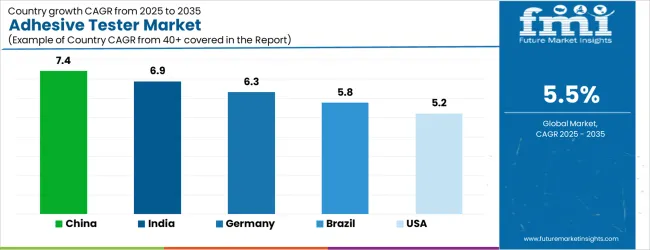
- Among key countries, China leads at 7.4% CAGR, followed by India at 6.9%, Germany at 6.3%, Brazil at 5.8%, USA at 5.2%, UK at 4.7%, and Japan at 4.1%.
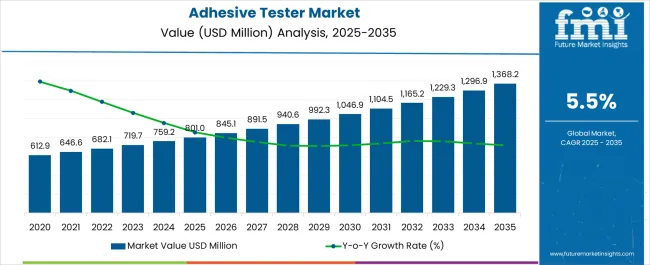
Adhesive Tester Market Key Takeaways
| Metric | Details |
|---|---|
| Industry Size (2026) | USD 0.844 billion |
| Industry Value (2036) | USD 1.44 billion |
| CAGR (2026-2036) | 5.5% |
Source: Future Market Insights, 2026
Stricter quality assurance protocols across manufacturing sectors and tighter bonding performance standards in automotive and aerospace assembly lines are accelerating procurement of adhesion testing instruments globally. What were once supplementary lab tools are now mandatory compliance checkpoints in multi-material joining workflows, forcing plant quality managers to upgrade from manual peel testers to automated pull-off systems capable of logging traceable data.
As per FMI, the absolute dollar opportunity of USD 0.60 billion between 2026 and 2036 reflects steady instrumentation refresh cycles rather than a single disruptive adoption event. Growth is anchored by regulatory tightening in construction adhesive certification (EN 1542, ASTM D4541) and by expanding composite bonding applications in wind energy blade manufacturing where adhesion failure carries both safety and warranty liability. Testing equipment suppliers that cannot offer integrated digital reporting compatible with factory MES platforms face procurement exclusion from Tier 1 automotive suppliers transitioning to fully traceable bonding quality records.
Country-level growth trajectories vary by industrial testing maturity and regulatory enforcement intensity. China leads at 7.4% CAGR, driven by rapid expansion of automotive and electronics adhesive bonding lines requiring pull-off verification. India follows at 6.9%, supported by construction sector formalization and growing adoption of EN-standard compliant testing. Germany advances at 6.3%, anchored by aerospace composite bonding certification requirements. Brazil records 5.8% growth tied to packaging adhesive quality mandates. USA operations grow at 5.2%, sustained by automotive lightweighting programs. United Kingdom tracks at 4.7%, and Japan at 4.1%, both reflecting mature replacement demand cycles.
Adhesive Tester Market Definition
Adhesive testers are precision instruments designed to measure the bond strength of adhesive joints by applying controlled tensile, shear, or peel forces to bonded substrates. These instruments are used in manufacturing quality control, incoming material inspection, and R&D laboratories to verify that adhesive bonds meet specified performance thresholds. End users span automotive assembly plants, aerospace composite fabrication facilities, construction material testing labs, and energy sector coating inspection operations. Testing methodologies conform to international standards including ASTM D4541, ISO 4624, and EN 1542.
Adhesive Tester Market Inclusions
Market scope includes automated pull-off adhesion testers, manual peel and shear test instruments, portable field testing units, benchtop laboratory systems, and calibration accessories. The report covers global and regional market sizes, forecast period 2026 to 2036, segment breakdowns by type and application, and pricing trend analysis across major procurement channels.
Adhesive Tester Market Exclusions
The scope excludes general-purpose universal testing machines not specifically configured for adhesion measurement, standalone force gauges without adhesion-specific fixtures, and coating thickness measurement instruments. Environmental testing chambers and accelerated aging equipment used in adhesive durability studies are also outside the defined scope.
Adhesive Tester Market Research Methodology
- Primary Research: Analysts engaged with procurement managers, product engineers, and distribution channel leaders across major adhesive tester end-use segments to map purchase decision criteria and replacement cycle timing.
- Desk Research: Data collection phases aggregated regulatory standards documentation, trade association publications, public company filings, and government statistical agency datasets relevant to the adhesive tester sector.
- Market-Sizing and Forecasting: Baseline values derive from a bottom-up aggregation of verified shipment and revenue data, applying region-specific adoption curves and replacement rate assumptions to project forecast period volumes.
- Data Validation and Update Cycle: Projections are cross-checked against publicly reported financial disclosures from leading industry participants and reconciled with primary interview findings on a quarterly refresh cycle.
Why is the Adhesive Tester Market Growing?
The Adhesive Tester market is experiencing steady growth due to the increasing demand for precision and quality in bonding and adhesion applications across various industries. Current market trends indicate that manufacturers and quality assurance departments are prioritizing consistent adhesive performance, which is critical for automotive, electronics, packaging, and industrial applications.
The market’s expansion is being supported by advancements in automated testing systems, which enhance accuracy, repeatability, and throughput. Investment in research and development for adhesives with improved durability, environmental resistance, and compliance with stringent regulatory standards has also driven adoption of advanced testing solutions.
Furthermore, the growing emphasis on product safety, quality assurance, and performance validation across manufacturing supply chains is enabling widespread deployment of adhesive testing technologies As industries continue to adopt automation and smart manufacturing principles, the demand for reliable adhesive testers capable of providing detailed analytics and real-time monitoring is expected to strengthen, offering significant growth potential for equipment providers globally.
Segmental Analysis
The adhesive tester market is segmented by type, application, and geographic regions. By type, adhesive tester market is divided into Automatic Adhesive Tester, Manual Adhesive Tester, and Accessories. In terms of application, adhesive tester market is classified into Automotive, Aerospace, Building, Energy, and Others. Regionally, the adhesive tester industry is classified into North America, Latin America, Western Europe, Eastern Europe, Balkan & Baltic Countries, Russia & Belarus, Central Asia, East Asia, South Asia & Pacific, and the Middle East & Africa.
Insights into the Automatic Adhesive Tester Segment
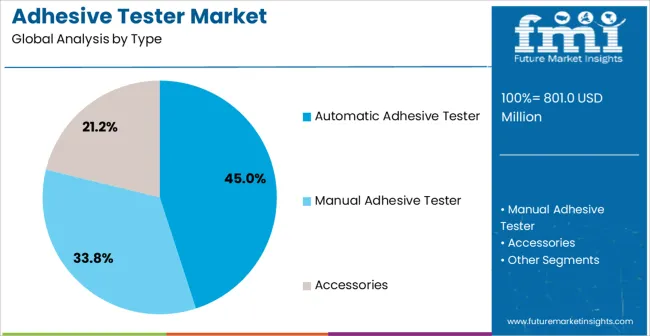
The Automatic Adhesive Tester type is projected to hold 45.00% of the market revenue share in 2026, positioning it as the leading type in the Adhesive Tester market. This prominence is being attributed to the increasing preference for automated solutions that offer high precision and consistent testing results. Automatic adhesive testers are capable of performing repetitive and standardized tests with minimal human intervention, reducing errors and increasing operational efficiency.
The growth of this segment has been facilitated by the rising demand for fast and accurate quality control processes in high-volume manufacturing environments, particularly where adhesive reliability directly affects product performance and safety. Additionally, the flexibility of automatic testers to accommodate multiple testing methods and adhesive types has further reinforced their adoption.
The integration of advanced software for data logging, analysis, and reporting has also enhanced the value proposition of these systems As industries continue to emphasize product quality, compliance, and process efficiency, automatic adhesive testers are expected to remain the dominant type, driven by their ability to deliver reliable and scalable testing solutions.
Insights into the Automotive Application Segment
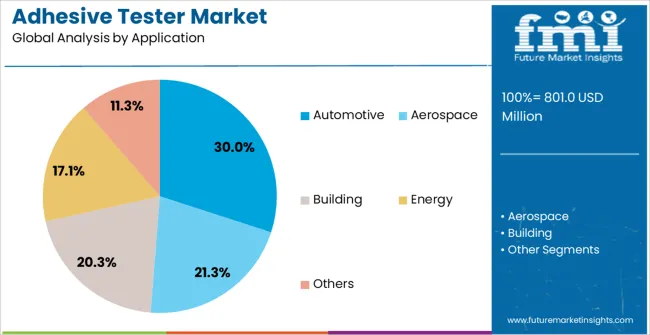
The Automotive application segment is expected to account for 30.00% of the Adhesive Tester market revenue in 2026, establishing it as the leading application. This dominance is being fueled by the extensive use of adhesives in automotive manufacturing for bonding components, improving fuel efficiency, and enhancing structural integrity.
The growth of this segment has been accelerated by the increasing adoption of lightweight materials such as composites and aluminum, which require precise and consistent adhesive performance. Automotive manufacturers are investing heavily in testing solutions that ensure adhesives meet stringent safety and durability standards, particularly in critical areas such as body panels, glazing, and interior components.
The trend towards electric vehicles and advanced driver assistance systems has also increased the reliance on adhesives for lightweighting, noise vibration harshness control, and assembly simplification, further driving the adoption of adhesive testers The ability to monitor and validate adhesive performance efficiently has become critical for automotive production lines, supporting the continued growth of this application segment.
Market Overview
Adhesive Tester Market: Overview
Adhesion is a process widely used across all industry verticals as they involve the binding of two different materials. Adhesive testers are used for testing adhesion properties of the materials. This checking is now becoming one of the key functions in building a new product across different industries.
From past few years, increasing production, manufacturing, and construction activities at the global level is one of the prime factors fuelling the need for using adhesive testers in different application areas.
Adhesion tester is used for measuring the force required to detach a coating from a material. Adhesion tester also known as a peel tester or pull-off adhesion tester. The adhesion tester is known for its capability as this adhesion tester applies a force for evaluating the strength of the coating's bond.
The manufacturers are facing an increasing need for improving quality and performance of their adhesive tester due to changing end-user requirements as the properties of materials to be bound changing. The addition of technological parameters such as USB interface, display units, software for managing the adhesive tester operations is also provided as an advancement in products.
In addition to this, features of adhesive testers such as internal memory, data transferability, and others are increasing the popularity of adhesive tester devices and fuelling the growth of market.
Analysis of Adhesive Tester Market By Key Countries
.webp "Top Country Growth Comparison Adhesive Tester Market Cagr (2026 2036)")
| Country | CAGR |
|---|---|
| China | 7.4% |
| India | 6.9% |
| Germany | 6.3% |
| Brazil | 5.8% |
| USA | 5.2% |
| UK | 4.7% |
| Japan | 4.1% |
Country-wise Analysis
The Adhesive Tester Market is expected to register a CAGR of 5.5% during the forecast period, exhibiting varied country level momentum. China leads with the highest CAGR of 7.4%, followed by India at 6.9%. Developed markets such as Germany, France, and the UK continue to expand steadily, while the USA is likely to grow at consistent rates. Japan posts the lowest CAGR at 4.1%, yet still underscores a broadly positive trajectory for the global Adhesive Tester Market. In 2024, Germany held a dominant revenue in the Western Europe market and is expected to grow with a CAGR of 6.3%. The USA Adhesive Tester Market is estimated to be valued at USD 296.6 million in 2026 and is anticipated to reach a valuation of USD 296.6 million by 2036. Sales are projected to rise at a CAGR of 0.0% over the forecast period between 2026 and 2036. While Japan and South Korea markets are estimated to be valued at USD 41.2 million and USD 21.4 million respectively in 2026.
Key Players in the Adhesive Tester Market
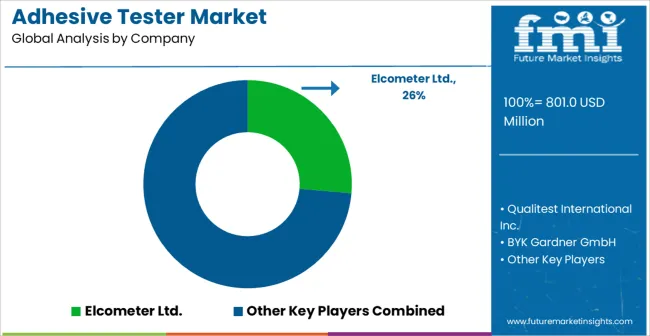
- Elcometer Ltd.
- Qualitest International Inc.
- BYK Gardner GmbH
- PosiTest (DeFelsko Corporation)
- Mecmesin Ltd.
- Sheen Instruments Ltd.
- TQC Sheen Instruments
- Fischer Technology Inc.
Scope of the Report
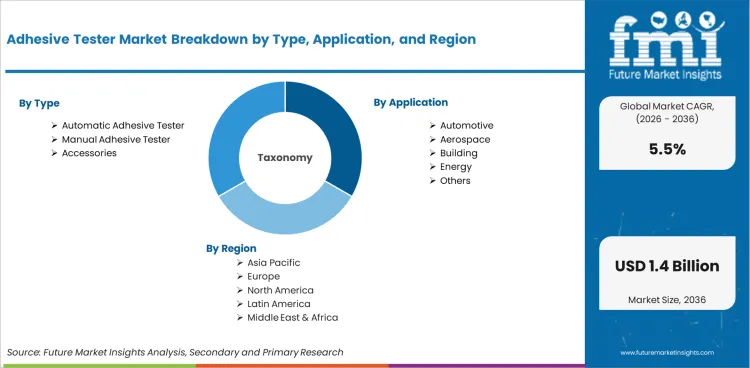
| Quantitative Units | USD 0.844 billion to USD 1.44 billion, at a CAGR of 5.5% |
|---|---|
| Market Definition | Adhesive testers are precision instruments designed to measure the bond strength of adhesive joints by applying controlled tensile, shear, or peel forces to bonded substrates. These instruments are us... |
| Segmentation | Type: Automatic Adhesive Tester, Manual Adhesive Tester, Accessories; Application: Automotive, Aerospace, Building, Energy, Others |
| Regions Covered | North America, Latin America, Europe, East Asia, South Asia, Oceania, Middle East & Africa |
| Countries Covered | China, India, Germany, Brazil, USA, UK, Japan, and 40 plus countries |
| Key Companies Profiled | Elcometer Ltd., Qualitest International Inc., BYK Gardner GmbH, PosiTest (DeFelsko Corporation), Mecmesin Ltd., Sheen Instruments Ltd., TQC Sheen Instruments, Fischer Technology Inc. |
| Forecast Period | 2026 to 2036 |
| Approach | Forecasting models apply a bottom-up methodology starting with verified industry shipment data and projecting adoption conversion rates using region-specific demand drivers. |
Adhesive Tester Market by Segments
Type:
- Automatic Adhesive Tester
- Manual Adhesive Tester
- Accessories
Application:
- Automotive
- Aerospace
- Building
- Energy
- Others
Region:
- North America
- USA
- Canada
- Mexico
- Latin America
- Brazil
- Chile
- Rest of Latin America
- Western Europe
- Germany
- UK
- Italy
- Spain
- France
- Nordic
- BENELUX
- Rest of Western Europe
- Eastern Europe
- Russia
- Poland
- Hungary
- Balkan & Baltic
- Rest of Eastern Europe
- East Asia
- China
- Japan
- South Korea
- South Asia and Pacific
- India
- ASEAN
- Australia & New Zealand
- Rest of South Asia and Pacific
- Middle East & Africa
- Kingdom of Saudi Arabia
- Other GCC Countries
- Turkiye
- South Africa
- Other African Union
- Rest of Middle East & Africa
Bibliography
- ASTM International. (2024). ASTM D4541: Standard test method for pull-off strength of coatings using portable adhesion testers. ASTM International.
- International Organization for Standardization. (2024). ISO 4624: Paints and varnishes, pull-off test for adhesion. ISO.
- European Committee for Standardization. (2024). EN 1542: Products and systems for the protection and repair of concrete structures, test methods, measurement of bond strength by pull-off. CEN.
- Elcometer Ltd. (2025). Annual report and financial statements 2024. Elcometer.
- United States Bureau of Labor Statistics. (2025). Producer price index: Testing and measuring instruments. U.S. Bureau of Labor Statistics.
- World Trade Organization. (2024). Technical barriers to trade: Conformity assessment procedures. WTO.
This bibliography is provided for reader reference. The full Future Market Insights report contains the complete reference list with primary research documentation.
Frequently Asked Questions
How large is the demand for Adhesive Tester in the global market in 2026?
Demand for Adhesive Tester in the global market is estimated to be valued at USD 0.844 billion in 2026.
What will be the market size of Adhesive Tester in the global market by 2036?
Market size for Adhesive Tester is projected to reach USD 1.44 billion by 2036.
What is the expected demand growth for Adhesive Tester in the global market between 2026 and 2036?
Demand for Adhesive Tester is expected to grow at a CAGR of 5.5% between 2026 and 2036.
Which Type is poised to lead global sales by 2026?
Automatic Adhesive Tester accounts for 45.0% in 2026 as factory automation mandates drive replacement of manual testing instruments with digitally integrated systems.
How is Automotive positioned by Application in 2026?
Automotive represents 30.0% of the Application segment in 2026, reflecting vehicle assembly adhesion testing requirements across global OEM production lines.
What is China's growth outlook in this report?
China is projected to grow at a CAGR of 7.4% during 2026 to 2036.
What is Adhesive Tester and what is it mainly used for?
Adhesive testers measure the bond strength of adhesive joints using controlled pull-off, peel, or shear forces. Manufacturing quality control teams primarily use them to verify bonding performance against specified thresholds in automotive, aerospace, construction, and energy applications.
How does FMI build and validate the Adhesive Tester forecast?
Forecasting models apply a bottom-up methodology starting with verified industry data and cross-validate projections against quarterly enterprise revenue disclosures and primary research interviews.
Preview the report firsthand - request a free sample
Get SampleGet the brochure for pricing and purchase details.
Get PDFTable of Content
- Executive Summary
- Global Market Outlook
- Demand-side Trends
- Supply-side Trends
- Technology Roadmap Analysis
- Analysis and Recommendations
- Market Overview
- Chapter Orientation
- Analytical Lens and Working Hypotheses
- Market Structure, Signals, and Trend Drivers
- Benchmarking and Cross-market Comparability
- Market Sizing, Forecasting, and Opportunity Mapping
- Research Design and Evidence Framework
- Desk Research Programme (Secondary Evidence)
- Company Annual and Sustainability Reports
- Peer-reviewed Journals and Academic Literature
- Corporate Websites, Product Literature, and Technical Notes
- Earnings Decks and Investor Briefings
- Statutory Filings and Regulatory Disclosures
- Technical White Papers and Standards Notes
- Sector Databases and Reference Repositories
- FMI Internal Proprietary Databases and Historical Market Datasets
- Subscription Datasets and Paid Sources
- Social Channels, Communities, and Digital Listening Inputs
- Additional Desk Sources
- Expert Input and Fieldwork (Primary Evidence)
- Primary Modes
- Qualitative Interviews and Expert Elicitation
- Quantitative Surveys and Structured Data Capture
- Blended Approach
- Why Primary Evidence is Used
- Field Techniques
- Interviews
- Surveys
- Focus Groups
- Observational and In-context Research
- Social and Community Interactions
- Stakeholder Universe Engaged
- C-suite Leaders
- Board Members
- Presidents and Vice Presidents
- R&D and Innovation Heads
- Technical Specialists
- Domain Subject-matter Experts
- Scientists
- Physicians and Other Healthcare Professionals
- Governance, Ethics, and Data Stewardship
- Research Ethics
- Data Integrity and Handling
- Primary Modes
- Tooling, Models, and Reference Databases
- Desk Research Programme (Secondary Evidence)
- Data Engineering and Model Build
- Data Acquisition and Ingestion
- Cleaning, Normalisation, and Verification
- Synthesis, Triangulation, and Analysis
- Quality Assurance and Audit Trail
- Market Background
- Market Dynamics
- Drivers
- Restraints
- Opportunity
- Trends
- Scenario Forecast
- Demand in Optimistic Scenario
- Demand in Likely Scenario
- Demand in Conservative Scenario
- Opportunity Map Analysis
- Product Life Cycle Analysis
- Supply Chain Analysis
- Investment Feasibility Matrix
- Value Chain Analysis
- PESTLE and Porter’s Analysis
- Regulatory Landscape
- Regional Parent Market Outlook
- Production and Consumption Statistics
- Import and Export Statistics
- Market Dynamics
- Global Market Analysis 2021 to 2025 and Forecast, 2026 to 2036
- Historical Market Size Value (USD Million) Analysis, 2021 to 2025
- Current and Future Market Size Value (USD Million) Projections, 2026 to 2036
- Y-o-Y Growth Trend Analysis
- Absolute $ Opportunity Analysis
- Global Market Pricing Analysis 2021 to 2025 and Forecast 2026 to 2036
- Global Market Analysis 2021 to 2025 and Forecast 2026 to 2036, By Type
- Introduction / Key Findings
- Historical Market Size Value (USD Million) Analysis By Type , 2021 to 2025
- Current and Future Market Size Value (USD Million) Analysis and Forecast By Type , 2026 to 2036
- Automatic Adhesive Tester
- Manual Adhesive Tester
- Accessories
- Automatic Adhesive Tester
- Y-o-Y Growth Trend Analysis By Type , 2021 to 2025
- Absolute $ Opportunity Analysis By Type , 2026 to 2036
- Global Market Analysis 2021 to 2025 and Forecast 2026 to 2036, By Application
- Introduction / Key Findings
- Historical Market Size Value (USD Million) Analysis By Application, 2021 to 2025
- Current and Future Market Size Value (USD Million) Analysis and Forecast By Application, 2026 to 2036
- Automotive
- Aerospace
- Building
- Energy
- Others
- Automotive
- Y-o-Y Growth Trend Analysis By Application, 2021 to 2025
- Absolute $ Opportunity Analysis By Application, 2026 to 2036
- Global Market Analysis 2021 to 2025 and Forecast 2026 to 2036, By Region
- Introduction
- Historical Market Size Value (USD Million) Analysis By Region, 2021 to 2025
- Current Market Size Value (USD Million) Analysis and Forecast By Region, 2026 to 2036
- North America
- Latin America
- Western Europe
- Eastern Europe
- East Asia
- South Asia and Pacific
- Middle East & Africa
- Market Attractiveness Analysis By Region
- North America Market Analysis 2021 to 2025 and Forecast 2026 to 2036, By Country
- Historical Market Size Value (USD Million) Trend Analysis By Market Taxonomy, 2021 to 2025
- Market Size Value (USD Million) Forecast By Market Taxonomy, 2026 to 2036
- By Country
- USA
- Canada
- Mexico
- By Type
- By Application
- By Country
- Market Attractiveness Analysis
- By Country
- By Type
- By Application
- Key Takeaways
- Latin America Market Analysis 2021 to 2025 and Forecast 2026 to 2036, By Country
- Historical Market Size Value (USD Million) Trend Analysis By Market Taxonomy, 2021 to 2025
- Market Size Value (USD Million) Forecast By Market Taxonomy, 2026 to 2036
- By Country
- Brazil
- Chile
- Rest of Latin America
- By Type
- By Application
- By Country
- Market Attractiveness Analysis
- By Country
- By Type
- By Application
- Key Takeaways
- Western Europe Market Analysis 2021 to 2025 and Forecast 2026 to 2036, By Country
- Historical Market Size Value (USD Million) Trend Analysis By Market Taxonomy, 2021 to 2025
- Market Size Value (USD Million) Forecast By Market Taxonomy, 2026 to 2036
- By Country
- Germany
- UK
- Italy
- Spain
- France
- Nordic
- BENELUX
- Rest of Western Europe
- By Type
- By Application
- By Country
- Market Attractiveness Analysis
- By Country
- By Type
- By Application
- Key Takeaways
- Eastern Europe Market Analysis 2021 to 2025 and Forecast 2026 to 2036, By Country
- Historical Market Size Value (USD Million) Trend Analysis By Market Taxonomy, 2021 to 2025
- Market Size Value (USD Million) Forecast By Market Taxonomy, 2026 to 2036
- By Country
- Russia
- Poland
- Hungary
- Balkan & Baltic
- Rest of Eastern Europe
- By Type
- By Application
- By Country
- Market Attractiveness Analysis
- By Country
- By Type
- By Application
- Key Takeaways
- East Asia Market Analysis 2021 to 2025 and Forecast 2026 to 2036, By Country
- Historical Market Size Value (USD Million) Trend Analysis By Market Taxonomy, 2021 to 2025
- Market Size Value (USD Million) Forecast By Market Taxonomy, 2026 to 2036
- By Country
- China
- Japan
- South Korea
- By Type
- By Application
- By Country
- Market Attractiveness Analysis
- By Country
- By Type
- By Application
- Key Takeaways
- South Asia and Pacific Market Analysis 2021 to 2025 and Forecast 2026 to 2036, By Country
- Historical Market Size Value (USD Million) Trend Analysis By Market Taxonomy, 2021 to 2025
- Market Size Value (USD Million) Forecast By Market Taxonomy, 2026 to 2036
- By Country
- India
- ASEAN
- Australia & New Zealand
- Rest of South Asia and Pacific
- By Type
- By Application
- By Country
- Market Attractiveness Analysis
- By Country
- By Type
- By Application
- Key Takeaways
- Middle East & Africa Market Analysis 2021 to 2025 and Forecast 2026 to 2036, By Country
- Historical Market Size Value (USD Million) Trend Analysis By Market Taxonomy, 2021 to 2025
- Market Size Value (USD Million) Forecast By Market Taxonomy, 2026 to 2036
- By Country
- Kingdom of Saudi Arabia
- Other GCC Countries
- Turkiye
- South Africa
- Other African Union
- Rest of Middle East & Africa
- By Type
- By Application
- By Country
- Market Attractiveness Analysis
- By Country
- By Type
- By Application
- Key Takeaways
- Key Countries Market Analysis
- USA
- Pricing Analysis
- Market Share Analysis, 2025
- By Type
- By Application
- Canada
- Pricing Analysis
- Market Share Analysis, 2025
- By Type
- By Application
- Mexico
- Pricing Analysis
- Market Share Analysis, 2025
- By Type
- By Application
- Brazil
- Pricing Analysis
- Market Share Analysis, 2025
- By Type
- By Application
- Chile
- Pricing Analysis
- Market Share Analysis, 2025
- By Type
- By Application
- Germany
- Pricing Analysis
- Market Share Analysis, 2025
- By Type
- By Application
- UK
- Pricing Analysis
- Market Share Analysis, 2025
- By Type
- By Application
- Italy
- Pricing Analysis
- Market Share Analysis, 2025
- By Type
- By Application
- Spain
- Pricing Analysis
- Market Share Analysis, 2025
- By Type
- By Application
- France
- Pricing Analysis
- Market Share Analysis, 2025
- By Type
- By Application
- India
- Pricing Analysis
- Market Share Analysis, 2025
- By Type
- By Application
- ASEAN
- Pricing Analysis
- Market Share Analysis, 2025
- By Type
- By Application
- Australia & New Zealand
- Pricing Analysis
- Market Share Analysis, 2025
- By Type
- By Application
- China
- Pricing Analysis
- Market Share Analysis, 2025
- By Type
- By Application
- Japan
- Pricing Analysis
- Market Share Analysis, 2025
- By Type
- By Application
- South Korea
- Pricing Analysis
- Market Share Analysis, 2025
- By Type
- By Application
- Russia
- Pricing Analysis
- Market Share Analysis, 2025
- By Type
- By Application
- Poland
- Pricing Analysis
- Market Share Analysis, 2025
- By Type
- By Application
- Hungary
- Pricing Analysis
- Market Share Analysis, 2025
- By Type
- By Application
- Kingdom of Saudi Arabia
- Pricing Analysis
- Market Share Analysis, 2025
- By Type
- By Application
- Turkiye
- Pricing Analysis
- Market Share Analysis, 2025
- By Type
- By Application
- South Africa
- Pricing Analysis
- Market Share Analysis, 2025
- By Type
- By Application
- USA
- Market Structure Analysis
- Competition Dashboard
- Competition Benchmarking
- Market Share Analysis of Top Players
- By Regional
- By Type
- By Application
- Competition Analysis
- Competition Deep Dive
- Elcometer Ltd.
- Overview
- Product Portfolio
- Profitability by Market Segments (Product/Age /Sales Channel/Region)
- Sales Footprint
- Strategy Overview
- Marketing Strategy
- Product Strategy
- Channel Strategy
- Qualitest International Inc.
- BYK Gardner GmbH
- PosiTest (DeFelsko Corporation)
- Mecmesin Ltd.
- Sheen Instruments Ltd.
- TQC Sheen Instruments
- Fischer Technology Inc.
- Elcometer Ltd.
- Competition Deep Dive
- Assumptions & Acronyms Used


