

- Industry Size (2026)
- USD 209.0 Mn
- Forecast (2036)
- USD 620.7 Mn
- CAGR (2026 to 2036)
- 11.50%
Flame-Retardant Phosphate Esters for EV E-Drivetrains Market Size, Market Forecast and Outlook By FMI
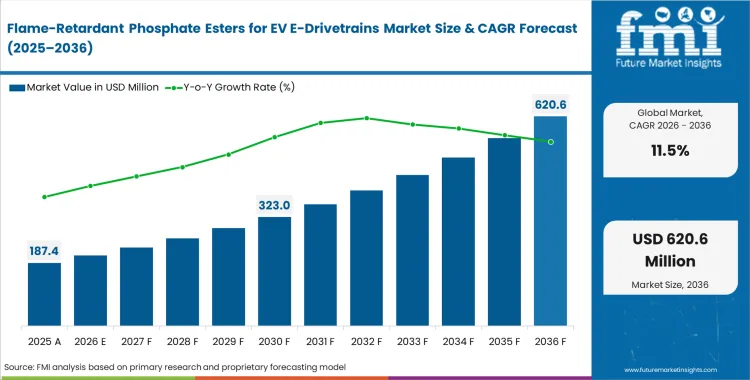
The flame-retardant phosphate esters for EV e-drivetrains market was valued at USD 187.4 million in 2025. Sales are expected to reach USD 209.0 million in 2026 at a CAGR of 11.50% during the forecast period. Demand in terms of revenue is estimated to reach USD 620.7 million through 2036 as automotive OEMs standardizing direct-cooled architectures specify phosphate esters in EV drivetrains to manage rising thermal loads.
Summary of Flame-Retardant Phosphate Esters for EV E-Drivetrains Market
- The market is estimated at USD 209.0 million in 2026.
- The market is projected to reach USD 620.7 million by 2036.
- The market is expected to grow at a CAGR of 11.5% from 2026 to 2036.
- The forecast period represents an incremental opportunity of USD 411.7 million.
- Aryl phosphates lead the chemistry segment with a 38% share.
- Engineering plastics dominate the application segment with a 41% share.
- Traction inverters lead the component segment with a 29% share.
- Passenger BEVs dominate the vehicle type segment with a 62% share.
- Compounders lead the sales channel segment with a 55% share.
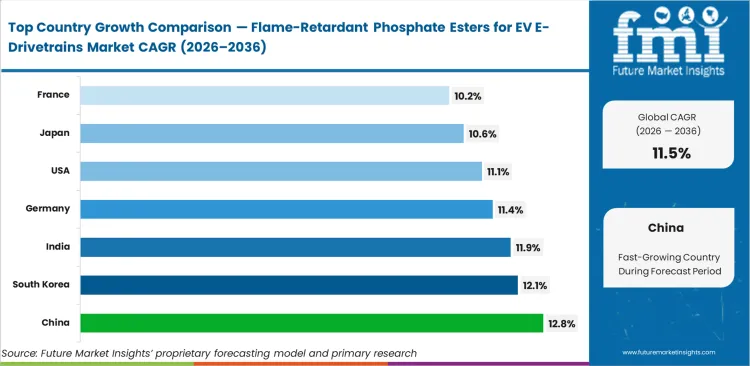
- China (12.8%), South Korea (12.1%), and India (11.9%) are among the fastest-growing markets.
- Key companies in the market include LANXESS, ICL Group, ADEKA, Clariant, Italmatch Chemicals, Lubrizol, and Afton Chemical.
Flame-Retardant Phosphate Esters for EV E-Drivetrains Market Key Takeaways
| Metric | Details |
|---|---|
| Industry Size (2026) | USD 209.0 Million |
| Industry Value (2036) | USD 620.7 Million |
| CAGR (2026 to 2036) | 11.50% |
Source: Future Market Insights (FMI) analysis, based on proprietary forecasting model and primary research
Qualification challenges concerning safety protocols for high-voltage constituents are rising among powertrain engineering personnel. Effective thermal management within highly confined traction inverter enclosures necessitates the utilization of EV e-drivetrain phosphate ester formulations. These compounds simultaneously deliver essential dielectric insulation properties and robust fire suppression capabilities, crucially avoiding the introduction of ingredients triggering current halogen-related regulatory prohibitions. Failure to secure an adequate supply of these critical polyamide compounds postpones introduction of new vehicle platform launches. Organizational procurement teams significantly undervalue the rapid reduction occurring in legacy flame-retardant supply chain options under intensified European chemical oversight and regulatory scrutiny.
Transitioning vehicle designs to incorporate 800-volt electrical architectures initiates a fundamental change regarding material specification requirements. Higher operating voltages inherently elevate tracking indices across critical connection points and busbars. This forces Tier-1 component manufacturers to specify advanced organophosphorus flame retardants for electric vehicle applications as a replacement for standard commodity plastics. Significant voltage threshold transforms the necessity for advanced chemistry into a baseline compliance prerequisite for achieving high-power drivetrain component certification and market access approval.
China is expected to lead at a 12.8% CAGR during the forecast period, as domestic manufacturers scale integrated electric motor production. Heavy investments in advanced battery integration supports the estimated 12.1% CAGR for South Korea over the forecast period. Rising localized manufacturing mandates drive expansion in India at 11.9% CAGR over the next 10 years. Europe-based automakers re-engineering legacy platforms around strict sustainability targets drive sales valuation in Germany to a projected 11.4% CAGR. Federal incentives for domestic supply chains support United States demand rising at CAGR of 11.1% during the forecast period. Japan and France are likely to register 10.6% and 10.2% CAGR respectively, during the forecast period.
Here is the polished and properly formatted report summary, written in professional business English with all parenthetical citations removed and numerical data highlighted as requested.
Segmental Analysis
Flame-Retardant Phosphate Esters for EV E-Drivetrains Market Analysis by Chemistry Type
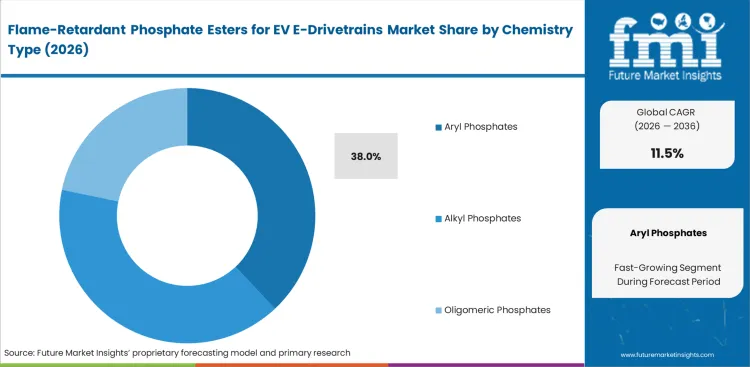
Thermal stability parameters define material selection across high-voltage motor environments. The aryl phosphates segment is expected to account for 38.0% revenue share in 2026. This dominance is driven by superior resistance of aryl phosphates to volatility at extreme continuous operating temperatures, and ability of the product to integrate seamlessly into high-performance thermoplastics without compromising mechanical strength during injection molding.
Established regulatory compliance profile against legacy halogens, and their proven track record in passing rigorous automotive thermal aging certification tests are also driving growth. Polymer scientists at major compounding firms prioritize aryl phosphate flame retardants for inverters because these molecules resist the thermal degradation that typically plagues baseline additives. Specifying less stable alkyl alternatives often results in chemical migration to the surface over time, degrading the thermal interface materials meant to cool the assembly.
- Performance baseline: Aryl esters maintain structural integrity under extreme heat cycling environments. Formulators achieve consistent, reliable flame retardancy without plasticizing the host polymer excessively, ensuring that rigid structural components do not soften during peak operational loads.
- Edge condition vulnerability: High chemical concentrations sometimes reduce impact strength in low-temperature environments. Compounding engineers must carefully balance flame suppression capabilities against the risk of cold-weather mechanical brittleness, which can lead to cracking during winter driving conditions.
- Qualification standard: Meeting UL94 V-0 ratings at ultra-thin wall thicknesses defines commercial viability for tier suppliers. Formulators failing this specific dimensional metric face immediate rejection from Tier-1 housing projects, as automotive designers relentlessly thin out component walls to save vehicle weight.
Flame-Retardant Phosphate Esters for EV E-Drivetrains Market Analysis by Application
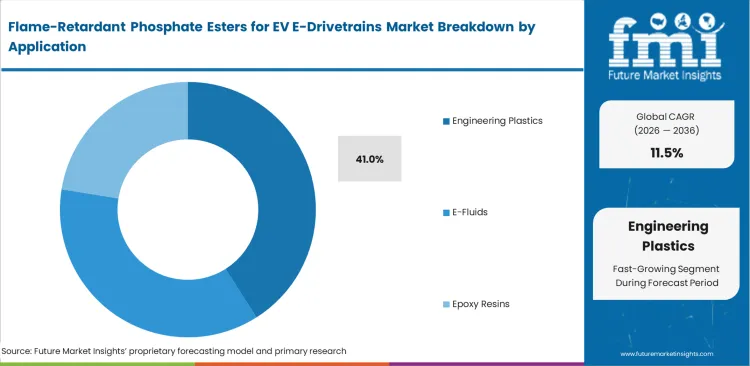
High volume requirements for drivetrain components secure the dominant position of solid-state polymers. Transitioning from aluminum housings to lightweight composites requires intense chemical fortification against electrical tracking. The engineering plastics segment is likely to record 41.0% revenue share in 2026, supported by large volume requirements for inverter housings, and critical need to eliminate weight penalty of traditional metal shielding. Rising demand for inherent fire barriers within high-voltage motor end-caps, and industry-wide shift toward fully integrated e-axle assemblies that demand fortified non-conductive composites are other factors driving growth of this segment.
- Procurement savings: Eliminating secondary insulating wraps reduces overall factory assembly time. Production managers cut direct labor costs by utilizing inherently flame-resistant molded housings that do not require additional protective taping or manual heat-shield installation.
- Hidden operational costs: Abrasive phosphate fillers accelerate wear on expensive injection molding screws. Operations directors face unexpected maintenance expenses and costly machine downtime when running highly loaded flame-retardant resins continuously across multiple manufacturing shifts.
- Lifecycle comparison: True economic value emerges during end-of-life recycling operations. Halogen-free phosphate systems allow plastic components to enter standard recovery streams without triggering hazardous waste protocols, sparing OEMs from expensive environmental disposal liabilities.
Flame-Retardant Phosphate Esters for EV E-Drivetrains Market Analysis by Component
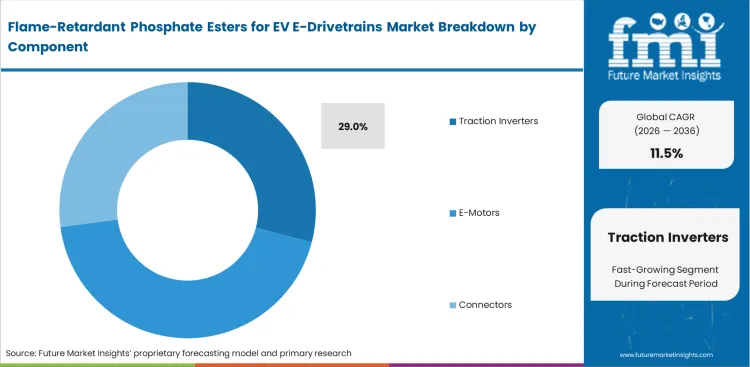
Packaging dense power electronics into confined spaces creates extreme thermal challenges. Shrinking physical distance between high-voltage internal conductors, and uncompromising safety mandates requiring rapid spark extinguishment within confined electrical housings. The traction inverters segment is predicted to secure 29.0% revenue share in 2026, owing to extreme thermal challenges generated by compact power electronics, and transition toward high-temperature silicon carbide switching components. Electrical design heads rely on traction inverter housing flame retardants to ensure dielectric fluids and surrounding encapsulants do not ignite if a semiconductor module fails under load. The push toward silicon carbide inverters amplifies this requirement, given their significantly higher operational temperatures and closer component spacing.
- Initial trigger: Higher switching frequencies in modern electric inverters generate intensely concentrated heat pockets. Design engineers specify robust, thermally stable flame retardants to prevent localized ignition events that could spread to adjacent vehicle systems.
- Qualification validation: High-voltage components must survive simulated short-circuits without sustaining a continuous flame. Quality assurance teams rigorously verify that EV connector flame retardant materials rapidly extinguish any sparks before they can breach the component housing.
- Expansion driver: Moving to advanced 800-volt architectures drastically shrinks the physical distance between active conductors. System architects demand significantly higher dielectric strength from all surrounding halogen-free flame retardants for EV connectors to prevent electrical arcing.
Flame-Retardant Phosphate Esters for EV E-Drivetrains Market Analysis by Vehicle Type
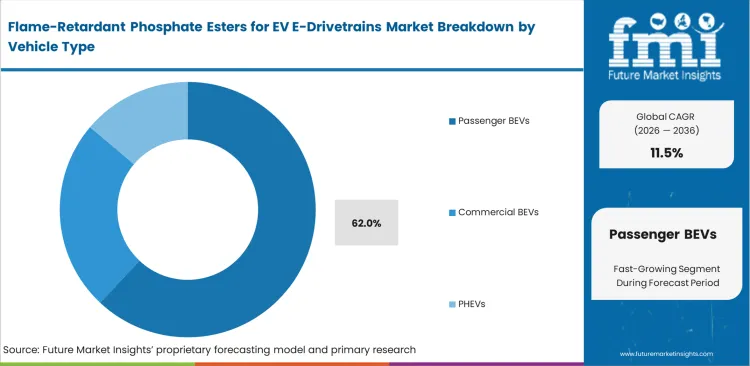
Global production scaling heavily favors standard consumer platforms. Platform directors at major automakers standardise their automotive engineering plastics flame retardants across millions of vehicles to drive down per-unit material costs. The passenger BEVs segment is projected to account for 62.0% revenue share in 2026, fueled by sheer volume of global consumer platforms requiring comprehensive safety certification, and standardization of chemical specifications by major automakers to leverage purchasing economies of scale. Rapid trickle-down of premium fire-safety features into mid-market models, and intense regulatory scrutiny pushing fleet-wide compliance across all passenger vehicle classes are also driving growth of this segment.
- Early adopters: Premium electric vehicle brands prioritize maximum safety margins over raw material cost. Chief engineers at luxury marques willingly pay premiums for advanced phosphate ester profiles that guarantee flawless performance under extreme driving conditions.
- Follow-on integration: Mid-market automotive platforms adopt these chemistries as global regulatory scrutiny intensifies. Procurement teams leverage the extensive testing data generated by premium brands to accelerate their own internal validation timelines and reduce engineering overhead.
- Late converters: Entry-level micro-mobility and lightweight vehicles transition last. Cost engineers in these highly price-sensitive segments only abandon legacy materials when localized urban regulations explicitly ban older flame-retardant technologies from city centers.
Flame-Retardant Phosphate Esters for EV E-Drivetrains Market Analysis by Sales Channel
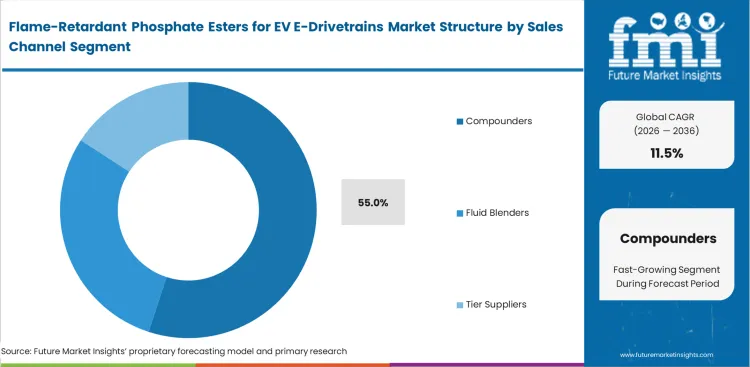
The compounders segment is estimated to account for 55.0% revenue share in 2026. This dominance is sustained by highly specialized twin-screw extrusion technology required for precise chemical blending. Other factors include inability of primary chemical synthesizers to economically manage fragmented customized orders, critical need for pelletized materials that perform consistently batch after batch, and strict material traceability mandates imposed by Tier-1 automotive molders.
Phosphate ester suppliers for EV compounds possess the proprietary manufacturing equipment necessary to blend these liquid or low-melting esters into solid polymer matrices without causing thermal degradation during the mixing phase. Molders rely heavily on these intermediaries to deliver ready-to-use materials that eliminate downstream processing variables. The share figure understates the massive technical influence these compounders wield over OEM material specifications. Brands often mistakenly believe they are buying chemical technology directly from primary synthesis companies, when they are actually relying entirely on the proprietary blending techniques of the intermediate compounder.
- Producer logic: Primary chemical synthesis companies prefer shipping large, standardized bulk quantities. Synthesizers actively partner with compounders to avoid managing fragmented, highly customized smaller orders that disrupt their continuous manufacturing processes.
- Supply constraints: Global manufacturing capacity for high-temperature twin-screw extrusion remains structurally limited. Supply chain directors must secure tolling capacity months in advance to guarantee material availability for upcoming vehicle launch schedules.
- Future landscape: Major, well-capitalized compounders could increasingly acquire niche chemical formulators. Operations heads anticipate tighter vertical integration across the supply chain as complete material traceability becomes a strict regulatory mandate for automotive compliance.
Flame-Retardant Phosphate Esters for EV E-Drivetrains Market Drivers, Restraints, and Opportunities
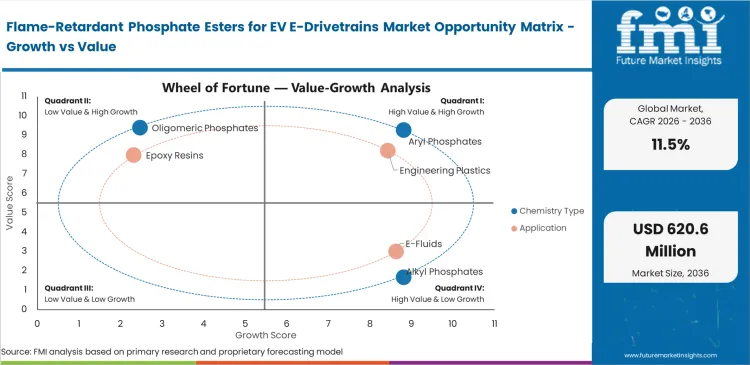
Transitioning to high-voltage direct-cooled e-axles forces engineering teams to specify materials capable of simultaneous dielectric insulation and thermal stability. Powertrain directors face intense pressure to eliminate traditional halogenated fire suppressants ahead of strict European chemical phase-outs. Delaying the qualification of direct-cooled motor fluid additives threatens vehicle launch schedules, as regulatory bodies increasingly refuse certification for legacy material profiles. The integration of electric motors and traction inverters into single compact housings reduces the physical space available for physical heat shields. This architectural compression compels engineers to rely heavily on chemical flame retardants embedded directly into the structural plastics and lubricating fluids to prevent thermal propagation during electrical faults.
Stringent long-term material compatibility testing slows rapid adoption even when engineering teams desire immediate implementation. Chemical interactions between new EV power electronics fire retardant additives and existing seals, gaskets, and copper wiring create unpredictable degradation over a ten-year vehicle lifespan. Materials engineers cannot swap legacy additives for new esters without executing 3,000-hour aging cycles to verify that the substituted chemicals do not induce stress cracking in surrounding electric vehicle insulation layers. While predictive modeling software offers some relief, OEM quality assurance protocols mandate physical hardware validation. This testing friction ensures that legacy materials persist in older platforms until complete architectural redesigns force a comprehensive material overhaul.
Opportunities in the Flame-Retardant Phosphate Esters for EV E-Drivetrains Market
- Direct-cooling fluid integration: Developing a comprehensive e-fluid additive package for direct-cooled motors allows formulators to capture significant value. Lubrication engineers gain critical performance advantages by offering single-fluid solutions for both tribological protection and fire suppression.
- Bio-based synthesis pathways: Sourcing phosphorus from recovered or renewable agricultural streams appeals directly to automaker sustainability targets. Procurement heads actively seek supply chains that reduce the overall carbon footprint of their fire-safe plastics utilized in next-generation platforms.
- Synergistic nitrogen blends: Formulating the best flame retardant chemistry for EV inverters involves combining phosphorus and nitrogen functionalities to lower the total volume of additive required. Polymer scientists utilize these advanced blends to maintain high mechanical strength in structural components without sacrificing stringent V-0 flammability ratings.
Regional Analysis
Based on regional analysis, the flame-retardant phosphate esters for EV e-drivetrains market is segmented into North America, Europe, East Asia, and South Asia across 40 plus countries.
.webp "Top Country Growth Comparison Flame Retardant Phosphate Esters For Ev E Drivetrains Market Cagr (2026 2036)")
| Country | CAGR (2026 to 2036) |
|---|---|
| China | 12.8% |
| South Korea | 12.1% |
| India | 11.9% |
| Germany | 11.4% |
| United States | 11.1% |
| Japan | 10.6% |
| France | 10.2% |
Source: Future Market Insights (FMI) analysis, based on proprietary forecasting model and primary research
Asia Pacific Flame-Retardant Phosphate Esters for EV E-Drivetrains Market Analysis
Scaling of highly integrated e-axle architectures defines material consumption patterns across this crucial manufacturing hub. Domestic automakers continuously compress vehicle development cycles, forcing material suppliers to deliver validated flame-retardant packages at unprecedented speeds to maintain launch schedules. Regional supply chains benefit from deep, entrenched vertical integration, allowing raw phosphorus processors to collaborate directly with local injection molders and battery integrators on a daily basis. This close geographic and operational proximity accelerates iterative testing, enabling rapid refinement of advanced ester formulations to successfully meet escalating 800-volt and 1000-volt architectural requirements without relying on distant overseas suppliers.
- China: Supply chain personnel navigating the China EV drivetrain flame retardant sector secure massive commercial opportunities as regional automakers increasingly dominate global export channels. Demand in China is projected to expand at a 12.8% CAGR during the forecast period. This rapid growth is driven by unmatched volume requirements of domestic electric platforms, and increasing scaling of unified e-axle architectures for global export markets. Other factors include deep vertical integration allowing raw phosphorus processors to collaborate directly with injection molders, and continuous compression of development cycles by nimble local automakers.
- South Korea: Materials engineers here benchmark their formulations directly against the most rigorous international standards, positioning South Korea material suppliers favorably against legacy global competitors in the high-voltage insulation space. Demand in South Korea is expected to register a 12.1% CAGR during the forecast period, driven by heavy investments in advanced battery-to-chassis integration, and strict benchmarking against rigorous international fire-performance standards. Strong governmental support for next-generation materials research, and concentrated presence of globally dominant automotive electronics suppliers are also key factors driving growth.
- Japan: Sales in Japan are anticipated to grow at a 10.6% CAGR during the forecast period. This steady progression is driven by conservative engineering philosophies prioritizing long-term reliability over rapid adoption, and exhaustive qualification protocols requiring decades of simulated aging data. Some other key factors driving growth are deliberate transitions away from legacy materials to ensure zero defect rates, and outsized influence of established quality assurance teams demanding flawless performance metrics. This deliberate transition ensures that once an ester profile is approved, it remains locked into the supply chain for the entire multi-year lifecycle of the vehicle platform.
- India: Adoption of standardized domestic supply allows procurement heads to effectively stabilize unpredictable currency fluctuations and significantly shorten precarious shipping lead times. Revenue in India is expected to rise at an 11.9% CAGR during the forecast period, supported by rising localized manufacturing mandates that force Tier-1 suppliers to build regional supply chains. Other driving factors are rapid electrification of commercial two-wheeler and three-wheeler fleets requiring robust fire-safe composites, government incentives aimed at stabilizing domestic production ecosystems, and a deliberate strategic shift away from costly imported additive packages.
FMI's report includes additional countries not in bullets. Neighboring assembly hubs across Asia Pacific increasingly look toward Indian testing protocols and material specifications when evaluating highly affordable, durable electric mobility solutions.
Europe Flame-Retardant Phosphate Esters for EV E-Drivetrains Market Analysis
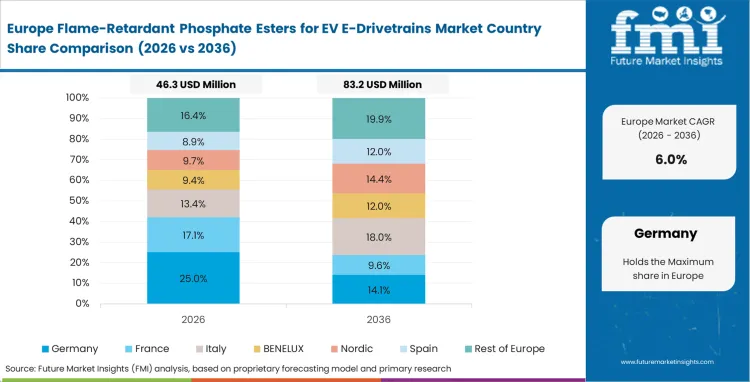
Intense regulatory scrutiny regarding long-term chemical toxicity heavily dictates every aspect of material selection across the continent. Automakers proactively eliminate suspected hazardous substances well ahead of official European Chemicals Agency (ECHA) bans, driving intense, immediate demand for clean, fully documented organophosphorus alternatives. Sustainability directives force polymer compounders to explicitly prove that their specific phosphate esters do not hinder complex end-of-life plastic recycling processes. This unyielding regulatory pressure permanently transforms flame-retardant selection from a pure engineering performance decision into a core, board-level corporate compliance strategy.
- Germany: The market in Germany is poised to expand at an 11.4% CAGR during the forecast period. This positive outlook is sustained by premium automakers extensively re-engineering legacy platforms around uncompromising sustainability targets, and intense regulatory pressure from the European Chemicals Agency forcing the total elimination of legacy halogens. Reaching full compliance within the Germany EV insulation additives landscape fundamentally reorganizes procurement around suppliers who provide fully documented, traceable halogen-free systems.
- France: France-based automotive designers are deliberately specifying standardized compounds to ensure absolute baseline safety without unnecessarily over-engineering lightweight commuter-class vehicles. Demand in France is likely to record a 10.2% CAGR during the forecast period. Rise is supported by a strong national governmental focus on widespread consumer EV adoption, critical engineering need for scalable and cost-effective fire protection in high-volume commuter-class vehicles, active implementation of standardized phosphate-loaded polyamides to ensure baseline safety, and tight strategic alignment with broader European Union circular-economy sustainability directives.
FMI's report includes additional countries not in bullets. Nordic countries apply severe auxiliary pressure to the supply chain by demanding verifiable, audited low-carbon footprints for all imported chemical additives entering their markets.
North America Flame-Retardant Phosphate Esters for EV E-Drivetrains Market Analysis
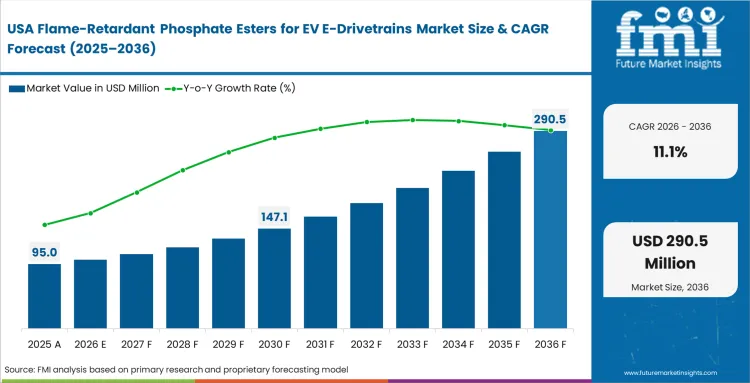
Aggressive federal incentives aimed at rapidly establishing independent, secure domestic supply chains fundamentally reshape long-term chemical procurement strategies. Automakers aggressively seek sources for critical high-voltage drivetrain materials to qualify for highly lucrative consumer tax credits and governmental subsidies. This intense geopolitical pressure forces major chemical synthesizers to heavily expand regional toll compounding capacity to meet localized demand. Massive investments in localized testing laboratories and validation facilities allow domestic suppliers to rapidly certify new, complex formulations against stringent automotive fire-safety requirements without waiting on overseas testing queues.
- United States: Sales in the United States are projected to rise at an 11.1% CAGR during the forecast period, fueled by sweeping federal incentives aimed at establishing independent domestic supply chains, and government funding dedicated to localized battery and drivetrain manufacturing. Other factors are rapid expansion of regional toll compounding capacity by major chemical synthesizers, and heavy capital investments in localized testing laboratories to accelerate material certification. Securing approved supplier status for these heavily subsidized domestic platforms guarantees lucrative, long-term volume contracts for nimble chemical producers capable of meeting localized content requirements.
FMI's report includes additional countries not in bullets. Canadian raw material processors increasingly align their core phosphorus extraction and refinement techniques to feed directly into this rapidly expanding, highly integrated cross-border automotive ecosystem.
Competitive Aligners for Market Players
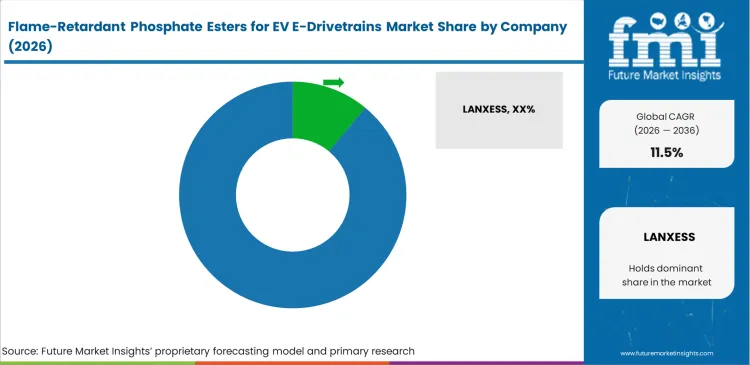
Overlap between traditional polymer additive suppliers and specialized automotive fluid formulators creates a fragmented competitive environment. Evaluating who are the leading suppliers of EV drivetrain phosphate ester additives reveals that LANXESS and Clariant leverage deep institutional knowledge of engineering plastics to dominate the solid-state resin compounding channel. Conversely, companies like Lubrizol and Afton Chemical approach the exact same thermal challenges by engineering phosphorus esters specifically for complex fluid matrices. Purchasing directors evaluate these suppliers on their ability to generate comprehensive toxicity and aging dossiers that satisfy strict automotive homologation requirements.
Established primary chemical synthesizers possess extensive registration libraries that emerging EV flame retardant additive manufacturers cannot replicate within standard vehicle development timelines. ICL Group and ADEKA maintain distinct advantages through their proprietary access to raw phosphorus streams and decades of documented UL94 testing data. Scaling a competitive alternative requires challengers to invest heavily in localized regulatory approvals before selling a single kilogram of advanced material. These data-generation costs protect incumbent margins even when underlying raw material costs fluctuate.
Key Players in the Flame-Retardant Phosphate Esters for EV E-Drivetrains Market
- LANXESS
- ICL Group
- ADEKA
- Clariant
- Italmatch Chemicals
- Lubrizol
- Afton Chemical
Scope of the Report
| Metric | Value |
|---|---|
| Quantitative Units | USD 209.0 Million to USD 620.7 Million, at a CAGR of 11.50% |
| Market Definition | Functional boundaries for this sector encompass specialty electrical insulation chemicals for EVs engineered specifically to impart fire resistance and dielectric stability within propulsion architectures. This category covers additive chemistries blended into insulating polymers and specialized formulations deployed within driveline cooling fluids. Defining characteristics include halogen-free composition and thermal stability under continuous electrical stress. |
| Segmentation | Chemistry Type, Application, Component, Vehicle Type, Sales Channel, and Region |
| Regions Covered | North America, Latin America, Europe, East Asia, South Asia, Oceania, Middle East and Africa |
| Countries Covered | United States, Canada, Brazil, Mexico, Germany, United Kingdom, France, Spain, Italy, China, Japan, South Korea, India, Australia, New Zealand, GCC Countries, South Africa |
| Key Companies Profiled | LANXESS, ICL Group, ADEKA, Clariant, Italmatch Chemicals, Lubrizol, Afton Chemical |
| Forecast Period | 2026 to 2036 |
| Approach | Global electric vehicle production volumes are cross-referenced with average plastic weight per integrated e-axle to establish baseline demand. Independent chemical compounder pricing indices and fluid additive volume reports subsequently validate these consumption models to ensure high accuracy. |
Source: Future Market Insights (FMI) analysis, based on proprietary forecasting model and primary research
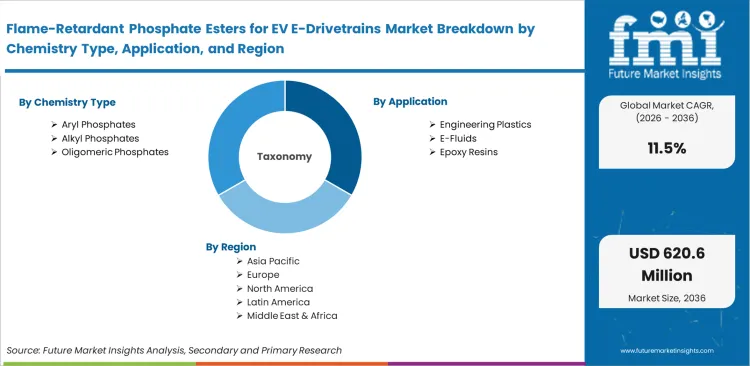
Flame-Retardant Phosphate Esters for EV E-Drivetrains Market Analysis by Segments
Chemistry Type
- Aryl Phosphates
- Alkyl Phosphates
- Oligomeric Phosphates
Application
- Engineering Plastics
- E-Fluids
- Epoxy Resins
- Cable Compounds
Component
- Traction Inverters
- E-Motors
- Connectors
- Harnesses
Vehicle Type
- Passenger BEVs
- Commercial BEVs
- PHEVs
Sales Channel
- Compounders
- Fluid Blenders
- Tier Suppliers
- OEM Direct
Region
- North America
- Latin America
- Europe
- East Asia
- South Asia
- Oceania
- Middle East and Africa
Bibliography
- USA Environmental Protection Agency. (2025, August). Fact sheet: Assessing risks from flame retardants.
- Office of the Principal Scientific Adviser to the Government of India. (2024, July). eMobility R&D roadmap.
- United Nations Economic Commission for Europe. (2025, December). GRSP-78-04: Proposal related to fire resistance testing for electric vehicles.
- Yin, Z., Zhang, X., Zhang, Y., & Wang, D. (2025, April). The development and application of contemporary phosphorus flame retardants: A review. Frontiers in Materials, 12, Article 1508000.
- Bifulco, A., Guo, Y., & coauthors. (2024, November). Recycling of flame-retardant polymers. Journal of Materiomics.
- Patel, R., & coauthors. (2025, June). Fire-resistant coatings: Advances in flame-retardant materials, mechanisms, and applications. Polymers, 17(13), 1814.
This bibliography is provided for reader reference and is not exhaustive. The full report contains the complete reference list and detailed citations.
This Report Addresses
- Specific volume requirements for aryl phosphate esters inside 800-volt traction inverter housings.
- Strategic responses to impending European chemical agency restrictions on legacy halogenated fire suppressants.
- Cost implications of lengthy qualification cycles for high-temperature engineered polyamides.
- Material interactions between new phosphate-based driveline fluids and legacy copper wiring components.
- Regional production shifts driven by massive integrated e-axle manufacturing investments in China.
- Testing protocols mandated by major automakers for dielectric potting compounds and motor encapsulants.
- Pricing premiums commanded by primary chemical synthesizers holding comprehensive automotive aging dossiers.
- Structural vulnerabilities created by dual-sourcing mandates imposed by cost-conscious tier-one purchasing directors.
Frequently Asked Questions
What are flame-retardant phosphate esters used for in EV e-drivetrains?
These specialized organophosphorus formulations provide simultaneous dielectric insulation and fire suppression. They are blended directly into high-voltage plastics, insulating resins, and driveline cooling fluids to manage extreme thermal events inside compact traction inverters and electric motors without triggering halogen-related regulatory bans.
How large is the flame-retardant phosphate esters for EV e-drivetrains market?
FMI projects the sector is estimated to cross USD 620.7 million by 2036. This cumulative buildup reflects the absolute necessity for specialized chemistry as automotive OEMs standardize high-voltage direct-cooled drivetrain architectures, moving away from legacy air-cooled systems.
Why are phosphate esters used in EV drivetrain materials?
Formulators select these chemicals because they maintain structural integrity at continuous operating temperatures exceeding 150 degrees Celsius. They resist volatility under extreme thermal cycling while allowing plastic components to enter standard recovery streams without triggering hazardous waste protocols.
Explain the market for flame-retardant phosphate esters in EV drivetrains?
This sector bridges the gap between raw chemical synthesis, specialized polymer compounding, and automotive fluid blending. It operates as a critical specification-driven niche where meeting UL94 V-0 ratings at ultra-thin wall thicknesses defines commercial viability for Tier-1 suppliers.
What drives demand for phosphate esters in electric vehicle e-drivetrains?
The transition to 800-volt architectures dramatically increases the risk of electrical arcing across tight clearances. This structural shift converts advanced flame-retardant chemistry from an optional upgrade into a mandatory compliance requirement for component certification.
Who are the leading suppliers of EV drivetrain phosphate ester additives?
The competitive landscape includes traditional polymer additive suppliers like LANXESS, Clariant, ICL Group, and ADEKA, alongside specialized automotive fluid formulators such as Lubrizol, Afton Chemical, and Italmatch Chemicals.
Phosphate esters vs brominated flame retardants for EVs: how do they compare?
Legacy brominated options frequently fail strict European toxicity standards and hinder end-of-life recycling processes. Phosphate esters provide a halogen-free alternative that delivers equivalent high-temperature fire resistance while aligning with stringent corporate sustainability and compliance directives.
Which EV components use phosphorus-based flame retardants?
Vast volumes are consumed by traction inverter housings, motor end-caps, high-voltage connectors, and internal wiring harnesses. Specialized fluid formulations also integrate these additives to protect fast-spinning gears while maintaining dielectric strength during immersion cooling.
Are phosphate esters used in EV e-fluids?
Yes. Specialized blenders engineer custom phosphate profiles directly into drivetrain lubricants. This dual-function approach ensures the e-fluid performs necessary tribological duties while preventing thermal propagation during electrical faults in direct-cooled motor architectures.
Why does China lead regional growth?
Domestic manufacturers aggressively scale unified e-axle production for export platforms. Intense localization allows raw phosphorus processors to iterate chemical formulations rapidly alongside injection molders and battery integrators.
How does South Korea differ from broader Asian consumption?
Stringent benchmarking against international export standards dictates regional material selection. Purchasing teams willingly absorb premium chemical costs to ensure their integrated drivetrains pass rigorous European and North American fire homologation.
What operational friction slows immediate material substitution?
Validating a new flame-retardant package requires exhaustive 3,000-hour aging cycles. Quality assurance protocols force engineers to prove that novel phosphate esters do not chemically degrade surrounding seals or internal wiring harnesses.
What role do polymer compounders play?
Successfully dispersing liquid phosphorus esters into solid resin matrices requires highly specialized twin-screw extrusion technology. Major OEMs rely entirely on these toll manufacturers to guarantee batch-to-batch consistency for critical molded parts.
How do halogen phase-outs affect pricing?
Regulatory bans on legacy chemical systems narrow the pool of viable suppliers. Chemical synthesizers holding validated safety dossiers for clean alternatives command structural premiums detached from raw synthesis costs.
Why do passenger BEVs account for the largest share?
Volume dominance reflects millions of standardized consumer platforms rolling off global assembly lines. Qualifying a chemical package for a high-volume sedan establishes the material baseline for subsequent commercial and hybrid applications.
How does Germany approach material qualification?
Sustainability targets dictate European automotive strategy. Germany-based engineers prioritize phosphate esters that guarantee V-0 fire compliance while simultaneously proving they do not contaminate future end-of-life plastic recycling streams.
What limits immediate adoption in micro-mobility platforms?
Severe cost constraints prevent rapid substitution of basic legacy plastics. Entry-level engineering teams only adopt premium organophosphorus systems when localized urban regulations explicitly mandate upgraded fire safety standards.
How do dual-sourcing mandates impact chemical producers?
Major automakers actively avoid locking into proprietary molecular architectures to preserve negotiating leverage. Chemical suppliers must design highly effective ester blends that remain compatible with generic alternative sourcing options.
What hidden costs impact injection molders?
Heavily loaded flame-retardant resins can be highly abrasive. Operations directors frequently encounter accelerated wear on molding equipment, driving up unexpected maintenance expenses for Tier-1 parts suppliers.
Why is cold-weather performance a concern for formulators?
Excessive concentrations of flame suppressants can inadvertently plasticize host polymers. Material scientists must balance absolute fire resistance against the risk of components becoming dangerously brittle in sub-zero operational environments.
How does India approach EV drivetrain safety?
Localization mandates push suppliers to source chemical additives domestically. Robust fire-safe composites remain crucial for Indian platforms that frequently operate in extreme ambient temperatures without sophisticated active liquid cooling systems.
What role do synergistic nitrogen blends play?
Combining nitrogen functionalities with phosphorus molecules reduces the total volume of additive required. This strategy allows formulators to hit strict flammability ratings while preserving the native mechanical strength of the structural composite.
How do OEM direct sales compare to compounding channels?
Pure chemical synthesis companies prefer shipping bulk quantities to intermediaries. Direct sales to automakers remain rare, occurring only when an OEM vertically integrates its own specialized plastic extrusion or fluid blending operations.
Preview the report firsthand - request a free sample
Get SampleGet the brochure for pricing and purchase details.
Get PDFTable of Content
- Executive Summary
- Global Market Outlook
- Demand-side Trends
- Supply-side Trends
- Technology Roadmap Analysis
- Analysis and Recommendations
- Market Overview
- Market Coverage / Taxonomy
- Market Definition / Scope / Limitations
- Research Methodology
- Chapter Orientation
- Analytical Lens and Working Hypotheses
- Market Structure, Signals, and Trend Drivers
- Benchmarking and Cross-market Comparability
- Market Sizing, Forecasting, and Opportunity Mapping
- Research Design and Evidence Framework
- Desk Research Programme (Secondary Evidence)
- Company Annual and Sustainability Reports
- Peer-reviewed Journals and Academic Literature
- Corporate Websites, Product Literature, and Technical Notes
- Earnings Decks and Investor Briefings
- Statutory Filings and Regulatory Disclosures
- Technical White Papers and Standards Notes
- Trade Journals, Industry Magazines, and Analyst Briefs
- Conference Proceedings, Webinars, and Seminar Materials
- Government Statistics Portals and Public Data Releases
- Press Releases and Reputable Media Coverage
- Specialist Newsletters and Curated Briefings
- Sector Databases and Reference Repositories
- FMI Internal Proprietary Databases and Historical Market Datasets
- Subscription Datasets and Paid Sources
- Social Channels, Communities, and Digital Listening Inputs
- Additional Desk Sources
- Expert Input and Fieldwork (Primary Evidence)
- Primary Modes
- Qualitative Interviews and Expert Elicitation
- Quantitative Surveys and Structured Data Capture
- Blended Approach
- Why Primary Evidence is Used
- Field Techniques
- Interviews
- Surveys
- Focus Groups
- Observational and In-context Research
- Social and Community Interactions
- Stakeholder Universe Engaged
- C-suite Leaders
- Board Members
- Presidents and Vice Presidents
- R&D and Innovation Heads
- Technical Specialists
- Domain Subject-matter Experts
- Scientists
- Physicians and Other Healthcare Professionals
- Governance, Ethics, and Data Stewardship
- Research Ethics
- Data Integrity and Handling
- Primary Modes
- Tooling, Models, and Reference Databases
- Desk Research Programme (Secondary Evidence)
- Data Engineering and Model Build
- Data Acquisition and Ingestion
- Cleaning, Normalisation, and Verification
- Synthesis, Triangulation, and Analysis
- Quality Assurance and Audit Trail
- Market Background
- Market Dynamics
- Drivers
- Restraints
- Opportunity
- Trends
- Scenario Forecast
- Demand in Optimistic Scenario
- Demand in Likely Scenario
- Demand in Conservative Scenario
- Opportunity Map Analysis
- Product Life Cycle Analysis
- Supply Chain Analysis
- Investment Feasibility Matrix
- Value Chain Analysis
- PESTLE and Porter’s Analysis
- Regulatory Landscape
- Regional Parent Market Outlook
- Production and Consumption Statistics
- Import and Export Statistics
- Market Dynamics
- Global Market Analysis 2021 to 2025 and Forecast, 2026 to 2036
- Historical Market Size Value (USD Million) Analysis, 2021 to 2025
- Current and Future Market Size Value (USD Million) Projections, 2026 to 2036
- Y-o-Y Growth Trend Analysis
- Absolute $ Opportunity Analysis
- Global Market Pricing Analysis 2021 to 2025 and Forecast 2026 to 2036
- Global Market Analysis 2021 to 2025 and Forecast 2026 to 2036, By Chemistry Type
- Introduction / Key Findings
- Historical Market Size Value (USD Million) Analysis By Chemistry Type , 2021 to 2025
- Current and Future Market Size Value (USD Million) Analysis and Forecast By Chemistry Type , 2026 to 2036
- Aryl Phosphates
- Alkyl Phosphates
- Oligomeric Phosphates
- Aryl Phosphates
- Y-o-Y Growth Trend Analysis By Chemistry Type , 2021 to 2025
- Absolute $ Opportunity Analysis By Chemistry Type , 2026 to 2036
- Global Market Analysis 2021 to 2025 and Forecast 2026 to 2036, By Application
- Introduction / Key Findings
- Historical Market Size Value (USD Million) Analysis By Application, 2021 to 2025
- Current and Future Market Size Value (USD Million) Analysis and Forecast By Application, 2026 to 2036
- Engineering Plastics
- E-Fluids
- Epoxy Resins
- Engineering Plastics
- Y-o-Y Growth Trend Analysis By Application, 2021 to 2025
- Absolute $ Opportunity Analysis By Application, 2026 to 2036
- Global Market Analysis 2021 to 2025 and Forecast 2026 to 2036, By Component
- Introduction / Key Findings
- Historical Market Size Value (USD Million) Analysis By Component, 2021 to 2025
- Current and Future Market Size Value (USD Million) Analysis and Forecast By Component, 2026 to 2036
- Traction Inverters
- E-Motors
- Connectors
- Traction Inverters
- Y-o-Y Growth Trend Analysis By Component, 2021 to 2025
- Absolute $ Opportunity Analysis By Component, 2026 to 2036
- Global Market Analysis 2021 to 2025 and Forecast 2026 to 2036, By Vehicle Type
- Introduction / Key Findings
- Historical Market Size Value (USD Million) Analysis By Vehicle Type, 2021 to 2025
- Current and Future Market Size Value (USD Million) Analysis and Forecast By Vehicle Type, 2026 to 2036
- Passenger BEVs
- Commercial BEVs
- PHEVs
- Passenger BEVs
- Y-o-Y Growth Trend Analysis By Vehicle Type, 2021 to 2025
- Absolute $ Opportunity Analysis By Vehicle Type, 2026 to 2036
- Global Market Analysis 2021 to 2025 and Forecast 2026 to 2036, By Sales Channel
- Introduction / Key Findings
- Historical Market Size Value (USD Million) Analysis By Sales Channel, 2021 to 2025
- Current and Future Market Size Value (USD Million) Analysis and Forecast By Sales Channel, 2026 to 2036
- Compounders
- Fluid Blenders
- Tier Suppliers
- Compounders
- Y-o-Y Growth Trend Analysis By Sales Channel, 2021 to 2025
- Absolute $ Opportunity Analysis By Sales Channel, 2026 to 2036
- Global Market Analysis 2021 to 2025 and Forecast 2026 to 2036, By Region
- Introduction
- Historical Market Size Value (USD Million) Analysis By Region, 2021 to 2025
- Current Market Size Value (USD Million) Analysis and Forecast By Region, 2026 to 2036
- North America
- Latin America
- Western Europe
- Eastern Europe
- East Asia
- South Asia and Pacific
- Middle East & Africa
- Market Attractiveness Analysis By Region
- North America Market Analysis 2021 to 2025 and Forecast 2026 to 2036, By Country
- Historical Market Size Value (USD Million) Trend Analysis By Market Taxonomy, 2021 to 2025
- Market Size Value (USD Million) Forecast By Market Taxonomy, 2026 to 2036
- By Country
- USA
- Canada
- Mexico
- By Chemistry Type
- By Application
- By Component
- By Vehicle Type
- By Sales Channel
- By Country
- Market Attractiveness Analysis
- By Country
- By Chemistry Type
- By Application
- By Component
- By Vehicle Type
- By Sales Channel
- Key Takeaways
- Latin America Market Analysis 2021 to 2025 and Forecast 2026 to 2036, By Country
- Historical Market Size Value (USD Million) Trend Analysis By Market Taxonomy, 2021 to 2025
- Market Size Value (USD Million) Forecast By Market Taxonomy, 2026 to 2036
- By Country
- Brazil
- Chile
- Rest of Latin America
- By Chemistry Type
- By Application
- By Component
- By Vehicle Type
- By Sales Channel
- By Country
- Market Attractiveness Analysis
- By Country
- By Chemistry Type
- By Application
- By Component
- By Vehicle Type
- By Sales Channel
- Key Takeaways
- Western Europe Market Analysis 2021 to 2025 and Forecast 2026 to 2036, By Country
- Historical Market Size Value (USD Million) Trend Analysis By Market Taxonomy, 2021 to 2025
- Market Size Value (USD Million) Forecast By Market Taxonomy, 2026 to 2036
- By Country
- Germany
- UK
- Italy
- Spain
- France
- Nordic
- BENELUX
- Rest of Western Europe
- By Chemistry Type
- By Application
- By Component
- By Vehicle Type
- By Sales Channel
- By Country
- Market Attractiveness Analysis
- By Country
- By Chemistry Type
- By Application
- By Component
- By Vehicle Type
- By Sales Channel
- Key Takeaways
- Eastern Europe Market Analysis 2021 to 2025 and Forecast 2026 to 2036, By Country
- Historical Market Size Value (USD Million) Trend Analysis By Market Taxonomy, 2021 to 2025
- Market Size Value (USD Million) Forecast By Market Taxonomy, 2026 to 2036
- By Country
- Russia
- Poland
- Hungary
- Balkan & Baltic
- Rest of Eastern Europe
- By Chemistry Type
- By Application
- By Component
- By Vehicle Type
- By Sales Channel
- By Country
- Market Attractiveness Analysis
- By Country
- By Chemistry Type
- By Application
- By Component
- By Vehicle Type
- By Sales Channel
- Key Takeaways
- East Asia Market Analysis 2021 to 2025 and Forecast 2026 to 2036, By Country
- Historical Market Size Value (USD Million) Trend Analysis By Market Taxonomy, 2021 to 2025
- Market Size Value (USD Million) Forecast By Market Taxonomy, 2026 to 2036
- By Country
- China
- Japan
- South Korea
- By Chemistry Type
- By Application
- By Component
- By Vehicle Type
- By Sales Channel
- By Country
- Market Attractiveness Analysis
- By Country
- By Chemistry Type
- By Application
- By Component
- By Vehicle Type
- By Sales Channel
- Key Takeaways
- South Asia and Pacific Market Analysis 2021 to 2025 and Forecast 2026 to 2036, By Country
- Historical Market Size Value (USD Million) Trend Analysis By Market Taxonomy, 2021 to 2025
- Market Size Value (USD Million) Forecast By Market Taxonomy, 2026 to 2036
- By Country
- India
- ASEAN
- Australia & New Zealand
- Rest of South Asia and Pacific
- By Chemistry Type
- By Application
- By Component
- By Vehicle Type
- By Sales Channel
- By Country
- Market Attractiveness Analysis
- By Country
- By Chemistry Type
- By Application
- By Component
- By Vehicle Type
- By Sales Channel
- Key Takeaways
- Middle East & Africa Market Analysis 2021 to 2025 and Forecast 2026 to 2036, By Country
- Historical Market Size Value (USD Million) Trend Analysis By Market Taxonomy, 2021 to 2025
- Market Size Value (USD Million) Forecast By Market Taxonomy, 2026 to 2036
- By Country
- Kingdom of Saudi Arabia
- Other GCC Countries
- Turkiye
- South Africa
- Other African Union
- Rest of Middle East & Africa
- By Chemistry Type
- By Application
- By Component
- By Vehicle Type
- By Sales Channel
- By Country
- Market Attractiveness Analysis
- By Country
- By Chemistry Type
- By Application
- By Component
- By Vehicle Type
- By Sales Channel
- Key Takeaways
- Key Countries Market Analysis
- USA
- Pricing Analysis
- Market Share Analysis, 2025
- By Chemistry Type
- By Application
- By Component
- By Vehicle Type
- By Sales Channel
- Canada
- Pricing Analysis
- Market Share Analysis, 2025
- By Chemistry Type
- By Application
- By Component
- By Vehicle Type
- By Sales Channel
- Mexico
- Pricing Analysis
- Market Share Analysis, 2025
- By Chemistry Type
- By Application
- By Component
- By Vehicle Type
- By Sales Channel
- Brazil
- Pricing Analysis
- Market Share Analysis, 2025
- By Chemistry Type
- By Application
- By Component
- By Vehicle Type
- By Sales Channel
- Chile
- Pricing Analysis
- Market Share Analysis, 2025
- By Chemistry Type
- By Application
- By Component
- By Vehicle Type
- By Sales Channel
- Germany
- Pricing Analysis
- Market Share Analysis, 2025
- By Chemistry Type
- By Application
- By Component
- By Vehicle Type
- By Sales Channel
- UK
- Pricing Analysis
- Market Share Analysis, 2025
- By Chemistry Type
- By Application
- By Component
- By Vehicle Type
- By Sales Channel
- Italy
- Pricing Analysis
- Market Share Analysis, 2025
- By Chemistry Type
- By Application
- By Component
- By Vehicle Type
- By Sales Channel
- Spain
- Pricing Analysis
- Market Share Analysis, 2025
- By Chemistry Type
- By Application
- By Component
- By Vehicle Type
- By Sales Channel
- France
- Pricing Analysis
- Market Share Analysis, 2025
- By Chemistry Type
- By Application
- By Component
- By Vehicle Type
- By Sales Channel
- India
- Pricing Analysis
- Market Share Analysis, 2025
- By Chemistry Type
- By Application
- By Component
- By Vehicle Type
- By Sales Channel
- ASEAN
- Pricing Analysis
- Market Share Analysis, 2025
- By Chemistry Type
- By Application
- By Component
- By Vehicle Type
- By Sales Channel
- Australia & New Zealand
- Pricing Analysis
- Market Share Analysis, 2025
- By Chemistry Type
- By Application
- By Component
- By Vehicle Type
- By Sales Channel
- China
- Pricing Analysis
- Market Share Analysis, 2025
- By Chemistry Type
- By Application
- By Component
- By Vehicle Type
- By Sales Channel
- Japan
- Pricing Analysis
- Market Share Analysis, 2025
- By Chemistry Type
- By Application
- By Component
- By Vehicle Type
- By Sales Channel
- South Korea
- Pricing Analysis
- Market Share Analysis, 2025
- By Chemistry Type
- By Application
- By Component
- By Vehicle Type
- By Sales Channel
- Russia
- Pricing Analysis
- Market Share Analysis, 2025
- By Chemistry Type
- By Application
- By Component
- By Vehicle Type
- By Sales Channel
- Poland
- Pricing Analysis
- Market Share Analysis, 2025
- By Chemistry Type
- By Application
- By Component
- By Vehicle Type
- By Sales Channel
- Hungary
- Pricing Analysis
- Market Share Analysis, 2025
- By Chemistry Type
- By Application
- By Component
- By Vehicle Type
- By Sales Channel
- Kingdom of Saudi Arabia
- Pricing Analysis
- Market Share Analysis, 2025
- By Chemistry Type
- By Application
- By Component
- By Vehicle Type
- By Sales Channel
- Turkiye
- Pricing Analysis
- Market Share Analysis, 2025
- By Chemistry Type
- By Application
- By Component
- By Vehicle Type
- By Sales Channel
- South Africa
- Pricing Analysis
- Market Share Analysis, 2025
- By Chemistry Type
- By Application
- By Component
- By Vehicle Type
- By Sales Channel
- USA
- Market Structure Analysis
- Competition Dashboard
- Competition Benchmarking
- Market Share Analysis of Top Players
- By Region
- By Chemistry Type
- By Application
- By Component
- By Vehicle Type
- By Sales Channel
- Competition Analysis
- Competition Deep Dive
- LANXESS
- Overview
- Product Portfolio
- Profitability by Market Segments (Product/Age /Sales Channel/Region)
- Sales Footprint
- Strategy Overview
- Marketing Strategy
- Product Strategy
- Channel Strategy
- ICL Group
- ADEKA
- Clariant
- Italmatch Chemicals
- Lubrizol
- Afton Chemical
- LANXESS
- Competition Deep Dive
- Assumptions & Acronyms Used


