

- Market Size (2026)
- USD 24.9 Mn
- Forecast (2036)
- USD 269.5 Mn
- CAGR (2026 to 2036)
- 26.9%
eVTOL and UAM Line Maintenance Services Market Size, Market Forecast and Outlook By FMI
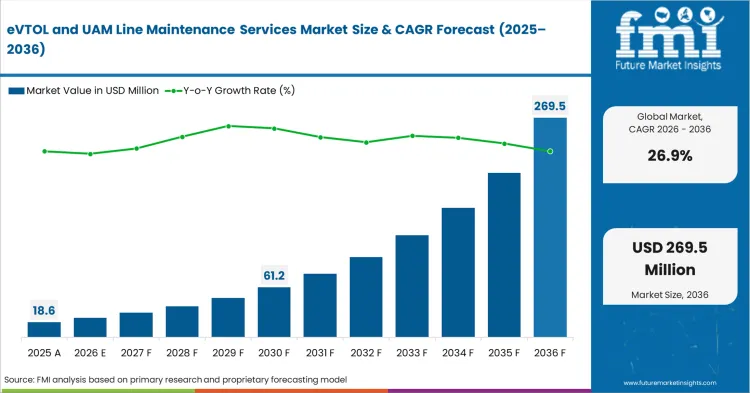
The eVTOL and UAM line maintenance services market was valued at USD 18.6 million in 2025. The market is forecast to reach USD 24.9 million by 2026-end and expand at a CAGR of 26.9% between 2026 and 2036 to reach USD 269.5 million by 2036. Piloted eVTOL is projected to hold 58.0% aircraft type share, and fleet operators are expected to lead the customer type segment with 46.0% share.
Summary of the eVTOL and UAM Line Maintenance Services Market
- Demand and Growth Drivers
- Powered-lift operating rules reinforce demand for line checks as operators prepare aircraft release records before passenger service.
- Vertiport-based aircraft turnarounds increase service need as short city flights require faster inspection and charging checks.
- Battery safety work strengthens specialist service demand as electric aircraft need pack condition records before dispatch approval.
- Product and Segment View
- Inspection services are projected to account for 34.0% of service type demand in 2026 as operators need quick release checks after short urban flights.
- Piloted eVTOL is expected to represent 58.0% of aircraft type segment in 2026, supported by nearer crewed certification pathways.
- Fleet operators are anticipated to form the leading-value customer base since aircraft availability directly affects scheduled air taxi operations.
- Geography and Competitive Outlook
- UAE is expected to record a CAGR of 31.4% through 2036, backed by Dubai’s early air taxi service planning.
- USA is projected to expand at 29.8% CAGR by 2036 as FAA powered-lift rules clarify early operating requirements.
- Companies combining aircraft data access with high-voltage service capability are improving early service access during the forecast period.
- Analyst Opinion
- Nikhil Kaitwade, Associate Vice President at FMI says, “eVTOL line maintenance now supports aircraft approval and uptime for passenger service. Battery records and release checks need one ground plan. High-voltage technicians with documentation discipline can reduce delays as training costs and OEM data access shape long service agreements.”
- eVTOL and UAM Line Maintenance Services Market Value Analysis
- The eVTOL and UAM line maintenance services market is shifting from aircraft trial readiness into scheduled line service planning.
- Powered-lift operating rules and aircraft release documentation needs are increasing service uptake across early air taxi programs.
- Airport shuttle and city travel concepts are widening the service base for advanced air mobility maintenance programs.
- Aviation release requirements create a steady need for documented inspection records before aircraft return to service.
- Battery checks and charging verification confirm aircraft readiness and help operators manage turnaround timing.
Key Takeaways
- The eVTOL and UAM line maintenance services market was valued at USD 18.6 million in 2025.
- By 2036, the eVTOL and UAM line maintenance services market is forecast at USD 269.5 million.
- From 2026 to 2036, the market is projected to expand at a CAGR of 26.9%.
- The market is projected to create an incremental opportunity of USD 244.6 million between 2026 and 2036.
- In 2026, Piloted eVTOL is expected to account for 58.0% of aircraft type demand.
- UAE at 31.4% and USA at 29.8% are two faster country markets through 2036.
eVTOL line maintenance will be judged on dispatch safety, approval scope and fast turnaround rather than traditional hangar depth alone. Archer’s February 2024 FAA Part 145 certification shows why repair-station readiness is becoming an early commercial requirement. The FAA’s April 2024 repair-station guidance also matters because a station can only work on aviation articles within its approval. UAM service providers therefore need narrow but well-documented task authority. EASA’s July 2025 VTOL compliance update shows that certification expectations are still developing for aircraft outside conventional helicopter and fixed-wing categories.
Maintenance teams must keep procedures updated. Operating guidance adds another layer because EASA links IAM operations to preflight preparation, landing-site availability and energy management. Joby’s Part 145 activity shows the same market pattern. OEMs and operators are building maintenance capability before high-frequency services begin. Providers with approval discipline, battery checks and dispatch-focused procedures are better positioned.
eVTOL and UAM Line Maintenance Services Market Definition
The eVTOL and UAM line maintenance services market includes on-site aircraft service tasks performed between flights. These services assess aircraft condition, battery health, charging status, avionics faults, and software readiness before release. Scope includes inspection services, battery diagnostics, charging checks, and field-level line maintenance. Heavy overhaul, aircraft manufacturing, and vertiport construction are outside the scope.
eVTOL and UAM Line Maintenance Services Market Inclusions
Market scope covers all commercially traded eVTOL and UAM line maintenance services categorized by service type, including inspection services, battery diagnostics, charging checks, avionics checks, and software updates; maintenance location, including vertiport line, airport line, mobile field, and depot interface; aircraft type, including piloted eVTOL, autonomous eVTOL, hybrid VTOL, and cargo eVTOL; customer type, including fleet operators, OEM programs, vertiport operators, and public agencies; and contract type, including OEM managed, independent MRO, operator in-house, and FBO partner models. Revenue scope covers 2026 to 2036. Market stakeholders include eVTOL aircraft manufacturers, UAM fleet operators, aviation maintenance providers, vertiport operators, battery system providers, charging equipment firms, avionics service companies, airport service firms, FBO partners, civil aviation authorities, training providers, software diagnostics vendors, and urban air mobility infrastructure developers.
eVTOL and UAM Line Maintenance Services Market Exclusions
Scope does not include aircraft manufacturing, battery cell production, passenger ticketing, vertiport construction, pilot training, or heavy base maintenance.
eVTOL and UAM Line Maintenance Services Market Research Methodology
- Primary Research: FMI analysts interviewed aircraft developers, maintenance service providers, vertiport operators, and aviation service specialists in launch markets.
- Desk Research: FMI combined data from aviation authority rules, certification guidance, company service plans, and aircraft operating requirements.
- Market sizing and forecasting: FMI added service use across aircraft checks, battery diagnostics, charging verification, and launch-country operating plans from the bottom up.
- Data validation: FMI cross-checked every quarter against powered-lift regulation, launch-city readiness, aircraft program timing, and adjacent air transport MRO service patterns.
Why is the eVTOL and UAM Line Maintenance Services Market Growing?
- Operators prepare line maintenance systems earlier to reduce release delays before passenger service begins.
- Aircraft makers are using controlled service plans as early fleets need fault data and battery health records.
- Vertiport operators need service partners able to complete inspection and charging checks near aircraft stands.
Powered-lift regulation is making line maintenance documentation a formal service requirement. The Federal Aviation Administration issued its final powered-lift rule in October 2024, covering pilot qualifications and operational requirements for powered-lift aircraft. The rule gives operators a clearer basis for aircraft release planning before passenger service. Maintenance providers take a larger role as aircraft checks must match regulated operating discipline and reliable records. Service firms with aviation release knowledge can gain early program access across the United States launch corridors.
Ground infrastructure shifts line service toward a vertiport-level task across early air taxi networks. As per Skyports April 2026 report, the Dubai vertiport has a 3,100 square meter footprint and two dedicated take-off and landing areas. The facility layout creates demand for service teams located near aircraft stands and charging points. Faster inspection access reduces aircraft ground time and protects early schedule reliability. Vertiport line work will shape service pricing before broader vertiport networks scale.
Market Segmentation Analysis
- Inspection services are projected to represent 34.0% of the service type segment in 2026 as release checks become the first routine step before flight approval.
- Vertiport line activity is forecast to capture 42.0% of the maintenance location mix in 2026, reflecting technician placement close to aircraft stands.
- Piloted eVTOL is anticipated to make up 58.0% of the aircraft type base in 2026 through nearer crewed certification pathways.
- Fleet operators are estimated to account for 46.0% of the customer type segment in 2026 since aircraft availability shapes scheduled air taxi operations.
- OEM managed contracts are expected to represent 39.0% of the contract type structure in 2026, driven by manufacturer control over service manuals and fault data.
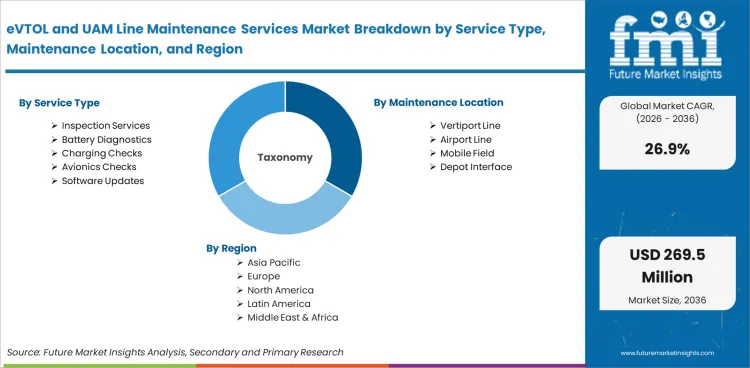
eVTOL and UAM line maintenance services are divided into five primary segment groups based on service type, maintenance location, aircraft type, customer type, and contract type. Service type includes inspection services, battery diagnostics, charging checks, avionics checks, and software updates. Maintenance location includes vertiport line, airport line, mobile field, and depot interface. Aircraft type includes piloted eVTOL, autonomous eVTOL, hybrid VTOL, and cargo eVTOL. Customer type includes fleet operators, OEM programs, vertiport operators, and public agencies. Contract type includes OEM managed, independent MRO, operator in-house, and FBO partner.
Insights into the Inspection Services Service Type Segment
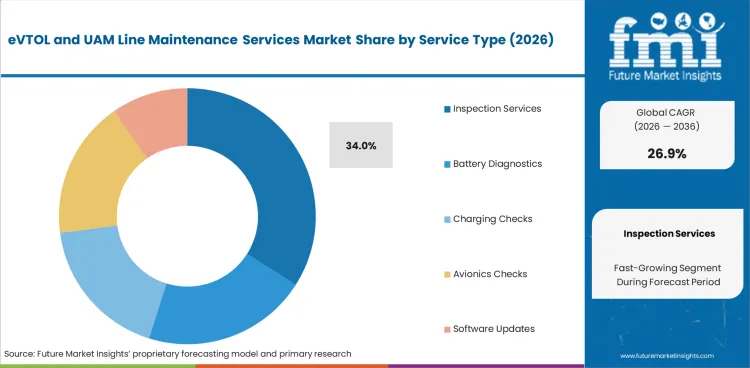
In 2026, Inspection services are estimated to make up 34.0% of the service type segment. Daily release checks and exterior condition reviews keep line tasks central to early eVTOL operations.
Short urban flight cycles require fast inspection routines before aircraft return to passenger service. Digital release records will decide how quickly operators clear each aircraft.
Insights into the Vertiport Line Maintenance Location Segment
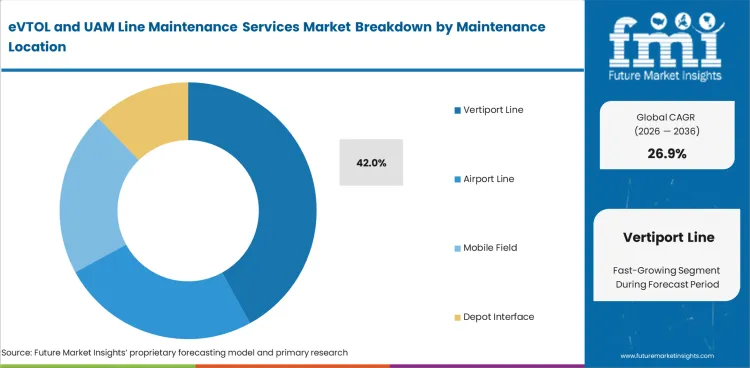
- Vertiport line is projected to account for 42.0% of the maintenance location segment in 2026. Service activity stays closest to aircraft stands as turnaround planning moves into launch sites.
- Tool placement near charging points helps technicians complete battery checks and release work without moving aircraft to distant hangars.
Insights into the Piloted eVTOL Aircraft Type Segment
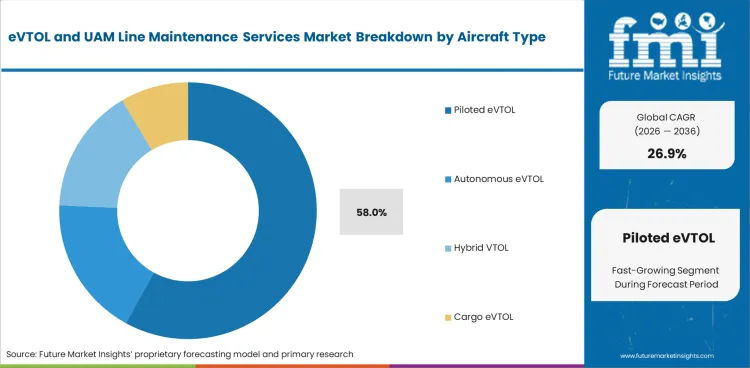
- Piloted eVTOL is forecast to hold 58.0% of the aircraft type segment in 2026. Crewed certification pathways give this aircraft group a stronger near-term service base.
- Maintenance teams need records aligned with pilot operations and aircraft release procedures. Autonomous programs will require deeper sensor review before higher service use.
Insights into the Fleet Operators Customer Type Segment
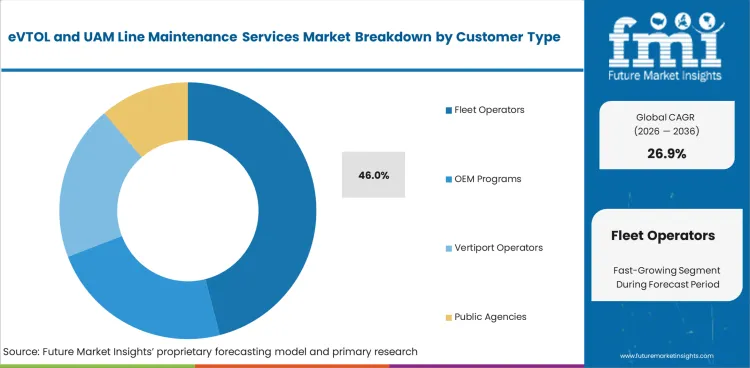
- In 2026, Fleet operators are predicted to account for 46.0% of the customer type segment. Aircraft availability directly affects scheduled air taxi service and daily route planning.
- Operator-led service demand is based on uptime control and faster fault closure. Early fleet teams will prefer partners able to manage records and battery checks together.
Insights into the OEM Managed Contract Type Segment
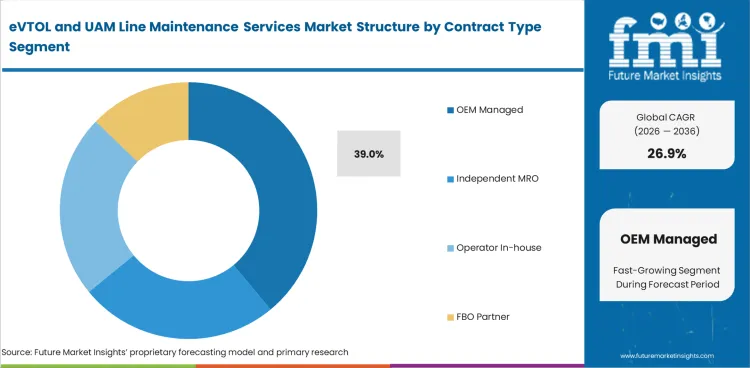
- OEM managed contracts are estimated to represent 39.0% of the contract type segment in 2026. Aircraft makers retain early control over service data and fault-code access.
- Independent service providers may enter later as operators seek local line support. Software permissions and maintenance manual access will decide contract depth.
eVTOL and UAM Line Maintenance Services Market Drivers, Restraints, and Opportunities
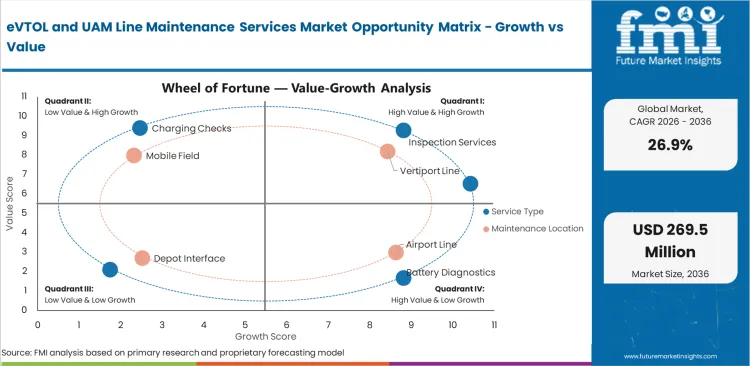
- Powered-lift certification pressure creates structured service demand across aircraft release and safety documentation.
- Limited technician supply increases pricing pressure for line maintenance providers entering high-voltage aviation service.
- Connected aircraft systems improve maintenance planning by using software logs and battery records.
eVTOL and UAM line maintenance services continue as air taxi fleets need reliable release checks and battery records before every scheduled flight. Cost pressure and limited high-voltage technician availability can slow broader service rollout across early launch cities. Demand continues through vertiport line checks and OEM managed contracts as operators protect aircraft availability.
Readiness Pricing Is Moving Ahead of Utilization
The pricing curve for eVTOL and UAM line maintenance is forming before scaled aircraft utilization exists. In December 2025, the United States Department of Transportation’s Advanced Air Mobility strategy stated that demonstrations and initial operations are expected by 2027. The strategy projected new urban and rural powered-lift operations by 2030. Advanced use cases are expected by 2035 under the same strategy. The FAA economic impact report sized civil aviation at $1.8 trillion and 4.0% of U.S. GDP. For service providers, this supports early pricing built around readiness retainers and approved tooling. Battery-safety procedures and vertiport response coverage also become part of the paid service scope. Documentation work adds another cost layer before aircraft density can absorb labor efficiently. Operators should expect higher minimum monthly charges until aircraft density improves. Line maintenance teams must be available before daily task volumes justify full labor absorption.
Technician Cost Floors Are Hardening Rates
Labor is the price floor eVTOL line maintenance buyers should model with extra care. In March 2026, the United States Bureau of Labor Statistics reported September 2025 private-industry employer costs at $32.37 per hour for wages and salaries. Benefits added $13.68 per hour, which put fully loaded compensation at $46.05 per hour before recovery costs. That figure excludes training and certification expenses before providers recover additional operating overhead. Tools and supervision need recovery through service pricing instead of headline inspection fees. Insurance and downtime recovery can further lift the rate needed for profitable coverage. For eVTOL providers, the cost stack is amplified by scarce aviation maintenance and high-voltage skills. Avionics diagnostics and software-enabled health monitoring add another layer of technician specialization. Pricing is likely to shift toward fixed availability fees plus event-based charges. That structure is more realistic than per-inspection pricing for early networks. Buyers should benchmark quotes on technician coverage hours instead of aircraft count alone.
Analysis of eVTOL and UAM Line Maintenance Services Market By Key Countries
.webp "Top Country Growth Comparison Evtol And Uam Line Maintenance Services Market Cagr (2026 2036)")
| Country | CAGR |
|---|---|
| UAE | 31.4% |
| USA | 29.8% |
| China | 28.6% |
| South Korea | 27.9% |
| Japan | 27.1% |
| UK | 25.4% |
| India | 24.8% |
Source: Future Market Insights, 2026.
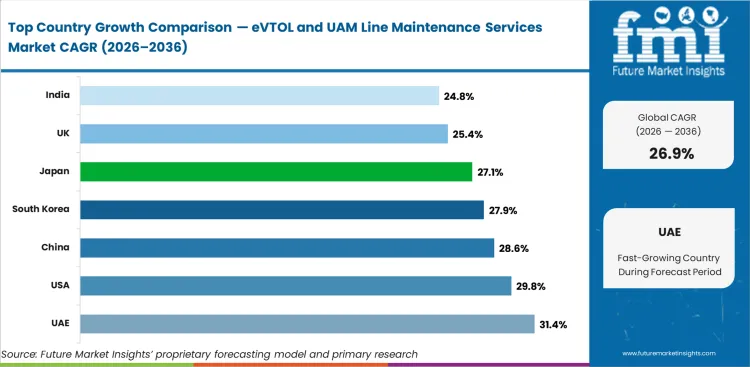
eVTOL and UAM Line Maintenance Services Market CAGR Analysis By Country
- UAE is projected to record a 31.4% CAGR between 2026 and 2036 as Dubai builds early air taxi launch infrastructure.
- Powered-lift rule clarity and active aircraft certification programs place the USA at a 29.8% CAGR across the forecast period.
- China is forecast at 28.6% CAGR by 2036 after eVTOL production approval improved pilotless passenger aircraft readiness.
- South Korea is expected to reach 27.9% CAGR as K-UAM demonstrations and urban test corridor planning advance.
- Japan is projected at 27.1% CAGR during the assessment period with Expo-related advanced air mobility planning and public vertiport trials.
- UK is expected to post 25.4% CAGR as regulatory preparation advances airport air taxi service planning.
- India is forecast to expand at 24.8% CAGR over 2026 to 2036 because aviation design capability and early electric aircraft concepts.
Demand for eVTOL and UAM line maintenance services is forecast to rise at 26.9% CAGR from 2026 to 2036. Country-level analysis covers the major markets contributing to this forecast, with the listed markets listed below.
Demand Outlook for eVTOL and UAM Line Maintenance Services Market in UAE
UAE’s eVTOL and UAM line maintenance services industry is projected to record a CAGR of 31.4% through 2036. Joby Aviation signed a definitive agreement with Dubai’s Roads and Transport Authority in February 2024 to launch air taxi services in Dubai by early 2026. This agreement creates an early operating base for UAE eVTOL and UAM line maintenance services. Local service providers can gain from inspection, charging, and release work around planned launch locations.
- Dubai’s air taxi service planning raises direct demand for local aircraft release and battery checks.
- Vertiport readiness adds need for technicians trained in charging verification and aircraft access procedures.
- Early service density can help UAE maintenance firms build reference programs for broader GCC adoption.
Sales Analysis of eVTOL and UAM Line Maintenance Services Market in USA
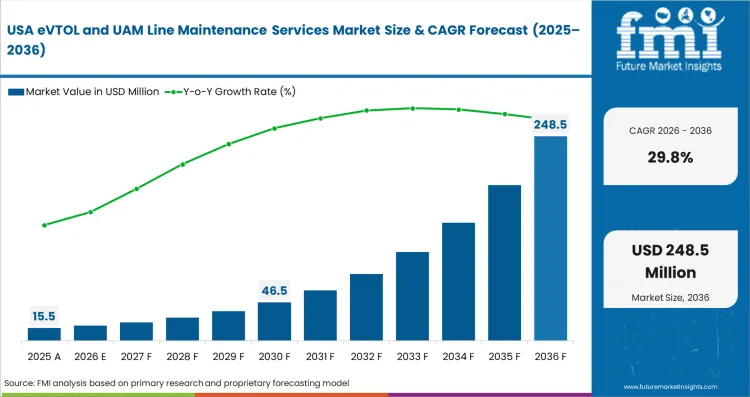
The USA eVTOL and UAM line maintenance services sector is expected to expand at a CAGR of 29.8% during the assessment period. The Federal Aviation Administration’s October 2024 powered-lift rule clarified pilot qualifications and operating rules for the aircraft category. Federal Aviation Administration rule clarity backs demand for USA eVTOL and UAM line maintenance services as operators prepare regulated launch plans. Service providers benefit from aircraft programs seeking release records and high-voltage maintenance readiness.
- FAA rule clarity helps operators frame aircraft release procedures before commercial passenger operations.
- Joby’s FAA-conforming aircraft flight in March 2026 increases focus on line service readiness.
- Aviation MRO firms can extend aviation test equipment use into eVTOL diagnostics.
Demand Outlook for eVTOL and UAM Line Maintenance Services Market in China
The China eVTOL and UAM line maintenance services industry is forecast to grow at a CAGR of 28.6% by 2036. EHang secured the CAAC Production Certificate for its EH216-S passenger-carrying pilotless eVTOL aircraft in April 2024. The approval improves the base for China eVTOL and UAM line maintenance services as local aircraft enter production pathways. Service partners need pilotless aircraft knowledge and disciplined battery records for early fleet use.
- CAAC production approval strengthens the base for service manuals and approved line procedures.
- Pilotless aircraft service needs software log review and sensor checks before passenger operations expand.
- Domestic eVTOL output can raise line maintenance demand around test sites and early operating cities.
Opportunity Analysis of eVTOL and UAM Line Maintenance Services Market in South Korea
The eVTOL and UAM line maintenance services segment in South Korea is forecast to advance at 27.9% CAGR over the forecast years. Joby completed flight tests in Korea’s K-UAM Grand Challenge in December 2024. Joby’s demonstration base supports demand for South Korea eVTOL and UAM line maintenance services across urban test planning. Maintenance demand is strongest for aircraft checks and ground support around demonstration corridors.
- K-UAM trials boost service learning around aircraft turnaround and charging readiness.
- Urban demonstration work increases demand for local technicians trained on electric aircraft release checks.
- Korea’s aircraft service base can build capability around aircraft ground support equipment integration.
Future Outlook for eVTOL and UAM Line Maintenance Services Market in Japan
The Japan eVTOL and UAM line maintenance services industry is expected to post 27.1% CAGR through 2036. Japan’s International Civil Aviation Organization working paper in July 2025 described the period up to Expo 2025 Osaka as the phase from test flights to commercial AAM launch. Expo-related planning supports demand for Japan eVTOL and UAM line maintenance services as demonstration flights create operating data. Service providers with reliable release planning can help aircraft developers prepare public-facing operations.
- Expo-related AAM trials increase visibility for vertiport line service and aircraft inspection work.
- Japanese operators need low-error documentation as public demonstration flights carry high reputation risk.
- Local suppliers can link service planning with aircraft electric motors and battery checks.
Demand Outlook for eVTOL and UAM Line Maintenance Services Market in the United Kingdom
The UK eVTOL and UAM line maintenance services industry is projected to record 25.4% CAGR through 2036. The United Kingdom Civil Aviation Authority states that advanced air mobility introduces new challenges around safety and infrastructure. The authority identifies airspace integration issues requiring coordinated planning across regulators and operators. Regulatory preparation supports demand for UK eVTOL and UAM line maintenance services as aircraft developers plan service entry. Providers with continuing airworthiness knowledge can help operators reduce early launch uncertainty.
- UK regulatory preparation increases the need for documented inspection and aircraft release procedures.
- Airport air taxi planning increases need for service teams near existing aviation infrastructure.
- Local MRO firms can adapt flight line testing equipment experience for electric aircraft checks.
In-depth Analysis of eVTOL and UAM Line Maintenance Services Market in India
India’s eVTOL and UAM line maintenance services market is expected to expand at 24.8% CAGR through 2036. India’s Ministry of Civil Aviation annual report for 2024 to 2025 listed 379 initial aircraft maintenance engineer licenses and 211 category extensions in 2024. This licensing activity supports India eVTOL and UAM line maintenance services as electric aircraft concepts need trained aviation technicians. Local service creation will rely on high-voltage training and aircraft data access.
- AME training capacity gives India a foundation for future electric aircraft line service roles.
- Design approval activity can help local firms enter early eVTOL maintenance planning.
- Service firms need battery safety systems before commercial UAM operations become practical.
Competitive Landscape and Strategic Positioning
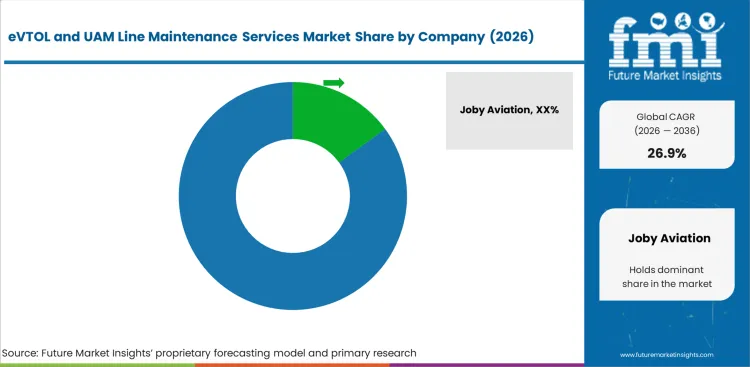
Competition in eVTOL and UAM line maintenance centers on aircraft data access and certified service readiness. Aircraft developers hold an early advantage as they control maintenance manuals and fault information during launch programs.
- Joby Aviation holds a strong position through aircraft program maturity and early service planning across the USA and UAE.
- Archer Aviation and Eve Air Mobility focus on certification progress and operator readiness systems for planned air taxi services.
- Specialist service providers focus on vertiport operations and high-voltage line safety for early launch cities and airport-adjacent sites.
Joby Aviation has strong positioning through Federal Aviation Administration certification progress and Dubai service planning. Archer Aviation adds pilot training progress after receiving Federal Aviation Administration Part 141 approval in February 2025. Eve Air Mobility brings Embraer service knowledge into aircraft care and operating readiness. BETA Technologies adds electric aircraft field experience through test programs and charging familiarity. Bristow Group brings vertical flight operations and field service experience into early electric aviation trials.
Competitive barriers include limited trained technicians and restricted access to OEM service data across early aircraft programs. Strategic priorities center on high-voltage procedures and faster fault closure across short ground cycles. Operators favor service partners able to combine inspection records and battery diagnostics under one line plan. Providers with aviation service systems and approved data access are best placed to win long-term fleet work.
Key Companies in the eVTOL and UAM Line Maintenance Services Market
Global companies active in the eVTOL and UAM line maintenance services market include:
- Joby Aviation, Archer Aviation, and Eve Air Mobility have strong aircraft program visibility and early service planning capability.
- BETA Technologies, Bristow Group, and Skyports Infrastructure serve operators through electric aircraft trials and vertiport operating knowledge.
- Lufthansa Technik holds a specialist position across regulated aviation maintenance and aircraft service process discipline.
Competitive Benchmarking: eVTOL and UAM Line Maintenance Services Market
| Company | High-Voltage Service Depth | Aircraft Data Access | Vertiport Service Readiness | Geographic Footprint |
|---|---|---|---|---|
| Joby Aviation | High | High | Strong | USA, UAE, Japan, South Korea |
| Archer Aviation | High | High | Strong | USA, UAE |
| Eve Air Mobility | High | High | Strong | Brazil, USA, Europe |
| BETA Technologies | High | Medium | Moderate | USA, select test markets |
| Bristow Group | Medium | Medium | Strong | USA, UK, Norway, global offshore markets |
| Skyports Infrastructure | Medium | Medium | Strong | UK, USA, UAE, Europe, Asia |
| Lufthansa Technik | Medium | Medium | Moderate | EMEA, Asia Pacific, Americas |
Source: Future Market Insights, 2026.
Key Developments in eVTOL and UAM Line Maintenance Services Market
- April 2024, EHang secured a CAAC Production Certificate for the EH216-S passenger-carrying pilotless eVTOL aircraft. The approval improves the base for aircraft production and future line maintenance systems in China.
- March 2026, Joby’s first FAA-conforming aircraft for Type Inspection Authorization completed its first flight. The milestone increases focus on line maintenance readiness before formal FAA evaluation.
Key Players in the eVTOL and UAM Line Maintenance Services Market
Major Global Players:
- Joby Aviation
- Archer Aviation
- Eve Air Mobility
- BETA Technologies
- Bristow Group
Specialist Players:
- Skyports Infrastructure
- Lufthansa Technik
Report Scope and Coverage
| Parameter | Details |
|---|---|
| Quantitative Units | USD 24.9 million to USD 269.5 million, at a CAGR of 26.9% |
| Market Definition | The eVTOL and UAM line maintenance services market encompasses aircraft release checks, battery diagnostics, charging verification, and field-level service work before flight. |
| Regions Covered | North America, Latin America, Europe, East Asia, South Asia and Pacific, Middle East and Africa |
| Countries Covered | USA, UK, Germany, China, India, Japan, South Korea, UAE, and 30 plus countries |
| Key Companies Profiled | Joby Aviation, Archer Aviation, Eve Air Mobility, BETA Technologies, Bristow Group, Skyports Infrastructure, Lufthansa Technik |
| Forecast Period | 2026 to 2036 |
| Approach | Hybrid bottom-up and top-down methodology starting with aircraft service events and verified launch-country readiness. |
Source: Future Market Insights, 2026.
eVTOL and UAM Line Maintenance Services Market by Segments
eVTOL and UAM Line Maintenance Services Market Segmented by Service Type:
- Inspection Services
- Battery Diagnostics
- Charging Checks
- Avionics Checks
- Software Updates
eVTOL and UAM Line Maintenance Services Market Segmented by Maintenance Location:
- Vertiport Line
- Airport Line
- Mobile Field
- Depot Interface
eVTOL and UAM Line Maintenance Services Market Segmented by Aircraft Type:
- Piloted eVTOL
- Autonomous eVTOL
- Hybrid VTOL
- Cargo eVTOL
eVTOL and UAM Line Maintenance Services Market Segmented by Customer Type:
- Fleet Operators
- OEM Programs
- Vertiport Operators
- Public Agencies
eVTOL and UAM Line Maintenance Services Market Segmented by Contract Type:
- OEM Managed
- Independent MRO
- Operator In-house
- FBO Partner
eVTOL and UAM Line Maintenance Services Market by Region:
- North America
- USA
- Canada
- Mexico
- Latin America
- Brazil
- Chile
- Rest of Latin America
- Europe
- Germany
- UK
- Italy
- Spain
- France
- Rest of Europe
- East Asia
- China
- Japan
- South Korea
- South Asia and Pacific
- India
- ASEAN
- Australia & New Zealand
- Rest of South Asia and Pacific
- Middle East and Africa
- Saudi Arabia
- Other GCC Countries
- South Africa
- Rest of Middle East and Africa
Research Sources and Bibliography
- Federal Aviation Administration. (2024, October 22). With new rule, FAA is ready for air travel of the future.
- Federal Register. (2024, November 21). Integration of Powered-Lift: Pilot Certification and Operations; Miscellaneous Amendments Related to Rotorcraft and Airplanes.
- European Union Aviation Safety Agency. (2025, July 18). Special Condition for VTOL and Means of Compliance.
- Joby Aviation. (2024, February 11). Joby to launch air taxi service in UAE.
- EHang Holdings Limited. (2024, April 7). EHang secures Production Certificate from CAAC, clearing path for mass production of EH216-S pilotless eVTOL aircraft.
- Archer Aviation. (2025, February 18). Archer receives FAA certification to launch its pilot training academy.
- Joby Aviation. (2026, March 11). Joby’s first FAA-conforming aircraft takes flight.
- Skyports Infrastructure. (2026, April 16). Air taxi ready: world’s first commercial vertiport by Dubai International Airport reaches technical completion.
- Bristow Group. (2026, February 2). Norway completes its first electric aviation test project.
- Ministry of Civil Aviation. (2025, March). Annual Report Civil Aviation for the year 2024-25. Government of India.
- International Civil Aviation Organization. (2025, July 28). AAM operations at the Expo 2025 Osaka, Kansai, Japan.
- UK Civil Aviation Authority. (2026). Enabling advanced air mobility.
This Report Answers
- What is the current and future size of the eVTOL and UAM line maintenance services market?
- How fast is the eVTOL and UAM line maintenance services market expected to expand between 2026 and 2036?
- Which service type is expected to lead the market by 2026?
- Which aircraft type is expected to account for the most demand by 2026?
- What factors are driving demand for eVTOL and UAM line maintenance services globally?
- How are powered-lift rules influencing line maintenance service planning?
- Why are fleet operators the main demand base for line maintenance services?
- How are battery checks creating demand for specialized line maintenance capability?
- Which countries are projected to record faster expansion through 2036?
- What is driving market expansion in UAE and USA?
- Who are the key companies active in the eVTOL and UAM line maintenance services market?
- How does FMI estimate and validate the market forecast?
Frequently Asked Questions
What is the global market demand for eVTOL and UAM Line Maintenance Services in 2026?
In 2026, the global market for eVTOL and UAM line maintenance services is expected to be worth USD 24.9 million.
How big will the market for eVTOL and UAM Line Maintenance Services be in 2036?
By 2036, the market for eVTOL and UAM line maintenance services is expected to be worth USD 269.5 million.
How much is demand for eVTOL and UAM Line Maintenance Services expected to expand between 2026 and 2036?
Between 2026 and 2036, demand for eVTOL and UAM line maintenance services is expected to expand at a CAGR of 26.9%.
Which service type segment is likely to lead globally by 2026?
Inspection Services will make up 34.0% of the service type segment in 2026.
What is causing demand to rise in UAE?
The UAE eVTOL and UAM line maintenance services market is projected to record 31.4% CAGR through 2036, backed by Dubai’s early air taxi service planning.
What is causing demand to rise in USA?
The USA eVTOL and UAM line maintenance services market is projected to expand at 29.8% CAGR through 2036, backed by FAA powered-lift rule clarity.
What does this report mean by eVTOL and UAM Line Maintenance Services Market definition?
The eVTOL and UAM line maintenance services market includes aircraft checks, battery diagnostics, charging verification, and field-level service work before flight release.
How does FMI make the eVTOL and UAM Line Maintenance Services forecast and check it?
Forecasting models use a hybrid bottom-up and top-down approach, starting with aircraft service events and checking them against launch-country readiness.
Preview the report firsthand - request a free sample
Get SampleGet the brochure for pricing and purchase details.
Get PDFTable of Content
- Key Takeaways
- Market Size and CAGR
- Top Growth Driver
- Fastest Growing Segment
- Leading Region
- Key Companies
- Emerging Opportunities
- Executive Summary
- Global Market Outlook
- Demand-side Trends
- Supply-side Trends
- Technology Roadmap Analysis
- Analysis and Recommendations
- Analyst Perspective (What is happening? Why now? What should investors know?)
- Key Questions Answered
- How large is the market?
- What is the CAGR?
- What are key trends?
- Which region dominates?
- Who are the leaders?
- Market Overview
- Market Coverage / Taxonomy
- Market Definition / Scope / Limitations
- Research Methodology
- Chapter Orientation
- Analytical Lens and Working Hypotheses
- Market Structure, Signals, and Trend Drivers
- Benchmarking and Cross-market Comparability
- Market Sizing, Forecasting, and Opportunity Mapping
- Research Design and Evidence Framework
- Desk Research Programme (Secondary Evidence)
- Expert Input and Fieldwork (Primary Evidence)
- Tooling, Models, and Reference Databases
- Data Engineering and Model Build
- Quality Assurance and Audit Trail
- Market Background
- Market Dynamics (Drivers, Restraints, Opportunity, Trends)
- Scenario Forecast (Optimistic, Likely, Conservative)
- Impact Analysis
- AI Impact
- Sustainability Impact
- Regulatory Impact
- Technology Impact
- Consumer / Buyer Analysis
- Purchase Drivers
- Adoption Barriers
- Buyer Journey
- Opportunity Map Analysis
- Product Life Cycle Analysis
- Supply Chain Analysis
- Investment Feasibility Matrix
- Value Chain Analysis
- PESTLE and Porter's Analysis
- Regulatory Landscape
- Regional Parent Market Outlook
- Production and Consumption Statistics
- Import and Export Statistics
- Global Market Analysis and Forecast, 2021 to 2036
- Historical Market Size Value (USD Million) & Volume (Unit) Analysis, 2021 to 2025
- Current and Future Market Size Value (USD Million) & Volume (Unit) Projections, 2026 to 2036
- Y-o-Y Growth Trend Analysis
- Absolute $ Opportunity Analysis
- Global Market Pricing Analysis, 2021 to 2036
- Global Market Analysis and Forecast, By Service Type, 2021 to 2036
- Introduction / Key Findings
- Historical Market Size Value (USD Million) & Volume (Unit) Analysis By Service Type, 2021 to 2025
- Current and Future Market Size Value (USD Million) & Volume (Unit) Analysis and Forecast By Service Type, 2026 to 2036
- Inspection Services
- Battery Diagnostics
- Charging Checks
- Avionics Checks
- Software Updates
- Inspection Services
- Y-o-Y Growth Trend Analysis By Service Type, 2021 to 2025
- Absolute $ Opportunity Analysis By Service Type, 2026 to 2036
- Global Market Analysis and Forecast, By Maintenance Location, 2021 to 2036
- Introduction / Key Findings
- Historical Market Size Value (USD Million) & Volume (Unit) Analysis By Maintenance Location, 2021 to 2025
- Current and Future Market Size Value (USD Million) & Volume (Unit) Analysis and Forecast By Maintenance Location, 2026 to 2036
- Vertiport Line
- Airport Line
- Mobile Field
- Depot Interface
- Vertiport Line
- Y-o-Y Growth Trend Analysis By Maintenance Location, 2021 to 2025
- Absolute $ Opportunity Analysis By Maintenance Location, 2026 to 2036
- Global Market Analysis and Forecast, By Aircraft Type, 2021 to 2036
- Introduction / Key Findings
- Historical Market Size Value (USD Million) & Volume (Unit) Analysis By Aircraft Type, 2021 to 2025
- Current and Future Market Size Value (USD Million) & Volume (Unit) Analysis and Forecast By Aircraft Type, 2026 to 2036
- Piloted eVTOL
- Autonomous eVTOL
- Hybrid VTOL
- Cargo eVTOL
- Piloted eVTOL
- Y-o-Y Growth Trend Analysis By Aircraft Type, 2021 to 2025
- Absolute $ Opportunity Analysis By Aircraft Type, 2026 to 2036
- Global Market Analysis and Forecast, By Customer Type, 2021 to 2036
- Introduction / Key Findings
- Historical Market Size Value (USD Million) & Volume (Unit) Analysis By Customer Type, 2021 to 2025
- Current and Future Market Size Value (USD Million) & Volume (Unit) Analysis and Forecast By Customer Type, 2026 to 2036
- Fleet Operators
- OEM Programs
- Vertiport Operators
- Public Agencies
- Fleet Operators
- Y-o-Y Growth Trend Analysis By Customer Type, 2021 to 2025
- Absolute $ Opportunity Analysis By Customer Type, 2026 to 2036
- Global Market Analysis and Forecast, By Contract Type, 2021 to 2036
- Introduction / Key Findings
- Historical Market Size Value (USD Million) & Volume (Unit) Analysis By Contract Type, 2021 to 2025
- Current and Future Market Size Value (USD Million) & Volume (Unit) Analysis and Forecast By Contract Type, 2026 to 2036
- OEM Managed
- Independent MRO
- Operator In-house
- FBO Partner
- OEM Managed
- Y-o-Y Growth Trend Analysis By Contract Type, 2021 to 2025
- Absolute $ Opportunity Analysis By Contract Type, 2026 to 2036
- Global Market Analysis and Forecast, By Region, 2021 to 2036
- Introduction
- Historical Market Size Value (USD Million) & Volume (Unit) Analysis By Region, 2021 to 2025
- Current Market Size Value (USD Million) & Volume (Unit) Analysis and Forecast By Region, 2026 to 2036
- North America
- Latin America
- Western Europe
- Eastern Europe
- East Asia
- South Asia and Pacific
- Middle East & Africa
- Market Attractiveness Analysis By Region
- North America Market Analysis and Forecast, By Country, 2021 to 2036
- Historical Market Size Value (USD Million) & Volume (Unit) Trend Analysis By Market Taxonomy, 2021 to 2025
- Market Size Value (USD Million) & Volume (Unit) Forecast By Market Taxonomy, 2026 to 2036
- By Country
- USA
- Canada
- Mexico
- By Service Type
- By Maintenance Location
- By Aircraft Type
- By Customer Type
- By Contract Type
- By Country
- Market Attractiveness Analysis
- By Country
- By Service Type
- By Maintenance Location
- By Aircraft Type
- By Customer Type
- By Contract Type
- Key Takeaways
- Latin America Market Analysis and Forecast, By Country
- Historical Market Size Value (USD Million) & Volume (Unit) Trend Analysis By Market Taxonomy, 2021 to 2025
- Market Size Value (USD Million) & Volume (Unit) Forecast By Market Taxonomy, 2026 to 2036
- By Country
- Brazil
- Chile
- Rest of Latin America
- By Service Type
- By Maintenance Location
- By Aircraft Type
- By Customer Type
- By Contract Type
- By Country
- Market Attractiveness Analysis
- By Country
- By Service Type
- By Maintenance Location
- By Aircraft Type
- By Customer Type
- By Contract Type
- Key Takeaways
- Western Europe Market Analysis and Forecast, By Country
- Historical Market Size Value (USD Million) & Volume (Unit) Trend Analysis By Market Taxonomy, 2021 to 2025
- Market Size Value (USD Million) & Volume (Unit) Forecast By Market Taxonomy, 2026 to 2036
- By Country
- Germany
- UK
- Italy
- Spain
- France
- Nordic
- BENELUX
- Rest of Western Europe
- By Service Type
- By Maintenance Location
- By Aircraft Type
- By Customer Type
- By Contract Type
- By Country
- Market Attractiveness Analysis
- By Country
- By Service Type
- By Maintenance Location
- By Aircraft Type
- By Customer Type
- By Contract Type
- Key Takeaways
- Eastern Europe Market Analysis and Forecast, By Country
- Historical Market Size Value (USD Million) & Volume (Unit) Trend Analysis By Market Taxonomy, 2021 to 2025
- Market Size Value (USD Million) & Volume (Unit) Forecast By Market Taxonomy, 2026 to 2036
- By Country
- Russia
- Poland
- Hungary
- Balkan & Baltic
- Rest of Eastern Europe
- By Service Type
- By Maintenance Location
- By Aircraft Type
- By Customer Type
- By Contract Type
- By Country
- Market Attractiveness Analysis
- By Country
- By Service Type
- By Maintenance Location
- By Aircraft Type
- By Customer Type
- By Contract Type
- Key Takeaways
- East Asia Market Analysis and Forecast, By Country
- Historical Market Size Value (USD Million) & Volume (Unit) Trend Analysis By Market Taxonomy, 2021 to 2025
- Market Size Value (USD Million) & Volume (Unit) Forecast By Market Taxonomy, 2026 to 2036
- By Country
- China
- Japan
- South Korea
- By Service Type
- By Maintenance Location
- By Aircraft Type
- By Customer Type
- By Contract Type
- By Country
- Market Attractiveness Analysis
- By Country
- By Service Type
- By Maintenance Location
- By Aircraft Type
- By Customer Type
- By Contract Type
- Key Takeaways
- South Asia and Pacific Market Analysis and Forecast, By Country
- Historical Market Size Value (USD Million) & Volume (Unit) Trend Analysis By Market Taxonomy, 2021 to 2025
- Market Size Value (USD Million) & Volume (Unit) Forecast By Market Taxonomy, 2026 to 2036
- By Country
- India
- ASEAN
- Australia & New Zealand
- Rest of South Asia and Pacific
- By Service Type
- By Maintenance Location
- By Aircraft Type
- By Customer Type
- By Contract Type
- By Country
- Market Attractiveness Analysis
- By Country
- By Service Type
- By Maintenance Location
- By Aircraft Type
- By Customer Type
- By Contract Type
- Key Takeaways
- Middle East & Africa Market Analysis and Forecast, By Country
- Historical Market Size Value (USD Million) & Volume (Unit) Trend Analysis By Market Taxonomy, 2021 to 2025
- Market Size Value (USD Million) & Volume (Unit) Forecast By Market Taxonomy, 2026 to 2036
- By Country
- Kingdom of Saudi Arabia
- Other GCC Countries
- Türkiye
- South Africa
- Other African Union
- Rest of Middle East & Africa
- By Service Type
- By Maintenance Location
- By Aircraft Type
- By Customer Type
- By Contract Type
- By Country
- Market Attractiveness Analysis
- By Country
- By Service Type
- By Maintenance Location
- By Aircraft Type
- By Customer Type
- By Contract Type
- Key Takeaways
- Key Countries Market Analysis
- USA
- Pricing Analysis
- Market Share Analysis, 2025
- By Service Type
- By Maintenance Location
- By Aircraft Type
- By Customer Type
- By Contract Type
- Canada
- Pricing Analysis
- Market Share Analysis, 2025
- By Service Type
- By Maintenance Location
- By Aircraft Type
- By Customer Type
- By Contract Type
- Mexico
- Pricing Analysis
- Market Share Analysis, 2025
- By Service Type
- By Maintenance Location
- By Aircraft Type
- By Customer Type
- By Contract Type
- Brazil
- Pricing Analysis
- Market Share Analysis, 2025
- By Service Type
- By Maintenance Location
- By Aircraft Type
- By Customer Type
- By Contract Type
- Chile
- Pricing Analysis
- Market Share Analysis, 2025
- By Service Type
- By Maintenance Location
- By Aircraft Type
- By Customer Type
- By Contract Type
- Germany
- Pricing Analysis
- Market Share Analysis, 2025
- By Service Type
- By Maintenance Location
- By Aircraft Type
- By Customer Type
- By Contract Type
- UK
- Pricing Analysis
- Market Share Analysis, 2025
- By Service Type
- By Maintenance Location
- By Aircraft Type
- By Customer Type
- By Contract Type
- Italy
- Pricing Analysis
- Market Share Analysis, 2025
- By Service Type
- By Maintenance Location
- By Aircraft Type
- By Customer Type
- By Contract Type
- Spain
- Pricing Analysis
- Market Share Analysis, 2025
- By Service Type
- By Maintenance Location
- By Aircraft Type
- By Customer Type
- By Contract Type
- France
- Pricing Analysis
- Market Share Analysis, 2025
- By Service Type
- By Maintenance Location
- By Aircraft Type
- By Customer Type
- By Contract Type
- India
- Pricing Analysis
- Market Share Analysis, 2025
- By Service Type
- By Maintenance Location
- By Aircraft Type
- By Customer Type
- By Contract Type
- ASEAN
- Pricing Analysis
- Market Share Analysis, 2025
- By Service Type
- By Maintenance Location
- By Aircraft Type
- By Customer Type
- By Contract Type
- Australia & New Zealand
- Pricing Analysis
- Market Share Analysis, 2025
- By Service Type
- By Maintenance Location
- By Aircraft Type
- By Customer Type
- By Contract Type
- China
- Pricing Analysis
- Market Share Analysis, 2025
- By Service Type
- By Maintenance Location
- By Aircraft Type
- By Customer Type
- By Contract Type
- Japan
- Pricing Analysis
- Market Share Analysis, 2025
- By Service Type
- By Maintenance Location
- By Aircraft Type
- By Customer Type
- By Contract Type
- South Korea
- Pricing Analysis
- Market Share Analysis, 2025
- By Service Type
- By Maintenance Location
- By Aircraft Type
- By Customer Type
- By Contract Type
- Russia
- Pricing Analysis
- Market Share Analysis, 2025
- By Service Type
- By Maintenance Location
- By Aircraft Type
- By Customer Type
- By Contract Type
- Poland
- Pricing Analysis
- Market Share Analysis, 2025
- By Service Type
- By Maintenance Location
- By Aircraft Type
- By Customer Type
- By Contract Type
- Hungary
- Pricing Analysis
- Market Share Analysis, 2025
- By Service Type
- By Maintenance Location
- By Aircraft Type
- By Customer Type
- By Contract Type
- Kingdom of Saudi Arabia
- Pricing Analysis
- Market Share Analysis, 2025
- By Service Type
- By Maintenance Location
- By Aircraft Type
- By Customer Type
- By Contract Type
- Türkiye
- Pricing Analysis
- Market Share Analysis, 2025
- By Service Type
- By Maintenance Location
- By Aircraft Type
- By Customer Type
- By Contract Type
- South Africa
- Pricing Analysis
- Market Share Analysis, 2025
- By Service Type
- By Maintenance Location
- By Aircraft Type
- By Customer Type
- By Contract Type
- USA
- Market Structure Analysis
- Competition Dashboard
- Competition Benchmarking
- Market Share Analysis of Top Players
- By Regional
- By Service Type
- By Maintenance Location
- By Aircraft Type
- By Customer Type
- By Contract Type
- Emerging Startups
- Innovation Benchmarking
- Competition Analysis
- Competition Deep Dive
- JoAviation
- Overview
- Product Portfolio
- Profitability by Market Segments (Product/Region/Sales Channel)
- Sales Footprint
- Strategy Overview
- Marketing Strategy
- Product Strategy
- Channel Strategy
- Archer Aviation
- Eve Air Mobility
- BETA Technologies
- Bristow Group
- Skyports Infrastructure
- Lufthansa Technik
- JoAviation
- Case Studies
- Success Stories
- Recent Developments
- Competition Deep Dive
- Assumptions & Acronyms Used


