

- Industry Size (2026)
- USD 1250.0 Mn
- Forecast (2036)
- USD 2368.5 Mn
- CAGR (2026 to 2036)
- 6.6%
Line Cord Commercial Surge Protection Devices Market Forecast and Outlook 2026 to 2036
The line cord commercial surge protection devices is likely to reach USD 1,250.0 million in 2026 and is forecasted to reach USD 2,368.5 million by 2036 at a CAGR of 6.6%. Value formation is driven by equipment protection requirements within commercial electrical installations rather than discretionary technology upgrades. Deployment reflects increasing concentration of sensitive electronic assets at point-of-use locations, including retail terminals, office workstations, communication racks, and localized computing nodes. Procurement decisions prioritize devices that mitigate transient overvoltage exposure caused by switching events, grid disturbances, and internal electrical loads. Investment aligns with asset protection policies and operational continuity requirements rather than expansion of connected device counts.
Demand persistence reflects structural reliance on uninterrupted operation of commercial electronics across offices, retail environments, and light industrial facilities. Line cord devices offer localized protection without permanent electrical modification, supporting rapid deployment and replacement. Facilities with distributed IT and networking equipment specify surge protection at outlet level to reduce failure risk outside centralized power conditioning systems. Replacement cycles align with equipment refresh schedules, protection status indicators, and electrical incident exposure rather than routine wear. Value growth remains anchored to risk management practices and protection of installed electronic assets rather than broad infrastructure expansion.
Quick Stats for Line Cord Commercial Surge Protection Devices Market
- Line Cord Commercial Surge Protection Devices Market Value (2026): USD 1,250.0 million
- Line Cord Commercial Surge Protection Devices Market Forecast Value (2036): USD 2,368.5 million
- Line Cord Commercial Surge Protection Devices Market Forecast CAGR 2026 to 2036: 6.6%
- Leading Product Type by Demand Share: Power Strip Surge Protectors
- Fastest-Growing Countries: India, China, USA, Germany, Japan
- Top Players in Global Demand: APC (Schneider Electric), Eaton, Legrand, Tripp Lite, Belkin
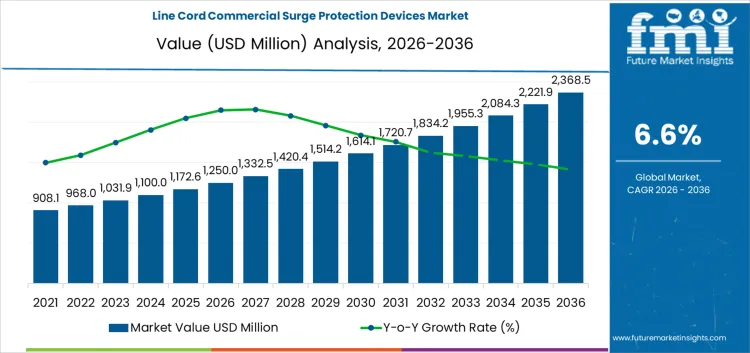
Line Cord Commercial Surge Protection Devices Market Key Takeaways
| Metric | Value |
|---|---|
| Market Value (2026) | USD 1,250.0 million |
| Market Forecast Value (2036) | USD 2,368.5 million |
| Forecast CAGR 2026 to 2036 | 6.6% |
Why is the Demand for Line Cord Commercial Surge Protection Devices Market Growing?
Demand for line cord commercial surge protection devices is rising as businesses seek to safeguard sensitive electronic equipment from transient voltage spikes caused by switching operations and external disturbances. Retail stores, office environments and industrial facilities deploy point of use surge protection to reduce risk of damage to point of sale systems, computers, communication equipment and network infrastructure. Facility managers emphasize hardware that plugs into existing outlet configurations without complex installation.
Expansion of server rooms and edge computing nodes outside traditional data centers increases need for localized protection at equipment racks. Maintenance teams prioritize devices that offer visible indicators of protection status and replaceable modules to support lifecycle management.
Growth in regulatory emphasis on asset protection and continuity planning influences purchase decisions because unplanned downtime can disrupt operations and incur costs. Suppliers respond with line cord units rated for higher joule absorption and fast response times that meet commercial electrical safety standards. Telecom and broadcast facilities integrate surge protection at endpoints to help maintain signal integrity and uptime. Educational institutions equip labs with surge devices to protect audiovisual and laboratory instrumentation. Distributor networks expand availability across regional markets to support rapid fulfillment for planned upgrades and reactive replacements.
How Are the Segments Classified in the Line Cord Commercial Surge Protection Devices Market?
Demand for line cord commercial surge protection devices is shaped by increasing exposure of commercial electronic equipment to transient voltage events and the need to limit operational disruption. Adoption reflects risk mitigation practices across offices, retail locations, and technical facilities where point-of-use protection reduces failure incidence. System selection prioritizes electrical compatibility, suppression performance, and ease of deployment. Segment classification reflects differentiation by form factor, voltage rating, and end-use environment influencing protection density and replacement frequency.
Which product type represents the largest share of demand?
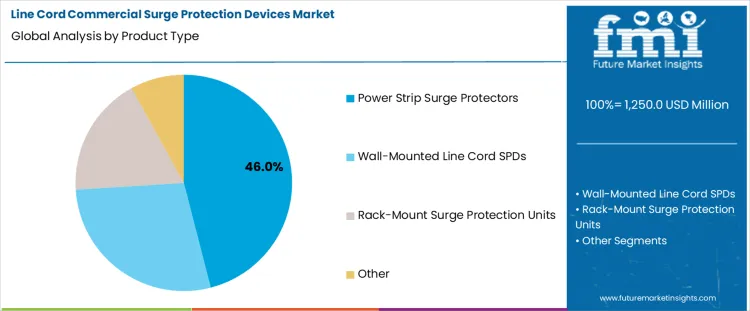
Power strip surge protectors lead product type demand, capturing a 46.0% share due to their versatility and widespread use in commercial environments. These protectors provide convenient power distribution while safeguarding multiple devices from power surges. Their ability to support various plug configurations makes them ideal for offices, data centers, and retail setups with multiple electronic devices. Cost-effectiveness and ease of installation further enhance their preference across diverse commercial applications.
Key Points:
- Versatile and cost-effective solution for multiple devices
- Easy installation and widespread compatibility
- Ideal for high-density electronics environments
Which voltage rating accounts for the highest share of demand?
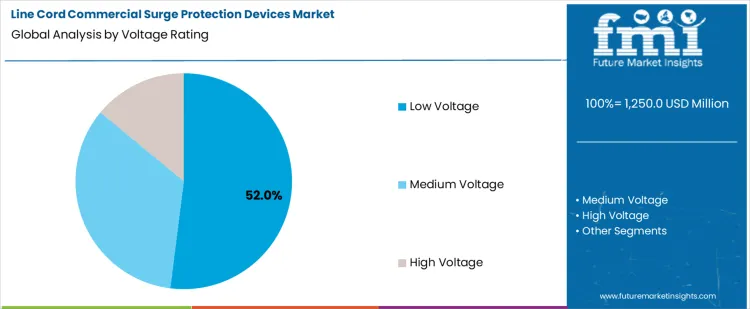
Low voltage surge protectors dominate the market with a 52.0% share due to their applicability in most commercial and office environments. These devices protect equipment operating at standard voltage levels from transient voltage spikes, such as those caused by lightning or power grid fluctuations. Low voltage systems are most commonly used in commercial offices, data centers, and retail spaces, where electrical systems predominantly operate within these voltage ranges.
Key Points:
- Protects devices operating at standard voltage levels
- Commonly deployed in commercial office and retail environments
- Reduces damage to sensitive electronics from voltage spikes
Which end use accounts for the highest share of demand?
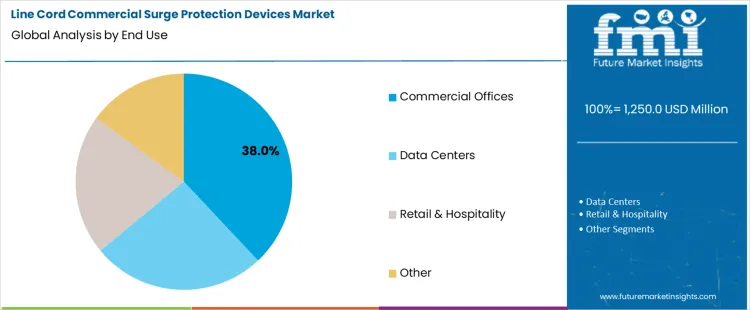
Commercial offices represent the largest end use with a 38.0% share, driven by the widespread need to protect office electronics, including computers, printers, and communication systems. As offices increasingly rely on electronic devices for day-to-day operations, surge protection devices become essential to prevent downtime and reduce the risk of equipment damage. The ongoing digitalization of office environments further sustains consistent demand for surge protectors.
Key Points:
- High need for protection of office electronics and systems
- Reduces risk of downtime and equipment damage
- Supports the digitalization and automation of office operations
What are the Key Dynamics in the line cord commercial surge protection devices market?
Demand dynamics in the line cord commercial surge protection devices market reflect increasing reliance on distributed electronic equipment within commercial electrical environments. Activity centers on preventing damage from transient voltage events affecting computing, communication, and control systems. Value formation depends on surge suppression capacity, response speed, and compliance with electrical safety standards. Purchasing decisions align with equipment protection requirements, installation compatibility, and lifecycle reliability rather than discretionary upgrades.
How Do Electrical Risk Exposure and Safety Standards Shape Adoption?
Adoption increases as businesses seek to mitigate equipment downtime and repair costs from power surges, especially in high-tech and mission-critical environments. Demand strengthens in industries like telecommunications, data centers, and manufacturing, where electrical stability is crucial for operational continuity. Regulatory frameworks regarding electrical safety and equipment protection encourage demand for surge protection devices with verified certifications. Integration with networked systems and building management systems supports adoption in smart buildings and commercial infrastructure. As surge protection devices offer multi-layered protection, they help businesses meet safety standards and reduce liability. Investment in high-quality protection systems grows as enterprises experience equipment failure and downtime linked to voltage transients, investment in point-of-use surge protection increases.
How do installation and device reliability constraints influence market scalability?
Market scalability faces constraints from installation complexity and the need for highly reliable protection systems. Demand encounters resistance where businesses hesitate to incur high upfront costs for comprehensive surge protection solutions, especially in facilities with extensive electrical networks. Compatibility with existing electrical setups and equipment requires customized designs and technical expertise during installation. Reliability concerns, such as failure during extreme surge events, drive demand for devices with proven track records and long operational lifespans. Maintenance and periodic testing requirements for surge protectors add operational complexity and additional costs. Regional variance in voltage standards and surge intensity further impacts the scalability of devices across diverse geographies and market segments.
How Is Demand for Line Cord Commercial Surge Protection Devices Evolving Globally?
Demand for line cord commercial surge protection devices is expanding globally due to power quality risks, equipment protection requirements, and higher electronic load density in commercial facilities. Offices, retail outlets, healthcare sites, and data-enabled workspaces require point-of-use protection to prevent damage from transient voltage events. Adoption aligns with compliance audits, insurance requirements, and continuity planning rather than discretionary upgrades. Replacement cycles follow wear-out of MOV components and layout reconfiguration. Growth rates in India at 8.1%, China at 7.6%, USA at 6.0%, Germany at 5.4%, and Japan at 5.0% indicate steady expansion driven by device proliferation, grid variability exposure, and risk-managed procurement practices.
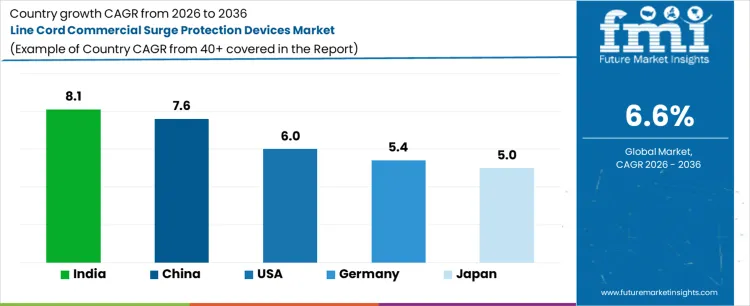
| Country | CAGR (%) |
|---|---|
| India | 8.1% |
| China | 7.6% |
| USA | 6.0% |
| Germany | 5.4% |
| Japan | 5.0% |
What Is Driving Expansion of Line Cord Surge Protection Demand in India?
Demand for line cord commercial surge protection devices in India is growing at a CAGR of 8.1%, supported by expanding commercial floor space and uneven power quality. Offices, clinics, and retail outlets deploy plug-in protection to safeguard POS systems, networking gear, and medical electronics. Voltage fluctuations and switching surges increase risk at last-mile distribution points. Compliance checks by insurers and facility managers influence procurement. Growth of coworking spaces raises density of sensitive electronics per outlet. Demand growth reflects protection necessity under grid variability and equipment density rather than adoption of centralized surge systems.
- Variable grid quality at commercial endpoints
- High density of sensitive electronic equipment
- Insurance and facility compliance requirements
- Expansion of coworking and retail spaces
Why Is China Sustaining Growth in Line Cord Surge Protection Adoption?
Line cord commercial surge protection demand in China is expanding at a CAGR of 7.6%, driven by electronics-heavy commercial environments and standardized safety practices. Retail chains, offices, and service centers deploy surge strips to protect terminals and displays. High equipment turnover increases need for portable, low-cost protection. Manufacturing-led commercial facilities emphasize downtime prevention. Domestic production ensures wide availability across ratings and form factors. Demand growth reflects endpoint protection standardization and equipment density rather than reliance on building-level surge suppression alone.
- Electronics-intensive commercial interiors
- Standardized safety practices across chains
- Downtime prevention in service operations
- Broad domestic availability of protection devices
How Is the United States Supporting Demand for Line Cord Surge Protection?
Sales of line cord commercial surge protection devices in the United States are growing at a CAGR of 6.0%, supported by risk management practices and equipment liability considerations. Offices, healthcare facilities, and education sites specify point-of-use protection for compliance. Aging electrical infrastructure in some regions increases transient exposure. IT refresh cycles and workstation reconfiguration drive replacement demand. Preference for certified products shapes purchasing decisions. Growth reflects structured procurement and liability mitigation rather than expansion in commercial real estate footprint.
- Risk management and liability mitigation practices
- Aging electrical infrastructure exposure
- Frequent IT refresh and workspace reconfiguration
- Preference for certified surge protection products
What Factors Are Influencing Line Cord Surge Protection Demand in Germany?
Line cord commercial surge protection demand in Germany is expanding at a CAGR of 5.4%, shaped by safety standards and equipment reliability expectations. Commercial users deploy plug-in devices to protect automation controls, office IT, and retail electronics. Emphasis on compliance with electrical safety norms influences specification. Replacement demand arises from lifecycle wear of protection components. Energy transition-related grid switching increases transient events. Growth reflects standards-driven procurement and reliability focus rather than rapid expansion of device counts.
- Strict electrical safety and compliance standards
- Protection of automation and IT equipment
- Lifecycle replacement of surge components
- Grid switching associated with energy transition
Why Is Japan Experiencing Measured Growth in Line Cord Surge Protection Demand?
Line cord commercial surge protection demand in Japan is growing at a CAGR of 5.0%, supported by risk awareness and high equipment sensitivity. Seismic activity and grid resilience planning encourage localized protection strategies. Offices and service facilities deploy compact surge devices for terminals and communication equipment. Space constraints favor integrated, low-profile designs. Stable commercial activity sustains predictable replacement cycles. Growth remains measured, reflecting mature adoption and risk-managed maintenance rather than expansion in commercial electronics density.
- Seismic risk influencing protection strategies
- High sensitivity of communication equipment
- Preference for compact, integrated designs
- Predictable replacement in mature facilities
What is the competitive landscape of demand for the line cord commercial surge protection devices market globally?
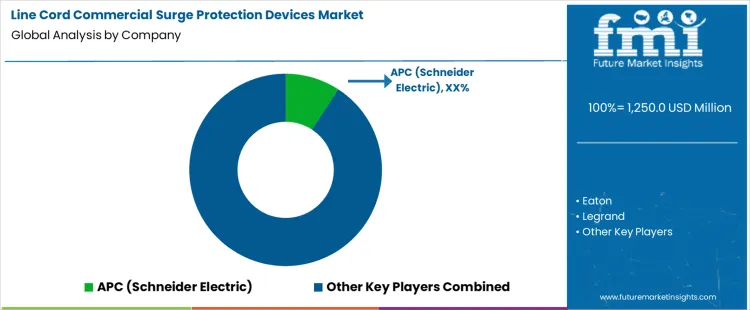
Demand for line cord commercial surge protection devices is driven by increased reliance on sensitive electronics, industrial power systems, and the need to safeguard against electrical disruptions. Buyers evaluate surge suppression capacity, reliability, compatibility with varied equipment, ease of installation, and durability under high electrical loads. Procurement behavior emphasizes product certifications, performance under extreme conditions, scalability for multi-device protection, and cost-effectiveness. Purchasing decisions prioritize warranties, brand reputation, and adaptability to both small and large-scale business environments. Trend in the market reflects heightened awareness of electrical risk, growing adoption of energy-efficient systems, and demand for integrated protection solutions.
APC (Schneider Electric) leads competitive positioning through trusted surge protection solutions, strong brand reputation, and compatibility with Schneider Electric’s broad power management systems. Eaton supports demand with high-performance surge devices integrated into comprehensive power management solutions. Legrand competes through modular, reliable protection options optimized for commercial settings and varied electrical configurations. Tripp Lite maintains relevance with compact surge protectors catering to both small and medium business requirements, providing easy installation and cost-effective solutions. Belkin participates through reliable surge protection for everyday commercial applications, focusing on affordability and user-friendly design. Competitive differentiation depends on protection capacity, service reliability, compatibility with existing infrastructure, and brand trust.
Key Players in the Line Cord Commercial Surge Protection Devices Market
- APC (Schneider Electric)
- Eaton
- Legrand
- Tripp Lite
- Belkin
Scope of the Report
| Items | Values |
|---|---|
| Quantitative Units | USD million |
| Product Type | Power Strip Surge Protectors; Wall-Mounted Line Cord SPDs; Rack-Mount Surge Protection Units; Other |
| Voltage Rating | Low Voltage; Medium Voltage; High Voltage |
| End Use | Commercial Offices; Data Centers; Retail & Hospitality; Other |
| Regions Covered | Asia Pacific, Europe, North America, Latin America, Middle East & Africa |
| Countries Covered | India, China, USA, Germany, Japan, and 40+ countries |
| Key Companies Profiled | APC (Schneider Electric); Eaton; Legrand; Tripp Lite; Belkin |
| Additional Attributes | Dollar sales by product type, voltage rating, end use, and sales channel; surge suppression capacity and response time for low, medium, and high voltage applications; durability and thermal stability across commercial and data center environments; integration with uninterruptible power supplies (UPS) and backup systems; channel dynamics driven by commercial office contracts, data center infrastructure needs, and retail/hospitality system upgrades. |
Line Cord Commercial Surge Protection Devices Market by Segment
By Product Type:
- Power Strip Surge Protectors
- Wall-Mounted Line Cord SPDs
- Rack-Mount Surge Protection Units
- Other
By Voltage Rating:
- Low Voltage
- Medium Voltage
- High Voltage
By End Use:
- Commercial Offices
- Data Centers
- Retail & Hospitality
- Other
By Region:
- Asia Pacific
- China
- Japan
- South Korea
- India
- Australia & New Zealand
- ASEAN
- Rest of Asia Pacific
- Europe
- Germany
- United Kingdom
- France
- Italy
- Spain
- Nordic
- BENELUX
- Rest of Europe
- North America
- United States
- Canada
- Mexico
- Latin America
- Brazil
- Chile
- Rest of Latin America
- Middle East & Africa
- Kingdom of Saudi Arabia
- Other GCC Countries
- Turkey
- South Africa
- Other African Union
- Rest of Middle East & Africa
Bibliography
- International Electrotechnical Commission. (2024). IEC 61643-01:2024: Low-voltage surge protective devices—Part 01: General requirements and test methods. International Electrotechnical Commission.
- Institute of Electrical and Electronics Engineers. (2002). IEEE Std C62.41.1-2002: IEEE guide on the surge environment in low-voltage (1000 V and less) AC power circuits. IEEE.
- National Fire Protection Association. (2023). NFPA 70: National electrical code (NEC), 2023 edition. National Fire Protection Association.
Frequently Asked Questions
How big is the line cord commercial surge protection devices market in 2026?
The global line cord commercial surge protection devices market is estimated to be valued at USD 1,250.0 million in 2026.
What will be the size of line cord commercial surge protection devices market in 2036?
The market size for the line cord commercial surge protection devices market is projected to reach USD 2,368.5 million by 2036.
How much will be the line cord commercial surge protection devices market growth between 2026 and 2036?
The line cord commercial surge protection devices market is expected to grow at a 6.6% CAGR between 2026 and 2036.
What are the key product types in the line cord commercial surge protection devices market?
The key product types in line cord commercial surge protection devices market are power strip surge protectors, wall-mounted line cord spds, rack-mount surge protection units and other.
Which voltage rating segment to contribute significant share in the line cord commercial surge protection devices market in 2026?
In terms of voltage rating, low voltage segment to command 52.0% share in the line cord commercial surge protection devices market in 2026.
Preview the report firsthand - request a free sample
Get SampleGet the brochure for pricing and purchase details.
Get PDFTable of Content
- Executive Summary
- Global Market Outlook
- Demand-side Trends
- Supply-side Trends
- Technology Roadmap Analysis
- Analysis and Recommendations
- Market Overview
- Market Coverage / Taxonomy
- Market Definition / Scope / Limitations
- Market Background
- Market Dynamics
- Drivers
- Restraints
- Opportunity
- Trends
- Scenario Forecast
- Demand in Optimistic Scenario
- Demand in Likely Scenario
- Demand in Conservative Scenario
- Opportunity Map Analysis
- Product Life Cycle Analysis
- Supply Chain Analysis
- Investment Feasibility Matrix
- Value Chain Analysis
- PESTLE and Porter’s Analysis
- Regulatory Landscape
- Regional Parent Market Outlook
- Production and Consumption Statistics
- Import and Export Statistics
- Market Dynamics
- Global Market Analysis 2021 to 2025 and Forecast, 2026 to 2036
- Historical Market Size Value (USD Million) Analysis, 2021 to 2025
- Current and Future Market Size Value (USD Million) Projections, 2026 to 2036
- Y-o-Y Growth Trend Analysis
- Absolute $ Opportunity Analysis
- Global Market Pricing Analysis 2021 to 2025 and Forecast 2026 to 2036
- Global Market Analysis 2021 to 2025 and Forecast 2026 to 2036, By Product Type
- Introduction / Key Findings
- Historical Market Size Value (USD Million) Analysis By Product Type, 2021 to 2025
- Current and Future Market Size Value (USD Million) Analysis and Forecast By Product Type, 2026 to 2036
- Power Strip Surge Protectors
- Wall-Mounted Line Cord SPDs
- Rack-Mount Surge Protection Value (USD Million)s
- Other
- Power Strip Surge Protectors
- Y-o-Y Growth Trend Analysis By Product Type, 2021 to 2025
- Absolute $ Opportunity Analysis By Product Type, 2026 to 2036
- Global Market Analysis 2021 to 2025 and Forecast 2026 to 2036, By Voltage Rating
- Introduction / Key Findings
- Historical Market Size Value (USD Million) Analysis By Voltage Rating, 2021 to 2025
- Current and Future Market Size Value (USD Million) Analysis and Forecast By Voltage Rating, 2026 to 2036
- Low Voltage
- Medium Voltage
- High Voltage
- Low Voltage
- Y-o-Y Growth Trend Analysis By Voltage Rating, 2021 to 2025
- Absolute $ Opportunity Analysis By Voltage Rating, 2026 to 2036
- Global Market Analysis 2021 to 2025 and Forecast 2026 to 2036, By End Use
- Introduction / Key Findings
- Historical Market Size Value (USD Million) Analysis By End Use, 2021 to 2025
- Current and Future Market Size Value (USD Million) Analysis and Forecast By End Use, 2026 to 2036
- Commercial Offices
- Data Centers
- Retail & Hospitality
- Other
- Commercial Offices
- Y-o-Y Growth Trend Analysis By End Use, 2021 to 2025
- Absolute $ Opportunity Analysis By End Use, 2026 to 2036
- Global Market Analysis 2021 to 2025 and Forecast 2026 to 2036, By Region
- Introduction
- Historical Market Size Value (USD Million) Analysis By Region, 2021 to 2025
- Current Market Size Value (USD Million) Analysis and Forecast By Region, 2026 to 2036
- North America
- Latin America
- Western Europe
- Eastern Europe
- East Asia
- South Asia and Pacific
- Middle East & Africa
- Market Attractiveness Analysis By Region
- North America Market Analysis 2021 to 2025 and Forecast 2026 to 2036, By Country
- Historical Market Size Value (USD Million) Trend Analysis By Market Taxonomy, 2021 to 2025
- Market Size Value (USD Million) Forecast By Market Taxonomy, 2026 to 2036
- By Country
- USA
- Canada
- Mexico
- By Product Type
- By Voltage Rating
- By End Use
- By Country
- Market Attractiveness Analysis
- By Country
- By Product Type
- By Voltage Rating
- By End Use
- Key Takeaways
- Latin America Market Analysis 2021 to 2025 and Forecast 2026 to 2036, By Country
- Historical Market Size Value (USD Million) Trend Analysis By Market Taxonomy, 2021 to 2025
- Market Size Value (USD Million) Forecast By Market Taxonomy, 2026 to 2036
- By Country
- Brazil
- Chile
- Rest of Latin America
- By Product Type
- By Voltage Rating
- By End Use
- By Country
- Market Attractiveness Analysis
- By Country
- By Product Type
- By Voltage Rating
- By End Use
- Key Takeaways
- Western Europe Market Analysis 2021 to 2025 and Forecast 2026 to 2036, By Country
- Historical Market Size Value (USD Million) Trend Analysis By Market Taxonomy, 2021 to 2025
- Market Size Value (USD Million) Forecast By Market Taxonomy, 2026 to 2036
- By Country
- Germany
- UK
- Italy
- Spain
- France
- Nordic
- BENELUX
- Rest of Western Europe
- By Product Type
- By Voltage Rating
- By End Use
- By Country
- Market Attractiveness Analysis
- By Country
- By Product Type
- By Voltage Rating
- By End Use
- Key Takeaways
- Eastern Europe Market Analysis 2021 to 2025 and Forecast 2026 to 2036, By Country
- Historical Market Size Value (USD Million) Trend Analysis By Market Taxonomy, 2021 to 2025
- Market Size Value (USD Million) Forecast By Market Taxonomy, 2026 to 2036
- By Country
- Russia
- Poland
- Hungary
- Balkan & Baltic
- Rest of Eastern Europe
- By Product Type
- By Voltage Rating
- By End Use
- By Country
- Market Attractiveness Analysis
- By Country
- By Product Type
- By Voltage Rating
- By End Use
- Key Takeaways
- East Asia Market Analysis 2021 to 2025 and Forecast 2026 to 2036, By Country
- Historical Market Size Value (USD Million) Trend Analysis By Market Taxonomy, 2021 to 2025
- Market Size Value (USD Million) Forecast By Market Taxonomy, 2026 to 2036
- By Country
- China
- Japan
- South Korea
- By Product Type
- By Voltage Rating
- By End Use
- By Country
- Market Attractiveness Analysis
- By Country
- By Product Type
- By Voltage Rating
- By End Use
- Key Takeaways
- South Asia and Pacific Market Analysis 2021 to 2025 and Forecast 2026 to 2036, By Country
- Historical Market Size Value (USD Million) Trend Analysis By Market Taxonomy, 2021 to 2025
- Market Size Value (USD Million) Forecast By Market Taxonomy, 2026 to 2036
- By Country
- India
- ASEAN
- Australia & New Zealand
- Rest of South Asia and Pacific
- By Product Type
- By Voltage Rating
- By End Use
- By Country
- Market Attractiveness Analysis
- By Country
- By Product Type
- By Voltage Rating
- By End Use
- Key Takeaways
- Middle East & Africa Market Analysis 2021 to 2025 and Forecast 2026 to 2036, By Country
- Historical Market Size Value (USD Million) Trend Analysis By Market Taxonomy, 2021 to 2025
- Market Size Value (USD Million) Forecast By Market Taxonomy, 2026 to 2036
- By Country
- Kingdom of Saudi Arabia
- Other GCC Countries
- Turkiye
- South Africa
- Other African Union
- Rest of Middle East & Africa
- By Product Type
- By Voltage Rating
- By End Use
- By Country
- Market Attractiveness Analysis
- By Country
- By Product Type
- By Voltage Rating
- By End Use
- Key Takeaways
- Key Countries Market Analysis
- USA
- Pricing Analysis
- Market Share Analysis, 2025
- By Product Type
- By Voltage Rating
- By End Use
- Canada
- Pricing Analysis
- Market Share Analysis, 2025
- By Product Type
- By Voltage Rating
- By End Use
- Mexico
- Pricing Analysis
- Market Share Analysis, 2025
- By Product Type
- By Voltage Rating
- By End Use
- Brazil
- Pricing Analysis
- Market Share Analysis, 2025
- By Product Type
- By Voltage Rating
- By End Use
- Chile
- Pricing Analysis
- Market Share Analysis, 2025
- By Product Type
- By Voltage Rating
- By End Use
- Germany
- Pricing Analysis
- Market Share Analysis, 2025
- By Product Type
- By Voltage Rating
- By End Use
- UK
- Pricing Analysis
- Market Share Analysis, 2025
- By Product Type
- By Voltage Rating
- By End Use
- Italy
- Pricing Analysis
- Market Share Analysis, 2025
- By Product Type
- By Voltage Rating
- By End Use
- Spain
- Pricing Analysis
- Market Share Analysis, 2025
- By Product Type
- By Voltage Rating
- By End Use
- France
- Pricing Analysis
- Market Share Analysis, 2025
- By Product Type
- By Voltage Rating
- By End Use
- India
- Pricing Analysis
- Market Share Analysis, 2025
- By Product Type
- By Voltage Rating
- By End Use
- ASEAN
- Pricing Analysis
- Market Share Analysis, 2025
- By Product Type
- By Voltage Rating
- By End Use
- Australia & New Zealand
- Pricing Analysis
- Market Share Analysis, 2025
- By Product Type
- By Voltage Rating
- By End Use
- China
- Pricing Analysis
- Market Share Analysis, 2025
- By Product Type
- By Voltage Rating
- By End Use
- Japan
- Pricing Analysis
- Market Share Analysis, 2025
- By Product Type
- By Voltage Rating
- By End Use
- South Korea
- Pricing Analysis
- Market Share Analysis, 2025
- By Product Type
- By Voltage Rating
- By End Use
- Russia
- Pricing Analysis
- Market Share Analysis, 2025
- By Product Type
- By Voltage Rating
- By End Use
- Poland
- Pricing Analysis
- Market Share Analysis, 2025
- By Product Type
- By Voltage Rating
- By End Use
- Hungary
- Pricing Analysis
- Market Share Analysis, 2025
- By Product Type
- By Voltage Rating
- By End Use
- Kingdom of Saudi Arabia
- Pricing Analysis
- Market Share Analysis, 2025
- By Product Type
- By Voltage Rating
- By End Use
- Turkiye
- Pricing Analysis
- Market Share Analysis, 2025
- By Product Type
- By Voltage Rating
- By End Use
- South Africa
- Pricing Analysis
- Market Share Analysis, 2025
- By Product Type
- By Voltage Rating
- By End Use
- USA
- Market Structure Analysis
- Competition Dashboard
- Competition Benchmarking
- Market Share Analysis of Top Players
- By Regional
- By Product Type
- By Voltage Rating
- By End Use
- Competition Analysis
- Competition Deep Dive
- APC (Schneider Electric)
- Overview
- Product Portfolio
- Profitability by Market Segments (Product/Age /Sales Channel/Region)
- Sales Footprint
- Strategy Overview
- Marketing Strategy
- Product Strategy
- Channel Strategy
- Eaton
- Legrand
- Tripp Lite
- Belkin
- APC (Schneider Electric)
- Competition Deep Dive
- Assumptions & Acronyms Used
- Research Methodology


