

- Industry Size (2026)
- USD 120 Mn
- Forecast (2036)
- USD 1060 Mn
- CAGR (2026 to 2036)
- 24.5%
UAM Rotor and Pylon Fairing Systems Market Size, Market Forecast and Outlook By FMI
The UAM rotor and pylon fairing systems market stood at USD 90 million in 2025 and is projected to rise to USD 120 million in 2026. With a CAGR of 24.5% over the forecast period, the market is likely to reach USD 1,060 million by 2036. Demand is increasing as next-generation air taxi platforms adopt distributed propulsion systems that require durable and aerodynamic enclosures for stable transition flight.
The rotor and pylon fairing systems market is increasingly defined by how well manufacturers can handle the aerodynamic interference linked to distributed electric propulsion. Powered-lift eVTOLs use several small rotors mounted across booms and pylons rather than one main rotor. That structure brings added airflow disruption, making advanced fairings necessary for drag control, cleaner surfaces, and better protection of high-voltage internal systems. Aerospace integrators analyzing the broader urban air mobility fairing systems market are discovering that legacy helicopter fairing designs fail in these applications because they cannot accommodate the rapid thermal cycling generated by closely packed electric aircraft motors operating at high torque during urban hover profiles.
Scaling production to meet advanced air mobility timelines forces a pivot in manufacturing strategy. Early prototype fleets utilized hand-laid composite fairings, which proved sufficient for limited flight testing but financially disastrous for volume production. To reach the promised output of dozens of aircraft per month, original equipment manufacturers evaluating the eVTOL rotor fairing market are actively migrating their rotor aerodynamic covers for air taxis to automated fiber placement and out-of-autoclave resin transfer molding. This manufacturing shift dictates supplier selection: contracts are overwhelmingly awarded to tier-one eVTOL composite structure suppliers who already possess the certified cleanrooms and automated non-destructive testing infrastructure required to guarantee defect-free volume.
Summary of UAM Rotor and Pylon Fairing Systems Market
- UAM Rotor and Pylon Fairing Systems Market Definition
- The sector covers the aerodynamic shrouds and protective composite covers engineered to manage drag and enclose the distributed electric propulsion architecture of powered-lift aircraft, defined functionally by their ability to withstand severe harmonic vibrations during transition flight.
- Demand Drivers in the Market
- Stringent energy density limitations on electric flight batteries force structural engineers to relentlessly pursue drag reduction through perfectly contoured composite pylon fairings.
- The unique harmonic resonance generated by distributed propulsion pylons requires specialized vibration-dampening fairing mounts to prevent catastrophic fatigue.
- Intense urban cycling demands rapid maintenance turnarounds, compelling operators to procure fairing systems with quick-release aerospace adhesives and sealants that do not compromise aerodynamic integrity.
- Key Segments Analyzed in the FMI Report
- Rotor fairings and hub-adjacent aerodynamic covers: Rotor fairings and hub-adjacent aerodynamic covers is expected to hold 31.0% share in 2026, capturing the highest value because every distributed lift unit requires a dedicated, precision-molded aerodynamic enclosure.
- Carbon fiber composites: Carbon fiber composites is poised to garner 54.0% share in 2026, as no other material system delivers the mandatory stiffness-to-weight ratio required to satisfy aviation authority crashworthiness standards.
- Lift plus cruise eVTOL platforms: Lift plus cruise eVTOL platforms is anticipated to account for 37.0% share in 2026, representing the dominant architectural compromise that requires extensive fairing integration to smooth static lift rotors during forward flight.
- OEM line-fit supply: OEM line-fit supply is set to capture 83.0% share in 2026, driven by the reality that the entire industry remains focused on producing initial conforming flight-test articles rather than servicing non-existent aftermarket fleets.
- Passenger urban air taxi fleets: Passenger urban air taxi fleets is estimated to record 64.0% share in 2026, defining the stringent aesthetic and acoustic mitigation requirements demanded by commercial commuter operations.
- China: 28.7% compound growth, propelled by a centralized regulatory framework that allows domestic tier-ones to scale high-volume composite production without waiting for synchronized international airspace harmonization.
- Analyst Opinion at FMI
- Nikhil Kaitwade, Principal Analyst, Automotive, at FMI, states, "Many in the industry assume that battery technology is the main factor shaping eVTOL commercialization timelines. The reality of distributed propulsion points to a much larger bottleneck in fairing production. An aircraft with twelve separate rotors needs twelve highly complex aerodynamic interfaces, and each one requires its own expensive outer mold line and fresh requalification when changes are introduced. As a result, eVTOL developers are locking in exterior geometries earlier than ideal to secure autoclave capacity from tier-one suppliers, even when that means accepting less efficient aerodynamic performance to keep physical hardware ready for 2026 certification flights."
- Strategic Implications / Executive Takeaways
- Tier-one advanced composites suppliers must validate automated thermoplastic stamp-forming techniques to meet the unprecedented volume requirements of eVTOL production ramps.
- Coatings formulators face a lucrative opening to develop specialized surface protection films that shield low-clearance rotor fairings from urban particulate abrasion without adding parasitic weight.
- Aircraft integrators who delay locking their fairing designs risk losing critical production slots at established aerospace suppliers, jeopardizing their commercial launch windows.
- Methodology
- Primary Research: Executive interviews with composite engineers, eVTOL supply chain managers, and certification specialists.
- Desk Research: Analysis of tier-one supplier contract disclosures, civil aviation special conditions, and composite material test registries.
- Market-Sizing and Forecasting: Anchored to near-term air-taxi production volumes paired with estimated rotor-and-pylon-fairing system content per aircraft.
- Data Validation and Update Cycle: Triangulated against public supplier positioning from companies like FACC, GKN, and Syensqo.
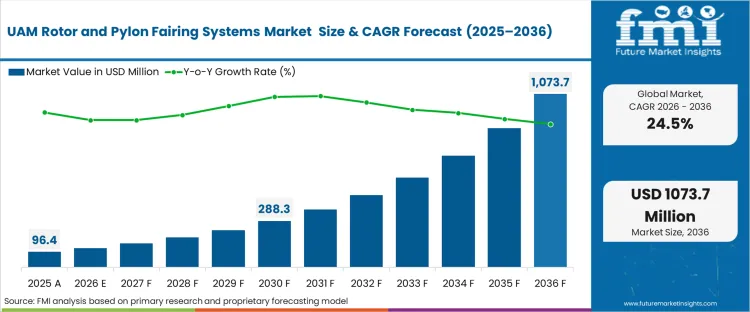
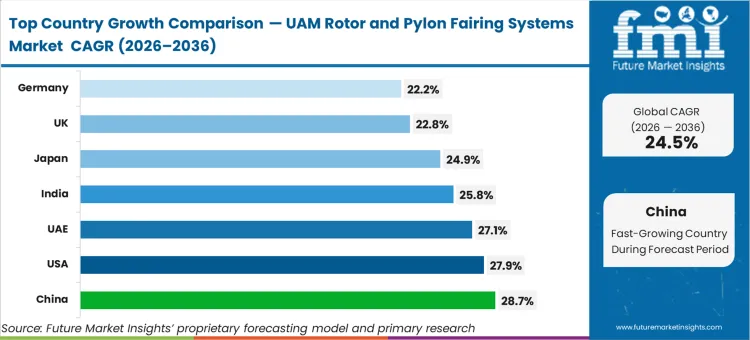
China leads growth at 28.7%, with state-supported certification mechanisms helping domestic manufacturers move faster toward commercial deployment. The United States comes next at 27.9%, where military testing and validation programs are helping de-risk aerodynamic performance before civil certification. The United Arab Emirates grows at 27.1%, using sovereign investment to establish itself as a leading launch market for commercial urban air mobility. India follows at 25.8% through carefully structured technology transfer activity, and Japan records 24.9% growth tied to planned urban aviation timelines. The United Kingdom advances at 22.8%, while Germany reaches 22.2%. The difference across these markets reflects the uneven speed at which regulators are approving novel fairing systems for repeated urban flight use.
UAM Rotor and Pylon Fairing Systems Market Definition
The UAM rotor and pylon fairing systems market consists of the specialized aerodynamic outer structures, transition covers, and protective shrouds designed specifically to house, support, and streamline the distributed electric propulsion units of advanced air mobility vehicles. These components bridge the gap between the primary fuselage, wing booms, and active rotor hubs within the broader advanced air mobility aerostructures industry.
UAM Rotor and Pylon Fairing Systems Market Inclusions
When detailing what is included in uam rotor and pylon fairing systems, the scope encompasses all primary external aerodynamic shrouds supporting distributed lift. This includes eVTOL rotor fairings, hub-adjacent aerodynamic covers, and air taxi pylon fairing systems. The landscape also covers nacelle and pylon fairings for eVTOL, boom-to-pylon transition fairings, and the removable access panels required for line maintenance. Furthermore, specialized aerospace lightweight materials applied directly to these structures, such as surface protection films, edge seals, and fairing bonding kits, are fully included.
UAM Rotor and Pylon Fairing Systems Market Exclusions
The market excludes the internal electric motors, inverters, and high-voltage wiring housed within the fairings. Primary lifting surfaces such as main wings, tail sections, and the central fuselage shell are excluded. Rotor blades, propeller hubs, and battery containment systems are not captured. These exclusions isolate the exterior aerodynamic fairing envelopes from the active powertrain and the primary internal airframe architecture.
UAM Rotor and Pylon Fairing Systems Market Research Methodology
- Primary Research: Procurement directors at leading eVTOL original equipment manufacturers, engineers specializing in distributed propulsion aerodynamics, and composite tooling managers at tier-one eVTOL pylon fairing suppliers.
- Desk Research: Aggregation of material qualification dossiers from national aviation bodies, supplier capacity expansion announcements, and public capital expenditure reports tracking out-of-autoclave composite manufacturing lines.
- Market-Sizing and Forecasting: Baseline sizing anchors to publicly disclosed eVTOL production ramps and pre-order backlogs, utilizing a bottom-up aircraft-content model to estimate total fairing volume per airframe.
- Data Validation and Update Cycle: Forecast trajectories are triangulated against public supplier participation evidence from major tier-ones and plausibility checks against generalized eVTOL cost-model literature.
Segmental Analysis
UAM Rotor and Pylon Fairing Systems Market Analysis by Component Type
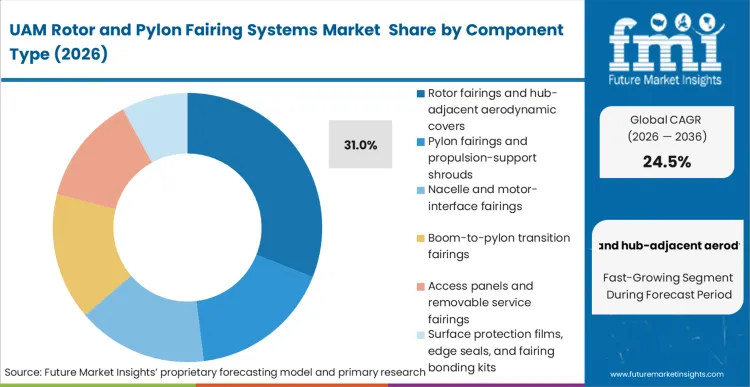
The leading share of 31.0% for rotor fairings and hub-adjacent aerodynamic covers is tied to the architecture of distributed propulsion aircraft. Each rotor assembly requires its own aerodynamic housing, creating much higher component demand than in conventional rotorcraft. FMI estimates these fairings carry premium value because they must perform under unstable airflow conditions during transition flight. Engineering teams prioritize them at the start because one failed fairing can affect control balance across the aircraft.
- Initial specification: The multiplication of propulsion units directly multiplies the demand for identical, high-tolerance aerodynamic shrouds.
- Qualification gate: Hub covers sit adjacent to rapidly spinning components, requiring rigorous containment and vibrational fatigue validation under aviation safety rules.
- Volume scaling: Manufacturers must pivot from bespoke hand-layup to automated molding to profitably produce dozens of identical fairings per aircraft.
UAM Rotor and Pylon Fairing Systems Market Analysis by Material System
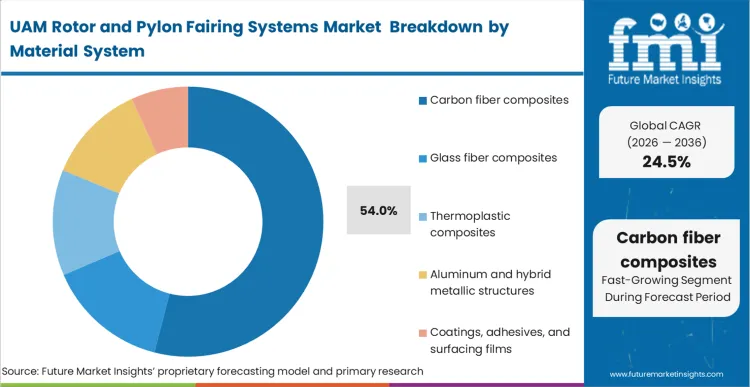
The choice of materials in rotor and pylon fairings is shaped by the strict energy limits of electric propulsion aircraft. Carbon fiber composites account for a 54.0% share as they offer the rigidity required while keeping weight to a minimum. In the comparison between carbon fiber and thermoplastic pylon fairings, thermoset carbon remains the preferred option, as attempts to shift toward lower-cost glass fiber or hybrid metallic alternatives often result in unacceptable range losses. FMI’s assessment indicates that structural engineers must rely on advanced carbon fiber to prevent extended pylons from flexing under high-torque rotor loads. This demanding specification directly influences the supply chain, pushing eVTOL developers toward the capacity-constrained network of tier-one advanced air mobility composite suppliers.
- Weight penalty: Any excess mass in the fairing architecture directly degrades the aircraft's commercial range and passenger payload capacity.
- Tooling constraints: The reliance on high-grade carbon prepregs mandates massive autoclave curing cycles, bottlenecking rapid production scaling.
- Lifecycle fatigue: Carbon fiber provides the mandatory stiffness to resist the complex harmonic vibrations generated by distributed electric motors without micro-cracking.
UAM Rotor and Pylon Fairing Systems Market Analysis by Aircraft Configuration
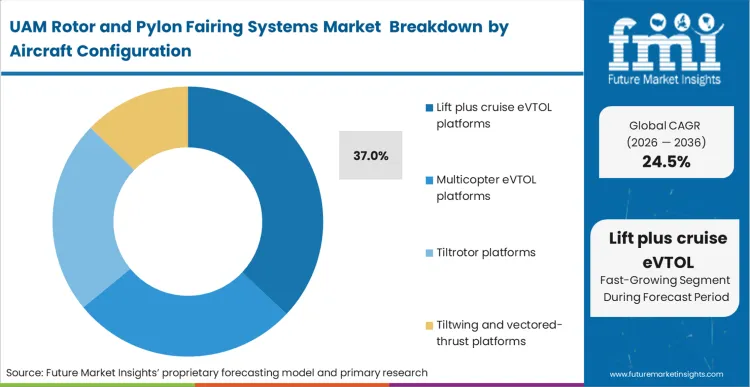
A lift plus cruise eVTOL holds a 37.0% share, driven by the higher fairing content required across its airframe. The configuration separates vertical lift rotors from forward cruise propulsors, creating a major aerodynamic penalty as idle lift rotors continue generating drag during horizontal flight. Designers address this challenge through complex pylon shrouds and boom transition fairings that smooth airflow around stationary blades and hub structures. FMI views this layout as the most practical route toward civil certification, avoiding the added engineering burden associated with full vectored thrust systems. This position supports stronger near-term demand for specialized exterior composite materials across advanced air mobility platforms.
- Aerodynamic compromise: Static vertical rotors create unacceptable cruise drag unless perfectly shrouded by specialized transition fairings.
- Drag mitigation: Sourcing precision-molded aerodynamic covers becomes the primary mechanism for preserving battery efficiency during forward flight.
- Certification predictability: Developers accept the higher structural weight of separate lift and cruise systems to avoid protracted software validation, driving immediate hardware demand.
UAM Rotor and Pylon Fairing Systems Market Analysis by Sales Channel
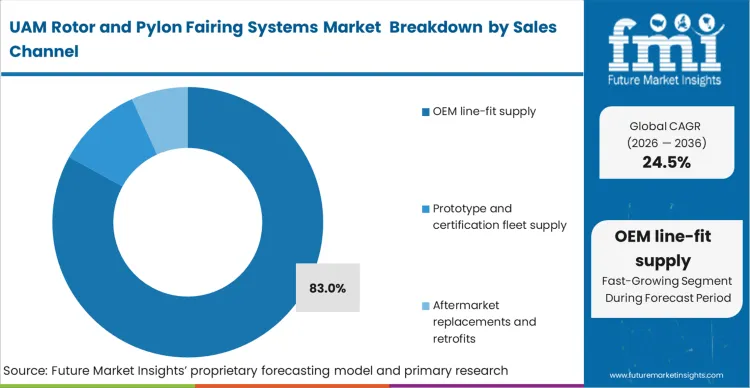
OEM line-fit supply captures an overwhelming 83.0% share, reflecting the reality that the entire sector is currently occupied with building initial conforming aircraft rather than maintaining existing ones. Fleet operations have not commenced, meaning there is zero natural attrition or wear driving aftermarket replacement demand. Procurement directors are singularly focused on securing massive forward contracts from eVTOL pylon fairing suppliers to guarantee that complex structures arrive at the final assembly line exactly when needed. Failing to establish reliable pipelines creates disastrous bottlenecks, leaving expensive aircraft nacelle and thrust reverser systems stranded on the factory floor awaiting their outer aerodynamic shells.
- Production scaling: All available capital is deployed toward manufacturing the first wave of commercial platforms, dictating volume OEM contracts.
- Quality conformity: Line-fit fairings must perfectly match type-design specifications. Rejection of non-conforming parts at incoming inspection halts final assembly.
- Future transitions: Aftermarket revenue will eventually emerge, but only after initial fleets accumulate thousands of urban flight hours and experience ramp damage.
UAM Rotor and Pylon Fairing Systems Market Analysis by End Use
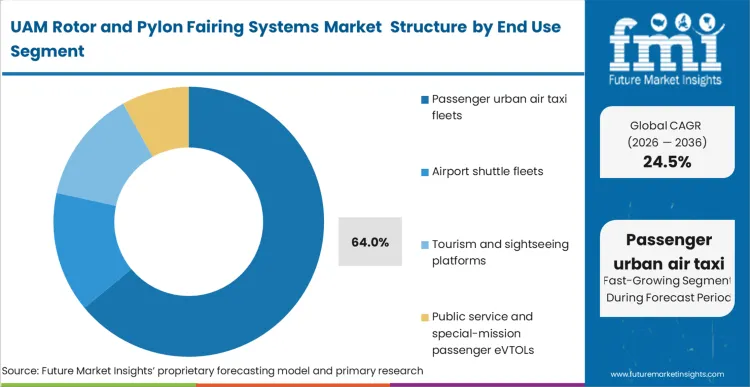
Passenger urban air taxi fleets lead the end-use segment with 64.0% share, establishing the baseline durability and acoustic requirements for the entire supply chain. High-frequency commuter operations subject the aircraft to rapid thermal cycling, constant pressurization changes, and abrasive urban environments. Maintenance directors for these proposed networks demand aerospace coatings and fairing designs that allow for split-second visual inspections and rapid access to internal powertrain components between short hops. Operators who miscalculate the operational abuse these fairings will take face unacceptable aircraft downtime as fragile composite shrouds crack under the strain of continuous daily boarding and cycling.
- High-frequency cycling: Air taxis must execute dozens of short flights daily, demanding fairings that resist fatigue under constant aerodynamic loading.
- Passenger perception: Commercial fleets require pristine, aesthetically flawless aerodynamic covers to project safety and reliability to nervous early adopters.
- Acoustic mitigation: Urban operational noise limits force manufacturers to embed acoustic dampening layers directly into the pylon fairings, complicating the layup process.
UAM Rotor and Pylon Fairing Systems Market Drivers, Restraints, and Opportunities
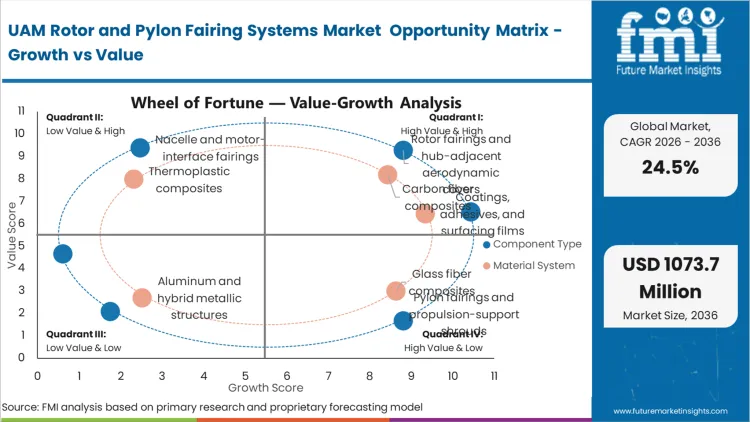
The main force pushing this market forward is the aerodynamic precision required in distributed electric propulsion aircraft. Electric batteries provide far less energy density than conventional aviation fuel, leaving eVTOL platforms with little room to absorb aerodynamic inefficiency. Exposed struts, wiring, and rotor hubs all need careful shaping to reduce parasitic drag and protect usable flight range. This design pressure is leading aircraft integrators to adopt highly contoured transition fairings that smoothly connect nacelles with wing structures and maintain cleaner laminar airflow across the airframe.
The critical restraint limiting immediate volume expansion is the severe misalignment between the promised production rates of air taxi developers and the proven manufacturing speeds of aerospace tier-ones. Producing aviation-grade high performance composites traditionally relies on slow, manual layup processes and hours-long curing cycles in pressurized autoclaves. While eVTOL business models require churning out hundreds of fairings monthly, current certified aerospace infrastructure is scaled to produce fractions of that volume. Automating these processes requires massive upfront capital expenditure and protracted requalification.
Opportunities in the UAM Rotor and Pylon Fairing Systems Market
- Thermoplastic Stamp-Forming: uam rotor fairing manufacturers who successfully validate thermoplastic composite stamping against aviation safety standards capture massive early contracts by radically reducing fairing production times from hours to minutes.
- Integrated EMI Shielding: As multiple electric motors generate severe electromagnetic interference, manufacturers who embed metallic meshes directly into the fairing layup eliminate the need for heavy secondary shielding, securing preferred supplier status.
- Rapid-Cure Bonding Systems: Developing aircraft structural bonding adhesives and specialized composite fairing bonding systems allows fleet mechanics to perform permanent repairs on the tarmac, drastically reducing costly aircraft downtime.
Regional Analysis
Based on the regional analysis, the UAM Rotor and Pylon Fairing Systems Market is segmented into North America, Europe, Asia Pacific, and Rest of the World across 40 plus countries.
.webp "Top Country Growth Comparison Uam Rotor And Pylon Fairing Systems Market Cagr (2026 2036)")
| Country | CAGR (2026 to 2036) |
|---|---|
| China | 28.7% |
| United States | 27.9% |
| United Arab Emirates | 27.1% |
| India | 25.8% |
| Japan | 24.9% |
| United Kingdom | 22.8% |
| Germany | 22.2% |
Source: Future Market Insights (FMI) analysis, based on proprietary forecasting model and primary research
Asia Pacific UAM Rotor and Pylon Fairing Systems Market Analysis
Asia Pacific is being shaped by centralized industrial policy, as national aviation authorities focus on fast commercialization instead of waiting for global regulatory harmonization. Through localized pilot ecosystems, domestic eVTOL manufacturers are able to scale production lines and deploy flight articles designed around national airspace rules. FMI estimates that this allows supply chains across the region to expand composite layup capacity more quickly, without the long software validation disputes holding back Western developers. The manufacturing base is also supported by established expertise in consumer electronics and automotive carbon fiber, with traceability frameworks gradually upgraded for aerospace use.
- China: China's state-directed regulatory environment bypasses complex pilot-in-command debates, allowing domestic developers to freeze their aerodynamic designs and issue massive volume contracts. The China rotor fairing market for eVTOL advances at an industry-leading 28.7% compound rate through 2036. This trajectory positions Chinese tier-one suppliers to capture the first global economies of scale, eventually translating their domestic volume dominance into highly competitive export pricing for aerostructures.
- Japan: Japan-based automotive conglomerates transitioning into the aerospace sector face the immediate challenge of qualifying high-volume advanced air mobility materials against stringent aviation standards. Operations managers are actively adapting precision stamping techniques for thermoplastic composites. The sector expands at an annual rate of 24.9%. Securing these requalification gates allows legacy Japanese industrial giants to seamlessly integrate into the global eVTOL supply chain as preferred tier-one providers of transition fairings.
- India: The rapid expansion of India’s market at a 25.8% compound rate reflects an aggressive competitive positioning strategy. Lacking deep legacy aerospace infrastructure, domestic aviation startups leverage strategic technology transfer agreements with established global engineering firms to import critical fairing expertise. Local procurement teams prioritize building domestic out-of-autoclave composite capabilities, strategically transitioning the nation from a reliance on imported aerostructures toward independent manufacturing nodes.
FMI’s report offers broad coverage of emerging markets in Southeast Asia and Oceania. Across these secondary countries, investment is directed more toward vertiports infrastructure for imported aircraft fleets than toward creating indigenous composite manufacturing capabilities.
North America and Europe UAM Rotor and Pylon Fairing Systems Market Analysis
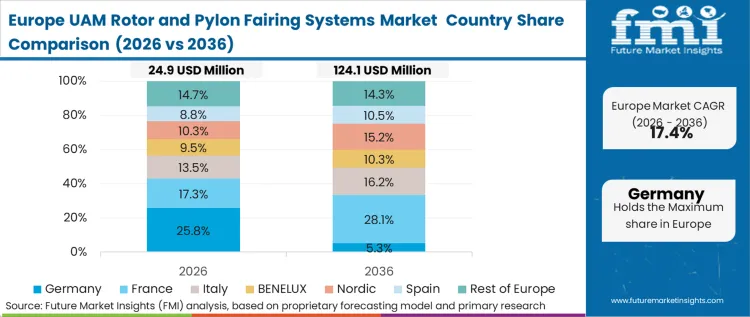
The pace of procurement across North America and Europe is largely shaped by strict, harmonized civil aviation safety standards. Aircraft integrators must meet the parallel requirements of the FAA and EASA, making sure every composite fairing and structural shroud delivers the crashworthiness and fatigue resistance expected in commercial aviation. FMI projects that this demanding regulatory environment is pushing eVTOL developers to consolidate sourcing around established aerospace tier-one suppliers with certified quality management systems already in place. Procurement decisions are centered on reducing risk in automated fiber placement processes so production can scale without weakening the safety margins required by Western regulators.
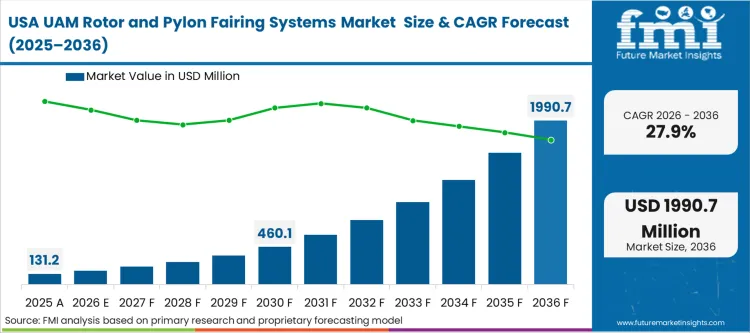
- United States: The United States eVTOL pylon fairing market leverages concurrent military validation programs to drastically accelerate the maturity of its domestic aerostructure supply chain. These non-dilutive defense contracts allow operators to cycle composite fairings through punishing flight profiles, generating critical fatigue data for FAA compliance without burning private capital. The market in the United States is poised for a CAGR of 27.9%. This dual-use strategy clears the operational bottleneck of producing conforming flight-test articles, establishing a practitioner reality where military funding directly subsidizes the civil certification timeline.
- United Kingdom: Airspace integration frameworks in the UK obligate engineering firms to focus heavily on acoustic mitigation alongside aerodynamic efficiency. Design teams iterate rotor fairings specifically engineered to dampen the distinct harmonic frequencies generated by distributed electric motors. The United Kingdom market is likely to post a CAGR of 22.8%. This regulatory focus guarantees that subsequent iterations of British urban air autonomous evtols systems prioritize noise reduction hardware, driving long-term structural innovation toward community-friendly operations.
- Germany: Germany's legacy stronghold in precision manufacturing requires specialized adaptation; suppliers must pivot their high-throughput capabilities to meet the exacting documentation standards of commercial aerospace. Procurement directors managing German supply lines actively validate rapid-cure bonding techniques that preserve structural integrity under high cyclic loading. Demand for fairing systems in Germany expands at a CAGR of 22.2%. Operations directors face the immediate practitioner reality that surviving in this market requires executing flawless material traceability across thousands of identical, small-scale aerodynamic covers.
FMI’s report provides detailed tracking of secondary European aerospace hubs such as France and Italy. These countries draw on long-standing expertise in helicopter manufacturing to supply highly specialized dynamic aerodynamic surfaces to the wider market.
Middle East UAM Rotor and Pylon Fairing Systems Market Analysis
The Middle East approaches advanced air mobility with abundant capital and strong government-backed smart city ambitions. Sovereign wealth is being used to draw in global eVTOL developers and build regional operating centers instead of indigenous aircraft manufacturing capacity. FMI’s assessment indicates that this strategy places far greater emphasis on durability in procurement decisions. Integrators supplying the region are required to modify composite fairings for resistance to severe sunlight, extreme heat, and airborne sand exposure. Attention centers on charging interfaces and protective shrouds designed to preserve battery and motor performance under demanding climate conditions.
- United Arab Emirates: Sovereign commitments establishing commercial networks by 2026 obligate operators in the UAE to demand severe environmental modifications from their global suppliers. Fleet managers require robust external coatings and specialized hybrid aircraft fairing architectures that prevent particulate ingress into sensitive distributed propulsion units. The UAE's component landscape expands at a CAGR of 27.1%. Securing these ruggedized systems opens immense commercial opportunity, as fleets successfully operating in the Emirates automatically establish the global durability baseline for all subsequent high-temperature network deployments.
FMI’s report covers Saudi Arabia’s smart city initiatives through adjacent market analysis. These large-scale urban developments are embedding dedicated aerial mobility infrastructure directly into their master plans. This approach is creating centralized procurement frameworks tailored to customized fleet operations.
Competitive Aligners for Market Players
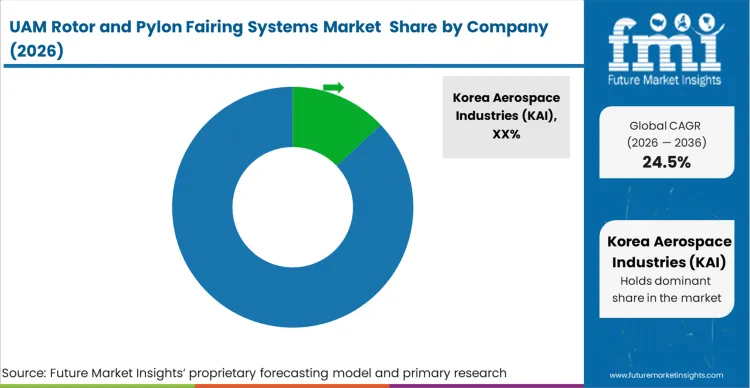
The competitive landscape exhibits a highly concentrated structure governed by the immense capital required to meet aerospace quality management standards. When evaluating who supplies eVTOL pylons and fairings, buyers in this sector, primarily the heavily capitalized eVTOL integrators, cannot risk sourcing critical aerodynamic structures from unproven vendors. The primary variable used to distinguish qualified vendors is their existing possession of certified clean rooms, massive autoclaves, and verifiable material traceability systems. top eVTOL pylon suppliers like Korea Aerospace Industries (KAI), FACC AG, and GKN Aerospace dominate because they absorb the massive upfront tooling costs and guarantee that every manufactured fairing matches the approved type-design exactly.
Long-standing integration with civil aviation authorities helps established suppliers preserve their market position. Decades of statistical data on composite fatigue performance make their material systems the default choice for eVTOL developers looking to streamline certification. Any challenger seeking to close this gap must build a broad testing database through extensive composite coupon validation across millions of simulated fatigue cycles. Vendors that embed automated non-destructive testing into air taxi component layup workflows gain a powerful advantage by enabling zero-defect production at scale.
As the market accelerates toward 2036, the tension between developers demanding automotive production rates and tier-one suppliers constrained by traditional aerospace methodologies will define the competitive trajectory. Integrators actively attempt to resist supplier lock-in by designing modular fairings that can be dual-sourced. However, the extreme aerodynamic tolerances required for transition flight ensure that the upper tier of the eVTOL pylon suppliers network, companies like Syensqo, PPG Aerospace, and Latecoere, remains highly concentrated, capturing the majority of line-fit aircraft electrification revenue.
Key Players in UAM Rotor and Pylon Fairing Systems Market
- Korea Aerospace Industries (KAI)
- FACC AG
- GKN Aerospace
- Hexcel Corporation
- Syensqo
- PPG Aerospace
- Latecoere
Scope of the Report
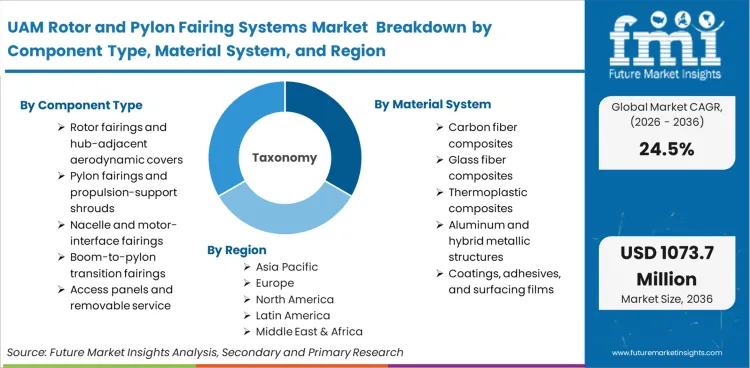
| Metric | Value |
|---|---|
| Quantitative Units | USD 120 million to USD 1060 million, at a CAGR of 24.5% |
| Market Definition | The sector covers the aerodynamic shrouds and protective composite covers engineered to manage drag and enclose the distributed electric propulsion architecture of powered-lift aircraft. |
| Component Type Segmentation | Rotor fairings and hub-adjacent aerodynamic covers, Pylon fairings and propulsion-support shrouds, Nacelle and motor-interface fairings, Boom-to-pylon transition fairings, Access panels and removable service fairings, Surface protection films, edge seals, and fairing bonding kits |
| Material System Segmentation | Carbon fiber composites, Glass fiber composites, Thermoplastic composites, Aluminum and hybrid metallic structures, Coatings, adhesives, and surfacing films |
| Aircraft Configuration Segmentation | Lift plus cruise eVTOL platforms, Multicopter eVTOL platforms, Tiltrotor platforms, Tiltwing and vectored-thrust platforms |
| Sales Channel Segmentation | OEM line-fit supply, Prototype and certification fleet supply, Aftermarket replacements and retrofits |
| End Use Segmentation | Passenger urban air taxi fleets, Airport shuttle fleets, Tourism and sightseeing platforms, Public service and special-mission passenger eVTOLs |
| Regions Covered | North America, Europe, Asia Pacific, Rest of the World |
| Countries Covered | China, United States, United Arab Emirates, India, Japan, United Kingdom, Germany, and 40 plus countries |
| Key Companies Profiled | Korea Aerospace Industries (KAI), FACC AG, GKN Aerospace, Hexcel Corporation, Syensqo, PPG Aerospace, Latecoere |
| Forecast Period | 2026 to 2036 |
| Approach | Procurement directors, structural engineers, and tooling specialists were interviewed to establish demand. Baseline sizing anchors to publicly disclosed pre-order backlogs and known composite manufacturing capacity. Forecasts are validated against supplier participation from major tier-ones and plausibility checks against generalized cost-model literature. |
Source: Future Market Insights (FMI) analysis, based on proprietary forecasting model and primary research
UAM Rotor and Pylon Fairing Systems Market Analysis by Segments
-
Component Type:
- Rotor fairings and hub-adjacent aerodynamic covers
- Pylon fairings and propulsion-support shrouds
- Nacelle and motor-interface fairings
- Boom-to-pylon transition fairings
- Access panels and removable service fairings
- Surface protection films, edge seals, and fairing bonding kits
-
Material System:
- Carbon fiber composites
- Glass fiber composites
- Thermoplastic composites
- Aluminum and hybrid metallic structures
- Coatings, adhesives, and surfacing films
-
Aircraft Configuration:
- Lift plus cruise eVTOL platforms
- Multicopter eVTOL platforms
- Tiltrotor platforms
- Tiltwing and vectored-thrust platforms
-
Sales Channel:
- OEM line-fit supply
- Prototype and certification fleet supply
- Aftermarket replacements and retrofits
-
End Use:
- Passenger urban air taxi fleets
- Airport shuttle fleets
- Tourism and sightseeing platforms
- Public service and special-mission passenger eVTOLs
-
Region:
- North America
- United States
- Canada
- Europe
- Germany
- United Kingdom
- France
- Italy
- Spain
- Asia Pacific
- China
- Japan
- South Korea
- Taiwan
- Singapore
- Latin America
- Brazil
- Mexico
- Argentina
- Middle East & Africa
- GCC Countries
- South Africa
- Israel
- North America
Bibliography
- Archer Aviation Inc. (2026, March 2). Archer announces fourth quarter and full year 2025 results, USA and UAE air taxi pilot programs on-track for 2026. (Archer Aviation)
- EHang Holdings Limited. (2026, March 12). EHang reports fourth quarter and fiscal year 2025 unaudited financial results. (EHang)
- Eve Air Mobility. (2024, June 10). Eve names suppliers for eVTOL windows, doors, and fuselage components. (eveairmobility.com)
- Joby Aviation, Inc. (2026, February 25). Joby reports fourth quarter 2025 financial financial results. (Joby Aero, Inc.)
- SkyDrive Inc. (2025, February 10). JCAB issues G-1 certification basis for SkyDrive eVTOL aircraft.
- USA Department of Transportation. (2025, December 17). The advanced air mobility national strategy. (Transportation Department)
This bibliography is provided for reader reference. The full FMI report contains the complete reference list with primary source documentation.
This Report Addresses
- Market intelligence to support strategic decision making across distributed propulsion aerodynamics and advanced composites
- Market size estimation and 10-year revenue forecasts from 2026 to 2036, supported by capacity tracking of tier-one aerospace manufacturing facilities
- Growth opportunity mapping across lift plus cruise architectures and end use sectors with emphasis on out-of-autoclave resin transfer molding
- Segment and regional revenue forecasts covering OEM line-fit supply across stringent aviation authority crashworthiness mandates
- Competition strategy assessment including clean room certifications, automated non-destructive testing workflows, and material traceability frameworks
- Capability development tracking including rapid-cure structural adhesives, thermoplastic stamp-forming, and acoustic dampening layers
- Market access analysis covering civil aviation type-certification bases, harmonic vibration fatigue testing, and military non-dilutive validation funding
- Market report delivery in PDF, Excel, PPT, and interactive dashboard formats for executive strategy, composite supply chain procurement, and operational benchmarking use
Frequently Asked Questions
How big is the evtol pylon fairing market?
The sector is valued at USD 120 million in 2026. This figure reflects the aggressive capital deployment required to secure massive autoclave curing cycles for the first wave of conforming flight-test fleets.
Estimate the uam rotor and pylon fairing systems market by 2036?
The valuation reaches USD 1,060 million by 2036. This massive expansion signals the operational transition from building single prototypes to automated serial manufacturing utilizing thermoplastic stamping.
What is included in uam rotor and pylon fairing systems?
The scope encompasses all primary external aerodynamic shrouds supporting distributed lift. This includes rotor fairings, hub-adjacent aerodynamic covers, pylon shrouds, nacelle interfaces, transition fairings, and associated bonding kits.
Explain the value chain for evtol rotor and pylon fairings?
The value chain begins with raw advanced composites suppliers providing carbon prepregs, which are processed by tier-one aerospace structural integrators using automated fiber placement to mold and cure the fairings, before final delivery to the eVTOL OEM for line-fit assembly.
Which Component Type segment leads?
Rotor fairings and hub-adjacent aerodynamic covers capture 31.0% share. Because distributed lift architectures require multiple independent motors, the demand for identical, precision-molded aerodynamic shrouds multiplies linearly per aircraft.
Which Material System segment leads?
Carbon fiber composites maintain a dominant 54.0% share. Aircraft developers cannot substitute heavier fiberglass without severely degrading the passenger payload and commercial range of their battery-constrained fleets.
Which Aircraft Configuration segment leads?
Lift plus cruise eVTOL platforms hold 37.0% share. This design requires highly specialized transition fairings to aerodynamically smooth the static lift rotors during forward flight, directly driving hardware volume.
What drives growth in the rotor fairing market?
The absolute aerodynamic necessity to minimize parasitic drag drives immediate procurement. Electric batteries hold limited energy density, meaning every exposed motor strut must be perfectly shrouded to preserve flight range.
What is the primary restraint facing suppliers?
The extreme mismatch between required air taxi volumes and traditional aerospace manufacturing speeds limits output. Requalifying automated rapid-layup techniques against strict aviation crashworthiness standards takes years of dedicated testing.
Which country grows fastest?
China expands at 28.7%, structurally outpacing the United States' 27.9%. China leverages centralized pilot ecosystems that bypass the protracted public airspace integration debates, allowing rapid scale of domestic composite lines.
How do European airspace regulations shape procurement?
Harmonized EASA standards compel developers in the UK and Germany to utilize heavily documented tier-one aerospace supply chains. Operations managers cannot risk sourcing from unproven automotive vendors lacking aviation-grade material traceability.
Why does the lack of aftermarket demand influence current strategies?
With OEM line-fit capturing 83.0% of the value, suppliers concentrate entirely on guaranteeing factory floor delivery. Capital is deployed toward clearing assembly line bottlenecks rather than building dispersed global repair networks.
How do incumbent aerospace tier-ones maintain dominance?
Incumbents hold immense statistical databases of material fatigue testing previously validated by the FAA. Challengers cannot replicate this regulatory trust without spending millions to redundantly test new composites across identical simulated flight cycles.
How does extreme heat in the Middle East alter fairing design?
Operations in the UAE require severe environmental modifications. Fleets must integrate specialized particulate filtration shrouds and highly reflective external coatings to prevent desert sand and solar radiation from degrading sensitive electric motors.
Why are lift plus cruise platforms faster to certify than vectored thrust?
Separating vertical hover rotors from horizontal cruise systems simplifies the flight control laws. Developers accept the heavier weight of dedicated lift fairings to avoid the protracted software validation required for tilting rotor mechanisms.
How does noise mitigation impact aerodynamic design?
Strict urban operational noise limits force structural engineers to embed acoustic dampening layers directly into the pylon fairings. This requirement adds significant manufacturing complexity to components that must remain obsessively lightweight.
What consequence do eVTOL developers face if they delay supplier lock-in?
Failing to secure production slots at established aerospace tier-ones leaves developers without conforming test hardware. Without these physical articles, certification flights halt entirely, jeopardizing promised commercial launch windows.
Why do structural engineers reject aluminum for these specific fairings?
Legacy metallic structures consume too much of the total weight allowance. Eliminating heavy metallic fasteners and shrouds is the only reliable way to preserve the commercial payload margins necessary for profitable air taxi operations.
What role do rapid-cure bonding systems play in fleet maintenance?
High-frequency urban cycling inevitably leads to abrasive ramp damage. Fleet operators require advanced room-temperature curing adhesives that allow mechanics to perform localized structural repairs on the tarmac, eliminating costly depot-level maintenance.
How does military funding derisk civilian commercial structures in the US?
Non-dilutive defense contracts allow developers to subject their composite fairings to extreme aerodynamic loading profiles. This generates the vital fatigue life data required for FAA compliance without burning private venture capital.
Why is thermoplastic stamp-forming considered a critical manufacturing shift?
Current thermoset resins require hours inside massive autoclaves, hard-capping output rates. Validating thermoplastic stamp-forming against aviation standards allows tier-one suppliers to mold complex pylon fairings in minutes, aligning aerospace output with automotive-style demand curves.
Preview the report firsthand - request a free sample
Get SampleGet the brochure for pricing and purchase details.
Get PDFTable of Content
- Executive Summary
- Global Market Outlook
- Demand-side Trends
- Supply-side Trends
- Technology Roadmap Analysis
- Analysis and Recommendations
- Market Overview
- Market Coverage / Taxonomy
- Market Definition / Scope / Limitations
- Research Methodology
- Chapter Orientation
- Analytical Lens and Working Hypotheses
- Market Structure, Signals, and Trend Drivers
- Benchmarking and Cross-market Comparability
- Market Sizing, Forecasting, and Opportunity Mapping
- Research Design and Evidence Framework
- Desk Research Programme (Secondary Evidence)
- Company Annual and Sustainability Reports
- Peer-reviewed Journals and Academic Literature
- Corporate Websites, Product Literature, and Technical Notes
- Earnings Decks and Investor Briefings
- Statutory Filings and Regulatory Disclosures
- Technical White Papers and Standards Notes
- Trade Journals, Industry Magazines, and Analyst Briefs
- Conference Proceedings, Webinars, and Seminar Materials
- Government Statistics Portals and Public Data Releases
- Press Releases and Reputable Media Coverage
- Specialist Newsletters and Curated Briefings
- Sector Databases and Reference Repositories
- FMI Internal Proprietary Databases and Historical Market Datasets
- Subscription Datasets and Paid Sources
- Social Channels, Communities, and Digital Listening Inputs
- Additional Desk Sources
- Expert Input and Fieldwork (Primary Evidence)
- Primary Modes
- Qualitative Interviews and Expert Elicitation
- Quantitative Surveys and Structured Data Capture
- Blended Approach
- Why Primary Evidence is Used
- Field Techniques
- Interviews
- Surveys
- Focus Groups
- Observational and In-context Research
- Social and Community Interactions
- Stakeholder Universe Engaged
- C-suite Leaders
- Board Members
- Presidents and Vice Presidents
- R&D and Innovation Heads
- Technical Specialists
- Domain Subject-matter Experts
- Scientists
- Physicians and Other Healthcare Professionals
- Governance, Ethics, and Data Stewardship
- Research Ethics
- Data Integrity and Handling
- Primary Modes
- Tooling, Models, and Reference Databases
- Desk Research Programme (Secondary Evidence)
- Data Engineering and Model Build
- Data Acquisition and Ingestion
- Cleaning, Normalisation, and Verification
- Synthesis, Triangulation, and Analysis
- Quality Assurance and Audit Trail
- Market Background
- Market Dynamics
- Drivers
- Restraints
- Opportunity
- Trends
- Scenario Forecast
- Demand in Optimistic Scenario
- Demand in Likely Scenario
- Demand in Conservative Scenario
- Opportunity Map Analysis
- Product Life Cycle Analysis
- Supply Chain Analysis
- Investment Feasibility Matrix
- Value Chain Analysis
- PESTLE and Porter’s Analysis
- Regulatory Landscape
- Regional Parent Market Outlook
- Production and Consumption Statistics
- Import and Export Statistics
- Market Dynamics
- Global Market Analysis 2021 to 2025 and Forecast, 2026 to 2036
- Historical Market Size Value (USD Million) Analysis, 2021 to 2025
- Current and Future Market Size Value (USD Million) Projections, 2026 to 2036
- Y-o-Y Growth Trend Analysis
- Absolute $ Opportunity Analysis
- Global Market Pricing Analysis 2021 to 2025 and Forecast 2026 to 2036
- Global Market Analysis 2021 to 2025 and Forecast 2026 to 2036, By Component Type
- Introduction / Key Findings
- Historical Market Size Value (USD Million) Analysis By Component Type , 2021 to 2025
- Current and Future Market Size Value (USD Million) Analysis and Forecast By Component Type , 2026 to 2036
- Rotor fairings and hub-adjacent aerodynamic covers
- Pylon fairings and propulsion-support shrouds
- Nacelle and motor-interface fairings
- Boom-to-pylon transition fairings
- Access panels and removable service fairings
- Surface protection films, edge seals, and fairing bonding kits
- Rotor fairings and hub-adjacent aerodynamic covers
- Y-o-Y Growth Trend Analysis By Component Type , 2021 to 2025
- Absolute $ Opportunity Analysis By Component Type , 2026 to 2036
- Global Market Analysis 2021 to 2025 and Forecast 2026 to 2036, By Material System
- Introduction / Key Findings
- Historical Market Size Value (USD Million) Analysis By Material System, 2021 to 2025
- Current and Future Market Size Value (USD Million) Analysis and Forecast By Material System, 2026 to 2036
- Carbon fiber composites
- Glass fiber composites
- Thermoplastic composites
- Aluminum and hybrid metallic structures
- Coatings, adhesives, and surfacing films
- Carbon fiber composites
- Y-o-Y Growth Trend Analysis By Material System, 2021 to 2025
- Absolute $ Opportunity Analysis By Material System, 2026 to 2036
- Global Market Analysis 2021 to 2025 and Forecast 2026 to 2036, By Aircraft Configuration
- Introduction / Key Findings
- Historical Market Size Value (USD Million) Analysis By Aircraft Configuration, 2021 to 2025
- Current and Future Market Size Value (USD Million) Analysis and Forecast By Aircraft Configuration, 2026 to 2036
- Lift plus cruise eVTOL platforms
- Multicopter eVTOL platforms
- Tiltrotor platforms
- Tiltwing and vectored-thrust platforms
- Lift plus cruise eVTOL platforms
- Y-o-Y Growth Trend Analysis By Aircraft Configuration, 2021 to 2025
- Absolute $ Opportunity Analysis By Aircraft Configuration, 2026 to 2036
- Global Market Analysis 2021 to 2025 and Forecast 2026 to 2036, By Sales Channel
- Introduction / Key Findings
- Historical Market Size Value (USD Million) Analysis By Sales Channel, 2021 to 2025
- Current and Future Market Size Value (USD Million) Analysis and Forecast By Sales Channel, 2026 to 2036
- OEM line-fit supply
- Prototype and certification fleet supply
- Aftermarket replacements and retrofits
- OEM line-fit supply
- Y-o-Y Growth Trend Analysis By Sales Channel, 2021 to 2025
- Absolute $ Opportunity Analysis By Sales Channel, 2026 to 2036
- Global Market Analysis 2021 to 2025 and Forecast 2026 to 2036, By End Use
- Introduction / Key Findings
- Historical Market Size Value (USD Million) Analysis By End Use, 2021 to 2025
- Current and Future Market Size Value (USD Million) Analysis and Forecast By End Use, 2026 to 2036
- Passenger urban air taxi fleets
- Airport shuttle fleets
- Tourism and sightseeing platforms
- Public service and special-mission passenger eVTOLs
- Passenger urban air taxi fleets
- Y-o-Y Growth Trend Analysis By End Use, 2021 to 2025
- Absolute $ Opportunity Analysis By End Use, 2026 to 2036
- Global Market Analysis 2021 to 2025 and Forecast 2026 to 2036, By Region
- Introduction
- Historical Market Size Value (USD Million) Analysis By Region, 2021 to 2025
- Current Market Size Value (USD Million) Analysis and Forecast By Region, 2026 to 2036
- North America
- Latin America
- Western Europe
- Eastern Europe
- East Asia
- South Asia and Pacific
- Middle East & Africa
- Market Attractiveness Analysis By Region
- North America Market Analysis 2021 to 2025 and Forecast 2026 to 2036, By Country
- Historical Market Size Value (USD Million) Trend Analysis By Market Taxonomy, 2021 to 2025
- Market Size Value (USD Million) Forecast By Market Taxonomy, 2026 to 2036
- By Country
- USA
- Canada
- Mexico
- By Component Type
- By Material System
- By Aircraft Configuration
- By Sales Channel
- By End Use
- By Country
- Market Attractiveness Analysis
- By Country
- By Component Type
- By Material System
- By Aircraft Configuration
- By Sales Channel
- By End Use
- Key Takeaways
- Latin America Market Analysis 2021 to 2025 and Forecast 2026 to 2036, By Country
- Historical Market Size Value (USD Million) Trend Analysis By Market Taxonomy, 2021 to 2025
- Market Size Value (USD Million) Forecast By Market Taxonomy, 2026 to 2036
- By Country
- Brazil
- Chile
- Rest of Latin America
- By Component Type
- By Material System
- By Aircraft Configuration
- By Sales Channel
- By End Use
- By Country
- Market Attractiveness Analysis
- By Country
- By Component Type
- By Material System
- By Aircraft Configuration
- By Sales Channel
- By End Use
- Key Takeaways
- Western Europe Market Analysis 2021 to 2025 and Forecast 2026 to 2036, By Country
- Historical Market Size Value (USD Million) Trend Analysis By Market Taxonomy, 2021 to 2025
- Market Size Value (USD Million) Forecast By Market Taxonomy, 2026 to 2036
- By Country
- Germany
- UK
- Italy
- Spain
- France
- Nordic
- BENELUX
- Rest of Western Europe
- By Component Type
- By Material System
- By Aircraft Configuration
- By Sales Channel
- By End Use
- By Country
- Market Attractiveness Analysis
- By Country
- By Component Type
- By Material System
- By Aircraft Configuration
- By Sales Channel
- By End Use
- Key Takeaways
- Eastern Europe Market Analysis 2021 to 2025 and Forecast 2026 to 2036, By Country
- Historical Market Size Value (USD Million) Trend Analysis By Market Taxonomy, 2021 to 2025
- Market Size Value (USD Million) Forecast By Market Taxonomy, 2026 to 2036
- By Country
- Russia
- Poland
- Hungary
- Balkan & Baltic
- Rest of Eastern Europe
- By Component Type
- By Material System
- By Aircraft Configuration
- By Sales Channel
- By End Use
- By Country
- Market Attractiveness Analysis
- By Country
- By Component Type
- By Material System
- By Aircraft Configuration
- By Sales Channel
- By End Use
- Key Takeaways
- East Asia Market Analysis 2021 to 2025 and Forecast 2026 to 2036, By Country
- Historical Market Size Value (USD Million) Trend Analysis By Market Taxonomy, 2021 to 2025
- Market Size Value (USD Million) Forecast By Market Taxonomy, 2026 to 2036
- By Country
- China
- Japan
- South Korea
- By Component Type
- By Material System
- By Aircraft Configuration
- By Sales Channel
- By End Use
- By Country
- Market Attractiveness Analysis
- By Country
- By Component Type
- By Material System
- By Aircraft Configuration
- By Sales Channel
- By End Use
- Key Takeaways
- South Asia and Pacific Market Analysis 2021 to 2025 and Forecast 2026 to 2036, By Country
- Historical Market Size Value (USD Million) Trend Analysis By Market Taxonomy, 2021 to 2025
- Market Size Value (USD Million) Forecast By Market Taxonomy, 2026 to 2036
- By Country
- India
- ASEAN
- Australia & New Zealand
- Rest of South Asia and Pacific
- By Component Type
- By Material System
- By Aircraft Configuration
- By Sales Channel
- By End Use
- By Country
- Market Attractiveness Analysis
- By Country
- By Component Type
- By Material System
- By Aircraft Configuration
- By Sales Channel
- By End Use
- Key Takeaways
- Middle East & Africa Market Analysis 2021 to 2025 and Forecast 2026 to 2036, By Country
- Historical Market Size Value (USD Million) Trend Analysis By Market Taxonomy, 2021 to 2025
- Market Size Value (USD Million) Forecast By Market Taxonomy, 2026 to 2036
- By Country
- Kingdom of Saudi Arabia
- Other GCC Countries
- Turkiye
- South Africa
- Other African Union
- Rest of Middle East & Africa
- By Component Type
- By Material System
- By Aircraft Configuration
- By Sales Channel
- By End Use
- By Country
- Market Attractiveness Analysis
- By Country
- By Component Type
- By Material System
- By Aircraft Configuration
- By Sales Channel
- By End Use
- Key Takeaways
- Key Countries Market Analysis
- USA
- Pricing Analysis
- Market Share Analysis, 2025
- By Component Type
- By Material System
- By Aircraft Configuration
- By Sales Channel
- By End Use
- Canada
- Pricing Analysis
- Market Share Analysis, 2025
- By Component Type
- By Material System
- By Aircraft Configuration
- By Sales Channel
- By End Use
- Mexico
- Pricing Analysis
- Market Share Analysis, 2025
- By Component Type
- By Material System
- By Aircraft Configuration
- By Sales Channel
- By End Use
- Brazil
- Pricing Analysis
- Market Share Analysis, 2025
- By Component Type
- By Material System
- By Aircraft Configuration
- By Sales Channel
- By End Use
- Chile
- Pricing Analysis
- Market Share Analysis, 2025
- By Component Type
- By Material System
- By Aircraft Configuration
- By Sales Channel
- By End Use
- Germany
- Pricing Analysis
- Market Share Analysis, 2025
- By Component Type
- By Material System
- By Aircraft Configuration
- By Sales Channel
- By End Use
- UK
- Pricing Analysis
- Market Share Analysis, 2025
- By Component Type
- By Material System
- By Aircraft Configuration
- By Sales Channel
- By End Use
- Italy
- Pricing Analysis
- Market Share Analysis, 2025
- By Component Type
- By Material System
- By Aircraft Configuration
- By Sales Channel
- By End Use
- Spain
- Pricing Analysis
- Market Share Analysis, 2025
- By Component Type
- By Material System
- By Aircraft Configuration
- By Sales Channel
- By End Use
- France
- Pricing Analysis
- Market Share Analysis, 2025
- By Component Type
- By Material System
- By Aircraft Configuration
- By Sales Channel
- By End Use
- India
- Pricing Analysis
- Market Share Analysis, 2025
- By Component Type
- By Material System
- By Aircraft Configuration
- By Sales Channel
- By End Use
- ASEAN
- Pricing Analysis
- Market Share Analysis, 2025
- By Component Type
- By Material System
- By Aircraft Configuration
- By Sales Channel
- By End Use
- Australia & New Zealand
- Pricing Analysis
- Market Share Analysis, 2025
- By Component Type
- By Material System
- By Aircraft Configuration
- By Sales Channel
- By End Use
- China
- Pricing Analysis
- Market Share Analysis, 2025
- By Component Type
- By Material System
- By Aircraft Configuration
- By Sales Channel
- By End Use
- Japan
- Pricing Analysis
- Market Share Analysis, 2025
- By Component Type
- By Material System
- By Aircraft Configuration
- By Sales Channel
- By End Use
- South Korea
- Pricing Analysis
- Market Share Analysis, 2025
- By Component Type
- By Material System
- By Aircraft Configuration
- By Sales Channel
- By End Use
- Russia
- Pricing Analysis
- Market Share Analysis, 2025
- By Component Type
- By Material System
- By Aircraft Configuration
- By Sales Channel
- By End Use
- Poland
- Pricing Analysis
- Market Share Analysis, 2025
- By Component Type
- By Material System
- By Aircraft Configuration
- By Sales Channel
- By End Use
- Hungary
- Pricing Analysis
- Market Share Analysis, 2025
- By Component Type
- By Material System
- By Aircraft Configuration
- By Sales Channel
- By End Use
- Kingdom of Saudi Arabia
- Pricing Analysis
- Market Share Analysis, 2025
- By Component Type
- By Material System
- By Aircraft Configuration
- By Sales Channel
- By End Use
- Turkiye
- Pricing Analysis
- Market Share Analysis, 2025
- By Component Type
- By Material System
- By Aircraft Configuration
- By Sales Channel
- By End Use
- South Africa
- Pricing Analysis
- Market Share Analysis, 2025
- By Component Type
- By Material System
- By Aircraft Configuration
- By Sales Channel
- By End Use
- USA
- Market Structure Analysis
- Competition Dashboard
- Competition Benchmarking
- Market Share Analysis of Top Players
- By Regional
- By Component Type
- By Material System
- By Aircraft Configuration
- By Sales Channel
- By End Use
- Competition Analysis
- Competition Deep Dive
- Korea Aerospace Industries (KAI)
- Overview
- Product Portfolio
- Profitability by Market Segments (Product/Age /Sales Channel/Region)
- Sales Footprint
- Strategy Overview
- Marketing Strategy
- Product Strategy
- Channel Strategy
- FACC AG
- GKN Aerospace
- Hexcel Corporation
- Syensqo
- PPG Aerospace
- Latecoere
- Korea Aerospace Industries (KAI)
- Competition Deep Dive
- Assumptions & Acronyms Used


