

- Industry Size (2026)
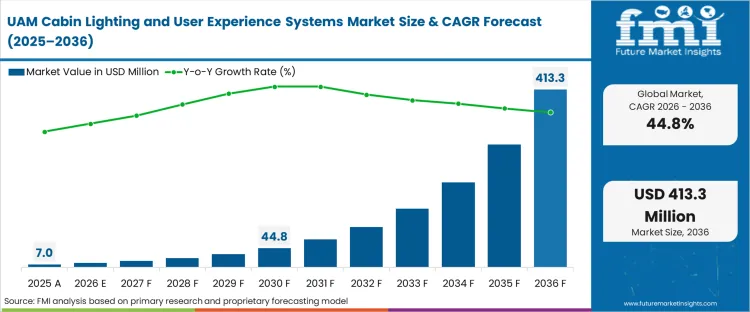
- USD 10.2 Mn
- Forecast (2036)
- USD 412.6 Mn
- CAGR (2026 to 2036)
- 44.8%
UAM Cabin Lighting and User Experience Systems Market Size, Market Forecast and Outlook By FMI
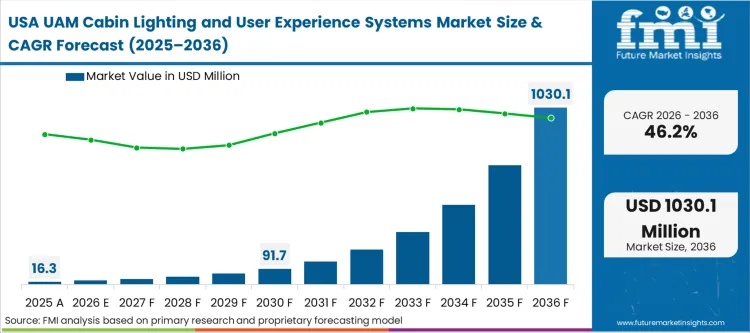
The UAM cabin lighting and user experience systems market growth globally scaled upto USD 7.0 million in 2025 with the industry sector expansion all set to push the valuation to USD 10.2 million in 2026, establishing a 44.8% CAGR across the forecast period. Regulatory compliance requirements lift the overall urban air mobility cabin lighting footprint to USD 412.6 million through 2036 as certification authorities mandate quantifiable psychological reassurance metrics for autonomous passenger carriage.
Cabin interior directors face intense pressure regarding passenger trust mechanics. Procurement teams evaluate eVTOL cabin UX systems growth by selecting architectures that maximize perceived safety during unpiloted flights. Delaying final interior specification forces costly recertification cycles once flight testing reveals passenger anxiety metrics exceeding acceptable thresholds. FMI's assessment indicates aircraft interior lighting paradigms shift rapidly away from simple visibility toward emotional regulation. Hardware validation now depends strictly upon psychological impact data. Certification delays carry massive commercial consequences for early-stage operators racing toward launch.
Once regulatory bodies establish specific lumen requirements for autonomous flight approval, rapid standardization follows. Passenger behavior studies show specific global aircraft cabin interior configurations reduce panic incidence during sudden descent maneuvers. This behavioral data forces OEMs to adopt unified visual communication standards across different cabin systems for powered-lift aircraft. Standardized interfaces reduce individual passenger training requirements before boarding.
Summary of UAM Cabin Lighting and User Experience Systems Market
- UAM Cabin Lighting and User Experience Systems Market Definition
- Cabin illumination infrastructure provides specialized visual interfaces bridging traditional aerospace standards with automotive interaction concepts. Weight-optimized components manage passenger psychology and behavioral guidance during unpiloted vertical transit operations.
- Demand Drivers in the Market
- Regulatory passenger safety mandates force eVTOL certification engineers to implement intuitive visual egress indicators.
- Weight reduction targets push airframe designers to adopt integrated multipurpose illumination and communication modules.
- Brand differentiation strategies compel premium fleet operators to install highly customizable interior mood control systems.
- Key Segments Analyzed in the FMI Report
- Ambient And Mood Lighting Systems: 42.0% in 2026, driven by passenger anxiety mitigation requirements.
- Integrated Lighting Plus UX Control Modules: 38.0% in 2026, due to extreme airframe mass constraints.
- OEM Line-Fit: 71.0% in 2026, stemming from structural integration necessities during composite molding.
- 4 To 6 Passenger Urban Air Taxis: 64.0% in 2026, as initial commercial viability targets this specific payload capacity.
- Passenger Transport Operators: 58.0% in 2026, based upon municipal fleet deployment schedules.
- United Arab Emirates: 48.9% CAGR, fueled by aggressive state mandates for autonomous premium tourism operations.
- Analyst Opinion at FMI
- Nikhil Kaitwade, Principal Analyst at FMI, Automotive, Chemicals, Industrial Equipment, Oil & Gas, and Service industries., notes that, "Generalist assumptions treat urban air taxi illumination simply as weight-reduced aviation lighting. Practitioners recognize certification officers refuse passenger carriage authorization unless cabin interiors guarantee behavioral compliance during autonomous descent. Procurement directors at eVTOL startups mistakenly prioritize lumen-per-gram metrics over cognitive load reduction parameters. Operational reality dictates integration architecture must passively guide disoriented passengers toward egress pathways without pilot instruction. Systems failing psychological reassurance testing during simulated power-loss events face immediate rejection, regardless of component mass advantage. This behavioral requirement acts as an invisible barrier locking legacy aerospace suppliers out unless they approach this sector as a psychological management mandate."
- Strategic Implications / Executive Takeaways
- Chief engineering officers must abandon legacy commercial aviation component sourcing strategies favoring integrated behavioral interface vendors.
- Fleet procurement managers risk operational delays if specified cabin systems fail to secure autonomous flight passenger safety certifications.
- Component suppliers gain immense pricing leverage by providing documented psychological validation data alongside physical hardware specifications.
- Methodology
- FMI engaged chief interior engineers actively designing next-generation electric vertical takeoff vehicles.
- Research teams analyzed specialized aviation safety authority dockets regarding unmanned passenger carriage regulations.
- Quantitative models rely upon confirmed aircraft production schedules matched with specific interior bill-of-materials data.
- Forecast validation occurs through cross-referencing component purchase agreements against announced commercial launch dates.
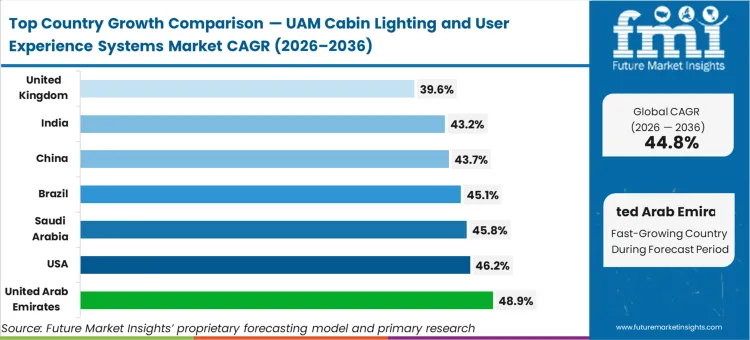
United Arab Emirates leads structural growth at 48.9% as state-sponsored infrastructure mandates premium interior styling for tourist fleets. Saudi Arabia tracks closely at 45.8% driven by massive sovereign wealth deployments targeting luxury transit pods. United States posts 46.2% CAGR via intense competition among domestic eVTOL pioneers securing early urban air mobility flight test systems certifications. Brazil expands at 45.1% fueled by local aerospace conglomerates integrating next-generation interior modules. China follows at 43.7% based upon high-volume production targets for municipal transit models. India achieves 43.2% as domestic aviation operators begin drafting future commuter requirements. United Kingdom records 39.6% reflecting strict aviation safety authority oversight over initial passenger trials. Regional variations stem entirely from differing regulatory approaches toward unmanned public transport qualification.
UAM Cabin Lighting and User Experience Systems Market Definition
Cabin illumination infrastructure encompasses specialized visual interfaces designed specifically for electric vertical takeoff passenger vehicles. This sector bridges traditional aerospace illumination standards with automotive-style occupant interaction technologies. Weight-optimized components operate under strict thermal constraints while providing continuous behavioral guidance. Analysts tracking advanced air mobility cabin systems define this category as active architectures managing passenger psychology during unpiloted vertical transit scenarios.
UAM Cabin Lighting and User Experience Systems Market Inclusions
Scope covers eVTOL mood lighting systems, capacitive touch surfaces, integrated reading nodes, and software suites managing urban air autonomous eVTOLs scene transitions. Components evaluated feature specific fire-retardancy certifications alongside vibration resistance ratings suited for distributed propulsion airframes. Data routing harnesses and centralized cabin control processors fall strictly within measured parameters. Aircraft exterior lighting modules remain excluded unless physically integrated into passenger entryways.
UAM Cabin Lighting and User Experience Systems Market Exclusions
External navigation beacons and traditional flight deck instrumentation panels fall entirely outside measured boundaries. Legacy commercial aviation interior components lacking specific eVTOL weight optimizations receive no tracking. Entertainment screens exceeding strictly defined mass allowances remain omitted. Basic mechanical switches without digital integration capability fail required inclusion criteria.
UAM Cabin Lighting and User Experience Systems Market Research Methodology
- Primary Research: Chief interior engineers and certification compliance officers at leading eVTOL manufacturers
- Desk Research: EASA Special Condition VTOL dockets and FAA powered-lift passenger cabin safety documentation
- Market-Sizing and Forecasting: Total projected airframe production schedules crossed with interior module unit costs
- Data Validation and Update Cycle: Component purchase agreements matched against publicly announced aircraft delivery timelines
Segmental Analysis
UAM Cabin Lighting and User Experience Systems Market Analysis by System Type
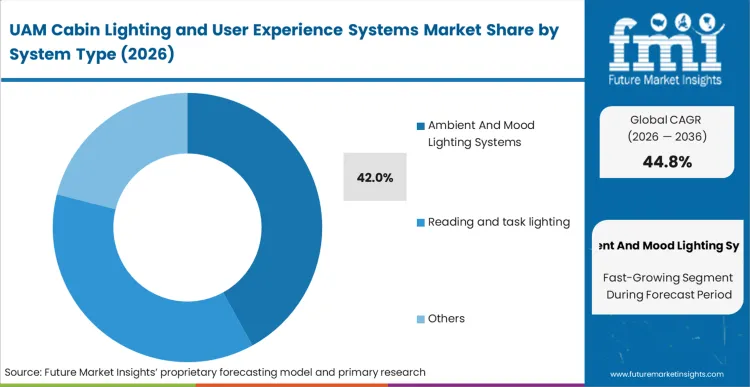
Procurement directors selecting cheaper industrial LEDs face massive redesign costs when flight testing reveals elevated passenger heart rates during critical flight phases. Without pilot presence, dynamic UAM cabin scene control modules serve as primary communication regarding flight status changes. Passenger anxiety mitigation requirements explain why ambient and mood lighting systems command a 42.0% share in 2026. Cabin interior designers at air taxi startups face strict payload limits that prevent installing heavy sound-dampening materials. FMI analysts observe that visual environment manipulation remains a primary tool for masking rotor noise discomfort. Ambient illumination cycles directly correlate with perceived ride smoothness during turbulent vertical transitions. Generalist aerospace interior observers often assume lumen output drives vendor selection here. True practitioners understand certification authorities evaluate ambient modules based entirely on seizure-prevention thresholds and psychological calming metrics.
- Trust Building: Color temperature adjustments signal operational normalcy during intense rotor pitch alterations. Cabin engineering leads secure passenger confidence through predictable visual cues rather than audible announcements.
- Biometric Feedback: Advanced modules interface directly with seat sensors monitoring occupant stress levels. System architects face complex integration hurdles ensuring real-time environmental responsiveness without triggering visual overload.
- Certification Failure: Incorrect strobe frequencies during emergency scenarios induce panic instead of guiding egress. Safety compliance officers mandate complete interior teardowns if UAM emergency egress lighting fails specific psychological impact evaluations.
UAM Cabin Lighting and User Experience Systems Market Analysis by Integration Architecture
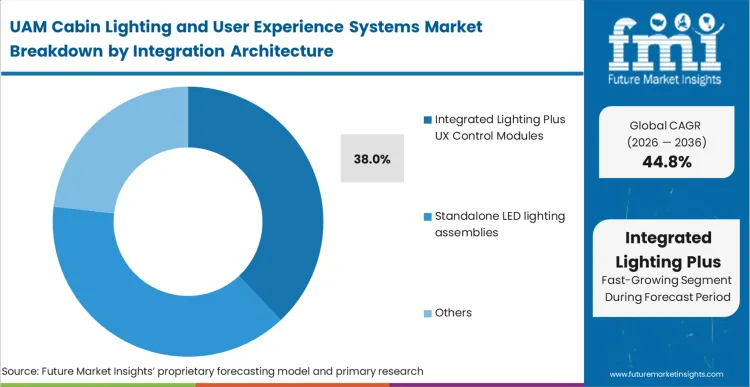
Extreme airframe mass constraints drive integrated lighting plus UX control modules to capture 38.0% share in 2026. Weight engineers cannot allocate separate wiring harnesses for illumination and passenger interfaces. Consolidating advanced air mobility control surfaces into structural cabin pillars eliminates redundant copper cabling. Based on FMI's assessment, distributed UAM cabin electronic architecture reduces overall aircraft weight by crucial kilograms. This approach minimizes thermal management requirements by spreading heat generation across larger composite surface areas. Hardware suppliers frequently boast about individual component lightness while ignoring harness penalties. Fleet operators discover standalone nodes require complex routing that ultimately degrades aircraft range due to excess battery drain. Supply chain directors who source disconnected systems struggle during final assembly when disparate communication protocols refuse native synchronization.
- Harness Elimination: Combining touch controls and LEDs onto single flexible printed circuits reduces copper weight. Airframe architects gain precious payload capacity for additional battery cells.
- Thermal Spreading: Integrated panels dissipate heat directly into composite fuselage structures. Thermal engineers avoid installing active cooling fans that draw parasitic power from main flight batteries.
- Protocol Conflict: Standalone legacy aviation components require heavy translation modules for digital handshake completion. Software integration managers experience massive delivery delays solving basic communication errors between mismatched vendor hardware.
UAM Cabin Lighting and User Experience Systems Market Analysis by Fitment
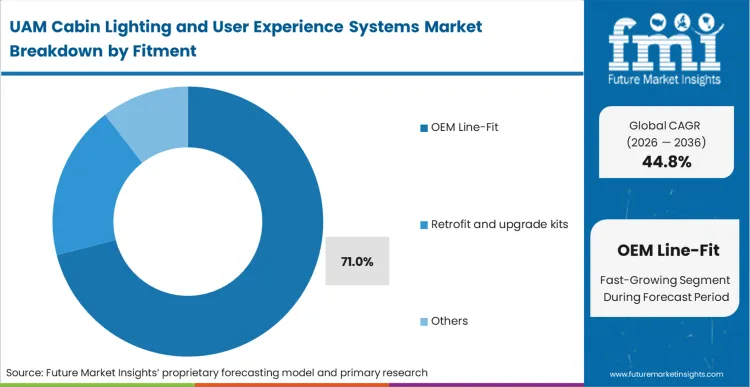
Procurement managers opting for modular aftermarket approaches discover their vehicles require factory-level teardowns just to replace malfunctioning communication nodes. FMI's analysis indicates aircraft glareshield lighting standards offer poor templates for modern urban air mobility construction. Wires must exist within structural layers before composite curing occurs. Structural integration necessities during composite molding push OEM line-fit to a dominant 71.0% share in 2026. Electric vertical takeoff vehicles feature completely novel fuselage designs lacking traditional ceiling cavities. Routing aftermarket wires through primary load-bearing structures violates fundamental aerospace stress tolerances. Aftermarket suppliers promoting easy upgrade paths misunderstand how completely sealed eVTOL cabins operate. Maintenance chiefs cannot simply remove ceiling panels because such actions often compromise primary airframe structural integrity.
- Embedded Routing: Wiring traces exist directly inside carbon fiber layup sheets before baking. Manufacturing directors eliminate entire assembly steps by specifying OEM line-fit cabin lighting for eVTOL platforms during primary structural fabrication.
- Stress Preservation: Drilling access holes for aftermarket brackets ruins composite load paths. Airworthiness inspectors automatically fail vehicles exhibiting unauthorized structural modifications for interior aesthetic upgrades.
- Maintenance Nightmare: Sealed cabin architectures prevent easy access behind decorative panels. Fleet technicians spend excessive hours performing minor repairs that require specialized composite rebonding procedures.
UAM Cabin Lighting and User Experience Systems Market Analysis by Aircraft Configuration
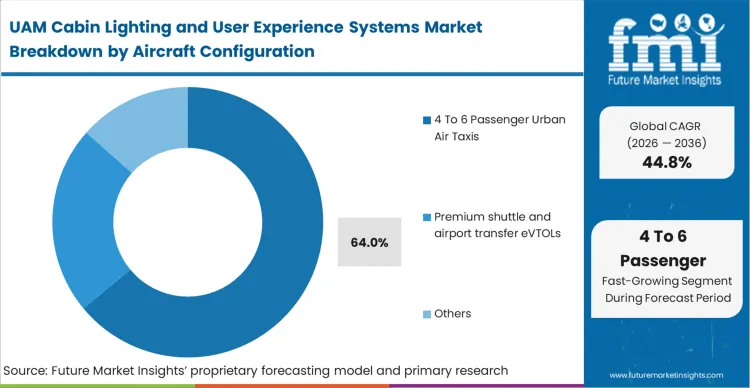
Initial commercial viability targets ensure 4 to 6 passenger urban air taxis hold 64.0% share in 2026. Economics dictate fleet operators require minimum passenger thresholds before route profitability occurs. Single-passenger configurations remain financially unviable for public transit applications. According to FMI's estimates, these specific mid-size airframes present unique quick release aircraft interior fasteners challenges regarding cabin illumination distribution. Designers struggle balancing individual reading zones without causing glare across adjacent seating positions. Surface observers think larger cabins simply scale up smaller designs. Seasoned interior specialists know four-passenger configurations create complex acoustic and visual echoing that smaller pods avoid entirely. Acoustic engineers rely upon specific lighting geometries to visually break up confined spaces.
- Profitability Threshold: Four paying seats represent a minimum requirement for route economic closure. Airline strategy officers refuse purchasing smaller airframes lacking sufficient revenue generation potential per flight cycle.
- Zone Isolation: Multiple occupants require individual task illumination without disturbing neighboring passengers. Cabin designers implement highly directional micro-louvers preventing cross-cabin light pollution during night operations.
- Visual Crowding: Confined mid-size cabins induce claustrophobia without strategic lighting application. Interior stylists face intense pressure creating optical illusions of spaciousness using passenger comfort electronics for urban air taxis.
UAM Cabin Lighting and User Experience Systems Market Analysis by End Use
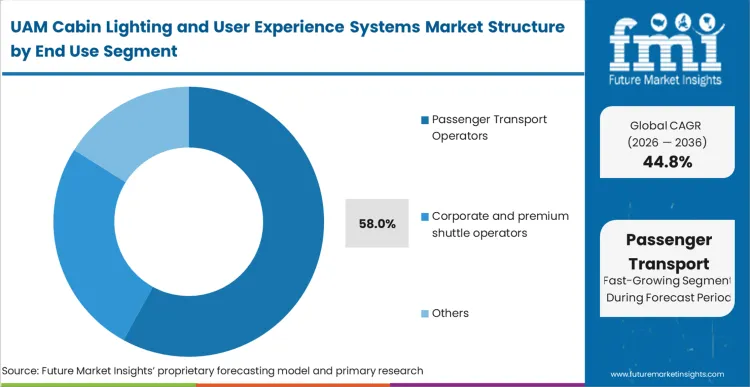
In FMI's view, exterior coating systems receive massive attention while interior durability remains critically underfunded. Public transit applications demand vandalism-resistant lighting modules that premium corporate shuttles never require. A common fallacy assumes wealthy early adopters will dominate initial ridership. Real operational data suggests subsidized commuter routes will generate initial flight volumes. Municipal fleet deployment schedules drive passenger transport operators to secure 58.0% share in 2026. City governments actively subsidize early aerial transit networks to alleviate ground congestion. High-frequency transit requires interiors capable of withstanding constant passenger cycling. Fleet maintenance directors quickly reject fragile capacitive touch surfaces designed for luxury markets once exposed to aggressive public usage patterns.
- High Cycle Wear: Public transit experiences continuous loading and unloading events daily. Maintenance planners demand scratch-resistant polycarbonate diffusers capable of surviving direct impacts from careless passengers.
- Sanitation Protocols: Municipal operators mandate harsh chemical cleaning between specific flight intervals. Material science engineers must qualify lighting covers against aggressive disinfectants that quickly degrade standard aviation plastics.
- Vandalism Resistance: Exposed touch panels invite intentional damage from unsupervised commuters. Interior architects must flush-mount all eVTOL passenger information display systems eliminating pry points for mischievous occupants.
UAM Cabin Lighting and User Experience Systems Market Drivers, Restraints, and Opportunities
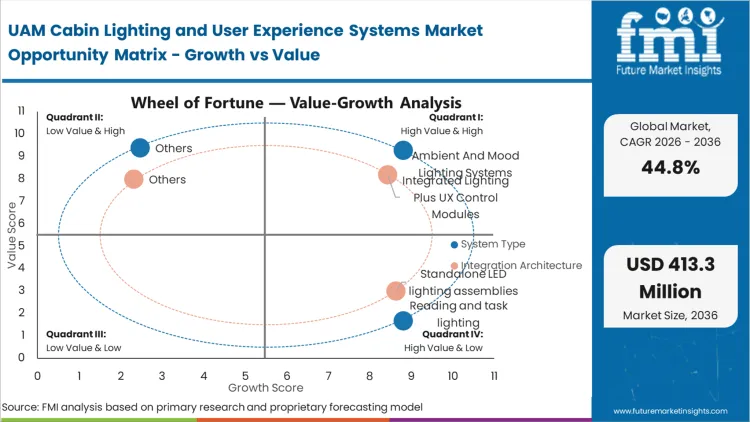
Regulatory passenger safety mandates force eVTOL certification engineers to implement intuitive visual egress indicators immediately. Aviation authorities globally refuse certifying unpiloted aircraft without fail-safe psychological reassurance mechanisms built directly into cabin architecture. Delaying interior specification creates severe bottlenecks during final airworthiness evaluations. Fleet launch schedules depend entirely upon proving passengers can safely evacuate crashed airframes without human crew guidance. This compliance pressure compels procurement directors to prioritize suppliers offering pre-validated behavioral interaction systems. Standard aircraft curtains or basic LED strips fail modern evacuation simulations. Immediate integration of dynamic egress routing systems ensures regulatory compliance while minimizing costly redesign loops prior to commercial debut.
Certification payload limits present massive operational friction slowing advanced system adoption. Integrating complex scene management software requires specific computing hardware that adds unacceptable mass. This physical barrier persists because battery energy density improvements continually lag behind aggressive airframe launch schedules. Battery engineers dictate every component must lose grams. Display manufacturers struggle shrinking robust commercial aviation technology into hyper-lightweight packages. Basic OLED screens draw too much continuous power. Emerging hybrid aircraft programs experiment with e-ink passenger interfaces to bypass battery drain issues. Current e-ink refresh rates remain too slow for dynamic emergency signaling.
Opportunities in the UAM Cabin Lighting and User Experience Systems Market
- Biometric Synchronization: Seat-integrated health sensors trigger specific cabin lighting adjustments. Passenger experience directors gain unique competitive advantages by offering stress-reducing autonomous flight environments.
- Predictive Maintenance Logging: Distributed nodes monitor individual LED degradation rates continuously. Maintenance scheduling officers eliminate manual cabin inspections by utilizing commercial aircraft video surveillance systems tied to lighting diagnostics.
- Weightless Haptics: Acoustic projection technology replaces physical vibration motors inside eVTOL human machine interface cabin modules. Interior weight engineers remove heavy mechanical components while maintaining tactile feedback for passenger comfort controls.
Regional Analysis
.webp "Top Country Growth Comparison Uam Cabin Lighting And User Experience Systems Market Cagr (2026 2036)")
The UAM cabin lighting and user experience systems market is segmented into North America and Latin America, Western Europe, Eastern Europe, Asia-Pacific, and Middle East and Africa across 40 plus countries. Regional trajectories in the urban air mobility cabin lighting sector diverge sharply based on local regulatory frameworks and state-sponsored infrastructure deployments. Emerging markets leverage massive sovereign wealth and greenfield transit plans to accelerate adoption, whereas established aviation hubs enforce strict, time-intensive psychological testing protocols before commercial launch.
| Country | CAGR (2026 to 2036) |
|---|---|
| United Arab Emirates | 48.9% |
| United States | 46.2% |
| Saudi Arabia | 45.8% |
| Brazil | 45.1% |
| China | 43.7% |
| India | 43.2% |
| United Kingdom | 39.6% |
Source: Future Market Insights (FMI) analysis, based on proprietary forecasting model and primary research
Middle East and Africa UAM Cabin Lighting and User Experience Systems Market Analysis
Sovereign wealth funds aggressively finance dedicated aerial transit hubs, dictating the necessity for matching luxury airframes. The standard commercial aircraft seat layouts as a result fall entirely short of regional passenger comfort expectations. FMI's projection reveals that local regulatory bodies are actively revising certification rules to fast-track the deployment of autonomous tourist fleets. Flawless aesthetic integration and robust cooling capabilities dominate the demands of operators targeting high-net-worth transit. Specialized thermal management remains a critical requirement for electronic cabin interfaces exposed to intense desert environments, as state-sponsored infrastructure mandates force the early adoption of ultra-premium interior styling.
- United Arab Emirates: Local certification officers establish luxury standard baselines by collaborating directly with eVTOL manufacturers. Driven by intense government initiatives, tourism operators face immense pressure to acquire premium-configured vertical takeoff fleets immediately. Pushing the country to develop at an impressive 48.9% CAGR, early suppliers within the UAM cabin systems UAE landscape secure lucrative multi-year maintenance contracts covering specialized luxury lighting nodes.
- Saudi Arabia: Expanding at 45.8% of CAGR, regional buyers evaluating the Saudi Arabia urban air taxi cabin market leverage immense purchasing power to force suppliers into customized hardware development. Dedicated aerial transit networks designed specifically for unmanned operation are becoming essential due to massive smart-city projects. The urban planners as a result demand seamless visual continuity connecting vertiport terminal aesthetics directly with vehicle cabin interiors.
FMI's report includes South Africa and additional African nations. Vast distance requirements across rural sectors push developmental focus toward hybrid endurance airframes rather than short-range urban lighting complexities.
North America and Latin America UAM Cabin Lighting and User Experience Systems Market Analysis
Startup engineering teams race to secure early FAA powered-lift passenger cabin safety certifications amid intense competition among domestic eVTOL pioneers. Massive venture capital deployments demand aggressive timeline adherence for commercial launches, while regulatory bodies rigorously scrutinize proposed evtol charging facilities alongside interior safety standards. South of this chaotic supply chain dynamic, local aerospace conglomerates actively integrate next-generation interior modules by leveraging established aviation manufacturing infrastructure. Regional fleet operators with decades of experience managing extreme urban airspace congestion transition traditional aircraft seating layouts rapidly toward social-facing pod configurations. Procurement managers across the hemisphere must balance high testing failure rates for novel touch interfaces in the north against a strict preference for extreme durability over delicate luxury features in the south.
- United States: Certification engineers commit thousands of hours to proving that novel interface concepts satisfy legacy crash-survivability metrics. Tracking at 46.2%, domestic manufacturers operating within the UAM cabin lighting market USA face significant operational hurdles when attempting to source specialized lightweight wiring harnesses locally. This reality stems directly from strict aviation safety authority oversight over initial passenger trials, which dictates highly conservative approaches toward dynamic cabin illumination.
- Brazil: Legacy aerospace giants rapidly pivot their existing composite manufacturing capabilities toward the production of integrated eVTOL cabin structures. Deep regional expertise regarding high-frequency urban aerial commuting heavily influences the strategies of interior design teams. The market advancing at 45.1% is propelled by domestic component suppliers that gain major competitive positioning by offering pre-certified hardware ready for immediate line-fit installation.
FMI's report includes Canada, Mexico, and Argentina. Operations primarily focus on medical evacuation and remote cargo transport or rely upon aftermarket upgrades on existing rotorcraft due to slower regulatory framework development.
Asia-Pacific UAM Cabin Lighting and User Experience Systems Market Analysis
High-volume production targets for municipal transit models dominate regional aerospace strategy across established manufacturing hubs, where state planners prioritize mass manufacturing efficiency over bespoke luxury configurations. Simultaneously, domestic aviation operators in rapidly developing urban centers begin drafting future commuter requirements based on massive congestion metrics. Supply chain consolidation enables extremely rapid iterations of passenger interface designs, driving simultaneous integration of complex digital scene management software via intense focus on in flight internet connectivity. In price-sensitive zones, initial pilot programs focus strictly on establishing viable route economics before investing in premium cabin features, elevating the priority of basic aircraft seat actuation systems above ambient lighting. Across the broader region, engineering teams must specify specialized conformal coatings for all interior electronics to combat extreme humidity profiles while planning aggressive autonomous fleet rollouts.
- China: Showing a 43.7% of CAGR value, massive domestic battery capabilities successfully resolve the critical power allocation tensions that previously restricted the China eVTOL cabin electronics market. Manufacturing directors aggressively scale production lines by utilizing highly integrated, single-piece cabin electronic modules. Government-backed aviation authorities actively accelerate this transition by issuing specialized air operator certificates for human-carrying pilotless aerial vehicles.
- India: Fleet strategy officers prioritize baseline functional lighting systems designed to maximize component longevity under notoriously harsh environmental conditions. Recording 43.2% CAGR, price-sensitive procurement environments force international suppliers targeting the India air taxi cabin systems market to develop simplified, highly durable interface models. This strict hardware focus directly answers the immense demand for aerial bypass transit solutions generated by rapidly growing urban centers.
FMI's report includes Japan, South Korea, Australia, and ASEAN nations. Dense urban topologies force designers to implement aggressive noise-canceling lighting therapies, while vast geographic dispersion creates segmented demand split between high-end urban air taxis and ruggedized regional transport configurations.
Western Europe UAM Cabin Lighting and User Experience Systems Market Analysis
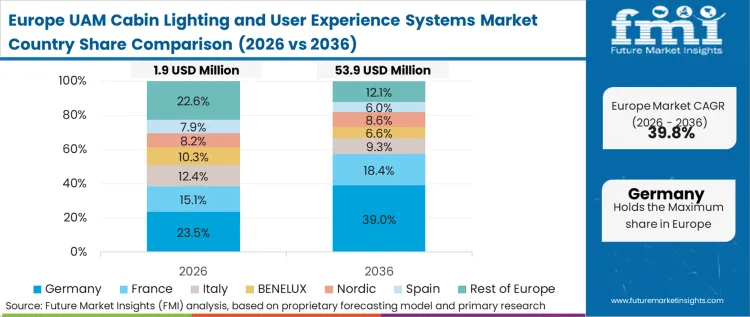
Regulators mandate extreme adherence to psychological safety parameters before granting autonomous flight privileges, ensuring that strict aviation safety authority oversight heavily influences all interior architectural decisions. Sustainability directives increasingly force suppliers to document total lifecycle environmental impacts for all cabin electronic components. FMI's analysis confirms that aircraft cabin environment sensor integration remains an absolutely non-negotiable requirement for regional certification across the continent.
- United Kingdom: Certification compliance officers strictly enforce EASA Special Condition parameters regarding emergency visual guidance protocols. Dedicated innovation funds actively support rigorous passenger behavioral testing during simulated vertical flight profiles to satisfy these mandates. Registering a 39.6% of CAGR in the market sector, as a result of conservative regulatory pacing ensuring that only extensively validated hardware designs reach commercial deployment.
FMI's report includes Germany and France. Established aerospace suppliers attempt to dominate new supply chains while facing fierce resistance from agile startups offering radically simplified integration architectures.
Competitive Aligners for Market Players
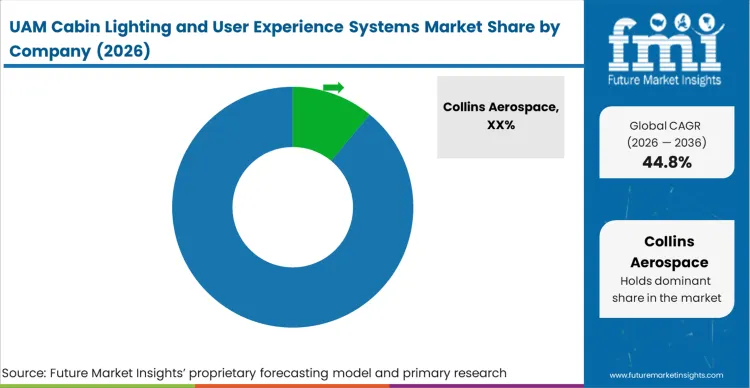
Weight engineering entirely redefines supplier viability inside electric vertical takeoff architectures, punishing legacy aviation interior giants that rely on established metal-based fabrication methods. Procurement directors evaluating initial air taxi bids explicitly exclude vendors failing strict gram-per-lumen thresholds, forcing a radical departure from commercial aerospace norms. Startups specializing in flexible printed circuits capture early attention by delivering integrated lighting panels weighing fractions of traditional assemblies. Companies like Collins Aerospace and Astronics Corporation possess immense certification experience but frequently face intense pressure from agile specialists such as Luminator Aerospace and Heads Up Technologies, who deliver stripped-down, ultra-lightweight hardware specifically tuned for battery-constrained platforms rather than over-engineered legacy solutions.
Navigating complex aviation safety authority documentation requirements remains a massive, invisible barrier protecting established suppliers against aggressive consumer electronics entrants. Traditional fabricators including Safran Cabin and Diehl Aviation maintain deep, proprietary libraries of pre-certified flame-retardant polymers that are absolutely necessary for passenger proximity approval. Competitors lacking this highly specific material compliance knowledge face multi-year delays attempting to qualify novel plastics for vertical lift environments. Software-focused interface entrants quickly discover they must partner with established avionics heavyweights like Thales to successfully embed complex airline technology integration systems inside certified airframes, as regulators refuse to approve unproven hardware operating critical cabin communications.
Fleet purchasing managers actively counter proprietary software-defined scene management platforms by demanding open-architecture communication protocols. Airframe designers aggressively push back against closed-ecosystem strategies, requiring ultimate configuration flexibility to ensure maintenance crews can swap damaged touch panels without executing expensive software reprogramming loops. System modularity emerges as the primary metric for long-term fleet maintenance calculations, allowing large transit operators to mix and match digital interfaces with third-party lighting nodes. Procurement power concentrates in the hands of launch operators who dictate these standardized digital handshakes, permanently altering how component value is captured as unpiloted commercial networks scale over the next decade.
Key Players in UAM Cabin Lighting and User Experience Systems Market
- Collins Aerospace
- Astronics Corporation
- Diehl Aviation
- Thales
- Luminator Aerospace
- Heads Up Technologies
- Safran Cabin
Scope of the Report
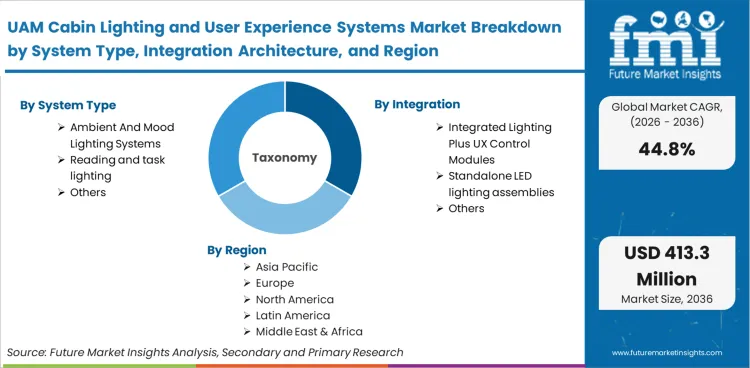
| Metric | Value |
|---|---|
| Quantitative Units | USD 10.2 million to USD 412.6 million, at a CAGR of 44.8% |
| Market Definition | Cabin illumination infrastructure encompasses specialized visual interfaces designed specifically for electric vertical takeoff passenger vehicles. This sector bridges traditional aerospace illumination standards with automotive-style occupant interaction technologies. Weight-optimized components operate under strict thermal constraints while providing continuous behavioral guidance. |
| Segmentation | By System type, By Integration architecture, By Fitment, By Aircraft configuration, By End use, By Region |
| Regions Covered | North America, Latin America, Western Europe, Eastern Europe, East Asia, South Asia and Pacific, Middle East and Africa |
| Countries Covered | United States, United Arab Emirates, Brazil, Saudi Arabia, China, India, United Kingdom |
| Key Companies Profiled | Collins Aerospace, Astronics Corporation, Diehl Aviation, Thales, Luminator Aerospace, Heads Up Technologies, Safran Cabin |
| Forecast Period | 2026 to 2036 |
| Approach | Total projected airframe production schedules crossed with interior module unit costs |
Source: Future Market Insights (FMI) analysis, based on proprietary forecasting model and primary research
Key Segments:
System Type
- Ambient and mood lighting systems
- Reading and task lighting
- Emergency egress and signage lighting
- Passenger information and status indicators
- Human-machine interface and scene-control modules
- USB/power-integrated user comfort modules
Integration Architecture
- Integrated lighting plus UX control modules
- Standalone LED lighting assemblies
- Distributed smart lighting nodes
- Cabin touchscreen or attendant control panels
- Software-defined scene management
Fitment
- OEM line-fit
- Retrofit and upgrade kits
Aircraft Configuration
- 4 to 6 passenger urban air taxis
- Premium shuttle and airport transfer eVTOLs
- Autonomous or pilot-assist cabin pods
- Hybrid regional UAM aircraft
End Use
- Passenger transport operators
- Corporate and premium shuttle operators
- Tourism and demonstration fleets
- Government and municipal pilot programs
Region:
- North America
- United States
- Canada
- Europe
- Germany
- United Kingdom
- France
- Italy
- Spain
- Asia Pacific
- China
- Japan
- South Korea
- Taiwan
- Singapore
- Latin America
- Brazil
- Mexico
- Argentina
- Middle East & Africa
- GCC Countries
- South Africa
- Israel
Bibliography
- Federal Aviation Administration. (2024, October 22). With new rule, FAA is ready for air travel of the future.
- Office of the Federal Register. (2025, January 3). Integration of powered-lift: Pilot certification and operations; miscellaneous amendments related to rotorcraft and airplanes.
- European Union Aviation Safety Agency. (2024, June 10). Special Condition for small-category VTOL-capable aircraft Issue 4.
- National Aeronautics and Space Administration. (2024). Aircraft design implications for Urban Air Mobility vehicles arising from crash dynamics and passenger experience considerations.
- Joby Aviation, Inc. (2026, February 25). Joby reports fourth quarter 2025 financial results.
This bibliography is provided for reader reference. The full FMI report contains the complete reference list with primary source documentation.
This Report Addresses
- Passenger behavioral compliance impacts on autonomous flight certification timelines
- Weight-penalty calculations for integrated versus distributed cabin architecture models
- Egress guidance validation metrics mandated by aviation safety authorities
- Psychological anxiety mitigation tactics utilizing dynamic color temperature shifting
- Hardware durability requirements for municipal aerial transit fleet applications
- Regional regulatory divergences regarding unmanned passenger carriage qualifications
- Thermal management constraints affecting high-density embedded lighting components
- Proprietary protocol barriers hindering third-party hardware integration efforts
Frequently Asked Questions
What is the UAM cabin lighting and user experience systems market?
It encompasses specialized, weight-optimized visual interfaces and active behavioral guidance architectures designed specifically for unpiloted electric vertical takeoff passenger vehicles.
How big is the eVTOL cabin lighting market?
The market is anticipated to reach USD 10.2 million in 2026 and expand at a 44.8% CAGR to achieve a USD 412.6 million valuation by 2036.
How is UAM cabin lighting different from commercial aircraft lighting?
Unlike traditional commercial aviation lighting, UAM cabin systems must actively manage passenger psychology and provide passive emergency egress guidance without any pilot interaction.
What drives growth in eVTOL cabin UX systems?
Stringent regulatory mandates requiring intuitive, fail-safe visual egress indicators and psychological reassurance mechanisms for autonomous flight approvals primarily drive market expansion.
Which companies supply cabin lighting for air taxis?
The supply chain features a mix of legacy aerospace providers like Collins Aerospace and agile, lightweight component specialists such as Luminator Aerospace and Heads Up Technologies.
Why do integrated control modules capture significant share?
Consolidating touch interfaces and lighting nodes onto single printed circuits eliminates redundant copper wiring, saving crucial mass that directly extends aircraft battery range.
How does structural integration impact aftermarket component sales?
Because aftermarket wiring requires compromising the load-bearing integrity of sealed composite cabins, traditional retrofit upgrade paths are effectively eliminated in favor of OEM line-fit solutions.
What creates operational friction for complex scene management software?
The substantial continuous power draw required for dynamic display operations creates severe energy allocation conflicts against the primary flight batteries.
Why do four-passenger configurations dominate initial production?
Four-seat architectures provide the minimum revenue-generating payload required by airline strategy officers to achieve route profitability in early public transit operations.
What separates United Arab Emirates adoption from United Kingdom timelines?
State-sponsored luxury mandates rapidly accelerate premium tourist fleet deployments in the UAE, while conservative European safety authorities stretch UK timelines through exhaustive psychological testing requirements.
How do operators approach public transit durability differently than corporate shuttles?
Municipal operators mandate scratch-resistant polycarbonate diffusers and harsh chemical tolerance to withstand continuous vandalism and high-cycle wear, whereas corporate fleets prioritize aesthetic luxury.
Why do legacy aerospace suppliers struggle with eVTOL interior bids?
Traditional manufacturers frequently lose bids because they approach cabin illumination strictly as a hardware delivery challenge rather than providing the pre-validated psychological impact data demanded by air taxi startups.
What forces procurement directors to abandon component weight targets?
Procurement teams will replace heavily weight-optimized systems with heavier alternatives if the original components fail to provide rapid, intuitive visual guidance during simulated emergency egress testing.
How do biometric sensors alter cabin lighting system architectures?
Advanced seat sensors create a closed-loop emotional regulation system by automatically adjusting cabin color temperatures to mitigate passenger anxiety spikes detected during turbulent flight phases.
What prevents third-party suppliers from entering the cabin touchscreen sector?
Airframe designers implement closed-ecosystem communication protocols that prevent independent hardware from handshaking properly with central flight computers, requiring massive reverse-engineering investments to overcome.
Why does thermal spreading matter for composite cabin structures?
Properly designed flexible circuits dissipate heat directly into primary composite structures, eliminating the need for heavy, power-draining active cooling fans.
What complication arises from dynamic color shifting during flight?
Incorrect strobe frequencies or rapid light pattern shifts can accidentally trigger adverse neurological events or induce panic, forcing system architects to validate exact flicker rates against strict physiological thresholds.
How do acoustic engineers utilize UAM cabin USB charging modules and lighting?
Audio specialists strategically integrate highly directional micro-louvers alongside passenger comfort electronics to visually break up confined spaces, creating optical illusions of spaciousness that lower perceived acoustic discomfort.
What specific maintenance challenge affects distributed smart nodes?
Because sealed composite cabin architectures prevent easy access behind decorative panels, performing minor hardware replacements requires specialized rebonding procedures that consume excessive maintenance labor hours.
How do supply chain directors mitigate protocol conflict risks?
Procurement strategies shift toward sourcing completely unified interior ecosystems from single providers to eliminate the software translation errors that occur when mixing disparate hardware components.
What drives demand for waitless haptics in touch panels?
Acoustic projection technologies replace heavy physical vibration motors, allowing weight engineers to eliminate grams while preserving the premium tactile feedback required for passenger comfort controls.
Why do operators resist proprietary software-defined scene management?
Fleet purchasing managers demand open-architecture communication protocols to prevent strict vendor lock-in and ensure maintenance crews can easily swap damaged third-party touch panels without expensive software reprogramming.
What forces immediate redesigns during early flight testing?
Engineers are forced into costly regulatory recertification cycles when initial flight trials reveal that lab-tested lighting configurations fail to keep passenger anxiety metrics below acceptable certification thresholds.
How do external lighting regulations impact interior design?
Interior stylists must implement precise directional cabin lighting to prevent unwanted external optical bleed, balancing internal passenger visibility against strict aviation authority limitations on night-operation light pollution.
Preview the report firsthand - request a free sample
Get SampleGet the brochure for pricing and purchase details.
Get PDFTable of Content
- Executive Summary
- Global Market Outlook
- Demand-side Trends
- Supply-side Trends
- Technology Roadmap Analysis
- Analysis and Recommendations
- Market Overview
- Market Coverage / Taxonomy
- Market Definition / Scope / Limitations
- Research Methodology
- Chapter Orientation
- Analytical Lens and Working Hypotheses
- Market Structure, Signals, and Trend Drivers
- Benchmarking and Cross-market Comparability
- Market Sizing, Forecasting, and Opportunity Mapping
- Research Design and Evidence Framework
- Desk Research Programme (Secondary Evidence)
- Company Annual and Sustainability Reports
- Peer-reviewed Journals and Academic Literature
- Corporate Websites, Product Literature, and Technical Notes
- Earnings Decks and Investor Briefings
- Statutory Filings and Regulatory Disclosures
- Technical White Papers and Standards Notes
- Trade Journals, Industry Magazines, and Analyst Briefs
- Conference Proceedings, Webinars, and Seminar Materials
- Government Statistics Portals and Public Data Releases
- Press Releases and Reputable Media Coverage
- Specialist Newsletters and Curated Briefings
- Sector Databases and Reference Repositories
- FMI Internal Proprietary Databases and Historical Market Datasets
- Subscription Datasets and Paid Sources
- Social Channels, Communities, and Digital Listening Inputs
- Additional Desk Sources
- Expert Input and Fieldwork (Primary Evidence)
- Primary Modes
- Qualitative Interviews and Expert Elicitation
- Quantitative Surveys and Structured Data Capture
- Blended Approach
- Why Primary Evidence is Used
- Field Techniques
- Interviews
- Surveys
- Focus Groups
- Observational and In-context Research
- Social and Community Interactions
- Stakeholder Universe Engaged
- C-suite Leaders
- Board Members
- Presidents and Vice Presidents
- R&D and Innovation Heads
- Technical Specialists
- Domain Subject-matter Experts
- Scientists
- Physicians and Other Healthcare Professionals
- Governance, Ethics, and Data Stewardship
- Research Ethics
- Data Integrity and Handling
- Primary Modes
- Tooling, Models, and Reference Databases
- Desk Research Programme (Secondary Evidence)
- Data Engineering and Model Build
- Data Acquisition and Ingestion
- Cleaning, Normalisation, and Verification
- Synthesis, Triangulation, and Analysis
- Quality Assurance and Audit Trail
- Market Background
- Market Dynamics
- Drivers
- Restraints
- Opportunity
- Trends
- Scenario Forecast
- Demand in Optimistic Scenario
- Demand in Likely Scenario
- Demand in Conservative Scenario
- Opportunity Map Analysis
- Product Life Cycle Analysis
- Supply Chain Analysis
- Investment Feasibility Matrix
- Value Chain Analysis
- PESTLE and Porter’s Analysis
- Regulatory Landscape
- Regional Parent Market Outlook
- Production and Consumption Statistics
- Import and Export Statistics
- Market Dynamics
- Global Market Analysis 2021 to 2025 and Forecast, 2026 to 2036
- Historical Market Size Value (USD Million) Analysis, 2021 to 2025
- Current and Future Market Size Value (USD Million) Projections, 2026 to 2036
- Y-o-Y Growth Trend Analysis
- Absolute $ Opportunity Analysis
- Global Market Pricing Analysis 2021 to 2025 and Forecast 2026 to 2036
- Global Market Analysis 2021 to 2025 and Forecast 2026 to 2036, By System Type
- Introduction / Key Findings
- Historical Market Size Value (USD Million) Analysis By System Type , 2021 to 2025
- Current and Future Market Size Value (USD Million) Analysis and Forecast By System Type , 2026 to 2036
- Ambient And Mood Lighting Systems
- Reading and task lighting
- Others
- Ambient And Mood Lighting Systems
- Y-o-Y Growth Trend Analysis By System Type , 2021 to 2025
- Absolute $ Opportunity Analysis By System Type , 2026 to 2036
- Global Market Analysis 2021 to 2025 and Forecast 2026 to 2036, By Integration Architecture
- Introduction / Key Findings
- Historical Market Size Value (USD Million) Analysis By Integration Architecture, 2021 to 2025
- Current and Future Market Size Value (USD Million) Analysis and Forecast By Integration Architecture, 2026 to 2036
- Integrated Lighting Plus UX Control Modules
- Standalone LED lighting assemblies
- Others
- Integrated Lighting Plus UX Control Modules
- Y-o-Y Growth Trend Analysis By Integration Architecture, 2021 to 2025
- Absolute $ Opportunity Analysis By Integration Architecture, 2026 to 2036
- Global Market Analysis 2021 to 2025 and Forecast 2026 to 2036, By Fitment
- Introduction / Key Findings
- Historical Market Size Value (USD Million) Analysis By Fitment, 2021 to 2025
- Current and Future Market Size Value (USD Million) Analysis and Forecast By Fitment, 2026 to 2036
- OEM Line-Fit
- Retrofit and upgrade kits
- Others
- OEM Line-Fit
- Y-o-Y Growth Trend Analysis By Fitment, 2021 to 2025
- Absolute $ Opportunity Analysis By Fitment, 2026 to 2036
- Global Market Analysis 2021 to 2025 and Forecast 2026 to 2036, By Aircraft Configuration
- Introduction / Key Findings
- Historical Market Size Value (USD Million) Analysis By Aircraft Configuration, 2021 to 2025
- Current and Future Market Size Value (USD Million) Analysis and Forecast By Aircraft Configuration, 2026 to 2036
- 4 To 6 Passenger Urban Air Taxis
- Premium shuttle and airport transfer eVTOLs
- Others
- 4 To 6 Passenger Urban Air Taxis
- Y-o-Y Growth Trend Analysis By Aircraft Configuration, 2021 to 2025
- Absolute $ Opportunity Analysis By Aircraft Configuration, 2026 to 2036
- Global Market Analysis 2021 to 2025 and Forecast 2026 to 2036, By End Use
- Introduction / Key Findings
- Historical Market Size Value (USD Million) Analysis By End Use, 2021 to 2025
- Current and Future Market Size Value (USD Million) Analysis and Forecast By End Use, 2026 to 2036
- Passenger Transport Operators
- Corporate and premium shuttle operators
- Others
- Passenger Transport Operators
- Y-o-Y Growth Trend Analysis By End Use, 2021 to 2025
- Absolute $ Opportunity Analysis By End Use, 2026 to 2036
- Global Market Analysis 2021 to 2025 and Forecast 2026 to 2036, By Region
- Introduction
- Historical Market Size Value (USD Million) Analysis By Region, 2021 to 2025
- Current Market Size Value (USD Million) Analysis and Forecast By Region, 2026 to 2036
- North America
- Latin America
- Western Europe
- Eastern Europe
- East Asia
- South Asia and Pacific
- Middle East & Africa
- Market Attractiveness Analysis By Region
- North America Market Analysis 2021 to 2025 and Forecast 2026 to 2036, By Country
- Historical Market Size Value (USD Million) Trend Analysis By Market Taxonomy, 2021 to 2025
- Market Size Value (USD Million) Forecast By Market Taxonomy, 2026 to 2036
- By Country
- USA
- Canada
- Mexico
- By System Type
- By Integration Architecture
- By Fitment
- By Aircraft Configuration
- By End Use
- By Country
- Market Attractiveness Analysis
- By Country
- By System Type
- By Integration Architecture
- By Fitment
- By Aircraft Configuration
- By End Use
- Key Takeaways
- Latin America Market Analysis 2021 to 2025 and Forecast 2026 to 2036, By Country
- Historical Market Size Value (USD Million) Trend Analysis By Market Taxonomy, 2021 to 2025
- Market Size Value (USD Million) Forecast By Market Taxonomy, 2026 to 2036
- By Country
- Brazil
- Chile
- Rest of Latin America
- By System Type
- By Integration Architecture
- By Fitment
- By Aircraft Configuration
- By End Use
- By Country
- Market Attractiveness Analysis
- By Country
- By System Type
- By Integration Architecture
- By Fitment
- By Aircraft Configuration
- By End Use
- Key Takeaways
- Western Europe Market Analysis 2021 to 2025 and Forecast 2026 to 2036, By Country
- Historical Market Size Value (USD Million) Trend Analysis By Market Taxonomy, 2021 to 2025
- Market Size Value (USD Million) Forecast By Market Taxonomy, 2026 to 2036
- By Country
- Germany
- UK
- Italy
- Spain
- France
- Nordic
- BENELUX
- Rest of Western Europe
- By System Type
- By Integration Architecture
- By Fitment
- By Aircraft Configuration
- By End Use
- By Country
- Market Attractiveness Analysis
- By Country
- By System Type
- By Integration Architecture
- By Fitment
- By Aircraft Configuration
- By End Use
- Key Takeaways
- Eastern Europe Market Analysis 2021 to 2025 and Forecast 2026 to 2036, By Country
- Historical Market Size Value (USD Million) Trend Analysis By Market Taxonomy, 2021 to 2025
- Market Size Value (USD Million) Forecast By Market Taxonomy, 2026 to 2036
- By Country
- Russia
- Poland
- Hungary
- Balkan & Baltic
- Rest of Eastern Europe
- By System Type
- By Integration Architecture
- By Fitment
- By Aircraft Configuration
- By End Use
- By Country
- Market Attractiveness Analysis
- By Country
- By System Type
- By Integration Architecture
- By Fitment
- By Aircraft Configuration
- By End Use
- Key Takeaways
- East Asia Market Analysis 2021 to 2025 and Forecast 2026 to 2036, By Country
- Historical Market Size Value (USD Million) Trend Analysis By Market Taxonomy, 2021 to 2025
- Market Size Value (USD Million) Forecast By Market Taxonomy, 2026 to 2036
- By Country
- China
- Japan
- South Korea
- By System Type
- By Integration Architecture
- By Fitment
- By Aircraft Configuration
- By End Use
- By Country
- Market Attractiveness Analysis
- By Country
- By System Type
- By Integration Architecture
- By Fitment
- By Aircraft Configuration
- By End Use
- Key Takeaways
- South Asia and Pacific Market Analysis 2021 to 2025 and Forecast 2026 to 2036, By Country
- Historical Market Size Value (USD Million) Trend Analysis By Market Taxonomy, 2021 to 2025
- Market Size Value (USD Million) Forecast By Market Taxonomy, 2026 to 2036
- By Country
- India
- ASEAN
- Australia & New Zealand
- Rest of South Asia and Pacific
- By System Type
- By Integration Architecture
- By Fitment
- By Aircraft Configuration
- By End Use
- By Country
- Market Attractiveness Analysis
- By Country
- By System Type
- By Integration Architecture
- By Fitment
- By Aircraft Configuration
- By End Use
- Key Takeaways
- Middle East & Africa Market Analysis 2021 to 2025 and Forecast 2026 to 2036, By Country
- Historical Market Size Value (USD Million) Trend Analysis By Market Taxonomy, 2021 to 2025
- Market Size Value (USD Million) Forecast By Market Taxonomy, 2026 to 2036
- By Country
- Kingdom of Saudi Arabia
- Other GCC Countries
- Turkiye
- South Africa
- Other African Union
- Rest of Middle East & Africa
- By System Type
- By Integration Architecture
- By Fitment
- By Aircraft Configuration
- By End Use
- By Country
- Market Attractiveness Analysis
- By Country
- By System Type
- By Integration Architecture
- By Fitment
- By Aircraft Configuration
- By End Use
- Key Takeaways
- Key Countries Market Analysis
- USA
- Pricing Analysis
- Market Share Analysis, 2025
- By System Type
- By Integration Architecture
- By Fitment
- By Aircraft Configuration
- By End Use
- Canada
- Pricing Analysis
- Market Share Analysis, 2025
- By System Type
- By Integration Architecture
- By Fitment
- By Aircraft Configuration
- By End Use
- Mexico
- Pricing Analysis
- Market Share Analysis, 2025
- By System Type
- By Integration Architecture
- By Fitment
- By Aircraft Configuration
- By End Use
- Brazil
- Pricing Analysis
- Market Share Analysis, 2025
- By System Type
- By Integration Architecture
- By Fitment
- By Aircraft Configuration
- By End Use
- Chile
- Pricing Analysis
- Market Share Analysis, 2025
- By System Type
- By Integration Architecture
- By Fitment
- By Aircraft Configuration
- By End Use
- Germany
- Pricing Analysis
- Market Share Analysis, 2025
- By System Type
- By Integration Architecture
- By Fitment
- By Aircraft Configuration
- By End Use
- UK
- Pricing Analysis
- Market Share Analysis, 2025
- By System Type
- By Integration Architecture
- By Fitment
- By Aircraft Configuration
- By End Use
- Italy
- Pricing Analysis
- Market Share Analysis, 2025
- By System Type
- By Integration Architecture
- By Fitment
- By Aircraft Configuration
- By End Use
- Spain
- Pricing Analysis
- Market Share Analysis, 2025
- By System Type
- By Integration Architecture
- By Fitment
- By Aircraft Configuration
- By End Use
- France
- Pricing Analysis
- Market Share Analysis, 2025
- By System Type
- By Integration Architecture
- By Fitment
- By Aircraft Configuration
- By End Use
- India
- Pricing Analysis
- Market Share Analysis, 2025
- By System Type
- By Integration Architecture
- By Fitment
- By Aircraft Configuration
- By End Use
- ASEAN
- Pricing Analysis
- Market Share Analysis, 2025
- By System Type
- By Integration Architecture
- By Fitment
- By Aircraft Configuration
- By End Use
- Australia & New Zealand
- Pricing Analysis
- Market Share Analysis, 2025
- By System Type
- By Integration Architecture
- By Fitment
- By Aircraft Configuration
- By End Use
- China
- Pricing Analysis
- Market Share Analysis, 2025
- By System Type
- By Integration Architecture
- By Fitment
- By Aircraft Configuration
- By End Use
- Japan
- Pricing Analysis
- Market Share Analysis, 2025
- By System Type
- By Integration Architecture
- By Fitment
- By Aircraft Configuration
- By End Use
- South Korea
- Pricing Analysis
- Market Share Analysis, 2025
- By System Type
- By Integration Architecture
- By Fitment
- By Aircraft Configuration
- By End Use
- Russia
- Pricing Analysis
- Market Share Analysis, 2025
- By System Type
- By Integration Architecture
- By Fitment
- By Aircraft Configuration
- By End Use
- Poland
- Pricing Analysis
- Market Share Analysis, 2025
- By System Type
- By Integration Architecture
- By Fitment
- By Aircraft Configuration
- By End Use
- Hungary
- Pricing Analysis
- Market Share Analysis, 2025
- By System Type
- By Integration Architecture
- By Fitment
- By Aircraft Configuration
- By End Use
- Kingdom of Saudi Arabia
- Pricing Analysis
- Market Share Analysis, 2025
- By System Type
- By Integration Architecture
- By Fitment
- By Aircraft Configuration
- By End Use
- Turkiye
- Pricing Analysis
- Market Share Analysis, 2025
- By System Type
- By Integration Architecture
- By Fitment
- By Aircraft Configuration
- By End Use
- South Africa
- Pricing Analysis
- Market Share Analysis, 2025
- By System Type
- By Integration Architecture
- By Fitment
- By Aircraft Configuration
- By End Use
- USA
- Market Structure Analysis
- Competition Dashboard
- Competition Benchmarking
- Market Share Analysis of Top Players
- By Regional
- By System Type
- By Integration Architecture
- By Fitment
- By Aircraft Configuration
- By End Use
- Competition Analysis
- Competition Deep Dive
- Collins Aerospace
- Overview
- Product Portfolio
- Profitability by Market Segments (Product/Age /Sales Channel/Region)
- Sales Footprint
- Strategy Overview
- Marketing Strategy
- Product Strategy
- Channel Strategy
- Astronics Corporation
- Diehl Aviation
- Thales
- Luminator Aerospace
- Heads Up Technologies
- Collins Aerospace
- Competition Deep Dive
- Assumptions & Acronyms Used


