

- Market Size (2026)
- USD 5.4 Bn
- Forecast (2036)
- USD 9.0 Bn
- CAGR (2026 to 2036)
- 5.2%
Cabin Reconfiguration and Retrofit MRO Services Market Size, Market Forecast and Outlook By FMI
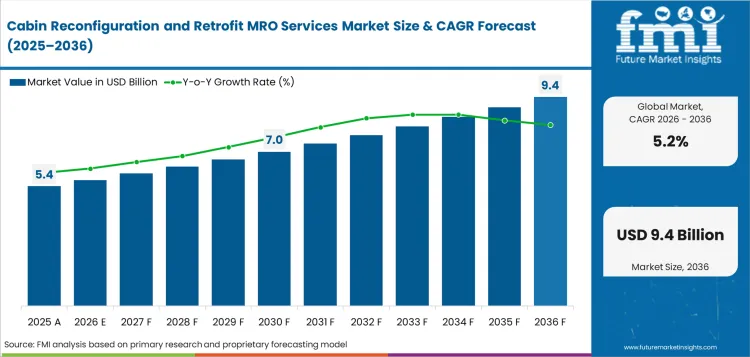
The cabin reconfiguration and retrofit MRO services market was valued at USD 5.1 billion in 2025. The market is set to reach USD 5.4 billion by 2026-end and expand at a CAGR of 5.2% between 2026 and 2036 to reach USD 9.0 billion by 2036. Commercial airlines are expected to dominate with a 57.0% end-use share, and narrow-body aircraft are expected to lead the aircraft type segment with a 48.0% share.
Summary of the Cabin Reconfiguration and Retrofit MRO Services Market
- Demand and Growth Drivers
- Fleet life extension is raising cabin retrofit demand as airlines keep aircraft active for longer planning cycles.
- Passenger product refresh programs lift demand for aircraft cabin interior work across seating and cabin finish upgrades.
- Lease return planning increases certified cabin work as operators need approved records before aircraft transfer.
- Product and Segment View
- Cabin reconfiguration is expected to lead the service type segment with 34.0% share in 2026, reflecting layout change work across airline fleets.
- Narrow-body aircraft are estimated to account for 48.0% of aircraft type demand in 2026, due to dense short-haul use.
- Commercial airlines are expected to represent 57.0% of end-use demand in 2026, reflecting brand and passenger experience needs.
- Geography and Competitive Outlook
- India is expected to record a CAGR of 7.4% by 2036, with domestic air travel and fleet use expanding.
- China is projected to expand at 6.3% CAGR through 2036, as passenger traffic lifts cabin refresh needs.
- Companies combining cabin engineering with MRO slot access are strengthening their position during the forecast period.
- Analyst Opinion
- Nikhil Kaitwade, Associate Vice President at FMI says, “Cabin retrofit work is becoming a schedule issue for airlines and lessors. Operators want seat changes and cabin records managed in one work package. They want release timing handled in the same schedule. Providers with engineering control and heavy check access can reduce downtime risk and protect schedules.”
- Cabin Reconfiguration and Retrofit MRO Services Market Value Analysis
- The cabin reconfiguration and retrofit MRO services market is moving from one-off cabin jobs into planned fleet programs.
- Demand is backed by aging aircraft cabins and higher use of commercial aircraft MRO planning.
- Airlines are using cabin retrofit programs to refresh interiors without waiting for new aircraft deliveries.
- Retrofit service demand is affected by seat supply timing and certification review capacity.
Key Takeaways
- The cabin reconfiguration and retrofit MRO services market was valued at USD 5.1 billion in 2025.
- By 2036, the Cabin Reconfiguration and Retrofit MRO Services Market is expected to be worth USD 9.0 billion.
- From 2026 to 2036, the market is projected to expand at a CAGR of 5.2%.
- The market is projected to create an incremental opportunity of USD 3.6 billion between 2026 and 2036.
- In 2026, commercial airlines are expected to account for 57.0% of end-use demand.
- India at 7.4% and China at 6.3% are two faster expanding country markets.
Cabin reconfiguration and retrofit MRO services are expected to see steady demand as airlines refresh older aircraft and rework seating layouts. FAA STC approval remains the main gate for interior modification work. Updated FAA and EASA guidance in 2024 supports higher value for MROs with in-house engineering approval capability. PMA cabin parts can reduce retrofit cost by 30-50% compared with OEM parts. This supports wider use of independent retrofit providers for cabin upgrades. Fleet age above 14 years in the US also keeps demand active for interior refreshes, seat changes and premium cabin work.
Cabin Reconfiguration and Retrofit MRO Services Market Definition
The cabin reconfiguration and retrofit MRO services market includes aircraft cabin modification work performed after aircraft delivery. These services cover seating changes, cabin monument replacement, lighting upgrades, IFE wiring, certification review, and installation labor. The market serves airlines, lessors, business aviation operators, and government aircraft users. New aircraft line-fit interiors and routine cabin cleaning are outside the scope.
Cabin Reconfiguration and Retrofit MRO Services Market Inclusions
Market scope covers commercially traded cabin reconfiguration and retrofit MRO services by service type. Service categories include cabin reconfiguration, interior retrofit, STC engineering, certification review, and turnkey integration, . Aircraft type covers narrow-body aircraft, wide-body aircraft, regional jets, and business jets. Component focus covers seating systems, cabin monuments, IFE connectivity, lighting systems, and floor panels. End users include commercial airlines, aircraft lessors, business aviation operators, and government fleets. Revenue scope covers 2026 to 2036. Relevant participants include airline operators, aircraft lessors, cabin MRO providers, and seat manufacturers. Cabin monument suppliers, avionics vendors, certification specialists, engineering service firms, aircraft OEMs, parts distributors, and aviation regulatory bodies are also included.
Cabin Reconfiguration and Retrofit MRO Services Market Exclusions
Scope does not include new aircraft line-fit interiors, aircraft exterior repainting, engine MRO, avionics-only repair, routine upholstery cleaning, or non-aircraft refurbishment work.
Cabin Reconfiguration and Retrofit MRO Services Market Research Methodology
- Primary Research: FMI analysts talked to airline retrofit planners, aircraft lessors, MRO providers, cabin engineers, and certification specialists in important markets.
- Desk Research: Combined data from aviation traffic sources, retrofit announcements, company service portfolios, and aircraft cabin modification references.
- Market sizing and forecasting: Added service use across cabin work packages and aircraft groups from the bottom up.
- Data validation: Cross-checked every three months against fleet activity, retrofit program evidence, and company capability coverage.
Why is the Cabin Reconfiguration and Retrofit MRO Services Market Growing?
- Airlines are refreshing cabins as older aircraft stay active across planned operating schedules.
- Retrofit partners are becoming important as cabin work needs engineering review and approved records.
- Lessors need certified cabin layouts before aircraft transfer and new operator induction.
Passenger traffic recovery keeps cabin refresh programs inside active airline planning. IATA reported that total full-year demand rose 5.3% in 2025. Capacity increased 5.2% in the same year. Passenger load factor reached 83.6%, leaving limited room for long aircraft downtime. Cabin retrofit suppliers gain importance as airlines align interior work with planned maintenance checks. Companies using aircraft seating upgrades need service partners able to protect schedule release dates.
USA operating density explains why cabin downtime control carries high value for retrofit planning. FAA data lists 16,191,379 yearly flights and 44,360 average daily flights handled by the agency. Aircraft used in dense networks need cabin work planned with reliable parts and inspection timing. This operating pattern favors MRO providers that can combine cabin labor with release documentation. Demand for aircraft seat replacement is tied to aircraft availability and service planning.
Market Segmentation Analysis
- Cabin Reconfiguration is estimated to account for 34.0% of service type activity in 2026, reflecting high use across layout change programs.
- Narrow-body Aircraft are expected to represent 48.0% of aircraft type revenue in 2026, due to heavier use across short-haul fleets.
- Seating Systems are expected to capture 39.0% of component focus spending in 2026, as cabin economics center on seat count.
- Commercial Airlines are estimated to contribute 57.0% of end-use demand in 2026, reflecting direct use across passenger-facing cabins.
- Full Cabin Refresh is estimated to make up 42.0% of retrofit scope activity in 2026, as aging cabins require deeper work packages.
The market for cabin reconfiguration and retrofit MRO services is divided into five primary segment groups. The groups cover service type and aircraft type. Component focus, end use, and retrofit scope form the remaining segment groups. Service type includes Cabin Reconfiguration, Interior Retrofit, STC Engineering, Certification Review, and Turnkey Integration. Aircraft type includes Narrow-body Aircraft, Wide-body Aircraft, Regional Jet, and Business Jet. Component focus includes Seating Systems, Cabin Monuments, IFE Connectivity, Lighting Systems, and Floor Panels. End use includes Commercial Airlines, Aircraft Lessors, Business Aviation, and Government Fleets. Retrofit scope includes Full Cabin Refresh, Class Rebalancing, Connectivity Upgrade, and Compliance Upgrade.
Insights into the Cabin Reconfiguration Service Type Segment
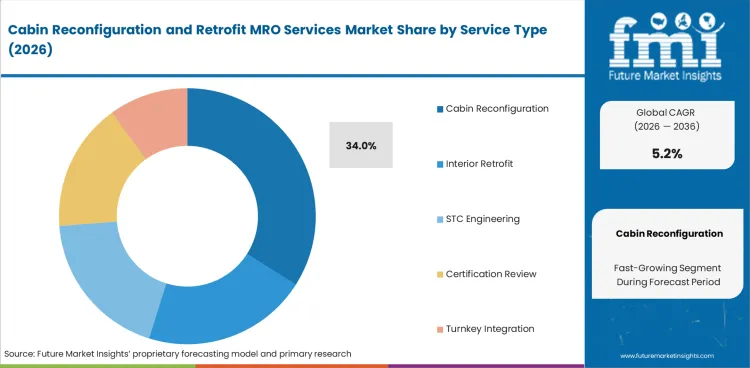
- Layout-change programs are estimated to place Cabin Reconfiguration at 34.0% of the service type segment in 2026. Airlines need seat-map updates and engineering review before approved records allow aircraft release.
- Interior retrofit and certification review services address narrower cabin upgrade needs. Their value improves in programs involving passenger comfort changes and documented compliance checks.
Insights into the Narrow-body Aircraft Type Segment
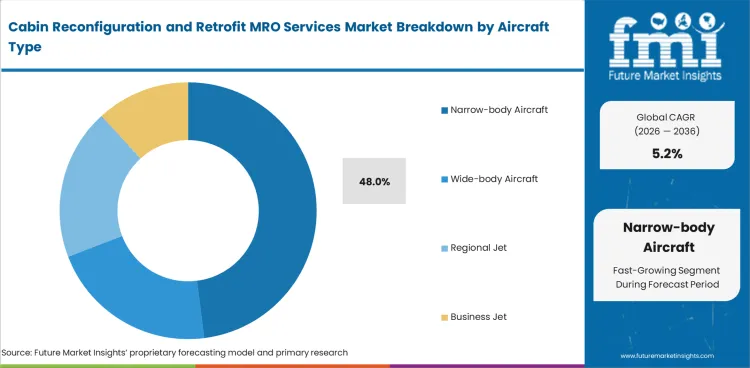
- Short-haul fleet utilization is expected to place Narrow-body Aircraft at 48.0% of the aircraft type segment in 2026. Domestic and regional aircraft require frequent cabin work as operators protect aircraft availability.
- Wide-body aircraft projects carry higher work value per aircraft. Premium cabin refresh and long-haul layout changes drive deeper work across international airline fleets.
Insights into the Seating Systems Component Focus Segment
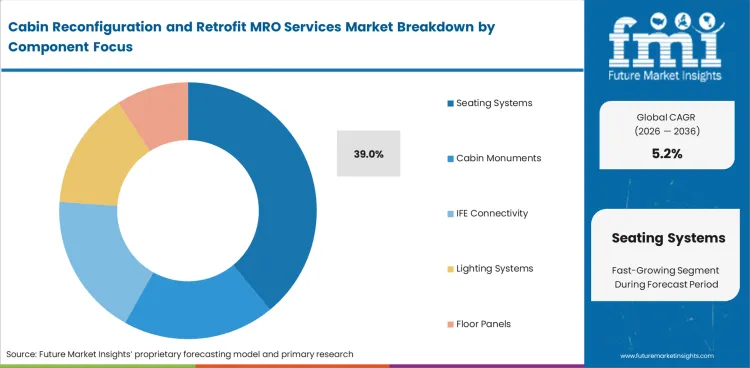
- In 2026, seat replacement and class rebalancing are expected to contribute 39.0% share to Seating Systems. Cabin economics depend on seat count and fare mix as passenger comfort standards guide retrofit choices.
- Cabin monuments and IFE connectivity address selected retrofit needs. Their use increases in projects involving cabin flow changes and passenger-facing digital upgrades.
Insights into the Commercial Airlines End-use Segment
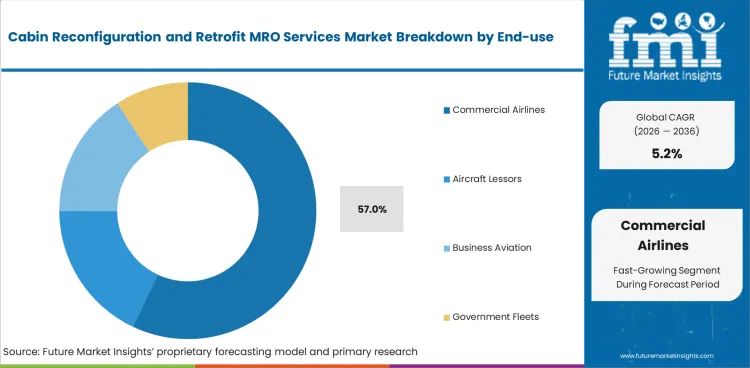
- Commercial Airlines are predicted to represent 57.0% of end-use share in 2026. Airline operators use retrofit services to align older aircraft cabins with brand and fare expectations.
- Aircraft lessors use cabin reconfiguration services during asset transfer cycles. Approved records and cabin condition checks play a central role in aircraft redelivery planning.
Insights into the Full Cabin Refresh Retrofit Scope Segment
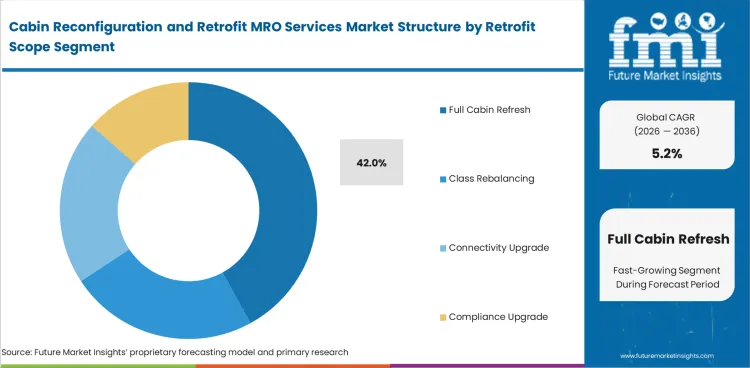
- In 2026, aging cabin programs are projected to make Full Cabin Refresh the largest retrofit scope at 42.0% share. Deeper work packages often cover seating and trim before lighting work enters the cabin refresh plan.
- Class rebalancing and connectivity upgrades serve targeted retrofit programs. Buyers use these services to adjust cabin economics without carrying out a full interior replacement.
Cabin Reconfiguration and Retrofit MRO Services Market Drivers, Restraints, and Opportunities
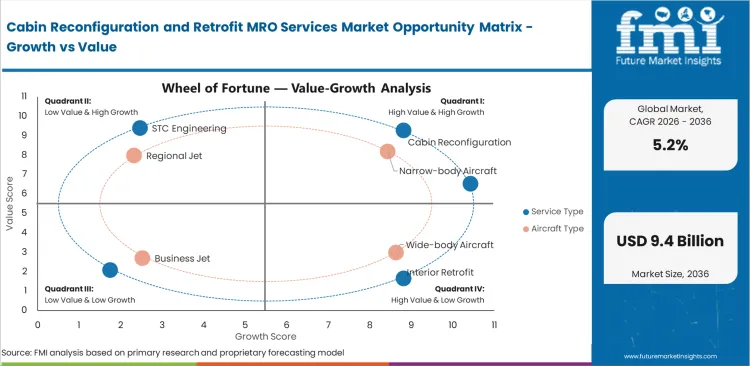
- Aircraft life extension is creating structured demand for cabin refresh programs across airline fleets.
- Seat supply and engineering review create timing pressure for complex cabin retrofit projects.
- Connectivity upgrades create service opportunity through wiring and cabin integration needs.
Cabin reconfiguration and retrofit MRO services keep expanding as airlines and lessors need older aircraft to match current seating plans and passenger comfort standards. Seat supply delays and certification review can slow project completion. Demand continues through cabin refresh programs and aircraft redelivery work.
Aging Fleets Are Lifting Retrofit Slot Prices
Cabin reconfiguration and retrofit MRO pricing is moving less like discretionary interiors spend and more like a constrained-capacity maintenance event. In October 2025, IATA said slow aircraft production could cost airlines over USD 11 billion in 2025. The estimate included USD 3.1 billion in additional maintenance costs because older aircraft require more frequent and expensive maintenance, . IATA also cited USD 1.4 billion in surplus inventory holding costs. For cabin retrofit buyers, longer aircraft use raises the need for seat refresh and monument upgrades before retirement. Airlines review IFE systems and connectivity packages because older cabins must match current passenger expectations. MRO providers can defend firmer labor-hour pricing and material markups as retrofit work joins heavy checks.
Mechanic Shortages Are Raising Labor Quotes
Labor-heavy cabin retrofit scopes are harder to price against prior-year assumptions. Interior work now competes with airframe checks and avionics changes. Wiring work and certification records add pressure on return-to-service labor. ATEC's September 2025 report states that the FAA issued more than 9,000 new mechanic certificates in 2024. Commercial air transport is expected to create a 10% shortage of certificated mechanics in 2025. For retrofit MRO suppliers, the labor shortage allows firmer hourly quotes and stricter cancellation terms. Overtime premiums may increase further as providers protect limited engineering and hangar capacity. Airlines and lessors now need early slot booking and clearer workscopes to reduce late engineering changes. Phased cabin programs can limit rework risk as late changes now carry a higher price penalty.
Analysis of Cabin Reconfiguration and Retrofit MRO Services Market By Key Countries
.webp "Top Country Growth Comparison Cabin Reconfiguration And Retrofit Mro Services Market Cagr (2026 2036)")
| Country | CAGR |
|---|---|
| India | 7.4% |
| China | 6.3% |
| USA | 5.0% |
| Germany | 4.4% |
| UK | 4.1% |
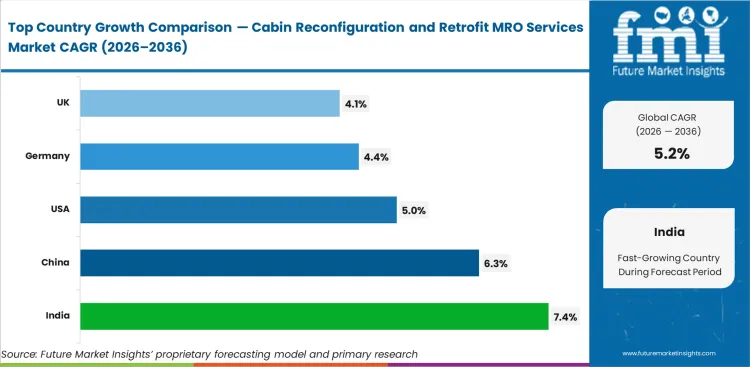
Source: Future Market Insights, 2026.
Cabin Reconfiguration and Retrofit MRO Services Market CAGR Analysis By Country
- India leads with a 7.4% CAGR through 2036 as airport traffic and airline capacity expand.
- China at 6.3% reflects large passenger volume and cabin renewal needs across local carriers.
- The USA at 5.0% reflects high flight activity and steady cabin maintenance planning.
- Germany at 4.4% and the UK at 4.1% reflect mature service bases with controlled expansion.
Demand for cabin reconfiguration and retrofit MRO services is forecast to rise at 5.2% CAGR from 2026 to 2036. Country-level analysis covers the major markets contributing to this forecast, with the key markets listed below.
Demand Outlook for Cabin Reconfiguration and Retrofit MRO Services Market in India
India’s cabin reconfiguration and retrofit MRO services industry is projected to record a CAGR of 7.4% through 2036. India handled 412 million airport passengers in FY25 and had 164 airports in 2025. The operating base raises demand for cabin reconfiguration and retrofit MRO services in the country. Local providers can gain from airlines needing cabin refresh work near growing domestic fleets.
- Local airline expansion raises demand for seat changes and cabin finish upgrades.
- Airport network expansion creates a larger operating base for cabin work planning.
- Domestic carriers need service partners who can reduce aircraft downtime during retrofit work.
Sales Analysis of Cabin Reconfiguration and Retrofit MRO Services Market in China
The cabin reconfiguration and retrofit MRO services sector in China is expected to expand at a CAGR of 6.3% during the assessment period. China’s civil aviation passenger traffic reached 770 million in 2025 and increased 5.5% over the prior year. The traffic scale creates demand for China cabin reconfiguration and retrofit MRO services across local airline networks. Service providers benefit from carriers seeking cabin consistency across large aircraft fleets.
- Large passenger traffic increases pressure for consistent cabin finish across aircraft fleets.
- Local carriers need retrofit work, which can be aligned with planned maintenance schedules.
- Cabin service providers with engineering depth can serve layout changes across dense fleets.
Demand Outlook for Cabin Reconfiguration and Retrofit MRO Services Market in the United States
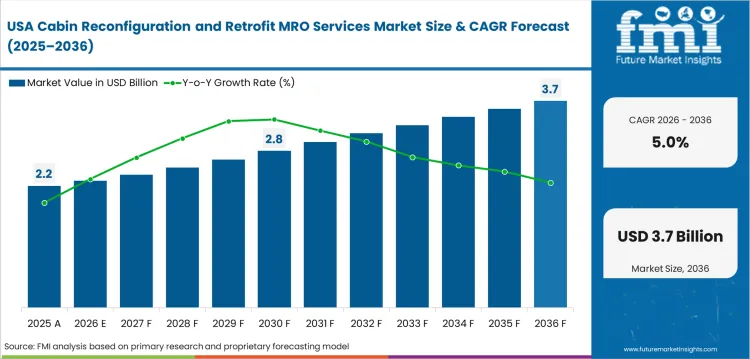
The USA cabin reconfiguration and retrofit MRO services industry is forecast to grow at a CAGR of 5.0% by 2036. FAA data lists 5,500 aircraft in the sky at peak operational times. The operating load creates steady need for U.S. cabin reconfiguration and retrofit MRO services. Airlines value providers with slot reliability and approved cabin documentation.
- Dense flight activity creates demand for retrofit work inside planned maintenance windows.
- Narrow-body cabin projects stay important as domestic networks need frequent aircraft availability.
- Airlines need cabin providers who can manage records and release timing together.
Opportunity Analysis of Cabin Reconfiguration and Retrofit MRO Services Market in Germany
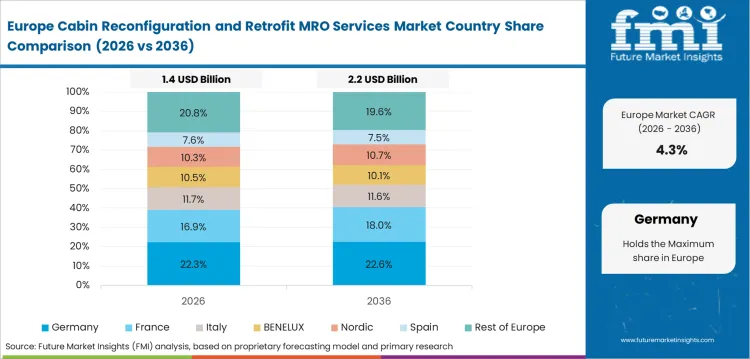
The cabin reconfiguration and retrofit MRO services segment in Germany is projected to advance at 4.4% CAGR from 2026 to 2036. German airspace recorded 3.071 million aircraft movements in 2025 and increased 3.5% from the prior year. Established MRO capability supports Germany cabin reconfiguration and retrofit MRO services. Retrofit demand is strongest for complex cabins needing engineering review and certified records.
- Germany’s MRO base favors cabin projects with engineering and certification depth.
- High aircraft movement levels create steady demand for planned cabin maintenance work.
- Premium cabin upgrades create service demand across aerospace interior programs.
Future Outlook for Cabin Reconfiguration and Retrofit MRO Services Market in the United Kingdom
The UK cabin reconfiguration and retrofit MRO services industry is forecast to record 4.1% CAGR during the forecast period. UK airports handled 302 million passengers in 2025 after a 2% rise from 2024. The passenger base favors demand for UK cabin reconfiguration and retrofit MRO services as airlines refresh older interiors. Service providers with cabin records and labor planning can assist fleet refresh schedules.
- Passenger traffic recovery keeps cabin refresh work inside airline planning cycles.
- UK carriers need cabin upgrades to protect aircraft availability across busy route networks.
- Cabin refresh work can increase use of in-flight internet installation services.
Competitive Landscape and Strategic Positioning
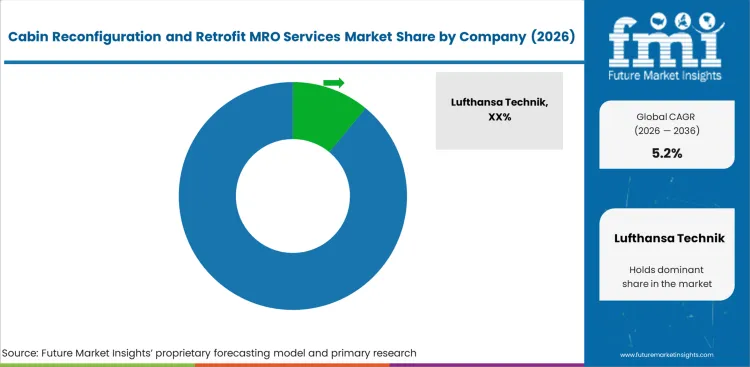
- Cabin Reconfiguration and Retrofit MRO Services Market Analysis By Company
- Lufthansa Technik is a leading provider through cabin modification engineering and certification depth.
- HAECO and ST Engineering Aerospace are differentiated by their heavy maintenance capabilities and the breadth of their cabin services.
- Specialist providers focus on STC work and cabin records. They deliver project-specific engineering control.
Lufthansa Technik has a defensible position through cabin engineering and approved modification capability. HAECO offers airframe MRO access and cabin service coverage through its global service network. ST Engineering Aerospace and SIA Engineering Company focus on maintenance capacity in Asia. AAR adds engineering capability through reconfiguration services. Turkish Technic serves retrofit demand through airline and third-party maintenance programs.
Barriers include seat supply timing and certification documentation depth across regulated aircraft cabins. Operating priorities include kit planning and faster release documentation across long retrofit cycles. Buyers favor service providers offering cabin installation and approval control inside one managed work package. Suppliers with broader cabin menus can reduce coordination burden for airlines and lessors.
Key Companies in the Cabin Reconfiguration and Retrofit MRO Services Market
Global companies leading the cabin reconfiguration and retrofit MRO services market include:
- Lufthansa Technik has cabin modification engineering and approved service coverage.
- HAECO serves airlines through airframe maintenance and cabin service capability.
- ST Engineering Aerospace holds a defensible position across heavy checks and cabin retrofit programs.
- SIA Engineering Company serves retrofit demand through Singapore-based engineering and maintenance depth.
- AAR focuses on aircraft reconfiguration engineering and certification services.
- Air France Industries KLM E&M serves cabin demand through airline-backed MRO capability.
- Turkish Technic provides cabin retrofit work across airline and third-party aircraft programs.
Competitive Benchmarking: Cabin Reconfiguration and Retrofit MRO Services Market
| Company | Geographic Footprint | Cabin Engineering Depth | Certification Control | Heavy Check Access |
|---|---|---|---|---|
| Lufthansa Technik | Global network across Europe, Americas, Asia, and Middle East | High | High | Strong |
| HAECO | Asia-Pacific base with global airline customer reach | High | High | Strong |
| ST Engineering Aerospace | Asia-Pacific, China, Vietnam, Europe, and United States | High | Medium | Strong |
| SIA Engineering Company | Singapore-led network across over 40 airports in 9 countries | Medium | Medium | Strong |
| AAR | North America-led footprint serving customers in over 100 countries | High | Medium | Strong |
| Air France Industries KLM E&M | Europe-led global MRO network through France and Netherlands bases | Medium | High | Strong |
| Turkish Technic | Türkiye-based two-continent MRO footprint serving global operators | Medium | Medium | Strong |
Source: Future Market Insights, 2026.
Key Developments in Cabin Reconfiguration and Retrofit MRO Services Market
- In April 2026, AAR completed the acquisition of Aircraft Reconfig Technologies from ZIM Aircraft Cabin Solutions. The acquisition expands AAR’s engineering and certification capability for passenger aircraft reconfiguration.
- In October 2025, Air India completed the first phase of its legacy retrofit programme. The first phase included 27 legacy A320neo aircraft and raised upgraded A320 family aircraft to 104.
Key Players in the Cabin Reconfiguration and Retrofit MRO Services Market
Major Global Players:
- Lufthansa Technik
- HAECO
- ST Engineering Aerospace
- SIA Engineering Company
- AAR
Specialist Players:
- Air France Industries KLM E&M
- Turkish Technic
Report Scope and Coverage
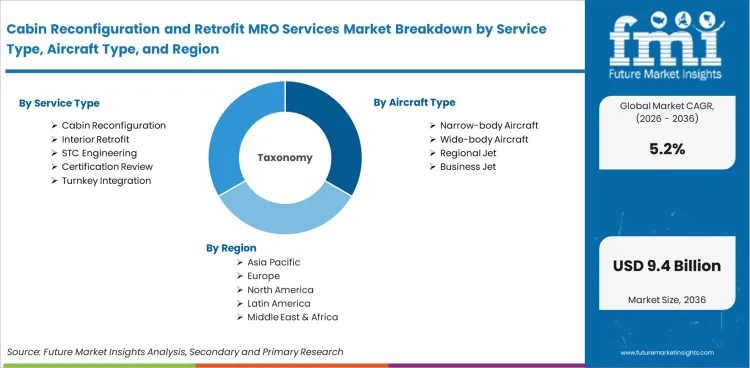
Cabin Reconfiguration and Retrofit MRO Services Market Breakdown By Service Type, Aircraft Type, And Region
| Parameter | Details |
|---|---|
| Quantitative Units | USD 5.4 billion to USD 9.0 billion, at a CAGR of 5.2% |
| Market Definition | The market encompasses cabin modification and retrofit services performed after aircraft delivery. |
| Regions Covered | North America, Latin America, Europe, East Asia, South Asia and Pacific, Middle East and Africa |
| Countries Covered | USA, UK, Germany, China, India, Japan, South Korea, and 30 plus countries |
| Key Companies Profiled | Lufthansa Technik, HAECO, ST Engineering Aerospace, SIA Engineering Company, AAR, Air France Industries KLM E&M, Turkish Technic |
| Forecast Period | 2026 to 2036 |
| Approach | Hybrid bottom-up and top-down methodology starting with service demand and verified fleet use patterns |
Source: Future Market Insights, 2026.
Cabin Reconfiguration and Retrofit MRO Services Market by Segments
Cabin Reconfiguration and Retrofit MRO Services Market Segmented by Service Type:
- Cabin Reconfiguration
- Interior Retrofit
- STC Engineering
- Certification Review
- Turnkey Integration
Cabin Reconfiguration and Retrofit MRO Services Market Segmented by Aircraft Type:
- Narrow-body Aircraft
- Wide-body Aircraft
- Regional Jet
- Business Jet
Cabin Reconfiguration and Retrofit MRO Services Market Segmented by Component Focus:
- Seating Systems
- Cabin Monuments
- IFE Connectivity
- Lighting Systems
- Floor Panels
Cabin Reconfiguration and Retrofit MRO Services Market Segmented by End Use:
- Commercial Airlines
- Aircraft Lessors
- Business Aviation
- Government Fleets
Cabin Reconfiguration and Retrofit MRO Services Market Segmented by Retrofit Scope:
- Full Cabin Refresh
- Class Rebalancing
- Connectivity Upgrade
- Compliance Upgrade
Cabin Reconfiguration and Retrofit MRO Services Market by Region:
- North America
- USA
- Canada
- Mexico
- Latin America
- Brazil
- Chile
- Rest of Latin America
- Europe
- Germany
- UK
- Italy
- Spain
- France
- Rest of Europe
- East Asia
- China
- Japan
- South Korea
- South Asia and Pacific
- India
- ASEAN
- Australia & New Zealand
- Rest of South Asia and Pacific
- Middle East and Africa
- Saudi Arabia
- Other GCC Countries
- South Africa
- Rest of Middle East and Africa
Research Sources and Bibliography
- Aviation Technician Education Council. (2025, September 18). ATEC publishes 2025 Pipeline Report: New mechanic certificates jumped in 2024, but technical workforce gap concerns remain.
- International Air Transport Association. (2025, October 13). Supply chain challenges could cost airlines more than USD 11 billion in 2025.
- International Air Transport Association. (2026, January 29). Strong 2025 passenger demand masks ongoing capacity constraints.
- Federal Aviation Administration. (2025, July). Air traffic by the numbers.
- EUROCONTROL. (2026, April 2). Annual Network Operations Report 2025.
- Press Information Bureau. (2026, January 29). India is the world’s third-largest domestic aviation market, with the number of airports increasing from 74 in 2014 to 164 in 2025. https://www.pib.gov.in/PressReleseDetailm.aspx?PRID=2219991
- State Council of the People’s Republic of China. (2026, January 6). China’s civil aviation sector achieves steady growth in 2025.
- UK Civil Aviation Authority. (2026, February 24). UK aviation officially breaks records with over 300m passenger journeys in 2025.
- DFS Deutsche Flugsicherung GmbH. (2026, January 5). Air traffic in Germany 2025: More flights, good punctuality level.
- Air India. (2025, October 31). Air India completes first phase of legacy retrofit programme, 104 A320 family aircraft now feature new or upgraded cabin interiors.
- Emirates. (2024, May 7). Emirates extends retrofit programme to 191 aircraft.
- Singapore Airlines. (2024, November 4). Singapore Airlines to elevate premium travel experience with USD 1.1 billion Airbus A350 cabin retrofit programme.
- AAR. (2026, April 24). AAR completes acquisition of Aircraft Reconfig Technologies.
This Report Answers
- What is the current and future size of the cabin reconfiguration and retrofit MRO services market?
- How fast is the market expected to expand between 2026 and 2036?
- Which service type is expected to lead the market by 2026?
- Which aircraft type is expected to account for the highest demand by 2026?
- What factors are driving demand for cabin reconfiguration and retrofit MRO services globally?
- How are airline fleet programs influencing demand for outsourced cabin retrofit work?
- Why are commercial airlines the main demand base for cabin retrofit services?
- How are cabin certification needs creating demand for specialist retrofit providers?
- Which countries are projected to record faster expansion through 2036?
- What is driving market expansion in India and China?
- Who are the key companies active in the cabin reconfiguration and retrofit MRO services market?
- How does FMI estimate and validate the market forecast?
Frequently Asked Questions
What is the global market demand for Cabin Reconfiguration and Retrofit MRO Services in 2026?
In 2026, the global market for cabin reconfiguration and retrofit MRO services is expected to be worth USD 5.4 billion.
How big will the market for Cabin Reconfiguration and Retrofit MRO Services be in 2036?
By 2036, the market for cabin reconfiguration and retrofit MRO services is expected to be worth USD 9.0 billion.
How much is demand for Cabin Reconfiguration and Retrofit MRO Services expected to expand between 2026 and 2036?
Between 2026 and 2036, demand for cabin reconfiguration and retrofit MRO services is expected to expand at a CAGR of 5.2%.
Which service type segment is likely to be the best seller globally by 2026?
Cabin Reconfiguration is expected to make up 34.0% of the service type segment in 2026.
What is causing demand to rise in India?
The India cabin reconfiguration and retrofit MRO services market is projected to record 7.4% CAGR through 2036, backed by airport traffic and airline fleet activity.
What is causing demand to rise in China?
The China cabin reconfiguration and retrofit MRO services market is projected to expand at 6.3% CAGR through 2036, backed by passenger traffic and carrier cabin renewal needs.
What does this report mean by Cabin Reconfiguration and Retrofit MRO Services Market definition?
The market includes aircraft cabin modification services used after aircraft delivery across seating, lighting, cabin monuments, and certification work.
How does FMI make the Cabin Reconfiguration and Retrofit MRO Services forecast and check
Forecasting models use a hybrid bottom-up and top-down approach, starting with service demand and checking it against fleet use patterns.
Preview the report firsthand - request a free sample
Get SampleGet the brochure for pricing and purchase details.
Get PDFTable of Content
- Executive Summary
- Global Market Outlook
- Demand-side Trends
- Supply-side Trends
- Technology Roadmap Analysis
- Analysis and Recommendations
- Market Overview
- Market Coverage / Taxonomy
- Market Definition / Scope / Limitations
- Research Methodology
- Chapter Orientation
- Analytical Lens and Working Hypotheses
- Market Structure, Signals, and Trend Drivers
- Benchmarking and Cross-market Comparability
- Market Sizing, Forecasting, and Opportunity Mapping
- Research Design and Evidence Framework
- Desk Research Programme (Secondary Evidence)
- Company Annual and Sustainability Reports
- Peer-reviewed Journals and Academic Literature
- Corporate Websites, Product Literature, and Technical Notes
- Earnings Decks and Investor Briefings
- Statutory Filings and Regulatory Disclosures
- Technical White Papers and Standards Notes
- Trade Journals, Industry Magazines, and Analyst Briefs
- Conference Proceedings, Webinars, and Seminar Materials
- Government Statistics Portals and Public Data Releases
- Press Releases and Reputable Media Coverage
- Specialist Newsletters and Curated Briefings
- Sector Databases and Reference Repositories
- FMI Internal Proprietary Databases and Historical Market Datasets
- Subscription Datasets and Paid Sources
- Social Channels, Communities, and Digital Listening Inputs
- Additional Desk Sources
- Expert Input and Fieldwork (Primary Evidence)
- Primary Modes
- Qualitative Interviews and Expert Elicitation
- Quantitative Surveys and Structured Data Capture
- Blended Approach
- Why Primary Evidence is Used
- Field Techniques
- Interviews
- Surveys
- Focus Groups
- Observational and In-context Research
- Social and Community Interactions
- Stakeholder Universe Engaged
- C-suite Leaders
- Board Members
- Presidents and Vice Presidents
- R&D and Innovation Heads
- Technical Specialists
- Domain Subject-matter Experts
- Scientists
- Physicians and Other Healthcare Professionals
- Governance, Ethics, and Data Stewardship
- Research Ethics
- Data Integrity and Handling
- Primary Modes
- Tooling, Models, and Reference Databases
- Desk Research Programme (Secondary Evidence)
- Data Engineering and Model Build
- Data Acquisition and Ingestion
- Cleaning, Normalisation, and Verification
- Synthesis, Triangulation, and Analysis
- Quality Assurance and Audit Trail
- Market Background
- Demand in Likely Scenario
- Demand in Conservative Scenario
- Opportunity Map Analysis
- Product Life Cycle Analysis
- Supply Chain Analysis
- Investment Feasibility Matrix
- Value Chain Analysis
- PESTLE and Porter’s Analysis
- Regulatory Landscape
- Regional Parent Market Outlook
- Production and Consumption Statistics
- Import and Export Statistics
- Global Market Analysis 2021 to 2025 and Forecast, 2026 to 2036
- Historical Market Size Value (USD Million) Analysis, 2021 to 2025
- Current and Future Market Size Value (USD Million) Projections, 2026 to 2036
- Y-o-Y Growth Trend Analysis
- Absolute $ Opportunity Analysis
- Global Market Pricing Analysis 2021 to 2025 and Forecast 2026 to 2036
- Global Market Analysis 2021 to 2025 and Forecast 2026 to 2036, By Service Type
- Introduction / Key Findings
- Historical Market Size Value (USD Million) Analysis By Service Type , 2021 to 2025
- Current and Future Market Size Value (USD Million) Analysis and Forecast By Service Type , 2026 to 2036
- Cabin Reconfiguration
- Interior Retrofit
- STC Engineering
- Certification Review
- Turnkey Integration
- Cabin Reconfiguration
- Y-o-Y Growth Trend Analysis By Service Type , 2021 to 2025
- Absolute $ Opportunity Analysis By Service Type , 2026 to 2036
- Global Market Analysis 2021 to 2025 and Forecast 2026 to 2036, By Aircraft Type
- Introduction / Key Findings
- Historical Market Size Value (USD Million) Analysis By Aircraft Type, 2021 to 2025
- Current and Future Market Size Value (USD Million) Analysis and Forecast By Aircraft Type, 2026 to 2036
- Narrow-body Aircraft
- Wide-body Aircraft
- Regional Jet
- Business Jet
- Narrow-body Aircraft
- Y-o-Y Growth Trend Analysis By Aircraft Type, 2021 to 2025
- Absolute $ Opportunity Analysis By Aircraft Type, 2026 to 2036
- Global Market Analysis 2021 to 2025 and Forecast 2026 to 2036, By Component Focus
- Introduction / Key Findings
- Historical Market Size Value (USD Million) Analysis By Component Focus, 2021 to 2025
- Current and Future Market Size Value (USD Million) Analysis and Forecast By Component Focus, 2026 to 2036
- Seating Systems
- Cabin Monuments
- IFE Connectivity
- Lighting Systems
- Floor Panels
- Seating Systems
- Y-o-Y Growth Trend Analysis By Component Focus, 2021 to 2025
- Absolute $ Opportunity Analysis By Component Focus, 2026 to 2036
- Global Market Analysis 2021 to 2025 and Forecast 2026 to 2036, By End-use
- Introduction / Key Findings
- Historical Market Size Value (USD Million) Analysis By End-use, 2021 to 2025
- Current and Future Market Size Value (USD Million) Analysis and Forecast By End-use, 2026 to 2036
- Commercial Airlines
- Aircraft Lessors
- Business Aviation
- Government Fleets
- Commercial Airlines
- Y-o-Y Growth Trend Analysis By End-use, 2021 to 2025
- Absolute $ Opportunity Analysis By End-use, 2026 to 2036
- Global Market Analysis 2021 to 2025 and Forecast 2026 to 2036, By Retrofit Scope
- Introduction / Key Findings
- Historical Market Size Value (USD Million) Analysis By Retrofit Scope, 2021 to 2025
- Current and Future Market Size Value (USD Million) Analysis and Forecast By Retrofit Scope, 2026 to 2036
- Full Cabin Refresh
- Class Rebalancing
- Connectivity Upgrade
- Compliance Upgrade
- Full Cabin Refresh
- Y-o-Y Growth Trend Analysis By Retrofit Scope, 2021 to 2025
- Absolute $ Opportunity Analysis By Retrofit Scope, 2026 to 2036
- Global Market Analysis 2021 to 2025 and Forecast 2026 to 2036, By Region
- Introduction
- Historical Market Size Value (USD Million) Analysis By Region, 2021 to 2025
- Current Market Size Value (USD Million) Analysis and Forecast By Region, 2026 to 2036
- North America
- Latin America
- Western Europe
- Eastern Europe
- East Asia
- South Asia and Pacific
- Middle East & Africa
- Market Attractiveness Analysis By Region
- North America Market Analysis 2021 to 2025 and Forecast 2026 to 2036, By Country
- Historical Market Size Value (USD Million) Trend Analysis By Market Taxonomy, 2021 to 2025
- Market Size Value (USD Million) Forecast By Market Taxonomy, 2026 to 2036
- By Country
- USA
- Canada
- Mexico
- By Service Type
- By Aircraft Type
- By Component Focus
- By End-use
- By Retrofit Scope
- By Country
- Market Attractiveness Analysis
- By Country
- By Service Type
- By Aircraft Type
- By Component Focus
- By End-use
- By Retrofit Scope
- Key Takeaways
- Latin America Market Analysis 2021 to 2025 and Forecast 2026 to 2036, By Country
- Historical Market Size Value (USD Million) Trend Analysis By Market Taxonomy, 2021 to 2025
- Market Size Value (USD Million) Forecast By Market Taxonomy, 2026 to 2036
- By Country
- Brazil
- Chile
- Rest of Latin America
- By Service Type
- By Aircraft Type
- By Component Focus
- By End-use
- By Retrofit Scope
- By Country
- Market Attractiveness Analysis
- By Country
- By Service Type
- By Aircraft Type
- By Component Focus
- By End-use
- By Retrofit Scope
- Key Takeaways
- Western Europe Market Analysis 2021 to 2025 and Forecast 2026 to 2036, By Country
- Historical Market Size Value (USD Million) Trend Analysis By Market Taxonomy, 2021 to 2025
- Market Size Value (USD Million) Forecast By Market Taxonomy, 2026 to 2036
- By Country
- Germany
- UK
- Italy
- Spain
- France
- Nordic
- BENELUX
- Rest of Western Europe
- By Service Type
- By Aircraft Type
- By Component Focus
- By End-use
- By Retrofit Scope
- By Country
- Market Attractiveness Analysis
- By Country
- By Service Type
- By Aircraft Type
- By Component Focus
- By End-use
- By Retrofit Scope
- Key Takeaways
- Eastern Europe Market Analysis 2021 to 2025 and Forecast 2026 to 2036, By Country
- Historical Market Size Value (USD Million) Trend Analysis By Market Taxonomy, 2021 to 2025
- Market Size Value (USD Million) Forecast By Market Taxonomy, 2026 to 2036
- By Country
- Russia
- Poland
- Hungary
- Balkan & Baltic
- Rest of Eastern Europe
- By Service Type
- By Aircraft Type
- By Component Focus
- By End-use
- By Retrofit Scope
- By Country
- Market Attractiveness Analysis
- By Country
- By Service Type
- By Aircraft Type
- By Component Focus
- By End-use
- By Retrofit Scope
- Key Takeaways
- East Asia Market Analysis 2021 to 2025 and Forecast 2026 to 2036, By Country
- Historical Market Size Value (USD Million) Trend Analysis By Market Taxonomy, 2021 to 2025
- Market Size Value (USD Million) Forecast By Market Taxonomy, 2026 to 2036
- By Country
- China
- Japan
- South Korea
- By Service Type
- By Aircraft Type
- By Component Focus
- By End-use
- By Retrofit Scope
- By Country
- Market Attractiveness Analysis
- By Country
- By Service Type
- By Aircraft Type
- By Component Focus
- By End-use
- By Retrofit Scope
- Key Takeaways
- South Asia and Pacific Market Analysis 2021 to 2025 and Forecast 2026 to 2036, By Country
- Historical Market Size Value (USD Million) Trend Analysis By Market Taxonomy, 2021 to 2025
- Market Size Value (USD Million) Forecast By Market Taxonomy, 2026 to 2036
- By Country
- India
- ASEAN
- Australia & New Zealand
- Rest of South Asia and Pacific
- By Service Type
- By Aircraft Type
- By Component Focus
- By End-use
- By Retrofit Scope
- By Country
- Market Attractiveness Analysis
- By Country
- By Service Type
- By Aircraft Type
- By Component Focus
- By End-use
- By Retrofit Scope
- Key Takeaways
- Middle East & Africa Market Analysis 2021 to 2025 and Forecast 2026 to 2036, By Country
- Historical Market Size Value (USD Million) Trend Analysis By Market Taxonomy, 2021 to 2025
- Market Size Value (USD Million) Forecast By Market Taxonomy, 2026 to 2036
- By Country
- Kingdom of Saudi Arabia
- Other GCC Countries
- Turkiye
- South Africa
- Other African Union
- Rest of Middle East & Africa
- By Service Type
- By Aircraft Type
- By Component Focus
- By End-use
- By Retrofit Scope
- By Country
- Market Attractiveness Analysis
- By Country
- By Service Type
- By Aircraft Type
- By Component Focus
- By End-use
- By Retrofit Scope
- Key Takeaways
- Key Countries Market Analysis
- USA
- Pricing Analysis
- Market Share Analysis, 2025
- By Service Type
- By Aircraft Type
- By Component Focus
- By End-use
- By Retrofit Scope
- Canada
- Pricing Analysis
- Market Share Analysis, 2025
- By Service Type
- By Aircraft Type
- By Component Focus
- By End-use
- By Retrofit Scope
- Mexico
- Pricing Analysis
- Market Share Analysis, 2025
- By Service Type
- By Aircraft Type
- By Component Focus
- By End-use
- By Retrofit Scope
- Brazil
- Pricing Analysis
- Market Share Analysis, 2025
- By Service Type
- By Aircraft Type
- By Component Focus
- By End-use
- By Retrofit Scope
- Chile
- Pricing Analysis
- Market Share Analysis, 2025
- By Service Type
- By Aircraft Type
- By Component Focus
- By End-use
- By Retrofit Scope
- Germany
- Pricing Analysis
- Market Share Analysis, 2025
- By Service Type
- By Aircraft Type
- By Component Focus
- By End-use
- By Retrofit Scope
- UK
- Pricing Analysis
- Market Share Analysis, 2025
- By Service Type
- By Aircraft Type
- By Component Focus
- By End-use
- By Retrofit Scope
- Italy
- Pricing Analysis
- Market Share Analysis, 2025
- By Service Type
- By Aircraft Type
- By Component Focus
- By End-use
- By Retrofit Scope
- Spain
- Pricing Analysis
- Market Share Analysis, 2025
- By Service Type
- By Aircraft Type
- By Component Focus
- By End-use
- By Retrofit Scope
- France
- Pricing Analysis
- Market Share Analysis, 2025
- By Service Type
- By Aircraft Type
- By Component Focus
- By End-use
- By Retrofit Scope
- India
- Pricing Analysis
- Market Share Analysis, 2025
- By Service Type
- By Aircraft Type
- By Component Focus
- By End-use
- By Retrofit Scope
- ASEAN
- Pricing Analysis
- Market Share Analysis, 2025
- By Service Type
- By Aircraft Type
- By Component Focus
- By End-use
- By Retrofit Scope
- Australia & New Zealand
- Pricing Analysis
- Market Share Analysis, 2025
- By Service Type
- By Aircraft Type
- By Component Focus
- By End-use
- By Retrofit Scope
- China
- Pricing Analysis
- Market Share Analysis, 2025
- By Service Type
- By Aircraft Type
- By Component Focus
- By End-use
- By Retrofit Scope
- Japan
- Pricing Analysis
- Market Share Analysis, 2025
- By Service Type
- By Aircraft Type
- By Component Focus
- By End-use
- By Retrofit Scope
- South Korea
- Pricing Analysis
- Market Share Analysis, 2025
- By Service Type
- By Aircraft Type
- By Component Focus
- By End-use
- By Retrofit Scope
- Russia
- Pricing Analysis
- Market Share Analysis, 2025
- By Service Type
- By Aircraft Type
- By Component Focus
- By End-use
- By Retrofit Scope
- Poland
- Pricing Analysis
- Market Share Analysis, 2025
- By Service Type
- By Aircraft Type
- By Component Focus
- By End-use
- By Retrofit Scope
- Hungary
- Pricing Analysis
- Market Share Analysis, 2025
- By Service Type
- By Aircraft Type
- By Component Focus
- By End-use
- By Retrofit Scope
- Kingdom of Saudi Arabia
- Pricing Analysis
- Market Share Analysis, 2025
- By Service Type
- By Aircraft Type
- By Component Focus
- By End-use
- By Retrofit Scope
- Turkiye
- Pricing Analysis
- Market Share Analysis, 2025
- By Service Type
- By Aircraft Type
- By Component Focus
- By End-use
- By Retrofit Scope
- South Africa
- Pricing Analysis
- Market Share Analysis, 2025
- By Service Type
- By Aircraft Type
- By Component Focus
- By End-use
- By Retrofit Scope
- USA
- Market Structure Analysis
- Competition Dashboard
- Competition Benchmarking
- Market Share Analysis of Top Players
- By Regional
- By Service Type
- By Aircraft Type
- By Component Focus
- By End-use
- By Retrofit Scope
- Competition Analysis
- Competition Deep Dive
- Lufthansa Technik
- Overview
- Product Portfolio
- Profitability by Market Segments (Product/Age /Sales Channel/Region)
- Sales Footprint
- Strategy Overview
- Marketing Strategy
- Product Strategy
- Channel Strategy
- HAECO
- ST Engineering Aerospace
- SIA Engineering Company
- AAR
- Air France Industries KLM E&M
- Turkish Technic
- Lufthansa Technik
- Competition Deep Dive
- Assumptions & Acronyms Used


