

- Market Size (2026)
- USD 748.0 Mn
- Forecast (2036)
- USD 1226.0 Mn
- CAGR (2026 to 2036)
- 5.1%
Cabin Air Filter Housing Replacement Parts Market Size, Forecast, and Outlook By FMI
Summary of the Cabin Air Filter Housing Replacement Parts Market
- Demand and Growth Drivers
- Routine cabin filter changes create the main replacement path since access covers and clips are handled during every service cycle.
- Older passenger cars widen the repair pool as brittle covers and gaskets become more prone to cracking.
- EV cabin air systems raise fit sensitivity with tighter HVAC packaging and added air-quality features.
- Product and Segment View
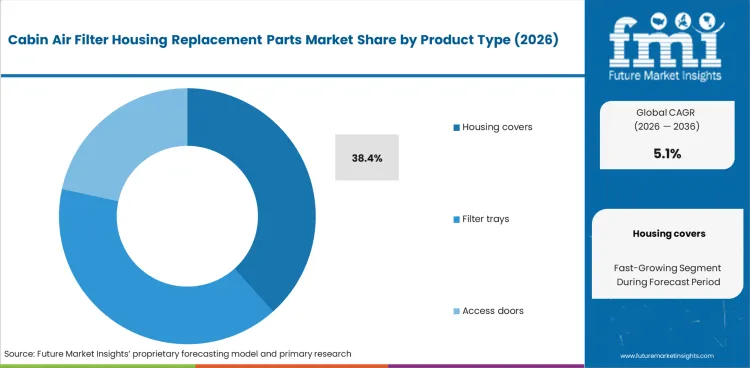
- Housing covers are projected to lead the product type segment with 38.4% share as they face the highest service touch frequency.
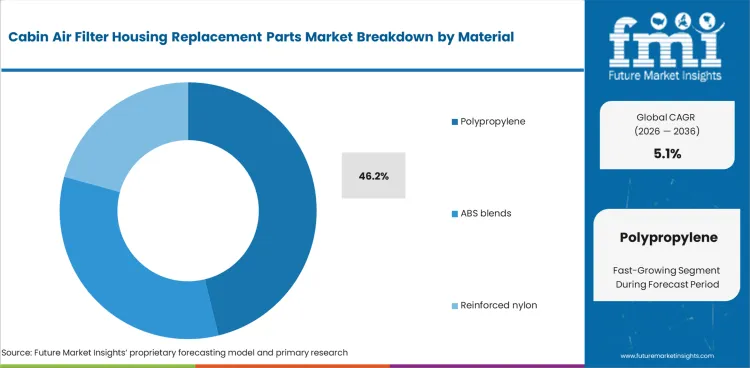
- Polypropylene is expected to hold 46.2% material share in 2026 with molded cost control and acceptable heat resistance.
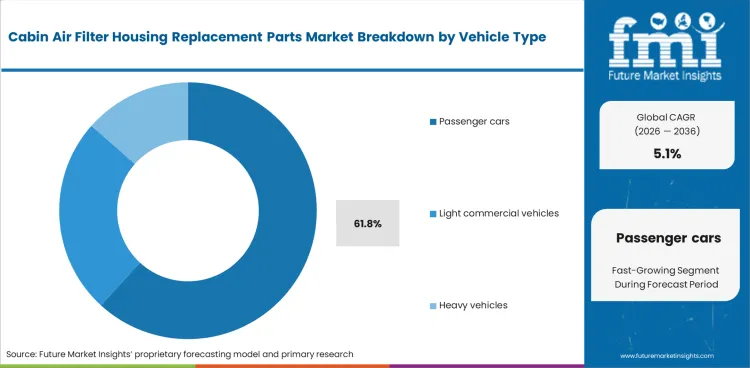
- Passenger cars are anticipated to represent 61.8% of vehicle type demand in 2026 due to service volume and cabin filter access frequency.
- Independent aftermarket channels are projected to account for 52.6% share in 2026 as garages replace damaged covers during filter work.
- Geography and Competitive Outlook
- China and India are expected to grow above the global pace as service visits rise with large vehicle fleets.
- The United States and Germany remain important industries due to high parts access and broad aftermarket catalog coverage.
- MANN+HUMMEL, DENSO, Bosch, MAHLE, Hengst, Sogefi, and Valeo shape supply through filter and HVAC service portfolios.
- Analyst Opinion
- Nikhil Kaitwade, Associate Vice President at FMI says, “The real buying trigger in this category is the service moment when a technician removes a cover, forces a tight access door, or finds a seal that no longer seats correctly. Suppliers with fitment depth and fast garage availability will capture repeat orders. The category looks small beside filters, but it sits inside a high-frequency maintenance job. Clients should watch how EV cabin air systems change access design and how catalog coverage expands for older vehicles. The strongest suppliers will treat housings and gaskets as part of one service kit instead of separate low-value pieces.”
Key Takeaways, Market Size, and Forecast
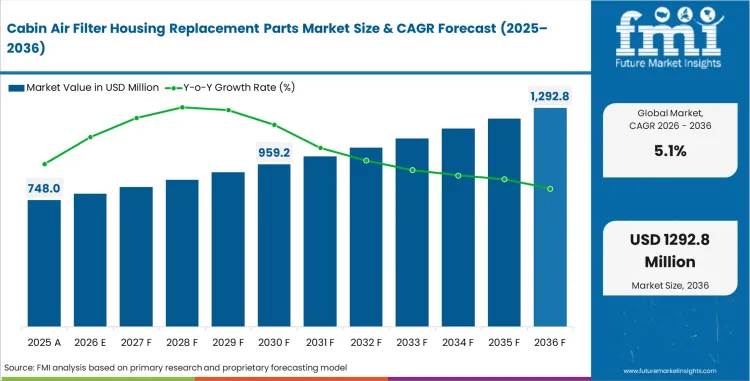
- The cabin air filter housing replacement parts market crossed a valuation of USD 712.0 million in 2025.
- The industry is likely to reach USD 1,226.0 million by 2036 which reflects higher filter access frequency in aging vehicles and more complex HVAC packaging.
- The market is projected to advance at 5.1% CAGR from 2026 to 2036 across global replacement channels.
- The incremental opportunity from 2026 to 2036 is estimated at USD 478.0 million across housing covers and related sealing components.
- Housing covers are projected to lead product type demand with 38.4% share in 2026 as covers are most exposed during filter service.
- China is projected to record the fastest country pace at 6.4% CAGR through 2036 due to vehicle parc scale and dense service traffic.
- Polypropylene is expected to account for 46.2% share in 2026 with molded durability and low part cost supporting broad use.
- Independent aftermarket channels are estimated to hold 52.6% share in 2026 as garages handle routine cabin filter replacement visits.
Cabin Air Filter Housing Replacement Parts Market Value Analysis
- Routine cabin filter servicing accelerates housing cover replacement, as technicians must remove and refit covers during every pollen and activated carbon filter change, increasing wear and breakage incidence.
- High passenger car service volumes support sustained adoption, driven by frequent maintenance cycles and extensive model coverage within aftermarket fitment catalogs.
- Independent repair shops act as the primary adoption channel, as they bundle housing cover and access part replacement with regular cabin filter and minor HVAC service jobs.
- Cost‑conscious purchasing behavior shapes replacement demand, with buyers prioritizing accurate fitment and sealing performance over brand premium due to the low‑ticket, plastic nature of these components.
Cabin Air Filter Housing Replacement Parts Market Definition
The market includes replacement covers, trays, access doors, clips, and sealing parts used around cabin air filter housings. These parts support HVAC filtration service in passenger vehicles and commercial vehicles. The scope excludes the cabin air filter media itself, full HVAC units, blower motors, and dashboard assemblies.
Cabin Air Filter Housing Replacement Parts Market Inclusions
The scope includes plastic housing covers, filter carriers, access doors, foam seals, rubber gaskets, mounting clips, independent aftermarket supply, OEM service parts, online retail, and global replacement demand.
Cabin Air Filter Housing Replacement Parts Market Exclusions
The scope excludes standalone cabin air filters, engine air filters, full HVAC modules, air-conditioning compressors, sensors, ducts, and unrelated interior trim parts.
Cabin Air Filter Housing Replacement Parts Market Research Methodology
- Primary Research: FMI analysts reviewed repair shop behavior, aftermarket catalog structures, and supplier portfolios. Inputs were weighted toward service parts that are handled during cabin filter replacement.
- Desk Research: Desk research used OICA production data, ACEA vehicle parc data, IEA electric vehicle data, NHTSA recall records, and official supplier releases. Company product information was used only for participation and development checks.
- Market Sizing and Forecasting: The model combined vehicle parc exposure, cabin filter service frequency, housing damage probability, and average part pricing. Country values were adjusted for vehicle age, service channel depth, and model coverage.
- Data Validation: Forecast outputs were checked against automotive filter adjacency, HVAC component pricing, and official company catalog expansions. Extreme values were rejected when replacement incidence exceeded reasonable garage experience.
Why is the Cabin Air Filter Housing Replacement Parts Market Growing?
- Routine pollen filter replacement exposes covers and clips to repeated removal, which raises the chance of small part failure.
- Aging vehicle fleets increase brittle plastic failure in glovebox access and cowl access locations.
- EVs and premium vehicles use tighter HVAC packaging, which makes damaged access pieces harder to ignore.
- Aftermarket catalog expansion gives garages more direct replacement options instead of improvised repairs.
Routine cabin filter service is the main demand trigger for housing parts. DENSO said in August 2025 that 82 new cabin filter part numbers added unique coverage for over 6 million passenger cars in Europe and extended carbon coverage to 145 million passenger cars. That wider filter coverage increases the number of service moments in which damaged covers, trays, and seals are found. Garages need small parts that match the filter opening so that airflow and dust sealing remain stable after service.
Electric vehicle growth changes how technicians view cabin air management. The International Energy Agency reported in May 2025 that electric car sales topped 17 million worldwide in 2024 and exceeded 11 million in China. This fleet shift raises the value of cabin comfort and air-quality systems in service work. Suppliers that align housings with low-leakage filter fit can protect repeat sales as cabin systems become more sensitive.
Market Segmentation Analysis
- With an estimated 38.4% share in 2026, housing covers are expected to lead product type demand due to repeated service handling.
- Polypropylene is projected to account for 46.2% material share in 2026 as molded cost and chemical resistance fit mass-market housings.
- Passenger cars are anticipated to hold 61.8% of vehicle type demand in 2026 with high cabin filter service frequency.
- Independent aftermarket channels are expected to direct 52.6% of 2026 volume through garages and parts distributors.
- Damage repair is estimated to represent 44.8% of replacement trigger demand in 2026 as broken tabs and covers require direct part replacement.
- Asia Pacific is projected to represent 36.4% regional share in 2026 with China, India, and Japan supporting service volume.
Segmentation is shaped by how technicians reach the cabin filter housing and how often the same access point is opened. Product type demand leans toward covers because they are removed first and often carry small tabs that break under force. Material choice is led by polypropylene due to injection molding economics and acceptable resistance to heat inside the dashboard. The commercial result is a parts category that depends less on vehicle production alone and more on repeated service handling across a large vehicle parc.
Insights into the Housing Covers Product Type Segment
Cabin Air Filter Housing Replacement Parts Market Analysis By Product Type
- Housing covers are projected to account for 38.4% of product type demand in 2026 as they are the first part removed during service.
- Cover breakage often occurs at latch points, so garages prefer exact-fit replacements over universal panels that may leak around the filter frame.
Insights into the Polypropylene Material Segment
Cabin Air Filter Housing Replacement Parts Market Analysis By Material
- Polypropylene is expected to represent 46.2% material share in 2026 as it supports low-cost molding and common interior heat exposure.
- Material choice is tied to clip flexibility since overly stiff plastics crack during removal in cold service conditions.
Insights into the Passenger Cars Vehicle Type Segment
Cabin Air Filter Housing Replacement Parts Market Analysis By Vehicle Type
- Passenger cars are anticipated to hold 61.8% vehicle type share in 2026 due to broad cabin filter use and high service traffic.
- Compact cars and SUVs create different access paths, which means suppliers need model-specific covers rather than broad shape families.
Insights into the Independent Aftermarket Sales Channel Segment
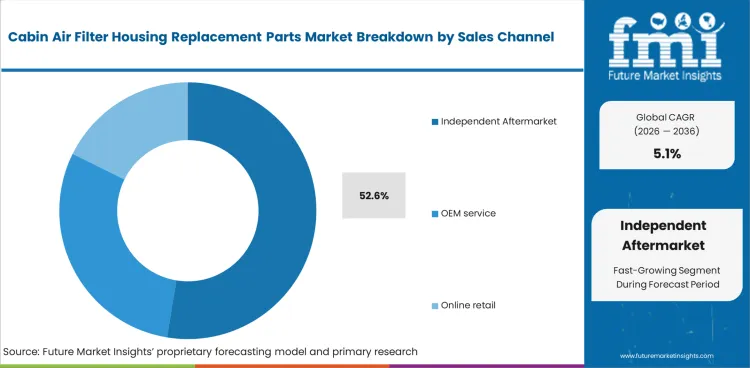
Cabin Air Filter Housing Replacement Parts Market Analysis By Sales Channel
- Independent aftermarket supply is projected to account for 52.6% channel share in 2026 as garages combine filter service with small plastic repairs.
- Wholesale distributors win when they stock low-ticket housings near cabin filters because technicians rarely delay a service job for one cover.
Insights into the Damage Repair Replacement Trigger Segment
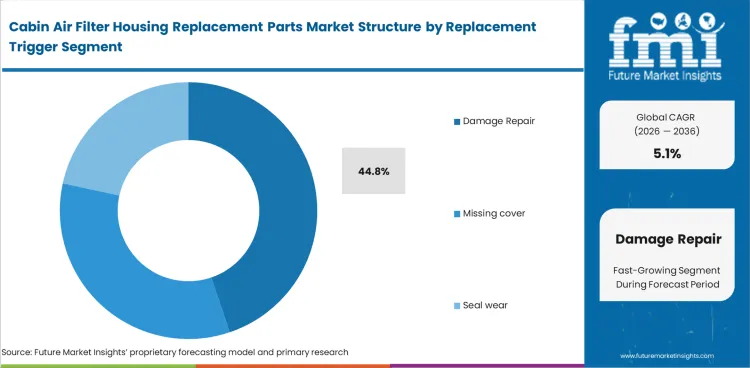
Cabin Air Filter Housing Replacement Parts Market Analysis By Replacement Trigger
- Damage repair is estimated to represent 44.8% trigger share in 2026 as cracked tabs and lost screws force immediate replacement.
- NHTSA recall 26V096 showed that a cabin air filter housing cover screw could damage nearby air-conditioning wiring during replacement.
Insights into the Asia Pacific Region Segment
Cabin Air Filter Housing Replacement Parts Market Analysis By Region
- Asia Pacific is expected to represent 36.4% regional share in 2026 as China and India provide large serviceable vehicle populations.
- The region has strong low-cost parts production, so fitment accuracy becomes the main way branded suppliers defend price points.
Cabin Air Filter Housing Replacement Parts Market Drivers, Restraints, and Opportunities
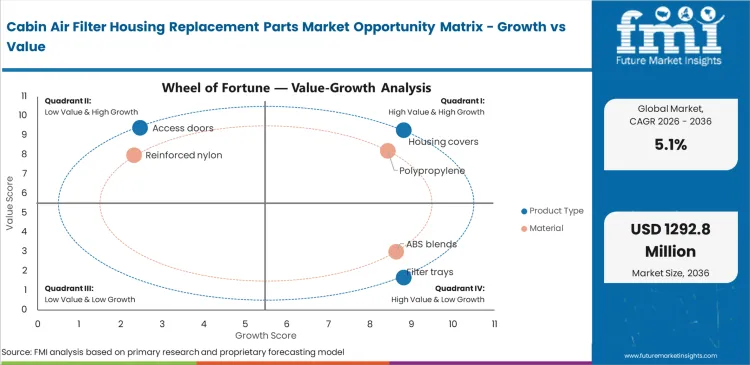
- Filter-service handling drives cover and clip replacement when access points are tight or repeatedly opened.
- Low part value restrains margins since garages often bundle housings into routine cabin filter work.
- EV cabin air packaging creates an opportunity for tighter seal kits and better access-door fitment.
- Online parts lookup supports demand where buyers need VIN-linked fitment before ordering small HVAC pieces.
Filter access cover fatigue
Cabin filter housings fail most often at the access point where technicians apply force. The failure is usually small but it can leave the filter loose or the cover unsealed. MANN-FILTER noted in May 2025 that its commercial vehicle air filter used complex sealing and 99.98% separation efficiency. That example shows why sealing quality is central to air management. The same buyer concern applies to cabin access parts even when the part value is low. Suppliers with cover geometry and gasket control can reduce repeat complaints.
EV cabin airflow sensitivity
EV cabin systems place more weight on air quality and low power draw. Hengst states that its Blue.ion cabin filter uses lower differential pressure and around five times less installation space than conventional filters for the same performance values. Smaller air paths make poor housing fit more visible to technicians. Replacement parts that preserve airflow and seal position gain value in EV service channels. This makes precise molding and reliable gasket seating a stronger selling point.
Analysis of Cabin Air Filter Housing Replacement Parts Market By Key Countries
.webp "Top Country Growth Comparison Cabin Air Filter Housing Replacement Parts Market Cagr (2026 2036)")
| Country | CAGR |
|---|---|
| China | 6.4% |
| India | 6.1% |
| United States | 4.6% |
| Germany | 4.2% |
| Japan | 3.8% |
| Brazil | 5.3% |
| United Kingdom | 4.1% |
Source: FMI analysis based on primary research and proprietary forecasting model.
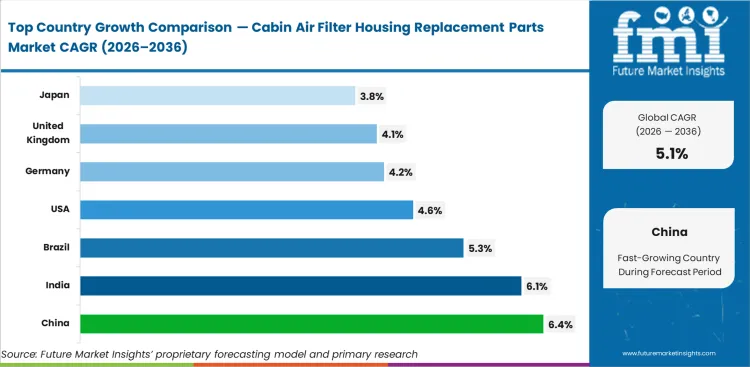
Cabin Air Filter Housing Replacement Parts Market CAGR Analysis By Country
- China is projected to record a 6.4% CAGR through 2036 as large vehicle output and EV service growth widen parts exposure.
- India is expected to expand at 6.1% CAGR through 2036 since passenger vehicle exports and domestic service networks keep rising.
- The United States is forecast to grow at 4.6% CAGR through 2036 as aging vehicles sustain filter and HVAC service visits.
- Germany is expected to advance at 4.2% CAGR through 2036 given its premium vehicle parc and service quality expectations.
- Japan is projected to rise at 3.8% CAGR through 2036 where mature service practices keep replacement rates stable.
- Brazil is forecast at 5.3% CAGR through 2036 as local vehicle production and aftermarket repair activity expand.
- The United Kingdom is expected to post 4.1% CAGR through 2036 as older vehicles and high cabin filter service rates support demand.
Country growth varies by vehicle age and model coverage. China and India are forecast above the global rate due to fleet scale and service network expansion. Germany and Japan track below the global pace because mature service patterns leave less room for step changes. The spread points to a market shaped by repair frequency more than new vehicle production alone.
Demand Outlook for Cabin Air Filter Housing Replacement Parts in China
China’s aftermarket scale is being shaped by dense city service traffic and the speed at which new energy vehicles enter regular maintenance cycles. CAAM data cited by official Chinese media showed 2025 automobile production at 34.531 million vehicles. That production base gives suppliers a wide future pool for access covers, clips, foam seals, and molded cabin air housing pieces. China is projected to record a 6.4% CAGR through 2036 as large vehicle output and EV service growth widen exposure for cabin air system parts. Guangdong and Jiangsu support high repair density through commuter vehicle use and strong parts distribution. Suppliers need broad model coverage and low-cost molded part supply to compete.
- Guangdong repair corridors support frequent cabin filter work as Pearl River Delta cities carry dense commuter vehicle traffic.
- Jiangsu distributors benefit from nearby automotive supply chains that improve replacement cover availability for mass-market models.
- Shanghai and Shenzhen workshops need accurate housing parts as EV owners place higher weight on quiet cabin airflow.
Sales Analysis of Cabin Air Filter Housing Replacement Parts in India
Dust exposure and high small-car use make India a replacement-led opportunity for cabin air filter housing parts. SIAM reported in August 2025 that passenger vehicles recorded their highest-ever sales of 4.3 million units in FY 2024-25. That larger service pool is expected to raise future replacement needs for access covers and sealing parts. Delhi NCR workshops face dust-heavy operating conditions that support regular cabin filter work. India is expected to expand at 6.1% CAGR through 2036 as passenger vehicle exports and domestic repair networks keep widening. Gujarat and Tamil Nadu production clusters improve parts availability for mass-market models.
- Delhi NCR workshops see frequent cabin filter replacement as dust exposure raises airflow complaints during scheduled service.
- Gujarat parts channels support faster replenishment for molded covers used in compact cars and small SUVs.
- Tamil Nadu’s Chennai automotive cluster improves aftermarket access for housing clips, access doors, and seal kits.
Demand Analysis of Cabin Air Filter Housing Replacement Parts in the United States
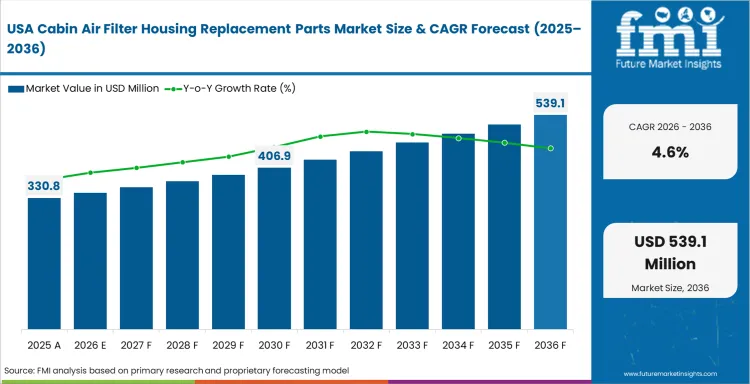
Long vehicle life keeps the United States aftermarket active for small HVAC parts that are often replaced outside dealer service. OICA data released in October 2025 showed the United States produced more than 10 million vehicles in 2024. The large vehicle parc creates steady aftermarket pull for filter doors, retaining tabs, and foam sealing pieces. California and Texas add high workshop density and strong online parts ordering. The United States is forecast to grow at 4.6% CAGR through 2036 as aging vehicles sustain filter and HVAC service visits. Suppliers need clear fitment notes for do-it-yourself buyers.
- California service centers face higher cabin comfort demand as wildfire smoke and pollen exposure raise filter service frequency.
- Texas workshops need wide coverage for pickup trucks and SUVs that dominate service bays outside major metro areas.
- Michigan and Ohio parts channels support quick HVAC component supply through their long automotive manufacturing and distribution base.
Opportunity Analysis of Cabin Air Filter Housing Replacement Parts in Germany
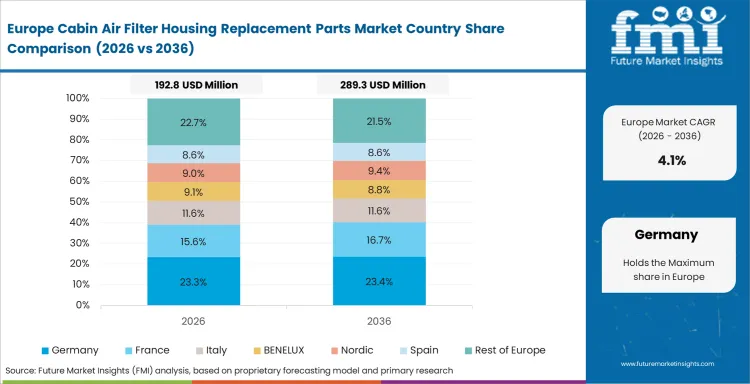
Premium vehicle service standards make Germany less price-driven than many aftermarket parts markets. VDA reported in February 2026 that Germany produced 13.3 million passenger cars across domestic and foreign plants in 2025. Germany is expected to advance at 4.2% CAGR through 2036 given its premium vehicle parc and strict service quality expectations. Premium vehicle platforms often have tighter cabin filter access and higher expectations for glovebox fit. Bavaria and Baden-Wurttemberg support strong OEM repair networks and trained independent workshops. Suppliers with German model coverage can defend price against generic replacements.
- Bavaria workshops handle premium platforms where loose housing covers can create noise complaints after cabin filter service.
- Baden-Wurttemberg service networks value OE-like fit as Mercedes-Benz and Porsche platforms raise replacement standards.
- North Rhine-Westphalia distributors benefit from dense urban vehicle use across Cologne, Dortmund, and Dusseldorf repair corridors.
Future Outlook for Cabin Air Filter Housing Replacement Parts in Japan
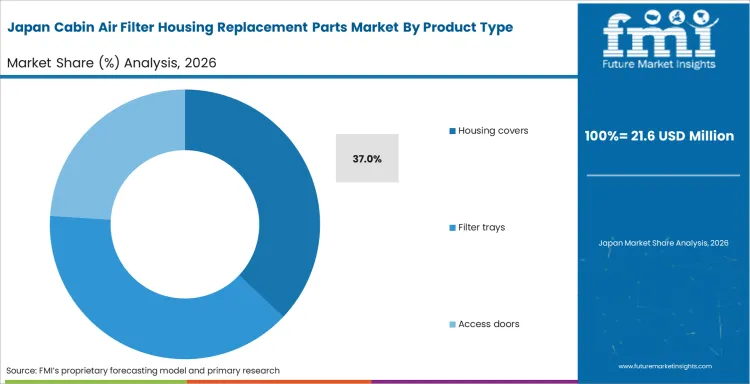
Compact vehicle packaging is the main reason Japan needs precise cabin air filter housing replacement parts. JAMA reported in September 2025 that Japan produced 8.23 million motor vehicles in 2024. Japan’s service culture places high weight on low-noise cabin systems and clean fit after minor HVAC work. Japan is projected to rise at 3.8% CAGR through 2036 where mature service practices keep replacement rates stable. Kei cars create tighter packaging around filter housings than larger passenger cars. Tokyo and Aichi concentrate service traffic and model variety.
- Tokyo repair shops handle compact vehicles where cabin filter access parts must fit tight dashboard packaging.
- Aichi’s automotive supplier base supports faster availability for molded HVAC parts tied to Toyota-group platforms.
- Osaka service networks benefit from steady urban vehicle use and recurring cabin comfort maintenance.
Demand Outlook for Cabin Air Filter Housing Replacement Parts in Brazil
Road dust and humidity make Brazil’s cabin filtration service needs different from those in mature temperate markets. Brazilian industry sources reported in 2025 that Brazil ranked eighth in global automobile production in 2024. Brazil is forecast at 5.3% CAGR through 2036 as local vehicle production and aftermarket repair activity expand. Sao Paulo and Minas Gerais concentrate repair networks and parts distribution. Local production supports quicker availability for common models. Suppliers must balance low replacement cost with seal reliability in a price-sensitive aftermarket.
- Sao Paulo distributors need broad stock coverage as the state anchors Brazil’s largest passenger vehicle service network.
- Minas Gerais repair channels favor durable clips and seals as mixed road use can stress plastic housing parts.
- Parana’s automotive cluster supports replacement part flow for compact cars and light vehicles used across southern Brazil.
In-depth Analysis of Cabin Air Filter Housing Replacement Parts in the United Kingdom
Independent garages shape the United Kingdom market because many cars move out of dealer service after warranty expiry. ACEA reported in January 2026 that 256 million cars were on EU roads in 2024. UK-linked European parc data supports a mature replacement setting with many older vehicles in regular repair cycles. Greater London and the Midlands concentrate repair activity. The United Kingdom is expected to post 4.1% CAGR through 2036 as older vehicles and high cabin filter service rates support demand. Wet weather raises attention to cabin misting and airflow.
- Greater London workshops see recurring cabin filter work as congestion and urban particulate exposure affect driver comfort.
- West Midlands distribution hubs support fast delivery of small HVAC housing parts for independent garages.
- Manchester and Birmingham service corridors benefit from registration-based lookup as model-year changes alter cover shape and clip placement.
Competitive Landscape and Strategic Positioning
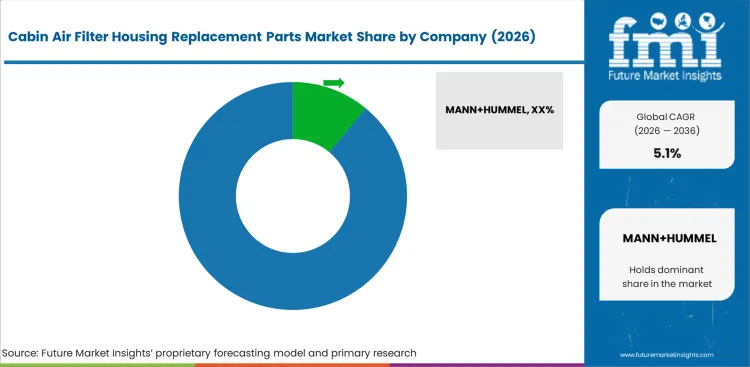
- Competition is moderately fragmented with filtration brands and aftermarket catalog specialists sharing demand.
- Large suppliers hold advantages through catalog coverage and OE service relationships.
- Specialist distributors compete with fast availability for low-ticket replacement covers and clips.
- Entry barriers include model-specific tooling, fitment data, and low tolerance for sealing errors.
Competitors win by making small parts easy to identify and safe to replace. DENSO expanded its cabin filter range in August 2025 with 82 new part numbers and added coverage for large European vehicle populations. That move signals the value of catalog depth around routine filter service. Suppliers that pair filters with related housing pieces can capture more of the service ticket. This approach is more durable than selling isolated plastic parts without application guidance.
Established filtration suppliers have an advantage because they already appear in garage workflows. Bosch replaced FILTER+ with FILTER+pro at the beginning of 2024 after OFI certification confirmed filtration performance. This supports trust in cabin air service categories and gives Bosch a platform to cross-sell related service components. The same advantage applies to MANN+HUMMEL, MAHLE, and Hengst when their filter brands guide technician choice. Brand trust matters most when a low-cost housing part can cause a return visit.
Smaller suppliers can win in low-volume part numbers that larger brands do not prioritize. Sogefi lists new pollen and activated carbon filter applications, which shows how application expansion keeps the aftermarket moving. Housing replacement demand follows the same pattern. Long-tail part availability can decide the sale when a garage needs one cover for an older model. The entry challenge is that tooling cost must be recovered over modest volumes.
Key Companies in the Cabin Air Filter Housing Replacement Parts Market
The supplier field spans filtration brands, HVAC part makers, and catalog-driven aftermarket distributors.
- Global Leaders: MANN+HUMMEL, DENSO, Bosch, MAHLE, and Valeo carry strong positions through cabin filtration brands, vehicle application coverage, and service-channel visibility across Europe, North America, and Asia.
- Regional Players: Hengst and Sogefi support the market through application-specific filtration portfolios and European aftermarket reach. Their strength comes from catalog fitment, service part availability, and coverage of older vehicles.
- Emerging and Specialist Suppliers: Vemo, URO Parts, Dorman, and TYC compete in replacement housings, clips, and adjacent HVAC parts. Their main role is long-tail coverage for models that need low-cost replacement pieces.
Competitive Benchmarking: Cabin Air Filter Housing Replacement Parts Market
| Company | Fitment Catalog Depth | HVAC Access Part Coverage | Aftermarket Channel Reach | Geographic Footprint |
|---|---|---|---|---|
| MANN+HUMMEL | High | Strong | High | Global |
| DENSO | High | Strong | High | Global |
| Bosch | High | Medium | High | Global |
| MAHLE | High | Medium | High | Global |
| Hengst | Medium | Strong | Medium | Europe |
| Sogefi | Medium | Medium | Medium | Europe |
| Valeo | Medium | Strong | High | Global |
| Dorman | Medium | High | High | North America |
| TYC | Medium | Medium | Medium | Asia and North America |
| URO Parts | Low | Medium | Medium | North America |
Source: Future Market Insights competitive analysis, 2026. Ratings reflect relative positioning based on fitment depth, HVAC access coverage, and aftermarket reach.
Key Developments in Cabin Air Filter Housing Replacement Parts Market
- In January 2024, Bosch began replacing FILTER+ with FILTER+pro for cabin filtration service. The change raises service attention around cabin air quality.
- In May 2025, MANN-FILTER promoted a patented air filter with complex sealing and high separation efficiency. The update reinforces sealing as a repair priority.
- In August 2025, DENSO added 82 cabin filter part numbers covering large European vehicle pools. This expands the service moments tied to filter housing access.
- In September 2025, MAHLE presented production-ready cabin air quality technologies. This points to higher value around cabin airflow and interior air treatment.
- In October 2025, Hengst showcased filtration development for cabin air systems at Agritechnica. This reflects wider use of cabin filtration beyond passenger cars.
Key Players in the Cabin Air Filter Housing Replacement Parts Market
Global Leaders
- MANN+HUMMEL
- DENSO
- Bosch
- MAHLE
- Valeo
Regional Players
- Hengst
- Sogefi
- Corteco
Emerging and Specialist Suppliers
- Dorman
- TYC
- URO Parts
- Vemo
Report Scope and Coverage
| Item | Value |
|---|---|
| Quantitative Units | USD million and CAGR |
| Market Definition | Replacement parts around cabin air filter housings |
| Product Type | Housing covers, filter trays, access doors, sealing gaskets |
| Material | Polypropylene, ABS blends, reinforced nylon, elastomer seals |
| Vehicle Type | Passenger cars, light commercial vehicles, heavy vehicles, electric vehicles |
| Sales Channel | Independent aftermarket, OEM service, online retail, fleet service |
| Replacement Trigger | Damage repair, missing cover, seal wear, retrofit access |
| Regions Covered | North America, Latin America, Europe, East Asia, South Asia Pacific, Middle East and Africa |
| Countries Covered | China, India, United States, Germany, Japan, Brazil, United Kingdom |
| Forecast Period | 2026 to 2036 |
| Approach | Bottom-up service part incidence with aftermarket channel validation |
Market Analysis By Segments
By Product Type
- Housing covers
- Filter trays
- Access doors
- Sealing gaskets
By Material
- Polypropylene
- ABS blends
- Reinforced nylon
- Elastomer seals
By Vehicle Type
- Passenger cars
- Light commercial vehicles
- Heavy vehicles
- Electric vehicles
By Sales Channel
- Independent aftermarket
- OEM service
- Online retail
- Fleet service
By Replacement Trigger
- Damage repair
- Missing cover
- Seal wear
- Retrofit access
By Region
- North America
- Latin America
- Europe
- East Asia
- South Asia Pacific
- Middle East and Africa
Regional Taxonomy
- North America
- United States
- Canada
- Latin America
- Brazil
- Mexico
- Europe
- Germany
- United Kingdom
- France
- Italy
- East Asia
- China
- Japan
- South Korea
- South Asia Pacific
- India
- ASEAN
- Australia
- Middle East and Africa
- GCC
- South Africa
Bibliography
- Association des Constructeurs Europeens d’Automobiles. (2026, January 15). Report: Vehicles on European roads 2026.
- Bosch Mobility Aftermarket. (2024, January). FILTER+pro, the new Bosch cabin filter, for reliable protection against harmful substances.
- DENSO Europe. (2025, August). Cabin air filter range expanded: 82 new part numbers added.
- Hengst SE. (2025, October 20). Touch Smart Filtration: Hengst at Agritechnica 2025.
- International Energy Agency. (2025, May 14). Global EV Outlook 2025: Trends in electric car markets.
- International Organization of Motor Vehicle Manufacturers. (2025, October). World motor vehicle production by country and region 2024.
- Japan Automobile Manufacturers Association. (2025, September 26). The motor industry of Japan 2025.
- MAHLE GmbH. (2025, September 8). Production-ready innovations for sustainable mobility.
- MANN+HUMMEL. (2025, May 13). Easy servicing thanks to innovative air filter.
- National Highway Traffic Safety Administration. (2026, April 13). Part 573 Safety Recall Report 26V096.
- Society of Indian Automobile Manufacturers. (2025, August 28). SIAM annual report 2024-25.
- Verband der Automobilindustrie. (2026, February 16). Automobile production.
This Report Addresses
- What is the projected value of the cabin air filter housing replacement parts market by 2036?
- Which product type is expected to hold the highest share in 2026?
- Why do housing covers lead replacement demand in routine service channels?
- Which countries are forecast to grow faster than the global average?
- How do suppliers compete in catalog coverage and fitment accuracy?
- Which replacement triggers create the strongest aftermarket pull?
Frequently Asked Questions
What is the cabin air filter housing replacement parts market value in 2026?
The market is projected at USD 748.0 million in 2026, with demand tied to cabin filter service and small HVAC access part replacement.
What is the cabin air filter housing replacement parts market forecast for 2036?
The market is forecast to reach USD 1,226.0 million by 2036, reflecting a 5.1% CAGR across replacement channels.
Which product segment leads the cabin air filter housing replacement parts market?
Housing covers are projected to lead with 38.4% share in 2026 as technicians remove them during routine filter changes.
Which material leads the cabin air filter housing replacement parts market?
Polypropylene is expected to lead with 46.2% share in 2026 due to molding cost and suitable heat resistance.
Which country grows fastest in the cabin air filter housing replacement parts market?
China is projected to grow fastest at 6.4% CAGR through 2036 due to vehicle scale and expanding service traffic.
How does a cabin air filter housing replacement part work?
The housing part holds the filter in the HVAC air path and seals the access opening so dust bypass and airflow noise stay controlled.
Why replace a cabin air filter housing cover instead of repairing it?
A replacement cover gives a more reliable seal than taped or improvised repairs, especially when tabs or screw points are damaged.
What affects the cost of cabin air filter housing replacement parts?
Cost depends on vehicle model, material, seal design, and whether clips or gaskets are sold with the housing part.
How long do cabin air filter housing replacement parts last?
A correctly fitted housing part can last for years, but repeated filter service or brittle plastic can shorten its useful life.
Preview the report firsthand - request a free sample
Get SampleGet the brochure for pricing and purchase details.
Get PDFTable of Content
- Executive Summary
- Global Market Outlook
- Demand-side Trends
- Supply-side Trends
- Technology Roadmap Analysis
- Market Coverage / Taxonomy
- Market Definition / Scope / Limitations
- Research Methodology
- Chapter Orientation
- Analytical Lens and Working Hypotheses
- Market Structure, Signals, and Trend Drivers
- Benchmarking and Cross-market Comparability
- Market Sizing, Forecasting, and Opportunity Mapping
- Research Design and Evidence Framework
- Desk Research Programme (Secondary Evidence)
- Company Annual and Sustainability Reports
- Peer-reviewed Journals and Academic Literature
- Trade Journals, Industry Magazines, and Analyst Briefs
- Conference Proceedings, Webinars, and Seminar Materials
- Government Statistics Portals and Public Data Releases
- Press Releases and Reputable Media Coverage
- Specialist Newsletters and Curated Briefings
- Sector Databases and Reference Repositories
- FMI Internal Proprietary Databases and Historical Market Datasets
- Subscription Datasets and Paid Sources
- Social Channels, Communities, and Digital Listening Inputs
- Additional Desk Sources
- Expert Input and Fieldwork (Primary Evidence)
- Primary Modes
- Qualitative Interviews and Expert Elicitation
- Quantitative Surveys and Structured Data Capture
- Blended Approach
- Why Primary Evidence is Used
- Field Techniques
- Interviews
- Surveys
- Focus Groups
- Observational and In-context Research
- Social and Community Interactions
- Stakeholder Universe Engaged
- C-suite Leaders
- Board Members
- Presidents and Vice Presidents
- R&D and Innovation Heads
- Technical Specialists
- Domain Subject-matter Experts
- Scientists
- Physicians and Other Healthcare Professionals
- Governance, Ethics, and Data Stewardship
- Research Ethics
- Restraints
- Opportunity
- Trends
- Scenario Forecast
- Demand in Optimistic Scenario
- Demand in Likely Scenario
- Demand in Conservative Scenario
- Opportunity Map Analysis
- Product Life Cycle Analysis
- Supply Chain Analysis
- Investment Feasibility Matrix
- Value Chain Analysis
- PESTLE and Porter’s Analysis
- Regulatory Landscape
- Regional Parent Market Outlook
- Production and Consumption Statistics
- Import and Export Statistics
- Primary Modes
- Global Market Analysis 2021 to 2025 and Forecast, 2026 to 2036
- Historical Market Size Value (USD Million) Analysis, 2021 to 2025
- Current and Future Market Size Value (USD Million) Projections, 2026 to 2036
- Y-o-Y Growth Trend Analysis
- Absolute $ Opportunity Analysis
- Global Market Pricing Analysis 2021 to 2025 and Forecast 2026 to 2036
- Global Market Analysis 2021 to 2025 and Forecast 2026 to 2036, By Product Type
- Introduction / Key Findings
- Historical Market Size Value (USD Million) Analysis By Product Type , 2021 to 2025
- Current and Future Market Size Value (USD Million) Analysis and Forecast By Product Type , 2026 to 2036
- Housing covers
- Filter trays
- Access doors
- Housing covers
- Y-o-Y Growth Trend Analysis By Product Type , 2021 to 2025
- Absolute $ Opportunity Analysis By Product Type , 2026 to 2036
- Global Market Analysis 2021 to 2025 and Forecast 2026 to 2036, By Material
- Introduction / Key Findings
- Historical Market Size Value (USD Million) Analysis By Material, 2021 to 2025
- Current and Future Market Size Value (USD Million) Analysis and Forecast By Material, 2026 to 2036
- Polypropylene
- ABS blends
- Reinforced nylon
- Polypropylene
- Y-o-Y Growth Trend Analysis By Material, 2021 to 2025
- Absolute $ Opportunity Analysis By Material, 2026 to 2036
- Global Market Analysis 2021 to 2025 and Forecast 2026 to 2036, By Vehicle Type
- Introduction / Key Findings
- Historical Market Size Value (USD Million) Analysis By Vehicle Type, 2021 to 2025
- Current and Future Market Size Value (USD Million) Analysis and Forecast By Vehicle Type, 2026 to 2036
- Passenger cars
- Light commercial vehicles
- Heavy vehicles
- Passenger cars
- Y-o-Y Growth Trend Analysis By Vehicle Type, 2021 to 2025
- Absolute $ Opportunity Analysis By Vehicle Type, 2026 to 2036
- Global Market Analysis 2021 to 2025 and Forecast 2026 to 2036, By Sales Channel
- Introduction / Key Findings
- Historical Market Size Value (USD Million) Analysis By Sales Channel, 2021 to 2025
- Current and Future Market Size Value (USD Million) Analysis and Forecast By Sales Channel, 2026 to 2036
- Independent Aftermarket
- OEM service
- Online retail
- Independent Aftermarket
- Y-o-Y Growth Trend Analysis By Sales Channel, 2021 to 2025
- Absolute $ Opportunity Analysis By Sales Channel, 2026 to 2036
- Global Market Analysis 2021 to 2025 and Forecast 2026 to 2036, By Replacement Trigger
- Introduction / Key Findings
- Historical Market Size Value (USD Million) Analysis By Replacement Trigger, 2021 to 2025
- Current and Future Market Size Value (USD Million) Analysis and Forecast By Replacement Trigger, 2026 to 2036
- Damage Repair
- Missing cover
- Seal wear
- Damage Repair
- Y-o-Y Growth Trend Analysis By Replacement Trigger, 2021 to 2025
- Absolute $ Opportunity Analysis By Replacement Trigger, 2026 to 2036
- Global Market Analysis 2021 to 2025 and Forecast 2026 to 2036, By Region
- Introduction
- Historical Market Size Value (USD Million) Analysis By Region, 2021 to 2025
- Current Market Size Value (USD Million) Analysis and Forecast By Region, 2026 to 2036
- North America
- Latin America
- Western Europe
- Eastern Europe
- East Asia
- South Asia and Pacific
- Middle East & Africa
- Market Attractiveness Analysis By Region
- North America Market Analysis 2021 to 2025 and Forecast 2026 to 2036, By Country
- Historical Market Size Value (USD Million) Trend Analysis By Market Taxonomy, 2021 to 2025
- Market Size Value (USD Million) Forecast By Market Taxonomy, 2026 to 2036
- By Country
- USA
- Canada
- Mexico
- By Product Type
- By Material
- By Vehicle Type
- By Sales Channel
- By Replacement Trigger
- By Country
- Market Attractiveness Analysis
- By Country
- By Product Type
- By Material
- By Vehicle Type
- By Sales Channel
- By Replacement Trigger
- Key Takeaways
- Latin America Market Analysis 2021 to 2025 and Forecast 2026 to 2036, By Country
- Historical Market Size Value (USD Million) Trend Analysis By Market Taxonomy, 2021 to 2025
- Market Size Value (USD Million) Forecast By Market Taxonomy, 2026 to 2036
- By Country
- Brazil
- Chile
- Rest of Latin America
- By Product Type
- By Material
- By Vehicle Type
- By Sales Channel
- By Replacement Trigger
- By Country
- Market Attractiveness Analysis
- By Country
- By Product Type
- By Material
- By Vehicle Type
- By Sales Channel
- By Replacement Trigger
- Key Takeaways
- Western Europe Market Analysis 2021 to 2025 and Forecast 2026 to 2036, By Country
- Historical Market Size Value (USD Million) Trend Analysis By Market Taxonomy, 2021 to 2025
- Market Size Value (USD Million) Forecast By Market Taxonomy, 2026 to 2036
- By Country
- Germany
- UK
- Italy
- Spain
- France
- Nordic
- BENELUX
- Rest of Western Europe
- By Product Type
- By Material
- By Vehicle Type
- By Sales Channel
- By Replacement Trigger
- By Country
- Market Attractiveness Analysis
- By Country
- By Product Type
- By Material
- By Vehicle Type
- By Sales Channel
- By Replacement Trigger
- Key Takeaways
- Eastern Europe Market Analysis 2021 to 2025 and Forecast 2026 to 2036, By Country
- Historical Market Size Value (USD Million) Trend Analysis By Market Taxonomy, 2021 to 2025
- Market Size Value (USD Million) Forecast By Market Taxonomy, 2026 to 2036
- By Country
- Russia
- Poland
- Hungary
- Balkan & Baltic
- Rest of Eastern Europe
- By Product Type
- By Material
- By Vehicle Type
- By Sales Channel
- By Replacement Trigger
- By Country
- Market Attractiveness Analysis
- By Country
- By Product Type
- By Material
- By Vehicle Type
- By Sales Channel
- By Replacement Trigger
- Key Takeaways
- East Asia Market Analysis 2021 to 2025 and Forecast 2026 to 2036, By Country
- Historical Market Size Value (USD Million) Trend Analysis By Market Taxonomy, 2021 to 2025
- Market Size Value (USD Million) Forecast By Market Taxonomy, 2026 to 2036
- By Country
- China
- Japan
- South Korea
- By Product Type
- By Material
- By Vehicle Type
- By Sales Channel
- By Replacement Trigger
- By Country
- Market Attractiveness Analysis
- By Country
- By Product Type
- By Material
- By Vehicle Type
- By Sales Channel
- By Replacement Trigger
- Key Takeaways
- South Asia and Pacific Market Analysis 2021 to 2025 and Forecast 2026 to 2036, By Country
- Historical Market Size Value (USD Million) Trend Analysis By Market Taxonomy, 2021 to 2025
- Market Size Value (USD Million) Forecast By Market Taxonomy, 2026 to 2036
- By Country
- India
- ASEAN
- Australia & New Zealand
- Rest of South Asia and Pacific
- By Product Type
- By Material
- By Vehicle Type
- By Sales Channel
- By Replacement Trigger
- By Country
- Market Attractiveness Analysis
- By Country
- By Product Type
- By Material
- By Vehicle Type
- By Sales Channel
- By Replacement Trigger
- Key Takeaways
- Middle East & Africa Market Analysis 2021 to 2025 and Forecast 2026 to 2036, By Country
- Historical Market Size Value (USD Million) Trend Analysis By Market Taxonomy, 2021 to 2025
- Market Size Value (USD Million) Forecast By Market Taxonomy, 2026 to 2036
- By Country
- Kingdom of Saudi Arabia
- Other GCC Countries
- Turkiye
- South Africa
- Other African Union
- Rest of Middle East & Africa
- By Product Type
- By Material
- By Vehicle Type
- By Sales Channel
- By Replacement Trigger
- By Country
- Market Attractiveness Analysis
- By Country
- By Product Type
- By Material
- By Vehicle Type
- By Sales Channel
- By Replacement Trigger
- Key Takeaways
- Key Countries Market Analysis
- USA
- Pricing Analysis
- Market Share Analysis, 2025
- By Product Type
- By Material
- By Vehicle Type
- By Sales Channel
- By Replacement Trigger
- Canada
- Pricing Analysis
- Market Share Analysis, 2025
- By Product Type
- By Material
- By Vehicle Type
- By Sales Channel
- By Replacement Trigger
- Mexico
- Pricing Analysis
- Market Share Analysis, 2025
- By Product Type
- By Material
- By Vehicle Type
- By Sales Channel
- By Replacement Trigger
- Brazil
- Pricing Analysis
- Market Share Analysis, 2025
- By Product Type
- By Material
- By Vehicle Type
- By Sales Channel
- By Replacement Trigger
- Chile
- Pricing Analysis
- Market Share Analysis, 2025
- By Product Type
- By Material
- By Vehicle Type
- By Sales Channel
- By Replacement Trigger
- Germany
- Pricing Analysis
- Market Share Analysis, 2025
- By Product Type
- By Material
- By Vehicle Type
- By Sales Channel
- By Replacement Trigger
- UK
- Pricing Analysis
- Market Share Analysis, 2025
- By Product Type
- By Material
- By Vehicle Type
- By Sales Channel
- By Replacement Trigger
- Italy
- Pricing Analysis
- Market Share Analysis, 2025
- By Product Type
- By Material
- By Vehicle Type
- By Sales Channel
- By Replacement Trigger
- Spain
- Pricing Analysis
- Market Share Analysis, 2025
- By Product Type
- By Material
- By Vehicle Type
- By Sales Channel
- By Replacement Trigger
- France
- Pricing Analysis
- Market Share Analysis, 2025
- By Product Type
- By Material
- By Vehicle Type
- By Sales Channel
- By Replacement Trigger
- India
- Pricing Analysis
- Market Share Analysis, 2025
- By Product Type
- By Material
- By Vehicle Type
- By Sales Channel
- By Replacement Trigger
- ASEAN
- Pricing Analysis
- Market Share Analysis, 2025
- By Product Type
- By Material
- By Vehicle Type
- By Sales Channel
- By Replacement Trigger
- Australia & New Zealand
- Pricing Analysis
- Market Share Analysis, 2025
- By Product Type
- By Material
- By Vehicle Type
- By Sales Channel
- By Replacement Trigger
- China
- Pricing Analysis
- Market Share Analysis, 2025
- By Product Type
- By Material
- By Vehicle Type
- By Sales Channel
- By Replacement Trigger
- Japan
- Pricing Analysis
- Market Share Analysis, 2025
- By Product Type
- By Material
- By Vehicle Type
- By Sales Channel
- By Replacement Trigger
- South Korea
- Pricing Analysis
- Market Share Analysis, 2025
- By Product Type
- By Material
- By Vehicle Type
- By Sales Channel
- By Replacement Trigger
- Russia
- Pricing Analysis
- Market Share Analysis, 2025
- By Product Type
- By Material
- By Vehicle Type
- By Sales Channel
- By Replacement Trigger
- Poland
- Pricing Analysis
- Market Share Analysis, 2025
- By Product Type
- By Material
- By Vehicle Type
- By Sales Channel
- By Replacement Trigger
- Hungary
- Pricing Analysis
- Market Share Analysis, 2025
- By Product Type
- By Material
- By Vehicle Type
- By Sales Channel
- By Replacement Trigger
- Kingdom of Saudi Arabia
- Pricing Analysis
- Market Share Analysis, 2025
- By Product Type
- By Material
- By Vehicle Type
- By Sales Channel
- By Replacement Trigger
- Turkiye
- Pricing Analysis
- Market Share Analysis, 2025
- By Product Type
- By Material
- By Vehicle Type
- By Sales Channel
- By Replacement Trigger
- South Africa
- Pricing Analysis
- Market Share Analysis, 2025
- By Product Type
- By Material
- By Vehicle Type
- By Sales Channel
- By Replacement Trigger
- USA
- Market Structure Analysis
- Competition Dashboard
- Competition Benchmarking
- Market Share Analysis of Top Players
- By Regional
- By Product Type
- By Material
- By Vehicle Type
- By Sales Channel
- By Replacement Trigger
- Competition Analysis
- Competition Deep Dive
- MANN+HUMMEL
- Overview
- Product Portfolio
- Profitability by Market Segments (Product/Age /Sales Channel/Region)
- Sales Footprint
- Strategy Overview
- Marketing Strategy
- Product Strategy
- Channel Strategy
- DENSO
- Bosch
- MAHLE
- Valeo
- Hengst
- MANN+HUMMEL
- Competition Deep Dive
- Desk Research Programme (Secondary Evidence)
- Assumptions & Acronyms Used


