

- Market Size (2026)
- USD 414.0 Mn
- Forecast (2036)
- USD 829.8 Mn
- CAGR (2026 to 2036)
- 7.2%
Vehicle Cabin Air Quality and Filtration Efficiency Test Systems Market Size, Market Forecast and Outlook By FMI
Summary of the Vehicle Cabin Air Quality and Filtration Efficiency Test Systems Market
- Demand and Growth Drivers
- Rising concern around cabin exposure is increasing the need for repeatable cabin air validation across new vehicle programs.
- Growth is supported by wider use of PM filtration claims and software-based air quality monitoring.
- Supplier development work is expanding the use of chamber testing and integrated validation benches.
- Product and Segment View
- Filtration efficiency leads test demand because PM removal claims are easier to compare and validate across media options.
- Passenger cars and chamber systems lead segment demand due to stronger comfort positioning and higher laboratory intensity per platform.
- OEM laboratories and direct sales hold leading shares because validation programs are closely linked to development timing and system integration.
- Geography and Competitive Outlook
- China is expected to be a key growth center due to high vehicle output and stronger urban air-quality pressure.
- India is expected to post strong growth because local vehicle volumes are rising and cabin filtration is becoming a more visible feature.
- Companies with stronger capability in chamber testing and automotive lab support are likely to strengthen their position.
- Analyst Opinion
- Nikhil Kaitwade, Principal Consultant at FMI says, “Companies that can support repeatable cabin-air validation across particle, gas, and airflow testing are likely to strengthen their position over the forecast period. Demand depends on how quickly vehicle brands widen cabin air claims from basic filter checks to broader health and smart HVAC performance.”
- Vehicle Cabin Air Quality and Filtration Efficiency Test Systems Market Value Analysis
- The market is moving from a narrow cabin filter validation niche into a broader vehicle interior air quality testing category.
- Demand is driven by the need to measure particulate reduction and recirculation performance under controlled conditions.
- Adoption is supported by higher validation content in premium vehicles and in feature-rich electric platforms.
- Spending is linked to equipment that combines particle analysis and data capture in one workflow.
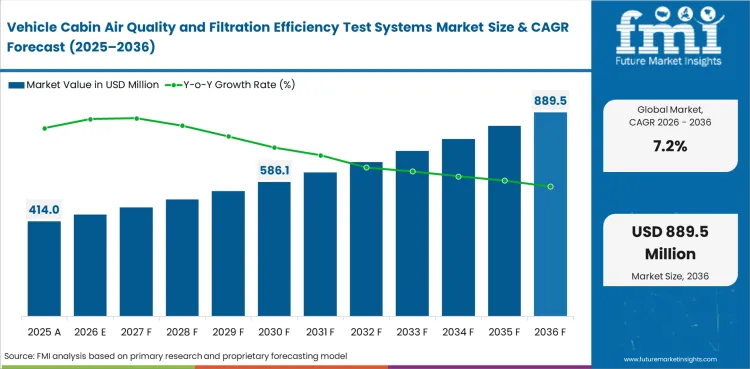
Key Takeaways, Market Size, and Forecast
- The vehicle cabin air quality and filtration efficiency test systems market was valued at USD 386.2 million in 2025.
- By 2036, the vehicle cabin air quality and filtration efficiency test systems market is expected to reach USD 829.8 million.
- From 2026 to 2036, the market is projected to expand at a CAGR of 7.2%.
- The market is expected to create an incremental opportunity of USD 415.8 million between 2026 and 2036.
- Passenger cars are projected to hold 61.0% of total vehicle-based demand in 2026
- China and India are predicted to rank among the faster-growing national markets through 2036.
Vehicle Cabin Air Quality and Filtration Efficiency Test Systems Market Definition
The vehicle cabin air quality and filtration efficiency test systems market includes instruments, chambers, integrated benches, software, fixtures, and technical services used to evaluate cabin air quality and filtration performance in vehicles.
Vehicle Cabin Air Quality and Filtration Efficiency Test Systems Market Inclusions
Market scope includes chamber-based test environments, aerosol generation systems, particle counters, gas analyzers, VOC testing instruments, data acquisition software, flow benches, environmental simulation hardware, and laboratory services that directly assess vehicle cabin air quality or cabin filter performance.
Vehicle Cabin Air Quality and Filtration Efficiency Test Systems Market Exclusions
The scope excludes production cabin air filters sold as replacement parts, installed HVAC modules sold for vehicle assembly, consumer air purifiers sold as accessories, general indoor air monitors with no vehicle testing role, and broad automotive emissions equipment with no direct use in cabin-air validation.
Vehicle Cabin Air Quality and Filtration Efficiency Test Systems Market Research Methodology
- Primary Research: FMI assessed supplier positioning across instrumentation vendors, chamber suppliers and validation service providers active in this niche category.
- Desk Research: The study used public vehicle production data, registration statistics, technical documents, and official supplier updates linked to vehicle interior air quality work.
- Market Sizing and Forecasting: The market was sized through a bottom-up model based on vehicle development activity and revenue triangulation across active suppliers.
- Data Validation: Forecast assumptions were checked against current automotive production trends and visible supplier activity during 2024 to 2026.
Why is the Vehicle Cabin Air Quality and Filtration Efficiency Test Systems Market Growing?
- Cabin health and comfort claims are moving into visible vehicle features and this is increasing validation work.
- Higher pollution exposure in large urban areas keeps PM and gas filtration performance commercially relevant.
- Sensor-rich HVAC systems need broader lab work than earlier cabin filter programs required.
The real growth driver comes from testing depth per development program. OEMs and tier suppliers now run more checks around particulate capture and gas reduction. That change raises the value of each validation program even in periods where total vehicle output grows at a slower pace. Premium passenger vehicles and electric platforms add to this trend because cabin comfort and health features carry stronger product value in those categories.
Regulatory attention is keeping vehicle interior air quality visible across engineering roadmaps. Vehicle brands usually tighten their own validation methods early because they need consistent claims across multiple regions. This supports demand for chambers and outsourced testing services that can reproduce controlled pollutant conditions and generate repeatable data. Growth in connected cabin functions overlaps with developments tracked in vehicle interior air quality monitoring technology.
Supplier activity points to rising technical expectations in cabin air performance. Filter media development is moving toward finer particle capture and stronger gas control. Media stacks become more advanced. Laboratories need better tools to compare performance and validate end-use behavior under controlled conditions.
Market Segmentation Analysis
- Filtration efficiency is expected to lead test demand with 34.0% share in 2026, supported by clearer measurement methods and stronger product claim relevance.
- Passenger cars and chamber systems are projected to lead their segments with 61.0% and 38.0% shares in 2026.
- OEM laboratories and direct sales are projected to hold 48.0% and 57.0% shares in 2026.
The market is segmented by test type, vehicle type, technology, deployment, sales channel, and region. Test type includes Filtration Efficiency, Gas and VOC Testing, Particulate Exposure Testing, and Sensor Calibration. Vehicle type includes Passenger Cars, Light Commercial Vehicles, Heavy Commercial Vehicles, and Buses. Technology includes Chamber Systems, Particle Analyzers, Gas Analyzers, and Integrated Benches. Deployment includes OEM Laboratories, Third-party Laboratories, and Engineering Service Providers. Sales channel includes Direct Sales, Distributors, System Integrators, and Service Contracts.
Insights into the Test Type Segment
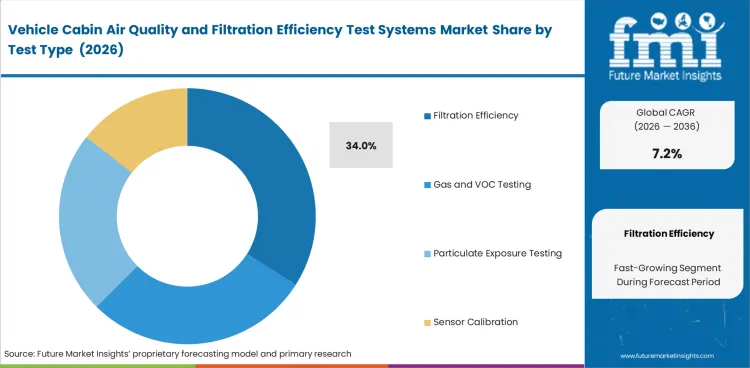
- Filtration efficiency is expected to account for 34.0% share in 2026. this segment leads because particulate reduction is one of the clearest claims that vehicle brands and filter suppliers can validate and compare across test conditions.
- Gas and VOC testing is important because broader cabin comfort claims now depend on proving how well systems manage odors and gaseous pollutants in controlled environments.
Insights into the Vehicle Type Segment
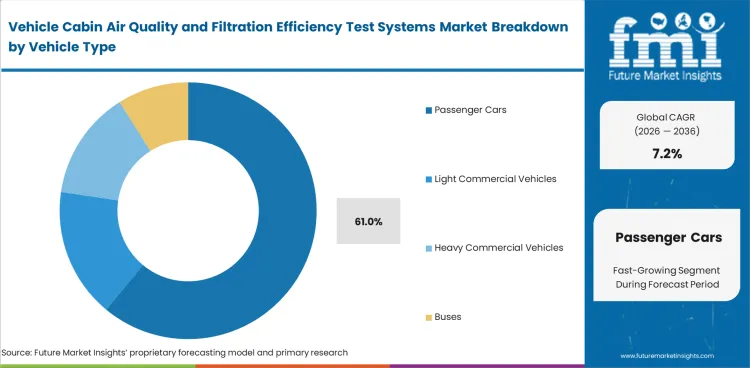
- Passenger cars are projected to represent 61.0% of the market in 2026. Premium comfort features and visible cabin-air claims are more concentrated in passenger vehicle development programs.
- Light commercial vehicles and buses continue to support validation demand. Passenger cars generate higher average testing intensity across feature-rich platforms.
Insights into the Technology Segment
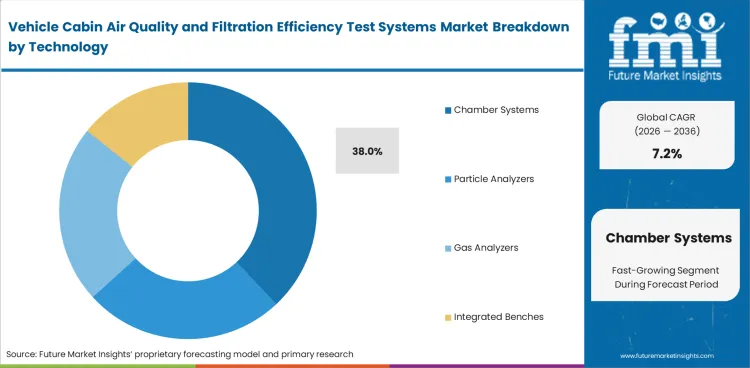
- Chamber systems are expected to hold 38.0% share in 2026. This segment leads because chambers make it possible to reproduce pollutant loads and temperature conditions in a repeatable way.
- Particle analyzers are essential because engineers need accurate counting and comparison data to verify filtration performance under controlled cabin simulation programs.
Insights into the Deployment Segment
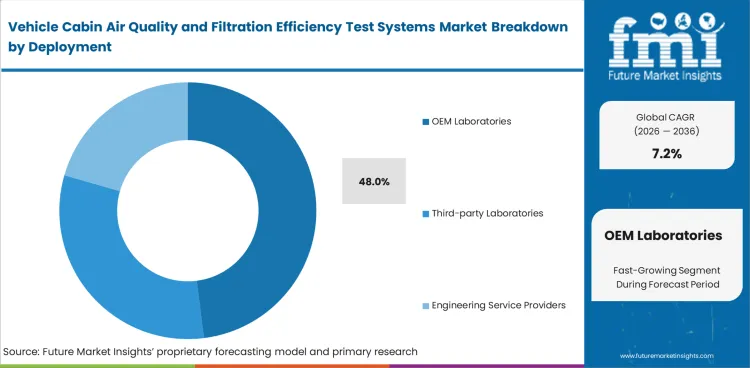
- OEM laboratories are projected to account for 48.0% share in 2026 because vehicle manufacturers want tighter control over benchmarking and release timing during platform development.
- Third-party laboratories are important because overflow testing and regional program support continue to create service demand across the market.
Insights into the Sales Channel Segment
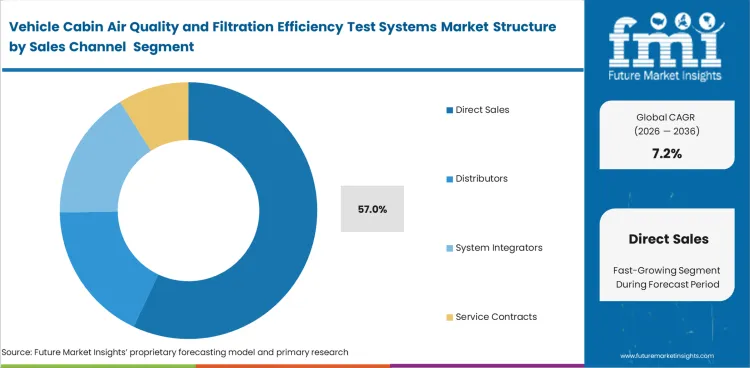
- Direct sales are expected to contribute 57.0% share in 2026 as large projects usually involve calibration and application-specific support during installation.
- Distributors play a role in standardized analyzers, though direct supplier engagement is stronger in chamber systems and integrated validation benches.
Vehicle Cabin Air Quality and Filtration Efficiency Test Systems Market Drivers, Restraints, and Opportunities
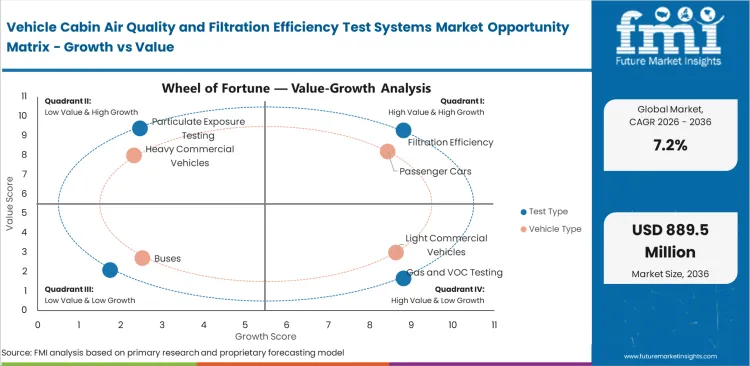
- Wider use of in-cabin health features is increasing the need for defensible air-quality and filtration claims.
- Method fragmentation across regions can slow equipment upgrades in some laboratories.
- Multi-parameter validation benches are creating new opportunity across premium vehicle and smart HVAC programs.
The market is expanding because vehicle interior air quality now carries more weight in product development. Cabin performance depends on filtration media and software behavior. A broader technical stack means a single filter check is no longer enough for many development programs. Labs need combined evidence across particles and response timing, which supports investment in more capable test systems.
Cabin Health and Validation Expansion
Demand shows that vehicle brands are moving beyond simple cabin filter checks toward broader interior air quality validation. Filtration efficiency testing leads because particulate removal claims are easier to measure and compare across media types. Passenger cars are the largest demand center because premium comfort features and stronger cabin health claims are more common in these programs. Chamber systems and integrated benches are becoming more important as laboratories need repeatable pollutant conditions and gas testing within one workflow.
Method Fragmentation and Laboratory Upgrade Constraints
Adoption is limited by uneven validation methods across countries and vehicle brands. This makes equipment upgrades less consistent from one laboratory base to another. Some OEMs already have deep internal capability. Others depend more on modular benches or outsourced testing services. This creates a mixed replacement cycle for suppliers. Growth is stronger in China and India where program counts are rising. Mature engineering centers focus more on upgrades and software integration. Large new laboratory installations are less common there.
Analysis of Vehicle Cabin Air Quality and Filtration Efficiency Test Systems Market by Key Countries
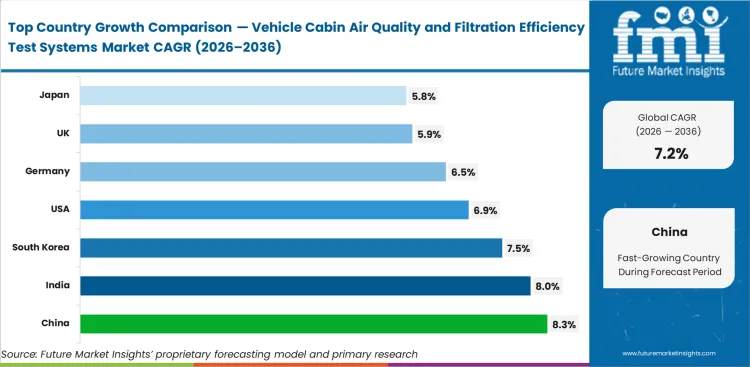
.webp "Top Country Growth Comparison Vehicle Cabin Air Quality And Filtration Efficiency Test Systems Market Cagr (2026 2036)")
| Country | CAGR |
|---|---|
| China | 8.3% |
| India | 8.0% |
| South Korea | 7.5% |
| United States | 6.9% |
| Germany | 6.5% |
| United Kingdom | 5.9% |
| Japan | 5.8% |
Source: FMI analysis based on primary research and proprietary forecasting model
- China leads major country growth with a CAGR of 8.3% through 2036.
- India follows at a CAGR of 8.0% due to rising platform count and stronger cabin feature adoption.
- South Korea is projected to record a CAGR of 7.5% because electronics-rich vehicle programs need deeper validation support.
- The United States is expected to hold a CAGR of 6.9%, supported by established OEM labs and premium vehicle development.
- Germany, the United Kingdom, and Japan are projected to post slower growth because they are more mature engineering bases with steadier replacement demand.
The global market is projected to rise at a CAGR of 7.2% over the forecast period. Country growth differs based on vehicle scale, engineering intensity local laboratory infrastructure.
Demand Outlook for Vehicle Cabin Air Quality and Filtration Efficiency Test Systems Market in China
The China vehicle cabin air quality and filtration efficiency test systems market is projected to grow at a CAGR of 8.3% through 2036. High urban exposure and rapid premium vehicle adoption support stronger demand for PM and gas validation in chamber system. Local supply depth makes it easier for OEMs and tier suppliers to expand dedicated testing capability inside domestic programs.
- Large program count supports more installed lab capacity.
- Urban exposure concerns keep cabin filtration commercially visible.
- Premium EV growth adds more testing content per platform.
Demand Outlook for Vehicle Cabin Air Quality and Filtration Efficiency Test Systems Market in India
The India vehicle cabin air quality and filtration efficiency test systems market is projected to grow at a CAGR of 8.0% from 2026 to 2036. Air-quality concern in large cities keeps cabin filtration commercially relevant. Feature rich vehicles are adding more demand for PM capture and sensor response testing. Cost discipline is important in this market, so modular benches and phased laboratory upgrades often see stronger adoption than very large turnkey systems.
- Record passenger vehicle sales expand the testing base.
- Modular benches fit cost-conscious lab expansion.
- Urban pollution supports stronger cabin filtration positioning.
Demand Outlook for Vehicle Cabin Air Quality and Filtration Efficiency Test Systems Market in South Korea
The South Korea vehicle cabin air quality and filtration efficiency test systems market is projected to grow at a CAGR of 7.5% by 2036. Korean OEMs compete heavily on electronics integration and in-cabin technology, which supports demand for validation systems linked to sensors and premium filtration claims. Dense supplier coordination adds to this trend because integrated benches are often easier to deploy across connected development workflows.
- Export-oriented OEMs sustain rigorous validation work.
- Electronics-rich cabins raise system integration needs.
- Supplier density supports faster method deployment.
Demand Outlook for Vehicle Cabin Air Quality and Filtration Efficiency Test Systems Market in the United States
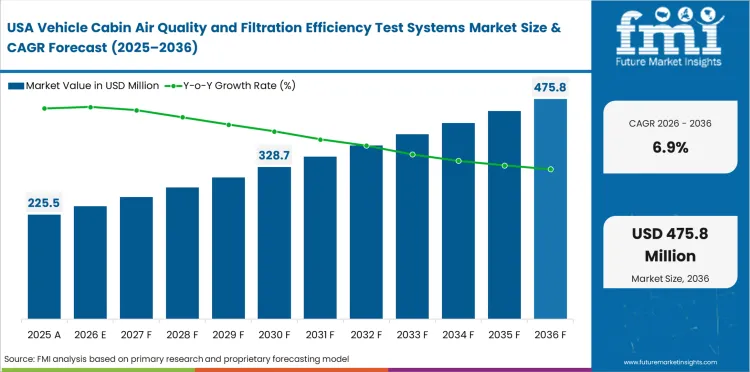
The United States vehicle cabin air quality and filtration efficiency test systems market is projected to grow at a CAGR of 6.9% through 2036. Large domestic production and widespread premium trim strategies support continuing lab investment around comfort and interior health features. Many large OEM laboratories are already established in this market, so demand focus on upgrades and wider method coverage.
- Established OEM labs support steady upgrade demand.
- Premium trims keep comfort and health features relevant.
- Outsourced services complement in-house engineering capacity.
Demand Outlook for Vehicle Cabin Air Quality and Filtration Efficiency Test Systems Market in Germany
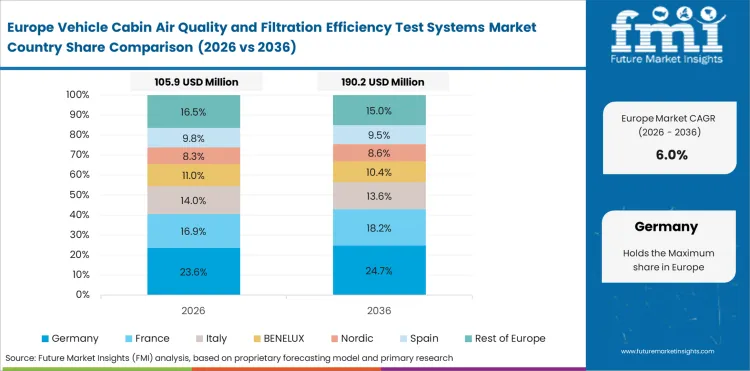
The Germany vehicle cabin air quality and filtration efficiency test systems market is projected to grow at a CAGR of 6.5% from 2026 to 2036. German OEMs and tier suppliers usually run high test intensity per platform, especially in premium vehicles where cabin comfort and pollutant reduction carry brand value. Capital discipline can slow year-to-year orders, though local demand is resilient because validation is built into early development work.
- Premium engineering work lifts average testing intensity.
- Tier-one laboratories remain an important demand source.
- Spending often favors method upgrades over large new installations.
Demand Outlook for Vehicle Cabin Air Quality and Filtration Efficiency Test Systems Market in the United Kingdom
The United Kingdom vehicle cabin air quality and filtration efficiency test systems market is projected to grow at a CAGR of 5.9% by 2036. The country benefits from advanced engineering services and applied automotive testing capability. Growth is more moderate because production scale is smaller than in China, India, or the United States.
- Applied testing capability supports specialist demand.
- Smaller production scale keeps growth more measured.
- Outsourced engineering work remains commercially relevant.
Demand Outlook for Vehicle Cabin Air Quality and Filtration Efficiency Test Systems Market in Japan
The Japan vehicle cabin air quality and filtration efficiency test systems market is projected to grow at a CAGR of 5.8% by 2036. Japan is a stable engineering center where reliability and validation discipline are very important. Growth is lower than the global average because many testing workflows are already established. New demand focuses on upgrades and refined measurement capability.
- Mature engineering practice supports steady replacement demand.
- Reliability standards keep testing discipline high.
- New demand centers on method refinement and lab upgrades.
Competitive Landscape and Strategic Positioning
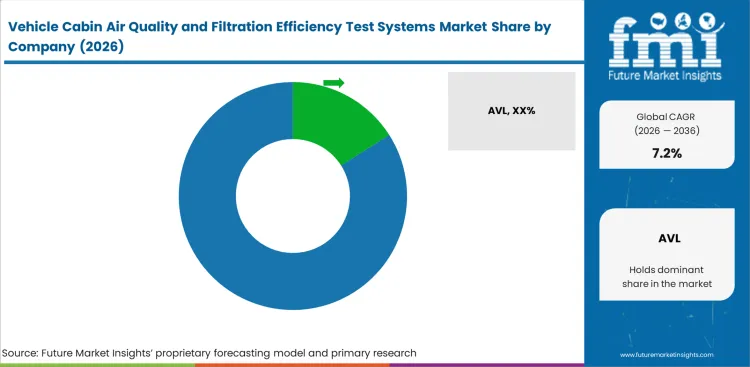
- The market remains moderately fragmented with a mix of instrument suppliers and testing service providers.
- Leading companies compete on accuracy, local service reach and so on.
- Specialist suppliers can win niche projects where aerosol or gas measurement depth matters more than total scale.
Competition in this market depends on whether a supplier can support repeatable evidence inside an automotive validation workflow. OEM and tier laboratories want more than a basic instrument. They need calibration support and service that reduce the risk of delayed development work. This gives an advantage to companies that already serve automotive emissions or filtration testing environments because those relationships can extend into cabin-air programs.
Third-party laboratories shape competition from another side of the market. These service groups do not always lead in turnkey chamber installations, though they remain important because outsourced testing often acts as a benchmark before customers invest in internal systems. That gives the market a mix of equipment competition and service competition.
Filter-media suppliers influence the testing ecosystem even when they are not direct leaders in test system supply. These moves raise the performance bar for cabin air systems and increase the need for better comparison work in OEM and supplier labs. As product claims become more technical, demand for test-system capability usually moves higher with them.
Key Companies in the Vehicle Cabin Air Quality and Filtration Efficiency Test Systems Market
Key global companies leading the vehicle cabin air quality and filtration efficiency test systems market include:
- AVL (Austria), HORIBA (Japan), SGS (Switzerland), and Intertek (United Kingdom). These companies offer strong capability in automotive testing and measurement systems used for cabin air quality assessment.
- Weiss Technik (Germany), TSI Incorporated (USA), and Palas GmbH (Germany) are known for chamber systems and particle analysis used in controlled cabin air validation.
- Ahlstrom (Finland), MANN+HUMMEL (Germany), and Freudenberg Filtration Technologies (Germany). Their filter media development activity supports higher testing needs across OEM and supplier programs.
Competitive Benchmarking: Vehicle Cabin Air Quality and Filtration Efficiency Test Systems Market
| Company | Cabin-Air Test Breadth | Measurement Depth | Automotive Access | Geographic Footprint |
|---|---|---|---|---|
| AVL | High | High | Strong | Global |
| SGS | High | Medium | Strong | Global |
| HORIBA | High | High | Strong | Global |
| Intertek | Medium | Medium | Moderate | Global |
| Weiss Technik | High | Medium | Moderate | Europe / Asia |
| TSI | Medium | High | Moderate | Global |
| Palas | Medium | High | Moderate | Europe / Asia |
| MANN+HUMMEL | Low | Medium | Moderate | Global |
| Ahlstrom | Low | Medium | Low | Europe / North America |
| Freudenberg Filtration Technologies | Low | Medium | Low | Europe / Asia |
Source: Future Market Insights competitive analysis, 2026.
Key Developments in the Vehicle Cabin Air Quality and Filtration Efficiency Test Systems Market
- In June 2024, MANN+HUMMEL launched a cabin air filter using nanofiber media aimed at stronger ultra-fine particle and pollutant filtration.
- In January 2024, Ahlstrom announced investment in a new Turin line for molecular filtration media serving indoor air quality and electric-vehicle applications.
Key Players in the Vehicle Cabin Air Quality and Filtration Efficiency Test Systems Market
Major Global Players
- AVL
- SGS
- HORIBA
- Intertek
- TSI
Emerging Players / Specialists
- Palas
- Weiss Technik
- Ahlstrom
- Freudenberg Filtration Technologies
- MANN+HUMMEL
Report Scope and Coverage
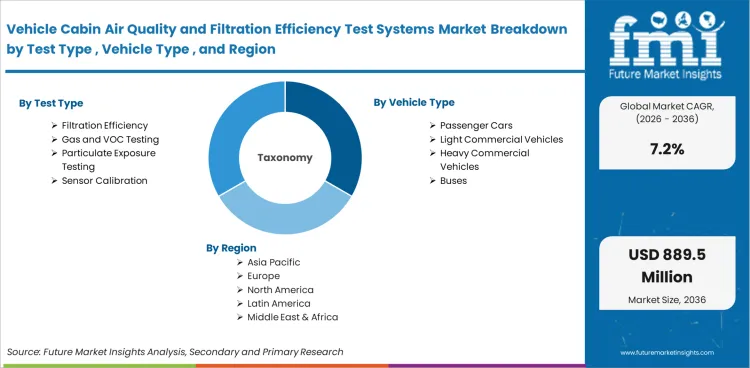
| Parameter | Details |
|---|---|
| Quantitative Units | USD 414.0 million to USD 829.8 million by 2036, at a CAGR of 7.2% |
| Market Definition | Test systems and related services used to validate vehicle cabin air quality and cabin filtration performance |
| Regions Covered | North America, Europe, East Asia, South Asia, Rest of World |
| Countries Covered | China, India, South Korea, United States, Germany, United Kingdom, Japan |
| Key Companies Profiled | AVL, SGS, HORIBA, Intertek, Weiss Technik, TSI, Palas |
| Forecast Period | 2026 to 2036 |
| Approach | Analyst-built bottom-up and triangulated model using vehicle production, registration, supplier footprint, and test-intensity assumptions |
Vehicle Cabin Air Quality and Filtration Efficiency Test Systems Market by Segments
Vehicle Cabin Air Quality and Filtration Efficiency Test Systems Market Segmented by Test Type
- Filtration Efficiency
- Gas and VOC Testing
- Particulate Exposure Testing
- Sensor Calibration
Vehicle Cabin Air Quality and Filtration Efficiency Test Systems Market Segmented by Vehicle Type
- Passenger Cars
- Light Commercial Vehicles
- Heavy Commercial Vehicles
- Buses
Vehicle Cabin Air Quality and Filtration Efficiency Test Systems Market Segmented by Technology
- Chamber Systems
- Particle Analyzers
- Gas Analyzers
- Integrated Benches
Vehicle Cabin Air Quality and Filtration Efficiency Test Systems Market Segmented by Deployment
- OEM Laboratories
- Third-party Laboratories
- Engineering Service Providers
Vehicle Cabin Air Quality and Filtration Efficiency Test Systems Market Segmented by Sales Channel
- Direct Sales
- Distributors
- System Integrators
- Service Contracts
Vehicle Cabin Air Quality and Filtration Efficiency Test Systems Market Segmented by Region
- North America
- USA
- Canada
- Mexico
- Latin America
- Brazil
- Chile
- Rest of Latin America
- Western Europe
- Germany
- UK
- Italy
- Spain
- France
- Nordic
- BENELUX
- Rest of Western Europe
- Eastern Europe
- Russia
- Poland
- Hungary
- Balkan & Baltic
- Rest of Eastern Europe
- East Asia
- China
- Japan
- South Korea
- South Asia and Pacific
- India
- ASEAN
- Australia & New Zealand
- Rest of South Asia and Pacific
- Middle East & Africa
- Kingdom of Saudi Arabia
- Other GCC Countries
- Turkiye
- South Africa
- Other African Union
- Rest of Middle East & Africa
Research Sources and Bibliography
- MANN+HUMMEL. (2024, June 26). New MANN-FILTER cabin air filter featuring nanofibers.
- Ahlstrom Oyj. (2024, January 23). Ahlstrom plans to invest in a new production line for molecular filtration media to expand further its offering for indoor air quality and electric vehicles.
- Japan Automobile Manufacturers Association. (2025). The Motor Industry of Japan 2025.
- European Automobile Manufacturers’ Association. (2026, March 24). New car registrations in Europe, 2025 results.
- Verband der Automobilindustrie. (2025, December 08). New registrations data in Germany.
This Report Answers
- What is the current and future size of the vehicle cabin air quality and filtration efficiency test systems market?
- How fast is the market expected to grow between 2026 and 2036?
- Which test type is likely to lead the market by 2026?
- Which vehicle segment is expected to account for the highest demand by 2026?
- What factors are driving market demand globally?
- How are vehicle interior air-quality claims influencing equipment demand?
- Why are passenger cars expected to remain a major demand center?
- Which countries are projected to show the fastest growth through 2036?
- What is driving expansion in China, India, and the United States?
- Who are the key companies active in the market?
- How does FMI estimate and validate the market forecast?
Frequently Asked Questions
What is the global market demand for vehicle cabin air quality and filtration efficiency test systems in 2026?
In 2026, the global market for vehicle cabin air quality and filtration efficiency test systems is expected to be worth USD 414.0 million.
How big will the vehicle cabin air quality and filtration efficiency test systems market be in 2036?
By 2036, the market is expected to be worth USD 829.8 million.
How much is demand expected to grow between 2026 and 2036?
Between 2026 and 2036, the market is expected to grow at a CAGR of 7.2%.
Which test type is likely to lead the market by 2026?
Filtration efficiency is expected to lead the market with an estimated 34.0% share in 2026.
Which vehicle segment is expected to lead demand by 2026?
Passenger cars are expected to account for the highest demand with an estimated 61.0% share in 2026.
What is driving demand growth in China?
Demand in China is linked to high vehicle output, stronger urban air-quality pressure, and rising premium vehicle content that increases validation intensity.
Preview the report firsthand - request a free sample
Get SampleGet the brochure for pricing and purchase details.
Get PDFTable of Content
- Executive Summary
- Global Market Outlook
- Demand-side Trends
- Supply-side Trends
- Technology Roadmap Analysis
- Analysis and Recommendations
- Market Overview
- Market Coverage / Taxonomy
- Market Definition / Scope / Limitations
- Research Methodology
- Chapter Orientation
- Analytical Lens and Working Hypotheses
- Market Structure, Signals, and Trend Drivers
- Benchmarking and Cross-market Comparability
- Market Sizing, Forecasting, and Opportunity Mapping
- Research Design and Evidence Framework
- Desk Research Programme (Secondary Evidence)
- Company Annual and Sustainability Reports
- Peer-reviewed Journals and Academic Literature
- Corporate Websites, Product Literature, and Technical Notes
- Earnings Decks and Investor Briefings
- Statutory Filings and Regulatory Disclosures
- Technical White Papers and Standards Notes
- Trade Journals, Industry Magazines, and Analyst Briefs
- Conference Proceedings, Webinars, and Seminar Materials
- Government Statistics Portals and Public Data Releases
- Press Releases and Reputable Media Coverage
- Specialist Newsletters and Curated Briefings
- Sector Databases and Reference Repositories
- FMI Internal Proprietary Databases and Historical Market Datasets
- Subscription Datasets and Paid Sources
- Social Channels, Communities, and Digital Listening Inputs
- Additional Desk Sources
- Expert Input and Fieldwork (Primary Evidence)
- Primary Modes
- Qualitative Interviews and Expert Elicitation
- Quantitative Surveys and Structured Data Capture
- Blended Approach
- Why Primary Evidence is Used
- Field Techniques
- Interviews
- Surveys
- Focus Groups
- Observational and In-context Research
- Social and Community Interactions
- Stakeholder Universe Engaged
- C-suite Leaders
- Board Members
- Presidents and Vice Presidents
- R&D and Innovation Heads
- Technical Specialists
- Domain Subject-matter Experts
- Scientists
- Physicians and Other Healthcare Professionals
- Governance, Ethics, and Data Stewardship
- Research Ethics
- Data Integrity and Handling
- Primary Modes
- Tooling, Models, and Reference Databases
- Desk Research Programme (Secondary Evidence)
- Data Engineering and Model Build
- Data Acquisition and Ingestion
- Cleaning, Normalisation, and Verification
- Synthesis, Triangulation, and Analysis
- Quality Assurance and Audit Trail
- Market Background
- Market Dynamics
- Drivers
- Restraints
- Opportunity
- Trends
- Scenario Forecast
- Demand in Optimistic Scenario
- Demand in Likely Scenario
- Demand in Conservative Scenario
- Opportunity Map Analysis
- Product Life Cycle Analysis
- Supply Chain Analysis
- Investment Feasibility Matrix
- Value Chain Analysis
- PESTLE and Porter’s Analysis
- Regulatory Landscape
- Regional Parent Market Outlook
- Production and Consumption Statistics
- Import and Export Statistics
- Market Dynamics
- Global Market Analysis 2021 to 2025 and Forecast, 2026 to 2036
- Historical Market Size Value (USD Million) Analysis, 2021 to 2025
- Current and Future Market Size Value (USD Million) Projections, 2026 to 2036
- Y-o-Y Growth Trend Analysis
- Absolute $ Opportunity Analysis
- Global Market Pricing Analysis 2021 to 2025 and Forecast 2026 to 2036
- Global Market Analysis 2021 to 2025 and Forecast 2026 to 2036, By Test Type
- Introduction / Key Findings
- Historical Market Size Value (USD Million) Analysis By Test Type , 2021 to 2025
- Current and Future Market Size Value (USD Million) Analysis and Forecast By Test Type , 2026 to 2036
- Filtration Efficiency
- Gas and VOC Testing
- Particulate Exposure Testing
- Sensor Calibration
- Filtration Efficiency
- Y-o-Y Growth Trend Analysis By Test Type , 2021 to 2025
- Absolute $ Opportunity Analysis By Test Type , 2026 to 2036
- Global Market Analysis 2021 to 2025 and Forecast 2026 to 2036, By Vehicle Type
- Introduction / Key Findings
- Historical Market Size Value (USD Million) Analysis By Vehicle Type, 2021 to 2025
- Current and Future Market Size Value (USD Million) Analysis and Forecast By Vehicle Type, 2026 to 2036
- Passenger Cars
- Light Commercial Vehicles
- Heavy Commercial Vehicles
- Buses
- Passenger Cars
- Y-o-Y Growth Trend Analysis By Vehicle Type, 2021 to 2025
- Absolute $ Opportunity Analysis By Vehicle Type, 2026 to 2036
- Global Market Analysis 2021 to 2025 and Forecast 2026 to 2036, By Technology
- Introduction / Key Findings
- Historical Market Size Value (USD Million) Analysis By Technology, 2021 to 2025
- Current and Future Market Size Value (USD Million) Analysis and Forecast By Technology, 2026 to 2036
- Chamber Systems
- Particle Analyzers
- Gas Analyzers
- Integrated Benches
- Chamber Systems
- Y-o-Y Growth Trend Analysis By Technology, 2021 to 2025
- Absolute $ Opportunity Analysis By Technology, 2026 to 2036
- Global Market Analysis 2021 to 2025 and Forecast 2026 to 2036, By Deployment
- Introduction / Key Findings
- Historical Market Size Value (USD Million) Analysis By Deployment, 2021 to 2025
- Current and Future Market Size Value (USD Million) Analysis and Forecast By Deployment, 2026 to 2036
- OEM Laboratories
- Third-party Laboratories
- Engineering Service Providers
- OEM Laboratories
- Y-o-Y Growth Trend Analysis By Deployment, 2021 to 2025
- Absolute $ Opportunity Analysis By Deployment, 2026 to 2036
- Global Market Analysis 2021 to 2025 and Forecast 2026 to 2036, By Sales Channel
- Introduction / Key Findings
- Historical Market Size Value (USD Million) Analysis By Sales Channel, 2021 to 2025
- Current and Future Market Size Value (USD Million) Analysis and Forecast By Sales Channel, 2026 to 2036
- Direct Sales
- Distributors
- System Integrators
- Service Contracts
- Direct Sales
- Y-o-Y Growth Trend Analysis By Sales Channel, 2021 to 2025
- Absolute $ Opportunity Analysis By Sales Channel, 2026 to 2036
- Global Market Analysis 2021 to 2025 and Forecast 2026 to 2036, By Region
- Introduction
- Historical Market Size Value (USD Million) Analysis By Region, 2021 to 2025
- Current Market Size Value (USD Million) Analysis and Forecast By Region, 2026 to 2036
- North America
- Latin America
- Western Europe
- Eastern Europe
- East Asia
- South Asia and Pacific
- Middle East & Africa
- Market Attractiveness Analysis By Region
- North America Market Analysis 2021 to 2025 and Forecast 2026 to 2036, By Country
- Historical Market Size Value (USD Million) Trend Analysis By Market Taxonomy, 2021 to 2025
- Market Size Value (USD Million) Forecast By Market Taxonomy, 2026 to 2036
- By Country
- USA
- Canada
- Mexico
- By Test Type
- By Vehicle Type
- By Technology
- By Deployment
- By Sales Channel
- By Country
- Market Attractiveness Analysis
- By Country
- By Test Type
- By Vehicle Type
- By Technology
- By Deployment
- By Sales Channel
- Key Takeaways
- Latin America Market Analysis 2021 to 2025 and Forecast 2026 to 2036, By Country
- Historical Market Size Value (USD Million) Trend Analysis By Market Taxonomy, 2021 to 2025
- Market Size Value (USD Million) Forecast By Market Taxonomy, 2026 to 2036
- By Country
- Brazil
- Chile
- Rest of Latin America
- By Test Type
- By Vehicle Type
- By Technology
- By Deployment
- By Sales Channel
- By Country
- Market Attractiveness Analysis
- By Country
- By Test Type
- By Vehicle Type
- By Technology
- By Deployment
- By Sales Channel
- Key Takeaways
- Western Europe Market Analysis 2021 to 2025 and Forecast 2026 to 2036, By Country
- Historical Market Size Value (USD Million) Trend Analysis By Market Taxonomy, 2021 to 2025
- Market Size Value (USD Million) Forecast By Market Taxonomy, 2026 to 2036
- By Country
- Germany
- UK
- Italy
- Spain
- France
- Nordic
- BENELUX
- Rest of Western Europe
- By Test Type
- By Vehicle Type
- By Technology
- By Deployment
- By Sales Channel
- By Country
- Market Attractiveness Analysis
- By Country
- By Test Type
- By Vehicle Type
- By Technology
- By Deployment
- By Sales Channel
- Key Takeaways
- Eastern Europe Market Analysis 2021 to 2025 and Forecast 2026 to 2036, By Country
- Historical Market Size Value (USD Million) Trend Analysis By Market Taxonomy, 2021 to 2025
- Market Size Value (USD Million) Forecast By Market Taxonomy, 2026 to 2036
- By Country
- Russia
- Poland
- Hungary
- Balkan & Baltic
- Rest of Eastern Europe
- By Test Type
- By Vehicle Type
- By Technology
- By Deployment
- By Sales Channel
- By Country
- Market Attractiveness Analysis
- By Country
- By Test Type
- By Vehicle Type
- By Technology
- By Deployment
- By Sales Channel
- Key Takeaways
- East Asia Market Analysis 2021 to 2025 and Forecast 2026 to 2036, By Country
- Historical Market Size Value (USD Million) Trend Analysis By Market Taxonomy, 2021 to 2025
- Market Size Value (USD Million) Forecast By Market Taxonomy, 2026 to 2036
- By Country
- China
- Japan
- South Korea
- By Test Type
- By Vehicle Type
- By Technology
- By Deployment
- By Sales Channel
- By Country
- Market Attractiveness Analysis
- By Country
- By Test Type
- By Vehicle Type
- By Technology
- By Deployment
- By Sales Channel
- Key Takeaways
- South Asia and Pacific Market Analysis 2021 to 2025 and Forecast 2026 to 2036, By Country
- Historical Market Size Value (USD Million) Trend Analysis By Market Taxonomy, 2021 to 2025
- Market Size Value (USD Million) Forecast By Market Taxonomy, 2026 to 2036
- By Country
- India
- ASEAN
- Australia & New Zealand
- Rest of South Asia and Pacific
- By Test Type
- By Vehicle Type
- By Technology
- By Deployment
- By Sales Channel
- By Country
- Market Attractiveness Analysis
- By Country
- By Test Type
- By Vehicle Type
- By Technology
- By Deployment
- By Sales Channel
- Key Takeaways
- Middle East & Africa Market Analysis 2021 to 2025 and Forecast 2026 to 2036, By Country
- Historical Market Size Value (USD Million) Trend Analysis By Market Taxonomy, 2021 to 2025
- Market Size Value (USD Million) Forecast By Market Taxonomy, 2026 to 2036
- By Country
- Kingdom of Saudi Arabia
- Other GCC Countries
- Turkiye
- South Africa
- Other African Union
- Rest of Middle East & Africa
- By Test Type
- By Vehicle Type
- By Technology
- By Deployment
- By Sales Channel
- By Country
- Market Attractiveness Analysis
- By Country
- By Test Type
- By Vehicle Type
- By Technology
- By Deployment
- By Sales Channel
- Key Takeaways
- Key Countries Market Analysis
- USA
- Pricing Analysis
- Market Share Analysis, 2025
- By Test Type
- By Vehicle Type
- By Technology
- By Deployment
- By Sales Channel
- Canada
- Pricing Analysis
- Market Share Analysis, 2025
- By Test Type
- By Vehicle Type
- By Technology
- By Deployment
- By Sales Channel
- Mexico
- Pricing Analysis
- Market Share Analysis, 2025
- By Test Type
- By Vehicle Type
- By Technology
- By Deployment
- By Sales Channel
- Brazil
- Pricing Analysis
- Market Share Analysis, 2025
- By Test Type
- By Vehicle Type
- By Technology
- By Deployment
- By Sales Channel
- Chile
- Pricing Analysis
- Market Share Analysis, 2025
- By Test Type
- By Vehicle Type
- By Technology
- By Deployment
- By Sales Channel
- Germany
- Pricing Analysis
- Market Share Analysis, 2025
- By Test Type
- By Vehicle Type
- By Technology
- By Deployment
- By Sales Channel
- UK
- Pricing Analysis
- Market Share Analysis, 2025
- By Test Type
- By Vehicle Type
- By Technology
- By Deployment
- By Sales Channel
- Italy
- Pricing Analysis
- Market Share Analysis, 2025
- By Test Type
- By Vehicle Type
- By Technology
- By Deployment
- By Sales Channel
- Spain
- Pricing Analysis
- Market Share Analysis, 2025
- By Test Type
- By Vehicle Type
- By Technology
- By Deployment
- By Sales Channel
- France
- Pricing Analysis
- Market Share Analysis, 2025
- By Test Type
- By Vehicle Type
- By Technology
- By Deployment
- By Sales Channel
- India
- Pricing Analysis
- Market Share Analysis, 2025
- By Test Type
- By Vehicle Type
- By Technology
- By Deployment
- By Sales Channel
- ASEAN
- Pricing Analysis
- Market Share Analysis, 2025
- By Test Type
- By Vehicle Type
- By Technology
- By Deployment
- By Sales Channel
- Australia & New Zealand
- Pricing Analysis
- Market Share Analysis, 2025
- By Test Type
- By Vehicle Type
- By Technology
- By Deployment
- By Sales Channel
- China
- Pricing Analysis
- Market Share Analysis, 2025
- By Test Type
- By Vehicle Type
- By Technology
- By Deployment
- By Sales Channel
- Japan
- Pricing Analysis
- Market Share Analysis, 2025
- By Test Type
- By Vehicle Type
- By Technology
- By Deployment
- By Sales Channel
- South Korea
- Pricing Analysis
- Market Share Analysis, 2025
- By Test Type
- By Vehicle Type
- By Technology
- By Deployment
- By Sales Channel
- Russia
- Pricing Analysis
- Market Share Analysis, 2025
- By Test Type
- By Vehicle Type
- By Technology
- By Deployment
- By Sales Channel
- Poland
- Pricing Analysis
- Market Share Analysis, 2025
- By Test Type
- By Vehicle Type
- By Technology
- By Deployment
- By Sales Channel
- Hungary
- Pricing Analysis
- Market Share Analysis, 2025
- By Test Type
- By Vehicle Type
- By Technology
- By Deployment
- By Sales Channel
- Kingdom of Saudi Arabia
- Pricing Analysis
- Market Share Analysis, 2025
- By Test Type
- By Vehicle Type
- By Technology
- By Deployment
- By Sales Channel
- Turkiye
- Pricing Analysis
- Market Share Analysis, 2025
- By Test Type
- By Vehicle Type
- By Technology
- By Deployment
- By Sales Channel
- South Africa
- Pricing Analysis
- Market Share Analysis, 2025
- By Test Type
- By Vehicle Type
- By Technology
- By Deployment
- By Sales Channel
- USA
- Market Structure Analysis
- Competition Dashboard
- Competition Benchmarking
- Market Share Analysis of Top Players
- By Regional
- By Test Type
- By Vehicle Type
- By Technology
- By Deployment
- By Sales Channel
- Competition Analysis
- Competition Deep Dive
- AVL
- Overview
- Product Portfolio
- Profitability by Market Segments (Product/Age /Sales Channel/Region)
- Sales Footprint
- Strategy Overview
- Marketing Strategy
- Product Strategy
- Channel Strategy
- SGS
- HORIBA
- Intertek
- TSI
- Palas
- Weiss Technik
- Ahlstrom
- Freudenberg Filtration Technologies
- MANN+HUMMEL
- AVL
- Competition Deep Dive
- Assumptions & Acronyms Used


