

- Industry Size (2026)
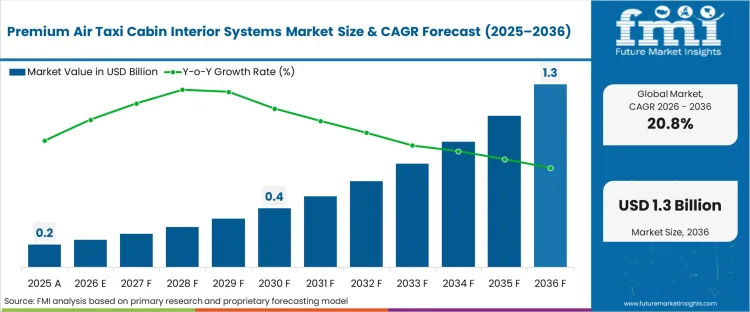
- USD 0.2 Bn
- Forecast (2036)
- USD 1.3 Bn
- CAGR
- to USD 1.3 Bn (2026 to 2036)
Premium Air Taxi Cabin Interior Systems Market Size, Market Forecast and Outlook By FMI
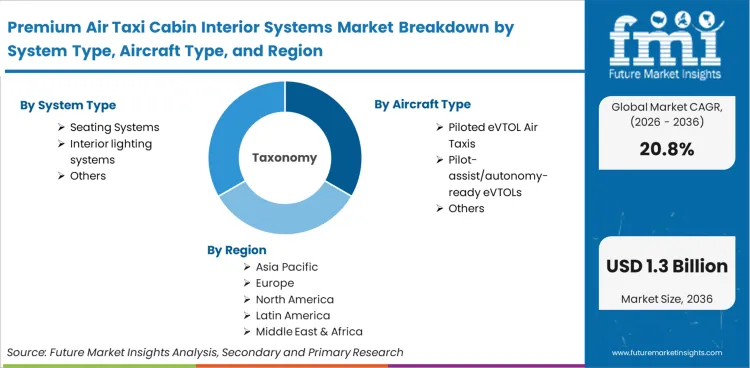
The premium air taxi cabin interior systems market’s baseline revenue reached USD 0.1 billion in 2025 with the industry demand anticipated to cross USD 0.2 billion in 2026, expanding at a CAGR of 20.8% over this forecast timeline. Commercial momentum propels the overall market sector scale to USD 1.3 billion through 2036, as stringent aerospace weight budgets intersect with luxury passenger expectations to establish a massive air taxi interior systems market size driven by structural material replacement.
Sourcing directors at original equipment manufacturers face a brutal zero-sum tradeoff between passenger payload capacity and executive-tier finish quality. Selecting automotive-grade luxury trims destroys flight range, forcing engineering teams to source lightweight interior materials for air taxis that meet 16G crash ratings. Delaying supplier qualification for premium air taxi cabin interiors risks missing type certification windows, because every pound of seat material alters aircraft center of gravity and requires costly flight requalification. FMI's analysis indicates that securing low-weight air taxi enclosures now dictates commercial launch viability.
Engineering teams navigating complex eVTOL cabin certification requirements trigger structural transitions from prototype testing to fleet scaling. Once suppliers demonstrate compliance with EASA SC-VTOL-02 load paths without adding steel reinforcement, vehicle manufacturers instantly move from bespoke cabin fabrication to line-rate procurement. This validation removes the primary design bottleneck holding back serial production of advanced air mobility passenger variants.
Summary of Premium Air Taxi Cabin Interior Systems Market
- Premium Air Taxi Cabin Interior Systems Market Definition
- Premium air taxi cabin interior systems encompass weight-optimized, crash-certified passenger enclosure components engineered specifically for vertical take-off and landing vehicles, integrating luxury aesthetics with extreme mass constraints.
- Demand Drivers in the Market
- Rigid battery energy density limitations compel chief engineers to eliminate every possible ounce from advanced air mobility cabin interiors.
- High-net-worth passenger expectations force cabin design directors to source acoustic dampening materials that mask electric rotor frequencies.
- Rapid turnaround requirements push fleet operations managers to demand highly durable surface laminates that withstand constant daily cycling.
- Key Segments Analyzed in the FMI Report
- Seating Systems: 31% share in 2026, driven by mandatory 16G vertical drop test certification that concentrates value in specialized structural frames.
- Piloted eVTOL Air Taxis: 72% share through 2036, requiring physical barrier integration between flight crews and passengers.
- Line-Fit OEM Installation: 83% share, as retrofitting alters critical center-of-gravity calculations requiring expensive recertification.
- Airport-To-City Premium Shuttle: 38% share, necessitating integrated high-end luggage restraints within passenger footprints.
- Lightweight Composites: 34% share, offering viable strength-to-weight ratios for primary interior structures.
- UAE: 24.8% CAGR, fueled by sovereign wealth initiatives accelerating executive transport infrastructure ahead of commercial airline timelines.
- Analyst Opinion at FMI
- Nikhil Kaitwade, Principal Analyst, Automotive and Aerospace, at FMI, points out, "Standard metrics capture passenger capacity and seat pitch accurately. What they miss entirely is the brutal mathematical reality of eVTOL mass budgets, where interior components compete directly with battery cells for payload allowance. Generalists assume an air taxi interior is simply a miniaturized corporate jet cabin. In practice, interior engineering directors are ripping out conventional foam cushioning and replacing it with tensioned smart textiles just to save a few kilograms. When evaluating premium air taxi interiors vs standard eVTOL cabins, suppliers who pitch luxury without a corresponding weight-reduction strategy will not survive preliminary design reviews."
- Strategic Implications / Executive Takeaways
- Procurement directors at tier-1 suppliers face immediate mandates to secure exclusive supply contracts for advanced thermoplastic composites.
- Certification managers risk multi-year delays if they attempt to port existing part-25 airline seating compliance data into novel part-27 rotorcraft frameworks.
- Fleet operators gain significant margin advantages by selecting modular aerospace interior systems for urban air mobility that permit cabin reconfiguration without grounding aircraft.
- Methodology
- Primary Research: Chief engineers, interior qualification managers, and procurement directors at tier-1 aerospace suppliers.
- Desk Research: EASA SC-VTOL-02 certification logs, FAA Engineering Brief dockets, and composite material flammability test registries.
- Market-Sizing and Forecasting: Aircraft order book backlogs paired with projected cabin component bill-of-materials costs per vehicle.
- Data Validation and Update Cycle: Cross-referenced against quarterly supplier earnings reports and OEM weight-allocation design freeze announcements.
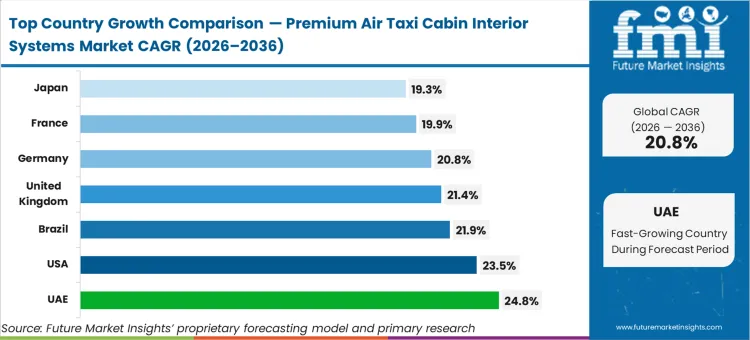
UAE leads geographic expansion at 24.8%, driven by sovereign wealth commitments establishing immediate executive transfer eVTOL cabin design networks independent of legacy airspace constraints. United States tracks closely at 23.5%, supported by concentrated venture funding in domestic OEM programs. Brazil registers 21.9% growth as regional operators adapt platforms for existing heavy-helicopter commuter routes. United Kingdom advances at 21.4%, while Germany secures 20.8% through deep aerospace engineering integration. France grows at 19.9%, and Japan follows at 19.3%. Structural divergence separates regions funding clean-sheet aerial networks from those forcing vertical lift operations into existing crowded vertiports infrastructure.
Premium Air Taxi Cabin Interior Systems Market Definition
Premium air taxi cabin interior systems comprise specialized, weight-optimized passenger enclosure components engineered specifically for vertical take-off and landing vehicles. This eVTOL cabin interior systems market encompasses all structural, environmental, and aesthetic modules situated within pressure vessels that must pass aviation flammability testing while operating within extreme mass limitations. Effective premium cabin design for eVTOL aircraft balances high-net-worth aesthetic expectations against strict battery-electric propulsion boundaries.
Premium Air Taxi Cabin Interior Systems Market Inclusions
Scope covers crash-attenuating passenger seats, vibration-dampening floor panels, and active air taxi cabin noise reduction systems designed for rotorcraft. Evaluation incorporates urban air mobility cabin systems such as panoramic aircraft interior lighting modules, eVTOL cabin doors and transparencies, and specialized cargo retention mechanisms. Hardware supporting flight test environments, including urban air mobility flight test systems, falls within parameters when integrated directly into passenger compartments.
Premium Air Taxi Cabin Interior Systems Market Exclusions
Propulsion batteries, flight control avionics, and exterior aerodynamic fairings fall outside this analysis due to their classification as primary aircraft systems rather than interior accommodations. Dedicated ground-based eVTOL charging facilities are omitted because they represent physical infrastructure assets. Standard commercial aviation seats and bespoke medical and VIP eVTOL cabin layout conversions lacking baseline SC-VTOL crash certification are excluded.
Premium Air Taxi Cabin Interior Systems Market Research Methodology
- Primary Research: Chief engineers, interior qualification managers, and procurement directors at tier-1 aerospace suppliers.
- Desk Research: EASA SC-VTOL-02 certification logs, FAA Engineering Brief dockets, and composite material flammability test registries.
- Market-Sizing and Forecasting: Aircraft order book backlogs paired with projected cabin interior content per eVTOL aircraft bill-of-materials costs.
- Data Validation and Update Cycle: Cross-referenced against quarterly supplier earnings reports and OEM weight-allocation design freeze announcements.
Segmental Analysis
Premium Air Taxi Cabin Interior Systems Market Analysis by System Type
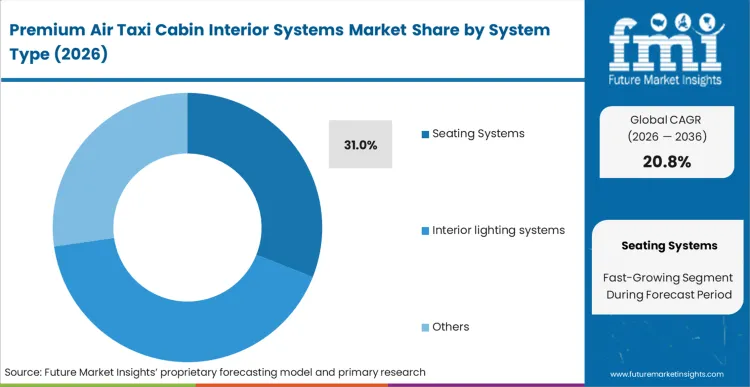
Selecting advanced carbon-fiber seat pans reduces overall aircraft weight by crucial kilograms, directly extending effective operational ranges. The aspect that procurement teams rarely factor into their initial global aircraft cabin interior budgets is that these specialized units require bespoke floor attachments. Subcontractors who fail to deliver certified dynamic test results early in development cycles force OEMs into costly redesign loops, driving intense competition among eVTOL seat suppliers for air taxis to secure early contracts. Vertical drop-load requirements dictate fundamental architectures of eVTOL enclosures, forcing manufacturers to abandon standard commercial aircraft seating tracks. Seating systems holds 31% share in 2026, and FMI's assessment is that this dominance stems entirely from the extreme difficulty of passing EASA SC-VTOL crash condition testing. Interior qualification managers must ensure energy-absorbing seat bases attenuate impact forces without exceeding strict mass limits.
- Initial Specification Criteria: Aircraft chief engineers prioritize energy-absorbing structural properties over aesthetic finish when selecting vendor designs. Finding a reliable premium air taxi seat supplier requires validating computational fluid dynamics models before cutting physical molds.
- Qualification Testing Hurdles: Dynamic crash-test facilities subject seat structures to 16G forward and vertical loads. Quality assurance directors evaluating aviation seating for electric aircraft face severe schedule risks if composite layups delaminate under strain.
- Fleet Renewal Drivers: High passenger turnover degrades soft goods rapidly. Maintenance managers require modular cushion replacement mechanisms, determining the best seat solution for eVTOL air taxis based on tarmac turnaround speed.
Premium Air Taxi Cabin Interior Systems Market Analysis by Aircraft Type
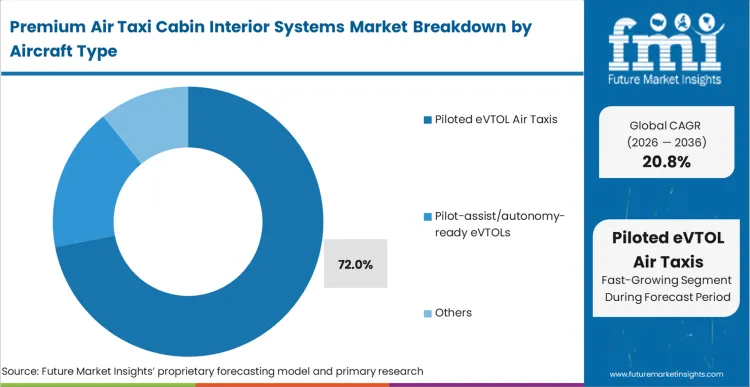
Regulatory frameworks mandating physical separation between flight controls and passenger compartments heavily shape early vehicle layouts. Piloted eVTOL air taxis command 72% share as certification authorities prioritize human-in-the-loop operations for initial urban deployments. Cabin design directors at major OEMs are forced to integrate transparent, impact-resistant bulkheads that add unwanted mass to airframes. These specialized aircraft cabin interiors necessitate complex airflow management to keep pilots comfortable without draining battery reserves through excessive HVAC usage. The constraint most observers miss is that integrating physical flight controls inherently compromises panoramic passenger views heavily featured in conceptual renderings. Manufacturers electing to bypass piloted designs entirely rely heavily on aircraft cabin engineering for eVTOL OEMs to navigate significantly longer, unproven autonomy certification pathways.
- Pilot Safety Integration: Cockpit engineers specify anti-ballistic transparent partitions to satisfy security mandates. Sourcing directors absorb higher component costs to acquire lightweight polycarbonate alternatives for air taxi cabin interiors market applications.
- Hidden Operational Penalties: Independent pilot climate zones require duplicate environmental sensors and ducting. Systems integration managers battle constant weight creep as complexity increases.
- Total Lifecycle Assessment: Transitioning piloted airframes to future autonomous operations requires complete cabin overhauls. Financial planning officers must calculate depreciation curves of pilot-specific interior hardware.
Premium Air Taxi Cabin Interior Systems Market Analysis by Fit Type
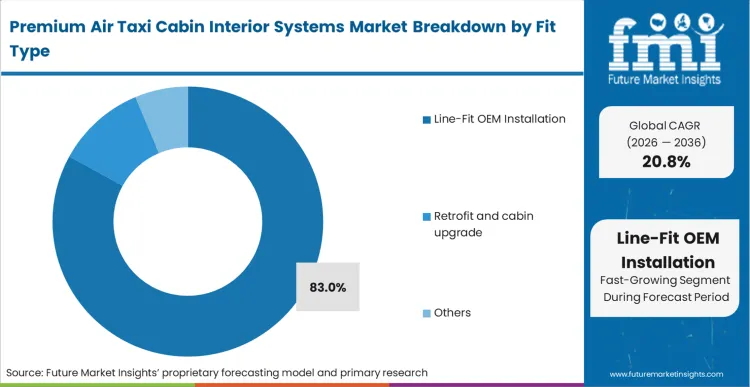
Based on FMI's projection, commercial aircraft cabin interior aftermarket modifications will remain severely stunted in this sector. A practitioner knows that analyzing line-fit vs retrofit air taxi interiors reveals swapping a fabric seat cover for a leather one without factory approval can theoretically ground an air taxi if weight deltas violate certified flight envelopes. Aircraft center-of-gravity calculations govern every aspect of eVTOL payload distribution, making ad-hoc cabin modifications virtually impossible. Line-fit OEM installation captures 83% share because vehicle manufacturers must freeze interior configurations long before final assembly to guarantee flight stability. Procurement directors at companies like RECARO Aircraft Seating secure long-term contracts by integrating directly with OEM digital twin models. Operators submitting an RFQ for eVTOL cabin interiors must mandate strict factory-only hardware replacement policies.
- Crash Attenuation Failures: Uncertified aftermarket floor panels alter intended energy absorption paths. Safety directors must mandate strict OEM-only hardware replacement policies.
- Component Vibration Fatigue: Improperly torqued interior panels resonate at electric motor frequencies. Maintenance technicians face unpredictable interior wear if non-factory fasteners are utilized.
- Warranty Validation Requirements: OEMs lock down diagnostic sensor networks embedded in cabin walls. Fleet operators must purchase expensive line-fit spares to maintain operational data continuity.
Premium Air Taxi Cabin Interior Systems Market Analysis by Use Case
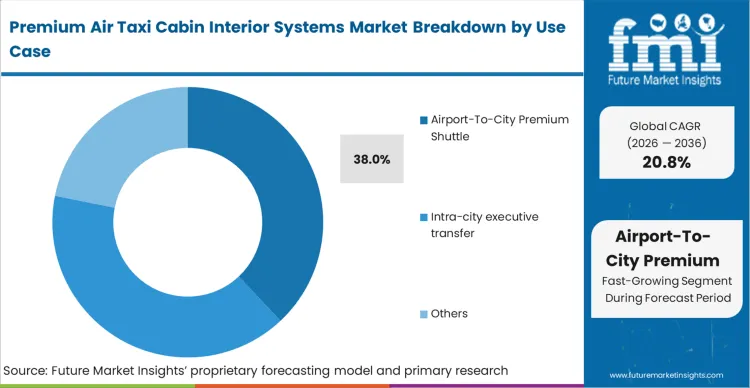
Luggage accommodation presents a severe geometric challenge for vehicles lacking traditional cargo bays. Airport-to-city premium shuttle configurations account for 38% share, forcing interior architects to design robust baggage securing mechanisms directly within passenger envelopes. Route planning directors select airport shuttle air taxi interiors that prioritize rapid ingress and egress, utilizing wide-opening doors and strategically placed grab handles. Integrating heavy luggage restraints adjacent to passenger seating complicates acoustic insulation strategies. The irony escaping casual observers is that intercity eVTOL passenger cabin systems often utilize fewer luxury materials than sightseeing variants, because structural reinforcements required for 50-pound suitcases consume available weight budgets. Fleet managers who incorrectly specify interior layouts face excessive boarding times that destroy economic advantages of rapid aerial transit.
- Primary Component Suppliers: Legacy aerospace seating firms dominate initial contracts by leveraging existing certification libraries. Supply chain managers depend on these incumbents for predictable delivery schedules in premium air taxi passenger experience market deployments.
- Production Bottleneck Risks: Specialty lightweight foam manufacturing scales poorly. Assembly line directors must warehouse excess cushion inventory to protect tourism air taxi premium cabins against raw material shortages.
- Future Sourcing Shifts: Startups pioneering ultra-light 3D-printed brackets gain traction. Value engineering teams aggressively switch vendors to shave fractional ounces from interior assemblies.
Premium Air Taxi Cabin Interior Systems Market Analysis by Material Type
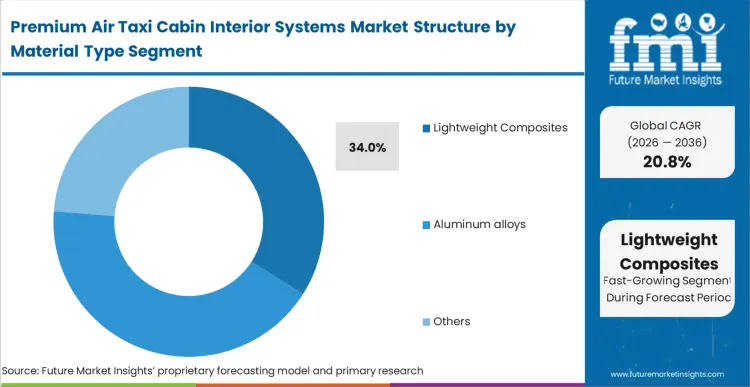
Materials science directors evaluate advanced thermoplastic resin matrices that meet strict smoke and toxicity standards while offering rapid forming times. These aircraft cabin environment sensor housings and trim pieces require specialized, high-cost tooling. Flammability resistance requirements in battery-dense vehicles push engineers away from traditional aerospace plastics. Lightweight composites hold 34% share, providing critical structural rigidity necessary for crash-load transfer. The non-obvious reality within manufacturing facilities is that carbon-fiber surface finishes often require extensive hand-sanding, introducing labor bottlenecks that undermine high-volume automotive-style production goals. Production managers sourcing lightweight aerospace cabin components for air taxis failing to secure reliable composite molding capacity face immediate assembly line stoppages.
- Luxury Touchpoint Adoption: Initial high-ticket routes demand bespoke aesthetic finishes. Brand managers dictate specific veneer applications to justify premium ticket pricing.
- Mainstream Operational Pivots: High passenger volume degrades fragile luxury surfaces rapidly. Cabin maintenance supervisors demand a shift toward scuff-resistant, self-healing smart polymers.
- Late-Stage Utilitarian Conversion: Mature aerial networks prioritize extreme durability over visual appeal. Fleet procurement officers ultimately standardize on washable, injection-molded composites to minimize cleaning turnaround times.
Premium Air Taxi Cabin Interior Systems Market Drivers, Restraints, And Opportunities
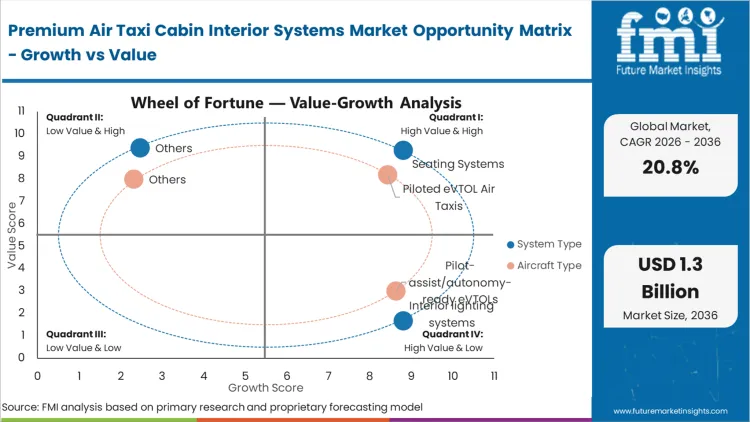
Strict vehicle weight limitations force eVTOL chief engineers to relentlessly pursue advanced composite interior solutions. Securing flight type certification requires demonstrating structural crashworthiness without exceeding maximum payload caps, compelling procurement directors to source ultra-lightweight, 16G-rated seating components immediately. Delaying vendor selection for these critical structures pushes entire aircraft development timelines backward, threatening early-to-market advantages. Operators preparing for commercial launch demand aircraft seat architectures that withstand high-frequency boarding cycles while maintaining executive-level aesthetics, driving rapid innovation in urban air mobility passenger experience systems.
Severe gaps between automotive-style volume aspirations and rigid aerospace-grade certification protocols slow interior production scaling. Quality assurance managers struggle to maintain high production velocities when every interior composite layup requires meticulous, slow-cure processes to satisfy aviation flammability and smoke toxicity standards. Suppliers are investing in automated thermoplastic forming, but cycle times remain structurally incompatible with projected demand for thousands of annual air taxi units.
Opportunities in the Premium Air Taxi Cabin Interior Systems Market
- Modular Cabin Architectures: Rapid-release floor track attachments. Fleet operations directors gain the ability to swap executive seating for cargo configurations within minutes, attracting eVTOL cabin systems manufacturers.
- Embedded Structural Sensors: Laminates containing fiber-optic strain gauges. Maintenance supervisors avoid manual cabin inspections by monitoring structural fatigue via aircraft electrification networks.
- Acoustic Metamaterials: Sub-wavelength resonant structures integrated into headliners. Cabin environment engineers acting as an air taxi cabin engineering partner achieve significant noise reduction without adding dense sound-deadening mass.
Regional Analysis
.webp "Top Country Growth Comparison Premium Air Taxi Cabin Interior Systems Market Cagr (2026 2036)")
Based on regional analysis, the Premium Air Taxi Cabin Interior Systems Market is segmented into the Americas, Europe, Asia-Pacific, South Asia & Pacific, and Middle East & Africa across 40 plus countries. Sovereign wealth density, legacy aerospace infrastructure, and existing heavy-helicopter commuter networks dictate the specific pace at which these distinct geographies adopt advanced composite cabin enclosures.
| Country | CAGR (2026 to 2036) |
|---|---|
| UAE | 24.8% |
| United States | 23.5% |
| Brazil | 21.9% |
| United Kingdom | 21.4% |
| Germany | 20.8% |
| France | 19.9% |
| Japan | 19.3% |
Source: Future Market Insights (FMI) analysis, based on proprietary forecasting model and primary research
Middle East & Africa Premium Air Taxi Cabin Interior Systems Market Analysis
Government transport authorities across this geography fund clean-sheet vertiport infrastructure that perfectly aligns with eVTOL launch schedules, bypassing legacy ground congestion entirely through aggressive sovereign wealth commitments. Procurement officers at regional airlines transitioning into urban air mobility source advanced climate-control interiors capable of managing extreme external heat loads without depleting battery reserves. Local operators possess the capital density to demand highly customized, ultra-luxury cabin configurations that exceed baseline OEM offerings, driving complex interior geometry modifications to accommodate VIP privacy screens and separation requirements.
- UAE: Expanding at 24.8%, dedicated air corridors for executive transport sponsored by state-backed aviation authorities define local deployment. Procurement directors at sovereign fleet operators secure lucrative long-term maintenance contracts that lock out budget-oriented aftermarket suppliers while demanding aircraft exterior lighting and bespoke interior cabin cooling systems.
FMI's report includes Saudi Arabia and South Africa. Regulatory sandboxes in these adjacent geographies allow suppliers to test novel cabin materials under extreme thermal conditions before seeking global EASA certification.
Americas Premium Air Taxi Cabin Interior Systems Market Analysis
Fleet operators managing high-frequency urban flight schedules in southern markets demand interior systems that mimic the durability of current rotorcraft cabins while achieving massive weight reductions. Simultaneously, engineering teams in northern hubs prioritize achieving basic FAA compliance over complex luxury fit-outs to accelerate initial flight testing, fueled by concentrated venture capital deployment into domestic OEM programs. Certification managers navigate evolving regulatory pathways alongside major legacy aerospace interior suppliers, giving local eVTOL startups immediate access to 16G testing facilities while southern procurement officers evaluate aircraft glareshield lighting and ruggedized cabin panels to minimize maintenance downtime.
- United States: Intensive domestic OEM competition forces rapid iteration of interior mockups, generating a 23.5% CAGR as supply chain directors source lightweight structural composites locally to avoid import delays. By leveraging existing commercial aviation supply chains, domestic manufacturers establish strong competitive positioning to attract top interior suppliers.
- Brazil: The reality on the ground is that local operators completely reject aesthetic materials requiring specialized overnight cleaning protocols. Sustaining a scale of 21.9% CAGR value, legacy urban helicopter operators transition massive client bases toward eVTOL platforms as fleet purchasing managers specify highly durable, low-maintenance seat trims.
FMI's report includes Canada, Mexico, Argentina, and Chile. Cross-border manufacturing integration allows OEMs to outsource labor-intensive interior composite layup processes to specialized facilities, while nascent operator networks monitor initial deployments before committing to large-scale fleet purchases.
Europe Premium Air Taxi Cabin Interior Systems Market Analysis
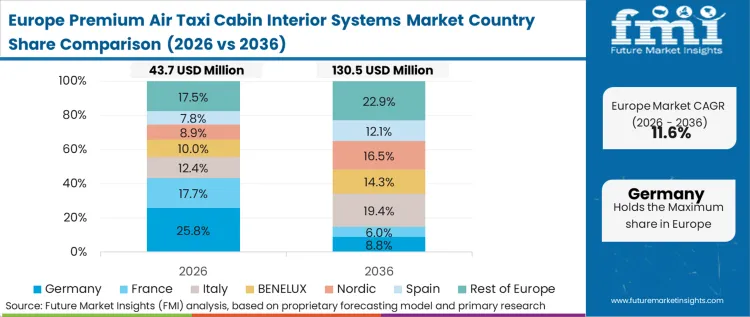
Supply chain directors operate within highly mature aerospace corridors, easily sourcing specialized lightweight resins and acoustic materials. Chief engineers design hybrid aircraft and eVTOL cabins that meet rigorous EASA flammability standards by leveraging decades of commercial aviation expertise rooted in legacy manufacturing conglomerates. Operators launching inter-city commuter routes prioritize passenger comfort, demanding active noise cancellation systems embedded directly into seat headrests to navigate deep regulatory integration timelines.
- United Kingdom: Driving 21.4% growth, extensive aerospace engineering clusters pioneer advanced composite forming techniques. R&D directors secure significant government grants to develop ultra-lightweight seating structures, creating a massive commercial opportunity for export to North American OEMs once interior modules are successfully certified.
- Germany: Assembly plant managers optimize robotic thermoplastic molding processes, resulting in a 20.8% CAGR across the domestic industrial base. Precision manufacturing expertise allows suppliers to achieve automotive-scale production rates for aerospace-grade components, drastically improving turnaround times on factory floors through modular cabin architectures.
- France: Certification officers fast-track interior component approvals based on legacy data as proximity to major commercial aviation OEMs facilitates rapid technology transfer into the eVTOL sector. Expanding at 19.9% CAGR, local operators dominate early intra-city executive transfer routes.
FMI's report includes Italy and Spain. Specialized design houses in these regions partner with major OEMs to style premium interior trims without compromising strict weight limitations.
Asia-Pacific Premium Air Taxi Cabin Interior Systems Market Analysis
OEM design directors incorporate advanced digital interfaces and panoramic exterior coating systems for urban air mobility and eVTOL fleets into bare-bones autonomous pods to maximize internal passenger volume. Removing the requirement for pilot partitions or flight controls drastically reshapes interior cabin geometries through the aggressive deployment of autonomous flight technologies. Procurement teams leverage massive regional electronics supply chains to source lightweight passenger infotainment systems.
- Japan: Domestic suppliers pivot existing high-speed rail interior expertise directly into the air taxi sector. Tracking at 19.3% CAGR, fleet operators mandate wide-opening doors and snag-free interior surfaces to manage dense urban operating environments requiring extremely efficient passenger ingress and egress flows.
FMI's report includes China and South Korea. Rapid prototyping capabilities allow regional manufacturers to iterate autonomous cabin layouts significantly faster than Western competitors.
Competitive Aligners for Market Players
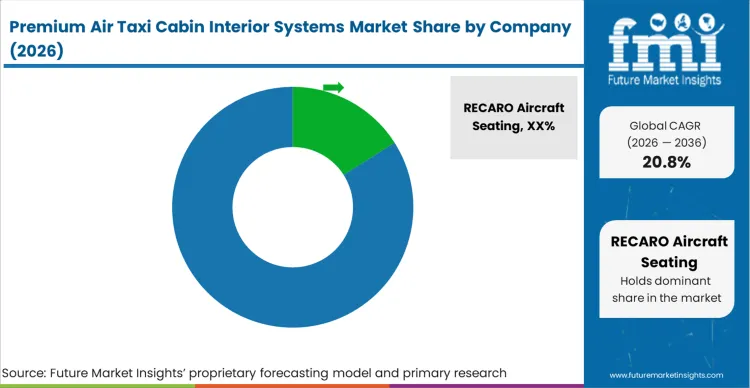
Legacy aerospace seating manufacturers face structural disruption from automotive interior suppliers possessing superior high-volume production capabilities. Traditional aviation incumbents leverage decades of EASA and FAA part-27 certification data, easily navigating complex 16G vertical drop tests that paralyze eVTOL cabin systems key players. Automotive tier-1 suppliers excel at rapid thermoplastic molding and integrated smart-surface manufacturing, aggressively pitching cost-reduction strategies to eVTOL OEMs. Procurement directors exploit this tension, playing legacy aerospace reliability against automotive production scaling to secure favorable pricing on critical cabin components.
Incumbents hold massive defensive moats built entirely on dynamic crash-test certification libraries. Challengers evaluating RECARO vs Diehl for eVTOL cabin programs discover that validating novel lightweight materials requires thousands of hours in specialized impact sled facilities. OEMs selecting unproven vendors risk severe program delays if a prototype seat pan shatters during regulatory compliance testing. To penetrate this ecosystem, new entrants must acquire or partner with established testing laboratories, effectively buying their way through regulatory bottlenecks rather than engineering around them.
Large fleet operators ruthlessly evaluate interior component lifecycles to prevent vendor lock-in on aftermarket spares. Maintenance directors demand modular aircraft seat actuation systems and standardized attachment tracks, refusing to purchase proprietary cabin configurations that dictate single-source replacement parts. Structural shifts indicate that when comparing eVTOL cabin systems vs helicopter interiors, operators prioritize rapid turnaround capabilities over bespoke luxury, forcing interior suppliers to design components that technicians can swap on the tarmac using standard tools within ten-minute turnaround windows.
Key Players in Premium Air Taxi Cabin Interior Systems Market
- RECARO Aircraft Seating
- Diehl Aviation
- Joby Aviation
- Archer Aviation
- Eve Air Mobility
- Vertical Aerospace
- Airbus
Scope of the Report
| Metric | Value |
|---|---|
| Quantitative Units | USD 0.2 billion to USD 1.3 billion, at a CAGR of 20.8% |
| Market Definition | Premium air taxi cabin interior systems encompass weight-optimized, crash-certified passenger enclosure components engineered specifically for vertical take-off and landing vehicles, integrating luxury aesthetics with extreme mass constraints. |
| Segmentation | System Type, Aircraft Type, Fit Type, Use Case, Material Type |
| Regions Covered | North America, Latin America, Western Europe, Eastern Europe, East Asia, South Asia & Pacific, Middle East & Africa |
| Countries Covered | UAE, United States, Brazil, United Kingdom, Germany, France, Japan |
| Key Companies Profiled | RECARO Aircraft Seating, Diehl Aviation, Joby Aviation, Archer Aviation, Eve Air Mobility, Vertical Aerospace, Airbus |
| Forecast Period | 2026 to 2036 |
| Approach | Aircraft order book backlogs paired with projected cabin component bill-of-materials costs per vehicle. |
Source: Future Market Insights (FMI) analysis, based on proprietary forecasting model and primary research
Key Segments:
System Type
- Seating systems
- Interior lighting systems
- Cabin panels and trim
- Doors and transparencies
- Cabin electronics and environmental sensors
Aircraft Type
- Piloted eVTOL air taxis
- Pilot-assist/autonomy-ready eVTOLs
- Hybrid-electric premium VTOLs
Fit Type
- Line-fit OEM installation
- Retrofit and cabin upgrade
- Aftermarket spares and replacements
Use Case
- Airport-to-city premium shuttle
- Intra-city executive transfer
- Inter-city premium commuter
- Tourism and sightseeing premium cabins
Material Type
- Lightweight composites
- Aluminum alloys
- Advanced textiles
- Polycarbonate/acrylic transparencies
- Smart polymers and trim laminates
Regions:
- North America
- United States
- Canada
- Mexico
- Latin America
- Brazil
- Argentina
- Chile
- Europe
- Germany
- United Kingdom
- France
- Italy
- Spain
- Asia-Pacific
- China
- Japan
- South Korea
- India
- ASEAN
- ANZ
- Middle East & Africa
- UAE
- Saudi Arabia
- South Africa
Bibliography
- European Union Aviation Safety Agency. (2024, June 10). Special Condition for small-category VTOL-capable aircraft Issue 2 (SC-VTOL-02).
- Federal Aviation Administration. (2024, October 22). Integration of Powered-Lift: Pilot Certification and Operations; Miscellaneous Amendments Related to Rotorcraft and Airplanes.
- National Aeronautics and Space Administration. (2024, May 9). NAC Aeronautics Committee Report May 2024.
- RECARO Aircraft Seating. (2024, January 29). RECARO Aircraft Seating takes flight with Eve Air Mobility in historic eVTOL project.
- Washington State Department of Transportation. (2025, May). Advanced Air Mobility Aircraft Plan.
This bibliography is provided for reader reference. The full FMI report contains the complete reference list with primary source documentation.
This Report Addresses
- Procurement strategies for premium air taxi cabin interior systems segmentation under EASA SC-VTOL-02 parameters.
- Certification timelines for 16G vertical drop-load compliance in passenger seating architectures.
- Center-of-gravity constraints preventing aftermarket retrofit adoption.
- Acoustic dampening techniques mitigating electric rotor frequencies within the cabin.
- Flammability testing protocols for advanced thermoplastic resins.
- Operator requirements for modular, rapid-release baggage retention systems.
- Production scaling friction between bespoke aerospace layups and automotive forming cycles.
- Fleet maintenance implications of integrated smart-surface diagnostic networks.
Frequently Asked Questions
What limits aftermarket interior modifications in air taxis?
Strict center-of-gravity tolerances prohibit unauthorized weight distribution changes, meaning operations managers cannot swap cabin materials without initiating complex and expensive aerodynamic recertification processes.
Why do seating systems dominate component value?
Procurement officers must pay severe premiums for advanced composite frames because passing mandatory 16G crash dynamic testing forces suppliers to engineer highly specialized energy-absorbing structures.
How does payload capacity impact interior material selection?
Because every kilogram allocated to passenger comfort directly reduces battery range or available payload, chief engineers ruthlessly strip luxury amenities and force suppliers to innovate with ultra-lightweight smart textiles.
Why is the UAE expanding faster than Western markets?
Sovereign wealth funding accelerates clean-sheet vertiport construction without waiting for legacy airspace integration, allowing transport authorities to dictate immediate executive routing capabilities to bypass severe ground traffic congestion.
What specific operational friction slows production scaling?
Assembly plant directors struggle to automate production while maintaining stringent quality control over structural integrity because the meticulous composite layup processes required to pass aerospace flammability standards cannot match automotive manufacturing speeds.
How do piloted configurations affect cabin design?
Because mandatory anti-ballistic bulkheads separating flight crews from passengers add massive weight penalties, interior architects must carefully route independent environmental control ducting to support pilots without draining battery reserves.
Why are luggage accommodations problematic for early eVTOLs?
Lacking dedicated cargo holds, designers must integrate robust baggage restraints directly into the passenger envelope, which forces fleet operators to face delayed boarding times if these systems are poorly positioned near entry doors.
What structural advantage do legacy aerospace suppliers possess?
Established firms hold extensive proprietary certification libraries for dynamic crash testing, leaving challengers to face multi-year delays navigating complex FAA and EASA part-27 compliance requirements.
How does vibration fatigue influence material choice?
Because electric motors generate specific high-frequency resonances that degrade poorly integrated interior panels, maintenance technicians demand rigorously tested OEM fasteners to prevent acoustic rattling and long-term structural failure.
Why is smart polymer adoption accelerating for fleet operations?
Since high passenger volume rapidly destroys traditional luxury veneers and fabrics, fleet procurement officers specify self-healing, scratch-resistant materials to drastically reduce nightly cleaning and turnaround times.
What role do acoustic metamaterials play in passenger comfort?
Engineers integrate sub-wavelength resonant structures into headliners to actively cancel rotor noise, achieving significant cabin quieting without introducing dense, heavy sound-deadening foam.
How do autonomous designs alter interior supply chains?
Removing physical flight controls and pilot partitions drastically increases available cabin volume, prompting supply chain directors to pivot to sourcing panoramic transparencies and integrated digital infotainment displays for passenger engagement.
Why are aluminum alloys losing share to composites?
Materials science directors are phasing out metallic brackets in favor of advanced thermoplastic resins because they offer superior strength-to-weight ratios critical for vertical lift efficiency.
What prevents operators from using standard airline seats?
Because commercial part-25 seating dramatically exceeds the mass limitations required for battery-electric propulsion, certification managers mandate bespoke, minimalist structures designed specifically for rotorcraft load paths.
How does production tooling impact material cost?
Financial planning officers must amortize massive upfront capital expenditures across relatively small initial fleet production runs because specialized molds required for large-format thermoplastic panels are highly expensive.
Why do tourism use cases require different interiors?
Route planning directors specify minimalist seating configurations to maximize window space because sightseeing operators prioritize panoramic visibility over passenger privacy screens or work surfaces.
What complication arises from integrated environmental sensors?
Since embedding climate control diagnostics directly into cabin panels complicates routine maintenance access, fleet supervisors require modular wiring harnesses to prevent minor sensor failures from grounding the aircraft.
How does venture capital shape North American development?
Concentrated funding accelerates rapid interior prototyping loops among domestic startups, where engineering teams prioritize functional certification over luxury finishes to secure critical early-stage flight testing data.
Why do European OEMs favor hybrid-electric designs?
Because extensive inter-city routes require extended operational range beyond current battery capabilities, cabin design directors must accommodate noise and vibration profiles associated with combustion-assisted propulsion systems.
What operational outcome results from modular floor tracks?
Rapid-release attachment mechanisms allow operators to reconfigure cabins between passenger and cargo modes in minutes, maximizing asset utilization during off-peak passenger travel hours.
How does EASA SC-VTOL-02 differ from legacy regulations?
Because the special condition framework introduces novel crash dynamic requirements specifically tailored to vertical lift load paths, compliance officers must abandon historical part-25 data and execute entirely new physical test regimes.
Why is surface flammability a critical bottleneck?
High energy density battery architectures heighten regulatory scrutiny over cabin fire resistance, leading quality assurance managers to reject any interior material that cannot pass strict smoke toxicity and burn-rate metrics.
What is the market size of premium air taxi cabin interior systems?
FMI projects the sector will reach USD 1.3 billion by 2036, a metric that relies entirely on structural upgrades driven by aerospace regulations as weight limitations force the immediate replacement of conventional interior materials.
Which companies are building cabin interiors for eVTOL air taxis?
Procurement directors rely heavily on dominant tier-1 suppliers like RECARO Aircraft Seating, Diehl Aviation, and established aerospace OEMs because they hold massive existing libraries of EASA crash-test data.
Preview the report firsthand - request a free sample
Get SampleGet the brochure for pricing and purchase details.
Get PDFTable of Content
- Executive Summary
- Global Market Outlook
- Demand-side Trends
- Supply-side Trends
- Technology Roadmap Analysis
- Analysis and Recommendations
- Market Overview
- Market Coverage / Taxonomy
- Market Definition / Scope / Limitations
- Research Methodology
- Chapter Orientation
- Analytical Lens and Working Hypotheses
- Market Structure, Signals, and Trend Drivers
- Benchmarking and Cross-market Comparability
- Market Sizing, Forecasting, and Opportunity Mapping
- Research Design and Evidence Framework
- Desk Research Programme (Secondary Evidence)
- Company Annual and Sustainability Reports
- Peer-reviewed Journals and Academic Literature
- Corporate Websites, Product Literature, and Technical Notes
- Earnings Decks and Investor Briefings
- Statutory Filings and Regulatory Disclosures
- Technical White Papers and Standards Notes
- Trade Journals, Industry Magazines, and Analyst Briefs
- Conference Proceedings, Webinars, and Seminar Materials
- Government Statistics Portals and Public Data Releases
- Press Releases and Reputable Media Coverage
- Specialist Newsletters and Curated Briefings
- Sector Databases and Reference Repositories
- FMI Internal Proprietary Databases and Historical Market Datasets
- Subscription Datasets and Paid Sources
- Social Channels, Communities, and Digital Listening Inputs
- Additional Desk Sources
- Expert Input and Fieldwork (Primary Evidence)
- Primary Modes
- Qualitative Interviews and Expert Elicitation
- Quantitative Surveys and Structured Data Capture
- Blended Approach
- Why Primary Evidence is Used
- Field Techniques
- Interviews
- Surveys
- Focus Groups
- Observational and In-context Research
- Social and Community Interactions
- Stakeholder Universe Engaged
- C-suite Leaders
- Board Members
- Presidents and Vice Presidents
- R&D and Innovation Heads
- Technical Specialists
- Domain Subject-matter Experts
- Scientists
- Physicians and Other Healthcare Professionals
- Governance, Ethics, and Data Stewardship
- Research Ethics
- Data Integrity and Handling
- Primary Modes
- Tooling, Models, and Reference Databases
- Desk Research Programme (Secondary Evidence)
- Data Engineering and Model Build
- Data Acquisition and Ingestion
- Cleaning, Normalisation, and Verification
- Synthesis, Triangulation, and Analysis
- Quality Assurance and Audit Trail
- Market Background
- Market Dynamics
- Drivers
- Restraints
- Opportunity
- Trends
- Scenario Forecast
- Demand in Optimistic Scenario
- Demand in Likely Scenario
- Demand in Conservative Scenario
- Opportunity Map Analysis
- Product Life Cycle Analysis
- Supply Chain Analysis
- Investment Feasibility Matrix
- Value Chain Analysis
- PESTLE and Porter’s Analysis
- Regulatory Landscape
- Regional Parent Market Outlook
- Production and Consumption Statistics
- Import and Export Statistics
- Market Dynamics
- Global Market Analysis 2021 to 2025 and Forecast, 2026 to 2036
- Historical Market Size Value (USD Million) Analysis, 2021 to 2025
- Current and Future Market Size Value (USD Million) Projections, 2026 to 2036
- Y-o-Y Growth Trend Analysis
- Absolute $ Opportunity Analysis
- Global Market Pricing Analysis 2021 to 2025 and Forecast 2026 to 2036
- Global Market Analysis 2021 to 2025 and Forecast 2026 to 2036, By System Type
- Introduction / Key Findings
- Historical Market Size Value (USD Million) Analysis By System Type , 2021 to 2025
- Current and Future Market Size Value (USD Million) Analysis and Forecast By System Type , 2026 to 2036
- Seating Systems
- Interior lighting systems
- Others
- Seating Systems
- Y-o-Y Growth Trend Analysis By System Type , 2021 to 2025
- Absolute $ Opportunity Analysis By System Type , 2026 to 2036
- Global Market Analysis 2021 to 2025 and Forecast 2026 to 2036, By Aircraft Type
- Introduction / Key Findings
- Historical Market Size Value (USD Million) Analysis By Aircraft Type, 2021 to 2025
- Current and Future Market Size Value (USD Million) Analysis and Forecast By Aircraft Type, 2026 to 2036
- Piloted eVTOL Air Taxis
- Pilot-assist/autonomy-ready eVTOLs
- Others
- Piloted eVTOL Air Taxis
- Y-o-Y Growth Trend Analysis By Aircraft Type, 2021 to 2025
- Absolute $ Opportunity Analysis By Aircraft Type, 2026 to 2036
- Global Market Analysis 2021 to 2025 and Forecast 2026 to 2036, By Fit Type
- Introduction / Key Findings
- Historical Market Size Value (USD Million) Analysis By Fit Type, 2021 to 2025
- Current and Future Market Size Value (USD Million) Analysis and Forecast By Fit Type, 2026 to 2036
- Line-Fit OEM Installation
- Retrofit and cabin upgrade
- Others
- Line-Fit OEM Installation
- Y-o-Y Growth Trend Analysis By Fit Type, 2021 to 2025
- Absolute $ Opportunity Analysis By Fit Type, 2026 to 2036
- Global Market Analysis 2021 to 2025 and Forecast 2026 to 2036, By Use Case
- Introduction / Key Findings
- Historical Market Size Value (USD Million) Analysis By Use Case, 2021 to 2025
- Current and Future Market Size Value (USD Million) Analysis and Forecast By Use Case, 2026 to 2036
- Airport-To-City Premium Shuttle
- Intra-city executive transfer
- Others
- Airport-To-City Premium Shuttle
- Y-o-Y Growth Trend Analysis By Use Case, 2021 to 2025
- Absolute $ Opportunity Analysis By Use Case, 2026 to 2036
- Global Market Analysis 2021 to 2025 and Forecast 2026 to 2036, By Material Type
- Introduction / Key Findings
- Historical Market Size Value (USD Million) Analysis By Material Type, 2021 to 2025
- Current and Future Market Size Value (USD Million) Analysis and Forecast By Material Type, 2026 to 2036
- Lightweight Composites
- Aluminum alloys
- Others
- Lightweight Composites
- Y-o-Y Growth Trend Analysis By Material Type, 2021 to 2025
- Absolute $ Opportunity Analysis By Material Type, 2026 to 2036
- Global Market Analysis 2021 to 2025 and Forecast 2026 to 2036, By Region
- Introduction
- Historical Market Size Value (USD Million) Analysis By Region, 2021 to 2025
- Current Market Size Value (USD Million) Analysis and Forecast By Region, 2026 to 2036
- North America
- Latin America
- Western Europe
- Eastern Europe
- East Asia
- South Asia and Pacific
- Middle East & Africa
- Market Attractiveness Analysis By Region
- North America Market Analysis 2021 to 2025 and Forecast 2026 to 2036, By Country
- Historical Market Size Value (USD Million) Trend Analysis By Market Taxonomy, 2021 to 2025
- Market Size Value (USD Million) Forecast By Market Taxonomy, 2026 to 2036
- By Country
- USA
- Canada
- Mexico
- By System Type
- By Aircraft Type
- By Fit Type
- By Use Case
- By Material Type
- By Country
- Market Attractiveness Analysis
- By Country
- By System Type
- By Aircraft Type
- By Fit Type
- By Use Case
- By Material Type
- Key Takeaways
- Latin America Market Analysis 2021 to 2025 and Forecast 2026 to 2036, By Country
- Historical Market Size Value (USD Million) Trend Analysis By Market Taxonomy, 2021 to 2025
- Market Size Value (USD Million) Forecast By Market Taxonomy, 2026 to 2036
- By Country
- Brazil
- Chile
- Rest of Latin America
- By System Type
- By Aircraft Type
- By Fit Type
- By Use Case
- By Material Type
- By Country
- Market Attractiveness Analysis
- By Country
- By System Type
- By Aircraft Type
- By Fit Type
- By Use Case
- By Material Type
- Key Takeaways
- Western Europe Market Analysis 2021 to 2025 and Forecast 2026 to 2036, By Country
- Historical Market Size Value (USD Million) Trend Analysis By Market Taxonomy, 2021 to 2025
- Market Size Value (USD Million) Forecast By Market Taxonomy, 2026 to 2036
- By Country
- Germany
- UK
- Italy
- Spain
- France
- Nordic
- BENELUX
- Rest of Western Europe
- By System Type
- By Aircraft Type
- By Fit Type
- By Use Case
- By Material Type
- By Country
- Market Attractiveness Analysis
- By Country
- By System Type
- By Aircraft Type
- By Fit Type
- By Use Case
- By Material Type
- Key Takeaways
- Eastern Europe Market Analysis 2021 to 2025 and Forecast 2026 to 2036, By Country
- Historical Market Size Value (USD Million) Trend Analysis By Market Taxonomy, 2021 to 2025
- Market Size Value (USD Million) Forecast By Market Taxonomy, 2026 to 2036
- By Country
- Russia
- Poland
- Hungary
- Balkan & Baltic
- Rest of Eastern Europe
- By System Type
- By Aircraft Type
- By Fit Type
- By Use Case
- By Material Type
- By Country
- Market Attractiveness Analysis
- By Country
- By System Type
- By Aircraft Type
- By Fit Type
- By Use Case
- By Material Type
- Key Takeaways
- East Asia Market Analysis 2021 to 2025 and Forecast 2026 to 2036, By Country
- Historical Market Size Value (USD Million) Trend Analysis By Market Taxonomy, 2021 to 2025
- Market Size Value (USD Million) Forecast By Market Taxonomy, 2026 to 2036
- By Country
- China
- Japan
- South Korea
- By System Type
- By Aircraft Type
- By Fit Type
- By Use Case
- By Material Type
- By Country
- Market Attractiveness Analysis
- By Country
- By System Type
- By Aircraft Type
- By Fit Type
- By Use Case
- By Material Type
- Key Takeaways
- South Asia and Pacific Market Analysis 2021 to 2025 and Forecast 2026 to 2036, By Country
- Historical Market Size Value (USD Million) Trend Analysis By Market Taxonomy, 2021 to 2025
- Market Size Value (USD Million) Forecast By Market Taxonomy, 2026 to 2036
- By Country
- India
- ASEAN
- Australia & New Zealand
- Rest of South Asia and Pacific
- By System Type
- By Aircraft Type
- By Fit Type
- By Use Case
- By Material Type
- By Country
- Market Attractiveness Analysis
- By Country
- By System Type
- By Aircraft Type
- By Fit Type
- By Use Case
- By Material Type
- Key Takeaways
- Middle East & Africa Market Analysis 2021 to 2025 and Forecast 2026 to 2036, By Country
- Historical Market Size Value (USD Million) Trend Analysis By Market Taxonomy, 2021 to 2025
- Market Size Value (USD Million) Forecast By Market Taxonomy, 2026 to 2036
- By Country
- Kingdom of Saudi Arabia
- Other GCC Countries
- Turkiye
- South Africa
- Other African Union
- Rest of Middle East & Africa
- By System Type
- By Aircraft Type
- By Fit Type
- By Use Case
- By Material Type
- By Country
- Market Attractiveness Analysis
- By Country
- By System Type
- By Aircraft Type
- By Fit Type
- By Use Case
- By Material Type
- Key Takeaways
- Key Countries Market Analysis
- USA
- Pricing Analysis
- Market Share Analysis, 2025
- By System Type
- By Aircraft Type
- By Fit Type
- By Use Case
- By Material Type
- Canada
- Pricing Analysis
- Market Share Analysis, 2025
- By System Type
- By Aircraft Type
- By Fit Type
- By Use Case
- By Material Type
- Mexico
- Pricing Analysis
- Market Share Analysis, 2025
- By System Type
- By Aircraft Type
- By Fit Type
- By Use Case
- By Material Type
- Brazil
- Pricing Analysis
- Market Share Analysis, 2025
- By System Type
- By Aircraft Type
- By Fit Type
- By Use Case
- By Material Type
- Chile
- Pricing Analysis
- Market Share Analysis, 2025
- By System Type
- By Aircraft Type
- By Fit Type
- By Use Case
- By Material Type
- Germany
- Pricing Analysis
- Market Share Analysis, 2025
- By System Type
- By Aircraft Type
- By Fit Type
- By Use Case
- By Material Type
- UK
- Pricing Analysis
- Market Share Analysis, 2025
- By System Type
- By Aircraft Type
- By Fit Type
- By Use Case
- By Material Type
- Italy
- Pricing Analysis
- Market Share Analysis, 2025
- By System Type
- By Aircraft Type
- By Fit Type
- By Use Case
- By Material Type
- Spain
- Pricing Analysis
- Market Share Analysis, 2025
- By System Type
- By Aircraft Type
- By Fit Type
- By Use Case
- By Material Type
- France
- Pricing Analysis
- Market Share Analysis, 2025
- By System Type
- By Aircraft Type
- By Fit Type
- By Use Case
- By Material Type
- India
- Pricing Analysis
- Market Share Analysis, 2025
- By System Type
- By Aircraft Type
- By Fit Type
- By Use Case
- By Material Type
- ASEAN
- Pricing Analysis
- Market Share Analysis, 2025
- By System Type
- By Aircraft Type
- By Fit Type
- By Use Case
- By Material Type
- Australia & New Zealand
- Pricing Analysis
- Market Share Analysis, 2025
- By System Type
- By Aircraft Type
- By Fit Type
- By Use Case
- By Material Type
- China
- Pricing Analysis
- Market Share Analysis, 2025
- By System Type
- By Aircraft Type
- By Fit Type
- By Use Case
- By Material Type
- Japan
- Pricing Analysis
- Market Share Analysis, 2025
- By System Type
- By Aircraft Type
- By Fit Type
- By Use Case
- By Material Type
- South Korea
- Pricing Analysis
- Market Share Analysis, 2025
- By System Type
- By Aircraft Type
- By Fit Type
- By Use Case
- By Material Type
- Russia
- Pricing Analysis
- Market Share Analysis, 2025
- By System Type
- By Aircraft Type
- By Fit Type
- By Use Case
- By Material Type
- Poland
- Pricing Analysis
- Market Share Analysis, 2025
- By System Type
- By Aircraft Type
- By Fit Type
- By Use Case
- By Material Type
- Hungary
- Pricing Analysis
- Market Share Analysis, 2025
- By System Type
- By Aircraft Type
- By Fit Type
- By Use Case
- By Material Type
- Kingdom of Saudi Arabia
- Pricing Analysis
- Market Share Analysis, 2025
- By System Type
- By Aircraft Type
- By Fit Type
- By Use Case
- By Material Type
- Turkiye
- Pricing Analysis
- Market Share Analysis, 2025
- By System Type
- By Aircraft Type
- By Fit Type
- By Use Case
- By Material Type
- South Africa
- Pricing Analysis
- Market Share Analysis, 2025
- By System Type
- By Aircraft Type
- By Fit Type
- By Use Case
- By Material Type
- USA
- Market Structure Analysis
- Competition Dashboard
- Competition Benchmarking
- Market Share Analysis of Top Players
- By Regional
- By System Type
- By Aircraft Type
- By Fit Type
- By Use Case
- By Material Type
- Competition Analysis
- Competition Deep Dive
- RECARO Aircraft Seating
- Overview
- Product Portfolio
- Profitability by Market Segments (Product/Age /Sales Channel/Region)
- Sales Footprint
- Strategy Overview
- Marketing Strategy
- Product Strategy
- Channel Strategy
- Diehl Aviation
- Joby Aviation
- Archer Aviation
- Eve Air Mobility
- RECARO Aircraft Seating
- Competition Deep Dive
- Assumptions & Acronyms Used


