

- Market Size (2026)
- USD 2.7 Bn
- Forecast (2036)
- USD 4.6 Bn
- CAGR (2026 to 2036)
- 5.3%
HVAC Airflow and Blend Door Actuator Systems Market Size, Market Forecast and Outlook By FMI
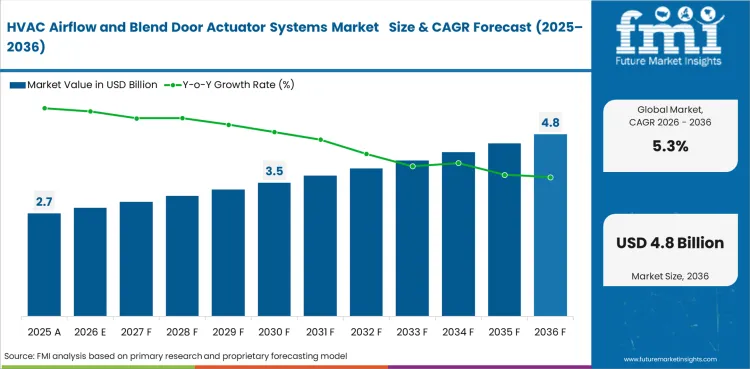
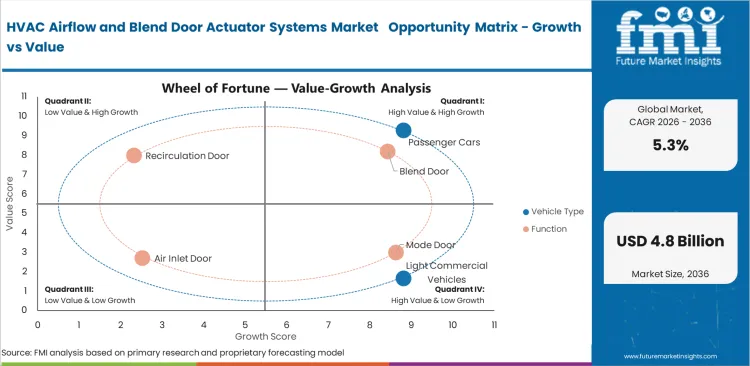
The HVAC airflow and blend door actuator systems market was valued at USD 2.6 billion in 2025. The market is set to reach USD 2.7 billion by 2026-end and grow at a CAGR of 5.3% between 2026 and 2036 to reach USD 4.6 billion by 2036. Passenger cars are projected to lead with a 74.0% share, while OEM fitment is expected to account for an 86.0% share.
Summary of the HVAC Airflow and Blend Door Actuator Systems Market
- Demand and Growth Drivers
- Rising use of automotive climate control systems is increasing actuator-controlled airflow functions across passenger vehicle cabins.
- EV-focused automotive thermal systems are increasing the value of accurate recirculation and blend control inside HVAC modules.
- Passenger vehicle comfort upgrades are widening demand for quiet and durable airflow-control hardware across new platform programs.
- Product and Segment View
- Passenger cars are expected to lead the segment because they account for the largest share of vehicle production and carry broader HVAC feature adoption.
- Blend door actuators are likely to lead function demand because they directly govern temperature mix control across most cabin HVAC systems.
- OEM fitment is expected to lead because actuator systems are usually integrated into HVAC module sourcing at the platform development stage.
- Geography and Competitive Outlook
- China is likely to be a key growth market due to large passenger vehicle output and rising thermal control sophistication across domestic vehicle programs.
- India is expected to record solid growth. The United States holds an important position through higher value climate control content and a broad installed fleet.
- Companies with stronger HVAC integration capability and actuator design depth are expected to strengthen their position.
- Analyst Opinion
- Nikhil Kaitwade, Principal Consultant at FMI says, “Companies that can combine compact HVAC packaging with precise airflow-door control are likely to strengthen their position over the forecast period, as vehicle makers place greater value on cabin comfort refinement, lower noise operation, and better thermal efficiency across passenger vehicle and electric vehicle programs.”
- HVAC Airflow and Blend Door Actuator Systems Market Value Analysis
- The market is moving from a basic HVAC hardware category into a more defined cabin-control component space.
- Demand is rising as climate-control systems carry more door movements tied to airflow routing, blend positioning, and recirculation control.
- Adoption is also being supported by the need to improve comfort quality across passenger vehicles without raising HVAC packaging burden.
- Spending is further backed by the push for actuator systems that help OEMs reduce field failures and maintain stable HVAC response across long vehicle life.
Key Takeaways
- The HVAC airflow and blend door actuator systems market was valued at USD 2.6 billion in 2025.
- By 2036, the HVAC airflow and blend door actuator systems market is projected to reach USD 4.6 billion.
- From 2026 to 2036, the market is expected to expand at a CAGR of 5.3%.
- The market is likely to generate an incremental opportunity of USD 1.9 billion between 2026 and 2036.
- In 2026, passenger cars are expected to account for 74.0% of the vehicle type segment.
- Blend door actuators are expected to remain a leading function segment with 38.0% share in 2026.
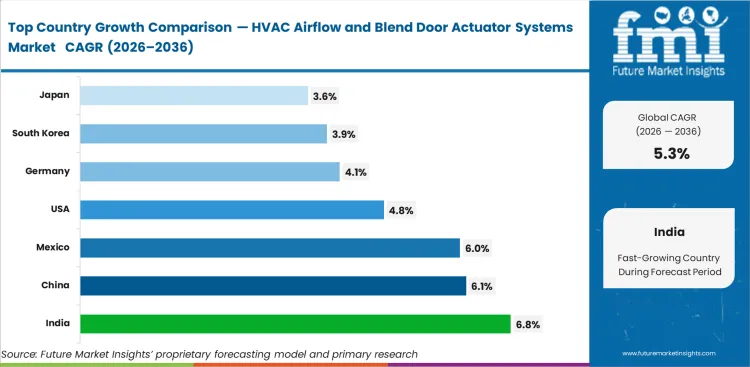
- India (6.8%) and China (6.1%) are projected to rank among the faster-growing markets, while broader demand direction remains linked to vehicle output and climate-control feature migration.
HVAC Airflow and Blend Door Actuator Systems Market Definition
The HVAC airflow and blend door actuator systems market includes electric actuator assemblies used inside automotive HVAC modules to control airflow path, vent mode selection, air recirculation, and cabin temperature blend positioning.
HVAC Airflow and Blend Door Actuator Systems Market Inclusions
Included within scope are blend door actuators, mode door actuators, recirculation door actuators, and air inlet control actuators designed for vehicle HVAC units. The study includes DC brushed designs, stepper-based formats, and related compact actuator systems used in front HVAC modules, rear auxiliary climate units, and multi-zone passenger cabin systems.
HVAC Airflow and Blend Door Actuator Systems Market Exclusions
Excluded from scope are complete HVAC assemblies, compressors, evaporators, heater cores, battery-cooling actuators, coolant-routing valves outside cabin airflow control, and building HVAC actuator systems.
Market Research Methodology
- Primary Research: FMI assesses supplier positioning, actuator scope, HVAC function relevance, and end-user demand through structured analysis of active automotive thermal-system and mechatronic suppliers.
- Desk Research: The study uses vehicle production direction, official supplier product material, thermal-system integration information, and other non-commercial indicators tied directly to automotive HVAC airflow control hardware.
- Market Sizing and Forecasting: The market is sized through a top-down allocation of vehicle production, actuator content per HVAC system, feature migration, and pricing across OEM and replacement demand.
- Data Validation and Update Cycle: Forecast assumptions are cross-checked against passenger vehicle trends, HVAC content progression, country demand patterns, and recent supplier activity across 2024 to 2026.
Why Is the HVAC Airflow and Blend Door Actuator Systems Market Growing?
- Automatic climate control adoption is increasing airflow and blend-door movement requirements across more passenger vehicle programs.
- Cabin thermal-efficiency targets in electric vehicles are increasing the need for more accurate recirculation and mode control.
- Vehicle makers are giving more weight to actuator durability and tighter module packaging during HVAC development.
Vehicle HVAC architecture carries more controlled functions today than earlier cabin systems. More passenger vehicles now use airflow path selection and recirculation management that must respond smoothly across changing thermal conditions. This shift lifts the value of dedicated actuator systems because more cabin comfort performance now depends on compact motion control hardware inside the HVAC unit. As automotive AC compressor systems and broader thermal hardware advance, airflow-control precision becomes more important at the module level.
Passenger vehicle comfort expectations are widening the demand base. Automakers continue to expand automatic climate control and better air distribution management across more trim lines. This raises actuator count per vehicle and gives movement quality more commercial value. Small door position errors can reduce perceived HVAC performance. This keeps actuator reliability closely tied to overall climate control quality.
Electric vehicles add more support because cabin conditioning influences energy consumption more directly in battery powered platforms. That creates stronger demand for actuator systems that can manage airflow and recirculation with greater precision. Suppliers that align automotive electric actuator technologies are likely to find stronger program relevance as EV thermal packages evolve.
Segmental Market Segmentation Analysis
- Passenger cars lead vehicle type demand with 74.0% share, supported by larger production volumes and broader climate-control content.
- Blend door leads function demand with 38.0% share while DC brushed designs hold 57.0% share in 2026.
- OEM fitment holds 86.0% share, reflecting direct integration into new HVAC module sourcing and vehicle assembly.
- Manual HVAC remains ahead with 53.0% share, while single-zone systems hold 48.0% share in 2026.
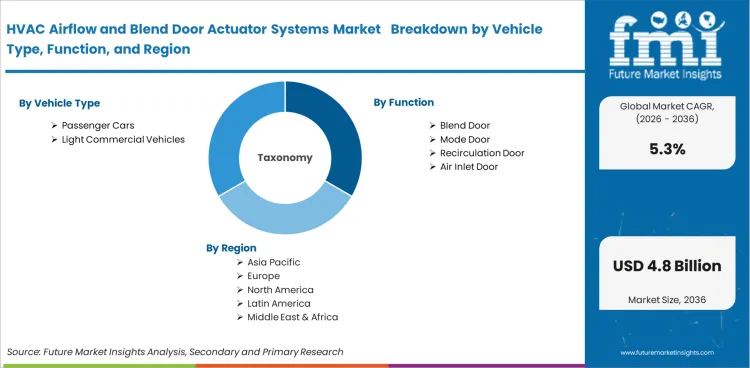
The HVAC airflow and blend door actuator systems market is segmented by vehicle type, function, motor technology, HVAC control type, sales channel, zone configuration, and region. Vehicle type includes Passenger Cars and Light Commercial Vehicles. Function includes Blend Door, Mode Door, Recirculation Door, and Air Inlet Door. Motor technology includes DC Brushed, Stepper, and Brushless formats. HVAC control type includes Manual HVAC and Automatic HVAC. Sales channel includes OEM Fitment and Aftermarket. Zone configuration includes Single-Zone, Dual-Zone, and Multi-Zone systems.
Insights into the Passenger Cars Segment
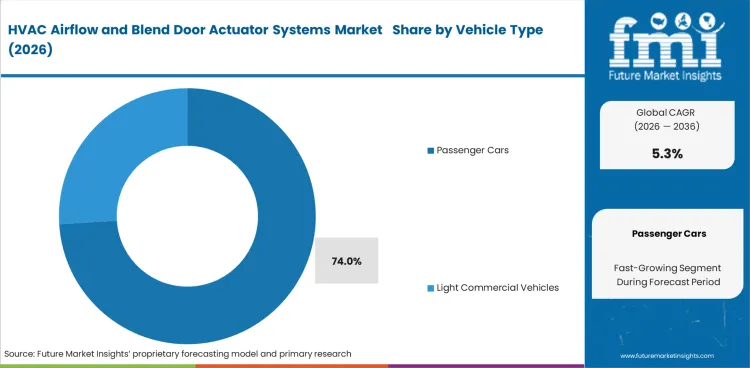
- Passenger cars are expected to account for 74.0% share in 2026. Passenger vehicle programs hold the broadest HVAC feature base and carry the largest installed demand pool.
- This improves the value position of actuator systems across mainstream vehicle platforms. Stronger alignment with automotive electronics, where comfort and control functions now carry more software and electrical coordination than earlier HVAC layouts.
Insights into the Blend Door Segment
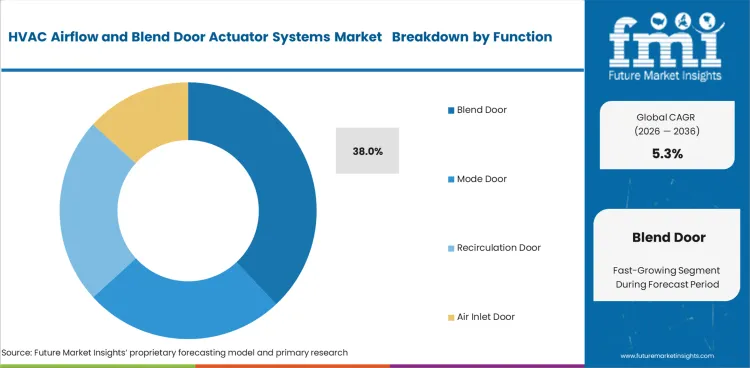
- Blend door actuators are anticipated to represent 38.0% of the market in 2026 because temperature-mix control is central to cabin comfort quality across manual and automatic HVAC systems.
- Blend door control leads because thermal comfort depends heavily on how accurately warm and cool air are mixed before cabin delivery. This gives blend movement higher commercial importance.
Insights into the DC Brushed Segment
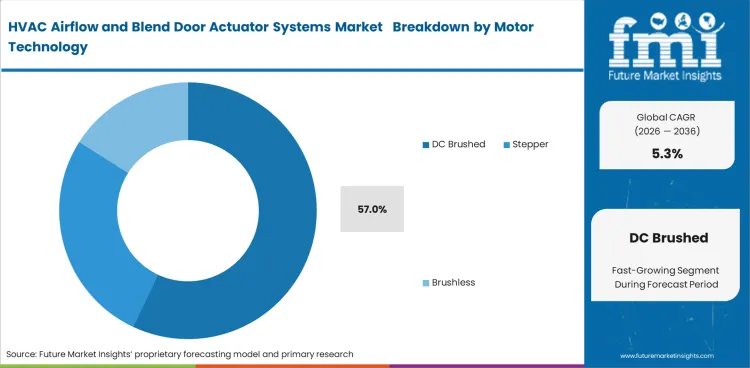
- DC brushed designs are likely to secure 57.0% share in 2026. This segment is large because high-volume vehicle programs favor established and cost-efficient motor formats for airflow-control tasks.
- Stepper and more advanced formats are expanding, though brushed designs remain deeply established across broad cabin-climate applications. Their position aligns with the wider automotive actuator supply chain, where proven designs hold strong appeal in cost-sensitive program environments.
Insights into the Manual HVAC Segment
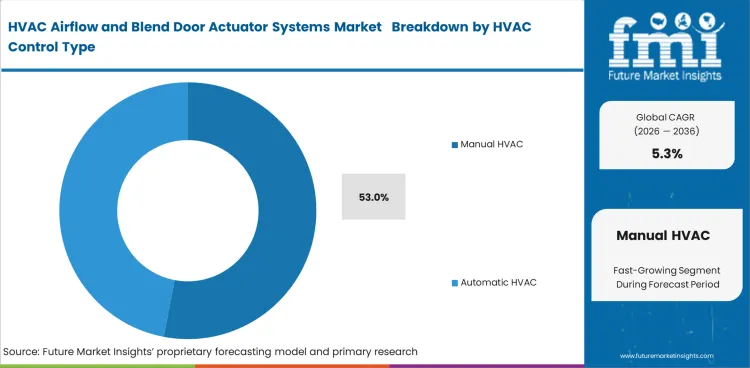
- Manual HVAC is set to make up 53.0% of the market in 2026 as a large share of global vehicle production uses manual or semi-automatic cabin climate layouts.
- Automatic systems are widening, though manual layouts account for more unit demand at the global level. Their relevance is tiled to broader airflow-delivery parts such as automotive HVAC blowers, where mass-market vehicle applications keep volume demand steady.
Insights into the OEM Fitment Segment
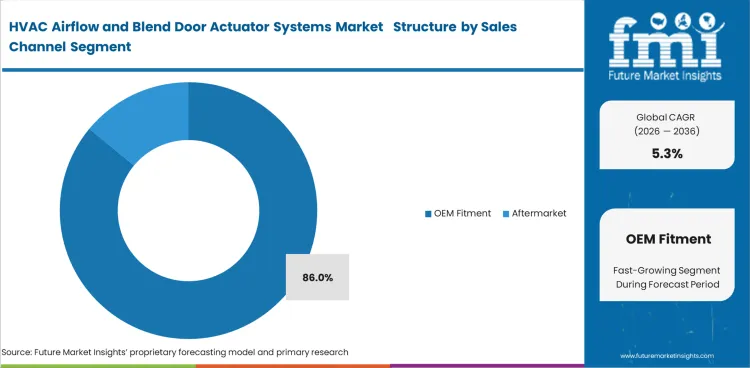
- OEM fitment is expected to account for 86.0% share in 2026. Actuator systems are chosen during vehicle development and integrated directly into factory-built HVAC assemblies.
- Vehicle makers and HVAC suppliers decide actuator architecture during the module-development stage, which keeps most annual value tied to new vehicle production rather than later service activity.
Insights into the Single-Zone Segment
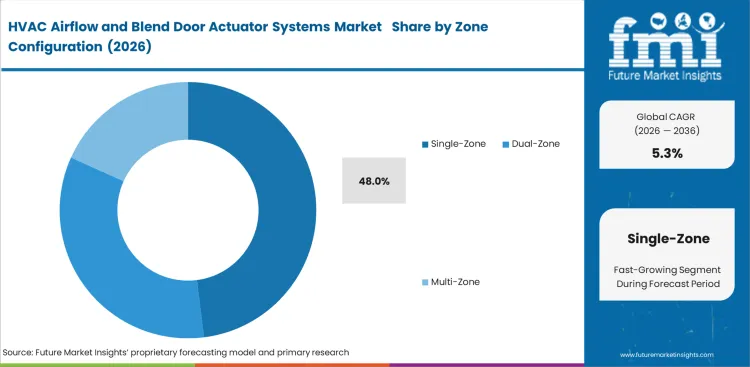
- Single zone systems are expected to account for 48.0% share in 2026. Many compact and mid market vehicles use one zone front cabin climate layouts.
- Dual zone and multi zone formats are expanding as comfort expectations improve. One zone configurations dominate a large share of cost sensitive and mid range programs.
HVAC Airflow and Blend Door Actuator Systems Market: What Are the Drivers, Restraints, and Key Trends?
- Richer HVAC feature migration is increasing actuator content across passenger vehicle programs.
- Tight cost targets and packaging constraints keep supplier engineering discipline important.
- Smaller and better integrated actuator formats are taking a larger role in HVAC module development.
HVAC actuator systems now sit closer to overall cabin comfort quality because movement accuracy and cycle durability affect the user experience. This is raising the value of actuator systems that can maintain stable operation across long service intervals while fitting compact HVAC packaging. As automotive electric actuators and broader electronic control unit systems continue to shape vehicle architecture, actuator performance is becoming more visible inside climate-control design choices.
Testing and Validation Needs
Automotive development teams place more attention on actuator validation because HVAC door faults can reduce comfort quality and increase warranty attention after launch. Positioning accuracy and stable response matter during platform qualification. Suppliers with stronger validation depth and closer ties to thermal system development hold a stronger position because OEMs prefer airflow control hardware with lower field risk and steadier long cycle performance.
Input Cost and Integration Pressure
HVAC actuator systems must fit within compact module layouts while delivering durable and low noise movement. Suppliers that can hold performance quality while protecting packaging efficiency are likely to remain relevant in large volume vehicle programs.
HVAC Airflow and Blend Door Actuator Systems Market CAGR Analysis by Country
.webp "Top Country Growth Comparison Hvac Airflow And Blend Door Actuator Systems Market Cagr (2026 2036)")
| Country | CAGR |
|---|---|
| India | 6.8% |
| China | 6.1% |
| Mexico | 6.0% |
| United States | 4.8% |
| Germany | 4.1% |
| South Korea | 3.9% |
| Japan | 3.6% |
Source: FMI analysis based on primary research and proprietary forecasting model
HVAC Airflow and Blend Door Actuator Systems Market Analysis by Country
- India is expected to lead major country growth with a 6.8% CAGR through 2036.
- China is projected to expand at a 6.1% CAGR, while Mexico is likely to record 6.0% CAGR during the same period.
- The United States is forecast to post 4.8% CAGR, while Germany is likely to grow at 4.1% through 2036.
- Japan at 3.6% and South Korea at 3.9% remain important additional markets where engineering quality and vehicle output continue to support demand.
- The global market is projected to rise at a CAGR of 5.3% over the forecast period.
Demand Outlook for HVAC Airflow and Blend Door Actuator Systems Market in the United States
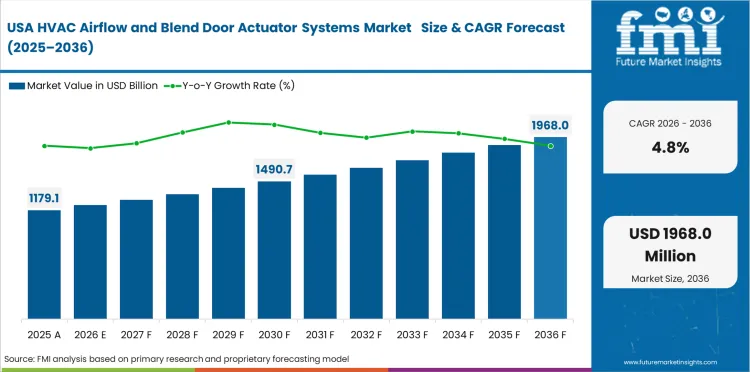
The U.S. HVAC airflow and blend door actuator systems market is projected to grow at a CAGR of 4.8% through 2036. Demand is supported by high-value passenger vehicle production and strong SUV and crossover volumes across larger vehicle platforms. Growth in premium climate-control functions is also increasing the amount of airflow and blend management required inside HVAC assemblies.
- Larger passenger vehicles support broader HVAC content per unit.
- Cabin refinement standards help sustain demand for reliable actuator systems.
- Service replacement adds a secondary revenue layer beyond OEM fitment.
Future Outlook for HVAC Airflow and Blend Door Actuator Systems Market in Germany
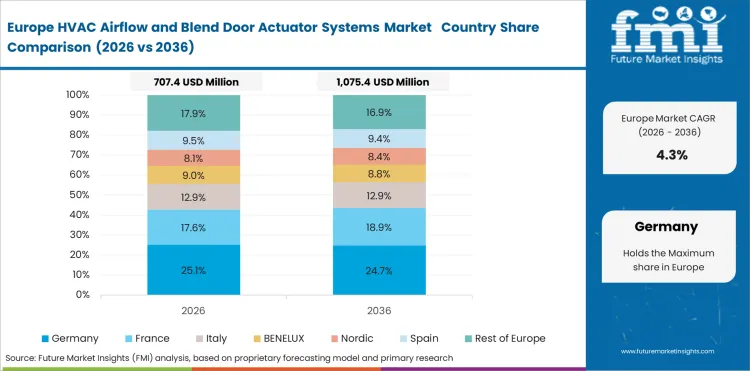
The Germany HVAC airflow and blend door actuator systems market is projected to grow at a CAGR of 4.1% through 2036. Demand is driven by premium vehicle engineering and continued use of higher-spec HVAC packaging across passenger vehicle programs. Broader climate-control sophistication keeps actuator performance standards high.
- Premium vehicle development keeps validation intensity high.
- Refined HVAC packaging supports demand for compact actuator formats.
- Suppliers with stronger integration capability remain well placed in Germany.
In-depth Analysis of HVAC Airflow and Blend Door Actuator Systems Market in Japan
The Japan HVAC airflow and blend door actuator systems market is projected to grow at a CAGR of 3.6% through 2036. Growth is supported by a n established automotive engineering base and stable use of advanced climate-control systems in domestic and export vehicle programs.
- Mature engineering programs support repeatable actuator testing demand.
- Hybrid and EV activity is increasing focus on refined thermal management.
- Japan remains important for suppliers with strong reliability credentials.
Sales Analysis of HVAC Airflow and Blend Door Actuator Systems Market in China
The China HVAC airflow and blend door actuator systems market is projected to grow at a CAGR of 6.1% through 2036. This market is a major growth centers because vehicle production is large and domestic brands are improving cabin comfort content. EV rollout is increasing the relevance of efficient airflow management. Demand is supported by richer passenger vehicle HVAC systems across a wider part of the local market.
- Large vehicle output supports a wider engineering and sourcing base.
- EV growth increases the need for controlled airflow and recirculation hardware.
- Domestic brands are expanding climate-control features across more models.
In-depth Analysis of HVAC Airflow and Blend Door Actuator Systems Market in India
The India HVAC airflow and blend door actuator systems market is projected to grow at a CAGR of 6.8% through 2036. Demand is rising as passenger vehicle production expands and compact SUVs gain more share. Climate-control features are spreading into more mid-range vehicle programs. Growth in this market reflects feature migration, since automatic HVAC and improved cabin comfort are moving beyond premium-only vehicle lines.
- Passenger vehicle scale is widening the base for actuator demand.
- Feature migration is increasing actuator value per HVAC assembly.
- Cost-efficient and durable designs remain important in supplier selection.
Opportunity Analysis of HVAC Airflow and Blend Door Actuator Systems Market in Mexico
The Mexico HVAC airflow and blend door actuator systems market is projected to grow at a CAGR of 6.0% through 2036. Demand is supported by export oriented vehicle production and long platform runs. Steady sourcing linked with North American passenger vehicle assembly helps maintain annual actuator demand at the OEM level because HVAC modules are usually sourced in line with high volume vehicle manufacturing.
- Export-led vehicle assembly supports stable OEM demand.
- Long production runs improve sourcing visibility for actuator suppliers.
- Manufacturing consistency remains important in supplier evaluation.
Opportunity Analysis of HVAC Airflow and Blend Door Actuator Systems Market in South Korea
The South Korea HVAC airflow and blend door actuator systems market is projected to grow at a CAGR of 3.9% through 2036. Demand is supported by strong passenger vehicle manufacturing capability and continued export connected vehicle production. Ongoing attention to climate control integration across modern vehicle platforms adds more support. South Korea is relevant because suppliers serving local OEMs often work within demanding packaging and durability expectations.
- Export-oriented vehicle production supports stable OEM sourcing demand.
- HVAC integration quality remains important across passenger vehicle platforms.
- Compact and durable actuator designs continue to fit local program needs.
Competitive Landscape
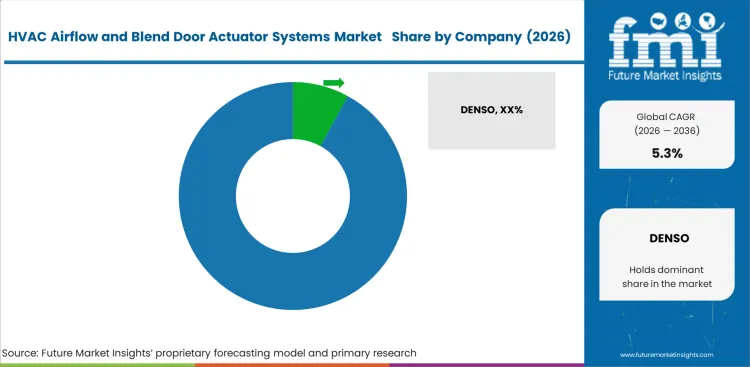
- The market remains moderately concentrated with a mix of thermal-system suppliers and automotive mechatronic specialists.
- Leading companies compete on HVAC integration depth, actuator durability, packaging fit, and OEM validation support.
- Specialist suppliers can still win where customers need compact designs, cost-focused sourcing, or region-specific support.
Competition in this market is shaped less by headline scale and more by fit inside automotive HVAC development. Suppliers need to support stable motor behavior and repeatable airflow-control performance across factory-fit vehicle programs. Companies operating close to automotive actuator systems and adjacent automotive climate control categories carry an advantage because automakers prefer suppliers that understand both actuator design and full thermal-system integration.
Supplier direction also points toward stronger module-level integration rather than isolated component supply. Companies with direct HVAC involvement are better placed because actuator performance depends on housing layout and program-level qualification requirements. This gives an edge to participants that can support both actuation hardware and the surrounding thermal package across vehicle development workflows.
Major Industry Players
- DENSO, Valeo, Hanon Systems, and Marelli fit this group because they bring wider thermal-system capability and broad OEM relationships across multiple regions.
- Johnson Electric, Nidec, and Brose fit here because they carry strong actuator and motor engineering capability.
- Regional mechatronic suppliers and compact actuator specialists remain relevant where buyers need tighter cost control or application-specific support.
Competitive Benchmarking: HVAC Airflow and Blend Door Actuator Systems Market
| Company | HVAC Integration Depth | Actuator Design Capability | OEM Access | Geographic Footprint |
|---|---|---|---|---|
| DENSO | High | High | Strong | Global |
| Valeo | High | High | Strong | Global |
| Hanon Systems | High | Medium | Strong | Global |
| Marelli | High | Medium | Strong | Global |
| Johnson Electric | Medium | High | Moderate | Global |
| Nidec | Medium | High | Moderate | Global |
| Brose | Medium | Medium | Moderate | Europe, Global |
| Mitsuba | Low | Medium | Moderate | Asia |
| Mahle | Medium | Medium | Moderate | Global |
| Eberspächer | Medium | Medium | Moderate | Europe, Global |
Source: Future Market Insights competitive analysis, 2026.
Key Developments
- In December 2024, DENSO reorganized its thermal business structure to strengthen focus across air-conditioning systems, thermal components, and thermal-management systems.
Key Players in the HVAC Airflow and Blend Door Actuator Systems Market
HVAC Airflow and Blend Door Actuator Systems Market Major global players
- DENSO
- Valeo
- Hanon Systems
- Marelli
- Johnson Electric
HVAC Airflow and Blend Door Actuator Systems Market Key emerging players / specialists
- Nidec
- Brose
- Mitsuba
- Mahle
- Eberspächer
Scope of the Report
| Metric | Value |
|---|---|
| Quantitative Units | USD 2.7 billion in 2026 to USD 4.6 billion by 2036, at a CAGR of 5.3% |
| Market Definition | Actuator systems used to control airflow path, blend position, recirculation, and cabin mode functions inside automotive HVAC assemblies |
| Regions Covered | North America, Europe, East Asia, South Asia Pacific, Latin America, Middle East and Africa |
| Countries Covered | United States, China, India, Germany, Japan and others |
| Key Companies Profiled | DENSO, Valeo, Hanon Systems, Marelli, Johnson Electric, Nidec, Brose |
| Forecast Period | 2026 to 2036 |
| Approach | Top-down vehicle-content sizing cross-checked against HVAC feature migration, vehicle production direction, and supplier activity |
HVAC Airflow and Blend Door Actuator Systems Market by Segments
HVAC Airflow and Blend Door Actuator Systems Market by Vehicle Type
- Passenger Cars
- Light Commercial Vehicles
HVAC Airflow and Blend Door Actuator Systems Market by Function
- Blend Door
- Mode Door
- Recirculation Door
- Air Inlet Door
HVAC Airflow and Blend Door Actuator Systems Market by Motor Technology
- DC Brushed
- Stepper
- Brushless
HVAC Airflow and Blend Door Actuator Systems Market by HVAC Control Type
- Manual HVAC
- Automatic HVAC
HVAC Airflow and Blend Door Actuator Systems Market by Sales Channel
- OEM Fitment
- Aftermarket
HVAC Airflow and Blend Door Actuator Systems Market by Zone Configuration
- Single-Zone
- Dual-Zone
- Multi-Zone
HVAC Airflow and Blend Door Actuator Systems Market by Region
- North America
- USA
- Canada
- Mexico
- Latin America
- Brazil
- Chile
- Rest of Latin America
- Western Europe
- Germany
- UK
- Italy
- Spain
- France
- Nordic
- BENELUX
- Rest of Western Europe
- Eastern Europe
- Russia
- Poland
- Hungary
- Balkan & Baltic
- Rest of Eastern Europe
- East Asia
- China
- Japan
- South Korea
- South Asia and Pacific
- India
- ASEAN
- Australia & New Zealand
- Rest of South Asia and Pacific
- Middle East & Africa
- Kingdom of Saudi Arabia
- Other GCC Countries
- Turkiye
- South Africa
- Other African Union
- Rest of Middle East & Africa
Bibliography
- DENSO Corporation. (2024, December 6). DENSO to reorganize its business structure to accelerate solving social issues through business. DENSO.
- DENSO Aftermarket. (2024). Air conditioning components. DENSO Aftermarket.
- International Energy Agency. (2025). Trends in electric car markets - Global EV Outlook 2025.
- MAHLE. (2025, April 21). Bionics optimizes air conditioning systems. This bibliography is provided for reader reference.
This Report Answers
- What is the current and future size of the HVAC airflow and blend door actuator systems market?
- How fast is the HVAC airflow and blend door actuator systems market expected to grow between 2026 and 2036?
- Which vehicle type is likely to lead the market by 2026?
- Which function is expected to account for the highest demand by 2026?
- What factors are driving demand for HVAC airflow and blend door actuator systems globally?
- How are cabin comfort upgrades influencing actuator demand?
- Why are EV thermal-efficiency needs supporting more precise airflow and recirculation control?
- Which countries are projected to show the fastest growth through 2036?
- What is driving market expansion in China and India?
- Who are the key companies active in the HVAC airflow and blend door actuator systems market?
- How does FMI estimate and validate the market forecast?
Frequently Asked Questions
What is the market size in 2026?
The market is estimated at USD 2.7 billion in 2026.
What is the forecast market value for 2036?
The market is projected to reach USD 4.6 billion by 2036.
What is the CAGR from 2026 to 2036?
The market is forecast to expand at a CAGR of 5.3% through 2036.
Which vehicle type leads the market?
Passenger cars are expected to lead with about 74.0% share in 2026.
Which function leads demand?
Blend door actuators are projected to remain the leading function with about 38.0% share in 2026.
Which sales channel leads demand?
OEM fitment is expected to account for about 86.0% of total demand in 2026.
What is causing demand to rise in China?
The China HVAC airflow and blend door actuator systems market is projected to grow at a CAGR of 6.1% through 2036 because of large vehicle output and broader climate-control feature expansion.
Preview the report firsthand - request a free sample
Get SampleGet the brochure for pricing and purchase details.
Get PDFTable of Content
- Executive Summary
- Global Market Outlook
- Demand-side Trends
- Supply-side Trends
- Technology Roadmap Analysis
- Analysis and Recommendations
- Market Overview
- Market Coverage / Taxonomy
- Market Definition / Scope / Limitations
- Research Methodology
- Chapter Orientation
- Analytical Lens and Working Hypotheses
- Market Structure, Signals, and Trend Drivers
- Benchmarking and Cross-market Comparability
- Market Sizing, Forecasting, and Opportunity Mapping
- Research Design and Evidence Framework
- Desk Research Programme (Secondary Evidence)
- Company Annual and Sustainability Reports
- Peer-reviewed Journals and Academic Literature
- Corporate Websites, Product Literature, and Technical Notes
- Earnings Decks and Investor Briefings
- Statutory Filings and Regulatory Disclosures
- Technical White Papers and Standards Notes
- Trade Journals, Industry Magazines, and Analyst Briefs
- Conference Proceedings, Webinars, and Seminar Materials
- Government Statistics Portals and Public Data Releases
- Press Releases and Reputable Media Coverage
- Specialist Newsletters and Curated Briefings
- Sector Databases and Reference Repositories
- FMI Internal Proprietary Databases and Historical Market Datasets
- Subscription Datasets and Paid Sources
- Social Channels, Communities, and Digital Listening Inputs
- Additional Desk Sources
- Expert Input and Fieldwork (Primary Evidence)
- Primary Modes
- Qualitative Interviews and Expert Elicitation
- Quantitative Surveys and Structured Data Capture
- Blended Approach
- Why Primary Evidence is Used
- Field Techniques
- Interviews
- Surveys
- Focus Groups
- Observational and In-context Research
- Social and Community Interactions
- Stakeholder Universe Engaged
- C-suite Leaders
- Board Members
- Presidents and Vice Presidents
- R&D and Innovation Heads
- Technical Specialists
- Domain Subject-matter Experts
- Scientists
- Physicians and Other Healthcare Professionals
- Governance, Ethics, and Data Stewardship
- Research Ethics
- Data Integrity and Handling
- Primary Modes
- Tooling, Models, and Reference Databases
- Desk Research Programme (Secondary Evidence)
- Data Engineering and Model Build
- Data Acquisition and Ingestion
- Cleaning, Normalisation, and Verification
- Synthesis, Triangulation, and Analysis
- Quality Assurance and Audit Trail
- Market Background
- Market Dynamics
- Drivers
- Restraints
- Opportunity
- Trends
- Scenario Forecast
- Demand in Optimistic Scenario
- Demand in Likely Scenario
- Demand in Conservative Scenario
- Opportunity Map Analysis
- Product Life Cycle Analysis
- Supply Chain Analysis
- Investment Feasibility Matrix
- Value Chain Analysis
- PESTLE and Porter’s Analysis
- Regulatory Landscape
- Regional Parent Market Outlook
- Production and Consumption Statistics
- Import and Export Statistics
- Market Dynamics
- Global Market Analysis 2021 to 2025 and Forecast, 2026 to 2036
- Historical Market Size Value (USD Million) Analysis, 2021 to 2025
- Current and Future Market Size Value (USD Million) Projections, 2026 to 2036
- Y-o-Y Growth Trend Analysis
- Absolute $ Opportunity Analysis
- Global Market Pricing Analysis 2021 to 2025 and Forecast 2026 to 2036
- Global Market Analysis 2021 to 2025 and Forecast 2026 to 2036, By Vehicle Type
- Introduction / Key Findings
- Historical Market Size Value (USD Million) Analysis By Vehicle Type , 2021 to 2025
- Current and Future Market Size Value (USD Million) Analysis and Forecast By Vehicle Type , 2026 to 2036
- Passenger Cars
- Light Commercial Vehicles
- Passenger Cars
- Y-o-Y Growth Trend Analysis By Vehicle Type , 2021 to 2025
- Absolute $ Opportunity Analysis By Vehicle Type , 2026 to 2036
- Global Market Analysis 2021 to 2025 and Forecast 2026 to 2036, By Function
- Introduction / Key Findings
- Historical Market Size Value (USD Million) Analysis By Function, 2021 to 2025
- Current and Future Market Size Value (USD Million) Analysis and Forecast By Function, 2026 to 2036
- Blend Door
- Mode Door
- Recirculation Door
- Air Inlet Door
- Blend Door
- Y-o-Y Growth Trend Analysis By Function, 2021 to 2025
- Absolute $ Opportunity Analysis By Function, 2026 to 2036
- Global Market Analysis 2021 to 2025 and Forecast 2026 to 2036, By Motor Technology
- Introduction / Key Findings
- Historical Market Size Value (USD Million) Analysis By Motor Technology, 2021 to 2025
- Current and Future Market Size Value (USD Million) Analysis and Forecast By Motor Technology, 2026 to 2036
- DC Brushed
- Stepper
- Brushless
- DC Brushed
- Y-o-Y Growth Trend Analysis By Motor Technology, 2021 to 2025
- Absolute $ Opportunity Analysis By Motor Technology, 2026 to 2036
- Global Market Analysis 2021 to 2025 and Forecast 2026 to 2036, By HVAC Control Type
- Introduction / Key Findings
- Historical Market Size Value (USD Million) Analysis By HVAC Control Type, 2021 to 2025
- Current and Future Market Size Value (USD Million) Analysis and Forecast By HVAC Control Type, 2026 to 2036
- Manual HVAC
- Automatic HVAC
- Manual HVAC
- Y-o-Y Growth Trend Analysis By HVAC Control Type, 2021 to 2025
- Absolute $ Opportunity Analysis By HVAC Control Type, 2026 to 2036
- Global Market Analysis 2021 to 2025 and Forecast 2026 to 2036, By Sales Channel
- Introduction / Key Findings
- Historical Market Size Value (USD Million) Analysis By Sales Channel, 2021 to 2025
- Current and Future Market Size Value (USD Million) Analysis and Forecast By Sales Channel, 2026 to 2036
- OEM Fitment
- Aftermarket
- OEM Fitment
- Y-o-Y Growth Trend Analysis By Sales Channel, 2021 to 2025
- Absolute $ Opportunity Analysis By Sales Channel, 2026 to 2036
- Global Market Analysis 2021 to 2025 and Forecast 2026 to 2036, By Zone Configuration
- Introduction / Key Findings
- Historical Market Size Value (USD Million) Analysis By Zone Configuration, 2021 to 2025
- Current and Future Market Size Value (USD Million) Analysis and Forecast By Zone Configuration, 2026 to 2036
- Single-Zone
- Dual-Zone
- Multi-Zone
- Single-Zone
- Y-o-Y Growth Trend Analysis By Zone Configuration, 2021 to 2025
- Absolute $ Opportunity Analysis By Zone Configuration, 2026 to 2036
- Global Market Analysis 2021 to 2025 and Forecast 2026 to 2036, By Region
- Introduction
- Historical Market Size Value (USD Million) Analysis By Region, 2021 to 2025
- Current Market Size Value (USD Million) Analysis and Forecast By Region, 2026 to 2036
- North America
- Latin America
- Western Europe
- Eastern Europe
- East Asia
- South Asia and Pacific
- Middle East & Africa
- Market Attractiveness Analysis By Region
- North America Market Analysis 2021 to 2025 and Forecast 2026 to 2036, By Country
- Historical Market Size Value (USD Million) Trend Analysis By Market Taxonomy, 2021 to 2025
- Market Size Value (USD Million) Forecast By Market Taxonomy, 2026 to 2036
- By Country
- USA
- Canada
- Mexico
- By Vehicle Type
- By Function
- By Motor Technology
- By HVAC Control Type
- By Sales Channel
- By Zone Configuration
- By Country
- Market Attractiveness Analysis
- By Country
- By Vehicle Type
- By Function
- By Motor Technology
- By HVAC Control Type
- By Sales Channel
- By Zone Configuration
- Key Takeaways
- Latin America Market Analysis 2021 to 2025 and Forecast 2026 to 2036, By Country
- Historical Market Size Value (USD Million) Trend Analysis By Market Taxonomy, 2021 to 2025
- Market Size Value (USD Million) Forecast By Market Taxonomy, 2026 to 2036
- By Country
- Brazil
- Chile
- Rest of Latin America
- By Vehicle Type
- By Function
- By Motor Technology
- By HVAC Control Type
- By Sales Channel
- By Zone Configuration
- By Country
- Market Attractiveness Analysis
- By Country
- By Vehicle Type
- By Function
- By Motor Technology
- By HVAC Control Type
- By Sales Channel
- By Zone Configuration
- Key Takeaways
- Western Europe Market Analysis 2021 to 2025 and Forecast 2026 to 2036, By Country
- Historical Market Size Value (USD Million) Trend Analysis By Market Taxonomy, 2021 to 2025
- Market Size Value (USD Million) Forecast By Market Taxonomy, 2026 to 2036
- By Country
- Germany
- UK
- Italy
- Spain
- France
- Nordic
- BENELUX
- Rest of Western Europe
- By Vehicle Type
- By Function
- By Motor Technology
- By HVAC Control Type
- By Sales Channel
- By Zone Configuration
- By Country
- Market Attractiveness Analysis
- By Country
- By Vehicle Type
- By Function
- By Motor Technology
- By HVAC Control Type
- By Sales Channel
- By Zone Configuration
- Key Takeaways
- Eastern Europe Market Analysis 2021 to 2025 and Forecast 2026 to 2036, By Country
- Historical Market Size Value (USD Million) Trend Analysis By Market Taxonomy, 2021 to 2025
- Market Size Value (USD Million) Forecast By Market Taxonomy, 2026 to 2036
- By Country
- Russia
- Poland
- Hungary
- Balkan & Baltic
- Rest of Eastern Europe
- By Vehicle Type
- By Function
- By Motor Technology
- By HVAC Control Type
- By Sales Channel
- By Zone Configuration
- By Country
- Market Attractiveness Analysis
- By Country
- By Vehicle Type
- By Function
- By Motor Technology
- By HVAC Control Type
- By Sales Channel
- By Zone Configuration
- Key Takeaways
- East Asia Market Analysis 2021 to 2025 and Forecast 2026 to 2036, By Country
- Historical Market Size Value (USD Million) Trend Analysis By Market Taxonomy, 2021 to 2025
- Market Size Value (USD Million) Forecast By Market Taxonomy, 2026 to 2036
- By Country
- China
- Japan
- South Korea
- By Vehicle Type
- By Function
- By Motor Technology
- By HVAC Control Type
- By Sales Channel
- By Zone Configuration
- By Country
- Market Attractiveness Analysis
- By Country
- By Vehicle Type
- By Function
- By Motor Technology
- By HVAC Control Type
- By Sales Channel
- By Zone Configuration
- Key Takeaways
- South Asia and Pacific Market Analysis 2021 to 2025 and Forecast 2026 to 2036, By Country
- Historical Market Size Value (USD Million) Trend Analysis By Market Taxonomy, 2021 to 2025
- Market Size Value (USD Million) Forecast By Market Taxonomy, 2026 to 2036
- By Country
- India
- ASEAN
- Australia & New Zealand
- Rest of South Asia and Pacific
- By Vehicle Type
- By Function
- By Motor Technology
- By HVAC Control Type
- By Sales Channel
- By Zone Configuration
- By Country
- Market Attractiveness Analysis
- By Country
- By Vehicle Type
- By Function
- By Motor Technology
- By HVAC Control Type
- By Sales Channel
- By Zone Configuration
- Key Takeaways
- Middle East & Africa Market Analysis 2021 to 2025 and Forecast 2026 to 2036, By Country
- Historical Market Size Value (USD Million) Trend Analysis By Market Taxonomy, 2021 to 2025
- Market Size Value (USD Million) Forecast By Market Taxonomy, 2026 to 2036
- By Country
- Kingdom of Saudi Arabia
- Other GCC Countries
- Turkiye
- South Africa
- Other African Union
- Rest of Middle East & Africa
- By Vehicle Type
- By Function
- By Motor Technology
- By HVAC Control Type
- By Sales Channel
- By Zone Configuration
- By Country
- Market Attractiveness Analysis
- By Country
- By Vehicle Type
- By Function
- By Motor Technology
- By HVAC Control Type
- By Sales Channel
- By Zone Configuration
- Key Takeaways
- Key Countries Market Analysis
- USA
- Pricing Analysis
- Market Share Analysis, 2025
- By Vehicle Type
- By Function
- By Motor Technology
- By HVAC Control Type
- By Sales Channel
- By Zone Configuration
- Canada
- Pricing Analysis
- Market Share Analysis, 2025
- By Vehicle Type
- By Function
- By Motor Technology
- By HVAC Control Type
- By Sales Channel
- By Zone Configuration
- Mexico
- Pricing Analysis
- Market Share Analysis, 2025
- By Vehicle Type
- By Function
- By Motor Technology
- By HVAC Control Type
- By Sales Channel
- By Zone Configuration
- Brazil
- Pricing Analysis
- Market Share Analysis, 2025
- By Vehicle Type
- By Function
- By Motor Technology
- By HVAC Control Type
- By Sales Channel
- By Zone Configuration
- Chile
- Pricing Analysis
- Market Share Analysis, 2025
- By Vehicle Type
- By Function
- By Motor Technology
- By HVAC Control Type
- By Sales Channel
- By Zone Configuration
- Germany
- Pricing Analysis
- Market Share Analysis, 2025
- By Vehicle Type
- By Function
- By Motor Technology
- By HVAC Control Type
- By Sales Channel
- By Zone Configuration
- UK
- Pricing Analysis
- Market Share Analysis, 2025
- By Vehicle Type
- By Function
- By Motor Technology
- By HVAC Control Type
- By Sales Channel
- By Zone Configuration
- Italy
- Pricing Analysis
- Market Share Analysis, 2025
- By Vehicle Type
- By Function
- By Motor Technology
- By HVAC Control Type
- By Sales Channel
- By Zone Configuration
- Spain
- Pricing Analysis
- Market Share Analysis, 2025
- By Vehicle Type
- By Function
- By Motor Technology
- By HVAC Control Type
- By Sales Channel
- By Zone Configuration
- France
- Pricing Analysis
- Market Share Analysis, 2025
- By Vehicle Type
- By Function
- By Motor Technology
- By HVAC Control Type
- By Sales Channel
- By Zone Configuration
- India
- Pricing Analysis
- Market Share Analysis, 2025
- By Vehicle Type
- By Function
- By Motor Technology
- By HVAC Control Type
- By Sales Channel
- By Zone Configuration
- ASEAN
- Pricing Analysis
- Market Share Analysis, 2025
- By Vehicle Type
- By Function
- By Motor Technology
- By HVAC Control Type
- By Sales Channel
- By Zone Configuration
- Australia & New Zealand
- Pricing Analysis
- Market Share Analysis, 2025
- By Vehicle Type
- By Function
- By Motor Technology
- By HVAC Control Type
- By Sales Channel
- By Zone Configuration
- China
- Pricing Analysis
- Market Share Analysis, 2025
- By Vehicle Type
- By Function
- By Motor Technology
- By HVAC Control Type
- By Sales Channel
- By Zone Configuration
- Japan
- Pricing Analysis
- Market Share Analysis, 2025
- By Vehicle Type
- By Function
- By Motor Technology
- By HVAC Control Type
- By Sales Channel
- By Zone Configuration
- South Korea
- Pricing Analysis
- Market Share Analysis, 2025
- By Vehicle Type
- By Function
- By Motor Technology
- By HVAC Control Type
- By Sales Channel
- By Zone Configuration
- Russia
- Pricing Analysis
- Market Share Analysis, 2025
- By Vehicle Type
- By Function
- By Motor Technology
- By HVAC Control Type
- By Sales Channel
- By Zone Configuration
- Poland
- Pricing Analysis
- Market Share Analysis, 2025
- By Vehicle Type
- By Function
- By Motor Technology
- By HVAC Control Type
- By Sales Channel
- By Zone Configuration
- Hungary
- Pricing Analysis
- Market Share Analysis, 2025
- By Vehicle Type
- By Function
- By Motor Technology
- By HVAC Control Type
- By Sales Channel
- By Zone Configuration
- Kingdom of Saudi Arabia
- Pricing Analysis
- Market Share Analysis, 2025
- By Vehicle Type
- By Function
- By Motor Technology
- By HVAC Control Type
- By Sales Channel
- By Zone Configuration
- Turkiye
- Pricing Analysis
- Market Share Analysis, 2025
- By Vehicle Type
- By Function
- By Motor Technology
- By HVAC Control Type
- By Sales Channel
- By Zone Configuration
- South Africa
- Pricing Analysis
- Market Share Analysis, 2025
- By Vehicle Type
- By Function
- By Motor Technology
- By HVAC Control Type
- By Sales Channel
- By Zone Configuration
- USA
- Market Structure Analysis
- Competition Dashboard
- Competition Benchmarking
- Market Share Analysis of Top Players
- By Regional
- By Vehicle Type
- By Function
- By Motor Technology
- By HVAC Control Type
- By Sales Channel
- By Zone Configuration
- Competition Analysis
- Competition Deep Dive
- DENSO
- Overview
- Product Portfolio
- Profitability by Market Segments (Product/Age /Sales Channel/Region)
- Sales Footprint
- Strategy Overview
- Marketing Strategy
- Product Strategy
- Channel Strategy
- Valeo
- Hanon Systems
- Marelli
- Johnson Electric
- Nidec
- Brose
- Mitsuba
- Mahle
- Eberspächer
- DENSO
- Competition Deep Dive
- Assumptions & Acronyms Used


