

- Industry Size (2026)
- USD 7033.6 Mn
- Forecast (2036)
- USD 18078.2 Mn
- CAGR (2026 to 2036)
- 9.9%
Energy-Efficient EV Cabin HVAC Market Forecast and Outlook 2026 to 2036
The energy-efficient EV cabin HVAC market is valued at USD 7,033.6 million in 2026 and projected to reach USD 18,078.2 million by 2036 at a CAGR of 9.9%. Value behavior reflects structural importance of cabin HVAC as a primary auxiliary energy load within electric vehicles. OEM investment concentrates on heat pump architectures, integrated thermal loops, and variable-speed components embedded at platform design stage. Spending aligns with efforts to stabilize real-world driving range under heating and cooling demand rather than expand comfort feature density.
Procurement emphasis centers on efficiency performance, durability across frequent duty cycles, and compatibility with battery and power electronics thermal systems. Revenue concentration remains strongest in passenger EV platforms where HVAC efficiency directly affects usability, certification metrics, and consumer acceptance.
Growth quality remains shaped by integration depth, cost discipline, and climate performance limits. Energy-efficient HVAC systems introduce added control complexity, calibration effort, and validation burden across software, sensors, and power electronics. Value realization depends on consistent heat pump performance across temperature extremes, requiring supplemental architectures in cold conditions. Cost sensitivity persists in entry and mid-range segments where HVAC efficiency competes with battery capacity and infotainment investment.
Quick Stats for Energy-Efficient EV Cabin HVAC Market
- Energy-Efficient EV Cabin HVAC Market Value (2026): USD 7,033.6 million
- Energy-Efficient EV Cabin HVAC Market Forecast Value (2036): USD 18,078.2 million
- Energy-Efficient EV Cabin HVAC Market Forecast CAGR 2026 to 2036: 9.9%
- Leading HVAC Architecture in Global Demand: Heat Pump-Based HVAC
- Fastest-Growing Countries: China, Brazil, USA, South Korea, Germany
- Top Players in Global Demand: Denso, Hanon Systems, Valeo, MAHLE, Bosch, Sanden, Marelli, Eberspächer, Gentherm, Modine
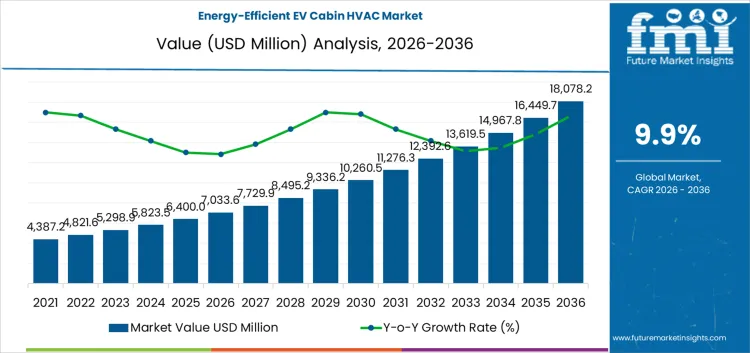
Supply exposure to compressors, inverters, and refrigerant-compliant components influences scalability. Adoption favors platforms pursuing integrated thermal management as a core efficiency lever rather than incremental upgrades. Long-term value concentration reflects capital allocation toward system-level energy optimization, regulatory compliance, and range preservation under diverse operating environments.
Energy-Efficient EV Cabin HVAC Market Key Takeaways
| Metric | Value |
|---|---|
| Market Value (2026) | USD 7,033.6 million |
| Market Forecast Value (2036) | USD 18,078.2 million |
| Forecast CAGR 2026 to 2036 | 9.9% |
Why is the Demand for Energy-Efficient EV Cabin HVAC Growing?
Demand for energy-efficient EV cabin HVAC solutions is rising as vehicle manufacturers pursue systems that support range optimization and occupant comfort without excessive power draw. Electric powertrains have limited energy budgets compared with internal combustion engines, and HVAC systems that minimize consumption while delivering effective heating and cooling preserve usable driving distance. Engineers are specifying heat pump integration, variable speed compressors, and advanced thermal management strategies that align with vehicle control systems and battery constraints. Procurement teams evaluate components for efficiency performance, durability under repeated duty cycles, and compatibility with diverse vehicle architectures when selecting suppliers for new programs.
Fleet operators and individual EV buyers prioritize vehicles with cabin climate control that adapts to ambient conditions with minimal impact on overall energy consumption. Growth in connected vehicle controls and predictive thermal management algorithms reinforces uptake of HVAC solutions that proactively adjust to forecasted conditions and occupant preferences. Regulatory emphasis on energy efficiency performance labels and vehicle certification criteria influences specification of systems that contribute to overall vehicle energy ratings. Technical training for assembly and service personnel ensures reliable installation and maintenance of intricate HVAC subsystems across production and service networks. These dynamics support sustained adoption of energy-efficient cabin HVAC solutions in evolving electric vehicle segments.
How Are the Segments Classified in the Energy-Efficient EV Cabin HVAC Market?
Demand for energy-efficient EV cabin HVAC systems is shaped by driving range preservation, occupant comfort expectations, and regulatory efficiency requirements. Thermal systems directly influence battery load and vehicle operating efficiency under extreme ambient conditions. Adoption aligns with integrated vehicle thermal strategies balancing cabin conditioning and energy management. Automakers prioritize architectures supporting reduced power draw and fast thermal response. Segment classification reflects differentiation by HVAC architecture, vehicle positioning, and feature integration approach. Structure highlights how system design, vehicle category, and integration depth influence deployment intensity, control complexity, and efficiency outcomes across electric vehicle platforms.
Which HVAC Architecture Represents the Largest Share of Demand?
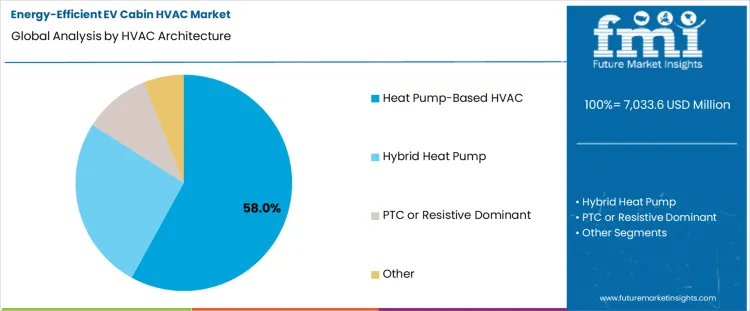
Heat pump-based HVAC systems hold 58.0%, representing the largest share among HVAC architectures due to superior energy efficiency. These systems transfer heat rather than generate it, reducing electrical load during heating and cooling. Integration supports improved driving range under cold and hot conditions. Compatibility with battery thermal management enhances system-level efficiency. Hybrid heat pump systems combine multiple heat sources to extend operating envelopes. PTC or resistive dominant systems address simpler architectures with higher energy draw. Architecture segmentation reflects preference for solutions delivering measurable efficiency gains aligned with electric vehicle performance priorities.
Key Points
- Heat pump architectures reduce electrical energy consumption.
- Heat transfer improves range preservation in varied climates.
- Other architectures address simplicity or extended operating needs.
Which Vehicle Segment Drives the Largest Share of Demand?
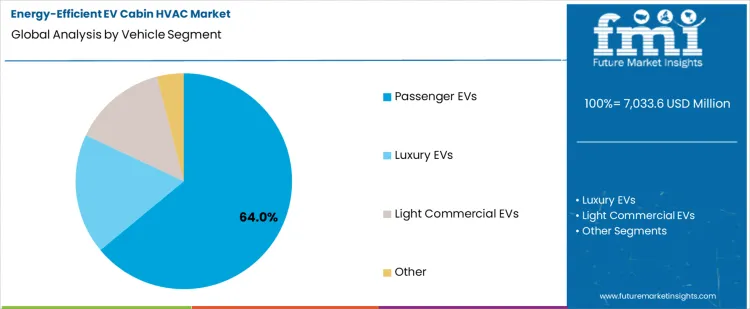
Passenger EVs hold 64.0%, representing the largest share among vehicle segments adopting energy-efficient HVAC systems. High production volumes and broad consumer adoption support standardized HVAC integration. Energy efficiency directly influences perceived vehicle usability and range confidence. Manufacturers prioritize scalable HVAC solutions across mass-market platforms. Luxury EVs adopt advanced thermal features with higher system complexity. Light commercial EVs integrate efficiency-focused systems based on duty cycle considerations. Vehicle segment segmentation reflects concentration of deployment within passenger-focused electric vehicles emphasizing efficiency, comfort, and volume scalability.
Key Points
- Passenger EVs prioritize efficiency to support daily usability.
- High volumes enable standardized HVAC deployment.
- Other segments integrate systems based on positioning and duty cycles.
Which Feature Integration Approach Accounts for the Highest Share of Demand?
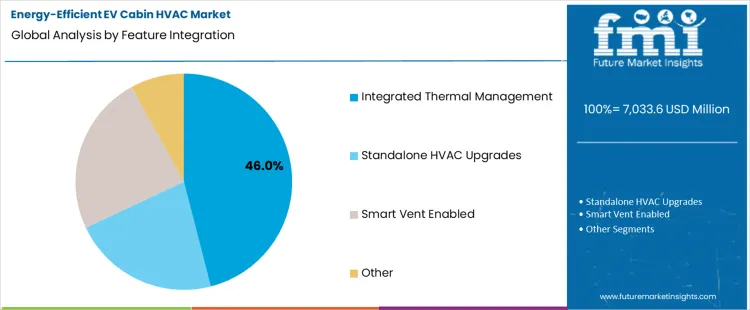
Integrated thermal management holds 46.0%, representing the largest share among feature integration approaches due to system-level efficiency benefits. Integration coordinates cabin HVAC with battery and power electronics cooling. Unified control improves energy distribution and thermal balance. Centralized architecture reduces redundant components and optimizes packaging. Smart vent-enabled and standalone HVAC upgrades support targeted airflow control and retrofit flexibility. Other approaches address niche configurations. Feature integration segmentation reflects emphasis on holistic thermal coordination delivering efficiency gains and simplified system management across modern electric vehicle platforms.
Key Points
- Integrated management coordinates cabin and battery thermal needs.
- Centralized control improves efficiency and packaging.
- Other approaches support modular or airflow-focused enhancements.
What are the Key Dynamics in the Energy-Efficient EV Cabin HVAC Market?
Demand for energy-efficient EV cabin HVAC systems reflects requirement to balance occupant comfort with vehicle range preservation. Adoption spans passenger electric vehicles, light commercial fleets, and shared mobility platforms. Global scope aligns with electrification mandates and efficiency-driven vehicle design priorities. Usage centers on advanced heat pumps, intelligent controls, and low-loss components integrated within vehicle thermal architectures to minimize auxiliary energy consumption.
How do range preservation and integrated thermal management shape adoption?
Electric vehicle platforms face direct tradeoffs between cabin comfort and driving range. Demand increases as efficient HVAC systems reduce auxiliary power draw during heating and cooling cycles. Heat pump architectures replace resistive heating to improve energy utilization, particularly in moderate climates. Integration with battery and power electronics thermal loops enables shared energy management and load optimization. Software-driven controls adjust airflow, temperature setpoints, and operating modes based on occupancy and ambient conditions. Adoption strengthens where regulatory efficiency testing incorporates real-world energy usage. OEMs prioritize compact, lightweight HVAC modules supporting vehicle packaging constraints. Fleet operators value predictable energy consumption to stabilize route planning and utilization metrics.
How do system complexity, climate performance limits, and cost sensitivity influence market scalability?
Energy-efficient HVAC systems require advanced compressors, power electronics, sensors, and control software, increasing design complexity. Demand sensitivity rises where added cost affects vehicle affordability targets. Performance degradation in extreme cold reduces heat pump efficiency, requiring supplemental heating solutions. Integration challenges emerge across vehicle platforms with varied thermal layouts. Validation requirements for safety, durability, and electromagnetic compatibility extend development timelines. Software calibration complexity increases risk of inconsistent real-world performance. Supply chain dependence on specialized components limits sourcing flexibility. Warranty exposure related to thermal system reliability constrains aggressive deployment across entry-level electric vehicle segments.
How Is Demand for Energy-Efficient EV Cabin HVAC Evolving Globally?
Demand for energy-efficient EV cabin HVAC systems is expanding globally as electric vehicle platforms prioritize range preservation, thermal efficiency, and integrated energy management. Cabin HVAC remains one of the largest auxiliary power consumers in EVs, driving redesign toward heat pumps, variable-speed compressors, and intelligent control strategies. Adoption reflects alignment with regulatory efficiency targets and real-world driving performance expectations. Integration across passenger vehicles, commercial fleets, and electric buses continues to widen application scope. Growth rates in China at 11.5%, Brazil at 11.3%, USA at 9.5%, South Korea at 9.3%, and Germany at 9.1% indicate sustained expansion driven by electrification scale, climate exposure, and platform-level HVAC optimization.
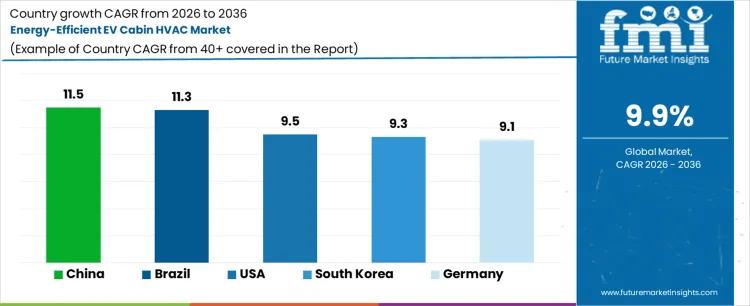
| Country | CAGR (%) |
|---|---|
| China | 11.5% |
| Brazil | 11.3% |
| USA | 9.5% |
| South Korea | 9.3% |
| Germany | 9.1% |
What Is Driving Rapid Growth of Energy-Efficient EV Cabin HVAC Demand in China?
Energy-efficient EV cabin HVAC demand in China is expanding at a CAGR of 11.5% due to large-scale EV deployment and regulatory efficiency pressure. High vehicle production volumes magnify impact of HVAC energy consumption on fleet-wide range metrics. OEMs integrate heat pump-based systems to improve cold and hot weather efficiency. Dense urban driving increases HVAC usage frequency, reinforcing optimization priorities. Public transport electrification extends demand into buses requiring high-capacity yet efficient HVAC units. Domestic suppliers support rapid scaling through localized component manufacturing and system integration capabilities.
- Large-scale EV production amplifying efficiency impact
- Regulatory pressure on vehicle energy performance
- Adoption of heat pump-based HVAC architectures
- Strong domestic HVAC and component supply base
Why Is Brazil Experiencing Accelerated Adoption of Energy-Efficient EV Cabin HVAC?
Energy-efficient EV cabin HVAC demand in Brazil is growing at a CAGR of 11.3%, shaped by climate-driven cooling intensity. High ambient temperatures significantly increase HVAC load during vehicle operation. Efficient systems reduce energy draw and improve usable driving range. Electric bus and commercial fleet electrification programs prioritize HVAC efficiency to control operating costs. Depot charging enables optimization of thermal strategies aligned with duty cycles. Passenger EV adoption contributes incremental demand, though fleet usage remains the dominant driver of system deployment.
- High ambient temperatures increasing HVAC energy load
- Electric bus and fleet electrification initiatives
- Operating cost reduction priorities for fleets
- Depot-based charging enabling thermal optimization
How Is the USA Supporting Sustained Growth of Energy-Efficient EV Cabin HVAC?
Energy-efficient EV cabin HVAC demand in the USA is expanding at a CAGR of 9.5%, supported by platform-level energy optimization strategies. OEMs integrate advanced HVAC controls to stabilize range performance across diverse climates. Consumer usage emphasizes consistent comfort without compromising driving range. Commercial fleets adopt efficient HVAC to reduce auxiliary energy consumption. Broad availability of residential and workplace charging supports off-peak thermal management. Demand growth reflects system-level integration within connected vehicle architectures rather than standalone HVAC upgrades.
- Platform-level focus on range consistency
- Consumer expectation for comfort efficiency balance
- Fleet adoption to reduce auxiliary energy draw
- High penetration of residential and workplace charging
What Factors Are Driving Energy-Efficient EV Cabin HVAC Demand in South Korea?
Energy-efficient EV cabin HVAC demand in South Korea is growing at a CAGR of 9.3%, driven by advanced vehicle engineering and export-oriented platform design. OEMs emphasize coordinated control between HVAC, battery, and power electronics. Efficiency gains support performance stability during seasonal temperature extremes. Export markets require compliance with varied climate efficiency standards. Supplier innovation enables compact, high-efficiency HVAC modules. Demand growth reflects technology-led integration within globally deployed EV platforms rather than region-specific feature additions.
- Integrated thermal management across vehicle systems
- Seasonal efficiency requirements across operating conditions
- Export-driven compliance with global efficiency standards
- Strong supplier innovation in compact HVAC modules
Why Is Germany Showing Steady Expansion in Energy-Efficient EV Cabin HVAC?
Energy-efficient EV cabin HVAC demand in Germany is expanding at a CAGR of 9.1%, influenced by efficiency-focused vehicle engineering practices. Cold climate operation increases energy consumption during cabin heating, reinforcing relevance of efficient HVAC solutions. OEMs integrate heat pumps and intelligent controls to preserve driving range. Regulatory efficiency targets guide system selection across new platforms. Corporate fleet electrification supports incremental deployment. Growth is linked to platform redesign cycles and standardized system integration rather than retrofit-driven demand.
- Cold climate impact on HVAC energy consumption
- Integration of heat pumps and intelligent controls
- Regulatory focus on vehicle efficiency metrics
- Corporate fleet electrification contributing steady demand
What is the competitive landscape of demand for the energy-efficient EV cabin HVAC market globally?
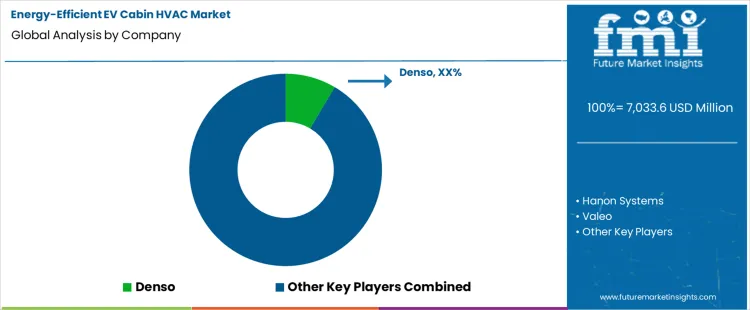
Demand for energy-efficient EV cabin HVAC systems is driven by electrification targets, range optimization priorities, and rising passenger comfort expectations. EV HVAC must manage cabin thermal comfort with minimal energy draw from the battery while maintaining performance in extreme temperatures. Buyers evaluate system efficiency, heat pump integration, thermal management strategies, compressor types, and control algorithms that balance comfort and energy consumption. Procurement teams prioritize suppliers with low-energy HVAC platforms, OEM certifications, global engineering support, and strong integration capabilities with vehicle thermal architecture. Trend in the global market reflects increased adoption of heat pump technology, zonal climate control, and connected climate strategies that reduce net energy impact on range.
Denso holds leading positioning through energy-efficient EV HVAC solutions combining heat pump modules and advanced control logic optimized for low electrical load. Hanon Systems supports demand with modular, heat-pump-ready HVAC platforms tailored for electric and hybrid powertrains. Valeo participates with low-energy cabin climate solutions designed to improve energy utilization in EV applications. MAHLE contributes integrated thermal systems and HVAC components engineered for efficient heat exchange and minimal drag on the battery. Bosch supplies climate control modules and electronics that enhance energy-responsive HVAC performance in electrified vehicles. Competitive differentiation depends on heat pump performance, energy management software, integration flexibility, and ability to meet diverse OEM thermal comfort and range targets.
Key Players in the Energy-Efficient EV Cabin HVAC Market
- Denso
- Hanon Systems
- Valeo
- MAHLE
- Bosch
- Sanden
- Marelli
- Eberspächer
- Gentherm
- Modine
Scope of the Report
| Items | Values |
|---|---|
| Quantitative Units | USD million |
| HVAC Architecture | Heat Pump-Based HVAC; Hybrid Heat Pump; PTC or Resistive Dominant; Other |
| Vehicle Segment | Passenger EVs; Luxury EVs; Light Commercial EVs; Other |
| Feature Integration | Integrated Thermal Management; Standalone HVAC Upgrades; Smart Vent Enabled; Other |
| Sales Channel | OEM Line-Fit; Tier-1 Modules; Aftermarket; Other |
| Regions Covered | Asia Pacific, Europe, North America, Latin America, Middle East & Africa |
| Countries Covered | China, Brazil, USA, South Korea, Germany, and 40+ countries |
| Key Companies Profiled | Denso; Hanon Systems; Valeo; MAHLE; Bosch; Sanden; Marelli; Eberspächer; Gentherm; Modine |
| Additional Attributes | Dollar sales by HVAC architecture and vehicle segment; adoption trends for heat pump-centric cabin HVAC to extend EV range; COP efficiency, low-ambient heating performance, and transient response metrics; integration with battery and power electronics thermal loops; control software sophistication, sensor fusion, and smart vent actuation considerations; compliance with refrigerant regulations, OEM efficiency targets, and interior NVH standards influencing system selection. |
Energy-Efficient EV Cabin HVAC Market by Segment
HVAC Architecture:
- Heat Pump-Based HVAC
- Hybrid Heat Pump
- PTC or Resistive Dominant
- Other
Vehicle Segment:
- Passenger EVs
- Luxury EVs
- Light Commercial EVs
- Other
Feature Integration:
- Integrated Thermal Management
- Standalone HVAC Upgrades
- Smart Vent Enabled
- Other
Sales Channel:
- OEM Line-Fit
- Tier-1 Modules
- Aftermarket
- Other
Region:
- Asia Pacific
- China
- Japan
- South Korea
- India
- Australia & New Zealand
- ASEAN
- Rest of Asia Pacific
- Europe
- Germany
- United Kingdom
- France
- Italy
- Spain
- Nordic
- BENELUX
- Rest of Europe
- North America
- United States
- Canada
- Mexico
- Latin America
- Brazil
- Chile
- Rest of Latin America
- Middle East & Africa
- Kingdom of Saudi Arabia
- Other GCC Countries
- Turkey
- South Africa
- Other African Union
- Rest of Middle East & Africa
Bibliography
- International Energy Agency. (2024). Energy-efficient thermal management systems for electric vehicles. IEA Transport and Energy Efficiency Reports.
- Society of Automotive Engineers International. (2023). Heat pump-based HVAC architectures and energy optimization in electric vehicles. SAE Technical Papers.
- European Commission Joint Research Centre. (2024). Auxiliary energy consumption and cabin HVAC efficiency in electric vehicles. JRC Science for Policy Reports.
- National Renewable Energy Laboratory. (2023). Impact of advanced HVAC systems on electric vehicle range and energy use. NREL Transportation Research Publications.
Frequently Asked Questions
How big is the energy-efficient ev cabin hvac market in 2026?
The global energy-efficient ev cabin hvac market is estimated to be valued at USD 7,033.6 million in 2026.
What will be the size of energy-efficient ev cabin hvac market in 2036?
The market size for the energy-efficient ev cabin hvac market is projected to reach USD 18,078.2 million by 2036.
How much will be the energy-efficient ev cabin hvac market growth between 2026 and 2036?
The energy-efficient ev cabin hvac market is expected to grow at a 9.9% CAGR between 2026 and 2036.
What are the key product types in the energy-efficient ev cabin hvac market?
The key product types in energy-efficient ev cabin hvac market are heat pump-based hvac, hybrid heat pump, ptc or resistive dominant and other.
Which vehicle segment segment to contribute significant share in the energy-efficient ev cabin hvac market in 2026?
In terms of vehicle segment, passenger evs segment to command 64.0% share in the energy-efficient ev cabin hvac market in 2026.
Preview the report firsthand - request a free sample
Get SampleGet the brochure for pricing and purchase details.
Get PDFTable of Content
- Executive Summary
- Global Market Outlook
- Demand-side Trends
- Supply-side Trends
- Technology Roadmap Analysis
- Analysis and Recommendations
- Market Overview
- Market Coverage / Taxonomy
- Market Definition / Scope / Limitations
- Market Background
- Market Dynamics
- Drivers
- Restraints
- Opportunity
- Trends
- Scenario Forecast
- Demand in Optimistic Scenario
- Demand in Likely Scenario
- Demand in Conservative Scenario
- Opportunity Map Analysis
- Product Life Cycle Analysis
- Supply Chain Analysis
- Investment Feasibility Matrix
- Value Chain Analysis
- PESTLE and Porter’s Analysis
- Regulatory Landscape
- Regional Parent Market Outlook
- Production and Consumption Statistics
- Import and Export Statistics
- Market Dynamics
- Global Market Analysis 2021 to 2025 and Forecast, 2026 to 2036
- Historical Market Size Value (USD Million) Analysis, 2021 to 2025
- Current and Future Market Size Value (USD Million) Projections, 2026 to 2036
- Y-o-Y Growth Trend Analysis
- Absolute $ Opportunity Analysis
- Global Market Pricing Analysis 2021 to 2025 and Forecast 2026 to 2036
- Global Market Analysis 2021 to 2025 and Forecast 2026 to 2036, By HVAC Architecture
- Introduction / Key Findings
- Historical Market Size Value (USD Million) Analysis By HVAC Architecture , 2021 to 2025
- Current and Future Market Size Value (USD Million) Analysis and Forecast By HVAC Architecture , 2026 to 2036
- Heat Pump-Based HVAC
- Hybrid Heat Pump
- PTC or Resistive Dominant
- Other
- Heat Pump-Based HVAC
- Y-o-Y Growth Trend Analysis By HVAC Architecture , 2021 to 2025
- Absolute $ Opportunity Analysis By HVAC Architecture , 2026 to 2036
- Global Market Analysis 2021 to 2025 and Forecast 2026 to 2036, By Vehicle Segment
- Introduction / Key Findings
- Historical Market Size Value (USD Million) Analysis By Vehicle Segment, 2021 to 2025
- Current and Future Market Size Value (USD Million) Analysis and Forecast By Vehicle Segment, 2026 to 2036
- Passenger EVs
- Luxury EVs
- Light Commercial EVs
- Other
- Passenger EVs
- Y-o-Y Growth Trend Analysis By Vehicle Segment, 2021 to 2025
- Absolute $ Opportunity Analysis By Vehicle Segment, 2026 to 2036
- Global Market Analysis 2021 to 2025 and Forecast 2026 to 2036, By Feature Integration
- Introduction / Key Findings
- Historical Market Size Value (USD Million) Analysis By Feature Integration, 2021 to 2025
- Current and Future Market Size Value (USD Million) Analysis and Forecast By Feature Integration, 2026 to 2036
- Integrated Thermal Management
- Standalone HVAC Upgrades
- Smart Vent Enabled
- Other
- Integrated Thermal Management
- Y-o-Y Growth Trend Analysis By Feature Integration, 2021 to 2025
- Absolute $ Opportunity Analysis By Feature Integration, 2026 to 2036
- Global Market Analysis 2021 to 2025 and Forecast 2026 to 2036, By Sales Channel
- Introduction / Key Findings
- Historical Market Size Value (USD Million) Analysis By Sales Channel, 2021 to 2025
- Current and Future Market Size Value (USD Million) Analysis and Forecast By Sales Channel, 2026 to 2036
- OEM Line-Fit
- Tier-1 Modules
- Aftermarket
- Other
- OEM Line-Fit
- Y-o-Y Growth Trend Analysis By Sales Channel, 2021 to 2025
- Absolute $ Opportunity Analysis By Sales Channel, 2026 to 2036
- Global Market Analysis 2021 to 2025 and Forecast 2026 to 2036, By Region
- Introduction
- Historical Market Size Value (USD Million) Analysis By Region, 2021 to 2025
- Current Market Size Value (USD Million) Analysis and Forecast By Region, 2026 to 2036
- North America
- Latin America
- Western Europe
- Eastern Europe
- East Asia
- South Asia and Pacific
- Middle East & Africa
- Market Attractiveness Analysis By Region
- North America Market Analysis 2021 to 2025 and Forecast 2026 to 2036, By Country
- Historical Market Size Value (USD Million) Trend Analysis By Market Taxonomy, 2021 to 2025
- Market Size Value (USD Million) Forecast By Market Taxonomy, 2026 to 2036
- By Country
- USA
- Canada
- Mexico
- By HVAC Architecture
- By Vehicle Segment
- By Feature Integration
- By Sales Channel
- By Country
- Market Attractiveness Analysis
- By Country
- By HVAC Architecture
- By Vehicle Segment
- By Feature Integration
- By Sales Channel
- Key Takeaways
- Latin America Market Analysis 2021 to 2025 and Forecast 2026 to 2036, By Country
- Historical Market Size Value (USD Million) Trend Analysis By Market Taxonomy, 2021 to 2025
- Market Size Value (USD Million) Forecast By Market Taxonomy, 2026 to 2036
- By Country
- Brazil
- Chile
- Rest of Latin America
- By HVAC Architecture
- By Vehicle Segment
- By Feature Integration
- By Sales Channel
- By Country
- Market Attractiveness Analysis
- By Country
- By HVAC Architecture
- By Vehicle Segment
- By Feature Integration
- By Sales Channel
- Key Takeaways
- Western Europe Market Analysis 2021 to 2025 and Forecast 2026 to 2036, By Country
- Historical Market Size Value (USD Million) Trend Analysis By Market Taxonomy, 2021 to 2025
- Market Size Value (USD Million) Forecast By Market Taxonomy, 2026 to 2036
- By Country
- Germany
- UK
- Italy
- Spain
- France
- Nordic
- BENELUX
- Rest of Western Europe
- By HVAC Architecture
- By Vehicle Segment
- By Feature Integration
- By Sales Channel
- By Country
- Market Attractiveness Analysis
- By Country
- By HVAC Architecture
- By Vehicle Segment
- By Feature Integration
- By Sales Channel
- Key Takeaways
- Eastern Europe Market Analysis 2021 to 2025 and Forecast 2026 to 2036, By Country
- Historical Market Size Value (USD Million) Trend Analysis By Market Taxonomy, 2021 to 2025
- Market Size Value (USD Million) Forecast By Market Taxonomy, 2026 to 2036
- By Country
- Russia
- Poland
- Hungary
- Balkan & Baltic
- Rest of Eastern Europe
- By HVAC Architecture
- By Vehicle Segment
- By Feature Integration
- By Sales Channel
- By Country
- Market Attractiveness Analysis
- By Country
- By HVAC Architecture
- By Vehicle Segment
- By Feature Integration
- By Sales Channel
- Key Takeaways
- East Asia Market Analysis 2021 to 2025 and Forecast 2026 to 2036, By Country
- Historical Market Size Value (USD Million) Trend Analysis By Market Taxonomy, 2021 to 2025
- Market Size Value (USD Million) Forecast By Market Taxonomy, 2026 to 2036
- By Country
- China
- Japan
- South Korea
- By HVAC Architecture
- By Vehicle Segment
- By Feature Integration
- By Sales Channel
- By Country
- Market Attractiveness Analysis
- By Country
- By HVAC Architecture
- By Vehicle Segment
- By Feature Integration
- By Sales Channel
- Key Takeaways
- South Asia and Pacific Market Analysis 2021 to 2025 and Forecast 2026 to 2036, By Country
- Historical Market Size Value (USD Million) Trend Analysis By Market Taxonomy, 2021 to 2025
- Market Size Value (USD Million) Forecast By Market Taxonomy, 2026 to 2036
- By Country
- India
- ASEAN
- Australia & New Zealand
- Rest of South Asia and Pacific
- By HVAC Architecture
- By Vehicle Segment
- By Feature Integration
- By Sales Channel
- By Country
- Market Attractiveness Analysis
- By Country
- By HVAC Architecture
- By Vehicle Segment
- By Feature Integration
- By Sales Channel
- Key Takeaways
- Middle East & Africa Market Analysis 2021 to 2025 and Forecast 2026 to 2036, By Country
- Historical Market Size Value (USD Million) Trend Analysis By Market Taxonomy, 2021 to 2025
- Market Size Value (USD Million) Forecast By Market Taxonomy, 2026 to 2036
- By Country
- Kingdom of Saudi Arabia
- Other GCC Countries
- Turkiye
- South Africa
- Other African Union
- Rest of Middle East & Africa
- By HVAC Architecture
- By Vehicle Segment
- By Feature Integration
- By Sales Channel
- By Country
- Market Attractiveness Analysis
- By Country
- By HVAC Architecture
- By Vehicle Segment
- By Feature Integration
- By Sales Channel
- Key Takeaways
- Key Countries Market Analysis
- USA
- Pricing Analysis
- Market Share Analysis, 2025
- By HVAC Architecture
- By Vehicle Segment
- By Feature Integration
- By Sales Channel
- Canada
- Pricing Analysis
- Market Share Analysis, 2025
- By HVAC Architecture
- By Vehicle Segment
- By Feature Integration
- By Sales Channel
- Mexico
- Pricing Analysis
- Market Share Analysis, 2025
- By HVAC Architecture
- By Vehicle Segment
- By Feature Integration
- By Sales Channel
- Brazil
- Pricing Analysis
- Market Share Analysis, 2025
- By HVAC Architecture
- By Vehicle Segment
- By Feature Integration
- By Sales Channel
- Chile
- Pricing Analysis
- Market Share Analysis, 2025
- By HVAC Architecture
- By Vehicle Segment
- By Feature Integration
- By Sales Channel
- Germany
- Pricing Analysis
- Market Share Analysis, 2025
- By HVAC Architecture
- By Vehicle Segment
- By Feature Integration
- By Sales Channel
- UK
- Pricing Analysis
- Market Share Analysis, 2025
- By HVAC Architecture
- By Vehicle Segment
- By Feature Integration
- By Sales Channel
- Italy
- Pricing Analysis
- Market Share Analysis, 2025
- By HVAC Architecture
- By Vehicle Segment
- By Feature Integration
- By Sales Channel
- Spain
- Pricing Analysis
- Market Share Analysis, 2025
- By HVAC Architecture
- By Vehicle Segment
- By Feature Integration
- By Sales Channel
- France
- Pricing Analysis
- Market Share Analysis, 2025
- By HVAC Architecture
- By Vehicle Segment
- By Feature Integration
- By Sales Channel
- India
- Pricing Analysis
- Market Share Analysis, 2025
- By HVAC Architecture
- By Vehicle Segment
- By Feature Integration
- By Sales Channel
- ASEAN
- Pricing Analysis
- Market Share Analysis, 2025
- By HVAC Architecture
- By Vehicle Segment
- By Feature Integration
- By Sales Channel
- Australia & New Zealand
- Pricing Analysis
- Market Share Analysis, 2025
- By HVAC Architecture
- By Vehicle Segment
- By Feature Integration
- By Sales Channel
- China
- Pricing Analysis
- Market Share Analysis, 2025
- By HVAC Architecture
- By Vehicle Segment
- By Feature Integration
- By Sales Channel
- Japan
- Pricing Analysis
- Market Share Analysis, 2025
- By HVAC Architecture
- By Vehicle Segment
- By Feature Integration
- By Sales Channel
- South Korea
- Pricing Analysis
- Market Share Analysis, 2025
- By HVAC Architecture
- By Vehicle Segment
- By Feature Integration
- By Sales Channel
- Russia
- Pricing Analysis
- Market Share Analysis, 2025
- By HVAC Architecture
- By Vehicle Segment
- By Feature Integration
- By Sales Channel
- Poland
- Pricing Analysis
- Market Share Analysis, 2025
- By HVAC Architecture
- By Vehicle Segment
- By Feature Integration
- By Sales Channel
- Hungary
- Pricing Analysis
- Market Share Analysis, 2025
- By HVAC Architecture
- By Vehicle Segment
- By Feature Integration
- By Sales Channel
- Kingdom of Saudi Arabia
- Pricing Analysis
- Market Share Analysis, 2025
- By HVAC Architecture
- By Vehicle Segment
- By Feature Integration
- By Sales Channel
- Turkiye
- Pricing Analysis
- Market Share Analysis, 2025
- By HVAC Architecture
- By Vehicle Segment
- By Feature Integration
- By Sales Channel
- South Africa
- Pricing Analysis
- Market Share Analysis, 2025
- By HVAC Architecture
- By Vehicle Segment
- By Feature Integration
- By Sales Channel
- USA
- Market Structure Analysis
- Competition Dashboard
- Competition Benchmarking
- Market Share Analysis of Top Players
- By Regional
- By HVAC Architecture
- By Vehicle Segment
- By Feature Integration
- By Sales Channel
- Competition Analysis
- Competition Deep Dive
- Denso
- Overview
- Product Portfolio
- Profitability by Market Segments (Product/Age /Sales Channel/Region)
- Sales Footprint
- Strategy Overview
- Marketing Strategy
- Product Strategy
- Channel Strategy
- Hanon Systems
- Valeo
- MAHLE
- Bosch
- Sanden
- Marelli
- Eberspächer
- Gentherm
- Modine
- Denso
- Competition Deep Dive
- Assumptions & Acronyms Used
- Research Methodology


