

- Market Size (2026)
- USD 0.7 Bn
- Forecast (2036)
- USD 1.1 Bn
- CAGR (2026 to 2036)
- 4.6%
Cabin Divider and Privacy Partition Systems Market Size, Market Forecast and Outlook By FMI
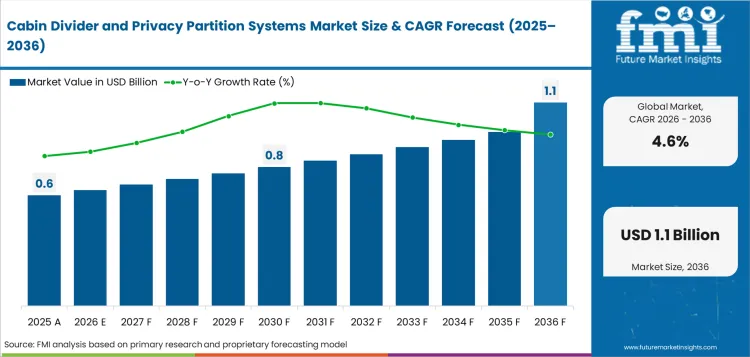
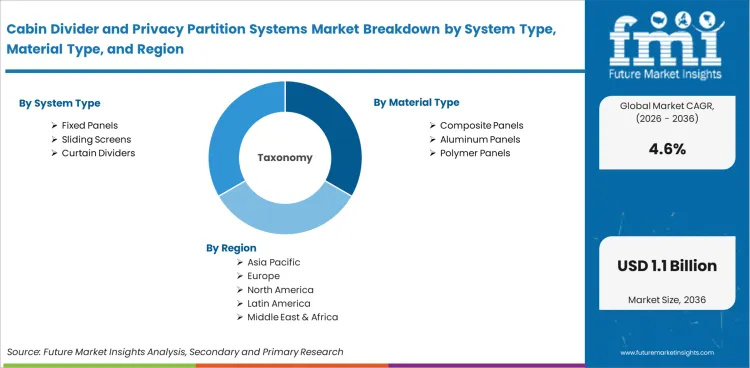
The cabin divider and privacy partition systems market was valued at USD 0.6 billion in 2025. The market value is expected to reach USD 0.7 billion by 2026-end and expand at a CAGR of 4.6% between 2026 and 2036 to reach USD 1.1 billion by 2036. Line-fit fitment is expected to lead with a 52.0% installation share. Commercial aircraft are forecast to lead the end-use segment with a 47.0% share.
Summary of the Cabin Divider and Privacy Partition Systems Market
- Demand and Growth Drivers
- Premium cabin privacy needs raise demand for divider systems as airlines redesign front cabins around passenger comfort.
- Aircraft retrofit programs lift replacement need as operators refresh partitions during seat and trim upgrade cycles.
- Certification-ready materials raise supplier value as cabin panels must meet interior fire and smoke rules.
- Product and Segment View
- Line-fit fitment is expected to lead installation demand with 52.0% share in 2026, reflecting easier approval during aircraft build.
- Commercial aircraft are forecast to lead the end-use segment with 47.0% share in 2026, reflecting repeatable divider layouts across fleet programs.
- Geography and Competitive Outlook
- India is expected to record a CAGR of 7.2% through 2036 as aircraft induction and premium cabin work expand.
- China is projected to expand at 6.6% CAGR by 2036 as domestic air travel scale raises interior fitment needs.
- Suppliers combining certified panel design with privacy mechanism depth are strengthening their market position.
- Analyst Opinion
- Nikhil Kaitwade, Principal Consultant at FMI says, “Cabin divider and privacy partition systems are design controls for premium passenger space. Airlines need privacy without seat loss. Aircraft builders need fire-safe parts with integration certainty. Certified composites and approval cycles raise cost while cabin interface expertise reduces rework.”
- Cabin Divider and Privacy Partition Systems Market Value Analysis
- Cabin divider and privacy partition systems are evolving from simple cabin separators into engineered privacy elements used in premium interior layouts.
- Airline cabin upgrades and aircraft refurbishment work are creating demand for divider systems with certified materials and dependable fitment.
- Commercial aircraft and business jet programs use these systems to improve passenger separation without adding unnecessary cabin weight.
- Demand is strengthened by comfort-focused cabin design and replacement needs across long-service aircraft interiors.
Key Takeaways, Market Size and Forecast
- The cabin divider and privacy partition systems market was valued at USD 0.6 billion in 2025.
- By 2036, the cabin divider and privacy partition systems market is expected to be worth USD 1.1 billion.
- From 2026 to 2036, the market is projected to expand at a CAGR of 4.6%.
- The market is projected to create an incremental opportunity of USD 0.4 billion between 2026 and 2036.
- In 2026, line-fit fitment is expected to account for 52.0% of installation demand.
- India, with a 7.2% CAGR, and China, with a 6.6% CAGR, are expected to rank among the faster-growing country markets.
Premium cabin programs now need privacy systems which are light, safe, and easy to certify. Safran stated in June 2025 that ANA’s THE Room FX business class seat includes a privacy door for each Boeing 787-9 seat, with rollout starting in 2026. This makes thin privacy door design important for airlines upgrading mid-sized long-haul aircraft. Aircraft cabin partitions need approved fire-performance records under 14 CFR 25.853 and appendix F requirements.
This means material testing and documentation can affect supplier selection before style or finish choices. Panasonic Avionics and Collins Aerospace introduced MAYA in May 2024 with a 45-inch OLED display and integrated controls. This reveals how privacy partitions are moving closer to digital cabin systems. Suppliers that offer certified panels and develop low weight designs are better positioned. Electronics-ready integration capabilities position them well for premium line fit cabin programs.
Cabin Divider and Privacy Partition Systems Market Definition
The cabin divider and privacy partition systems market includes certified panels and sliding privacy screens. Scope includes curtain dividers and smart glass partitions used inside passenger cabins. These systems create separation between seating zones and private spaces in commercial aircraft and business jets. Premium road vehicles and rail cabins form adjacent end uses. Scope excludes structural bulkheads and cockpit doors. Lavatory doors and cargo bay panels are outside the defined product base. Building partition systems are outside scope. Aircraft cabin interior materials must meet 14 CFR 25.853 compartment interior requirements for fire performance and related safety checks.
Cabin Divider and Privacy Partition Systems Market Inclusions
Market scope covers all commercially traded cabin divider and privacy partition systems categorized by system type, including fixed panels, sliding screens, curtain dividers, and smart glass partitions; material type, including composite panels, aluminum panels, polymer panels, and fabric systems; end users, including commercial aircraft operators, business jet owners, premium vehicle manufacturers, and rail cabin operators; and installation type, including line-fit fitment, retrofit fitment, and custom completion. Revenue scope covers 2026 to 2036. Key stakeholders include cabin interior system manufacturers, aircraft seating companies, material suppliers, aircraft OEMs, airline operators, business jet completion centers, interior integrators, aftermarket service providers, distributors, and aviation regulatory bodies.
Cabin Divider and Privacy Partition Systems Market Exclusions
Scope does not include structural aircraft bulkheads and cockpit security doors. Lavatory enclosure doors and cargo liners are outside scope. Office partitions and finished seat assemblies are excluded.
Cabin Divider and Privacy Partition Systems Market Research Methodology
- Primary Research: FMI analysts talked to aircraft interior suppliers and cabin integrators. Interviews covered seating system firms and business jet completion specialists.
- Desk Research: Combined data from aviation safety rules and company product portfolios. Fleet activity and cabin interior specification records were reviewed.
- Market sizing and forecasting: Added divider content per cabin across system types and end-use groups from the bottom up.
- Data validation: Cross-checked forecasts against aircraft traffic activity and supplier portfolios. Retrofit timing and cabin certification needs were checked.
Why is the Cabin Divider and Privacy Partition Systems Market Growing?
- Premium cabin programs are using divider panels earlier to reduce layout rework before aircraft delivery begins.
- Airlines are adding privacy systems as long-haul cabins place higher value on enclosed passenger space.
- Completion centers are using custom partitions as business jet owners seek private zones inside cabins.
- Aircraft interior suppliers are offering certified divider kits to shorten approval work for retrofit projects.
Passenger traffic recovery is increasing the case for front-cabin refresh programs and divider replacement work. IATA reported full-year 2025 traffic increases of 10.9% for Asia-Pacific airlines and 6.0% for European carriers. This usage level increases wear on premium cabin surfaces and raises the value of privacy panels with durable tracks. Cabin suppliers able to connect partition hardware with aircraft seating programs can reach airline upgrade budgets with lower approval risk.
Aircraft availability constraints are pushing operators to improve existing cabins instead of waiting for new deliveries. IATA forecast 4.9% passenger traffic expansion in 2026 and noted limited aircraft availability as a supply constraint. This creates a practical case for divider retrofits across premium cabins and business jets.
Market Segmentation Analysis
- Fixed panels are expected to hold 36.0% of system type demand in 2026, as premium cabins need rigid privacy zones with stable finish quality.
- Composite panels are projected to represent 41.0% of material type use, with 2026 cabin layouts favoring low-weight panels and durable surfaces.
- Commercial aircraft are forecast to account for 47.0% of end-use share in 2026 as airline cabin programs use dividers across premium seating layouts.
- Line-fit fitment is expected to account for 52.0% share for installation type, reflecting early integration across aircraft approval programs in 2026.
- Direct OEM contracts are expected to account for 45.0% of sales channel share in 2026, with closer engineering control across certified cabin programs.
The market for cabin divider and privacy partition systems is divided into groups based on system type, material type, end use, installation type, sales channel, and region. Fixed panels, sliding screens, curtain dividers, and smart glass partitions are covered under system type. By material type, the market includes composite panels, aluminum panels, polymer panels, and fabric systems. By end use, the market covers commercial aircraft, business jets, premium road vehicles, and rail cabins. Based on installation type, it includes line-fit fitment, retrofit fitment, and custom completion. By sales channel, the market is segmented into direct OEM contracts, interior integrators, and aftermarket suppliers.
Insights into Cabin Divider and Privacy Partition Systems Market by System Type
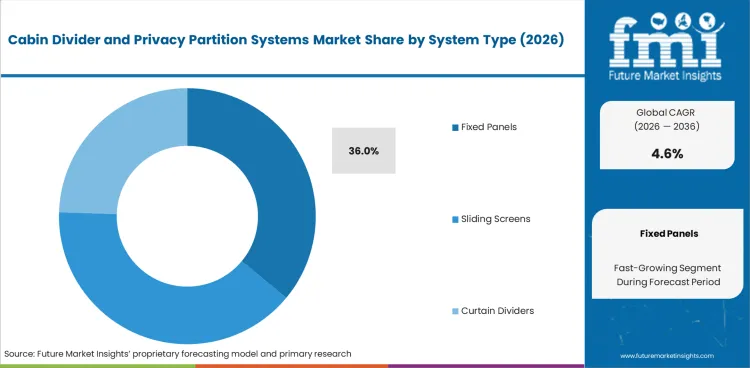
- In 2026, fixed panels are expected to make up 36.0% of the system type segment. Rigid divider formats suit premium cabins requiring stable separation, better surface finish, and lower vibration during long-haul service.
- Sliding screens and curtain dividers serve cabins with tighter space and faster upgrade needs. Their value improves in retrofit projects requiring easier installation with limited cabin downtime.
Insights into Cabin Divider and Privacy Partition Systems Market by Material Type
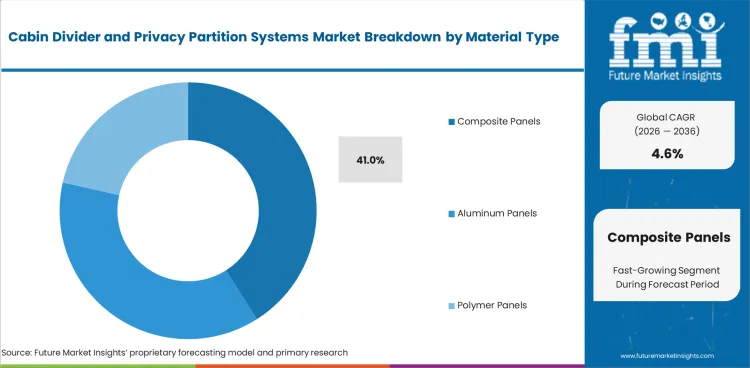
- Composite panels are projected to account for 41.0% of material type demand in 2026. Low-weight structures help aircraft interiors balance passenger privacy with strict cabin weight limits.
- Aluminum and polymer panels address selected cabin layouts requiring stronger frames or easier shaping. Fabric systems serve cost-sensitive separation needs across selected retrofit programs.
Insights into Cabin Divider and Privacy Partition Systems Market by End Use
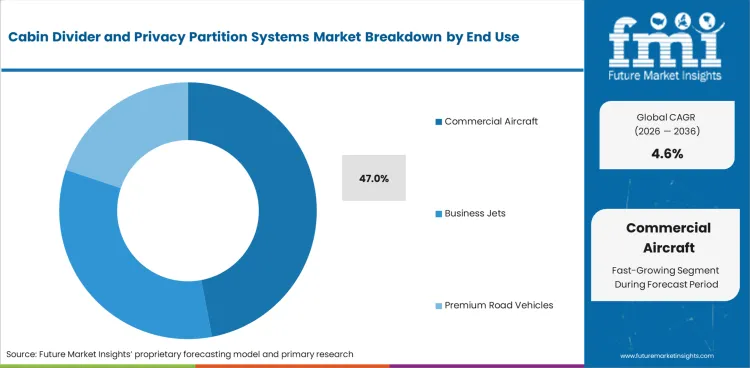
- Commercial aircraft are forecast to hold 47.0% of end-use demand in 2026. Airline cabin programs use divider systems to create private seating zones across premium layouts.
- Business jets require higher customization across divider finish and cabin fit. Premium vehicle and rail uses serve privacy-focused interiors with smaller volume needs.
Insights into Cabin Divider and Privacy Partition Systems Market by Installation Type
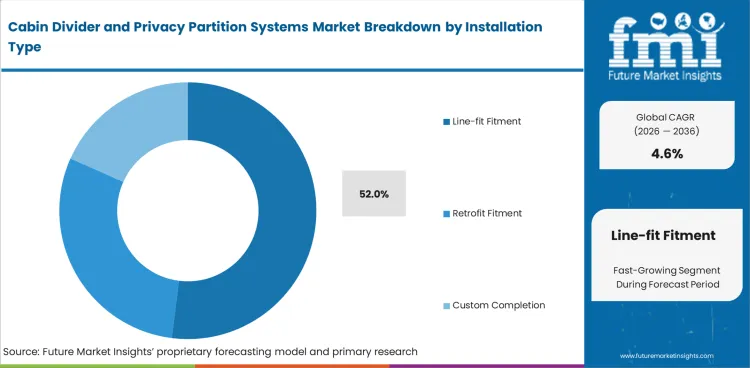
- Line-fit fitment is expected to represent 52.0% of installation demand in 2026. Aircraft builders prefer early divider integration to reduce approval work after delivery.
- Retrofit fitment serves airline refurbishment and business jet upgrade cycles. Custom completion projects require tighter coordination between cabin designers and interior integrators.
Insights into Cabin Divider and Privacy Partition Systems Market by Sales Channel
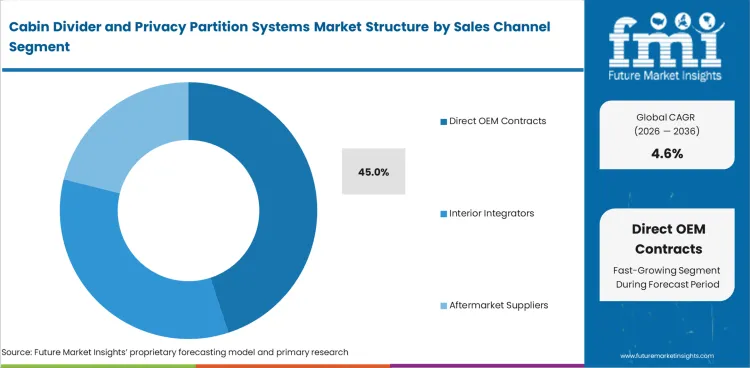
- Direct OEM contracts are projected to hold 45.0% share in 2026. Large cabin programs prefer direct sourcing for engineering control and certification documentation.
- Interior integrators handle complex cabin layouts requiring coordinated trim and partition work. Aftermarket suppliers serve replacement parts and smaller cabin refresh projects.
Cabin Divider and Privacy Partition Systems Market Drivers, Restraints and Opportunities
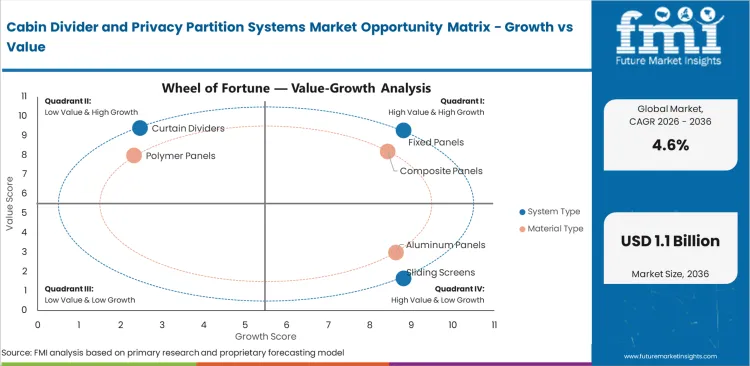
- Premium suite privacy is creating demand for divider panels across business class and first class cabins.
- Retrofit cabin refresh work adds service opportunity for divider kits and curtains. Replacement privacy screens add service demand.
- Composite and certified hardware costs increase pricing pressure for smaller retrofit programs.
- Smart cabin interfaces improve opportunity through electrochromic glass and electronic privacy control.
Cabin divider and privacy partition systems keep growing as airlines and business jet operators need better passenger separation and certified cabin layouts. Cost pressure and approval requirements can slow adoption in smaller retrofit programs. Growth continues through premium cabin upgrades and line-fit aircraft interior programs.
Aircraft Supply Constraints Support Retrofit Quotes
Cabin divider and privacy partition system pricing is being supported by airline retrofit urgency and continues to draw strength beyond material cost considerations. In June 2025, IATA expected 4.99 billion travelers in 2025, up 4% from 2024, while passenger load factors were projected to reach 84.0%. The same source reported an aircraft backlog exceeding 17000 units and projected 1692 aircraft deliveries for 2025. This outlook places overall deliveries at nearly 26 percent below earlier industry expectations. For privacy partitions and class dividers, this situation keeps replacement work competing for limited interiors capacity. Seat zone screens and modular cabin separation panels face similar pressure on available interiors capacity. Suppliers can therefore defend firmer quotes and maintain shorter validity periods in negotiations. They can charge premiums for certified quick turn retrofit kits in constrained market conditions.
Metal Tariffs Are Raising Hardware Pass-Through
Cabin divider and privacy partition prices are becoming more exposed to tariff-linked hardware costs. In June 2025 the White House issued a proclamation that increased tariffs on steel articles and derivative steel articles from 25 percent to 50 percent. The same measure raised tariffs on aluminum articles and derivative aluminum articles to 50 percent effective June 4 2025. This holds importance as partition systems rarely price only as finished panels. Their cost base includes aluminum framing and steel brackets used in certified cabin installations. It covers tracks and locking hardware which support structural performance requirements. Hinge assemblies and fasteners are additional components to contribute to overall system costs. Buyers sourcing into the United States should expect clearer duty clauses and material content disclosures. Separate pass through pricing lines for metal hardware may replace a single blended partition price.
Analysis of Cabin Divider and Privacy Partition Systems Market By Key Countries
.webp "Top Country Growth Comparison Cabin Divider And Privacy Partition Systems Market Cagr (2026 2036)")
| Country | CAGR |
|---|---|
| India | 7.2% |
| China | 6.6% |
| USA | 5.4% |
| Germany | 4.6% |
| UK | 4.1% |
Source: Future Market Insights, 2026.
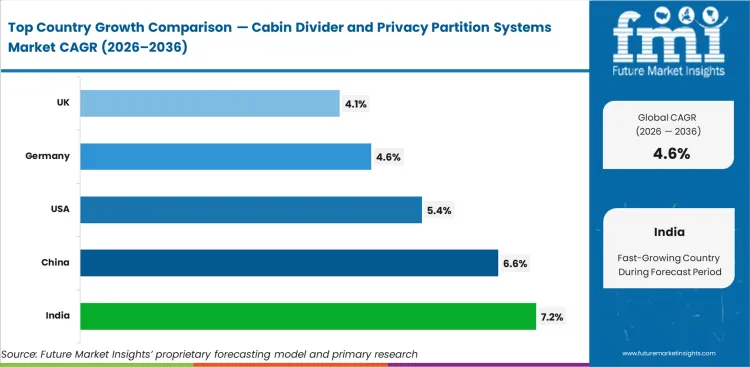
Cabin Divider and Privacy Partition Systems Market CAGR Analysis By Country
- India is projected to record the fastest country outlook at 7.2% CAGR through 2036, helped by fleet additions and cabin upgrade programs.
- China’s demand outlook stands at 6.6% CAGR for the forecast period, shaped by large passenger volumes and aircraft interior fitment needs.
- In the United States, retrofit programs and business jet completions are expected to support a 5.4% CAGR between 2026 and 2036.
- Germany and the UK are expected to grow at 4.6% and 4.1% CAGR, respectively, reflecting established service networks and measured cabin modernization.
Demand for cabin divider and privacy partition systems is forecast to rise at 4.6% CAGR from 2026 to 2036. Country-level analysis covers major aviation and cabin interior markets contributing to this forecast, with the key markets listed below.
Demand Outlook for Cabin Divider and Privacy Partition Systems Market in India
India’s cabin divider and privacy partition systems industry is projected to record a CAGR of 7.2% through 2036. India’s civil aviation sector recorded 538429 domestic departing passengers on November 23 2025. This activity base raises demand for India cabin divider and privacy partition systems across aircraft cabin programs. Local and global suppliers can gain from airline cabin refresh needs and expanding premium travel demand.
- Delhi and Mumbai airport networks raise steady need for premium cabin durability across high-traffic aircraft rotations.
- Ministry of Civil Aviation planning favors airport capacity expansion and stronger aircraft utilization across major metro routes.
Sales Analysis of Cabin Divider and Privacy Partition Systems Market in China
The cabin divider and privacy partition systems sector in China is expected to expand at a CAGR of 6.6% during the assessment period. CAAC reported 770.1468 million passenger trips in 2025 and a 5.5% year-on-year increase. This scale improves demand visibility for China cabin divider and privacy partition systems. Local aircraft programs and large airline fleets increase opportunities for certified interior suppliers.
- Beijing and Shanghai long-haul networks increase premium cabin use on international aircraft rotations.
- CAAC certification practice raises the value of documented material and installation records.
Demand Outlook for Cabin Divider and Privacy Partition Systems Market in the United States
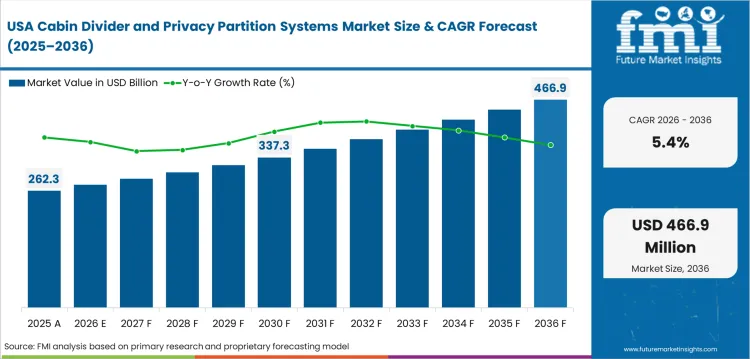
The United States cabin divider and privacy partition systems industry is forecast to grow at a CAGR of 5.4% by 2036. BTS reported USA airlines carried 81.2 million scheduled service passengers in December 2025. Aircraft operators value partition suppliers with retrofit know-how and cabin downtime control. Business aviation completions add premium demand for custom dividers and privacy screens.
- Dallas-Fort Worth and Atlanta traffic hubs increase high cabin utilization across premium domestic routes.
- FAA interior rules make certified material records important for divider panels and privacy door parts.
Opportunity Analysis of Cabin Divider and Privacy Partition Systems Market in Germany
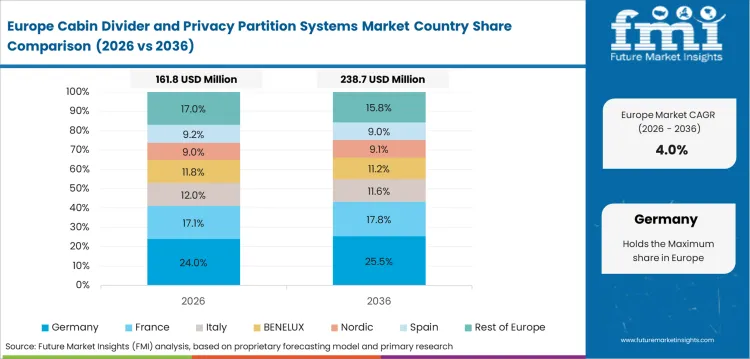
The cabin divider and privacy partition systems segment in Germany is expected to advance at 4.6% CAGR over the forecast years. Destatis listed 97324895 boarding air passengers at German airports in 2025. This mature travel base sustains demand for Germany cabin divider and privacy partition systems through retrofit and premium cabin service work. Suppliers benefit from divider systems reducing cabin downtime and matching certified interior trim.
- Hamburg aerospace activity strengthens access to aircraft cabin design and interior completion skills.
- Munich and Frankfurt premium routes keep long-haul cabin comfort investment active across carriers.
Future Outlook for Cabin Divider and Privacy Partition Systems Market in the United Kingdom
The UK cabin divider and privacy partition systems industry is expected to post 4.1% CAGR through 2036. UK Civil Aviation Authority data recorded 302 million airport passengers in 2025. This favors demand for UK cabin divider and privacy partition systems as airlines manage busy premium routes and retrofit cycles. Service providers with quick installation planning and certified trim records can serve airline cabin programs.
- Heathrow and Gatwick premium traffic boosts regular cabin wear across high-frequency international aircraft.
- UK Civil Aviation Authority oversight keeps documentation important for certified interior materials and installation work.
Competitive Landscape and Strategic Positioning
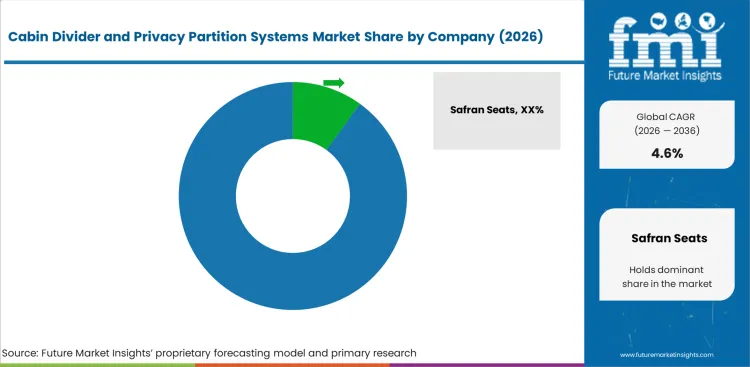
Safran Seats leads through premium seating platforms and privacy door integration across business class and first class cabin programs. Competition is based on certified privacy parts and reliable delivery across aircraft cabin programs for airlines and aircraft builders. Safran Seats holds a strong position through integrated privacy doors across premium seating programs and airline cabin awards. Collins Aerospace competes on premium suite design and cabin control interfaces used in premium seating programs.
RECARO Aircraft Seating brings certified seating platforms for programs needing divider coordination with seat structures. Diehl Aviation and FACC add cabin systems depth through monuments and interior lining work across aircraft interiors. F/LIST serves premium completion demand through custom materials and refined cabin finish work.
Competitive pressure comes from certified material costs and tight installation needs across aircraft interiors. Privacy mechanism durability and faster documentation are key priorities for line-fit programs. Airlines prefer companies offering divider hardware and surface finish control within one approval path. Companies with broad cabin interior portfolios and proven certification records are better placed to win aircraft builder and completion center contracts.
Key Companies in the Cabin Divider and Privacy Partition Systems Market
Key global companies leading the cabin divider and privacy partition systems market include:
- Safran Seats and Collins Aerospace. RECARO Aircraft Seating has strong cabin integration infrastructure for premium seating and privacy system delivery.
- JAMCO Corporation and Diehl Aviation and FACC serve aircraft builders through certified cabin systems and interior component programs.
- F/LIST, AeroVisto and OmnAvia Interiors hold specialist positions across custom partitions and business jet cabin privacy work.
Competitive Benchmarking: Cabin Divider and Privacy Partition Systems Market
| Company | Privacy Mechanism Depth | Cabin Certification Control | Interior Integration Reach | Geographic Footprint |
|---|---|---|---|---|
| Safran Seats | High | High | Strong | France, UK, USA, China, UAE |
| Collins Aerospace | High | High | Strong | USA, UK, France, Germany, China |
| RECARO Aircraft Seating | Medium | High | Strong | Germany, USA, China, Poland, South Africa |
| JAMCO Corporation | Medium | Medium | Moderate | Japan, USA, Germany, Italy, India |
| Diehl Aviation | Medium | High | Strong | Germany, Hungary, USA, Mexico, China |
| FACC | Medium | High | Strong | Austria, Croatia, Canada, China, USA |
| F/LIST | High | Medium | Moderate | Austria, Germany, UK, UAE, Canada |
| AeroVisto | Medium | Medium | Moderate | Switzerland, Germany, Czech Republic, Europe-wide service reach |
| OmnAvia Interiors | Medium | Medium | Moderate | USA, with general aviation and business jet refurbishment reach |
Source: Future Market Insights, 2026.
Key Developments in Cabin Divider and Privacy Partition Systems Market
- In April 2026, Collins Aerospace won a Crystal Cabin Award for its SkyNook cabin seating solution. The concept includes a privacy divider designed to create a visual barrier from the aisle and nearby passengers while also reducing noise from the galley and lavatory areas. This makes it highly relevant to cabin privacy partition innovation in economy and widebody aircraft layouts.
- In November 2024, British Airways unveiled its brand-new First seat for its A380 retrofit program. The suite includes a cocooned 60-inch curved wall for privacy, and the centre-cabin divider slides open to create a shared lounge space for passengers travelling together. Collins Aerospace, an RTX business, worked with British Airways on the seat.
Key Players in the Cabin Divider and Privacy Partition Systems Market
Major Global Players:
- Safran Seats
- Collins Aerospace
- RECARO Aircraft Seating
- JAMCO Corporation
- Diehl Aviation
- FACC
Specialist Players:
- F/LIST
- AeroVisto
- OmnAvia Interiors
- Cabinair Group
Report Scope and Coverage
| Parameter | Details |
|---|---|
| Quantitative Units | USD 0.7 billion to USD 1.1 billion, at a CAGR of 4.6% |
| Market Definition | The cabin divider and privacy partition systems market encompasses certified panels and privacy systems used to separate passenger cabin zones. |
| Regions Covered | North America; Latin America; Europe; East Asia; South Asia and Pacific; Middle East and Africa |
| Countries Covered | USA; UK; Germany; China; India; Japan; UAE; and 30 plus countries |
| Key Companies Profiled | Safran Seats; Collins Aerospace; RECARO Aircraft Seating; JAMCO Corporation; Diehl Aviation; FACC; F/LIST; AeroVisto; OmnAvia Interiors |
| Forecast Period | 2026 to 2036 |
| Approach | Hybrid bottom-up and top-down methodology starting with cabin fitment demand and verified interior program use patterns. |
Cabin Divider and Privacy Partition Systems Market by Segments
Cabin Divider and Privacy Partition Systems Market Segmented by System Type:
- Fixed Panels
- Sliding Screens
- Curtain Dividers
- Smart Glass Partitions
Cabin Divider and Privacy Partition Systems Market Segmented by Material Type:
- Composite Panels
- Aluminum Panels
- Polymer Panels
- Fabric Systems
Cabin Divider and Privacy Partition Systems Market Segmented by End Use:
- Commercial Aircraft
- Business Jets
- Premium Road Vehicles
- Rail Cabins
Cabin Divider and Privacy Partition Systems Market Segmented by Installation Type:
- Line-fit Fitment
- Retrofit Fitment
- Custom Completion
Cabin Divider and Privacy Partition Systems Market Segmented by Sales Channel:
- Direct OEM Contracts
- Interior Integrators
- Aftermarket Suppliers
Cabin Divider and Privacy Partition Systems Market by Region:
- North America
- USA
- Canada
- Mexico
- Latin America
- Brazil
- Chile
- Rest of Latin America
- Europe
- Germany
- UK
- Italy
- Spain
- France
- Rest of Europe
- East Asia
- China
- Japan
- South Korea
- South Asia and Pacific
- India
- ASEAN
- Australia & New Zealand
- Rest of South Asia and Pacific
- Middle East and Africa
- Saudi Arabia
- Other GCC Countries
- South Africa
- Rest of Middle East and Africa
Research Sources and Bibliography
- International Air Transport Association. (2026, January 29). Strong 2025 passenger demand masks ongoing capacity constraints.
- International Air Transport Association. (2025, December 9). Global outlook for air transport in 2026: December 2025.
- Press Information Bureau. (2026, January 21). Year end review of Ministry of Civil Aviation. Government of India.
- Civil Aviation Administration of China. (2026, April 22). CAAC releases statistical bulletin of civil aviation industry development in 2025.
- Bureau of Transportation Statistics. (2026, March 13). December 2025 USA airline traffic data down 2.6% from the same month last year. USA Department of Transportation.
- German Federal Statistical Office. (2026). Boarding air passengers at German airports.
- UK Civil Aviation Authority. (2026, February 24). UK aviation officially breaks records with over 300m passenger journeys in 2025.
- Electronic Code of Federal Regulations. (2026). 14 CFR § 25.853: Compartment interiors.
- Federal Reserve Bank of St. Louis. (2026, May 13). Producer Price Index by Industry: Other aircraft parts and equipment manufacturing. FRED.
- Safran. (2025, June 17). All Nippon Airways takes business class to new heights with “THE Room FX” supersized seats.
- Panasonic Avionics. (2024, May 28). RTX’s Collins Aerospace and Panasonic Avionics unveil MAYA - the future of premium air travel.
- FACC. (2026, February 27). FACC develops and manufactures new cabin components for Embraer Praetor 600E and Praetor 500E.
- Safran. (2025, June 17). All Nippon Airways takes business class to new heights with “THE Room FX” supersized seats.
- Panasonic Avionics. (2024, May). RTX’s Collins Aerospace and Panasonic Avionics unveil MAYA - the future of premium air travel.
- Electronic Code of Federal Regulations. (2026). 14 CFR § 25.853 - Compartment interiors.
- Electronic Code of Federal Regulations. (2026). Appendix F to Part 25 - Test criteria and procedures for showing compliance with § 25.853.
- The White House. (2025, June 3). Adjusting imports of aluminum and steel into the United States. The White House. Adjusting Imports of Aluminum and Steel into the United States - The White House
- International Air Transport Association. (2025, June 2). Airline profitability to strengthen slightly in 2025 despite cost pressure. IATA.
- British Airways. (2024, November 25). Taking luxury to new heights: British Airways unveils its brand-new First class.
This bibliography is provided for reader reference and is not exhaustive. The full report contains the complete reference list and detailed citations.
This Report Answers
- What is the current and future size of the cabin divider and privacy partition systems market?
- How fast is the market expected to expand between 2026 and 2036?
- Which installation type is expected to lead the market?
- Which end-use segment is expected to account for the leading demand by 2026?
Frequently Asked Questions
What is the global market demand for Cabin Divider and Privacy Partition Systems in 2026?
In 2026, the global cabin divider and privacy partition systems market is expected to be worth USD 0.7 billion.
How big will the market for Cabin Divider and Privacy Partition Systems be in 2036?
By 2036, the market for cabin divider and privacy partition systems is expected to be worth USD 1.1 billion.
How much is demand for Cabin Divider and Privacy Partition Systems expected to expand between 2026 and 2036?
Between 2026 and 2036, demand for cabin divider and privacy partition systems is expected to expand at a CAGR of 4.6%.
Which installation type segment is likely to be the leading segment by 2026?
Line-fit fitment will contribute 52.0% of the installation type segment in 2026.
Preview the report firsthand - request a free sample
Get SampleGet the brochure for pricing and purchase details.
Get PDFTable of Content
- Executive Summary
- Global Market Outlook
- Demand-side Trends
- Supply-side Trends
- Technology Roadmap Analysis
- Analysis and Recommendations
- Market Overview
- Market Coverage / Taxonomy
- Market Definition / Scope / Limitations
- Research Methodology
- Chapter Orientation
- Analytical Lens and Working Hypotheses
- Market Structure, Signals, and Trend Drivers
- Benchmarking and Cross-market Comparability
- Market Sizing, Forecasting, and Opportunity Mapping
- Research Design and Evidence Framework
- Desk Research Programme (Secondary Evidence)
- Company Annual and Sustainability Reports
- Peer-reviewed Journals and Academic Literature
- Corporate Websites, Product Literature, and Technical Notes
- Earnings Decks and Investor Briefings
- Statutory Filings and Regulatory Disclosures
- Technical White Papers and Standards Notes
- Trade Journals, Industry Magazines, and Analyst Briefs
- Conference Proceedings, Webinars, and Seminar Materials
- Government Statistics Portals and Public Data Releases
- Press Releases and Reputable Media Coverage
- Specialist Newsletters and Curated Briefings
- Sector Databases and Reference Repositories
- FMI Internal Proprietary Databases and Historical Market Datasets
- Subscription Datasets and Paid Sources
- Social Channels, Communities, and Digital Listening Inputs
- Additional Desk Sources
- Expert Input and Fieldwork (Primary Evidence)
- Primary Modes
- Qualitative Interviews and Expert Elicitation
- Quantitative Surveys and Structured Data Capture
- Blended Approach
- Why Primary Evidence is Used
- Field Techniques
- Interviews
- Surveys
- Focus Groups
- Observational and In-context Research
- Social and Community Interactions
- Stakeholder Universe Engaged
- C-suite Leaders
- Board Members
- Presidents and Vice Presidents
- R&D and Innovation Heads
- Technical Specialists
- Domain Subject-matter Experts
- Scientists
- Physicians and Other Healthcare Professionals
- Governance, Ethics, and Data Stewardship
- Research Ethics
- Data Integrity and Handling
- Primary Modes
- Tooling, Models, and Reference Databases
- Desk Research Programme (Secondary Evidence)
- Data Engineering and Model Build
- Data Acquisition and Ingestion
- Cleaning, Normalisation, and Verification
- Synthesis, Triangulation, and Analysis
- Quality Assurance and Audit Trail
- Market Background
- Market Dynamics
- Drivers
- Restraints
- Opportunity
- Trends
- Scenario Forecast
- Demand in Optimistic Scenario
- Demand in Likely Scenario
- Demand in Conservative Scenario
- Opportunity Map Analysis
- Product Life Cycle Analysis
- Supply Chain Analysis
- Investment Feasibility Matrix
- Value Chain Analysis
- PESTLE and Porter’s Analysis
- Regulatory Landscape
- Regional Parent Market Outlook
- Production and Consumption Statistics
- Import and Export Statistics
- Market Dynamics
- Global Market Analysis 2021 to 2025 and Forecast, 2026 to 2036
- Historical Market Size Value (USD Million) Analysis, 2021 to 2025
- Current and Future Market Size Value (USD Million) Projections, 2026 to 2036
- Y-o-Y Growth Trend Analysis
- Absolute $ Opportunity Analysis
- Global Market Pricing Analysis 2021 to 2025 and Forecast 2026 to 2036
- Global Market Analysis 2021 to 2025 and Forecast 2026 to 2036, By System Type
- Introduction / Key Findings
- Historical Market Size Value (USD Million) Analysis By System Type , 2021 to 2025
- Current and Future Market Size Value (USD Million) Analysis and Forecast By System Type , 2026 to 2036
- Fixed Panels
- Sliding Screens
- Curtain Dividers
- Fixed Panels
- Y-o-Y Growth Trend Analysis By System Type , 2021 to 2025
- Absolute $ Opportunity Analysis By System Type , 2026 to 2036
- Global Market Analysis 2021 to 2025 and Forecast 2026 to 2036, By Material Type
- Introduction / Key Findings
- Historical Market Size Value (USD Million) Analysis By Material Type, 2021 to 2025
- Current and Future Market Size Value (USD Million) Analysis and Forecast By Material Type, 2026 to 2036
- Composite Panels
- Aluminum Panels
- Polymer Panels
- Composite Panels
- Y-o-Y Growth Trend Analysis By Material Type, 2021 to 2025
- Absolute $ Opportunity Analysis By Material Type, 2026 to 2036
- Global Market Analysis 2021 to 2025 and Forecast 2026 to 2036, By End Use
- Introduction / Key Findings
- Historical Market Size Value (USD Million) Analysis By End Use, 2021 to 2025
- Current and Future Market Size Value (USD Million) Analysis and Forecast By End Use, 2026 to 2036
- Commercial Aircraft
- Business Jets
- Premium Road Vehicles
- Commercial Aircraft
- Y-o-Y Growth Trend Analysis By End Use, 2021 to 2025
- Absolute $ Opportunity Analysis By End Use, 2026 to 2036
- Global Market Analysis 2021 to 2025 and Forecast 2026 to 2036, By Installation Type
- Introduction / Key Findings
- Historical Market Size Value (USD Million) Analysis By Installation Type, 2021 to 2025
- Current and Future Market Size Value (USD Million) Analysis and Forecast By Installation Type, 2026 to 2036
- Line-fit Fitment
- Retrofit Fitment
- Custom Completion
- Line-fit Fitment
- Y-o-Y Growth Trend Analysis By Installation Type, 2021 to 2025
- Absolute $ Opportunity Analysis By Installation Type, 2026 to 2036
- Global Market Analysis 2021 to 2025 and Forecast 2026 to 2036, By Sales Channel
- Introduction / Key Findings
- Historical Market Size Value (USD Million) Analysis By Sales Channel, 2021 to 2025
- Current and Future Market Size Value (USD Million) Analysis and Forecast By Sales Channel, 2026 to 2036
- Direct OEM Contracts
- Interior Integrators
- Aftermarket Suppliers
- Direct OEM Contracts
- Y-o-Y Growth Trend Analysis By Sales Channel, 2021 to 2025
- Absolute $ Opportunity Analysis By Sales Channel, 2026 to 2036
- Global Market Analysis 2021 to 2025 and Forecast 2026 to 2036, By Region
- Introduction
- Historical Market Size Value (USD Million) Analysis By Region, 2021 to 2025
- Current Market Size Value (USD Million) Analysis and Forecast By Region, 2026 to 2036
- North America
- Latin America
- Western Europe
- Eastern Europe
- East Asia
- South Asia and Pacific
- Middle East & Africa
- Market Attractiveness Analysis By Region
- North America Market Analysis 2021 to 2025 and Forecast 2026 to 2036, By Country
- Historical Market Size Value (USD Million) Trend Analysis By Market Taxonomy, 2021 to 2025
- Market Size Value (USD Million) Forecast By Market Taxonomy, 2026 to 2036
- By Country
- USA
- Canada
- Mexico
- By System Type
- By Material Type
- By End Use
- By Installation Type
- By Sales Channel
- By Country
- Market Attractiveness Analysis
- By Country
- By System Type
- By Material Type
- By End Use
- By Installation Type
- By Sales Channel
- Key Takeaways
- Latin America Market Analysis 2021 to 2025 and Forecast 2026 to 2036, By Country
- Historical Market Size Value (USD Million) Trend Analysis By Market Taxonomy, 2021 to 2025
- Market Size Value (USD Million) Forecast By Market Taxonomy, 2026 to 2036
- By Country
- Brazil
- Chile
- Rest of Latin America
- By System Type
- By Material Type
- By End Use
- By Installation Type
- By Sales Channel
- By Country
- Market Attractiveness Analysis
- By Country
- By System Type
- By Material Type
- By End Use
- By Installation Type
- By Sales Channel
- Key Takeaways
- Western Europe Market Analysis 2021 to 2025 and Forecast 2026 to 2036, By Country
- Historical Market Size Value (USD Million) Trend Analysis By Market Taxonomy, 2021 to 2025
- Market Size Value (USD Million) Forecast By Market Taxonomy, 2026 to 2036
- By Country
- Germany
- UK
- Italy
- Spain
- France
- Nordic
- BENELUX
- Rest of Western Europe
- By System Type
- By Material Type
- By End Use
- By Installation Type
- By Sales Channel
- By Country
- Market Attractiveness Analysis
- By Country
- By System Type
- By Material Type
- By End Use
- By Installation Type
- By Sales Channel
- Key Takeaways
- Eastern Europe Market Analysis 2021 to 2025 and Forecast 2026 to 2036, By Country
- Historical Market Size Value (USD Million) Trend Analysis By Market Taxonomy, 2021 to 2025
- Market Size Value (USD Million) Forecast By Market Taxonomy, 2026 to 2036
- By Country
- Russia
- Poland
- Hungary
- Balkan & Baltic
- Rest of Eastern Europe
- By System Type
- By Material Type
- By End Use
- By Installation Type
- By Sales Channel
- By Country
- Market Attractiveness Analysis
- By Country
- By System Type
- By Material Type
- By End Use
- By Installation Type
- By Sales Channel
- Key Takeaways
- East Asia Market Analysis 2021 to 2025 and Forecast 2026 to 2036, By Country
- Historical Market Size Value (USD Million) Trend Analysis By Market Taxonomy, 2021 to 2025
- Market Size Value (USD Million) Forecast By Market Taxonomy, 2026 to 2036
- By Country
- China
- Japan
- South Korea
- By System Type
- By Material Type
- By End Use
- By Installation Type
- By Sales Channel
- By Country
- Market Attractiveness Analysis
- By Country
- By System Type
- By Material Type
- By End Use
- By Installation Type
- By Sales Channel
- Key Takeaways
- South Asia and Pacific Market Analysis 2021 to 2025 and Forecast 2026 to 2036, By Country
- Historical Market Size Value (USD Million) Trend Analysis By Market Taxonomy, 2021 to 2025
- Market Size Value (USD Million) Forecast By Market Taxonomy, 2026 to 2036
- By Country
- India
- ASEAN
- Australia & New Zealand
- Rest of South Asia and Pacific
- By System Type
- By Material Type
- By End Use
- By Installation Type
- By Sales Channel
- By Country
- Market Attractiveness Analysis
- By Country
- By System Type
- By Material Type
- By End Use
- By Installation Type
- By Sales Channel
- Key Takeaways
- Middle East & Africa Market Analysis 2021 to 2025 and Forecast 2026 to 2036, By Country
- Historical Market Size Value (USD Million) Trend Analysis By Market Taxonomy, 2021 to 2025
- Market Size Value (USD Million) Forecast By Market Taxonomy, 2026 to 2036
- By Country
- Kingdom of Saudi Arabia
- Other GCC Countries
- Turkiye
- South Africa
- Other African Union
- Rest of Middle East & Africa
- By System Type
- By Material Type
- By End Use
- By Installation Type
- By Sales Channel
- By Country
- Market Attractiveness Analysis
- By Country
- By System Type
- By Material Type
- By End Use
- By Installation Type
- By Sales Channel
- Key Takeaways
- Key Countries Market Analysis
- USA
- Pricing Analysis
- Market Share Analysis, 2025
- By System Type
- By Material Type
- By End Use
- By Installation Type
- By Sales Channel
- Canada
- Pricing Analysis
- Market Share Analysis, 2025
- By System Type
- By Material Type
- By End Use
- By Installation Type
- By Sales Channel
- Mexico
- Pricing Analysis
- Market Share Analysis, 2025
- By System Type
- By Material Type
- By End Use
- By Installation Type
- By Sales Channel
- Brazil
- Pricing Analysis
- Market Share Analysis, 2025
- By System Type
- By Material Type
- By End Use
- By Installation Type
- By Sales Channel
- Chile
- Pricing Analysis
- Market Share Analysis, 2025
- By System Type
- By Material Type
- By End Use
- By Installation Type
- By Sales Channel
- Germany
- Pricing Analysis
- Market Share Analysis, 2025
- By System Type
- By Material Type
- By End Use
- By Installation Type
- By Sales Channel
- UK
- Pricing Analysis
- Market Share Analysis, 2025
- By System Type
- By Material Type
- By End Use
- By Installation Type
- By Sales Channel
- Italy
- Pricing Analysis
- Market Share Analysis, 2025
- By System Type
- By Material Type
- By End Use
- By Installation Type
- By Sales Channel
- Spain
- Pricing Analysis
- Market Share Analysis, 2025
- By System Type
- By Material Type
- By End Use
- By Installation Type
- By Sales Channel
- France
- Pricing Analysis
- Market Share Analysis, 2025
- By System Type
- By Material Type
- By End Use
- By Installation Type
- By Sales Channel
- India
- Pricing Analysis
- Market Share Analysis, 2025
- By System Type
- By Material Type
- By End Use
- By Installation Type
- By Sales Channel
- ASEAN
- Pricing Analysis
- Market Share Analysis, 2025
- By System Type
- By Material Type
- By End Use
- By Installation Type
- By Sales Channel
- Australia & New Zealand
- Pricing Analysis
- Market Share Analysis, 2025
- By System Type
- By Material Type
- By End Use
- By Installation Type
- By Sales Channel
- China
- Pricing Analysis
- Market Share Analysis, 2025
- By System Type
- By Material Type
- By End Use
- By Installation Type
- By Sales Channel
- Japan
- Pricing Analysis
- Market Share Analysis, 2025
- By System Type
- By Material Type
- By End Use
- By Installation Type
- By Sales Channel
- South Korea
- Pricing Analysis
- Market Share Analysis, 2025
- By System Type
- By Material Type
- By End Use
- By Installation Type
- By Sales Channel
- Russia
- Pricing Analysis
- Market Share Analysis, 2025
- By System Type
- By Material Type
- By End Use
- By Installation Type
- By Sales Channel
- Poland
- Pricing Analysis
- Market Share Analysis, 2025
- By System Type
- By Material Type
- By End Use
- By Installation Type
- By Sales Channel
- Hungary
- Pricing Analysis
- Market Share Analysis, 2025
- By System Type
- By Material Type
- By End Use
- By Installation Type
- By Sales Channel
- Kingdom of Saudi Arabia
- Pricing Analysis
- Market Share Analysis, 2025
- By System Type
- By Material Type
- By End Use
- By Installation Type
- By Sales Channel
- Turkiye
- Pricing Analysis
- Market Share Analysis, 2025
- By System Type
- By Material Type
- By End Use
- By Installation Type
- By Sales Channel
- South Africa
- Pricing Analysis
- Market Share Analysis, 2025
- By System Type
- By Material Type
- By End Use
- By Installation Type
- By Sales Channel
- USA
- Market Structure Analysis
- Competition Dashboard
- Competition Benchmarking
- Market Share Analysis of Top Players
- By Regional
- By System Type
- By Material Type
- By End Use
- By Installation Type
- By Sales Channel
- Competition Analysis
- Competition Deep Dive
- Safran Seats
- Overview
- Product Portfolio
- Profitability by Market Segments (Product/Age /Sales Channel/Region)
- Sales Footprint
- Strategy Overview
- Marketing Strategy
- Product Strategy
- Channel Strategy
- Collins Aerospace
- RECARO Aircraft Seating
- JAMCO Corporation
- Diehl Aviation
- FACC
- Safran Seats
- Competition Deep Dive
- Assumptions & Acronyms Used


