

- Market Size (2026)
- USD 1.2 Bn
- Forecast (2036)
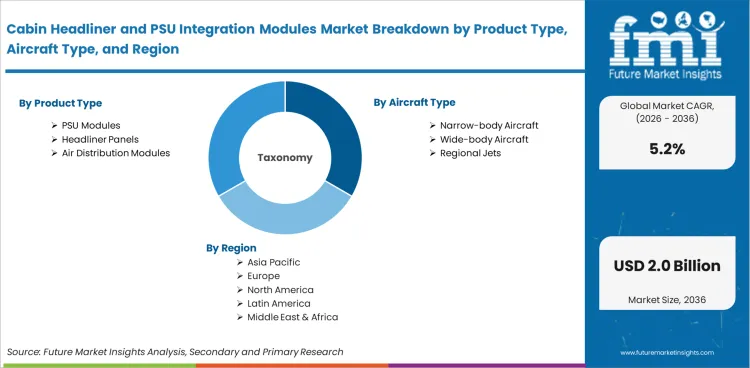
- USD 2.0 Bn
- CAGR (2026 to 2036)
- 5.2%
Cabin Headliner and PSU Integration Modules Market Size, Market Forecast and Outlook By FMI
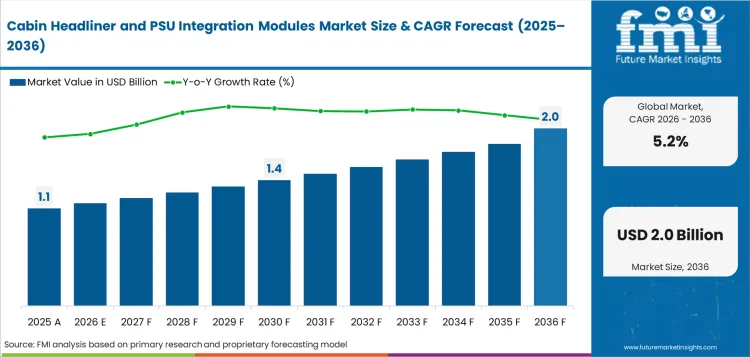
The cabin headliner and PSU integration modules market reached USD 1.1 billion in 2025 and is estimated at USD 1.2 billion in 2026. With demand advancing at a 5.2% CAGR from 2026 to 2036, the market is expected to reach USD 2.0 billion by 2036. Line fit is expected to dominate with a 56.0% fit type share, and commercial airlines are expected to lead the end-user segment with a 58.0% share.
Summary of the Cabin Headliner and PSU Integration Modules Market
- Demand and Growth Drivers
- Aircraft production schedules raise demand for overhead modules as airframers need certified cabin roof assemblies before delivery.
- Cabin refresh activity boosts retrofit demand as operators replace worn panels and older passenger service units during planned checks.
- Passenger service units gain value as air vents and oxygen systems are combined in one certified overhead block.
- Product and Segment View
- PSU modules are projected to hold 41.0% of product type demand in 2026 as airlines place more passenger controls and safety functions within the overhead service unit.
- Narrow-body aircraft are expected to account for 49.0% of aircraft type segment in 2026, driven by large single-aisle fleets using common cabin roof layouts.
- Composite panels are gaining use across cabin programs, with weight control and fire performance needs guiding material selection.
- Geography and Competitive Outlook
- India is expected to record a CAGR of 7.4% through 2036, reflecting fleet expansion and airline capacity additions.
- China is projected to expand at 6.9% CAGR by 2036, as domestic aviation scale lifts cabin content requirements.
- Companies combining PSU certification depth with headliner panel capability are strengthening their position during the forecast period.
- Analyst Opinion
- Nikhil Kaitwade, Principal Consultant at FMI, says, “Cabin roof integration is now a systems decision for aircraft operators beyond trim purchasing. Airlines need overhead functions aligned before delivery or retrofit release. Retrofit access time and documentation raise cost while certified PSU designs reduce installation risk during upgrades.”
- Cabin Headliner and PSU Integration Modules Market Value Analysis
- The cabin headliner and PSU integration modules market is moving from separate cabin trim buying into structured overhead system sourcing.
- Aircraft roof-zone complexity supports demand as PSU assemblies integrate passenger controls with safety functions in a single overhead unit.
- Demand is supported by aircraft cabin interior programs across new aircraft and refurbishment cycles.
- Installation-ready modules are gaining preference as aircraft programs require complete documentation and cleaner release workflows.
Key Takeaways, Market Size and Forecast
- The cabin headliner and PSU integration modules market was valued at USD 1.1 billion in 2025.
- By 2036, the cabin headliner and PSU integration modules market is projected to reach USD 2.0 billion.
- From 2026 to 2036, the market is projected to expand at a CAGR of 5.2%.
- The market is projected to create an incremental opportunity of USD 0.8 billion between 2026 and 2036.
- In 2026, line fit is expected to account for 56.0% of fit type demand.
- India at 7.4% and China at 6.9% are expected to record stronger country-level expansion through 2036.
Cabin roof design is under pressure because airlines want more functions in fewer overhead parts. Safran’s PaxPod combines an air gasper, LED reading light, call button, and optional oxygen system in one PSU. It also improves headroom by 1 inch, which helps airlines improve passenger space without a major cabin redesign. Collins Aerospace uses composite materials in key PSU parts such as reading lights and air outlet valves. This helps reduce weight across repeated overhead units. FAA rules also make certification a supplier requirement for ceiling and wall panels in passenger aircraft. Suppliers with certified materials, PSU integration skill, and retrofit-ready modules can help OEMs and MRO providers reduce approval risk and cabin downtime. Airbus expects the global aircraft fleet to exceed 49,000 aircraft by 2044, which creates a larger long-term base for cabin roof replacements and upgrades.
Cabin Headliner and PSU Integration Modules Market Definition
The cabin headliner and PSU integration modules market includes overhead cabin panels and passenger service units installed above aircraft passenger seats. These modules carry air outlets, reading lights, call buttons, oxygen panels, and mounting interfaces for commercial and business aircraft cabins. Scope includes headliner panels, PSU modules, lighting units, air distribution modules, and certified replacement kits. Seats, galleys, lavatories, floor panels, and cockpit roof panels are outside the scope.
Cabin Headliner and PSU Integration Modules Market Inclusions
Market scope covers all commercially traded cabin headliner and PSU integration modules categorized by product type, including PSU modules, headliner panels, air distribution modules, lighting units, and oxygen panels; aircraft type, including narrow-body aircraft, wide-body aircraft, regional jets, business jets, and turboprops; fit type, including line fit, retrofit, and replacement; and material type, including composite panels, thermoplastic panels, aluminum frames, fabric laminates, and foam backing. Revenue scope covers 2026 to 2036. The value chain includes aircraft interior suppliers, PSU module manufacturers, headliner panel producers, lighting system providers, oxygen system integrators, aircraft OEMs, commercial airlines, business aviation operators, MRO providers, leasing companies, distributors, and aviation certification bodies.
Cabin Headliner and PSU Integration Modules Market Exclusions
Scope does not include aircraft seats, lavatory modules, galley structures, cockpit panels, floor coverings, exterior lighting, or full cabin design services.
Cabin Headliner and PSU Integration Modules Market Research Methodology
Primary Research: FMI analysts spoke to aircraft interior suppliers, airline engineering teams, cabin MRO providers, and aircraft program specialists in aviation markets.Desk Research: Combined data from aviation safety references, aircraft cabin supplier portfolios, certification requirements, and aircraft production indicators.Market sizing and forecasting: Added unit demand across aircraft type, fit type, and material groups from the bottom up.Data validation: Cross-checked every three months against fleet activity, cabin refurbishment patterns, supplier portfolios, and commercial aircraft cabin interior demand.
Why is the Cabin Headliner and PSU Integration Modules Market Growing?
- Airlines are using integrated overhead modules earlier to reduce fit errors before aircraft delivery or cabin release.
- Aircraft OEMs need certified roof-zone assemblies as cabin layouts combine lighting with airflow and oxygen access.
- MRO providers are replacing aging headliner panels during cabin refresh programs to avoid repeat aircraft downtime.
Cabin roof systems are gaining value as airlines compress cabin refresh work into planned maintenance windows. ACI World and ICAO estimated global passenger traffic at 9.5 billion passengers in 2024, exceeding pre-pandemic levels and lifting aircraft utilization across major regions. This traffic recovery raises wear exposure for cabin surfaces and overhead service hardware. Airlines prefer pre-engineered modules as repeated aircraft use raises the cost of replacement errors. Certified roof-zone assemblies help suppliers protect release timing during refurbishment work.
Aircraft fleet expansion supports the need for line-fit overhead systems across new aircraft programs. A larger active fleet raises steady aftermarket demand for headliner panels and PSU assemblies as cabins age and operators plan interior refresh work. Cabin suppliers gain from repeatable module designs suited for both new aircraft delivery and later replacement programs. This favors companies with aircraft program experience and strong service documentation.
Market Segmentation Analysis
- PSU modules are projected to hold 41.0% of product type demand in 2026 as overhead units combine passenger comfort and safety controls.
- Narrow-body aircraft are expected to represent 49.0% of aircraft type value, with large single-aisle fleets using repeatable cabin roof layouts.
- Line fit is expected to capture 56.0% share in 2026 as aircraft programs prefer factory-installed overhead assemblies.
- Composite panels are expected to account for 44.0% of material type sales, driven by lighter cabin roof structures.
- Commercial airlines are expected to account for 58.0% of end-user demand as common cabin layouts simplify maintenance planning.
Market scope covers all commercially traded cabin headliner and PSU integration modules categorized by product type, including PSU modules, headliner panels, air distribution modules, lighting units, and oxygen panels; aircraft type, including narrow-body aircraft, wide-body aircraft, regional jets, business jets, and turboprops; fit type, including line fit, retrofit, and replacement; and material type, including composite panels, thermoplastic panels, aluminum frames, fabric laminates, and foam backing. Revenue scope covers 2026 to 2036. The value chain includes aircraft interior suppliers, PSU module manufacturers, headliner panel producers, lighting system providers, oxygen system integrators, aircraft OEMs, commercial airlines, business aviation operators, MRO providers, leasing companies, distributors, and aviation certification bodies.
Insights into Cabin Headliner and PSU Integration Modules Market by Product Type
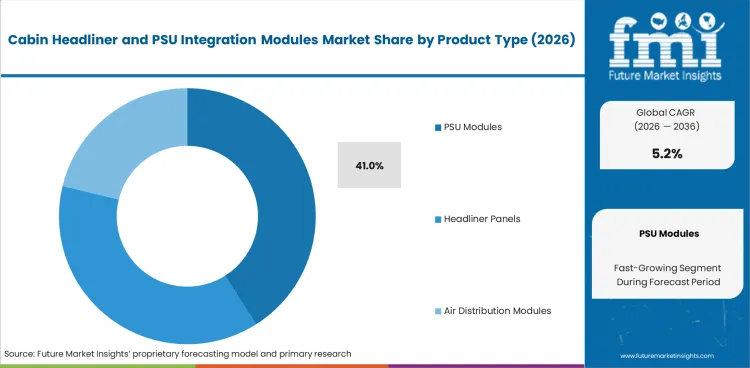
- PSU modules are expected to contribute 41.0% of the product type segment in 2026. These modules combine air outlet and oxygen functions across the aircraft roof zone.
- Headliner panels and lighting units serve adjacent cabin needs. Their value improves in retrofit programs requiring cleaner ceiling finishes and easier passenger interface upgrades.
Insights into Cabin Headliner and PSU Integration Modules Market by Aircraft Type
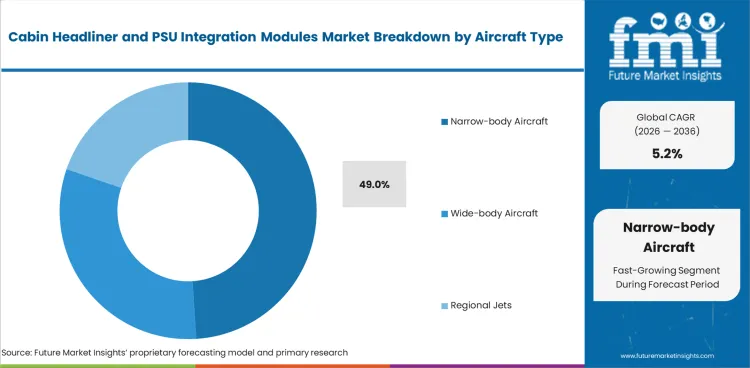
- Narrow-body aircraft are projected to account for 49.0% of the aircraft type segment in 2026. Single-aisle fleets need repeatable overhead layouts to improve production consistency and cabin maintenance planning.
- Wide-body aircraft carry higher value per cabin set. Demand is strongest in premium cabins requiring larger PSU layouts and refined headliner integration.
Insights into Cabin Headliner and PSU Integration Modules Market by Fit Type
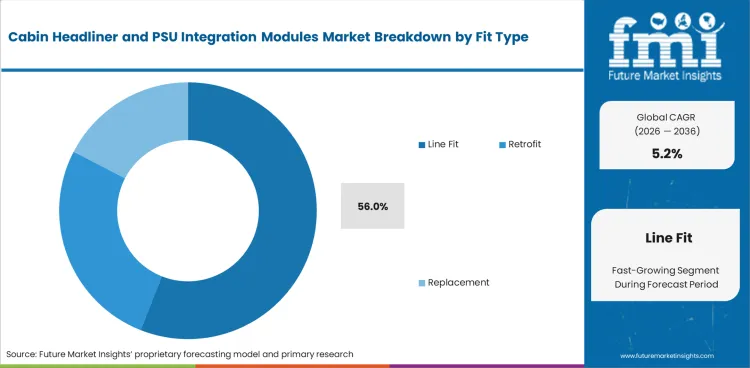
- Line fit is forecast to account for 56.0% share in 2026. Aircraft OEMs prefer factory-installed overhead modules to reduce assembly variation before delivery.
- Retrofit demand is shaped by cabin refresh cycles and scheduled maintenance windows. Airlines need certified replacement kits with clear drawings and stable installation records.
Insights into Cabin Headliner and PSU Integration Modules Market by Material Type
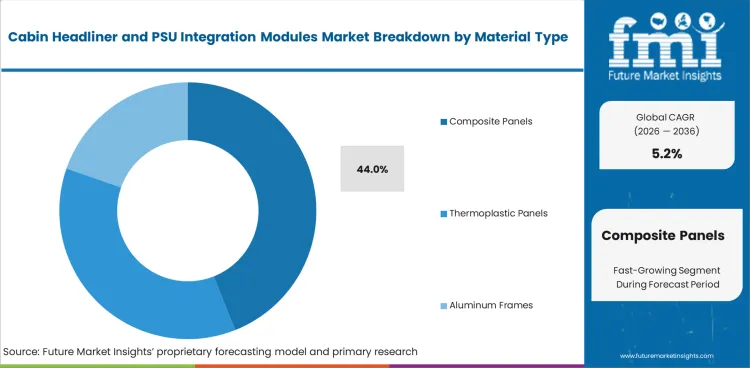
- Composite panels are expected to account for 44.0% share in 2026. Composite headliner products reduce cabin roof weight and meet aircraft interior fire performance needs.
- Thermoplastic panels address selected trim and cover needs. Their value improves in replacement programs requiring molded parts with consistent fit.
Insights into Cabin Headliner and PSU Integration Modules Market by End User
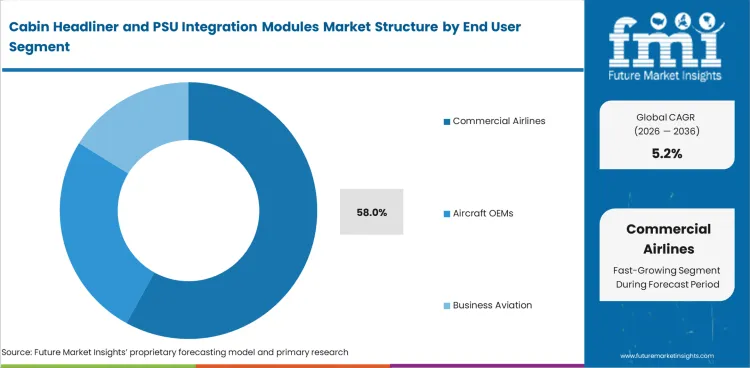
- Commercial airlines are projected to hold 58.0% share in 2026. Fleet operators use common PSU layouts to simplify spares planning and cabin maintenance work.
- Aircraft OEMs and MRO providers support the next demand base. Their role expands in programs requiring certified overhead assemblies and faster cabin release timing.
Cabin Headliner and PSU Integration Modules Market Drivers, Restraints, and Opportunities
- Aircraft delivery backlogs are creating demand for pre-certified overhead cabin assemblies across production programs.
- The need for certified oxygen and electrical interfaces creates entry barriers for smaller cabin component makers.
- Retrofit programs boost opportunity through PSU rearrangement and aircraft interior lighting refresh work.
Cabin headliner and PSU integration modules continue to grow as aircraft cabins need lightweight overhead panels. Reliable passenger service units manage lighting and airflow. They also handle call functions and oxygen access. Certification cost can slow wider adoption. Aircraft downtime and retrofit budget limits can also restrict faster uptake. Growth continues through modular PSU assemblies and narrow-body cabin refurbishment applications.
Aluminum Core Costs Are Moving Into Cabin Quotes
Cabin headliner and PSU integration module pricing is becoming more exposed to aluminum cost pass through. This is especially evident when suppliers use aluminum honeycomb structures and lightweight support components. In January 2025, the USA Geological Survey reported that the estimated average annual USA market price for aluminum increased by 3% in 2024, while primary aluminum production fell 11% and net import reliance reached 47%. Transportation applications accounted for 36% of domestic aluminum consumption. For cabin module buyers, this supports firmer pricing on engineered interiors with less reliance on broad commodity-based negotiation. Suppliers are likely to protect margins through shorter quote validity and metal adjustment clauses. They apply separate charges for low-volume aircraft program customization.
PSU Electronics Premiums Are Becoming Harder to Avoid
PSU integration module pricing is also being pulled upward by electronics content, not only by plastics or cabin trim materials. Passenger service units increasingly bundle LED reading lights and call buttons. They include signage and sensors with control boards, making semiconductor availability a direct pricing factor. In February 2026, the Semiconductor Industry Association reported that global semiconductor sales reached USD 791.7 billion in 2025, up 25.2% from 2024; fourth-quarter sales rose 37.1% year over year to USD 236.6 billion. For aerospace interiors, which buy qualified chips in lower volumes, suppliers may add allocation premiums and lifecycle risk buffers into PSU module quotations.
They may also include non-cancellable procurement terms as part of overall pricing structures.
Analysis of Cabin Headliner and PSU Integration Modules Market By Key Countries
.webp "Top Country Growth Comparison Cabin Headliner And Psu Integration Modules Market Cagr (2026 2036)")
| Country | CAGR |
|---|---|
| India | 7.4% |
| China | 6.9% |
| USA | 5.4% |
| Germany | 4.7% |
| UK | 4.1% |
Source: Future Market Insights, 2026.
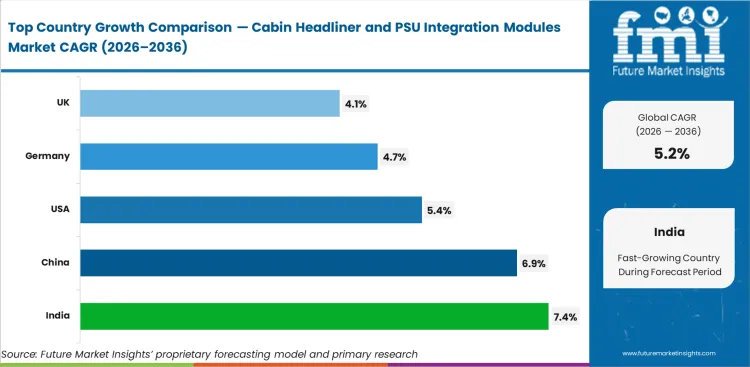
Cabin Headliner and PSU Integration Modules Market CAGR Analysis By Country
- India is projected to record 7.4% CAGR through 2036, helped by fleet additions and rising cabin integration work.
- China is forecast to expand at 6.9% CAGR as domestic aviation scale lifts cabin program volume and quality control needs.
- USA demand is expected to advance at 5.4% CAGR during the forecast period, driven by retrofit planning and heavy fleet utilization.
- Germany at 4.7% and the UK at 4.1% indicate mature aviation markets with selective cabin renewal activity.
Demand for cabin headliner and PSU integration modules is forecast to rise at 5.2% CAGR from 2026 to 2036. Country-level analysis covers the major markets contributing to this forecast, with the key markets listed below.
Demand Outlook for Cabin Headliner and PSU Integration Modules Market in India
India’s cabin headliner and PSU integration modules industry is projected to record a CAGR of 7.4% through 2036. India’s aviation vision notes passenger traffic is expected to grow six-fold to around 1.1 billion by 2040. This fleet and traffic base backs demand for India cabin headliner and PSU integration modules. Local MRO and airline engineering teams can gain from suppliers able to provide certified roof-zone kits for fast cabin work.
- Indian airline fleet expansion increases demand for PSU modules across narrow-body delivery programs.
- UDAN route development increases aircraft utilization across regional networks and raises cabin service requirements.
- Bengaluru and Hyderabad aviation clusters improve access to trained cabin maintenance and component teams.
Sales Analysis of Cabin Headliner and PSU Integration Modules Market in China
The cabin headliner and PSU integration modules sector in China is expected to expand at a CAGR of 6.9% during the assessment period. In 2024, CAAC reported record passenger traffic of 730 million and cargo/mail volume of 8.98 million metric tons. This traffic scale increases demand for China cabin headliner and PSU integration modules. Cabin suppliers benefit from local aircraft programs and airline fleets seeking standardized overhead assemblies.
- COMAC program activity strengthens local interest in certified interior modules and aircraft cabin supply chains.
- Shanghai and Tianjin aviation clusters improve cabin integration access for aircraft assembly and maintenance work.
- Domestic airline expansion raises replacement needs for headliner panels and PSU covers across high-use routes.
Demand Outlook for Cabin Headliner and PSU Integration Modules Market in the United States
The USA cabin headliner and PSU integration modules industry is forecast to grow at a CAGR of 5.4% by 2036. FAA’s 2026 forecast expects USA carrier system passenger growth in 2026 to be 2.4%, with domestic passenger growth averaging the same rate over twenty years. Aircraft operators value cabin suppliers with FAA documentation knowledge and retrofit installation experience. This creates a steady market for certified PSU and headliner replacement work.
- USA airline fleets support repeat demand for PSU replacement through scheduled cabin maintenance cycles.
- FAA certification discipline favors suppliers able to document oxygen, lighting, and mounting interfaces.
- Atlanta and Denver large-hub activity increases cabin wear across high-frequency aircraft use.
Opportunity Analysis of Cabin Headliner and PSU Integration Modules Market in Germany
The cabin headliner and PSU integration modules segment in Germany is projected to grow at 4.7% CAGR over the forecast years. Germany’s aviation base benefits from engineering depth across aircraft interiors and cabin certification work. Demand is strongest for precision headliner panels and PSU modules needing stable fit across aircraft programs. Suppliers with composite processing skill and documentation discipline can serve OEM and MRO orders.
- Hamburg’s aviation cluster boosts supplier access for cabin structures and certified aircraft modification work.
- Lufthansa Technik activity in Germany drives cabin refurbishment planning and overhead component replacement demand.
- German engineering standards favor suppliers with repeatable panel geometry and traceable material records.
Future Outlook for Cabin Headliner and PSU Integration Modules Market in the United Kingdom
The UK cabin headliner and PSU integration modules industry is expected to post 4.1% CAGR through 2036. The UK government noted 2.7 million flights in 2024 during its airspace redesign update. This operating base supports demand for cabin headliner and PSU integration modules in the UK as aircraft cycles continue across major airports. Service providers with fast installation planning can help airlines manage cabin release windows.
- Heathrow and Gatwick traffic concentration increases cabin utilization pressure across long-haul and short-haul aircraft.
- UK ADS airspace redesign favors a policy backdrop for higher operational efficiency across airport networks.
- UK CAA oversight favors documented cabin modifications and traceable replacement parts during retrofit work.
Competitive Landscape and Strategic Positioning
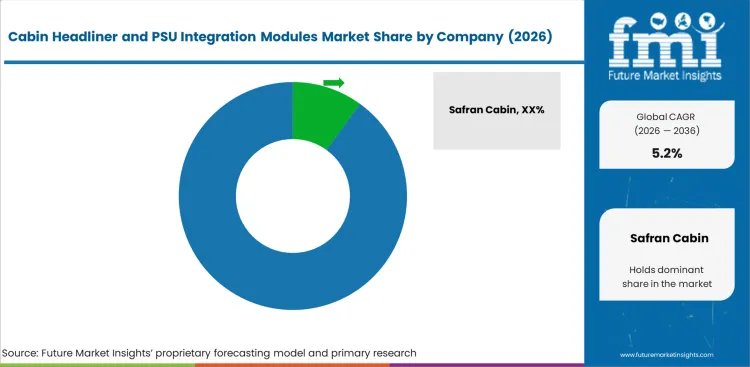
- Certified PSU assemblies and cabin roof integration define competition across aircraft programs with strict approval needs.
- Safran Cabin holds a broad position through broad PSU coverage and proven aircraft program supply references.
- Collins Aerospace and Diehl Aviation compete on cabin systems depth and certified overhead function integration.
- Specialist providers focus on trim panels and retrofit kits for selected aircraft platforms with lower system scope.
Safran Cabin is well positioned through passenger service units combining air gaspers and LED reading lights. Collins Aerospace competes with PSU systems using composite materials across lighting controls and air outlet valves. Diehl Aviation adds depth through cabin lighting and passenger service unit supply for aircraft programs. Astronics strengthens the competitive field through aircraft lighting and power content suited to cabin interface work.
Certification cost and aircraft program approval create the main barriers across cabin roof systems. Precision panel fit also affects supplier selection during long aircraft production cycles. Airlines prefer roof-zone assemblies with proven installation records and reliable spares access. Suppliers with certified PSU depth and complete cabin portfolios are better positioned for OEM and MRO contracts.
Key Companies in the Cabin Headliner and PSU Integration Modules Market
Key companies in the cabin headliner and PSU integration modules market include:
- Safran Cabin, Collins Aerospace, and Diehl Aviation have established capability for passenger service unit design and aircraft program delivery.
- FACC AG, JAMCO Corporation, and Bucher Group serve cabin structures through panel capability and aircraft interior integration experience.
- Astronics Corporation, C&D Zodiac legacy operations, and AIM Altitude hold specialist positions across cabin lighting, trim modules, and retrofit support.
Competitive Benchmarking: Cabin Headliner and PSU Integration Modules Market
| Company | PSU Integration Depth | Headliner Panel Capability | Aircraft Program Access | Geographic Footprint |
|---|---|---|---|---|
| Safran Cabin | High | High | Strong | North America, Europe, and Asia-Pacific |
| Collins Aerospace | High | Medium | Strong | North America, Europe, Asia-Pacific, and Middle East |
| Diehl Aviation | High | Medium | Strong | Europe, North America, and Asia-Pacific |
| FACC AG | Medium | High | Strong | Europe, North America, China, and India |
| JAMCO Corporation | Medium | High | Moderate | Japan, North America, and Asia-Pacific |
| Bucher Group | Medium | Medium | Moderate | Switzerland, Germany, and United States |
| Astronics Corporation | Medium | Low | Moderate | United States, Canada, and Europe |
| AIM Altitude | Low | Medium | Moderate | United Kingdom, Europe, and Asia-Pacific |
Source: Future Market Insights, 2026.
Key Developments in Cabin Headliner and PSU Integration Modules Market
- In April 2026, Diehl Aviation received Embraer’s 2026 Best Suppliers Award in the Interiors category. The development is relevant because Diehl’s Embraer partnership covers cabin systems, emergency lighting, passenger service units, and cabin management systems for Phenom and E-Jet E2 programs. The same release also notes Diehl’s 2024 contract to develop Eve’s complete eVTOL interior, including panels, partitions, flooring, cabin linings, and LED cabin lighting.
- In April 2025, Satair and Collins Aerospace signed a four-year extension of their cabin interior parts distribution agreement. The agreement covers Collins oxygen systems and Goodrich lighting solutions for Airbus, Boeing, and other aircraft platforms, making it relevant to PSU integration because oxygen equipment, reading lights, and cabin lighting are core overhead service-zone components.
Key Players in the Cabin Headliner and PSU Integration Modules Market
Major Global Players:
- Safran Cabin
- Collins Aerospace
- Diehl Aviation
- FACC AG
- JAMCO Corporation
- Bucher Group
- Astronics Corporation
Specialist Players:
- AIM Altitude
- AVIC Cabin Systems
- EnCore Group
Report Scope and Coverage
| Parameter | Details |
|---|---|
| Quantitative Units | USD 1.2 billion to USD 2.0 billion, at a CAGR of 5.2% |
| Market Definition | The cabin headliner and PSU integration modules market encompasses certified overhead cabin panels and passenger service units used in aircraft interiors. |
| Regions Covered | North America, Latin America, Europe, East Asia, South Asia and Pacific, Middle East and Africa |
| Countries Covered | USA, UK, Germany, China, India, Japan, South Korea, and 30 plus countries |
| Key Companies Profiled | Safran Cabin, Collins Aerospace, Diehl Aviation, FACC AG, JAMCO Corporation, Bucher Group, Astronics Corporation, AIM Altitude, AVIC Cabin Systems, EnCore Group |
| Forecast Period | 2026 to 2036 |
| Approach | Hybrid bottom-up and top-down methodology starting with aircraft cabin content demand and verified fleet use patterns. |
Cabin Headliner and PSU Integration Modules Market by Segments
Cabin Headliner and PSU Integration Modules Market Segmented by Product Type:
- PSU Modules
- Headliner Panels
- Air Distribution Modules
- Lighting Units
- Oxygen Panels
Cabin Headliner and PSU Integration Modules Market Segmented by Aircraft Type:
- Narrow-body Aircraft
- Wide-body Aircraft
- Regional Jets
- Business Jets
- Turboprops
Cabin Headliner and PSU Integration Modules Market Segmented by Fit Type:
- Line Fit
- Retrofit
- Replacement
Cabin Headliner and PSU Integration Modules Market Segmented by Material Type:
- Composite Panels
- Thermoplastic Panels
- Aluminum Frames
- Fabric Laminates
- Foam Backing
Cabin Headliner and PSU Integration Modules Market Segmented by End User:
- Commercial Airlines
- Aircraft OEMs
- Business Aviation
- MRO Providers
- Leasing Companies
Cabin Headliner and PSU Integration Modules Market by Region:
- North America
- USA
- Canada
- Mexico
- Latin America
- Brazil
- Chile
- Rest of Latin America
- Europe
- Germany
- UK
- Italy
- Spain
- France
- Rest of Europe
- East Asia
- China
- Japan
- South Korea
- South Asia and Pacific
- India
- ASEAN
- Australia & New Zealand
- Rest of South Asia and Pacific
- Middle East and Africa
- Saudi Arabia
- Other GCC Countries
- South Africa
- Rest of Middle East and Africa
Research Sources and Bibliography
- Airports Council International World. (2025, January 28). Joint ACI World-ICAO passenger traffic report, trends and outlook. ACI World and ICAO Passenger Traffic ReportACI World
- Airbus. (2025, October). Airbus Global Services Forecast 2025-2044. Airbus Global Services Forecast 2025-2044Airbus
- Boeing. (2025, June). Commercial Services Market Outlook 2025-2044. Boeing Commercial Services Market Outlook 2025-2044Boeing
- Collins Aerospace. (2026). Passenger service units. Collins Aerospace Passenger Service UnitsCollins Aerospace
- Collins Aerospace. (2026). Interior reconfigurations. Collins Aerospace Interior ReconfigurationsCollins Aerospace
- Diehl Aviation. (2024, May). Diehl Aviation honored with Embraer’s Best Supplier Award 2024. Diehl Aviation Best Supplier Award 2024Diehl Aviation
- International Air Transport Association. (2026, January). Strong 2025 passenger demand masks ongoing capacity constraints. IATA Strong 2025 Passenger DemandIATA
- Press Information Bureau. (2025, October). India’s Aviation Vision 2047. PIB India’s Aviation Vision 2047
- Safran Cabin. (2026). Passenger service units. Safran Cabin Passenger Service UnitsSafran Cabin
- USA International Trade Administration. (2025, September). China - Aviation. ITA China AviationInternational Trade Administration
- UK Department for Transport. (2025, June). Redesigned flight paths to deliver quicker quieter flights and boost growth. GOV.UK Redesigned Flight PathsUK Department for Transport
- Airbus. (2025). Airbus Global Services Forecast 2025-2044.
- Collins Aerospace. (n.d.). Passenger service units. RTX. Aerospace
- Electronic Code of Federal Regulations. (n.d.). 14 CFR § 25.853 - Compartment interiors. Code of Federal Regulations
- Safran Cabin. (n.d.). Passenger service units: The product that changes the look and feel of the cabin. Safran. Cabin
- Federal Aviation Administration. (2026, May). FAA Aerospace Forecast Fiscal Years 2026-2046. USA Department of Transportation. FAA Aerospace Forecast Fiscal Years 2026-2046
This Report Answers
- What is the current and future size of the cabin headliner and PSU integration modules market?
- How fast is the cabin headliner and PSU integration modules market expected to expand between 2026 and 2036?
- Which product type is expected to lead the market by 2026?
- Which fit type segment is expected to account for the leading demand by 2026?
- What factors are driving demand for cabin headliner and PSU integration modules globally?
- How are aircraft delivery programs influencing adoption of integrated PSU modules?
- Why are commercial airlines the main demand base for cabin headliner and PSU integration modules?
- How are retrofit programs creating demand for certified overhead cabin replacements?
- Which countries are projected to record faster expansion through 2036?
- What is driving market expansion in India and China?
- Who are the key companies active in the cabin headliner and PSU integration modules market?
- How does FMI estimate and validate the market forecast?
Frequently Asked Questions
What is the market value for Cabin Headliner and PSU Integration Modules in 2026?
In 2026, the global market for cabin headliner and PSU integration modules is expected to be worth USD 1.2 billion.
How big will the market for Cabin Headliner and PSU Integration Modules be in 2036?
By 2036, the market for cabin headliner and PSU integration modules is projected to reach USD 2.0 billion.
How much is demand for Cabin Headliner and PSU Integration Modules expected to expand between 2026 and 2036?
Between 2026 and 2036, demand for cabin headliner and PSU integration modules is expected to expand at a CAGR of 5.2%.
Which product type segment is likely to be the leading seller globally by 2026?
PSU modules are expected to contribute 41.0% of the product type segment in 2026.
What is causing demand to rise in India?
The India cabin headliner and PSU integration modules market is projected to record 7.4% CAGR through 2036, backed by airline fleet expansion.
What is causing demand to rise in China?
The China cabin headliner and PSU integration modules market is projected to expand at 6.9% CAGR through 2036, backed by aviation scale.
What does this report mean by Cabin Headliner and PSU Integration Modules Market definition?
The cabin headliner and PSU integration modules market includes overhead cabin panels and passenger service units installed above aircraft passenger seats.
How does FMI estimate the Cabin Headliner and PSU Integration Modules forecast?
FMI uses aircraft cabin content demand, fleet use patterns, supplier checks, and refurbishment activity to validate the forecast.
Preview the report firsthand - request a free sample
Get SampleGet the brochure for pricing and purchase details.
Get PDFTable of Content
- Executive Summary
- Global Market Outlook
- Demand-side Trends
- Supply-side Trends
- Technology Roadmap Analysis
- Analysis and Recommendations
- Market Overview
- Market Coverage / Taxonomy
- Market Definition / Scope / Limitations
- Research Methodology
- Chapter Orientation
- Analytical Lens and Working Hypotheses
- Market Structure, Signals, and Trend Drivers
- Benchmarking and Cross-market Comparability
- Market Sizing, Forecasting, and Opportunity Mapping
- Research Design and Evidence Framework
- Desk Research Programme (Secondary Evidence)
- Company Annual and Sustainability Reports
- Peer-reviewed Journals and Academic Literature
- Corporate Websites, Product Literature, and Technical Notes
- Earnings Decks and Investor Briefings
- Statutory Filings and Regulatory Disclosures
- Technical White Papers and Standards Notes
- Trade Journals, Industry Magazines, and Analyst Briefs
- Conference Proceedings, Webinars, and Seminar Materials
- Government Statistics Portals and Public Data Releases
- Press Releases and Reputable Media Coverage
- Specialist Newsletters and Curated Briefings
- Sector Databases and Reference Repositories
- FMI Internal Proprietary Databases and Historical Market Datasets
- Subscription Datasets and Paid Sources
- Social Channels, Communities, and Digital Listening Inputs
- Additional Desk Sources
- Expert Input and Fieldwork (Primary Evidence)
- Primary Modes
- Qualitative Interviews and Expert Elicitation
- Quantitative Surveys and Structured Data Capture
- Blended Approach
- Why Primary Evidence is Used
- Field Techniques
- Interviews
- Surveys
- Focus Groups
- Observational and In-context Research
- Social and Community Interactions
- Stakeholder Universe Engaged
- C-suite Leaders
- Board Members
- Presidents and Vice Presidents
- R&D and Innovation Heads
- Technical Specialists
- Domain Subject-matter Experts
- Scientists
- Physicians and Other Healthcare Professionals
- Governance, Ethics, and Data Stewardship
- Research Ethics
- Data Integrity and Handling
- Primary Modes
- Tooling, Models, and Reference Databases
- Desk Research Programme (Secondary Evidence)
- Data Engineering and Model Build
- Data Acquisition and Ingestion
- Cleaning, Normalisation, and Verification
- Synthesis, Triangulation, and Analysis
- Quality Assurance and Audit Trail
- Market Background
- Market Dynamics
- Drivers
- Restraints
- Opportunity
- Trends
- Scenario Forecast
- Demand in Optimistic Scenario
- Demand in Likely Scenario
- Demand in Conservative Scenario
- Opportunity Map Analysis
- Product Life Cycle Analysis
- Supply Chain Analysis
- Investment Feasibility Matrix
- Value Chain Analysis
- PESTLE and Porter’s Analysis
- Regulatory Landscape
- Regional Parent Market Outlook
- Production and Consumption Statistics
- Import and Export Statistics
- Market Dynamics
- Global Market Analysis 2021 to 2025 and Forecast, 2026 to 2036
- Historical Market Size Value (USD Million) Analysis, 2021 to 2025
- Current and Future Market Size Value (USD Million) Projections, 2026 to 2036
- Y-o-Y Growth Trend Analysis
- Absolute $ Opportunity Analysis
- Global Market Pricing Analysis 2021 to 2025 and Forecast 2026 to 2036
- Global Market Analysis 2021 to 2025 and Forecast 2026 to 2036, By Product Type
- Introduction / Key Findings
- Historical Market Size Value (USD Million) Analysis By Product Type , 2021 to 2025
- Current and Future Market Size Value (USD Million) Analysis and Forecast By Product Type , 2026 to 2036
- PSU Modules
- Headliner Panels
- Air Distribution Modules
- PSU Modules
- Y-o-Y Growth Trend Analysis By Product Type , 2021 to 2025
- Absolute $ Opportunity Analysis By Product Type , 2026 to 2036
- Global Market Analysis 2021 to 2025 and Forecast 2026 to 2036, By Aircraft Type
- Introduction / Key Findings
- Historical Market Size Value (USD Million) Analysis By Aircraft Type, 2021 to 2025
- Current and Future Market Size Value (USD Million) Analysis and Forecast By Aircraft Type, 2026 to 2036
- Narrow-body Aircraft
- Wide-body Aircraft
- Regional Jets
- Narrow-body Aircraft
- Y-o-Y Growth Trend Analysis By Aircraft Type, 2021 to 2025
- Absolute $ Opportunity Analysis By Aircraft Type, 2026 to 2036
- Global Market Analysis 2021 to 2025 and Forecast 2026 to 2036, By Fit Type
- Introduction / Key Findings
- Historical Market Size Value (USD Million) Analysis By Fit Type, 2021 to 2025
- Current and Future Market Size Value (USD Million) Analysis and Forecast By Fit Type, 2026 to 2036
- Line Fit
- Retrofit
- Replacement
- Line Fit
- Y-o-Y Growth Trend Analysis By Fit Type, 2021 to 2025
- Absolute $ Opportunity Analysis By Fit Type, 2026 to 2036
- Global Market Analysis 2021 to 2025 and Forecast 2026 to 2036, By Material Type
- Introduction / Key Findings
- Historical Market Size Value (USD Million) Analysis By Material Type, 2021 to 2025
- Current and Future Market Size Value (USD Million) Analysis and Forecast By Material Type, 2026 to 2036
- Composite Panels
- Thermoplastic Panels
- Aluminum Frames
- Composite Panels
- Y-o-Y Growth Trend Analysis By Material Type, 2021 to 2025
- Absolute $ Opportunity Analysis By Material Type, 2026 to 2036
- Global Market Analysis 2021 to 2025 and Forecast 2026 to 2036, By End User
- Introduction / Key Findings
- Historical Market Size Value (USD Million) Analysis By End User, 2021 to 2025
- Current and Future Market Size Value (USD Million) Analysis and Forecast By End User, 2026 to 2036
- Commercial Airlines
- Aircraft OEMs
- Business Aviation
- Commercial Airlines
- Y-o-Y Growth Trend Analysis By End User, 2021 to 2025
- Absolute $ Opportunity Analysis By End User, 2026 to 2036
- Global Market Analysis 2021 to 2025 and Forecast 2026 to 2036, By Region
- Introduction
- Historical Market Size Value (USD Million) Analysis By Region, 2021 to 2025
- Current Market Size Value (USD Million) Analysis and Forecast By Region, 2026 to 2036
- North America
- Latin America
- Western Europe
- Eastern Europe
- East Asia
- South Asia and Pacific
- Middle East & Africa
- Market Attractiveness Analysis By Region
- North America Market Analysis 2021 to 2025 and Forecast 2026 to 2036, By Country
- Historical Market Size Value (USD Million) Trend Analysis By Market Taxonomy, 2021 to 2025
- Market Size Value (USD Million) Forecast By Market Taxonomy, 2026 to 2036
- By Country
- USA
- Canada
- Mexico
- By Product Type
- By Aircraft Type
- By Fit Type
- By Material Type
- By End User
- By Country
- Market Attractiveness Analysis
- By Country
- By Product Type
- By Aircraft Type
- By Fit Type
- By Material Type
- By End User
- Key Takeaways
- Latin America Market Analysis 2021 to 2025 and Forecast 2026 to 2036, By Country
- Historical Market Size Value (USD Million) Trend Analysis By Market Taxonomy, 2021 to 2025
- Market Size Value (USD Million) Forecast By Market Taxonomy, 2026 to 2036
- By Country
- Brazil
- Chile
- Rest of Latin America
- By Product Type
- By Aircraft Type
- By Fit Type
- By Material Type
- By End User
- By Country
- Market Attractiveness Analysis
- By Country
- By Product Type
- By Aircraft Type
- By Fit Type
- By Material Type
- By End User
- Key Takeaways
- Western Europe Market Analysis 2021 to 2025 and Forecast 2026 to 2036, By Country
- Historical Market Size Value (USD Million) Trend Analysis By Market Taxonomy, 2021 to 2025
- Market Size Value (USD Million) Forecast By Market Taxonomy, 2026 to 2036
- By Country
- Germany
- UK
- Italy
- Spain
- France
- Nordic
- BENELUX
- Rest of Western Europe
- By Product Type
- By Aircraft Type
- By Fit Type
- By Material Type
- By End User
- By Country
- Market Attractiveness Analysis
- By Country
- By Product Type
- By Aircraft Type
- By Fit Type
- By Material Type
- By End User
- Key Takeaways
- Eastern Europe Market Analysis 2021 to 2025 and Forecast 2026 to 2036, By Country
- Historical Market Size Value (USD Million) Trend Analysis By Market Taxonomy, 2021 to 2025
- Market Size Value (USD Million) Forecast By Market Taxonomy, 2026 to 2036
- By Country
- Russia
- Poland
- Hungary
- Balkan & Baltic
- Rest of Eastern Europe
- By Product Type
- By Aircraft Type
- By Fit Type
- By Material Type
- By End User
- By Country
- Market Attractiveness Analysis
- By Country
- By Product Type
- By Aircraft Type
- By Fit Type
- By Material Type
- By End User
- Key Takeaways
- East Asia Market Analysis 2021 to 2025 and Forecast 2026 to 2036, By Country
- Historical Market Size Value (USD Million) Trend Analysis By Market Taxonomy, 2021 to 2025
- Market Size Value (USD Million) Forecast By Market Taxonomy, 2026 to 2036
- By Country
- China
- Japan
- South Korea
- By Product Type
- By Aircraft Type
- By Fit Type
- By Material Type
- By End User
- By Country
- Market Attractiveness Analysis
- By Country
- By Product Type
- By Aircraft Type
- By Fit Type
- By Material Type
- By End User
- Key Takeaways
- South Asia and Pacific Market Analysis 2021 to 2025 and Forecast 2026 to 2036, By Country
- Historical Market Size Value (USD Million) Trend Analysis By Market Taxonomy, 2021 to 2025
- Market Size Value (USD Million) Forecast By Market Taxonomy, 2026 to 2036
- By Country
- India
- ASEAN
- Australia & New Zealand
- Rest of South Asia and Pacific
- By Product Type
- By Aircraft Type
- By Fit Type
- By Material Type
- By End User
- By Country
- Market Attractiveness Analysis
- By Country
- By Product Type
- By Aircraft Type
- By Fit Type
- By Material Type
- By End User
- Key Takeaways
- Middle East & Africa Market Analysis 2021 to 2025 and Forecast 2026 to 2036, By Country
- Historical Market Size Value (USD Million) Trend Analysis By Market Taxonomy, 2021 to 2025
- Market Size Value (USD Million) Forecast By Market Taxonomy, 2026 to 2036
- By Country
- Kingdom of Saudi Arabia
- Other GCC Countries
- Turkiye
- South Africa
- Other African Union
- Rest of Middle East & Africa
- By Product Type
- By Aircraft Type
- By Fit Type
- By Material Type
- By End User
- By Country
- Market Attractiveness Analysis
- By Country
- By Product Type
- By Aircraft Type
- By Fit Type
- By Material Type
- By End User
- Key Takeaways
- Key Countries Market Analysis
- USA
- Pricing Analysis
- Market Share Analysis, 2025
- By Product Type
- By Aircraft Type
- By Fit Type
- By Material Type
- By End User
- Canada
- Pricing Analysis
- Market Share Analysis, 2025
- By Product Type
- By Aircraft Type
- By Fit Type
- By Material Type
- By End User
- Mexico
- Pricing Analysis
- Market Share Analysis, 2025
- By Product Type
- By Aircraft Type
- By Fit Type
- By Material Type
- By End User
- Brazil
- Pricing Analysis
- Market Share Analysis, 2025
- By Product Type
- By Aircraft Type
- By Fit Type
- By Material Type
- By End User
- Chile
- Pricing Analysis
- Market Share Analysis, 2025
- By Product Type
- By Aircraft Type
- By Fit Type
- By Material Type
- By End User
- Germany
- Pricing Analysis
- Market Share Analysis, 2025
- By Product Type
- By Aircraft Type
- By Fit Type
- By Material Type
- By End User
- UK
- Pricing Analysis
- Market Share Analysis, 2025
- By Product Type
- By Aircraft Type
- By Fit Type
- By Material Type
- By End User
- Italy
- Pricing Analysis
- Market Share Analysis, 2025
- By Product Type
- By Aircraft Type
- By Fit Type
- By Material Type
- By End User
- Spain
- Pricing Analysis
- Market Share Analysis, 2025
- By Product Type
- By Aircraft Type
- By Fit Type
- By Material Type
- By End User
- France
- Pricing Analysis
- Market Share Analysis, 2025
- By Product Type
- By Aircraft Type
- By Fit Type
- By Material Type
- By End User
- India
- Pricing Analysis
- Market Share Analysis, 2025
- By Product Type
- By Aircraft Type
- By Fit Type
- By Material Type
- By End User
- ASEAN
- Pricing Analysis
- Market Share Analysis, 2025
- By Product Type
- By Aircraft Type
- By Fit Type
- By Material Type
- By End User
- Australia & New Zealand
- Pricing Analysis
- Market Share Analysis, 2025
- By Product Type
- By Aircraft Type
- By Fit Type
- By Material Type
- By End User
- China
- Pricing Analysis
- Market Share Analysis, 2025
- By Product Type
- By Aircraft Type
- By Fit Type
- By Material Type
- By End User
- Japan
- Pricing Analysis
- Market Share Analysis, 2025
- By Product Type
- By Aircraft Type
- By Fit Type
- By Material Type
- By End User
- South Korea
- Pricing Analysis
- Market Share Analysis, 2025
- By Product Type
- By Aircraft Type
- By Fit Type
- By Material Type
- By End User
- Russia
- Pricing Analysis
- Market Share Analysis, 2025
- By Product Type
- By Aircraft Type
- By Fit Type
- By Material Type
- By End User
- Poland
- Pricing Analysis
- Market Share Analysis, 2025
- By Product Type
- By Aircraft Type
- By Fit Type
- By Material Type
- By End User
- Hungary
- Pricing Analysis
- Market Share Analysis, 2025
- By Product Type
- By Aircraft Type
- By Fit Type
- By Material Type
- By End User
- Kingdom of Saudi Arabia
- Pricing Analysis
- Market Share Analysis, 2025
- By Product Type
- By Aircraft Type
- By Fit Type
- By Material Type
- By End User
- Turkiye
- Pricing Analysis
- Market Share Analysis, 2025
- By Product Type
- By Aircraft Type
- By Fit Type
- By Material Type
- By End User
- South Africa
- Pricing Analysis
- Market Share Analysis, 2025
- By Product Type
- By Aircraft Type
- By Fit Type
- By Material Type
- By End User
- USA
- Market Structure Analysis
- Competition Dashboard
- Competition Benchmarking
- Market Share Analysis of Top Players
- By Regional
- By Product Type
- By Aircraft Type
- By Fit Type
- By Material Type
- By End User
- Competition Analysis
- Competition Deep Dive
- Safran Cabin
- Overview
- Product Portfolio
- Profitability by Market Segments (Product/Age /Sales Channel/Region)
- Sales Footprint
- Strategy Overview
- Marketing Strategy
- Product Strategy
- Channel Strategy
- Collins Aerospace
- Diehl Aviation
- FACC AG
- JAMCO Corporation
- Bucher Group
- Safran Cabin
- Competition Deep Dive
- Assumptions & Acronyms Used


