

- Industry Size (2026)
- USD 4231.2 Mn
- Forecast (2036)
- USD 5797.8 Mn
- CAGR (2026 to 2036)
- 3.2%
Bus HVAC Components Market Forecast and Outlook 2026 to 2036
The bus HVAC components market is valued at USD 4,231.2 million in 2026 and is forecasted to reach USD 5,797.8 million by 2036, reflecting a CAGR of 3.2%. Value formation is anchored in the operational necessity of maintaining thermal comfort and air quality in buses operating under continuous duty cycles. HVAC systems are not discretionary features in public transport fleets, as passenger density, frequent door openings, and long operating hours impose persistent thermal loads. Component demand is therefore closely tied to fleet utilization intensity, route characteristics, and climatic exposure rather than fleet size expansion alone. Compressors, evaporators, and blowers are specified based on endurance, energy draw, and recovery time after repeated air exchange events.
Cost behavior reflects lifecycle performance priorities rather than short-term efficiency gains. Transit authorities emphasize reliability, predictable maintenance intervals, and compatibility with existing electrical and propulsion architectures. Electrification introduces constraints on auxiliary power consumption, increasing scrutiny of compressor efficiency and control logic integration. Roof-mounted installation exposes components to vibration, moisture, and particulate ingress, shaping material selection and validation requirements. Aftermarket demand tracks refurbishment cycles and mid-life overhauls of buses with long service lives. Capital allocation decisions favor HVAC solutions that minimize service disruptions and energy penalties, reinforcing steady replacement-driven growth across urban and intercity transit systems.
Quick Stats for Bus HVAC Components Market
- Bus HVAC Components Market Value (2026): USD 4,231.2 million
- Bus HVAC Components Market Forecast Value (2036): USD 5,797.8 million
- Bus HVAC Components Market Forecast CAGR 2026 to 2036: 3.2%
- Leading Component by Demand Share: Compressors
- Fastest-Growing Countries: China, Brazil, USA, Germany, South Korea
- Top Players in Global Demand: Thermo King, Valeo, Denso, Eberspächer, Hanon Systems, Sanden, MAHLE, Carrier, Modine, Bosch
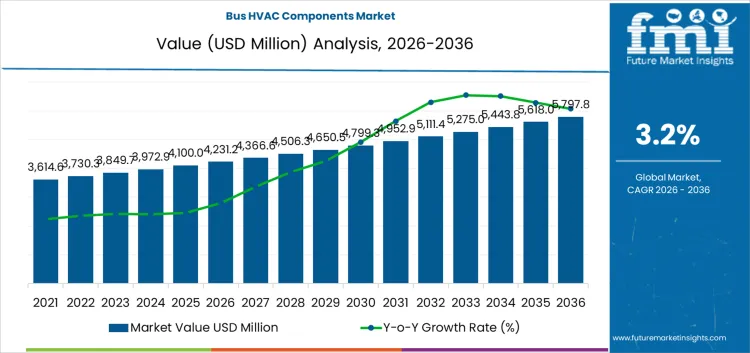
Bus HVAC Components Market Key Takeaways
| Metric | Value |
|---|---|
| Market Value (2026) | USD 4,231.2 million |
| Market Forecast Value (2036) | USD 5,797.8 million |
| Forecast CAGR 2026 to 2036 | 3.2% |
Why is the Demand for Bus HVAC Components Growing?
Demand for bus HVAC components is rising as transit agencies and fleet operators prioritize passenger comfort and air quality across diverse climate conditions. Urban and intercity buses require robust blowers, heat exchangers, evaporators, and control modules that maintain consistent cabin temperature and ventilation during continuous service hours. Engineers specify components that meet performance criteria for airflow distribution, energy efficiency, and resistance to vibration and thermal stress because reliable climate management supports operational timetables and passenger satisfaction. Procurement teams assess compatibility with vehicle electrical systems, ease of integration, and maintenance accessibility when selecting HVAC modules for new buses and replacement cycles.
Regulatory expectations related to indoor air quality and transport safety encourage specification of advanced filtration and ventilation solutions that reduce exposure to pollutants and support compliance with health standards. Growth in public transit ridership and expansion of bus rapid transit corridors reinforce adoption of HVAC components designed for heavy duty usage and extended service life. Manufacturers are refining fan motors and heat pump elements to improve thermal response while minimizing energy draw from auxiliary power systems. Retrofit programs in older fleets also drive component demand as operators seek upgrades that improve efficiency and reduce downtime. Coordination between transit planners, vehicle integrators, and service technicians ensures systems are tested and commissioned to maintain performance across seasonal extremes. These operational and technical dynamics contribute to sustained uptake of bus HVAC components in evolving mobility networks.
How Are the Segments Classified in the Bus HVAC Components Market?
Demand for bus HVAC components is shaped by passenger comfort requirements, climatic operating conditions, and continuous duty cycle expectations. Public transport operators prioritize reliable thermal performance to maintain acceptable cabin conditions across varying passenger loads. Component selection emphasizes durability, airflow consistency, and compatibility with bus electrical and powertrain architectures. Electrification trends influence HVAC design and energy management strategies. Segment classification reflects differentiation by HVAC component role, bus operating profile, and propulsion system. Structure highlights how thermal function, route characteristics, and powertrain configuration influence specification priorities, integration complexity, and component utilization across bus fleets.
Which Component Represents the Largest Share of Demand?
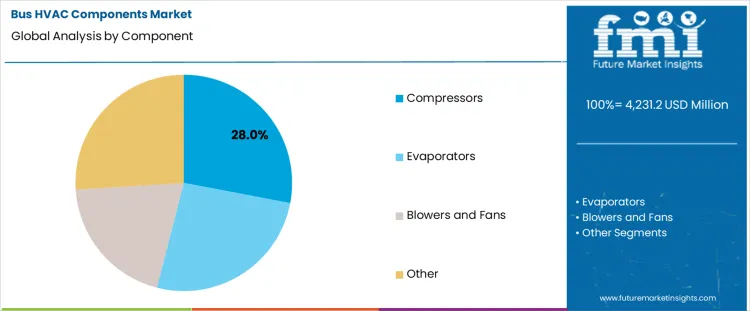
Compressors hold 28.0%, representing the largest share among HVAC components due to central role in cooling cycle operation. These units drive refrigerant circulation, directly determining cooling capacity and system responsiveness. Continuous operation during service hours increases mechanical and thermal stress exposure. Design priorities include efficiency, reliability, and compatibility with refrigerant standards. Evaporators facilitate heat exchange within the cabin with slightly lower replacement intensity. Blowers and fans manage air distribution supporting thermal comfort consistency. Other components support control and auxiliary functions. Component segmentation reflects emphasis on core refrigeration elements where performance reliability governs overall HVAC effectiveness.
Key Points
- Compressors enable refrigerant circulation and cooling output.
- High duty cycles increase reliability requirements.
- Other components support heat exchange and airflow distribution.
Which Bus Type Accounts for the Highest Share of Demand?
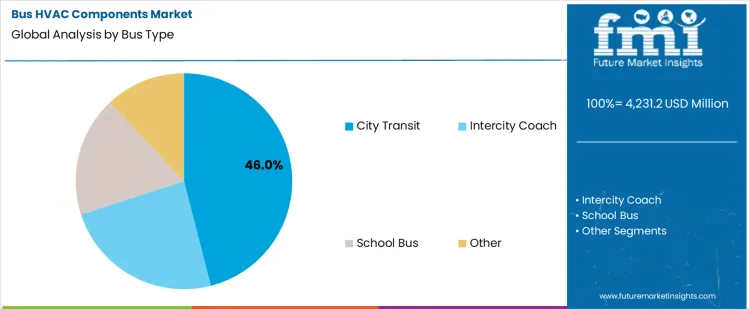
City transit buses hold 46.0%, representing the largest share among bus types due to high passenger turnover and frequent stops. Continuous door opening increases thermal load and HVAC usage intensity. Urban routes require consistent cooling performance throughout extended operating hours. Fleet scale and standardized specifications support repeated component deployment. Intercity coaches operate under longer routes with steadier thermal loads. School buses experience seasonal and route-specific usage patterns. Bus type segmentation reflects concentration of HVAC component demand within urban transit fleets where operating intensity and passenger density remain highest.
Key Points
- City buses face frequent thermal load fluctuations.
- High passenger turnover drives sustained HVAC operation.
- Other bus types operate under different usage profiles.
Which Powertrain Category Drives the Largest Share of Demand?
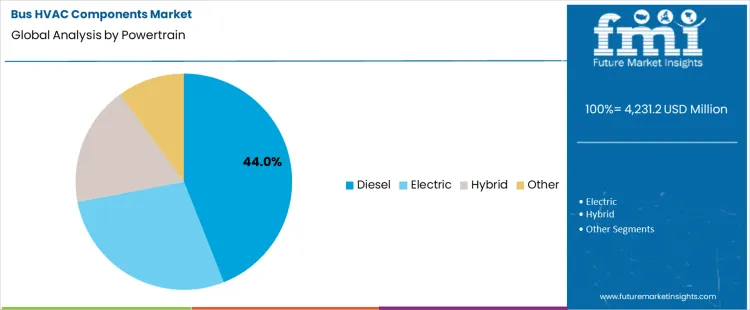
Diesel powertrains hold 44.0%, representing the largest share among powertrain categories due to established fleet composition. Diesel buses rely on engine-driven HVAC systems with proven architectures. Existing maintenance practices support continued component utilization. Electric and hybrid buses introduce energy management constraints influencing HVAC sizing and control. Other powertrains contribute limited volume. Powertrain segmentation reflects continued prevalence of conventional propulsion where HVAC component designs remain standardized and widely deployed across current bus fleets.
Key Points
- Diesel fleets sustain established HVAC architectures.
- Engine-driven systems support consistent thermal performance.
- Electrified powertrains introduce evolving HVAC integration needs.
What are the Key Dynamics in the Bus HVAC Components Market?
Demand for bus HVAC components reflects operational necessity to maintain cabin thermal comfort, ventilation, and air quality across urban and intercity bus fleets. Adoption spans compressors, evaporators, condensers, blowers, ducts, and electronic control units integrated into roof-mounted and rear-mounted systems. Global scope aligns with passenger comfort expectations, public transport utilization intensity, and regulatory requirements for ventilation and defogging performance.
How do route duty cycles and passenger density shape adoption?
City and intercity buses operate under prolonged engine-on hours, frequent door openings, and high passenger turnover. Demand increases as HVAC components must recover cabin temperature rapidly after repeated air exchange events at stops. Urban buses require high airflow capacity to manage peak passenger density during short dwell times. Intercity coaches prioritize thermal stability and noise control during extended operation. High ambient temperature regions drive adoption of higher-capacity compressors and condensers. Electrified buses require HVAC components optimized for low auxiliary power draw. Integration with automatic climate control improves temperature consistency across varying load conditions. Adoption reflects route-specific thermal load management rather than comfort differentiation.
How do energy consumption, maintenance exposure, and procurement constraints influence market scalability?
HVAC systems represent a significant auxiliary energy load, affecting fuel efficiency and electric bus range. Demand sensitivity rises where operators face energy cost pressure and range limitations. Roof-mounted components experience vibration, dust, and water exposure, increasing wear rates. Maintenance access complexity affects service time and fleet availability. Public transport procurement emphasizes lifecycle cost, limiting adoption of high-cost component upgrades. Regulatory requirements for refrigerants increase design and validation burden. Performance degradation in extreme climates affects reliability perception. Supply chain dependence on compressors, heat exchangers, and control electronics constrains rapid standardization across diverse bus platforms.
How Is Demand for Bus HVAC Components Evolving Globally?
Demand for bus HVAC components is expanding globally due to urban transit utilization, passenger comfort standards, and fleet electrification. HVAC performance affects uptime, energy efficiency, and service reliability under high-duty urban operations. Electrified buses require optimized compressors, heat exchangers, and control units compatible with low-voltage architectures. Retrofit programs contribute where legacy fleets undergo modernization. Growth rates in China at 4.8%, Brazil at 4.6%, USA at 2.8%, Germany at 2.6%, and South Korea at 2.5% indicate steady expansion driven by operating intensity, climate exposure, and lifecycle replacement rather than rapid fleet size growth.
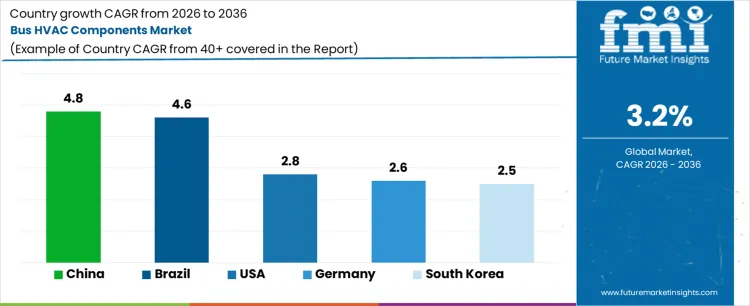
| Country | CAGR (%) |
|---|---|
| China | 4.8% |
| Brazil | 4.6% |
| USA | 2.8% |
| Germany | 2.6% |
| South Korea | 2.5% |
What Is Supporting Bus HVAC Component Demand Growth in China?
Bus HVAC component demand in China is growing at a CAGR of 4.8%, supported by intensive urban transit utilization and large electric bus fleets. High passenger density increases thermal loads and continuous HVAC operation across daily routes. Municipal procurement emphasizes reliability, fast cooling response, and energy efficiency. Electrified buses require HVAC components optimized for battery-powered operation and regenerative energy management. Frequent stop cycles accelerate wear on compressors and blowers, reinforcing replacement demand. Domestic bus manufacturing supports OEM volumes, while inspection regimes encourage preventive maintenance. Demand growth remains maintenance-led, reflecting operating intensity and public service reliability expectations.
- Large-scale electric bus fleet deployment
- High passenger density increasing HVAC duty cycles
- Municipal standards emphasizing reliability and efficiency
- Strong domestic bus OEM integration
Why Is Brazil Experiencing Steady Expansion in Bus HVAC Component Demand?
Operating environment conditions shape bus HVAC component demand in Brazil, expanding at a CAGR of 4.6%. High ambient temperatures increase cooling load throughout extended operating hours. Urban congestion prolongs dwell times, sustaining continuous HVAC usage. Electric and hybrid bus programs require energy-efficient HVAC systems to control operating costs. Road vibration and dust exposure affect component durability, increasing maintenance-driven replacement. Public transport authorities prioritize passenger comfort to maintain ridership levels. Demand growth reflects climate exposure and utilization intensity rather than expansion of route networks or fleet size.
- High ambient temperatures increasing cooling demand
- Congested urban routes extending HVAC operation
- Electrified bus programs prioritizing efficiency
- Environmental exposure accelerating component wear
How Is the USA Sustaining Demand for Bus HVAC Components?
Bus HVAC component demand in the USA is expanding at a CAGR of 2.8%, driven by fleet replacement cycles and comfort compliance requirements. Aging transit buses undergo systematic refurbishment, including HVAC upgrades. Diverse climate conditions require systems capable of heating and cooling performance stability. Electrified bus adoption increases focus on efficient compressors and controls. Transit agencies emphasize reliability to minimize service disruptions. Aftermarket replacement dominates due to long bus service life. Demand growth remains measured, aligned with capital budgeting cycles and maintenance programs rather than rapid transit expansion.
- Fleet refurbishment and replacement programs
- Climate diversity requiring balanced HVAC performance
- Electrified buses increasing efficiency requirements
- Aftermarket replacement across aging fleets
What Factors Are Shaping Bus HVAC Component Demand in Germany?
Engineering discipline influences bus HVAC component demand in Germany, growing at a CAGR of 2.6%. Public transport operators prioritize precise temperature control and low noise operation. Energy efficiency standards influence component selection and system integration. Electrified buses require HVAC units compatible with heat pump and energy recovery systems. Preventive maintenance schedules extend component life, moderating replacement frequency. Export-oriented bus manufacturing supports steady OEM demand. Growth reflects structured servicing within mature transit systems rather than expansion of passenger capacity.
- Strict comfort and noise performance standards
- Energy efficiency influencing HVAC specification
- Integration with electric bus thermal systems
- Predictable preventive maintenance cycles
Why Is South Korea Showing Controlled Growth in Bus HVAC Component Demand?
Bus HVAC component demand in South Korea is growing at a CAGR of 2.5%, shaped by efficient urban transit operations and disciplined fleet management. Compact geography limits route length while maintaining high passenger turnover. Seasonal temperature variation sustains balanced heating and cooling requirements. Electrified bus deployment increases need for reliable, energy-efficient HVAC components. Strong maintenance practices reduce premature component failure. Municipal procurement favors standardized systems with long service intervals. Growth remains controlled, reflecting efficiency-focused operations and scheduled replacement rather than expansion of bus fleets.
- Compact routes with high passenger turnover
- Seasonal heating and cooling performance needs
- Electrified buses requiring efficient HVAC systems
- Standardized procurement with long service intervals
What is the competitive landscape of demand for the bus HVAC components market?
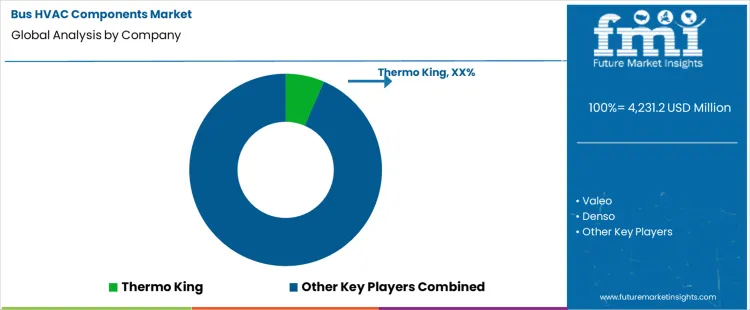
Demand for bus HVAC components is driven by public transit modernization, passenger comfort expectations, and stringent climate control standards in warm and cold operating environments. Components such as compressors, condensers, evaporators, blowers, and control units are essential for maintaining interior thermal comfort, air quality, and energy efficiency. Buyers evaluate component efficiency, reliability under heavy duty cycles, compatibility with electric, hybrid, and conventional powertrains, and ease of integration with vehicle electrical systems. Procurement teams prioritize suppliers with comprehensive HVAC portfolios, global supply networks, certified quality systems, and strong technical support for OEM and aftermarket channels. Trend in the global market reflects growth in urban bus fleets, electrification of public transport, and demand for HVAC solutions that reduce energy consumption while maintaining performance.
Thermo King holds leading positioning through specialized bus HVAC systems and components tailored for heavy-duty transit applications with extensive OEM integration and climate control expertise. Valeo supports demand with modular HVAC components and heat exchanger technologies used in buses across multiple global markets. Denso participates with efficient compressors and climate system components designed for reliability and energy efficiency. Eberspächer contributes HVAC units and control systems optimized for bus applications and diversified climatic conditions. Hanon Systems supplies thermal management components and system modules integrated into broader bus climate control architectures. Competitive differentiation depends on energy performance, system reliability, component durability, integration flexibility, and ability to meet diverse region-specific regulatory and comfort requirements.
Key Players in the Bus HVAC Components Market
- Thermo King
- Valeo
- Denso
- Eberspächer
- Hanon Systems
- Sanden
- Mahle
- Carrier
- Modine
- Bosch
Scope of the Report
| Items | Values |
|---|---|
| Quantitative Units | USD million |
| Component | Compressors; Evaporators; Blowers and Fans; Other |
| Bus Type | City Transit; Intercity Coach; School Bus; Other |
| Powertrain | Diesel; Electric; Hybrid; Other |
| Sales Channel | OEM Line-Fit; Aftermarket; Dealer or OES; Other |
| Regions Covered | Asia Pacific, Europe, North America, Latin America, Middle East & Africa |
| Countries Covered | China, Brazil, USA, Germany, South Korea, and 40+ countries |
| Key Companies Profiled | Thermo King; Valeo; Denso; Eberspächer; Hanon Systems; Sanden; MAHLE; Carrier; Modine; Bosch |
| Additional Attributes | Dollar sales by component and bus type; adoption trends for electric and hybrid bus HVAC with higher efficiency and reduced parasitic load; cooling capacity, airflow rate, and energy consumption performance metrics; refrigerant compatibility, thermal durability, and noise control considerations; integration with battery thermal management in electric buses; aftermarket replacement cycles and serviceability factors; compliance with passenger comfort standards, emissions regulations, and OEM validation requirements influencing bus HVAC component selection. |
Bus HVAC Components Market by Segment
Component:
- Compressors
- Evaporators
- Blowers and Fans
- Other
Bus Type:
- City Transit
- Intercity Coach
- School Bus
- Other
Powertrain:
- Diesel
- Electric
- Hybrid
- Other
Sales Channel:
- OEM Line-Fit
- Aftermarket
- Dealer or OES
- Other
Region:
- Asia Pacific
- China
- Japan
- South Korea
- India
- Australia & New Zealand
- ASEAN
- Rest of Asia Pacific
- Europe
- Germany
- United Kingdom
- France
- Italy
- Spain
- Nordic
- BENELUX
- Rest of Europe
- North America
- United States
- Canada
- Mexico
- Latin America
- Brazil
- Chile
- Rest of Latin America
- Middle East & Africa
- Kingdom of Saudi Arabia
- Other GCC Countries
- Turkey
- South Africa
- Other African Union
- Rest of Middle East & Africa
Bibliography
- European Commission. (2023). Regulation (EU) 2019/2144 on type-approval requirements for motor vehicles and systems, components and separate technical units, including climate control, ventilation, and defogging performance requirements (consolidated version with staged application applicable from 2022-2024). Official Journal of the European Union.
- United Nations Economic Commission for Europe. (2023). UNECE Regulation No. 107: Uniform provisions concerning the approval of category M2 and M3 vehicles with regard to general construction, including ventilation, heating, and air-conditioning requirements (consolidated text incorporating amendments in force during 2023). United Nations.
- United Nations Economic Commission for Europe. (2024). UNECE Regulation No. 10: Uniform provisions concerning electromagnetic compatibility of vehicles, including HVAC electrical and control system components (latest amendments applicable from 2024). United Nations.
- International Organization for Standardization. (2023). ISO 19453-6: Road vehicles-Environmental conditions and testing for electric propulsion components-HVAC and thermal management systems (current edition applied in electric bus platforms during 2023). International Organization for Standardization.
- International Organization for Standardization. (2024). ISO 16750-2: Road vehicles-Environmental conditions and testing for electrical and electronic equipment-Electrical loads and thermal stress (latest edition confirmed in use for bus HVAC systems in 2024). International Organization for Standardization.
Frequently Asked Questions
How big is the bus hvac components market in 2026?
The global bus hvac components market is estimated to be valued at USD 4,231.2 million in 2026.
What will be the size of bus hvac components market in 2036?
The market size for the bus hvac components market is projected to reach USD 5,797.8 million by 2036.
How much will be the bus hvac components market growth between 2026 and 2036?
The bus hvac components market is expected to grow at a 3.2% CAGR between 2026 and 2036.
What are the key product types in the bus hvac components market?
The key product types in bus hvac components market are compressors, evaporators, blowers and fans and other.
Which bus type segment to contribute significant share in the bus hvac components market in 2026?
In terms of bus type, city transit segment to command 46.0% share in the bus hvac components market in 2026.
Preview the report firsthand - request a free sample
Get SampleGet the brochure for pricing and purchase details.
Get PDFTable of Content
- Executive Summary
- Global Market Outlook
- Demand-side Trends
- Supply-side Trends
- Technology Roadmap Analysis
- Analysis and Recommendations
- Market Overview
- Market Coverage / Taxonomy
- Market Definition / Scope / Limitations
- Market Background
- Market Dynamics
- Drivers
- Restraints
- Opportunity
- Trends
- Scenario Forecast
- Demand in Optimistic Scenario
- Demand in Likely Scenario
- Demand in Conservative Scenario
- Opportunity Map Analysis
- Product Life Cycle Analysis
- Supply Chain Analysis
- Investment Feasibility Matrix
- Value Chain Analysis
- PESTLE and Porter’s Analysis
- Regulatory Landscape
- Regional Parent Market Outlook
- Production and Consumption Statistics
- Import and Export Statistics
- Market Dynamics
- Global Market Analysis 2021 to 2025 and Forecast, 2026 to 2036
- Historical Market Size Value (USD Million) Analysis, 2021 to 2025
- Current and Future Market Size Value (USD Million) Projections, 2026 to 2036
- Y-o-Y Growth Trend Analysis
- Absolute $ Opportunity Analysis
- Global Market Pricing Analysis 2021 to 2025 and Forecast 2026 to 2036
- Global Market Analysis 2021 to 2025 and Forecast 2026 to 2036, By Component
- Introduction / Key Findings
- Historical Market Size Value (USD Million) Analysis By Component , 2021 to 2025
- Current and Future Market Size Value (USD Million) Analysis and Forecast By Component , 2026 to 2036
- Compressors
- Evaporators
- Blowers and Fans
- Other
- Compressors
- Y-o-Y Growth Trend Analysis By Component , 2021 to 2025
- Absolute $ Opportunity Analysis By Component , 2026 to 2036
- Global Market Analysis 2021 to 2025 and Forecast 2026 to 2036, By Bus Type
- Introduction / Key Findings
- Historical Market Size Value (USD Million) Analysis By Bus Type, 2021 to 2025
- Current and Future Market Size Value (USD Million) Analysis and Forecast By Bus Type, 2026 to 2036
- City Transit
- Intercity Coach
- School Bus
- Other
- City Transit
- Y-o-Y Growth Trend Analysis By Bus Type, 2021 to 2025
- Absolute $ Opportunity Analysis By Bus Type, 2026 to 2036
- Global Market Analysis 2021 to 2025 and Forecast 2026 to 2036, By Powertrain
- Introduction / Key Findings
- Historical Market Size Value (USD Million) Analysis By Powertrain, 2021 to 2025
- Current and Future Market Size Value (USD Million) Analysis and Forecast By Powertrain, 2026 to 2036
- Diesel
- Electric
- Hybrid
- Other
- Diesel
- Y-o-Y Growth Trend Analysis By Powertrain, 2021 to 2025
- Absolute $ Opportunity Analysis By Powertrain, 2026 to 2036
- Global Market Analysis 2021 to 2025 and Forecast 2026 to 2036, By Sales Channel
- Introduction / Key Findings
- Historical Market Size Value (USD Million) Analysis By Sales Channel, 2021 to 2025
- Current and Future Market Size Value (USD Million) Analysis and Forecast By Sales Channel, 2026 to 2036
- OEM Line-Fit
- Aftermarket
- Dealer or OES
- Other
- OEM Line-Fit
- Y-o-Y Growth Trend Analysis By Sales Channel, 2021 to 2025
- Absolute $ Opportunity Analysis By Sales Channel, 2026 to 2036
- Global Market Analysis 2021 to 2025 and Forecast 2026 to 2036, By Region
- Introduction
- Historical Market Size Value (USD Million) Analysis By Region, 2021 to 2025
- Current Market Size Value (USD Million) Analysis and Forecast By Region, 2026 to 2036
- North America
- Latin America
- Western Europe
- Eastern Europe
- East Asia
- South Asia and Pacific
- Middle East & Africa
- Market Attractiveness Analysis By Region
- North America Market Analysis 2021 to 2025 and Forecast 2026 to 2036, By Country
- Historical Market Size Value (USD Million) Trend Analysis By Market Taxonomy, 2021 to 2025
- Market Size Value (USD Million) Forecast By Market Taxonomy, 2026 to 2036
- By Country
- USA
- Canada
- Mexico
- By Component
- By Bus Type
- By Powertrain
- By Sales Channel
- By Country
- Market Attractiveness Analysis
- By Country
- By Component
- By Bus Type
- By Powertrain
- By Sales Channel
- Key Takeaways
- Latin America Market Analysis 2021 to 2025 and Forecast 2026 to 2036, By Country
- Historical Market Size Value (USD Million) Trend Analysis By Market Taxonomy, 2021 to 2025
- Market Size Value (USD Million) Forecast By Market Taxonomy, 2026 to 2036
- By Country
- Brazil
- Chile
- Rest of Latin America
- By Component
- By Bus Type
- By Powertrain
- By Sales Channel
- By Country
- Market Attractiveness Analysis
- By Country
- By Component
- By Bus Type
- By Powertrain
- By Sales Channel
- Key Takeaways
- Western Europe Market Analysis 2021 to 2025 and Forecast 2026 to 2036, By Country
- Historical Market Size Value (USD Million) Trend Analysis By Market Taxonomy, 2021 to 2025
- Market Size Value (USD Million) Forecast By Market Taxonomy, 2026 to 2036
- By Country
- Germany
- UK
- Italy
- Spain
- France
- Nordic
- BENELUX
- Rest of Western Europe
- By Component
- By Bus Type
- By Powertrain
- By Sales Channel
- By Country
- Market Attractiveness Analysis
- By Country
- By Component
- By Bus Type
- By Powertrain
- By Sales Channel
- Key Takeaways
- Eastern Europe Market Analysis 2021 to 2025 and Forecast 2026 to 2036, By Country
- Historical Market Size Value (USD Million) Trend Analysis By Market Taxonomy, 2021 to 2025
- Market Size Value (USD Million) Forecast By Market Taxonomy, 2026 to 2036
- By Country
- Russia
- Poland
- Hungary
- Balkan & Baltic
- Rest of Eastern Europe
- By Component
- By Bus Type
- By Powertrain
- By Sales Channel
- By Country
- Market Attractiveness Analysis
- By Country
- By Component
- By Bus Type
- By Powertrain
- By Sales Channel
- Key Takeaways
- East Asia Market Analysis 2021 to 2025 and Forecast 2026 to 2036, By Country
- Historical Market Size Value (USD Million) Trend Analysis By Market Taxonomy, 2021 to 2025
- Market Size Value (USD Million) Forecast By Market Taxonomy, 2026 to 2036
- By Country
- China
- Japan
- South Korea
- By Component
- By Bus Type
- By Powertrain
- By Sales Channel
- By Country
- Market Attractiveness Analysis
- By Country
- By Component
- By Bus Type
- By Powertrain
- By Sales Channel
- Key Takeaways
- South Asia and Pacific Market Analysis 2021 to 2025 and Forecast 2026 to 2036, By Country
- Historical Market Size Value (USD Million) Trend Analysis By Market Taxonomy, 2021 to 2025
- Market Size Value (USD Million) Forecast By Market Taxonomy, 2026 to 2036
- By Country
- India
- ASEAN
- Australia & New Zealand
- Rest of South Asia and Pacific
- By Component
- By Bus Type
- By Powertrain
- By Sales Channel
- By Country
- Market Attractiveness Analysis
- By Country
- By Component
- By Bus Type
- By Powertrain
- By Sales Channel
- Key Takeaways
- Middle East & Africa Market Analysis 2021 to 2025 and Forecast 2026 to 2036, By Country
- Historical Market Size Value (USD Million) Trend Analysis By Market Taxonomy, 2021 to 2025
- Market Size Value (USD Million) Forecast By Market Taxonomy, 2026 to 2036
- By Country
- Kingdom of Saudi Arabia
- Other GCC Countries
- Turkiye
- South Africa
- Other African Union
- Rest of Middle East & Africa
- By Component
- By Bus Type
- By Powertrain
- By Sales Channel
- By Country
- Market Attractiveness Analysis
- By Country
- By Component
- By Bus Type
- By Powertrain
- By Sales Channel
- Key Takeaways
- Key Countries Market Analysis
- USA
- Pricing Analysis
- Market Share Analysis, 2025
- By Component
- By Bus Type
- By Powertrain
- By Sales Channel
- Canada
- Pricing Analysis
- Market Share Analysis, 2025
- By Component
- By Bus Type
- By Powertrain
- By Sales Channel
- Mexico
- Pricing Analysis
- Market Share Analysis, 2025
- By Component
- By Bus Type
- By Powertrain
- By Sales Channel
- Brazil
- Pricing Analysis
- Market Share Analysis, 2025
- By Component
- By Bus Type
- By Powertrain
- By Sales Channel
- Chile
- Pricing Analysis
- Market Share Analysis, 2025
- By Component
- By Bus Type
- By Powertrain
- By Sales Channel
- Germany
- Pricing Analysis
- Market Share Analysis, 2025
- By Component
- By Bus Type
- By Powertrain
- By Sales Channel
- UK
- Pricing Analysis
- Market Share Analysis, 2025
- By Component
- By Bus Type
- By Powertrain
- By Sales Channel
- Italy
- Pricing Analysis
- Market Share Analysis, 2025
- By Component
- By Bus Type
- By Powertrain
- By Sales Channel
- Spain
- Pricing Analysis
- Market Share Analysis, 2025
- By Component
- By Bus Type
- By Powertrain
- By Sales Channel
- France
- Pricing Analysis
- Market Share Analysis, 2025
- By Component
- By Bus Type
- By Powertrain
- By Sales Channel
- India
- Pricing Analysis
- Market Share Analysis, 2025
- By Component
- By Bus Type
- By Powertrain
- By Sales Channel
- ASEAN
- Pricing Analysis
- Market Share Analysis, 2025
- By Component
- By Bus Type
- By Powertrain
- By Sales Channel
- Australia & New Zealand
- Pricing Analysis
- Market Share Analysis, 2025
- By Component
- By Bus Type
- By Powertrain
- By Sales Channel
- China
- Pricing Analysis
- Market Share Analysis, 2025
- By Component
- By Bus Type
- By Powertrain
- By Sales Channel
- Japan
- Pricing Analysis
- Market Share Analysis, 2025
- By Component
- By Bus Type
- By Powertrain
- By Sales Channel
- South Korea
- Pricing Analysis
- Market Share Analysis, 2025
- By Component
- By Bus Type
- By Powertrain
- By Sales Channel
- Russia
- Pricing Analysis
- Market Share Analysis, 2025
- By Component
- By Bus Type
- By Powertrain
- By Sales Channel
- Poland
- Pricing Analysis
- Market Share Analysis, 2025
- By Component
- By Bus Type
- By Powertrain
- By Sales Channel
- Hungary
- Pricing Analysis
- Market Share Analysis, 2025
- By Component
- By Bus Type
- By Powertrain
- By Sales Channel
- Kingdom of Saudi Arabia
- Pricing Analysis
- Market Share Analysis, 2025
- By Component
- By Bus Type
- By Powertrain
- By Sales Channel
- Turkiye
- Pricing Analysis
- Market Share Analysis, 2025
- By Component
- By Bus Type
- By Powertrain
- By Sales Channel
- South Africa
- Pricing Analysis
- Market Share Analysis, 2025
- By Component
- By Bus Type
- By Powertrain
- By Sales Channel
- USA
- Market Structure Analysis
- Competition Dashboard
- Competition Benchmarking
- Market Share Analysis of Top Players
- By Regional
- By Component
- By Bus Type
- By Powertrain
- By Sales Channel
- Competition Analysis
- Competition Deep Dive
- Thermo King
- Overview
- Product Portfolio
- Profitability by Market Segments (Product/Age /Sales Channel/Region)
- Sales Footprint
- Strategy Overview
- Marketing Strategy
- Product Strategy
- Channel Strategy
- Valeo
- Denso
- Eberspächer
- Hanon Systems
- Sanden
- Mahle
- Carrier
- Modine
- Bosch
- Thermo King
- Competition Deep Dive
- Assumptions & Acronyms Used
- Research Methodology


