

- Industry Size (2026)
- USD 980.0 Mn
- Forecast (2036)
- USD 2320.0 Mn
- CAGR (2026 to 2036)
- 9.0%
Busbar Insulation Films Market Forecast and Outlook 2026 to 2036
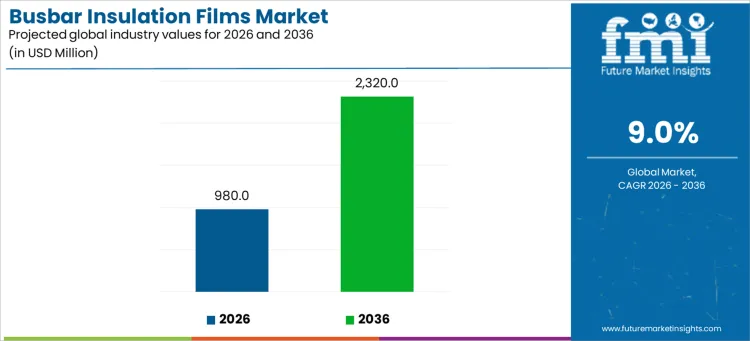
The busbar insulation films market is projected to grow from USD 980.0 million in 2026 to USD 2,320.0 million in 2036, advancing at a 9.0% CAGR over the forecast period. Growth reflects how EV battery packs and power electronics are being packaged. Busbars are designed for higher current density, tighter stacking, and smaller separation distances to reduce resistance and inductance. This turns insulation from a basic wrap into a controlled engineering layer, where thickness tolerance, dielectric stability, and defect control influence reliability, inspection yields, and long-term field performance.
High-volume programs are shifting toward roll-to-roll conversion and automated wrapping because they reduce handling damage and support repeatable takt time. Films that can be formed around sharp edges, bolt zones, and connector interfaces without cracking or lifting are being specified earlier in design freezes. As laminated busbar constructions and compact stack-ups spread, buyers judge insulation not only on dielectric strength but also on dimensional stability, abrasion resistance, and adhesion consistency when bonding layers are used.
Quick Stats for Busbar Insulation Films Market
- Busbar Insulation Films Market Value (2026): USD 980.0 million
- Busbar Insulation Films Market Forecast Value (2036): USD 2,320.0 million
- Busbar Insulation Films Market Forecast CAGR: 9.0%
- Leading Application in Busbar Insulation Films Market: EV Battery Busbars (52%)
- Key Growth Countries in Busbar Insulation Films Market: China, Germany, South Korea, UK, Japan, USA
- Key Players in Busbar Insulation Films Market: DuPont, Toray Industries, 3M, Mitsubishi Polyester Film, Coveme
Polyimide leads where thermal endurance and isolation margins are critical in compact assemblies. PET and PEN are widely used where processability, thickness consistency, and cost discipline matter. Polyolefin and other films compete where toughness and chemical resistance are prioritized. Multi-layer and composite stacks are gaining share because they let engineers tune properties, pairing robust outer surfaces with stable inner dielectrics to reduce pinhole and edge-failure risk. EV battery busbars remain the largest application, followed by inverter and power electronics busbars, while industrial busbars add steady volume.
Busbar Insulation Films Market Key Takeaways
| Metric | Value |
|---|---|
| Market Value (2026) | USD 980.0 million |
| Market Forecast Value (2036) | USD 2,320.0 million |
| Forecast CAGR 2026 to 2036 | 9.0% |
How Are Trade and Compliance Rules Rewiring Busbar Insulation Film Supply Chains?
Trade in busbar insulation films is moving away from opportunistic imports toward compliance-led, documentation-heavy sourcing. EV incentive frameworks and battery supply-chain restrictions are pushing assemblers to prefer films produced or converted within eligible regional networks, because origin claims and supplier due diligence are now procurement gatekeepers, not back-office paperwork. In Europe, battery sustainability and traceability requirements are nudging buyers toward suppliers that can provide auditable material lineage, consistent lot certification, and lifecycle documentation that follows the component through the value chain. The electric safety type-approval expectations are driving global platforms to standardize qualification methods and reduce the number of film constructions they approve across plants, which tends to concentrate trade flows into fewer, validated grades.
How Is the Market Structured Across Functional Applications?
The busbar insulation films market demonstrates clear segmentation patterns based on functional requirements and application-specific performance criteria. Primary electrical insulation applications dominate the market, reflecting the fundamental safety requirements that drive adoption across all sectors. Secondary functions including thermal management and mechanical protection represent growing segments as system designers seek to consolidate multiple protective functions within single-layer solutions.
The market structure also reveals distinct supply chain patterns, with roll stock films representing the preferred format for high-volume manufacturing operations. This preference reflects the efficiency advantages of continuous processing systems that can apply insulation materials during busbar fabrication without requiring additional handling steps. Pre-laminated busbar wraps serve specialized applications where dimensional precision is critical, while die-cut insulation parts address custom geometries in low-volume applications.
Which Polymer Type Generates the Highest Demand?

Polyimide films maintain 34.0% market share, establishing their position as the preferred material for high-performance busbar insulation applications. These advanced polymers offer exceptional thermal stability, maintaining their dielectric properties at temperatures exceeding 200°C while demonstrating excellent chemical resistance to electrolytes and cleaning solvents commonly encountered in battery systems. The molecular structure of polyimide provides inherent flame retardancy without requiring additional chemical treatments, making these films ideal for safety-critical applications where fire propagation must be prevented.
PET/PEN films capture significant market share due to their cost-effectiveness and adequate performance characteristics for moderate-temperature applications. These materials offer excellent dimensional stability and processing characteristics, making them suitable for high-volume manufacturing operations where consistent film properties are essential. Polyolefin and composite films serve specialized niches where specific property combinations are required, such as enhanced flexibility or improved chemical compatibility with particular battery chemistries.
Which Insulation Function Leads Market Adoption?
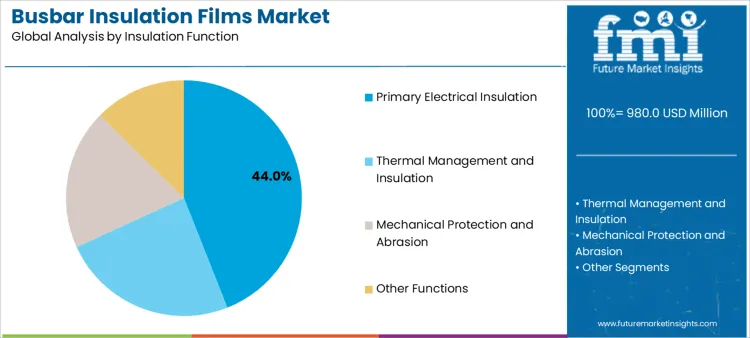
Primary electrical insulation holds 44.0% of functional applications, reflecting the core safety requirement that anchors demand across EV battery systems, power electronics, and industrial power distribution. These applications need films that sustain continuous voltage stress while maintaining dielectric strength, insulation resistance, and dimensional stability over long service life.
Selection criteria typically center on breakdown performance, resistance to partial discharge initiation, and consistency across production lots, because even minor defects can translate into localized field concentration at edges, bends, and fastener zones. The dominance of primary insulation also mirrors tighter quality-control expectations in electrified platforms, where insulation performance is validated through environmental conditioning and repeated thermal cycling to reduce the risk of short circuits, arc events, and downstream system damage.
Which Application Segment Dominates Market Growth?
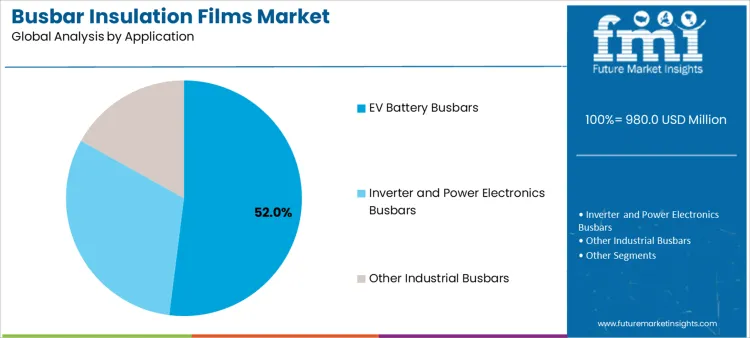
EV battery busbars represent 52.0% of market applications, reflecting the scale-up of electric vehicle production and the demanding reliability expectations placed on high-voltage battery systems. These busbars operate in tightly packed assemblies where insulation films must hold electrical integrity while facing vibration, repeated thermal cycling, and handling stresses during pack assembly and service. Performance requirements typically extend beyond basic dielectric strength to include resistance to edge damage, stable insulation resistance after environmental conditioning, and consistent thickness control to avoid localized electrical stress points.
Film selections are also influenced by pack design realities such as sharp bend radii, bolt interfaces, routing constraints, and the need to prevent abrasion against adjacent components. Because a single defect can escalate into a system-level failure, automotive qualification tends to emphasize repeatability, defect containment, and robust process control across high-volume production runs.
Which Supply Form Leads Manufacturing Preference?
Roll stock films maintain 46.0% of supply preferences, reflecting the productivity and quality-control advantages of continuous processing in high-volume busbar manufacturing. This format supports automated lamination and wrapping lines that apply insulation with consistent tension, overlap, and positioning, which helps reduce wrinkles, edge lift, and placement drift that can lead to rework. Roll-based supply also enables tighter control of thickness uniformity across long runs, which matters when insulation performance is sensitive to small variations around bends, fastener zones, and conductor edges.
From an operations perspective, roll stock simplifies logistics through standardized widths and longer changeover intervals, while allowing converters to slit, coat, or surface-treat films to match specific assembly requirements. It typically reduces scrap compared with pre-cut alternatives because manufacturers can optimize nesting and cut patterns downstream and adjust usage based on real-time line conditions rather than committing to fixed part shapes upfront.
How Is Automotive Electrification Driving Innovation?
The automotive industry's transition toward electrification is creating unprecedented demand for high-performance busbar insulation films while simultaneously imposing stringent cost and weight constraints. Electric vehicle manufacturers are implementing voltage levels that significantly exceed traditional automotive standards, requiring insulation materials with enhanced dielectric strength and improved corona resistance. Packaging constraints around EV power modules raise sensitivity to clearance, edge protection, and thermal cycling performance. This evolution is compelling film manufacturers to develop new polymer formulations that can maintain their electrical properties under sustained high-voltage stress while demonstrating the durability required for automotive service life expectations.
The integration of thermal management functions within insulation films is becoming essential as battery systems operate at higher power densities. Some pack layouts rely on cold plates near conductors to stabilize temperatures under peak load. Modern EVs require insulation materials that can facilitate heat dissipation from busbars while maintaining electrical isolation, creating demand for specialized composite films incorporating thermally conductive fillers. This multifunctional approach enables more compact battery designs while ensuring safe operation under extreme thermal conditions.
What Challenges Limit Widespread Adoption?
The primary constraint affecting busbar insulation films market expansion is the cost sensitivity of high-volume manufacturing applications, particularly in price-competitive consumer electronics and automotive sectors. While advanced polyimide films offer superior performance characteristics, their higher material costs can impact adoption in applications where alternative insulation methods might provide adequate performance at lower cost. This price pressure is driving innovation toward cost-optimized formulations that maintain essential performance characteristics while reducing raw material expenses.
Technical challenges related to processing and application consistency also limit market growth in certain sectors. The requirement for precise thickness control and uniform adhesive coverage becomes critical in high-voltage applications where local variations in insulation properties could create failure points. Manufacturers must invest in sophisticated quality control systems to ensure consistent film properties, adding complexity to production operations and potentially limiting adoption among smaller equipment manufacturers.
How Do Regulatory Standards Create Market Opportunities?
Evolving safety regulations for electrical equipment are creating significant growth opportunities within the busbar insulation films market as manufacturers seek to ensure compliance with increasingly stringent requirements. International standards for electric vehicle safety are establishing minimum performance criteria for insulation materials, effectively mandating the use of certified films in critical applications. This regulatory environment is beneficial for specialized film manufacturers who invest in testing and certification capabilities to demonstrate compliance with relevant standards.
The implementation of environmental regulations restricting the use of certain chemical substances is also creating opportunities for manufacturers offering alternative formulations. Films that eliminate halogenated flame retardants or reduce volatile organic compound emissions are gaining preference as equipment manufacturers seek to meet environmental compliance requirements. This regulatory trend is driving innovation toward bio-based and environmentally sustainable insulation materials that maintain necessary performance characteristics.
How Is the Busbar Insulation Films Market Expected to Evolve Across Major Nations?
The global landscape for busbar insulation films is experiencing rapid transformation as nations implement electrification initiatives and renewable energy programs that require advanced electrical insulation solutions. Developed economies are leading adoption of high-performance films to meet stringent safety standards, while emerging markets are scaling production capabilities to serve growing domestic demand and export opportunities. Regional variations in market growth reflect differences in automotive electrification rates, renewable energy deployment, and manufacturing investment patterns across different economic zones.
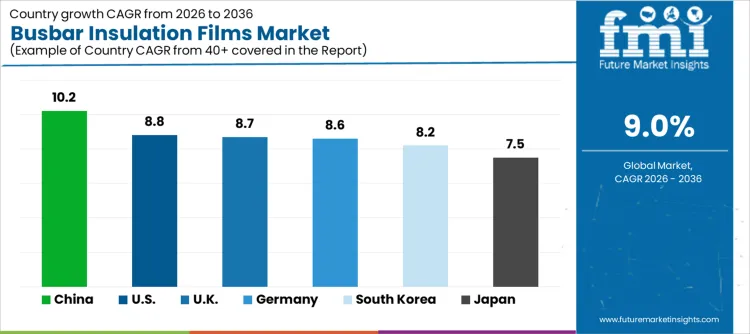
| Country | CAGR (%) |
|---|---|
| China | 10.2% |
| Germany | 8.6% |
| UK | 8.7% |
| USA | 8.8% |
| Japan | 7.5% |
| South Korea | 8.2% |
What Factors Drive China's Market Leadership?
China's busbar insulation films market is projected to achieve the highest growth rate at 10.2% CAGR, driven primarily by the country's dominant position in global electric vehicle production and battery manufacturing. The Chinese government's aggressive electrification targets and substantial investments in EV infrastructure are creating massive demand for high-performance insulation materials across automotive and energy storage applications. Local manufacturers are rapidly scaling production capabilities while investing in advanced polymer technologies to serve both domestic consumption and export markets.
The concentration of battery gigafactories in China is creating a substantial market for specialized insulation films designed for high-energy-density applications. Chinese manufacturers are developing cost-effective alternatives to traditional polyimide films while maintaining necessary performance characteristics for automotive applications. This innovation focus, combined with significant production scale advantages, positions China as a key global supplier of busbar insulation films for multiple industries.
How Is Germany's Engineering Excellence Shaping Market Development?
Germany's busbar insulation films market growth of 8.6% CAGR reflects the country's leadership in automotive engineering and advanced manufacturing technologies. German automotive manufacturers are implementing cutting-edge electrical architectures that require sophisticated insulation solutions, driving demand for films with exceptional reliability and performance characteristics. The emphasis on premium vehicle segments creates opportunities for high-value insulation materials that demonstrate superior long-term durability.
The country's strong industrial automation sector also contributes to market growth as manufacturers seek advanced insulation solutions for high-power electrical systems. German engineering standards typically exceed international minimums, creating demand for specialized films that can meet rigorous performance criteria. This quality-focused approach supports premium pricing for advanced materials while encouraging continuous innovation in film technology.
Why Is the USA Market Emphasizing Domestic Production?
The United States market is experiencing 8.8% CAGR growth, supported by significant investments in domestic battery production and electric vehicle manufacturing capabilities. Federal initiatives promoting domestic supply chain development are creating opportunities for film manufacturers to establish local production facilities serving automotive and energy storage sectors. This trend toward supply chain localization is driving investment in advanced manufacturing technologies while creating demand for materials that meet stringent automotive qualification requirements.
The integration of renewable energy systems with grid-scale storage is also contributing to market growth as utilities require reliable insulation materials for high-voltage applications. American manufacturers are focusing on developing films that can withstand extreme environmental conditions while maintaining consistent electrical properties throughout extended service life. This emphasis on durability and reliability supports premium market positioning for specialized insulation materials.
How Are Advanced Materials Driving Japanese Innovation?
Japan's market growth of 7.5% CAGR is supported by the country's expertise in advanced materials science and precision manufacturing technologies. Japanese manufacturers are developing next-generation insulation films incorporating nanotechnology and molecular engineering to achieve superior performance characteristics in ultra-thin configurations. This innovation focus addresses the increasing miniaturization requirements of electronic systems while maintaining necessary safety margins.
The country's leadership in hybrid and electric vehicle technologies creates demand for specialized insulation materials that can operate reliably under unique thermal and electrical stress conditions. Japanese quality standards emphasize long-term reliability and consistent performance, driving development of films with enhanced aging characteristics and improved resistance to environmental degradation.
What Opportunities Exist in South Korea's Technology Sector?
South Korea's 8.2% CAGR growth is driven by the country's strong position in battery technology and consumer electronics manufacturing. Korean companies are investing heavily in next-generation battery chemistries that require advanced insulation materials with enhanced chemical compatibility and thermal stability. This technological advancement creates opportunities for specialized films designed to support emerging battery technologies including solid-state and lithium-metal systems.
The country's leadership in memory and semiconductor manufacturing also contributes to market demand as manufacturers require precise insulation materials for high-frequency applications. Korean engineering standards emphasize miniaturization and high-density integration, driving development of ultra-thin films with exceptional dielectric properties and dimensional stability.
What Does Helping Suppliers Defend Share in Busbar Insulation Films?
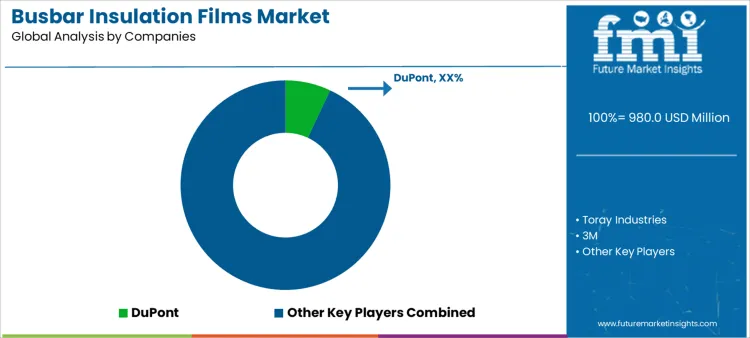
Suppliers are holding position in busbar insulation films less by offering a long list of products and more by proving that their materials run cleanly in real production. As a result, development work is shifting toward film constructions that reduce build complexity, combining electrical isolation with abrasion resistance or controlled thermal behavior so busbar converters can cut layers, shorten process steps, and stabilize yields. Programs are also being won earlier in the cycle. Manufacturers that stay close to automotive OEMs, battery pack teams, and tier busbar fabricators can shape the specification, align on test methods, and demonstrate manufacturability before designs are locked, which makes later switching difficult.
Buying teams are adding more screening around lot traceability, scrap reduction, and end-of-life compatibility, but only if electrical and mechanical performance remains intact. That pressure is pushing suppliers to tighten resin and film process control, improve conversion efficiency, and reduce defects through disciplined quality systems rather than experimenting with high-variance material changes. Footprint decisions are part of the same playbook. Companies are expanding regional production and application engineering support so they can shorten lead times, reduce logistics exposure, and respond quickly when customers need fast troubleshooting, validation support, or a controlled change to meet a new platform requirement.
Key Players in the Busbar Insulation Films Market
- DuPont
- Toray Industries
- 3M
- Mitsubishi Polyester Film
- Coveme
- SABIC (insulation films)
- Saint-Gobain Performance Plastics
- Nitto Denko
- Krempel
- Ahlstrom
Scope of Report
| Items | Values |
|---|---|
| Quantitative Units | USD Million |
| Polymer Type Segments | Polyimide Films; PET/PEN Films; Polyolefin and Other Films; Multi-Layer/Composite Films |
| Insulation Function Types | Primary Electrical Insulation; Thermal Management and Insulation; Mechanical Protection and Abrasion; Other Functions |
| Application Types | EV Battery Busbars; Inverter and Power Electronics Busbars; Other Industrial Busbars |
| Supply Form Types | Roll Stock Films; Pre-Laminated Busbar Wraps; Die-Cut Insulation Parts |
| Regions Covered | North America, Europe, Asia Pacific, Latin America, Middle East & Africa |
| Key Countries | USA, Germany, China, Japan, Brazil, South Korea |
| Key Companies Profiled | DuPont, Toray Industries, 3M, Mitsubishi Polyester Film, Coveme, and others |
| Additional Attributes | Dollar sales measured for busbar insulation films used on EV battery, inverter, and industrial busbars, specified by dielectric strength, insulation resistance, thickness tolerance, thermal class, partial discharge resistance, abrasion durability, chemical compatibility, adhesion performance, and compliance documentation. |
Busbar Insulation Films Market by Segment
By Polymer Type
- Polyimide Films
- PET/PEN Films
- Polyolefin and Other Films
- Multi-Layer/Composite Films
By Insulation Function
- Primary Electrical Insulation
- Thermal Management and Insulation
- Mechanical Protection and Abrasion
- Other Functions
By Application
- EV Battery Busbars
- Inverter and Power Electronics Busbars
- Other Industrial Busbars
By Supply Form
- Roll Stock Films
- Pre-Laminated Busbar Wraps
- Die-Cut Insulation Parts
Bibliography
- International Electrotechnical Commission. (2024). ;IEC 61800‑5‑1: Adjustable speed electrical power drive systems-Safety requirements-Electrical, thermal and energy (3rd ed.). Geneva, Switzerland: International Electrotechnical Commission.
- SAE International. (2024). SAE J2929: Electric and hybrid vehicle propulsion battery system safety (Revised ed.). Warrendale, PA, United States: SAE International.
- National Renewable Energy Laboratory. (2024). Electrical insulation reliability considerations for high‑voltage electric vehicle power electronics. Golden, CO, United States: USA Department of Energy.
Frequently Asked Questions
How big is the busbar insulation films market in 2026?
The global busbar insulation films market is estimated to be valued at USD 980.0 million in 2026.
What will be the size of busbar insulation films market in 2036?
The market size for the busbar insulation films market is projected to reach USD 2,320.0 million by 2036.
How much will be the busbar insulation films market growth between 2026 and 2036?
The busbar insulation films market is expected to grow at a 9.0% CAGR between 2026 and 2036.
What are the key product types in the busbar insulation films market?
The key product types in busbar insulation films market are polyimide films, pet/pen films, polyolefin and other films and multi-layer/composite films.
Which insulation function segment to contribute significant share in the busbar insulation films market in 2026?
In terms of insulation function, primary electrical insulation segment to command 44.0% share in the busbar insulation films market in 2026.
Preview the report firsthand - request a free sample
Get SampleGet the brochure for pricing and purchase details.
Get PDFTable of Content
- Executive Summary
- Global Market Outlook
- Demand-side Trends
- Supply-side Trends
- Technology Roadmap Analysis
- Analysis and Recommendations
- Market Overview
- Market Coverage / Taxonomy
- Market Definition / Scope / Limitations
- Market Background
- Market Dynamics
- Drivers
- Restraints
- Opportunity
- Trends
- Scenario Forecast
- Demand in Optimistic Scenario
- Demand in Likely Scenario
- Demand in Conservative Scenario
- Opportunity Map Analysis
- Product Life Cycle Analysis
- Supply Chain Analysis
- Investment Feasibility Matrix
- Value Chain Analysis
- PESTLE and Porter’s Analysis
- Regulatory Landscape
- Regional Parent Market Outlook
- Production and Consumption Statistics
- Import and Export Statistics
- Market Dynamics
- Global Market Analysis 2021 to 2025 and Forecast, 2026 to 2036
- Historical Market Size Value (USD Million) Analysis, 2021 to 2025
- Current and Future Market Size Value (USD Million) Projections, 2026 to 2036
- Y-o-Y Growth Trend Analysis
- Absolute $ Opportunity Analysis
- Global Market Pricing Analysis 2021 to 2025 and Forecast 2026 to 2036
- Global Market Analysis 2021 to 2025 and Forecast 2026 to 2036, By Polymer Type
- Introduction / Key Findings
- Historical Market Size Value (USD Million) Analysis By Polymer Type , 2021 to 2025
- Current and Future Market Size Value (USD Million) Analysis and Forecast By Polymer Type , 2026 to 2036
- Polyimide Films
- PET/PEN Films
- Polyolefin and Other Films
- Multi-Layer/Composite Films
- Polyimide Films
- Y-o-Y Growth Trend Analysis By Polymer Type , 2021 to 2025
- Absolute $ Opportunity Analysis By Polymer Type , 2026 to 2036
- Global Market Analysis 2021 to 2025 and Forecast 2026 to 2036, By Insulation Function
- Introduction / Key Findings
- Historical Market Size Value (USD Million) Analysis By Insulation Function, 2021 to 2025
- Current and Future Market Size Value (USD Million) Analysis and Forecast By Insulation Function, 2026 to 2036
- Primary Electrical Insulation
- Thermal Management and Insulation
- Mechanical Protection and Abrasion
- Other Functions
- Primary Electrical Insulation
- Y-o-Y Growth Trend Analysis By Insulation Function, 2021 to 2025
- Absolute $ Opportunity Analysis By Insulation Function, 2026 to 2036
- Global Market Analysis 2021 to 2025 and Forecast 2026 to 2036, By Application
- Introduction / Key Findings
- Historical Market Size Value (USD Million) Analysis By Application, 2021 to 2025
- Current and Future Market Size Value (USD Million) Analysis and Forecast By Application, 2026 to 2036
- EV Battery Busbars
- Inverter and Power Electronics Busbars
- Other Industrial Busbars
- EV Battery Busbars
- Y-o-Y Growth Trend Analysis By Application, 2021 to 2025
- Absolute $ Opportunity Analysis By Application, 2026 to 2036
- Global Market Analysis 2021 to 2025 and Forecast 2026 to 2036, By Supply Form
- Introduction / Key Findings
- Historical Market Size Value (USD Million) Analysis By Supply Form, 2021 to 2025
- Current and Future Market Size Value (USD Million) Analysis and Forecast By Supply Form, 2026 to 2036
- Roll Stock Films
- Pre-Laminated Busbar Wraps
- Die-Cut Insulation Parts
- Roll Stock Films
- Y-o-Y Growth Trend Analysis By Supply Form, 2021 to 2025
- Absolute $ Opportunity Analysis By Supply Form, 2026 to 2036
- Global Market Analysis 2021 to 2025 and Forecast 2026 to 2036, By Region
- Introduction
- Historical Market Size Value (USD Million) Analysis By Region, 2021 to 2025
- Current Market Size Value (USD Million) Analysis and Forecast By Region, 2026 to 2036
- North America
- Latin America
- Western Europe
- Eastern Europe
- East Asia
- South Asia and Pacific
- Middle East & Africa
- Market Attractiveness Analysis By Region
- North America Market Analysis 2021 to 2025 and Forecast 2026 to 2036, By Country
- Historical Market Size Value (USD Million) Trend Analysis By Market Taxonomy, 2021 to 2025
- Market Size Value (USD Million) Forecast By Market Taxonomy, 2026 to 2036
- By Country
- USA
- Canada
- Mexico
- By Polymer Type
- By Insulation Function
- By Application
- By Supply Form
- By Country
- Market Attractiveness Analysis
- By Country
- By Polymer Type
- By Insulation Function
- By Application
- By Supply Form
- Key Takeaways
- Latin America Market Analysis 2021 to 2025 and Forecast 2026 to 2036, By Country
- Historical Market Size Value (USD Million) Trend Analysis By Market Taxonomy, 2021 to 2025
- Market Size Value (USD Million) Forecast By Market Taxonomy, 2026 to 2036
- By Country
- Brazil
- Chile
- Rest of Latin America
- By Polymer Type
- By Insulation Function
- By Application
- By Supply Form
- By Country
- Market Attractiveness Analysis
- By Country
- By Polymer Type
- By Insulation Function
- By Application
- By Supply Form
- Key Takeaways
- Western Europe Market Analysis 2021 to 2025 and Forecast 2026 to 2036, By Country
- Historical Market Size Value (USD Million) Trend Analysis By Market Taxonomy, 2021 to 2025
- Market Size Value (USD Million) Forecast By Market Taxonomy, 2026 to 2036
- By Country
- Germany
- UK
- Italy
- Spain
- France
- Nordic
- BENELUX
- Rest of Western Europe
- By Polymer Type
- By Insulation Function
- By Application
- By Supply Form
- By Country
- Market Attractiveness Analysis
- By Country
- By Polymer Type
- By Insulation Function
- By Application
- By Supply Form
- Key Takeaways
- Eastern Europe Market Analysis 2021 to 2025 and Forecast 2026 to 2036, By Country
- Historical Market Size Value (USD Million) Trend Analysis By Market Taxonomy, 2021 to 2025
- Market Size Value (USD Million) Forecast By Market Taxonomy, 2026 to 2036
- By Country
- Russia
- Poland
- Hungary
- Balkan & Baltic
- Rest of Eastern Europe
- By Polymer Type
- By Insulation Function
- By Application
- By Supply Form
- By Country
- Market Attractiveness Analysis
- By Country
- By Polymer Type
- By Insulation Function
- By Application
- By Supply Form
- Key Takeaways
- East Asia Market Analysis 2021 to 2025 and Forecast 2026 to 2036, By Country
- Historical Market Size Value (USD Million) Trend Analysis By Market Taxonomy, 2021 to 2025
- Market Size Value (USD Million) Forecast By Market Taxonomy, 2026 to 2036
- By Country
- China
- Japan
- South Korea
- By Polymer Type
- By Insulation Function
- By Application
- By Supply Form
- By Country
- Market Attractiveness Analysis
- By Country
- By Polymer Type
- By Insulation Function
- By Application
- By Supply Form
- Key Takeaways
- South Asia and Pacific Market Analysis 2021 to 2025 and Forecast 2026 to 2036, By Country
- Historical Market Size Value (USD Million) Trend Analysis By Market Taxonomy, 2021 to 2025
- Market Size Value (USD Million) Forecast By Market Taxonomy, 2026 to 2036
- By Country
- India
- ASEAN
- Australia & New Zealand
- Rest of South Asia and Pacific
- By Polymer Type
- By Insulation Function
- By Application
- By Supply Form
- By Country
- Market Attractiveness Analysis
- By Country
- By Polymer Type
- By Insulation Function
- By Application
- By Supply Form
- Key Takeaways
- Middle East & Africa Market Analysis 2021 to 2025 and Forecast 2026 to 2036, By Country
- Historical Market Size Value (USD Million) Trend Analysis By Market Taxonomy, 2021 to 2025
- Market Size Value (USD Million) Forecast By Market Taxonomy, 2026 to 2036
- By Country
- Kingdom of Saudi Arabia
- Other GCC Countries
- Turkiye
- South Africa
- Other African Union
- Rest of Middle East & Africa
- By Polymer Type
- By Insulation Function
- By Application
- By Supply Form
- By Country
- Market Attractiveness Analysis
- By Country
- By Polymer Type
- By Insulation Function
- By Application
- By Supply Form
- Key Takeaways
- Key Countries Market Analysis
- USA
- Pricing Analysis
- Market Share Analysis, 2025
- By Polymer Type
- By Insulation Function
- By Application
- By Supply Form
- Canada
- Pricing Analysis
- Market Share Analysis, 2025
- By Polymer Type
- By Insulation Function
- By Application
- By Supply Form
- Mexico
- Pricing Analysis
- Market Share Analysis, 2025
- By Polymer Type
- By Insulation Function
- By Application
- By Supply Form
- Brazil
- Pricing Analysis
- Market Share Analysis, 2025
- By Polymer Type
- By Insulation Function
- By Application
- By Supply Form
- Chile
- Pricing Analysis
- Market Share Analysis, 2025
- By Polymer Type
- By Insulation Function
- By Application
- By Supply Form
- Germany
- Pricing Analysis
- Market Share Analysis, 2025
- By Polymer Type
- By Insulation Function
- By Application
- By Supply Form
- UK
- Pricing Analysis
- Market Share Analysis, 2025
- By Polymer Type
- By Insulation Function
- By Application
- By Supply Form
- Italy
- Pricing Analysis
- Market Share Analysis, 2025
- By Polymer Type
- By Insulation Function
- By Application
- By Supply Form
- Spain
- Pricing Analysis
- Market Share Analysis, 2025
- By Polymer Type
- By Insulation Function
- By Application
- By Supply Form
- France
- Pricing Analysis
- Market Share Analysis, 2025
- By Polymer Type
- By Insulation Function
- By Application
- By Supply Form
- India
- Pricing Analysis
- Market Share Analysis, 2025
- By Polymer Type
- By Insulation Function
- By Application
- By Supply Form
- ASEAN
- Pricing Analysis
- Market Share Analysis, 2025
- By Polymer Type
- By Insulation Function
- By Application
- By Supply Form
- Australia & New Zealand
- Pricing Analysis
- Market Share Analysis, 2025
- By Polymer Type
- By Insulation Function
- By Application
- By Supply Form
- China
- Pricing Analysis
- Market Share Analysis, 2025
- By Polymer Type
- By Insulation Function
- By Application
- By Supply Form
- Japan
- Pricing Analysis
- Market Share Analysis, 2025
- By Polymer Type
- By Insulation Function
- By Application
- By Supply Form
- South Korea
- Pricing Analysis
- Market Share Analysis, 2025
- By Polymer Type
- By Insulation Function
- By Application
- By Supply Form
- Russia
- Pricing Analysis
- Market Share Analysis, 2025
- By Polymer Type
- By Insulation Function
- By Application
- By Supply Form
- Poland
- Pricing Analysis
- Market Share Analysis, 2025
- By Polymer Type
- By Insulation Function
- By Application
- By Supply Form
- Hungary
- Pricing Analysis
- Market Share Analysis, 2025
- By Polymer Type
- By Insulation Function
- By Application
- By Supply Form
- Kingdom of Saudi Arabia
- Pricing Analysis
- Market Share Analysis, 2025
- By Polymer Type
- By Insulation Function
- By Application
- By Supply Form
- Turkiye
- Pricing Analysis
- Market Share Analysis, 2025
- By Polymer Type
- By Insulation Function
- By Application
- By Supply Form
- South Africa
- Pricing Analysis
- Market Share Analysis, 2025
- By Polymer Type
- By Insulation Function
- By Application
- By Supply Form
- USA
- Market Structure Analysis
- Competition Dashboard
- Competition Benchmarking
- Market Share Analysis of Top Players
- By Regional
- By Polymer Type
- By Insulation Function
- By Application
- By Supply Form
- Competition Analysis
- Competition Deep Dive
- DuPont
- Overview
- Product Portfolio
- Profitability by Market Segments (Product/Age /Sales Channel/Region)
- Sales Footprint
- Strategy Overview
- Marketing Strategy
- Product Strategy
- Channel Strategy
- Toray Industries
- 3M
- Mitsubishi Polyester Film
- Coveme
- SABIC (insulation films)
- Saint-Gobain Performance Plastics
- Nitto Denko
- Krempel
- Ahlstrom
- DuPont
- Competition Deep Dive
- Assumptions & Acronyms Used
- Research Methodology


