

- Industry Size (2026)
- USD 1.7 Bn
- Forecast (2036)
- USD 4.3 Bn
- CAGR (2026 to 2036)
- 9.7%
Busbar Insulation & Thermal Management Materials Market Outlook and Forecast 2026 to 2036
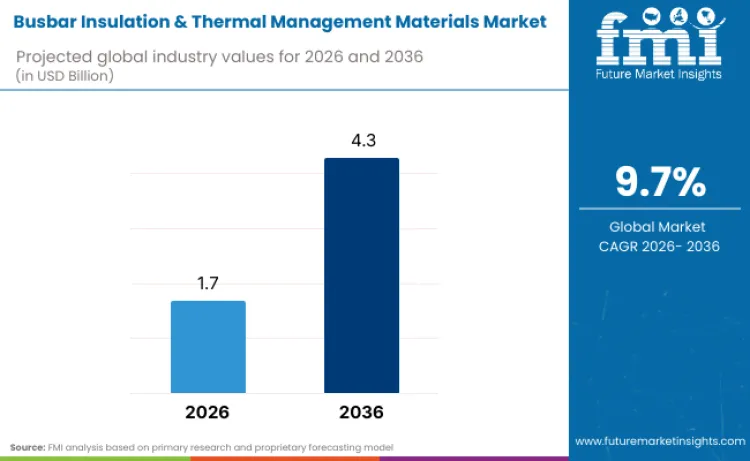
The global busbar insulation & thermal management materials market is slated to total USD 1.7 billion in 2026, and expected to increase further to USD 4.3 billion in 2036 at a 9.7% CAGR. As per FMI’s forecast, Industry leaders are currently scaling infrastructure and materials to meet the rigorous thermal and electrical requirements of next-generation power distribution.
Summary of Busbar Insulation & Thermal Management Materials Market
- Market Snapshot
- The Busbar Insulation & Thermal Management Materials Market is estimated at USD 1.7 billion in 2026.
- The Busbar Insulation & Thermal Management Materials Market is projected to reach USD 4.3 billion by 2036 at a CAGR of 9.7%.
- The market growth reflects increasing material demand driven by electrification across EVs, data centers, and grid infrastructure.
- Demand and Growth Drivers
- Rising adoption of 800V+ EV architectures is increasing demand for high-performance insulation and thermal materials.
- Data center electricity consumption is expected to reach 1,050 TWh by 2026, driving advanced thermal management adoption.
- Europe requires €584 billion in grid investments by 2030, increasing demand for high-voltage insulation materials.
- Product and Segment View
- Polyimide and high-temperature films hold a 33% share due to superior thermal and dielectric performance.
- Primary electrical insulation accounts for 36% share as the core safety function in high-voltage systems.
- EV battery busbars dominate with a 52% share driven by rising battery demand and electrification.
- Geography and Competitive Outlook
- The United States leads with a CAGR of 10.9%, followed by the UK at 9.9% and Germany at 9.8%.
- South Korea is projected to grow at a CAGR of 9.4% driven by advanced battery technologies.
- Key players include DuPont, Toray Industries, 3M, Saint-Gobain, Nitto Denko, and Sumitomo Electric focusing on high-performance materials and PFAS-free solutions.
In the data center sector, the expansion of high-density AI workloads has necessitated the development of specialized hardware, such as TE Connectivity’s BB1000 PSU output power connector, which is engineered for the 1000A+ requirements of the Open Rack v3 architecture. These systems utilize laminated busbar assemblies and advanced insulation to manage increasing heat loads while maintaining compact footprints in liquid-cooled environments.
The automotive sector’s transition toward x-in-1 integrated powertrains has shifted material demands toward high-performance potting and bonding agents. Henkel recently expanded its portfolio with the launch of Loctite SI 5643 and SI 5637, two-component silicone potting compounds designed specifically for thermal transfer in EV on-board chargers and inverters. Similarly, DuPont has advanced its BETAMATE 2090 technology to facilitate lower-temperature curing during battery pack assembly, enhancing both structural integrity and thermal management efficiency.
To support this surge in demand, manufacturers are making substantial capital investments in production capacity. Mersen inaugurated a new European facility in April 2025 and committed an additional USD 20 million in February 2025 to scale its laminated busbar output for the renewable energy and electric vehicle markets. Luc Themelin, CEO of Mersen, confirmed this long-term trajectory during the company's fiscal reporting, stating:
"2025 was a year that clearly demonstrated the resilience of our portfolio. We are following a roadmap built on attractive end markets, specifically targeting the expansion of our production capacity in laminated busbars to meet the long-term demand in the energy storage and electric vehicle sectors." - Luc Themelin, CEO of Mersen, as recorded in the Q4 2025 Earnings Call Transcript.
In the corporate landscape, Rogers Corporation continues to position its ROLINX busbar and curamik cooling solutions as primary growth drivers for high-power semiconductor applications, particularly those utilizing SiC technology. These developments, ranging from Siemens’ new laminated busbar lines for renewable grids to Molex’s high-density solutions for data centers, underscore a strategic focus on materials that offer low stray inductance and superior heat dissipation.
Summary of the Busbar Insulation & Thermal Management Materials Market
What is the Growth Outlook for the Busbar Insulation & Thermal Management Materials Market as per Future Market Insights?
Future Market Insights projects the busbar insulation & thermal management materials market to expand at a CAGR of 9.7% from 2026 to 2036, increasing from USD 1.7 billion in 2026 to USD 4.3 billion by 2036. Growth is being driven by rising power densities across electric vehicles, renewable energy infrastructure, and data centers, where laminated busbars and advanced insulation materials are increasingly replacing conventional cabling solutions.
FMI Research Approach: FMI proprietary forecasting model based on power electronics penetration, electrification intensity, and insulation material adoption across high-voltage systems.
How do FMI Analysts Interpret the Evolution of the Busbar Insulation & Thermal Management Materials Market?
FMI analysts interpret the market as transitioning from conventional electrical insulation toward integrated thermal-electrical material systems. Busbar insulation materials are no longer specified solely for dielectric separation but are increasingly engineered to manage heat, vibration, and electromagnetic interference in compact, high-current environments. This shift is particularly visible in EV powertrains, AI-driven data centers, and grid-scale renewable installations.
FMI Research Approach: Analysis of power density trends, OEM design shifts, and material qualification requirements in high-voltage applications.
Which Regions and Countries Are Driving Demand for Busbar Insulation & Thermal Management Materials?
Demand is being driven by North America, Western Europe, and East Asia, reflecting large-scale investment in EV manufacturing, grid modernization, and data center expansion. The United States is benefiting from localized battery and energy storage production, while Germany and the UK are accelerating adoption through grid reinforcement and electrified mobility policies. South Korea is emerging as a technology-driven market due to advanced battery safety architectures and high-voltage system integration.
FMI Research Approach: Country-level electrification analysis, infrastructure investment tracking, and industrial power distribution assessment.
How large is the Busbar Insulation & Thermal Management Materials Market Expected to Be by 2036?
By 2036, the global busbar insulation & thermal management materials market is expected to reach USD 4.3 billion, supported by increasing use of laminated busbars in EV battery packs, power electronics, renewable energy substations, and high-density data center architectures. The expansion reflects higher material intensity per system as operating voltages and thermal loads continue to rise.
FMI Research Approach: Long-term revenue modeling linked to busbar deployment rates, insulation thickness requirements, and end-use electrification depth.
What defines the Busbar Insulation & Thermal Management Materials Market?
The busbar insulation & thermal management materials market comprises films, coatings, potting compounds, and composite insulation systems used to electrically isolate and thermally regulate busbars in high-current power distribution systems. These materials are designed to provide dielectric protection, heat dissipation, mechanical stability, and long-term reliability under high-voltage and high-temperature operating conditions.
FMI Research Approach: FMI market taxonomy and inclusion-exclusion framework.
What are the Key Global Trends Shaping the Busbar Insulation & Thermal Management Materials Market?
Key global trends include the shift toward 800V and higher-voltage EV architectures, rising adoption of laminated busbars in AI data centers, and large-scale grid modernization programs supporting renewable energy integration. Regulatory pressure around PFAS disclosure and material traceability is accelerating the transition toward fluorine-free insulation solutions, while lightweighting and modularity are reshaping material selection in automotive and power electronics applications.
FMI Research Approach: Regulatory analysis, infrastructure investment tracking, and material innovation assessment.
Busbar Insulation & Thermal Management Materials Market Key Takeaways
| Metric | Value |
|---|---|
| Expected Value (2026E) | USD 1.7 billion |
| Projected Value (2036F) | USD 4.3 billion |
| CAGR (2026-2036) | 9.7% |
Source: Future Market Insights (FMI) analysis, based on proprietary forecasting model and primary research
Why is the Busbar Insulation & Thermal Management Materials Market Growing?
Deep-seated shifts in global energy infrastructure, the standardization of high-voltage automotive platforms, and the massive cooling requirements of artificial intelligence infrastructure are expanding the market for busbar insulation and thermal management materials.
National utilities are executing large-scale grid reinforcements to accommodate renewable energy and rising electrification. The European Commission identifies that 40% of Europe’s distribution grids are over 40 years old, necessitating €584 billion in investments through 2030. According to the USA Energy Information Administration (EIA), global electricity demand is projected to increase by approximately 4% in 2025, spurred by economic expansion and the proliferation of energy-intensive technologies. High-voltage busbars are replacing traditional cabling in these projects because their larger surface-area-to-volume ratio facilitates superior heat dissipation, allowing for higher current-carrying capacity without exceeding safe temperature limits in substations and renewable energy hubs.
The automotive industry is moving toward 800V electrical architectures to enable ultra-fast charging and improve powertrain efficiency. This transition, led by manufacturers like Hyundai, Porsche, and BYD, significantly intensifies the requirements for electrical insulation and thermal regulation.
Operating at these higher voltages reduces current levels and conductor mass but requires materials that can withstand stricter creepage, clearance, and arc prevention standards. Technical disclosures from the Faist Group in January 2026 indicate that 800V systems must operate reliably across ranges up to 900V and beyond, making specialized insulation strategies a system-level performance driver.
The rapid deployment of generative AI and high-performance computing is driving a surge in data center power density. The US Department of Energy’s FY 2026 Budget Request highlights research into managing large dynamic loads from data centers, noting these facilities are fundamentally changing grid dynamics. The IEA projects that data center electricity consumption will reach approximately 1,050 TWh by 2026. This scale-up forces the adoption of advanced thermal interface materials and laminated busbar systems that offer low stray inductance and high energy efficiency to manage the intense heat generated within server racks.
How is the Busbar Insulation & Thermal Management Materials Landscape Segmented?
Performance functions, material types, and end-use applications categorize the market for busbar insulation and thermal management materials. The material class is led by polyimide & high-temperature films (33%), followed by polyesters, elastomers, and ceramic/mica-based solutions. under function, primary electrical insulation commands the largest share at 36%, alongside thermal management and mechanical protection. The end use landscape is dominated by EV battery busbars at 52%, with the remaining share split between Power Electronics and Industrial applications.
Why do Polyimide and High-Temperature Films lead the material segment?
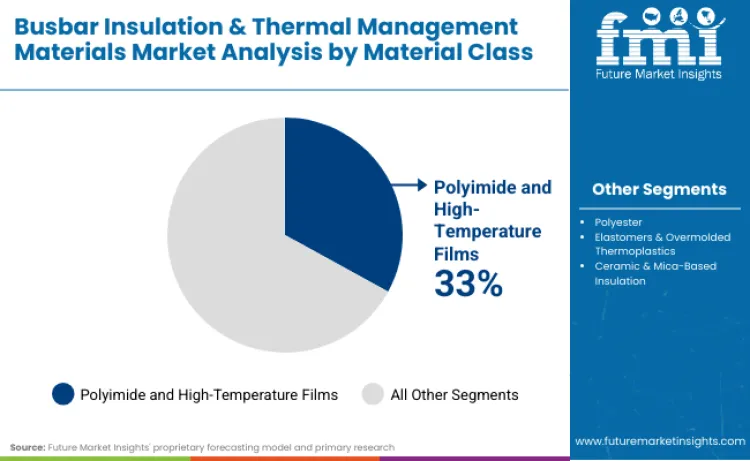
Polyimide and high-temperature films have secured a 33% market share due to their unmatched thermal stability and dielectric strength in space-constrained environments. As electronic components and power modules undergo extreme miniaturization, manufacturers require insulation that maintains its integrity at temperatures exceeding 250°C. The National Renewable Energy Laboratory (NREL) notes that research into high-temperature packaging is critical for wide-bandgap (WBG) devices, which must operate reliably up to 250°C near lower-temperature-rated components like electrical boards and capacitors.
This dominance is further reinforced by the shifting global manufacturing landscape. Reports from UN Trade and Development (UNCTAD) in January 2026 highlight that electronic components power over USD 35 trillion in global trade, with Asia serving as the primary hub producing 80% of these goods. As high-speed and high-density integrated components become mainstream for AI and edge computing, the requirement for low-coefficient-of-thermal-expansion (CTE) films has become a mandatory performance standard, ensuring polyimide remains the baseline material for mission-critical power distribution.
How does Primary Electrical Insulation maintain its functional dominance?
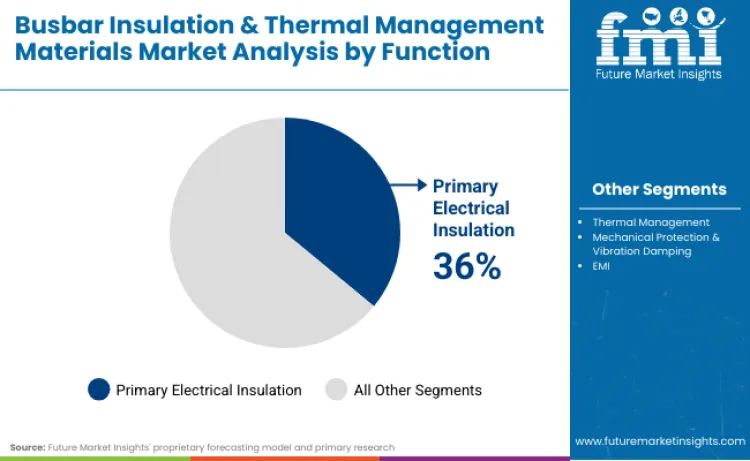
Primary electrical insulation remains the core functional requirement, capturing 36% of the market because it is the fundamental safety barrier in all high-voltage architectures. Without robust dielectric separation, the reliability of the entire power distribution system is compromised, especially in applications like data centers and renewable energy hubs where uptime is critical. The USA Department of Energy (DOE) Fiscal Year 2026 budget request identifies the management of large dynamic loads as a primary challenge, necessitating high-dielectric materials that can handle rapid current fluctuations without dielectric breakdown.
The expansion of this segment is also a direct result of the global modernization of aging electrical grids. The IEEE Power & Energy Society (PES), in its 2026 technical meetings, identifies that as utilities face rapid electrification and increasing grid complexity, resilience through advanced insulation is no longer an option but a necessity. Global energy trends show that electricity demand is set to grow at its fastest rate in years through 2026, forcing a systemic shift toward certified insulation materials that ensure the functional integrity of transmission hardware.
What factors drive the share for EV Battery Busbars?
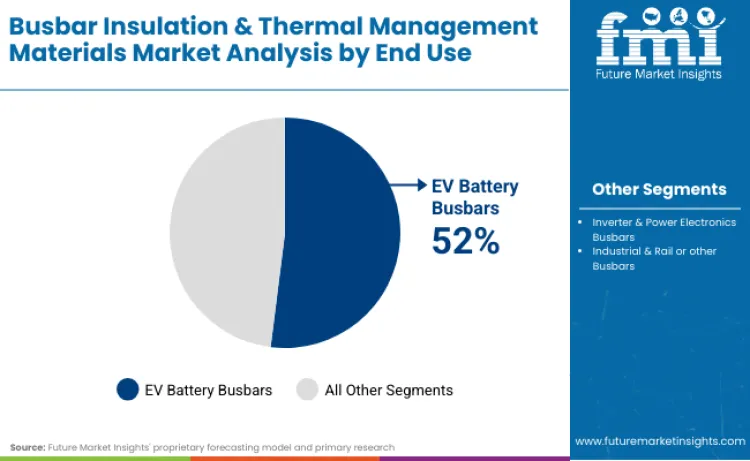
EV battery busbars represent the largest end-use segment at 52% due to the exponential rise in BEV production and the transition to high-voltage battery packs. According to the IEA Global EV Outlook 2025, battery demand for the energy sector reached the historical milestone of 1 TWh in 2024 and is expected to exceed 3 TWh by 2030. This growth is primarily located inside the battery, where complex module-to-cell interconnections require lightweight, high-conductivity busbars that outperform traditional wire harnesses in both volume and thermal efficiency.
Strategic corporate actions are aligning to support this demand as manufacturers integrate busbars directly into the battery pack architecture. In late 2023, Amphenol Corporation completed the acquisition of Connor Manufacturing Services to specifically strengthen its position in the EV power distribution value chain. Amphenol’s record 2025 results, reporting USD 23.1 billion in sales, were driven by exceptional organic growth in IT datacom and automotive markets. These developments, paired with the surging demand for larger battery sizes per vehicle, solidify the battery busbar segment as the primary engine for expansion through 2026.
Which Factors will Influence Outcomes in Busbar Insulation & Thermal Management Materials?
A primary growth driver is the systematic modernization of regional power grids to handle the shift toward decentralized energy. In UK, National Grid’s Great Grid Upgrade is executing 17 major infrastructure projects to connect up to 50GW of offshore wind by 2030, with most construction of new overhead lines and substations accelerating through 2026. This overhaul requires significant quantities of high-voltage busbar insulation to manage the increased power flows from subsea and remote generation sites to urban centers.
A significant technical opportunity lies in the shift toward lightweight materials and modularity in the automotive sector. For instance, Volkswagen has committed $52 billion toward electrification through 2026, specifically targeting the ID. series. This investment is catalyzing a transition from traditional copper to aluminum-based busbars, which offer up to 70% weight reduction. Furthermore, the emergence of ultra-fast charging prototypes, such as the Nyobolt EV which achieved an 80% charge in under five minutes in late 2024, demonstrates an opportunity for "smart" busbars with integrated cooling channels and embedded sensors for real-time thermal monitoring.
Supply chain sovereignty and the move toward circular economies act as critical market restraints. The EU Critical Raw Materials Act, which entered into force in May 2024, mandates that by 2030, no more than 65% of any strategic raw material such as copper or lithium should originate from a single third-party nation. For 2026, the European Commission has already designated 60 strategic projects to bolster domestic processing and recycling. This regulatory pressure forces manufacturers to diversify their sourcing and invest in secondary (recycled) material streams, which can initially increase production costs.
The regulatory threat of PFAS reporting has reached a critical compliance window. The USA EPA has finalized a rule under TSCA Section 8(a)(7) requiring all companies that have manufactured or imported PFAS-containing articles since 2011 to report detailed data by October 13, 2026. Since many high-performance busbar coatings and films historically utilize PFAS for fire retardancy, this deadline is forcing an industry-wide audit and a pivot toward fluorine-free alternatives to avoid legal and reputational risks.
What is the Country Profile of the Busbar Insulation & Thermal Management Materials Market?
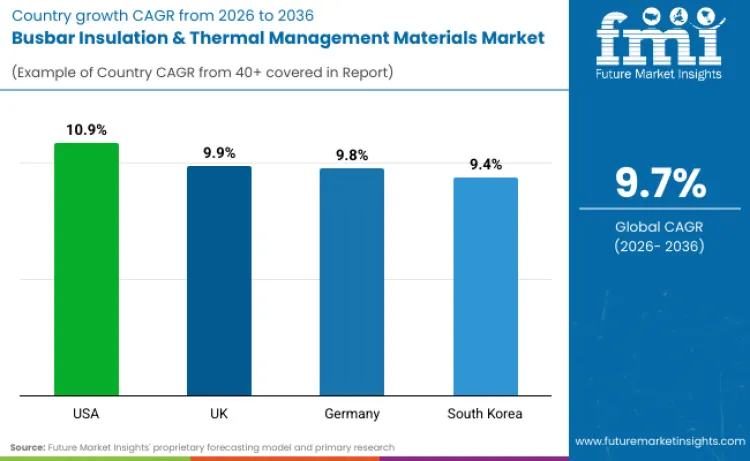
| Country | CAGR (2026-2036) |
|---|---|
| USA | 10.9% |
| UK | 9.9% |
| Germany | 9.8% |
| South Korea | 9.4% |
Source: FMI analysis based on primary research and proprietary forecasting model
How is USA’s Battery Belt Initiative expansion Driving Growth?
The United States market is projected to expand at a CAGR of 10.9%, underpinned by a massive wave of private sector gigafactory construction. By 2026, the BlueOval SK Battery Park in Kentucky, a joint venture between Ford and SK On, is expected to begin commissioning its twin plants with a combined capacity of 86 GWh. These facilities require high-amperage busway systems and specialized thermal runaway containment materials to manage the production of both LFP and NMC cells. This localized manufacturing surge is a direct response to 2026 domestic content requirements that restrict federal tax credits for components produced under foreign entity control.
Further momentum is provided by the energy storage sector, which is set to reach 50 GWh of annual domestic cell manufacturing capacity by the end of 2026. Canadian Solar’s Kentucky factory is on track for completion in Q1 2026, and LG Energy Solution is ramping up its Arizona Battery Complex. This shift toward domestic energy storage system (ESS) assembly, aided by new facilities like Hithium’s Texas factory, necessitates a high volume of insulated busbars for module-to-module connectivity. The focus on AI-driven data centers is also prompting companies like LGES to convert existing EV production lines into ESS lines by early 2026 to meet the electricity demand of hyperscalers.
What is the impact of the Accelerated Strategic Transmission Investment on UK’s Landscape?
UK is witnessing a CAGR of 9.9% as Ofgem fast-tracks critical infrastructure through its Accelerated Strategic Transmission Investment (ASTI) framework. In December 2025, Ofgem approved early construction funding for major electricity superhighways, including Eastern Green Links 3 and 4, with delivery targets set for the mid-2030s but pre-construction works peaking in 2026. These projects involve building 400kV high-capacity links to transport clean power from the North Sea, requiring advanced laminated busbars and high-dielectric insulation to handle the increased voltage loads at converter stations.
SSEN Transmission has outlined a £22 billion investment plan for the 2026-2031 period to deliver a "Network for Net Zero." In early 2026, SSEN is concluding innovation projects like NIA SHET 0044, which focuses on low-profile 220kV single-circuit designs, and NIA SHET 0042 for pollution monitoring of high-voltage assets. These initiatives highlight a strategic shift toward composite insulators and alternatives to sulfur hexafluoride (SF6) gases. The convergence of these transmission reinforcements and a new government focus on Great British Energy ensures a robust pipeline for thermal management materials in the UK power sector.
Can Automotive Gen6 Architectures sustain Demand for Busbar Insulation & Thermal Management Materials in Germany?
Germany’s market growth at a CAGR of 9.8% is y tied to the Neue Klasse era of electric vehicles and the total decarbonization of its industrial grid. BMW Group is currently spearheading this transition with its Irlbach-Straßkirchen plant, which is slated to produce 1,000 sixth-generation high-voltage battery packs per day by late 2026. This new architecture shifts from prismatic to cylindrical cells, eliminating modules entirely in a "cell-to-pack" construction. This design change necessitates a complete redesign of internal busbar layouts, prioritizing high-nickel materials and secondary aluminum to meet 2026 sustainability targets.
Beyond automotive, the German transmission system operator EnBW has updated its climate roadmap to achieve a climate-neutral energy system by 2040, necessitating the total rebuilding of the energy backbone for Germany’s industrialized economy. In April 2025, the Bundesnetzagentur confirmed a grid reserve requirement of 6,493 megawatts for the 2025/2026 winter, emphasizing the critical role of grid stability. The gradual reduction of grid congestion through these expansions ensures a steady demand for advanced thermal management materials and busbar insulation in both the transmission and industrial sectors.
How is South Korea’s No T" technology redefining its Busbar Insulation & Thermal Management Materials Landscape?
South Korea is projected to maintain a CAGR of 9.4%, largely driven by the technological leadership of its domestic battery giants. Samsung SDI received the Best of Innovation award at CES 2026 for its SDI 25U-Power battery and was recognized for its No TP technology. This advancement uses a proprietary thermal propagation prediction program to optimize safety materials between cells, utilizing gas vents and thermal barriers to prevent fire from spreading to adjacent cells. This focus on "No TP" is a key market driver, as it integrates thermal management directly into the busbar and module housing design.
The government is supporting this trajectory with a USD 15 billion cash infusion announced in early 2025 to bolster the national battery sector. In January 2026, Samsung SDI partnered with KG Mobility to commercialize 46-series cylindrical battery packs, which utilize a tabless design to minimize internal resistance and enhance thermal characteristics. Furthermore, South Korea is accelerating the timeline for ASBs, with pilot lines already operational and mass production targets set for 2027. These high-voltage, high-density battery developments are the core reason for the sustained demand for advanced busbar insulation in the Korean peninsula.
What is the Intensity of Competition in the Busbar Insulation & Thermal Management Materials Landscape?
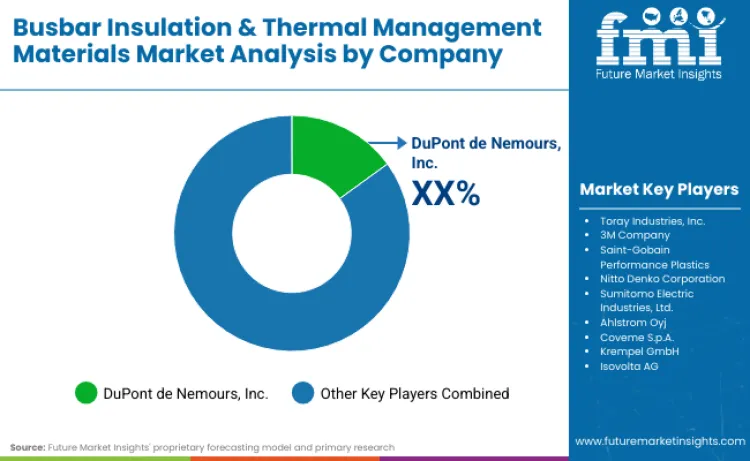
The competitive landscape for busbar insulation and thermal management materials is characterized by a strategic pivot toward high-performance polymers and advanced dielectric coatings. Leading material science firms are increasingly aligning their R&D with the 2026 mandates for electrification and the extreme power densities of AI-ready data centers. This has resulted in a shift from providing standalone films to developing integrated "thermal-electric" systems, where the insulation itself acts as a primary heat dissipation channel.
Industry players are also navigating a complex regulatory transition involving the phased reduction of PFAS. This is driving a surge in the development of "fluoro-free" yet high-performance alternatives, such as bio-based or ceramic-filled thermoplastics. Strategic capital is being deployed to localize production in key "Battery Belt" regions across North America and Europe, ensuring that companies can meet domestic content requirements while mitigating the logistics risks associated with high-voltage material transit.
Key Market Developments
- Toray Industries (2025): Under its "Project AP-G 2025" strategic program, the company identified electronic coating materials for semiconductors as a "Core Growth Business," accelerating the expansion of high-added-value films for high-frequency switching environments.
- Ahlstrom (October 2025): Launched a specialized flame-retardant paper to enhance fire protection in industrial applications, building on its June 2024 introduction of fluoro-free technology for challenging thermal environments.
- Sumitomo Electric Industries (2024): Initiated construction of a new high-voltage cable plant in Scotland and reported increased demand for rectangular magnet wires specifically engineered for EV thermal and electrical efficiency.
Key Players Profiled
- DuPont de Nemours, Inc.
- Toray Industries, Inc.
- 3M Company
- Saint-Gobain Performance Plastics
- Nitto Denko Corporation
- Sumitomo Electric Industries, Ltd.
- Ahlstrom Oyj
- Coveme S.p.A.
- Krempel GmbH
- Isovolta AG
Market Definition
The busbar insulation & thermal management materials market comprises specialized materials used to electrically isolate, thermally regulate, and mechanically protect busbars operating in high-current power distribution systems. These materials play a critical role in managing heat, preventing electrical faults, and ensuring long-term reliability as power densities increase across electric vehicles, data centers, renewable energy systems, and grid infrastructure.
The report includes films, coatings, potting compounds, laminates, and composite insulation systems applied to busbars in applications such as EV battery packs, inverters, power electronics, industrial equipment, and transmission infrastructure. It covers key material classes including polyimide and high-temperature films, polyesters, elastomers, thermoplastics, and ceramic or mica-based insulation, along with their use across major electrification-driven regions and end-use sectors
The scope excludes busbar hardware, conductors, connectors, and power distribution assemblies themselves, as well as cooling hardware such as liquid cooling plates, heat exchangers, and external thermal management systems. It also excludes insulation materials used solely in low-voltage wiring, consumer electronics, or applications not exposed to high-current or high-temperature operating conditions.
Scope of Report
| Items | Values |
|---|---|
| Quantitative Units (2026) | USD 1.7 billion |
| Material Class | Polyimide & High-Temperature Films, Polyester, Elastomers & Overmolded Thermoplastics, Ceramic & Mica-Based Insulation |
| Function | Primary Electrical Insulation, Thermal Management, Mechanical Protection & Vibration Damping, EMI |
| End Use | EV Battery Busbars, Inverter & Power Electronics Busbars, Industrial & Rail or other Busbars |
| Regions Covered | North America, Latin America, Western Europe, Eastern Europe, East Asia, South Asia & Pacific, Middle East & Africa |
| Countries Covered | USA, UK, Germany, South Korea and 40+ Countries |
| Companies Profiled | DuPont de Nemours, Inc., Toray Industries, Inc., 3M Company, Saint-Gobain Performance Plastics, Nitto Denko Corporation, Sumitomo Electric Industries, Ltd., Ahlstrom Oyj, Coveme S.p.A., Krempel GmbH, Isovolta AG |
Source: FMI analysis based on primary research and proprietary forecasting model
Busbar Insulation & Thermal Management Materials Market Key Segments
Material Class:
- Polyimide & High-Temperature Films
- Polyester
- Elastomers & Overmolded Thermoplastics
- Ceramic & Mica-Based Insulation
Function:
- Primary Electrical Insulation
- Thermal Management
- Mechanical Protection & Vibration Damping
- EMI
End Use:
- EV Battery Busbars
- Inverter & Power Electronics Busbars
- Industrial & Rail or other Busbars
Region:
- North America
- Latin America
- Western Europe
- Eastern Europe
- East Asia
- South Asia & Pacific
- Middle East & Africa
Bibliography
- National Renewable Energy Laboratory (NREL). (2024). High-temperature packaging and reliability challenges for wide-bandgap power electronics.
- IEEE Power & Energy Society (IEEE PES). (2026).Grid modernization, insulation reliability, and resilience under high electrification.
- USA Environmental Protection Agency (EPA). (2024). TSCA Section 8(a)(7): PFAS reporting rule for articles and components.
- National Grid ESO (United Kingdom). (2025). The Great Grid Upgrade: Offshore wind and transmission expansion.
- Ofgem (United Kingdom). (2025). Accelerated Strategic Transmission Investment (ASTI) framework.
- Bundesnetzagentur (Germany). (2025). Grid reserve determination for winter 2025/2026.
- Samsung SDI. (2026). CES 2026 Innovation Award: No-TP battery thermal propagation prevention technology.
- Mersen Group. (2025). FY 2025 earnings call and laminated busbar capacity expansion disclosures.
Frequently Asked Questions
How large is the busbar insulation and thermal management materials market in automotive applications?
The market is valued at about USD 1.7 billion in 2026, with EV battery busbars representing the largest share due to rising voltage levels and power density in electric vehicles.
Why are busbar insulation materials becoming critical in modern vehicle architectures?
As vehicles shift to 800V and higher electrical systems, busbar insulation materials are no longer passive dielectrics but system-critical components that manage heat, prevent arcing, and ensure long-term reliability under high current loads.
Which automotive systems are driving the highest demand for these materials?
EV battery packs are the primary demand driver, followed by inverters, onboard chargers, and integrated x-in-1 power electronics where laminated busbars are increasingly replacing conventional cabling.
How does the transition to high-voltage EV platforms affect material selection?
High-voltage platforms tighten requirements around creepage, clearance, and thermal stability, favoring high-temperature films, advanced coatings, and potting compounds that combine electrical insulation with heat dissipation and vibration resistance.
What are the main constraints facing automotive adoption of advanced busbar insulation materials?
Key constraints include higher material costs, longer qualification cycles, and growing regulatory pressure around PFAS disclosure and material traceability, which are forcing reformulation and supply-chain audits.
Which regions are shaping automotive demand for busbar insulation materials?
China leads due to EV production scale and rapid adoption of high-voltage architectures, while the USA and Europe are driving demand through battery localization policies, grid-ready vehicle platforms, and stricter safety and sustainability requirements.
Preview the report firsthand - request a free sample
Get SampleGet the brochure for pricing and purchase details.
Get PDFTable of Content
- Executive Summary
- Market Overview
- Market Definition
- Market Taxonomy
- Market Scope and Limitations
- Why is the Busbar Insulation & Thermal Management Materials Market Growing?
- Key Market Drivers
- Key Market Restraints
- Emerging Opportunities
- Key Market Trends
- How is the Busbar Insulation & Thermal Management Materials Market Segmented?
- By Material Class
- By Function
- By End Use
- What are the Key Factors Influencing the Market?
- Regulatory Landscape
- Technology Evolution
- Supply Chain Analysis
- Investment Feasibility Analysis
- What is the Country-level Outlook for the Market?
- United States
- United Kingdom
- Germany
- South Korea
- What is the Competitive Intensity in the Market?
- Market Structure Analysis
- Competition Dashboard
- Key Strategic Developments
- Key Players Profiled
- DuPont de Nemours, Inc.
- Toray Industries, Inc.
- 3M Company
- Saint-Gobain Performance Plastics
- Nitto Denko Corporation
- Sumitomo Electric Industries, Ltd.
- Ahlstrom Oyj
- Coveme S.p.A.
- Krempel GmbH
- Isovolta AG
- Market Definition
- Scope of Report
- Market Segmentation
- Bibliography
- Frequently Asked Questions (FAQs)


