

- Market Size (2026)
- USD 1.2 Bn
- Forecast (2036)
- USD 1.9 Bn
- CAGR (2026 to 2036)
- 4.7%
Brake Fluid Thermal Management System Components Market Size, Forecast, and Outlook By FMI
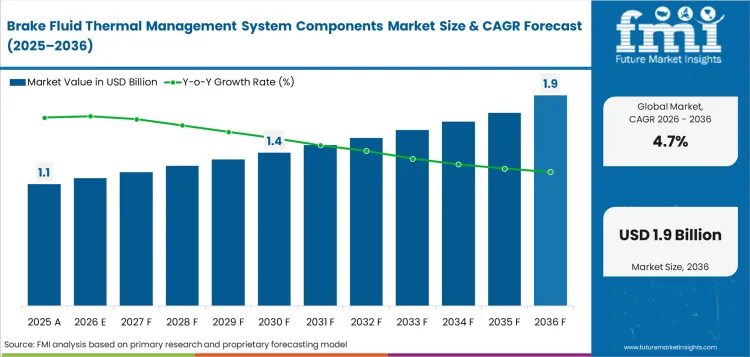
The brake fluid thermal management system components market was valued at USD 1.1 billion in 2025. The market is expected to reach USD 1.2 billion by 2026-end and expand at a CAGR of 4.7% between 2026 and 2036 to reach USD 1.9 billion by 2036.
Summary of the Brake Fluid Thermal Management System Components Market
- Demand and Growth Drivers
- AEB readiness increases demand for heat-stable hydraulic paths as passenger vehicles need repeatable brake pressure response.
- EV platform packaging raises demand for reservoir protection as compact layouts place brake fluid parts near heat sources.
- Brake-by-wire programs increase the need for pressure sensors as hydraulic fallback paths must stay measurable.
- Product and Segment View
- OEM fitment is expected to account for 68.0% of sales channel demand in 2026 as platform approval requires validated thermal brake parts.
- Passenger cars are projected to hold 54.0% share of vehicle type segment in 2026 through high-volume brake system integration.
- Fluid lines are likely to be the leading-value component area as heat-stable routing helps protect hydraulic pressure transfer.
- Geography and Competitive Outlook
- South Korea is expected to record a CAGR of 6.7% through 2036 as brake electronics and EV output deepen.
- China is projected to expand at 6.4% CAGR through 2036 as NEV production scales across domestic platforms.
- Companies combining hydraulic brake design with sensor-ready module depth are likely to strengthen their position during the forecast period.
- Analyst Opinion
- Nikhil Kaitwade, Principal Consultant for the Automotive domain at FMI, says, “Brake fluid thermal management is becoming a platform approval issue as AEB and brake-by-wire raise hydraulic stability demands. OEM teams need heat-ready reservoirs and shields without service complexity. Validated elastomers increase cost while material testing reduces late design changes.”
- Brake Fluid Thermal Management System Components Market Value Analysis
- The brake fluid thermal management system components market is moving from basic hydraulic routing into a validated thermal protection component base.
- Adoption is connected to safety braking needs for passenger cars and light commercial vehicles.
- The market is benefiting from deeper use ofautomotive brake system components across regulated vehicle platforms.
- Demand is reinforced by fluid routing parts meeting heat and pressure requirements across electronic brake programs.
- Pricing pressure is strongest across EPDM seals and stainless routing as material validation raises component cost.
Key Takeaways, Market Size, and Forecast
- The brake fluid thermal management system components market was valued at USD 1.1 billion in 2025.
- By 2036, the brake fluid thermal management system components market is expected to be worth USD 1.9 billion.
- From 2026 to 2036, the market is projected to expand at a CAGR of 4.7%.
- The market is projected to create an incremental opportunity of USD 0.7 billion between 2026 and 2036.
- In 2026, OEM fitment is expected to account for 68.0% of sales channel demand.
- South Korea at 6.7% CAGR and China at 6.4% CAGR are expected to record faster expansion through 2036.
- In 2026, passenger cars are expected to account for 54.0% of vehicle type demand.
Brake fluid thermal management is becoming more important as braking systems rely on faster electronic control and stable hydraulic backup. NHTSA finalized FMVSS No. 127 in April 2024 and required AEB on passenger cars and light trucks by September 2029. This raises the need for reservoirs and fluid lines able to keep brake pressure stable during emergency braking. Bosch tested a hydraulic brake-by-wire system over 2,050 miles in January 2025, showing how new brake layouts need compact routing and validated seals. Fluid quality affects service risk, as NHTSA recorded 40,440 recalled ACDelco brake and clutch fluid containers in May 2026 due to visible sediment and FMVSS 116 nonconformance. Brembo’s Sensify entered production in May 2026 with a fluid-free design, so hydraulic component suppliers need to focus on validated brake fluid parts and replacement demand.
Brake Fluid Thermal Management System Components Market Definition
The brake fluid thermal management system components market includes parts used to store, route, protect, and monitor hydraulic brake fluid under heat exposure. Scope includes fluid lines, reservoirs, thermal shields, pressure sensors, and cooling ducts used in road vehicles. These components protect brake fluid integrity and help maintain pressure response during high-load braking events. Scope does not include brake fluid chemicals, friction pads, rotors, full ABS units, or software-only brake control systems.
Brake Fluid Thermal Management System Components Market Inclusions
Market scope covers all commercially traded brake fluid thermal management system components categorized by component type, including fluid lines, reservoir modules, thermal shields, pressure sensors, and cooling ducts; thermal control type, including passive shielding, active cooling, fluid monitoring, and heat deflection; vehicle type, including passenger cars, light commercial vehicles, heavy trucks, performance vehicles, and two-wheelers; material type, including EPDM rubber, stainless steel, aluminum, PTFE, and polymer composites; and sales channel, including OEM fitment, service replacement, and motorsport upgrades. Revenue scope covers 2026 to 2036. Key stakeholders include brake system manufacturers, reservoir and hose producers, sensor providers, polymer and metal component suppliers, vehicle manufacturers, aftermarket distributors, service networks, testing laboratories, system integrators, and regulatory bodies.
Brake Fluid Thermal Management System Components Market Exclusions
Scope does not include brake fluids, brake pads, rotors, calipers sold without fluid thermal functions, aircraft brakes, rail brakes, or racing prototypes.
Brake Fluid Thermal Management System Components Market Research Methodology
- Primary Research: FMI analysts spoke to brake system suppliers, vehicle manufacturers, materials specialists, and service channel participants in key markets.
- Desk Research: Combined data from vehicle safety rules, EV production records, company product portfolios, and adjacent brake component references.
- Market sizing and forecasting: Added component use across vehicle platforms and replacement channels from the bottom up.
- Data validation:Validated quarterly against brake system production, EV mix, safety regulation timing, and supplier coverage.
Why is the Brake Fluid Thermal Management System Components Market Growing?
- Vehicle makers are validating fluid lines earlier as AEB systems need repeatable pressure response under heat load.
- EV architectures place reservoirs and fluid lines in tighter spaces as thermal exposure increases around compact brake modules.
- Service channels replace hoses and reservoirs as aged parts raise contamination and leakage risk.
Automatic braking rules are making heat-stable hydraulic brake paths more important across passenger cars. Safety-focused brake systems need fluid lines and reservoirs able to keep pressure response steady during repeated braking. This raises a stronger demand for thermal shields and sensor-ready reservoir modules in OEM platform design. Vehicle manufacturers can reduce late-stage rework by validating fluid routing and thermal protection before launch.
Electrification changes brake duty cycles without removing hydraulic safety needs from many vehicle platforms. IEA reported electric car sales above 20 million globally in 2025, equal to one in four new cars sold worldwide. This vehicle base increases the number of platforms using regenerative braking with hydraulic backup. Brake fluid parts must perform after longer idle periods and during sudden friction-brake demand. Suppliers with proven EV thermal system understanding can align fluid protection with compact electric vehicle packaging.
Market Segmentation Analysis
- Fluid lines are projected to hold 33.0% share in 2026 as heat-exposed brake routing keeps stable pressure transfer paths important.
- Passive shielding is likely to hold 46.0% of thermal control demand by 2026 because it manages heat risk without the validation load of active cooling.
- Passenger cars are expected to represent 54.0% of vehicle type use in 2026, supported by shared platforms and high-volume braking system layouts.
- EPDM rubber is likely to hold a 39.0% material type share in 2026 as seal durability and brake fluid compatibility support broad use.
- OEM fitment is likely to leadthe sales channel with 68.0% share for 2026 since early platform nomination is central to brake system integration.
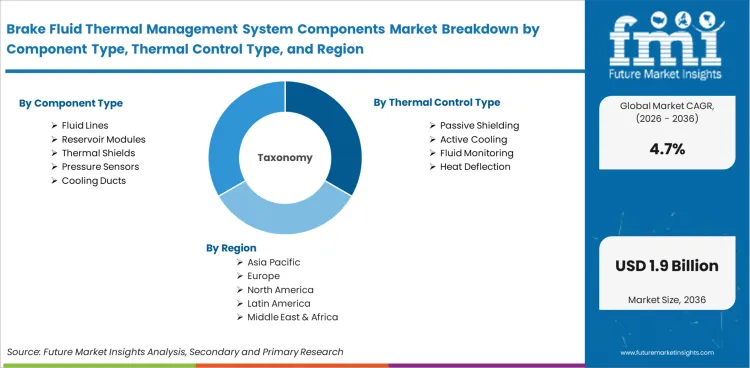
The market for brake fluid thermal management system components is divided into five primary segment groups based on component type, thermal control type, vehicle type, material type, and sales channel. Component type includes fluid lines, reservoir modules, thermal shields, pressure sensors, and cooling ducts. Thermal control type includes passive shielding, active cooling, fluid monitoring, and heat deflection. Vehicle type includes passenger cars, light commercial vehicles, heavy trucks, performance vehicles, and two-wheelers. Material type includes EPDM rubber, stainless steel, aluminum, PTFE, and polymer composites. Sales channel includes OEM fitment, service replacement, and motorsport upgrades.
Insights into Brake Fluid Thermal Management System Components Market by Component Type
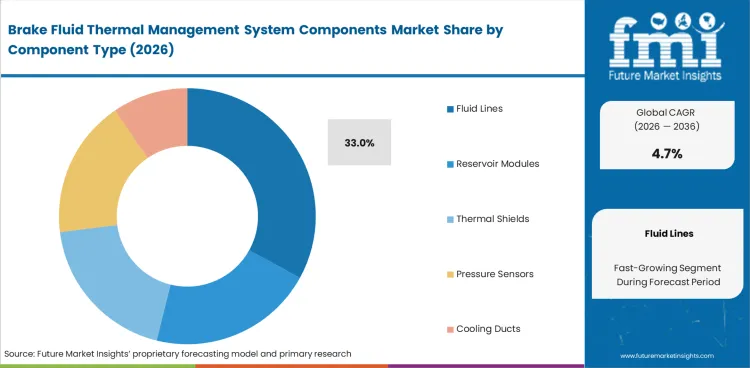
- In 2026, fluid lines are expected to account for 33.0% of component type demand. Heat-exposed hydraulic routing needs validated hose and tube performance before platform approval.
- Reservoir modules and pressure sensors address fluid storage and monitoring needs. Their value improves in brake-by-wire programs and compact EV brake layouts.
Insights into Brake Fluid Thermal Management System Components Market by Thermal Control Type
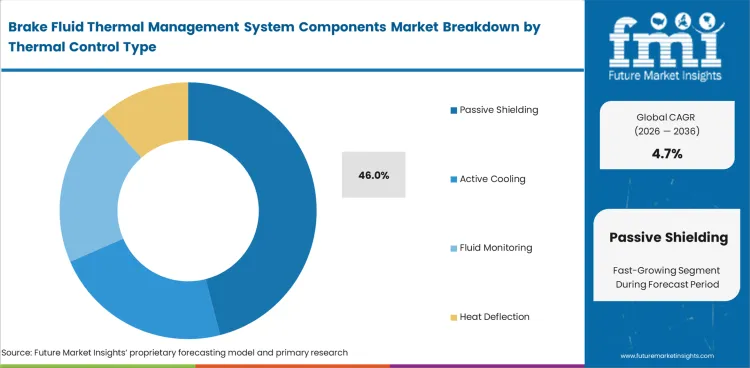
- Passive shielding is projected to account for 46.0% of thermal control demand in 2026. Fixed shields protect fluid paths without electronic controls or moving mechanisms.
- Active cooling and fluid monitoring address higher-load brake applications. Their use improves in performance vehicles and electronically managed braking systems.
Insights into Brake Fluid Thermal Management System Components Market by Vehicle Type
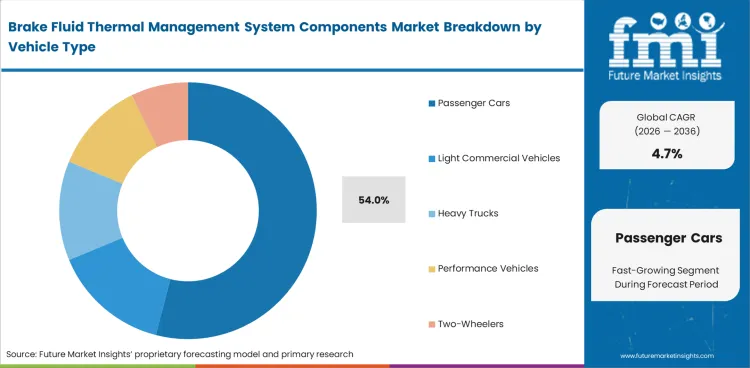
- Passenger cars are expected to contribute 54.0% of vehicle type demand in 2026. Shared platforms create repeat demand for molded reservoirs and compact brake fluid routing.
- Light commercial vehicles and heavy trucks need stronger thermal protection for higher load cycles. Service life and braking duty shape component selection.
Insights into Brake Fluid Thermal Management System Components Market by Material Type
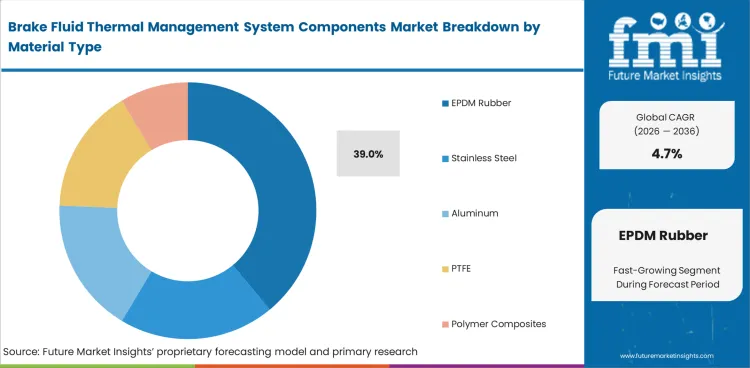
- In 2026, EPDM rubber is forecast to hold 39.0% of material type demand. Brake fluid compatibility keeps it important across caps and reservoir sealing points.
- Stainless steel and PTFE options support hotter routing areas. Their value improves in pressure-control sections and high-temperature brake line applications.
Insights into Brake Fluid Thermal Management System Components Market by Sales Channel
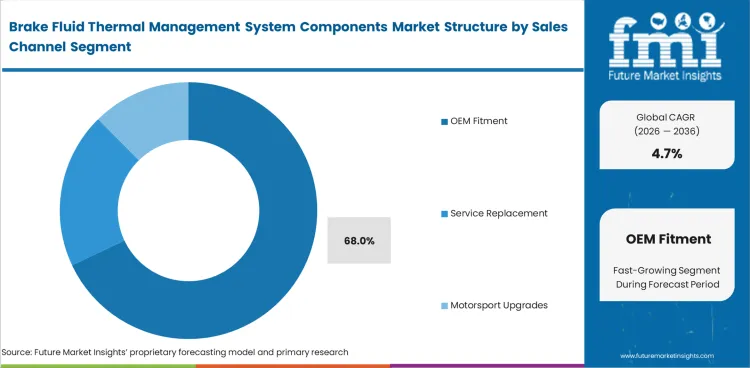
- OEM fitment is projected to hold 68.0% of sales channel demand in 2026. Vehicle manufacturers prefer factory-approved thermal parts for warranty and safety control.
- Service replacement demand covers aged hoses and contaminated reservoirs. Aftermarket access improves in older vehicle fleets and inspection-driven brake repair jobs.
Brake Fluid Thermal Management System Components Market Drivers, Restraints, and Opportunities
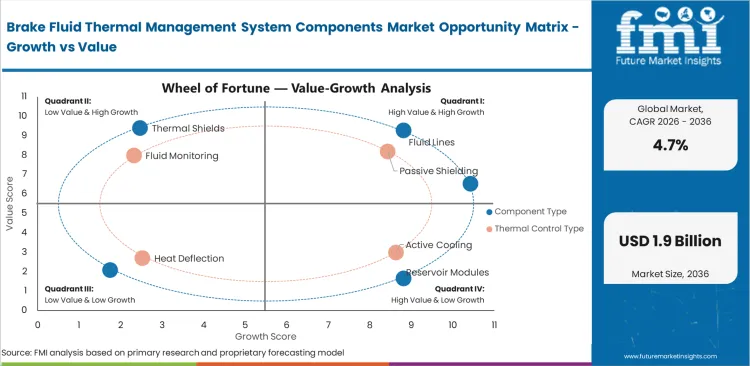
- AEB pressure stability raises demand for thermal proof across hydraulic routing and reservoir modules.
- EV packaging density raises heat exposure near fluid parts as compact layouts limit separation space.
- Brake-by-wire improves opportunity for sensors and monitored reservoirs across mixed hydraulic-electronic brake systems.
Brake fluid thermal management system components keep growing as vehicles need stable brake fluid pressure and heat-protected hydraulic paths during repeated braking. Cost pressure and longer validation cycles can slow broader use across lower-cost vehicle platforms. Growth continues through EV brake layouts and AEB-ready systems and sensor-enabled reservoir modules.
Electrified Mix Volatility Is Repricing Thermal Validation
Brake fluid thermal management component pricing is now more closely tied to powertrain mix uncertainty, with vehicle demand playing a secondary role. In February 2026 the USA Energy Information Administration reported that hybrid and battery electric vehicles accounted for about 22% of USA light-duty vehicle sales in 2025. The report noted an increase from 20% in 2024, showing continued growth in electrified vehicle adoption across the market. BEV share reached 12% in September 2025 before falling below 6% in each remaining month of 2025. This volatility affects pricing for brake fluid reservoirs and temperature sensors because suppliers must recover validation and tooling costs across less predictable production runs. It also affects cooling interfaces and heat-resistant hoses as suppliers face higher material qualification costs over uncertain production volumes. Contracts are moving toward shorter quote windows and stronger engineering-cost recovery.
Metal Tariffs Are Lifting Component Cost Floors
Pricing for brake fluid thermal management components is facing direct landed cost pressure as assemblies rely on aluminum housings and steel fittings. Additional pressure emerges from thermal shields and brackets, and reinforced line hardware in these systems. In June 2025 the White House stated that tariffs on steel articles and derivative steel articles would increase from 25 percent to 50 percent. The same policy confirmed higher tariffs for aluminum articles and derivative aluminum articles effective June 4 2025. For brake fluid cooling modules and temperature management subassemblies this raises the cost floor before machining, brazing, coating, sealing, or leak testing is added. Buyers should separatemetal content escalators, tariff exposure, and conversion charges in supplier negotiations while avoiding treating the finished assembly price as one blended line item.
Analysis of Brake Fluid Thermal Management System Components Market By Key Countries
.webp "Top Country Growth Comparison Brake Fluid Thermal Management System Components Market Cagr (2026 2036)")
| Country | CAGR |
|---|---|
| South Korea | 6.7% |
| China | 6.4% |
| USA | 5.8% |
| Germany | 5.2% |
| Japan | 4.9% |
Source: Future Market Insights, 2026.
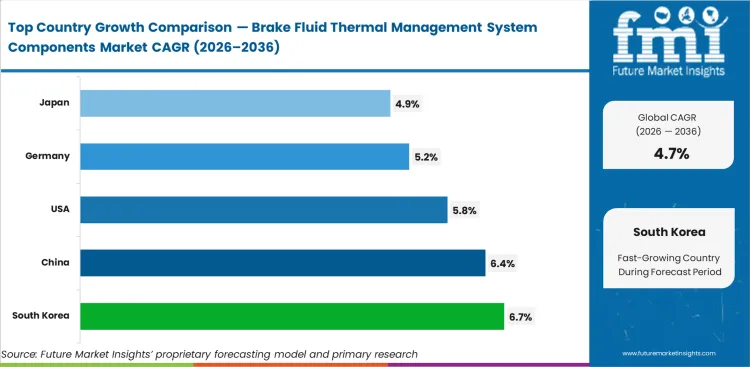
Brake Fluid Thermal Management System Components Market CAGR Analysis By Country
- South Korea is projected to lead with a 6.7% CAGR through 2036 as EV production and brake electronics adoption move deeper into vehicle platforms.
- China is expected to advance at 6.4% CAGR, supported by NEV platform scale and stronger local sourcing for brake system components.
- In the USA, growth is forecast at 5.8% CAGR by 2036 as AEB compliance timing aligns with a large light-vehicle replacement base.
- Germany’s 5.2% CAGR is linked to premium EV manufacturing and established brake system engineering depth across OEM programs.
- Japan is expected to expand at 4.9% CAGR as mature platform design keeps demand steady across hydraulic system replacement activity.
Demand for brake fluid thermal management system components is forecast to rise at 4.7% CAGR from 2026 to 2036. Country-level analysis covers the major markets contributing to this forecast, with the key markets listed below.
Demand Outlook for Brake Fluid Thermal Management System Components Market in South Korea
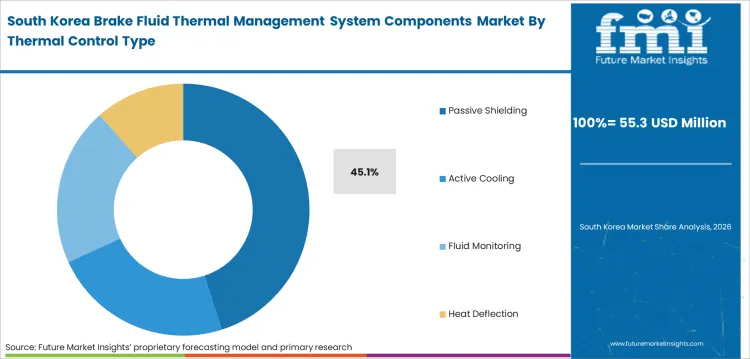
Brake fluid thermal management system components industry in South Korea is projected to record a CAGR of 6.7% through 2036. Domestic automobile production reached 4.1 million units in 2025, topping 4 million units for the third straight year according to Invest Korea. This manufacturing base increases demand for heat-stable reservoirs and fluid routing parts across export vehicle programs. Local suppliers can gain from OEMs seeking brake components with electronic system compatibility.
- Korean vehicle production depth boosts demand for brake modules with validated thermal and fluid-contact performance.
- EV export programs raise the need for reservoir modules suited to compact underhood layouts.
- Local brake suppliers need stronger testing records to serve high-volume OEM programs.
Sales Analysis of Brake Fluid Thermal Management System Components Market in China
The brake fluid thermal management system components sector in China is expected to expand at a CAGR of 6.4% during the assessment period. Large-scale NEV production leads to a broad demand base for sensor-ready and heat-stable brake fluid parts. Local suppliers benefit from shorter platform development cycles across domestic EV makers. China’s scale makes component cost discipline important for reservoirs and fluid lines.
- NEV platform scale increases demand for pressure monitoring and fluid stability across electric vehicles.
- Local brake system sourcing favors suppliers with fast tooling and validated polymer choices.
- Heat shields gain use as compact vehicle packaging raises exposure near brake fluid reservoirs.
Demand Outlook for Brake Fluid Thermal Management System Components Market in the United States
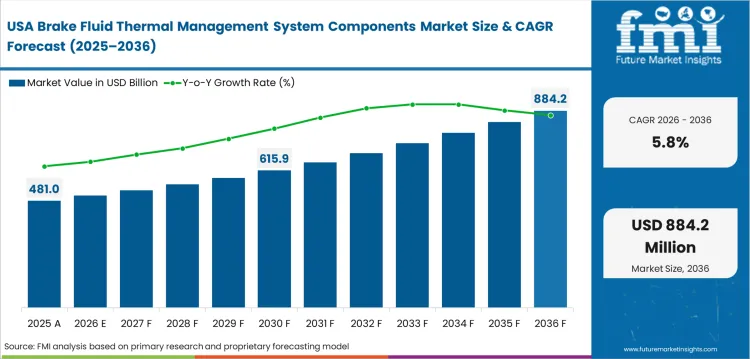
The USA brake fluid thermal management system components industry is forecast to grow at a CAGR of 5.8% by 2036. AEB rule timing creates a stronger need for reliable brake pressure response across passenger cars and light trucks. OICA listed USA motor vehicle sales at 16,675,488 units in 2025, making the country one of the largest service and OEM demand bases. Brake fluid thermal parts gain importance across Automotive Brake Actuation Systems programs and service channels.
- AEB compliance raises platform attention on hydraulic pressure stability and thermal shielding.
- Large vehicle parc size enhances service replacement demandfor hoses and reservoirs.
- Light truck platforms increase demand for durable thermal parts under higher braking loads.
Opportunity Analysis of Brake Fluid Thermal Management System Components Market in Germany
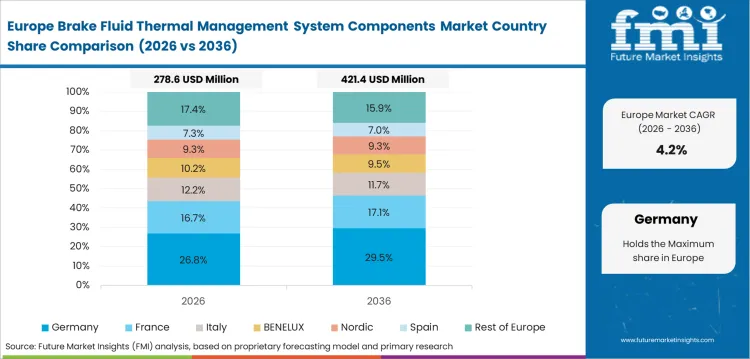
The brake fluid thermal management system components segment in Germany is expected to advance at 5.2% CAGR over the forecast years. Established premium vehicle production increases demand for advanced brake fluid routing and thermal shielding. VDA reported 864,000 electric cars produced in Germany during the first half of 2025, equal to 40% of domestic car output during the period. This production mix increases demandfor brake fluid parts suited to electrified vehicle packaging.
- Premium EV production increases the need for compact reservoirs and high-temperature shielding.
- Brake engineering depth favors suppliers with validated materials and platform test records.
- German OEMs value integrated parts linked with Automotive Brake Booster and Master Cylinder layouts.
Future Outlook for Brake Fluid Thermal Management System Components Market in Japan
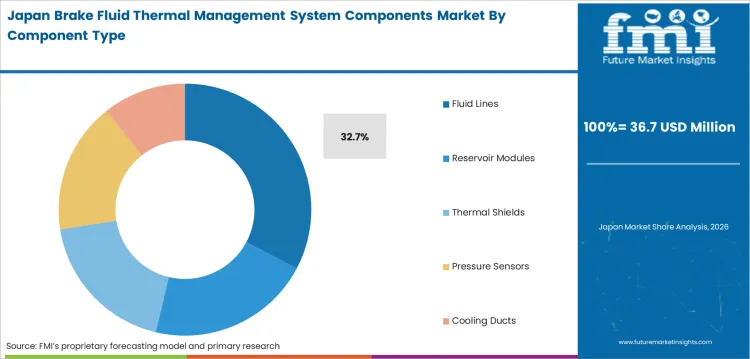
The Japan brake fluid thermal management system components industry is expected to post 4.9% CAGR by 2036. Japan’s mature vehicle production base favors careful design change and controlled replacement cycles. OICA listed Japan motor vehicle sales at 4,565,777 units in 2025, giving the country a large brake service base and OEM platform pool. Suppliers with compact packaging skill can serve hybrid and small car programs more effectively.
- Compact vehicle platforms need fluid reservoirs with tight packaging and reliable sealing.
- Hybrid programs raise demand for hydraulic backup parts across regenerative braking layouts.
- Mature service channels favor replacement parts with OEM-grade material compatibility.
Competitive Landscape and Strategic Positioning
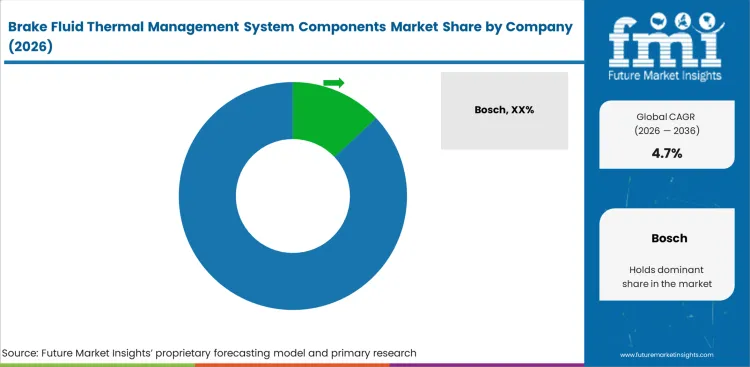
- Bosch leads through electro-hydraulic brake architecture and strong access to OEM brake programs across major vehicle platforms.
- Continental and ZF emphasize brake-by-wire portfolios and electronic brake control depth across global vehicle programs.
- Specialist suppliers focus on reservoirs, hoses and shields for thermal protection matched to individual vehicle platform needs.
Suppliers compete on early OEM program access and proven ability to manage brake fluid heat across safety-critical braking systems. Bosch holds a strong position through electro-hydraulic braking systems and hydraulic backup experience across hybrid vehicle platforms. Continental brings brake-by-wire knowledge and integrated brake module depth across global OEM programs. ZF offers wet and dry brake-by-wire choices for manufacturers planning different levels of hydraulic content. Brembo is expanding electronic braking relevance through Sensify, which entered large-scale series production in May 2026 for a leading global manufacturer.
Material qualification cost and long OEM approval cycles create entry barriers across safety-critical brake components. Suppliers need proven fluid-contact polymer capability and fast validation under thermal exposure conditions. Vehicle manufacturers prefer partners combining hydraulic stability and electronic interface knowledge within one program plan. Brake suppliers with deep product coverage and proven validation records arewell positioned to secure repeat platform awards.
Key Companies in the Brake Fluid Thermal Management System Components Market
Key global companies leading the brake fluid thermal management system components market include:
- Bosch, Continental, and ZF Friedrichshafen have strong brake system infrastructure for hydraulic control and electronic braking.
- Aisin, Hitachi Astemo, and Brembo serve manufacturers through brake modules and performance braking expertise.
- Aptiv holds specialist positioning across electronic interfaces and sensor integration for monitored brake systems.
Competitive Benchmarking: Brake Fluid Thermal Management System Components Market
| Company | Hydraulic Integration Depth | Thermal Routing Coverage | Electronic Brake Control Reach | Geographic Footprint |
|---|---|---|---|---|
| Bosch | High | High | Strong | Europe, North America, China, India, Japan, and South Korea |
| Continental | High | Medium | Strong | Europe, North America, China, Japan, South Korea, and India |
| ZF Friedrichshafen | High | Medium | Strong | Europe, North America, China, India, Japan, and South Korea |
| Aisin | Medium | Medium | Moderate | Japan, China, ASEAN, North America, and Europe |
| Hitachi Astemo | Medium | Medium | Moderate | Japan, North America, Europe, China, and Asia Pacific |
| Brembo | Medium | High | Strong | Europe, North America, China, Japan, and India |
| Aptiv | Low | Medium | Strong | North America, Europe, China, India, and Asia Pacific |
Source: Future Market Insights, 2026.
Key Developments in Brake Fluid Thermal Management System Components Market
- In January 2025, ZF secured a major brake-by-wire technology order for light vehicles, covering nearly 5 million vehicles over the contract period. The system combines rear electro-mechanical braking with ZF’s Integrated Brake Control and traditional front calipers, creating a hybrid architecture using both by-wire and hydraulic braking. This is relevant for brake fluid thermal management components because hybrid systems continue to require front hydraulic brake circuits while shifting system value toward integrated electro-hydraulic control, calipers, and redundancy hardware.
- In January 2025, Bosch tested its hydraulic brake-by-wire system over 3,300 kilometers to the Arctic Circle. The test used brake control without a direct mechanical pedal connection, while hydraulic circuits and validated seals remained important for brake reliability. This is relevant for brake fluid thermal management because compact routing, stable pressure response, and thermal protection remain part of mixed hydraulic-electronic brake layouts.
Key Players in the Brake Fluid Thermal Management System Components Market
Major Global Players:
- Bosch
- Continental
- ZF Friedrichshafen
- Aisin
- Hitachi Astemo
- Brembo
- Aptiv
Specialist Players:
- FTE Automotive
- Marelli
- Valeo
- Brakes India
Report Scope and Coverage
| Parameter | Details |
|---|---|
| Quantitative Units | USD 1.2 billion to USD 1.9 billion, at a CAGR of 4.7% |
| Market Definition | The market encompasses components used to protect and monitor hydraulic brake fluid under thermal load. |
| Regions Covered | North America, Latin America, Europe, East Asia, South Asia and Pacific, Middle East and Africa |
| Countries Covered | USA, China, Germany, Japan, South Korea, India, Mexico, and 30 plus countries |
| Key Companies Profiled | Bosch, Continental, ZF Friedrichshafen, Aisin, Hitachi Astemo, Brembo, Aptiv, FTE Automotive, Marelli, Valeo |
| Forecast Period | 2026 to 2036 |
| Approach | FMI uses a bottom-up and top-down methodology, starting with component attachment and verified vehicle platform use patterns. |
Brake Fluid Thermal Management System Components Market by Segments
Brake Fluid Thermal Management System Components Market Segmented by Component Type:
- Fluid Lines
- Reservoir Modules
- Thermal Shields
- Pressure Sensors
- Cooling Ducts
Brake Fluid Thermal Management System Components Market Segmented by Thermal Control Type:
- Passive Shielding
- Active Cooling
- Fluid Monitoring
- Heat Deflection
Brake Fluid Thermal Management System Components Market Segmented by Vehicle Type:
- Passenger Cars
- Light Commercial Vehicles
- Heavy Trucks
- Performance Vehicles
- Two-Wheelers
Brake Fluid Thermal Management System Components Market Segmented by Material Type:
- EPDM Rubber
- Stainless Steel
- Aluminum
- PTFE
- Polymer Composites
Brake Fluid Thermal Management System Components Market Segmented by Sales Channel:
- OEM Fitment
- Service Replacement
- Motorsport Upgrades
Brake Fluid Thermal Management System Components Market by Region:
- North America
- USA
- Canada
- Mexico
- Latin America
- Brazil
- Chile
- Rest of Latin America
- Europe
- Germany
- UK
- Italy
- Spain
- France
- Rest of Europe
- East Asia
- China
- Japan
- South Korea
- South Asia and Pacific
- India
- ASEAN
- Australia & New Zealand
- Rest of South Asia and Pacific
- Middle East and Africa
- Saudi Arabia
- Other GCC Countries
- South Africa
- Rest of Middle East and Africa
Research Sources and Bibliography
- National Highway Traffic Safety Administration. (2024, April). NHTSA finalizes key safety rule to reduce crashes and save lives.
- International Energy Agency. (2026, May). Trends in electric cars. Global EV Outlook 2026.
- State Council of the People’s Republic of China. (2026, January). China’s auto output and sales reach new highs in 2025.
- Verband der Automobilindustrie. (2025, August). Production and market in July 2025.
- Invest Korea. (2026, January). South Korea’s auto exports hit record USD 72 billion in 2025.
- International Organization of Motor Vehicle Manufacturers. (2026, April). World motor vehicle sales statistics 2025.
- Bosch. (2025, January). With brake-by-wire from Bosch to the Arctic Circle.
- Brembo. (2026, May). Sensify by Brembo enters production.
- ZF Friedrichshafen. (2025, September). Steering, braking, electrification at IAA Mobility 2025.
- The White House. (2025, June 3). Adjusting imports of aluminum and steel into the United States.
- USA Energy Information Administration. (2026, February 9). Electric vehicle sales fell as hybrid vehicle sales continued to rise in 2025.
- Robert Bosch GmbH. (2025, January 28). With brake-by-wire from Bosch to the Arctic Circle [Press release].
- ZF Group. (2025, January 6). ZF secures substantial brake-by-wire technology business for light vehicles [Press release].
This Report Answers
- What is the current and future size of the brake fluid thermal management system components market?
- How fast is the market expected to expand between 2026 and 2036?
- Which component type is expected to lead the market by 2026?
- Which vehicle type is expected to account for the leading demand by 2026?
- What factors are driving demand for brake fluid thermal management system components globally?
- How are AEB rules influencing hydraulic brake component validation?
- Why are OEM fitment programs the main demand base for thermal brake fluid parts?
- How are EV platforms creating demand for specialized brake fluid protection?
- Which countries are projected to record faster expansion through 2036?
- What is driving market expansion in South Korea and China?
- Who are the key companies active in the brake fluid thermal management system components market?
- How does FMI estimate and validate the market forecast?
Frequently Asked Questions
What is the global market demand for Brake Fluid Thermal Management System Components in 2026?
In 2026, the global market for brake fluid thermal management system components is expected to be worth USD 1.2 billion.
How big will the market for Brake Fluid Thermal Management System Components be in 2036?
By 2036, the market for brake fluid thermal management system components is expected to be worth USD 1.9 billion.
How much is demand for Brake Fluid Thermal Management System Components expected to expand between 2026 and 2036?
Between 2026 and 2036, demand for brake fluid thermal management system components is expected to expand at a CAGR of 4.7%.
Which component type segment is expected to be the leading seller globally by 2026?
Fluid lines are expected to make up 33.0% of the component type segment in 2026.
What is causing demand to rise in South Korea?
The South Korea brake fluid thermal management system components market is projected to record 6.7% CAGR through 2036, driven by brake electronics and vehicle export depth.
What is causing demand to rise in China?
The China brake fluid thermal management system components market is projected to expand at 6.4% CAGR through 2036, driven by NEV platform scale.
What does this report mean by Brake Fluid Thermal Management System Components Market definition?
The market includes parts used to store, route, protect, and monitor hydraulic brake fluid under heat exposure.
How does FMI make the Brake Fluid Thermal Management System Components forecast and check it?
FMI uses a bottom-up and top-down approach, starting with component attachment and verified vehicle platform use patterns.
Preview the report firsthand - request a free sample
Get SampleGet the brochure for pricing and purchase details.
Get PDFTable of Content
- Executive Summary
- Global Market Outlook
- Demand-side Trends
- Supply-side Trends
- Technology Roadmap Analysis
- Analysis and Recommendations
- Market Overview
- Market Coverage / Taxonomy
- Market Definition / Scope / Limitations
- Research Methodology
- Chapter Orientation
- Analytical Lens and Working Hypotheses
- Market Structure, Signals, and Trend Drivers
- Benchmarking and Cross-market Comparability
- Market Sizing, Forecasting, and Opportunity Mapping
- Research Design and Evidence Framework
- Desk Research Programme (Secondary Evidence)
- Company Annual and Sustainability Reports
- Peer-reviewed Journals and Academic Literature
- Corporate Websites, Product Literature, and Technical Notes
- Earnings Decks and Investor Briefings
- Statutory Filings and Regulatory Disclosures
- Technical White Papers and Standards Notes
- Trade Journals, Industry Magazines, and Analyst Briefs
- Conference Proceedings, Webinars, and Seminar Materials
- Government Statistics Portals and Public Data Releases
- Press Releases and Reputable Media Coverage
- Specialist Newsletters and Curated Briefings
- Sector Databases and Reference Repositories
- FMI Internal Proprietary Databases and Historical Market Datasets
- Subscription Datasets and Paid Sources
- Social Channels, Communities, and Digital Listening Inputs
- Additional Desk Sources
- Expert Input and Fieldwork (Primary Evidence)
- Primary Modes
- Qualitative Interviews and Expert Elicitation
- Quantitative Surveys and Structured Data Capture
- Blended Approach
- Why Primary Evidence is Used
- Field Techniques
- Interviews
- Surveys
- Focus Groups
- Observational and In-context Research
- Social and Community Interactions
- Stakeholder Universe Engaged
- C-suite Leaders
- Board Members
- Presidents and Vice Presidents
- R&D and Innovation Heads
- Technical Specialists
- Domain Subject-matter Experts
- Scientists
- Physicians and Other Healthcare Professionals
- Governance, Ethics, and Data Stewardship
- Research Ethics
- Data Integrity and Handling
- Primary Modes
- Tooling, Models, and Reference Databases
- Desk Research Programme (Secondary Evidence)
- Data Engineering and Model Build
- Data Acquisition and Ingestion
- Cleaning, Normalisation, and Verification
- Synthesis, Triangulation, and Analysis
- Quality Assurance and Audit Trail
- Market Background
- Market Dynamics
- Drivers
- Restraints
- Opportunity
- Trends
- Scenario Forecast
- Demand in Optimistic Scenario
- Demand in Likely Scenario
- Demand in Conservative Scenario
- Opportunity Map Analysis
- Product Life Cycle Analysis
- Supply Chain Analysis
- Investment Feasibility Matrix
- Value Chain Analysis
- PESTLE and Porter’s Analysis
- Regulatory Landscape
- Regional Parent Market Outlook
- Production and Consumption Statistics
- Import and Export Statistics
- Market Dynamics
- Global Market Analysis 2021 to 2025 and Forecast, 2026 to 2036
- Historical Market Size Value (USD Million) Analysis, 2021 to 2025
- Current and Future Market Size Value (USD Million) Projections, 2026 to 2036
- Y-o-Y Growth Trend Analysis
- Absolute $ Opportunity Analysis
- Global Market Pricing Analysis 2021 to 2025 and Forecast 2026 to 2036
- Global Market Analysis 2021 to 2025 and Forecast 2026 to 2036, By Component Type
- Introduction / Key Findings
- Historical Market Size Value (USD Million) Analysis By Component Type , 2021 to 2025
- Current and Future Market Size Value (USD Million) Analysis and Forecast By Component Type , 2026 to 2036
- Fluid Lines
- Reservoir Modules
- Thermal Shields
- Pressure Sensors
- Cooling Ducts
- Fluid Lines
- Y-o-Y Growth Trend Analysis By Component Type , 2021 to 2025
- Absolute $ Opportunity Analysis By Component Type , 2026 to 2036
- Global Market Analysis 2021 to 2025 and Forecast 2026 to 2036, By Thermal Control Type
- Introduction / Key Findings
- Historical Market Size Value (USD Million) Analysis By Thermal Control Type, 2021 to 2025
- Current and Future Market Size Value (USD Million) Analysis and Forecast By Thermal Control Type, 2026 to 2036
- Passive Shielding
- Active Cooling
- Fluid Monitoring
- Heat Deflection
- Passive Shielding
- Y-o-Y Growth Trend Analysis By Thermal Control Type, 2021 to 2025
- Absolute $ Opportunity Analysis By Thermal Control Type, 2026 to 2036
- Global Market Analysis 2021 to 2025 and Forecast 2026 to 2036, By Vehicle Type
- Introduction / Key Findings
- Historical Market Size Value (USD Million) Analysis By Vehicle Type, 2021 to 2025
- Current and Future Market Size Value (USD Million) Analysis and Forecast By Vehicle Type, 2026 to 2036
- Passenger Cars
- Light Commercial Vehicles
- Heavy Trucks
- Performance Vehicles
- Two-Wheelers
- Passenger Cars
- Y-o-Y Growth Trend Analysis By Vehicle Type, 2021 to 2025
- Absolute $ Opportunity Analysis By Vehicle Type, 2026 to 2036
- Global Market Analysis 2021 to 2025 and Forecast 2026 to 2036, By Material Type
- Introduction / Key Findings
- Historical Market Size Value (USD Million) Analysis By Material Type, 2021 to 2025
- Current and Future Market Size Value (USD Million) Analysis and Forecast By Material Type, 2026 to 2036
- EPDM Rubber
- Stainless Steel
- Aluminum
- PTFE
- Polymer Composites
- EPDM Rubber
- Y-o-Y Growth Trend Analysis By Material Type, 2021 to 2025
- Absolute $ Opportunity Analysis By Material Type, 2026 to 2036
- Global Market Analysis 2021 to 2025 and Forecast 2026 to 2036, By Sales Channel
- Introduction / Key Findings
- Historical Market Size Value (USD Million) Analysis By Sales Channel, 2021 to 2025
- Current and Future Market Size Value (USD Million) Analysis and Forecast By Sales Channel, 2026 to 2036
- OEM Fitment
- Service Replacement
- Motorsport Upgrades
- OEM Fitment
- Y-o-Y Growth Trend Analysis By Sales Channel, 2021 to 2025
- Absolute $ Opportunity Analysis By Sales Channel, 2026 to 2036
- Global Market Analysis 2021 to 2025 and Forecast 2026 to 2036, By Region
- Introduction
- Historical Market Size Value (USD Million) Analysis By Region, 2021 to 2025
- Current Market Size Value (USD Million) Analysis and Forecast By Region, 2026 to 2036
- North America
- Latin America
- Western Europe
- Eastern Europe
- East Asia
- South Asia and Pacific
- Middle East & Africa
- Market Attractiveness Analysis By Region
- North America Market Analysis 2021 to 2025 and Forecast 2026 to 2036, By Country
- Historical Market Size Value (USD Million) Trend Analysis By Market Taxonomy, 2021 to 2025
- Market Size Value (USD Million) Forecast By Market Taxonomy, 2026 to 2036
- By Country
- USA
- Canada
- Mexico
- By Component Type
- By Thermal Control Type
- By Vehicle Type
- By Material Type
- By Sales Channel
- By Country
- Market Attractiveness Analysis
- By Country
- By Component Type
- By Thermal Control Type
- By Vehicle Type
- By Material Type
- By Sales Channel
- Key Takeaways
- Latin America Market Analysis 2021 to 2025 and Forecast 2026 to 2036, By Country
- Historical Market Size Value (USD Million) Trend Analysis By Market Taxonomy, 2021 to 2025
- Market Size Value (USD Million) Forecast By Market Taxonomy, 2026 to 2036
- By Country
- Brazil
- Chile
- Rest of Latin America
- By Component Type
- By Thermal Control Type
- By Vehicle Type
- By Material Type
- By Sales Channel
- By Country
- Market Attractiveness Analysis
- By Country
- By Component Type
- By Thermal Control Type
- By Vehicle Type
- By Material Type
- By Sales Channel
- Key Takeaways
- Western Europe Market Analysis 2021 to 2025 and Forecast 2026 to 2036, By Country
- Historical Market Size Value (USD Million) Trend Analysis By Market Taxonomy, 2021 to 2025
- Market Size Value (USD Million) Forecast By Market Taxonomy, 2026 to 2036
- By Country
- Germany
- UK
- Italy
- Spain
- France
- Nordic
- BENELUX
- Rest of Western Europe
- By Component Type
- By Thermal Control Type
- By Vehicle Type
- By Material Type
- By Sales Channel
- By Country
- Market Attractiveness Analysis
- By Country
- By Component Type
- By Thermal Control Type
- By Vehicle Type
- By Material Type
- By Sales Channel
- Key Takeaways
- Eastern Europe Market Analysis 2021 to 2025 and Forecast 2026 to 2036, By Country
- Historical Market Size Value (USD Million) Trend Analysis By Market Taxonomy, 2021 to 2025
- Market Size Value (USD Million) Forecast By Market Taxonomy, 2026 to 2036
- By Country
- Russia
- Poland
- Hungary
- Balkan & Baltic
- Rest of Eastern Europe
- By Component Type
- By Thermal Control Type
- By Vehicle Type
- By Material Type
- By Sales Channel
- By Country
- Market Attractiveness Analysis
- By Country
- By Component Type
- By Thermal Control Type
- By Vehicle Type
- By Material Type
- By Sales Channel
- Key Takeaways
- East Asia Market Analysis 2021 to 2025 and Forecast 2026 to 2036, By Country
- Historical Market Size Value (USD Million) Trend Analysis By Market Taxonomy, 2021 to 2025
- Market Size Value (USD Million) Forecast By Market Taxonomy, 2026 to 2036
- By Country
- China
- Japan
- South Korea
- By Component Type
- By Thermal Control Type
- By Vehicle Type
- By Material Type
- By Sales Channel
- By Country
- Market Attractiveness Analysis
- By Country
- By Component Type
- By Thermal Control Type
- By Vehicle Type
- By Material Type
- By Sales Channel
- Key Takeaways
- South Asia and Pacific Market Analysis 2021 to 2025 and Forecast 2026 to 2036, By Country
- Historical Market Size Value (USD Million) Trend Analysis By Market Taxonomy, 2021 to 2025
- Market Size Value (USD Million) Forecast By Market Taxonomy, 2026 to 2036
- By Country
- India
- ASEAN
- Australia & New Zealand
- Rest of South Asia and Pacific
- By Component Type
- By Thermal Control Type
- By Vehicle Type
- By Material Type
- By Sales Channel
- By Country
- Market Attractiveness Analysis
- By Country
- By Component Type
- By Thermal Control Type
- By Vehicle Type
- By Material Type
- By Sales Channel
- Key Takeaways
- Middle East & Africa Market Analysis 2021 to 2025 and Forecast 2026 to 2036, By Country
- Historical Market Size Value (USD Million) Trend Analysis By Market Taxonomy, 2021 to 2025
- Market Size Value (USD Million) Forecast By Market Taxonomy, 2026 to 2036
- By Country
- Kingdom of Saudi Arabia
- Other GCC Countries
- Turkiye
- South Africa
- Other African Union
- Rest of Middle East & Africa
- By Component Type
- By Thermal Control Type
- By Vehicle Type
- By Material Type
- By Sales Channel
- By Country
- Market Attractiveness Analysis
- By Country
- By Component Type
- By Thermal Control Type
- By Vehicle Type
- By Material Type
- By Sales Channel
- Key Takeaways
- Key Countries Market Analysis
- USA
- Pricing Analysis
- Market Share Analysis, 2025
- By Component Type
- By Thermal Control Type
- By Vehicle Type
- By Material Type
- By Sales Channel
- Canada
- Pricing Analysis
- Market Share Analysis, 2025
- By Component Type
- By Thermal Control Type
- By Vehicle Type
- By Material Type
- By Sales Channel
- Mexico
- Pricing Analysis
- Market Share Analysis, 2025
- By Component Type
- By Thermal Control Type
- By Vehicle Type
- By Material Type
- By Sales Channel
- Brazil
- Pricing Analysis
- Market Share Analysis, 2025
- By Component Type
- By Thermal Control Type
- By Vehicle Type
- By Material Type
- By Sales Channel
- Chile
- Pricing Analysis
- Market Share Analysis, 2025
- By Component Type
- By Thermal Control Type
- By Vehicle Type
- By Material Type
- By Sales Channel
- Germany
- Pricing Analysis
- Market Share Analysis, 2025
- By Component Type
- By Thermal Control Type
- By Vehicle Type
- By Material Type
- By Sales Channel
- UK
- Pricing Analysis
- Market Share Analysis, 2025
- By Component Type
- By Thermal Control Type
- By Vehicle Type
- By Material Type
- By Sales Channel
- Italy
- Pricing Analysis
- Market Share Analysis, 2025
- By Component Type
- By Thermal Control Type
- By Vehicle Type
- By Material Type
- By Sales Channel
- Spain
- Pricing Analysis
- Market Share Analysis, 2025
- By Component Type
- By Thermal Control Type
- By Vehicle Type
- By Material Type
- By Sales Channel
- France
- Pricing Analysis
- Market Share Analysis, 2025
- By Component Type
- By Thermal Control Type
- By Vehicle Type
- By Material Type
- By Sales Channel
- India
- Pricing Analysis
- Market Share Analysis, 2025
- By Component Type
- By Thermal Control Type
- By Vehicle Type
- By Material Type
- By Sales Channel
- ASEAN
- Pricing Analysis
- Market Share Analysis, 2025
- By Component Type
- By Thermal Control Type
- By Vehicle Type
- By Material Type
- By Sales Channel
- Australia & New Zealand
- Pricing Analysis
- Market Share Analysis, 2025
- By Component Type
- By Thermal Control Type
- By Vehicle Type
- By Material Type
- By Sales Channel
- China
- Pricing Analysis
- Market Share Analysis, 2025
- By Component Type
- By Thermal Control Type
- By Vehicle Type
- By Material Type
- By Sales Channel
- Japan
- Pricing Analysis
- Market Share Analysis, 2025
- By Component Type
- By Thermal Control Type
- By Vehicle Type
- By Material Type
- By Sales Channel
- South Korea
- Pricing Analysis
- Market Share Analysis, 2025
- By Component Type
- By Thermal Control Type
- By Vehicle Type
- By Material Type
- By Sales Channel
- Russia
- Pricing Analysis
- Market Share Analysis, 2025
- By Component Type
- By Thermal Control Type
- By Vehicle Type
- By Material Type
- By Sales Channel
- Poland
- Pricing Analysis
- Market Share Analysis, 2025
- By Component Type
- By Thermal Control Type
- By Vehicle Type
- By Material Type
- By Sales Channel
- Hungary
- Pricing Analysis
- Market Share Analysis, 2025
- By Component Type
- By Thermal Control Type
- By Vehicle Type
- By Material Type
- By Sales Channel
- Kingdom of Saudi Arabia
- Pricing Analysis
- Market Share Analysis, 2025
- By Component Type
- By Thermal Control Type
- By Vehicle Type
- By Material Type
- By Sales Channel
- Turkiye
- Pricing Analysis
- Market Share Analysis, 2025
- By Component Type
- By Thermal Control Type
- By Vehicle Type
- By Material Type
- By Sales Channel
- South Africa
- Pricing Analysis
- Market Share Analysis, 2025
- By Component Type
- By Thermal Control Type
- By Vehicle Type
- By Material Type
- By Sales Channel
- USA
- Market Structure Analysis
- Competition Dashboard
- Competition Benchmarking
- Market Share Analysis of Top Players
- By Regional
- By Component Type
- By Thermal Control Type
- By Vehicle Type
- By Material Type
- By Sales Channel
- Competition Analysis
- Competition Deep Dive
- Bosch
- Overview
- Product Portfolio
- Profitability by Market Segments (Product/Age /Sales Channel/Region)
- Sales Footprint
- Strategy Overview
- Marketing Strategy
- Product Strategy
- Channel Strategy
- Continental
- ZF Friedrichshafen
- Aisin
- Hitachi Astemo
- Brembo
- Aptiv
- Bosch
- Competition Deep Dive
- Assumptions & Acronyms Used


