

- Industry Size (2026)
- USD 3450.0 Mn
- Forecast (2036)
- USD 6537.2 Mn
- CAGR (2026 to 2036)
- 6.6%
Bus Stop Shelter Market Forecast and Outlook 2026 to 2036
The bus stop shelter market is likely to be valued at USD 3,450.0 million in 2026 and is forecasted to reach USD 6,537.2 million by 2036 at a CAGR of 6.6%. Value formation is linked to municipal infrastructure provisioning rather than discretionary passenger amenities. Shelters are treated as fixed urban assets within transit corridor design, funded through capital programs, concession contracts, or advertising-linked concessions. Specification decisions are governed by climate exposure, pedestrian safety standards, accessibility compliance, and long-term maintenance liability. Procurement volume aligns with route density, stop spacing norms, and formalization of previously informal boarding points. Budget release timing and concession structuring influence deployment cadence more than ridership growth alone.
Expansion dynamics reflect constraints tied to streetscape geometry, utility conflicts, and local approval processes. Installation requires coordination across transport authorities, public works departments, and advertising partners, limiting rapid standardization. Material selection is shaped by vandalism risk, corrosion exposure, and lifecycle cost scrutiny, affecting replacement intervals. Advertising-funded models introduce revenue dependency that moderates rollout pace in lower-traffic corridors. Retrofit demand emerges where legacy shelters fail accessibility or durability benchmarks. Competitive differentiation remains limited by standardized design briefs, keeping value growth dependent on network expansion, corridor upgrades, and renewal cycles rather than unit price escalation.
Quick Stats for Bus Stop Shelter Market
- Bus Stop Shelter Market Value (2026): USD 3,450.0 million
- Bus Stop Shelter Market Forecast Value (2036): USD 6,537.2 million
- Bus Stop Shelter Market Forecast CAGR 2026 to 2036: 6.6%
- Leading Shelter Type by Demand Share: Standard Steel or Glass Shelters
- Fastest-Growing Countries: India, Saudi Arabia, UAE, Indonesia, Vietnam
- Key Global Players: JCDecaux, Clear Channel Outdoor, CIVIQ Smartscapes, Tolar Manufacturing, Brasco International
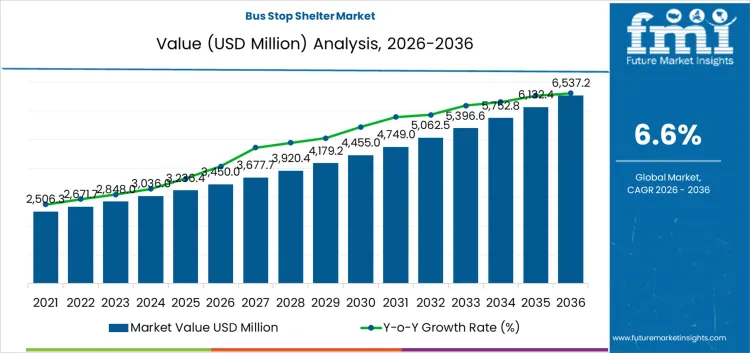
Bus Stop Shelter Market Key Takeaways
| Metric | Value |
|---|---|
| Market Value (2026) | USD 3,450.0 million |
| Market Forecast Value (2036) | USD 6,537.2 million |
| Forecast CAGR 2026 to 2036 | 6.6% |
Why is the Demand for Bus Stop Shelter Growing?
Demand for bus stop shelters is increasing as urban planners and transit authorities seek to improve rider comfort, safety, and perception of public transportation services. Bus stop shelters provide protection from sun, rain, wind, and snow, which encourages ridership retention and supports modal shift objectives in cities managing congestion and pollution. Transit agencies specify shelters with durable materials, vandal-resistant features, and clear sightlines to support safety and reduce maintenance costs in high-usage corridors. Procurement teams evaluate canopy design, seating options, lighting integration, and structural resilience to ensure shelters meet local climatic conditions and municipal aesthetics guidelines. Many agencies also require shelters that accommodate signage, route information panels, and real-time arrival displays to enhance user experience and accessibility for all passenger segments.
Growth in public transport investment and community mobility initiatives reinforces uptake of bus stop shelters that align with broader urban improvement programs. Transit planners coordinate shelter placement with pedestrian access zones, ADA compliance requirements, and multimodal connectivity points such as bike racks and pedestrian crossings. Manufacturers are offering modular shelter designs that simplify installation and future upgrades while minimizing disruption to curbside operations. Coordination between city engineers, transit operators, and installation contractors ensures shelters are sited for optimal use and safety, including sightlines, lighting, and proximity to high-demand stops. These practical, environment-specific considerations are contributing to sustained demand growth for bus stop shelters.
How Are the Segments Classified in the Bus Stop Shelter Market?
Demand for bus stop shelters is shaped by public transport usage growth, passenger comfort expectations, and urban infrastructure planning priorities. Municipal authorities and transit operators deploy shelters to provide weather protection, safety, and route information for commuters. Adoption aligns with expansion of bus rapid transit corridors, urban renewal programs, and advertising-supported street furniture models. Product selection prioritizes durability, visibility, and maintenance efficiency. Segment classification reflects differentiation by shelter construction approach, ownership or funding structure, and material composition influencing lifecycle cost, deployment scale, and integration with urban streetscapes.
Which Shelter Type Represents the Largest Share of Demand?
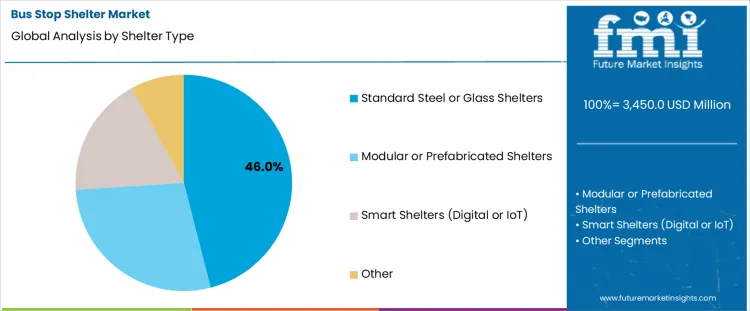
Standard steel or glass shelters hold 46.0%, representing the largest share among shelter types due to proven durability and design familiarity. These shelters provide basic weather protection and seating while fitting diverse urban layouts. Structural rigidity supports resistance to vandalism and environmental exposure. Transparent panels enhance visibility and passenger security. Modular or prefabricated shelters support faster installation with standardized components. Smart shelters integrate digital displays and connectivity with higher cost and complexity. Shelter type segmentation reflects preference for conventional designs delivering reliable performance, manageable costs, and broad acceptance across transit networks.
Key Points
- Standard shelters offer durable and familiar designs.
- Steel and glass structures suit varied urban conditions.
- Other types address speed of deployment or digital features.
Which Ownership Model Accounts for the Highest Share of Demand?
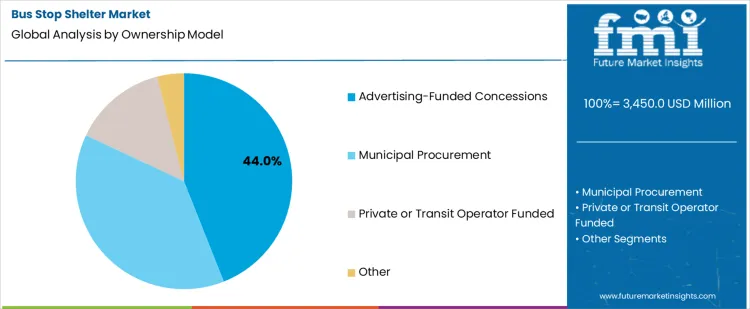
Advertising-funded concessions hold 44.0%, representing the largest share among ownership models due to funding efficiency. Revenue from advertising offsets installation and maintenance costs for municipalities. Long-term concession agreements support standardized shelter deployment across city corridors. Centralized management improves upkeep consistency. Municipal procurement supports direct ownership with budget-dependent rollout pace. Private or transit operator funding applies to targeted routes with specific service needs. Ownership model segmentation reflects concentration where external revenue streams enable scalable shelter deployment without full public capital allocation.
Key Points
- Advertising revenue supports cost-neutral shelter deployment.
- Concession models enable large-scale rollout consistency.
- Other models rely on public or operator funding capacity.
Which Material Accounts for the Highest Share of Demand?
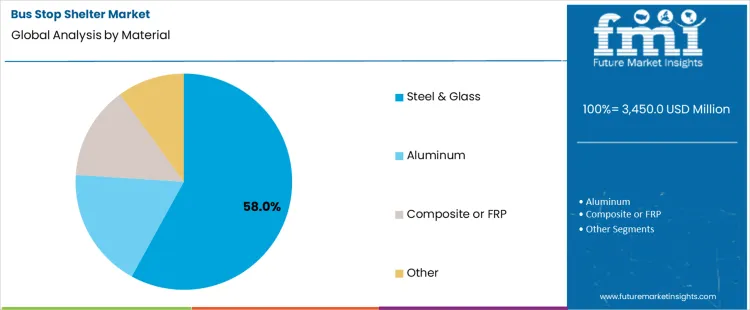
Steel and glass hold 58.0%, representing the largest share among materials used for bus stop shelters due to strength and visibility. Steel frames provide structural durability under continuous outdoor exposure. Glass panels allow clear sightlines improving safety and wayfinding. Material longevity supports extended service life with routine maintenance. Aluminum offers lighter structures with different cost profiles. Composite or FRP materials provide corrosion resistance with limited structural adoption. Material segmentation reflects reliance on robust, transparent materials where durability, safety perception, and urban compatibility remain essential.
Key Points
- Steel frames deliver strength and vandal resistance.
- Glass panels enhance visibility and passenger safety.
- Other materials address weight or corrosion considerations.
What are the Key Dynamics in the Bus Stop Shelter Market?
Demand for bus stop shelters reflects public transport infrastructure requirements for passenger protection, dwell time management, and service visibility. Adoption concentrates in urban corridors, suburban routes, and high-usage interchanges operated by municipal authorities and transit agencies. Global scope aligns with ridership volumes, climate exposure, and streetscape integration. Usage centers on fixed shelters incorporating roofing, side panels, seating, lighting, and route information displays.
How do passenger comfort need and service reliability shape adoption?
Bus stop shelters address exposure to rain, heat, wind, and solar load during waiting periods. Demand increases where ridership volumes and headways extend average dwell time. Urban routes with high boarding frequency require shelters sized for peak passenger accumulation without obstructing pedestrian flow. Climate severity drives material selection, ventilation design, and shading performance. Integration of seating improves accessibility for elderly and mobility-limited users. Lighting and visibility features support perceived safety during early morning and evening hours. Route maps and real-time arrival displays improve service predictability and reduce crowding near curb edges. Adoption reflects operational need to stabilize passenger experience and boarding efficiency.
How do installation constraints, vandalism risk, and budget limits influence market scalability?
Shelter deployment depends on sidewalk width, underground utilities, and curb geometry, increasing site-specific engineering. Demand sensitivity rises where municipal budgets prioritize fleet renewal over streetside assets. Vandalism and graffiti exposure elevate lifecycle maintenance cost, influencing material choice toward tempered glass, polycarbonate, or perforated metal. Advertising-supported shelters introduce contractual complexity and uneven revenue realization. Accessibility and setback regulations constrain standardized footprints. Power availability limits lighting and digital display integration. Weather durability requirements increase upfront cost. Project-based procurement and neighborhood-level approvals constrain uniform, large-scale rollout across transit networks.
How Is Demand for Bus Stop Shelters Evolving Globally?
Demand for bus stop shelters is expanding globally due to public transport modernization, passenger comfort requirements, and urban mobility investments. Adoption aligns with protection from weather exposure, accessibility compliance, and integration of route information and lighting. Municipal authorities prioritize standardized designs to improve waiting safety and dwell efficiency. Replacement demand emerges where aging shelters fail durability and accessibility criteria. Growth rates in India at 8.8%, Saudi Arabia at 8.4%, UAE at 8.1%, Indonesia at 7.6%, and Vietnam at 7.4% indicate sustained expansion driven by transit ridership growth, climate exposure, and city-led streetscape upgrades.
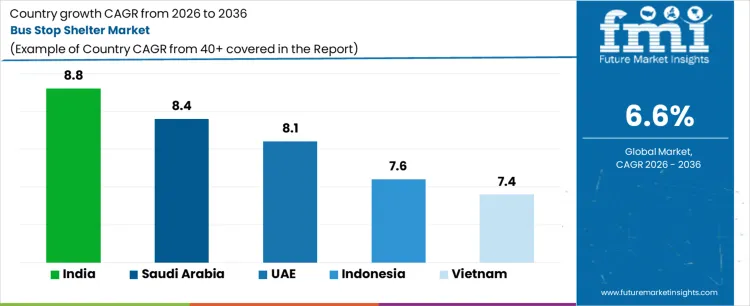
| Country | CAGR (%) |
|---|---|
| India | 8.8% |
| Saudi Arabia | 8.4% |
| UAE | 8.1% |
| Indonesia | 7.6% |
| Vietnam | 7.4% |
What Is Driving Rapid Growth of Bus Stop Shelter Demand in India?
India is growing at a CAGR of 8.8%, supported by expansion of city bus networks and passenger amenity programs. High daily ridership necessitates shaded, rain-protected waiting areas. Urban local bodies deploy standardized shelters to improve safety and boarding discipline. Integration of route maps, lighting, and seating improves dwell management at busy corridors. Public-private partnerships support installation and maintenance at scale. Demand growth reflects transit utilization intensity and weather protection needs rather than discretionary urban beautification.
- Expansion of city bus corridors and depots
- High ridership requiring weather-protected waiting
- Standardized municipal shelter specifications
- PPP-led installation and maintenance models
Why Is Saudi Arabia Experiencing Strong Expansion in Bus Stop Shelter Adoption?
Saudi Arabia is expanding at a CAGR of 8.4%, driven by public transport rollout and heat mitigation priorities. New bus networks require shelters to protect passengers from extreme temperatures. Municipal projects emphasize durable materials and shaded designs. Integration with route information and lighting supports service reliability. National mobility programs sustain procurement across cities. Demand growth reflects climate adaptation and transit system commissioning rather than replacement of mature shelter stock.
- Heat mitigation for passengers in extreme climates
- New bus network commissioning requirements
- Durable, shaded shelter design specifications
- National urban mobility program funding
How Is the UAE Shaping Demand for Bus Stop Shelters?
Bus stop shelter demand in United Arab Emirates is growing at a CAGR of 8.1%, influenced by service quality standards and climate exposure. Cities specify air-flow optimized and shaded shelters to improve passenger comfort. Integration of digital displays and lighting enhances usability. High standards for aesthetics and durability shape procurement. Expansion of bus feeder services to metro systems increases shelter density. Growth reflects quality-driven transit infrastructure and heat management rather than expansion in basic coverage.
- Climate-responsive shelter designs
- Integration with digital route information
- High durability and aesthetic standards
- Feeder service expansion to rail networks
What Factors Are Supporting Bus Stop Shelter Demand in Indonesia?
Bus stop shelter demand in Indonesia is expanding at a CAGR of 7.6%, shaped by urban congestion management and public transport upgrades. Cities deploy shelters to improve boarding order and passenger safety. Tropical rainfall increases need for covered waiting areas. Standardized shelter programs support rapid deployment along corridors. Maintenance considerations influence material selection. Demand growth reflects transit reliability initiatives and climate exposure rather than high-security infrastructure requirements.
- Urban congestion management via bus priority
- Protection from heavy rainfall and humidity
- Standardized shelter rollout programs
- Maintenance-focused material selection
Why Is Vietnam Showing Steady Growth in Bus Stop Shelter Demand?
Vietnam is growing at a CAGR of 7.4%, supported by urban transport reform and corridor development. Municipalities add shelters to improve passenger comfort and visibility of stops. Integration with signage and lighting improves safety during peak hours. Expansion of bus services in growing cities increases installation needs. Replacement of informal stops with formal infrastructure contributes incremental demand. Growth reflects structured transit development and streetscape formalization rather than rapid ridership surges.
- Formalization of bus stops along corridors
- Passenger comfort and safety improvements
- Integration of signage and lighting
- Expansion of urban bus services
What is the competitive landscape of demand for the bus stop shelter market globally?
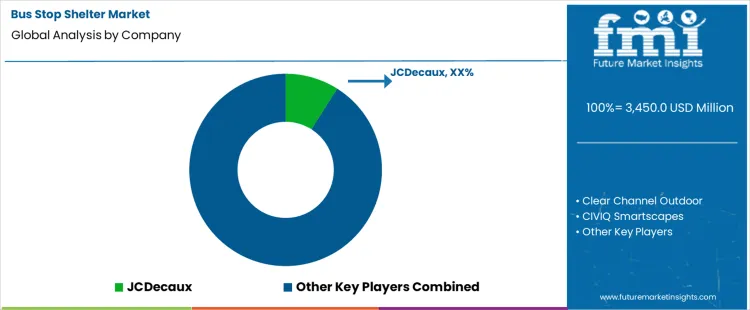
Demand for bus stop shelters is driven by public transit network expansion, urbanization, last-mile mobility improvements, and city initiatives focused on passenger comfort, safety, and multimodal integration. Buyers evaluate shelter durability, vandal resistance, weather protection, visibility, integrated seating, lighting, and digital signage capabilities. Procurement teams prioritize suppliers with experience in large-scale public infrastructure projects, global installation capacity, compliance with local standards, and ability to offer customization for city branding and smart city integration. Trend in the global market reflects increased adoption of solar-powered lighting, real-time passenger information displays, and materials that balance robustness with aesthetic appeal in urban environments.
JCDecaux holds leading positioning through an extensive global footprint and turnkey bus stop shelter solutions deployed in major cities supported by digital integration and maintenance services. Clear Channel Outdoor supports demand with branded shelters, transit signage partnerships, and digital display integration across diverse urban environments. CIVIQ Smartscapes participates with modular shelter systems emphasizing safety, comfort, and integration with smart city infrastructure. Brasco International supplies shelters and transit furniture designed for durability and ease of installation in varied climates. Tolar Manufacturing contributes transit shelter systems with customizable design options and structural resilience. Competitive differentiation depends on modular design flexibility, integration with digital displays or solar power, quality of materials, compliance with local infrastructure standards, and ability to support long-term service and warranties.
Key Players in the Bus Stop Shelter Market
- JCDecaux
- Clear Channel Outdoor
- CIVIQ Smartscapes
- Tolar Manufacturing
- Brasco International
- Daytech
- Streetlife
- URBAN Solar
- Madrax
- Landscape Forms
Scope of the Report
| Items | Values |
|---|---|
| Quantitative Units | USD million |
| Shelter Type | Standard Steel or Glass Shelters; Modular or Prefabricated Shelters; Smart Shelters (Digital or IoT); Other |
| Ownership Model | Advertising-Funded Concessions; Municipal Procurement; Private or Transit Operator Funded; Other |
| Material | Steel & Glass; Aluminum; Composite or FRP; Other |
| Sales Channel | Public Tenders; Concession Agreements; Direct to Transit Operators; Other |
| Regions Covered | Asia Pacific, Europe, North America, Latin America, Middle East & Africa |
| Countries Covered | India, Saudi Arabia, UAE, Indonesia, Vietnam, and 40+ countries |
| Key Companies Profiled | JCDecaux; Clear Channel Outdoor; CIVIQ Smartscapes; Tolar Manufacturing; Brasco International; Daytech; Streetlife; URBAN Solar; Madrax; Landscape Forms |
| Additional Attributes | Dollar sales by shelter type, ownership model, material, and sales channel; structural durability and wind-load compliance for urban and coastal environments; glazing safety, corrosion resistance, and lifecycle maintenance requirements; smart shelter integration covering digital signage, passenger information, CCTV, and power management; concession-driven deployment economics versus municipally funded procurement cycles; standardization and modularity influencing installation speed and total cost of ownership. |
Bus Stop Shelter Market by Segment
Shelter Type:
- Standard Steel or Glass Shelters
- Modular or Prefabricated Shelters
- Smart Shelters (Digital or IoT)
- Other
Ownership Model:
- Advertising-Funded Concessions
- Municipal Procurement
- Private or Transit Operator Funded
- Other
Material:
- Steel & Glass
- Aluminum
- Composite or FRP
- Other
Sales Channel:
- Public Tenders
- Concession Agreements
- Direct to Transit Operators
- Other
Region:
- Asia Pacific
- China
- Japan
- South Korea
- India
- Australia & New Zealand
- ASEAN
- Rest of Asia Pacific
- Europe
- Germany
- United Kingdom
- France
- Italy
- Spain
- Nordic
- BENELUX
- Rest of Europe
- North America
- United States
- Canada
- Mexico
- Latin America
- Brazil
- Chile
- Rest of Latin America
- Middle East & Africa
- Kingdom of Saudi Arabia
- Other GCC Countries
- Turkey
- South Africa
- Other African Union
- Rest of Middle East & Africa
Bibliography
- Federal Transit Administration. (2023). Bus stop design guide. U.S. Department of Transportation.
- American Public Transportation Association. (2024). Recommended practice for bus stops and passenger shelters. APTA Standards Program.
- National Association of City Transportation Officials. (2023). Transit Street Design Guide. NACTO.
- United States Access Board. (2024). ADA accessibility guidelines for transportation facilities. U.S. Access Board.
- Organisation for Economic Co-operation and Development. (2023). Transport infrastructure and urban mobility best practices. OECD Publishing.
Frequently Asked Questions
How big is the bus stop shelter market in 2026?
The global bus stop shelter market is estimated to be valued at USD 3,450.0 million in 2026.
What will be the size of bus stop shelter market in 2036?
The market size for the bus stop shelter market is projected to reach USD 6,537.2 million by 2036.
How much will be the bus stop shelter market growth between 2026 and 2036?
The bus stop shelter market is expected to grow at a 6.6% CAGR between 2026 and 2036.
What are the key product types in the bus stop shelter market?
The key product types in bus stop shelter market are standard steel or glass shelters, modular or prefabricated shelters, smart shelters (digital or IoT) and other.
Which ownership model segment to contribute significant share in the bus stop shelter market in 2026?
In terms of ownership model, advertising-funded concessions segment to command 44.0% share in the bus stop shelter market in 2026.
Preview the report firsthand - request a free sample
Get SampleGet the brochure for pricing and purchase details.
Get PDFTable of Content
- Executive Summary
- Global Market Outlook
- Demand-side Trends
- Supply-side Trends
- Technology Roadmap Analysis
- Analysis and Recommendations
- Market Overview
- Market Coverage / Taxonomy
- Market Definition / Scope / Limitations
- Market Background
- Market Dynamics
- Drivers
- Restraints
- Opportunity
- Trends
- Scenario Forecast
- Demand in Optimistic Scenario
- Demand in Likely Scenario
- Demand in Conservative Scenario
- Opportunity Map Analysis
- Product Life Cycle Analysis
- Supply Chain Analysis
- Investment Feasibility Matrix
- Value Chain Analysis
- PESTLE and Porter’s Analysis
- Regulatory Landscape
- Regional Parent Market Outlook
- Production and Consumption Statistics
- Import and Export Statistics
- Market Dynamics
- Global Market Analysis 2021 to 2025 and Forecast, 2026 to 2036
- Historical Market Size Value (USD Million) Analysis, 2021 to 2025
- Current and Future Market Size Value (USD Million) Projections, 2026 to 2036
- Y-o-Y Growth Trend Analysis
- Absolute $ Opportunity Analysis
- Global Market Pricing Analysis 2021 to 2025 and Forecast 2026 to 2036
- Global Market Analysis 2021 to 2025 and Forecast 2026 to 2036, By Shelter Type
- Introduction / Key Findings
- Historical Market Size Value (USD Million) Analysis By Shelter Type , 2021 to 2025
- Current and Future Market Size Value (USD Million) Analysis and Forecast By Shelter Type , 2026 to 2036
- Standard Steel or Glass Shelters
- Modular or Prefabricated Shelters
- Smart Shelters (Digital or IoT)
- Other
- Standard Steel or Glass Shelters
- Y-o-Y Growth Trend Analysis By Shelter Type , 2021 to 2025
- Absolute $ Opportunity Analysis By Shelter Type , 2026 to 2036
- Global Market Analysis 2021 to 2025 and Forecast 2026 to 2036, By Ownership Model
- Introduction / Key Findings
- Historical Market Size Value (USD Million) Analysis By Ownership Model, 2021 to 2025
- Current and Future Market Size Value (USD Million) Analysis and Forecast By Ownership Model, 2026 to 2036
- Advertising-Funded Concessions
- Municipal Procurement
- Private or Transit Operator Funded
- Other
- Advertising-Funded Concessions
- Y-o-Y Growth Trend Analysis By Ownership Model, 2021 to 2025
- Absolute $ Opportunity Analysis By Ownership Model, 2026 to 2036
- Global Market Analysis 2021 to 2025 and Forecast 2026 to 2036, By Material
- Introduction / Key Findings
- Historical Market Size Value (USD Million) Analysis By Material, 2021 to 2025
- Current and Future Market Size Value (USD Million) Analysis and Forecast By Material, 2026 to 2036
- Steel & Glass
- Aluminum
- Composite or FRP
- Other
- Steel & Glass
- Y-o-Y Growth Trend Analysis By Material, 2021 to 2025
- Absolute $ Opportunity Analysis By Material, 2026 to 2036
- Global Market Analysis 2021 to 2025 and Forecast 2026 to 2036, By Sales Channel
- Introduction / Key Findings
- Historical Market Size Value (USD Million) Analysis By Sales Channel, 2021 to 2025
- Current and Future Market Size Value (USD Million) Analysis and Forecast By Sales Channel, 2026 to 2036
- Public Tenders
- Concession Agreements
- Direct to Transit Operators
- Other
- Public Tenders
- Y-o-Y Growth Trend Analysis By Sales Channel, 2021 to 2025
- Absolute $ Opportunity Analysis By Sales Channel, 2026 to 2036
- Global Market Analysis 2021 to 2025 and Forecast 2026 to 2036, By Region
- Introduction
- Historical Market Size Value (USD Million) Analysis By Region, 2021 to 2025
- Current Market Size Value (USD Million) Analysis and Forecast By Region, 2026 to 2036
- North America
- Latin America
- Western Europe
- Eastern Europe
- East Asia
- South Asia and Pacific
- Middle East & Africa
- Market Attractiveness Analysis By Region
- North America Market Analysis 2021 to 2025 and Forecast 2026 to 2036, By Country
- Historical Market Size Value (USD Million) Trend Analysis By Market Taxonomy, 2021 to 2025
- Market Size Value (USD Million) Forecast By Market Taxonomy, 2026 to 2036
- By Country
- USA
- Canada
- Mexico
- By Shelter Type
- By Ownership Model
- By Material
- By Sales Channel
- By Country
- Market Attractiveness Analysis
- By Country
- By Shelter Type
- By Ownership Model
- By Material
- By Sales Channel
- Key Takeaways
- Latin America Market Analysis 2021 to 2025 and Forecast 2026 to 2036, By Country
- Historical Market Size Value (USD Million) Trend Analysis By Market Taxonomy, 2021 to 2025
- Market Size Value (USD Million) Forecast By Market Taxonomy, 2026 to 2036
- By Country
- Brazil
- Chile
- Rest of Latin America
- By Shelter Type
- By Ownership Model
- By Material
- By Sales Channel
- By Country
- Market Attractiveness Analysis
- By Country
- By Shelter Type
- By Ownership Model
- By Material
- By Sales Channel
- Key Takeaways
- Western Europe Market Analysis 2021 to 2025 and Forecast 2026 to 2036, By Country
- Historical Market Size Value (USD Million) Trend Analysis By Market Taxonomy, 2021 to 2025
- Market Size Value (USD Million) Forecast By Market Taxonomy, 2026 to 2036
- By Country
- Germany
- UK
- Italy
- Spain
- France
- Nordic
- BENELUX
- Rest of Western Europe
- By Shelter Type
- By Ownership Model
- By Material
- By Sales Channel
- By Country
- Market Attractiveness Analysis
- By Country
- By Shelter Type
- By Ownership Model
- By Material
- By Sales Channel
- Key Takeaways
- Eastern Europe Market Analysis 2021 to 2025 and Forecast 2026 to 2036, By Country
- Historical Market Size Value (USD Million) Trend Analysis By Market Taxonomy, 2021 to 2025
- Market Size Value (USD Million) Forecast By Market Taxonomy, 2026 to 2036
- By Country
- Russia
- Poland
- Hungary
- Balkan & Baltic
- Rest of Eastern Europe
- By Shelter Type
- By Ownership Model
- By Material
- By Sales Channel
- By Country
- Market Attractiveness Analysis
- By Country
- By Shelter Type
- By Ownership Model
- By Material
- By Sales Channel
- Key Takeaways
- East Asia Market Analysis 2021 to 2025 and Forecast 2026 to 2036, By Country
- Historical Market Size Value (USD Million) Trend Analysis By Market Taxonomy, 2021 to 2025
- Market Size Value (USD Million) Forecast By Market Taxonomy, 2026 to 2036
- By Country
- China
- Japan
- South Korea
- By Shelter Type
- By Ownership Model
- By Material
- By Sales Channel
- By Country
- Market Attractiveness Analysis
- By Country
- By Shelter Type
- By Ownership Model
- By Material
- By Sales Channel
- Key Takeaways
- South Asia and Pacific Market Analysis 2021 to 2025 and Forecast 2026 to 2036, By Country
- Historical Market Size Value (USD Million) Trend Analysis By Market Taxonomy, 2021 to 2025
- Market Size Value (USD Million) Forecast By Market Taxonomy, 2026 to 2036
- By Country
- India
- ASEAN
- Australia & New Zealand
- Rest of South Asia and Pacific
- By Shelter Type
- By Ownership Model
- By Material
- By Sales Channel
- By Country
- Market Attractiveness Analysis
- By Country
- By Shelter Type
- By Ownership Model
- By Material
- By Sales Channel
- Key Takeaways
- Middle East & Africa Market Analysis 2021 to 2025 and Forecast 2026 to 2036, By Country
- Historical Market Size Value (USD Million) Trend Analysis By Market Taxonomy, 2021 to 2025
- Market Size Value (USD Million) Forecast By Market Taxonomy, 2026 to 2036
- By Country
- Kingdom of Saudi Arabia
- Other GCC Countries
- Turkiye
- South Africa
- Other African Union
- Rest of Middle East & Africa
- By Shelter Type
- By Ownership Model
- By Material
- By Sales Channel
- By Country
- Market Attractiveness Analysis
- By Country
- By Shelter Type
- By Ownership Model
- By Material
- By Sales Channel
- Key Takeaways
- Key Countries Market Analysis
- USA
- Pricing Analysis
- Market Share Analysis, 2025
- By Shelter Type
- By Ownership Model
- By Material
- By Sales Channel
- Canada
- Pricing Analysis
- Market Share Analysis, 2025
- By Shelter Type
- By Ownership Model
- By Material
- By Sales Channel
- Mexico
- Pricing Analysis
- Market Share Analysis, 2025
- By Shelter Type
- By Ownership Model
- By Material
- By Sales Channel
- Brazil
- Pricing Analysis
- Market Share Analysis, 2025
- By Shelter Type
- By Ownership Model
- By Material
- By Sales Channel
- Chile
- Pricing Analysis
- Market Share Analysis, 2025
- By Shelter Type
- By Ownership Model
- By Material
- By Sales Channel
- Germany
- Pricing Analysis
- Market Share Analysis, 2025
- By Shelter Type
- By Ownership Model
- By Material
- By Sales Channel
- UK
- Pricing Analysis
- Market Share Analysis, 2025
- By Shelter Type
- By Ownership Model
- By Material
- By Sales Channel
- Italy
- Pricing Analysis
- Market Share Analysis, 2025
- By Shelter Type
- By Ownership Model
- By Material
- By Sales Channel
- Spain
- Pricing Analysis
- Market Share Analysis, 2025
- By Shelter Type
- By Ownership Model
- By Material
- By Sales Channel
- France
- Pricing Analysis
- Market Share Analysis, 2025
- By Shelter Type
- By Ownership Model
- By Material
- By Sales Channel
- India
- Pricing Analysis
- Market Share Analysis, 2025
- By Shelter Type
- By Ownership Model
- By Material
- By Sales Channel
- ASEAN
- Pricing Analysis
- Market Share Analysis, 2025
- By Shelter Type
- By Ownership Model
- By Material
- By Sales Channel
- Australia & New Zealand
- Pricing Analysis
- Market Share Analysis, 2025
- By Shelter Type
- By Ownership Model
- By Material
- By Sales Channel
- China
- Pricing Analysis
- Market Share Analysis, 2025
- By Shelter Type
- By Ownership Model
- By Material
- By Sales Channel
- Japan
- Pricing Analysis
- Market Share Analysis, 2025
- By Shelter Type
- By Ownership Model
- By Material
- By Sales Channel
- South Korea
- Pricing Analysis
- Market Share Analysis, 2025
- By Shelter Type
- By Ownership Model
- By Material
- By Sales Channel
- Russia
- Pricing Analysis
- Market Share Analysis, 2025
- By Shelter Type
- By Ownership Model
- By Material
- By Sales Channel
- Poland
- Pricing Analysis
- Market Share Analysis, 2025
- By Shelter Type
- By Ownership Model
- By Material
- By Sales Channel
- Hungary
- Pricing Analysis
- Market Share Analysis, 2025
- By Shelter Type
- By Ownership Model
- By Material
- By Sales Channel
- Kingdom of Saudi Arabia
- Pricing Analysis
- Market Share Analysis, 2025
- By Shelter Type
- By Ownership Model
- By Material
- By Sales Channel
- Turkiye
- Pricing Analysis
- Market Share Analysis, 2025
- By Shelter Type
- By Ownership Model
- By Material
- By Sales Channel
- South Africa
- Pricing Analysis
- Market Share Analysis, 2025
- By Shelter Type
- By Ownership Model
- By Material
- By Sales Channel
- USA
- Market Structure Analysis
- Competition Dashboard
- Competition Benchmarking
- Market Share Analysis of Top Players
- By Regional
- By Shelter Type
- By Ownership Model
- By Material
- By Sales Channel
- Competition Analysis
- Competition Deep Dive
- JCDecaux
- Overview
- Product Portfolio
- Profitability by Market Segments (Product/Age /Sales Channel/Region)
- Sales Footprint
- Strategy Overview
- Marketing Strategy
- Product Strategy
- Channel Strategy
- Clear Channel Outdoor
- CIVIQ Smartscapes
- Tolar Manufacturing
- Brasco International
- Daytech
- Streetlife
- URBAN Solar
- Madrax
- Landscape Forms
- JCDecaux
- Competition Deep Dive
- Assumptions & Acronyms Used
- Research Methodology


