

- Market Size (2026)
- USD 34 Mn
- Forecast (2036)
- USD 68 Mn
- CAGR (2026 to 2036)
- 7.1%
High-Intensity LED Logo and Livery Lighting Systems Market Size, Market Forecast and Outlook By FMI
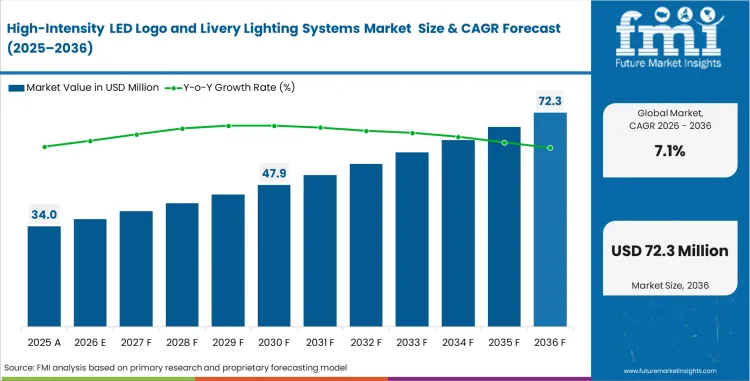
High-intensity LED logo and livery lighting systems market was valued at USD 32 million in 2025. Industry outlook is estimated to reach USD 34 million in 2026, with the sector projected to advance at a 7.1% CAGR from 2026 to 2036. Valuation is likely to touch USD 68 million by 2036 as airlines continue moving exterior branding illumination toward LED systems that lower replacement frequency and fit more smoothly into fleet appearance programs.
Summary of High-Intensity LED Logo and Livery Lighting Systems Market
- High-Intensity LED Logo and Livery Lighting Systems Market Snapshot
- High-Intensity LED Logo and Livery Lighting Systems Market is valued at USD 32 million in 2025 and is projected to reach USD 68 million by 2036.
- Industry outlook points to a 7% CAGR from 2026 to 2036, creating an incremental opportunity of USD 34 million over the period.
- Category covers aviation-grade LED systems used to illuminate aircraft tail logos, exterior branding graphics, and livery-focused visual zones across commercial aircraft, business jets, and selected special-mission platforms.
- Qualification standards, installation fit, power compatibility, durability, and certification requirements keep this sector distinct from decorative lighting applications.
- High-Intensity LED Logo and Livery Lighting Systems Market Demand and Growth Drivers
- Fresh line-fit potential remains supported by ongoing aircraft deliveries, giving suppliers a steady base for exterior branding illumination programs.
- Retrofit activity stays active because in-service fleets continue moving away from halogen and other legacy lighting units toward lower-maintenance LED replacements.
- Business aviation adds another layer to industry outlook, particularly where premium exterior presentation and aircraft identity remain commercially important.
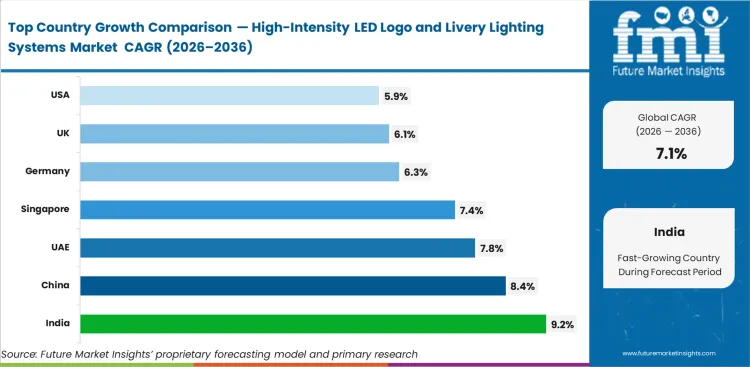
- Country-level demand analysis places India on top at 9.2% CAGR, followed by China at 8.4%, the United Arab Emirates at 7.8%, Singapore at 7.4%, Germany at 6.3%, the United Kingdom at 6.1%, and the United States at 5.9% during 2026 to 2036.
- Certification lead times, platform-specific fit requirements, and a narrower spending profile than navigation, landing, taxi, or cabin-lighting systems continue to keep expansion measured.
- High-Intensity LED Logo and Livery Lighting Systems Market Product and Segment View
- Scope covers tail logo lights, livery flood lights, graphic wash lights, and dual-mode exterior branding lights, along with integrated LEDs, LED arrays, and control-compatible retrofit modules.
- Use cases extend across commercial airlines, MRO-led retrofit work, business jets, VIP aircraft, and selected special-mission platforms where exterior identity visibility carries value.
- Long-established airline branding practice keeps tail-mounted illumination in front, and Tail Logo Lights are expected to account for 52% share in 2026.
- With the segment projected to secure 58% share in 2026 as carriers continue replacing legacy lighting hardware, installed fleet opportunity remains the main advantage for Retrofit Kits.
- Narrowbody Jets are likely to represent 46% of total market share in 2026. Narrowbody aircraft create the widest recurring replacement base.
- Lower upkeep, longer service life, and reduced power draw support Integrated LEDs, which are anticipated to emerge with 71% market share in 2026.
- Commercial Airlines are forecast to represent 64% share in 2026 as airline fleets remain the largest visible use case and deepest installed base.
- Scope includes aviation-certified exterior logo and livery illumination hardware, replacement kits, and fit-compatible modules, while cabin mood lighting, standard runway lighting, and non-aviation decorative LEDs remain outside this assessment.
- High-Intensity LED Logo and Livery Lighting Systems Market Geography and Competitive Outlook
- India, China, and the United Arab Emirates remain the fastest-rising demand centers, while the United States continues to provide a steadier replacement-driven base because of its large installed fleet and aftermarket depth.
- Competitive positioning depends more on retrofit approvals, aircraft-platform coverage, and OEM or MRO alignment than on simple price competition.
- Moderate fragmentation continues across the sector, with the leading supplier estimated to contribute 18% share due to its wider exterior-lighting capability and active logo-and-branding product presence.
Key Takeaways, Market Size, and Forecast
- High-Intensity LED Logo and Livery Lighting Systems Market is likely to increase from USD 34 million in 2026 to USD 68 million by 2036, at a CAGR of 7.1%.
- The high-intensity LED logo and livery lighting systems market was valued at USD 32 million in 2025.
- By 2036, the High-Intensity LED Logo and Livery Lighting Systems Market is predicted to reach USD 68 million.
- The market is expected to register a CAGR of 7.1% from 2026 to 2036.
- The market is projected to create an incremental opportunity of USD 34 million over the forecast period.
- In 2026, Tail Logo Lights are expected to account for 52% of the product type segment.
- India (9.2% CAGR) and China (8.4% CAGR) are anticipated to be the fastest growing markets.
Airlines no longer treat logo and livery lighting as a minor cosmetic item. Engineering teams are now weighing whether older exterior lighting hardware should stay in service until failure or be replaced with LED units during planned maintenance windows, and that decision carries direct implications for service intervals, visual consistency, and parts support. Industry outlook remains on a positive trend for platforms that combine branding visibility with lower upkeep, making this niche more relevant within the broader aircraft exterior lighting category.
Adoption does not expand automatically once LED performance is accepted. Broader conversion begins only when platform-specific fit, approval pathways, and replacement practicality line up well enough for maintenance teams to treat logo-light upgrades as routine work instead of one-off engineering activity. Once that stage is reached, repeat installations become easier to justify across sister aircraft and follow-on units.
India is expected to register 9.2% CAGR in this sector through 2036, followed by China at 8.4%, the United Arab Emirates at 7.8%, Singapore at 7.4%, Germany at 6.3%, the United Kingdom at 6.1%, and the United States at 5.9%. Faster expansion across Asia and selected Middle Eastern hubs reflects a stronger mix of aircraft additions, retrofit activity, and airline branding visibility, while mature Western markets depend more on replacement timing and installed-aircraft economics than on first-time adoption.
High-Intensity LED Logo and Livery Lighting Systems Market Key Takeaways
| Metric | Details |
|---|---|
| Industry Size (2026) | USD 34 million |
| Industry Value (2036) | USD 68 million |
| CAGR (2026-2036) | 7.1% |
Source: Future Market Insights (FMI) analysis, based on proprietary forecasting model and primary research
Segmental Analysis
High-Intensity LED Logo and Livery Lighting Systems Market Analysis by Product Type
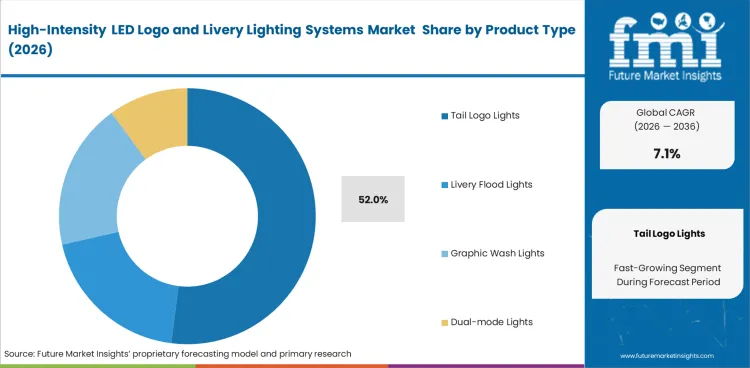
Airline branding visibility depends on where illumination delivers the clearest visual return, and tail-mounted lighting continues to serve that role better than other exterior positions. Vertical tail graphics remain visible from distance, work across a broad range of liveries, and fit long-established airline presentation priorities. Tail Logo Lights are expected to account for 52% share in 2026. Lead position comes less from novelty and more from placement efficiency, since carriers usually treat the tail as the most recognizable illuminated branding point on an aircraft exterior. Livery flood lights and graphic wash lights remain relevant for wider visual coverage, yet tail-focused systems stay ahead because they deliver recognizable brand exposure without requiring larger illuminated zones. Dual-mode units add flexibility, though adoption stays more selective where installation simplicity carries more weight.
- Placement advantage: Tail-mounted illumination serves the most visible airline branding area during ground presence and night operations. Maintenance teams can justify upgrades more easily where visual return is immediate.
- Airline familiarity: Airlines already understand tail-branding value, and that shortens internal acceptance for this product type. Familiar use cases also keep suppliers closer to repeat-fit opportunities.
- Upgrade practicality: Broader livery lighting can require more coordination across exterior surfaces. Tail units usually face a cleaner justification path where installation scope needs to stay controlled.
High-Intensity LED Logo and Livery Lighting Systems Market Analysis by Installation Type
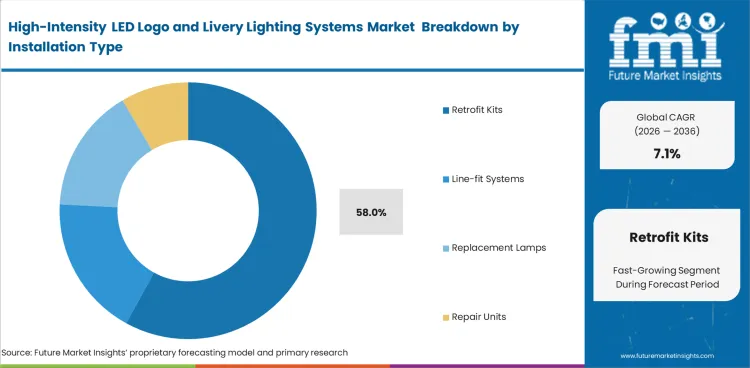
Installed aircraft create the largest current opening in this category because airlines already operate units that can be upgraded without waiting for new deliveries. Retrofit Kits are projected to secure 58% share in 2026, reflecting the size of the addressable in-service base and the practical value of replacing older lighting hardware during planned checks. Line-fit systems remain relevant, though retrofit demand analysis stays stronger because operators want visible improvement without tying every upgrade to new-aircraft intake. Replacement lamps and repair units continue to serve narrower needs, especially where carriers prefer incremental upkeep over broader kit replacement. Retrofit leadership also reflects maintenance reality. Once an LED solution proves easier to support than legacy lighting, repeat conversion across similar aircraft becomes easier to defend inside operating plans.
- Installed-base pull: Active aircraft create a larger immediate opportunity than line-fit alone. Industry outlook favors solutions that can enter service through maintenance windows already on the calendar.
- Service-life logic: LED retrofits attract attention where lamp replacement frequency has become an annoyance rather than a tolerable routine. Lower intervention needs strengthen the case for conversion.
- Execution control: Full replacement never happens all at once. Kit-based adoption lets carriers phase upgrades across aircraft groups without reopening wider lighting programs.
High-Intensity LED Logo and Livery Lighting Systems Market Analysis by Aircraft Type
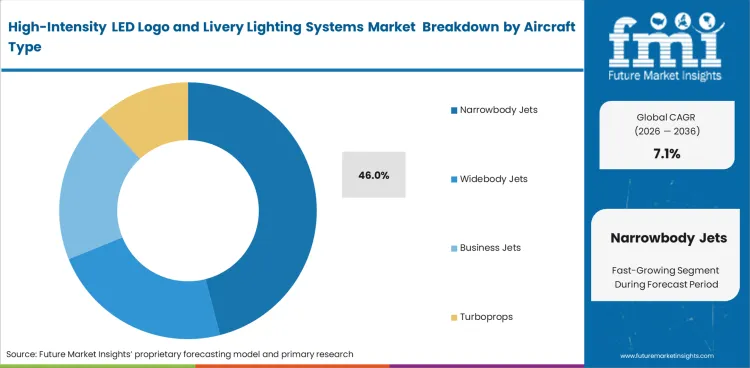
Aircraft count matters more than prestige in this category, and narrowbody platforms keep that advantage across airline operations. Broad active aircraft presence and recurring replacement potential across short- and medium-haul routes keep this class ahead of other aircraft categories. Narrowbody Jets are likely to represent 46% of the market in 2026. Widebody jets still matter where night branding and premium exterior presentation carry greater visibility, while business jets retain value in smaller but image-conscious programs. Turboprops participate more selectively, with fit, economics, and operator priorities narrowing the addressable base. Leadership here reflects routine operating arithmetic rather than any special technology preference. More aircraft in service, more maintenance events, and more repeatable replacement opportunities keep this category ahead.
- Aircraft volume: Narrowbody platforms outnumber other aircraft classes in many airline operations. Larger in-service counts naturally widen the opportunity for line-fit and retrofit work.
- Maintenance cadence: Higher utilization can bring exterior components into regular service review sooner. Frequent aircraft touchpoints help replacement programs gain traction.
- Program repeatability: Once one narrowbody variant is cleared and accepted, follow-on aircraft in the same family become easier to address. Suppliers gain better continuity where platform commonality is strong.
High-Intensity LED Logo and Livery Lighting Systems Market Analysis by Light Source
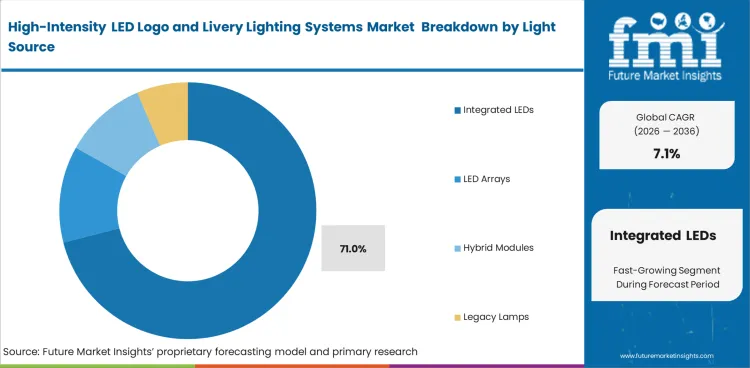
Maintenance economics continue pushing this category toward fully integrated LED systems rather than partial upgrades built around older lamp logic. Integrated LEDs are forecast to account for 71% share in 2026, reflecting their ability to combine longer service life, lower power draw, and steadier visual output in one package. LED arrays and hybrid modules still serve use cases where platform compatibility or partial replacement paths matter, but legacy lamps continue to lose ground where upkeep frequency becomes harder to justify. Integrated designs remain the preferred route when airlines want exterior lighting that stays brighter for longer without repeated intervention. Choice here stays closely tied to operating practicality. Once support burden and replacement cycles become central to the discussion, integrated LEDs gain a clear edge.
- Life-cycle value: Integrated units reduce repeat lamp changes and lower the upkeep burden on maintenance teams. Longer service intervals carry real appeal in exterior applications.
- Power efficiency: Lower energy draw supports broader airline preference for more efficient onboard systems. Benefit is modest per unit but still meaningful across fleets.
- Visual consistency: Integrated LED formats tend to deliver cleaner and more stable exterior illumination over time. Branding appearance matters more where airlines want a uniform fleet image.
High-Intensity LED Logo and Livery Lighting Systems Market Analysis by End User
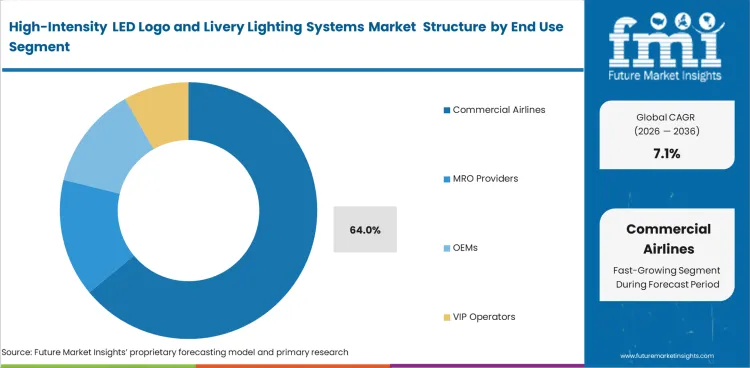
Commercial Airlines are expected to account for 64% share in 2026. Commercial aircraft continue to define the center of this category because airline branding visibility, aircraft scale, and maintenance planning all converge there. OEMs and MRO providers remain influential through installation pathways and retrofit execution, while VIP operators support a smaller but image-sensitive niche. Airline leadership is rooted in use intensity as much as operating scale. Exterior logo illumination matters most where aircraft remain visible across multiple airports and move through repeat maintenance programs that can absorb lighting upgrades into routine work. Smaller operator groups participate, though their aircraft counts and replacement frequency rarely match airline-led demand analysis.
- Brand exposure: Airlines receive the most direct visual benefit from illuminated logos and liveries. Exterior presentation carries greater weight where aircraft visibility is constant.
- Operational scale: Large aircraft counts create repeat opportunities for replacement and support. Suppliers generally find stronger continuity in airline-led programs.
- Maintenance access: Airline aircraft move through regular checks that can absorb lighting upgrades. Better access to scheduled work keeps adoption more practical.
High-Intensity LED Logo and Livery Lighting Systems Market Drivers, Restraints, and Opportunities
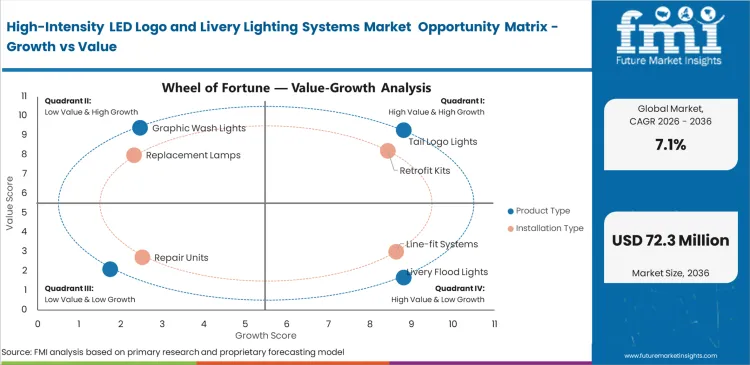
Airline maintenance planning now places more weight on parts that can reduce repeated service events without weakening visible fleet presentation. Exterior branding illumination fits that requirement where LED systems replace older hardware that needs more frequent attention. Industry outlook also favors upgrades that can be introduced during scheduled checks rather than through separate intervention cycles. Valuation in this category rises where airlines want cleaner visual consistency across active fleets and where service-life improvement is strong enough to justify replacement timing.
Platform-specific approval and fit requirements still keep adoption below full near-term potential. Engineering teams may prefer LED conversion in principle, yet installation practicality, documentation needs, and compatibility questions can slow rollout from one aircraft family to the next. Category is narrow enough that buyers do not always treat it as a top maintenance priority unless replacement logic is already clear. Delay rarely comes from weak interest alone. Competing maintenance workloads and the extra effort required to move an exterior lighting change through acceptance steps remain the bigger issue.
Opportunities in the High-Intensity LED Logo and Livery Lighting Systems Market
- Aircraft-standardization programs: Carriers trying to keep branding appearance aligned across mixed aircraft can use LED conversions to improve nighttime consistency. Opportunity is strongest where aircraft families share similar exterior presentation goals.
- Aftermarket replacement cycles: MRO-led installation work opens a recurring route for suppliers that can support practical retrofit timing. Adjacent relevance can also be read through aircraft refurbishing, where cabin and exterior refresh logic often overlap in scheduled upgrade windows.
- Premium visibility needs: Widebody operators, flag carriers, and image-conscious airlines can justify brighter exterior branding where presentation still carries commercial value. Better illumination matters most where aircraft appearance remains part of carrier identity.
Regional Analysis
Based on the regional analysis, the High-Intensity LED Logo and Livery Lighting Systems Market is segmented into North America, Latin America, Western Europe, Eastern Europe, East Asia, South Asia and Pacific, and Middle East and Africa across 40 plus countries.
.webp "Top Country Growth Comparison High Intensity Led Logo And Livery Lighting Systems Market Cagr (2026 2036)")
| Country | CAGR (2026 to 2036) |
|---|---|
| India | 9.2% |
| China | 8.4% |
| United Arab Emirates | 7.8% |
| Singapore | 7.4% |
| Germany | 6.3% |
| United Kingdom | 6.1% |
| United States | 5.9% |
Source: Future Market Insights (FMI) analysis, based on proprietary forecasting model and primary research
North America High-Intensity LED Logo and Livery Lighting Systems Market Analysis
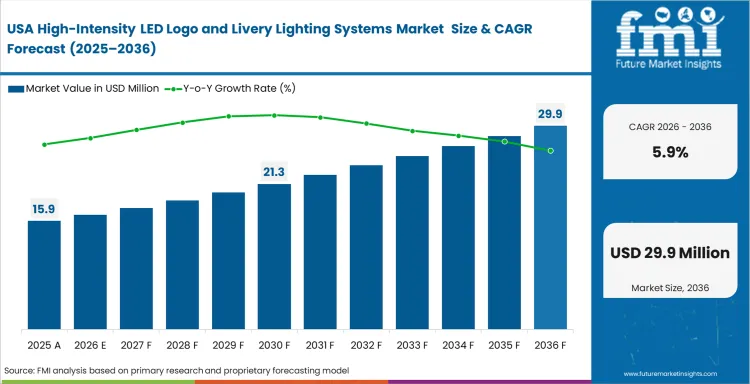
North America remains a replacement-led region where installed fleet depth matters more than first-time conversion. Airlines and maintenance teams usually assess logo and livery lighting upgrades through service-life logic, installation practicality, and support continuity rather than visual appeal alone. Exterior branding illumination becomes easier to justify when older hardware begins adding avoidable maintenance effort across active fleets. Related categories such as aircraft exterior lighting and aircraft refurbishing stay relevant because visible aircraft upgrades are often reviewed alongside broader exterior refresh priorities.
- United States: Installed aircraft scale keeps the United States central to North American valuation. Large commercial aircraft populations, a mature aftermarket base, and steady maintenance activity create a dependable environment for approved exterior lighting replacements. Industry outlook in the United States points to 5.9% CAGR through 2036, and that measured pace reflects a market driven more by replacement timing than by rapid aircraft addition. Airlines here tend to prioritize fit certainty, parts support, and maintenance practicality before broadening conversion across multiple aircraft families. Acceptance often builds gradually, since service teams prefer upgrades that can be absorbed into scheduled checks without widening engineering workload. Category direction remains steady because installed-aircraft economics continue to support repeat replacement opportunities across active aircraft.
FMI’s report includes Canada and Mexico within North America. Installed aircraft presence across these countries supports a steady base for approved exterior lighting replacement, with activity tied mainly to maintenance timing, airline branding visibility, and the practicality of integrating upgrades into scheduled service work.
Western Europe High-Intensity LED Logo and Livery Lighting Systems Market Analysis
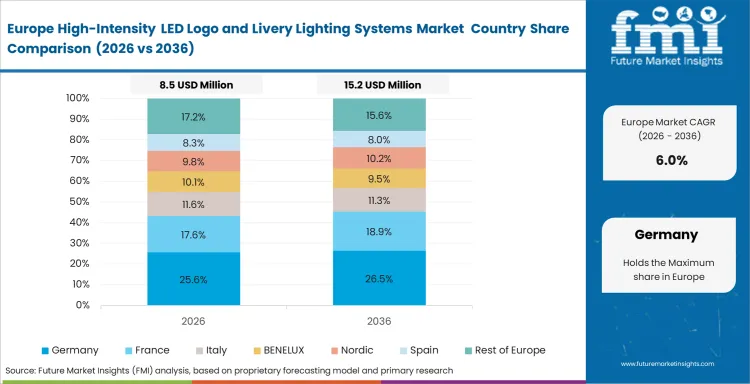
Western Europe stays commercially relevant because airline presentation standards, maintenance discipline, and engineering review processes remain well established across major airline operations. Operators in this region rarely approach exterior branding illumination as a stand-alone visual project. More often, it is assessed alongside aircraft upkeep cycles, appearance-related work, and the practical burden of supporting legacy lighting hardware over time. Adjacent areas such as aircraft interior lighting and aircraft cabin interiors remain useful references because visible aircraft systems are often reviewed together during broader aircraft refresh planning.
- Germany: Engineering discipline gives Germany a firm position in this category. Airlines and service providers operating here usually place more value on installation clarity, approval confidence, and dependable upkeep than on cosmetic uplift alone. A 6.3% CAGR is expected for Germany through 2036, with category movement supported by steady replacement logic across mature airline operations rather than by rapid aircraft addition. Exterior branding illumination remains relevant where carriers want visual consistency without creating unnecessary maintenance complexity. Local demand analysis also benefits from a strong service culture, since approved upgrades are more likely to move forward when installation fit and long-run support can be assessed clearly. Germany stays important because disciplined acceptance in this market often signals how similar Western European operators will evaluate the same type of upgrade.
- United Kingdom: Airline visibility and dense operating networks keep the United Kingdom active in this sector. Exterior presentation carries value where aircraft recognition matters across busy domestic and international routes, and that keeps approved lighting replacements commercially relevant. Maintenance access also supports adoption, since upgrades become easier to defend when they can be introduced during routine aircraft checks. Midway through the country’s operating logic sits its forecast pace; the United Kingdom is likely to post 6.1% CAGR through 2036. Local industry outlook remains steady rather than fast-rising, largely because the country is working from a mature aircraft base. Even so, replacement-driven activity continues to support a credible path for suppliers that can meet fit, support, and installation requirements without adding avoidable service burden.
FMI’s report includes France within Western Europe. Airline presentation standards and established maintenance capability in this market keep exterior logo and livery lighting relevant, particularly where carriers want visual consistency without widening the scope of aircraft modification work.
East Asia and South Asia & Pacific High-Intensity LED Logo and Livery Lighting Systems Market Analysis
Aircraft addition plays a much larger role here than it does in mature Western aviation markets. Airlines across this geography are managing new-aircraft intake, rising route visibility, and stronger focus on exterior presentation at the same time. Category activity therefore comes from both line-fit and retrofit logic, which gives the region broader momentum than markets led mainly by replacement needs. Adjacent themes such as aircraft LED and global aircraft cabin interior remain close to this discussion because aircraft modernization often spans several visible systems rather than one isolated component.
- China: China is likely to post 8.4% CAGR in this sector by 2036. Scale gives China one of the strongest positions in global demand analysis for this category. Large airline operations, expanding route networks, and rising attention to visual aircraft consistency all strengthen the case for approved exterior branding illumination. Pace remains above mature Western countries because category expansion here is supported by both active aircraft additions and recurring replacement opportunities across units already in service. Airlines in this market also benefit when approved-fit products can be applied across multiple platforms with limited extra engineering effort. Country role remains important because wider operational scale improves continuity for suppliers seeking repeat installations rather than isolated conversion projects.
- India: Expansion keeps India among the country with lucrative potential. Airlines are adding aircraft, widening route visibility, and paying closer attention to how active operations present themselves across increasingly competitive aviation corridors. Maintenance capability is also becoming more relevant in decision-making, which helps exterior lighting move beyond a purely cosmetic discussion. Adoption in India is anticipated to move ahead at a 9.2% CAGR during the assessment period. Pace reflects a market where line-fit and retrofit potential are advancing together rather than in separate phases. Country outlook remains especially strong because new deliveries create fresh installation opportunities while in-service aircraft continue building a base for follow-on replacement work. India stands out as a market where category relevance is broadening on both operational and commercial fronts.
- Singapore: Industry outlook is on a positive trend in Singapore, where the market is set to advance at a 7.4% CAGR through 2036. Maintenance concentration defines Singapore’s role more clearly than aircraft count. Country importance comes from aviation support capability, engineering quality, and its position as a regional service hub where approved upgrades can be handled with discipline and efficiency. Airlines and service teams operating through Singapore tend to value installation fit, turnaround practicality, and predictable support pathways. Local category activity is therefore tied less to aircraft count and more to the country’s role in retrofit execution and regional aviation support. Singapore remains commercially relevant because service-led hubs often influence how quickly practical upgrade paths can move from evaluation into actual installation.
FMI’s report includes Japan and South Korea within East Asia. Large aviation networks, disciplined engineering review, and active aircraft support in these countries keep the category commercially relevant, especially where operators evaluate exterior lighting upgrades alongside broader aircraft modernization programs.
Middle East and Africa High-Intensity LED Logo and Livery Lighting Systems Market Analysis
Brand image carries more weight in this region than in many other aviation markets. Several fleets place visible importance on aircraft presentation, and that raises the role of logo and livery illumination beyond basic replacement economics. Widebody exposure also matters more here, giving exterior branding systems greater visual relevance on internationally visible aircraft. Connected exterior themes such as uv-resistant aircraft exterior paints and bio-based and low-voc aircraft exterior coating systems sit close to the same airline priorities because appearance-related decisions often move together.
- United Arab Emirates: Premium presentation gives the United Arab Emirates a stronger role than aircraft count alone would imply. Airlines operating here place clear value on exterior image, and that keeps branding illumination commercially relevant across highly visible aircraft. Widebody activity adds further support because logo and livery lighting carries more visual effect on larger aircraft operating long-haul routes. Country is forecast to register 7.8% CAGR in this market over the study period. Pace stays above mature Western aviation markets because category relevance is supported by both airline image priorities and disciplined aircraft upkeep. Installation decisions in this market are easier to justify when visual standards, maintenance timing, and aircraft visibility all align. Local outlook remains favorable because presentation quality continues to matter in a commercially meaningful way.
FMI’s report includes Saudi Arabia and South Africa within Middle East and Africa. Category direction across these countries is influenced by airline image priorities, maintenance readiness, and the pace at which exterior upgrade work can be absorbed into active aircraft programs.
Competitive Aligners for Market Players
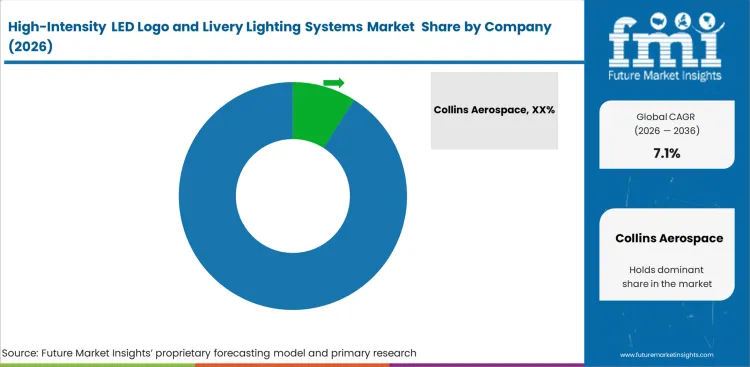
Category remains moderately fragmented because airlines and service organizations do not choose suppliers on brightness alone. Platform fit, replacement practicality, support continuity, and confidence in approved installation pathways matter just as much as light output. Collins Aerospace, Honeywell Aerospace, Astronics, Talon Aerospace, Oxley Group, PWI, and IFE Products remain relevant names in this niche because buyers prefer vendors that can stay close to aircraft compatibility requirements and ongoing fleet support. aircraft exterior lighting remains the closest broader reference point for understanding how supplier presence is judged around approved exterior illumination categories.
Established suppliers benefit from familiarity with aircraft fit requirements, long-standing service relationships, and better continuity across active aircraft programs. Challengers can still gain ground, though they usually need more than a lower-cost offer to do so. Installation confidence, repeat support, and product acceptance across specific aircraft families matter far more than broad branding claims. Advantage in this category comes from staying easy to specify, easy to support, and credible across multiple maintenance events.
Large airline customers rarely want unnecessary vendor lock-in for a niche exterior component, yet they also avoid product changes that create extra engineering work or parts uncertainty. Competitive direction through 2036 therefore points toward suppliers that can keep support practical while serving both retrofit and line-fit demand. Industry outlook is ascending for vendors that stay close to approved fit, stable replacement logic, and repeat fleet programs rather than chasing visibility alone.
Key Players in High-Intensity LED Logo and Livery Lighting Systems Market
- Collins Aerospace
- Honeywell Aerospace
- Astronics
- Talon Aerospace
- Oxley Group
- PWI
- IFE Products
Scope of the Report
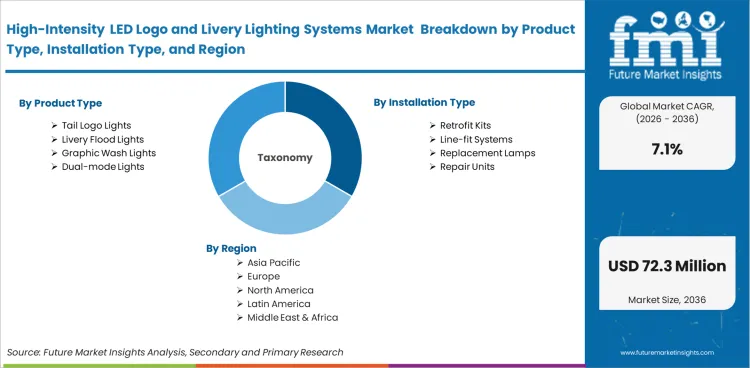
| Metric | Value |
|---|---|
| Quantitative Units | USD 34 million to USD 68 million, at a 7.1% CAGR |
| Market Definition | High-Intensity LED Logo and Livery Lighting Systems Market covers aircraft-mounted exterior logo and livery illumination systems used across commercial and selected business aviation fleets. Scope remains limited to branding-focused exterior lighting hardware rather than the full aircraft lighting category. |
| Product Type Segmentation | Tail Logo Lights, Livery Flood Lights, Graphic Wash Lights, Dual-mode Lights |
| Installation Type Segmentation | Retrofit Kits, Line-fit Systems, Replacement Lamps, Repair Units |
| Aircraft Type Segmentation | Narrowbody Jets, Widebody Jets, Business Jets, Turboprops |
| Light Source Segmentation | Integrated LEDs, LED Arrays, Hybrid Modules, Legacy Lamps |
| End User Segmentation | Commercial Airlines, MRO Providers, OEMs, VIP Operators |
| Regions Covered | North America, Latin America, Western Europe, Eastern Europe, East Asia, South Asia and Pacific, Middle East and Africa |
| Countries Covered | India, China, United Arab Emirates, Singapore, Germany, United Kingdom, United States, and 40 plus countries |
| Key Companies Profiled | Collins Aerospace, Honeywell Aerospace, Astronics, Talon Aerospace, Oxley Group, PWI, IFE Products |
| Forecast Period | 2026 to 2036 |
| Approach | FMI analysis combines airline fleet direction, aircraft platform coverage, replacement timing, supplier participation, and exterior lighting compatibility logic. Interviews with airline engineering teams, MRO specialists, and suppliers support category interpretation. Forecasts are checked against broader aircraft lighting valuation and niche install-base realities. |
Source: Future Market Insights (FMI) analysis, based on proprietary forecasting model and primary research
High-Intensity LED Logo and Livery Lighting Systems Market Analysis by Segments
Product Type:
- Tail Logo Lights
- Livery Flood Lights
- Graphic Wash Lights
- Dual-mode Lights
Installation Type:
- Retrofit Kits
- Line-fit Systems
- Replacement Lamps
- Repair Units
Aircraft Type:
- Narrowbody Jets
- Widebody Jets
- Business Jets
- Turboprops
Light Source:
- Integrated LEDs
- LED Arrays
- Hybrid Modules
- Legacy Lamps
End User:
- Commercial Airlines
- MRO Providers
- OEMs
- VIP Operators
Region:
- North America
- United States
- Canada
- Mexico
- Latin America
- Brazil
- Argentina
- Rest of Latin America
- Western Europe
- Germany
- United Kingdom
- France
- Benelux
- Nordic Countries
- Eastern Europe
- Poland
- Czech Republic
- Rest of Eastern Europe
- East Asia
- China
- Japan
- South Korea
- South Asia and Pacific
- India
- Singapore
- Australia
- Thailand
- Malaysia
- Indonesia
- Middle East and Africa
- United Arab Emirates
- Saudi Arabia
- South Africa
- Rest of Middle East and Africa
Bibliography
- Airbus. (2026, January 12). Airbus reports 793 commercial aircraft deliveries in 2025. Airbus.
- Airbus. (2025, June). Global Market Forecast 2025-2044. Airbus.
- Boeing. (2026, January 13). Boeing Announces Fourth Quarter Deliveries. Boeing.
- General Aviation Manufacturers Association. (2026, February 18). 2025 Year-End General Aviation Aircraft Shipment Report. GAMA.
- RTCA, Inc. (2024, March). DO-160 Environmental Conditions and Test Procedures for Airborne Equipment. RTCA.
This bibliography is provided for reader reference. The full FMI report contains the complete reference list with primary source documentation.
This Report Addresses
- Market intelligence to support strategic decision making across tail logo lights, livery flood lights, graphic wash lights, dual-mode lights, and aircraft-compatible LED exterior branding systems
- Market size estimation and 10-year valuation forecasts from 2026 to 2036, supported by aircraft platform mapping, fleet replacement logic, and install-base assessment
- Opportunity mapping across Product Type, Installation Type, Aircraft Type, Light Source, End User, and Region with emphasis on fit-compatible LED conversion and maintenance timing
- Segment and regional valuation forecasts covering Tail Logo Lights, Retrofit Kits, Narrowbody Jets, Integrated LEDs, and Commercial Airlines across airline engineering and MRO-led installation pathways
- Competition assessment including aircraft compatibility, installation practicality, service continuity, replacement support, and repeat fleet-program relevance
- Exterior lighting development tracking including retrofit kits, line-fit systems, replacement lamps, integrated LEDs, and approved-fit aircraft illumination assemblies
- Market access analysis covering aircraft fit requirements, replacement-cycle timing, installation practicality, and service-support expectations across active fleets
- Market report delivery in PDF, Excel, PPT, and interactive dashboard formats for executive strategy, planning, and operating benchmark use
Frequently Asked Questions
How large is the High-Intensity LED Logo and Livery Lighting Systems Market in 2026?
High-Intensity LED Logo and Livery Lighting Systems Market is estimated at USD 34 million in 2026. Value at that stage reflects a niche aviation lighting category with active retrofit and line-fit demand rather than a broad aircraft electronics segment.
What will High-Intensity LED Logo and Livery Lighting Systems Market be worth by 2036?
FMI analysis places the market at USD 68 million by 2036. Valuation expansion is expected to come from continued LED replacement across active aircraft and the wider move toward lower-upkeep exterior branding illumination.
What CAGR is projected for this market during 2026 to 2036?
Forecasts indicate a 7.1% CAGR for 2026 to 2036. Pace sits in a range that suits a specialized aircraft equipment category where replacement logic matters as much as new-aircraft intake.
Which Product Type segment is expected to lead in 2026?
Tail Logo Lights are expected to lead with 52% share in 2026. Lead position comes from the tail remaining the most recognizable illuminated airline branding point on an aircraft exterior.
Which Installation Type segment is expected to remain ahead?
Retrofit Kits are projected to account for 58.0% share in 2026. Installed aircraft create a larger immediate opening than line-fit alone, especially where carriers want visible improvement during scheduled maintenance work.
Which Aircraft Type segment stays in front of the category?
Narrowbody Jets are likely to represent 46.0% of the market in 2026. Larger aircraft counts and repeat maintenance cycles keep this aircraft class ahead of widebodies, business jets, and turboprops.
What is pushing valuation higher in this category?
LED replacement economics remain a major support factor. Airlines want exterior lighting systems that stay in service longer, reduce repeat attention, and preserve cleaner branding visibility across active aircraft.
What is the main restraint in this industry outlook?
Fit compatibility and approval effort remain the main limiting issues. Interest in LED conversion can be clear, yet rollout slows where engineering review and installation practicality vary across aircraft families.
Which country posts the fastest forecast pace?
India leads the forecast range with 9.2% CAGR through 2036. China follows at 8.4%, and the gap reflects a stronger mix of aircraft additions and rising maintenance activity in India.
Why does this category stay separate from general aircraft lighting?
Purpose is different. Logo and livery lighting exists to illuminate airline identity and exterior presentation, while navigation, landing, taxi, and cabin systems serve operational or interior functions.
Why are integrated LEDs expected to remain dominant?
Integrated LEDs are forecast to hold 71% share in 2026 because service-life extension, power efficiency, and steadier visual output matter in exterior applications. Carriers usually prefer solutions that reduce repeated lamp changes.
What defines competition in this niche?
Competition depends on fit confidence, installation practicality, and support continuity more than brightness or simple product performance.
Why do commercial airlines lead the End User category?
Commercial Airlines are expected to contribute 64.0% share in 2026 due to aircraft scale and maintenance access.
How does the United States compare with faster-rising countries?
United States is projected at 5.9% CAGR through 2036, supported by replacement activity across a mature installed base.
What keeps Germany relevant in Western Europe?
Germany is expected to record 6.3% CAGR through 2036, backed by engineering discipline and steady replacement activity.
Why is the United Kingdom still commercially relevant?
United Kingdom is likely to post 6.1% CAGR, supported by carrier visibility, installed aircraft needs, and aftermarket access.
What gives the UAE a stronger position than aircraft count alone suggests?
United Arab Emirates is forecast at 7.8% CAGR, helped by premium presentation standards and strong widebody visibility.
How does Singapore contribute if aircraft count is smaller than China or India?
Singapore is set to expand at 7.4% CAGR, driven by aviation maintenance concentration and regional service relevance.
Why does China stay near the top of the forecast range?
China is expected to advance at 8.4% CAGR through 2036 because aircraft additions widen repeat installation opportunities.
What falls outside the scope of this report?
Cabin mood lighting, reading lights, navigation lights, landing lights, taxi lights, airport lighting, and decorative LEDs are excluded.
How was this market sized by FMI?
Sizing used aircraft platform coverage, installation patterns, retrofit intensity, and aircraft-grade LED replacement economics.
What does the narrow size of this market tell readers?
It shows that this is a focused aircraft exterior niche, not a broad lighting category. Opportunity is real, though it sits inside a narrow set of approved-fit products, visible airline branding needs, and repeat replacement cycles.
What changes by 2036 in practical terms for this category?
LED-based exterior branding illumination is likely to look less like a selective upgrade and more like a normal replacement route across relevant platforms.
Preview the report firsthand - request a free sample
Get SampleGet the brochure for pricing and purchase details.
Get PDFTable of Content
- Executive Summary
- Global Market Outlook
- Demand-side Trends
- Supply-side Trends
- Technology Roadmap Analysis
- Analysis and Recommendations
- Market Overview
- Market Coverage / Taxonomy
- Market Definition / Scope / Limitations
- Research Methodology
- Chapter Orientation
- Analytical Lens and Working Hypotheses
- Market Structure, Signals, and Trend Drivers
- Benchmarking and Cross-market Comparability
- Market Sizing, Forecasting, and Opportunity Mapping
- Research Design and Evidence Framework
- Desk Research Programme (Secondary Evidence)
- Company Annual and Sustainability Reports
- Peer-reviewed Journals and Academic Literature
- Corporate Websites, Product Literature, and Technical Notes
- Earnings Decks and Investor Briefings
- Statutory Filings and Regulatory Disclosures
- Technical White Papers and Standards Notes
- Trade Journals, Industry Magazines, and Analyst Briefs
- Conference Proceedings, Webinars, and Seminar Materials
- Government Statistics Portals and Public Data Releases
- Press Releases and Reputable Media Coverage
- Specialist Newsletters and Curated Briefings
- Sector Databases and Reference Repositories
- FMI Internal Proprietary Databases and Historical Market Datasets
- Subscription Datasets and Paid Sources
- Social Channels, Communities, and Digital Listening Inputs
- Additional Desk Sources
- Expert Input and Fieldwork (Primary Evidence)
- Primary Modes
- Qualitative Interviews and Expert Elicitation
- Quantitative Surveys and Structured Data Capture
- Blended Approach
- Why Primary Evidence is Used
- Field Techniques
- Interviews
- Surveys
- Focus Groups
- Observational and In-context Research
- Social and Community Interactions
- Stakeholder Universe Engaged
- C-suite Leaders
- Board Members
- Presidents and Vice Presidents
- R&D and Innovation Heads
- Technical Specialists
- Domain Subject-matter Experts
- Scientists
- Physicians and Other Healthcare Professionals
- Governance, Ethics, and Data Stewardship
- Research Ethics
- Data Integrity and Handling
- Primary Modes
- Tooling, Models, and Reference Databases
- Desk Research Programme (Secondary Evidence)
- Data Engineering and Model Build
- Data Acquisition and Ingestion
- Cleaning, Normalisation, and Verification
- Synthesis, Triangulation, and Analysis
- Quality Assurance and Audit Trail
- Market Background
- Market Dynamics
- Drivers
- Restraints
- Opportunity
- Trends
- Scenario Forecast
- Demand in Optimistic Scenario
- Demand in Likely Scenario
- Demand in Conservative Scenario
- Opportunity Map Analysis
- Product Life Cycle Analysis
- Supply Chain Analysis
- Investment Feasibility Matrix
- Value Chain Analysis
- PESTLE and Porter’s Analysis
- Regulatory Landscape
- Regional Parent Market Outlook
- Production and Consumption Statistics
- Import and Export Statistics
- Market Dynamics
- Global Market Analysis 2021 to 2025 and Forecast, 2026 to 2036
- Historical Market Size Value (USD Million) Analysis, 2021 to 2025
- Current and Future Market Size Value (USD Million) Projections, 2026 to 2036
- Y-o-Y Growth Trend Analysis
- Absolute $ Opportunity Analysis
- Global Market Pricing Analysis 2021 to 2025 and Forecast 2026 to 2036
- Global Market Analysis 2021 to 2025 and Forecast 2026 to 2036, By Product Type
- Introduction / Key Findings
- Historical Market Size Value (USD Million) Analysis By Product Type , 2021 to 2025
- Current and Future Market Size Value (USD Million) Analysis and Forecast By Product Type , 2026 to 2036
- Tail Logo Lights
- Livery Flood Lights
- Graphic Wash Lights
- Dual-mode Lights
- Tail Logo Lights
- Y-o-Y Growth Trend Analysis By Product Type , 2021 to 2025
- Absolute $ Opportunity Analysis By Product Type , 2026 to 2036
- Global Market Analysis 2021 to 2025 and Forecast 2026 to 2036, By Installation Type
- Introduction / Key Findings
- Historical Market Size Value (USD Million) Analysis By Installation Type, 2021 to 2025
- Current and Future Market Size Value (USD Million) Analysis and Forecast By Installation Type, 2026 to 2036
- Retrofit Kits
- Line-fit Systems
- Replacement Lamps
- Repair Value (USD Million)s
- Retrofit Kits
- Y-o-Y Growth Trend Analysis By Installation Type, 2021 to 2025
- Absolute $ Opportunity Analysis By Installation Type, 2026 to 2036
- Global Market Analysis 2021 to 2025 and Forecast 2026 to 2036, By Aircraft Type
- Introduction / Key Findings
- Historical Market Size Value (USD Million) Analysis By Aircraft Type, 2021 to 2025
- Current and Future Market Size Value (USD Million) Analysis and Forecast By Aircraft Type, 2026 to 2036
- Narrowbody Jets
- Widebody Jets
- Business Jets
- Turboprops
- Narrowbody Jets
- Y-o-Y Growth Trend Analysis By Aircraft Type, 2021 to 2025
- Absolute $ Opportunity Analysis By Aircraft Type, 2026 to 2036
- Global Market Analysis 2021 to 2025 and Forecast 2026 to 2036, By Light Source
- Introduction / Key Findings
- Historical Market Size Value (USD Million) Analysis By Light Source, 2021 to 2025
- Current and Future Market Size Value (USD Million) Analysis and Forecast By Light Source, 2026 to 2036
- Integrated LEDs
- LED Arrays
- Hybrid Modules
- Legacy Lamps
- Integrated LEDs
- Y-o-Y Growth Trend Analysis By Light Source, 2021 to 2025
- Absolute $ Opportunity Analysis By Light Source, 2026 to 2036
- Global Market Analysis 2021 to 2025 and Forecast 2026 to 2036, By End Use
- Introduction / Key Findings
- Historical Market Size Value (USD Million) Analysis By End Use, 2021 to 2025
- Current and Future Market Size Value (USD Million) Analysis and Forecast By End Use, 2026 to 2036
- Commercial Airlines
- MRO Providers
- OEMs
- VIP Operators
- Commercial Airlines
- Y-o-Y Growth Trend Analysis By End Use, 2021 to 2025
- Absolute $ Opportunity Analysis By End Use, 2026 to 2036
- Global Market Analysis 2021 to 2025 and Forecast 2026 to 2036, By Region
- Introduction
- Historical Market Size Value (USD Million) Analysis By Region, 2021 to 2025
- Current Market Size Value (USD Million) Analysis and Forecast By Region, 2026 to 2036
- North America
- Latin America
- Western Europe
- Eastern Europe
- East Asia
- South Asia and Pacific
- Middle East & Africa
- Market Attractiveness Analysis By Region
- North America Market Analysis 2021 to 2025 and Forecast 2026 to 2036, By Country
- Historical Market Size Value (USD Million) Trend Analysis By Market Taxonomy, 2021 to 2025
- Market Size Value (USD Million) Forecast By Market Taxonomy, 2026 to 2036
- By Country
- USA
- Canada
- Mexico
- By Product Type
- By Installation Type
- By Aircraft Type
- By Light Source
- By End Use
- By Country
- Market Attractiveness Analysis
- By Country
- By Product Type
- By Installation Type
- By Aircraft Type
- By Light Source
- By End Use
- Key Takeaways
- Latin America Market Analysis 2021 to 2025 and Forecast 2026 to 2036, By Country
- Historical Market Size Value (USD Million) Trend Analysis By Market Taxonomy, 2021 to 2025
- Market Size Value (USD Million) Forecast By Market Taxonomy, 2026 to 2036
- By Country
- Brazil
- Chile
- Rest of Latin America
- By Product Type
- By Installation Type
- By Aircraft Type
- By Light Source
- By End Use
- By Country
- Market Attractiveness Analysis
- By Country
- By Product Type
- By Installation Type
- By Aircraft Type
- By Light Source
- By End Use
- Key Takeaways
- Western Europe Market Analysis 2021 to 2025 and Forecast 2026 to 2036, By Country
- Historical Market Size Value (USD Million) Trend Analysis By Market Taxonomy, 2021 to 2025
- Market Size Value (USD Million) Forecast By Market Taxonomy, 2026 to 2036
- By Country
- Germany
- UK
- Italy
- Spain
- France
- Nordic
- BENELUX
- Rest of Western Europe
- By Product Type
- By Installation Type
- By Aircraft Type
- By Light Source
- By End Use
- By Country
- Market Attractiveness Analysis
- By Country
- By Product Type
- By Installation Type
- By Aircraft Type
- By Light Source
- By End Use
- Key Takeaways
- Eastern Europe Market Analysis 2021 to 2025 and Forecast 2026 to 2036, By Country
- Historical Market Size Value (USD Million) Trend Analysis By Market Taxonomy, 2021 to 2025
- Market Size Value (USD Million) Forecast By Market Taxonomy, 2026 to 2036
- By Country
- Russia
- Poland
- Hungary
- Balkan & Baltic
- Rest of Eastern Europe
- By Product Type
- By Installation Type
- By Aircraft Type
- By Light Source
- By End Use
- By Country
- Market Attractiveness Analysis
- By Country
- By Product Type
- By Installation Type
- By Aircraft Type
- By Light Source
- By End Use
- Key Takeaways
- East Asia Market Analysis 2021 to 2025 and Forecast 2026 to 2036, By Country
- Historical Market Size Value (USD Million) Trend Analysis By Market Taxonomy, 2021 to 2025
- Market Size Value (USD Million) Forecast By Market Taxonomy, 2026 to 2036
- By Country
- China
- Japan
- South Korea
- By Product Type
- By Installation Type
- By Aircraft Type
- By Light Source
- By End Use
- By Country
- Market Attractiveness Analysis
- By Country
- By Product Type
- By Installation Type
- By Aircraft Type
- By Light Source
- By End Use
- Key Takeaways
- South Asia and Pacific Market Analysis 2021 to 2025 and Forecast 2026 to 2036, By Country
- Historical Market Size Value (USD Million) Trend Analysis By Market Taxonomy, 2021 to 2025
- Market Size Value (USD Million) Forecast By Market Taxonomy, 2026 to 2036
- By Country
- India
- ASEAN
- Australia & New Zealand
- Rest of South Asia and Pacific
- By Product Type
- By Installation Type
- By Aircraft Type
- By Light Source
- By End Use
- By Country
- Market Attractiveness Analysis
- By Country
- By Product Type
- By Installation Type
- By Aircraft Type
- By Light Source
- By End Use
- Key Takeaways
- Middle East & Africa Market Analysis 2021 to 2025 and Forecast 2026 to 2036, By Country
- Historical Market Size Value (USD Million) Trend Analysis By Market Taxonomy, 2021 to 2025
- Market Size Value (USD Million) Forecast By Market Taxonomy, 2026 to 2036
- By Country
- Kingdom of Saudi Arabia
- Other GCC Countries
- Turkiye
- South Africa
- Other African Union
- Rest of Middle East & Africa
- By Product Type
- By Installation Type
- By Aircraft Type
- By Light Source
- By End Use
- By Country
- Market Attractiveness Analysis
- By Country
- By Product Type
- By Installation Type
- By Aircraft Type
- By Light Source
- By End Use
- Key Takeaways
- Key Countries Market Analysis
- USA
- Pricing Analysis
- Market Share Analysis, 2025
- By Product Type
- By Installation Type
- By Aircraft Type
- By Light Source
- By End Use
- Canada
- Pricing Analysis
- Market Share Analysis, 2025
- By Product Type
- By Installation Type
- By Aircraft Type
- By Light Source
- By End Use
- Mexico
- Pricing Analysis
- Market Share Analysis, 2025
- By Product Type
- By Installation Type
- By Aircraft Type
- By Light Source
- By End Use
- Brazil
- Pricing Analysis
- Market Share Analysis, 2025
- By Product Type
- By Installation Type
- By Aircraft Type
- By Light Source
- By End Use
- Chile
- Pricing Analysis
- Market Share Analysis, 2025
- By Product Type
- By Installation Type
- By Aircraft Type
- By Light Source
- By End Use
- Germany
- Pricing Analysis
- Market Share Analysis, 2025
- By Product Type
- By Installation Type
- By Aircraft Type
- By Light Source
- By End Use
- UK
- Pricing Analysis
- Market Share Analysis, 2025
- By Product Type
- By Installation Type
- By Aircraft Type
- By Light Source
- By End Use
- Italy
- Pricing Analysis
- Market Share Analysis, 2025
- By Product Type
- By Installation Type
- By Aircraft Type
- By Light Source
- By End Use
- Spain
- Pricing Analysis
- Market Share Analysis, 2025
- By Product Type
- By Installation Type
- By Aircraft Type
- By Light Source
- By End Use
- France
- Pricing Analysis
- Market Share Analysis, 2025
- By Product Type
- By Installation Type
- By Aircraft Type
- By Light Source
- By End Use
- India
- Pricing Analysis
- Market Share Analysis, 2025
- By Product Type
- By Installation Type
- By Aircraft Type
- By Light Source
- By End Use
- ASEAN
- Pricing Analysis
- Market Share Analysis, 2025
- By Product Type
- By Installation Type
- By Aircraft Type
- By Light Source
- By End Use
- Australia & New Zealand
- Pricing Analysis
- Market Share Analysis, 2025
- By Product Type
- By Installation Type
- By Aircraft Type
- By Light Source
- By End Use
- China
- Pricing Analysis
- Market Share Analysis, 2025
- By Product Type
- By Installation Type
- By Aircraft Type
- By Light Source
- By End Use
- Japan
- Pricing Analysis
- Market Share Analysis, 2025
- By Product Type
- By Installation Type
- By Aircraft Type
- By Light Source
- By End Use
- South Korea
- Pricing Analysis
- Market Share Analysis, 2025
- By Product Type
- By Installation Type
- By Aircraft Type
- By Light Source
- By End Use
- Russia
- Pricing Analysis
- Market Share Analysis, 2025
- By Product Type
- By Installation Type
- By Aircraft Type
- By Light Source
- By End Use
- Poland
- Pricing Analysis
- Market Share Analysis, 2025
- By Product Type
- By Installation Type
- By Aircraft Type
- By Light Source
- By End Use
- Hungary
- Pricing Analysis
- Market Share Analysis, 2025
- By Product Type
- By Installation Type
- By Aircraft Type
- By Light Source
- By End Use
- Kingdom of Saudi Arabia
- Pricing Analysis
- Market Share Analysis, 2025
- By Product Type
- By Installation Type
- By Aircraft Type
- By Light Source
- By End Use
- Turkiye
- Pricing Analysis
- Market Share Analysis, 2025
- By Product Type
- By Installation Type
- By Aircraft Type
- By Light Source
- By End Use
- South Africa
- Pricing Analysis
- Market Share Analysis, 2025
- By Product Type
- By Installation Type
- By Aircraft Type
- By Light Source
- By End Use
- USA
- Market Structure Analysis
- Competition Dashboard
- Competition Benchmarking
- Market Share Analysis of Top Players
- By Regional
- By Product Type
- By Installation Type
- By Aircraft Type
- By Light Source
- By End Use
- Competition Analysis
- Competition Deep Dive
- Collins Aerospace
- Overview
- Product Portfolio
- Profitability by Market Segments (Product/Age /Sales Channel/Region)
- Sales Footprint
- Strategy Overview
- Marketing Strategy
- Product Strategy
- Channel Strategy
- Honeywell Aerospace
- Astronics
- Talon Aerospace
- Oxley Group
- PWI
- IFE Products
- Collins Aerospace
- Competition Deep Dive
- Assumptions & Acronyms Used


