

- Market Size (2026)
- USD 85 Mn
- Forecast (2036)
- USD 164 Mn
- CAGR (2026 to 2036)
- 6.8%
LED-Based Exterior Navigation and Position Lighting Systems Market Size, Market Forecast and Outlook By FMI
LED-based exterior navigation and position lighting systems market recorded a value of USD 80 million in 2025. Industry is expected to reach USD 85 million in 2026 at a CAGR of 6.8% during the forecast period. Demand buildup takes total valuation to USD 164 million through 2036 as aircraft operators continue replacing legacy exterior light assemblies with longer-life LED systems that reduce maintenance interruption and fit more easily into approved service schedules.
Summary of LED-Based Exterior Navigation and Position Lighting Systems Market
- LED-Based Exterior Navigation and Position Lighting Systems Market Snapshot
- The LED-based exterior navigation and position lighting systems market is valued at USD 80 million in 2025 and is projected to reach USD 164 million by 2036.
- The industry is expected to expand at a 6.8% CAGR from 2026 to 2036, creating an incremental opportunity of USD 79 million over the 2026 base of USD 85 million.
- This is a specification-driven aerospace niche centered on certified red, green, and white exterior position-light functions used for aircraft visibility, direction recognition, and low-visibility safety compliance.
- Competitive standing in this sector depends on certification pedigree, optical performance, vibration and EMI resistance, lifecycle cost, and retrofit fit across installed fleets.
- LED-Based Exterior Navigation and Position Lighting Systems Market Demand and Growth Drivers
- Replacement activity stays active because the commercial aircraft base remains large, which keeps retrofit and service-cycle demand relevant across certified exterior lighting systems.
- OEM demand is supported by continuing aircraft production, which sustains line-fit requirements alongside replacement activity in the installed fleet.
- LED adoption is on a positive trend because certified systems offer longer service life, lower maintenance burden, and easier replacement pathways than legacy bulb-based assemblies.
- Among key countries by 2036, India leads at 8.1% CAGR, followed by China at 8%, United Arab Emirates at 6.4%, United States at 6.1%, United Kingdom at 6%, France at 5.8%, and Germany at 5.7%.
- Industry expansion remains measured by long aerospace certification cycles, program-specific qualification work, and the need to align replacement with scheduled maintenance rather than one-off installation windows.
- LED-Based Exterior Navigation and Position Lighting Systems Market Product and Segment View
- The market covers LED-based wingtip, tail, and integrated position-light systems used across commercial aircraft, business aircraft, military aircraft, helicopters, and UAVs.
- These systems are built mainly around visible-spectrum LED assemblies, with narrower use of NVIS-compatible and dual-mode variants in defense and special-mission applications.
- Supported by the largest certified installed base and the strongest long-term delivery pipeline, commercial aircraft are expected to account for 34% share of the Platform segment in 2026.
- Retrofit is projected to secure 44% share of the Fitment segment in 2026 because operators continue replacing older exterior light assemblies during planned maintenance events and approved upgrades.
- Integrated lightsets are likely to represent 36% of the Product Type segment in 2026, reflecting buyer preference for combined functions and lower installation complexity.
- Since Visible LED serves the broadest civil certification requirement and remains the standard offer across most platforms, in 2026, it is expected to contribute 58% of total Technology segment share.
- OEM is anticipated to emerge with 39% share in the Sales Channel segment in 2026, although MRO and aftermarket channels remain relevant where legacy fleets are still being upgraded.
- The scope includes certified exterior navigation and position-light assemblies, integrated nav-strobe-position units, and related LED replacement systems, while runway lighting, cabin lighting, logo lights, and general non-aviation LED assemblies remain outside the boundary.
- LED-Based Exterior Navigation and Position Lighting Systems Market Geography and Competitive Outlook
- India, China, and the UAE are the fastest-moving demand centers, while the United States remains the most stable high-value installed-base market.
- Competitive direction in this sector is shaped more by certification breadth, retrofit approval pathways, OEM line-fit access, and aircraft-family coverage than by broad consolidation activity.
- The sector remains moderately fragmented, with competitive positioning shaped by certification coverage, approved retrofit pathways, platform fit, and the ability to support smaller aircraft and mission-specific applications.
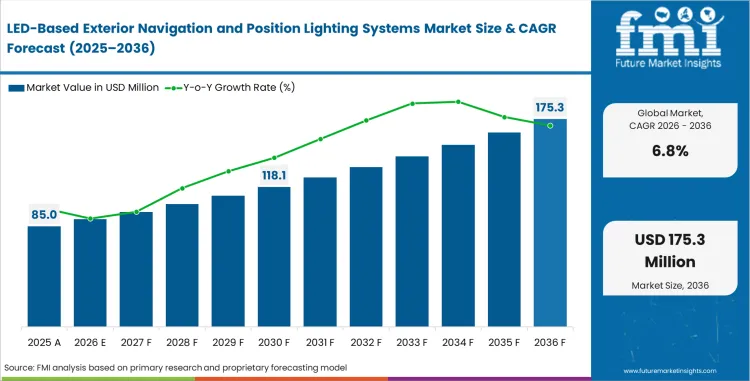
Key Takeaways, Market Size, and Forecast
- LED-Based Exterior Navigation and Position Lighting Systems Market is expected to grow from USD 85 million in 2026 to USD 164 million by 2036, at a CAGR of 6.8%.
- The LED-based exterior navigation and position lighting systems market was valued at USD 80 million in 2025.
- By 2036, the LED-Based Exterior Navigation and Position Lighting Systems Market is projected to reach USD 164 million.
- The market is predicted to register a CAGR of 6.8% over the forecast period.
- The market is forecast to create an incremental opportunity of USD 79 million over the 2026 base.
- In 2026, Commercial Aircraft is likely to hold 34% share of the platform segment.
- India (8.0% CAGR) and China (7.8% CAGR) are expected to remain the fastest growing country markets.
Airlines, business aircraft operators, defense aviation teams, and maintenance units now evaluate exterior lighting with a different lens than they did a few years ago. Decision-making has moved away from simple lamp replacement and toward certified lifecycle improvement, installation fit, and service interval control. Exterior navigation and position lighting now sit closer to broader fleet-efficiency discussions because each approved lighting change affects maintenance timing, documentation burden, and fleet standardization. Retrofit decisions in this category also sit near adjacent spending in aircraft exterior lighting, where operators prefer component packages that reduce repeat removals and keep aircraft dispatch schedules cleaner.
Qualification readiness is the gate that changes adoption speed in this sector. Once an LED configuration is cleared across a usable group of aircraft and can move through routine maintenance planning, follow-on replacement becomes easier for engineering teams, line stations, and parts support networks. Wider take-up follows when approval, fit, and stocking discipline stop being one-off work.
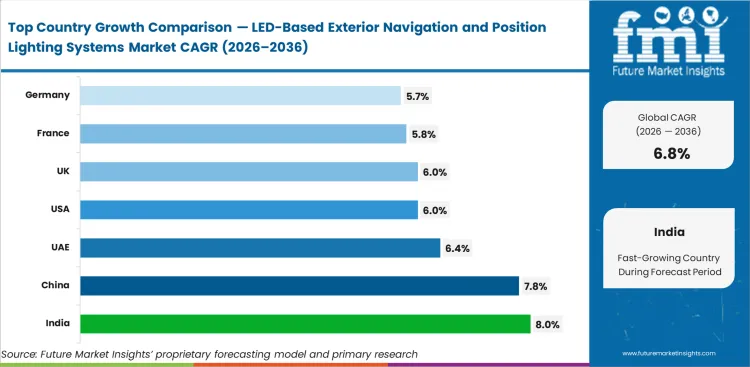
India is expected to register 8% CAGR, followed by China at 7.8%, the United Arab Emirates at 6.4%, the United States at 6.1%, the United Kingdom at 6%, France at 5.8%, and Germany at 5.7% through 2036. Faster expansion in India and China comes from fleet additions and rising maintenance intensity, while the United States stays important because a large installed base continues to generate replacement demand. Western Europe remains steadier because much of the opportunity comes from certification-led replacement and fleet upkeep rather than rapid fleet expansion.
LED-Based Exterior Navigation and Position Lighting Systems Market Key Takeaways
| Metric | Details |
|---|---|
| Industry Size (2026) | USD 85 million |
| Industry Value (2036) | USD 164 million |
| CAGR (2026-2036) | 6.8% |
Source: Future Market Insights analysis, based on proprietary forecasting model and primary research
Segmental Analysis
LED-Based Exterior Navigation and Position Lighting Systems Market Analysis by Platform
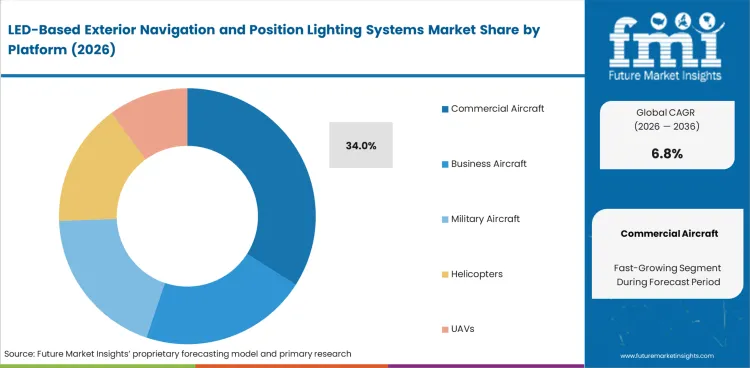
In 2026, commercial aircraft is projected to contribute 34% of total market share. Commercial aircraft remain central to this sector because exterior lighting replacement becomes a recurring requirement across large active fleets that operate under tight maintenance discipline. Service frequency, route intensity, and dispatch pressure make reliability more important here than in lower-utilization aviation categories. Commercial operators also benefit more from standardizing approved LED assemblies across aircraft families, especially where repeated lamp changes and unscheduled removals create avoidable maintenance burden. Wider fleet presence supports that lead, but the real advantage comes from how quickly reliability gains translate into fewer service interruptions across high-use aircraft. Avionics spending may attract more attention, yet exterior lighting still carries direct operating relevance when maintenance timing and dispatch discipline are under pressure.
- Installed base advantage: Commercial fleets create the broadest replacement pool, which keeps approved LED conversion active over a longer period.
- Maintenance logic: Airlines prefer lighting assemblies that can be repeated across multiple aircraft without adding extra fit uncertainty.
- Service consequence: Better durability matters more in aircraft categories where repeated access and replacement create avoidable labor load.
LED-Based Exterior Navigation and Position Lighting Systems Market Analysis by Fitment
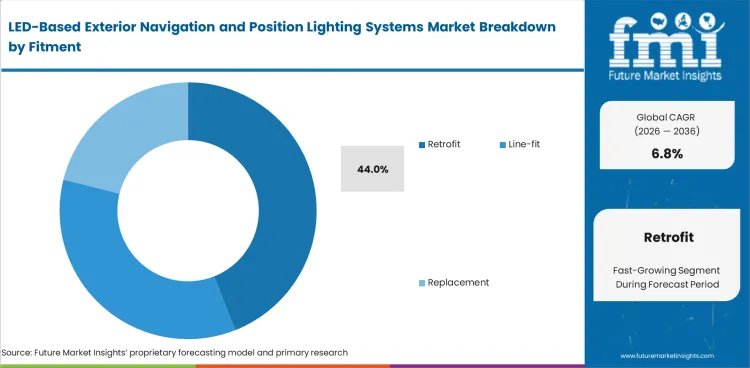
Retrofit activity matters in this category because many aircraft already in service can absorb LED conversion without waiting for new-platform purchases. Buyers in this segment are usually trying to improve lifecycle performance inside existing fleet plans rather than change aircraft architecture. Installation timing, approval coverage, and parts commonality carry more weight than novelty. Retrofit is expected to account for 44% share in 2026, reflecting how much current demand still comes from the installed fleet rather than fresh line-fit volumes. Engineering teams tend to move first where approved replacements reduce repeat maintenance and fit neatly into planned checks. That keeps retrofit commercially attractive even when capital discipline slows broader electrical spending linked to aircraft electrification.
- Installed fleet pull: Active aircraft create a larger immediate opportunity than new deliveries alone.
- Approval discipline: Buyers favor configurations that can move through known maintenance routines without extra integration burden.
- Commercial effect: Retrofit remains attractive where lifecycle savings can be captured without changing broader aircraft architecture.
LED-Based Exterior Navigation and Position Lighting Systems Market Analysis by Product Type
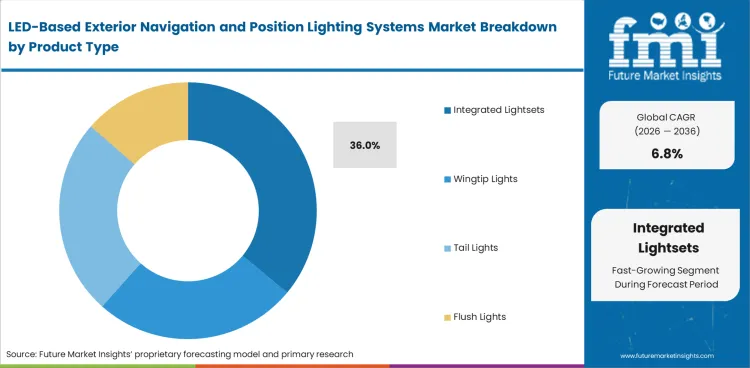
Market estimates place integrated lightsets segment garnering around 36% share in 2026. Integrated lightsets lead because they simplify installation, reduce part-count complexity, and support a cleaner service model across multiple aircraft types. Buyers generally prefer assemblies that combine functions where certification, fitment, and replacement can be managed as one approved package. Separate wingtip or tail units still matter, especially in aircraft-specific layouts, but combined systems reduce handling and replacement complexity for many operators. That lead comes from practical maintenance logic rather than feature inflation. Fewer separate units, cleaner replacement planning, and easier inventory discipline give integrated formats an advantage in a category that depends heavily on reliable electrical connections and wire and cable compatibility.
- Installation fit: Combined assemblies reduce the number of separate parts that must be handled and tracked.
- Maintenance planning: Integrated units support cleaner removal-and-replace routines during planned aircraft checks.
- Buyer preference: Operators often choose assemblies that reduce service burden more than those that simply add configuration variety.
LED-Based Exterior Navigation and Position Lighting Systems Market Analysis by Technology
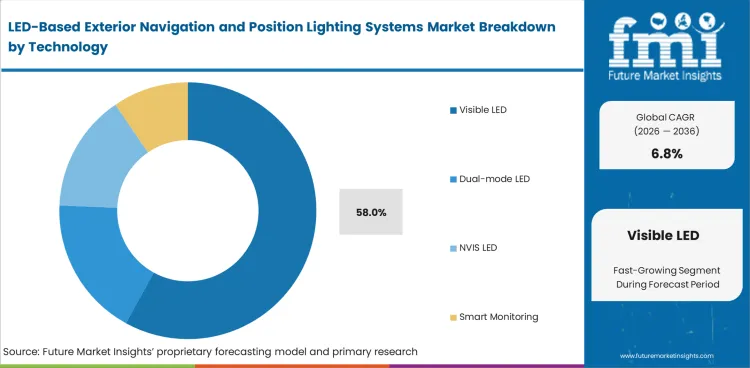
Visible LED remains the core technology because it serves the broadest range of civil aircraft requirements and has become the default path for exterior position-light replacement. Dual-mode and NVIS-compatible versions carry importance in defense and special-mission use, though those applications remain narrower in volume. Buyers choosing visible LED are typically prioritizing service life, electrical efficiency, and approved reliability over added mission-specific capability. By 2026, it is likely to represent 58% of total market share. Scale favors it, but so does its ability to satisfy mainstream aviation use without adding the extra qualification and support burden that can follow specialized configurations. Similar selection logic also appears in adjacent military lighting, where specialized requirements remain more concentrated.
- Civil platform relevance: Visible LED fits the broadest base of commercial and general certified applications.
- Qualification burden: Specialized variants carry narrower demand because support and approval needs are heavier.
- Replacement cycle effect: Mainstream LED formats move faster where they solve service-life issues without complicating installation decisions.
LED-Based Exterior Navigation and Position Lighting Systems Market Drivers, Restraints, and Opportunities
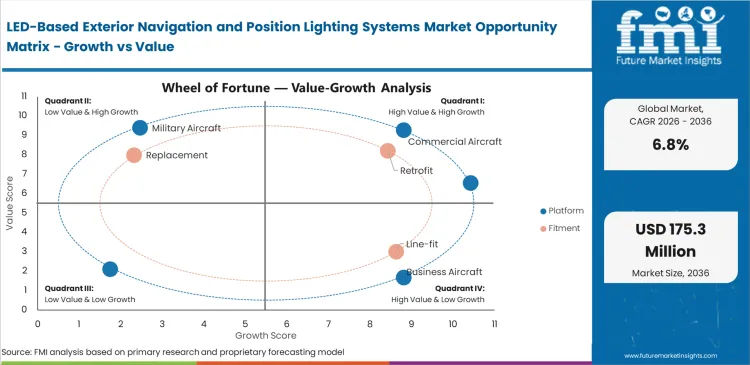
Maintenance teams continue to favor LED-based exterior navigation and position lighting because repeated bulb changes, service interruptions, and component access effort carry a visible cost across active fleets. Exterior lighting may look small beside larger aircraft systems, yet approved reliability improvement matters where aircraft utilization is high and unscheduled replacement creates avoidable downtime. Demand also benefits from the way operators increasingly treat lighting replacement as part of wider fleet-efficiency housekeeping rather than a stand-alone technical upgrade. Related movement in runway lighting reinforces the broader preference for longer-life lighting systems in aviation environments.
Qualification burden still limits faster adoption. Exterior navigation and position lighting sits inside a tightly controlled installation environment where approval coverage, aircraft-family fit, and electrical compatibility must align before repeat replacement becomes easy. Buyers may accept LED performance benefits, but adoption slows when installation logic is fragmented across platforms or when replacement must be handled outside planned maintenance timing. That keeps this category disciplined rather than fast-moving, especially in mature fleets where change approval matters as much as technical merit.
Opportunities
- Installed fleet conversion: A large active aircraft base leaves room for approved LED replacement across commercial, business, rotorcraft, and defense platforms.
- Integrated assemblies: Combined light formats can win more demand where operators want simpler stocking, cleaner fitment, and fewer service interventions.
- Regional maintenance depth: Aviation centers with stronger engineering capability and repair capacity are well placed to absorb certified replacement programs at scale.
Regional Analysis
Regional industry outlook for LED-based exterior navigation and position lighting systems stays tied to fleet size, maintenance depth, aircraft utilization, and the ease with which certified assemblies can move into repeat service. Faster-moving countries benefit from fleet additions and stronger repair activity, while mature aviation bases remain important because installed aircraft continue to require replacement work. Approval discipline, engineering support, and planned maintenance timing shape this sector more directly than product novelty.
.webp "Top Country Growth Comparison Led Based Exterior Navigation And Position Lighting Systems Market Cagr (2026 2036)")
| Country | CAGR (2026 to 2036) |
|---|---|
| India | 8% |
| China | 7.8% |
| United Arab Emirates | 6.4% |
| United States | 6% |
| United Kingdom | 6% |
| France | 5.8% |
| Germany | 5.7% |
Source: Future Market Insights analysis, based on proprietary forecasting model and primary research
Asia Pacific LED-Based Exterior Navigation and Position Lighting Systems Market Analysis
Asia Pacific remains the strongest regional pocket for this sector because aircraft additions, maintenance build-up, and repair activity are rising together. Certification fit, delivery reliability, and engineering readiness shape replacement decisions across the region, so exterior lighting is treated as part of wider aircraft upkeep rather than a simple component change. India and China define most of the regional direction, though each does so for a different operational reason. India is expanding through a wider aircraft base and deeper maintenance activity, while China benefits from stronger manufacturing depth and installed fleet support. That keeps the regional outlook firm through the forecast period.
- India: India is expected to record 8% CAGR through 2036 in this market. Fleet additions keep the installed aircraft base on a positive trend, which creates more room for certified LED replacement over time. Maintenance capability is also becoming more relevant because approved assemblies need to move through scheduled checks without adding extra technical burden. Airlines in India are weighing service interval improvement, fit consistency, and the ease of handling replacement across active fleets. This keeps the country ahead of most other markets in the study period, especially where aircraft availability remains commercially important.
- China: China follows with 7.8% CAGR through 2036, supported by aviation manufacturing depth, a broad support base, and a larger installed fleet that continues to require approved component replacement. Exterior navigation and position lighting fits into a wider aircraft upkeep cycle here, where engineering teams value reliable supply, platform compatibility, and certification clarity. Local technical depth also supports this category because replacement becomes easier when assemblies can be absorbed into established service routines. China does not depend on one narrow source of industry movement in this segment. Its position is supported by fleet scale, technical capability, and the need to maintain service quality across a large aviation system.
FMI analysis indicates that Asia Pacific will remain the leading regional pocket because aircraft intake and active fleet servicing continue to reinforce one another across major aviation economies.
North America LED-Based Exterior Navigation and Position Lighting Systems Market Analysis
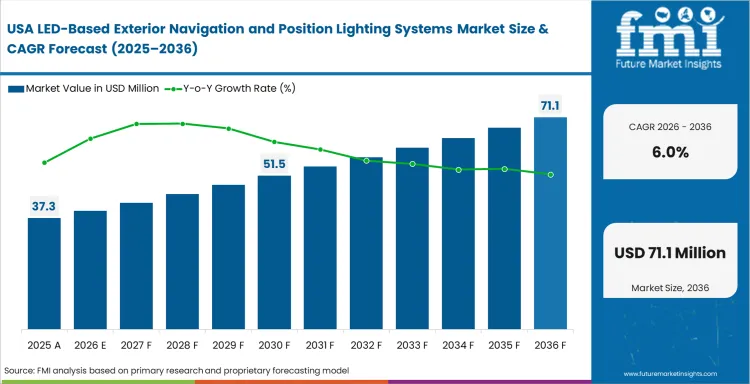
North America remains a high-value replacement base because the region carries a large installed fleet, deep maintenance capability, and a stronger culture of approved component replacement across active aircraft. Engineering teams in this region usually place more weight on documentation clarity, reliability, and repeatable fit across several aircraft families than on minor specification variation. Exterior lighting is handled as a maintenance discipline issue as much as a product decision. That keeps the region commercially relevant even when the pace is lower than in Asia Pacific. United States activity anchors the regional outlook, with replacement programs supported by fleet scale and the need to preserve dispatch reliability through approved service planning.
- United States: The industry outlook in the United States points to 6% CAGR through 2036. A broad aircraft base keeps replacement activity rising across commercial fleets, business aviation, and other certified platforms where service continuity matters. Mature MRO depth gives the country an advantage because approved LED assemblies can be installed and supported through known maintenance pathways rather than improvised one-off work. Engineering teams also place weight on documentation, electrical compatibility, and repeat maintenance logic before moving ahead with replacement programs. The United States therefore remains important less because of rapid fleet expansion and more because installed aircraft continue to require dependable exterior-lighting upgrades.
FMI analysis indicates that North America will remain commercially significant because installed-base replacement and disciplined serviceability continue to support a steady stream of approved lighting activity.
Europe and Middle East LED-Based Exterior Navigation and Position Lighting Systems Market Analysis
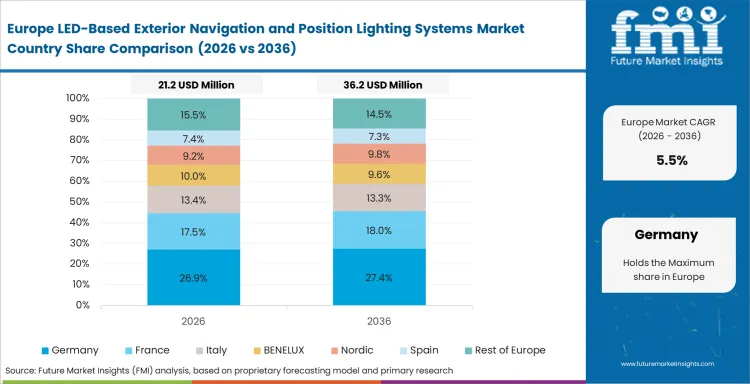
Europe and the Middle East remain relevant through engineering depth, certification discipline, and heavy-use aviation operations. Regional direction does not come from one uniform pattern. Middle Eastern activity is shaped more by concentrated airline operations and technical service intensity, while Europe contributes through long-cycle fleet support, mature engineering capability, and organized maintenance planning. Across both geographies, carriers tend to prefer approved assemblies that reduce repeat removals and fit cleanly into scheduled service events. United Arab Emirates leads this regional set, while the United Kingdom, France, and Germany hold steady positions supported by established aviation ecosystems and tighter maintenance control over active fleets.
- United Arab Emirates: Heavy-use fleet environments keep exterior lighting commercially relevant because component reliability matters when aircraft utilization is high and maintenance timing is tightly managed. United Arab Emirates is forecast to register 6.4% CAGR in this market over the study period. Strong technical service capability also supports adoption, since approved LED assemblies can be integrated more smoothly where engineering readiness is already in place. Carriers in the country are likely to prioritize dependable operation, certification fit, and replacement simplicity over expanded feature sets. That gives the UAE a stronger position than many mature aviation locations where replacement activity remains steadier.
- United Kingdom: The United Kingdom is likely to post 6% CAGR in the sector by 2036. Industry outlook here is supported by established fleet upkeep practices, engineering discipline, and the continued need to manage replacement through approved technical pathways. Exterior navigation and position lighting remains relevant because carriers prefer assemblies that reduce repeat service effort and maintain aircraft readiness without creating extra fit uncertainty. Maintenance planning carries real weight in the United Kingdom, especially where service continuity and documentation standards shape replacement decisions. The country stays relevant in this category because stable aviation operations continue to support certified replacement across active aircraft.
- France: France is expected to record 5.8% CAGR in the market during the forecast period. Aircraft support capability, technical oversight, and a mature aviation base keep replacement activity on a positive trend even without the faster pace seen in Asia Pacific. Engineering teams here usually pay close attention to installation fit, product reliability, and the ease with which approved assemblies can be absorbed into planned service schedules. Exterior lighting decisions therefore stay tied to upkeep discipline rather than isolated component spending. France remains commercially relevant because strong engineering culture and organized fleet support allow exterior-lighting upgrades to move ahead in a controlled and repeatable manner.
- Germany: Maintenance quality, aircraft systems integration, and disciplined service planning keep Germany relevant in this category. The market in Germany is projected to expand at a CAGR of 5.7% through 2036. Engineering teams generally favor approved assemblies that support reliable operation and reduce repeated intervention across active fleets. Technical evaluation tends to remain practical, with more weight placed on fit consistency and serviceability than on broad feature variation. Germany may sit slightly below the faster countries in the study, yet its role remains important because mature engineering capacity and careful maintenance execution continue to support replacement activity. That keeps the country commercially steady across the forecast period.
FMI analysis indicates that Europe and the Middle East will remain important to this sector because technical service depth, approval discipline, and aircraft availability priorities continue to support repeat replacement activity across mature aviation systems.
Competitive Aligners for Market Players
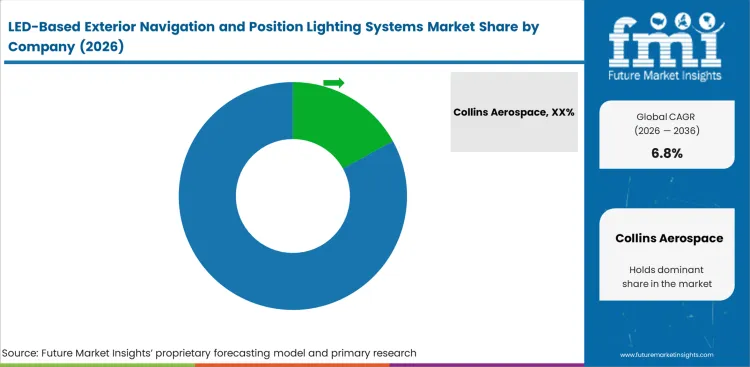
Competition in this category is shaped less by broad pricing moves and more by approval coverage, product reliability, and fit across different aircraft platforms. Buyers usually favor suppliers that can support repeat installation with minimal service disruption. Exterior navigation and position lighting looks like a narrow hardware category, yet selection often turns on whether the supplier can support approved configurations across several aircraft families without creating extra engineering effort.
Collins Aerospace, Safran Electrical & Power, Astronics Corporation, Diehl Aviation, Oxley Group, AVEO Engineering, and AeroLEDs operate across different parts of this competitive field. Larger suppliers benefit from wider platform reach and stronger integration depth, while specialist players remain visible where retrofit focus, business aviation presence, rotorcraft support, or compact certified assemblies matter more. Buyers do not evaluate these companies in the same way across every platform, because platform type, service expectations, and installation pathways differ widely.
Next competitive separation is likely to come from aircraft-family coverage, replacement simplicity, and the ability to support operators through approved maintenance logic rather than from feature-heavy positioning alone. Demand in adjacent categories such as aircraft interior lighting may widen overall awareness of LED aviation systems, but this niche remains grounded in certified fit, service interval value, and repeat replacement discipline.
Key Players in LED-Based Exterior Navigation and Position Lighting Systems Market
- Collins Aerospace
- Safran Electrical & Power
- Astronics Corporation
- Diehl Aviation
- Oxley Group
- AVEO Engineering
- AeroLEDs
Scope of the Report
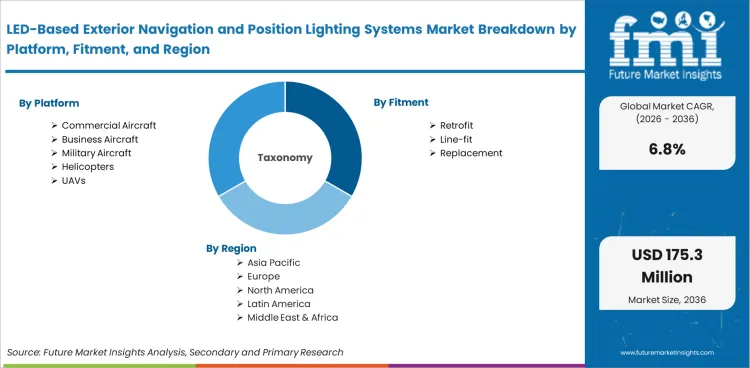
| Item | Value |
|---|---|
| Quantitative Units | USD 80 million in 2025 to USD 164 million by 2036, at a 6.8% CAGR |
| Market Definition | Certified LED-based aircraft exterior navigation and position lighting systems used to support regulated visibility and directional identification functions across aviation platforms |
| Segmentation | Platform, Fitment, Product Type, Technology, and Region |
| By Platform | Commercial Aircraft, Business Aircraft, Military Aircraft, Helicopters, UAVs |
| By Fitment | Retrofit, Line-fit, Replacement |
| By Product Type | Integrated Lightsets, Wingtip Lights, Tail Lights, Flush Lights |
| By Technology | Visible LED, Dual-mode LED, NVIS LED, Smart Monitoring |
| Regions Covered | North America, Europe and Middle East, Asia Pacific |
| Countries Covered | India, China, United Arab Emirates, United States, United Kingdom, France, Germany |
| Key Companies Profiled | Collins Aerospace, Safran Electrical & Power, Astronics Corporation, Diehl Aviation, Oxley Group, AVEO Engineering, AeroLEDs |
| Forecast Period | 2026 to 2036 |
| Approach | Installed-base replacement analysis, line-fit demand assessment, retrofit conversion logic, platform-wise fitment mapping, and supplier coverage evaluation |
Source: Future Market Insights analysis, based on proprietary forecasting model and primary research
LED-Based Exterior Navigation and Position Lighting Systems Market Analysis by Segments
By Platform
- Commercial Aircraft
- Business Aircraft
- Military Aircraft
- Helicopters
- UAVs
By Fitment
- Retrofit
- Line-fit
- Replacement
By Product Type
- Integrated Lightsets
- Wingtip Lights
- Tail Lights
- Flush Lights
By Technology
- Visible LED
- Dual-mode LED
- NVIS LED
- Smart Monitoring
By Region
- North America
- United States
- Europe
- United Kingdom
- France
- Germany
- Middle East
- United Arab Emirates
- Asia Pacific
- India
- China
Bibliography
- Airbus. (2026, January 12). Airbus reports 793 commercial aircraft deliveries in 2025.
- Boeing. (2026, January 13). Boeing announces fourth quarter deliveries.
- Boeing. (2025). Commercial market outlook 2025-2044.
- International Air Transport Association. (2025, August). The global commercial aircraft fleet.
- Radio Technical Commission for Aeronautics. (2026, March). DO-160 standards & training.
This bibliography is provided for reader reference. The full FMI report contains the complete reference list with primary source documentation.
This Report Addresses
- Market valuation for LED-based exterior navigation and position lighting systems in 2025, 2026, and 2036
- Forecast outlook for the sector between 2026 and 2036
- Platform-wise demand analysis across commercial, business, military, rotorcraft, and UAV categories
- Fitment analysis covering retrofit, line-fit, and replacement demand
- Product-type outlook across integrated lightsets, wingtip lights, tail lights, and flush lights
- Technology analysis across visible LED, dual-mode LED, NVIS LED, and smart monitoring formats
- Country-level outlook for India, China, United States, United Kingdom, France, Germany, and United Arab Emirates
- Competitive positioning of major suppliers active in the category
Frequently Asked Questions
What is the estimated size of the LED-Based Exterior Navigation and Position Lighting Systems Market in 2026?
LED-Based Exterior Navigation and Position Lighting Systems Market is estimated at USD 85 million in 2026, reflecting replacement demand from active fleets and ongoing approved LED conversion activity.
What valuation is projected for the LED-Based Exterior Navigation and Position Lighting Systems Market by 2036?
LED-Based Exterior Navigation and Position Lighting Systems Market is projected to reach USD 164 million by 2036 as certified replacement demand continues across commercial and special-use aircraft.
What CAGR is expected for the LED-Based Exterior Navigation and Position Lighting Systems Market?
LED-Based Exterior Navigation and Position Lighting Systems Market is expected to advance at 6.8% CAGR from 2026 to 2036, supported by retrofit demand and broader LED replacement logic.
Which platform leads the LED-Based Exterior Navigation and Position Lighting Systems Market?
Commercial Aircraft is expected to lead the LED-Based Exterior Navigation and Position Lighting Systems Market, with 34% share projected in 2026 because the installed fleet remains widest here.
Which fitment category leads the LED-Based Exterior Navigation and Position Lighting Systems Market?
Retrofit leads the LED-Based Exterior Navigation and Position Lighting Systems Market, with 44% share expected in 2026 as in-service aircraft continue absorbing approved LED replacements.
Which product type holds the strongest position in the LED-Based Exterior Navigation and Position Lighting Systems Market?
Integrated Lightsets are projected to account for 36% share in the LED-Based Exterior Navigation and Position Lighting Systems Market in 2026 due to easier installation control.
Which technology dominates the LED-Based Exterior Navigation and Position Lighting Systems Market?
Visible LED is expected to represent 58% share in the LED-Based Exterior Navigation and Position Lighting Systems Market in 2026 because it fits mainstream civil aircraft requirements.
Why does retrofit matter so much in the LED-Based Exterior Navigation and Position Lighting Systems Market?
Retrofit matters because many aircraft already in service can adopt approved LED replacements during scheduled checks, which keeps replacement demand active without waiting for new deliveries.
Why do airlines invest in the LED-Based Exterior Navigation and Position Lighting Systems Market?
Airlines invest in the LED-Based Exterior Navigation and Position Lighting Systems Market to improve service life, reduce repeated maintenance effort, and standardize approved exterior light assemblies.
What keeps adoption disciplined in the LED-Based Exterior Navigation and Position Lighting Systems Market?
Qualification burden, aircraft-family fit, electrical compatibility, and maintenance timing keep adoption disciplined in the LED-Based Exterior Navigation and Position Lighting Systems Market despite clear service-life benefits.
How is the LED-Based Exterior Navigation and Position Lighting Systems Market different from broader aviation lighting?
LED-Based Exterior Navigation and Position Lighting Systems Market is narrower because it covers certified exterior position and navigation-light assemblies, not cabin lighting, runway lighting, or airport systems.
What types of aircraft are covered in the LED-Based Exterior Navigation and Position Lighting Systems Market?
LED-Based Exterior Navigation and Position Lighting Systems Market covers commercial aircraft, business aircraft, military aircraft, helicopters, and UAVs where certified exterior lighting is required.
Which countries are expanding fastest in the LED-Based Exterior Navigation and Position Lighting Systems Market?
India and China are the fastest-expanding countries in the LED-Based Exterior Navigation and Position Lighting Systems Market, with 8% and 7.8% CAGR respectively through 2036.
Why is India a strong country in the LED-Based Exterior Navigation and Position Lighting Systems Market?
India is strong in the LED-Based Exterior Navigation and Position Lighting Systems Market because fleet additions and maintenance capability are rising together, supporting recurring approved replacement activity.
Why does the United States remain important in the LED-Based Exterior Navigation and Position Lighting Systems Market?
United States remains important because a large installed aircraft base continues generating steady replacement demand, even though its 6% CAGR is lower than India or China.
How does the United Arab Emirates contribute to the LED-Based Exterior Navigation and Position Lighting Systems Market?
United Arab Emirates contributes through high-utilization fleet operations, strong technical support, and premium maintenance discipline, which support a 6.4% CAGR through 2036.
What do buyers usually compare in the LED-Based Exterior Navigation and Position Lighting Systems Market?
Buyers usually compare approval coverage, service life, installation fit, replacement simplicity, and aircraft-family compatibility when evaluating suppliers in the LED-Based Exterior Navigation and Position Lighting Systems Market.
Who are the key suppliers in the LED-Based Exterior Navigation and Position Lighting Systems Market?
Key suppliers in the LED-Based Exterior Navigation and Position Lighting Systems Market include Collins Aerospace, Safran Electrical & Power, Astronics Corporation, Diehl Aviation, Oxley Group, AVEO Engineering, and AeroLEDs.
Why do integrated lightsets lead in the LED-Based Exterior Navigation and Position Lighting Systems Market?
Integrated lightsets lead because they simplify installation planning, reduce separate part handling, and help maintenance teams manage approved replacement as one cleaner service event.
What is excluded from the LED-Based Exterior Navigation and Position Lighting Systems Market?
LED-Based Exterior Navigation and Position Lighting Systems Market excludes cabin lighting, landing lights, taxi lights, logo lights, runway lighting, and non-aviation LED assemblies.
How are the LED-Based Exterior Navigation and Position Lighting Systems Market researched?
LED-Based Exterior Navigation and Position Lighting Systems Market is researched through primary interviews, technical desk review, installed-base replacement modeling, and country-level forecast triangulation.
What makes visible LED the main technology in the LED-Based Exterior Navigation and Position Lighting Systems Market?
Visible LED leads because it serves the broadest certified civil applications and delivers the service-life improvement buyers want without the narrower qualification burden of specialized variants.
What kind of competitive environment defines the LED-Based Exterior Navigation and Position Lighting Systems Market?
LED-Based Exterior Navigation and Position Lighting Systems Market shows a moderately fragmented competitive environment where approval breadth and service support matter as much as product reliability.
What should suppliers focus on in the LED-Based Exterior Navigation and Position Lighting Systems Market?
Suppliers in the LED-Based Exterior Navigation and Position Lighting Systems Market should focus on aircraft-family coverage, approved retrofit pathways, and service-friendly replacement logic that reduces operator burden.
Preview the report firsthand - request a free sample
Get SampleGet the brochure for pricing and purchase details.
Get PDFTable of Content
- Executive Summary
- Global Market Outlook
- Demand-side Trends
- Supply-side Trends
- Technology Roadmap Analysis
- Analysis and Recommendations
- Market Overview
- Market Coverage / Taxonomy
- Market Definition / Scope / Limitations
- Research Methodology
- Chapter Orientation
- Analytical Lens and Working Hypotheses
- Market Structure, Signals, and Trend Drivers
- Benchmarking and Cross-market Comparability
- Market Sizing, Forecasting, and Opportunity Mapping
- Research Design and Evidence Framework
- Desk Research Programme (Secondary Evidence)
- Company Annual and Sustainability Reports
- Trade Journals, Industry Magazines, and Analyst Briefs
- Conference Proceedings, Webinars, and Seminar Materials
- Government Statistics Portals and Public Data Releases
- Press Releases and Reputable Media Coverage
- Specialist Newsletters and Curated Briefings
- Sector Databases and Reference Repositories
- FMI Internal Proprietary Databases and Historical Market Datasets
- Subscription Datasets and Paid Sources
- Social Channels, Communities, and Digital Listening Inputs
- Additional Desk Sources
- Expert Input and Fieldwork (Primary Evidence)
- Primary Modes
- Qualitative Interviews and Expert Elicitation
- Quantitative Surveys and Structured Data Capture
- Blended Approach
- Why Primary Evidence is Used
- Field Techniques
- Interviews
- Surveys
- Focus Groups
- Observational and In-context Research
- Social and Community Interactions
- Stakeholder Universe Engaged
- C-suite Leaders
- Board Members
- Presidents and Vice Presidents
- R&D and Innovation Heads
- Technical Specialists
- Domain Subject-matter Experts
- Scientists
- Physicians and Other Healthcare Professionals
- Governance, Ethics, and Data Stewardship
- Research Ethics
- Data Integrity and Handling
- Primary Modes
- Tooling, Models, and Reference Databases
- Desk Research Programme (Secondary Evidence)
- Data Engineering and Model Build
- Data Acquisition and Ingestion
- Cleaning, Normalisation, and Verification
- Synthesis, Triangulation, and Analysis
- Quality Assurance and Audit Trail
- Market Background
- Market Dynamics
- Drivers
- Restraints
- Opportunity
- Trends
- Scenario Forecast
- Demand in Optimistic Scenario
- Demand in Likely Scenario
- Introduction / Key Findings
- Historical Market Size Value (USD Million) Analysis By Platform , 2021 to 2025
- Current and Future Market Size Value (USD Million) Analysis and Forecast By Platform , 2026 to 2036
- Commercial Aircraft
- Business Aircraft
- Military Aircraft
- Helicopters
- UAVs
- Y-o-Y Growth Trend Analysis By Platform , 2021 to 2025
- Absolute $ Opportunity Analysis By Platform , 2026 to 2036
- Market Dynamics
- Global Market Analysis 2021 to 2025 and Forecast 2026 to 2036, By Fitment
- Introduction / Key Findings
- Historical Market Size Value (USD Million) Analysis By Fitment, 2021 to 2025
- Current and Future Market Size Value (USD Million) Analysis and Forecast By Fitment, 2026 to 2036
- Retrofit
- Line-fit
- Replacement
- Y-o-Y Growth Trend Analysis By Fitment, 2021 to 2025
- Absolute $ Opportunity Analysis By Fitment, 2026 to 2036
- Global Market Analysis 2021 to 2025 and Forecast 2026 to 2036, By Product Type
- Introduction / Key Findings
- Historical Market Size Value (USD Million) Analysis By Product Type, 2021 to 2025
- Current and Future Market Size Value (USD Million) Analysis and Forecast By Product Type, 2026 to 2036
- Integrated Lightsets
- Wingtip Lights
- Tail Lights
- Flush Lights
- Y-o-Y Growth Trend Analysis By Product Type, 2021 to 2025
- Absolute $ Opportunity Analysis By Product Type, 2026 to 2036
- Global Market Analysis 2021 to 2025 and Forecast 2026 to 2036, By Technology
- Introduction / Key Findings
- Historical Market Size Value (USD Million) Analysis By Technology, 2021 to 2025
- Current and Future Market Size Value (USD Million) Analysis and Forecast By Technology, 2026 to 2036
- Visible LED
- Dual-mode LED
- NVIS LED
- Smart Monitoring
- Y-o-Y Growth Trend Analysis By Technology, 2021 to 2025
- Absolute $ Opportunity Analysis By Technology, 2026 to 2036
- Global Market Analysis 2021 to 2025 and Forecast 2026 to 2036, By Region
- Introduction
- Historical Market Size Value (USD Million) Analysis By Region, 2021 to 2025
- Current Market Size Value (USD Million) Analysis and Forecast By Region, 2026 to 2036
- North America
- Latin America
- Western Europe
- Eastern Europe
- East Asia
- South Asia and Pacific
- Middle East & Africa
- Market Attractiveness Analysis By Region
- North America Market Analysis 2021 to 2025 and Forecast 2026 to 2036, By Country
- Historical Market Size Value (USD Million) Trend Analysis By Market Taxonomy, 2021 to 2025
- Market Size Value (USD Million) Forecast By Market Taxonomy, 2026 to 2036
- By Country
- USA
- Canada
- Mexico
- By Platform
- By Fitment
- By Product Type
- By Technology
- By Country
- Market Attractiveness Analysis
- By Country
- By Platform
- By Fitment
- By Product Type
- By Technology
- Key Takeaways
- Latin America Market Analysis 2021 to 2025 and Forecast 2026 to 2036, By Country
- Historical Market Size Value (USD Million) Trend Analysis By Market Taxonomy, 2021 to 2025
- Market Size Value (USD Million) Forecast By Market Taxonomy, 2026 to 2036
- By Country
- Brazil
- Chile
- Rest of Latin America
- By Platform
- By Fitment
- By Product Type
- By Technology
- By Country
- Market Attractiveness Analysis
- By Country
- By Platform
- By Fitment
- By Product Type
- By Technology
- Key Takeaways
- Western Europe Market Analysis 2021 to 2025 and Forecast 2026 to 2036, By Country
- Historical Market Size Value (USD Million) Trend Analysis By Market Taxonomy, 2021 to 2025
- Market Size Value (USD Million) Forecast By Market Taxonomy, 2026 to 2036
- By Country
- Germany
- UK
- Italy
- Spain
- France
- Nordic
- BENELUX
- Rest of Western Europe
- By Platform
- By Fitment
- By Product Type
- By Technology
- By Country
- Market Attractiveness Analysis
- By Country
- By Platform
- By Fitment
- By Product Type
- By Technology
- Key Takeaways
- Eastern Europe Market Analysis 2021 to 2025 and Forecast 2026 to 2036, By Country
- Historical Market Size Value (USD Million) Trend Analysis By Market Taxonomy, 2021 to 2025
- Market Size Value (USD Million) Forecast By Market Taxonomy, 2026 to 2036
- By Country
- Russia
- Poland
- Hungary
- Balkan & Baltic
- Rest of Eastern Europe
- By Platform
- By Fitment
- By Product Type
- By Technology
- By Country
- Market Attractiveness Analysis
- By Country
- By Platform
- By Fitment
- By Product Type
- By Technology
- Key Takeaways
- East Asia Market Analysis 2021 to 2025 and Forecast 2026 to 2036, By Country
- Historical Market Size Value (USD Million) Trend Analysis By Market Taxonomy, 2021 to 2025
- Market Size Value (USD Million) Forecast By Market Taxonomy, 2026 to 2036
- By Country
- China
- Japan
- South Korea
- By Platform
- By Fitment
- By Product Type
- By Technology
- By Country
- Market Attractiveness Analysis
- By Country
- By Platform
- By Fitment
- By Product Type
- By Technology
- Key Takeaways
- South Asia and Pacific Market Analysis 2021 to 2025 and Forecast 2026 to 2036, By Country
- Historical Market Size Value (USD Million) Trend Analysis By Market Taxonomy, 2021 to 2025
- Market Size Value (USD Million) Forecast By Market Taxonomy, 2026 to 2036
- By Country
- India
- ASEAN
- Australia & New Zealand
- Rest of South Asia and Pacific
- By Platform
- By Fitment
- By Product Type
- By Technology
- By Country
- Market Attractiveness Analysis
- By Country
- By Platform
- By Fitment
- By Product Type
- By Technology
- Key Takeaways
- Middle East & Africa Market Analysis 2021 to 2025 and Forecast 2026 to 2036, By Country
- Historical Market Size Value (USD Million) Trend Analysis By Market Taxonomy, 2021 to 2025
- Market Size Value (USD Million) Forecast By Market Taxonomy, 2026 to 2036
- By Country
- Kingdom of Saudi Arabia
- Other GCC Countries
- Turkiye
- South Africa
- Other African Union
- Rest of Middle East & Africa
- By Platform
- By Fitment
- By Product Type
- By Technology
- By Country
- Market Attractiveness Analysis
- By Country
- By Platform
- By Fitment
- By Product Type
- By Technology
- Key Takeaways
- Key Countries Market Analysis
- USA
- Pricing Analysis
- Market Share Analysis, 2025
- By Platform
- By Fitment
- By Product Type
- By Technology
- Canada
- Pricing Analysis
- Market Share Analysis, 2025
- By Platform
- By Fitment
- By Product Type
- By Technology
- Mexico
- Pricing Analysis
- Market Share Analysis, 2025
- By Platform
- By Fitment
- By Product Type
- By Technology
- Brazil
- Pricing Analysis
- Market Share Analysis, 2025
- By Platform
- By Fitment
- By Product Type
- By Technology
- Chile
- Pricing Analysis
- Market Share Analysis, 2025
- By Platform
- By Fitment
- By Product Type
- By Technology
- Germany
- Pricing Analysis
- Market Share Analysis, 2025
- By Platform
- By Fitment
- By Product Type
- By Technology
- UK
- Pricing Analysis
- Market Share Analysis, 2025
- By Platform
- By Fitment
- By Product Type
- By Technology
- Italy
- Pricing Analysis
- Market Share Analysis, 2025
- By Platform
- By Fitment
- By Product Type
- By Technology
- Spain
- Pricing Analysis
- Market Share Analysis, 2025
- By Platform
- By Fitment
- By Product Type
- By Technology
- France
- Pricing Analysis
- Market Share Analysis, 2025
- By Platform
- By Fitment
- By Product Type
- By Technology
- India
- Pricing Analysis
- Market Share Analysis, 2025
- By Platform
- By Fitment
- By Product Type
- By Technology
- ASEAN
- Pricing Analysis
- Market Share Analysis, 2025
- By Platform
- By Fitment
- By Product Type
- By Technology
- Australia & New Zealand
- Pricing Analysis
- Market Share Analysis, 2025
- By Platform
- By Fitment
- By Product Type
- By Technology
- China
- Pricing Analysis
- Market Share Analysis, 2025
- By Platform
- By Fitment
- By Product Type
- By Technology
- Japan
- Pricing Analysis
- Market Share Analysis, 2025
- By Platform
- By Fitment
- By Product Type
- By Technology
- South Korea
- Pricing Analysis
- Market Share Analysis, 2025
- By Platform
- By Fitment
- By Product Type
- By Technology
- Russia
- Pricing Analysis
- Market Share Analysis, 2025
- By Platform
- By Fitment
- By Product Type
- By Technology
- Poland
- Pricing Analysis
- Market Share Analysis, 2025
- By Platform
- By Fitment
- By Product Type
- By Technology
- Hungary
- Pricing Analysis
- Market Share Analysis, 2025
- By Platform
- By Fitment
- By Product Type
- By Technology
- Kingdom of Saudi Arabia
- Pricing Analysis
- Market Share Analysis, 2025
- By Platform
- By Fitment
- By Product Type
- By Technology
- Turkiye
- Pricing Analysis
- Market Share Analysis, 2025
- By Platform
- By Fitment
- By Product Type
- By Technology
- South Africa
- Pricing Analysis
- Market Share Analysis, 2025
- By Platform
- By Fitment
- By Product Type
- By Technology
- USA
- Market Structure Analysis
- Competition Dashboard
- Competition Benchmarking
- Market Share Analysis of Top Players
- By Regional
- By Platform
- By Fitment
- By Product Type
- By Technology
- Competition Analysis
- Competition Deep Dive
- Collins Aerospace
- Overview
- Product Portfolio
- Profitability by Market Segments (Product/Age /Sales Channel/Region)
- Sales Footprint
- Strategy Overview
- Marketing Strategy
- Product Strategy
- Channel Strategy
- Safran Electrical & Power
- Astronics Corporation
- Diehl Aviation
- Oxley Group
- AVEO Engineering
- AeroLEDs
- Collins Aerospace
- Competition Deep Dive
- Assumptions & Acronyms Used


