

- Industry Size (2026)
- USD 578 Mn
- Forecast (2036)
- USD 1705 Mn
- CAGR (2026 to 2036)
- 11.4%
AI-Enabled Sorting Systems for Dark Plastics Market Forecast and Outlook 2026 to 2036
The AI-Enabled Sorting Systems for Dark Plastics market is projected to grow from USD 578 million in 2026 to USD 1,705 million by 2036, at a CAGR of 11.4%. Expansion is fueled by increasing volumes of black and dark plastics in post-consumer waste streams, which are traditionally difficult to sort using conventional near-infrared (NIR) systems. AI-enhanced optical sorters and deep-learning vision technologies are enabling high-purity separation, driving adoption across MRFs, large-scale recycling hubs, and urban recycling facilities.
Material streams primarily include dark PP, PE, and mixed polymers, with the technology focus on hyperspectral imaging and real-time AI classification. System providers are emphasizing modular, conveyor-integrated, and compact AI solutions to address diverse plant sizes and processing capacities. Rising regulatory mandates for recycled content, combined with sustainability commitments from packaging and consumer goods sectors, are accelerating investments in automated dark-plastic sorting systems to maximize throughput, reduce contamination, and improve circularity.
Quick Stats of the AI-Enabled Sorting Systems for Dark Plastics Market:
- AI-Enabled Sorting Systems for Dark Plastics Market Value (2026): USD 578 million
- AI-Enabled Sorting Systems for Dark Plastics Market Forecast Value (2036): USD 1,705 million
- AI-Enabled Sorting Systems for Dark Plastics Market Forecast CAGR (2026 to 2036): 11.4%
- Leading Sorting System Type in the Market: Optical + AI Sorters (45%)
- Key Growth Regions in the Market: India, China, USA, Brazil, Germany
- Top Players in the Market: TOMRA, STEINERT, MSS China, Recycleye India, Local System Integrators, Mitsubishi Electric, AMP Robotics
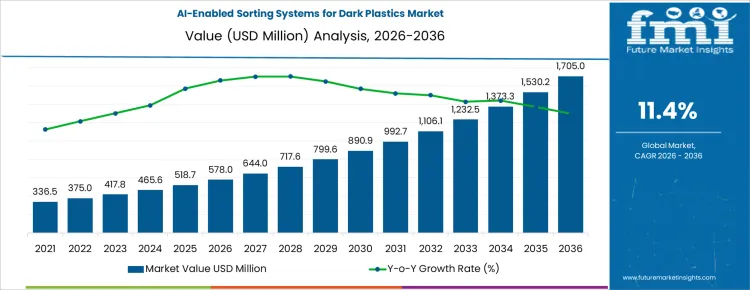
What is the Growth Forecast for the AI-Enabled Sorting Systems for Dark Plastics Market through 2036?
From 2026 to 2031, the AI-enabled sorting systems market for dark plastics grows from USD 578 million to approximately USD 960 million, representing the early adoption phase. Annual value additions increase from USD 23 million in 2026 to USD 92 million in 2031. Growth is driven by pilot implementation in recycling facilities handling post-consumer and post-industrial dark plastic waste, where traditional optical sorting fails. Adoption is concentrated in North America and Europe, accounting for roughly 65% of early market value, with operators evaluating AI accuracy, integration with conveyor systems, and throughput performance.
Between 2031 and 2036, the market expands from roughly USD 960 million to USD 1,705 million, illustrating the late adoption curve characterized by broader commercial deployment. Annual increments rise from USD 92 million to USD 225 million, supported by scaled integration across multiple recycling sites, multi-region adoption, and repeat procurement. Growth is reinforced by regulatory mandates for recycled content, increasing demand for high-quality sorted dark plastics, and structural adoption of AI-enabled systems as a standard for automated waste stream processing. Early growth relied on selective pilot programs, while later expansion is driven by full-scale industrial deployment and global market penetration.
AI Enabled Sorting Systems for Dark Plastics Market Key Takeaways
| Metric | Value |
|---|---|
| Market Value (2026) | USD 578 million |
| Forecast Value (2036) | USD 1,705 million |
| Forecast CAGR (2026 to 2036) | 11.4% |
Why Is Demand Growing for AI-Enabled Sorting Systems for Dark Plastics?
Early recycling operations struggled to separate dark plastics because conventional near-infrared (NIR) sorting technologies could not reliably identify dark or black polymer streams. Traditional NIR systems detect reflected wavelengths to classify materials, but pigments in dark plastics absorb infrared light, leaving mixed streams unresolved. As a result, black containers, automotive parts, and dark packaging were frequently diverted to residual waste or downcycled into low-value products. Manual sorting and optical aids offered limited improvement.
Demand for AI-enabled sorting systems emerged from this gap, with machine learning models and advanced sensor arrays trained to recognise dark plastics by subtle spectral, visual, and structural cues. Initial adoption was corrective and site-specific rather than broad industry practice, addressing persistent rejection rates and contamination challenges without a unifying quality standard.
Future demand for AI-enabled sorting systems for dark plastics will be driven by structural changes in recycling requirements, material circularity mandates, and product stewardship expectations rather than reactive troubleshooting alone. Regulatory frameworks and recycled content targets are increasing the volume of plastics that must be recovered and reprocessed, including polymers previously sidelined due to identification limitations.
AI systems trained on diverse material signatures, combined with multispectral sensors, will enable automated classification of dark plastics with accuracy approaching that of traditional NIR on light-coloured streams. Adoption will align with formal quality criteria for recycled feedstock and contractual recycled content obligations in packaging and durable goods.
What Factors Are Affecting the Demand for AI Enabled Sorting Systems for Dark Plastics Market in Terms of End Use Application and Sorting System or Type?
Demand for AI enabled sorting systems for dark plastics is segmented by end use application and sorting system or type across material recovery and recycling operations. MRFs and recycling plants account for about 42% of total demand, making them the leading end use segment. Packaging recycling operations, large scale sorting hubs, urban recycling facilities, municipal recycling programs, and precision recycling users represent additional applications without disclosed share splits.
What Drives Demand by End Use Application in the AI Enabled Sorting Systems for Dark Plastics Market?
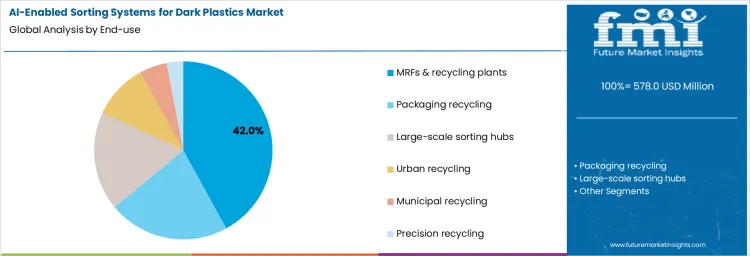
MRFs and recycling plants lead demand with a 42% share because dark plastics remain difficult to identify using conventional optical systems. These facilities face pressure to improve recovery rates without slowing line speed. Packaging recycling operations adopt AI sorting to separate dark trays, bottles, and films from mixed streams. Large scale sorting hubs apply AI systems to manage high throughput and variable feedstock quality. Urban recycling facilities favor compact systems where space is limited. Municipal recycling programs deploy selectively based on funding and infrastructure readiness. End use demand therefore reflects operational need to recover previously missed material fractions rather than expansion of recycling capacity.
Application driven demand remains stable because sorting challenges persist across feedstock streams. MRF operators integrate AI systems into existing lines to improve yield. Packaging focused recyclers adopt where dark plastics volumes justify investment. Urban and municipal users scale gradually due to capital constraints. Precision recycling applications remain niche but growing. These patterns limit short term volatility. End use segmentation highlights dependence on AI driven detection to address legacy sorting blind spots rather than discretionary technology upgrades.
How Does Sorting System or Type Shape Demand for AI Enabled Sorting Systems for Dark Plastics Market?
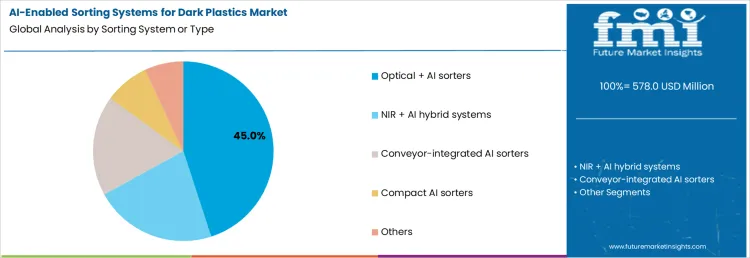
Optical plus AI sorters account for about 45% of total demand, making them the leading system type. Their dominance reflects ability to combine visual recognition with machine learning to detect carbon black and low reflectance materials. NIR and AI hybrid systems extend detection where partial spectral response is available. Conveyor integrated AI sorters support high speed lines with minimal layout disruption. Compact AI sorters are used in urban or decentralized facilities with lower throughput. Other system types address specialized sorting needs. System selection depends on line speed, material mix, and retrofit feasibility. Demand follows recovery performance under real world conditions rather than system novelty.
Optical plus AI systems maintain leadership due to proven accuracy gains. Hybrid systems remain relevant where existing NIR infrastructure is retained. Conveyor integrated units’ scale in centralized hubs. Compact systems address space constrained operations. Operators avoid frequent system changes due to integration costs. This stabilizes demand by system type. Sorting system segmentation therefore reinforces concentration in AI augmented optical platforms capable of addressing dark plastic detection limits.
How Are AI Enabled Sorting Systems for Dark Plastics Being Applied Across Recycling Facilities?
Use appears in post-consumer plastic recycling operations where conventional optical sorting struggles to identify and separate dark or black plastics. Facilities integrate AI-enabled systems using advanced cameras, machine learning, and hyperspectral imaging to detect, classify, and divert dark polymers such as PET, PP, and ABS. Appliance, automotive, and packaging recyclers adopt these technologies to improve yield, purity, and downstream recyclate quality. These applications reflect operational and material recovery priorities rather than decorative or aesthetic objectives, with adoption driven by sorting accuracy, efficiency, and recyclate value.
What Operational and Material Conditions Support Adoption of AI Enabled Sorting Systems for Dark Plastics?
Selection aligns with facilities managing mixed plastic streams with high variability in color, shape, and polymer type. AI systems are trained to recognize spectral signatures and surface features for precise classification. Process engineers integrate machines with conveyor, sensor, and ejection mechanisms to optimize throughput. Maintenance teams monitor calibration, lighting, and algorithm performance to maintain sorting reliability. These conditions emerge from operational efficiency, recyclate quality, and automation priorities within structured recycling workflows.
Which Practical Considerations Limit Wider Use of AI Enabled Sorting Systems for Dark Plastics?
High upfront capital cost and ongoing software maintenance can limit adoption in smaller facilities. Training data must be extensive and updated regularly to maintain accuracy. Integration with existing conveyor and separation lines may require modifications. Power consumption and operational complexity can increase maintenance demands. Variability in feedstock contamination or surface wear can reduce detection precision. These factors lead to selective deployment where enhanced sorting yield, recyclate purity, and operational efficiency justify incremental cost and technical investment.
What is the Demand for AI Enabled Sorting Systems for Dark Plastics by Country?
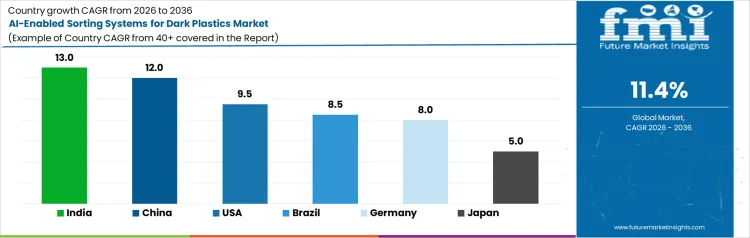
| Country | CAGR (%) |
|---|---|
| USA | 9.5% |
| Germany | 8.0% |
| China | 12.0% |
| India | 13.0% |
| Brazil | 8.5% |
The demand for AI enabled sorting systems for dark plastics varies across countries, driven by recycling efficiency, automation adoption, and regulatory pressure for improved waste management. India leads with a 13.0% CAGR, supported by growing recycling infrastructure, urban waste management initiatives, and adoption of advanced sorting technologies. China follows at 12.0%, driven by large scale plastic processing, regulatory requirements, and integration of AI in recycling operations. The USA grows at 9.5%, reflecting adoption in industrial and municipal recycling programs. Brazil records 8.5%, shaped by expanding recycling networks. Germany posts 8.0%, supported by structured recycling systems and steady technology adoption.
How Is AI-Enabled Sorting Driving Growth in Dark Plastics in the United States?
In the United States, revenue from the AI-Enabled Sorting Systems for Dark Plastics Market is expanding at a CAGR of 9.5% through 2036, driven by adoption of artificial intelligence and machine vision technologies to accurately identify and separate dark-colored post-consumer recycled (PCR) plastics. Manufacturers are integrating AI-enabled sorting systems in recycling facilities, material recovery operations, and industrial recycling lines to improve purity, throughput, and efficiency. Demand is concentrated in food and beverage packaging, automotive components, and consumer goods. Domestic suppliers provide high-performance, technology-compatible systems suitable for automated sorting lines. Growing PCR usage, regulatory compliance, and recurring recycling operations are sustaining predictable procurement nationwide.
- Recycling facilities, industrial lines, and material recovery operations drive adoption
- AI-enabled systems improve identification, purity, and throughput of dark plastics
- Domestic suppliers provide technology-compatible, high-performance sorting systems
- Recurring PCR recycling operations sustain predictable procurement
How Are Recycling Standards and Automation Supporting Growth in Germany?
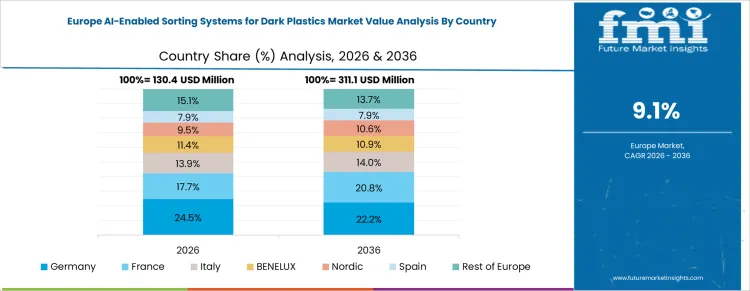
Germany continues to record steady growth in the AI-Enabled Sorting Systems for Dark Plastics Market at a CAGR of 8% through 2036, supported by strict recycling quality standards and automation initiatives. Manufacturers are adopting AI-enabled sorting to improve separation of dark-colored PCR plastics for packaging, automotive, and industrial applications. Demand is concentrated in food and beverage packaging, household products, and automotive interiors. Domestic suppliers provide high-performance systems compatible with conveyor and robotic sorting lines. Compliance with recycling regulations, material quality standards, and recurring recycling operations are sustaining measured adoption nationwide.
- Food and beverage packaging, household products, and automotive interiors anchor demand
- AI-enabled systems improve dark plastic separation and material purity
- Domestic suppliers provide conveyor- and robotic-compatible systems
- Recurring recycling operations sustain steady adoption
How Is Industrial and Municipal Recycling Expansion Accelerating Adoption in China?
In China, revenue from the AI-Enabled Sorting Systems for Dark Plastics Market is growing at a CAGR of 12% through 2036, driven by rapid expansion of post-consumer plastic recycling infrastructure and industrial processing. Manufacturers are integrating AI-enabled sorting to increase efficiency, throughput, and purity in separation of dark plastics for packaging, automotive, and consumer applications. Demand is strong across food and beverage packaging, industrial products, and automotive interiors. Domestic suppliers are scaling production of high-performance systems compatible with automated sorting and conveyor lines. Expanding recycling infrastructure and structured PCR operations are sustaining rapid adoption nationwide.
- Food and beverage packaging, industrial products, and automotive interiors drive adoption
- AI-enabled systems improve efficiency, throughput, and dark plastic separation
- Domestic suppliers scale high-performance, automated sorting systems
- Expanding recycling infrastructure sustains consistent adoption
How Is Industrial and Consumer Recycling Supporting Growth in India?
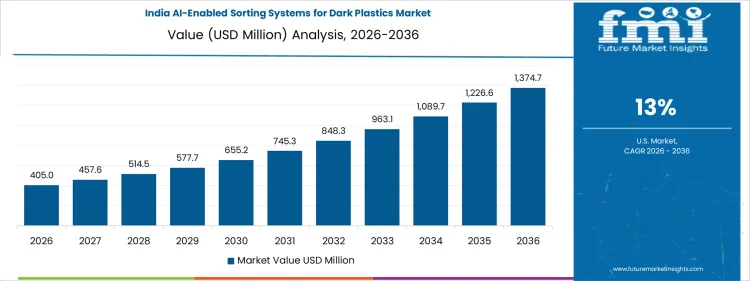
In India, revenue from the AI-Enabled Sorting Systems for Dark Plastics Market is expanding at a CAGR of 13% through 2036, supported by growing post-consumer plastic recycling and industrial sorting operations. Manufacturers are adopting AI-enabled systems to enhance separation accuracy, improve material purity, and increase processing efficiency for dark-colored PCR plastics. Demand is concentrated in food and beverage packaging, automotive components, and household goods. Domestic suppliers provide high-performance, technology-compatible sorting systems for conveyor and robotic operations. Growth in recycling facilities, recurring PCR processing, and automation initiatives are sustaining robust adoption nationwide.
- Food and beverage packaging, automotive components, and household goods drive adoption
- AI-enabled systems improve separation accuracy and material purity
- Domestic suppliers provide technology-compatible, high-performance sorting systems
- Recurring PCR processing sustains robust adoption
How Is Recycling and Industrial Facility Expansion Supporting Adoption in Brazil?
Brazil is seeing strong growth in the AI-Enabled Sorting Systems for Dark Plastics Market at a CAGR of 8.5% through 2036, supported by increasing industrial recycling operations and adoption of post-consumer recycled plastics in packaging and automotive applications. Manufacturers are integrating AI-enabled sorting systems to improve throughput, efficiency, and purity in dark plastic separation. Demand is concentrated in food and beverage packaging, household products, and automotive interiors. Domestic suppliers are expanding production of high-performance, automated sorting systems compatible with industrial lines. Growth in recycling infrastructure and recurring PCR processing are sustaining robust procurement nationwide.
- Food and beverage packaging, household products, and automotive interiors drive adoption
- AI-enabled systems improve throughput, efficiency, and separation purity
- Domestic suppliers expand automated, technology-compatible sorting systems
- Recurring PCR processing sustains robust adoption
Which Companies Are Shaping Competition in The AI Enabled Sorting Systems for Dark Plastics Market Through Detection Capability and Plant Integration?
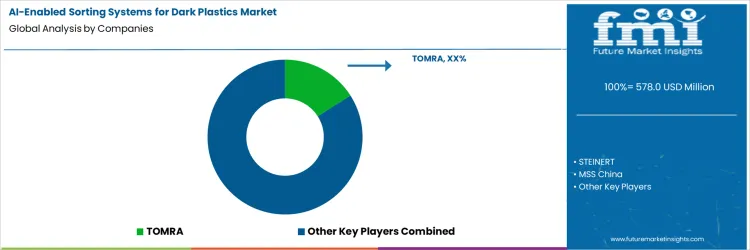
Sorting dark plastics presents technical constraints that differ from conventional NIR based separation, placing emphasis on sensor fusion, AI models, and real world plant performance. TOMRA and STEINERT influence this market through multi sensor systems combining hyperspectral imaging, electromagnetic detection, and machine learning trained on low reflectance materials. Their solutions are typically deployed in high throughput material recovery facilities where consistency and uptime are critical. Mitsubishi Electric contributes through industrial vision systems and control technologies adapted for sorting environments rather than turnkey recycling lines. System selection is driven by detection accuracy on carbon black materials, adaptability to mixed waste streams, and compatibility with existing mechanical sorting infrastructure.
Execution and adoption are shaped heavily by regional deployment models and system integration. MSS China supports cost sensitive installations through AI assisted optical sorters tailored to local waste compositions. AMP Robotics plays a role through robotic picking platforms that complement sensor based sorting where precision recovery is required. Recycleye India focuses on AI driven vision systems designed for emerging market facilities with variable feedstock quality. Local system integrators influence competitive outcomes by configuring hardware, software, and material flow layouts to site specific constraints. Competitive positioning depends on commissioning success, operator training, and sustained performance under fluctuating input conditions rather than algorithm sophistication alone.
Key Players in the AI Enabled Sorting Systems for Dark Plastics Market
- TOMRA
- STEINERT
- MSS China
- Recycleye India
- Local system integrators
- Mitsubishi Electric
- AMP Robotics
Scope of the Report
| Items | Values |
|---|---|
| Quantitative Units (2026) | USD million |
| End-use / Application | MRFs & recycling plants, Packaging recycling, Large-scale sorting hubs, Urban recycling, Municipal recycling, Precision recycling |
| Sorting System / Type | Optical + AI sorters, NIR + AI hybrid systems, Conveyor-integrated AI sorters, Compact AI sorters, Others |
| Material Stream | Black & dark plastics (PP, PE), Dark rigid packaging, Mixed dark polymers, Dark mixed plastics, Others |
| Technology | Hyperspectral imaging + AI classification, Deep-learning vision systems, Real-time AI material recognition, Cost-optimized AI algorithms, Others |
| Region | Asia Pacific (China, Japan, South Korea, India, Australia & New Zealand, ASEAN, Rest of Asia Pacific), Europe (Germany, United Kingdom, France, Italy, Spain, Nordic, BENELUX, Rest of Europe), North America (United States, Canada, Mexico), Latin America (Brazil, Chile, Rest of Latin America), Middle East & Africa (KSA, Other GCC Countries, Turkey, South Africa, Other African Union, Rest of Middle East & Africa) |
| Key Companies Profiled | TOMRA, STEINERT, MSS China, Recycleye India, Local system integrators, Mitsubishi Electric, AMP Robotics |
| Additional Attributes | Dollar by sales end-use and sorting system, adoption by end-use and system type, material stream performance, technology deployment, regional penetration, regulatory compliance, integration with existing recycling lines, operational efficiency, throughput and purity enhancement, automation and AI model training requirements |
AI Enabled Sorting Systems for Dark Plastics Market Segmentation
By End-use / Application:
- MRFs & recycling plants
- Packaging recycling
- Large-scale sorting hubs
- Urban recycling
- Municipal recycling
- Precision recycling
By Sorting System / Type:
- Optical + AI sorters
- NIR + AI hybrid systems
- Conveyor-integrated AI sorters
- Compact AI sorters
- Others
By Material Stream:
- Black & dark plastics (PP, PE)
- Dark rigid packaging
- Mixed dark polymers
- Dark mixed plastics
- Others
By Technology:
- Hyperspectral imaging + AI classification
- Deep-learning vision systems
- Real-time AI material recognition
- Cost-optimised AI algorithms
- Others
By Region:
- Asia Pacific
- China
- Japan
- South Korea
- India
- Australia & New Zealand
- ASEAN
- Rest of Asia Pacific
- Europe
- Germany
- United Kingdom
- France
- Italy
- Spain
- Nordic
- BENELUX
- Rest of Europe
- North America
- United States
- Canada
- Mexico
- Latin America
- Brazil
- Chile
- Rest of Latin America
- Middle East & Africa
- Kingdom of Saudi Arabia
- Other GCC Countries
- Turkey
- South Africa
- Other African Union
- Rest of Middle East & Africa
Frequently Asked Questions
How big is the ai-enabled sorting systems for dark plastics market in 2026?
The global ai-enabled sorting systems for dark plastics market is estimated to be valued at USD 578.0 million in 2026.
What will be the size of ai-enabled sorting systems for dark plastics market in 2036?
The market size for the ai-enabled sorting systems for dark plastics market is projected to reach USD 1,705.0 million by 2036.
How much will be the ai-enabled sorting systems for dark plastics market growth between 2026 and 2036?
The ai-enabled sorting systems for dark plastics market is expected to grow at a 11.4% CAGR between 2026 and 2036.
What are the key product types in the ai-enabled sorting systems for dark plastics market?
The key product types in ai-enabled sorting systems for dark plastics market are mrfs & recycling plants, packaging recycling, large-scale sorting hubs, urban recycling, municipal recycling and precision recycling.
Which sorting system or type segment to contribute significant share in the ai-enabled sorting systems for dark plastics market in 2026?
In terms of sorting system or type, optical + ai sorters segment to command 45.0% share in the ai-enabled sorting systems for dark plastics market in 2026.
Preview the report firsthand - request a free sample
Get SampleGet the brochure for pricing and purchase details.
Get PDFTable of Content
- Executive Summary
- Global Market Outlook
- Demand-side Trends
- Supply-side Trends
- Technology Roadmap Analysis
- Analysis and Recommendations
- Market Overview
- Market Coverage / Taxonomy
- Market Definition / Scope / Limitations
- Market Background
- Market Dynamics
- Drivers
- Restraints
- Opportunity
- Trends
- Scenario Forecast
- Demand in Optimistic Scenario
- Demand in Likely Scenario
- Demand in Conservative Scenario
- Opportunity Map Analysis
- Product Life Cycle Analysis
- Supply Chain Analysis
- Investment Feasibility Matrix
- Value Chain Analysis
- PESTLE and Porter’s Analysis
- Regulatory Landscape
- Regional Parent Market Outlook
- Production and Consumption Statistics
- Import and Export Statistics
- Market Dynamics
- Global Market Analysis 2021 to 2025 and Forecast, 2026 to 2036
- Historical Market Size Value (USD Million) Analysis, 2021 to 2025
- Current and Future Market Size Value (USD Million) Projections, 2026 to 2036
- Y-o-Y Growth Trend Analysis
- Absolute $ Opportunity Analysis
- Global Market Pricing Analysis 2021 to 2025 and Forecast 2026 to 2036
- Global Market Analysis 2021 to 2025 and Forecast 2026 to 2036, By End-use
- Introduction / Key Findings
- Historical Market Size Value (USD Million) Analysis By End-use , 2021 to 2025
- Current and Future Market Size Value (USD Million) Analysis and Forecast By End-use , 2026 to 2036
- MRFs & recycling plants
- Packaging recycling
- Large-scale sorting hubs
- Urban recycling
- Municipal recycling
- Precision recycling
- Y-o-Y Growth Trend Analysis By End-use , 2021 to 2025
- Absolute $ Opportunity Analysis By End-use , 2026 to 2036
- Global Market Analysis 2021 to 2025 and Forecast 2026 to 2036, By Sorting System or Type
- Introduction / Key Findings
- Historical Market Size Value (USD Million) Analysis By Sorting System or Type, 2021 to 2025
- Current and Future Market Size Value (USD Million) Analysis and Forecast By Sorting System or Type, 2026 to 2036
- Optical + AI sorters
- NIR + AI hybrid systems
- Conveyor-integrated AI sorters
- Compact AI sorters
- Others
- Y-o-Y Growth Trend Analysis By Sorting System or Type, 2021 to 2025
- Absolute $ Opportunity Analysis By Sorting System or Type, 2026 to 2036
- Global Market Analysis 2021 to 2025 and Forecast 2026 to 2036, By Material Stream
- Introduction / Key Findings
- Historical Market Size Value (USD Million) Analysis By Material Stream, 2021 to 2025
- Current and Future Market Size Value (USD Million) Analysis and Forecast By Material Stream, 2026 to 2036
- Black & dark plastics (PP, PE)
- Dark rigid packaging
- Mixed dark polymers
- Dark mixed plastics
- Others
- Y-o-Y Growth Trend Analysis By Material Stream, 2021 to 2025
- Absolute $ Opportunity Analysis By Material Stream, 2026 to 2036
- Global Market Analysis 2021 to 2025 and Forecast 2026 to 2036, By Technology
- Introduction / Key Findings
- Historical Market Size Value (USD Million) Analysis By Technology, 2021 to 2025
- Current and Future Market Size Value (USD Million) Analysis and Forecast By Technology, 2026 to 2036
- Hyperspectral imaging + AI classification
- Deep-learning vision systems
- Real-time AI material recognition
- Cost-optimised AI algorithms
- Others
- Y-o-Y Growth Trend Analysis By Technology, 2021 to 2025
- Absolute $ Opportunity Analysis By Technology, 2026 to 2036
- Global Market Analysis 2021 to 2025 and Forecast 2026 to 2036, By Region
- Introduction
- Historical Market Size Value (USD Million) Analysis By Region, 2021 to 2025
- Current Market Size Value (USD Million) Analysis and Forecast By Region, 2026 to 2036
- North America
- Latin America
- Western Europe
- Eastern Europe
- East Asia
- South Asia and Pacific
- Middle East & Africa
- Market Attractiveness Analysis By Region
- North America Market Analysis 2021 to 2025 and Forecast 2026 to 2036, By Country
- Historical Market Size Value (USD Million) Trend Analysis By Market Taxonomy, 2021 to 2025
- Market Size Value (USD Million) Forecast By Market Taxonomy, 2026 to 2036
- By Country
- USA
- Canada
- Mexico
- By End-use
- By Sorting System or Type
- By Material Stream
- By Technology
- By Country
- Market Attractiveness Analysis
- By Country
- By End-use
- By Sorting System or Type
- By Material Stream
- By Technology
- Key Takeaways
- Latin America Market Analysis 2021 to 2025 and Forecast 2026 to 2036, By Country
- Historical Market Size Value (USD Million) Trend Analysis By Market Taxonomy, 2021 to 2025
- Market Size Value (USD Million) Forecast By Market Taxonomy, 2026 to 2036
- By Country
- Brazil
- Chile
- Rest of Latin America
- By End-use
- By Sorting System or Type
- By Material Stream
- By Technology
- By Country
- Market Attractiveness Analysis
- By Country
- By End-use
- By Sorting System or Type
- By Material Stream
- By Technology
- Key Takeaways
- Western Europe Market Analysis 2021 to 2025 and Forecast 2026 to 2036, By Country
- Historical Market Size Value (USD Million) Trend Analysis By Market Taxonomy, 2021 to 2025
- Market Size Value (USD Million) Forecast By Market Taxonomy, 2026 to 2036
- By Country
- Germany
- UK
- Italy
- Spain
- France
- Nordic
- BENELUX
- Rest of Western Europe
- By End-use
- By Sorting System or Type
- By Material Stream
- By Technology
- By Country
- Market Attractiveness Analysis
- By Country
- By End-use
- By Sorting System or Type
- By Material Stream
- By Technology
- Key Takeaways
- Eastern Europe Market Analysis 2021 to 2025 and Forecast 2026 to 2036, By Country
- Historical Market Size Value (USD Million) Trend Analysis By Market Taxonomy, 2021 to 2025
- Market Size Value (USD Million) Forecast By Market Taxonomy, 2026 to 2036
- By Country
- Russia
- Poland
- Hungary
- Balkan & Baltic
- Rest of Eastern Europe
- By End-use
- By Sorting System or Type
- By Material Stream
- By Technology
- By Country
- Market Attractiveness Analysis
- By Country
- By End-use
- By Sorting System or Type
- By Material Stream
- By Technology
- Key Takeaways
- East Asia Market Analysis 2021 to 2025 and Forecast 2026 to 2036, By Country
- Historical Market Size Value (USD Million) Trend Analysis By Market Taxonomy, 2021 to 2025
- Market Size Value (USD Million) Forecast By Market Taxonomy, 2026 to 2036
- By Country
- China
- Japan
- South Korea
- By End-use
- By Sorting System or Type
- By Material Stream
- By Technology
- By Country
- Market Attractiveness Analysis
- By Country
- By End-use
- By Sorting System or Type
- By Material Stream
- By Technology
- Key Takeaways
- South Asia and Pacific Market Analysis 2021 to 2025 and Forecast 2026 to 2036, By Country
- Historical Market Size Value (USD Million) Trend Analysis By Market Taxonomy, 2021 to 2025
- Market Size Value (USD Million) Forecast By Market Taxonomy, 2026 to 2036
- By Country
- India
- ASEAN
- Australia & New Zealand
- Rest of South Asia and Pacific
- By End-use
- By Sorting System or Type
- By Material Stream
- By Technology
- By Country
- Market Attractiveness Analysis
- By Country
- By End-use
- By Sorting System or Type
- By Material Stream
- By Technology
- Key Takeaways
- Middle East & Africa Market Analysis 2021 to 2025 and Forecast 2026 to 2036, By Country
- Historical Market Size Value (USD Million) Trend Analysis By Market Taxonomy, 2021 to 2025
- Market Size Value (USD Million) Forecast By Market Taxonomy, 2026 to 2036
- By Country
- Kingdom of Saudi Arabia
- Other GCC Countries
- Turkiye
- South Africa
- Other African Union
- Rest of Middle East & Africa
- By End-use
- By Sorting System or Type
- By Material Stream
- By Technology
- By Country
- Market Attractiveness Analysis
- By Country
- By End-use
- By Sorting System or Type
- By Material Stream
- By Technology
- Key Takeaways
- Key Countries Market Analysis
- USA
- Pricing Analysis
- Market Share Analysis, 2025
- By End-use
- By Sorting System or Type
- By Material Stream
- By Technology
- Canada
- Pricing Analysis
- Market Share Analysis, 2025
- By End-use
- By Sorting System or Type
- By Material Stream
- By Technology
- Mexico
- Pricing Analysis
- Market Share Analysis, 2025
- By End-use
- By Sorting System or Type
- By Material Stream
- By Technology
- Brazil
- Pricing Analysis
- Market Share Analysis, 2025
- By End-use
- By Sorting System or Type
- By Material Stream
- By Technology
- Chile
- Pricing Analysis
- Market Share Analysis, 2025
- By End-use
- By Sorting System or Type
- By Material Stream
- By Technology
- Germany
- Pricing Analysis
- Market Share Analysis, 2025
- By End-use
- By Sorting System or Type
- By Material Stream
- By Technology
- UK
- Pricing Analysis
- Market Share Analysis, 2025
- By End-use
- By Sorting System or Type
- By Material Stream
- By Technology
- Italy
- Pricing Analysis
- Market Share Analysis, 2025
- By End-use
- By Sorting System or Type
- By Material Stream
- By Technology
- Spain
- Pricing Analysis
- Market Share Analysis, 2025
- By End-use
- By Sorting System or Type
- By Material Stream
- By Technology
- France
- Pricing Analysis
- Market Share Analysis, 2025
- By End-use
- By Sorting System or Type
- By Material Stream
- By Technology
- India
- Pricing Analysis
- Market Share Analysis, 2025
- By End-use
- By Sorting System or Type
- By Material Stream
- By Technology
- ASEAN
- Pricing Analysis
- Market Share Analysis, 2025
- By End-use
- By Sorting System or Type
- By Material Stream
- By Technology
- Australia & New Zealand
- Pricing Analysis
- Market Share Analysis, 2025
- By End-use
- By Sorting System or Type
- By Material Stream
- By Technology
- China
- Pricing Analysis
- Market Share Analysis, 2025
- By End-use
- By Sorting System or Type
- By Material Stream
- By Technology
- Japan
- Pricing Analysis
- Market Share Analysis, 2025
- By End-use
- By Sorting System or Type
- By Material Stream
- By Technology
- South Korea
- Pricing Analysis
- Market Share Analysis, 2025
- By End-use
- By Sorting System or Type
- By Material Stream
- By Technology
- Russia
- Pricing Analysis
- Market Share Analysis, 2025
- By End-use
- By Sorting System or Type
- By Material Stream
- By Technology
- Poland
- Pricing Analysis
- Market Share Analysis, 2025
- By End-use
- By Sorting System or Type
- By Material Stream
- By Technology
- Hungary
- Pricing Analysis
- Market Share Analysis, 2025
- By End-use
- By Sorting System or Type
- By Material Stream
- By Technology
- Kingdom of Saudi Arabia
- Pricing Analysis
- Market Share Analysis, 2025
- By End-use
- By Sorting System or Type
- By Material Stream
- By Technology
- Turkiye
- Pricing Analysis
- Market Share Analysis, 2025
- By End-use
- By Sorting System or Type
- By Material Stream
- By Technology
- South Africa
- Pricing Analysis
- Market Share Analysis, 2025
- By End-use
- By Sorting System or Type
- By Material Stream
- By Technology
- USA
- Market Structure Analysis
- Competition Dashboard
- Competition Benchmarking
- Market Share Analysis of Top Players
- By Regional
- By End-use
- By Sorting System or Type
- By Material Stream
- By Technology
- Competition Analysis
- Competition Deep Dive
- TOMRA
- Overview
- Product Portfolio
- Profitability by Market Segments (Product/Age /Sales Channel/Region)
- Sales Footprint
- Strategy Overview
- Marketing Strategy
- Product Strategy
- Channel Strategy
- STEINERT
- MSS China
- Recycleye India
- Local system integrators
- Mitsubishi Electric
- AMP Robotics
- TOMRA
- Competition Deep Dive
- Assumptions & Acronyms Used
- Research Methodology


