

- Industry Size (2026)
- USD 1.4 Bn
- Forecast (2036)
- USD 3.2 Bn
- CAGR (2026 to 2036)
- 8.5%
Aquaculture Lighting and Environmental Control Systems Market Forecast and Outlook 2026 to 2036
The aquaculture lighting and environmental control systems market is forecast to grow from USD 1.4 billion in 2026 to USD 3.2 billion by 2036, registering a CAGR of 8.5%. Growth quality over the forecast period is closely tied to application concentration within commercial fish farming rather than broad-based diversification. Fish growth optimization remains the dominant end-use, creating predictable volume demand but increasing reliance on a limited set of production outcomes. System adoption is strongly linked to biomass yield targets, feed conversion efficiency, and survival rate stabilization, making demand sensitive to operational performance rather than discretionary spending.
End-use dependency is reinforced by intensive farming models, where lighting and environmental controls become core production inputs rather than optional upgrades. Volume stability is supported by recurring operational needs across production cycles, though exposure to species-specific risks and farm-level expansion decisions persists. As a result, market expansion reflects depth of use within existing applications more than rapid penetration into new end-use categories.
Quick Stats for Aquaculture Lighting and Environmental Control Systems Market
- Aquaculture Lighting and Environmental Control Systems Market Value (2026): USD 1.4 Billion
- Aquaculture Lighting and Environmental Control Systems Market Forecast Value (2036): USD 3.2 Billion
- Aquaculture Lighting and Environmental Control Systems Market Forecast CAGR 2026 to 2036: 8.5%
- Leading Type of Aquaculture Lighting and Environmental Control Systems: Aquaculture Lighting Systems (60% share)
- Key Growth Regions in Aquaculture Lighting and Environmental Control Systems Market: Asia Pacific, Europe, North America, Latin America, Middle East & Africa
- Top Key Players in Aquaculture Lighting and Environmental Control Systems Market: Signify Holding, GE Lighting (Savoy), Osram GmbH, EcoTech Marine, AquaIllumination, AquaSpy, Greengage Agritech Ltd., LED Livestock ApS, Shenzhen Hontech-Wins Electronics Co., Ltd., Aquaculture LED Lighting Co.
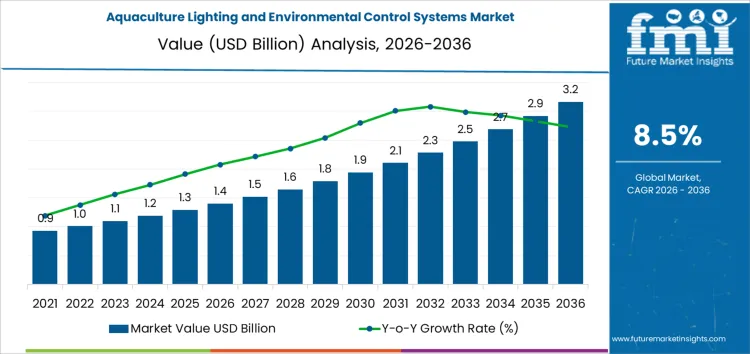
Aquaculture Lighting and Environmental Control Systems Market Key Takeaways
| Metric | Value |
|---|---|
| Aquaculture Lighting and Environmental Control Systems Market Value (2026) | USD 1.4 Billion |
| Aquaculture Lighting and Environmental Control Systems Market Forecast Value (2036) | USD 3.2 Billion |
| Aquaculture Lighting and Environmental Control Systems Market Forecast CAGR 2026 to 2036 | 8.5% |
What Is Driving Growth in the Aquaculture Lighting and Environmental Control Systems Market?
Growth of the aquaculture lighting and environmental control systems market is driven by increasing adoption of intensive and controlled aquaculture farming practices. Rising global demand for seafood, coupled with pressure on wild fish stocks, is accelerating investment in land-based and recirculating aquaculture systems. Lighting and environmental control technologies play a critical role in regulating photoperiods, water temperature, oxygen levels, and feeding cycles, which directly influence growth rates, survival ratios, and production efficiency in fish and shrimp farming operations.
Technological advancements in system design are further strengthening market growth. Modern aquaculture facilities are increasingly deploying automated lighting systems, sensor-based monitoring, and integrated control platforms to maintain optimal rearing conditions. These systems enable precise adjustment of environmental parameters, reduce manual intervention, and improve operational consistency across production cycles. Improved control over environmental variables also supports disease prevention and stress reduction, which are key priorities for commercial aquaculture operators focused on yield stability and cost management.
Expansion of aquaculture capacity in emerging economies is creating additional growth opportunities. Asia Pacific, Latin America, and parts of Europe are witnessing increased investment in commercial fish farming to support food security and export demand. At the same time, regulatory emphasis on sustainable aquaculture practices is encouraging adoption of energy-efficient lighting and environmentally controlled systems. Combined, intensification of aquaculture production, technological integration, and sustainability-driven investments are supporting strong growth of the aquaculture lighting and environmental control systems market over the forecast period.
What Is The Segment Overview Of The Aquaculture Lighting And Environmental Control Systems Market?
The aquaculture lighting and environmental control systems market is segmented by type and application, with strong leadership in specific categories. By type, aquaculture lighting systems lead the segment, reflecting widespread adoption of controlled lighting to improve biomass yield and operational efficiency. Other types in the aquaculture lighting and environmental control systems market include environmental monitoring and control systems and integrated LED and IoT control solutions that support automation and data-driven farm management. By application, fish growth optimization represents the leading use case, while shrimp and shellfish farming, seaweed and algae farming, research and hatchery facilities, and other marine cultivation applications contribute to diversified demand.
Why Do Aquaculture Lighting Systems Lead The Aquaculture Lighting And Environmental Control Systems Market By Type?

Aquaculture lighting systems account for 60% share in the aquaculture lighting and environmental control systems market because light intensity, spectrum, and photoperiod directly influence feeding behavior, growth rates, and stress levels in aquatic species. Controlled lighting enables producers to optimize growth cycles and improve feed conversion efficiency. LED-based systems reduce energy consumption while offering precise spectral tuning for different species and life stages. Farms adopt lighting systems as a foundational upgrade due to lower integration complexity compared to full environmental automation. Consistent performance benefits across freshwater and marine operations explain why aquaculture lighting systems remain the most widely deployed type.
Why Does Fish Growth Optimization Dominate The Aquaculture Lighting And Environmental Control Systems Market By Application?

Fish growth optimization leads the aquaculture lighting and environmental control systems market by application with 45% share because commercial aquaculture operations prioritize predictable biomass output and reduced production cycles. Lighting and environmental controls regulate circadian rhythms, feeding activity, and metabolic efficiency, which directly impact harvest timelines. Fish farming operations apply these systems to improve survival rates and uniformity across stocks. Rising demand for farmed fish protein increases focus on productivity-enhancing technologies. Environmental control systems support stable water conditions, reinforcing growth performance. These operational priorities explain why fish growth optimization remains the primary application focus across global aquaculture facilities.
What Are The Key Dynamics Of The Aquaculture Lighting And Environmental Control Systems Market?
The aquaculture lighting and environmental control systems market is driven by the need to optimize aquatic farming conditions for fish, shrimp, and shellfish production. Lighting systems tailored to species-specific photoperiod and spectral requirements enhance growth rates, feed conversion efficiency, and reproductive cycles. Environmental control systems that manage water quality, temperature, dissolved oxygen, and biosecurity improve survival rates and production yields. Expansion of commercial aquaculture, emphasis on sustainable intensification, and regulatory focus on animal welfare are supporting adoption. Capital costs, integration complexity with existing infrastructure, and energy efficiency considerations are key factors shaping supplier and buyer decisions in this market.
What Challenges Are Limiting Growth Of The Aquaculture Lighting And Environmental Control Systems Market?
The aquaculture lighting and environmental control systems market faces challenges associated with high upfront costs, technical complexity, and operational demands. Installation of advanced LED lighting arrays, sensors, and control units requires significant capital investment, particularly for small and mid-scale farms. Complexity in integrating lighting, water quality monitoring, temperature control, and automation systems increases implementation risk. Dependence on reliable power supply and skilled personnel for calibration and maintenance raises operating costs. Environmental variability, such as salinity fluctuations, seasonal temperature changes, and biofouling, can reduce system performance. These factors collectively constrain faster adoption of integrated aquaculture lighting and environmental control solutions.
What Opportunities Are Supporting Expansion Of The Aquaculture Lighting And Environmental Control Systems Market?
Expansion opportunities in the aquaculture lighting and environmental control systems market are supported by rapid growth in global aquaculture production and rising seafood demand. Investments in recirculating aquaculture systems (RAS) and offshore farming are creating demand for sophisticated environmental controls to maintain stable growing conditions. Growing emphasis on sustainable and traceable seafood production is encouraging adoption of automated systems that improve resource efficiency. Technological advancements in smart sensors, remote monitoring, and cloud-based analytics offer value-added services and subscription-based support models. Emerging markets in Asia Pacific, Latin America, and Africa present expansion potential as producers modernize infrastructure to enhance productivity and comply with environmental standards.
What Is the Country-Wise Outlook of the Aquaculture Lighting and Environmental Control Systems Market?
Demand for aquaculture lighting and environmental control systems varies across countries depending on aquaculture intensity, species diversification, and technology adoption levels. Asia Pacific leads growth due to expanding fish and shrimp farming operations, while developed regions show steady adoption driven by efficiency and sustainability goals. China is expected to grow at a CAGR of 9.1% during 2026 to 2036, followed by India at 8.7%, supported by commercial aquaculture expansion. The United States, Japan, and Germany are projected to register CAGRs of 7.8%, 7.3%, and 7.0%, respectively, reflecting controlled but technology-driven growth. Country-level demand is influenced by productivity optimization, water quality management, and energy-efficient farming practices.
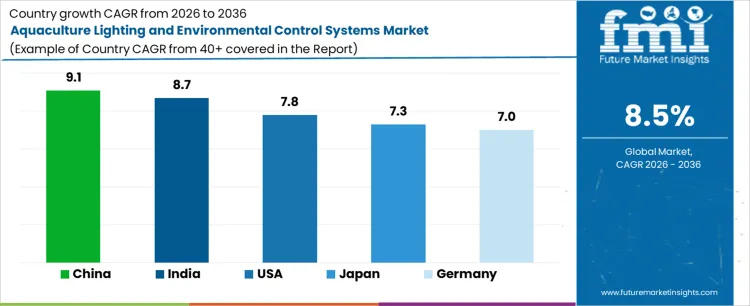
| Country | CAGR (%) |
|---|---|
| China | 9.1% |
| India | 8.7% |
| United States | 7.8% |
| Japan | 7.3% |
| Germany | 7.0% |
Why Is Demand for Aquaculture Lighting and Environmental Control Systems Expanding in China?
Demand for aquaculture lighting and environmental control systems in China, expanding at a CAGR of 9.1% during 2026 to 2036, is driven by large-scale intensification of inland and coastal aquaculture operations. The aquaculture lighting and environmental control systems market in China benefits from rising adoption of controlled farming environments to improve survival rates and feed efficiency. Commercial fish and shrimp producers are integrating lighting, oxygen control, and temperature regulation systems to stabilize production cycles. Government initiatives promoting modern aquaculture practices further support system deployment. Expansion of recirculating aquaculture systems is increasing reliance on automated environmental controls. Domestic equipment manufacturing improves affordability and accelerates technology penetration. These factors collectively position China as the largest and fastest-growing contributor to the aquaculture lighting and environmental control systems market over the forecast period.
How Are Sales of Aquaculture Lighting and Environmental Control Systems Increasing in India?
Sales of aquaculture lighting and environmental control systems in India, growing at a CAGR of 8.7% from 2026 to 2036, are supported by rapid expansion of commercial aquaculture and shrimp farming activities. The aquaculture lighting and environmental control systems market in India is driven by rising export demand for farmed seafood and increasing adoption of intensive farming models. Producers are investing in lighting and water quality control systems to improve growth consistency and reduce disease risk. Government support for aquaculture modernization and infrastructure development is strengthening technology uptake. Cost-sensitive operators are gradually shifting toward automated solutions as productivity gains become evident. Growing awareness of environmental monitoring further supports adoption. These dynamics position India as a high-growth market during the forecast period.
Why Is Demand for Aquaculture Lighting and Environmental Control Systems Rising in the United States?
Demand for aquaculture lighting and environmental control systems in the United States, expanding at a CAGR of 7.8% during 2026 to 2036, is driven by increasing focus on sustainable and controlled aquaculture production. The aquaculture lighting and environmental control systems market in the United States benefits from growing adoption of recirculating aquaculture systems and land-based fish farming facilities. Producers prioritize precise control of light cycles, dissolved oxygen levels, and water temperature to improve growth rates and reduce mortality risks. Regulatory emphasis on environmental compliance and water management standards encourages investment in automated monitoring technologies. Replacement of manual and semi-automated systems with integrated control solutions supports recurring demand. Focus on operational efficiency, biosecurity, and production predictability further reinforces system adoption. These factors collectively support steady, value-driven expansion across the United States.
How Are Sales of Aquaculture Lighting and Environmental Control Systems Developing in Japan?
Sales of aquaculture lighting and environmental control systems in Japan, growing at a CAGR of 7.3% over the forecast period, reflect modernization within a technologically advanced aquaculture sector. The aquaculture lighting and environmental control systems market in Japan is driven by adoption of precision farming practices for high-value fish species. Producers emphasize stability, reliability, and energy efficiency when implementing environmental control solutions. Limited availability of farming space increases reliance on land-based and controlled aquaculture environments. Investments are directed toward improving yield predictability, water quality management, and labor efficiency. Strong engineering standards support integration of advanced sensors and automated control platforms. Focus on long-term operational stability sustains replacement demand. These dynamics result in steady and controlled growth across Japan.
Why Is Demand for Aquaculture Lighting and Environmental Control Systems Stable in Germany?
Demand for aquaculture lighting and environmental control systems in Germany, expanding at a CAGR of 7.0% during 2026 to 2036, is supported by controlled expansion of inland aquaculture operations. The aquaculture lighting and environmental control systems market in Germany is influenced by strong emphasis on environmental sustainability and efficient resource utilization. Producers invest in monitoring and control technologies to comply with stringent regulatory and environmental standards. Growth is primarily driven by replacement and upgrade of existing systems rather than new facility development. Energy-efficient lighting solutions and precise environmental controls support operational optimization. Focus on compliance, process reliability, and system longevity sustains consistent adoption. These factors contribute to stable, technology-led growth across Germany.
How Are Companies Competing in the Aquaculture Lighting and Environmental Control Systems Market?
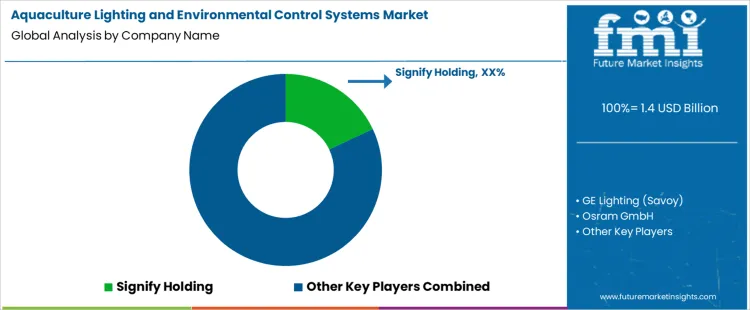
Competition in the aquaculture lighting and environmental control systems market is defined by product performance, energy efficiency, and integration capabilities documented in official product materials. Signify Holding positions its aquaculture lighting solutions with brochures that highlight customized spectral outputs for species-specific growth and energy-optimized LED platforms. Its product literature emphasizes digital control interfaces that tie lighting with environmental monitoring systems. GE Lighting (Savoy) competes by promoting robust aquatic LED luminaires engineered for corrosion resistance and consistent light distribution; official datasheets focus on long life, cool-running operation, and modular control compatibility. Osram GmbH differentiates through advanced LED arrays with tunable spectra, backed by technical brochures that stress wavelength precision and integration with third-party automation platforms.
Strategic competition expands into ecosystem control. EcoTech Marine markets aquaculture lighting with official brochures centered on programmable spectral tuning, wireless control, and synchronized environmental management features for tank systems. AquaIllumination (AI) positions its lighting systems with emphasis on firmware-driven performance optimization and gradient lighting sequences tailored to aquatic life cycles, as outlined in product guides. AquaSpy competes by integrating environmental control sensors with centralized dashboards; brochures highlight real-time water quality data and automated responses linked to lighting adjustments.
Smaller and specialist suppliers leverage niche performance claims. Greengage Agritech Ltd. offers environmental control suites that include LED lighting as part of broader aquaculture infrastructure, documented in brochures that emphasize climate regulation and energy tracking. LED Livestock ApS focuses on customizable LED solutions with datasheets detailing adjustable intensity and spectral balance for recirculating aquaculture systems. Shenzhen Hontech-Wins Electronics Co., Ltd. and Aquaculture LED Lighting Co. compete on cost-effective LED platforms with official specifications covering IP ratings, lifespan, and power efficiency aimed at commercial aquaculture farms. Overall, differentiation is achieved through brochure-verified performance metrics, integration depth with control systems, and adaptability to diverse aquaculture environments rather than price alone.
Key Players in Aquaculture Lighting and Environmental Control Systems Market
- Signify Holding
- GE Lighting (Savoy)
- Osram GmbH
- EcoTech Marine
- AquaIllumination (AI)
- AquaSpy
- Greengage Agritech Ltd.
- LED Livestock ApS
- Shenzhen Hontech-Wins Electronics Co., Ltd.
- Aquaculture LED Lighting Co.
Scope of Report
| Attribute | Description |
|---|---|
| Quantitative Unit | USD Billion |
| Type | Aquaculture Lighting Systems, Environmental Monitoring & Control Systems, Integrated LED & IoT Control Solutions |
| Application | Fish Growth Optimization, Shrimp & Shellfish Farming, Seaweed & Algae Farming, Research & Hatchery Facilities, Other Marine Cultivation |
| Countries Covered | China, Japan, South Korea, India, Australia & New Zealand, ASEAN, Rest of Asia Pacific, Germany, United Kingdom, France, Italy, Spain, Nordic, BENELUX, Rest of Europe, United States, Canada, Mexico, Brazil, Chile, Rest of Latin America, Kingdom of Saudi Arabia, Other GCC Countries, Turkey, South Africa, Other African Union, Rest of Middle East & Africa |
| Regions Covered | Asia Pacific, Europe, North America, Latin America, Middle East & Africa |
| Key Companies Profiled | Signify Holding, GE Lighting (Savoy), Osram GmbH, EcoTech Marine, AquaIllumination (AI), AquaSpy, Greengage Agritech Ltd., LED Livestock ApS, Shenzhen Hontech-Wins Electronics Co., Ltd., Aquaculture LED Lighting Co. |
| Additional Attributes | Dollar sales by system type and application are evaluated across commercial aquaculture operations. The report includes country-level demand assessment, growth projections for 2026 to 2036, analysis of light spectrum and environmental parameter control, evaluation of IoT-based monitoring adoption, competitive benchmarking of suppliers, and assessment of efficiency-driven upgrades in intensive farming systems. |
Aquaculture Lighting and Environmental Control Systems Market by Key Segments
Type
- Aquaculture Lighting Systems
- Environmental Monitoring & Control Systems
- Integrated LED & IoT Control Solutions
Application
- Fish Growth Optimization
- Shrimp & Shellfish Farming
- Seaweed & Algae Farming
- Research & Hatchery Facilities
- Other Marine Cultivation
Region:
- Asia Pacific
- China
- Japan
- South Korea
- India
- Australia & New Zealand
- ASEAN
- Rest of Asia Pacific
- Europe
- Germany
- United Kingdom
- France
- Italy
- Spain
- Nordic
- BENELUX
- Rest of Europe
- North America
- United States
- Canada
- Mexico
- Latin America
- Brazil
- Chile
- Rest of Latin America
- Middle East & Africa
- Kingdom of Saudi Arabia
- Other GCC Countries
- Turkey
- South Africa
- Other African Union
- Rest of Middle East & Africa
Bibliography
- Food and Agriculture Organization of the United Nations. (2024). The state of world fisheries and aquaculture 2024: Blue transformation in action. FAO.
- National Oceanic and Atmospheric Administration. (2025). National aquaculture development plan 2025: Sustainable production and ecosystem integration. U.S. Department of Commerce.
- United States Department of Agriculture, Economic Research Service. (2024). Aquaculture production, trade, and seafood consumption patterns in the United States. USDA ERS.
Frequently Asked Questions
How big is the aquaculture lighting and environmental control systems market in 2026?
The global aquaculture lighting and environmental control systems market is estimated to be valued at USD 1.4 billion in 2026.
What will be the size of aquaculture lighting and environmental control systems market in 2036?
The market size for the aquaculture lighting and environmental control systems market is projected to reach USD 3.2 billion by 2036.
How much will be the aquaculture lighting and environmental control systems market growth between 2026 and 2036?
The aquaculture lighting and environmental control systems market is expected to grow at a 8.5% CAGR between 2026 and 2036.
What are the key product types in the aquaculture lighting and environmental control systems market?
The key product types in aquaculture lighting and environmental control systems market are aquaculture lighting systems, environmental monitoring & control systems and integrated led & iot control solutions.
Which application segment to contribute significant share in the aquaculture lighting and environmental control systems market in 2026?
In terms of application, fish growth optimization segment to command 45.0% share in the aquaculture lighting and environmental control systems market in 2026.
Preview the report firsthand - request a free sample
Get SampleGet the brochure for pricing and purchase details.
Get PDFTable of Content
- Executive Summary
- Global Market Outlook
- Demand-side Trends
- Supply-side Trends
- Technology Roadmap Analysis
- Analysis and Recommendations
- Market Overview
- Market Coverage / Taxonomy
- Market Definition / Scope / Limitations
- Market Background
- Market Dynamics
- Drivers
- Restraints
- Opportunity
- Trends
- Scenario Forecast
- Demand in Optimistic Scenario
- Demand in Likely Scenario
- Demand in Conservative Scenario
- Opportunity Map Analysis
- Product Life Cycle Analysis
- Supply Chain Analysis
- Investment Feasibility Matrix
- Value Chain Analysis
- PESTLE and Porter’s Analysis
- Regulatory Landscape
- Regional Parent Market Outlook
- Production and Consumption Statistics
- Import and Export Statistics
- Market Dynamics
- Global Market Analysis 2021 to 2025 and Forecast, 2026 to 2036
- Historical Market Size Value (USD Million) Analysis, 2021 to 2025
- Current and Future Market Size Value (USD Million) Projections, 2026 to 2036
- Y-o-Y Growth Trend Analysis
- Absolute $ Opportunity Analysis
- Global Market Pricing Analysis 2021 to 2025 and Forecast 2026 to 2036
- Global Market Analysis 2021 to 2025 and Forecast 2026 to 2036, By Type
- Introduction / Key Findings
- Historical Market Size Value (USD Million) Analysis By Type , 2021 to 2025
- Current and Future Market Size Value (USD Million) Analysis and Forecast By Type , 2026 to 2036
- Aquaculture Lighting Systems
- Environmental Monitoring & Control Systems
- Integrated LED & IoT Control Solutions
- Aquaculture Lighting Systems
- Y-o-Y Growth Trend Analysis By Type , 2021 to 2025
- Absolute $ Opportunity Analysis By Type , 2026 to 2036
- Global Market Analysis 2021 to 2025 and Forecast 2026 to 2036, By Application
- Introduction / Key Findings
- Historical Market Size Value (USD Million) Analysis By Application, 2021 to 2025
- Current and Future Market Size Value (USD Million) Analysis and Forecast By Application, 2026 to 2036
- Fish Growth Optimization
- Shrimp & Shellfish Farming
- Seaweed & Algae Farming
- Research & Hatchery Facilities
- Other Marine Cultivation
- Fish Growth Optimization
- Y-o-Y Growth Trend Analysis By Application, 2021 to 2025
- Absolute $ Opportunity Analysis By Application, 2026 to 2036
- Global Market Analysis 2021 to 2025 and Forecast 2026 to 2036, By Region
- Introduction
- Historical Market Size Value (USD Million) Analysis By Region, 2021 to 2025
- Current Market Size Value (USD Million) Analysis and Forecast By Region, 2026 to 2036
- North America
- Latin America
- Western Europe
- Eastern Europe
- East Asia
- South Asia and Pacific
- Middle East & Africa
- Market Attractiveness Analysis By Region
- North America Market Analysis 2021 to 2025 and Forecast 2026 to 2036, By Country
- Historical Market Size Value (USD Million) Trend Analysis By Market Taxonomy, 2021 to 2025
- Market Size Value (USD Million) Forecast By Market Taxonomy, 2026 to 2036
- By Country
- USA
- Canada
- Mexico
- By Type
- By Application
- By Country
- Market Attractiveness Analysis
- By Country
- By Type
- By Application
- Key Takeaways
- Latin America Market Analysis 2021 to 2025 and Forecast 2026 to 2036, By Country
- Historical Market Size Value (USD Million) Trend Analysis By Market Taxonomy, 2021 to 2025
- Market Size Value (USD Million) Forecast By Market Taxonomy, 2026 to 2036
- By Country
- Brazil
- Chile
- Rest of Latin America
- By Type
- By Application
- By Country
- Market Attractiveness Analysis
- By Country
- By Type
- By Application
- Key Takeaways
- Western Europe Market Analysis 2021 to 2025 and Forecast 2026 to 2036, By Country
- Historical Market Size Value (USD Million) Trend Analysis By Market Taxonomy, 2021 to 2025
- Market Size Value (USD Million) Forecast By Market Taxonomy, 2026 to 2036
- By Country
- Germany
- UK
- Italy
- Spain
- France
- Nordic
- BENELUX
- Rest of Western Europe
- By Type
- By Application
- By Country
- Market Attractiveness Analysis
- By Country
- By Type
- By Application
- Key Takeaways
- Eastern Europe Market Analysis 2021 to 2025 and Forecast 2026 to 2036, By Country
- Historical Market Size Value (USD Million) Trend Analysis By Market Taxonomy, 2021 to 2025
- Market Size Value (USD Million) Forecast By Market Taxonomy, 2026 to 2036
- By Country
- Russia
- Poland
- Hungary
- Balkan & Baltic
- Rest of Eastern Europe
- By Type
- By Application
- By Country
- Market Attractiveness Analysis
- By Country
- By Type
- By Application
- Key Takeaways
- East Asia Market Analysis 2021 to 2025 and Forecast 2026 to 2036, By Country
- Historical Market Size Value (USD Million) Trend Analysis By Market Taxonomy, 2021 to 2025
- Market Size Value (USD Million) Forecast By Market Taxonomy, 2026 to 2036
- By Country
- China
- Japan
- South Korea
- By Type
- By Application
- By Country
- Market Attractiveness Analysis
- By Country
- By Type
- By Application
- Key Takeaways
- South Asia and Pacific Market Analysis 2021 to 2025 and Forecast 2026 to 2036, By Country
- Historical Market Size Value (USD Million) Trend Analysis By Market Taxonomy, 2021 to 2025
- Market Size Value (USD Million) Forecast By Market Taxonomy, 2026 to 2036
- By Country
- India
- ASEAN
- Australia & New Zealand
- Rest of South Asia and Pacific
- By Type
- By Application
- By Country
- Market Attractiveness Analysis
- By Country
- By Type
- By Application
- Key Takeaways
- Middle East & Africa Market Analysis 2021 to 2025 and Forecast 2026 to 2036, By Country
- Historical Market Size Value (USD Million) Trend Analysis By Market Taxonomy, 2021 to 2025
- Market Size Value (USD Million) Forecast By Market Taxonomy, 2026 to 2036
- By Country
- Kingdom of Saudi Arabia
- Other GCC Countries
- Turkiye
- South Africa
- Other African Union
- Rest of Middle East & Africa
- By Type
- By Application
- By Country
- Market Attractiveness Analysis
- By Country
- By Type
- By Application
- Key Takeaways
- Key Countries Market Analysis
- USA
- Pricing Analysis
- Market Share Analysis, 2025
- By Type
- By Application
- Canada
- Pricing Analysis
- Market Share Analysis, 2025
- By Type
- By Application
- Mexico
- Pricing Analysis
- Market Share Analysis, 2025
- By Type
- By Application
- Brazil
- Pricing Analysis
- Market Share Analysis, 2025
- By Type
- By Application
- Chile
- Pricing Analysis
- Market Share Analysis, 2025
- By Type
- By Application
- Germany
- Pricing Analysis
- Market Share Analysis, 2025
- By Type
- By Application
- UK
- Pricing Analysis
- Market Share Analysis, 2025
- By Type
- By Application
- Italy
- Pricing Analysis
- Market Share Analysis, 2025
- By Type
- By Application
- Spain
- Pricing Analysis
- Market Share Analysis, 2025
- By Type
- By Application
- France
- Pricing Analysis
- Market Share Analysis, 2025
- By Type
- By Application
- India
- Pricing Analysis
- Market Share Analysis, 2025
- By Type
- By Application
- ASEAN
- Pricing Analysis
- Market Share Analysis, 2025
- By Type
- By Application
- Australia & New Zealand
- Pricing Analysis
- Market Share Analysis, 2025
- By Type
- By Application
- China
- Pricing Analysis
- Market Share Analysis, 2025
- By Type
- By Application
- Japan
- Pricing Analysis
- Market Share Analysis, 2025
- By Type
- By Application
- South Korea
- Pricing Analysis
- Market Share Analysis, 2025
- By Type
- By Application
- Russia
- Pricing Analysis
- Market Share Analysis, 2025
- By Type
- By Application
- Poland
- Pricing Analysis
- Market Share Analysis, 2025
- By Type
- By Application
- Hungary
- Pricing Analysis
- Market Share Analysis, 2025
- By Type
- By Application
- Kingdom of Saudi Arabia
- Pricing Analysis
- Market Share Analysis, 2025
- By Type
- By Application
- Turkiye
- Pricing Analysis
- Market Share Analysis, 2025
- By Type
- By Application
- South Africa
- Pricing Analysis
- Market Share Analysis, 2025
- By Type
- By Application
- USA
- Market Structure Analysis
- Competition Dashboard
- Competition Benchmarking
- Market Share Analysis of Top Players
- By Regional
- By Type
- By Application
- Competition Analysis
- Competition Deep Dive
- Signify Holding
- Overview
- Product Portfolio
- Profitability by Market Segments (Product/Age /Sales Channel/Region)
- Sales Footprint
- Strategy Overview
- Marketing Strategy
- Product Strategy
- Channel Strategy
- GE Lighting (Savoy)
- Osram GmbH
- EcoTech Marine
- AquaIllumination (AI)
- AquaSpy
- Greengage Agritech Ltd.
- LED Livestock ApS
- Shenzhen Hontech-Wins Electronics Co., Ltd.
- Aquaculture LED Lighting Co.
- Signify Holding
- Competition Deep Dive
- Assumptions & Acronyms Used
- Research Methodology


