

- Industry Size (2026)
- USD 2.1 Bn
- Forecast (2036)
- USD 5.3 Bn
- CAGR (2026 to 2036)
- 9.7%
Vertical Grow Rack Systems Market Forecast and Outlook 2026 to 2036
The vertical grow rack systems market is projected to reach USD 5.3 billion by 2036, growing at a CAGR of 9.7% from its 2026 valuation of USD 2.1 billion. This market’s commercial importance lies in its alignment with the growing demand for sustainable and efficient agricultural practices. As food production methods evolve, buyers are increasingly seeking solutions that maximize space and resource efficiency, especially in urban environments where land is limited. The decision-making process is driven by cost-effectiveness, scalability, and the ability to integrate with existing farming technologies. This trend is particularly relevant as both private companies and government initiatives push for food security and sustainable urban agriculture. The market’s economic relevance extends to its impact on global supply chains, as vertical farming technologies can reduce transportation costs and improve freshness. Companies that can offer adaptable, cost-efficient solutions will capture value by aligning with broader sustainability and food security goals.
Quick Stats for the Vertical Grow Rack Systems Market
- Vertical Grow Rack Systems Market Value (2026): USD 2.1 billion
- Vertical Grow Rack Systems Market Forecast Value (2036): USD 5.3 billion
- Vertical Grow Rack Systems Market Global Forecast CAGR 2026 to 2036: 9.7%
- Vertical Grow Rack Systems Market Leading Segment: Powder-Coated Steel (58%)
- Key Growth Regions in Vertical Grow Rack Systems Market: India
- Top Players in Vertical Grow Rack Systems Market: Priva, Ridder (Hortimax), Kubo Group, Certhon, Bosman Van Zaal
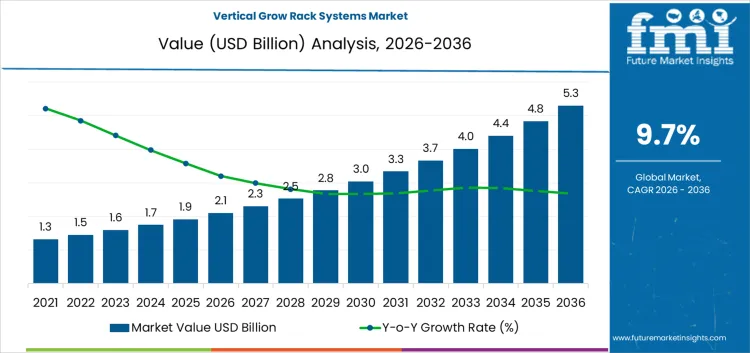
What is the Absolute Dollar Opportunity for the Vertical Grow Rack Systems Market through 2036?
The absolute dollar opportunity for the vertical grow rack systems market reflects the significant potential for growth over the next decade. Starting from USD 2.1 billion in 2026, the market will grow by USD 0.2 billion annually during the early years, reaching USD 2.6 billion by 2028. As vertical farming technologies become more widespread and demand for space-efficient, sustainable farming solutions increases, the market will experience faster growth in the later years. By 2036, the market is projected to reach USD 5.3 billion, indicating an absolute dollar opportunity of USD 3.3 billion over the forecast period.
This opportunity highlights the expanding role of vertical grow rack systems in the global food production landscape. The demand for these systems will be driven by the increasing need for urban agriculture solutions, technological innovations, and the growing focus on sustainable farming practices to meet the challenges of population growth and food security.
Vertical Grow Rack Systems Market Key Takeaways
| Metric | Value |
|---|---|
| Industry Sales Value (2026) | USD 2.1 billion |
| Industry Forecast Value (2036) | USD 5.3 billion |
| Industry Forecast CAGR 2026 to 2036 | 9.7% |
What Is Driving the Vertical Grow Rack Systems Market?
Historically, the vertical grow rack systems market developed from the limitations of traditional horizontal farming and greenhouse cultivation methods in maximizing space and productivity. Conventional plant cultivation relied on floor level planting beds and bench systems that consumed large footprints and constrained output per unit area. As demand for fresh produce grew in urban centers and controlled environment agriculture (CEA) expanded, growers began experimenting with stacked shelving and multi tiered layouts to increase plant density without expanding land use. Early vertical rack systems were simple, manually irrigated structures that offered modest gains in productivity but still faced challenges with light distribution, access for maintenance, and efficient water delivery. Initial adoption occurred in nurseries and research facilities where space optimization was a priority, providing early data on how stacking plant layers influenced microclimates, light penetration, and labor workflows. These early implementations clarified the benefits of vertical configuration for specific crops such as herbs and leafy greens while highlighting the need for integrated lighting and environmental controls to support uniform growth across tiers.
Future demand for vertical grow rack systems is expected to be shaped by rapid urbanization of food systems, rising interest in local and year round production, and advances in controlled environment technology that improve yield, resource efficiency, and operational scalability. Growth drivers include integration with LED lighting optimized for plant spectra, automated irrigation and fertigation systems that deliver precise water and nutrient profiles to each layer, and climate controls that maintain consistent temperature and humidity throughout the rack. Commercial growers will increasingly adopt vertical systems to maximize production per square foot, reduce transportation costs for perishable crops, and meet consumer expectations for freshness and traceability. Expansion of urban farms, grocery anchored micro farms, and foodservice procurement strategies will further support investment in vertical rack infrastructure. Barriers include higher upfront capital expenditure compared with traditional farming, energy costs associated with supplemental lighting, and the technical expertise required to balance environmental parameters across multiple growing tiers. Long term market growth will depend on demonstrable improvements in crop yield and quality, operational cost reductions through automation, and broader acceptance of vertical farming as a sustainable complement to conventional agriculture in global food systems.
What are the Key Segments in the Vertical Grow Rack Systems Market?
The Vertical Grow Rack Systems market is structured around material selection and sales channels. Powder-coated steel dominates material adoption due to durability and cost control, while stainless steel and aluminum serve niche requirements. On the sales side, project EPCs or integrators represent the leading route to market, followed by direct OEM sales and distributors. Regional demand spans North America, Europe, and Asia Pacific, shaped by controlled-environment agriculture deployment patterns and project scale preferences.
Why Does Powder-Coated Steel Lead the Material Segment in Vertical Grow Rack Systems?
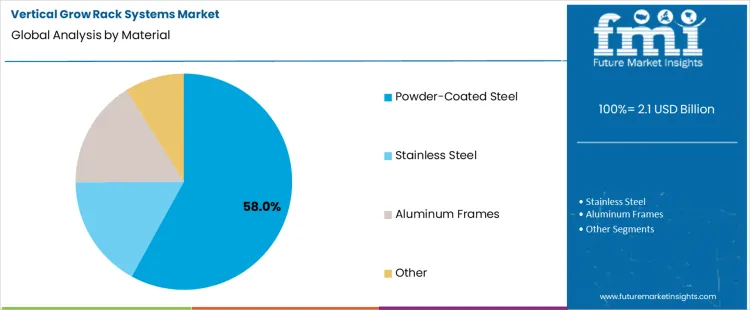
Powder-coated steel accounts for the leading share of the material segment at 58%, reflecting its balance of structural strength, cost efficiency, and operational durability. Vertical grow rack installations require high load-bearing capacity to support stacked trays, irrigation hardware, lighting systems, and mature crop weight. Powder-coated steel provides this strength while maintaining resistance to corrosion, abrasion, and routine washdown cycles common in indoor farming environments.
The coating process improves surface protection without significantly increasing material costs, which is critical for large-scale installations where capital efficiency influences project viability. Powder-coated steel also supports modular fabrication, enabling standardized rack designs that can be rapidly assembled or reconfigured as crop plans change. This flexibility aligns with commercial vertical farms that frequently adjust layouts to optimize yields or accommodate different plant varieties.
Compared with stainless steel, powder-coated steel offers a lower upfront cost while still meeting hygiene and durability expectations in most controlled environments. Aluminum frames, while lightweight, face limitations in load capacity for multi-tier systems. As vertical farming expands across warehouse-scale and retrofitted facilities, material choices increasingly favor solutions that combine mechanical strength with predictable lifecycle performance. Powder-coated steel continues to meet these requirements across a wide range of operational scales, reinforcing its position as the preferred structural material.
Why Do Project EPCs or Integrators Dominate the Sales Channel for Vertical Grow Rack Systems?
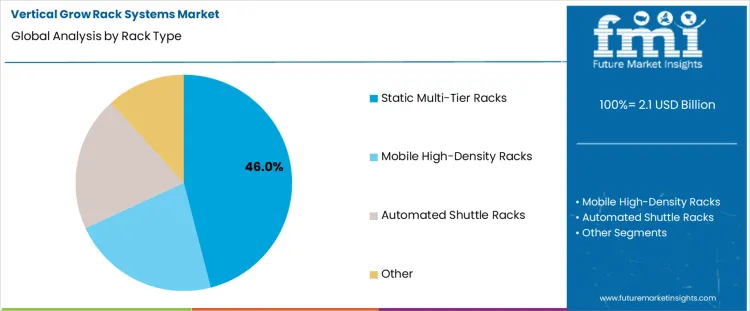
Project EPCs or integrators hold the largest sales channel share at 46%, driven by the complexity and system-level integration required in vertical farming projects. Vertical grow rack installations are rarely standalone purchases, as they must align with lighting layouts, HVAC systems, irrigation networks, automation controls, and building constraints. EPCs and integrators coordinate these elements into unified project designs, reducing execution risk for operators.
This approach is especially prevalent in commercial and industrial-scale farms, where timelines, performance guarantees, and regulatory compliance are tightly managed. Integrators also customize rack dimensions, materials, and load specifications based on crop type, ceiling height, and operational workflow, offering value beyond standardized product sales. Their involvement simplifies procurement by bundling equipment sourcing, installation, and commissioning under a single contractual structure.
Direct OEM sales tend to serve experienced operators with in-house engineering capacity, while distributors mainly address smaller or replacement-driven demand. As vertical farming projects grow in size and technical sophistication, buyers increasingly prefer turnkey delivery models that limit coordination challenges. EPC-led procurement provides predictability in cost, schedule, and system compatibility, making it the dominant channel for large-scale deployments. This dynamic supports continued leadership of integrators in the sales structure of vertical grow rack systems.
What are the Key Dynamics in the Vertical Grow Rack Systems Market?
The vertical grow rack systems market is expanding as the demand for sustainable, space-efficient, and high-yield agricultural solutions increases. These systems are used in indoor farming, particularly in urban environments, where available space is limited. Vertical grow racks enable crops to be grown in stacked layers, utilizing artificial lighting and controlled environments, which allows for higher productivity and reduced land use. The market is driven by the growing need for food security, urban farming, and the rising consumer preference for locally grown produce. Additionally, the increasing adoption of vertical farming techniques, as well as advancements in hydroponic and aeroponic technologies, are supporting market growth.
What are the Key Drivers of Growth in the Vertical Grow Rack Systems Market?
The growth of the vertical grow rack systems market is primarily driven by the increasing demand for sustainable and efficient food production systems. With the rising global population and the pressures on arable land, vertical farming provides a solution that maximizes space and resources while minimizing water usage and transportation costs.
The trend toward urbanization is also contributing to the market's growth, as cities look for ways to produce fresh food locally. Moreover, the growing consumer preference for organic and locally sourced produce is pushing the demand for vertical farming systems. Technological advancements in LED lighting, automation, and nutrient management systems have also made vertical farming more efficient and scalable, further driving the market. Finally, government incentives and support for sustainable agriculture are fueling investments in vertical farming technologies, including grow rack systems.
What are the Key Restraints in the Vertical Grow Rack Systems Market?
Despite the market’s growth potential, several challenges exist. One key restraint is the high initial investment required to set up vertical grow rack systems, which can be a significant barrier for small-scale farmers or new entrants to the market. The cost of infrastructure, including lighting, ventilation, and automation systems, can be prohibitive. Additionally, the technical expertise required to operate and maintain these systems can pose a challenge, as it may require specialized knowledge in areas such as hydroponics, aeroponics, and climate control.
Another challenge is the energy consumption associated with indoor farming systems, particularly the need for artificial lighting and climate control, which can lead to high operational costs. Finally, the limited availability of suitable space in urban environments may restrict the widespread adoption of vertical grow rack systems, especially in regions where infrastructure is already constrained.
What are the Key Trends in the Vertical Grow Rack Systems Market?
Several trends are shaping the vertical grow rack systems market. One major trend is the increasing integration of automation and artificial intelligence (AI) into vertical farming systems. Automated nutrient delivery, climate control, and crop monitoring systems are improving the efficiency and scalability of vertical farming operations. Another trend is the growing use of energy-efficient LED lighting, which reduces electricity consumption while providing optimal light conditions for plant growth.
The focus on sustainability is also driving the development of vertical grow rack systems that use less water, fewer chemicals, and recyclable materials, aligning with the increasing consumer demand for eco-friendly farming practices. Additionally, there is a rise in partnerships between technology companies and agricultural producers to enhance the capabilities of vertical farming systems, including the integration of IoT devices for real-time monitoring and data analysis. Finally, the market is seeing a shift toward modular and scalable vertical grow rack systems that can be customized for different spaces, including homes, commercial operations, and large-scale urban farms. These trends are making vertical farming more accessible and efficient, further driving the market forward.
What is the Country-Wise Analysis of the Vertical Grow Rack Systems Market?
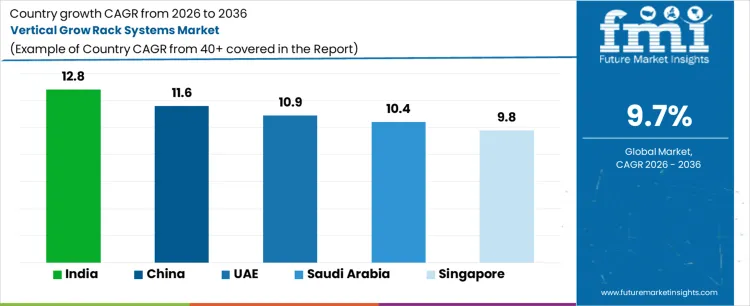
The vertical grow rack systems market is growing as the demand for efficient, space-saving farming solutions increases. These systems, which allow for the cultivation of crops in vertically stacked layers, are gaining popularity in urban farming, vertical farming, and indoor agriculture. They provide solutions for optimizing space and improving yield, especially in areas with limited land availability. The market is driven by increasing demand for fresh, locally grown produce, urbanization, and advances in agriculture technology. Countries like India, China, the UAE, Saudi Arabia, and Singapore are seeing significant growth in this market, driven by the need for sustainable farming solutions, limited space for traditional agriculture, and government support for agricultural innovations.
| Country | CAGR (%) |
|---|---|
| India | 12.8 |
| China | 11.6 |
| UAE | 10.9 |
| Saudi Arabia | 10.4 |
| Singapore | 9.8 |
What is Driving the Growth of the Vertical Grow Rack Systems Market in India?
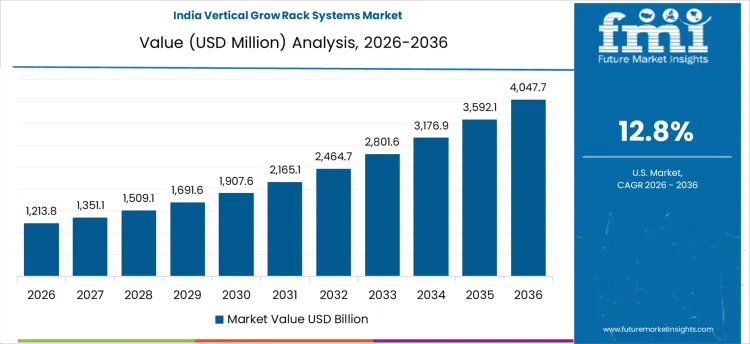
India’s vertical grow rack systems market is growing at a CAGR of 12.8%, the highest among the countries analyzed. The growth is largely driven by the increasing demand for sustainable farming solutions in India’s rapidly urbanizing population. As space for traditional farming becomes scarce in urban areas, vertical farming solutions like grow racks are gaining popularity. Additionally, India’s growing interest in organic farming and locally grown produce is driving the adoption of vertical farming systems. Government initiatives to support agricultural innovation and improve food security are also contributing to the growth of this market. As India’s urban farming sector continues to expand, the demand for vertical grow rack systems is expected to rise.
How is the Vertical Grow Rack Systems Market Performing in China?
China’s vertical grow rack systems market is growing at a CAGR of 11.6%. China’s increasing focus on food security, sustainable agriculture, and the efficient use of land is driving the adoption of vertical farming solutions. With urbanization and limited land for traditional farming, vertical grow rack systems are becoming an ideal solution for producing crops in densely populated areas. The country’s strong push towards technological advancements in agriculture, including the development of smart farming systems, is further fueling market growth. As China continues to prioritize sustainable agricultural practices and local food production, the demand for vertical grow racks and related technologies is expected to rise steadily.
What Factors are Shaping the Vertical Grow Rack Systems Market in the UAE?
The UAE’s vertical grow rack systems market is growing at a CAGR of 10.9%. The UAE, with its limited arable land and reliance on food imports, is increasingly turning to vertical farming solutions to improve food security and sustainability. Vertical grow rack systems are well-suited to urban farming in the UAE, as they maximize the use of limited space while offering a sustainable way to produce fresh food locally. The UAE government’s focus on promoting innovative agricultural technologies, such as vertical farming, has led to increased investments in these systems. The growing demand for locally sourced, organic produce is further driving the market for vertical grow racks in the UAE.
How is the Vertical Grow Rack Systems Market Evolving in Saudi Arabia?
Saudi Arabia’s vertical grow rack systems market is growing at a CAGR of 10.4%. With limited arable land and an increasing need for food security, Saudi Arabia is turning to vertical farming solutions to address its agricultural challenges. Vertical grow rack systems are being adopted to increase food production in urban and desert areas, where traditional farming methods are not feasible. The country’s focus on water conservation, sustainability, and reducing dependence on food imports is further driving the adoption of vertical farming technologies. As Saudi Arabia continues to invest in agricultural innovation and sustainability, the demand for vertical grow racks is expected to rise.
What is Contributing to the Growth of the Vertical Grow Rack Systems Market in Singapore?
Singapore’s vertical grow rack systems market is growing at a CAGR of 9.8%. As a highly urbanized country with limited agricultural land, Singapore is leading the way in innovative farming solutions like vertical farming. The government’s focus on improving food security, increasing local food production, and promoting sustainable agriculture is fueling the demand for vertical grow racks. Singapore’s commitment to developing urban farming technologies, along with the growing popularity of locally grown produce, is driving the adoption of vertical farming systems. As the country continues to invest in food innovation and smart agriculture, the market for vertical grow rack systems is expected to continue expanding.
What is the Competitive Landscape for the Vertical Grow Rack Systems Market?
The vertical grow rack systems market is expanding rapidly, driven by the growing demand for indoor and urban farming solutions that maximize space and optimize resource usage. Priva is another key competitor, providing integrated environmental control and automation systems that optimize growing conditions in vertical farming systems. Priva’s solutions focus on improving crop yield and quality by regulating factors such as temperature, humidity, and light. Ridder, through its Hortimax brand, offers innovative vertical grow rack systems that are designed to improve efficiency in controlled-environment agriculture, with a strong focus on automation and sustainability. Kubo Group provides high-quality vertical farming solutions, with a focus on energy efficiency and system integration for both small and large-scale operations. Certhon competes by offering customizable vertical grow rack systems that incorporate advanced lighting and climate control technology, ensuring optimal conditions for plant growth. Bosman Van Zaal offers innovative systems for vertical farming that integrate both hardware and software to provide seamless management of the growing process.
To remain competitive in the vertical grow rack systems market, companies are focusing on innovation, system integration, and sustainability. Priva is expanding its offering by integrating more advanced sensors and environmental controls, improving the precision and sustainability of its vertical farming systems. Ridder (Hortimax) is advancing its vertical farming solutions by incorporating AI and machine learning for more efficient resource management and improved crop yields. Kubo Group focuses on providing energy-efficient and flexible vertical farming solutions, catering to both small-scale and large-scale operations. Certhon continues to innovate by offering customizable systems that combine advanced climate control and lighting technology for a seamless growing environment. Bosman Van Zaal is improving its vertical farming systems with the integration of smart technology and automation, ensuring consistent plant growth and operational efficiency. These strategies, combined with the increasing demand for indoor and vertical farming solutions, position these companies to lead the rapidly growing vertical grow rack systems market.
Key Players of the Vertical Grow Rack Systems Market
- Priva
- Ridder (Hortimax)
- Kubo Group
- Certhon
- Bosman Van Zaal
Scope of the Report
| Items | Values |
|---|---|
| Quantitative Units (2026) | USD Billion |
| Rack Type | Static Multi-Tier Racks, Mobile High-Density Racks, Automated Shuttle Racks, Other |
| Facility Format | Warehouse Vertical Farms, Containerized Farms, Retail or Back-of-Store Farms, R&D and Pilot Facilities, Other |
| Material | Powder-Coated Steel, Stainless Steel, Aluminum Frames, Other |
| Sales Channel | Project EPC or Integrators, Direct OEM Sales, Distributors, Other |
| Companies | Priva, Ridder (Hortimax), Kubo Group, Certhon, Bosman Van Zaal |
| Regions Covered | North America, Latin America, Western Europe, Eastern Europe, South Asia and Pacific, East Asia, Middle East & Africa |
| Countries Covered | United States, Canada, Mexico, Brazil, Argentina, Germany, France, United Kingdom, Italy, Spain, Netherlands, China, India, Japan, South Korea, ANZ, GCC Countries, South Africa |
| Additional Attributes | Dollar by sales by rack type, facility format, material, and sales channel. Includes market trends towards energy efficiency, cost-effectiveness, regulatory compliance, and the role of vertical grow racks in enhancing urban farming and agricultural innovation. |
Vertical Grow Rack Systems Market Segmentation
Rack Type:
- Static Multi-Tier Racks
- Mobile High-Density Racks
- Automated Shuttle Racks
- Other
Facility Format:
- Warehouse Vertical Farms
- Containerized Farms
- Retail or Back-of-Store Farms
- R&D and Pilot Facilities
- Other
Material:
- Powder-Coated Steel
- Stainless Steel
- Aluminum Frames
- Other
Sales Channel:
- Project EPC or Integrators
- Direct OEM Sales
- Distributors
- Other
Region:
- Asia Pacific
- China
- Japan
- India
- Australia & New Zealand
- ASEAN
- Rest of Asia Pacific
- Europe
- Germany
- United Kingdom
- France
- Italy
- Spain
- Nordic
- BENELUX
- Rest of Europe
- North America
- United States
- Canada
- Mexico
- Latin America
- Brazil
- Argentina
- Rest of Latin America
- Middle East & Africa
- Kingdom of Saudi Arabia
- Other GCC Countries
- South Africa
- Rest of Middle East & Africa
Bibliography
- Food and Agriculture Organization of the United Nations. (2024). Vertical farming and sustainable food systems: Framework for controlled environment agriculture. FAO.
- European Committee for Standardization. (2024). EN 17712: Controlled environment agriculture-Performance and safety requirements for vertical growing installations. CEN.
- United Nations Environment Programme. (2023). Urban agriculture and energy-efficient horticulture systems for resilient cities. UNEP.
- International Electrotechnical Commission. (2024). IEC 63189: Lighting systems for plant growth in controlled environment facilities-Safety and performance requirements. IEC.
- World Bank. (2023). Emerging technologies in sustainable urban agriculture and indoor farming systems. World Bank Publications.
Frequently Asked Questions
How big is the vertical grow rack systems market in 2026?
The global vertical grow rack systems market is estimated to be valued at USD 2.1 billion in 2026.
What will be the size of vertical grow rack systems market in 2036?
The market size for the vertical grow rack systems market is projected to reach USD 5.3 billion by 2036.
How much will be the vertical grow rack systems market growth between 2026 and 2036?
The vertical grow rack systems market is expected to grow at a 9.7% CAGR between 2026 and 2036.
What are the key product types in the vertical grow rack systems market?
The key product types in vertical grow rack systems market are static multi-tier racks, mobile high-density racks, automated shuttle racks and other.
Which facility format segment to contribute significant share in the vertical grow rack systems market in 2026?
In terms of facility format, warehouse vertical farms segment to command 44.0% share in the vertical grow rack systems market in 2026.
Preview the report firsthand - request a free sample
Get SampleGet the brochure for pricing and purchase details.
Get PDFTable of Content
- Executive Summary
- Global Market Outlook
- Demand-side Trends
- Supply-side Trends
- Technology Roadmap Analysis
- Analysis and Recommendations
- Market Overview
- Market Coverage / Taxonomy
- Market Definition / Scope / Limitations
- Market Background
- Market Dynamics
- Drivers
- Restraints
- Opportunity
- Trends
- Scenario Forecast
- Demand in Optimistic Scenario
- Demand in Likely Scenario
- Demand in Conservative Scenario
- Opportunity Map Analysis
- Product Life Cycle Analysis
- Supply Chain Analysis
- Investment Feasibility Matrix
- Value Chain Analysis
- PESTLE and Porter’s Analysis
- Regulatory Landscape
- Regional Parent Market Outlook
- Production and Consumption Statistics
- Import and Export Statistics
- Market Dynamics
- Global Market Analysis 2021 to 2025 and Forecast, 2026 to 2036
- Historical Market Size Value (USD Million) Analysis, 2021 to 2025
- Current and Future Market Size Value (USD Million) Projections, 2026 to 2036
- Y-o-Y Growth Trend Analysis
- Absolute $ Opportunity Analysis
- Global Market Pricing Analysis 2021 to 2025 and Forecast 2026 to 2036
- Global Market Analysis 2021 to 2025 and Forecast 2026 to 2036, By Rack Type
- Introduction / Key Findings
- Historical Market Size Value (USD Million) Analysis By Rack Type , 2021 to 2025
- Current and Future Market Size Value (USD Million) Analysis and Forecast By Rack Type , 2026 to 2036
- Static Multi-Tier Racks
- Mobile High-Density Racks
- Automated Shuttle Racks
- Other
- Static Multi-Tier Racks
- Y-o-Y Growth Trend Analysis By Rack Type , 2021 to 2025
- Absolute $ Opportunity Analysis By Rack Type , 2026 to 2036
- Global Market Analysis 2021 to 2025 and Forecast 2026 to 2036, By Facility Format
- Introduction / Key Findings
- Historical Market Size Value (USD Million) Analysis By Facility Format, 2021 to 2025
- Current and Future Market Size Value (USD Million) Analysis and Forecast By Facility Format, 2026 to 2036
- Warehouse Vertical Farms
- Containerized Farms
- Retail or Back-of-Store Farms
- R&D and Pilot Facilities
- Warehouse Vertical Farms
- Y-o-Y Growth Trend Analysis By Facility Format, 2021 to 2025
- Absolute $ Opportunity Analysis By Facility Format, 2026 to 2036
- Global Market Analysis 2021 to 2025 and Forecast 2026 to 2036, By Material
- Introduction / Key Findings
- Historical Market Size Value (USD Million) Analysis By Material, 2021 to 2025
- Current and Future Market Size Value (USD Million) Analysis and Forecast By Material, 2026 to 2036
- Powder-Coated Steel
- Stainless Steel
- Aluminum Frames
- Other
- Powder-Coated Steel
- Y-o-Y Growth Trend Analysis By Material, 2021 to 2025
- Absolute $ Opportunity Analysis By Material, 2026 to 2036
- Global Market Analysis 2021 to 2025 and Forecast 2026 to 2036, By Sales Channel
- Introduction / Key Findings
- Historical Market Size Value (USD Million) Analysis By Sales Channel, 2021 to 2025
- Current and Future Market Size Value (USD Million) Analysis and Forecast By Sales Channel, 2026 to 2036
- Project EPC or Integrators
- Direct OEM Sales
- Distributors
- Other
- Project EPC or Integrators
- Y-o-Y Growth Trend Analysis By Sales Channel, 2021 to 2025
- Absolute $ Opportunity Analysis By Sales Channel, 2026 to 2036
- Global Market Analysis 2021 to 2025 and Forecast 2026 to 2036, By Region
- Introduction
- Historical Market Size Value (USD Million) Analysis By Region, 2021 to 2025
- Current Market Size Value (USD Million) Analysis and Forecast By Region, 2026 to 2036
- North America
- Latin America
- Western Europe
- Eastern Europe
- East Asia
- South Asia and Pacific
- Middle East & Africa
- Market Attractiveness Analysis By Region
- North America Market Analysis 2021 to 2025 and Forecast 2026 to 2036, By Country
- Historical Market Size Value (USD Million) Trend Analysis By Market Taxonomy, 2021 to 2025
- Market Size Value (USD Million) Forecast By Market Taxonomy, 2026 to 2036
- By Country
- USA
- Canada
- Mexico
- By Rack Type
- By Facility Format
- By Material
- By Sales Channel
- By Country
- Market Attractiveness Analysis
- By Country
- By Rack Type
- By Facility Format
- By Material
- By Sales Channel
- Key Takeaways
- Latin America Market Analysis 2021 to 2025 and Forecast 2026 to 2036, By Country
- Historical Market Size Value (USD Million) Trend Analysis By Market Taxonomy, 2021 to 2025
- Market Size Value (USD Million) Forecast By Market Taxonomy, 2026 to 2036
- By Country
- Brazil
- Chile
- Rest of Latin America
- By Rack Type
- By Facility Format
- By Material
- By Sales Channel
- By Country
- Market Attractiveness Analysis
- By Country
- By Rack Type
- By Facility Format
- By Material
- By Sales Channel
- Key Takeaways
- Western Europe Market Analysis 2021 to 2025 and Forecast 2026 to 2036, By Country
- Historical Market Size Value (USD Million) Trend Analysis By Market Taxonomy, 2021 to 2025
- Market Size Value (USD Million) Forecast By Market Taxonomy, 2026 to 2036
- By Country
- Germany
- UK
- Italy
- Spain
- France
- Nordic
- BENELUX
- Rest of Western Europe
- By Rack Type
- By Facility Format
- By Material
- By Sales Channel
- By Country
- Market Attractiveness Analysis
- By Country
- By Rack Type
- By Facility Format
- By Material
- By Sales Channel
- Key Takeaways
- Eastern Europe Market Analysis 2021 to 2025 and Forecast 2026 to 2036, By Country
- Historical Market Size Value (USD Million) Trend Analysis By Market Taxonomy, 2021 to 2025
- Market Size Value (USD Million) Forecast By Market Taxonomy, 2026 to 2036
- By Country
- Russia
- Poland
- Hungary
- Balkan & Baltic
- Rest of Eastern Europe
- By Rack Type
- By Facility Format
- By Material
- By Sales Channel
- By Country
- Market Attractiveness Analysis
- By Country
- By Rack Type
- By Facility Format
- By Material
- By Sales Channel
- Key Takeaways
- East Asia Market Analysis 2021 to 2025 and Forecast 2026 to 2036, By Country
- Historical Market Size Value (USD Million) Trend Analysis By Market Taxonomy, 2021 to 2025
- Market Size Value (USD Million) Forecast By Market Taxonomy, 2026 to 2036
- By Country
- China
- Japan
- South Korea
- By Rack Type
- By Facility Format
- By Material
- By Sales Channel
- By Country
- Market Attractiveness Analysis
- By Country
- By Rack Type
- By Facility Format
- By Material
- By Sales Channel
- Key Takeaways
- South Asia and Pacific Market Analysis 2021 to 2025 and Forecast 2026 to 2036, By Country
- Historical Market Size Value (USD Million) Trend Analysis By Market Taxonomy, 2021 to 2025
- Market Size Value (USD Million) Forecast By Market Taxonomy, 2026 to 2036
- By Country
- India
- ASEAN
- Australia & New Zealand
- Rest of South Asia and Pacific
- By Rack Type
- By Facility Format
- By Material
- By Sales Channel
- By Country
- Market Attractiveness Analysis
- By Country
- By Rack Type
- By Facility Format
- By Material
- By Sales Channel
- Key Takeaways
- Middle East & Africa Market Analysis 2021 to 2025 and Forecast 2026 to 2036, By Country
- Historical Market Size Value (USD Million) Trend Analysis By Market Taxonomy, 2021 to 2025
- Market Size Value (USD Million) Forecast By Market Taxonomy, 2026 to 2036
- By Country
- Kingdom of Saudi Arabia
- Other GCC Countries
- Turkiye
- South Africa
- Other African Union
- Rest of Middle East & Africa
- By Rack Type
- By Facility Format
- By Material
- By Sales Channel
- By Country
- Market Attractiveness Analysis
- By Country
- By Rack Type
- By Facility Format
- By Material
- By Sales Channel
- Key Takeaways
- Key Countries Market Analysis
- USA
- Pricing Analysis
- Market Share Analysis, 2025
- By Rack Type
- By Facility Format
- By Material
- By Sales Channel
- Canada
- Pricing Analysis
- Market Share Analysis, 2025
- By Rack Type
- By Facility Format
- By Material
- By Sales Channel
- Mexico
- Pricing Analysis
- Market Share Analysis, 2025
- By Rack Type
- By Facility Format
- By Material
- By Sales Channel
- Brazil
- Pricing Analysis
- Market Share Analysis, 2025
- By Rack Type
- By Facility Format
- By Material
- By Sales Channel
- Chile
- Pricing Analysis
- Market Share Analysis, 2025
- By Rack Type
- By Facility Format
- By Material
- By Sales Channel
- Germany
- Pricing Analysis
- Market Share Analysis, 2025
- By Rack Type
- By Facility Format
- By Material
- By Sales Channel
- UK
- Pricing Analysis
- Market Share Analysis, 2025
- By Rack Type
- By Facility Format
- By Material
- By Sales Channel
- Italy
- Pricing Analysis
- Market Share Analysis, 2025
- By Rack Type
- By Facility Format
- By Material
- By Sales Channel
- Spain
- Pricing Analysis
- Market Share Analysis, 2025
- By Rack Type
- By Facility Format
- By Material
- By Sales Channel
- France
- Pricing Analysis
- Market Share Analysis, 2025
- By Rack Type
- By Facility Format
- By Material
- By Sales Channel
- India
- Pricing Analysis
- Market Share Analysis, 2025
- By Rack Type
- By Facility Format
- By Material
- By Sales Channel
- ASEAN
- Pricing Analysis
- Market Share Analysis, 2025
- By Rack Type
- By Facility Format
- By Material
- By Sales Channel
- Australia & New Zealand
- Pricing Analysis
- Market Share Analysis, 2025
- By Rack Type
- By Facility Format
- By Material
- By Sales Channel
- China
- Pricing Analysis
- Market Share Analysis, 2025
- By Rack Type
- By Facility Format
- By Material
- By Sales Channel
- Japan
- Pricing Analysis
- Market Share Analysis, 2025
- By Rack Type
- By Facility Format
- By Material
- By Sales Channel
- South Korea
- Pricing Analysis
- Market Share Analysis, 2025
- By Rack Type
- By Facility Format
- By Material
- By Sales Channel
- Russia
- Pricing Analysis
- Market Share Analysis, 2025
- By Rack Type
- By Facility Format
- By Material
- By Sales Channel
- Poland
- Pricing Analysis
- Market Share Analysis, 2025
- By Rack Type
- By Facility Format
- By Material
- By Sales Channel
- Hungary
- Pricing Analysis
- Market Share Analysis, 2025
- By Rack Type
- By Facility Format
- By Material
- By Sales Channel
- Kingdom of Saudi Arabia
- Pricing Analysis
- Market Share Analysis, 2025
- By Rack Type
- By Facility Format
- By Material
- By Sales Channel
- Turkiye
- Pricing Analysis
- Market Share Analysis, 2025
- By Rack Type
- By Facility Format
- By Material
- By Sales Channel
- South Africa
- Pricing Analysis
- Market Share Analysis, 2025
- By Rack Type
- By Facility Format
- By Material
- By Sales Channel
- USA
- Market Structure Analysis
- Competition Dashboard
- Competition Benchmarking
- Market Share Analysis of Top Players
- By Regional
- By Rack Type
- By Facility Format
- By Material
- By Sales Channel
- Competition Analysis
- Competition Deep Dive
- Priva
- Overview
- Product Portfolio
- Profitability by Market Segments (Product/Age /Sales Channel/Region)
- Sales Footprint
- Strategy Overview
- Marketing Strategy
- Product Strategy
- Channel Strategy
- Ridder (Hortimax)
- Kubo Group
- Certhon
- Bosman Van Zaal
- Priva
- Competition Deep Dive
- Assumptions & Acronyms Used
- Research Methodology


