

- Industry Size (2026)
- USD 6200.0 Mn
- Forecast (2036)
- USD 12426.0 Mn
- CAGR (2026 to 2036)
- 7.2%
Growing Media Systems Market Forecast and Outlook 2026 to 2036
The growing media systems market is likely to be valued at USD 6,200.0 million in 2026 and is forecasted to reach USD 12,426.0 million by 2036 at a CAGR of 7.2%. Value behavior is shaped by the role of growing media as a consumable production input within greenhouse, nursery, and vertical farming operations rather than optional cultivation enhancement. Demand formation reflects reliance on media formulations that manage water distribution, root anchorage, and nutrient holding capacity under drip and fertigation layouts. Capital spending favors systems that maintain physical structure across extended crop cycles and frequent irrigation events. Purchasing decisions are tied to crop turnover rates, rooting volume requirements, and tolerance thresholds for moisture or salinity imbalance. Demand persistence follows commercial cultivation models where substrate replacement directly influences yield uniformity and production predictability.
Scaling dynamics remain bounded by feedstock availability, preprocessing requirements, and handling limitations specific to coco coir, peat blends, and inert aggregates. Coco-based systems face exposure to geographic concentration of raw material supply and washing intensity needed for salt reduction. Peat-based systems encounter extraction restrictions and permitting delays in regulated regions. Bulk transport economics are affected by compression ratios, rehydration behavior, and packaging formats. Quality variation across batches introduces risk during propagation and early growth stages. Disposal obligations for spent media impose labor and compliance costs. Capital efficiency weakens where short crop cycles accelerate replacement frequency and increase storage, sanitation, and logistics coordination requirements.
Quick Stats for Growing Media Systems Market
- Growing Media Systems Market Value (2026): USD 6,200.0 million
- Growing Media Systems Market Forecast Value (2036): USD 12,426.0 million
- Growing Media Systems Market Forecast CAGR 2026 to 2036: 7.2%
- Leading Media Type by Demand Share: Coco Coir
- Fastest-Growing Countries: India, China, Indonesia, Vietnam, Brazil
- Top Players in Global Demand: Grodan (ROCKWOOL), Pelemix, Jiffy Group, Premier Tech Horticulture, Klasmann-Deilmann, Berger, Dutch Plantin, Botanicare (Hawthorne), Sun Gro Horticulture, CANNA
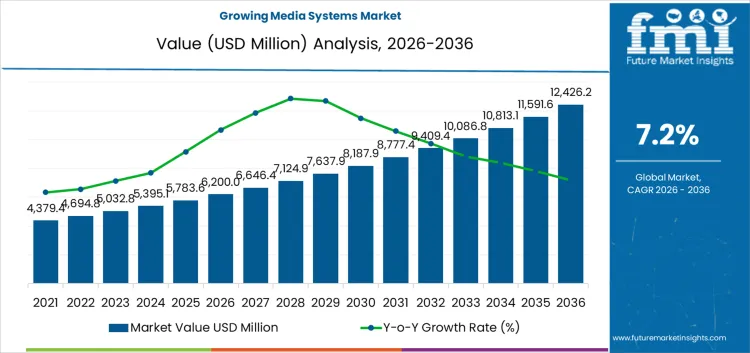
Growing Media Systems Market Key Takeaways
| Metric | Value |
|---|---|
| Market Value (2026) | USD 6,200.0 million |
| Market Forecast Value (2036) | USD 12,426.0 million |
| Forecast CAGR 2026 to 2036 | 7.2% |
Why is the Demand for Growing Media Systems Market Growing?
The demand for growing media systems is expanding as agricultural producers intensify efforts to enhance crop yields while conserving limited arable land. Controlled environment agriculture operators require substrates that support plant growth and optimize water retention and nutrient delivery. Urban farming adopts modular media to support vertical stacking and automated irrigation, increasing throughput with minimal spatial footprint. Demand from greenhouse cultivators rises due to the need for standardized rooting environments that reduce variability and support year round production. Research institutions apply these systems for trials that require repeatable growth conditions.
Technology advancements in substrate formulation are shaping market expansion as growers seek materials with porosity that improve oxygen availability at root zones. Biodegradable and renewable inputs attract attention from stakeholders aiming to reduce reliance on conventional peat based substrates and meet sustainability goals. Commercial nursery operators use sensor feedback with media mixes to refine irrigation scheduling and minimize resource waste. Expansion of horticultural education programs increases awareness of media selection criteria among growers. Regional production hubs are scaling manufacturing capacity to meet orders for blends suited to crops and climate.
How Are the Segments Classified in the Growing Media Systems Market?
Demand for growing media systems expands due to controlled cultivation adoption, yield consistency requirements, and resource efficiency priorities across intensive horticulture operations. Commercial growers prioritize substrate reliability, moisture management, and root zone stability to reduce variability in crop outcomes. Expansion of protected cultivation and precision farming reinforces preference for standardized systems supporting repeatable production cycles. Environmental compliance pressures also influence material selection, handling practices, and system integration decisions.
Which media type represents the largest share of demand?
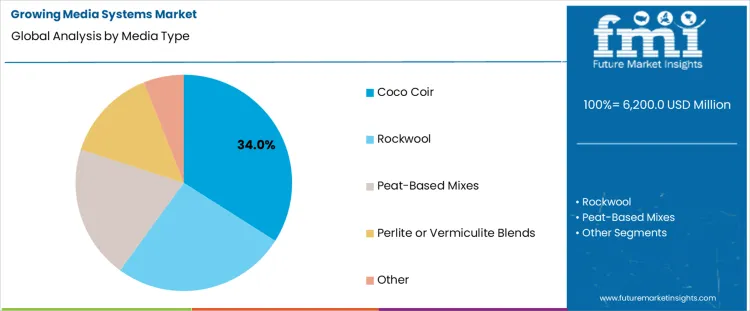
Coco coir leads media type demand with a 34.0% share, reflecting strong alignment with moisture retention and root aeration requirements. Coco coir supports consistent water availability while maintaining porosity, stabilizing crop performance under controlled irrigation regimes. Renewability perceptions and reduced reliance on peat extraction strengthen adoption across commercial operations. Compatibility with fertigation systems enables predictable nutrient delivery without structural degradation across multiple cycles. Uniform fiber structure improves handling efficiency during installation and crop turnover. Adoption remains broad across protected cultivation categories.
Key Points
- Supports balanced water retention and aeration profiles
- Aligns with sustainability-driven substrate selection practices
- Integrates effectively with automated irrigation systems
Which product format accounts for the highest share of demand?
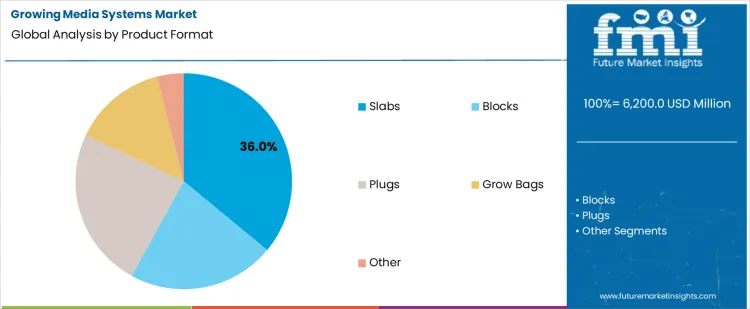
Slabs dominate product format demand at 36.0%, driven by scalability and uniformity advantages in commercial cultivation layouts. Slabs enable standardized spacing, simplified installation, and efficient drainage control within bench and gutter systems. Structural consistency supports mechanized handling and reduces labor variability during crop establishment. Predictable root zone dimensions improve irrigation accuracy and nutrient uptake consistency. Slabs also sustain longer production cycles without structural collapse under prolonged moisture exposure.
Key Points
- Facilitates standardized installation across large cultivation areas
- Enhances irrigation precision through consistent geometry
- Reduces labor variability during setup and crop transitions
Which end use accounts for the highest share of demand?
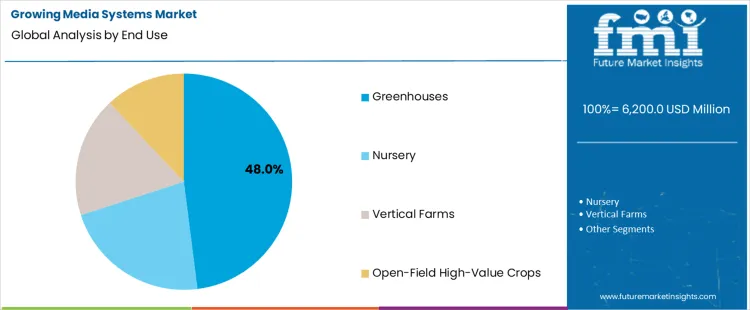
Greenhouses account for 48.0% of end use demand, reflecting concentration of intensive cultivation and capital investment. Greenhouse operators require substrates delivering predictable performance under tightly controlled climate and irrigation conditions. High planting density and year-round production increase dependence on stable root environments. Integration with automated climate, lighting, and fertigation systems reinforces reliance on engineered growing media. Operational scale heightens sensitivity to yield variability, strengthening preference for proven substrate systems.
Key Points
- Concentrates intensive production requiring consistent substrate performance
- Relies heavily on integration with automated cultivation systems
- Prioritizes yield stability under controlled environmental conditions
What are the Key Dynamics in the Growing Media Systems Market?
Demand dynamics in the growing media systems market reflect substrate performance requirements across horticulture, protected cultivation, and nursery production. Global adoption centers on yield consistency, root zone management, and water efficiency objectives. Value formation depends on physical structure, nutrient buffering capacity, and microbial compatibility. Purchasing decisions align with crop specificity, production cycles, and regulatory constraints governing peat use, waste inputs, and sustainability reporting.
How do cultivation substrate performance requirements shape adoption?
Adoption accelerates as intensive cultivation systems require predictable root aeration, moisture retention, and nutrient availability. Demand strengthens where growers replace soil with engineered substrates to control variability and disease pressure. Expansion of hydroponic and containerized production increases reliance on inert and blended media with stable physical properties. Regulatory scrutiny of water use elevates preference for media supporting precise irrigation scheduling.
Operational labor efficiency improves through uniform substrates enabling automation and repeatable crop protocols. Crop-specific formulations for fruits, vegetables, ornamentals, and seedlings further support uptake. Rising restrictions on peat extraction redirect procurement toward coir, wood fiber, and compost-based systems engineered for consistency and traceability. Commercial greenhouse investment planning increasingly embeds media selection within long-term yield optimization and input cost control frameworks.
How do raw material and handling constraints influence market scalability?
Scalability remains constrained by raw material availability, price volatility, and processing intensity across growing media categories. Demand faces pressure where peat alternatives require higher inclusion rates or supplemental fertilization. Transport costs rise due to bulk density and moisture content, affecting regional competitiveness. Quality inconsistency across batches increases crop risk and limits standardization. Regulatory limits on waste-derived inputs impose testing and certification expenses.
Media degradation over production cycles creates disposal and sanitation challenges. Compatibility issues with existing fertigation systems raise adjustment costs. Limited recycling infrastructure for spent substrates further restricts circular utilization across commercial cultivation operations. Capital budgeting becomes complex where frequent media replacement intersects with crop scheduling, storage requirements, and biosecurity protocols.
How Is Demand for the Growing Media Systems Market Evolving Globally?
Global demand for growing media systems is increasing due to controlled environment agriculture expansion and intensifying productivity optimization across horticulture supply chains worldwide. Commercial greenhouse investment, urban farming scale-up, and substrate standardization requirements are reinforcing equipment replacement cycles and system upgrades. Demand growth reflects operational dependence on precise moisture, aeration, and nutrient management rather than discretionary cultivation inputs. India records 9.8% CAGR, China records 9.1% CAGR, Brazil records 8.1% CAGR, Indonesia records 8.6% CAGR, and Vietnam records 8.4% CAGR. Adoption remains linked to yield stability economics, labor efficiency pressures, and climate variability exposure across global food production systems.
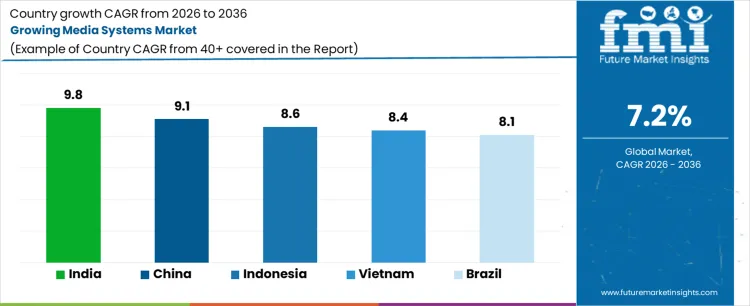
| Country | CAGR (%) |
|---|---|
| India | 9.8% |
| China | 9.1% |
| Brazil | 8.1% |
| Indonesia | 8.6% |
| Vietnam | 8.4% |
What is driving growth of growing media systems demand in India?
Demand for growing media systems in India is expanding as protected cultivation acreage increases within commercial horticulture and floriculture operations nationwide. Investment alignment favors standardized substrates supporting drip irrigation efficiency, nutrient uniformity, and reduced crop loss variability. Growth at 9.8% CAGR reflects structural pressure to raise output per square meter amid land fragmentation and labor constraints. Government-supported greenhouse clusters and private polyhouse deployment strengthen replacement demand for modular media systems. Adoption concentrates among vegetable, nursery, and export-oriented crop producers prioritizing predictable yields. Supply chains emphasize locally produced coco peat blends and inert substrates to manage import exposure and logistics cost volatility.
- Expansion of polyhouse vegetable cultivation
- Dependence on coco peat substrates
- Government-backed protected farming programs
- Yield optimization under land constraints
Why is China seeing expansion in growing media systems adoption?
Growing media systems demand in China is scaling with rapid modernization of greenhouse vegetable production and technology-driven yield optimization programs. Structural expansion at 9.1% CAGR aligns with large-scale facility agriculture serving urban consumption centers. Capital allocation prioritizes engineered substrates enabling automation compatibility, uniform root zone performance, and disease control reliability. Policy focus on food security and resource efficiency accelerates adoption across northern controlled-environment zones. Domestic manufacturing capacity supports consistent system availability and cost control. Purchasing behavior emphasizes durability, reuse potential, and integration with fertigation infrastructure across industrialized farming enterprises. Export-oriented producers increasingly standardize media specifications to meet retailer quality audits and traceability compliance requirements.
- Industrial-scale greenhouse deployment
- Emphasis on automation-compatible substrates
- Strong domestic manufacturing base
- Food security policy alignment
What factors are shaping growing media systems sales in Brazil?
Sales of growing media systems in Brazil are rising as commercial horticulture shifts toward protected cultivation and climate-resilient production models. Demand growth at 8.1% CAGR reflects sensitivity to rainfall variability and temperature volatility affecting open-field yields. Greenhouse adoption supports year-round vegetable supply for domestic retail and foodservice channels. Substrate selection emphasizes drainage control, pathogen reduction, and compatibility with fertigation practices. Investment decisions favor systems reducing water consumption and nutrient runoff exposure. Regional producers leverage locally available organic inputs blended with inert media to manage cost structures and supply reliability. Adoption concentrates among tomato, pepper, and berry operations supplying export and premium domestic segments.
- Climate risk mitigation requirements
- Greenhouse vegetable supply expansion
- Focus on water-efficient substrates
- Use of local organic inputs
How is Indonesia supporting growth of growing media systems demand?
Growing media systems sales in Indonesia are increasing as urban farming, peri-urban greenhouses, and high-value vegetable production expand. Recorded growth of 8.6% CAGR reflects rising investment in controlled cultivation supporting food security objectives. Structural drivers include limited arable land availability near cities and rising demand for consistent produce quality. Media systems enable improved water retention and nutrient efficiency under humid tropical conditions. Adoption favors lightweight substrates compatible with rooftop and modular greenhouse designs. Procurement decisions prioritize affordability, local sourcing, and adaptability to smallholder commercial operations. Growth concentrates within leafy greens, herbs, and specialty crops supplying hospitality and modern retail channels.
- Urban and peri-urban farming growth
- Lightweight substrate preference
- Smallholder commercial adoption
- Humid climate cultivation needs
What is driving expansion of growing media systems demand in Vietnam?
Growing media systems industry in Vietnam is expanding as export-oriented horticulture intensifies adoption of controlled growing environments. Demand growth at 8.4% CAGR aligns with vegetable and fruit production supporting regional and international supply chains. Structural emphasis centers on yield consistency, phytosanitary control, and efficient input utilization. Greenhouse investments increase across highland and peri-urban regions supplying premium markets. Media systems adoption supports standardized cultivation protocols required by overseas buyers. Cost-sensitive purchasing favors reusable substrates and locally processed organic blends. Government-backed agricultural modernization programs and private exporter investments jointly reinforce replacement cycles and technical upgrading of growing media systems. Adoption intensity rises with compliance requirements imposed by international retail and distribution partners.
- Export-driven horticulture expansion
- Compliance with international standards
- Growth of premium greenhouse produce
- Emphasis on reusable substrates
What is the competitive landscape of demand for the growing media systems market globally?
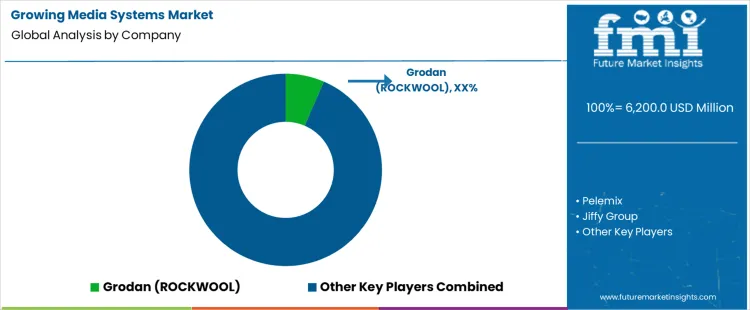
Demand for growing media systems is driven by protected cultivation expansion, yield consistency needs, and commercialization of intensive horticulture. Buyers evaluate physical structure stability, water holding capacity, aeration balance, buffering behavior, uniformity, pathogen control, and reproducible crop performance. Procurement behavior emphasizes reliable supply continuity, consistent batch quality, technical agronomy support, regional production footprints, and compliance with sustainability standards. Purchasing decisions prioritize long term cost predictability, substrate performance documentation, logistics resilience, and compatibility with automated irrigation systems. Trend in the growing media systems market reflects transition toward renewable inputs, precision engineered blends, and standardized substrates.
Klasmann-Deilmann leads competitive positioning through global peat and peat alternative portfolios supported by research, scale, and consistent quality. Premier Tech Horticulture competes through diversified growing media lines, automation compatible formats, and established distribution across controlled environment agriculture. Berger strengthens demand participation by focusing on tailored substrate recipes, professional grower partnerships, and performance consistency. Pelemix addresses coconut coir demand with traceable sourcing, washed and buffered products, and scalable international supply. Sun Gro Horticulture maintains relevance through broad product availability, retail reach, and operational scale serving diverse cultivation segments. Competitive logic centers on consistency, agronomic performance proof, logistics reliability, and ability to support large scale production cycles.
Key Players in the Growing Media Systems Market
- Grodan (ROCKWOOL)
- Pelemix
- Jiffy Group
- Premier Tech Horticulture
- Klasmann-Deilmann
- Berger
- Dutch Plantin
- Botanicare (Hawthorne)
- Sun Gro Horticulture
- CANNA
Scope of the Report
| Items | Values |
|---|---|
| Quantitative Units | USD million |
| Media Type | Coco Coir; Rockwool; Peat-Based Mixes; Perlite or Vermiculite Blends; Other |
| Product Format | Slabs; Blocks; Plugs; Grow Bags; Other |
| End Use | Greenhouses; Nursery; Vertical Farms; Open-Field High-Value Crops |
| Sales Channel | Direct to Commercial Growers; Distributors; OEM Bundled; E-commerce |
| Regions Covered | Asia Pacific, Europe, North America, Latin America, Middle East & Africa |
| Countries Covered | India, China, Brazil, Indonesia, Vietnam, and 40+ countries |
| Key Companies Profiled | Grodan (ROCKWOOL); Pelemix; Jiffy Group; Premier Tech Horticulture; Klasmann-Deilmann; Berger; Dutch Plantin; Botanicare (Hawthorne); Sun Gro Horticulture; CANNA |
| Additional Attributes | Dollar sales by media type, product format, end use, and sales channel; water retention capacity, air porosity, and structural stability across slab, block, and bag formats; consistency of fiber grading and substrate density affecting root development; buffering and pH stability for nutrient management; suitability for greenhouse, nursery, and vertical farming systems; procurement patterns balancing bulk distributor supply with direct commercial grower contracts and OEM bundled offerings. |
Growing Media Systems Market by Segment
Media Type:
- Coco Coir
- Rockwool
- Peat-Based Mixes
- Perlite or Vermiculite Blends
- Other
Product Format:
- Slabs
- Blocks
- Plugs
- Grow Bags
- Other
End Use:
- Greenhouses
- Nursery
- Vertical Farms
- Open-Field High-Value Crops
Sales Channel:
- Direct to Commercial Growers
- Distributors
- OEM Bundled
- E-commerce
Region:
- Asia Pacific
- China
- Japan
- South Korea
- India
- Australia & New Zealand
- ASEAN
- Rest of Asia Pacific
- Europe
- Germany
- United Kingdom
- France
- Italy
- Spain
- Nordic
- BENELUX
- Rest of Europe
- North America
- United States
- Canada
- Mexico
- Latin America
- Brazil
- Chile
- Rest of Latin America
- Middle East & Africa
- Kingdom of Saudi Arabia
- Other GCC Countries
- Turkey
- South Africa
- Other African Union
- Rest of Middle East & Africa
Bibliography
- Food and Agriculture Organization of the United Nations. (2023). Soilless cultivation systems and growing substrates in protected agriculture. FAO Plant Production and Protection Division.
- International Society for Horticultural Science. (2024). Advances in growing media formulations for controlled environment horticulture. Acta Horticulturae, 1357, 1-18.
- European Commission Directorate-General for Agriculture and Rural Development. (2024). Sustainable alternatives to peat in horticultural growing media. Publications Office of the European Union.
- United States Department of Agriculture. (2023). Controlled environment agriculture and substrate management practices. USDA Economic Research Service.
- Wageningen University & Research. (2024). Physical and chemical performance requirements of substrates for greenhouse crop production. Wageningen UR Greenhouse Horticulture.
Frequently Asked Questions
How big is the growing media systems market in 2026?
The global growing media systems market is estimated to be valued at USD 6,200.0 million in 2026.
What will be the size of growing media systems market in 2036?
The market size for the growing media systems market is projected to reach USD 12,426.2 million by 2036.
How much will be the growing media systems market growth between 2026 and 2036?
The growing media systems market is expected to grow at a 7.2% CAGR between 2026 and 2036.
What are the key product types in the growing media systems market?
The key product types in growing media systems market are coco coir, rockwool, peat-based mixes, perlite or vermiculite blends and other.
Which product format segment to contribute significant share in the growing media systems market in 2026?
In terms of product format, slabs segment to command 36.0% share in the growing media systems market in 2026.
Preview the report firsthand - request a free sample
Get SampleGet the brochure for pricing and purchase details.
Get PDFTable of Content
- Executive Summary
- Global Market Outlook
- Demand-side Trends
- Supply-side Trends
- Technology Roadmap Analysis
- Analysis and Recommendations
- Market Overview
- Market Coverage / Taxonomy
- Market Definition / Scope / Limitations
- Market Background
- Market Dynamics
- Drivers
- Restraints
- Opportunity
- Trends
- Scenario Forecast
- Demand in Optimistic Scenario
- Demand in Likely Scenario
- Demand in Conservative Scenario
- Opportunity Map Analysis
- Product Life Cycle Analysis
- Supply Chain Analysis
- Investment Feasibility Matrix
- Value Chain Analysis
- PESTLE and Porter’s Analysis
- Regulatory Landscape
- Regional Parent Market Outlook
- Production and Consumption Statistics
- Import and Export Statistics
- Market Dynamics
- Global Market Analysis 2021 to 2025 and Forecast, 2026 to 2036
- Historical Market Size Value (USD Million) Analysis, 2021 to 2025
- Current and Future Market Size Value (USD Million) Projections, 2026 to 2036
- Y-o-Y Growth Trend Analysis
- Absolute $ Opportunity Analysis
- Global Market Pricing Analysis 2021 to 2025 and Forecast 2026 to 2036
- Global Market Analysis 2021 to 2025 and Forecast 2026 to 2036, By Media Type
- Introduction / Key Findings
- Historical Market Size Value (USD Million) Analysis By Media Type, 2021 to 2025
- Current and Future Market Size Value (USD Million) Analysis and Forecast By Media Type, 2026 to 2036
- Coco Coir
- Rockwool
- Peat-Based Mixes
- Perlite or Vermiculite Blends
- Other
- Coco Coir
- Y-o-Y Growth Trend Analysis By Media Type, 2021 to 2025
- Absolute $ Opportunity Analysis By Media Type, 2026 to 2036
- Global Market Analysis 2021 to 2025 and Forecast 2026 to 2036, By Product Format
- Introduction / Key Findings
- Historical Market Size Value (USD Million) Analysis By Product Format, 2021 to 2025
- Current and Future Market Size Value (USD Million) Analysis and Forecast By Product Format, 2026 to 2036
- Slabs
- Blocks
- Plugs
- Grow Bags
- Other
- Slabs
- Y-o-Y Growth Trend Analysis By Product Format, 2021 to 2025
- Absolute $ Opportunity Analysis By Product Format, 2026 to 2036
- Global Market Analysis 2021 to 2025 and Forecast 2026 to 2036, By End Use
- Introduction / Key Findings
- Historical Market Size Value (USD Million) Analysis By End Use, 2021 to 2025
- Current and Future Market Size Value (USD Million) Analysis and Forecast By End Use, 2026 to 2036
- Greenhouses
- Nursery
- Vertical Farms
- Open-Field High-Value Crops
- Greenhouses
- Y-o-Y Growth Trend Analysis By End Use, 2021 to 2025
- Absolute $ Opportunity Analysis By End Use, 2026 to 2036
- Global Market Analysis 2021 to 2025 and Forecast 2026 to 2036, By Sales Channel
- Introduction / Key Findings
- Historical Market Size Value (USD Million) Analysis By Sales Channel, 2021 to 2025
- Current and Future Market Size Value (USD Million) Analysis and Forecast By Sales Channel, 2026 to 2036
- Direct to Commercial Growers
- Distributors
- OEM Bundled
- E-commerce
- Direct to Commercial Growers
- Y-o-Y Growth Trend Analysis By Sales Channel, 2021 to 2025
- Absolute $ Opportunity Analysis By Sales Channel, 2026 to 2036
- Global Market Analysis 2021 to 2025 and Forecast 2026 to 2036, By Region
- Introduction
- Historical Market Size Value (USD Million) Analysis By Region, 2021 to 2025
- Current Market Size Value (USD Million) Analysis and Forecast By Region, 2026 to 2036
- North America
- Latin America
- Western Europe
- Eastern Europe
- East Asia
- South Asia and Pacific
- Middle East & Africa
- Market Attractiveness Analysis By Region
- North America Market Analysis 2021 to 2025 and Forecast 2026 to 2036, By Country
- Historical Market Size Value (USD Million) Trend Analysis By Market Taxonomy, 2021 to 2025
- Market Size Value (USD Million) Forecast By Market Taxonomy, 2026 to 2036
- By Country
- USA
- Canada
- Mexico
- By Media Type
- By Product Format
- By End Use
- By Sales Channel
- By Country
- Market Attractiveness Analysis
- By Country
- By Media Type
- By Product Format
- By End Use
- By Sales Channel
- Key Takeaways
- Latin America Market Analysis 2021 to 2025 and Forecast 2026 to 2036, By Country
- Historical Market Size Value (USD Million) Trend Analysis By Market Taxonomy, 2021 to 2025
- Market Size Value (USD Million) Forecast By Market Taxonomy, 2026 to 2036
- By Country
- Brazil
- Chile
- Rest of Latin America
- By Media Type
- By Product Format
- By End Use
- By Sales Channel
- By Country
- Market Attractiveness Analysis
- By Country
- By Media Type
- By Product Format
- By End Use
- By Sales Channel
- Key Takeaways
- Western Europe Market Analysis 2021 to 2025 and Forecast 2026 to 2036, By Country
- Historical Market Size Value (USD Million) Trend Analysis By Market Taxonomy, 2021 to 2025
- Market Size Value (USD Million) Forecast By Market Taxonomy, 2026 to 2036
- By Country
- Germany
- UK
- Italy
- Spain
- France
- Nordic
- BENELUX
- Rest of Western Europe
- By Media Type
- By Product Format
- By End Use
- By Sales Channel
- By Country
- Market Attractiveness Analysis
- By Country
- By Media Type
- By Product Format
- By End Use
- By Sales Channel
- Key Takeaways
- Eastern Europe Market Analysis 2021 to 2025 and Forecast 2026 to 2036, By Country
- Historical Market Size Value (USD Million) Trend Analysis By Market Taxonomy, 2021 to 2025
- Market Size Value (USD Million) Forecast By Market Taxonomy, 2026 to 2036
- By Country
- Russia
- Poland
- Hungary
- Balkan & Baltic
- Rest of Eastern Europe
- By Media Type
- By Product Format
- By End Use
- By Sales Channel
- By Country
- Market Attractiveness Analysis
- By Country
- By Media Type
- By Product Format
- By End Use
- By Sales Channel
- Key Takeaways
- East Asia Market Analysis 2021 to 2025 and Forecast 2026 to 2036, By Country
- Historical Market Size Value (USD Million) Trend Analysis By Market Taxonomy, 2021 to 2025
- Market Size Value (USD Million) Forecast By Market Taxonomy, 2026 to 2036
- By Country
- China
- Japan
- South Korea
- By Media Type
- By Product Format
- By End Use
- By Sales Channel
- By Country
- Market Attractiveness Analysis
- By Country
- By Media Type
- By Product Format
- By End Use
- By Sales Channel
- Key Takeaways
- South Asia and Pacific Market Analysis 2021 to 2025 and Forecast 2026 to 2036, By Country
- Historical Market Size Value (USD Million) Trend Analysis By Market Taxonomy, 2021 to 2025
- Market Size Value (USD Million) Forecast By Market Taxonomy, 2026 to 2036
- By Country
- India
- ASEAN
- Australia & New Zealand
- Rest of South Asia and Pacific
- By Media Type
- By Product Format
- By End Use
- By Sales Channel
- By Country
- Market Attractiveness Analysis
- By Country
- By Media Type
- By Product Format
- By End Use
- By Sales Channel
- Key Takeaways
- Middle East & Africa Market Analysis 2021 to 2025 and Forecast 2026 to 2036, By Country
- Historical Market Size Value (USD Million) Trend Analysis By Market Taxonomy, 2021 to 2025
- Market Size Value (USD Million) Forecast By Market Taxonomy, 2026 to 2036
- By Country
- Kingdom of Saudi Arabia
- Other GCC Countries
- Turkiye
- South Africa
- Other African Union
- Rest of Middle East & Africa
- By Media Type
- By Product Format
- By End Use
- By Sales Channel
- By Country
- Market Attractiveness Analysis
- By Country
- By Media Type
- By Product Format
- By End Use
- By Sales Channel
- Key Takeaways
- Key Countries Market Analysis
- USA
- Pricing Analysis
- Market Share Analysis, 2025
- By Media Type
- By Product Format
- By End Use
- By Sales Channel
- Canada
- Pricing Analysis
- Market Share Analysis, 2025
- By Media Type
- By Product Format
- By End Use
- By Sales Channel
- Mexico
- Pricing Analysis
- Market Share Analysis, 2025
- By Media Type
- By Product Format
- By End Use
- By Sales Channel
- Brazil
- Pricing Analysis
- Market Share Analysis, 2025
- By Media Type
- By Product Format
- By End Use
- By Sales Channel
- Chile
- Pricing Analysis
- Market Share Analysis, 2025
- By Media Type
- By Product Format
- By End Use
- By Sales Channel
- Germany
- Pricing Analysis
- Market Share Analysis, 2025
- By Media Type
- By Product Format
- By End Use
- By Sales Channel
- UK
- Pricing Analysis
- Market Share Analysis, 2025
- By Media Type
- By Product Format
- By End Use
- By Sales Channel
- Italy
- Pricing Analysis
- Market Share Analysis, 2025
- By Media Type
- By Product Format
- By End Use
- By Sales Channel
- Spain
- Pricing Analysis
- Market Share Analysis, 2025
- By Media Type
- By Product Format
- By End Use
- By Sales Channel
- France
- Pricing Analysis
- Market Share Analysis, 2025
- By Media Type
- By Product Format
- By End Use
- By Sales Channel
- India
- Pricing Analysis
- Market Share Analysis, 2025
- By Media Type
- By Product Format
- By End Use
- By Sales Channel
- ASEAN
- Pricing Analysis
- Market Share Analysis, 2025
- By Media Type
- By Product Format
- By End Use
- By Sales Channel
- Australia & New Zealand
- Pricing Analysis
- Market Share Analysis, 2025
- By Media Type
- By Product Format
- By End Use
- By Sales Channel
- China
- Pricing Analysis
- Market Share Analysis, 2025
- By Media Type
- By Product Format
- By End Use
- By Sales Channel
- Japan
- Pricing Analysis
- Market Share Analysis, 2025
- By Media Type
- By Product Format
- By End Use
- By Sales Channel
- South Korea
- Pricing Analysis
- Market Share Analysis, 2025
- By Media Type
- By Product Format
- By End Use
- By Sales Channel
- Russia
- Pricing Analysis
- Market Share Analysis, 2025
- By Media Type
- By Product Format
- By End Use
- By Sales Channel
- Poland
- Pricing Analysis
- Market Share Analysis, 2025
- By Media Type
- By Product Format
- By End Use
- By Sales Channel
- Hungary
- Pricing Analysis
- Market Share Analysis, 2025
- By Media Type
- By Product Format
- By End Use
- By Sales Channel
- Kingdom of Saudi Arabia
- Pricing Analysis
- Market Share Analysis, 2025
- By Media Type
- By Product Format
- By End Use
- By Sales Channel
- Turkiye
- Pricing Analysis
- Market Share Analysis, 2025
- By Media Type
- By Product Format
- By End Use
- By Sales Channel
- South Africa
- Pricing Analysis
- Market Share Analysis, 2025
- By Media Type
- By Product Format
- By End Use
- By Sales Channel
- USA
- Market Structure Analysis
- Competition Dashboard
- Competition Benchmarking
- Market Share Analysis of Top Players
- By Regional
- By Media Type
- By Product Format
- By End Use
- By Sales Channel
- Competition Analysis
- Competition Deep Dive
- Grodan (ROCKWOOL)
- Overview
- Product Portfolio
- Profitability by Market Segments (Product/Age /Sales Channel/Region)
- Sales Footprint
- Strategy Overview
- Marketing Strategy
- Product Strategy
- Channel Strategy
- Pelemix
- Jiffy Group
- Premier Tech Horticulture
- Klasmann-Deilmann
- Berger
- Dutch Plantin
- Botanicare (Hawthorne)
- Sun Gro Horticulture
- CANNA
- Grodan (ROCKWOOL)
- Competition Deep Dive
- Assumptions & Acronyms Used
- Research Methodology


