

- Industry Size (2026)
- USD 749.9 Mn
- Forecast (2036)
- USD 1603.20 Mn
- CAGR (2026 to 2036)
- 7.90%
Variable Rate Precision Autonomous Tractors Market Forecast and Outlook 2026 to 2036
The variable rate precision autonomous tractors market is valued at USD 749.9 million in 2026 and is projected to reach USD 1,603.2 million by 2036, reflecting a CAGR of 7.9%. Market performance is shaped by concentration among manufacturers offering autonomous tractors integrated with variable-rate application systems. Regional adoption depends on arable land area, precision agriculture infrastructure, and regulatory frameworks for autonomous machinery. Cost structures are influenced by sensor technology, GPS guidance, and AI-enabled decision systems. Smaller operators face limitations in scaling production, maintaining operational reliability, and achieving multi-region certification.
Margin concentration favors suppliers providing validated, high-precision tractors with integrated software, predictive maintenance, and multi-crop compatibility. Fragmentation persists among regional or niche manufacturers, while leading companies capture concentrated value through platform standardization, integration with farm management systems, and operational performance rather than unit count alone. Market outcomes are determined by reliability, precision efficiency, and compatibility with large-scale agricultural operations rather than sheer production volume.
Quick Stats of the Variable Rate Precision Autonomous Tractors Market
- Variable Rate Precision Autonomous Tractors Market Value (2026): USD 749.9 million
- Variable Rate Precision Autonomous Tractors Forecast Value (2036): USD 1,603.2 million
- Variable Rate Precision Autonomous Tractors Forecast CAGR 2026 to 2036: 7.9%
- Leading Horsepower Class in Variable Rate Precision Autonomous Tractors Market: <150 HP (41 % share)
- Leading Automation Level in Variable Rate Precision Autonomous Tractors Market: Assisted autonomy (63 % share)
- Key Growth Regions in Variable Rate Precision Autonomous Tractors Market: USA, Brazil, Australia, India
- Top Players in Variable Rate Precision Autonomous Tractors Market: John Deere, CNH Industrial, AGCO, Kubota, Yanmar, Mahindra & Mahindra
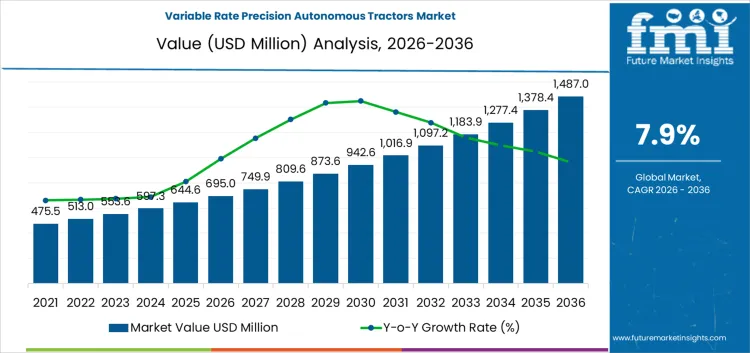
What is the Growth Forecast for Variable Rate Precision Autonomous Tractors Market through 2036?
Between 2026 and 2031, the variable rate precision autonomous tractors market is projected to grow from USD 749.9 million to USD 1,016.9 million, generating an absolute increase of USD 267 million and reflecting a CAGR of 7.9%. Growth is driven by adoption of tractors under <150 HP, 150-300 HP, and >300 HP across assisted and fully autonomous operations. Large and mid-size farms are primary end users. Expansion is supported by rising demand for precision agriculture, increased efficiency, and labor optimization. Suppliers focus on autonomous system reliability, GPS-enabled variable rate technology, and integration with farm management platforms.
From 2031 to 2036, the market is expected to expand from USD 1,016.9 million to USD 1,603.2 million. Growth is fueled by broader adoption of fully autonomous tractors, variable rate precision technology, and large-scale deployment on commercial farms. Market drivers include efficiency gains, reduced input costs, and technological advancements in autonomy and connectivity. Competitive advantage favors suppliers offering validated precision solutions, robust autonomous platforms, and strong service and support. Leading companies include John Deere, CNH Industrial, AGCO, Kubota, Yanmar, and Mahindra & Mahindra.
Variable Rate Precision Autonomous Tractors Market Key Takeaways
| Metric | Value |
|---|---|
| Market Value (2026) | USD 749.9 million |
| Forecast Value (2036) | USD 1,603.20 million |
| Forecast CAGR 2026 to 2036 | 7.90% |
What Is Driving Demand for Variable Rate Precision Autonomous Tractors?
Variable rate precision autonomous tractors are increasingly adopted to optimize field operations, improve input efficiency, and reduce labor requirements in modern agriculture. Historically, tractors required manual operation with uniform application of seeds, fertilizers, and pesticides, leading to suboptimal resource use and crop yields. Modern autonomous tractors integrate GPS, AI, and variable-rate technology to adjust inputs in real time based on soil conditions, crop health, and field variability. Farmers, agricultural service providers, and equipment manufacturers prioritize operational accuracy, system reliability, and integration with farm management platforms. Early adoption focused on large-scale commercial farms, while current demand spans medium and small farms driven by labor shortages, cost efficiency, and sustainable input management. Sensor accuracy, AI algorithm performance, and system interoperability influence adoption decisions.
Rising labor costs, increasing crop management complexity, and digital agriculture initiatives are shaping market growth. Compared with conventional tractors, precision autonomous systems emphasize autonomous navigation, real-time decision-making, and adaptive resource application for improved yield and efficiency. Cost structures depend on sensor integration, AI software, and vehicle hardware, concentrating margins among suppliers capable of delivering reliable, high-performance tractors. Farmers adopt these systems to optimize input use, reduce operational costs, and improve crop productivity. By 2036, variable rate precision autonomous tractors are expected to become standard in mechanized agriculture, supporting efficiency, precision, and advanced farm management practices.
What Factors Are Shaping the Demand for Variable Rate Precision Autonomous Tractors in Terms of Horsepower Class and Automation Level?
The demand for variable rate precision autonomous tractors is segmented by horsepower class and automation level. Horsepower classes include <150 HP, 150-300 HP, and >300 HP. Automation levels include assisted autonomy and full autonomy. Adoption is influenced by field size, crop type, and precision agriculture requirements. Uptake is driven by labor efficiency, fuel optimization, and enhanced crop yields. Horsepower class and automation level selection depend on farm size, operational complexity, and technology integration needs, ensuring reliable, scalable, and high-performance autonomous operations across small, medium, and large-scale farming enterprises.
Why Are <150 HP Tractors Leading the Horsepower Class Segment in Variable Rate Precision Autonomous Tractors?
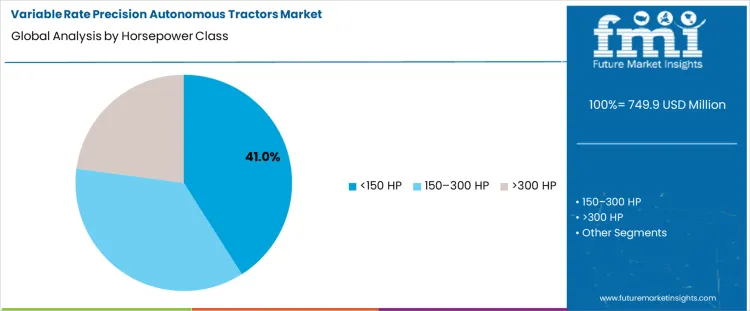
Tractors under 150 HP account for approximately 41% of total horsepower demand, making them the leading category. Adoption is driven by small- to medium-sized farms that require agile, fuel-efficient, and maneuverable equipment. These tractors integrate variable rate technology for precise seeding, fertilization, and spraying applications. Operational procedures include GPS-guided navigation, automated field mapping, and sensor-based application control. <150 HP tractors enable optimized input usage, reduced overlap, and improved field coverage. The segment leads because it provides cost-effective, high-precision solutions suitable for diverse crop types and smaller farm operations, balancing performance, affordability, and operational reliability.
Operational factors further reinforce adoption. Tractors must maintain accurate positioning, stable operation on variable terrain, and seamless integration with farm management systems. <150 HP tractors lead because they deliver scalable precision agriculture benefits, operational efficiency, and fuel savings while supporting assisted autonomy across small and medium-sized farms.
Why Is Assisted Autonomy Representing the Largest Automation Level Segment in Variable Rate Precision Autonomous Tractors?
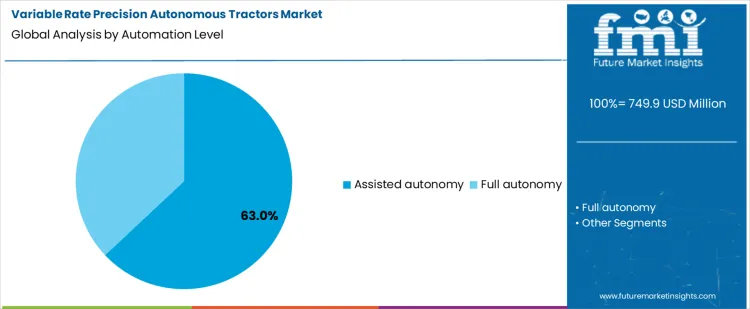
Assisted autonomy accounts for approximately 63% of total automation level demand, making it the largest category. Adoption is driven by farms seeking partial automation to reduce labor dependency while retaining operator oversight. Assisted tractors provide navigation, field mapping, and implement control while enabling manual intervention when necessary. Operational procedures include pre-programmed routes, sensor monitoring, and real-time operator input. Assisted autonomy improves precision, reduces operator fatigue, and enhances input efficiency.
Functional and operational factors further reinforce adoption. Systems must reliably detect obstacles, maintain field alignment, and integrate with variable rate technology. Assisted autonomy leads because it combines operational flexibility, safety, and precision, enabling farms to adopt autonomous solutions while maintaining control over critical operations and optimizing productivity and input management.
How Are Variable Rate Precision Autonomous Tractors Redefining Modern Farming?
Variable rate precision autonomous tractors are increasingly adopted to optimize field operations by adjusting input application such as seeds, fertilizers, and water in real time based on soil variability. Adoption is strongest in regions with advanced agricultural practices, large-scale mechanized farms, and high technology penetration. Tractors are selected for autonomous navigation accuracy, sensor integration, and precision control systems. Growth is driven by the need to increase crop yield, reduce input costs, and support sustainable farming practices. Investment focuses on AI algorithms, multi-sensor systems, and autonomous mobility. Operators prioritize tractors that enhance field efficiency, minimize resource wastage, and maintain consistent crop performance.
Why Are Regional Precision Agriculture Initiatives and Soil Variability Mapping Driving Adoption?
Demand is influenced by local government support for precision agriculture, high-value crops, and data-driven farming practices. Farmers adopt autonomous tractors to implement variable rate applications, reduce overuse of inputs, and optimize yield. Platforms offering multi-input adaptability, real-time field mapping, and predictive guidance gain preference. Adoption is concentrated in regions with high mechanization levels and robust agricultural extension services. Operational efficiency, input optimization, and crop performance drive procurement more than cost. Suppliers providing validated, high-accuracy autonomous systems gain competitive advantage among commercial and large-scale farmers.
What Factors Limit Broader Deployment of Precision Autonomous Tractors?
High capital investment, sensor calibration complexity, and reliance on reliable field data restrict adoption. Performance can be affected by terrain variability, weather conditions, and connectivity limitations. Integration with farm management systems and multi-crop operations requires technical expertise. Smaller farms or regions with low mechanization adopt solutions more slowly. These factors concentrate early deployment among large commercial farms, agri-tech operators, and regions with established precision agriculture infrastructure.
How Are Technological Innovations and Collaborative Ecosystems Shaping Market Growth?
Recent innovations include AI-driven guidance systems, real-time variable rate controllers, and multi-sensor fusion for adaptive field operation. Collaboration between tractor manufacturers, agri-tech software providers, and research institutions ensures system validation, field reliability, and workflow integration. Pilot programs assess precision application accuracy, autonomous navigation, and operational efficiency before full-scale adoption. Quality monitoring, system calibration, and data standardization maintain consistent performance. Focus is on input efficiency, crop yield optimization, and autonomous reliability rather than cost or scale. Collaborative initiatives enable broader adoption of variable rate precision autonomous tractors across commercial and industrial farming regions.
What is the Demand for Variable Rate Precision Autonomous Tractors by Country?
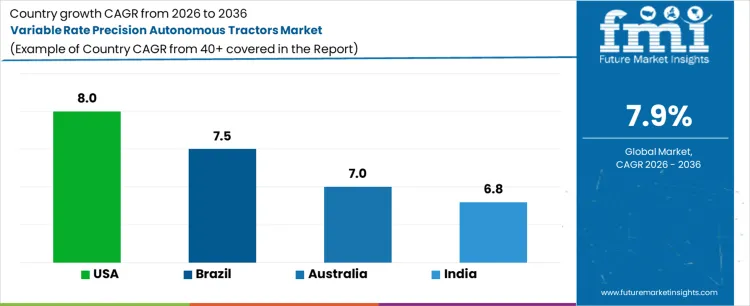
| Country | CAGR (%) |
|---|---|
| USA | 8.0% |
| Brazil | 7.5% |
| Australia | 7.0% |
| India | 6.8% |
Demand for variable rate precision autonomous tractors is rising as farmers adopt advanced automation and precision agriculture technologies to improve efficiency, optimize input usage, and increase crop yields. The USA leads with an 8.0% CAGR, driven by high adoption of autonomous farming equipment, government support for smart agriculture, and large-scale farming operations. Brazil follows at 7.5%, supported by expanding commercial agriculture and integration of variable rate technologies. Australia records 7.0% growth, shaped by adoption in large-scale crop and livestock farms. India shows 6.8% CAGR, reflecting gradual adoption of autonomous tractors, government initiatives for precision agriculture, and modernization of farming practices.
How is the United States experiencing growth in the variable rate precision autonomous tractors market?
United States is experiencing growth at a CAGR of 8%, supported by adoption of variable rate precision autonomous tractors market solutions to optimize agricultural productivity, reduce input costs, and enhance operational efficiency. Manufacturers and technology providers are deploying tractors equipped with AI-driven control systems, precision sensors, and autonomous navigation optimized for variable-rate seeding, fertilization, and spraying. Demand is concentrated in large-scale commercial farms, agricultural technology hubs, and research centers. Investments focus on system performance, sensor accuracy, and compliance with agricultural safety standards rather than fleet expansion. Growth reflects increasing adoption of precision agriculture, industrial focus on autonomous machinery, and government support for smart farming initiatives.
- Precision agriculture drives adoption.
- Tractors optimize variable-rate seeding, fertilization, and spraying.
- Commercial farms and agri-tech hubs concentrate demand.
- System performance and sensor accuracy guide investment.
How is Brazil witnessing growth in the variable rate precision autonomous tractors market?
Brazil is witnessing growth at a CAGR of 7.5%, fueled by adoption of variable rate precision autonomous tractors market solutions to improve crop yield, reduce input wastage, and support large-scale mechanized farming. Manufacturers and suppliers are deploying autonomous tractors optimized for real-time field mapping, AI-guided control, and variable-rate application of seeds and fertilizers. Demand is concentrated in agricultural production hubs, research farms, and precision agriculture centers. Investments prioritize system reliability, sensor performance, and compliance with agricultural regulations rather than fleet-scale deployment. Growth reflects increasing mechanization, adoption of smart farming technologies, and industrial emphasis on precision agriculture efficiency.
- Mechanized farming drives adoption.
- Tractors enhance real-time mapping and variable-rate applications.
- Agricultural hubs and research farms concentrate demand.
- System reliability and sensor performance guide investment.
How is Australia experiencing growth in the variable rate precision autonomous tractors market?
Australia is experiencing growth at a CAGR of 7%, supported by adoption of variable rate precision autonomous tractors market solutions to optimize field operations, reduce operational costs, and improve crop productivity. Manufacturers and technology providers are producing autonomous tractors optimized for AI-driven navigation, variable-rate input management, and soil monitoring. Demand is concentrated in large-scale farms, agricultural research centers, and precision agriculture hubs. Investments focus on system reliability, sensor accuracy, and regulatory compliance rather than mass-scale deployment. Growth reflects industrial adoption of autonomous machinery, precision agriculture expansion, and government support for technology-driven farming.
- Precision farming drives adoption.
- Tractors optimize AI-guided navigation and variable-rate inputs.
- Large-scale farms and research centers concentrate demand.
- System reliability and sensor accuracy guide investment.
How is India witnessing growth in the variable rate precision autonomous tractors market?
India is witnessing growth at a CAGR of 6.8%, fueled by adoption of variable rate precision autonomous tractors market solutions to improve productivity, reduce input costs, and enhance operational efficiency in mechanized agriculture. Manufacturers and technology providers are deploying autonomous tractors optimized for AI-driven field mapping, variable-rate application, and precision monitoring. Demand is concentrated in industrial agricultural hubs, large farms, and research centers. Investments prioritize system performance, sensor reliability, and compliance with agricultural standards rather than fleet-scale deployment. Growth reflects government initiatives supporting smart farming, industrial adoption of autonomous machinery, and expansion of precision agriculture solutions.
- Smart farming drives adoption.
- Tractors provide AI-guided field mapping and variable-rate inputs.
- Industrial agricultural hubs and large farms concentrate demand.
- System performance and sensor reliability guide investment.
Who Competes in the Variable Rate Precision Autonomous Tractors Market and What Defines Their Capabilities?
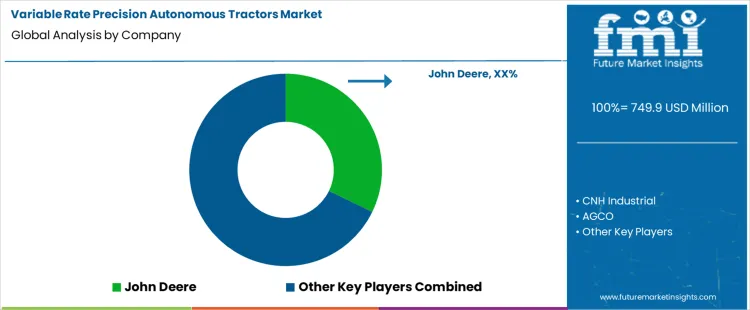
Competition in the variable rate precision autonomous tractors market is defined by automation capability, sensor integration, and precision agriculture performance. John Deere supplies autonomous tractors equipped with GPS-guided variable rate application systems, real-time sensor feedback, and advanced machine learning for optimized field operations. CNH Industrial develops autonomous tractors with integrated soil and crop monitoring systems for variable rate fertilizer and seed application. AGCO provides autonomous platforms with variable rate technology linked to precision guidance systems for efficient resource use. Kubota delivers compact autonomous tractors with precision application capabilities suitable for small to medium-sized farms. Yanmar focuses on sensor-driven autonomous solutions for variable input management and field optimization.
Mahindra & Mahindra supplies autonomous tractors integrated with variable rate controllers and telematics for precision farming in diverse climatic conditions. Other participants include regional and emerging autonomous tractor manufacturers offering software-enabled variable rate application systems. Differentiation arises from navigation precision, sensor accuracy, automation level, ease of integration with farm management software, and adaptability to different crop types and terrains. Market positioning is influenced by reliability, fuel and input efficiency, and the ability to enhance operational productivity while reducing resource consumption. Companies providing scalable, AI-enabled, and sensor-integrated autonomous tractors maintain competitive relevance in precision agriculture adoption.
Key Players in the Variable Rate Precision Autonomous Tractors Market
- John Deere
- CNH Industrial
- AGCO
- Kubota
- Yanmar
- Mahindra & Mahindra
Scope of the Report
| Items | Values |
|---|---|
| Quantitative Units (2026) | USD million |
| Horsepower Class | <150 HP, 150-300 HP, 300 HP |
| Automation Level | Assisted autonomy, Full autonomy |
| Farm Size | Large farms, Mid-size farms |
| Region | Asia Pacific, Europe, North America, Latin America, Middle East & Africa |
| Key Countries Covered | USA, Brazil, Australia, India |
| Key Companies Profiled | John Deere, CNH Industrial, AGCO, Kubota, Yanmar, Mahindra & Mahindra |
| Additional Attributes | Dollar sales by horsepower class, automation level, and farm size; regional CAGR, volume and value growth projections; adoption across small, mid-size, and large farms; integration with farm management platforms and AI-driven precision systems; focus on GPS-guided variable rate technology, sensor accuracy, and autonomous navigation performance; margins concentrated among suppliers delivering validated, high-performance autonomous tractors with predictive maintenance and multi-crop compatibility; competitive advantage from platform standardization and field data integration. |
Variable Rate Precision Autonomous Tractors Market Segmentation
Horsepower Class:
- <150 HP
- 150-300 HP
- 300 HP
Automation Level:
- Assisted autonomy
- Full autonomy
Farm Size:
- Large farms
- Mid-size farms
Region
- Asia Pacific
- China
- Japan
- South Korea
- India
- Australia & New Zealand
- ASEAN
- Rest of Asia Pacific
- Europe
- Germany
- United Kingdom
- France
- Italy
- Spain
- Nordic
- BENELUX
- Rest of Europe
- North America
- United States
- Canada
- Mexico
- Latin America
- Brazil
- Chile
- Rest of Latin America
- Middle East & Africa
- Kingdom of Saudi Arabia
- Other GCC Countries
- Turkey
- South Africa
- Other African Union
- Rest of Middle East & Africa
Bibliography
- United States Department of Agriculture (USDA). (2024). Precision agriculture and automation technologies.
- Australian Government - Department of Agriculture, Fisheries and Forestry. (2023). Digital and autonomous farming systems.
- Indian Council of Agricultural Research (ICAR). (2023). Mechanisation, precision farming, and autonomous equipment.
- Food and Agriculture Organization of the United Nations (FAO). (2023). Digital agriculture and precision farming technologies.
Frequently Asked Questions
How big is the variable rate precision autonomous tractors market in 2026?
The global variable rate precision autonomous tractors market is estimated to be valued at USD 749.9 million in 2026.
What will be the size of variable rate precision autonomous tractors market in 2036?
The market size for the variable rate precision autonomous tractors market is projected to reach USD 1,603.2 million by 2036.
How much will be the variable rate precision autonomous tractors market growth between 2026 and 2036?
The variable rate precision autonomous tractors market is expected to grow at a 7.9% CAGR between 2026 and 2036.
What are the key product types in the variable rate precision autonomous tractors market?
The key product types in variable rate precision autonomous tractors market are <150 hp, 150–300 hp and >300 hp.
Which automation level segment to contribute significant share in the variable rate precision autonomous tractors market in 2026?
In terms of automation level, assisted autonomy segment to command 63.0% share in the variable rate precision autonomous tractors market in 2026.
Preview the report firsthand - request a free sample
Get SampleGet the brochure for pricing and purchase details.
Get PDFTable of Content
- Executive Summary
- Global Market Outlook
- Demand-side Trends
- Supply-side Trends
- Technology Roadmap Analysis
- Analysis and Recommendations
- Market Overview
- Market Coverage / Taxonomy
- Market Definition / Scope / Limitations
- Market Background
- Market Dynamics
- Drivers
- Restraints
- Opportunity
- Trends
- Scenario Forecast
- Demand in Optimistic Scenario
- Demand in Likely Scenario
- Demand in Conservative Scenario
- Opportunity Map Analysis
- Product Life Cycle Analysis
- Supply Chain Analysis
- Investment Feasibility Matrix
- Value Chain Analysis
- PESTLE and Porter’s Analysis
- Regulatory Landscape
- Regional Parent Market Outlook
- Production and Consumption Statistics
- Import and Export Statistics
- Market Dynamics
- Global Market Analysis 2021 to 2025 and Forecast, 2026 to 2036
- Historical Market Size Value (USD Million) Analysis, 2021 to 2025
- Current and Future Market Size Value (USD Million) Projections, 2026 to 2036
- Y-o-Y Growth Trend Analysis
- Absolute $ Opportunity Analysis
- Global Market Pricing Analysis 2021 to 2025 and Forecast 2026 to 2036
- Global Market Analysis 2021 to 2025 and Forecast 2026 to 2036, By Horsepower Class
- Introduction / Key Findings
- Historical Market Size Value (USD Million) Analysis By Horsepower Class , 2021 to 2025
- Current and Future Market Size Value (USD Million) Analysis and Forecast By Horsepower Class , 2026 to 2036
- <150 HP
- 150–300 HP
- >300 HP
- <150 HP
- Y-o-Y Growth Trend Analysis By Horsepower Class , 2021 to 2025
- Absolute $ Opportunity Analysis By Horsepower Class , 2026 to 2036
- Global Market Analysis 2021 to 2025 and Forecast 2026 to 2036, By Automation Level
- Introduction / Key Findings
- Historical Market Size Value (USD Million) Analysis By Automation Level, 2021 to 2025
- Current and Future Market Size Value (USD Million) Analysis and Forecast By Automation Level, 2026 to 2036
- Assisted autonomy
- Full autonomy
- Assisted autonomy
- Y-o-Y Growth Trend Analysis By Automation Level, 2021 to 2025
- Absolute $ Opportunity Analysis By Automation Level, 2026 to 2036
- Global Market Analysis 2021 to 2025 and Forecast 2026 to 2036, By Farm Size
- Introduction / Key Findings
- Historical Market Size Value (USD Million) Analysis By Farm Size, 2021 to 2025
- Current and Future Market Size Value (USD Million) Analysis and Forecast By Farm Size, 2026 to 2036
- Large farms
- Mid-size farms
- Large farms
- Y-o-Y Growth Trend Analysis By Farm Size, 2021 to 2025
- Absolute $ Opportunity Analysis By Farm Size, 2026 to 2036
- Global Market Analysis 2021 to 2025 and Forecast 2026 to 2036, By Region
- Introduction
- Historical Market Size Value (USD Million) Analysis By Region, 2021 to 2025
- Current Market Size Value (USD Million) Analysis and Forecast By Region, 2026 to 2036
- North America
- Latin America
- Western Europe
- Eastern Europe
- East Asia
- South Asia and Pacific
- Middle East & Africa
- Market Attractiveness Analysis By Region
- North America Market Analysis 2021 to 2025 and Forecast 2026 to 2036, By Country
- Historical Market Size Value (USD Million) Trend Analysis By Market Taxonomy, 2021 to 2025
- Market Size Value (USD Million) Forecast By Market Taxonomy, 2026 to 2036
- By Country
- USA
- Canada
- Mexico
- By Horsepower Class
- By Automation Level
- By Farm Size
- By Country
- Market Attractiveness Analysis
- By Country
- By Horsepower Class
- By Automation Level
- By Farm Size
- Key Takeaways
- Latin America Market Analysis 2021 to 2025 and Forecast 2026 to 2036, By Country
- Historical Market Size Value (USD Million) Trend Analysis By Market Taxonomy, 2021 to 2025
- Market Size Value (USD Million) Forecast By Market Taxonomy, 2026 to 2036
- By Country
- Brazil
- Chile
- Rest of Latin America
- By Horsepower Class
- By Automation Level
- By Farm Size
- By Country
- Market Attractiveness Analysis
- By Country
- By Horsepower Class
- By Automation Level
- By Farm Size
- Key Takeaways
- Western Europe Market Analysis 2021 to 2025 and Forecast 2026 to 2036, By Country
- Historical Market Size Value (USD Million) Trend Analysis By Market Taxonomy, 2021 to 2025
- Market Size Value (USD Million) Forecast By Market Taxonomy, 2026 to 2036
- By Country
- Germany
- UK
- Italy
- Spain
- France
- Nordic
- BENELUX
- Rest of Western Europe
- By Horsepower Class
- By Automation Level
- By Farm Size
- By Country
- Market Attractiveness Analysis
- By Country
- By Horsepower Class
- By Automation Level
- By Farm Size
- Key Takeaways
- Eastern Europe Market Analysis 2021 to 2025 and Forecast 2026 to 2036, By Country
- Historical Market Size Value (USD Million) Trend Analysis By Market Taxonomy, 2021 to 2025
- Market Size Value (USD Million) Forecast By Market Taxonomy, 2026 to 2036
- By Country
- Russia
- Poland
- Hungary
- Balkan & Baltic
- Rest of Eastern Europe
- By Horsepower Class
- By Automation Level
- By Farm Size
- By Country
- Market Attractiveness Analysis
- By Country
- By Horsepower Class
- By Automation Level
- By Farm Size
- Key Takeaways
- East Asia Market Analysis 2021 to 2025 and Forecast 2026 to 2036, By Country
- Historical Market Size Value (USD Million) Trend Analysis By Market Taxonomy, 2021 to 2025
- Market Size Value (USD Million) Forecast By Market Taxonomy, 2026 to 2036
- By Country
- China
- Japan
- South Korea
- By Horsepower Class
- By Automation Level
- By Farm Size
- By Country
- Market Attractiveness Analysis
- By Country
- By Horsepower Class
- By Automation Level
- By Farm Size
- Key Takeaways
- South Asia and Pacific Market Analysis 2021 to 2025 and Forecast 2026 to 2036, By Country
- Historical Market Size Value (USD Million) Trend Analysis By Market Taxonomy, 2021 to 2025
- Market Size Value (USD Million) Forecast By Market Taxonomy, 2026 to 2036
- By Country
- India
- ASEAN
- Australia & New Zealand
- Rest of South Asia and Pacific
- By Horsepower Class
- By Automation Level
- By Farm Size
- By Country
- Market Attractiveness Analysis
- By Country
- By Horsepower Class
- By Automation Level
- By Farm Size
- Key Takeaways
- Middle East & Africa Market Analysis 2021 to 2025 and Forecast 2026 to 2036, By Country
- Historical Market Size Value (USD Million) Trend Analysis By Market Taxonomy, 2021 to 2025
- Market Size Value (USD Million) Forecast By Market Taxonomy, 2026 to 2036
- By Country
- Kingdom of Saudi Arabia
- Other GCC Countries
- Turkiye
- South Africa
- Other African Union
- Rest of Middle East & Africa
- By Horsepower Class
- By Automation Level
- By Farm Size
- By Country
- Market Attractiveness Analysis
- By Country
- By Horsepower Class
- By Automation Level
- By Farm Size
- Key Takeaways
- Key Countries Market Analysis
- USA
- Pricing Analysis
- Market Share Analysis, 2025
- By Horsepower Class
- By Automation Level
- By Farm Size
- Canada
- Pricing Analysis
- Market Share Analysis, 2025
- By Horsepower Class
- By Automation Level
- By Farm Size
- Mexico
- Pricing Analysis
- Market Share Analysis, 2025
- By Horsepower Class
- By Automation Level
- By Farm Size
- Brazil
- Pricing Analysis
- Market Share Analysis, 2025
- By Horsepower Class
- By Automation Level
- By Farm Size
- Chile
- Pricing Analysis
- Market Share Analysis, 2025
- By Horsepower Class
- By Automation Level
- By Farm Size
- Germany
- Pricing Analysis
- Market Share Analysis, 2025
- By Horsepower Class
- By Automation Level
- By Farm Size
- UK
- Pricing Analysis
- Market Share Analysis, 2025
- By Horsepower Class
- By Automation Level
- By Farm Size
- Italy
- Pricing Analysis
- Market Share Analysis, 2025
- By Horsepower Class
- By Automation Level
- By Farm Size
- Spain
- Pricing Analysis
- Market Share Analysis, 2025
- By Horsepower Class
- By Automation Level
- By Farm Size
- France
- Pricing Analysis
- Market Share Analysis, 2025
- By Horsepower Class
- By Automation Level
- By Farm Size
- India
- Pricing Analysis
- Market Share Analysis, 2025
- By Horsepower Class
- By Automation Level
- By Farm Size
- ASEAN
- Pricing Analysis
- Market Share Analysis, 2025
- By Horsepower Class
- By Automation Level
- By Farm Size
- Australia & New Zealand
- Pricing Analysis
- Market Share Analysis, 2025
- By Horsepower Class
- By Automation Level
- By Farm Size
- China
- Pricing Analysis
- Market Share Analysis, 2025
- By Horsepower Class
- By Automation Level
- By Farm Size
- Japan
- Pricing Analysis
- Market Share Analysis, 2025
- By Horsepower Class
- By Automation Level
- By Farm Size
- South Korea
- Pricing Analysis
- Market Share Analysis, 2025
- By Horsepower Class
- By Automation Level
- By Farm Size
- Russia
- Pricing Analysis
- Market Share Analysis, 2025
- By Horsepower Class
- By Automation Level
- By Farm Size
- Poland
- Pricing Analysis
- Market Share Analysis, 2025
- By Horsepower Class
- By Automation Level
- By Farm Size
- Hungary
- Pricing Analysis
- Market Share Analysis, 2025
- By Horsepower Class
- By Automation Level
- By Farm Size
- Kingdom of Saudi Arabia
- Pricing Analysis
- Market Share Analysis, 2025
- By Horsepower Class
- By Automation Level
- By Farm Size
- Turkiye
- Pricing Analysis
- Market Share Analysis, 2025
- By Horsepower Class
- By Automation Level
- By Farm Size
- South Africa
- Pricing Analysis
- Market Share Analysis, 2025
- By Horsepower Class
- By Automation Level
- By Farm Size
- USA
- Market Structure Analysis
- Competition Dashboard
- Competition Benchmarking
- Market Share Analysis of Top Players
- By Regional
- By Horsepower Class
- By Automation Level
- By Farm Size
- Competition Analysis
- Competition Deep Dive
- John Deere
- Overview
- Product Portfolio
- Profitability by Market Segments (Product/Age /Sales Channel/Region)
- Sales Footprint
- Strategy Overview
- Marketing Strategy
- Product Strategy
- Channel Strategy
- CNH Industrial
- AGCO
- Kubota
- Yanmar
- Mahindra & Mahindra
- John Deere
- Competition Deep Dive
- Assumptions & Acronyms Used
- Research Methodology


