

- Industry Size (2026)
- USD 1420.0 Mn
- Forecast (2036)
- USD 3392.6 Mn
- CAGR (2026 to 2036)
- 9.1%
Water Filtration Systems for Hydroponics Market Forecast and Outlook 2026 to 2036
The water filtration systems for hydroponics market is likely to be valued at USD 1,420.0 million in 2026 and is forecasted to reach USD 3,392.6 million by 2036 at a CAGR of 9.1%. Value formation is anchored in water quality control as a non-discretionary input within recirculating hydroponic systems rather than optional farm equipment. Filtration investment is tied to nutrient stability, emitter protection, and pathogen risk management, with specification decisions governed by incoming water variability and crop sensitivity. Capital allocation favors multi-stage configurations sized to continuous flow requirements, reflecting dependence on uninterrupted operation rather than seasonal use. Purchasing cadence aligns with farm commissioning, capacity expansion, and retrofit of underperforming treatment setups as growers transition toward higher-density production models.
Expansion behavior reflects structural constraints linked to operating cost, energy intensity, and maintenance burden. Membrane fouling risk, reject water handling, and consumable replacement cycles shape lifetime economics and limit indiscriminate scaling. System complexity increases integration effort with dosing, monitoring, and sanitation modules, elevating technical dependency. Space availability within greenhouses and vertical farms restricts equipment footprint and modularity. Replacement demand emerges from membrane degradation and shifts in water sourcing rather than routine wear. Competitive pressure centers on performance reliability and service support, keeping value growth dependent on installed system count and scale of commercial hydroponic adoption rather than pricing flexibility.
Quick Stats for Water Filtration Systems for Hydroponics Market
- Water Filtration Systems for Hydroponics Market Value (2026): USD 1,420.0 million
- Water Filtration Systems for Hydroponics Market Forecast Value (2036): USD 3,392.6 million
- Water Filtration Systems for Hydroponics Market Forecast CAGR 2026 to 2036: 9.1%
- Leading Filtration Technology by Demand Share: Screen and Disc Filters
- Fastest-Growing Countries: India, China, Indonesia, Vietnam, Brazil
- Top Players in Global Demand: Pentair, Amiad Water Systems, Netafim, Rivulis, Xylem, AZUD, Veolia, Pall (Danaher), Toray, Grundfos
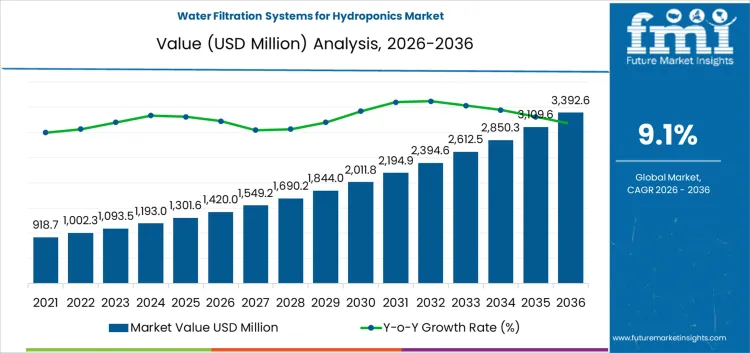
Water Filtration Systems for Hydroponics Market Key Takeaways
| Metric | Value |
|---|---|
| Market Value (2026) | USD 1,420.0 million |
| Market Forecast Value (2036) | USD 3,392.6 million |
| Forecast CAGR 2026 to 2036 | 9.1% |
Why is the Demand for Water Filtration Systems for Hydroponics Growing?
Demand for water filtration systems for hydroponics is rising as commercial growers and controlled environment agriculture operations require high purity water to optimize nutrient uptake and crop quality. Hydroponic cultivation depends on recirculating nutrient solutions, and suspended solids, dissolved minerals, and microbial contaminants can disrupt root zone balance and cause disease outbreaks. Growers specify filtration systems with fine mesh screens, carbon media, and membrane technologies to remove particulates, chlorine, and organic load without affecting essential nutrients. Procurement specialists evaluate filtration efficiency, flow rate capacity, and ease of maintenance because system performance influences crop yield consistency and reduces labor associated with water treatment tasks.
Expansion of leafy greens, herbs, and specialty vegetable production in vertical farms and greenhouse facilities reinforces need for reliable water quality control that protects sensitive crops from pH drift and pathogen proliferation. Integration of filtration with nutrient dosing and pH adjustment systems supports precise control of the root environment throughout growth cycles. Operators adopt modular filtration units that accommodate scaling plant density and changing crop cycles without extensive retrofit. Technical support for filter replacement, flushing protocols, and reliability under continuous recirculation further influences selection decisions. These cultivation specific and operational drivers are contributing to sustained uptake of water filtration systems within the hydroponics sector.
How Are the Segments Classified in the Water Filtration Systems for Hydroponics Market?
Demand for water filtration systems in hydroponics is shaped by nutrient solution purity requirements, emitter protection, and crop yield consistency. Controlled agriculture systems require reliable removal of particulates, organic matter, and dissolved contaminants to maintain stable root-zone conditions. Adoption aligns with expansion of commercial hydroponic farming, greenhouse cultivation, and vertical agriculture. System selection prioritizes filtration efficiency, flow stability, and compatibility with fertigation infrastructure. Segment classification reflects differentiation by filtration technology, cultivation application, and system throughput capacity influencing performance reliability, maintenance intensity, and scalability across hydroponic operations.
Which Filtration Technology Represents the Largest Share of Demand?
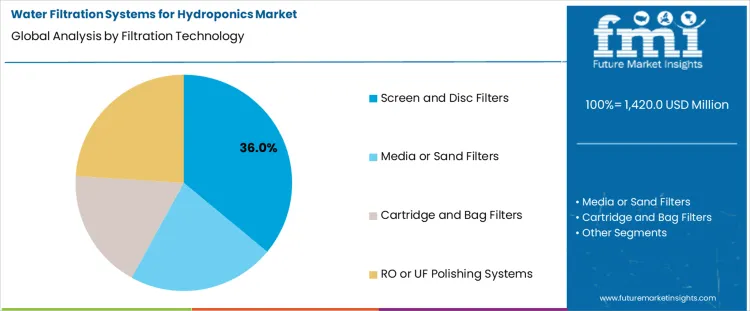
Screen and disc filters hold 36.0%, representing the largest share among filtration technologies due to effective particulate removal. These systems protect drip emitters and micro-irrigation lines from clogging caused by suspended solids. Simple mechanical operation supports consistent performance with manageable maintenance. Backwashing capability enables continuous operation under variable water quality conditions. Media or sand filters address higher organic load with larger footprint requirements. Cartridge and bag filters support fine filtration with higher replacement frequency. RO or UF polishing systems provide dissolved solids control with higher capital intensity. Technology segmentation reflects preference for practical solutions balancing protection efficiency and operational simplicity.
Key Points
- Screen and disc filters protect emitters from clogging.
- Mechanical operation supports consistent filtration performance.
- Other technologies address organic load or dissolved contaminants.
Which Application Accounts for the Highest Share of Demand?
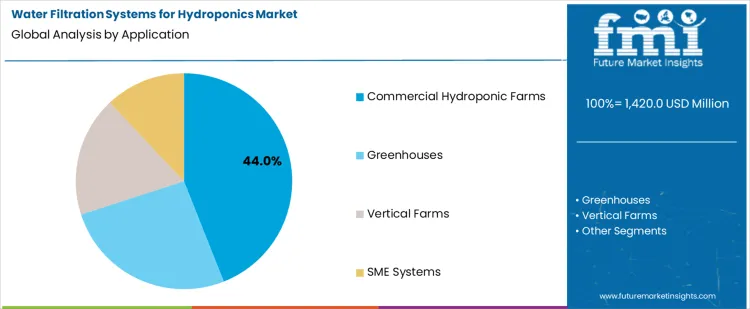
Commercial hydroponic farms hold 44.0%, representing the largest share among application categories due to scale of operation. Large facilities require continuous filtration to maintain uniform nutrient delivery across extensive grow areas. Water reuse practices increase dependence on reliable filtration. Consistent water quality supports predictable crop growth and yield. Greenhouses apply filtration for controlled cultivation with moderate scale. Vertical farms require compact systems with higher precision control. SME systems operate at smaller capacity with simplified requirements. Application segmentation reflects concentration where production scale and water recirculation intensity drive sustained filtration demand.
Key Points
- Commercial farms operate large-scale recirculating systems.
- Consistent water quality supports uniform crop performance.
- Other applications apply filtration at smaller or specialized scale.
Which System Capacity Category Drives the Largest Share of Demand?
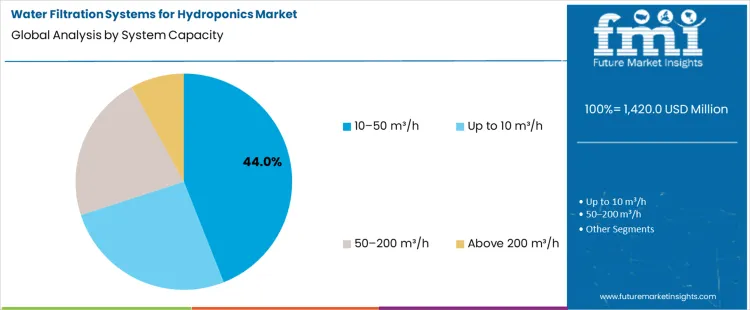
Systems rated at 10-50 m³/h hold 44.0%, representing the largest share among capacity categories due to alignment with mid-scale operations. This range supports commercial hydroponic farms and large greenhouses without oversizing infrastructure. Flow rates balance capital cost with operational flexibility. Modular expansion remains feasible as cultivation area increases. Smaller systems serve localized or pilot installations. Higher capacity systems address centralized facilities with extensive water circulation. Capacity segmentation reflects preference for scalable throughput matching common hydroponic farm sizing and incremental expansion strategies.
Key Points:
- Mid-range capacity suits typical commercial hydroponic scale.
- Balanced throughput supports cost and flexibility needs.
- Other capacities serve small pilots or very large installations.
What are the Key Dynamics in the Water Filtration Systems for Hydroponics Market?
Demand for water filtration systems for hydroponics reflects need to control nutrient solution quality, pathogen load, and dissolved solids within recirculating grow systems. Adoption concentrates in commercial greenhouses, vertical farms, container farms, and research grow facilities. Global scope aligns with controlled environment agriculture expansion and yield consistency requirements. Usage centers on multi-stage filtration combining mechanical, activated carbon, reverse osmosis, and disinfection modules.
How do nutrient precision and crop health requirements shape adoption?
Hydroponic cultivation depends on stable water chemistry to maintain nutrient availability and root zone health. Demand increases as growers require removal of suspended solids, chlorine, chloramines, heavy metals, and excess salts that interfere with nutrient uptake. Reverse osmosis supports precise nutrient formulation by reducing baseline dissolved solids. UV and ozone disinfection limit spread of waterborne pathogens in recirculating systems. Mechanical pre-filtration protects emitters and micro-irrigation lines from clogging. Crop sensitivity varies by species, driving tailored filtration configurations. Integration with dosing and monitoring systems enables consistent electrical conductivity and pH control. Adoption reflects operational reliance on water quality stability to protect yield and uniformity.
How do water source variability, operating cost, and system complexity influence market scalability?
Filtration design depends on incoming water variability across municipal, well, and surface sources. Demand sensitivity rises where high salinity or hardness increases membrane fouling and replacement frequency. Energy consumption and water rejection rates affect operating economics in water-scarce regions. Maintenance intensity increases due to filter media replacement and sanitation requirements. Improper sizing reduces flow stability and system effectiveness. Capital cost remains significant for multi-stage systems in price-sensitive grow operations. Space constraints limit installation in compact vertical farms. Supply dependence on membranes, UV components, and sensors constrains rapid scaling across distributed hydroponic facilities.
How Is Demand for Water Filtration Systems for Hydroponics Evolving Globally?
Demand for water filtration systems for hydroponics is expanding globally due to controlled environment agriculture growth and water quality management requirements. Commercial hydroponic farms require consistent removal of particulates, pathogens, and dissolved solids to protect crop yield stability. Urban farming, climate variability, and water reuse practices increase filtration dependency. System selection emphasizes reliability, low downtime, and compatibility with nutrient dosing regimes. Growth rates in India at 12.0%, China at 11.2%, Indonesia at 10.4%, Vietnam at 10.1%, and Brazil at 9.6% indicate strong expansion driven by commercial-scale hydroponics adoption, water scarcity management, and productivity-focused farming models.
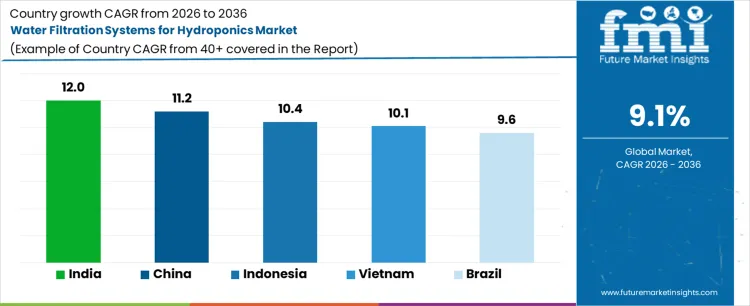
| Country | CAGR (%) |
|---|---|
| India | 12.0% |
| China | 11.2% |
| Indonesia | 10.4% |
| Vietnam | 10.1% |
| Brazil | 9.6% |
What Is Driving Rapid Growth of Hydroponic Water Filtration Demand in India?
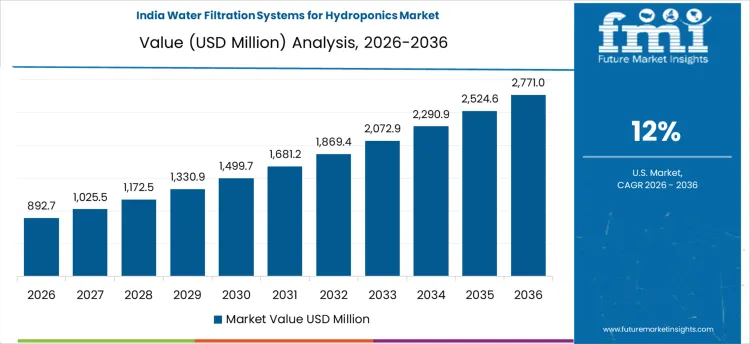
India is growing at a CAGR of 12.0%, supported by rapid expansion of commercial hydroponic farms. Urban agriculture projects require consistent water quality to maintain nutrient balance. Groundwater variability and suspended solids increase filtration dependency. Leafy greens and vine crops grown under controlled environments demand pathogen-free circulation water. Government-backed agri-tech initiatives support adoption of precision farming inputs. Demand growth reflects water quality inconsistency and yield optimization priorities rather than experimental or hobby-scale hydroponic activity.
- Commercial hydroponic farm expansion in urban regions
- Variable groundwater quality requiring multi-stage filtration
- High-value crop sensitivity to waterborne pathogens
- Adoption of precision farming under agri-tech programs
Why Is China Sustaining Elevated Demand for Hydroponic Water Filtration Systems?
Water filtration system demand for hydroponics in China is expanding at a CAGR of 11.2%, driven by large-scale protected agriculture development. Intensive vegetable production under greenhouse systems requires stable recirculating water quality. Surface water contamination and salinity variation increase filtration requirements. Operators integrate filtration with automated nutrient delivery systems. Domestic equipment manufacturing supports customized filtration configurations. Demand growth reflects scale-driven hydroponic commercialization and water management constraints rather than pilot urban farming initiatives.
- Expansion of greenhouse-based commercial hydroponics
- Surface water contamination and salinity management
- Integration with automated nutrient dosing systems
- Availability of domestically manufactured filtration equipment
How Is Indonesia Influencing Growth of Hydroponic Water Filtration Adoption?
Water filtration system demand for hydroponics in Indonesia is growing at a CAGR of 10.4%, shaped by climate conditions and food supply diversification. Tropical water sources contain organic load requiring filtration before recirculation. Urban farming initiatives increase use of compact hydroponic systems. Consistent water quality supports year-round vegetable production. Cost-effective filtration solutions gain preference among commercial growers. Demand growth reflects climatic water challenges and urban food production needs rather than export-driven greenhouse farming.
- High organic load in tropical water sources
- Growth of urban and peri-urban hydroponic farms
- Need for year-round vegetable production stability
- Preference for compact and cost-efficient filtration systems
What Factors Are Supporting Hydroponic Water Filtration Demand in Vietnam?
Vietnam is expanding at a CAGR of 10.1%, supported by controlled agriculture investment and water reuse practices. Greenhouse vegetable producers adopt recirculating systems to reduce water consumption. River and canal water sources require filtration to remove sediments and biological contaminants. Export-oriented growers emphasize consistent crop quality. Small and mid-sized commercial farms adopt modular filtration units. Demand growth reflects water efficiency priorities and crop quality consistency rather than large-scale industrial farming expansion.
- Adoption of recirculating hydroponic irrigation systems
- Sediment and contaminant removal from surface water
- Crop quality requirements for commercial growers
- Use of modular filtration units by mid-sized farms
Why Is Brazil Experiencing Strong Expansion in Hydroponic Water Filtration Demand?
Water filtration system demand for hydroponics in Brazil is growing at a CAGR of 9.6%, driven by commercial greenhouse farming and water quality variation. Agricultural regions face mineral content variability affecting nutrient formulations. Hydroponic vegetable and herb producers require consistent water parameters. Expansion of protected agriculture supports filtration system installations. Producers prioritize filtration to reduce disease incidence and nutrient imbalance. Growth reflects commercial yield protection and water variability management rather than transition from traditional soil-based farming.
- Water mineral variability affecting nutrient stability
- Expansion of commercial greenhouse hydroponics
- Disease risk reduction through water filtration
- Yield consistency requirements for commercial growers
What is the competitive landscape of demand for water filtration systems for hydroponics globally?
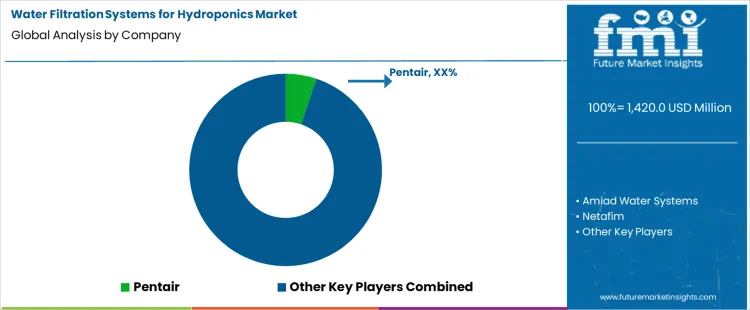
Demand for water filtration systems for hydroponics is driven by growth in controlled-environment agriculture, precision nutrient delivery needs, and requirements for disease-free recirculating nutrient solutions. Filtration systems remove particulates, biofilm, pathogens, and precipitates that compromise root zone health and crop uniformity. Buyers evaluate filter micron ratings, flow capacity, pressure tolerance, system scalability, ease of maintenance, and compatibility with nutrient dosing and UV sterilization modules. Procurement teams prioritize suppliers with proven quality standards, technical support, global distribution reach, and ability to tailor solutions for commercial greenhouse, vertical farm, and indoor cultivation environments. Trend in the global market reflects increased adoption of recirculating hydroponic systems, emphasis on water reuse efficiency, and integration of filtration with environmental controls to optimize crop yield and resource use.
Pentair holds leading positioning through a broad portfolio of water filtration and purification systems that support high-flow and recirculating hydroponic applications with global service infrastructure. Amiad Water Systems supports demand with modular and automated filtration technologies designed for agricultural and industrial water quality management. Netafim participates with water and nutrient delivery solutions that integrate filtration with precision irrigation systems used in controlled environments. Rivulis contributes filtration and fertigation technologies tailored to plant health and flow uniformity requirements. Xylem supplies filtration components and integrated water management platforms that support hydroponic system performance and operational continuity. Competitive differentiation depends on filtration efficacy, system scalability, integration ease with hydroponic infrastructure, maintenance simplicity, and ability to support stringent water quality targets.
Key Players in the Water Filtration Systems for Hydroponics Market
- Pentair
- Amiad Water Systems
- Netafim
- Rivulis
- Xylem
- AZUD
- Veolia
- Pall (Danaher)
- Toray
- Grundfos
Scope of the Report
| Items | Values |
|---|---|
| Quantitative Units | USD million |
| Filtration Technology | Screen and Disc Filters; Media or Sand Filters; Cartridge and Bag Filters; RO or UF Polishing Systems |
| Application | Commercial Hydroponic Farms; Greenhouses; Vertical Farms; SME Systems |
| System Capacity | 10-50 m³/h; Up to 10 m³/h; 50-200 m³/h; Above 200 m³/h |
| Sales Channel | Irrigation OEMs or System Integrators; Distributors; Direct to Growers; Online B2B |
| Regions Covered | Asia Pacific, Europe, North America, Latin America, Middle East & Africa |
| Countries Covered | India, China, Indonesia, Vietnam, Brazil, and 40+ countries |
| Key Companies Profiled | Pentair; Amiad Water Systems; Netafim; Rivulis; Xylem; AZUD; Veolia; Pall; Toray; Grundfos |
| Additional Attributes | Dollar sales by filtration technology, system capacity, application, and sales channel; removal efficiency for suspended solids, biofilm, and nutrient precipitates impacting emitter clogging risk; pressure drop and backwash frequency benchmarks across screen, disc, and media filters; polishing performance of RO and UF stages for pathogen control and nutrient solution stability; integration compatibility with fertigation units and recirculating hydroponic loops; operating cost, energy use, and maintenance profiles shaping grower procurement decisions across commercial and SME installations. |
Water Filtration Systems for Hydroponics Market by Segment
Filtration Technology:
- Screen and Disc Filters
- Media or Sand Filters
- Cartridge and Bag Filters
- RO or UF Polishing Systems
Application:
- Commercial Hydroponic Farms
- Greenhouses
- Vertical Farms
- SME Systems
System Capacity:
- 10-50 m³/h
- Up to 10 m³/h
- 50-200 m³/h
- Above 200 m³/h
Sales Channel:
- Irrigation OEMs or System Integrators
- Distributors
- Direct to Growers
- Online B2B
Region:
- Asia Pacific
- China
- Japan
- South Korea
- India
- Australia & New Zealand
- ASEAN
- Rest of Asia Pacific
- Europe
- Germany
- United Kingdom
- France
- Italy
- Spain
- Nordic
- BENELUX
- Rest of Europe
- North America
- United States
- Canada
- Mexico
- Latin America
- Brazil
- Chile
- Rest of Latin America
- Middle East & Africa
- Kingdom of Saudi Arabia
- Other GCC Countries
- Turkey
- South Africa
- Other African Union
- Rest of Middle East & Africa
Bibliography
- Food and Agriculture Organization of the United Nations. (2023). Water quality management for soilless and hydroponic crop production. FAO.
- International Society for Horticultural Science. (2023). Advances in hydroponic and controlled environment agriculture systems. ISHS.
- Organisation for Economic Co-operation and Development. (2023). Water reuse and quality management in intensive agriculture. OECD Publishing.
- United States Department of Agriculture. (2024). Controlled environment agriculture: Water management and filtration considerations. USDA National Agricultural Library.
- World Bank. (2023). Water security and treatment technologies for climate-resilient agriculture. World Bank Publications.
- World Health Organization. (2023). Water quality and microbial risk management in agricultural water reuse. WHO.
Frequently Asked Questions
How big is the water filtration systems for hydroponics market in 2026?
The global water filtration systems for hydroponics market is estimated to be valued at USD 1,420.0 million in 2026.
What will be the size of water filtration systems for hydroponics market in 2036?
The market size for the water filtration systems for hydroponics market is projected to reach USD 3,392.6 million by 2036.
How much will be the water filtration systems for hydroponics market growth between 2026 and 2036?
The water filtration systems for hydroponics market is expected to grow at a 9.1% CAGR between 2026 and 2036.
What are the key product types in the water filtration systems for hydroponics market?
The key product types in water filtration systems for hydroponics market are screen and disc filters, media or sand filters, cartridge and bag filters and ro or uf polishing systems.
Which application segment to contribute significant share in the water filtration systems for hydroponics market in 2026?
In terms of application, commercial hydroponic farms segment to command 44.0% share in the water filtration systems for hydroponics market in 2026.
Preview the report firsthand - request a free sample
Get SampleGet the brochure for pricing and purchase details.
Get PDFTable of Content
- Executive Summary
- Global Market Outlook
- Demand-side Trends
- Supply-side Trends
- Technology Roadmap Analysis
- Analysis and Recommendations
- Market Overview
- Market Coverage / Taxonomy
- Market Definition / Scope / Limitations
- Market Background
- Market Dynamics
- Drivers
- Restraints
- Opportunity
- Trends
- Scenario Forecast
- Demand in Optimistic Scenario
- Demand in Likely Scenario
- Demand in Conservative Scenario
- Opportunity Map Analysis
- Product Life Cycle Analysis
- Supply Chain Analysis
- Investment Feasibility Matrix
- Value Chain Analysis
- PESTLE and Porter’s Analysis
- Regulatory Landscape
- Regional Parent Market Outlook
- Production and Consumption Statistics
- Import and Export Statistics
- Market Dynamics
- Global Market Analysis 2021 to 2025 and Forecast, 2026 to 2036
- Historical Market Size Value (USD Million) Analysis, 2021 to 2025
- Current and Future Market Size Value (USD Million) Projections, 2026 to 2036
- Y-o-Y Growth Trend Analysis
- Absolute $ Opportunity Analysis
- Global Market Pricing Analysis 2021 to 2025 and Forecast 2026 to 2036
- Global Market Analysis 2021 to 2025 and Forecast 2026 to 2036, By Filtration Technology
- Introduction / Key Findings
- Historical Market Size Value (USD Million) Analysis By Filtration Technology , 2021 to 2025
- Current and Future Market Size Value (USD Million) Analysis and Forecast By Filtration Technology , 2026 to 2036
- Screen and Disc Filters
- Media or Sand Filters
- Cartridge and Bag Filters
- RO or UF Polishing Systems
- Screen and Disc Filters
- Y-o-Y Growth Trend Analysis By Filtration Technology , 2021 to 2025
- Absolute $ Opportunity Analysis By Filtration Technology , 2026 to 2036
- Global Market Analysis 2021 to 2025 and Forecast 2026 to 2036, By Application
- Introduction / Key Findings
- Historical Market Size Value (USD Million) Analysis By Application, 2021 to 2025
- Current and Future Market Size Value (USD Million) Analysis and Forecast By Application, 2026 to 2036
- Commercial Hydroponic Farms
- Greenhouses
- Vertical Farms
- SME Systems
- Commercial Hydroponic Farms
- Y-o-Y Growth Trend Analysis By Application, 2021 to 2025
- Absolute $ Opportunity Analysis By Application, 2026 to 2036
- Global Market Analysis 2021 to 2025 and Forecast 2026 to 2036, By System Capacity
- Introduction / Key Findings
- Historical Market Size Value (USD Million) Analysis By System Capacity, 2021 to 2025
- Current and Future Market Size Value (USD Million) Analysis and Forecast By System Capacity, 2026 to 2036
- 10-50 m³/h
- Up to 10 m³/h
- 50-200 m³/h
- Above 200 m³/h
- 10-50 m³/h
- Y-o-Y Growth Trend Analysis By System Capacity, 2021 to 2025
- Absolute $ Opportunity Analysis By System Capacity, 2026 to 2036
- Global Market Analysis 2021 to 2025 and Forecast 2026 to 2036, By Sales Channel
- Introduction / Key Findings
- Historical Market Size Value (USD Million) Analysis By Sales Channel, 2021 to 2025
- Current and Future Market Size Value (USD Million) Analysis and Forecast By Sales Channel, 2026 to 2036
- Irrigation OEMs or System Integrators
- Distributors
- Direct to Growers
- Online B2B
- Irrigation OEMs or System Integrators
- Y-o-Y Growth Trend Analysis By Sales Channel, 2021 to 2025
- Absolute $ Opportunity Analysis By Sales Channel, 2026 to 2036
- Global Market Analysis 2021 to 2025 and Forecast 2026 to 2036, By Region
- Introduction
- Historical Market Size Value (USD Million) Analysis By Region, 2021 to 2025
- Current Market Size Value (USD Million) Analysis and Forecast By Region, 2026 to 2036
- North America
- Latin America
- Western Europe
- Eastern Europe
- East Asia
- South Asia and Pacific
- Middle East & Africa
- Market Attractiveness Analysis By Region
- North America Market Analysis 2021 to 2025 and Forecast 2026 to 2036, By Country
- Historical Market Size Value (USD Million) Trend Analysis By Market Taxonomy, 2021 to 2025
- Market Size Value (USD Million) Forecast By Market Taxonomy, 2026 to 2036
- By Country
- USA
- Canada
- Mexico
- By Filtration Technology
- By Application
- By System Capacity
- By Sales Channel
- By Country
- Market Attractiveness Analysis
- By Country
- By Filtration Technology
- By Application
- By System Capacity
- By Sales Channel
- Key Takeaways
- Latin America Market Analysis 2021 to 2025 and Forecast 2026 to 2036, By Country
- Historical Market Size Value (USD Million) Trend Analysis By Market Taxonomy, 2021 to 2025
- Market Size Value (USD Million) Forecast By Market Taxonomy, 2026 to 2036
- By Country
- Brazil
- Chile
- Rest of Latin America
- By Filtration Technology
- By Application
- By System Capacity
- By Sales Channel
- By Country
- Market Attractiveness Analysis
- By Country
- By Filtration Technology
- By Application
- By System Capacity
- By Sales Channel
- Key Takeaways
- Western Europe Market Analysis 2021 to 2025 and Forecast 2026 to 2036, By Country
- Historical Market Size Value (USD Million) Trend Analysis By Market Taxonomy, 2021 to 2025
- Market Size Value (USD Million) Forecast By Market Taxonomy, 2026 to 2036
- By Country
- Germany
- UK
- Italy
- Spain
- France
- Nordic
- BENELUX
- Rest of Western Europe
- By Filtration Technology
- By Application
- By System Capacity
- By Sales Channel
- By Country
- Market Attractiveness Analysis
- By Country
- By Filtration Technology
- By Application
- By System Capacity
- By Sales Channel
- Key Takeaways
- Eastern Europe Market Analysis 2021 to 2025 and Forecast 2026 to 2036, By Country
- Historical Market Size Value (USD Million) Trend Analysis By Market Taxonomy, 2021 to 2025
- Market Size Value (USD Million) Forecast By Market Taxonomy, 2026 to 2036
- By Country
- Russia
- Poland
- Hungary
- Balkan & Baltic
- Rest of Eastern Europe
- By Filtration Technology
- By Application
- By System Capacity
- By Sales Channel
- By Country
- Market Attractiveness Analysis
- By Country
- By Filtration Technology
- By Application
- By System Capacity
- By Sales Channel
- Key Takeaways
- East Asia Market Analysis 2021 to 2025 and Forecast 2026 to 2036, By Country
- Historical Market Size Value (USD Million) Trend Analysis By Market Taxonomy, 2021 to 2025
- Market Size Value (USD Million) Forecast By Market Taxonomy, 2026 to 2036
- By Country
- China
- Japan
- South Korea
- By Filtration Technology
- By Application
- By System Capacity
- By Sales Channel
- By Country
- Market Attractiveness Analysis
- By Country
- By Filtration Technology
- By Application
- By System Capacity
- By Sales Channel
- Key Takeaways
- South Asia and Pacific Market Analysis 2021 to 2025 and Forecast 2026 to 2036, By Country
- Historical Market Size Value (USD Million) Trend Analysis By Market Taxonomy, 2021 to 2025
- Market Size Value (USD Million) Forecast By Market Taxonomy, 2026 to 2036
- By Country
- India
- ASEAN
- Australia & New Zealand
- Rest of South Asia and Pacific
- By Filtration Technology
- By Application
- By System Capacity
- By Sales Channel
- By Country
- Market Attractiveness Analysis
- By Country
- By Filtration Technology
- By Application
- By System Capacity
- By Sales Channel
- Key Takeaways
- Middle East & Africa Market Analysis 2021 to 2025 and Forecast 2026 to 2036, By Country
- Historical Market Size Value (USD Million) Trend Analysis By Market Taxonomy, 2021 to 2025
- Market Size Value (USD Million) Forecast By Market Taxonomy, 2026 to 2036
- By Country
- Kingdom of Saudi Arabia
- Other GCC Countries
- Turkiye
- South Africa
- Other African Union
- Rest of Middle East & Africa
- By Filtration Technology
- By Application
- By System Capacity
- By Sales Channel
- By Country
- Market Attractiveness Analysis
- By Country
- By Filtration Technology
- By Application
- By System Capacity
- By Sales Channel
- Key Takeaways
- Key Countries Market Analysis
- USA
- Pricing Analysis
- Market Share Analysis, 2025
- By Filtration Technology
- By Application
- By System Capacity
- By Sales Channel
- Canada
- Pricing Analysis
- Market Share Analysis, 2025
- By Filtration Technology
- By Application
- By System Capacity
- By Sales Channel
- Mexico
- Pricing Analysis
- Market Share Analysis, 2025
- By Filtration Technology
- By Application
- By System Capacity
- By Sales Channel
- Brazil
- Pricing Analysis
- Market Share Analysis, 2025
- By Filtration Technology
- By Application
- By System Capacity
- By Sales Channel
- Chile
- Pricing Analysis
- Market Share Analysis, 2025
- By Filtration Technology
- By Application
- By System Capacity
- By Sales Channel
- Germany
- Pricing Analysis
- Market Share Analysis, 2025
- By Filtration Technology
- By Application
- By System Capacity
- By Sales Channel
- UK
- Pricing Analysis
- Market Share Analysis, 2025
- By Filtration Technology
- By Application
- By System Capacity
- By Sales Channel
- Italy
- Pricing Analysis
- Market Share Analysis, 2025
- By Filtration Technology
- By Application
- By System Capacity
- By Sales Channel
- Spain
- Pricing Analysis
- Market Share Analysis, 2025
- By Filtration Technology
- By Application
- By System Capacity
- By Sales Channel
- France
- Pricing Analysis
- Market Share Analysis, 2025
- By Filtration Technology
- By Application
- By System Capacity
- By Sales Channel
- India
- Pricing Analysis
- Market Share Analysis, 2025
- By Filtration Technology
- By Application
- By System Capacity
- By Sales Channel
- ASEAN
- Pricing Analysis
- Market Share Analysis, 2025
- By Filtration Technology
- By Application
- By System Capacity
- By Sales Channel
- Australia & New Zealand
- Pricing Analysis
- Market Share Analysis, 2025
- By Filtration Technology
- By Application
- By System Capacity
- By Sales Channel
- China
- Pricing Analysis
- Market Share Analysis, 2025
- By Filtration Technology
- By Application
- By System Capacity
- By Sales Channel
- Japan
- Pricing Analysis
- Market Share Analysis, 2025
- By Filtration Technology
- By Application
- By System Capacity
- By Sales Channel
- South Korea
- Pricing Analysis
- Market Share Analysis, 2025
- By Filtration Technology
- By Application
- By System Capacity
- By Sales Channel
- Russia
- Pricing Analysis
- Market Share Analysis, 2025
- By Filtration Technology
- By Application
- By System Capacity
- By Sales Channel
- Poland
- Pricing Analysis
- Market Share Analysis, 2025
- By Filtration Technology
- By Application
- By System Capacity
- By Sales Channel
- Hungary
- Pricing Analysis
- Market Share Analysis, 2025
- By Filtration Technology
- By Application
- By System Capacity
- By Sales Channel
- Kingdom of Saudi Arabia
- Pricing Analysis
- Market Share Analysis, 2025
- By Filtration Technology
- By Application
- By System Capacity
- By Sales Channel
- Turkiye
- Pricing Analysis
- Market Share Analysis, 2025
- By Filtration Technology
- By Application
- By System Capacity
- By Sales Channel
- South Africa
- Pricing Analysis
- Market Share Analysis, 2025
- By Filtration Technology
- By Application
- By System Capacity
- By Sales Channel
- USA
- Market Structure Analysis
- Competition Dashboard
- Competition Benchmarking
- Market Share Analysis of Top Players
- By Regional
- By Filtration Technology
- By Application
- By System Capacity
- By Sales Channel
- Competition Analysis
- Competition Deep Dive
- Pentair
- Overview
- Product Portfolio
- Profitability by Market Segments (Product/Age /Sales Channel/Region)
- Sales Footprint
- Strategy Overview
- Marketing Strategy
- Product Strategy
- Channel Strategy
- Amiad Water Systems
- Netafim
- Rivulis
- Xylem
- AZUD
- Veolia
- Pall (Danaher)
- Toray
- Grundfos
- Pentair
- Competition Deep Dive
- Assumptions & Acronyms Used
- Research Methodology


