

- Industry Size (2026)
- USD 1.2 Bn
- Forecast (2036)
- USD 2.2 Bn
- CAGR (2026 to 2036)
- 6.4%
Greenhouse Multi-Layer Benching Systems Market Forecast and Outlook 2026 to 2036
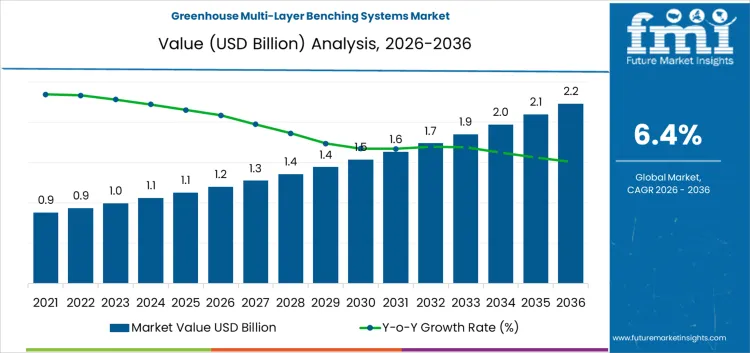
The greenhouse multi-layer benching systems market is projected to grow from USD 1.2 billion in 2026 to USD 2.2 billion by 2036, reflecting a compound annual growth rate (CAGR) of 6.4%. These systems are increasingly used in commercial greenhouse operations to maximize space utilization and improve production efficiency by creating multiple layers for growing plants. The growing global demand for sustainable and high-yield agricultural practices, particularly in controlled environments like greenhouses, is driving the adoption of these multi-layer benching systems. As the focus on local food production and greenhouse agriculture increases, the market for these systems is set to expand.
The market is expected to grow steadily over the forecast period, with values rising from USD 1.2 billion in 2026 to USD 1.3 billion in 2027, followed by USD 1.4 billion in 2028. In 2029, the market will reach USD 1.5 billion, continuing to rise to USD 1.6 billion in 2030. By 2036, the market is projected to reach USD 2.2 billion, driven by the increasing adoption of space-efficient, high-density agricultural solutions in greenhouses around the world.
Quick Stats for the Greenhouse Multi-Layer Benching Systems Market
- Greenhouse Multi-Layer Benching Systems Market Value (2026): USD 1.2 billion
- Greenhouse Multi-Layer Benching Systems Market Forecast Value (2036): USD 2.2 billion
- Greenhouse Multi-Layer Benching Systems Market Global Forecast CAGR 2026 to 2036: 6.4%
- Greenhouse Multi-Layer Benching Systems Market Leading Segment: Glass Greenhouses (52%)
- Key Growth Regions in Greenhouse Multi-Layer Benching Systems Market: India
- Top Players in Greenhouse Multi-Layer Benching Systems Market: Priva, Ridder, Kubo Group, Certhon, Bosman Van Zaal, Van der Hoeven, Rough Brothers, Nexus Corporation, Argus Controls, VRE Systems
What is the Growth Contribution Index for the Greenhouse Multi-Layer Benching Systems Market through 2036?
The growth contribution index for the greenhouse multi-layer benching systems market reflects the influence of various factors driving the market expansion, including technology advancements, increasing greenhouse adoption, and the need for efficient space utilization in agriculture.
In the initial phase of the forecast period (2026-2028), the market will experience steady growth driven primarily by increasing awareness of space-efficient growing systems and their ability to maximize productivity in limited spaces. The contribution of volume growth (driven by increasing greenhouse installations) will play a significant role during this phase. From USD 1.2 billion in 2026, the market will rise to USD 1.4 billion by 2028, reflecting this early adoption and demand for efficient growing systems in commercial greenhouses.
From 2029 to 2032, as technology improves and the benefits of multi-layer benching systems become more widely recognized, the market will see a higher contribution from both volume and technological innovation. The value will rise from USD 1.5 billion in 2029 to USD 1.9 billion in 2032. This period reflects stronger market penetration, with greenhouse operators seeking high-density growing solutions to meet increasing demand for locally grown crops.
By 2036, the market will reach USD 2.2 billion, driven by both continued volume growth and an increasing contribution from technological advancements, such as automated systems, which improve the efficiency and scalability of multi-layer benching systems. The final years of the forecast will see a more stable growth phase, with incremental increases driven by expansion in both developed and emerging markets where greenhouse agriculture is becoming increasingly important for sustainable food production.
Greenhouse Multi-Layer Benching Systems Market Key Takeaways
| Metric | Value |
|---|---|
| Industry Sales Value (2026) | USD 1.2 billion |
| Industry Forecast Value (2036) | USD 2.2 billion |
| Industry Forecast CAGR 2026 to 2036 | 6.4% |
What Is Driving the Greenhouse Multi-Layer Benching Systems Market?
Historically, the greenhouse multi-layer benching systems market developed from growers’ need to increase productive capacity within fixed greenhouse footprints while improving crop uniformity and labor efficiency. Traditional single-tier bench layouts limited the number of plants that could be cultivated per square meter, constrained by reach height, light distribution, and irrigation access. As commercial greenhouse operations expanded in ornamentals, vegetables, and seedlings, producers sought stacking solutions that elevated bench tiers with adjustable spacing and integrated pathways. Early multi-layer benching systems were manual and fixed in design, often retrofitted into existing houses with variable success due to shading, moisture imbalance, and uneven airflow between layers. Initial adopters, primarily nurseries with high plant turnover cycles, demonstrated productivity gains by optimizing vertical space, standardizing irrigation distribution across levels, and reducing time spent on plant handling. These early implementations also identified challenges in managing microclimates per layer and ensured that lighting, humidity, and pest control could be adjusted consistently across tiers, shaping incremental improvements in future system designs.
Future demand for greenhouse multi-layer benching systems is expected to be shaped by growth in controlled-environment agriculture, rising demand for year-round fresh produce, and increasing pressure to optimize space and labor in commercial horticulture. Expansion of high-density crops such as leafy greens, herbs, bedding plants, and seedlings will further drive adoption of benching solutions that maximize space utilization without compromising plant quality. Growth factors include integrated LED lighting strategies that deliver uniform light spectra to all layers, modular bench structures that adjust to crop height and spacing needs, and automation in irrigation and fertigation to maintain precise nutrient and moisture profiles per tier. Energy management will also influence system design to balance supplemental lighting with ambient greenhouse conditions. Barriers include higher upfront investment compared with conventional benches and the need for careful planning to avoid shading and microclimate imbalances. Long-term market expansion will depend on how effectively suppliers deliver flexible, scalable benching systems that support uniform growth environments, simplify labor tasks, and align with broader greenhouse automation and sustainability goals.
What are the Key Segments in the Greenhouse Multi-Layer Benching Systems Market?
The Greenhouse Multi-Layer Benching Systems market is segmented by greenhouse type and sales channel. Greenhouse types include glass greenhouses, poly or film greenhouses, indoor greenhouse modules, and others, with glass greenhouses leading the market at 52%. Sales channels consist of greenhouse builders or EPCs (engineering, procurement, and construction), direct OEM sales, distributors, and others, with greenhouse builders or EPCs holding the largest share at 48%. The market is driven by the growing demand for efficient and space-saving growing systems, particularly in controlled-environment agriculture (CEA), where maximizing space utilization and improving crop yields are critical. The expansion of greenhouse farming, especially in regions with fluctuating climates, is also contributing to the demand for advanced multi-layer benching systems.
What is Driving Growth in the Glass Greenhouses Segment?
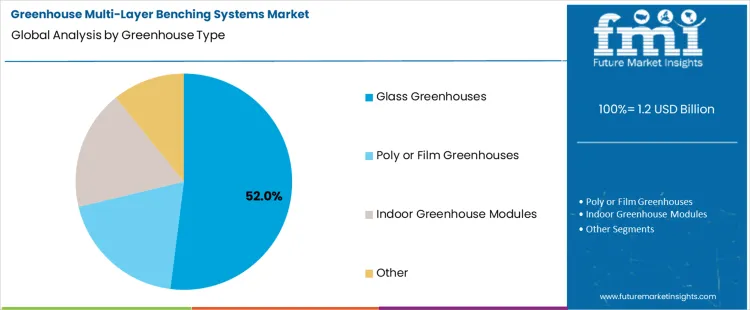
Glass greenhouses dominate the greenhouse type segment in the Greenhouse Multi-Layer Benching Systems market, accounting for 52% of the market share. This growth is driven by the long-term durability, high light transmission, and climate control benefits that glass greenhouses offer. Glass provides better insulation and resistance to temperature fluctuations compared to other greenhouse materials, creating an ideal environment for growing a wide variety of crops year-round. The increased interest in high-tech and efficient greenhouse operations, especially in regions with colder climates or where year-round production is a priority, is further contributing to the demand for glass greenhouses. Additionally, glass greenhouses are often more suitable for integrating advanced systems like multi-layer benching, which maximizes space utilization and supports vertical farming practices. As greenhouse farming becomes more prevalent in areas like Europe and North America, where demand for locally grown produce and sustainable farming practices is high, the glass greenhouse segment is expected to maintain its dominance.
What is Driving the Demand for Greenhouse Builders or EPC Sales Channels?
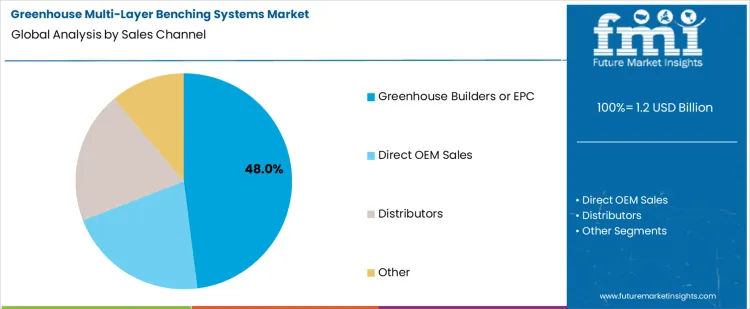
Greenhouse builders or EPCs (engineering, procurement, and construction) represent the largest sales channel segment in the Greenhouse Multi-Layer Benching Systems market, holding 48% of the market share. This growth is driven by the need for customized, large-scale greenhouse construction projects that integrate multi-layer benching systems as part of the overall infrastructure. EPCs provide end-to-end solutions, including design, installation, and project management, which makes them the preferred choice for constructing sophisticated greenhouse operations. These systems often require expert integration to ensure that the greenhouse's layout and technology meet the specific needs of crop types and production goals. As the demand for efficient, automated, and high-yield agricultural systems increases, particularly in controlled-environment agriculture, the role of greenhouse builders and EPCs becomes increasingly important. Their ability to deliver tailored solutions for commercial-scale greenhouse projects, including the integration of multi-layer benching systems, is a key driver of the growth in this sales channel segment. As the greenhouse industry expands globally, especially in North America, Europe, and parts of Asia Pacific, EPCs are expected to continue to dominate the sales channel, providing valuable expertise in large-scale, high-tech greenhouse construction.
What are the Key Dynamics in the Greenhouse Multi-Layer Benching Systems Market?
The greenhouse multi-layer benching systems market is growing due to the increasing demand for efficient, space-saving, and productive solutions for modern agriculture. Multi-layer benching systems are designed to maximize space in greenhouses by utilizing vertical layers to grow plants, which is particularly beneficial for crops that require intensive care and large volumes of production. This market is driven by the need for high-yield farming, especially in urban and commercial greenhouse environments, where land availability is limited. These systems not only increase plant production but also offer better control over environmental conditions, leading to higher efficiency in water and nutrient management. The growing focus on sustainable farming practices, as well as the demand for fresh produce year-round, is further accelerating the adoption of greenhouse multi-layer benching systems.
What are the Key Drivers of Growth in the Greenhouse Multi-Layer Benching Systems Market?
The growth of the greenhouse multi-layer benching systems market is primarily driven by the increasing global demand for food, particularly in urban areas where arable land is scarce. The need for high-efficiency farming solutions that can maximize crop yield in limited spaces is pushing the adoption of vertical farming systems like multi-layer benching. Additionally, these systems help improve resource efficiency, including water and nutrients, making them ideal for sustainable and eco-friendly farming practices. The rise of controlled environment agriculture (CEA) and advancements in hydroponics and other soil-free farming methods are further contributing to market growth. Government incentives and support for sustainable agriculture, along with the rising consumer demand for fresh, local, and organic produce, are also significant factors driving market expansion. Furthermore, the increasing popularity of greenhouse farming in regions with harsh climates or limited outdoor farming opportunities is further boosting the demand for these systems.
What are the Key Restraints in the Greenhouse Multi-Layer Benching Systems Market?
Despite its growth potential, the greenhouse multi-layer benching systems market faces several challenges. One of the primary restraints is the high initial cost associated with installing multi-layer benching systems, which includes the cost of infrastructure, equipment, and ongoing maintenance. The cost can be prohibitive for small-scale farmers or businesses looking to transition to greenhouse farming. Another challenge is the complexity of setting up and operating these systems, as they require specialized knowledge and training for effective management. The need for careful environmental control, such as regulating humidity, temperature, and light, can also add to the operational burden. Additionally, while multi-layer benching systems are space-efficient, they may not be suitable for all types of crops, particularly those with larger root systems or those that require extensive space for growth. Moreover, the systems require a significant amount of energy for artificial lighting, climate control, and irrigation, which could lead to higher operational costs, especially in regions with expensive energy resources.
What are the Key Trends in the Greenhouse Multi-Layer Benching Systems Market?
Several key trends are shaping the greenhouse multi-layer benching systems market. One significant trend is the increasing integration of automation and smart technologies. Modern systems now include automated climate control, irrigation, and nutrient delivery, which reduces labor costs and increases efficiency. The use of sensors and IoT devices to monitor plant health, humidity, and temperature in real-time is becoming more common, helping growers optimize the growing conditions for better yield. Another trend is the growing interest in sustainable and eco-friendly farming solutions, where greenhouse multi-layer benching systems are becoming a part of resource-efficient farming that minimizes water usage and reduces carbon footprints. Additionally, the development of modular and customizable benching systems that can be adapted to different greenhouse environments and crop types is gaining popularity, allowing for greater flexibility and scalability. As greenhouse farming expands, there is also a trend toward vertical farming systems that allow for year-round production of fresh produce, which is driving further innovation in the multi-layer benching systems market.
What is the Country-Wise Analysis of the Greenhouse Multi-Layer Benching Systems Market?
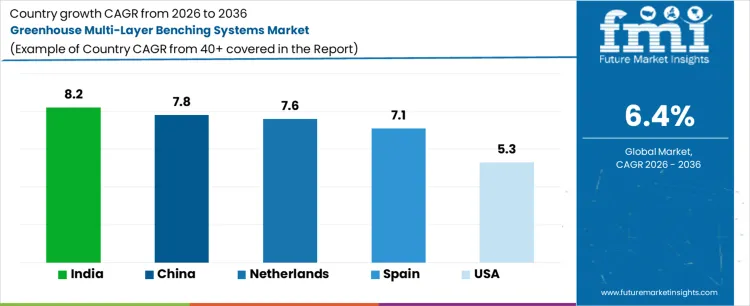
The greenhouse multi-layer benching systems market is growing as the demand for efficient, space-saving farming solutions increases, particularly in controlled-environment agriculture. These systems allow for the cultivation of multiple layers of crops within a greenhouse, maximizing space and improving productivity. The market is driven by the need for sustainable farming practices, increasing urbanization, and the growing adoption of high-tech agriculture systems that enhance yield and reduce environmental impact. Countries like the Netherlands, Spain, India, China, and the USA are witnessing significant growth in this market, influenced by the expansion of greenhouse agriculture, the rising need for efficient farming solutions, and government support for sustainable agricultural practices.
| Country | CAGR (%) |
|---|---|
| Netherlands | 7.6 |
| Spain | 7.1 |
| India | 8.2 |
| China | 7.8 |
| USA | 5.3 |
What is Driving the Growth of the Greenhouse Multi-Layer Benching Systems Market in India?
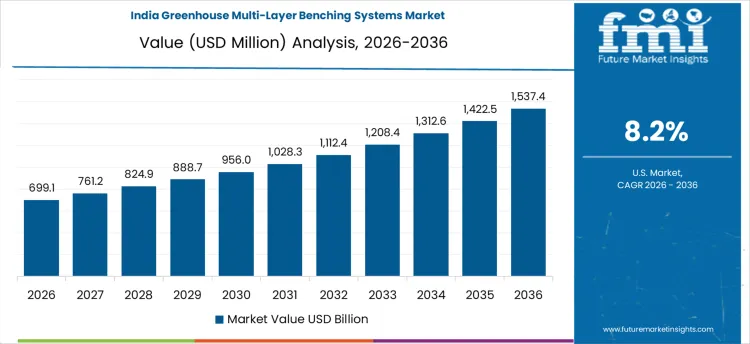
India’s greenhouse multi-layer benching systems market is growing at a CAGR of 8.2%, the highest among the countries analyzed. The growth is largely driven by India’s expanding greenhouse agriculture sector, which is focused on increasing productivity and maximizing limited space in urban and peri-urban areas. The country’s growing interest in controlled-environment farming, especially in high-value crops like vegetables and herbs, is contributing to the demand for multi-layer benching systems. India’s push towards sustainable farming, increased awareness of water and land conservation, and government initiatives supporting modern farming practices are all factors that are fueling market growth. As India continues to modernize its agricultural infrastructure, the demand for greenhouse solutions like multi-layer benching systems is expected to increase.
How is the Greenhouse Multi-Layer Benching Systems Market Performing in the Netherlands?
The Netherlands’ greenhouse multi-layer benching systems market is growing at a CAGR of 7.6%. The Netherlands is one of the global leaders in greenhouse farming and controlled-environment agriculture, where space optimization and high productivity are key goals. As the country continues to invest in sustainable agricultural practices and improve greenhouse efficiency, multi-layer benching systems are becoming essential for maximizing crop yields within limited spaces. The Dutch government’s support for innovation in agriculture and its focus on reducing environmental impact is driving the adoption of these systems. As greenhouse farming becomes more advanced and efficient, the demand for multi-layer benching systems in the Netherlands is expected to continue growing steadily.
What Factors are Shaping the Greenhouse Multi-Layer Benching Systems Market in Spain?
Spain’s greenhouse multi-layer benching systems market is growing at a CAGR of 7.1%. The growth in Spain is driven by the country’s expanding greenhouse agriculture sector, which is increasingly adopting advanced technologies to improve crop production and space utilization. With the rising demand for high-quality fruits, vegetables, and flowers, Spain is focusing on increasing the efficiency of its greenhouse operations. The adoption of multi-layer benching systems allows for more efficient use of space, particularly in regions where land availability is limited. Spain’s emphasis on sustainable farming practices and improving the agricultural value chain is contributing to the growing demand for these systems. As Spain’s greenhouse sector continues to expand, the market for multi-layer benching systems is expected to grow steadily.
How is the Greenhouse Multi-Layer Benching Systems Market Evolving in China?
China’s greenhouse multi-layer benching systems market is growing at a CAGR of 7.8%. China’s agricultural sector is undergoing a transformation, with increasing investments in modern farming technologies to enhance productivity and sustainability. The rise of greenhouse farming, particularly for high-value crops, is driving the demand for multi-layer benching systems. These systems allow for more efficient use of space in large-scale greenhouses, which is crucial as urbanization and land scarcity continue to grow. Additionally, the Chinese government’s focus on food security and sustainable farming practices is contributing to the adoption of advanced farming technologies. As China’s greenhouse agriculture sector continues to develop, the demand for multi-layer benching systems is expected to continue increasing.
What is Contributing to the Growth of the Greenhouse Multi-Layer Benching Systems Market in the USA?
The greenhouse multi-layer benching systems market in the USA is growing at a CAGR of 5.3%. While the growth rate is slower compared to other countries, the USA’s greenhouse farming sector is expanding, driven by the increasing demand for local, high-quality produce. The adoption of multi-layer benching systems is being supported by the need for efficient, space-saving farming solutions in both commercial and urban farms. With a growing focus on sustainability and improving agricultural productivity, the demand for greenhouse solutions that optimize space and increase yield is rising. As the USA continues to invest in sustainable farming and modern greenhouse systems, the market for multi-layer benching systems is expected to grow steadily.
What is the Competitive Landscape for the Greenhouse Multi-Layer Benching Systems Market?
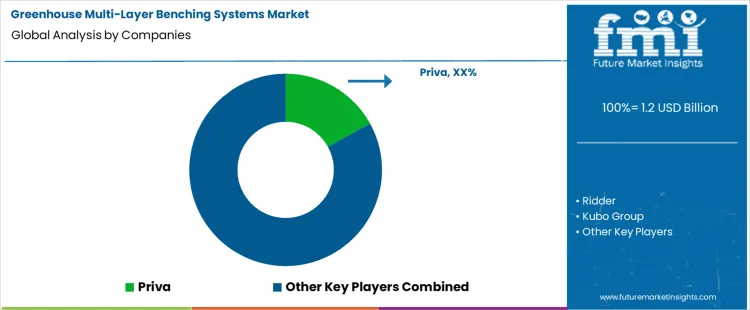
The greenhouse multi-layer benching systems market is growing as the demand for efficient, space-saving, and high-yield farming solutions increases in controlled environment agriculture (CEA). Priva leads the market, offering advanced multi-layer benching systems that are designed to maximize space and optimize plant growth in greenhouse environments. Priva’s innovative solutions integrate climate control and automation systems, providing growers with an efficient way to manage plant production while improving operational efficiency. Ridder is a significant competitor, providing customizable benching systems with a focus on durability, flexibility, and automation, making them ideal for high-efficiency greenhouse operations.
Kubo Group also plays a key role, offering robust multi-layer benching systems that emphasize space optimization and easy integration into existing greenhouse infrastructures. Certhon specializes in greenhouse technology, offering automated benching systems that combine energy-efficient designs with precise environmental control to boost crop yield. Bosman Van Zaal provides versatile and high-performance multi-layer benching systems, ensuring that they meet the growing demands for sustainability and space optimization in greenhouse operations.
Van der Hoeven focuses on providing modular benching solutions that cater to both large-scale and small-scale greenhouse environments, emphasizing ease of installation and flexibility. Rough Brothers offers durable multi-layer benching systems that are highly adaptable, making them suitable for various crops and greenhouse sizes. Nexus Corporation provides highly scalable benching systems that ensure maximum plant productivity while utilizing minimal space, ideal for large commercial greenhouse operations. Argus Controls and VRE Systems contribute with advanced benching systems integrated with smart control solutions, enabling growers to manage environmental factors and optimize space usage effectively.
To remain competitive in the greenhouse multi-layer benching systems market, companies focus on technological innovation, flexibility, and sustainability. Priva continues to lead by enhancing its multi-layer systems with advanced automation and climate control features, improving overall efficiency and yield. Ridder is expanding its offerings by providing customizable systems that cater to different crop types and greenhouse sizes, ensuring growers can meet diverse production needs. Kubo Group focuses on energy-efficient, space-saving designs that integrate seamlessly with other greenhouse systems. Certhon continues to innovate with automated multi-layer benching systems that provide precise control over environmental factors, optimizing plant growth and reducing labor costs.
Bosman Van Zaal is enhancing its systems by offering flexible and scalable solutions that adapt to the evolving needs of commercial greenhouse operators. Van der Hoeven focuses on improving the adaptability and modularity of its benching systems, ensuring easy integration with various greenhouse layouts. Rough Brothers is refining its products with a focus on reliability, energy efficiency, and easy maintenance. Nexus Corporation is developing systems with higher scalability and automation, ensuring they meet the demands of large-scale operations. Argus Controls and VRE Systems emphasize integrating smart technologies into their benching systems, allowing growers to monitor and control their greenhouse environments more effectively. These strategies, combined with the growing demand for efficient, high-yield greenhouse solutions, position these companies to lead the market in greenhouse multi-layer benching systems.
Key Players of the Greenhouse Multi-Layer Benching Systems Market
- Priva
- Ridder
- Kubo Group
- Certhon
- Bosman Van Zaal
- Van der Hoeven
- Rough Brothers
- Nexus Corporation
- Argus Controls
- VRE Systems
Scope of the Report
| Items | Values |
|---|---|
| Quantitative Units (2026) | USD Billion |
| Benching Type | Rolling Benches, Fixed Benches, Ebb & Flow Benches, Other |
| Crop Segment | Nursery Ornamentals, Leafy Greens, Young Plants/Propagation, Other |
| Greenhouse Type | Glass Greenhouses, Poly or Film Greenhouses, Indoor Greenhouse Modules, Other |
| Sales Channel | Greenhouse Builders or EPC, Direct OEM Sales, Distributors, Other |
| Companies | Priva, Ridder, Kubo Group, Certhon, Bosman Van Zaal, Van der Hoeven, Rough Brothers, Nexus Corporation, Argus Controls, VRE Systems |
| Regions Covered | North America, Latin America, Western Europe, Eastern Europe, South Asia and Pacific, East Asia, Middle East & Africa |
| Countries Covered | United States, Canada, Mexico, Brazil, Argentina, Germany, France, United Kingdom, Italy, Spain, Netherlands, China, India, Japan, South Korea, ANZ, GCC Countries, South Africa |
| Additional Attributes | Dollar by sales by benching type, crop segment, greenhouse type, and sales channel. Includes market trends towards sustainability, cost-effectiveness, greenhouse optimization, and the role of multi-layer benching systems in enhancing crop yield and operational efficiency. |
Greenhouse Multi-Layer Benching Systems Market Segmentation
Benching Type
- Rolling Benches
- Fixed Benches
- Ebb & Flow Benches
- Other
Crop Segment
- Nursery Ornamentals
- Leafy Greens
- Young Plants/Propagation
- Other
Greenhouse Type
- Glass Greenhouses
- Poly or Film Greenhouses
- Indoor Greenhouse Modules
- Other
Sales Channel
- Greenhouse Builders or EPC
- Direct OEM Sales
- Distributors
- Other
Region
- Asia Pacific
- China
- Japan
- India
- Australia & New Zealand
- ASEAN
- Rest of Asia Pacific
- Europe
- Germany
- United Kingdom
- France
- Italy
- Spain
- Nordic
- BENELUX
- Rest of Europe
- North America
- United States
- Canada
- Mexico
- Latin America
- Brazil
- Argentina
- Rest of Latin America
- Middle East & Africa
- Kingdom of Saudi Arabia
- Other GCC Countries
- South Africa
- Rest of Middle East & Africa
Bibliography
- Priva. (2023). Innovative Multi-Layer Benching Systems for Maximizing Greenhouse Space Efficiency. Priva.
- Ridder. (2023). Customizable Greenhouse Solutions for High-Efficiency Farming. Ridder.
- Kubo Group. (2023). Robust Greenhouse Systems for Sustainable Agriculture and Space Optimization. Kubo Group.
- Certhon. (2023). Automated Greenhouse Solutions for Improved Crop Yield and Resource Efficiency. Certhon.
- Bosman Van Zaal. (2023). Versatile Multi-Layer Benching Systems for Greenhouse Operations. Bosman Van Zaal.
Frequently Asked Questions
How big is the greenhouse multi-layer benching systems market in 2026?
The global greenhouse multi-layer benching systems market is estimated to be valued at USD 1.2 billion in 2026.
What will be the size of greenhouse multi-layer benching systems market in 2036?
The market size for the greenhouse multi-layer benching systems market is projected to reach USD 2.2 billion by 2036.
How much will be the greenhouse multi-layer benching systems market growth between 2026 and 2036?
The greenhouse multi-layer benching systems market is expected to grow at a 6.4% CAGR between 2026 and 2036.
What are the key product types in the greenhouse multi-layer benching systems market?
The key product types in greenhouse multi-layer benching systems market are rolling benches, fixed benches, ebb & flow benches and other.
Which crop segment segment to contribute significant share in the greenhouse multi-layer benching systems market in 2026?
In terms of crop segment, nursery ornamentals segment to command 38.0% share in the greenhouse multi-layer benching systems market in 2026.
Preview the report firsthand - request a free sample
Get SampleGet the brochure for pricing and purchase details.
Get PDFTable of Content
- Executive Summary
- Global Market Outlook
- Demand-side Trends
- Supply-side Trends
- Technology Roadmap Analysis
- Analysis and Recommendations
- Market Overview
- Market Coverage / Taxonomy
- Market Definition / Scope / Limitations
- Market Background
- Market Dynamics
- Drivers
- Restraints
- Opportunity
- Trends
- Scenario Forecast
- Demand in Optimistic Scenario
- Demand in Likely Scenario
- Demand in Conservative Scenario
- Opportunity Map Analysis
- Product Life Cycle Analysis
- Supply Chain Analysis
- Investment Feasibility Matrix
- Value Chain Analysis
- PESTLE and Porter’s Analysis
- Regulatory Landscape
- Regional Parent Market Outlook
- Production and Consumption Statistics
- Import and Export Statistics
- Market Dynamics
- Global Market Analysis 2021 to 2025 and Forecast, 2026 to 2036
- Historical Market Size Value (USD Million) Analysis, 2021 to 2025
- Current and Future Market Size Value (USD Million) Projections, 2026 to 2036
- Y-o-Y Growth Trend Analysis
- Absolute $ Opportunity Analysis
- Global Market Pricing Analysis 2021 to 2025 and Forecast 2026 to 2036
- Global Market Analysis 2021 to 2025 and Forecast 2026 to 2036, By Benching Type
- Introduction / Key Findings
- Historical Market Size Value (USD Million) Analysis By Benching Type , 2021 to 2025
- Current and Future Market Size Value (USD Million) Analysis and Forecast By Benching Type , 2026 to 2036
- Rolling Benches
- Fixed Benches
- Ebb & Flow Benches
- Other
- Rolling Benches
- Y-o-Y Growth Trend Analysis By Benching Type , 2021 to 2025
- Absolute $ Opportunity Analysis By Benching Type , 2026 to 2036
- Global Market Analysis 2021 to 2025 and Forecast 2026 to 2036, By Crop Segment
- Introduction / Key Findings
- Historical Market Size Value (USD Million) Analysis By Crop Segment, 2021 to 2025
- Current and Future Market Size Value (USD Million) Analysis and Forecast By Crop Segment, 2026 to 2036
- Nursery Ornamentals
- Leafy Greens
- Young Plants/Propagation
- Other
- Nursery Ornamentals
- Y-o-Y Growth Trend Analysis By Crop Segment, 2021 to 2025
- Absolute $ Opportunity Analysis By Crop Segment, 2026 to 2036
- Global Market Analysis 2021 to 2025 and Forecast 2026 to 2036, By Greenhouse Type
- Introduction / Key Findings
- Historical Market Size Value (USD Million) Analysis By Greenhouse Type, 2021 to 2025
- Current and Future Market Size Value (USD Million) Analysis and Forecast By Greenhouse Type, 2026 to 2036
- Glass Greenhouses
- Poly or Film Greenhouses
- Indoor Greenhouse Modules
- Other
- Glass Greenhouses
- Y-o-Y Growth Trend Analysis By Greenhouse Type, 2021 to 2025
- Absolute $ Opportunity Analysis By Greenhouse Type, 2026 to 2036
- Global Market Analysis 2021 to 2025 and Forecast 2026 to 2036, By Sales Channel
- Introduction / Key Findings
- Historical Market Size Value (USD Million) Analysis By Sales Channel, 2021 to 2025
- Current and Future Market Size Value (USD Million) Analysis and Forecast By Sales Channel, 2026 to 2036
- Greenhouse Builders or EPC
- Direct OEM Sales
- Distributors
- Other
- Greenhouse Builders or EPC
- Y-o-Y Growth Trend Analysis By Sales Channel, 2021 to 2025
- Absolute $ Opportunity Analysis By Sales Channel, 2026 to 2036
- Global Market Analysis 2021 to 2025 and Forecast 2026 to 2036, By Region
- Introduction
- Historical Market Size Value (USD Million) Analysis By Region, 2021 to 2025
- Current Market Size Value (USD Million) Analysis and Forecast By Region, 2026 to 2036
- North America
- Latin America
- Western Europe
- Eastern Europe
- East Asia
- South Asia and Pacific
- Middle East & Africa
- Market Attractiveness Analysis By Region
- North America Market Analysis 2021 to 2025 and Forecast 2026 to 2036, By Country
- Historical Market Size Value (USD Million) Trend Analysis By Market Taxonomy, 2021 to 2025
- Market Size Value (USD Million) Forecast By Market Taxonomy, 2026 to 2036
- By Country
- USA
- Canada
- Mexico
- By Benching Type
- By Crop Segment
- By Greenhouse Type
- By Sales Channel
- By Country
- Market Attractiveness Analysis
- By Country
- By Benching Type
- By Crop Segment
- By Greenhouse Type
- By Sales Channel
- Key Takeaways
- Latin America Market Analysis 2021 to 2025 and Forecast 2026 to 2036, By Country
- Historical Market Size Value (USD Million) Trend Analysis By Market Taxonomy, 2021 to 2025
- Market Size Value (USD Million) Forecast By Market Taxonomy, 2026 to 2036
- By Country
- Brazil
- Chile
- Rest of Latin America
- By Benching Type
- By Crop Segment
- By Greenhouse Type
- By Sales Channel
- By Country
- Market Attractiveness Analysis
- By Country
- By Benching Type
- By Crop Segment
- By Greenhouse Type
- By Sales Channel
- Key Takeaways
- Western Europe Market Analysis 2021 to 2025 and Forecast 2026 to 2036, By Country
- Historical Market Size Value (USD Million) Trend Analysis By Market Taxonomy, 2021 to 2025
- Market Size Value (USD Million) Forecast By Market Taxonomy, 2026 to 2036
- By Country
- Germany
- UK
- Italy
- Spain
- France
- Nordic
- BENELUX
- Rest of Western Europe
- By Benching Type
- By Crop Segment
- By Greenhouse Type
- By Sales Channel
- By Country
- Market Attractiveness Analysis
- By Country
- By Benching Type
- By Crop Segment
- By Greenhouse Type
- By Sales Channel
- Key Takeaways
- Eastern Europe Market Analysis 2021 to 2025 and Forecast 2026 to 2036, By Country
- Historical Market Size Value (USD Million) Trend Analysis By Market Taxonomy, 2021 to 2025
- Market Size Value (USD Million) Forecast By Market Taxonomy, 2026 to 2036
- By Country
- Russia
- Poland
- Hungary
- Balkan & Baltic
- Rest of Eastern Europe
- By Benching Type
- By Crop Segment
- By Greenhouse Type
- By Sales Channel
- By Country
- Market Attractiveness Analysis
- By Country
- By Benching Type
- By Crop Segment
- By Greenhouse Type
- By Sales Channel
- Key Takeaways
- East Asia Market Analysis 2021 to 2025 and Forecast 2026 to 2036, By Country
- Historical Market Size Value (USD Million) Trend Analysis By Market Taxonomy, 2021 to 2025
- Market Size Value (USD Million) Forecast By Market Taxonomy, 2026 to 2036
- By Country
- China
- Japan
- South Korea
- By Benching Type
- By Crop Segment
- By Greenhouse Type
- By Sales Channel
- By Country
- Market Attractiveness Analysis
- By Country
- By Benching Type
- By Crop Segment
- By Greenhouse Type
- By Sales Channel
- Key Takeaways
- South Asia and Pacific Market Analysis 2021 to 2025 and Forecast 2026 to 2036, By Country
- Historical Market Size Value (USD Million) Trend Analysis By Market Taxonomy, 2021 to 2025
- Market Size Value (USD Million) Forecast By Market Taxonomy, 2026 to 2036
- By Country
- India
- ASEAN
- Australia & New Zealand
- Rest of South Asia and Pacific
- By Benching Type
- By Crop Segment
- By Greenhouse Type
- By Sales Channel
- By Country
- Market Attractiveness Analysis
- By Country
- By Benching Type
- By Crop Segment
- By Greenhouse Type
- By Sales Channel
- Key Takeaways
- Middle East & Africa Market Analysis 2021 to 2025 and Forecast 2026 to 2036, By Country
- Historical Market Size Value (USD Million) Trend Analysis By Market Taxonomy, 2021 to 2025
- Market Size Value (USD Million) Forecast By Market Taxonomy, 2026 to 2036
- By Country
- Kingdom of Saudi Arabia
- Other GCC Countries
- Turkiye
- South Africa
- Other African Union
- Rest of Middle East & Africa
- By Benching Type
- By Crop Segment
- By Greenhouse Type
- By Sales Channel
- By Country
- Market Attractiveness Analysis
- By Country
- By Benching Type
- By Crop Segment
- By Greenhouse Type
- By Sales Channel
- Key Takeaways
- Key Countries Market Analysis
- USA
- Pricing Analysis
- Market Share Analysis, 2025
- By Benching Type
- By Crop Segment
- By Greenhouse Type
- By Sales Channel
- Canada
- Pricing Analysis
- Market Share Analysis, 2025
- By Benching Type
- By Crop Segment
- By Greenhouse Type
- By Sales Channel
- Mexico
- Pricing Analysis
- Market Share Analysis, 2025
- By Benching Type
- By Crop Segment
- By Greenhouse Type
- By Sales Channel
- Brazil
- Pricing Analysis
- Market Share Analysis, 2025
- By Benching Type
- By Crop Segment
- By Greenhouse Type
- By Sales Channel
- Chile
- Pricing Analysis
- Market Share Analysis, 2025
- By Benching Type
- By Crop Segment
- By Greenhouse Type
- By Sales Channel
- Germany
- Pricing Analysis
- Market Share Analysis, 2025
- By Benching Type
- By Crop Segment
- By Greenhouse Type
- By Sales Channel
- UK
- Pricing Analysis
- Market Share Analysis, 2025
- By Benching Type
- By Crop Segment
- By Greenhouse Type
- By Sales Channel
- Italy
- Pricing Analysis
- Market Share Analysis, 2025
- By Benching Type
- By Crop Segment
- By Greenhouse Type
- By Sales Channel
- Spain
- Pricing Analysis
- Market Share Analysis, 2025
- By Benching Type
- By Crop Segment
- By Greenhouse Type
- By Sales Channel
- France
- Pricing Analysis
- Market Share Analysis, 2025
- By Benching Type
- By Crop Segment
- By Greenhouse Type
- By Sales Channel
- India
- Pricing Analysis
- Market Share Analysis, 2025
- By Benching Type
- By Crop Segment
- By Greenhouse Type
- By Sales Channel
- ASEAN
- Pricing Analysis
- Market Share Analysis, 2025
- By Benching Type
- By Crop Segment
- By Greenhouse Type
- By Sales Channel
- Australia & New Zealand
- Pricing Analysis
- Market Share Analysis, 2025
- By Benching Type
- By Crop Segment
- By Greenhouse Type
- By Sales Channel
- China
- Pricing Analysis
- Market Share Analysis, 2025
- By Benching Type
- By Crop Segment
- By Greenhouse Type
- By Sales Channel
- Japan
- Pricing Analysis
- Market Share Analysis, 2025
- By Benching Type
- By Crop Segment
- By Greenhouse Type
- By Sales Channel
- South Korea
- Pricing Analysis
- Market Share Analysis, 2025
- By Benching Type
- By Crop Segment
- By Greenhouse Type
- By Sales Channel
- Russia
- Pricing Analysis
- Market Share Analysis, 2025
- By Benching Type
- By Crop Segment
- By Greenhouse Type
- By Sales Channel
- Poland
- Pricing Analysis
- Market Share Analysis, 2025
- By Benching Type
- By Crop Segment
- By Greenhouse Type
- By Sales Channel
- Hungary
- Pricing Analysis
- Market Share Analysis, 2025
- By Benching Type
- By Crop Segment
- By Greenhouse Type
- By Sales Channel
- Kingdom of Saudi Arabia
- Pricing Analysis
- Market Share Analysis, 2025
- By Benching Type
- By Crop Segment
- By Greenhouse Type
- By Sales Channel
- Turkiye
- Pricing Analysis
- Market Share Analysis, 2025
- By Benching Type
- By Crop Segment
- By Greenhouse Type
- By Sales Channel
- South Africa
- Pricing Analysis
- Market Share Analysis, 2025
- By Benching Type
- By Crop Segment
- By Greenhouse Type
- By Sales Channel
- USA
- Market Structure Analysis
- Competition Dashboard
- Competition Benchmarking
- Market Share Analysis of Top Players
- By Regional
- By Benching Type
- By Crop Segment
- By Greenhouse Type
- By Sales Channel
- Competition Analysis
- Competition Deep Dive
- Priva
- Overview
- Product Portfolio
- Profitability by Market Segments (Product/Age /Sales Channel/Region)
- Sales Footprint
- Strategy Overview
- Marketing Strategy
- Product Strategy
- Channel Strategy
- Ridder
- Kubo Group
- Certhon
- Bosman Van Zaal
- Van der Hoeven
- Rough Brothers
- Nexus Corporation
- Argus Controls
- VRE Systems
- Priva
- Competition Deep Dive
- Assumptions & Acronyms Used
- Research Methodology


