

- Industry Size (2026)
- USD 1150.0 Mn
- Forecast (2036)
- USD 3121.2 Mn
- CAGR (2026 to 2036)
- 10.5%
Reusable Cultivation Accessories Market Forecast and Outlook 2026 to 2036
The reusable cultivation accessories market is likely to be valued at USD 1,150.0 million in 2026 and is forecasted to reach USD 3,121.2 million by 2036 at a CAGR of 10.5%. Value behavior is shaped by the treatment of cultivation accessories as depreciable operational assets rather than disposable inputs within greenhouse and nursery systems. Adoption reflects pressure to reduce recurring spend on trays, pots, clips, and supports that undergo frequent handling and sanitation. Capital allocation favors accessories capable of surviving repeated wash cycles, mechanical stacking, and seasonal redeployment without dimensional distortion. Investment decisions align with crop turnover frequency, density of planting operations, and labor exposure during transplanting and spacing activities. Demand persistence concentrates where high cycle propagation amplifies replacement cost sensitivity.
Repeated reuse cycles introduce cumulative stress on cultivation accessories that directly affects achievable service life. Polymer trays, pots, and clips experience warping, embrittlement, or surface degradation under frequent chemical disinfection and heat exposure. Upfront pricing limits adoption among operators unable to amortize costs across sufficient reuse cycles. Sanitation infrastructure requirements increase total ownership expense and introduce scheduling dependencies during peak production periods. Inconsistent cleaning protocols elevate cross contamination risk, raising crop loss exposure. Storage and reverse logistics requirements expand as reusable inventories grow. Compliance documentation for hygiene tracking adds administrative burden. Adoption remains limited where space, capital, or process control restrict effective reuse management.
Quick Stats for Reusable Cultivation Accessories Market
- Reusable Cultivation Accessories Market Value (2026): USD 1,150.0 million
- Reusable Cultivation Accessories Market Forecast Value (2036): USD 3,121.2 million
- Reusable Cultivation Accessories Market Forecast CAGR 2026 to 2036: 10.5%
- Leading Product Category by Demand Share: Reusable Pots and Containers
- Fastest-Growing Countries: India, China, Indonesia, Vietnam, Mexico
- Top Players in Global Demand: Pöppelmann TEKU, Nursery Supplies Inc., East Jordan Plastics, Hydrofarm, Hawthorne Gardening Company, Gardena (Husqvarna), The HC Companies, Plastkon, Gothic Arch Greenhouses, AutoPot
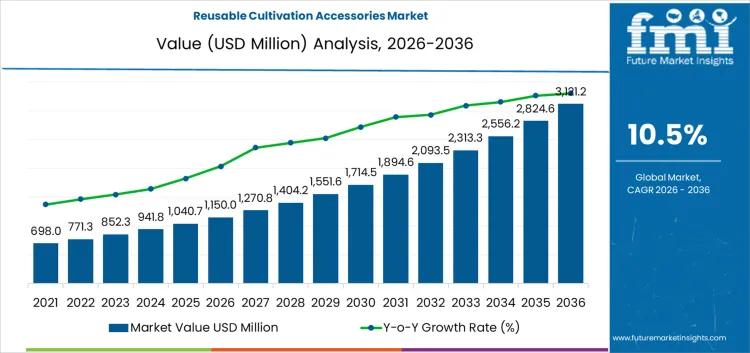
Reusable Cultivation Accessories Market Key Takeaways
| Metric | Value |
|---|---|
| Market Value (2026) | USD 1,150.0 million |
| Market Forecast Value (2036) | USD 3,121.2 million |
| Forecast CAGR 2026 to 2036 | 10.5% |
Why is the Demand for Reusable Cultivation Accessories Market Growing?
Demand for reusable cultivation accessories is increasing as commercial and hobby growers focus on reducing operational expenditures through durable tools and fixtures that withstand multiple cropping cycles. Controlled environment agriculture facilities adopt hardier trays, pots, and support systems that can endure frequent sanitation and reuse without compromising plant health. Agricultural enterprises aim to reduce procurement frequency and inventory turnover associated with single use products. As labor costs rise, growers select robust accessories that streamline handling and transplanting tasks while maintaining structural integrity across seasons. Regulatory pressure on waste reduction encourages agricultural operations to shift toward products with extended service lives to manage disposal costs and minimize landfill contributions.
Interest in sustainable cultivation practices promotes adoption of materials engineered for repeated use with minimal performance degradation. Manufacturers respond to grower demand by offering polymer blends and reinforcement features that maintain strength under exposure to moisture and cleaning agents. Research farms implement reusable accessories in trial plots to ensure consistent experimental conditions and cost management. Horticultural training programs integrate practices that emphasize resource conservation and tool longevity to prepare students for commercial expectations. Expanded distribution networks improve accessibility to these products for diverse cultivation sectors.
How Are the Segments Classified in the Reusable Cultivation Accessories Market?
Demand for reusable cultivation accessories expands due to durability requirements, cost control priorities, and waste reduction targets across commercial cultivation environments. Growers increasingly favor long lifecycle tools that withstand repeated sanitation and handling cycles. Operational emphasis on standardization and labor efficiency strengthens adoption of reusable systems across propagation and production stages. Sustainability policies and material recovery practices also influence purchasing decisions across professional cultivation settings.
Which product category represents the largest share of demand?
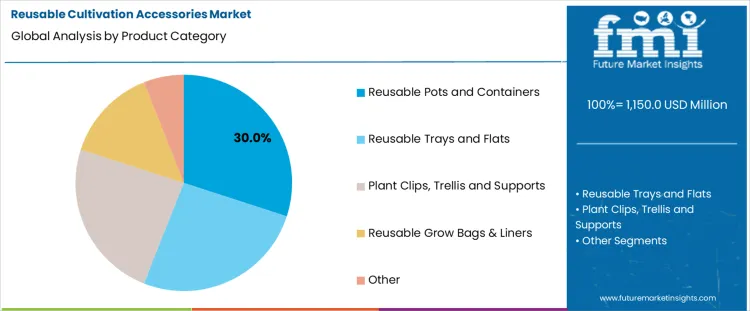
Reusable pots and containers lead the product category landscape, accounting for 30.0% of total demand within cultivation operations. High reuse potential supports repeated crop cycles without frequent replacement, improving cost efficiency over time. Structural rigidity allows compatibility with automated handling, spacing, and transport systems. Uniform sizing improves operational consistency across propagation, transplanting, and finishing stages. Resistance to cracking during washing and stacking further supports extended service life. Broad crop compatibility sustains adoption across varied cultivation formats.
Key Points
- Enables repeated use across multiple crop cycles
- Supports automation and standardized handling practices
- Delivers structural durability under intensive sanitation
Which material drives the largest share of demand?
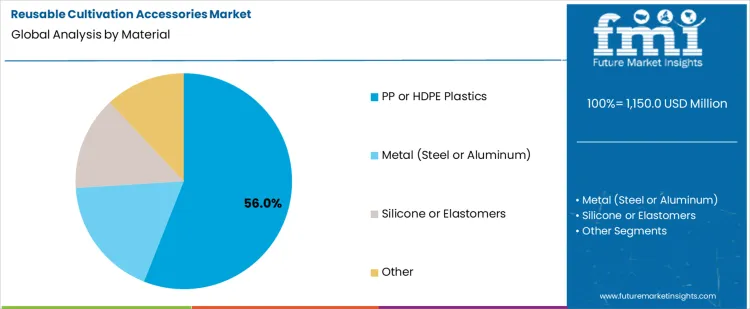
PP or HDPE plastics dominate material usage with a 56.0% share due to durability and chemical resistance characteristics. These plastics tolerate frequent washing, disinfectants, and mechanical stress without material degradation. Lightweight properties reduce labor strain during movement and stacking activities. Molded designs allow precise dimensional control, supporting uniform spacing and system integration. Recyclability attributes also align with circular material management strategies in professional cultivation environments.
Key Points
- Withstands repeated sanitation without performance loss
- Reduces handling effort through lightweight construction
- Aligns with recyclable material management systems
Which end use accounts for the highest share of demand?
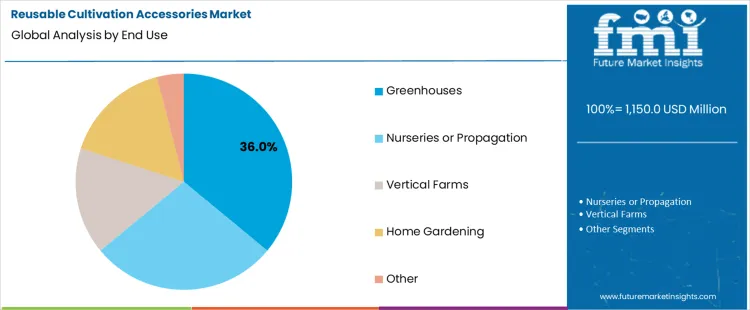
Greenhouses represent the largest end use segment with a 36.0% share, reflecting concentration of intensive and repeated cultivation cycles. High planting density increases reliance on accessories supporting stability and space optimization. Year-round production schedules elevate the value of reusable components that minimize replacement downtime. Integration with mechanized benches and irrigation systems further reinforces adoption. Operational scale amplifies cost sensitivity, strengthening preference for long service life accessories.
Key Points
- Concentrates intensive production requiring durable accessories
- Relies on integration with mechanized cultivation systems
- Prioritizes cost stability through extended product lifespan
What are the Key Dynamics in the Reusable Cultivation Accessories Market?
Demand dynamics in the reusable cultivation accessories market reflect cost control priorities and waste reduction requirements across commercial cultivation systems. Global adoption centers on durability, cleanability, and compatibility with repeated production cycles. Value formation depends on material longevity, sanitation performance, and dimensional consistency. Purchasing behavior aligns with labor efficiency, regulatory hygiene expectations, and reuse economics rather than one-time consumable replacement models.
How do operational reuse economics and hygiene requirements shape adoption?
Adoption increases where cultivation operations seek to lower recurring consumable expenditure across planting, propagation, and harvesting activities. Demand strengthens as growers standardize trays, pots, clips, trellising components, and plant supports designed for multi-cycle use. Sanitation protocols drive selection toward accessories tolerating chemical sterilants, heat treatment, and mechanical washing.
Automation compatibility elevates interest in rigid, dimensionally stable designs supporting conveyor and robotic handling. Regulatory oversight on food safety and phytosanitary control reinforces preference for accessories enabling traceable cleaning cycles. Labor efficiency improves through reduced handling variability and fewer replacement intervals. Large-scale greenhouses and vertical farms integrate reusable accessories into asset management systems to extend service life and stabilize operating budgets.
How do material fatigue and sanitation cost constraints influence market scalability?
Scalability remains constrained by material fatigue under repeated mechanical stress and aggressive sanitation exposure. Demand encounters limits where plastics crack, warp, or discolor after chemical or thermal cleaning cycles. Higher upfront costs deter smaller operators with limited capital flexibility. Sanitation infrastructure investment raises total ownership expense, especially where centralized washing systems are required.
Cross-contamination risk increases if cleaning protocols are inconsistent, elevating crop loss exposure. Regulatory documentation requirements add administrative burden for reuse tracking. Storage, transport, and inventory management of reusable accessories increase logistical complexity. Regional variation in waste policy and hygiene regulation further fragments standardization, constraining uniform adoption across diverse cultivation environments.
How Is Demand for the Reusable Cultivation Accessories Market Evolving Globally?
Global demand for reusable cultivation accessories is growing as commercial growers prioritize cost efficiency, waste reduction, and operational standardization. Expansion of protected agriculture increases reuse economics across trays, clips, containers, and support components. Demand growth reflects structural pressure to control input volatility and labor intensity rather than discretionary sustainability adoption. India shows 13.2% CAGR, China shows 12.4% CAGR, Indonesia shows 11.6% CAGR, Vietnam shows 11.1% CAGR, and Mexico shows 10.0% CAGR. Adoption aligns with greenhouse scale, sanitation infrastructure, and durability requirements shaping replacement cycles worldwide.
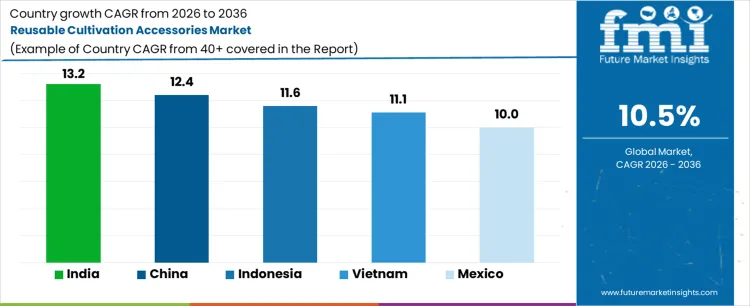
| Country | CAGR (%) |
|---|---|
| India | 13.2% |
| China | 12.4% |
| Indonesia | 11.6% |
| Vietnam | 11.1% |
| Mexico | 10.0% |
What is driving growth of reusable cultivation accessories demand in India?
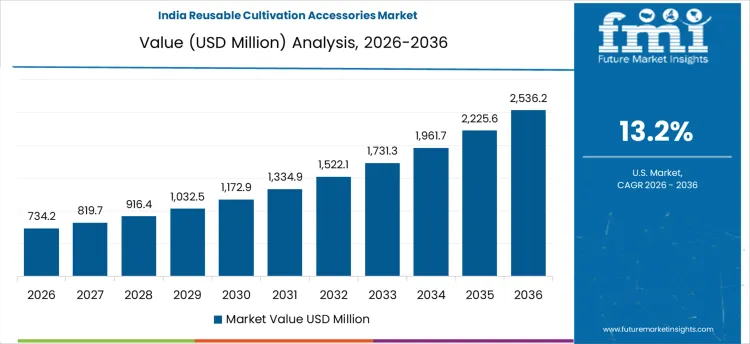
Demand for reusable cultivation accessories in India is accelerating as protected horticulture scales and input reuse economics gain priority among growers. Expansion at 13.2% CAGR reflects rising polyhouse density, cost pressure from consumables, and labor efficiency targets across vegetables and nurseries. Purchasing behavior favors trays, clips, pots, and supports designed for repeated cycles and sanitation compatibility. Supply chains emphasize durable polymers resisting UV exposure, cleaning chemicals, and mechanical stress. Adoption strengthens where cooperative farming and contract cultivation require standardized accessories. Import substitution policies and domestic manufacturing capacity support availability while controlling lifecycle costs for commercial producers. Capital allocation increasingly links accessory reuse rates with operating margin protection.
- Expansion of polyhouse cultivation
- Focus on multi-cycle accessories
- Growth of domestic manufacturing
- Emphasis on sanitation compatibility
Why is China seeing expansion in reusable cultivation accessories adoption?
Reusable cultivation accessories demand in China is expanding as industrial greenhouse operators pursue cost control and waste reduction objectives. Growth at 12.4% CAGR aligns with large facility clusters supplying urban retail networks year round. Procurement prioritizes standardized trays, trellising components, and containers supporting automated handling and cleaning systems. Domestic suppliers provide scale manufacturing and material consistency for high cycle reuse. Adoption intensifies where corporate farms enforce uniform operating protocols across sites. Regulatory pressure on agricultural waste and efficiency benchmarks reinforces replacement of disposable accessories with durable reusable alternatives. Export-focused growers favor accessories meeting traceability, hygiene auditing, and longevity performance requirements.
- Industrial greenhouse clustering
- Automation-compatible accessories
- Strong domestic supply base
- Waste reduction compliance pressure
How is Indonesia supporting growth of reusable cultivation accessories demand?
Sales of reusable cultivation accessories in Indonesia are increasing as urban agriculture and peri-urban greenhouses expand commercially. Recorded growth of 11.6% CAGR reflects sensitivity to input costs and frequent replacement burdens. Buyers prefer lightweight, stackable accessories enabling transport efficiency and repeated sanitation under humid conditions. Demand strengthens among leafy greens and herb producers supplying hospitality and modern retail channels. Local manufacturing and informal distribution networks improve affordability and availability. Adoption accelerates where training programs emphasize waste reduction and operating cost discipline within small commercial farms. Reusable designs reduce import dependence for plastic disposables and stabilize procurement planning for growers nationwide.
- Expansion of urban farming systems
- Preference for lightweight designs
- Smallholder commercial adoption
- Focus on cost containment
What factors are shaping reusable cultivation accessories sales in Vietnam?
Reusable cultivation accessories demand in Vietnam is rising as export-oriented horticulture upgrades operational standards and cost efficiency. Expansion at 11.1% CAGR corresponds with greenhouse investment supporting vegetables, flowers, and nursery stock. Buyers prioritize accessories compatible with cleaning protocols, reuse tracking, and standardized cultivation layouts. Export compliance requirements encourage durable pots, clips, and trays replacing single use inputs. Domestic processing of plastics supports localized supply. Adoption strengthens through cooperative models coordinating shared accessory inventories and maintenance practices. Government modernization initiatives and private exporters jointly reinforce capital spending discipline and longer replacement cycles. Cold chain expansion indirectly supports higher reuse rates through centralized handling.
- Export compliance requirements
- Growth of greenhouse investments
- Cooperative cultivation models
- Localized accessory processing
How is Mexico supporting growth of reusable cultivation accessories demand?
Market demand for reusable cultivation accessories in Mexico is advancing as protected vegetable production expands for domestic and export markets. Growth of 10.0% CAGR reflects focus on operating margin protection and labor efficiency within commercial greenhouses. Procurement favors durable clips, containers, and trellising suited to intensive crop cycles. Proximity to North American supply chains influences quality expectations and reuse standards. Domestic assembly and cross-border sourcing balance cost and performance. Adoption concentrates among tomato, pepper, and cucumber growers supplying retail and foodservice buyers. Water efficiency targets and sustainability audits reinforce preference for long life accessories. Replacement cycles extend as sanitation infrastructure improves across facilities.
- Protected vegetable cultivation growth
- Cross-border supply chain integration
- Emphasis on durable components
- Expansion of sanitation infrastructure
What is the competitive landscape of demand for the reusable cultivation accessories market globally?
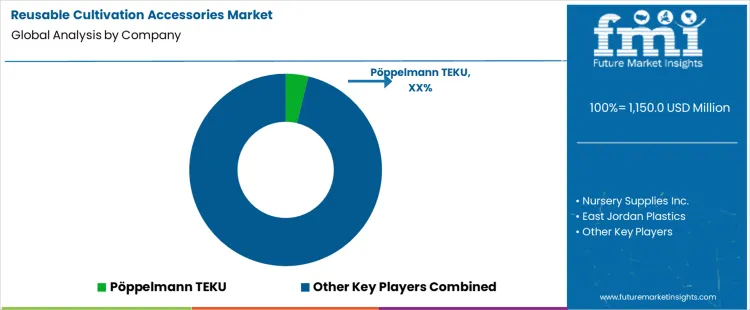
Demand for reusable cultivation accessories is driven by nursery expansion, sustainability mandates, and cost control priorities. Buyers evaluate durability, material consistency, cleaning tolerance, stackability, dimensional accuracy, and compatibility with automation. Procurement behavior emphasizes long lifecycle value, standardized specifications, reliable volumes, and suppliers with regional manufacturing. Purchasing teams prioritize traceability, recyclability, predictable lead times, and integration with irrigation and handling systems. Trend in the reusable cultivation accessories market reflects circular materials adoption, standardization across nurseries, and automation alignment. Demand concentrates in professional horticulture where reuse reduces waste, stabilizes costs, and supports operational consistency.
Pöppelmann TEKU leads competitive positioning through global scale, engineered plastics expertise, and closed loop reuse programs. Nursery Supplies Inc. supports demand with standardized containers, dependable quality, and strong relationships with commercial growers. East Jordan Plastics competes using injection molded products optimized for durability, repeat handling, and logistics efficiency. The HC Companies maintain relevance through diversified pot lines, manufacturing breadth, and consistent availability across regions. Hawthorne Gardening Company participates via professional accessory portfolios aligned with controlled environment cultivation supply chains. Competitive differentiation depends on durability, reuse cycles, dimensional precision, service reliability, and sustainability credential verification.
Key Players in the Reusable Cultivation Accessories Market
- Pöppelmann TEKU
- Nursery Supplies Inc.
- East Jordan Plastics
- Hydrofarm
- Hawthorne Gardening Company
- Gardena (Husqvarna)
- The HC Companies
- Plastkon
- Gothic Arch Greenhouses
- AutoPot
Scope of the Report
| Items | Values |
|---|---|
| Quantitative Units | USD million |
| Product Category | Reusable Pots and Containers; Reusable Trays and Flats; Plant Clips, Trellis and Supports; Reusable Grow Bags & Liners; Other |
| Material | PP or HDPE Plastics; Metal (Steel or Aluminum); Silicone or Elastomers; Other |
| End Use | Greenhouses; Nurseries or Propagation; Vertical Farms; Home Gardening; Other |
| Sales Channel | Distributors & Grow Shops; Online D2C; Direct B2B; Retail Chains |
| Regions Covered | Asia Pacific, Europe, North America, Latin America, Middle East & Africa |
| Countries Covered | India, China, Indonesia, Vietnam, Mexico, and 40+ countries |
| Key Companies Profiled | Pöppelmann TEKU; Nursery Supplies Inc.; East Jordan Plastics; Hydrofarm; Hawthorne Gardening Company; Gardena (Husqvarna); The HC Companies; Plastkon; Gothic Arch Greenhouses; AutoPot |
| Additional Attributes | Dollar sales by product category, material, end use, and sales channel; durability and reuse cycle performance across plastic, metal, and elastomer-based accessories; resistance to UV exposure, chemicals, and repeated sanitation processes; stackability and logistics efficiency for trays and containers; compatibility with automated propagation and irrigation systems; purchasing behavior across distributor-led channels, direct B2B supply agreements, and online D2C platforms. |
Reusable Cultivation Accessories Market by Segment
Product Category:
- Reusable Pots and Containers
- Reusable Trays and Flats
- Plant Clips, Trellis and Supports
- Reusable Grow Bags & Liners
- Other
Material:
- PP or HDPE Plastics
- Metal (Steel or Aluminum)
- Silicone or Elastomers
- Other
End Use:
- Greenhouses
- Nurseries or Propagation
- Vertical Farms
- Home Gardening
- Other
Sales Channel:
- Distributors & Grow Shops
- Online D2C
- Direct B2B
- Retail Chains
Region:
- Asia Pacific
- China
- Japan
- South Korea
- India
- Australia & New Zealand
- ASEAN
- Rest of Asia Pacific
- Europe
- Germany
- United Kingdom
- France
- Italy
- Spain
- Nordic
- BENELUX
- Rest of Europe
- North America
- United States
- Canada
- Mexico
- Latin America
- Brazil
- Chile
- Rest of Latin America
- Middle East & Africa
- Kingdom of Saudi Arabia
- Other GCC Countries
- Turkey
- South Africa
- Other African Union
- Rest of Middle East & Africa
Bibliography
- Food and Agriculture Organization of the United Nations. (2024). FAO’s work on the use and management of agricultural plastics (COAG/2024/8). FAO.
- U.S. Department of Agriculture, Economic Research Service. (2024). Trends, insights, and future prospects for production in controlled environment agriculture and agrivoltaics systems (Economic Information Bulletin No. 264). USDA.
- Organisation for Economic Co-operation and Development. (2024). Policy scenarios for eliminating plastic pollution by 2040. OECD Publishing.
Frequently Asked Questions
How big is the reusable cultivation accessories market in 2026?
The global reusable cultivation accessories market is estimated to be valued at USD 1,150.0 million in 2026.
What will be the size of reusable cultivation accessories market in 2036?
The market size for the reusable cultivation accessories market is projected to reach USD 3,121.2 million by 2036.
How much will be the reusable cultivation accessories market growth between 2026 and 2036?
The reusable cultivation accessories market is expected to grow at a 10.5% CAGR between 2026 and 2036.
What are the key product types in the reusable cultivation accessories market?
The key product types in reusable cultivation accessories market are reusable pots and containers, reusable trays and flats, plant clips, trellis and supports, reusable grow bags & liners and other.
Which material segment to contribute significant share in the reusable cultivation accessories market in 2026?
In terms of material, PP or HDPE plastics segment to command 56.0% share in the reusable cultivation accessories market in 2026.
Preview the report firsthand - request a free sample
Get SampleGet the brochure for pricing and purchase details.
Get PDFTable of Content
- Executive Summary
- Global Market Outlook
- Demand-side Trends
- Supply-side Trends
- Technology Roadmap Analysis
- Analysis and Recommendations
- Market Overview
- Market Coverage / Taxonomy
- Market Definition / Scope / Limitations
- Market Background
- Market Dynamics
- Drivers
- Restraints
- Opportunity
- Trends
- Scenario Forecast
- Demand in Optimistic Scenario
- Demand in Likely Scenario
- Demand in Conservative Scenario
- Opportunity Map Analysis
- Product Life Cycle Analysis
- Supply Chain Analysis
- Investment Feasibility Matrix
- Value Chain Analysis
- PESTLE and Porter’s Analysis
- Regulatory Landscape
- Regional Parent Market Outlook
- Production and Consumption Statistics
- Import and Export Statistics
- Market Dynamics
- Global Market Analysis 2021 to 2025 and Forecast, 2026 to 2036
- Historical Market Size Value (USD Million) Analysis, 2021 to 2025
- Current and Future Market Size Value (USD Million) Projections, 2026 to 2036
- Y-o-Y Growth Trend Analysis
- Absolute $ Opportunity Analysis
- Global Market Pricing Analysis 2021 to 2025 and Forecast 2026 to 2036
- Global Market Analysis 2021 to 2025 and Forecast 2026 to 2036, By Product Category
- Introduction / Key Findings
- Historical Market Size Value (USD Million) Analysis By Product Category, 2021 to 2025
- Current and Future Market Size Value (USD Million) Analysis and Forecast By Product Category, 2026 to 2036
- Reusable Pots and Containers
- Reusable Trays and Flats
- Plant Clips, Trellis and Supports
- Reusable Grow Bags & Liners
- Other
- Reusable Pots and Containers
- Y-o-Y Growth Trend Analysis By Product Category, 2021 to 2025
- Absolute $ Opportunity Analysis By Product Category, 2026 to 2036
- Global Market Analysis 2021 to 2025 and Forecast 2026 to 2036, By Material
- Introduction / Key Findings
- Historical Market Size Value (USD Million) Analysis By Material, 2021 to 2025
- Current and Future Market Size Value (USD Million) Analysis and Forecast By Material, 2026 to 2036
- PP or HDPE Plastics
- Metal (Steel or Aluminum)
- Silicone or Elastomers
- Other
- PP or HDPE Plastics
- Y-o-Y Growth Trend Analysis By Material, 2021 to 2025
- Absolute $ Opportunity Analysis By Material, 2026 to 2036
- Global Market Analysis 2021 to 2025 and Forecast 2026 to 2036, By End Use
- Introduction / Key Findings
- Historical Market Size Value (USD Million) Analysis By End Use, 2021 to 2025
- Current and Future Market Size Value (USD Million) Analysis and Forecast By End Use, 2026 to 2036
- Greenhouses
- Nurseries or Propagation
- Vertical Farms
- Home Gardening
- Other
- Greenhouses
- Y-o-Y Growth Trend Analysis By End Use, 2021 to 2025
- Absolute $ Opportunity Analysis By End Use, 2026 to 2036
- Global Market Analysis 2021 to 2025 and Forecast 2026 to 2036, By Sales Channel
- Introduction / Key Findings
- Historical Market Size Value (USD Million) Analysis By Sales Channel, 2021 to 2025
- Current and Future Market Size Value (USD Million) Analysis and Forecast By Sales Channel, 2026 to 2036
- Distributors & Grow Shops
- Online D2C
- Direct B2B
- Retail Chains
- Distributors & Grow Shops
- Y-o-Y Growth Trend Analysis By Sales Channel, 2021 to 2025
- Absolute $ Opportunity Analysis By Sales Channel, 2026 to 2036
- Global Market Analysis 2021 to 2025 and Forecast 2026 to 2036, By Region
- Introduction
- Historical Market Size Value (USD Million) Analysis By Region, 2021 to 2025
- Current Market Size Value (USD Million) Analysis and Forecast By Region, 2026 to 2036
- North America
- Latin America
- Western Europe
- Eastern Europe
- East Asia
- South Asia and Pacific
- Middle East & Africa
- Market Attractiveness Analysis By Region
- North America Market Analysis 2021 to 2025 and Forecast 2026 to 2036, By Country
- Historical Market Size Value (USD Million) Trend Analysis By Market Taxonomy, 2021 to 2025
- Market Size Value (USD Million) Forecast By Market Taxonomy, 2026 to 2036
- By Country
- USA
- Canada
- Mexico
- By Product Category
- By Material
- By End Use
- By Sales Channel
- By Country
- Market Attractiveness Analysis
- By Country
- By Product Category
- By Material
- By End Use
- By Sales Channel
- Key Takeaways
- Latin America Market Analysis 2021 to 2025 and Forecast 2026 to 2036, By Country
- Historical Market Size Value (USD Million) Trend Analysis By Market Taxonomy, 2021 to 2025
- Market Size Value (USD Million) Forecast By Market Taxonomy, 2026 to 2036
- By Country
- Brazil
- Chile
- Rest of Latin America
- By Product Category
- By Material
- By End Use
- By Sales Channel
- By Country
- Market Attractiveness Analysis
- By Country
- By Product Category
- By Material
- By End Use
- By Sales Channel
- Key Takeaways
- Western Europe Market Analysis 2021 to 2025 and Forecast 2026 to 2036, By Country
- Historical Market Size Value (USD Million) Trend Analysis By Market Taxonomy, 2021 to 2025
- Market Size Value (USD Million) Forecast By Market Taxonomy, 2026 to 2036
- By Country
- Germany
- UK
- Italy
- Spain
- France
- Nordic
- BENELUX
- Rest of Western Europe
- By Product Category
- By Material
- By End Use
- By Sales Channel
- By Country
- Market Attractiveness Analysis
- By Country
- By Product Category
- By Material
- By End Use
- By Sales Channel
- Key Takeaways
- Eastern Europe Market Analysis 2021 to 2025 and Forecast 2026 to 2036, By Country
- Historical Market Size Value (USD Million) Trend Analysis By Market Taxonomy, 2021 to 2025
- Market Size Value (USD Million) Forecast By Market Taxonomy, 2026 to 2036
- By Country
- Russia
- Poland
- Hungary
- Balkan & Baltic
- Rest of Eastern Europe
- By Product Category
- By Material
- By End Use
- By Sales Channel
- By Country
- Market Attractiveness Analysis
- By Country
- By Product Category
- By Material
- By End Use
- By Sales Channel
- Key Takeaways
- East Asia Market Analysis 2021 to 2025 and Forecast 2026 to 2036, By Country
- Historical Market Size Value (USD Million) Trend Analysis By Market Taxonomy, 2021 to 2025
- Market Size Value (USD Million) Forecast By Market Taxonomy, 2026 to 2036
- By Country
- China
- Japan
- South Korea
- By Product Category
- By Material
- By End Use
- By Sales Channel
- By Country
- Market Attractiveness Analysis
- By Country
- By Product Category
- By Material
- By End Use
- By Sales Channel
- Key Takeaways
- South Asia and Pacific Market Analysis 2021 to 2025 and Forecast 2026 to 2036, By Country
- Historical Market Size Value (USD Million) Trend Analysis By Market Taxonomy, 2021 to 2025
- Market Size Value (USD Million) Forecast By Market Taxonomy, 2026 to 2036
- By Country
- India
- ASEAN
- Australia & New Zealand
- Rest of South Asia and Pacific
- By Product Category
- By Material
- By End Use
- By Sales Channel
- By Country
- Market Attractiveness Analysis
- By Country
- By Product Category
- By Material
- By End Use
- By Sales Channel
- Key Takeaways
- Middle East & Africa Market Analysis 2021 to 2025 and Forecast 2026 to 2036, By Country
- Historical Market Size Value (USD Million) Trend Analysis By Market Taxonomy, 2021 to 2025
- Market Size Value (USD Million) Forecast By Market Taxonomy, 2026 to 2036
- By Country
- Kingdom of Saudi Arabia
- Other GCC Countries
- Turkiye
- South Africa
- Other African Union
- Rest of Middle East & Africa
- By Product Category
- By Material
- By End Use
- By Sales Channel
- By Country
- Market Attractiveness Analysis
- By Country
- By Product Category
- By Material
- By End Use
- By Sales Channel
- Key Takeaways
- Key Countries Market Analysis
- USA
- Pricing Analysis
- Market Share Analysis, 2025
- By Product Category
- By Material
- By End Use
- By Sales Channel
- Canada
- Pricing Analysis
- Market Share Analysis, 2025
- By Product Category
- By Material
- By End Use
- By Sales Channel
- Mexico
- Pricing Analysis
- Market Share Analysis, 2025
- By Product Category
- By Material
- By End Use
- By Sales Channel
- Brazil
- Pricing Analysis
- Market Share Analysis, 2025
- By Product Category
- By Material
- By End Use
- By Sales Channel
- Chile
- Pricing Analysis
- Market Share Analysis, 2025
- By Product Category
- By Material
- By End Use
- By Sales Channel
- Germany
- Pricing Analysis
- Market Share Analysis, 2025
- By Product Category
- By Material
- By End Use
- By Sales Channel
- UK
- Pricing Analysis
- Market Share Analysis, 2025
- By Product Category
- By Material
- By End Use
- By Sales Channel
- Italy
- Pricing Analysis
- Market Share Analysis, 2025
- By Product Category
- By Material
- By End Use
- By Sales Channel
- Spain
- Pricing Analysis
- Market Share Analysis, 2025
- By Product Category
- By Material
- By End Use
- By Sales Channel
- France
- Pricing Analysis
- Market Share Analysis, 2025
- By Product Category
- By Material
- By End Use
- By Sales Channel
- India
- Pricing Analysis
- Market Share Analysis, 2025
- By Product Category
- By Material
- By End Use
- By Sales Channel
- ASEAN
- Pricing Analysis
- Market Share Analysis, 2025
- By Product Category
- By Material
- By End Use
- By Sales Channel
- Australia & New Zealand
- Pricing Analysis
- Market Share Analysis, 2025
- By Product Category
- By Material
- By End Use
- By Sales Channel
- China
- Pricing Analysis
- Market Share Analysis, 2025
- By Product Category
- By Material
- By End Use
- By Sales Channel
- Japan
- Pricing Analysis
- Market Share Analysis, 2025
- By Product Category
- By Material
- By End Use
- By Sales Channel
- South Korea
- Pricing Analysis
- Market Share Analysis, 2025
- By Product Category
- By Material
- By End Use
- By Sales Channel
- Russia
- Pricing Analysis
- Market Share Analysis, 2025
- By Product Category
- By Material
- By End Use
- By Sales Channel
- Poland
- Pricing Analysis
- Market Share Analysis, 2025
- By Product Category
- By Material
- By End Use
- By Sales Channel
- Hungary
- Pricing Analysis
- Market Share Analysis, 2025
- By Product Category
- By Material
- By End Use
- By Sales Channel
- Kingdom of Saudi Arabia
- Pricing Analysis
- Market Share Analysis, 2025
- By Product Category
- By Material
- By End Use
- By Sales Channel
- Turkiye
- Pricing Analysis
- Market Share Analysis, 2025
- By Product Category
- By Material
- By End Use
- By Sales Channel
- South Africa
- Pricing Analysis
- Market Share Analysis, 2025
- By Product Category
- By Material
- By End Use
- By Sales Channel
- USA
- Market Structure Analysis
- Competition Dashboard
- Competition Benchmarking
- Market Share Analysis of Top Players
- By Regional
- By Product Category
- By Material
- By End Use
- By Sales Channel
- Competition Analysis
- Competition Deep Dive
- Pöppelmann TEKU
- Overview
- Product Portfolio
- Profitability by Market Segments (Product/Age /Sales Channel/Region)
- Sales Footprint
- Strategy Overview
- Marketing Strategy
- Product Strategy
- Channel Strategy
- Nursery Supplies Inc.
- East Jordan Plastics
- Hydrofarm
- Hawthorne Gardening Company
- Gardena (Husqvarna)
- The HC Companies
- Plastkon
- Gothic Arch Greenhouses
- AutoPot
- Pöppelmann TEKU
- Competition Deep Dive
- Assumptions & Acronyms Used
- Research Methodology


