

- Industry Size (2026)
- USD 5.8 Bn
- Forecast (2036)
- USD 8.3 Bn
- CAGR (2026 to 2036)
- 3.60%
Soil Tillage Implements Market Forecast and Outlook 2026 to 2036
The soil tillage implements market is projected to expand from USD 5.8 billion in 2026 to USD 8.3 billion by 2036, growing at a CAGR of 3.60%. Capital deployment in this market is measured and selective, reflecting its mature structure and replacement-driven demand profile. Investment decisions by manufacturers prioritize incremental capacity expansion, cost-efficient manufacturing, and product upgrades rather than aggressive greenfield builds. Returns are typically realized over medium time horizons through stable dealer networks, aftermarket parts, and recurring replacement cycles tied to farm utilization intensity. OEMs allocate capital toward strengthening distribution reach, improving durability of wear components, and aligning implements with higher-horsepower tractors and precision farming practices. Emerging markets attract investment focused on volume scalability and localized production, while developed regions see capital directed toward technology refinement and soil-conservation-compatible designs. Between 2026 and 2036, expansion is shaped less by rapid demand spikes and more by disciplined capital allocation, predictable cash flows, and sustained replacement demand, supporting steady but controlled investor returns.
Quick Stats for Soil Tillage Implements Market
- Soil Tillage Implements Market Value (2026): USD 5.8 Billion
- Soil Tillage Implements Market Forecast Value (2036): USD 8.3 Billion
- Soil Tillage Implements Market Forecast CAGR 2026 to 2036: 3.60%
- Leading Implement Types in Soil Tillage Implements Market: Cultivators and Ploughs (replacement-driven demand across mechanized farms)
- Key Growth Regions in Soil Tillage Implements Market: Asia Pacific, Europe, North America, Latin America, Middle East & Africa
- Top Key Players in Soil Tillage Implements Market: John Deere, CNH Industrial, AGCO Corporation, Mahindra & Mahindra, Kubota Corporation, Kuhn Group, Amazone, Lemken, Maschio Gaspardo, Great Plains Manufacturing
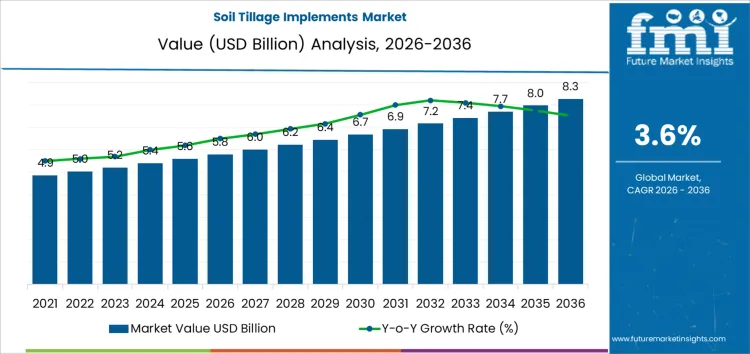
Soil Tillage Implements Market Key Takeaways
| Metric | Value |
|---|---|
| Soil Tillage Implements Market Value (2026) | USD 5.8 Billion |
| Soil Tillage Implements Market Forecast Value (2036) | USD 8.3 Billion |
| Soil Tillage Implements Market Forecast CAGR 2026 to 2036 | 3.60% |
How Are Farm Economics and Mechanization Strategies Shaping the Soil Tillage Implements Market?
Demand for soil tillage implements is increasingly influenced by farm-level economics and operational efficiency requirements rather than acreage expansion alone. Farmers are prioritizing implements that improve soil preparation speed, reduce fuel consumption, and support multi-crop cultivation within shorter planting windows. This is driving steady replacement demand for ploughs, harrows, cultivators, and disc implements with improved durability and optimized working widths. For manufacturers, value creation is shifting toward productivity gains and operating cost reduction rather than basic equipment availability.
Product selection patterns are also evolving due to mechanization depth and tractor horsepower alignment. Mid-range and high-horsepower tractors are becoming more common across commercial farms, increasing demand for heavier-duty and wider tillage implements. Equipment buyers are evaluating frame strength, wear-part life, ease of maintenance, and compatibility with precision farming practices. Manufacturers offering modular designs, interchangeable components, and low-maintenance wear solutions are better positioned to secure dealer preference and repeat sales.
Regional demand dynamics are shaping supplier strategies. Asia Pacific continues to generate volume demand driven by mechanization programs, rising labor costs, and government subsidies for farm equipment. In contrast, North America and Europe are seeing demand linked to soil conservation practices and optimized tillage approaches, influencing design requirements. For suppliers and OEM partners, competitive advantage increasingly depends on regional customization, dealer support strength, and the ability to balance cost efficiency with field performance. Together, replacement-driven demand, mechanization intensity, and regional farming practices are maintaining steady growth in the soil tillage implements market.
How Is The Soil Tillage Implements Market Structured?
The soil tillage implements market is segmented by implement type and power source, reflecting mechanization levels, farm size, and cropping intensity across regions. By implement type, cultivators lead with 30% share, as they are widely used for primary and secondary tillage, weed control, and soil aeration across diverse soil conditions. Other implements such as rotavators or rotary tillers, ploughs, harrows, and subsoilers address depth-specific and crop-specific tillage requirements. By power source, tractor-mounted PTO systems dominate with 55% share, driven by rising tractor penetration and demand for higher field productivity. Self-propelled units, animal-drawn implements, and mini-tillers remain relevant in smallholder and fragmented farming systems.
Why Do Cultivators Hold The Leading Share In The Soil Tillage Implements Market?
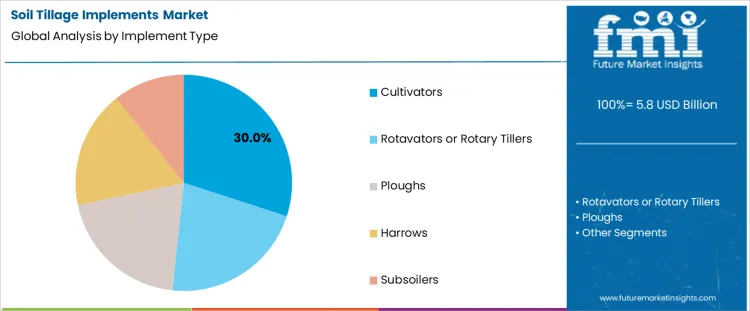
Cultivators account for 30% share of the soil tillage implements market because they offer versatility across multiple stages of land preparation. Farmers use cultivators for loosening topsoil, uprooting weeds, and mixing crop residues without excessive soil inversion. This supports moisture retention and improved soil structure. Cultivators are compatible with different tractor power ranges, making them suitable for small, medium, and large farms. Lower acquisition and maintenance costs compared to heavier tillage equipment encourage widespread adoption. Manufacturers benefit from steady replacement demand and model variations based on tine design and working width. These agronomic and economic advantages explain why cultivators remain the most widely used tillage implement.
Why Does Tractor-Mounted PTO Power Source Dominate The Soil Tillage Implements Market?
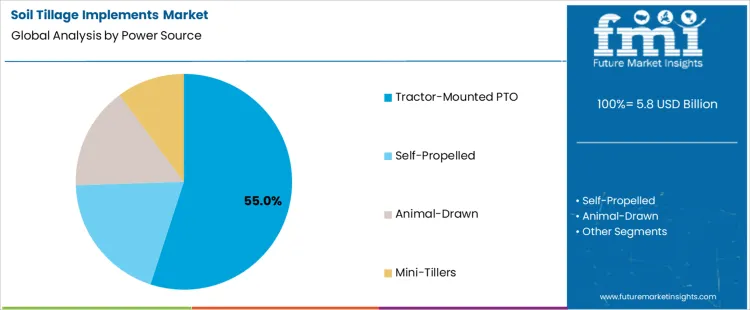
Tractor-mounted PTO systems lead the soil tillage implements market with 55% share because they deliver higher operational efficiency and consistent power output for intensive tillage operations. PTO-driven implements enable deeper soil penetration, uniform working depth, and faster field coverage compared to manual or animal-drawn systems. Increasing tractor ownership, government mechanization programs, and availability of financing support adoption of PTO-based implements. Farmers prioritize PTO-mounted equipment to reduce labor dependency and manage time-sensitive sowing cycles. For implement manufacturers, PTO compatibility allows standardization across product lines and scalability in sales. These productivity and commercialization factors explain the dominance of tractor-mounted PTO systems.
What Factors Are Driving Growth In The Soil Tillage Implements Market?
Growth in the soil tillage implements market is propelled by the increasing need for efficient land preparation, enhanced crop yields, and mechanization of agricultural operations. Rising global food demand and limited arable land are pushing farm operators to invest in soil tillage tools that optimize soil structure, weed control, and residue management. Demand is particularly strong for durable plows, disc harrows, cultivators, and rotary tillers that deliver uniform tillage depth, reduced fuel consumption, and adaptability to varying soil conditions. For manufacturers and suppliers, product reliability, ease of maintenance, and distribution reach are key factors influencing adoption and customer loyalty.
How Are Technological Advancements And Precision Agriculture Trends Shaping The Market?
Technological advancements and precision agriculture trends are reshaping the soil tillage implements market by integrating GPS guidance, variable depth control, and automated adjustment features. Modern implements are increasingly compatible with tractor CAN-bus systems and precision farming suites that allow operators to optimize tillage patterns, reduce overlap, and lower input costs. Development of lightweight yet high-strength materials improves implement efficiency while reducing soil compaction. For suppliers, aligning products with digital farming platforms and offering retrofit kits for legacy tractors can unlock additional value and differentiation in competitive markets.
What Challenges Are Impacting Supplier Performance And Market Adoption?
The soil tillage implements market faces challenges related to high initial investment, fuel dependency, and soil degradation concerns. Small and mid-scale farmers may defer upgrades to advanced implements due to upfront equipment costs and limited access to financing. Heavy tillage operations can increase fuel consumption and exacerbate soil erosion, prompting a shift toward conservation tillage practices that reduce market demand for traditional deep-tillage tools. Supply chain constraints for steel, components, and logistics can affect production schedules and delivery lead times. These factors require suppliers to balance product performance with affordability and sustainability considerations.
What Is the Country-Wise Outlook for the Soil Tillage Implements Market?
The soil tillage implements market reflects differences in farm size distribution, mechanization intensity, crop economics, and replacement cycles across regions. Emerging economies show stronger growth due to rising mechanization and government support programs, while developed markets are shaped by equipment replacement, precision farming adoption, and efficiency-focused upgrades. Growth is influenced by shifts toward conservation tillage, demand for multi-functional implements, and compatibility with higher-horsepower tractors. Suppliers that align product portfolios with regional agronomic practices, farm economics, and dealer networks gain competitive advantage across country markets.
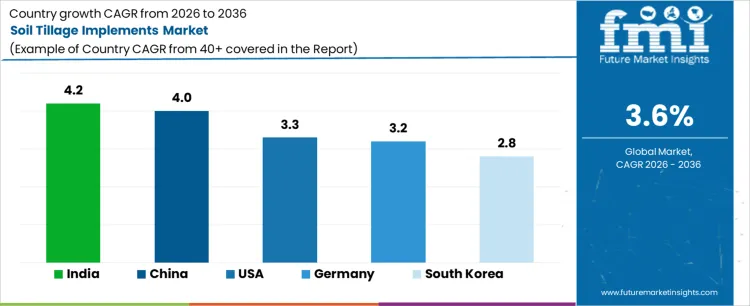
| Country | CAGR (%) |
|---|---|
| India | 4.2% |
| China | 4.0% |
| USA | 3.3% |
| Germany | 3.2% |
| South Korea | 2.8% |
How Is Replacement-Driven Mechanization Shaping the Soil Tillage Implements Market in the United States?
The soil tillage implements market in the United States, expanding at a CAGR of 3.3% during 2026 to 2036, is primarily shaped by replacement demand and operational efficiency improvements. Large commercial farms dominate equipment purchases, favoring heavy-duty plows, disc harrows, and cultivators compatible with high-horsepower tractors. Buyers prioritize durability, fuel efficiency, and consistent tillage depth across large acreage. Adoption of conservation tillage practices influences demand for reduced-disturbance implements rather than conventional deep plowing tools. Procurement decisions are closely linked to crop rotation cycles and seasonal equipment utilization. Precision depth control, hydraulic adjustment, and compatibility with GPS-enabled tractors increasingly influence purchasing behavior. Suppliers benefit from strong dealer networks, aftermarket parts sales, and service contracts. The United States market rewards manufacturers offering long service life, minimal downtime, and technology-enabled implements rather than low-cost, high-volume products.
Why Does Precision Farming Define the Soil Tillage Implements Market in Germany?
Demand for soil tillage implements in Germany, growing at a CAGR of 3.2% during the forecast period, reflects the country’s emphasis on precision agriculture and soil conservation. Medium- and large-scale farms prioritize controlled tillage depth, soil structure preservation, and uniform residue management. Buyers favor engineered cultivators and disc harrows designed for compatibility with precision farming systems. Procurement decisions emphasize build quality, durability, and compliance with environmental regulations. Demand is largely replacement-led, as farms upgrade equipment to improve efficiency and reduce soil compaction. Volumes remain moderate, but average selling prices are higher due to specification-driven purchasing. Suppliers offering customization options, technical documentation, and long-term service support gain preference. Germany represents a value-focused market where precision engineering, reliability, and regulatory alignment shape sustained procurement across professional farming operations.
How Do Farm Size Constraints Influence the Soil Tillage Implements Market in South Korea?
Sale of soil tillage implements market in South Korea, expanding at a CAGR of 2.8% during 2026 to 2036, is shaped by small land holdings and high labor costs. Compact and multi-functional tillage implements are preferred for rice paddies and mixed cropping systems. Buyers emphasize maneuverability, ease of operation, and compatibility with low- to mid-horsepower tractors. Demand is supported by government-led farm mechanization programs aimed at reducing labor dependency. Procurement focuses on standardized, easy-to-maintain equipment suitable for fragmented plots. Replacement demand gradually increases as manual and semi-mechanized practices decline. Suppliers benefit from offering compact designs, reliable performance, and accessible aftersales service. South Korea represents a niche market where functionality, operator convenience, and service availability outweigh scale-based considerations.
How Is Large-Scale Mechanization Driving Growth in China’s Soil Tillage Implements Market?
The soil tillage implements market in China, growing at a CAGR of 4.0% during 2026 to 2036, is shaped by rapid mechanization across large agricultural belts and consolidation of farmland. Expansion of grain-focused cultivation increases use of plows, harrows, and cultivators designed for high operating hours. Buyers prioritize affordability, wide availability, and compatibility with domestically manufactured tractors. Government programs supporting mechanized agriculture improve procurement visibility, especially in major crop-producing provinces. Domestic manufacturers dominate high-volume segments through competitive pricing and extensive dealer reach. Higher-specification implements find adoption among large agribusiness operators seeking productivity gains. Replacement cycles shorten as utilization intensity rises. China remains a volume-oriented market where supplier success depends on cost efficiency, scalable manufacturing, and strong regional distribution networks.
Why Is India Emerging as the Fastest-Growing Market for Soil Tillage Implements?
Demand for soil tillage implements market in India, expanding at a CAGR of 4.2% during 2026 to 2036, reflects accelerating mechanization across small and mid-sized farms. Rising tractor ownership, farm labor shortages, and government subsidy schemes support adoption of basic tillage equipment. Farmers favor robust, low-cost plows and cultivators capable of performing across varied soil and climatic conditions. Replacement of animal-drawn tools continues to drive incremental sales volumes. Procurement decisions remain price-sensitive, with strong emphasis on durability and ease of maintenance. Availability of local dealers and service support plays a decisive role in brand selection. India presents long-term volume growth potential as mechanization penetration deepens and efficiency-focused farming practices gradually expand.
How Are Manufacturers Competing in the Soil Tillage Implements Market?
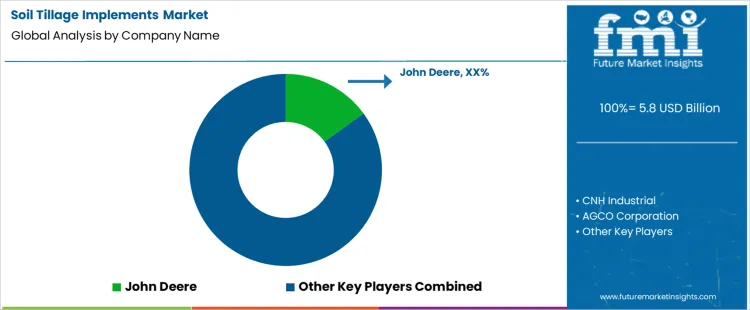
Competition in the soil tillage implements market centers on validated performance characteristics, durability claims, and operational efficiency documented in official product brochures that matter to farmers, dealers, and OEM procurement teams. John Deere positions its tillage lineup around robust frame design, optimized soil penetration profiles, and ease of maintenance. Brochures emphasize uniform residue handling, adjustable working depths, and high-strength materials suited for diverse soil conditions. CNH Industrial competes with branded tillage tools under its Case IH and New Holland portfolios. Official literature focuses on modular gangs, precise coulter action, and reduced draft force to lower fuel consumption.
Major global OEMs differentiate through application-specific engineering. AGCO Corporation markets tillage implements with product materials that highlight sectional float, frame stability, and integrated hitch systems for seamless tractor matching. Mahindra & Mahindra and Kubota Corporation emphasize compact, durable designs for small to mid-sized farms; brochures detail simplified adjustment mechanisms and serviceability that appeal to emerging market conditions. Kuhn Group and Amazone position their solutions through specialized disc and tine configurations documented for optimized seedbed preparation and residue incorporation efficiency.
European engineering heritage is evident in specific offers. Lemken highlights precision soil engagement and adjustable roller systems validated in official materials for consistent clod size and surface finish. Maschio Gaspardo competes with tillage suites showcased for rugged construction and flexibility across crop systems. Great Plains Manufacturing positions its implements with brochures focusing on soil preservation tillage and uniform seedbed conditioning tailored to conservation agriculture practices.
Key Players in Soil Tillage Implements Market
- John Deere
- CNH Industrial
- AGCO Corporation
- Mahindra & Mahindra
- Kubota Corporation
- Kuhn Group
- Amazone
- Lemken
- Maschio Gaspardo
- Great Plains Manufacturing
Scope of Report
| Attribute | Description |
|---|---|
| Quantitative Unit | USD Billion |
| Implement Type | Cultivators, Rotavators or Rotary Tillers, Ploughs, Harrows, Subsoilers |
| Power Source | Tractor-Mounted PTO, Self-Propelled, Animal-Drawn, Mini-Tillers |
| Countries Covered | China, Japan, South Korea, India, Australia & New Zealand, ASEAN, Rest of Asia Pacific, Germany, United Kingdom, France, Italy, Spain, Nordic, BENELUX, Rest of Europe, United States, Canada, Mexico, Brazil, Chile, Rest of Latin America, Kingdom of Saudi Arabia, Other GCC Countries, Turkey, South Africa, Other African Union, Rest of Middle East & Africa |
| Regions Covered | Asia Pacific, Europe, North America, Latin America, Middle East & Africa |
| Key Companies Profiled | John Deere, CNH Industrial, AGCO Corporation, Mahindra & Mahindra, Kubota Corporation, Kuhn Group, Amazone, Lemken, Maschio Gaspardo, Great Plains Manufacturing |
| Additional Attributes | Dollar sales by implement type and power source are evaluated across mechanized and semi-mechanized farming systems. The report includes country-level demand assessment, growth projections for 2026 to 2036, analysis of farm mechanization intensity, evaluation of productivity and soil preparation efficiency, competitive benchmarking of manufacturers, and assessment of equipment replacement and modernization trends across agricultural regions. |
Soil Tillage Implements Market by Key Segments
Implement Type:
- Cultivators
- Rotavators or Rotary Tillers
- Ploughs
- Harrows
- Subsoilers
Power Source:
- Tractor-Mounted PTO
- Self-Propelled
- Animal-Drawn
- Mini-Tillers
Region:
- Asia Pacific
- China
- Japan
- South Korea
- India
- Australia & New Zealand
- ASEAN
- Rest of Asia Pacific
- Europe
- Germany
- United Kingdom
- France
- Italy
- Spain
- Nordic
- BENELUX
- Rest of Europe
- North America
- United States
- Canada
- Mexico
- Latin America
- Brazil
- Chile
- Rest of Latin America
- Middle East & Africa
- Kingdom of Saudi Arabia
- Other GCC Countries
- Turkey
- South Africa
- Other African Union
- Rest of Middle East & Africa
Bibliography
- Food and Agriculture Organization of the United Nations. (2024). Mechanization for rural development: Global patterns and progress. FAO.
- U.S. Department of Agriculture, National Institute of Food and Agriculture. (2024). Precision agriculture and the future of farming in the United States. USDA.
- International Organization for Standardization. (2024). ISO 4254 series: Agricultural machinery safety standards (current editions). ISO.
- World Bank. (2024). World Development Report 2024: Farming, food systems, and rural livelihoods. World Bank.
Frequently Asked Questions
How big is the soil tillage implements market in 2026?
The global soil tillage implements market is estimated to be valued at USD 5.8 billion in 2026.
What will be the size of soil tillage implements market in 2036?
The market size for the soil tillage implements market is projected to reach USD 8.3 billion by 2036.
How much will be the soil tillage implements market growth between 2026 and 2036?
The soil tillage implements market is expected to grow at a 3.6% CAGR between 2026 and 2036.
What are the key product types in the soil tillage implements market?
The key product types in soil tillage implements market are cultivators, rotavators or rotary tillers, ploughs, harrows and subsoilers.
Which power source segment to contribute significant share in the soil tillage implements market in 2026?
In terms of power source, tractor-mounted pto segment to command 55.0% share in the soil tillage implements market in 2026.
Preview the report firsthand - request a free sample
Get SampleGet the brochure for pricing and purchase details.
Get PDFTable of Content
- Executive Summary
- Global Market Outlook
- Demand-side Trends
- Supply-side Trends
- Technology Roadmap Analysis
- Analysis and Recommendations
- Market Overview
- Market Coverage / Taxonomy
- Market Definition / Scope / Limitations
- Market Background
- Market Dynamics
- Drivers
- Restraints
- Opportunity
- Trends
- Scenario Forecast
- Demand in Optimistic Scenario
- Demand in Likely Scenario
- Demand in Conservative Scenario
- Opportunity Map Analysis
- Product Life Cycle Analysis
- Supply Chain Analysis
- Investment Feasibility Matrix
- Value Chain Analysis
- PESTLE and Porter’s Analysis
- Regulatory Landscape
- Regional Parent Market Outlook
- Production and Consumption Statistics
- Import and Export Statistics
- Market Dynamics
- Global Market Analysis 2021 to 2025 and Forecast, 2026 to 2036
- Historical Market Size Value (USD Million) Analysis, 2021 to 2025
- Current and Future Market Size Value (USD Million) Projections, 2026 to 2036
- Y-o-Y Growth Trend Analysis
- Absolute $ Opportunity Analysis
- Global Market Pricing Analysis 2021 to 2025 and Forecast 2026 to 2036
- Global Market Analysis 2021 to 2025 and Forecast 2026 to 2036, By Implement Type
- Introduction / Key Findings
- Historical Market Size Value (USD Million) Analysis By Implement Type , 2021 to 2025
- Current and Future Market Size Value (USD Million) Analysis and Forecast By Implement Type , 2026 to 2036
- Cultivators
- Rotavators or Rotary Tillers
- Ploughs
- Harrows
- Subsoilers
- Cultivators
- Y-o-Y Growth Trend Analysis By Implement Type , 2021 to 2025
- Absolute $ Opportunity Analysis By Implement Type , 2026 to 2036
- Global Market Analysis 2021 to 2025 and Forecast 2026 to 2036, By Power Source
- Introduction / Key Findings
- Historical Market Size Value (USD Million) Analysis By Power Source, 2021 to 2025
- Current and Future Market Size Value (USD Million) Analysis and Forecast By Power Source, 2026 to 2036
- Tractor-Mounted PTO
- Self-Propelled
- Animal-Drawn
- Mini-Tillers
- Tractor-Mounted PTO
- Y-o-Y Growth Trend Analysis By Power Source, 2021 to 2025
- Absolute $ Opportunity Analysis By Power Source, 2026 to 2036
- Global Market Analysis 2021 to 2025 and Forecast 2026 to 2036, By Region
- Introduction
- Historical Market Size Value (USD Million) Analysis By Region, 2021 to 2025
- Current Market Size Value (USD Million) Analysis and Forecast By Region, 2026 to 2036
- North America
- Latin America
- Western Europe
- Eastern Europe
- East Asia
- South Asia and Pacific
- Middle East & Africa
- Market Attractiveness Analysis By Region
- North America Market Analysis 2021 to 2025 and Forecast 2026 to 2036, By Country
- Historical Market Size Value (USD Million) Trend Analysis By Market Taxonomy, 2021 to 2025
- Market Size Value (USD Million) Forecast By Market Taxonomy, 2026 to 2036
- By Country
- USA
- Canada
- Mexico
- By Implement Type
- By Power Source
- By Country
- Market Attractiveness Analysis
- By Country
- By Implement Type
- By Power Source
- Key Takeaways
- Latin America Market Analysis 2021 to 2025 and Forecast 2026 to 2036, By Country
- Historical Market Size Value (USD Million) Trend Analysis By Market Taxonomy, 2021 to 2025
- Market Size Value (USD Million) Forecast By Market Taxonomy, 2026 to 2036
- By Country
- Brazil
- Chile
- Rest of Latin America
- By Implement Type
- By Power Source
- By Country
- Market Attractiveness Analysis
- By Country
- By Implement Type
- By Power Source
- Key Takeaways
- Western Europe Market Analysis 2021 to 2025 and Forecast 2026 to 2036, By Country
- Historical Market Size Value (USD Million) Trend Analysis By Market Taxonomy, 2021 to 2025
- Market Size Value (USD Million) Forecast By Market Taxonomy, 2026 to 2036
- By Country
- Germany
- UK
- Italy
- Spain
- France
- Nordic
- BENELUX
- Rest of Western Europe
- By Implement Type
- By Power Source
- By Country
- Market Attractiveness Analysis
- By Country
- By Implement Type
- By Power Source
- Key Takeaways
- Eastern Europe Market Analysis 2021 to 2025 and Forecast 2026 to 2036, By Country
- Historical Market Size Value (USD Million) Trend Analysis By Market Taxonomy, 2021 to 2025
- Market Size Value (USD Million) Forecast By Market Taxonomy, 2026 to 2036
- By Country
- Russia
- Poland
- Hungary
- Balkan & Baltic
- Rest of Eastern Europe
- By Implement Type
- By Power Source
- By Country
- Market Attractiveness Analysis
- By Country
- By Implement Type
- By Power Source
- Key Takeaways
- East Asia Market Analysis 2021 to 2025 and Forecast 2026 to 2036, By Country
- Historical Market Size Value (USD Million) Trend Analysis By Market Taxonomy, 2021 to 2025
- Market Size Value (USD Million) Forecast By Market Taxonomy, 2026 to 2036
- By Country
- China
- Japan
- South Korea
- By Implement Type
- By Power Source
- By Country
- Market Attractiveness Analysis
- By Country
- By Implement Type
- By Power Source
- Key Takeaways
- South Asia and Pacific Market Analysis 2021 to 2025 and Forecast 2026 to 2036, By Country
- Historical Market Size Value (USD Million) Trend Analysis By Market Taxonomy, 2021 to 2025
- Market Size Value (USD Million) Forecast By Market Taxonomy, 2026 to 2036
- By Country
- India
- ASEAN
- Australia & New Zealand
- Rest of South Asia and Pacific
- By Implement Type
- By Power Source
- By Country
- Market Attractiveness Analysis
- By Country
- By Implement Type
- By Power Source
- Key Takeaways
- Middle East & Africa Market Analysis 2021 to 2025 and Forecast 2026 to 2036, By Country
- Historical Market Size Value (USD Million) Trend Analysis By Market Taxonomy, 2021 to 2025
- Market Size Value (USD Million) Forecast By Market Taxonomy, 2026 to 2036
- By Country
- Kingdom of Saudi Arabia
- Other GCC Countries
- Turkiye
- South Africa
- Other African Union
- Rest of Middle East & Africa
- By Implement Type
- By Power Source
- By Country
- Market Attractiveness Analysis
- By Country
- By Implement Type
- By Power Source
- Key Takeaways
- Key Countries Market Analysis
- USA
- Pricing Analysis
- Market Share Analysis, 2025
- By Implement Type
- By Power Source
- Canada
- Pricing Analysis
- Market Share Analysis, 2025
- By Implement Type
- By Power Source
- Mexico
- Pricing Analysis
- Market Share Analysis, 2025
- By Implement Type
- By Power Source
- Brazil
- Pricing Analysis
- Market Share Analysis, 2025
- By Implement Type
- By Power Source
- Chile
- Pricing Analysis
- Market Share Analysis, 2025
- By Implement Type
- By Power Source
- Germany
- Pricing Analysis
- Market Share Analysis, 2025
- By Implement Type
- By Power Source
- UK
- Pricing Analysis
- Market Share Analysis, 2025
- By Implement Type
- By Power Source
- Italy
- Pricing Analysis
- Market Share Analysis, 2025
- By Implement Type
- By Power Source
- Spain
- Pricing Analysis
- Market Share Analysis, 2025
- By Implement Type
- By Power Source
- France
- Pricing Analysis
- Market Share Analysis, 2025
- By Implement Type
- By Power Source
- India
- Pricing Analysis
- Market Share Analysis, 2025
- By Implement Type
- By Power Source
- ASEAN
- Pricing Analysis
- Market Share Analysis, 2025
- By Implement Type
- By Power Source
- Australia & New Zealand
- Pricing Analysis
- Market Share Analysis, 2025
- By Implement Type
- By Power Source
- China
- Pricing Analysis
- Market Share Analysis, 2025
- By Implement Type
- By Power Source
- Japan
- Pricing Analysis
- Market Share Analysis, 2025
- By Implement Type
- By Power Source
- South Korea
- Pricing Analysis
- Market Share Analysis, 2025
- By Implement Type
- By Power Source
- Russia
- Pricing Analysis
- Market Share Analysis, 2025
- By Implement Type
- By Power Source
- Poland
- Pricing Analysis
- Market Share Analysis, 2025
- By Implement Type
- By Power Source
- Hungary
- Pricing Analysis
- Market Share Analysis, 2025
- By Implement Type
- By Power Source
- Kingdom of Saudi Arabia
- Pricing Analysis
- Market Share Analysis, 2025
- By Implement Type
- By Power Source
- Turkiye
- Pricing Analysis
- Market Share Analysis, 2025
- By Implement Type
- By Power Source
- South Africa
- Pricing Analysis
- Market Share Analysis, 2025
- By Implement Type
- By Power Source
- USA
- Market Structure Analysis
- Competition Dashboard
- Competition Benchmarking
- Market Share Analysis of Top Players
- By Regional
- By Implement Type
- By Power Source
- Competition Analysis
- Competition Deep Dive
- John Deere
- Overview
- Product Portfolio
- Profitability by Market Segments (Product/Age /Sales Channel/Region)
- Sales Footprint
- Strategy Overview
- Marketing Strategy
- Product Strategy
- Channel Strategy
- CNH Industrial
- AGCO Corporation
- Mahindra & Mahindra
- Kubota Corporation
- Kuhn Group
- Amazone
- Lemken
- Maschio Gaspardo
- Great Plains Manufacturing
- Other Players
- John Deere
- Competition Deep Dive
- Assumptions & Acronyms Used
- Research Methodology


