

- Industry Size (2026)
- USD 876.3 Mn
- Forecast (2036)
- USD 1526.20 Mn
- CAGR (2026 to 2036)
- 5.70%
Regenerative Soil 6M Tractor Tillage Market Forecast and Outlook 2026 to 2036
The regenerative soil 6M tractor tillage market is valued at USD 876.3 million in 2026 and is projected to reach USD 1,526.2 million by 2036, reflecting a CAGR of 5.7%. Market performance is concentrated among suppliers providing durable, high-capacity tillage equipment optimized for regenerative agricultural practices. Regional adoption is influenced by soil types, farm scale, and local farming regulations. Cost structures are shaped by precision engineering, materials quality, and maintenance requirements. Smaller operators face limitations in scaling production and accessing certified regenerative equipment for large-scale farms.
Margin concentration favors companies delivering validated, multi-platform tillage tractors with operational guidance, maintenance support, and integration with farm management systems. Fragmentation persists among regional or niche suppliers, while leading firms capture concentrated value through production control, equipment reliability, and alignment with high-volume agricultural operations rather than unit deployment alone. Market outcomes are determined by operational efficiency, equipment longevity, and farm integration rather than output volume.
Quick Stats of the Regenerative Soil 6M Tractor Tillage Market
- Regenerative Soil 6M Tractor Tillage Market Value (2026): USD 876.3 million
- Regenerative Soil 6M Tractor Tillage Forecast Value (2036): USD 1,526.2 million
- Regenerative Soil 6M Tractor Tillage Forecast CAGR 2026 to 2036: 5.7%
- Leading Practice Type in Regenerative Soil 6M Tractor Tillage Market: Reduced tillage (47 % share)
- Leading Crop Type in Regenerative Soil 6M Tractor Tillage Market: Cereals (49 % share)
- Key Growth Regions in Regenerative Soil 6M Tractor Tillage Market: USA, Brazil, Australia, India
- Top Players in Regenerative Soil 6M Tractor Tillage Market: John Deere, CNH Industrial, AGCO, Kubota, Mahindra & Mahindra, Escorts Kubota
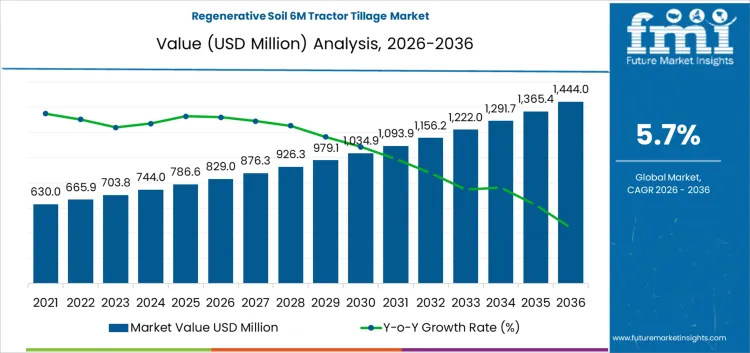
What is the Growth Forecast for Regenerative Soil 6M Tractor Tillage Market through 2036?
Between 2026 and 2031, the regenerative soil 6M tractor tillage market is projected to grow from USD 876.3 million to USD 1,093.9 million, generating an absolute increase of USD 217.6 million and reflecting a CAGR of 5.7%. Growth is driven by adoption of reduced tillage, no-till, and cover-crop integration practices across cereals, oilseeds, and pulses. Large and medium farms are primary end users. Expansion is supported by increasing awareness of soil health, demand for sustainable agricultural practices, and regulatory incentives. Suppliers focus on equipment efficiency, durability, and compatibility with multiple crop types.
From 2031 to 2036, the regenerative soil 6M tractor tillage industry is expected to expand from USD 1,093.9 million to USD 1,526.2 million. Growth is fueled by broader adoption of regenerative tillage techniques, advanced tractor integration, and large-scale farm deployment. Market drivers include improved soil fertility, reduced erosion, and labor efficiency. Competitive advantage favors suppliers offering validated equipment performance, scalable solutions, and technical support. Leading companies include John Deere, CNH Industrial, AGCO, Kubota, Mahindra & Mahindra, and Escorts Kubota.
Regenerative Soil 6M Tractor Tillage Market Key Takeaways
| Metric | Value |
|---|---|
| Market Value (2026) | USD 876.3 million |
| Forecast Value (2036) | USD 1,526.20 million |
| Forecast CAGR 2026 to 2036 | 5.70% |
What Is Driving Demand for Regenerative Soil 6M Tractor Tillage?
Regenerative soil 6M tractor tillage equipment is increasingly adopted to improve soil health, enhance nutrient retention, and optimize field preparation for crop cultivation. Historically, conventional tillage methods often led to soil compaction, erosion, and degradation of soil structure, limiting long-term productivity. Modern 6M tractors with regenerative tillage implements integrate adjustable blades, precision depth control, and residue management to loosen soil, maintain organic matter, and promote water retention. Farmers, agricultural service providers, and equipment manufacturers prioritize efficiency, durability, and compatibility with different soil types. Early adoption focused on high-value farms and large-scale commercial operations, while current demand spans medium and small-scale farms driven by sustainable farming practices, yield optimization, and soil conservation initiatives. Equipment durability, operational flexibility, and fuel efficiency influence adoption.
Rising focus on soil conservation, sustainable crop production, and regulatory guidance on soil management are shaping market growth. Compared with conventional tillage, regenerative 6M tractor systems emphasize reduced soil disturbance, improved nutrient cycling, and integration with precision agriculture tools. Cost structures depend on implement design, tractor compatibility, and maintenance requirements, concentrating margins among suppliers delivering reliable, high-performance equipment. Farmers adopt these systems to enhance soil quality, reduce erosion, and improve long-term productivity. By 2036, regenerative soil 6M tractor tillage is expected to become standard in mechanized agriculture, supporting efficient, conservation-focused, and high-yield farming practices globally.
What Factors Are Shaping the Demand for Regenerative Soil 6M Tractor Tillage in Terms of Practice Type and Crop Type?
The demand for regenerative soil 6M tractor tillage is segmented by practice type and crop type. Practice types include reduced tillage, no-till, and cover-crop integration. Crop types include cereals, oilseeds, and pulses. Adoption is influenced by soil health objectives, water retention efficiency, and operational cost optimization. Uptake is driven by the need to maintain fertility, reduce erosion, and enhance crop yield. Practice type and crop selection depend on soil characteristics, climate conditions, and field management strategies, ensuring sustainable, scalable, and productive tillage practices across a variety of crop systems and farming operations.
Why Is Reduced Tillage Leading the Practice Type Segment in Regenerative Soil 6M Tractor Tillage?
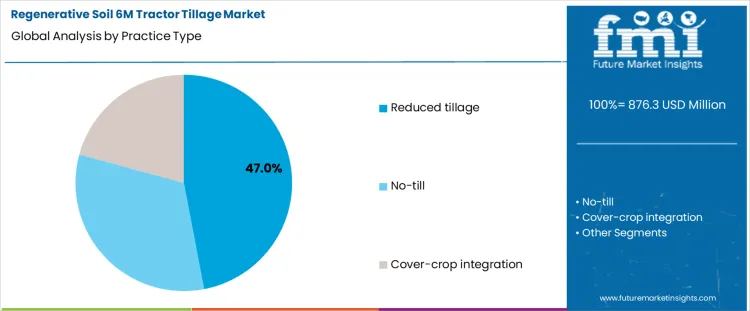
Reduced tillage accounts for approximately 47% of total practice type demand, making it the leading category. Adoption is driven by the need to minimize soil disturbance, retain organic matter, and improve soil structure. Reduced tillage allows for efficient residue management, prevents compaction, and supports microbial activity essential for nutrient cycling. Operational procedures include pre-plant soil preparation, precise depth control, and residue distribution to optimize seedbed conditions. Tractors equipped with 6M implements enable wide-area coverage, uniform soil engagement, and consistent tillage intensity. Reduced tillage provides measurable benefits in water retention, erosion control, and long-term soil fertility, making it the preferred practice for cereal, oilseed, and pulse production.
Operational factors further reinforce adoption. Implements must maintain uniform depth, handle variable soil textures, and integrate with precision guidance systems. Reduced tillage leads because it improves operational efficiency, enhances crop emergence, and supports sustainable soil management. Farmers gain lower fuel consumption, reduced labor requirements, and improved resilience against adverse weather, making it central to regenerative agriculture strategies.
Why Are Cereals Representing the Largest Crop Type Segment in Regenerative Soil 6M Tractor Tillage?
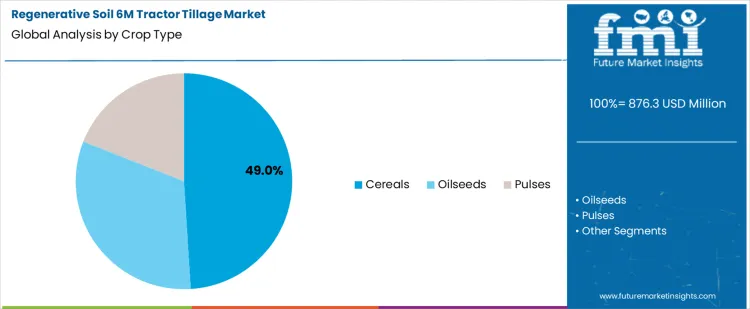
Cereals account for approximately 49% of total crop type demand, making them the largest category. Adoption is driven by high acreage, rotational cropping practices, and sensitivity to soil compaction and fertility. Tractors equipped with regenerative 6M tillage implements prepare uniform seedbeds, optimize residue incorporation, and enhance nutrient availability for wheat, maize, and barley. Operational procedures include precise row alignment, seedbed leveling, and integration with soil sensors to monitor moisture and compaction. Efficient soil preparation improves germination, crop uniformity, and yield potential.
Functional and operational factors further reinforce adoption. Implements must accommodate different cereal residue loads, maintain consistent soil contact, and operate efficiently over large fields. Cereals lead because they benefit most from reduced erosion, improved soil moisture retention, and operational efficiency. Adoption ensures higher yield stability, optimized input use, and improved soil health, making cereals the primary focus for regenerative 6M tractor tillage practices in modern precision agriculture systems.
How Are 6M Tractor Tillage Solutions Supporting Regenerative Agriculture?
Regenerative soil 6M tractor tillage systems are increasingly adopted to enhance soil health, improve moisture retention, and optimize nutrient cycling while preparing fields for crop planting. Adoption is strongest in regions with large-scale commercial farms, progressive sustainable agriculture programs, and mechanized farming infrastructure. Systems are selected for soil penetration depth, residue handling capability, and durability under varied terrain conditions. Growth is driven by demand for carbon sequestration, soil erosion reduction, and improved long-term productivity. Investment focuses on robust blade design, adaptive depth control, and tractor compatibility. Operators prioritize tillage solutions that maintain soil structure, support regenerative practices, and integrate with existing farm equipment.
Why Are Regional Sustainability Programs and Soil Health Initiatives Driving Adoption?
Demand is influenced by government incentives, regenerative agriculture programs, and growing awareness of soil degradation impacts. Farmers adopt 6M tillage systems to enhance soil microbiome, reduce chemical dependency, and maintain crop productivity. Implements offering adjustable depth, residue management, and minimal soil disruption gain preference. Adoption is concentrated in regions with large farmland, progressive sustainability policies, and high mechanization. Soil conservation, operational efficiency, and environmental compliance drive procurement rather than cost. Suppliers providing validated, durable tillage systems gain competitive advantage among commercial and cooperative farms.
What Operational Challenges Restrict Broader Deployment?
High acquisition costs, maintenance requirements, and tractor compatibility issues limit adoption. Performance can be affected by rocky or uneven terrain, moisture variability, and residue density. Operator training and calibration of adjustable settings add complexity. Smaller farms or regions with limited mechanization adopt 6M regenerative tillage more slowly. These factors concentrate early deployment among large-scale commercial farms, progressive operators, and regions with established agricultural infrastructure and regenerative practice programs.
How Are Technological Innovation and Collaborative Farming Models Shaping Market Growth?
Recent innovations include modular tillage implements, adaptive depth control, and wear-resistant blades optimized for minimal soil disturbance. Collaboration between equipment manufacturers, agritech providers, and research institutions ensures performance validation, sustainability compliance, and operational efficiency. Pilot programs evaluate soil health impact, residue management, and fuel efficiency before large-scale deployment. Quality monitoring, adaptive adjustments, and process standardization maintain consistent results. Focus is on soil preservation, operational effectiveness, and regenerative outcomes rather than cost or scale. Collaborative efforts enable broader adoption of 6M tractor tillage systems supporting regenerative agriculture practices.
What is the Demand for Regenerative Soil 6M Tractor Tillage by Country?
| Country | CAGR (%) |
|---|---|
| USA | 6.5% |
| Brazil | 6.2% |
| Australia | 6.0% |
| India | 5.8% |
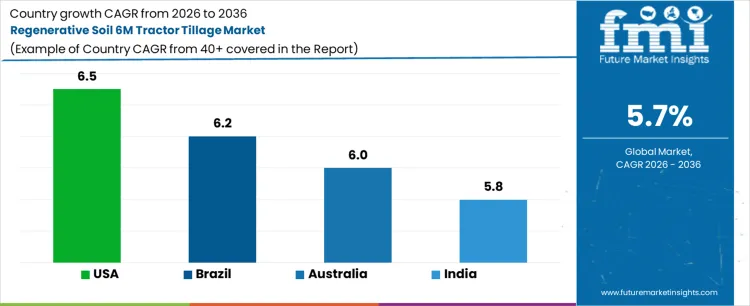
Demand for regenerative soil 6M tractor tillage is rising as farmers adopt sustainable agricultural practices to improve soil health, enhance nutrient retention, and increase crop productivity. The USA leads with a 6.5% CAGR, driven by large-scale adoption of regenerative farming techniques, government incentives, and integration of advanced tillage equipment. Brazil follows at 6.2%, supported by growing commercial agriculture and emphasis on sustainable soil management. Australia records 6.0% growth, shaped by adoption in broad-acre farming and soil conservation initiatives. India shows 5.8% CAGR, reflecting gradual implementation of regenerative agriculture practices and modernization of tractor tillage operations for improved soil sustainability.
How is the United States experiencing growth in the regenerative soil 6M tractor tillage market?
United States is experiencing growth at a CAGR of 6.5%, supported by adoption of regenerative soil 6M tractor tillage market solutions to improve soil health, increase crop yield, and reduce erosion in commercial farming. Manufacturers and technology providers are deploying tractors optimized for deep tillage, precise soil manipulation, and energy-efficient operation. Demand is concentrated in large-scale farms, agricultural research centers, and precision farming hubs. Investments focus on equipment performance, operational reliability, and compliance with sustainable farming practices rather than mass deployment. Growth reflects increasing adoption of regenerative agriculture, industrial focus on soil conservation, and government incentives supporting sustainable tillage practices.
- Regenerative agriculture drives adoption.
- Tractors optimize soil health, tillage precision, and energy efficiency.
- Large-scale farms and research centers concentrate demand.
- Equipment performance and sustainability compliance guide investment.
How is Brazil witnessing growth in the regenerative soil 6M tractor tillage market?
Brazil is witnessing growth at a CAGR of 6.2%, fueled by adoption of regenerative soil 6M tractor tillage market solutions to enhance soil fertility, reduce erosion, and improve crop productivity. Manufacturers and suppliers are deploying tractors optimized for energy-efficient operation, precision tillage, and soil compaction management. Demand is concentrated in commercial farms, agricultural technology hubs, and research facilities. Investments prioritize equipment reliability, operational efficiency, and adherence to sustainable farming regulations rather than large-scale deployment. Growth reflects industrial adoption of regenerative farming techniques, environmental sustainability initiatives, and increasing mechanization of agricultural operations.
- Soil conservation drives adoption.
- Tractors enhance precision tillage and energy-efficient operation.
- Commercial farms and research hubs concentrate demand.
- Equipment reliability and sustainability guide investment.
How is Australia experiencing growth in the regenerative soil 6M tractor tillage market?
Australia is experiencing growth at a CAGR of 6%, supported by adoption of regenerative soil 6M tractor tillage market solutions to improve soil structure, reduce erosion, and increase crop yield. Manufacturers and technology providers are producing tractors optimized for precision soil management, deep tillage, and efficient fuel consumption. Demand is concentrated in large-scale farms, agricultural research centers, and precision farming operations. Investments focus on operational reliability, equipment performance, and regulatory compliance rather than mass-scale deployment. Growth reflects industrial adoption of regenerative agricultural practices, focus on sustainable land management, and increasing mechanization of farming processes.
- Sustainable soil management drives adoption.
- Tractors optimize deep tillage and fuel efficiency.
- Large-scale farms and research centers concentrate demand.
- Equipment performance and regulatory compliance guide investment.
How is India witnessing growth in the regenerative soil 6M tractor tillage market?
India is witnessing growth at a CAGR of 5.8%, fueled by adoption of regenerative soil 6M tractor tillage market solutions to enhance soil fertility, reduce erosion, and increase crop productivity. Manufacturers and suppliers are deploying tractors optimized for precision soil manipulation, fuel-efficient operation, and operational reliability. Demand is concentrated in agricultural hubs, commercial farms, and R&D centers. Investments prioritize system performance, compliance with sustainable agriculture practices, and integration with farm management systems rather than large-scale deployment. Growth reflects government support for regenerative agriculture, industrial adoption of precision tillage, and mechanization of farming processes.
- Regenerative practices drive adoption.
- Tractors enhance soil fertility and precision tillage.
- Agricultural hubs and commercial farms concentrate demand.
- System performance and sustainability compliance guide investment.
Who Competes in the Regenerative Soil 6M Tractor Tillage Market and What Defines Their Capabilities?
Competition in the regenerative soil 6M tractor tillage market is defined by soil preservation performance, implement efficiency, and integration with precision farming technologies. John Deere supplies 6-meter tillage tractors designed for regenerative practices, optimizing soil aeration, residue management, and traction efficiency while minimizing soil disruption. CNH Industrial develops tillage tractors with regenerative capabilities integrated with GPS-guided depth control and soil monitoring. AGCO provides tractors engineered for low-compaction tillage and residue incorporation to support regenerative agriculture goals. Kubota delivers mid-sized 6M tillage tractors suitable for small to medium farms with regenerative soil management features. Mahindra & Mahindra focuses on tractors that combine soil health preservation with operational efficiency and modular attachments.
Escorts Kubota supplies regenerative tillage tractors with 6-meter working widths, emphasizing fuel efficiency, soil conservation, and ease of integration with precision farming systems. Other participants include regional tractor manufacturers providing modular tillage solutions compatible with regenerative agriculture practices. Differentiation arises from soil compaction reduction, fuel efficiency, implement compatibility, precision depth control, and adaptability to local soil conditions. Market positioning depends on the ability to enhance soil health, maintain field productivity, reduce input usage, and integrate with precision agriculture technologies. Suppliers delivering reliable, regenerative-capable tractors with efficient 6M tillage implements maintain competitive relevance in sustainable farming operations.
Key Players in the Regenerative Soil 6M Tractor Tillage Market
- John Deere
- CNH Industrial
- AGCO
- Kubota
- Mahindra & Mahindra
- Escorts Kubota
Scope of the Report
| Items | Values |
|---|---|
| Quantitative Units (2026) | USD million |
| Practice Type | Reduced tillage, No-till, Cover-crop integration |
| Crop Type | Cereals, Oilseeds, Pulses |
| Farm Size | Large farms, Medium farms |
| Region | Asia Pacific, Europe, North America, Latin America, Middle East & Africa |
| Key Countries Covered | USA, Brazil, Australia, India |
| Key Companies Profiled | John Deere, CNH Industrial, AGCO, Kubota, Mahindra & Mahindra, Escorts Kubota |
| Additional Attributes | Dollar sales by practice type, crop type, and farm size; regional CAGR, volume and value growth projections; adoption across large and medium farms; integration with regenerative soil practices, precision tillage, and cover-crop management; focus on operational efficiency, fuel efficiency, and soil conservation; margins concentrated among suppliers delivering validated, high-performance tractors; competitive advantage from equipment reliability, multi-crop compatibility, and farm management system integration. |
Regenerative Soil 6M Tractor Tillage Market Segmentation
Practice Type:
- Reduced tillage
- No-till
- Cover-crop integration
Crop Type:
- Cereals
- Oilseeds
- Pulses
Farm Size:
- Large farms
- Medium farms
Region
- Asia Pacific
- China
- Japan
- South Korea
- India
- Australia & New Zealand
- ASEAN
- Rest of Asia Pacific
- Europe
- Germany
- United Kingdom
- France
- Italy
- Spain
- Nordic
- BENELUX
- Rest of Europe
- North America
- United States
- Canada
- Mexico
- Latin America
- Brazil
- Chile
- Rest of Latin America
- Middle East & Africa
- Kingdom of Saudi Arabia
- Other GCC Countries
- Turkey
- South Africa
- Other African Union
- Rest of Middle East & Africa
Bibliography
- Food and Agriculture Organization of the United Nations (FAO). (2023). Soil health and conservation agriculture practices.
- Food and Agriculture Organization of the United Nations (FAO). (2023). Conservation agriculture and reduced tillage systems.
- Organisation for Economic Co-operation and Development (OECD). (2023). Sustainable productivity growth in agriculture.
- United States Department of Agriculture (USDA). (2024). Soil health and conservation tillage systems.
- Brazilian Agricultural Research Corporation (Embrapa). (2023). Soil management and conservation agriculture.
Frequently Asked Questions
How big is the regenerative soil 6m tractor tillage market in 2026?
The global regenerative soil 6m tractor tillage market is estimated to be valued at USD 876.3 million in 2026.
What will be the size of regenerative soil 6m tractor tillage market in 2036?
The market size for the regenerative soil 6m tractor tillage market is projected to reach USD 1,526.2 million by 2036.
How much will be the regenerative soil 6m tractor tillage market growth between 2026 and 2036?
The regenerative soil 6m tractor tillage market is expected to grow at a 5.7% CAGR between 2026 and 2036.
What are the key product types in the regenerative soil 6m tractor tillage market?
The key product types in regenerative soil 6m tractor tillage market are reduced tillage, no-till and cover-crop integration.
Which crop type segment to contribute significant share in the regenerative soil 6m tractor tillage market in 2026?
In terms of crop type, cereals segment to command 49.0% share in the regenerative soil 6m tractor tillage market in 2026.
Preview the report firsthand - request a free sample
Get SampleGet the brochure for pricing and purchase details.
Get PDFTable of Content
- Executive Summary
- Global Market Outlook
- Demand-side Trends
- Supply-side Trends
- Technology Roadmap Analysis
- Analysis and Recommendations
- Market Overview
- Market Coverage / Taxonomy
- Market Definition / Scope / Limitations
- Market Background
- Market Dynamics
- Drivers
- Restraints
- Opportunity
- Trends
- Scenario Forecast
- Demand in Optimistic Scenario
- Demand in Likely Scenario
- Demand in Conservative Scenario
- Opportunity Map Analysis
- Product Life Cycle Analysis
- Supply Chain Analysis
- Investment Feasibility Matrix
- Value Chain Analysis
- PESTLE and Porter’s Analysis
- Regulatory Landscape
- Regional Parent Market Outlook
- Production and Consumption Statistics
- Import and Export Statistics
- Market Dynamics
- Global Market Analysis 2021 to 2025 and Forecast, 2026 to 2036
- Historical Market Size Value (USD Million) Analysis, 2021 to 2025
- Current and Future Market Size Value (USD Million) Projections, 2026 to 2036
- Y-o-Y Growth Trend Analysis
- Absolute $ Opportunity Analysis
- Global Market Pricing Analysis 2021 to 2025 and Forecast 2026 to 2036
- Global Market Analysis 2021 to 2025 and Forecast 2026 to 2036, By Practice Type
- Introduction / Key Findings
- Historical Market Size Value (USD Million) Analysis By Practice Type , 2021 to 2025
- Current and Future Market Size Value (USD Million) Analysis and Forecast By Practice Type , 2026 to 2036
- Reduced tillage
- No-till
- Cover-crop integration
- Reduced tillage
- Y-o-Y Growth Trend Analysis By Practice Type , 2021 to 2025
- Absolute $ Opportunity Analysis By Practice Type , 2026 to 2036
- Global Market Analysis 2021 to 2025 and Forecast 2026 to 2036, By Crop Type
- Introduction / Key Findings
- Historical Market Size Value (USD Million) Analysis By Crop Type, 2021 to 2025
- Current and Future Market Size Value (USD Million) Analysis and Forecast By Crop Type, 2026 to 2036
- Cereals
- Oilseeds
- Pulses
- Cereals
- Y-o-Y Growth Trend Analysis By Crop Type, 2021 to 2025
- Absolute $ Opportunity Analysis By Crop Type, 2026 to 2036
- Global Market Analysis 2021 to 2025 and Forecast 2026 to 2036, By Farm Size
- Introduction / Key Findings
- Historical Market Size Value (USD Million) Analysis By Farm Size, 2021 to 2025
- Current and Future Market Size Value (USD Million) Analysis and Forecast By Farm Size, 2026 to 2036
- Large farms
- Medium farms
- Large farms
- Y-o-Y Growth Trend Analysis By Farm Size, 2021 to 2025
- Absolute $ Opportunity Analysis By Farm Size, 2026 to 2036
- Global Market Analysis 2021 to 2025 and Forecast 2026 to 2036, By Region
- Introduction
- Historical Market Size Value (USD Million) Analysis By Region, 2021 to 2025
- Current Market Size Value (USD Million) Analysis and Forecast By Region, 2026 to 2036
- North America
- Latin America
- Western Europe
- Eastern Europe
- East Asia
- South Asia and Pacific
- Middle East & Africa
- Market Attractiveness Analysis By Region
- North America Market Analysis 2021 to 2025 and Forecast 2026 to 2036, By Country
- Historical Market Size Value (USD Million) Trend Analysis By Market Taxonomy, 2021 to 2025
- Market Size Value (USD Million) Forecast By Market Taxonomy, 2026 to 2036
- By Country
- USA
- Canada
- Mexico
- By Practice Type
- By Crop Type
- By Farm Size
- By Country
- Market Attractiveness Analysis
- By Country
- By Practice Type
- By Crop Type
- By Farm Size
- Key Takeaways
- Latin America Market Analysis 2021 to 2025 and Forecast 2026 to 2036, By Country
- Historical Market Size Value (USD Million) Trend Analysis By Market Taxonomy, 2021 to 2025
- Market Size Value (USD Million) Forecast By Market Taxonomy, 2026 to 2036
- By Country
- Brazil
- Chile
- Rest of Latin America
- By Practice Type
- By Crop Type
- By Farm Size
- By Country
- Market Attractiveness Analysis
- By Country
- By Practice Type
- By Crop Type
- By Farm Size
- Key Takeaways
- Western Europe Market Analysis 2021 to 2025 and Forecast 2026 to 2036, By Country
- Historical Market Size Value (USD Million) Trend Analysis By Market Taxonomy, 2021 to 2025
- Market Size Value (USD Million) Forecast By Market Taxonomy, 2026 to 2036
- By Country
- Germany
- UK
- Italy
- Spain
- France
- Nordic
- BENELUX
- Rest of Western Europe
- By Practice Type
- By Crop Type
- By Farm Size
- By Country
- Market Attractiveness Analysis
- By Country
- By Practice Type
- By Crop Type
- By Farm Size
- Key Takeaways
- Eastern Europe Market Analysis 2021 to 2025 and Forecast 2026 to 2036, By Country
- Historical Market Size Value (USD Million) Trend Analysis By Market Taxonomy, 2021 to 2025
- Market Size Value (USD Million) Forecast By Market Taxonomy, 2026 to 2036
- By Country
- Russia
- Poland
- Hungary
- Balkan & Baltic
- Rest of Eastern Europe
- By Practice Type
- By Crop Type
- By Farm Size
- By Country
- Market Attractiveness Analysis
- By Country
- By Practice Type
- By Crop Type
- By Farm Size
- Key Takeaways
- East Asia Market Analysis 2021 to 2025 and Forecast 2026 to 2036, By Country
- Historical Market Size Value (USD Million) Trend Analysis By Market Taxonomy, 2021 to 2025
- Market Size Value (USD Million) Forecast By Market Taxonomy, 2026 to 2036
- By Country
- China
- Japan
- South Korea
- By Practice Type
- By Crop Type
- By Farm Size
- By Country
- Market Attractiveness Analysis
- By Country
- By Practice Type
- By Crop Type
- By Farm Size
- Key Takeaways
- South Asia and Pacific Market Analysis 2021 to 2025 and Forecast 2026 to 2036, By Country
- Historical Market Size Value (USD Million) Trend Analysis By Market Taxonomy, 2021 to 2025
- Market Size Value (USD Million) Forecast By Market Taxonomy, 2026 to 2036
- By Country
- India
- ASEAN
- Australia & New Zealand
- Rest of South Asia and Pacific
- By Practice Type
- By Crop Type
- By Farm Size
- By Country
- Market Attractiveness Analysis
- By Country
- By Practice Type
- By Crop Type
- By Farm Size
- Key Takeaways
- Middle East & Africa Market Analysis 2021 to 2025 and Forecast 2026 to 2036, By Country
- Historical Market Size Value (USD Million) Trend Analysis By Market Taxonomy, 2021 to 2025
- Market Size Value (USD Million) Forecast By Market Taxonomy, 2026 to 2036
- By Country
- Kingdom of Saudi Arabia
- Other GCC Countries
- Turkiye
- South Africa
- Other African Union
- Rest of Middle East & Africa
- By Practice Type
- By Crop Type
- By Farm Size
- By Country
- Market Attractiveness Analysis
- By Country
- By Practice Type
- By Crop Type
- By Farm Size
- Key Takeaways
- Key Countries Market Analysis
- USA
- Pricing Analysis
- Market Share Analysis, 2025
- By Practice Type
- By Crop Type
- By Farm Size
- Canada
- Pricing Analysis
- Market Share Analysis, 2025
- By Practice Type
- By Crop Type
- By Farm Size
- Mexico
- Pricing Analysis
- Market Share Analysis, 2025
- By Practice Type
- By Crop Type
- By Farm Size
- Brazil
- Pricing Analysis
- Market Share Analysis, 2025
- By Practice Type
- By Crop Type
- By Farm Size
- Chile
- Pricing Analysis
- Market Share Analysis, 2025
- By Practice Type
- By Crop Type
- By Farm Size
- Germany
- Pricing Analysis
- Market Share Analysis, 2025
- By Practice Type
- By Crop Type
- By Farm Size
- UK
- Pricing Analysis
- Market Share Analysis, 2025
- By Practice Type
- By Crop Type
- By Farm Size
- Italy
- Pricing Analysis
- Market Share Analysis, 2025
- By Practice Type
- By Crop Type
- By Farm Size
- Spain
- Pricing Analysis
- Market Share Analysis, 2025
- By Practice Type
- By Crop Type
- By Farm Size
- France
- Pricing Analysis
- Market Share Analysis, 2025
- By Practice Type
- By Crop Type
- By Farm Size
- India
- Pricing Analysis
- Market Share Analysis, 2025
- By Practice Type
- By Crop Type
- By Farm Size
- ASEAN
- Pricing Analysis
- Market Share Analysis, 2025
- By Practice Type
- By Crop Type
- By Farm Size
- Australia & New Zealand
- Pricing Analysis
- Market Share Analysis, 2025
- By Practice Type
- By Crop Type
- By Farm Size
- China
- Pricing Analysis
- Market Share Analysis, 2025
- By Practice Type
- By Crop Type
- By Farm Size
- Japan
- Pricing Analysis
- Market Share Analysis, 2025
- By Practice Type
- By Crop Type
- By Farm Size
- South Korea
- Pricing Analysis
- Market Share Analysis, 2025
- By Practice Type
- By Crop Type
- By Farm Size
- Russia
- Pricing Analysis
- Market Share Analysis, 2025
- By Practice Type
- By Crop Type
- By Farm Size
- Poland
- Pricing Analysis
- Market Share Analysis, 2025
- By Practice Type
- By Crop Type
- By Farm Size
- Hungary
- Pricing Analysis
- Market Share Analysis, 2025
- By Practice Type
- By Crop Type
- By Farm Size
- Kingdom of Saudi Arabia
- Pricing Analysis
- Market Share Analysis, 2025
- By Practice Type
- By Crop Type
- By Farm Size
- Turkiye
- Pricing Analysis
- Market Share Analysis, 2025
- By Practice Type
- By Crop Type
- By Farm Size
- South Africa
- Pricing Analysis
- Market Share Analysis, 2025
- By Practice Type
- By Crop Type
- By Farm Size
- USA
- Market Structure Analysis
- Competition Dashboard
- Competition Benchmarking
- Market Share Analysis of Top Players
- By Regional
- By Practice Type
- By Crop Type
- By Farm Size
- Competition Analysis
- Competition Deep Dive
- John Deere
- Overview
- Product Portfolio
- Profitability by Market Segments (Product/Age /Sales Channel/Region)
- Sales Footprint
- Strategy Overview
- Marketing Strategy
- Product Strategy
- Channel Strategy
- CNH Industrial
- AGCO
- Kubota
- Mahindra & Mahindra
- Escorts Kubota
- John Deere
- Competition Deep Dive
- Assumptions & Acronyms Used
- Research Methodology


