

- Industry Size (2026)
- USD 490.9 Mn
- Forecast (2036)
- USD 1172.8 Mn
- CAGR (2026 to 2036)
- 9.1%
Soil Washing Chemicals for Contaminated Sites Market Forecast and Outlook 2026 to 2036
The soil washing chemicals for contaminated sites market is valued at USD 490.9 million in 2026 and is forecasted to reach USD 1,172.8 million by 2036, expanding at a CAGR of 9.1%. Growth is driven by remediation mandates for legacy industrial sites, brownfield redevelopment programs, and tightening soil contamination standards. Demand strengthens as governments prioritize in-situ and ex-situ soil treatment methods that reduce landfill dependency and shorten remediation timelines.
Surfactant-based washing agents represent leading chemical type globally due to effectiveness in mobilizing and separating bound contaminants from soil matrices. Heavy metals dominate application focus, reflecting persistent contamination from mining, smelting, electroplating, and chemical manufacturing activities. Segment structure shows preference for formulations that balance high extraction efficiency with low secondary pollution risk, supporting recovery of treated soil for reuse while minimizing downstream wastewater treatment loads.
Quick Stats for Soil Washing Chemicals for Contaminated Sites Market
- Soil Washing Chemicals for Contaminated Sites Market Value (2026): USD 490.9 million
- Soil Washing Chemicals for Contaminated Sites Market Forecast Value (2036): USD 1,172.8 million
- Soil Washing Chemicals for Contaminated Sites Market Forecast CAGR (2026 to 2036): 9.1%
- Leading Chemical Type in Global Demand: Surfactant-Based Washing Agents
- Fastest-Growing Countries: China, India, USA, Germany, Canada
- Top Players in Global Demand: Clean Earth, Veolia Environmental Services, Remondis Group, EOS Remediation, Regenesis

China, India, USA, Germany, and Canada represent fastest-growing countries, supported by infrastructure renewal and environmental liability enforcement. Competitive landscape includes Clean Earth, Veolia Environmental Services, Remondis Group, EOS Remediation, and Regenesis, focusing on reagent efficiency, contaminant specificity, and integrated soil treatment solutions.
Soil Washing Chemicals for Contaminated Sites Market Key Takeaways
| Metric | Value |
|---|---|
| Market Value (2026) | USD 490.9 million |
| Market Forecast Value (2036) | USD 1,172.8 million |
| Forecast CAGR (2026 to 2036) | 9.1% |
Why is the Demand for Soil Washing Chemicals for Contaminated Sites Market Growing?
Demand for soil washing chemicals for contaminated sites is growing globally due to increased regulatory enforcement of soil remediation standards and rising awareness of environmental and human health risks associated with polluted land. Industrial activities, mining operations, chemical manufacturing, and improper waste disposal contribute hazardous substances such as heavy metals, hydrocarbons, and chlorinated solvents to soil matrices. Regulatory frameworks in multiple regions require remediation to mitigate exposure pathways and meet cleanup criteria, which motivates adoption of soil washing chemicals that enhance contaminant solubilization, separation, and removal.
Remediation contractors and environmental laboratories deploy surfactants, chelating agents, and specialized reagents to mobilize target contaminants and improve extraction efficiency during washing processes. Growth in brownfield redevelopment, urban renewal, and infrastructure expansion increases demand for effective soil remediation solutions to enable safe land reuse. Research and formulation development improve performance of washing reagents under diverse soil types, organic content levels, and contaminant profiles, supporting broader applicability. Corporate sustainability strategies and liability management priorities reinforce investment in advanced soil washing approaches. Public and private stakeholders prioritize remediation outcomes that reduce long term environmental impacts and support community health objectives.
How Are the Segments Classified in the Soil Washing Chemicals for Contaminated Sites Market?
Demand for soil washing chemicals globally is shaped by remediation mandates, brownfield redevelopment activity, and stricter soil contamination thresholds. Remediation operators assess contaminant extraction efficiency, soil compatibility, secondary waste generation, and reusability of treated soil fractions. Adoption patterns reflect preference for chemical-assisted washing solutions that enable on-site or centralized treatment of metal-, hydrocarbon-, and pesticide-contaminated soils.
Which Chemical Type Represents the Largest Share of Global Demand?

Surfactant-based washing agents hold 32.0%, representing the largest share of global demand. These agents enhance desorption of hydrophobic contaminants and support soil particle separation. Chelating agents account for 26.0%, enabling complexation and mobilization of heavy metals during washing operations. pH adjusters and acid or alkaline extractants hold 20.0%, supporting dissolution and release of metal-bound contaminants. Bio-based and enzymatic soil washing chemicals account for 12.0%, reflecting interest in lower-impact remediation approaches. Other specialty soil washing chemicals hold 10.0%. Chemical-type distribution reflects reliance on surfactant and chelation-driven extraction mechanisms.
Key Points
- Surfactant agents lead due to effectiveness on organic contaminants.
- Chelators support mobilization of metal-bound pollutants.
- pH control chemicals enable dissolution-based extraction.
Which Contaminant Type Drives the Highest Share of Global Application?

Heavy metals hold 38.0%, driving the highest share of global application. Contaminants such as lead, chromium, arsenic, mercury, and cadmium require aggressive extraction methods. Hydrocarbons and petroleum contaminants account for 26.0%, reflecting legacy fuel and spill-related soil pollution. Pesticides and agrochemicals hold 18.0%, linked to agricultural and storage site contamination. Industrial organics and solvents account for 12.0%, addressing PCBs and PAHs. Mixed contaminants hold 6.0%. Contaminant distribution reflects prevalence of metal contamination at industrial and mining sites.
Key Points
- Heavy metals dominate due to toxicity and persistence.
- Hydrocarbon contamination reflects legacy fuel handling.
- Mixed contaminants require multi-chemical washing strategies.
Which End-Use Sector Accounts for the Largest Share of Global Demand?
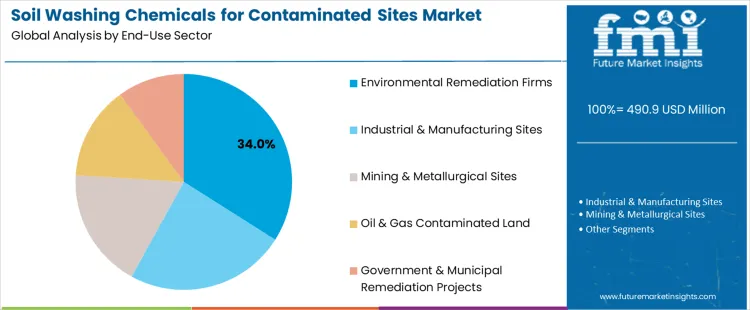
Environmental remediation firms hold 34.0%, accounting for the largest share of global demand. These firms deploy soil washing as part of integrated remediation projects. Industrial and manufacturing sites account for 24.0%, addressing on-site contamination liabilities. Mining and metallurgical sites hold 18.0%, managing metal-rich soils and tailings. Oil and gas contaminated land accounts for 14.0%, linked to drilling and storage operations. Government and municipal remediation projects hold 10.0%. End-use distribution reflects outsourcing of remediation activities to specialized service providers.
Key Points
- Remediation firms lead due to project-based deployment.
- Industrial sites address compliance-driven cleanup needs.
- Mining sites manage high metal soil loads.
What are the Key Dynamics in the Soil Washing Chemicals for Contaminated Sites Market?
Global demand rises as environmental remediation firms, industrial landowners, and government agencies adopt soil washing chemicals to treat contaminated sites affected by heavy metals, hydrocarbons, and persistent organic pollutants. Soil washing reagents enhance desorption and mobilization of contaminants, enabling separation and recovery through physical-chemical processes. Adoption aligns with tightened environmental regulations, brownfield redevelopment initiatives, and increased investment in sustainable remediation technologies worldwide. Usage spans mining sites, former industrial facilities, military ranges, and urban redevelopment projects requiring efficient contaminant removal and site reuse.
How do regulatory frameworks and site rehabilitation priorities shape global demand?
Environmental protection agencies and regulatory bodies across North America, Europe, Asia-Pacific, and other regions enforce strict soil quality standards to protect human health and ecosystems. Contaminated landowners are required to implement remediation strategies that achieve defined cleanup levels before redevelopment or reuse. Soil washing chemicals, including surfactants, chelating agents, and pH modifiers, facilitate extraction of contaminants from soil matrices into aqueous phases for subsequent separation and disposal or treatment. Industrial sectors with legacy contamination, such as mining, chemical manufacturing, and petroleum refining, deploy soil washing as part of comprehensive remediation plans. Public programs supporting brownfield revitalization reinforce investment in cost-effective, scalable soil treatment solutions that shorten remediation timelines and enable productive land use.
How do site variability, chemical cost, and process complexity influence market scalability?
Effectiveness of soil washing relies on contaminant type, soil texture, organic content, and distribution of target compounds, requiring tailored reagent selection and process optimization. Chemical costs and recurring reagent consumption impact project economics, particularly for large or heterogeneous sites. Integration with physical separation technologies such as sedimentation, flotation, or centrifugation adds operational complexity and requires skilled project design. Management of washed effluent and solids streams introduces additional treatment and disposal considerations subject to local regulatory oversight. Variability in regional regulatory requirements and cleanup thresholds influences urgency and investment planning. Global growth depends on continued innovation in robust, cost-effective soil washing reagents and integrated remediation frameworks that support efficient contaminant extraction and compliance across diverse site conditions worldwide.
How Is Demand for Soil Washing Chemicals for Contaminated Sites Evolving?
Demand for soil washing chemicals for contaminated sites is increasing globally due to stricter remediation standards, brownfield redevelopment, and preference for in-situ and ex-situ treatment solutions. China leads with a 10.2% CAGR, supported by industrial land remediation and redevelopment mandates. India follows at 9.6%, driven by legacy contamination cleanup and infrastructure expansion. USA records an 8.1% CAGR, reflecting regulatory remediation obligations and brownfield reuse programs. Germany posts 7.5%, shaped by precautionary environmental regulation and advanced remediation practices. Canada records 7.3%, supported by mining site rehabilitation and federal-provincial cleanup initiatives. Growth reflects sustained global focus on mobilizing and removing soil contaminants efficiently.
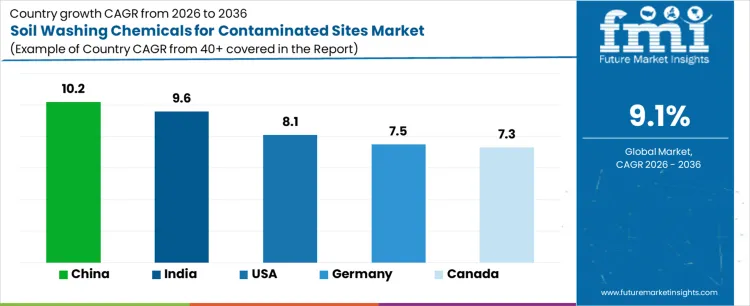
| Country | CAGR (%) |
|---|---|
| China | 10.2% |
| India | 9.6% |
| USA | 8.1% |
| Germany | 7.5% |
| Canada | 7.3% |
What factors are driving strong adoption of soil washing chemicals in China?
China demand is driven by remediation of industrial parks, mining areas, and legacy manufacturing sites. CAGR of 10.2% reflects increased use of surfactants, chelating agents, and pH modifiers to remove heavy metals and organic contaminants. Urban redevelopment projects require rapid soil cleanup to meet land reuse standards. Centralized environmental enforcement accelerates deployment of standardized soil washing programs. Large remediation projects favor chemical-based separation for speed and scalability. Growth remains scale-driven and regulation-aligned, supported by industrial restructuring and land reuse objectives.
- Remediation of industrial and mining-contaminated land
- Use of surfactants and chelants for contaminant mobilization
- Urban redevelopment-driven cleanup timelines
- Centralized enforcement and standardized remediation
How is India sustaining high growth in soil washing chemical usage?
India demand reflects cleanup of contaminated industrial zones, ports, and infrastructure corridors. CAGR of 9.6% is supported by adoption of soil washing chemicals to address hydrocarbons, metals, and mixed contaminants. Infrastructure expansion exposes contaminated soils requiring treatment before redevelopment. Regulatory scrutiny on hazardous waste disposal strengthens remediation activity. Cost-effective chemical washing is favored over excavation and disposal. Growth remains infrastructure-led and compliance-focused, aligned with environmental restoration and land reuse priorities.
- Industrial zone and infrastructure corridor remediation
- Treatment of hydrocarbons and metal-contaminated soils
- Preference for cost-effective on-site remediation
- Strengthening hazardous waste regulation
What regulatory drivers shape soil washing chemical demand growth in the USA?
USA demand is shaped by federal and state remediation programs, including brownfield redevelopment and Superfund cleanups. CAGR of 8.1% reflects use of soil washing chemicals to meet cleanup criteria while minimizing off-site disposal. Remediation contractors deploy chelants and surfactants to enhance contaminant removal efficiency. Liability management encourages permanent remediation solutions. Aging industrial sites sustain steady cleanup demand. Growth remains regulation-driven and project-focused, aligned with land reuse and environmental compliance goals.
- Federal and state contaminated site remediation programs
- Brownfield redevelopment activity
- Reduction of off-site soil disposal volumes
- Focus on permanent contaminant removal
Why does Germany show steady but controlled demand growth?
Germany demand reflects precautionary environmental policy and high remediation standards. CAGR of 7.5% is supported by targeted use of soil washing chemicals within engineered remediation systems. Operators emphasize precise chemical selection and recovery to limit secondary waste. Strong source control reduces emergence of new contaminated sites. Documentation and validation requirements guide remediation chemistry use. Growth remains efficiency-led and stability-focused, aligned with established environmental protection and land management frameworks.
- Precautionary remediation standards
- Emphasis on controlled chemical application
- Strong source pollution prevention
- Documentation and validation requirements
What supports continued demand growth in Canada?
Canada demand is driven by remediation of mining sites, oil and gas legacy areas, and industrial lands. CAGR of 7.3% reflects increased application of soil washing chemicals to address metal and hydrocarbon contamination. Federal and provincial cleanup funding supports remediation projects. Cold climate conditions favor chemical methods compatible with controlled processing environments. Indigenous land restoration initiatives further support cleanup activity. Growth remains program-led and compliance-aligned, supported by environmental stewardship and land rehabilitation priorities.
- Mining and industrial site remediation
- Federal and provincial cleanup funding
- Applicability under cold climate conditions
- Indigenous land restoration initiatives
What is the competitive landscape of demand for soil washing chemicals for contaminated sites?

Demand for soil washing chemicals for contaminated sites is driven by remediation mandates, redevelopment of brownfield land, and stricter soil contamination thresholds. Treatment programs focus on separating and extracting heavy metals, hydrocarbons, PFAS, and persistent organic pollutants from excavated soils using surfactants, chelating agents, acids, and process aids. Buyers evaluate contaminant removal efficiency, selectivity, soil fraction recovery rates, wastewater generation, and compatibility with downstream treatment or disposal. Procurement teams prioritize chemicals with predictable performance across diverse soil matrices, regulatory acceptance, and ability to reduce total remediation volumes and costs. Trend in the global market reflects increased preference for on-site treatment, reduced landfill dependency, and integration of soil washing within combined remediation strategies.
Clean Earth maintains strong positioning through soil treatment services supported by proprietary and third-party soil washing chemistries. Veolia Environmental Services supports global remediation projects with chemical programs integrated into comprehensive soil and waste treatment solutions. Remondis Group contributes remediation chemicals and process expertise aligned with large-scale infrastructure and industrial site cleanups. EOS Remediation specializes in surfactant- and reagent-based soil washing approaches targeting complex organic and metal contamination. Regenesis supports demand with specialty reagents and amendments applied within integrated soil and groundwater remediation programs. Competitive differentiation depends on removal efficiency, adaptability to site-specific conditions, waste minimization capability, and ability to deliver regulatory-compliant remediation outcomes.
Key Players in the Soil Washing Chemicals for Contaminated Sites Market
- Clean Earth
- Veolia Environmental Services
- Remondis Group
- EOS Remediation
- Regenesis
Scope of the Report
| Items | Values |
|---|---|
| Quantitative Units | USD million |
| Chemical Type | Surfactant-Based Washing Agents; Chelating Agents (EDTA, DTPA, etc.); pH Adjusters & Acid or Alkaline Extractants; Bio-Based & Enzymatic Soil Washing Chemicals; Other Specialty Soil Washing Chemicals |
| Contaminant Type | Heavy Metals (Pb, Cr, As, Hg, Cd); Hydrocarbons & Petroleum; Pesticides & Agrochemicals; Industrial Organics & Solvents (PCBs, PAHs); Mixed Contaminants |
| End-Use Sector | Environmental Remediation Firms; Industrial & Manufacturing Sites; Mining & Metallurgical Sites; Oil & Gas Contaminated Land; Government & Municipal Remediation Projects |
| Regions Covered | Asia Pacific, Europe, North America, Latin America, Middle East & Africa |
| Countries Covered | China, India, USA, Germany, Canada, and 40+ countries |
| Key Companies Profiled | Clean Earth; Veolia Environmental Services; Remondis Group; EOS Remediation; Regenesis |
| Additional Attributes | Dollar sales by chemical type and contaminant type; adoption trends for surfactant, chelant, and bio-based soil washing formulations; extraction efficiency metrics for metals, hydrocarbons, and mixed contaminants; compatibility with ex-situ and in-situ soil treatment systems; wastewater generation, reagent recovery, and disposal considerations; regulatory remediation standards and site cleanup thresholds influencing chemical selection. |
Soil Washing Chemicals for Contaminated Sites Market by Segment
Chemical Type:
- Surfactant-Based Washing Agents
- Chelating Agents (EDTA, DTPA, etc.)
- pH Adjusters & Acid or Alkaline Extractants
- Bio-Based & Enzymatic Soil Washing Chemicals
- Other Specialty Soil Washing Chemicals
Contaminant Type:
- Heavy Metals (Pb, Cr, As, Hg, Cd)
- Hydrocarbons & Petroleum
- Pesticides & Agrochemicals
- Industrial Organics & Solvents (PCBs, PAHs)
- Mixed Contaminants
End-Use Sector:
- Environmental Remediation Firms
- Industrial & Manufacturing Sites
- Mining & Metallurgical Sites
- Oil & Gas Contaminated Land
- Government & Municipal Remediation Projects
Region:
- Asia Pacific
- China
- Japan
- South Korea
- India
- Australia & New Zealand
- ASEAN
- Rest of Asia Pacific
- Europe
- Germany
- United Kingdom
- France
- Italy
- Spain
- Nordic
- BENELUX
- Rest of Europe
- North America
- United States
- Canada
- Mexico
- Latin America
- Brazil
- Chile
- Rest of Latin America
- Middle East & Africa
- Kingdom of Saudi Arabia
- Other GCC Countries
- Turkey
- South Africa
- Other African Union
- Rest of Middle East & Africa
Frequently Asked Questions
How big is the soil washing chemicals for contaminated sites market in 2026?
The global soil washing chemicals for contaminated sites market is estimated to be valued at USD 490.9 million in 2026.
What will be the size of soil washing chemicals for contaminated sites market in 2036?
The market size for the soil washing chemicals for contaminated sites market is projected to reach USD 1,172.8 million by 2036.
How much will be the soil washing chemicals for contaminated sites market growth between 2026 and 2036?
The soil washing chemicals for contaminated sites market is expected to grow at a 9.1% CAGR between 2026 and 2036.
What are the key product types in the soil washing chemicals for contaminated sites market?
The key product types in soil washing chemicals for contaminated sites market are surfactant-based washing agents, chelating agents (edta, dtpa, etc.), ph adjusters & acid or alkaline extractants, bio-based & enzymatic soil washing chemicals and other specialty soil washing chemicals.
Which contaminant type segment to contribute significant share in the soil washing chemicals for contaminated sites market in 2026?
In terms of contaminant type, heavy metals (pb, cr, as, hg, cd) segment to command 38.0% share in the soil washing chemicals for contaminated sites market in 2026.
Preview the report firsthand - request a free sample
Get SampleGet the brochure for pricing and purchase details.
Get PDFTable of Content
- Executive Summary
- Global Market Outlook
- Demand-side Trends
- Supply-side Trends
- Technology Roadmap Analysis
- Analysis and Recommendations
- Market Overview
- Market Coverage / Taxonomy
- Market Definition / Scope / Limitations
- Market Background
- Market Dynamics
- Drivers
- Restraints
- Opportunity
- Trends
- Scenario Forecast
- Demand in Optimistic Scenario
- Demand in Likely Scenario
- Demand in Conservative Scenario
- Opportunity Map Analysis
- Product Life Cycle Analysis
- Supply Chain Analysis
- Investment Feasibility Matrix
- Value Chain Analysis
- PESTLE and Porter’s Analysis
- Regulatory Landscape
- Regional Parent Market Outlook
- Production and Consumption Statistics
- Import and Export Statistics
- Market Dynamics
- Global Market Analysis 2021 to 2025 and Forecast, 2026 to 2036
- Historical Market Size Value (USD Million) Analysis, 2021 to 2025
- Current and Future Market Size Value (USD Million) Projections, 2026 to 2036
- Y-o-Y Growth Trend Analysis
- Absolute $ Opportunity Analysis
- Global Market Pricing Analysis 2021 to 2025 and Forecast 2026 to 2036
- Global Market Analysis 2021 to 2025 and Forecast 2026 to 2036, By Chemical Type
- Introduction / Key Findings
- Historical Market Size Value (USD Million) Analysis By Chemical Type , 2021 to 2025
- Current and Future Market Size Value (USD Million) Analysis and Forecast By Chemical Type , 2026 to 2036
- Surfactant-Based Washing Agents
- Chelating Agents (EDTA, DTPA, etc.)
- pH Adjusters & Acid or Alkaline Extractants
- Bio-Based & Enzymatic Soil Washing Chemicals
- Other Specialty Soil Washing Chemicals
- Surfactant-Based Washing Agents
- Y-o-Y Growth Trend Analysis By Chemical Type , 2021 to 2025
- Absolute $ Opportunity Analysis By Chemical Type , 2026 to 2036
- Global Market Analysis 2021 to 2025 and Forecast 2026 to 2036, By Contaminant Type
- Introduction / Key Findings
- Historical Market Size Value (USD Million) Analysis By Contaminant Type, 2021 to 2025
- Current and Future Market Size Value (USD Million) Analysis and Forecast By Contaminant Type, 2026 to 2036
- Heavy Metals (Pb, Cr, As, Hg, Cd)
- Hydrocarbons & Petroleum
- Pesticides & Agrochemicals
- Industrial Organics & Solvents (PCBs, PAHs)
- Mixed Contaminants
- Heavy Metals (Pb, Cr, As, Hg, Cd)
- Y-o-Y Growth Trend Analysis By Contaminant Type, 2021 to 2025
- Absolute $ Opportunity Analysis By Contaminant Type, 2026 to 2036
- Global Market Analysis 2021 to 2025 and Forecast 2026 to 2036, By End-Use Sector
- Introduction / Key Findings
- Historical Market Size Value (USD Million) Analysis By End-Use Sector, 2021 to 2025
- Current and Future Market Size Value (USD Million) Analysis and Forecast By End-Use Sector, 2026 to 2036
- Environmental Remediation Firms
- Industrial & Manufacturing Sites
- Mining & Metallurgical Sites
- Oil & Gas Contaminated Land
- Government & Municipal Remediation Projects
- Environmental Remediation Firms
- Y-o-Y Growth Trend Analysis By End-Use Sector, 2021 to 2025
- Absolute $ Opportunity Analysis By End-Use Sector, 2026 to 2036
- Global Market Analysis 2021 to 2025 and Forecast 2026 to 2036, By Region
- Introduction
- Historical Market Size Value (USD Million) Analysis By Region, 2021 to 2025
- Current Market Size Value (USD Million) Analysis and Forecast By Region, 2026 to 2036
- North America
- Latin America
- Western Europe
- Eastern Europe
- East Asia
- South Asia and Pacific
- Middle East & Africa
- Market Attractiveness Analysis By Region
- North America Market Analysis 2021 to 2025 and Forecast 2026 to 2036, By Country
- Historical Market Size Value (USD Million) Trend Analysis By Market Taxonomy, 2021 to 2025
- Market Size Value (USD Million) Forecast By Market Taxonomy, 2026 to 2036
- By Country
- USA
- Canada
- Mexico
- By Chemical Type
- By Contaminant Type
- By End-Use Sector
- By Country
- Market Attractiveness Analysis
- By Country
- By Chemical Type
- By Contaminant Type
- By End-Use Sector
- Key Takeaways
- Latin America Market Analysis 2021 to 2025 and Forecast 2026 to 2036, By Country
- Historical Market Size Value (USD Million) Trend Analysis By Market Taxonomy, 2021 to 2025
- Market Size Value (USD Million) Forecast By Market Taxonomy, 2026 to 2036
- By Country
- Brazil
- Chile
- Rest of Latin America
- By Chemical Type
- By Contaminant Type
- By End-Use Sector
- By Country
- Market Attractiveness Analysis
- By Country
- By Chemical Type
- By Contaminant Type
- By End-Use Sector
- Key Takeaways
- Western Europe Market Analysis 2021 to 2025 and Forecast 2026 to 2036, By Country
- Historical Market Size Value (USD Million) Trend Analysis By Market Taxonomy, 2021 to 2025
- Market Size Value (USD Million) Forecast By Market Taxonomy, 2026 to 2036
- By Country
- Germany
- UK
- Italy
- Spain
- France
- Nordic
- BENELUX
- Rest of Western Europe
- By Chemical Type
- By Contaminant Type
- By End-Use Sector
- By Country
- Market Attractiveness Analysis
- By Country
- By Chemical Type
- By Contaminant Type
- By End-Use Sector
- Key Takeaways
- Eastern Europe Market Analysis 2021 to 2025 and Forecast 2026 to 2036, By Country
- Historical Market Size Value (USD Million) Trend Analysis By Market Taxonomy, 2021 to 2025
- Market Size Value (USD Million) Forecast By Market Taxonomy, 2026 to 2036
- By Country
- Russia
- Poland
- Hungary
- Balkan & Baltic
- Rest of Eastern Europe
- By Chemical Type
- By Contaminant Type
- By End-Use Sector
- By Country
- Market Attractiveness Analysis
- By Country
- By Chemical Type
- By Contaminant Type
- By End-Use Sector
- Key Takeaways
- East Asia Market Analysis 2021 to 2025 and Forecast 2026 to 2036, By Country
- Historical Market Size Value (USD Million) Trend Analysis By Market Taxonomy, 2021 to 2025
- Market Size Value (USD Million) Forecast By Market Taxonomy, 2026 to 2036
- By Country
- China
- Japan
- South Korea
- By Chemical Type
- By Contaminant Type
- By End-Use Sector
- By Country
- Market Attractiveness Analysis
- By Country
- By Chemical Type
- By Contaminant Type
- By End-Use Sector
- Key Takeaways
- South Asia and Pacific Market Analysis 2021 to 2025 and Forecast 2026 to 2036, By Country
- Historical Market Size Value (USD Million) Trend Analysis By Market Taxonomy, 2021 to 2025
- Market Size Value (USD Million) Forecast By Market Taxonomy, 2026 to 2036
- By Country
- India
- ASEAN
- Australia & New Zealand
- Rest of South Asia and Pacific
- By Chemical Type
- By Contaminant Type
- By End-Use Sector
- By Country
- Market Attractiveness Analysis
- By Country
- By Chemical Type
- By Contaminant Type
- By End-Use Sector
- Key Takeaways
- Middle East & Africa Market Analysis 2021 to 2025 and Forecast 2026 to 2036, By Country
- Historical Market Size Value (USD Million) Trend Analysis By Market Taxonomy, 2021 to 2025
- Market Size Value (USD Million) Forecast By Market Taxonomy, 2026 to 2036
- By Country
- Kingdom of Saudi Arabia
- Other GCC Countries
- Turkiye
- South Africa
- Other African Union
- Rest of Middle East & Africa
- By Chemical Type
- By Contaminant Type
- By End-Use Sector
- By Country
- Market Attractiveness Analysis
- By Country
- By Chemical Type
- By Contaminant Type
- By End-Use Sector
- Key Takeaways
- Key Countries Market Analysis
- USA
- Pricing Analysis
- Market Share Analysis, 2025
- By Chemical Type
- By Contaminant Type
- By End-Use Sector
- Canada
- Pricing Analysis
- Market Share Analysis, 2025
- By Chemical Type
- By Contaminant Type
- By End-Use Sector
- Mexico
- Pricing Analysis
- Market Share Analysis, 2025
- By Chemical Type
- By Contaminant Type
- By End-Use Sector
- Brazil
- Pricing Analysis
- Market Share Analysis, 2025
- By Chemical Type
- By Contaminant Type
- By End-Use Sector
- Chile
- Pricing Analysis
- Market Share Analysis, 2025
- By Chemical Type
- By Contaminant Type
- By End-Use Sector
- Germany
- Pricing Analysis
- Market Share Analysis, 2025
- By Chemical Type
- By Contaminant Type
- By End-Use Sector
- UK
- Pricing Analysis
- Market Share Analysis, 2025
- By Chemical Type
- By Contaminant Type
- By End-Use Sector
- Italy
- Pricing Analysis
- Market Share Analysis, 2025
- By Chemical Type
- By Contaminant Type
- By End-Use Sector
- Spain
- Pricing Analysis
- Market Share Analysis, 2025
- By Chemical Type
- By Contaminant Type
- By End-Use Sector
- France
- Pricing Analysis
- Market Share Analysis, 2025
- By Chemical Type
- By Contaminant Type
- By End-Use Sector
- India
- Pricing Analysis
- Market Share Analysis, 2025
- By Chemical Type
- By Contaminant Type
- By End-Use Sector
- ASEAN
- Pricing Analysis
- Market Share Analysis, 2025
- By Chemical Type
- By Contaminant Type
- By End-Use Sector
- Australia & New Zealand
- Pricing Analysis
- Market Share Analysis, 2025
- By Chemical Type
- By Contaminant Type
- By End-Use Sector
- China
- Pricing Analysis
- Market Share Analysis, 2025
- By Chemical Type
- By Contaminant Type
- By End-Use Sector
- Japan
- Pricing Analysis
- Market Share Analysis, 2025
- By Chemical Type
- By Contaminant Type
- By End-Use Sector
- South Korea
- Pricing Analysis
- Market Share Analysis, 2025
- By Chemical Type
- By Contaminant Type
- By End-Use Sector
- Russia
- Pricing Analysis
- Market Share Analysis, 2025
- By Chemical Type
- By Contaminant Type
- By End-Use Sector
- Poland
- Pricing Analysis
- Market Share Analysis, 2025
- By Chemical Type
- By Contaminant Type
- By End-Use Sector
- Hungary
- Pricing Analysis
- Market Share Analysis, 2025
- By Chemical Type
- By Contaminant Type
- By End-Use Sector
- Kingdom of Saudi Arabia
- Pricing Analysis
- Market Share Analysis, 2025
- By Chemical Type
- By Contaminant Type
- By End-Use Sector
- Turkiye
- Pricing Analysis
- Market Share Analysis, 2025
- By Chemical Type
- By Contaminant Type
- By End-Use Sector
- South Africa
- Pricing Analysis
- Market Share Analysis, 2025
- By Chemical Type
- By Contaminant Type
- By End-Use Sector
- USA
- Market Structure Analysis
- Competition Dashboard
- Competition Benchmarking
- Market Share Analysis of Top Players
- By Regional
- By Chemical Type
- By Contaminant Type
- By End-Use Sector
- Competition Analysis
- Competition Deep Dive
- Clean Earth
- Overview
- Product Portfolio
- Profitability by Market Segments (Product/Age /Sales Channel/Region)
- Sales Footprint
- Strategy Overview
- Marketing Strategy
- Product Strategy
- Channel Strategy
- Veolia Environmental Services
- Remondis Group
- EOS Remediation
- Regenesis
- Clean Earth
- Competition Deep Dive
- Assumptions & Acronyms Used
- Research Methodology


