

- Industry Size (2026)
- USD 0.4 Bn
- Forecast (2036)
- USD 1.4 Bn
- CAGR (2026 to 2036)
- 13.7%
Cold-Soil Emergence Enhancer Seed Coating Market Forecast and Outlook 2026 to 2036
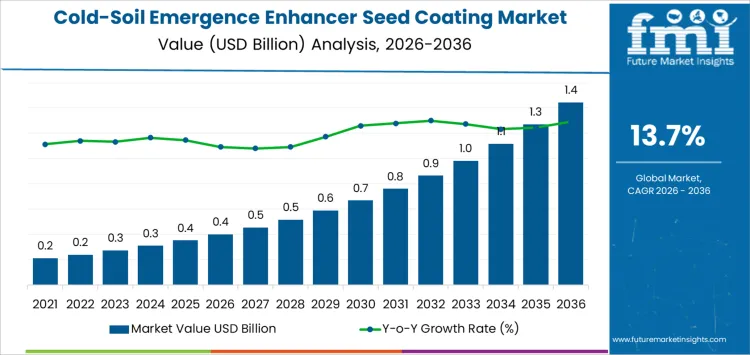
The global cold-soil emergence enhancer seed coating market is poised for substantial growth, with an expected increase from USD 0.4 billion in 2026 to USD 1.4 billion by 2036, reflecting a CAGR of 13.7%. Polymer-based thermal insulating coatings dominate the market, accounting for 36%, as they provide effective protection for seeds in cold soil conditions, especially for cereals and grains. These coatings play a critical role in enhancing seedling vigor and ensuring better emergence by providing thermal insulation in low-temperature environments. Demand is also driven by bio-stimulant embedded coatings, nutrient-infused cold-activation coatings, and microbial-assisted emergence coatings, which offer specialized benefits like improved seed hydration, nutrient availability, and root development under stress conditions. In terms of crop types, cereals and grains hold the largest share at 46%, due to their susceptibility to cold-soil stress, followed by oilseeds & pulses and vegetables.
Quick Stats for Cold-Soil Emergence Enhancer Seed Coating Market
- Cold-Soil Emergence Enhancer Seed Coating Market Value (2026): USD 0.4 billion
- Cold-Soil Emergence Enhancer Seed Coating Market Forecast Value (2036): USD 1.4 billion
- Cold-Soil Emergence Enhancer Seed Coating Market Forecast CAGR: 13.7%
- Leading Coating Technology in Cold-Soil Emergence Enhancer Seed Coating Market: Polymer-Based Thermal Insulating Coatings (36%)
- Key Growth Regions in Cold-Soil Emergence Enhancer Seed Coating Market: USA, India, Canada, Germany, China
- Key Players in Cold-Soil Emergence Enhancer Seed Coating Market: BASF SE, Bayer CropScience, Corteva Agriscience, Syngenta Group, Croda International
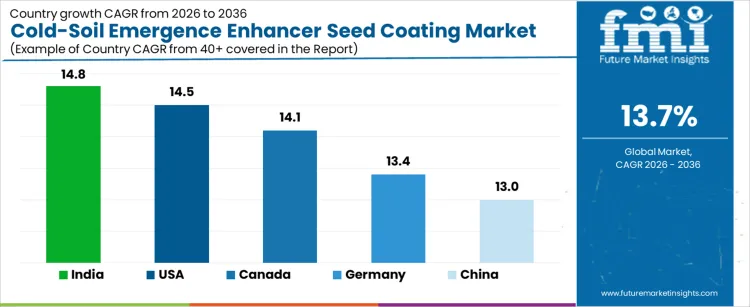
India leads the market with a 14.8% CAGR, driven by the country’s diverse agricultural base and the need for better seed performance in cooler climates. The USA follows with 14.5%, fueled by increasing demand for solutions to improve seed performance across varied environmental conditions. Canada’s market grows at 14.1%, supported by the need for early-season planting solutions in cold soils. Germany (13.4%), China (13.0%), and France (13.5%) also show steady growth as farmers adopt innovative seed treatments to ensure robust crop establishment despite adverse weather conditions.
Cold‑Soil Emergence Enhancer Seed Coating Market Key Takeaways
| Metric | Value |
|---|---|
| Industry Value (2026) | USD 0.4 billion |
| Forecast Value (2036) | USD 1.4 billion |
| Forecast CAGR (2026 to 2036) | 13.7% |
How is the Global Cold‑Soil Emergence Enhancer Seed Coating Sector Advancing?
The global cold‑soil emergence enhancer seed coating market is expanding rapidly as growers seek solutions that improve germination and early crop establishment in low‑temperature environments. Cold‑soil emergence enhancers are specialized coatings applied to seeds to boost early vigor and enhance emergence rates when soil temperatures are suboptimal. By supporting seedling growth under stress conditions, these coatings help maintain yield potential and reduce the risk of stand loss-challenges that are especially relevant in regions with short growing seasons or unpredictable spring weather. Traditional seed coatings mainly focused on pest and disease protection, but the rising emphasis on abiotic stress mitigation is driving adoption of performance‑enhancing coatings that address climatic variability.
Demand for cold‑soil emergence enhancer seed coatings is being driven by both climatic trends and agricultural productivity goals. As unpredictable weather patterns and cooler early‑season conditions become more common, growers are increasingly turning to advanced seed treatments that enable reliable crop establishment. Advances in coating chemistry and formulation technologies are improving the effectiveness of these enhancers across a wider range of crops including cereals, oilseeds, and specialty crops. These innovations enhance seed hydration balance, temperature tolerance, and early root development-factors that contribute to uniform emergence and stronger early‑season growth.
Cold‑soil emergence enhancer seed coating market is expected to grow strongly as the agricultural sector continues to prioritize resilient crop management practices. Challenges such as ensuring consistent performance across diverse soil types and climates, as well as educating growers on optimal use practices, may influence adoption rates. The strong focus on improving crop establishment under stress conditions and the rising integration of advanced seed technologies into precision agriculture strategies will continue to drive demand for cold‑soil emergence enhancer seed coatings globally.
What is the Segment-Wise Analysis for the Global Cold-Soil Emergence Enhancer Seed Coating Market?
The global cold-soil emergence enhancer seed coating market is segmented by coating technology type and crop type. Polymer-based thermal insulating coatings lead the market with a 36% share, as they are effective in enhancing seed emergence in cold soil by providing thermal insulation. Other significant coating technologies include bio-stimulant embedded coatings, nutrient-infused cold-activation coatings, and microbial-assisted emergence coatings. In terms of crop type, cereals & grains hold the largest share at 46%, followed by oilseeds & pulses, vegetables, and forage & specialty crops.
Why Do Polymer-Based Thermal Insulating Coatings Lead the Global Cold-Soil Emergence Enhancer Seed Coating Market?
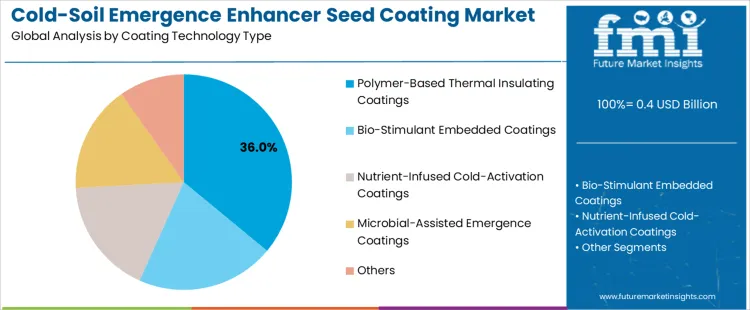
Polymer-based thermal insulating coatings hold a 36% share in the global cold-soil emergence enhancer seed coating market due to their effectiveness in protecting seeds from cold soil temperatures, which can inhibit germination. These coatings create a thermal barrier around the seed, helping maintain optimal temperatures for seed growth even in challenging cold soil conditions. The use of polymer-based coatings is particularly beneficial for crops that need a stable thermal environment to germinate, such as cereals and grains. Their proven performance in enhancing seed emergence and promoting faster growth has made polymer-based thermal insulating coatings the dominant choice in this market.
Why Do Cereals & Grains Hold the Largest Market Share in the Cold-Soil Emergence Enhancer Seed Coating Market?
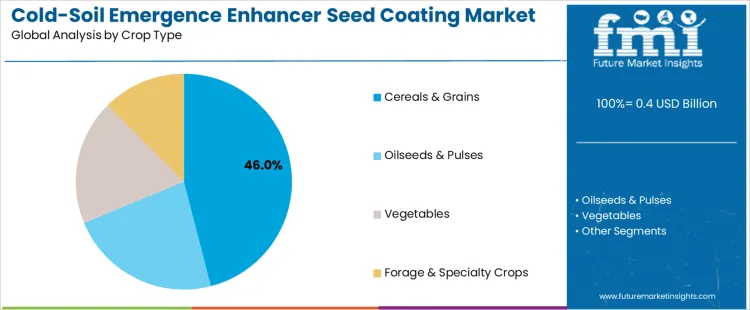
Cereals & grains hold the largest share of 46% in the global cold-soil emergence enhancer seed coating market due to their susceptibility to poor germination in cold soil conditions, particularly in regions with colder climates. Cold-soil emergence enhancer seed coatings, especially those that provide thermal insulation, are highly effective in improving the germination rates and overall emergence of cereals like wheat, corn, and barley. These coatings help protect the seeds from cold stress, ensuring consistent and healthy growth. As the demand for higher yields and reliable crop production increases, the adoption of seed coatings for cereals and grains continues to drive their dominant share in the market.
What is Shaping the Cold‑Soil Emergence Enhancer Seed Coating Market?
The cold‑soil emergence enhancer seed coating market is shaped by the growing need to improve crop establishment in early‑season and cool climates. Cold soils delay germination, reduce vigor, and increase vulnerability to disease, which can lower yields. Emergence enhancers-formulations applied as seed coatings boost water uptake, early root growth, and stress tolerance in cool conditions. As growers push planting windows earlier to maximize growing seasons and overall productivity, demand for seed coatings that support quick, uniform emergence is rising. Advances in polymer science and bioactive additives are also influencing market growth.
What Challenges Are Limiting Adoption of Cold‑Soil Emergence Enhancer Seed Coatings?
Adoption is constrained by cost sensitivity and variable field results across soil types and climates. Enhanced seed coatings can carry higher upfront prices compared with untreated seed, which may deter growers without clear data on return on investment under specific conditions. Performance can vary based on soil moisture, temperature fluctuations, and planting depth, making growers cautious about consistent outcomes. Compatibility with existing planting equipment and concern about potential impacts on seedling development if misapplied are additional barriers to wider use.
What Key Trends Are Shaping the Cold‑Soil Emergence Enhancer Seed Coating Market?
Key trends include the development of multi‑functional coatings that combine cold‑soil emergence enhancers with micronutrients, bio‑stimulants, and protective agents against soil pathogens. There is rising interest in biodegradable and low‑toxicity coating polymers that align with sustainability goals. Integration with digital agronomy platforms that provide soil temperature and moisture forecasting helps growers optimize application timing and seed selection. Partnerships between seed companies, agritech firms, and coating formulators are driving tailored solutions for specific crops and regions. Demand is also expanding in emerging agricultural regions where growers seek tools to improve early growth under cool conditions
What is the Growth Outlook for the Cold-Soil Emergence Enhancer Seed Coating Market by Country?
| Country | CAGR (%) |
|---|---|
| USA | 14.5% |
| Canada | 14.1% |
| Germany | 13.4% |
| China | 13.0% |
| India | 14.8% |
The cold-soil emergence enhancer seed coating market is expanding, with India leading at a 14.8% CAGR, driven by the increasing adoption of innovative agricultural solutions to boost crop yields in cooler climates. The USA follows with 14.5%, supported by the demand for efficient farming practices and improved seed performance in varying environmental conditions. Canada’s market grows at 14.1%, with farmers seeking solutions for early-season planting in cold soils. Germany’s market grows at 13.4%, driven by the demand for technologies that enhance seed performance while maintaining environmental sustainability. China’s market grows at 13.0%, fueled by the large agricultural base and focus on improving crop emergence in colder regions.
Why is India Leading in the Cold-Soil Emergence Enhancer Seed Coating Market?
India’s cold-soil emergence enhancer seed coating market is growing at 14.8%, driven by the country’s diverse agricultural sector and the need for improved seed performance in cooler climates. Many regions in India experience challenging weather conditions, including cold soils during the early planting season. Cold-soil emergence enhancers help improve seed germination and early growth by protecting seeds in low-temperature conditions. As India continues to focus on increasing crop yields and improving food security, the adoption of innovative solutions like cold-soil emergence enhancers is on the rise. Government initiatives supporting agricultural innovation and sustainable farming practices are further accelerating the growth of this market. As India faces increasing environmental pressures and climate change impacts, the demand for technologies that ensure reliable seed performance in cooler soils is expected to continue growing.
What is Driving the Growth of the Cold-Soil Emergence Enhancer Seed Coating Market in the USA?
The USA’s cold-soil emergence enhancer seed coating market is growing at 14.5%, fueled by the increasing demand for agricultural solutions that improve seed performance under varying environmental conditions. In regions with colder climates, early-season planting is a challenge, and cold-soil emergence enhancers play a crucial role in ensuring effective seed germination and growth. These coatings enhance seed vigor, protect seeds from soil-borne diseases, and help them withstand the stress caused by cooler temperatures. With a growing focus on improving crop yields and efficiency in farming, American farmers are increasingly adopting these innovative seed coating technologies. As the demand for sustainable and high-performance agriculture solutions rises, the cold-soil emergence enhancer seed coating market in the USA is expected to expand steadily.
How is the Cold-Soil Emergence Enhancer Seed Coating Market Expanding in Canada?
Canada’s cold-soil emergence enhancer seed coating market is growing at 14.1%, driven by the country’s agricultural landscape, which faces challenges associated with cold and short growing seasons. Early planting in cold soils can lead to poor seed emergence and reduced crop yields. Cold-soil emergence enhancers are increasingly being adopted by Canadian farmers to improve seed germination and ensure strong early-season growth. These coatings help protect seeds from environmental stress, allowing them to thrive in cold and moist conditions. As Canada’s agricultural sector focuses on boosting productivity and overcoming climatic challenges, the market for cold-soil emergence enhancers is expected to continue growing, providing farmers with solutions that maximize the potential of their crops during the early stages of growth.
What is Contributing to the Growth of the Cold-Soil Emergence Enhancer Seed Coating Market in Germany?
Germany’s cold-soil emergence enhancer seed coating market is growing at 13.4%, driven by the country’s emphasis on sustainable farming practices and the need to improve crop yields in colder climates. As European farmers face the challenges of early planting in cold soils, cold-soil emergence enhancers are gaining popularity. These coatings help seeds germinate and grow more effectively, even in low-temperature conditions. With a growing focus on reducing pesticide use and improving overall agricultural productivity, German farmers are increasingly turning to these innovative seed coating solutions. As Germany continues to lead Europe in sustainable farming technologies, the demand for cold-soil emergence enhancers is expected to rise, contributing to steady market growth.
What is Driving the Growth of the Cold-Soil Emergence Enhancer Seed Coating Market in China?
China’s cold-soil emergence enhancer seed coating market is growing at 13.0%, supported by the country’s large-scale agricultural sector and the need to improve crop emergence under colder conditions. As China faces challenges related to temperature fluctuations, particularly in northern regions, cold-soil emergence enhancers provide a way to improve seed performance and ensure successful germination. These technologies help farmers enhance the efficiency of early-season planting, which is crucial for maximizing crop yields. With China’s focus on agricultural modernization and improving food security, the adoption of cold-soil emergence enhancers is gaining momentum. As demand for innovative and sustainable agricultural solutions grows, the market for these seed coatings is expected to continue expanding.
How Are Companies Competing in the Cold‑Soil Emergence Enhancer Seed Coating Market?
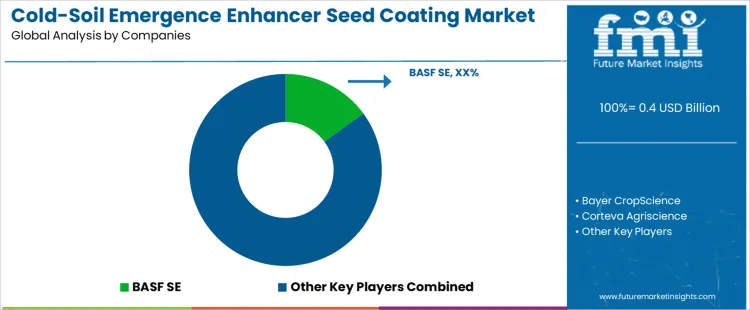
In the cold‑soil emergence enhancer seed coating market BASF SE, Bayer CropScience, Corteva Agriscience, Syngenta Group, and Croda International are positioned with product brochures that highlight seed performance under low temperature conditions. At BASF SE coatings are presented with formulation details that emphasize improved water uptake and uniform germination in cool soils. Technical data is shown with emergence percentages and seedling vigor metrics. At Bayer CropScience brochures describe enhancer systems that are paired with crop protection actives.
Application guidance and compatibility charts are included to support decision making. At Corteva Agriscience materials focus on coating technologies engineered to support rapid radicle growth in cold soils. Mode‑of‑action summaries and shaded trial results are provided for major crops and regions where early planting is critical. At Syngenta Group collateral positions cold‑soil emergence enhancers within broader seed treatment portfolios. Trial outcomes are presented alongside notes on ease of use and formulation stability. Croda International brochures highlight specialty adjuvants and polymer‑based coatings designed for consistent performance. Performance results are shown to illustrate improved emergence under low temperature stress.
Key Players in Cold-Soil Emergence Enhancer Seed Coating Market
- BASF SE
- Bayer CropScience
- Corteva Agriscience
- Syngenta Group
- Croda International
Scope of Report
| Items | Values |
|---|---|
| Quantitative Units (2026) | USD billion |
| Coating Technology Type | Polymer-Based Thermal Insulating Coatings, Bio-Stimulant Embedded Coatings, Nutrient-Infused Cold-Activation Coatings, Microbial-Assisted Emergence Coatings, Others |
| Crop Type | Cereals & Grains, Oilseeds & Pulses, Vegetables, Forage & Specialty Crops |
| Regions Covered | Asia Pacific, Europe, North America, Latin America, Middle East & Africa |
| Countries Covered | USA, China, Japan, South Korea, India, Australia & New Zealand, ASEAN, Germany, UK, France, Italy, Spain, Nordic, BENELUX, Brazil, Chile, Mexico, Saudi Arabia, Other GCC Countries, Turkey, South Africa, Other African Union |
| Key Companies Profiled | BASF SE, Bayer CropScience, Corteva Agriscience, Syngenta Group, Croda International |
| Additional Attributes | Dollar sales by coating technology type, crop type, and region; regional CAGR and growth outlook; distribution channels including agricultural suppliers, seed treatment manufacturers, and service providers; innovation trends in cold-soil emergence enhancer seed coatings; competitive positioning of global vs regional suppliers. |
Cold-Soil Emergence Enhancer Seed Coating Market by Segments
Coating Technology Type
- Polymer-Based Thermal Insulating Coatings
- Bio-Stimulant Embedded Coatings
- Nutrient-Infused Cold-Activation Coatings
- Microbial-Assisted Emergence Coatings
- Others
Crop Type
- Cereals & Grains
- Oilseeds & Pulses
- Vegetables
- Forage & Specialty Crops
Region:
- Asia Pacific
- China
- Japan
- South Korea
- India
- Australia & New Zealand
- ASEAN
- Rest of Asia Pacific
- Europe
- Germany
- United Kingdom
- France
- Italy
- Spain
- Nordic
- BENELUX
- Rest of Europe
- North America
- United States
- Canada
- Mexico
- Latin America
- Brazil
- Chile
- Rest of Latin America
- Middle East & Africa
- Kingdom of Saudi Arabia
- Other GCC Countries
- Turkey
- South Africa
- Other African Union
- Rest of Middle East & Africa
Frequently Asked Questions
How big is the cold-soil emergence enhancer seed coating market in 2026?
The global cold-soil emergence enhancer seed coating market is estimated to be valued at USD 0.4 billion in 2026.
What will be the size of cold-soil emergence enhancer seed coating market in 2036?
The market size for the cold-soil emergence enhancer seed coating market is projected to reach USD 1.4 billion by 2036.
How much will be the cold-soil emergence enhancer seed coating market growth between 2026 and 2036?
The cold-soil emergence enhancer seed coating market is expected to grow at a 13.7% CAGR between 2026 and 2036.
What are the key product types in the cold-soil emergence enhancer seed coating market?
The key product types in cold-soil emergence enhancer seed coating market are polymer-based thermal insulating coatings, bio-stimulant embedded coatings, nutrient-infused cold-activation coatings, microbial-assisted emergence coatings and others.
Which crop type segment to contribute significant share in the cold-soil emergence enhancer seed coating market in 2026?
In terms of crop type, cereals & grains segment to command 46.0% share in the cold-soil emergence enhancer seed coating market in 2026.
Preview the report firsthand - request a free sample
Get SampleGet the brochure for pricing and purchase details.
Get PDFTable of Content
- Executive Summary
- Global Market Outlook
- Demand-side Trends
- Supply-side Trends
- Technology Roadmap Analysis
- Analysis and Recommendations
- Market Overview
- Market Coverage / Taxonomy
- Market Definition / Scope / Limitations
- Market Background
- Market Dynamics
- Drivers
- Restraints
- Opportunity
- Trends
- Scenario Forecast
- Demand in Optimistic Scenario
- Demand in Likely Scenario
- Demand in Conservative Scenario
- Opportunity Map Analysis
- Product Life Cycle Analysis
- Supply Chain Analysis
- Investment Feasibility Matrix
- Value Chain Analysis
- PESTLE and Porter’s Analysis
- Regulatory Landscape
- Regional Parent Market Outlook
- Production and Consumption Statistics
- Import and Export Statistics
- Market Dynamics
- Global Market Analysis 2021 to 2025 and Forecast, 2026 to 2036
- Historical Market Size Value (USD Million) Analysis, 2021 to 2025
- Current and Future Market Size Value (USD Million) Projections, 2026 to 2036
- Y-o-Y Growth Trend Analysis
- Absolute $ Opportunity Analysis
- Global Market Pricing Analysis 2021 to 2025 and Forecast 2026 to 2036
- Global Market Analysis 2021 to 2025 and Forecast 2026 to 2036, By Coating Technology Type
- Introduction / Key Findings
- Historical Market Size Value (USD Million) Analysis By Coating Technology Type , 2021 to 2025
- Current and Future Market Size Value (USD Million) Analysis and Forecast By Coating Technology Type , 2026 to 2036
- Polymer-Based Thermal Insulating Coatings
- Bio-Stimulant Embedded Coatings
- Nutrient-Infused Cold-Activation Coatings
- Microbial-Assisted Emergence Coatings
- Others
- Y-o-Y Growth Trend Analysis By Coating Technology Type , 2021 to 2025
- Absolute $ Opportunity Analysis By Coating Technology Type , 2026 to 2036
- Global Market Analysis 2021 to 2025 and Forecast 2026 to 2036, By Crop Type
- Introduction / Key Findings
- Historical Market Size Value (USD Million) Analysis By Crop Type, 2021 to 2025
- Current and Future Market Size Value (USD Million) Analysis and Forecast By Crop Type, 2026 to 2036
- Cereals & Grains
- Oilseeds & Pulses
- Vegetables
- Forage & Specialty Crops
- Y-o-Y Growth Trend Analysis By Crop Type, 2021 to 2025
- Absolute $ Opportunity Analysis By Crop Type, 2026 to 2036
- Global Market Analysis 2021 to 2025 and Forecast 2026 to 2036, By Region
- Introduction
- Historical Market Size Value (USD Million) Analysis By Region, 2021 to 2025
- Current Market Size Value (USD Million) Analysis and Forecast By Region, 2026 to 2036
- North America
- Latin America
- Western Europe
- Eastern Europe
- East Asia
- South Asia and Pacific
- Middle East & Africa
- Market Attractiveness Analysis By Region
- North America Market Analysis 2021 to 2025 and Forecast 2026 to 2036, By Country
- Historical Market Size Value (USD Million) Trend Analysis By Market Taxonomy, 2021 to 2025
- Market Size Value (USD Million) Forecast By Market Taxonomy, 2026 to 2036
- By Country
- USA
- Canada
- Mexico
- By Coating Technology Type
- By Crop Type
- By Country
- Market Attractiveness Analysis
- By Country
- By Coating Technology Type
- By Crop Type
- Key Takeaways
- Latin America Market Analysis 2021 to 2025 and Forecast 2026 to 2036, By Country
- Historical Market Size Value (USD Million) Trend Analysis By Market Taxonomy, 2021 to 2025
- Market Size Value (USD Million) Forecast By Market Taxonomy, 2026 to 2036
- By Country
- Brazil
- Chile
- Rest of Latin America
- By Coating Technology Type
- By Crop Type
- By Country
- Market Attractiveness Analysis
- By Country
- By Coating Technology Type
- By Crop Type
- Key Takeaways
- Western Europe Market Analysis 2021 to 2025 and Forecast 2026 to 2036, By Country
- Historical Market Size Value (USD Million) Trend Analysis By Market Taxonomy, 2021 to 2025
- Market Size Value (USD Million) Forecast By Market Taxonomy, 2026 to 2036
- By Country
- Germany
- UK
- Italy
- Spain
- France
- Nordic
- BENELUX
- Rest of Western Europe
- By Coating Technology Type
- By Crop Type
- By Country
- Market Attractiveness Analysis
- By Country
- By Coating Technology Type
- By Crop Type
- Key Takeaways
- Eastern Europe Market Analysis 2021 to 2025 and Forecast 2026 to 2036, By Country
- Historical Market Size Value (USD Million) Trend Analysis By Market Taxonomy, 2021 to 2025
- Market Size Value (USD Million) Forecast By Market Taxonomy, 2026 to 2036
- By Country
- Russia
- Poland
- Hungary
- Balkan & Baltic
- Rest of Eastern Europe
- By Coating Technology Type
- By Crop Type
- By Country
- Market Attractiveness Analysis
- By Country
- By Coating Technology Type
- By Crop Type
- Key Takeaways
- East Asia Market Analysis 2021 to 2025 and Forecast 2026 to 2036, By Country
- Historical Market Size Value (USD Million) Trend Analysis By Market Taxonomy, 2021 to 2025
- Market Size Value (USD Million) Forecast By Market Taxonomy, 2026 to 2036
- By Country
- China
- Japan
- South Korea
- By Coating Technology Type
- By Crop Type
- By Country
- Market Attractiveness Analysis
- By Country
- By Coating Technology Type
- By Crop Type
- Key Takeaways
- South Asia and Pacific Market Analysis 2021 to 2025 and Forecast 2026 to 2036, By Country
- Historical Market Size Value (USD Million) Trend Analysis By Market Taxonomy, 2021 to 2025
- Market Size Value (USD Million) Forecast By Market Taxonomy, 2026 to 2036
- By Country
- India
- ASEAN
- Australia & New Zealand
- Rest of South Asia and Pacific
- By Coating Technology Type
- By Crop Type
- By Country
- Market Attractiveness Analysis
- By Country
- By Coating Technology Type
- By Crop Type
- Key Takeaways
- Middle East & Africa Market Analysis 2021 to 2025 and Forecast 2026 to 2036, By Country
- Historical Market Size Value (USD Million) Trend Analysis By Market Taxonomy, 2021 to 2025
- Market Size Value (USD Million) Forecast By Market Taxonomy, 2026 to 2036
- By Country
- Kingdom of Saudi Arabia
- Other GCC Countries
- Turkiye
- South Africa
- Other African Union
- Rest of Middle East & Africa
- By Coating Technology Type
- By Crop Type
- By Country
- Market Attractiveness Analysis
- By Country
- By Coating Technology Type
- By Crop Type
- Key Takeaways
- Key Countries Market Analysis
- USA
- Pricing Analysis
- Market Share Analysis, 2025
- By Coating Technology Type
- By Crop Type
- Canada
- Pricing Analysis
- Market Share Analysis, 2025
- By Coating Technology Type
- By Crop Type
- Mexico
- Pricing Analysis
- Market Share Analysis, 2025
- By Coating Technology Type
- By Crop Type
- Brazil
- Pricing Analysis
- Market Share Analysis, 2025
- By Coating Technology Type
- By Crop Type
- Chile
- Pricing Analysis
- Market Share Analysis, 2025
- By Coating Technology Type
- By Crop Type
- Germany
- Pricing Analysis
- Market Share Analysis, 2025
- By Coating Technology Type
- By Crop Type
- UK
- Pricing Analysis
- Market Share Analysis, 2025
- By Coating Technology Type
- By Crop Type
- Italy
- Pricing Analysis
- Market Share Analysis, 2025
- By Coating Technology Type
- By Crop Type
- Spain
- Pricing Analysis
- Market Share Analysis, 2025
- By Coating Technology Type
- By Crop Type
- France
- Pricing Analysis
- Market Share Analysis, 2025
- By Coating Technology Type
- By Crop Type
- India
- Pricing Analysis
- Market Share Analysis, 2025
- By Coating Technology Type
- By Crop Type
- ASEAN
- Pricing Analysis
- Market Share Analysis, 2025
- By Coating Technology Type
- By Crop Type
- Australia & New Zealand
- Pricing Analysis
- Market Share Analysis, 2025
- By Coating Technology Type
- By Crop Type
- China
- Pricing Analysis
- Market Share Analysis, 2025
- By Coating Technology Type
- By Crop Type
- Japan
- Pricing Analysis
- Market Share Analysis, 2025
- By Coating Technology Type
- By Crop Type
- South Korea
- Pricing Analysis
- Market Share Analysis, 2025
- By Coating Technology Type
- By Crop Type
- Russia
- Pricing Analysis
- Market Share Analysis, 2025
- By Coating Technology Type
- By Crop Type
- Poland
- Pricing Analysis
- Market Share Analysis, 2025
- By Coating Technology Type
- By Crop Type
- Hungary
- Pricing Analysis
- Market Share Analysis, 2025
- By Coating Technology Type
- By Crop Type
- Kingdom of Saudi Arabia
- Pricing Analysis
- Market Share Analysis, 2025
- By Coating Technology Type
- By Crop Type
- Turkiye
- Pricing Analysis
- Market Share Analysis, 2025
- By Coating Technology Type
- By Crop Type
- South Africa
- Pricing Analysis
- Market Share Analysis, 2025
- By Coating Technology Type
- By Crop Type
- USA
- Market Structure Analysis
- Competition Dashboard
- Competition Benchmarking
- Market Share Analysis of Top Players
- By Regional
- By Coating Technology Type
- By Crop Type
- Competition Analysis
- Competition Deep Dive
- BASF SE
- Overview
- Product Portfolio
- Profitability by Market Segments (Product/Age /Sales Channel/Region)
- Sales Footprint
- Strategy Overview
- Marketing Strategy
- Product Strategy
- Channel Strategy
- Bayer CropScience
- Corteva Agriscience
- Syngenta Group
- Croda International
- BASF SE
- Competition Deep Dive
- Assumptions & Acronyms Used
- Research Methodology


