

- Industry Size (2026)
- USD 0.4 Bn
- Forecast (2036)
- USD 1.5 Bn
- CAGR (2026 to 2036)
- 14.1%
Root-Architecting Seed Coating Chemistry Market Forecast and Outlook 2026 to 2036
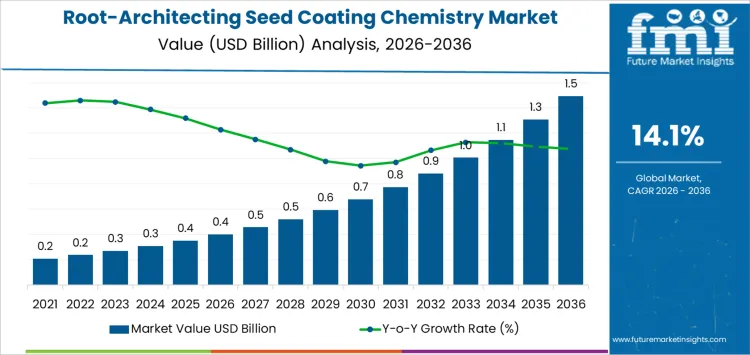
The global root-architecting seed coating chemistry market is experiencing rapid growth, projected to expand from USD 0.4 billion in 2026 to USD 1.5 billion by 2036, with a robust CAGR of 14.1%. Auxin-modulating compounds dominate the market with a 34% share, due to their pivotal role in enhancing root growth and structure by modulating plant hormones. These compounds are particularly effective in improving seedling establishment and root development, which is critical for optimizing crop productivity. The largest functional outcome, enhanced lateral root development, holds a 38% share, as lateral roots increase the surface area for nutrient and water uptake, significantly improving plant health and overall yield.
Quick Stats for Root-Architecting Seed Coating Chemistry Market
- Root-Architecting Seed Coating Chemistry Market Value (2026): USD 0.4 billion
- Root-Architecting Seed Coating Chemistry Market Forecast Value (2036): USD 1.5 billion
- Root-Architecting Seed Coating Chemistry Market Forecast CAGR: 14.1%
- Leading Chemistry Type in Root-Architecting Seed Coating Chemistry Market: Auxin-Modulating Compounds (34%)
- Key Growth Regions in Root-Architecting Seed Coating Chemistry Market: USA, India, Brazil, China, Germany
- Key Players in Root-Architecting Seed Coating Chemistry Market: BASF SE, Bayer CropScience, Corteva Agriscience, Syngenta Group, Croda International
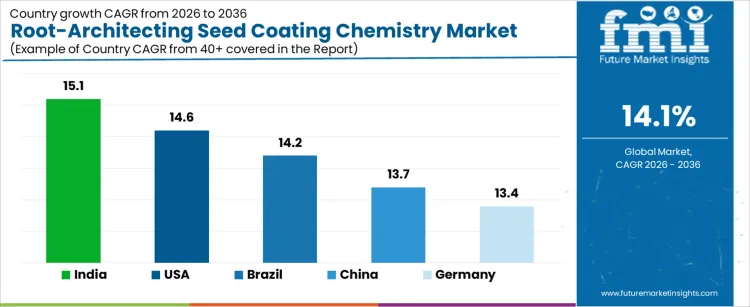
India leads the market with a 15.1% CAGR, driven by the country’s focus on improving crop resilience and adapting to environmental stresses. The USA follows with a 14.6% growth rate, supported by demand for sustainable farming solutions and enhanced crop performance. Brazil, growing at 14.2%, is benefiting from large-scale agricultural operations, while China (13.7%) and Germany (13.4%) are expanding as they seek technologies that improve root system architecture and overall crop productivity. As precision agriculture becomes more prevalent, the demand for these advanced seed coatings is expected to continue rising in key agricultural markets worldwide.
Root‑Architecting Seed Coating Chemistry Market Key Takeaways
| Metric | Value |
|---|---|
| Industry Value (2026) | USD 0.4 billion |
| Forecast Value (2036) | USD 1.5 billion |
| Forecast CAGR (2026 to 2036) | 14.1% |
How is the Global Root‑Architecting Seed Coating Chemistry Sector Advancing?
The global root‑architecting seed coating chemistry market is growing rapidly as growers seek solutions that enhance early root development and overall plant performance. Root‑architecting seed coatings are specialized formulations applied to seeds to influence root system architecture, promoting deeper, more robust root networks that improve nutrient and water uptake. This is especially valuable in environments with variable moisture and nutrient availability, where stronger root systems can help crops withstand stress and establish more uniformly. Traditional seed treatments have focused mainly on pest and disease protection, but the rising emphasis on abiotic stress resilience and efficient resource use is driving adoption of advanced seed coating chemistries that target root growth.
Demand for root‑architecting coatings is being propelled by the increasing need to improve crop productivity while adapting to climate variability. These coatings are used across key crops such as cereals, oilseeds, and specialty crops, where early root vigor can significantly influence yield potential. Advances in formulation technologies have improved the effectiveness of these chemistries, enabling precise delivery of growth‑modulating agents that influence hormonal pathways and root morphology. This has made them an important component of integrated crop establishment strategies that support stronger early‑season growth and improved plant health throughout the growing cycle.
Demand is expected to expand strongly as producers increasingly adopt precision agriculture practices and invest in technologies that enhance crop resilience and resource efficiency. Continued research into novel biostimulant and growth‑promoting ingredients will further broaden efficacy and crop specificity. Challenges such as cost considerations, variable soil responses, and the need for tailored guidance on application may influence adoption rates. Nonetheless, the focus on improving early root development to support sustainable yield gains will drive continued demand for root‑architecting seed coating chemistries worldwide.
What Is the Segment-Wise Analysis for the Global Root-Architecting Seed Coating Chemistry Market?
The global root-architecting seed coating chemistry market is segmented by chemistry type and functional outcome. Auxin-modulating compounds lead the market with a 34% share, as they play a significant role in influencing root growth and structure. Other significant chemistry types include root-promoting biostimulant blends, micronutrient-chelate architecting systems, and signal-molecule & hormone precursors. In terms of functional outcomes, enhanced lateral root development holds the largest share at 38%, followed by deeper root penetration, improved nutrient uptake efficiency, and drought & lodging resistance.
Why Do Auxin-Modulating Compounds Lead the Global Root-Architecting Seed Coating Chemistry Market?
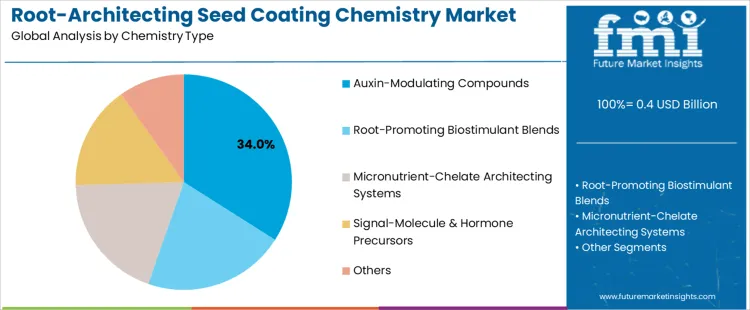
Auxin-modulating compounds hold a 34% share in the global root-architecting seed coating chemistry market due to their significant role in regulating plant growth, particularly root development. Auxins are essential plant hormones that influence root formation, and modulating these compounds in seed coatings helps promote the growth of strong, well-structured root systems. By enhancing root architecture, auxin-modulating compounds improve seedling establishment, nutrient absorption, and overall plant health. These compounds are particularly valuable in agriculture, where strong root systems are critical for crop productivity, making them the preferred choice for root-architecting seed coatings in the market.
Why Does Enhanced Lateral Root Development Hold the Largest Market Share in the Root-Architecting Seed Coating Chemistry Market?
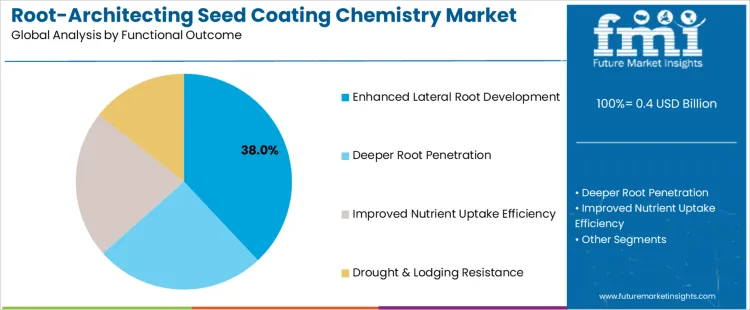
Enhanced lateral root development holds the largest share of 38% in the global root-architecting seed coating chemistry market due to its critical role in improving root system expansion and plant stability. Lateral roots increase the surface area for nutrient and water absorption, significantly improving overall plant health and productivity. By encouraging the development of lateral roots, seed coatings with this functional outcome help crops adapt to varying soil conditions and optimize growth. Enhanced lateral root development is particularly valuable in crops requiring robust root systems for efficient nutrient uptake, which drives its dominant market position in the root-architecting seed coating sector.
What Is Shaping the Root Architecting Seed Coating Chemistry Market?
The root architecting seed coating chemistry market is shaped by the growing need to enhance early root development for stronger crop establishment, improved nutrient uptake, and higher yield potential. Root architecting coatings are formulated to influence root growth patterns, encourage deeper rooting, or increase lateral root proliferation. As growers face soil constraints, drought stress, and nutrient variability, these technologies help crops optimize resource use and resilience. Advances in polymer science and bioactive additives, coupled with precision agriculture tools that guide placement and performance, are influencing market growth.
What Challenges Are Limiting Adoption of Root Architecting Seed Coating Chemistries?
Adoption can be limited by cost considerations and uncertainties over field performance across environments and soil types. Enhanced seed coatings often carry higher upfront prices than untreated seed, and growers may hesitate without clear ROI data specific to their conditions. Variability in outcomes due to soil texture, moisture, and nutrient status can create inconsistent responses. Compatibility with standard seed treatment equipment and potential effects on seed flow or planter performance require careful evaluation. Limited agronomic guidance on optimal formulations and application timing also slows broader uptake.
What Key Trends Are Shaping the Root Architecting Seed Coating Chemistry Market?
Key trends include the development of multifunctional seed coatings that combine root architecting agents with micronutrients, bio stimulants, and stress mitigation compounds for holistic early growth support. There is rising interest in bio based and low toxicity polymers that align with sustainability goals and regulatory preferences. Integration with digital agronomy platforms that provide soil and environmental data helps growers tailor seed treatment choices for specific fields. Partnerships between seed firms, chemical formulators, and agritech providers are accelerating customized solutions. Demand is increasing in regions where soil constraints limit early root growth, driving localized product adoption.
What is the Growth Outlook for the Root-Architecting Seed Coating Chemistry Market by Country?
| Country | CAGR (%) |
|---|---|
| USA | 14.6% |
| Brazil | 14.2% |
| China | 13.7% |
| Germany | 13.4% |
| India | 15.1% |
The root-architecting seed coating chemistry market is experiencing strong growth, with India leading at a 15.1% CAGR, driven by the country’s growing agricultural base and the need for improved root growth and crop resilience. The USA follows with 14.6%, supported by increasing demand for innovative seed treatments to enhance root structure and crop performance. Brazil’s market grows at 14.2%, fueled by the country’s large-scale farming operations and the adoption of advanced seed coating technologies. China’s market grows at 13.7%, driven by the need to improve crop yields and reduce environmental stress. Germany’s market grows at 13.4%, supported by a focus on sustainable farming practices and the need for enhanced crop productivity.
Why is India Leading in the Root-Architecting Seed Coating Chemistry Market?
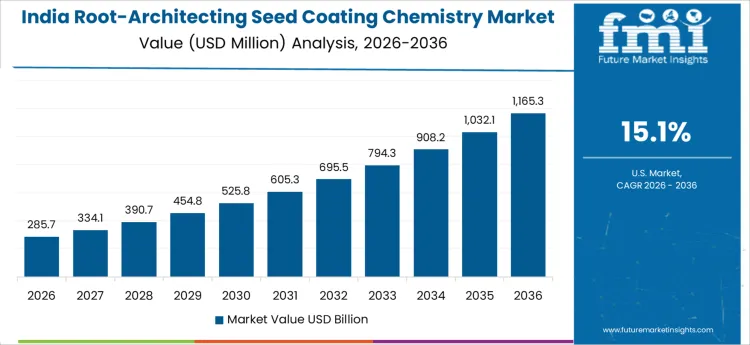
India’s root-architecting seed coating chemistry market is growing at 15.1%, driven by the country’s expanding agricultural sector and the increasing need for innovative solutions that enhance crop productivity. As India faces challenges related to soil health, water scarcity, and environmental stress, root-architecting seed coatings offer a solution by improving root structure and function, enabling crops to better absorb water and nutrients. These coatings enhance seedling establishment and root development, helping crops withstand harsh growing conditions. With government initiatives promoting sustainable farming practices and growing awareness among farmers about the benefits of these seed treatments, India is set to remain a leader in the adoption of root-architecting seed coating technologies. As India continues to focus on boosting agricultural productivity, the demand for these advanced solutions will continue to rise.
What is Driving the Growth of the Root-Architecting Seed Coating Chemistry Market in the USA?
The USA’s root-architecting seed coating chemistry market is growing at 14.6%, driven by the increasing need for sustainable farming practices and solutions that improve crop performance. Root-architecting seed coatings enhance root development, enabling crops to better withstand environmental stress, improve water and nutrient uptake, and increase overall crop yields. With the rising emphasis on precision agriculture and integrated pest management, these coatings are becoming a valuable tool for farmers seeking to optimize seed performance. Government regulations and consumer demand for more sustainable and eco-friendly farming practices are pushing the adoption of innovative seed treatments. As the USA continues to focus on improving agricultural efficiency and resilience, the market for root-architecting seed coating chemistry is expected to continue expanding.
How is the Root-Architecting Seed Coating Chemistry Market Expanding in Brazil?
Brazil’s root-architecting seed coating chemistry market is growing at 14.2%, driven by the country’s large-scale agricultural operations and the need to boost crop productivity. As Brazil is a major producer of crops like soybeans, coffee, and sugarcane, the adoption of innovative seed treatments is key to maintaining competitiveness in global markets. Root-architecting seed coatings improve root system development, enabling crops to better adapt to environmental stress and increasing their resilience against diseases and pests. Brazil’s push for sustainable agricultural practices, along with the need to increase yields while reducing environmental impact, is further fueling the demand for these advanced seed coatings. As Brazil continues to invest in agricultural innovation, the market for root-architecting seed coating chemistry is expected to expand steadily.
What is Contributing to the Growth of the Root-Architecting Seed Coating Chemistry Market in China?
China’s root-architecting seed coating chemistry market is growing at 13.7%, supported by the country’s vast agricultural base and the growing need to enhance crop yields and resilience. As China faces challenges like soil degradation, water scarcity, and climate change, root-architecting seed coatings provide an innovative solution to improve root system development and optimize water and nutrient uptake. These seed treatments help crops withstand environmental stress, reduce dependence on fertilizers, and improve overall crop performance. With the government’s support for sustainable farming and increasing adoption of advanced agricultural technologies, China’s market for root-architecting seed coatings is expected to continue its growth. As demand for higher productivity and more sustainable solutions increases, the adoption of these seed coatings is expected to rise.
What is Driving the Growth of the Root-Architecting Seed Coating Chemistry Market in Germany?
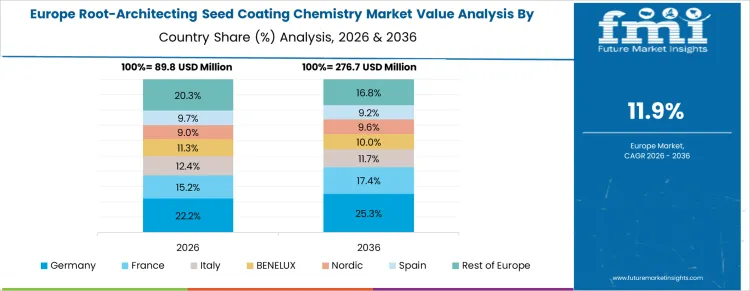
Germany’s root-architecting seed coating chemistry market is growing at 13.4%, supported by the country’s commitment to sustainability and efficient agricultural practices. As Germany continues to prioritize eco-friendly farming solutions, the demand for root-architecting seed coatings is increasing, as they help optimize crop yield and improve resilience in varying environmental conditions. These coatings enhance root structure, allowing crops to access water and nutrients more effectively, which is crucial in reducing the environmental footprint of farming. With stricter regulations on chemical pesticide use and growing consumer demand for organic and sustainably grown products, Germany’s agricultural industry is increasingly adopting advanced seed treatments like root-architecting coatings. As Germany’s focus on sustainability grows, the market for these seed coatings is expected to expand steadily.
How Are Companies Competing in the Root‑Architecting Seed Coating Chemistry Market?
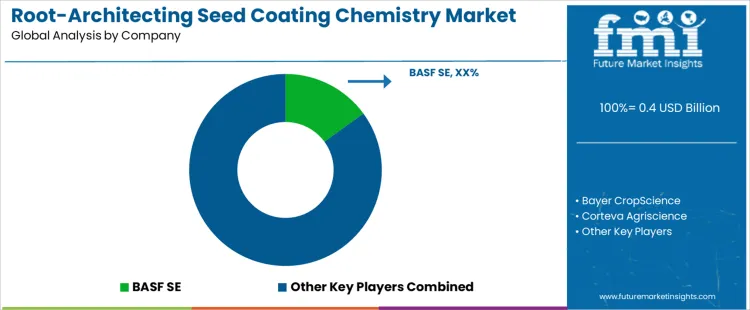
In the root‑architecting seed coating chemistry market, BASF SE, Bayer CropScience, Corteva Agriscience, Syngenta Group, Croda International, and others compete with products designed to enhance early plant development, root system architecture, and soil interaction for stronger crops. BASF SE brochures present seed coatings engineered to improve seed flowability and adhesion, promoting better root system establishment and seedling vigor. The company focuses on technical performance and clear application guidance for various crop types, highlighting the importance of uniform emergence and early growth. Bayer CropScience also emphasizes seed treatment solutions that enhance root growth and early vigor, with product literature detailing improved crop development outcomes and supporting agronomists in selecting the right solutions for diverse farming conditions. Syngenta Group, on the other hand, integrates root-architecting chemistries into broader seed treatment systems, positioning its products as crucial to fostering better seedling vigor and root development across multiple crops.
Corteva Agriscience positions its root‑targeted coatings within comprehensive seed enhancement strategies, offering product brochures that highlight improved root establishment and robust early plant growth, particularly in challenging soil environments. Croda International’s focus is on specialty polymers and bio‑enhancers designed to optimize root‑to‑soil contact and early growth, emphasizing environmental safety and technical performance. Other companies in the market offer niche formulations tailored to specific regional or crop needs. Across all firms, product brochures stress ease of use, compatibility with existing treatment systems, and field results, with competitive strategies shaped by innovative chemistries and strong agronomic support to foster better crop stand establishment and root health.
Key Players in Root-Architecting Seed Coating Chemistry Market
- BASF SE
- Bayer CropScience
- Corteva Agriscience
- Syngenta Group
- Croda International
- Others
Scope of Report
| Items | Values |
|---|---|
| Quantitative Units (2026) | USD 0.4 billion |
| Chemistry Type | Auxin-Modulating Compounds, Root-Promoting Biostimulant Blends, Micronutrient-Chelate Architecting Systems, Signal-Molecule & Hormone Precursors, Others |
| Functional Outcome | Enhanced Lateral Root Development, Deeper Root Penetration, Improved Nutrient Uptake Efficiency, Drought & Lodging Resistance |
| Regions Covered | Asia Pacific, Europe, North America, Latin America, Middle East & Africa |
| Countries Covered | USA, China, Japan, South Korea, India, Australia & New Zealand, ASEAN, Germany, UK, France, Italy, Spain, Nordic, BENELUX, Brazil, Chile, Mexico, Saudi Arabia, Other GCC Countries, Turkey, South Africa, Other African Union |
| Key Companies Profiled | BASF SE, Bayer CropScience, Corteva Agriscience, Syngenta Group, Croda International, Others |
| Additional Attributes | Dollar sales by chemistry type, functional outcome, and region; regional CAGR and growth outlook; distribution channels including agricultural suppliers, seed treatment manufacturers, and service providers; innovation trends in root-architecting seed coatings; competitive positioning of global vs regional suppliers. |
Root-Architecting Seed Coating Chemistry Market by Segments
Chemistry Type:
- Auxin-Modulating Compounds
- Root-Promoting Biostimulant Blends
- Micronutrient-Chelate Architecting Systems
- Signal-Molecule & Hormone Precursors
- Others
Functional Outcome:
- Enhanced Lateral Root Development
- Deeper Root Penetration
- Improved Nutrient Uptake Efficiency
- Drought & Lodging Resistance
Region:
- Asia Pacific
- China
- Japan
- South Korea
- India
- Australia & New Zealand
- ASEAN
- Rest of Asia Pacific
- Europe
- Germany
- United Kingdom
- France
- Italy
- Spain
- Nordic
- BENELUX
- Rest of Europe
- North America
- United States
- Canada
- Mexico
- Latin America
- Brazil
- Chile
- Rest of Latin America
- Middle East & Africa
- Kingdom of Saudi Arabia
- Other GCC Countries
- Turkey
- South Africa
- Other African Union
- Rest of Middle East & Africa
Frequently Asked Questions
How big is the root-architecting seed coating chemistry market in 2026?
The global root-architecting seed coating chemistry market is estimated to be valued at USD 0.4 billion in 2026.
What will be the size of root-architecting seed coating chemistry market in 2036?
The market size for the root-architecting seed coating chemistry market is projected to reach USD 1.5 billion by 2036.
How much will be the root-architecting seed coating chemistry market growth between 2026 and 2036?
The root-architecting seed coating chemistry market is expected to grow at a 14.1% CAGR between 2026 and 2036.
What are the key product types in the root-architecting seed coating chemistry market?
The key product types in root-architecting seed coating chemistry market are auxin-modulating compounds, root-promoting biostimulant blends, micronutrient-chelate architecting systems, signal-molecule & hormone precursors and others.
Which functional outcome segment to contribute significant share in the root-architecting seed coating chemistry market in 2026?
In terms of functional outcome, enhanced lateral root development segment to command 38.0% share in the root-architecting seed coating chemistry market in 2026.
Preview the report firsthand - request a free sample
Get SampleGet the brochure for pricing and purchase details.
Get PDFTable of Content
- Executive Summary
- Global Market Outlook
- Demand-side Trends
- Supply-side Trends
- Technology Roadmap Analysis
- Analysis and Recommendations
- Market Overview
- Market Coverage / Taxonomy
- Market Definition / Scope / Limitations
- Market Background
- Market Dynamics
- Drivers
- Restraints
- Opportunity
- Trends
- Scenario Forecast
- Demand in Optimistic Scenario
- Demand in Likely Scenario
- Demand in Conservative Scenario
- Opportunity Map Analysis
- Product Life Cycle Analysis
- Supply Chain Analysis
- Investment Feasibility Matrix
- Value Chain Analysis
- PESTLE and Porter’s Analysis
- Regulatory Landscape
- Regional Parent Market Outlook
- Production and Consumption Statistics
- Import and Export Statistics
- Market Dynamics
- Global Market Analysis 2021 to 2025 and Forecast, 2026 to 2036
- Historical Market Size Value (USD Million) Analysis, 2021 to 2025
- Current and Future Market Size Value (USD Million) Projections, 2026 to 2036
- Y-o-Y Growth Trend Analysis
- Absolute $ Opportunity Analysis
- Global Market Pricing Analysis 2021 to 2025 and Forecast 2026 to 2036
- Global Market Analysis 2021 to 2025 and Forecast 2026 to 2036, By Chemistry Type
- Introduction / Key Findings
- Historical Market Size Value (USD Million) Analysis By Chemistry Type , 2021 to 2025
- Current and Future Market Size Value (USD Million) Analysis and Forecast By Chemistry Type , 2026 to 2036
- Auxin-Modulating Compounds
- Root-Promoting Biostimulant Blends
- Micronutrient-Chelate Architecting Systems
- Signal-Molecule & Hormone Precursors
- Others
- Y-o-Y Growth Trend Analysis By Chemistry Type , 2021 to 2025
- Absolute $ Opportunity Analysis By Chemistry Type , 2026 to 2036
- Global Market Analysis 2021 to 2025 and Forecast 2026 to 2036, By Functional Outcome
- Introduction / Key Findings
- Historical Market Size Value (USD Million) Analysis By Functional Outcome, 2021 to 2025
- Current and Future Market Size Value (USD Million) Analysis and Forecast By Functional Outcome, 2026 to 2036
- Enhanced Lateral Root Development
- Deeper Root Penetration
- Improved Nutrient Uptake Efficiency
- Drought & Lodging Resistance
- Y-o-Y Growth Trend Analysis By Functional Outcome, 2021 to 2025
- Absolute $ Opportunity Analysis By Functional Outcome, 2026 to 2036
- Global Market Analysis 2021 to 2025 and Forecast 2026 to 2036, By Region
- Introduction
- Historical Market Size Value (USD Million) Analysis By Region, 2021 to 2025
- Current Market Size Value (USD Million) Analysis and Forecast By Region, 2026 to 2036
- North America
- Latin America
- Western Europe
- Eastern Europe
- East Asia
- South Asia and Pacific
- Middle East & Africa
- Market Attractiveness Analysis By Region
- North America Market Analysis 2021 to 2025 and Forecast 2026 to 2036, By Country
- Historical Market Size Value (USD Million) Trend Analysis By Market Taxonomy, 2021 to 2025
- Market Size Value (USD Million) Forecast By Market Taxonomy, 2026 to 2036
- By Country
- USA
- Canada
- Mexico
- By Chemistry Type
- By Functional Outcome
- By Country
- Market Attractiveness Analysis
- By Country
- By Chemistry Type
- By Functional Outcome
- Key Takeaways
- Latin America Market Analysis 2021 to 2025 and Forecast 2026 to 2036, By Country
- Historical Market Size Value (USD Million) Trend Analysis By Market Taxonomy, 2021 to 2025
- Market Size Value (USD Million) Forecast By Market Taxonomy, 2026 to 2036
- By Country
- Brazil
- Chile
- Rest of Latin America
- By Chemistry Type
- By Functional Outcome
- By Country
- Market Attractiveness Analysis
- By Country
- By Chemistry Type
- By Functional Outcome
- Key Takeaways
- Western Europe Market Analysis 2021 to 2025 and Forecast 2026 to 2036, By Country
- Historical Market Size Value (USD Million) Trend Analysis By Market Taxonomy, 2021 to 2025
- Market Size Value (USD Million) Forecast By Market Taxonomy, 2026 to 2036
- By Country
- Germany
- UK
- Italy
- Spain
- France
- Nordic
- BENELUX
- Rest of Western Europe
- By Chemistry Type
- By Functional Outcome
- By Country
- Market Attractiveness Analysis
- By Country
- By Chemistry Type
- By Functional Outcome
- Key Takeaways
- Eastern Europe Market Analysis 2021 to 2025 and Forecast 2026 to 2036, By Country
- Historical Market Size Value (USD Million) Trend Analysis By Market Taxonomy, 2021 to 2025
- Market Size Value (USD Million) Forecast By Market Taxonomy, 2026 to 2036
- By Country
- Russia
- Poland
- Hungary
- Balkan & Baltic
- Rest of Eastern Europe
- By Chemistry Type
- By Functional Outcome
- By Country
- Market Attractiveness Analysis
- By Country
- By Chemistry Type
- By Functional Outcome
- Key Takeaways
- East Asia Market Analysis 2021 to 2025 and Forecast 2026 to 2036, By Country
- Historical Market Size Value (USD Million) Trend Analysis By Market Taxonomy, 2021 to 2025
- Market Size Value (USD Million) Forecast By Market Taxonomy, 2026 to 2036
- By Country
- China
- Japan
- South Korea
- By Chemistry Type
- By Functional Outcome
- By Country
- Market Attractiveness Analysis
- By Country
- By Chemistry Type
- By Functional Outcome
- Key Takeaways
- South Asia and Pacific Market Analysis 2021 to 2025 and Forecast 2026 to 2036, By Country
- Historical Market Size Value (USD Million) Trend Analysis By Market Taxonomy, 2021 to 2025
- Market Size Value (USD Million) Forecast By Market Taxonomy, 2026 to 2036
- By Country
- India
- ASEAN
- Australia & New Zealand
- Rest of South Asia and Pacific
- By Chemistry Type
- By Functional Outcome
- By Country
- Market Attractiveness Analysis
- By Country
- By Chemistry Type
- By Functional Outcome
- Key Takeaways
- Middle East & Africa Market Analysis 2021 to 2025 and Forecast 2026 to 2036, By Country
- Historical Market Size Value (USD Million) Trend Analysis By Market Taxonomy, 2021 to 2025
- Market Size Value (USD Million) Forecast By Market Taxonomy, 2026 to 2036
- By Country
- Kingdom of Saudi Arabia
- Other GCC Countries
- Turkiye
- South Africa
- Other African Union
- Rest of Middle East & Africa
- By Chemistry Type
- By Functional Outcome
- By Country
- Market Attractiveness Analysis
- By Country
- By Chemistry Type
- By Functional Outcome
- Key Takeaways
- Key Countries Market Analysis
- USA
- Pricing Analysis
- Market Share Analysis, 2025
- By Chemistry Type
- By Functional Outcome
- Canada
- Pricing Analysis
- Market Share Analysis, 2025
- By Chemistry Type
- By Functional Outcome
- Mexico
- Pricing Analysis
- Market Share Analysis, 2025
- By Chemistry Type
- By Functional Outcome
- Brazil
- Pricing Analysis
- Market Share Analysis, 2025
- By Chemistry Type
- By Functional Outcome
- Chile
- Pricing Analysis
- Market Share Analysis, 2025
- By Chemistry Type
- By Functional Outcome
- Germany
- Pricing Analysis
- Market Share Analysis, 2025
- By Chemistry Type
- By Functional Outcome
- UK
- Pricing Analysis
- Market Share Analysis, 2025
- By Chemistry Type
- By Functional Outcome
- Italy
- Pricing Analysis
- Market Share Analysis, 2025
- By Chemistry Type
- By Functional Outcome
- Spain
- Pricing Analysis
- Market Share Analysis, 2025
- By Chemistry Type
- By Functional Outcome
- France
- Pricing Analysis
- Market Share Analysis, 2025
- By Chemistry Type
- By Functional Outcome
- India
- Pricing Analysis
- Market Share Analysis, 2025
- By Chemistry Type
- By Functional Outcome
- ASEAN
- Pricing Analysis
- Market Share Analysis, 2025
- By Chemistry Type
- By Functional Outcome
- Australia & New Zealand
- Pricing Analysis
- Market Share Analysis, 2025
- By Chemistry Type
- By Functional Outcome
- China
- Pricing Analysis
- Market Share Analysis, 2025
- By Chemistry Type
- By Functional Outcome
- Japan
- Pricing Analysis
- Market Share Analysis, 2025
- By Chemistry Type
- By Functional Outcome
- South Korea
- Pricing Analysis
- Market Share Analysis, 2025
- By Chemistry Type
- By Functional Outcome
- Russia
- Pricing Analysis
- Market Share Analysis, 2025
- By Chemistry Type
- By Functional Outcome
- Poland
- Pricing Analysis
- Market Share Analysis, 2025
- By Chemistry Type
- By Functional Outcome
- Hungary
- Pricing Analysis
- Market Share Analysis, 2025
- By Chemistry Type
- By Functional Outcome
- Kingdom of Saudi Arabia
- Pricing Analysis
- Market Share Analysis, 2025
- By Chemistry Type
- By Functional Outcome
- Turkiye
- Pricing Analysis
- Market Share Analysis, 2025
- By Chemistry Type
- By Functional Outcome
- South Africa
- Pricing Analysis
- Market Share Analysis, 2025
- By Chemistry Type
- By Functional Outcome
- USA
- Market Structure Analysis
- Competition Dashboard
- Competition Benchmarking
- Market Share Analysis of Top Players
- By Regional
- By Chemistry Type
- By Functional Outcome
- Competition Analysis
- Competition Deep Dive
- BASF SE
- Overview
- Product Portfolio
- Profitability by Market Segments (Product/Age /Sales Channel/Region)
- Sales Footprint
- Strategy Overview
- Marketing Strategy
- Product Strategy
- Channel Strategy
- Bayer CropScience
- Corteva Agriscience
- Syngenta Group
- Croda International
- Others
- BASF SE
- Competition Deep Dive
- Assumptions & Acronyms Used
- Research Methodology


